How to Choose a Software Development Partner? Checklist Included

Deciphering how to choose a software development company is challenging for businesses aiming for project success. There’s a myriad of options for nearly any type of outsourced support, biased opinions both internally and externally, and if your company’s reputation and growth depend on the quality and the suitability of the final deliverables, there’s added pressure to get it right. We get it. 

Determining the best criteria, or shortlisting the right questions to ask potential vendors is critical to inform such a decision. That’s why our experts have prepared a detailed guide to help you make the right call and hire a software development company that walks the talk.

Make sure that outsourcing your project to a software development partner is what you really need

According to Deloitte, two thirds of all companies turn to software partnership to get their IT solutions delivered. But as common as it may seem, app development partnership is not a cure-it-all solution. It’s a strategic decision made for very specific reasons.

Innovating new products and features

At the beginning of 2025, the global talent shortage in the IT industry reached 76%, making outsourcing an almost automatic option to secure the right talent on short notice. Digital innovators, more than anyone else, are dependent on the right available tech talent to bring new products to market.

Hiring app development partners allows organizations, anywhere on their  transformation journey or product roadmaps, to tap into on-demand technical and subject matter expertise, as and when needed. Software development partners allow companies whose in-house specialists do not have the required technical or product skills or capacity to deliver innovation sooner. 

Giving clarity to projects with vague requirements

Most often, companies have a product vision (albeit, often half-baked) but don’t see the path to its implementation. Reaching out to an experienced software development partner is a great way to eliminate requirements ambiguity and put your project on the right track from the get-go.

As a rule, software development companies offering innovation services pay special attention to discovery, an early stage or couple of practical steps focused on laying out your project scope, requirements, cost, and all the must-haves for successful delivery. So if you lack clarity in your journey, it’s better to have a partner with a savvy discovery capability to steer you in the right direction.

Slashed operating costs

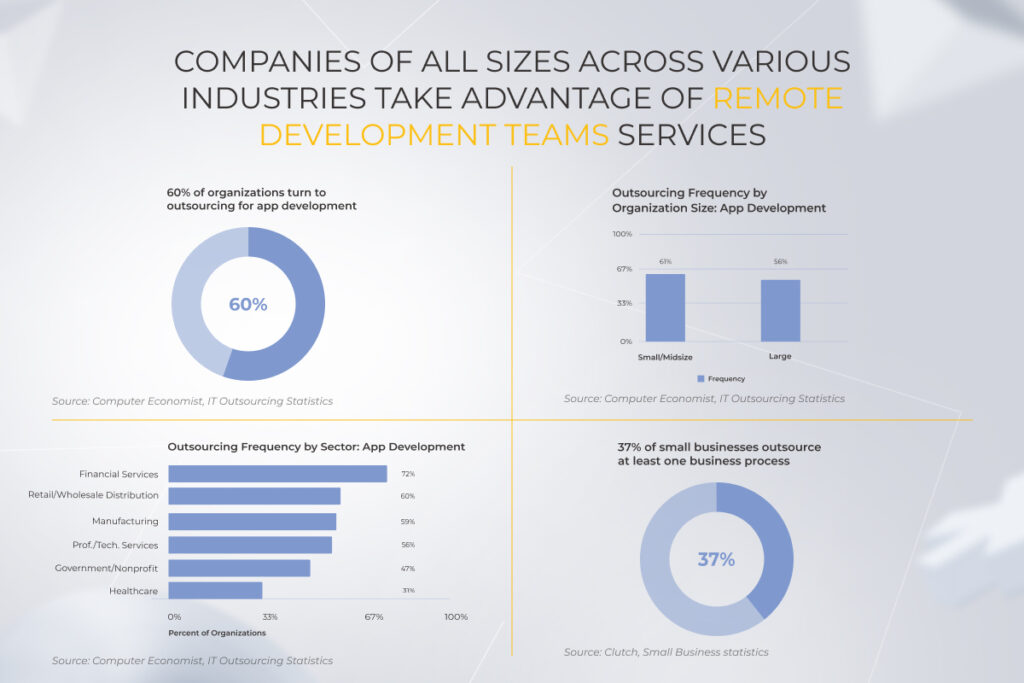
Over 55% of companies view outsourcing as a cost-reduction play and for a good reason. With outsourcing, you can forget about the costs associated with recruiting, training, paying salaries, and providing employee benefits including paid vacation and sick leave, while ensuring that at least part of your IT infrastructure is covered by an experienced software development company.
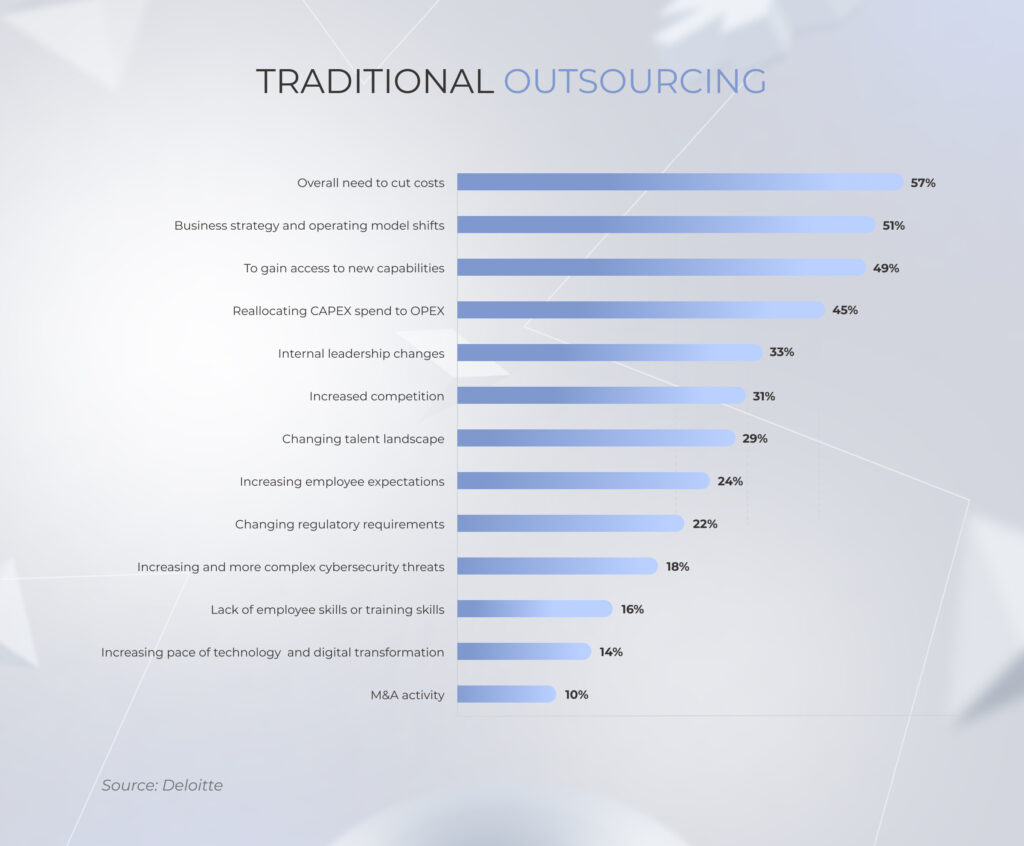
the drivers behind the growing use of outsourcing

Most importantly, the strategy of outsourcing may help you reduce the cost of software and data projects by 30% – 50%, given the right partner.

Scalability and flexibility

A good software development partner has developer talent on tap, with an ability (and willingness) to flex team sizes up and down as demand fluctuates. With this “flex-capacity”, you can extend your  team with outsourced talent and  scale down once the workload is completed without the additional costs and fallout associated with in-house termination.

Faster time to market

A company can also leverage outsourcing to accelerate the delivery of a new product. Ideally, the combination of fast hiring and a full-cycle software development process reduces the time to market, without compromising quality. A good software development partner for innovation-related work should articulate and demonstrate a mature, yet practical approach to quality assurance throughout the entire digital product life cycle.

We excel at solo flights in delivering top-tier software solutions to our clients, just as we do at co-piloting. Teaming up with other digital innovators, we join forces to amplify value for our shared customers. Explore.

Avoid the pitfalls of software partnership

There’s one thing you need to understand: outsourcing can fail. The root cause is often traced to the fundamental way companies view and discuss product development from the onset. Instead of prioritizing a product concept, businesses rush straight into outsourcing software development. However, the right approach includes laying the groundwork for a product’s success.
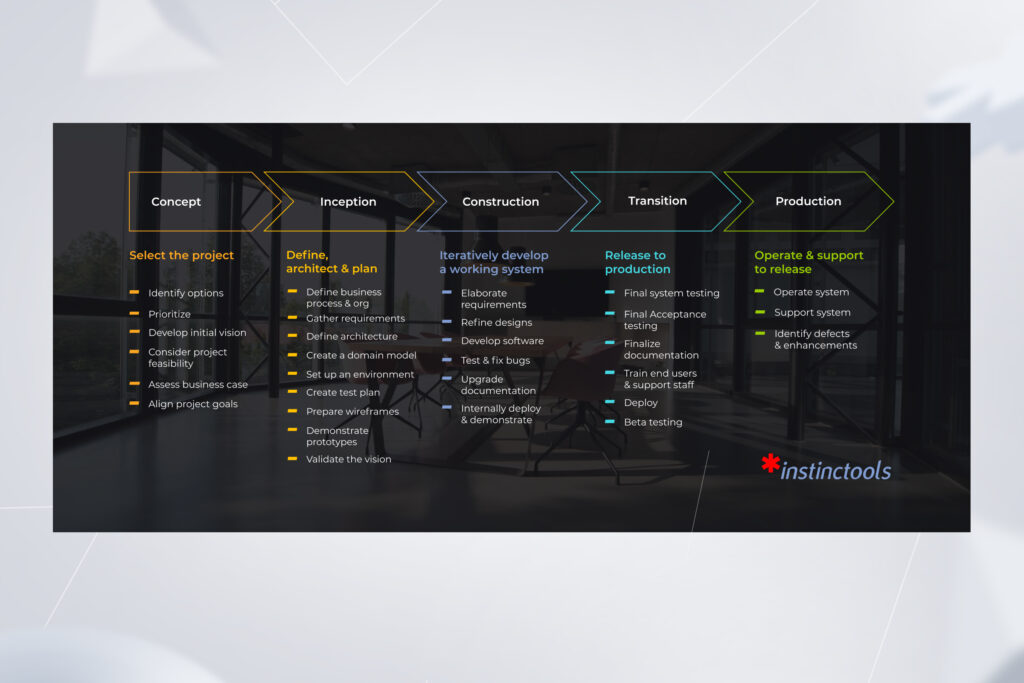
Instinctools' product development flow

Share your product vision. The more info, the better!

Before deciding upon a software development  partner, it’s vital to determine the essence and long-term mission of a product. In other words, communicate the “why” behind your product, including:

  • Your company’s core motivation (mission, values, and backstory) 
  • Key product information like target customers, needs, key benefits, and differentiators
  • Information on your business model and insight into any changes
  • Important or fundamental technologies, methodologies, and protocols
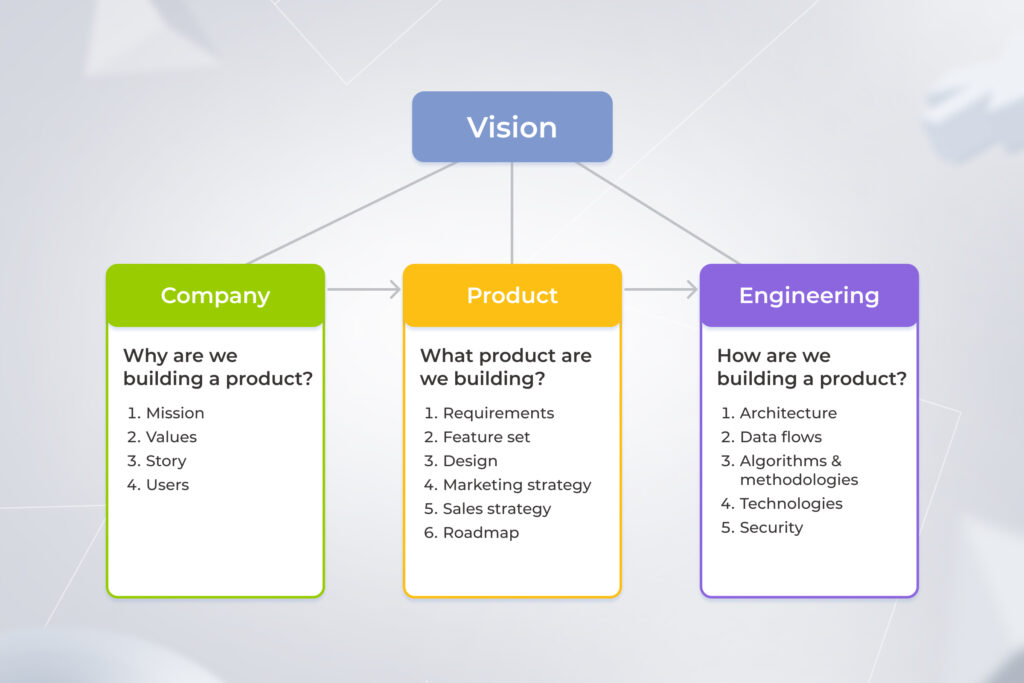
the building blocks of your product vision

Sharing your product vision early and widely can help you get off on the right foot with an outsourced software development partner.

Determine the rough project scope

With an idea of your final destination, you should then lay out the rough scope of the project to begin identifying the requirements and needed resources.

I recommend documenting and sharing the prioritized or at least the must-have features of the first product version completed with the new partner. To do that, you need to create a list of features based on user flows.

During the Discovery stage, your software development outsourcing company should have the capability to help you specify and prioritize your project scope. But having something to start from will help set the tone and accelerate development.

Set a preliminary budget

Surely, within the Agile software development life cycle, budget estimates evolve as the outsourcing partner gains a deeper understanding of the product with each iteration. However, you should allocate a specific budget before choosing a software development company if you don’t want to work in the dark.

To calculate an optimal amount, you can benchmark your product against similar products in the market and then ask a few development companies for a ballpark estimate.

Plan an approximate timeline

Again, after you reach out to a reliable potential tech partner, dedicated project management should be proposed with a project-specific timeline with all the deliverables laid out in chronological order. Sharing approximate start and end dates of your project and overall expected engagement duration with potential partners will help you align  your overall business and marketing strategies, reaping the benefits of client-provider partnership earlier.

Get stakeholder buy-in

After articulating the strategic importance and documenting a description of the work as best as you can, seek executive sponsorship to back your initiative. You should engage stakeholders early in the process and ensure they’ve bought into a shared vision and understand the scope of the project and amount of support they’re asked to provide, in money, time, and attention.

Measuring the potential ROI is a great way to win sponsorship and defend your initiative from competing interests. 

Having a well-defined vision, limited scope, preliminary budget approvals, timeline guidance, and a thorough and credible ROI calculation will win stakeholders who not only sponsor your initiative, but support your decisions to execute an ROI model which may incorporate outsourced software engineering help.

When in the market for any needed software development assistance, especially if the work is related to digital product innovation, look for a partner who requests the information and offers upfront consulting services to cover any gaps in project readiness. 

Enable faster project start and consistent growth

Contact us

How to choose the right software development partner? 7 steps to collaboration success

When the plans and sponsorships are at a good place, it’s time to finally start looking for a software development partner, and you might like a step-by-step plan to guide your search. That’s why *instinctools’ experts have assembled a list of steps to help you choose a reliable software development partner to transform your business ideas into winning products.

1. List down companies

Assuming you have already got a solid grip on your requirements and timeline, the next step will be to find a team that matches your specs. To locate a trusted software development partner, you can use the following resources:

  • The fastest and easiest way to find a prospective software development partner is to scour the Internet. With the criteria identified, you can shortlist potential companies that meet your requirements. 
  • Peer into professional listings. International and local directories can give you a better idea of reliable software development partners, their experience, average rates, and industry focus. These platforms help you cast your net and narrow your search at the same time, as you can hand-pick companies based on budget, industry, tech stacks, and more.
  • Browse through your connections on professional networks. On LinkedIn, you can ask around for references or reach out directly to prospective tech partners. 
  • Networking events, exhibitions, and conferences like Web Summit, Mobile World Congress, and others are great places to come across like-minded partners for your business.
  • Attending the workshops at tech-focused meetups and hackathons will help you to see your potential development partner in action and have a closer look at their skills.
  • Referral networks and word-of-mouth recommendations can also be a great way to find a team that has been recommended by a company you trust. 

proofs of *instinctools being a real software company

2. Choose a location where to hire a software development team

Once you have a list of potential software development partners, you need to trim it down and group the vendors by location. Choosing the right outsourcing location is an important part of the outsourcing strategy. The decision as to where to go hinges on the following factors:

Available talent pool

In top-dollar locations, you can run into stiff competition (which suggests higher costs of hiring) or distance yourself from target candidate pools. Conversely, countries with affordable cost of living have more diversity in their demographics, which leads to more concentrated pockets of talent.

Cost tolerance and quality of services

Although your knee-jerk reaction might be to hire the cheapest software development outsourcing partner, it’s not the affordability that makes your collaboration valuable. It’s the cost-value ratio that should guide your selection process. Therefore, you should look for software development firms with a cost-effective pricing model and a proven track record of software development services.

According to TalentUp, Poland offers the most affordable developer talent in the EU with an average yearly salary of a bit over €​​30,000. Paired with a high level of services, this location might be your destination for software outsourcing.
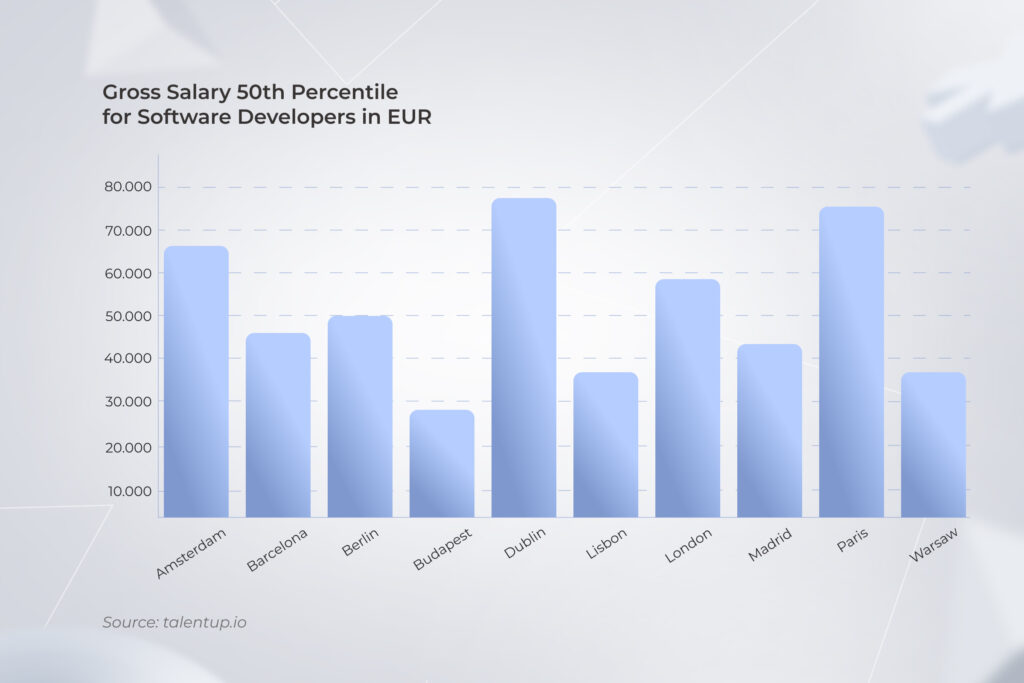
statistics on the gross salary for software developers in different European countries

Time zone

A significant difference in time zones can complicate communication and even derail your project. However, similar time zones allow you time to collaborate and align on projects without delay. Therefore, choose outsourcing locations with at least 4 hours of time zone overlap so you can easily find windows of collaboration.

Culture

Cultural harmony means that the standards and values of your company align with the ones of your potential software development partner. Cultural compatibility also includes having similar business practices, work ethics, social norms, and communication styles — everything that makes your software development partnership more comfortable for both sides.

English proficiency

Staying on the same page is impossible if both teams don’t speak the same language. That’s why you have to make sure software developers have a good command of the English language. Countries such as Poland, Romania, and Bulgaria boast a high level of English proficiency and pocket-friendly rates.

statistics on the English proficiency index in European countries
English proficiency index, by country 

Hire a dedicated software team that matches your needs

Partner up with us

3. Evaluate work methodology

You need a partner, not a project-doer. So next up is making sure the work approach of your software partner aligns with your project requirements and company culture. A good partner’s methodology should illustrate how the company, not their individuals, will support innovation across the long term and achieve your product development outcomes short term. 

A trustworthy software development partner has development approaches published on their website. Agile development practices and other modern software development frameworks such as Scrum and Iterative Incremental model are considered the gold standard for building quality digital products.

4. Verify expertise and experience

The best software development partner has everything your company lacks in terms of tech expertise. Look for fits in technology skills, experience building similar functionality, and industry experience. 

Remember to check whether vendors are in tune with industry trends and on-the-radar technologies. Take AI-powered outsourcing and digital workforce ideas, for example. 

Leading outsourcing partners go beyond providing you with seasoned experts. They supply you with aces who have already incorporated AI tools, such as co-pilots and AI agents, into their everyday work to deliver top results faster and at a lower cost. Deloitte’s survey pinpoints that 83% of executives expect the use of AI capabilities to be table stakes for fast-tracking outsourcing services without dropping their quality. 

You can get an idea of a prospective partner’s experience by studying their portfolio, evaluating case studies, and asking for testimonials from previous clients. A good potential partner’s methodology will support knowledge transfer of any industry knowledge delta in the most efficient manner possible.

Make sure to look into the complementary skills and knowledge that might be valuable for your project. If you’re good at hatching ideas but resource-constrained when it comes to their execution, you’ll need a partner with a vast toolbox to find an optimal way to realize your vision.

5. Explore cooperation models

The specific nature of your project is the key element you should consider when choosing an ideal engagement model. Project scope, certainty of the output, level of involvement, and the agenda differ from model to model.

IT staff augmentationDedicated team modelOffshore development center
PurposeTo cover talent gaps and accelerate project delivery.To find a development team with a single focus on your project and its full ownership.To develop large, complex, and compliance-heavy projects at a lower cost. 
Scope of workFixedFlexible, dynamicFlexible, dynamic
Level of involvementHighUp to the clientLittle
Product and project managementClientVendorVendor
Operational oversightClientVendorVendor
Main benefitReinforcing your team with industry expertsHaving your product developed from ideation to deliveryHaving a team of experts offshore as an extension of your own organization

6. Get a quote

Now, it’s finally the time for a money talk. When asking for a bid, avoid basing your decision on a generic rate card and seek a specific quote. The right software development firm will help you make key early decisions, provide insight while doing so, and provide you with an executable proposal that includes major terms, price, and timeline estimates. Now you can refine your ROI model to more accurately forecast the expected return and to support your decisions throughout.  

Most software development partners work according to the Fixed Budget, Time & Material, and Dedicated team outsourcing contracts. Again, it’s the case of different strokes for different folks so revisit your project specifics.

Fixed budget modelTime & MaterialDedicated team
Project sizeSmall and mid-size projects, MVPAny type of projectsMedium, large, long-term projects
Project requirementsPredefinedNot setEvolving
FlexibilityLittleHighHigh
BudgetFixedEstimatedEstimated
Client’s controlLittleHighHigh
TimelineFixed, but extendablePredefined, but extendablePredefined, but extendable
ScalabilityNoHighHigh

7. Investigate market reputation

No matter how heartfelt slogans on your partner’s website might be, you should research their background and reputation to double-check the quality of the services. No company would want a partner who always misses deadlines or is not polite to work with. 

Before sealing the deal, read first-hand testimonials from their previous clients on Clutch and GoodFirms or connect with a few of their past clients. We’ve deliberately listed this point last because you’ll have better questions for a potential partner’s referrals at the end of your research journey.

Choose a tech partner that delivers on time and on budget

Schedule a call
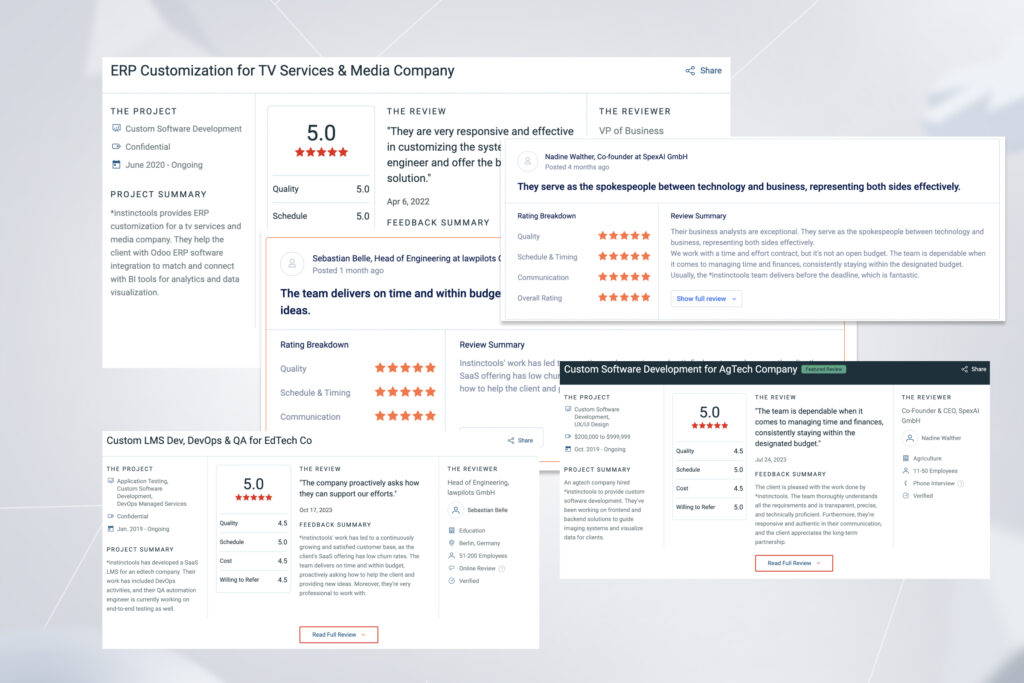
reviews on *instinctools' outsourcing services from Clutch and Goodfirms

Revealing red flags in a software development partnership

Here’s the deal. Any company, good or bad, tries to make an irresistible first impression on anyone who passes by. However, you need to see past an impressive client hall of fame, numerous accolades, and bold promises. Below, we’ve outlined early signs of trouble that might make your project go downhill.

  • Size mismatch

A good development partner should be small enough to care and big enough to scale. Therefore, you should steer clear of partnerships with big (1000+ employees) firms. Their often-rigid structure and broad focus might overlook the specific needs and nuances of your project. On the other hand, if the company is too small, you might have trouble scaling or developing a large-scale project. 

  • Cost-over-quality approach

Be cautious of companies that make low-priced offers, significantly lower than the market average. Underbidding can be indicative of compromised quality and a lack of the specialized expertise necessary for the success of your project. Therefore, it’s best to focus on value for money rather than grabbing the cheapest deal.

  • Jack-of-all-trades claims

There’s a big difference between a can-doer and a jack of all trades. If the company seems too eager to reel in a new client, they’re either rookies or too desperate to land a project, any project. Either way: you and your product lose.

Therefore, avoid partners who claim to have a decade-long expertise in all technologies. This overreach often results in a superficial breadth of knowledge, lacking the depth required for your specific technological needs.

  • Failed credibility check

Lastly, consider the visual cues you see on the website of your potential partners. Subpar websites, generic testimonials, and ambiguous portfolios often point to a lack of experience and credibility in company roles. The same goes for companies that put your project in a black box from the very first engagement, giving you evasive answers about the prices, experience, and business processes.

A tech partner worth their salt never operates behind a magic curtain. They are loud and proud of their track record, relevant experience, and terms of cooperation. Trusted development companies also have a clear understanding of who they are as a company. Otherwise, you might be dealing with a vendor that’s going out of business.

The problem of hiring a software development partner, solved

In 2025, your business can’t afford bad software. That’s why you need a trusted software development company to have your back. Although there’s no magic formula for choosing partners, such particulars as project development cost, wide experience, a proven track record, and a favorable location should be among your main selection criteria. 

When choosing a software development partner, especially for innovation, it’s important to consider data points outside of the hourly rate. Opting for MVP development services in USA ensures that your product is built with a strategic approach, balancing speed, quality, and scalability. If you dream big and plan small, you realize ROI beyond any model or spreadsheet.

Hire a tech partner that gets it

Schedule a call

FAQ

How do I find the right software development company?

First of all, you need to clearly define your requirements and objectives for the project. This will help you narrow down your search and identify the companies that specialize in the specific technology or domain you require. Once you establish a clear understanding of the project, you can either ask your network for recommendations or go on the hunt on your own.

What makes a good software development company?

The best software development company is the company that complements the skills of your team. Your ideal tech partner also has solid technical expertise and a diverse team composition. Make sure to check whether they’ve made a good name in the software development industry and look through the clients’ testimonials. A great partner also has a variety of agile software development methodologies to support the unique needs of different projects.

How much does it cost to hire a team of software developers?

The cost of hiring development teams varies based on the location of your vendor, team size, and the hiring model. Reach out to *instinctools and get a ballpark estimate for your project.

Why hire a dedicated software development team?

This hiring model offers a high level of commitment and accountability as you are working with a team of experts solely focused on your project. This in turn results in greater collaboration, accountability, and a shared sense of ownership. With a dedicated team, you also have the ability to scale your resources according to your project’s needs.
Kickstarting Success: the Discovery Phase in Software Development

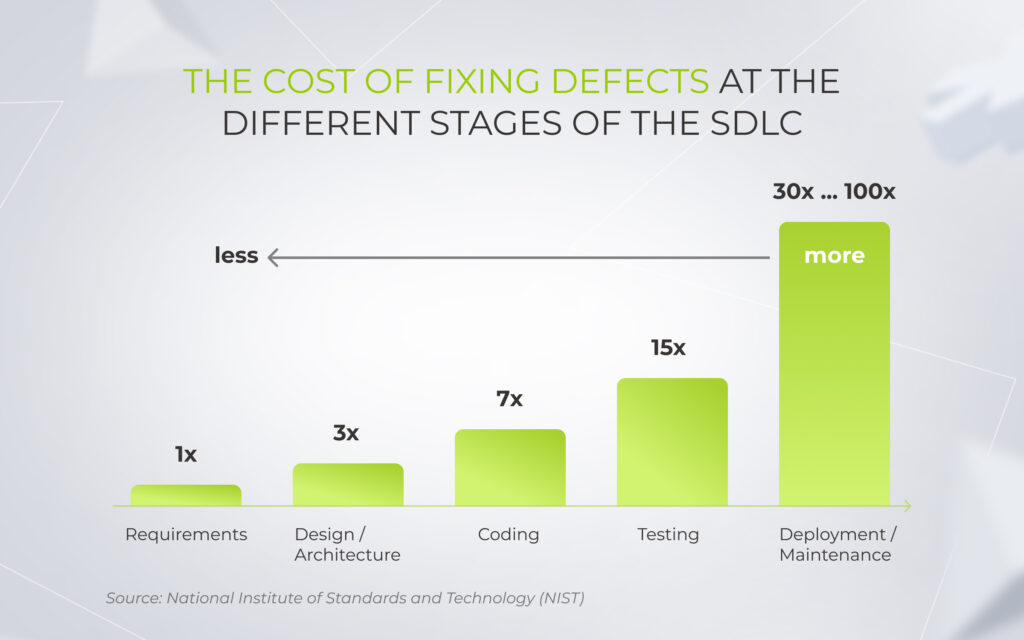
According to Deloitte, more than half of failed software projects go awry due to overlooked requirements in the early development phases, underscoring the pattern: 

Mistakes made during the initial planning stage are the most expensive to fix.

cost of fixing defects

The discovery phase in software development ensures your project is able to seize the high ground in overall statistics without draining the budget and causing rollout delays. 

What is the discovery phase?

A project’s discovery phase is an initial exploratory and planning activity lasting usually three to six weeks. It involves running a discovery workshop, where your tech partner collaborates with you to align your vision with market trends, user demands, and business context, expertly shaping your idea into a detailed roadmap to a solid technical solution.

Despite its bite-size nature, the goal of the discovery stage is to deliver tangible value without limiting your cooperation options to a particular service provider.

A stitch in time: when the discovery phase saves more than nine

The crux of the discovery phase boils down to five words: danger foreseen is half avoided. 

At the discovery phase of a software project, a team of experts asks the right questions from different angles of software development to unveil any pitfalls you may face in advance, create a plan to prevent them, and, thus, make steps toward eliminating costly failures down the road. 

Reaching out to a tech partner with proven expertise in your industry already minimizes the risks such as budget overruns, wrong resource estimates, feature mis-prioritization, stagnant development, among others. 

Yet, even with top-tier experts on board, there are cases when conducting a software development discovery phase becomes a good call. 

1. Unbiased idea and as-is state audit

Not all business ideas turn out to be great. Some of them can be unrealistic and misleading and result in wasted budget and time or even question the existence of your business when it comes to startups.

The earlier you validate your ideas, the easier it will be to fix your concepts and plans. At *instinctools, we adhere to the principle: 

Better bank on project discovery than deal with project recovery.

If you’ve already started working on a project, stay alert to these warning signs that may signal you should have requested a discovery workshop from your vendor:

  • Your development team is stumped on the project’s further progress and can’t outline possible evolution strategies. 
  • Your project has got off track and can’t find its way back, draining your time and budget without bringing you any closer to the desired outcomes. 

Here’s a real-world example that proves the importance of the discovery phase in software development. One of our clients, a fintech startup, planned to develop a web platform to consolidate information for VC investors and funds. 

Despite its trailblazing ambitions, the company almost ended up becoming another startup failure statistic. The client’s former contractor rushed into web development without doing market research, clarifying the product vision and scope, collecting project requirements and technical documentation, reviewing available architecture options, discussing UX/UI concepts, etc. 

With such an approach, when halfway to rollout, the client found themselves developing a product that nobody needed. Fortunately, running a project discovery phase with *instinctools helped them to marshal the resources and launch a robust MVP that fitted the bill and turned end users’ heads.

2. Bridging the gaps in stakeholders’ perspectives

Connecting your business goals and ambitions with your end users’ needs and expectations might turn out to be tricky if there are multiple stakeholders with different visions for a project, its strategy, and outcomes.

In this case, at the discovery stage, your software service provider should verify the technical feasibility of each stakeholder’s vision:

  • If the concepts can be brought together into a single solution, a business analyst within the development team will prioritize the features and capture them in the scope of a decomposition document that will serve as a linchpin for further work on your software project.
  • If the visions are too divergent, your tech partner will highlight the problem, and help you choose the concept to build on top of.

A discovery phase is a not-to-be-missed chance to cut out all the disagreements that drag your project backward. 

Working out a clear product vision and keeping stakeholders and development team members on the same page helps stay on the right track during long-term software projects where losing focus is one of the top perils that can screw the entire idea. 

3. Preparing documentation for fundraising

You may be sure you know enough to start the project. But given the current turbulent market backdrop, if you ask for financial support to bring your idea to life, you need to make your business goals’ viability crystal clear for possible investors. 

Whether seeking private investors or competing for a tender, a compelling business plan indicating the return on investments, assets, sales, and equity is pivotal to persuading stakeholders to put their dollars into your project fulfillment. Above all, you should provide clear administrative, technical, and financial documents to make your project comparable with others and prove that yours can deliver the highest business value.

Embracing an Agile discovery process is the most beneficial way to prepare technical specifications. You get multiple value assets, such as a project brief, scope, system requirements specification, technology environment, delivery schedule, etc., without committing to a long-tenured contract with a tech partner who helps you prepare the documentation. 

On top of that, during the product development discovery phase, initial wireframes can be provided to assure your credibility in front of potential investors.

Running a discovery stage empowers you to answer any investor’s questions right away. 

Any way you slice it, having consistent and accurate technical documentation — with scope decomposition, features prioritization, and customer journey map — before diving straight into development waters saves you from dealing with a chaos of must-, should-, and could-have features.  

Are you struggling with the travails of the software development process?

We’ll help

What happens in the discovery phase? | *instinctools’ experience

As a fundamental stage of working on a project, the discovery phase reveals all the potential pitfalls and ways to bypass them. At *instinctools, we’ve distilled the process into seven definitive steps. Each one is packed with vital questions designed to steer you clear of blind spots and guide you toward the project’s ultimate success.

1. Defining problem and business opportunity 

  • What market demand do you want to cover? 
  • Who are your target audience, and what are they hungry for? 
  • Are there different groups of customers within the target audience? 
  • What is your plan to meet the needs of end users? 

2. Analyzing as-is state 

  • What do you already have in place: a bare idea, prototype, or a flawed solution that needs to be fixed? 
  • Have you prepared any project requirements and technical documentation? 
  • Who is a product owner? 
  • Are there any other stakeholders besides you? 
  • Do you foresee any bottlenecks?

3. Figuring out to-be state 

  • What is your vision of the future project? 
  • What business goals are you aiming to achieve? 
  • What are the success criteria? 

4. First validation session 

  • Are we on the same page as to the vision of a future solution? 
  • Did we define project goals correctly? 

5. Analyzing gaps between an as-is and to-be state 

  • How do you see this software development project’s major business risks and constraints? 
  • Do you have any legal, regulatory, liability, etc., requirements in your target market or markets? 
  • Do you have any preferences or limitations in the technology stack? 

6. Planning the technology environment, preparing project backlog, drafting architectural vision, and demonstrating the UX/UI concept

  • What core features will distinguish your solution from others? 
  • Which features are the most vital, and which can be developed later?
  • Does the draft correlate with your functional and non-functional requirements? 
  • Have all the integrations you need been covered?
  • Are you satisfied with the depth of the user research we’ve conducted?
  • Do the user stories we’ve presented match your vision?
  • Do you have anything to add to the customer journey map?  

7. Second validation session 

  • Do you have any remarks on the project so far? 
  • Do you agree with the estimate of the project timeline and development costs?
  • Do you want to forge ahead with us or consider another service provider?

With a software project discovery phase, you’ll clearly define your business objectives, pinpoint project milestones, break down the scope, and set a comprehensive roadmap to start the development and deployment process.

Still have questions on the project discovery phase process?

Fire away

Turn raw ideas into tangible deliverables: your takeaways after the discovery workshop

Wellingtone’s report indicates that only 29% of software projects make it on time, and 43% of them stay within budget. Relying on solid deliverables is the approach that will help you hit that success statistic.  

Here is the discovery phase checklist of artifacts you get.

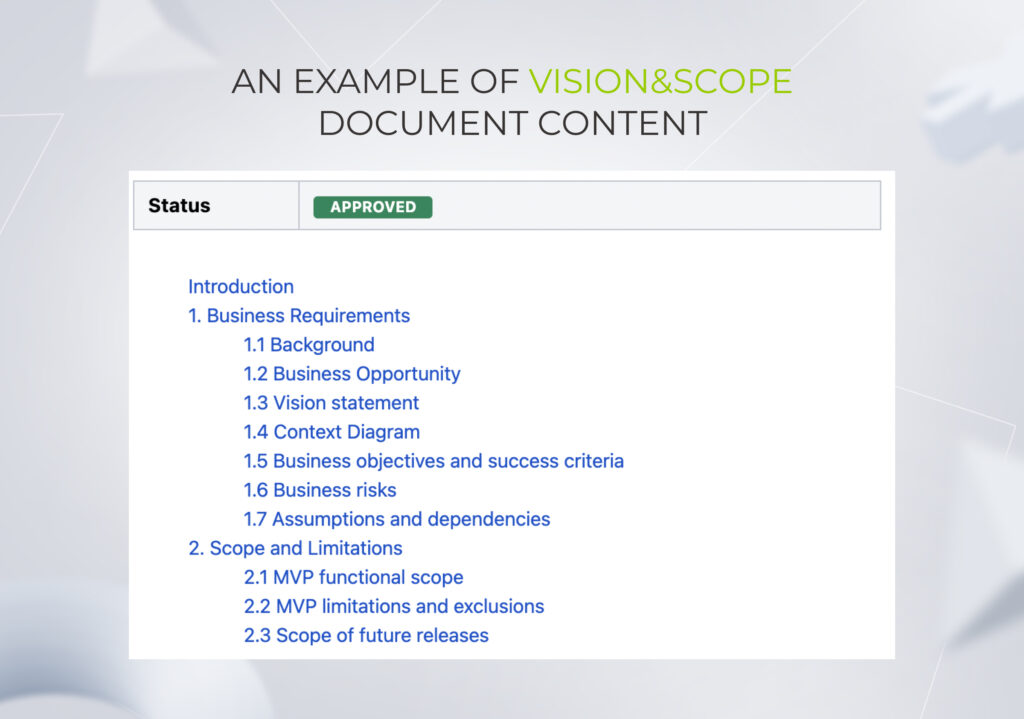
Vision & Scope

This document highlights your business problem, objectives and risks, captures the current product or process and the vision of its future state, identifies opportunities and success metrics, and describes the solution scope and roadmap. 

vision&scope

Competitor and target audience analysis

A vital part of a product development process is analyzing market trends and your competitors to spot new value-creation opportunities for your business and evaluate the viability of your project in the first place.

The software discovery process entails mapping the customer journey and creating documents such as user flow diagrams, user stories, and user roles matrix to pave a straight path to your target audience’s minds (and wallets).

Architecture overview

The documentation contains a review of the current state of your infrastructure, its functional elements, and technology stack. During the discovery process, a solution architect gathers technical specifications:

  • Architecturally significant requirements (ASRs) 
  • Software requirements specifications (SRSs) 

These docs help to outline your solution architecture, its components’ correlation, and integrations. 

UX/UI concepts

The discovery phase in Agile involves clarifying UX/UI concepts of the future software. At *instinctools, in some cases, we, in some cases, prepare the initial wireframes that can be leveraged for prototype development. 

Budget and time estimates

The discovery phase team also draws up a budget estimate for the entire project implementation and a clear timeline for its delivery. 

Tech vendors often bring an added value with the delivery proposal. This document highlights partnership strategies and flexible engagement models and ensures a seamless transition to a long-term collaboration if your current contractor meets your project expectations. 

The delivery proposal also outlines the project team structure, roles and responsibilities (RACI) within the dedicated team, vendor’s DevOps plan, QA approach, and a delivery roadmap.

Is taking care of these discovery phase deliverables on your to-do list?

Delegate the hassle

Your project’s best asset: the role of a cross-functional team in the discovery phase

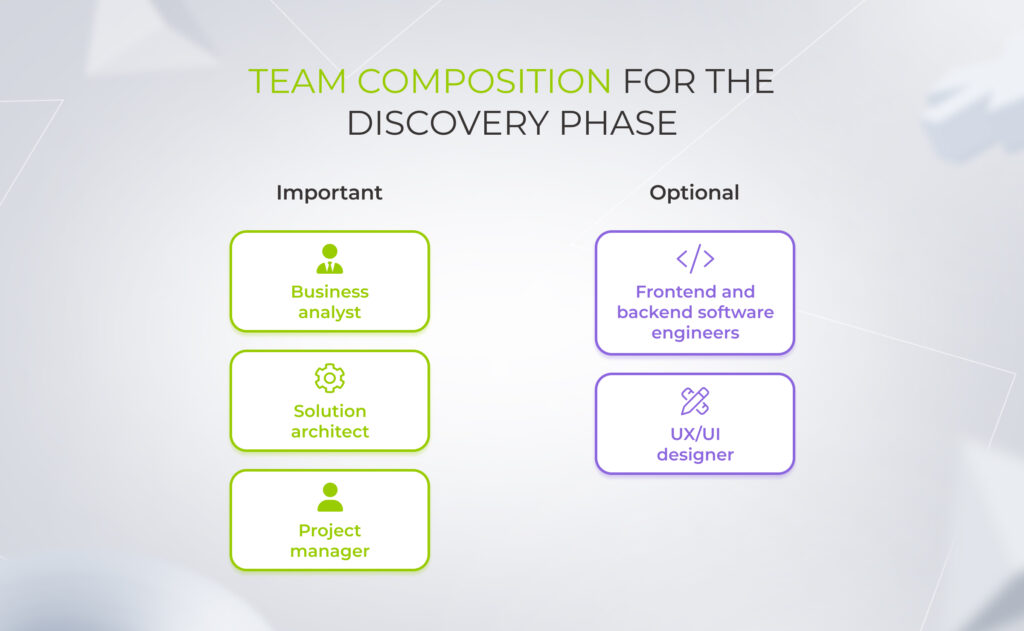
Here’s the project team composition for the discovery stage, which may vary depending on the complexity of your idea, the project’s current state, and the project development stage you are in.

team composition
  • Business analyst gathers project’s initial requirements from the business perspective and prepares a Vision&Scope document, conducts user research and prepares user stories and customer journey maps.
  • Solution architect captures significant architecture requirements and drafts solution’s architecture as a basis for development.
  • Project manager coordinates project’s development from gathering the requirements clarification to delivering the outcomes you’ve agreed upon with your discovery service provider. 
  • Frontend and backend software engineers are optional, their input is required if you already have a solution you want to dissect and need a code audit.
  • UX/UI designer is also facultative, yet they can bring more value to the discovery workshop if stakeholders already have clear UX/UI requirements and expect to get initial mockups and wireframes at the end of the discovery.

Book your dream team for the discovery process

Reach out

When is it ok to skip the discovery phase?

If you already have all the necessary project documentation where every single nuance is specified, or your tech ally’s expertise is beyond question, then you can bypass the discovery stage and go straight to product engineering. 

The discovery phase checklist confirms that you have:

  • Completed thorough market analysis to gauge its demand 
  • Put a premium on user research to pinpoint your target audience and its needs correctly 
  • Aligned your vision with other stakeholders, if there are any 
  • Captured your product vision in the relevant, accurate, and consistent documentation  

Discover and obtain the full value your project can deliver

Whatever the reason for running a discovery workshop, the outcomes of the discovery phase are always a pearl of great price. 

You get sufficient, accurate, and consistent documentation that makes a rock-solid foundation for any project you undertake. And with a reliable tech partner by your side, you won’t need to wrap your head around what comes after the discovery phase in a project – they will guide you throughout the whole development process to the planned outcomes. 

Contact your tech ally here

Get in touch

FAQ

What is the discovery phase in software development?

The discovery phase in software development is a bite-size initial stage of cooperation with a tech partner. It highlights your business context, end-user needs, and technical capabilities, and leaves you with basic documentation for the project, such as Vision&Scope, competitors and target audience analysis, architecture overview, UX/UI concepts, budget and time estimates. 
Unlike a long-term contract, the discovery phase offers you the flexibility to choose the right tech partner for further development without being tied down from the get-go.

What happens in the discovery phase?

A dedicated team of experts validates your request from different aspects of software development. They identify the current and desired state of your project to uncover the gaps and strategize how to cover them, review risks and constraints to evaluate idea viability, and collect project requirements (both functional and non-functional). 
The development team provides you with a draft of the project’s architecture, backlog, UX/UI concept, etc., and approves them during the validation session with the stakeholders.

How to Build an IoT Application: the Only Guide That Covers It All

Over the last few years, IoT application development has emerged as one of the buckets of innovation, underpinning the digital transformation of business. From wearables to smart homes, IoT apps have become a connective tissue between physical and digital — with a growing economic-value potential.

As field experts, we have put together every bit of information you need to know before building an IoT application. Core components of IoT-driven innovation, benefits, and mishaps, the importance of complementary mobile apps — these and much more await you below.

Untangling IoT market structure: where the value lies

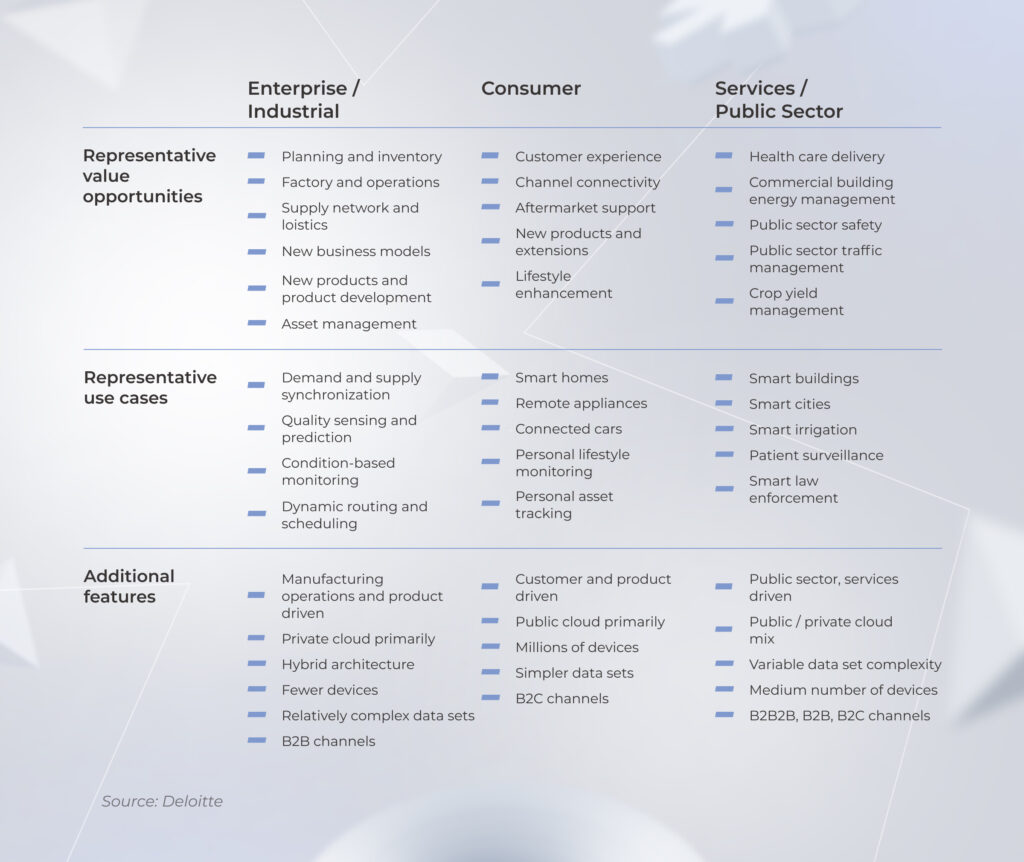
According to McKinsey, the IoT industry is poised to generate up to $12.6 trillion in value by 2030. Its potential is concentrated in certain settings, which can be broadly divided into industrial IoT, consumer-facing IoT technology, and public services. Each of these segments possesses distinct characteristics and market opportunities.

IoT market structure

Industrial setting

The industrial or factory environment is projected to scoop up the greatest value from the IoT, around 26% by 2030. Industrial IoT systems are grounded on a relatively private cloud architecture and rely on rich data sets, with smart devices focused mainly on the production environment.

In this category, digital supply network (DSN) applications act as a catalyst of innovation, making the various day-to-day management of assets and people more efficient. Condition-based monitoring, asset tracking, process optimization, and scheduling are the go-to areas transformed by IoT in Industry 4.0.

Consumer IoT

Consumer-focused IoT platforms are designed to support customer experience by operating primarily from within a public cloud environment. By 2030, the market value of the segment is set to hit over $292 billion. 

Cut out for the consumer market, these applications include smart wearables, smart homes, wearable technology, asset tracking, and other solutions that revolve around personal and home-connected devices.

Public sector

Adopting IoT for the public sector usually means leveraging connected devices for the greater good, whether it’s public well-being, safety, or resource repletion. In this segment, healthcare IoT exhibits the highest potential with up to $1.8 trillion of economic impact by 2030.

From remote patient monitoring to connected inhalers, the proliferation of IoT solutions in healthcare stretches from individual customers to insurers and governments.

Seize IoT market opportunities

Schedule a call

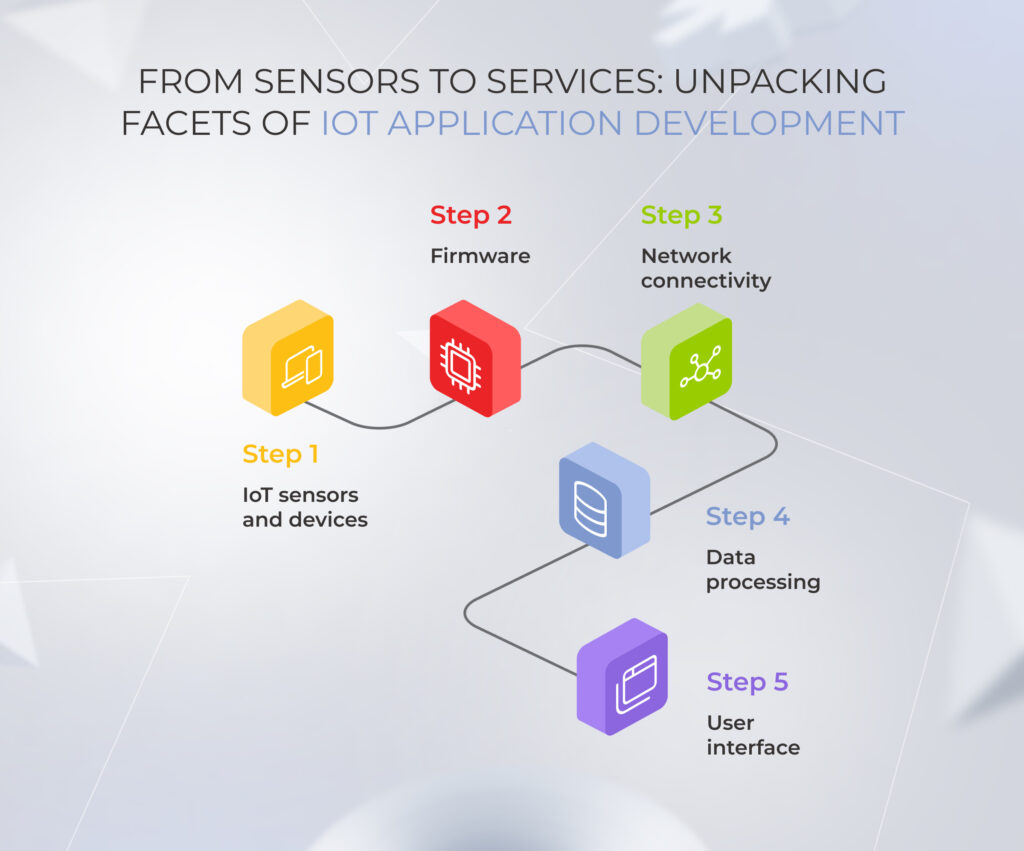
From sensors to services: unpacking facets of IoT application development

You cannot develop IoT applications in a vacuum. The Internet of Things architecture incorporates a combination of hardware and software components that, once connected together, create a smart system full of actionable insights. So let’s see what’s under the hood.

IoT sensors and devices

IoT sensors and devices

First and foremost, an IoT system includes a device layer with sensors, devices, or actuators used to collect and transfer data. Sensors can record all types of data — from vitals to humidity — and pass it on to the next layer. 

Firmware

Firmware is a chunk of code embedded into smart devices that enables them to collect and transmit data as well as empowers device-to-app and device-to-cloud connectivity. Firmware also determines the response of IoT devices to various inputs and conditions.

Network connectivity

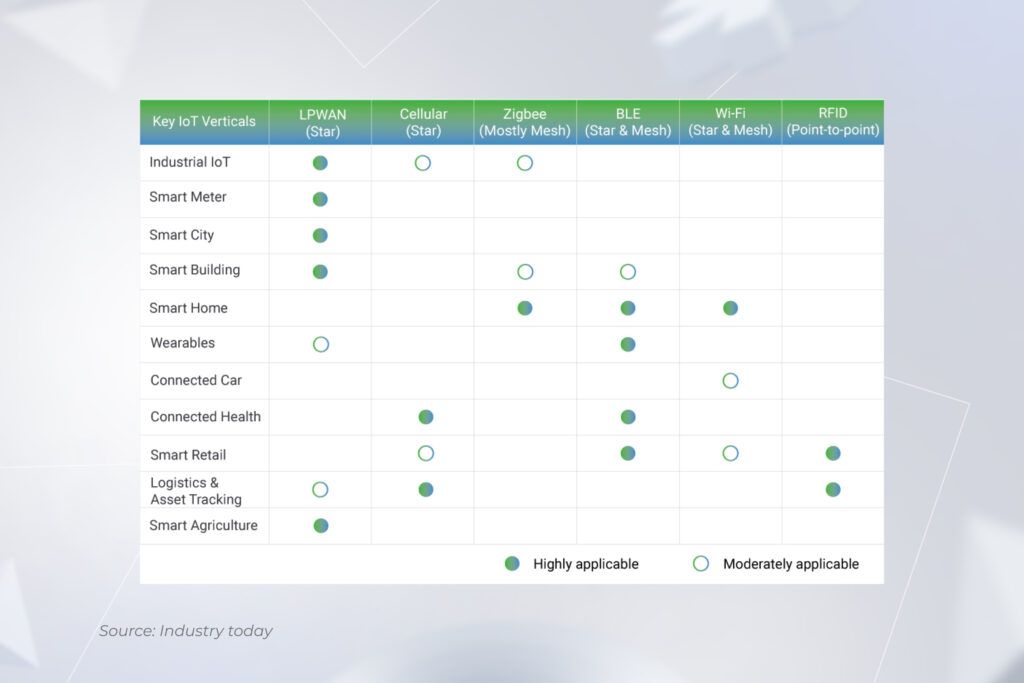
After vacuuming up the data, the device then talks to the cloud through some kind of connectivity. The latter includes a variety of communication technologies such as cellular networks, Wi-Fi, LPWANs, RFID, and others. The connectivity can be enabled either directly or via gateways (if there’s a bridge needed between different communication technologies).

IoT

Once parts of the IoT solution are synced, messaging protocols come into the picture. They enable the IoT ecosystem to exchange data with other devices and with the cloud. DDS, AMQP, and MQTT are the most popular protocols used in the IoT ecosystems.

Data processing

When the data gets to the cloud, it needs to be accumulated, stored, and processed. At first, all input ends up in a temporary data storage such as a data lake. If the input is relevant, it’s filtered, enriched, and sent to a permanent location such as a data warehouse where it can be easily accessed for insights. 

User interface

Here’s where all the magic happens. The data from a data warehouse is run through smart analytics and presented in an easily digestible form to the user via business intelligence tools. This whole functionality is combined in an IoT app. Depending on the business needs, companies may build web or mobile apps to access data, monitor the variables, and control devices.

Headwinds and tailwinds on the journey to IoT app development

Catching up on the opportunities of Internet of Things app development seems to become a global sport for forward-looking companies. However, with leapfrog potential come significant challenges that, if unattended, can upend your initiative.

Four challenges of building IoT applications

  1. Most IoT ecosystems are secluded with distinctive interfaces, protocols, and standards, making them incompatible with other connected platforms. Due to the lack of essential interoperability, connected devices cannot operate together, preventing companies from accessing deeper, more contextualized insights.
  2. The conflict between different IoT ecosystems ushers in added deployment challenges. When deploying at scale, businesses must customize their IoT infrastructure to meet specific requirements. 
  3. Security is another bump on the road to developing IoT applications caused by a large number of connected endpoints. Any vulnerability can end in a system failure or a hacking attack, so every stack layer must have the necessary safeguards in place and be designed with data security in mind.
  4. Along with the technical barriers, IoT adopters have to navigate an extremely scarce IoT talent market. According to research, over 37 percent of companies have to halt their IoT projects because of deficient in-house skills. An expanding market, growing competition, and evolving buyers’ expectations will only make it harder to bring IoT app developers into the fold.

The driving force behind IoT applications

Against all odds, the number of connected devices is steadily growing from 15.1 billion in 2020 to more than 29 billion IoT devices in 2030. The main reason behind this upward spiral is the real value of IoT applications as perceived by individuals and businesses. The connected ecosystem underpins the greatest tech advancements, enhances customer experiences, and promotes a more effective allocation of resources.

The second reason why more businesses are jumping on the bandwagon is that it’s become more cost-efficient to develop IoT apps at scale. Cloud, machine learning, analytics, and other technologies have now come together for successful IoT adoption in revenue-constrained settings.

The emergence of low-cost, wide-area communications solutions also marked a new chapter in cost-effective IoT adoption. Today, LPWAN enables low-power connectivity between IoT devices, maximizing the capacity, speed, latency, and reliability of connected solutions.

Leverage IoT technology to innovate and differentiate

Let’s discuss

How to create IoT applications: a step-by-step development process

Considering the challenges mentioned above, how can enterprises successfully develop IoT applications and align them with a given business or business case? The answer lies in a holistic and well-planned software development process. 

Ideation

As an initial step, you need to get to the bare bones of your objective, identifying the problem your app will solve. Then, it’s time for a feasibility study to see how your solution idea stacks up against existing products in the market. Legal, regulatory, and security requirements should also be top of mind at this stage to create a detailed project specification.

Discovery phase for hardware and firmware

The type of hardware depends on your project requirements. It can be sensors, GPS tags, active and passive RFID tags, RFID readers, and other kinds of hardware. Once you’ve made your choice, you need to drill down into the overall hardware architecture to see whether you need microcontrollers or microprocessors for data processing. 

The technology stack of your firmware varies by the hardware platform. As a preliminary step, your development team needs to determine the firmware’s architecture and structure and elicit requirements.

Design phase: IoT architecture and UI/UX

Once all the groundwork is finished, your IoT developers define the structure of the application, its main components, and their interaction. After that, your dev team charts out the data flow mechanics of the solution and designs data warehouses and data lakes for information processing.

At this stage, you also need to address the IoT integration challenges, if any, and identify communication requirements for IoT devices. The scope of integration may include cloud services, analytics tools, and other business platforms to automate actions and workflows based on IoT events.

There is no one-size-fits-all connectivity solution to go with any IoT product, so laying out the IoT connectivity landscape is important. Besides connectivity, you should also opt for a suitable communication protocol like MQTT, CoAP, HTTP, and others as well as ensure 

secure and efficient data transfer from devices to the platform and vice versa.

Develop firmware and software

Your technology partner develops IoT apps in stages, launching a first product version with high-value functionality. Every two to four weeks, new features are added to the solution until it reaches its full-fledged state. 

Quality Assurance

At this stage, a team of dedicated QA engineers runs multiple tests on your IoT solution to ensure it is ready for real-life applications. Functional testing, performance testing, and security testing are non-negotiables if you want your application to be reliable and high-performance.

Deployment

When your IoT product is ready to go, developers set up and configure the IoT hardware.

They also configure IoT devices and connect them to your enterprise’s network. After that, the IoT app is deployed into the target environment.

Maintenance and update

Driving value from IoT products isn’t fire-and-forget — you need to keep an eye on the ecosystem long after it’s deployed. This includes scheduled maintenance, troubleshooting, proactive diagnosing, and optimization of cloud resources.

As your business needs evolve, you might need to introduce new functionality or optimize the existing components such as device, network, data, and other facets.

From concept to completion, master every stage of IoT development

We got it all covered

IoT app development best practices: Aim high. Start small. Expand rapidly

According to Microsoft, 30% of IoT projects fail in the Proof of Concept phase. The rest of the projects are put on pause due to their complexity, technical challenges, and lack of talent. Our experts have gathered time-tested practices to prevent your IoT project from going down the hill.

Take care of security

IoT ecosystems are particularly vulnerable to malware and attacks because of the high number of endpoints they have and the lack of the necessary built-in security. To protect your organization, the foundation of your IoT ecosystem should be built around security. This includes device security, connection security, and cloud security. 

Preventive measures and active monitoring are also essential to continuously check the health of your at-field devices and react proactively to emerging security alerts. 

Get to know the data you already have

IoT application development is all about leveraging data to inform decisions and automate processes. But instead of blindly adopting connected devices, organizations should audit the existing raw data that’s already been sitting in isolation. This will help them get a better handle on their data’s current value and install sensors selectively to cover data gaps.

Pilot your ecosystem

The Internet of Things application development involves allocating large-cost resources and good infrastructure, which sometimes may prove irrelevant against the real use cases. Besides, a lot of IoT components can be validated only with real users. 

So it’s only logical to test an idea on a smaller scale before committing to full production. Having a trusted IoT partner on board will help you pilot ideas, analyze findings, and pivot your concepts if necessary. 

Embrace IoT at scale

Unlike single-case applications, the Internet of Things is meant to be a far-reaching initiative. By embracing IoT and other complementary technologies at scale, you can realize the real value of the connected ecosystem and trigger fundamental changes in the entire organization, not just the IT function. Therefore, you should design for scale from the get-go and make sure your ecosystem is interoperable from the very start.

Adopt an agile approach

The changing dynamics of IoT make a perfect case for the agile approach. Also, as connected infrastructures are multi-faceted, there will always be a degree of software stitching to connect the dots. 

Therefore, it’s faster and more cost-effective to downplay your initiatives at first by building lightweight prototypes via rapid application development models. As your solution takes off, you can then iterate your vision, hone the business case for it, and send it for full development. 

Invest in tech talent

Skill shortages remain the top barrier for IoT projects with 47% of adopters complaining about the lack of talent and training. Data management, connectivity, hardware and firmware, IoT app development — all these knowledge areas require hands-on expertise, often unavailable in-house. 

Today, companies cast a wider net to address the skills gap by attracting outside talent. Dedicated, third-party vendors help you leverage much-needed IoT expertise, give a head start on solution development, and reduce the costs of local hiring.

Maximize the ROI of your IoT projects

Contact us

IoT mobile applications: a necessity or a frill?

By 2026, the number of IoT mobile connections is projected to grow twofold — from 2.1 billion in 2021 to 4.3 billion. Acting as a touchpoint between physical devices and digital processing, IoT mobile apps promote a connected environment with automated and remote control of connected devices. But so do web apps, right? 

IoT mobile connections

A distinctive capability of IoT mobile apps is their portability. Mobile apps help users monitor the ecosystem on the go, while web and desktop apps are limited to static devices. Therefore, when estimating the necessity for IoT mobile applications, take into account the needs of your end user. For example, Industrial IoT mobile apps can become a great extension to desktop apps at manufacturing companies and enable real-time tracking and monitoring of field asset data.

Also, some use cases are meant exclusively for the mobile such as smart home apps, connected car experiences, fitness IoT, and more.

AIoT: a big moment for IoT and AI

Collating sensor data is not enough to uncover hidden patterns, you need to analyze the data pool to dig up meaningful insights. That’s why the nexus between AI and IoT has become a game-changer, bridging two technologies into a single knowledge hub. By analyzing, processing, and offering recommendations based on IoT data, AI makes the Internet of Things actionable. 

The blend of the two technologies has ushered in new use cases that help enterprises solve the most challenging business problems. Examples include predictive maintenance, data analytics for wearables in healthcare, IoT-based quality monitoring, smart energy usage management, and more. Whatever it is, AI and machine learning algorithms act as the brains of the IoT body, unlocking its true potential.

Proven success, real results: *instinctools’ in-the-trenches experience in building IoT applications

At *instinctools, we believe that the Internet of Things is the wave of the future that will pick up even greater momentum in the upcoming years. We offer comprehensive IoT application development services for forward-looking companies who want to develop IoT apps and thus optimize their operations.

In our recent undertaking focused on a plant management solution, we have developed a web application that collects IoT data and visualizes it in a detailed form for end users. The application receives data from the robot plant and BlueIOT® tags and then breaks down critical information on the plants’ health status. 

For our other client, *instinctools’ team has built a mobile app for remote unlock of the office. By leveraging iBEACON, the app determines the distance to the door and triggers a remote keyless entry system. 

Baby tech is another area redefined by IoT mobile apps. However, it’s crucial to provide high application stability and a convenient app UI — and that’s exactly what we did for one of our clients. We improved the existing app for baby monitoring by updating a communication protocol, revamping the UI, and enabling multiple connections of Parent devices to a Child device.

Want to find out how to bring your project vision to life?

Let’s talk

Capture an accelerating IoT value

With cutting-edge tech like predictive analytics, and blockchain, the Internet of Things is coming at us at a much faster pace than we expected. But only a few companies will be able to ride the IoT wave and get enough bang for the buck. At-scale adoption, investment in tech talent and infrastructure, prototyping, and iterative development will put companies on track to smoother adoption and higher ROIs.

Create smarter, connected experiences with IoT

Contact our team

MVP vs MMP: Choosing the Right Strategy for Your Product to Pan Out

MVP vs. MMP development – which is worth investing in? Stakeholders face this dilemma when coming up with the idea of a brand-new digital product or exploring ways to build on top of an existing solution.  

Where do a minimum viable product and a minimum marketable one fit in the software product development path? Can you leverage MMP and MVP concepts, or do you have to pick one option and stick to it as your North Star? And more importantly, let’s talk money — which approach can your business cash in on? Our experts’ battle-tested experience will help to make the right choice. 

Contrast or cohesion: what is the difference between MMP and MVP?

Right off the bat: MVP and MMP aren’t opposites. In the Agile approach, they represent consecutive phases of the software product development process. 

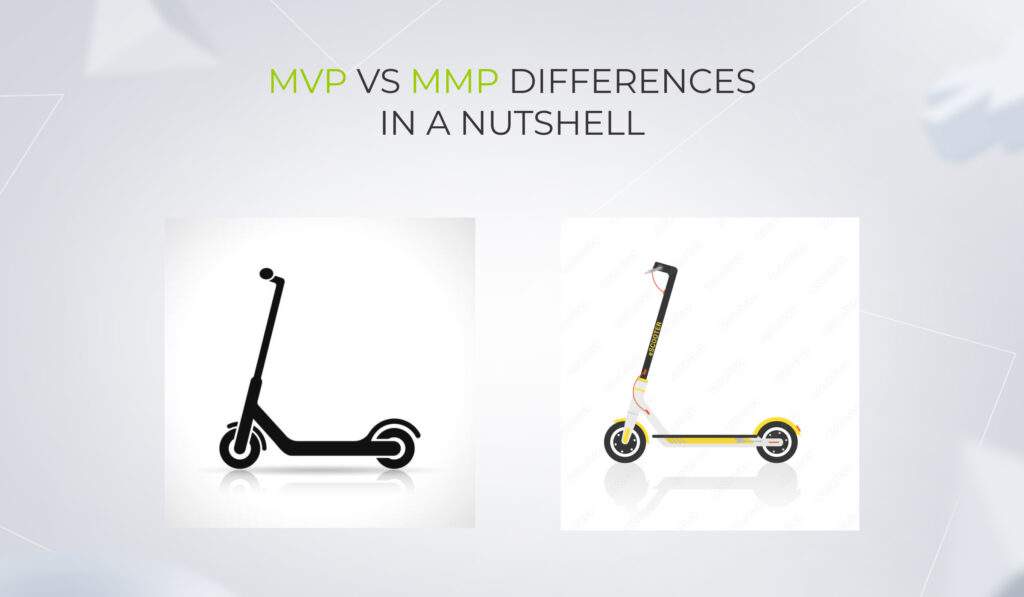
Imagine a basic self-riding scooter. Minimum features, no frills. That’s your MVP. It’s all about giving early adopters a taste, a hook — something they can’t resist even if it isn’t perfect and has limited functionality. It’s the spark that ignites their interest despite its raw design. MVP’s charm? It gets users moving through the city. And as a scooter innovator, it’s your golden ticket to leverage validated learning, gather real-world feedback from the product’s initial users, and evolve.

Now, let’s upgrade.

Enter the MMP. Think electric scooter: sleeker design, adjustable handlebars, and the thrill of choosing between multiple speeds. It’s not just about mobility anymore — it’s about zooming around town in style, tailored to target users’ individual preferences. The MMP isn’t a rough draft. It’s a polished piece with new features, primed to conquer the market and meet user needs with its enhanced value proposition. Plus, it tackles distribution challenges head-on.

In essence, while an MVP is the product’s early version with just enough features to capture initial interest, an MMP is the showstopper – refined, feature-rich, and ready for the spotlight.

Difference between MVP and MMP

Decoding MMP vs MVP: a face-to-face analysis

Even though MVP and MMP are rungs of the same product development ladder, it still makes sense to gauge them against various parameters. Consider that choosing one option over the other may have a knock-on effect on the desirable outcome.

1. Purpose and focus

MVP’s primary purpose is confirming your product’s viability, checking the product-market fit, gathering the first real feedback, and identifying areas for improvement. MVP also empowers companies in their startup phase, seeking investors’ financing support, to be more convincing.  

When crafting a minimum viable product, a dedicated team has a narrow focus on laying the groundwork for the future final version of full-fledged software.  

Generating revenue isn’t necessarily a goal at this stage. Yet, if your product is groundbreaking, odds are high for profits to roll in. Maybe you’ll be the next unicorn startup to join the ranks of successful minimum viable products that hit it big with no-frills MVPs, such as Spotify, Uber, and Airbnb.

As for MMP, its paramount purpose is a successful product launch and drawing customers’ attention to it. Along with product development, it focuses on marketing activities to promote the solution. 

2. Target audience

MVP is directed towards early adopters or potential investors if you’re looking for additional funding to develop your product idea. 

You can test the MVP concept on your established users if you run a company with a loyal customer base.

One of our clients – a healthcare corporation – developed MVPs to release to their devoted clients first. Not only did those clients gain access to the new products and features ahead of the rest, but the company reaped the rewards of detailed feedback from engaged users.

MMP aims to engage a broad audience of end users. Backed by blow-by-blow market research, you should know your target users better than anyone — what customer expectations have to be met, what pain points need to be addressed, etc., to enable surefire market entrance.

3. Feature set

You don’t need to build a penthouse if all your customers want is a camping tent. 

Keep this in mind when crafting your MVP, as its essence is in simplicity and precision. 

Our recent collaboration with our client, SpexAI, in developing the MVP of the frontline AgTech solution has once again proven it to be the right approach. We didn’t drown in features. Instead, we sharpened our focus on a singular game-changer: real-time monitoring of nutrient levels in crops.

When it comes to MVP vs. MMP comparison regarding their functional diversity, MMP truly shines. Packed with a richer array of features, minimum marketable product not only provides end-users with key features but also brilliantly caters to a wider spectrum of customer expectations and requirements, and tackles market demand more efficiently. 

For instance, here’s how PillPack – an online pharmacy – has rewired the shopping experience for elderly patients with an MMP. Pre-sorted packaging allows each client to receive their medicines arranged according to the individual intake schedule. PillPack’s MMP also covers home delivery, eliminating those pesky pharmacy visits. Add to that effortless collaboration with insurance companies, which simplifies purchasing drugs, and you’ll get the product that wins customers’ hearts and wallets.  

4. Development time & cost

Being built around a single killer feature, MVP development spans 2 to 6 months, making it a faster and often more cost-effective option compared to a full-blown MMP. However, the time frame can vary based on the project’s intricacies. For instance, if a company reuses its existing solution with legacy architecture for an MVP, the development process might take longer. 

With an MMP, which can take place after MVP rollout, you have to consider time for implementing should-have and could-have features. 

So, any way you slice it, crafting a minimum marketable product takes more time and money, than developing a minimum viable product.

5. Risks 

MVP and MMP are not just idle undertakings. Think of them as your protective shields against massive expenses and risky ventures. Instead of pouring heaps of money into a full-blown product, MVP and MMP offer a savvy path, ensuring you don’t break the bank or release something that doesn’t resonate with users and can’t generate revenue. 

But here’s the fun twist: an MVP, as a minimal offering, is like a sneak peek for early adopters. Even if it’s not perfect, you’ve got a golden opportunity to jazz it up based on the user feedback. It’s your solution’s debut, yet, with room for improvement.

But an MMP? It’s out there for a vast audience, and first impressions matter big time. No do-overs, no second acts to captivate users with your product.   

6. Monetization and revenue 

Even though the direct purpose of an MVP is to confirm the product’s viability and gather feedback from the early adopters for further development, it doesn’t mean it can’t bring you tangible value. Gartner warns against underpricing the MVP or positioning it as a freemium version of the product unless you use a freemium strategy.

If your solution with minimal features can be monetized and bring you ROI without investing a bundle of money in marketing promotion, such an opportunity shouldn’t be sniffed at. 

Unlike the MVP, which only lays the foundation for the future product, the MMP captivates a wider audience and is meticulously crafted to drive monetization and boost revenue. As MMP is closer to a full-fledged final product in terms of functionality and UX than MVP, its ROI potential is higher. 

7. Marketing investments 

MVP is the most cost-conscious option you can choose, as you invest only in software development. Banking on it in the MVP vs. MMP puzzle empowers you to keep the budget in check and save more of it for the upcoming feature releases and product fine-tuning.

There’s a reason for the second ‘M’ in the MMP — it stands for ‘marketable’, implying marketing investments. 

Odoo is a living example of a successful minimum marketable product that invested in marketing promotion ⅔ of the funds raised from investors and managed to get into high gear. Now it can compete with ERP titans. 

On the flip side, MMP’s expensive launch may consume budgets, leaving insufficient resources to launch the complex product later properly.

We’ve rounded up MMP vs. MVP key differences in a brief table to make it easier for you to grasp these two concepts.  

CriteriaMVPMMP
Purpose and focus– Confirming your product’s viability
– Checking the product-market fit
– Gathering the first real feedback
– Identifying areas for improvement 
– Checking if all the areas for improvement are covered, and primary should-have and could-have features are implemented alongside the must-have ones
– Gathering feedback from a wide range of actual customers
– Conquering the market 
Target audienceEarly adopters or potential investors for startups — a loyal customer base of midsize companies and enterprises.Any end user 
Feature setMust-have features onlyMust-have, should-have, and could-have features to ensure market success
Development time & costIt typically takes 2 to 6 months to craft an MVP and costs less compared to MMPRequires more time and investments as it involves developing more than the bare minimum features and planning marketing activities
RisksYou always have room for improvement based on the early adopters’ feedbackYou have to be quite sure that your product will pan out, as MMP is introduced to a wide audience and won’t have a second chance to reel in users
Monetization and revenueCan be monetized and bring ROI, but, in the first place, is designed to check the product’s viability Is designed for monetization and delivering quantifiable value and revenue
Marketing investmentsDoesn’t include marketing activities Requires marketing investment

Real-world examples of MVP vs MMP: when one approach works over another

McKinsey unveils that only 20% of start-ups reach product and market fit and can boast about hitting it big. Although each situation calls for unique approaches, not the standard playbook, you can learn from other established businesses’ experience. Here are two stories of the *instinctools’ clients.

  • Social media startup picks MMP over MVP to enter a highly competitive market  

That’s one of the projects we are currently working on. A client reached us with an idea of a new social media platform. At first, they wanted to develop an MVP. However, given that there are a lot of established players in this field, it would be challenging to entice users with just some basic features. 

Therefore, the client decided to craft a more advanced solution and up their game with marketing promotion to highlight the launch of a new social media platform to a broader audience. 

  • An innovative startup conquers the market with an MVP for aggregating EV charging points

Another client, Bonnet, considered going with an MMP from the start. However, as they were a trailblazer with a laser-focused mobile application for gathering EV charging points all over Europe, at first, there was no need for extensive functionality and a large-scale advertising campaign for the app. Therefore, they opted for MVP development and reallocated the funds earmarked for marketing activities for the product’s future versions and releases.

And it was a smart choice. Even the pilot version of the app turned out to be just what the market and users were hungry for. The MVP received support from prominent and influential investors like Lightspeed Venture Partners, Tier Mobility, Wise, etc., and from the product’s initial users, who were willing to participate in Bonnet’s crowdfunding campaign. The company exceeded the goal with 115% of capital raised and continues its thriving growth across the UK and Europe. 

Choosing between or going from MVP to MMP

While MVP and MMP aren’t the final versions of a product, they are key players when it comes to testing the market waters. 

An MVP allows you to pilot your idea, securing genuine feedback without breaking the bank.
On the other hand, an MMP is your ticket to rapidly wooing customers and accelerating your ROI.

If you aren’t tight on budget, why not let MMP use MVP as a launchpad for a double impact? 

The good thing is that you don’t have to deal with the MMP vs. MVP dilemma on your own either way. Partnering with an MVP development company in USA ensures you have the right expertise to navigate the transition smoothly. With a reliable tech ally by your side, you are doomed to succeed.   

Are you still in two minds?

Let’s discuss

FAQ

What is a minimum viable product (MVP)?

An MVP is a pilot version with a single killer feature that reflects an idea of a future final product and requires minimum investment. It’s a sneak peek at the solution to get feedback from early adopters and/or to attract investors and prove that your idea is worth their financial support.

What is a minimum marketable product (MMP)?

An MMP is a version of a product you can introduce to end users being sure that it will have a positive impression on them. MMP is more feature-rich than MVP and, along with investments in development, should include a budget for marketing promotion.

How does the development process of an MVP and MMP differ?

For an MVP, you have to identify must-have features and center on them, while with an MMP, you need to take care of should-have and could-have features on top of the core one. This difference in feature prioritization impacts the development process as well – you’ll need more sprints to develop and test the features above the bare minimum with the MMP.

How do MVP and MMP contribute to the success of a business?

Both an MVP and MMP can put your business on the fast track to success. In both cases, you start with a small feature set and move iteratively, staying in the loop of customers’ feedback. That way, you ensure crafting a product your target audience is hungry for.

How do MVP and MMP validate a product idea?

Validating the product’s idea is one of the primary purposes of an MVP. It’s designed to confirm the product’s viability by gathering and analyzing feedback from early adopters. And MMP aims to prove that end users will accept the product.

What is the role of user feedback in the MVP and MMP process?

For an MVP, feedback from the early adopters is a guiding star to unveil the areas for improvement before releasing your product to end users. And for an MMP, user feedback is the way to evaluate what kind of first impression the product has made and measure the product’s success.

How do you choose between MVP and MMP for your business?

The choice between MVP vs. MMP depends on a number of criteria — your target customers, purpose and focus of the product’s development, your budget, and if it can cover activities besides development, available time for crafting a software product, expectations of the product’s monetization, acceptable risk level, etc.

Can a product be both an MVP and an MMP?

Don’t bite off more than you can chew – this principle can be applied to software product development. MVP and MMP are close and related stages in the product’s SDLC but aren’t the same. You can craft a few MVPs that will later become an MMP’s components.

Ace the Pricing Game with Intelligent Pricing Analytics

Pricing analytics has become an indispensable tool for businesses on a quest for profitability. 

Even customers root for the use of advanced analytics as a way to get fair pricing — and high-performing businesses don’t think twice about leveraging pricing analytics techniques to achieve that. But does your business need it? And if so, what is the right framework for adopting smart price optimization? Let’s find out.

From optional to table stakes: what makes pricing analytics important for companies?

Back in the day, effective pricing strategies used to be hard to nail. Companies would have to drill down into the spreadsheets, crunch numbers, and, hopefully, locate a few patterns to inform their pricing models. But with data-driven pricing intelligence, it has become a one-click exercise — and that’s not the only thing that makes pricing analytics important.

Improved profit margins

To capture greater margins, companies have to go into the nitty-gritty of price metrics and effectiveness to spot the slightest tendencies. Without pricing analytics models, businesses can only get to the bottom of Average Selling Price by category, Gross Margins by segment, and Gross Margins by customer. But those pricing metrics hide too much discrepancy to be actionable.

Conversely, pricing analytics tools can identify patterns in customer retention rates, loss metrics, and other pricing data at an item level to spot pricing opportunities and margin leakage. According to Accenture, product pricing analysis is able to increase margins by two percentage points.

Reduced pricing-planning times

Usually, it takes a lot of effort to get to grips with financials, especially if the company is in the growth stage. Hundreds of product names sold at different price points, a few pricing tiers, and complex product bundles make companies go with the “sounds about right” pricing strategy as an easier alternative to spending hours manually calculating the medium.

With their drill-down abilities, pricing analysis tools reduce manual effort spent on price optimization and wrap unified data into pricing analytics dashboards that could be then sliced and diced for different departments. Also, the heavy lifting of price planning can be fully automated through smart approval workflows.

Higher pricing performance

To hit it big, a business’s pricing strategy should be based on customer behavior and customer expectations of pricing. In other words, your products should be sold at specific price points that align with the value of your product as seen by a customer. And the shortcut to this value-based pricing is hard data.

By analyzing product pricing data and the impact of past pricing actions, brands can sell items at optimal prices that match customers’ purchasing power. Being in alignment with your customer base also leads to higher customer loyalty and lower customer acquisition costs.

Informed price-setting decisions

No customer is ready to pay extra for your products if other brands retail the same exact items at a lower price. By taking into account your customer, competitor, and company data, predictive pricing analytics software can calculate the price elasticity of demand for your product, making sure you understand all the factors influencing consumer price sensitivity.

As a result, you can set fair and competitive prices, while keeping your customers coming back. Also, most AI-based tools allow you to simulate pricing impact and identify the optimal price points for the products.

Stop losing margins to incompetent pricing

Contact us

Four ways pricing analytics can improve your top and bottom lines

Price testing, competitor analysis, focus groups — one can adopt various approaches to optimize pricing and arrive at maximum profit. But there’s no more efficient and faster way to come across high-value pricing decisions than to wield the sword of predictive data analytics.

Finance, marketing, and sales put under one roof

A pricing structure doesn’t exist in a vacuum. Instead, the adoption of new pricing structures should be done across marketing, sales, and product development.

But you know how it goes in business: sales are chasing volume, marketers are after discount-based promotion, and product development is grappling with increasing supplier prices. The result? Your teams cannot make their mind as one, each having a different understanding of optimal pricing options.

Through price analytics, companies can coordinate pricing and promotions, estimate the outcome of promotions at a product level, and apply customer segmentation to offer tailored promotions.

Also, a unified implementation across teams will help you achieve brand consistency in your discount strategy. Your marketers can implement strategic discounts without making your company lose a high-end brand perception.

Allowing for timely markdowns

Markdowns are the go-to strategy for brands to shed excess inventory. By offering goods at discounted prices, retailers can reel in price-sensitive consumers, boost sales, and bring new customers into their stores. However, the challenge is to mark products down in a way that benefits the business without harming brand perception or profitability.

To make sure all products are bargained for a fair price, retailers need to have a 360-degree view of the following data:

  • Average revenue generated by item to put up the right items for clearance: here, companies need to stack up historical data of each item’s performance during a specific period against the sales plan.
  • Optimal sales channels for a given item: retailers run the item-level analysis for each store to make sure the item is put up for sale in the right place — and adjust discount prices to each channel/store.
  • The timing and frequency of markdowns, which should be based on the merchandise life cycle, seasonality, and customer demand.
  • Clearance price optimized for gross margin and sell-through: drawing on historical consumer pricing behavior, companies should apply differential discounting across items.

If calculated precisely, each markdown factor can contribute to markdown optimization and increase profitability.

Enabling dynamic pricing

The goal of dynamic pricing is to allow a retailer to adjust prices on the fly to account for changing demand. Companies that implement this technique can change their prices in real-time based on the fluctuations in supply and demand, racking up greater revenues and increasing sales.

Static and dynamic pricing

Customization is a critical component of effective dynamic pricing, that’s why dynamic pricing tools make predictions based on a large number of variables, including:

  • Profitability analysis
  • Price/trend forecasting
  • Competitive pricing analysis
  • Customer analysis for personalized pricing

To execute on differentiated price points, companies should also have price management automation in place that allows for quick, at-scale product price setting. Also, pricing should be dictated by accurate, centralized data — otherwise, price reduction can result in big margin losses.

Empowering your sales with personalized pricing

Personalized pricing allows businesses to adjust prices based on customer demographics, location, purchase, and other customer data. Unlike dynamic pricing, this pricing strategy is specific to each customer, instead of relying on external market factors.

By fine-tuning your prices to each client, you can maximize revenue, improve profitability, and identify the maximum value of a product as perceived by the customer. To make the most out of customized pricing, you need to follow a systematic process that involves:

  • Customer segmentation: grouping customers into cohorts based on similar characteristics.
  • Data collection: collating relevant data about customers, including purchase history, geography, and other customer insights.
  • Competitor analysis: monitoring competitors’ prices to strike the right balance between price customization and profitability.
  • Automation and customization: managing price changes on the go and at scale.

Custom data analytics enables businesses to master all four components at once, fuelling real-time price alterations grounded on unified and complete data.

Find new sales opportunities with our pricing analytics software

Schedule a call

Pricing analytics tools aren’t all-mighty, you need data excellence

Although pricing software can ramp up your operational efficiency and increase revenue, it’s a blunt instrument if its data management capabilities are scanty and half-hearted. Let’s look at the building blocks of a pricing analytics tool that can actually move the needle.

Data collection

The first step towards a data-driven pricing strategy is to collect reliable data from multiple sources. Therefore, your pricing analytics tool should be able to collect and vacuum up data related to transaction data, CRM systems, market research, competitor pricing, and supply chain costs.

Data quality and cleansing

No good can come out of incomplete and erroneous data. That’s why your pricing analytics software should ensure data accuracy and reliability by filtering out anomalies, weeding out errors, and handling missing data points.

Integration capabilities

High-performing pricing software integrates with CRMs, sales platforms, ERPs, and inventory management platforms to pave the way for informed decisions based on a holistic view of business operations.

Data analysis

This is when magic happens. Data analytics pricing models churn through your data and pick up the low-hanging fruit that can create extra revenue. To offer on-point pricing optimization strategies, tools should be able to run multiple types of pricing analyses.

  • Segmentation analysis:

Splitting customers into customer segments based on common characteristics such as purchasing behaviors, preferences, and others, to tailor pricing strategies accordingly.

  • Competitive analysis:

Analyzing the pricing and promotional strategies of your competitors to gain market share.

  • Elasticity analysis:

Determining the optimal price for a product by understanding how price changes impact demand.

  • Cost analysis:

Understanding the rationale and economics of each cost component, from production to distribution, to ensure pricing doesn’t affect profitability.

  • Scenario analysis:

Simulating various pricing strategies to assess the future performance of price changes and their potential impacts on revenue.

  • Promotion and discount analysis:

Identifying the impact of promotional campaigns and discounts on overall profitability and assessing their effectiveness.

Pricing analytics dashboards

Visualizing data through interactive dashboards will help your team make sense of pricing tendencies, performance, and potential issues or opportunities. From average selling price to discounting strategy, dashboards reflect outliers and trends in your company’s pricing optimization efforts.

average selling price analysis

Also, when business models change, current pricing model, product bundling, and channel-specific strategies are rendered irrelevant. Dashboards with iterative forecasts (like the one you can see below) help you keep up with changes without manually updating data.

interactive dashboards

Turning pricing into smart pricing with AI

Through the use of advanced analytics and artificial intelligence, companies can amplify the capabilities of their pricing analysis tools. Levi’s, for example, has elevated its average unit retail by 10% without negatively impacting demand — all thanks to AI.

Analyzing different data sources, pricing recommendation engines, what-if simulations, and other next-level AI-enabled features give an upper hand to pricing tools, allowing them to create more effective pricing strategies, run more accurate customer segmentation, and recommend optimal price points.

Security and compliance

Last, but not least, your pricing analysis tool should keep your customer data under lock and key to maintain customer privacy. The data processing flow must also meet industry regulations, ensuring compliance excellence at all levels of analysis.

What does it take to brew a successful pricing strategy?

Keeping tabs on customer buying habits, competitor prices, and market conditions can be quite dizzying unless it’s automated. Pricing analytics tools take this burden off your shoulders, revealing a real-time view of every data point that can affect your pricing decisions.

Paired with AI, smart pricing analysis turns from descriptive into predictive, identifying tangible opportunities for revenue growth. But to capitalize on the potential of pricing analytics, your company should first shore up current capabilities, assess data readiness, and make necessary connections in the existing IT ecosystem.

Create a data analytics center of excellence for maximum impact

Get in touch

FAQ

What is the future of pricing analytics?

As the competition is growing and margins are shrinking, pricing analytics will continue to supercharge the pricing strategies of companies. This technology will lead business on the way to optimized pricing aligned across channels, quick pricing wins, and accurate customer insights.

What are the tools for price analysis?

Using pricing analytics software, companies can determine the optimal pricing strategy for their products. Businesses have two options when it comes to price analysis tools: they can either go for platform-based solutions such as systems based on Tableau and Power BI or opt for custom software built from scratch. Each option brings its own benefits to the table so it’s important to know your requirements before going into development.

How do you analyze price data?

A detailed dive into pricing data calls for comprehensive monitoring of pricing history, competitor prices, customer behavior, average revenue per user/ customer, and other data points. Smart pricing tools unify all data and run analysis on input without your manual effort.

PWA vs. Native App: Pros and Cons in 2026. Our Experts Weigh In

Spotify saw a 73% rise in premium subscriptions after launching their PWA. Meanwhile, Amazon and TikTok stay native, and not by accident. The difference between PWA and native apps isn’t about one being better, but rather about each being better at different things.

The PWA vs. native app debate has real stakes: going native gets you top-tier performance but costs more time, money, and dependency on app store approvals. The advantages of PWA over native apps are speed and reach, but they come with trade-offs in UX and device integration.

This guide breaks down the pros and cons of both approaches so you can pick the one that fits your business goals, not just your budget.

Difference between PWA and native app at a glance

The difference between a progressive web app and a native app comes down to trade-offs across cost, capability, and user experience. This table breaks it down point by point:

across cost, capability, and user experience. This table breaks it down point by point:

ParametersPWANative app
InstallationNo download needed; add to Home Screen in two tapsRequires downloading and installation from an app store
Distribution channelOpen web (search engines, direct URL)Apple App Store, Google Play
DiscoverabilitySEO + GEO (search engines and AI)ASO (App Store Optimization)
PerformanceBrowser-level rendering; sufficient for most use casesHardware-level rendering; superior for graphics-heavy apps
Offline modeAvailable via Service Workers cachingFull offline-first capability built into the OS
Push notificationsFull support on Android and desktop; limited on iOSFull support across all platforms
Hardware accessCamera, mic, geolocation supported; Bluetooth and NFC limitedUnrestricted access to all device features
Development costSingle codebase; ×3-4 cheaper than native developmentSeparate iOS/Android codebases; higher investment
Time to marketWeeks; no app store reviewMonths; app store approvals required
Maintenance~10% of development cost~15–20% of development cost

In short, the key difference between PWA and native apps is scope vs. speed. PWAs get you to market faster and cheaper with strong discoverability, while native apps unlock the full potential of the device at a higher cost and longer timeline.

PWA vs. native app: all-round comparison from a business perspective

Time, cost, and security are probably the first things that come to your mind as a business owner when thinking about developing any software. Indeed, speaking of native apps vs PWAs, they are crucial, yet not the only factors to consider during app development requirements elicitation.

1. Development cost 

Since their inception in 2015, progressive web apps have been a hot take, and the mobile app vs. PWA debate often starts with one question: cost. In essence, PWA is a website that offers user experience and visual aesthetic similar to that of a native mobile app, all while costing significantly less. This is achieved by using a single codebase and building a one-stop solution that performs equally across all platforms and devices. For those who already have a web application, migrating it to a progressive one seems like a viable option that can further reduce development costs.

Native apps are developed specifically for an operating system on which they will run. If you plan to create an application for two OS – Android and iOS – double the development cost. You’ll require a team with expertise in the main programming languages – Swift and Objective-C for iOS and Java and Kotlin for Android.

However, if your idea revolves around using Bluetooth connection, location tracking, camera features, etc., mobile development becomes the only option. It doesn’t mean though, that you’ll have to bid a farewell to a fortune. Cross-platform development empowers you to use best-of-the-breed frameworks (Flutter, React Native, Node.js, etc.) and craft native app-like look and feel solutions both for iOS and Android without breaking a bank. 

Check out a robust healthcare platform we’ve created for both Android and iOS

View the case study
Native iOS, Android, and cross-platform development toolkit

If you want to reduce the development cost for both PWA and a native app, look into hiring a remote development team in a more cost-effective and talent-rich location, such as Poland. 

2. Maintenance 

PWAs mean working with one codebase that suits multiple platforms. This alone makes maintaining a progressive web application more manageable and affordable. In our experience, support for PWA requires around 10% of its development cost. 

Native apps: In addition to the impact on the project’s development cost, separate codebases lead to higher maintenance costs for your app. Statistics show you’ll need 15–20% of the development expenses to maintain your native mobile application.

Another nuance of PWA vs. native app maintenance, which often slips the mind in the beginning, is the fact that any changes made to a native application have to be submitted for a review in app marketplaces. Meanwhile, with a PWA, you completely control the delivery of updates and do not need to wait for third-party approvals, making the whole process more efficient and streamlined.

There is one more thing to keep in mind at the start, which applies to both PWAs and native apps. The application code should initially be clear and readable to make updates easier for developers. Maintaining the code written with multiple workarounds to cover the functionality you need will be tricky. Consider this when choosing a technical partner for mobile app development. 

3. Security 

PWAs run under HTTPS protocols that entail browser-to-server encryption. In addition, you can implement JSON Web Tokens (JWT) for authenticating users, Content Security Policy (CSP) to prevent cross-site scripting attacks and malicious code injection, etc. 

As a result, progressive web apps can be as secure or vulnerable as any website is. 

PWAs rely on server-side security measures, leaving no room for local storage. As for native apps, they become an integral part of the operating system, unlocking the ability to securely store data within the app. 

All native apps published in the official store must pass the verification of the Apple App Store or Google Play Store. Only solutions with five-star security are allowed to be published.

One of the basic ways to ensure a proper security level for your application is leveraging Multi-Factor Authentication. Besides this feature, you can incorporate such native-app-specific options as Face ID and Touch ID.

If you want to put a premium on security, you can also build additional features into your mobile app:

  • certificate pinning to prevent man-in-the-middle (MITM) type of security attacks;
  • VPN or SSL tunnel to transfer sensitive information and protect it from data theft;
  • runtime application self-protection (RASP) to monitor all the incoming requests and intercept attackers, etc. 

The boon of a native app is that all these features can be built-in. For example, VPN cannot be integrated directly within a PWA, but in the case of native app development, it can be embedded in the application itself. In fact, we did just that in one of our projects so that the traffic would not be intercepted.

Therefore, if you are going to build a personal finance app, healthcare, or banking solution that constantly has to handle sensitive user data, with a native app you can implement as many advanced security control features as you want to hone the safety of the solution.

Any way you slice it, in the PWA vs. native matchup on security, native apps come out ahead.

But it’s worth remembering that the actual level of application security also depends on the experience and skills of the team responsible for it. Data breaches and vulnerabilities can occur because of human error within the development team. Therefore, battle-proven experts are the bedrock of your solution’s security.

4. Discoverability 

meme on the importance of strategy for a successful software product launch

Unfortunately, building a great product is not enough, and you should take care to adequately promote your solution to users. Both PWA and native apps offer options to do so.

PWAs are essentially websites that can be easily found through search engines. This means that SEO (Search Engine Optimization) and Generative Engine Optimization (GEO) are crucial components in ensuring that your PWA reaches its target audience. As a PWA is web-indexed by nature, its content can be crawled, parsed, and cited by generative AI, making GEO one of the key advantages of PWA for business that didn’t exist even a few years ago.

Among other benefits of progressive web apps is their inherent mobile-first design, so Google’s mobile-first indexing approach naturally favors them. Take the example of BMW, an automotive industry giant, that wanted to improve its website while staying customer-centric. By implementing a PWA, they saw a whopping 49% increase in site visits generated by SEO. On top of that, the PWA loaded 3-4 times faster than the old website, leading to a remarkable 50% increase in the number of mobile users.

In the case of native apps, you should pay attention to ASO (App Store Optimization) to increase the number of people who can find your application. Just as with PWA, where you have to mind SEO in your marketing strategy, you’ll face similar challenges with ASO. It includes putting your app in the correct category, providing quality and relevant screenshots of your app, writing a catchy title, investigating keywords to provide a results-oriented meta description, etc. These efforts should pay off with a higher rank among other similar applications.

Still, the PWA vs. native discoverability picture isn’t one-sided. It’s easier to beat the competition in app stores than to win the race among web applications.Here’s why. Two solutions with identical names cannot exist in an app stores. If a user is looking for your app, they will find exactly that one. Search engines operate differently and imply more hangups. For instance, even if users seek out your web application, there will be the lion’s share of pages not related to your app in search results. Moreover, your rivals can set up paid ads under your solution’s name to occupy the first pages and, thus, make looking for your web app a painstaking experience for customers.

5. Time to market 

When it comes to time to market, the PWA vs. native difference is dramatic. PWAs adapt seamlessly to any platform, significantly reducing development time and effort – no more grappling with the technical nitty-gritty of multiple operating systems and their respective app stores. As a result, you can release your PWA in a timeframe that has never been possible for a native application.

When the pandemic struck and lockdowns became the norm, our team was approached by a US mental health startup that wanted to develop a mobile-friendly solution to connect people with psychological support via text chat. We’ve suggested betting on PWA to craft the application as soon as possible. Our team managed to roll out the progressive web app in just one month, an unimaginable feat when you think about developing a native mobile app for each paticular platform separately.

The fact that the native app should be developed for different operating systems delays the app’s time to market. Add to this the need to wait for approvals from app stores like Apple App Store and Google Play before putting your solution on display. Therefore, be prepared that it will take more than a few months from the start of the development to the point when users can download your app.

Want to join the list of companies with successful front-and-center solutions?

Let’s cooperate

Progressive web apps vs. native apps: the user’s standpoint

When choosing how to implement your idea, it’s crucial to keep in mind that the final decision should rest with those, who will ultimately be interacting with the app – end users. Therefore, you need to consider what level of customer experience they may expect from your app when evaluating PWA vs native pros and cons. This refers to the ease of the app installation, updates convenience, functionality, performance, personalization level, required space, and battery consumption.

1. Installation approach 

One of the key benefits of PWA is skipping the download and install altogether. Users need two clicks to bookmark it and add it to their home screen for direct access. Therefore, PWA can boost users’ engagement without the hassle of downloads and installations.

Enhancing readers’ engagement and digital media time is one of the top-of-mind goals for brands like Forbes. Thanks to introducing PWA, they experienced a 100% increase in engagement rates and raised readership by 12%.

Native apps require to be installed from official app stores. If you want to build an app that people will turn to frequently, such as social media or a parking app, then a native application is likely your best bet. But, let’s say you’re creating an app for something that people don’t use every day, like insurance claims. In that case, having to download and install a native app can be a real pain.

Here is a simple visualization to compare the convenience of both options from a user’s perspective. 

native app vs. PWA: the ease of the installation process from a user perspective

2. Required memory space 

PWAs are designed to be lightweight, so they don’t take up as much space as native apps. For example, Starbucks’ PWA consumes 99.84% less space than its iOS app. It’s one of the most tangible advantages of progressive web apps, and there are other spectacular examples. For instance, Trivago PWA is equal to 1,5% of the size of the native app of this hotel search engine.

Starbucks PWA

Native apps require more space as users need to install them on their devices. That’s the price users pay for the extensive functionality a native app can offer and the accessibility of their personal data which is stored on the devices.

3. Battery consumption 

Higher battery consumption is among the notable cons of PWAs. As they run from web browsers, they drain more power than native apps.

Native apps: Native code is the fastest as it’s tied to the underlying OS. Therefore, native mobile applications won’t leave the user device’s battery dry as quickly as PWAs will do. 

In native mobile development, you can create a feature-rich application while making sure it consumes as little battery power as possible. Let’s say, if you build a PWA with the same functionality as a native app, it’ll consume way more battery. That is one of the reasons why PWAs are packed with lighter functionality.

4. Functionality 

PWA: Bounded flexibility and cumbersome access to mobile or desktop device features is one of the main progressive web app limitations.

Although utilizing Bluetooth and accessing the camera and microphone are already well-supported in PWAs, they still fall short on the background GPS tracking, NFC, and deep sensor integration that require persistent OS-level access. That said, the list of functionality-related cons of PWA is getting thinner every year. For use cases that don’t require always-on background hardware access, a PWA can now cover most of what users expect from a native app.

However, you can still use other ways for user engagement, such as push notifications. This feature is not available for iOS, but if most of your customers use Android OS, it’s worth trying PWA.

Native apps: When it comes to hardware interactions (GPS receivers, Bluetooth, camera, etc.), a native application is your best bet. From smart watches to smart houses, all these solutions require Bluetooth connectivity. This function is also vital for healthcare mobile apps such as the one for blood glucose measuring.

The same works for GPS. Bonnet, one of our clients, came up with a solution that helps EV drivers access the public charging infrastructure. Naturally, it requires the user’s geolocation data, so the solution could only be built in a native app. 

Retailers can also benefit from GPS integration, using push notifications to promote in-store deals to nearby customers.

5. Personalization level 

Personalization depends on how long you foster a relationship with a user. If they allow the native application to collect data, you can collect it from sensors and hardware. And in the case of PWA, you can only collect data at the browser level. 

Speaking of other areas where asking “are PWAs better” gets a clear “not yet,” progressive web apps currently can’t offer extraordinary personalization to your users. Yes, you can provide personalized push notifications based on the customer’s activity on the web application, but only until the user resets the browser settings, and you’ll have to start building a personalized experience all over again.

Native apps: If you want to provide users with a first-class personalized experience, it’s better to invest in native app development. For instance, you can send push notifications based on the user’s personal data, location, purchase history, etc., and the only limitation will be the number of messages your users are willing to receive daily. 

Furthermore, you can take advantage of other personalization strategies used in successful native apps, such as detailed segmentation during user onboarding. That’s the method Duolingo and other educational solutions follow. The app onboards a user with a series of questions to generate a curriculum tailored to the person’s learning goals.

Duolingo's personalization process

The democratization of AI technologies has also reshaped the personalization game for both native apps and PWAs, but not equally. Native applications still have the upper hand when it comes to on-device AI that requires persistent access to sensors, health data, or background behavioral signals. However, PWAs in 2026 can tap into cloud-based LLMs, ML-driven recommendation engines, and even run lightweight models on-device via WebAssembly and WebGPU. For use cases like conversational chatbots, content recommendations, or AI-assisted search, a PWA can deliver a compelling personalized experience. Where native approach still wins is hyper-personalization that depends on deep device integration, such as agentic systems that perform actions on the user’s behalf, processes biometric data, or leverages multiple AI agents working with OS-level permissions.

For instance, one of our clients, a Czech bank, leveraged frontline technologies to transform their reactive chatbot into a full-fledged virtual financial advisor. A customer can voice the command to send money to a person from their contact list and click only one button to confirm the operation. 

Another Instinctools’ client went further, creating a powerful travel assistant for GCC countries. Users can entrust the software to find an optimal flight, hotel, attractions, etc., book them, and pay with the customer’s bank card. 

Have a similar project?

Let’s discuss

6. Performance 

PWA: One of the questions our clients, who are curious about the advantages of PWA over native apps, usually ask is “Can progressive web apps be used in offline mode?” Yes, thanks to the Service Workers caching system, PWAs offline capabilities can be used even when you’re not connected to the internet. In fact, PWAs can offer more efficient app experiences in low connectivity areas. Take the example of Flipkart, an ecommerce platform that needed to provide access to the website for users who only had a 2G connection. After introducing PWA, the time-on-site increased threefold, and the re-engagement rate spiked by 40%.

If you’re running a business presented online, you know that every second counts when it comes to application loading times. With progressive web applications, you can drastically improve your app’s loading speed and boost conversion rates. Statistics indicate that even a 0.1-second increase in website loading can result in a 10% increase in conversions.

Real-life examples confirm this observation. Faster loading is a direct benefit of PWA that translates into measurable business results. Pinterest’s old website needed at least 23 seconds to respond to user inputs. With PWA, this time was reduced to six seconds, leading to an immediate performance metric enhancement.

statistics on the performance of Pinterest's PWA

Native apps leverage hardware and device features. Therefore, after installation, they integrate seamlessly as part of the user’s device and are more powerful when speaking about PWA vs native performance.

In terms of UX performance, native apps are vastly superior to PWAs. In a native application, rendering is carried out at the hardware level, while in PWA, it’s performed at the browser level. Since progressive web apps are made for all OSs, their UX needs to be unified and simplified. For example, smooth and responsive scrolling we have in iOS-based apps is beyond the reach for web applications.

7. Updates  

Updates are a textbook example of progressive web app pros and cons at play. For PWAs, the entire process is automated and doesn’t require users’ participation — they always see the latest version in a browser. On a flip side, the customer cannot influence the app’s updates.

Native apps should be updated on both the company and customer sides.

Users can set up auto updates or manage them manually to keep under control. Managing updates manually empowers customers to choose whether to install a new app’s version or stay with the one they find most handy. With PWA, users don’t have such a luxury.

Advantages of PWA over native apps

Having read this far, you already know the details. Here’s a quick recap of the core advantages of PWA that make progressive web apps a compelling choice for business:

  • Cross-platform single codebase. One codebase covers all devices and operating systems – build once, deploy everywhere. No need to maintain separate iOS and Android versions.
  • Lower development cost. Crafting a PWA can cost three to four times less than building native apps for two platforms. For companies with an existing web application, migrating to a PWA reduces that gap even further.
  • Faster time to market. Native apps have to go through app store submissions and platform-specific builds that take months, whereas a PWA can go live in weeks.
  • Instant updates without app store review. With PWAs, you can push changes directly to users, skipping roundabout approval queues.
  • Easier discoverability thanks to SEO and GEO. Unlike native apps locked behind app store walls, PWAs are indexable by search engines and citable by AI.
  • No app store fees. Skip the 15-30% commission that Apple and Google charge on in-app purchases and subscriptions.
  • Smaller storage footprint. PWAs take up a tiny fraction of the space a native app requires.

Each of these advantages of progressive web app development compounds over time: lower costs free up budget for features, faster releases mean quicker feedback loops, and web-native discoverability keeps acquisition costs down.

PWA disadvantages and limitations

No technology is without trade-offs. Here come the most significant PWA disadvantages to factor into your decision:

  • Inconsistent support across platforms. Android offers near-full PWA capabilities, while iOS still lags behind with restrictions on push notifications, no background sync, and limited functionality in the EU.
  • No full hardware access. Web Bluetooth works on Chrome and Edge but is blocked on iOS. NFC, advanced sensor APIs, and HealthKit integration remain native-only territory.
  • Limited Play Store and no App Store presence. PWAs live outside app marketplaces, which means you miss out on this discovery channel. Google Play accepts TWA-wrapped PWAs, but Apple’s App Store does not.
  • Browser-dependent performance. Your PWA is only as capable as the browser running it. Safari’s tighter storage quotas, shorter cache persistence, and missing APIs create a noticeably different experience compared to Chrome.
  • Higher battery consumption. That’s one of the cons of PWA that matters most for high-frequency use cases, as running through a browser layer consumes more power than native code tied directly to the OS.
  • Weaker personalization capabilities. Data collection is limited to the browser level, and resets when the user clears settings. Building a long-term personalized experience is harder without OS-level access to sensors and behavioral signals.
  • Perceived trust gap. Users are accustomed to downloading apps from official stores. “Add to Home Screen” may still feel unfamiliar to many and be a reason behind lower install conversion rates.

Understanding these limitations is essential to an honest progressive web app pros and cons assessment. The goal isn’t to avoid PWAs, but to know exactly where they fall short so you can plan around it.

Native app pros and cons

For a balanced mobile app vs. PWA assessment, here’s a summary of where native apps shine and where they don’t.

ProsCons
Premium security due to various in-built security featuresHigher development cost as you need to develop an app for different OSs and various mobile devices
Efficient visibility with ASOBigger maintenance costs; updates may be tricky
Low battery consumption thanks to the fast native codeSlower time to market because of building solutions for different OSs
Boundless functionality (GPS receivers, Bluetooth, camera access, etc.)Needs to be downloaded and installed by users
Unlimited personalization thanks to collecting user data from sensors and hardwareRequires more space on the customer’s devices
Higher performance due to using hardware and device featuresNeeds to be updated on both the company’s and the customer’s sides

Native app pros and cons

For a balanced mobile app vs. PWA assessment, here’s a summary of where native apps shine and where they don’t.

ProsCons
Premium security due to various in-built security featuresHigher development cost as you need to develop an app for different OSs and various mobile devices
Efficient visibility with ASOBigger maintenance costs; updates may be tricky
Low battery consumption thanks to the fast native codeSlower time to market because of building solutions for different OSs
Boundless functionality (GPS receivers, Bluetooth, camera access, etc.)Needs to be downloaded and installed by users
Unlimited personalization thanks to collecting user data from sensors and hardwareRequires more space on the customer’s devices
Higher performance due to using hardware and device featuresNeeds to be updated on both the company’s and the customer’s sides

Native apps offer capabilities no other approach can match. Factor in the app cons early, and you can plan around them instead of running into them mid-project.

When to choose PWA over native (and vice versa)

The PWA vs. native decision comes down to what your product needs to do and who it needs to reach. Our mobile experts prepared a quick decision framework to rely on.

Choose PWA when:

  • Your product is a content platform, media site, or ecommerce catalog where organic discoverability through SEO and GEO is a key growth driver
  • You’re validating an idea with an MVP and speed to market is the priority
  • Your audience is unlikely to download an app (think one-time or infrequent use cases like insurance claims, event guides, or booking tools)
  • Budget is tight and maintaining separate iOS/Android codebases isn’t feasible
  • You need to reach users in low-connectivity environments where lightweight, offline-capable apps matter most
  • Your product doesn’t depend on hardware features beyond camera, microphone, and geolocation

Go native if: 

  • Your product relies on heavy graphics, real-time rendering, AR/VR, or gaming engines
  • You need persistent access to Bluetooth, NFC, HealthKit, or advanced camera features
  • Your app requires background processing, such as location tracking, data sync, or audio playback
  • Push notifications are central to retention, and you need full reliability across iOS and Android
  • Performance is non-negotiable as the end users expect smooth animations, hardware-level rendering, and platform-specific UX patterns
  • You’re building agentic software that performs actions on the user’s behalf using OS-level permissions

So, are PWAs better? For reach, speed, and cost – often yes. For depth, performance, and device integration, native apps still win. The smartest advantages of PWA for business come from matching the technology to the use case, not picking a side.

PWA and native app examples in 2026

Many of the examples we’ve covered throughout this article speak for themselves. Starbucks, Pinterest, Forbes, BMW, Flipkart, and Trivago all bet on PWAs and saw measurable gains in engagement, load speed, and storage efficiency.

Other companies stay native for good reason. TikTok, Instagram, and Snapchat rely heavily on capabilities that still require full OS-level integration, such as camera access, real-time video processing, and background notifications. The same goes for mobile gaming, where hardware-level rendering isn’t optional.

And then there are companies that choose both. When expanding to new markets, Uber uncovered that they should offer an alternative to their native app for users in locations with 2G low-speed connections. Now, with an m.uber PWA, customers have to wait only two seconds for the app’s content to load, even under the weakest internet connection. As a result, 30% of Uber bookings are made through the web application.

The takeaway is simple: the most successful companies don’t pick sides, they match the technology to the audience. 

Whether you decide to build a PWA or native app, Instinctools is your tech ally

Whichever side you choose in the PWA vs. native app standoff, don’t let any technical challenges hold you back. With vetted expertise in both native apps and PWA web technologies, Instinctools is committed to delivering best-in-class software, and we’re here to share our cutting-edge knowledge with you. With our hands-on guidance and forward-thinking approach to development, you can confidently choose the solution well-suited for your users and your budget.

Remove concerns and roadblocks in your app development journey

Reach out

FAQ

What is the difference between progressive web apps and native apps?

The difference between PWA and native apps comes down to three things: technology, distribution, and capabilities.

A PWA is built on a web stack (HTML, CSS, JavaScript) enhanced with Service Workers for offline caching and a Web App Manifest for installability. It runs in a browser, is distributed via URL, and is discoverable through search engines. Twitter Lite is a well-known example.

A native app is built with platform-specific languages (Swift/Kotlin) or cross-platform frameworks (Flutter, React Native), distributed through the App Store or Google Play, and has full access to device hardware and system APIs. Instagram is a textbook native-first product.

In short, PWAs prioritize reach and speed, while native apps put depth and performance on the front burner.

What are the advantages of PWA over native apps?

The core advantages of PWA over native apps are: ×3-4 lower development cost, faster time to market, instant updates without app store review, SEO and GEO discoverability, smaller storage footprint, and no app store commissions. Pinterest saw +60% engagement after switching to PWA, and Twitter Lite cut data usage by 70%. These benefits of PWA matter most when reach and speed outweigh deep device integration.

What are the disadvantages of PWA over native apps?

The main PWA disadvantages are: inconsistent support across platforms (iOS still limits push notifications and lacks background sync), restricted access to hardware APIs like Bluetooth and NFC, browser-dependent performance, and weaker personalization capabilities compared to native. That said, the list of cons of PWA is getting shorter every year as browser capabilities expand and web standards mature.

When should I choose PWA over a native app?

In the mobile app vs. PWA decision, lean toward PWA if your product relies on organic traffic, targets infrequent use cases, needs a fast MVP, or operates on a tight budget. Go native if you need heavy graphics, AR/VR, Bluetooth/NFC, or background processing.

What is the difference between PWA and a regular web app?

The difference between a PWA and a web app is four additional capabilities: a Service Worker for offline mode and caching, a Web App Manifest for installability on the Home Screen, mandatory HTTPS, and push notifications. A regular web app only works online in a browser tab. A PWA vs. web app comparison is essentially a standard vs. app-like web experience: same technology, different level of engagement.

How much does it cost to develop a PWA vs. a native app?

A PWA MVP typically runs $25,000-$60,000 with one team over 3-4 months; a full-featured PWA falls in the $60,000-$150,000 range. Native development covering both iOS and Android starts at $80,000-$250,000 and can reach $400,000+ for complex products requiring two parallel teams. If you don’t need heavy hardware features, a PWA delivers roughly 80% of the result for 30-40% of the cost, making it one of the clearest advantages of PWA for business.

Is PWA better for SEO than a native app?

Yes. Every screen in a PWA has a URL, is crawlable by search bots, and supports meta tags and Schema.org markup, just like a regular website. In 2026, this extends to GEO as well: PWA content can be cited by AI-powered search platforms, while native app content cannot. For content-driven products and ecommerce, this organic discoverability is one of the most valuable progressive web app benefits.

Can I convert my native app to a PWA (or vice versa)?

Yes, both directions are possible. Converting a native app to a PWA means rebuilding on a web stack (React, Angular, Vue) and adding a Service Worker and Manifest. Going from PWA to native, you can use wrappers like Capacitor or do a full rewrite in Swift/Kotlin/React Native. Most businesses start with a PWA and move to native later when hardware features become a requirement.

Will PWA replace native apps? 

Will cats replace dogs since they both are pets? The same is relevant for the debate regarding PWAs and native mobile apps. Each solution has its pros and cons, so one cannot fully replace the other. However, as a business owner, you should stay in the know of both options to find the golden mean between your budget limitations and users’ needs.

Should I build a PWA or a native app?

Let end-users guide you. If your audience is unlikely to download and install the app, invest in developing a progressive web app that doesn’t require these actions. And if you need to collect data from users’ devices to provide them with a first-class UX and CX, a native app wins. Also, consider building both a PWA and a native app to cover more customer groups.

Why is PWA better than native apps?

There are several advantages of PWA over native apps, such as a no-installation approach, accessibility via any web browser, and platform compatibility without extra development efforts. Nevertheless, the progressive web app is not better than native apps. Each has its strengths and weaknesses. They are tools to achieve different goals and reach different targeted audiences.

B2B Ecommerce Benefits: Meet Your Customers Where They Are

Business-to-business players have been hesitant to embrace the benefits of B2B ecommerce, believing that their customers would never abandon the personal touch of traditional sales methods. However, for the second year in a row, B2B high-performers crown ecommerce as their most effective sales channel.

This once again proves that your customers have long been ready for your online presence. The question is — are you?

In this article, we’ll explore how a B2C-inspired approach can make your B2B company an outperformer in gaining the loyalty of current clients and attracting new ones. 

Find your growth equation with these 12 B2B ecommerce benefits

According to McKinsey, more than 30% of B2B customers prefer a digital self-service channel throughout various stages of the sales process. Induced by the pandemic, this consumer resettlement marked an inflection point for global sellers, catapulting digital commerce into a role of critical importance. Along with the $7 trillion value of digital selling, sellers can reap other B2B ecommerce benefits.

Breakdown of preferred communication forms for B2B buyers at different stages of buying journey

1. Making your mark

If you’re not online, you don’t exist — the harsh truth of the 21st century that can be easily transformed into leverage. So the first obvious benefit of B2B ecommerce is the opportunity to put your brand out there.

Setting up your business online increases your brand’s visibility, expands your horizons, and lets you claim a market niche ahead of your offline competitors. Online visibility, in turn, translates into new visitors that might otherwise go past your brick-and-mortar store.

2. Maximizing sales to their fullest potential

First and foremost, digital presence allows you to reach new customers, automatically boosting your market prospects. The potential for greater share gains can be maximized by the adoption of AI-enabled modules that serve personalized content and offers to your leads. In this case, you can target the customers most likely to purchase your goods or services — the advantage unobtainable for offline sales.

Moreover, B2B ecommerce advantages include always-on access to your digital storefront, making your e-platform a 24-hours-a-day sales team.

3. Increasing the order value and volume

As much as 6% of B2B decision-makers are now ready to spend over $10 million (!) for a new product or service through digital self-service or remote human interactions. An order value this high became easily attainable due to a bundle of engagement mechanisms online selling platforms offer.

The meaningful shopping experience, automated ordering process, and self-service capabilities clear the way for buying a larger volume of products at once. Supported by enhanced upselling and cross-selling, an ecommerce platform can spiral your sales volume to unprecedented heights.

4. Meeting customers’ ever-growing demand

Easy scalability is among core, game-changing B2B ecommerce features that promote seamless growth of your business. Unlike offline points of sale, an online platform can accommodate the evolving needs of your business, including seasonality, budget cycles, or new service lines.

Or better, a built-in analytics engine allows you to predict your scale-ups and rise to the challenge with no stockouts or staff shortages.

5. Reaching new markets

An online sales portal sets your business up to go global and reach fast-growing markets. Although cross-border commerce still implies legal hassle, it’s easier to enter overseas markets without having to set up a physical presence there.

An integrated payment gateway makes it a breeze to accept multiple currencies, while modern global delivery solutions help you reach your customers faster and easier.

6. Making calibrated sales and marketing decisions

Thanks to data centricity gained through the possibility of various integrations, your online store can magnify your marketing efforts and drive improved sales engagement. You can cast your nets as wide as social media, ad platforms, devices, and more to map an accurate customer journey and establish a customer 360° view.

Paired with advanced analytics, this trove of information translates into a wheel of data — a necessary prerequisite for winning customer experience and higher conversions.

7. Cutting down operational costs

Cost efficiency is among other transformative B2B ecommerce advantages. An ecommerce store can help you save money on inventory, slash transactional costs, and reduce other operational expenses while increasing your profit margins.

An ecommerce platform also adds automation to your entire fulfillment process, optimizing supply chain management and distribution. You don’t have to stock hard-to-find parts in the showroom, all orders can be shipped from the warehouse straight to the end consumer.

8. Streamlining business operations for maximum efficiency

Facilitated day-to-day business processes and better decision-making are among the other benefits of B2B integration. With enterprise software baked into your store, you can automate many of the time drains associated with accounting, inventory management, shipping, and reporting. 

In addition, the joined forces of marketing automation and CRM tools further improve the profitability of your venture and allow you to reel in and nurture qualified leads at scale. Product recommendations, retargeting, and personalized content can make your existing customers splurge on complimentary products — all that without manual effort.

9. Growing customer loyalty

These days, don’t count on buyer loyalty — regardless of their location or industry — unless you deliver a seamless omnichannel experience. With clients engaging across many (over 10!) touchpoints, achieving CX excellence across all of them is more critical than ever. Otherwise, you risk losing out. In fact, more than half of B2B buyers say they’re likely to look elsewhere if their experience across channels isn’t smooth.

Number of distinct channels B2B customers use during their decision journey

10. Personalizing your offers

Granular personalization is a significant benefit of B2B commerce that both reduces your customer acquisition costs and boosts your profits. Based on the collected customer data, your sales team can tailor advertising, offers, and communication efforts to fit the needs of each B2B customer.

Also, by embedding automation and personalization software into your store, you can dynamically show content based on individual visitor demographics, interests, history, and other unique parameters.

11. Strengthening offline sales efforts

To get the benefits of B2B ecommerce, you don’t have to commit to an online sales model only. You can use an online selling platform as an intermediary or supplementary channel for your offline business. Unlike your physical point of sale, a digital store can offer comprehensive information about your services and products at all times.

Supported by self-service functions, this purchasing autonomy saves time and effort for your new-gen, busy B2B buyers. Also, by balancing online and offline interactions, you make inroads into the hybrid selling model that drives up to 10% more revenue.

12. Removing friction both from buyers and sellers

Although B2B ecommerce benefits have always been skewed toward the buyer side, digital transformation also oils the wheel for your B2B sales representatives. Along with more informed selling, nurtured leads, and efficient service delivery, the digital model brings win-win automation to the table. 

While your sales team has an easier time managing their day-to-day minutiae, customers can self-serve and call the shots on their interactions with vendors.

Let’s shape your B2B ecommerce future together

Let’s talk

Still on the fence? These myths of B2B ecommerce might be to blame

Although the digitally-enabled mode of selling has rapidly made inroads since the pandemic, there is still some prejudice about it in the B2B world. Deemed the realm of digital natives, business-to-business trading remains uncharted territory for conventional sellers. But that stigma is about to shatter.

Ecommerce isn’t a viable match for the B2B product and service lineup

Not every seller can imagine themselves getting a slice of that ecommerce pie. Complicated products might make the benefits of an ecommerce website feel like a far-off dream. The complexity stems from a typically wide product range in B2B that can include both simple consumable products and highly configured items.

But the complexity of products or services is exactly what makes digital so convenient for corporate sellers. Advanced product attributes, specs, warranty information, and other product data are easily communicated and served through a digital-first channel.

And if the nature of your assets does make opportunities in B2B distribution impossible, this is typically not true for your full portfolio. You can think about offering complimentary products and support services via digital channels.

Ecommerce is ill-suited for the intricate B2B pricing and contracting model

Business-to-business suppliers have multi-tiered buyer-seller agreements. Company-level contracts, volume pricing, bulk buys, geographical factors, and government-preferred supplier arrangements demand the medley of B2B ecommerce pricing strategies.

Thanks to account-based personalization, the majority of ecommerce solutions allow you to construct an accurate algorithm that covers all those price variables. When your B2B customers log into the portal, they can see all buyer-specific pricing based on the negotiations, buying volume, and other factors. This makes even the most intricate buyer cycles easier to manage.

B2B customers cannot do without assistance to complete a purchase

Long gone are the days when corporate buyers preferred the sales representative to take the lead. In fact, last year, revenue generated from in-person sales dropped by 5%, with most of it flowing as you might guess — toward ecommerce. We’re likely to see this trend continue, as the new breed of B2B buyers flock to digital channels that make ordering as simple, fast, and straightforward as possible.

McKinsey’s recent B2B Pulse Survey highlights buyers’ growing comfort with remote and self-service spending:

  • 73% of buyers are ready to place orders worth more than $50,000,
  • 39% are ready to spend over $500,000,
  • 20% are willing to spend over $1 million online.
Maximum order value through digital self-service and remote human interactions for a new B2B product or service, % of respondents

Most B2B companies get by without an ecommerce platform

B2B might take it longer to reset than B2C, but don’t let this curve shadow the importance of digital ordering. As of 2025, 71% of B2B firms have already tapped into ecommerce, with online sales now representing more than a third of their revenue. Plus, ecommerce has been their top-performing channel for four years running.

Statistics showing the effectiveness of B2B ecommerce

To further solidify this point, it’s worth mentioning that the annual US B2B ecommerce sales soared to nearly $2 trillion. So if you’re not here, you cannot catch up to that value.

In-person interactions reign supreme for B2B buyers

There are still many traditional B2B buyers that would prefer picking up the phone and placing an order directly with a sales rep. However, two-thirds of corporate customers intentionally opt for digital engagement. It means that your in-person follow-up or a call might stay in the way of high-ticket purchases.

A basic ecommerce solution is enough for your B2B needs

While you might think that B2B ecommerce has stepped onto the scene only a few years ago, for the majority of B2B companies it has already dethroned in-person sales as the leading money-making channel. In turn, leaders are ramping up their ecommerce investments.

So, to fully embrace the benefits of an ecommerce website, you require a head-on approach to your build-out — bundling service, product, and experience excellence. 

Find your way to online B2B sales or get sidelined

With an estimated third of sales in question, e-commerce is a mainstay for successful B2B sellers. However, the ascent of digital selling won’t send in-person interaction into oblivion. Instead, a mix of selling channels will enable broader, deeper customer engagement and unlock unmatched market opportunities for the B2B sector.

To tap into that double value of hybrid selling, you need a future-proof B2B ecommerce platform that grows in step with your business. We, at *instinctools, help global B2B sellers adjust to the new market dynamics and cultivate tech capabilities that make ecommerce simple and profitable.

Ready to grab the benefits of B2B ecommerce?

Share your project details

FAQ

Why is B2B ecommerce so attractive?

Business-to-business ecommerce offers a number of benefits over traditional brick-and-mortar businesses, including 24/7 operation, global reach, and lower overhead costs. Not to mention, B2B ecommerce is more convenient for both buyers and sellers.

Among other benefits of ecommerce websites are their ability to deliver self-service options, excellent customer experience, and tailored pricing options.

What are the four stages of ecommerce development?

B2B ecommerce development typically includes the following stages:
– Discovery — business analysis, requirements identification, planning, and strategizing.
– Design — system architecture, wireframing, prototyping, design of branded visuals.
– Development — front- and back-end development, integrations, API development, testing.
– Delivery and maintenance — solution deployment, ongoing maintenance, feature updates, and support.

How do I create a B2B ecommerce?

As B2B solutions tend to be more complex compared with B2C, companies usually opt for custom solutions designed with their business needs in mind. To build a bespoke platform, you need to contact an experienced B2B ecommerce development company. Your vendor will analyze your requirements and suggest an optimal solution for your needs.

What is B2B ecommerce with an example?

It is the process of selling products and services between two businesses through a digital platform. Its key feature is that it enables corporate buyers to buy items or order services at scale.

Some platforms, such as Alibaba.com, focus on connecting buyers and suppliers from around the world. Others, such as Amazon Business, focus on providing businesses with a one-stop shop for all their procurement needs.

What are the key capabilities of B2B integration?

In B2B ecommerce, integration refers to a process whereby your ecommerce platform seamlessly exchanges data with other parts of your digital infrastructure. Typically, an ecommerce platform is integrated with inventory, sales, marketing, and accounting software. The key capabilities of such integration depend on the solution your ecommerce platform interfaces with.

A Not-to-Miss Opportunity: How to Build Data Products

Becoming data-driven has been a long-standing ambition for companies since lavish amounts of data came into sight. But the transition to a data-centric company is not that simple. Today, top performers are setting the bar high — thinking of data as a stand-alone product rather than a side activity. 

A data product strategy is hailed as the fastest way to realize near-time value from data and pave the way for new revenue streams. Around 84% of the market value of S&P 500 companies stems from intangible assets, including data and software. 

Any company can build a data product, so why not grasp this opportunity and get the most out of the insights you already have? Let’s dive deep into data product development and its benefits.

Why does a project mindset no longer work?

Over the past few years, companies have changed their perspective on how teams operate to better position them for adopting new technologies. A transition from a project-driven to a product-based mindset takes center stage in this transformation. Why? Because a project approach has been rendered ineffective in managing data assets.

Takes more time than it could

Whenever a business function stumbles, the team kicks off a project to solve the problem through data technologies. The project initiation sets in motion the entire lifecycle of data collecting, cleansing, and aligning it with a specific use case. In this context, each business case requires a separate data preparation cycle.

Focuses on completing tasks rather than delivering value to customers

A project is born and planned to deliver a clearly defined scope, within budget and on time. Rather than focusing on evolving customer needs, it is rooted in a specific business case, task, and process. There is no place for personas or recipients of value, while data products are wired to solve a core user need.

Fails to connect the dots across the company’s data sources

A project mindset supports a silo mentality where data exists in isolated applications and is taken as a necessary step for project needs. Therefore, a project framework neither channels data opportunities to the entire organization nor provides employees from different units with easy access to data.

Conversely, a product-first vision allows teams to set up their data estate as an interoperable organism, with each asset contributing to the whole picture.

Makes it impossible to reuse the outputs to address other use cases

As a project originates as a response to a specific task, its outcomes can hardly be repurposed for other projects. In this case, both data sets and technologies are stored as use case-specific assets instead of becoming a unified hub. This fragmented structure doesn’t accommodate evolving requirements or support multiple outcomes.

data product strategy

Leads to a heavy reliance on the data team and an array of bottlenecks

Within a project framework, data is a luxury kept in the hands of data science teams. Individual teams have to collate the data they need, which results in effort duplication and a raft of dependencies. Most of the time, the input isn’t aligned with business use cases and doesn’t scale to end-user needs.

What is a data product?

A data product is a self-adaptive and versatile power plant built at the intersection of data, industry insights, software engineering, and analytics. The input it produces can fuel the development of brand-new data products designed for other business contexts. Data products are built on top of data management systems such as warehouses or lakes.

data product strategy

Spotting opportunities for new value through different types of data products

Data products come in different forms and shapes. Based on their granularity, organizations can make them available within a specific business unit, hand out to the entire company, or market beyond the company’s settings. Let’s go over these top three data products examples:

Used within a single business unit

This group of products provides data as it is, with some level of processing. The main goal of this product cohort is to improve internal efficiency and augment decision making within a given area of business activity.

Most examples of data products in this category revolve around an analytical record or dataset, such as customer data. For instance, this can be a customer 360 dataset added to your CRM application to support the decision-making process of the sales department.

Cross-organizational

This group of products isn’t limited to a single business domain. With innovation as their core value, such data products make data available to users across the entire organization, enabling them to come up with ideas for other breakthrough products and services. As a result, this product category supports a business unit’s decision making and accelerates time-to-insight for other units.

Data governance plays an important role here as all business units must agree on the right levels of service level objectives, data quality, and lineage. The usability of enterprise-wide data analytics solutions can be enhanced through experiment sandboxes that allow for exploring new data use cases.

Used outside the organization

At this level, an organization gives access to the data product to external or third-party providers to drive new revenue streams. A central data team makes datasets compliant with relevant regulations and governance rules. Authenticated and easy data access is an important prerequisite for an external data product.

For example, a medical device manufacturer can develop a new monetization opportunity by providing device data to healthcare providers via compliant APIs.

Anatomy of a data product: four core components

When building data products, organizations can present them to end users through different types of interfaces and interactions.

Datasets

A dataset is the most basic and well-known type of data product presentation. In this case, it should be a reusable dataset, stream, feed, or API that backs up various business objectives.

Code

Data as a product may come in the form of a transformation code that changes an existing solution or creates the data product on top of the existing basis. You can also pack it into out-of-the-box data models that can be combined to construct flexible, scalable data models for different business domains.

Algorithms and analytics models

Reusable machine learning models are another way to pack data products. Instead of locating a suitable model from an external resource and training it with the data, organizations can apply reusable machine algorithms to solve a variety of different problems. The algorithm feeds on the underlying data foundations while improving the applications.

Dashboards

Most data visualizations and dashboards available through interactive visual interfaces do not cover domain-specific needs, such as a healthcare context. Reusable data visualization components and dashboards, on the contrary, can be customized and extended to meet end users’ specific needs.

Uncork the success of the product-led vision

According to Harvard Business Review, companies with a data-led product vision reduce the time it takes to adopt existing data heritage in new business cases by 90%. But along with accelerated innovation, creating data products allows companies to tap into other, equally essential business benefits.

Drive customer value

The product mindset places customer feedback at the heart of all processes and bases your application on real-time insights, rather than static data sets. Moreover, it enables you to serve data in ways that your customers can leverage, be it a warehouse for a data analyst or dashboards for business users.

Open up new revenue streams

Core data products are based on foundational data aggregated by your company. You can generate incremental revenue for and from every department or derive it from external customers by repurposing this data for other business use cases. For example, Apple shares users’ Health app data with healthcare organizations participating in the Health app.

Speed up time-to-insight

Data products enable more speed and efficiency as they are essentially pre-built. Teams don’t have to spend much time collecting and preparing raw data as it’s available on data platforms in a ready-to-use format.

data product strategy

Leverage real-time data

Data-as-a-product approach reinforces real-time business intelligence, allowing you to analyze data as soon as it’s available. As fresh-baked input is stored in a structured format in an integrated database, companies can both provide a real-time response for operational use cases and get updated about shifting consumer behaviors.

Make data available for everyone in the business who needs it

Product-led is a part of the data mesh architecture that empowers domain teams to perform cross-domain data analysis on their own. This approach democratizes data accessibility, making relevant enterprise data readily accessible for all teams.

Consume data easily

Treating data as a product involves understanding how to make the input easily digestible for the end user. Unlike raw datasets, data products are wrapped into a well-defined interface (e.g. visuals, apps, and others), which improves comprehensibility of insights for both internal teams and external customers.

Don’t let your data go to waste – productize it

Find out how

Crafting a data product

A data-as-a-product mindset organizes the data life cycle along the lines of a production process. Just like any other commercial offering, a data-based product follows an iterative path to make sure it delivers the desired business outcome.

data product strategy

Ideation

The ideation stage in data product development is the first point of entry into the design process. It is where business objectives and requirements are defined, documented, and analyzed. At this stage, a product owner is assigned.

Design

Following the defined requirements, the team decides on whether they are developing a from-scratch foundational product or a derived one based on other core data models. The product’s granularity also plays a central role in defining the high-level design. The more granular it is, the more effort end users have to make to navigate it. This stage also finalizes the creation of a conceptual data model.

Engineering

At this stage, a cross-functional team drives the product from the idea phase to the actual building. This stage results in an MVP, an early product version that collects the feedback of a select group of lighthouse users.

Release

As the team iterates on the users’ feedback, the product gets new features and updates. The new versions, such as MMP, are then rolled out to the customer.

Maintenance

Once the product is out into the wild, a support team is assigned for troubleshooting and ongoing maintenance and support. Center of excellence teams disseminates best practices for easier product adoption, while the support team monitors the data pipelines associated with the product.

The bedrock of effective data products: expertise as the foundation

To create data products, companies need to develop a wide range of data management capabilities supported by data-first technologies, hands-on technological expertise, and profound domain knowledge.

Technology and data governance backbone

An efficient data strategy allows organizations to derive sustainable value from enterprise data and make it easily available for creating data products.

  • Data gathering — systems of records that collect quality and valuable data from internal and external resources.
  • Data storage and integration — domain-agnostic, shared data platforms for both long- and short-term storage, including data warehouses, lakes, and operational data stores.
  • Data product management — a new organizational function to manage data quality, service level objectives, architectural improvements, and more.
  • Data visualization — visuals and dashboards that display a specific data product.
  • Cloud computing — scalable and flexible architectures that distribute data pipeline workloads.
  • Artificial intelligence — ML models that consume data products to assist decision-making.

Cross-functional skills

To create successful and compliant products, an organization also needs a data utility group. The latter includes product managers and stream-aligned domain data teams that provide operational and process assistance to data product teams. Business analysts, DevOps, and product managers, in turn, enable rapid iteration and product alignment with business needs.
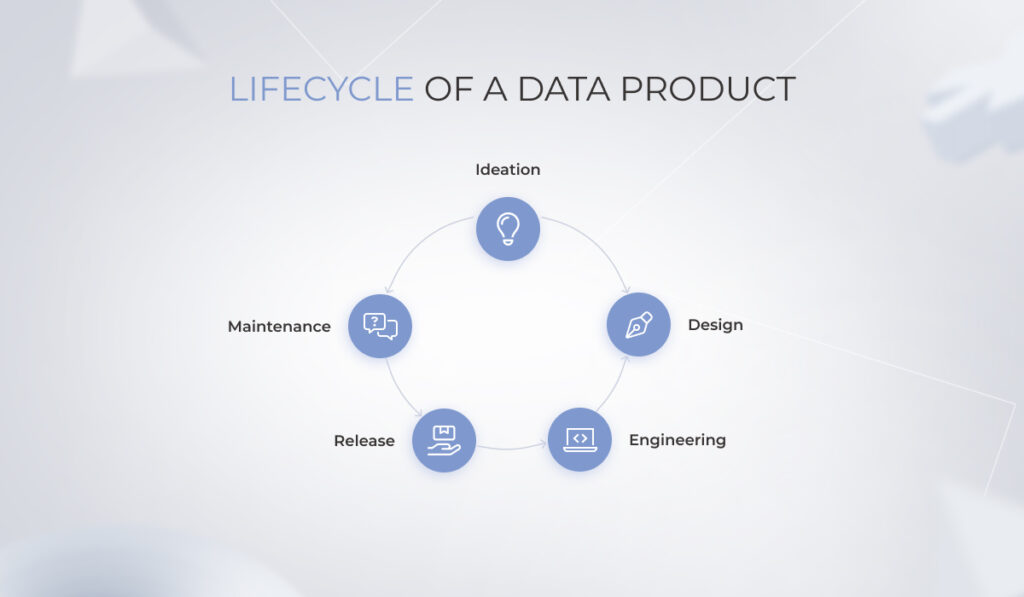
Domain knowledge

To execute a high-performing data monetization strategy, you also need profound expertise in the area you’re developing for. This way, you can accurately assess the feasibility and value of use cases in the domain.

The key to sustainable value creation

Data has become on par with financial capital that helps businesses thrive in the digital age. Data products come with greater ROI, fit into multiple use cases, and bring multiple objectives over the goal line — with lower cost-per-use.

But to unleash the potential value, you need to lead with architecture that brings your enterprise data together, makes it traceable and easily accessible. Coupled with the right expertise and operating model, it helps generate reusable data products with future-proof value.

Let’s make your data more valuable

Schedule a call

How Digital Product Engineering Services Help in Growing Your Business

With more eyes on technology innovation than ever before, industry leaders have rapidly cruised toward product engineering. However, having innovative products in your portfolio doesn’t cut it anymore. Today, it’s more about building a perpetual circle of scalable innovation with future-proof digital solutions that grow in lockstep with your business.

This particularly applies to organizations that revolve around technology or have digital products as their main revenue source. So if you’re a digital-first retailer, healthcare provider, or an agriculture techpreneur, you should take no chances when it comes to the quality of your software. 

Let’s see how a digital product engineering company can maximize the value of your digital estate and accelerate your response to shifting industry trends.

What is digital product engineering?

Digital product engineering services mean the full scope of IT architectures, technologies, and development processes to design, implement and adopt high-value digital products in high-load environments. The process takes over the entire development lifecycle — from conception to implementation — and advances in fast iterations. 

This uninterrupted flow ushers in ceaseless innovation, enabling companies to release lasting products and adjust them with added speed.

product engineering

The five Pillars of digital product development services

According to Gartner, worldwide IT spending is on pace to grow by 5.1% in 2023. But not each IT endeavor turns into a profitable venture. Around 70% of digital transformation projects go downhill, falling short of their objectives, which often has a knock-on effect across business operations. 

Having your project implemented within a product engineering framework increases the odds of technology success. Supplemented by quality processes, automation, continuous integration, and deployment, product engineering maximizes the value you get from the development lifecycle.

Velocity: increasing your speed to market for more impact

A double squeeze of scarcity and high rates has made talent sourcing an uphill battle for companies. IT executives list talent shortages as the most significant roadblock to the adoption of 64% of new technologies. 

Long and tiresome hiring cycles prevent companies from hitting the market first and claiming leadership. To overcome this headwind in local markets, businesses either augment their in-house teams with outsourced talent or delegate the entire project to a dedicated team of developers. 

We, at *instinctools, help global organizations get resource elasticity for product engineering by offering on-demand workforce scaling. Talent expandability allows your company to create new products fast and adapt swiftly to evolving goals and market demand.

Accelerate your innovation efforts

Get in touch

Flexibility: holding the door open for new opportunities

A narrow product engineering mindset goes only so far. Conversely, a technology- and methodology-agnostic approach is the crown jewel for product creation as there are a lot of variables that go into the process. Therefore, flexibility as a philosophy is essential to move with the changes that are inevitable during the product development cycle. 

Ultimately, your development team should be able to identify the best methods to achieve the desired results based on mutually clear goals — regardless of their subjective preferences. It means that a team embeds natively into your company, inheriting processes, values, and passion for excellence. 

Quality and reliability: increasing your speed without sacrificing, sometimes even improving, your quality standards

A digital product is not solely in the tech, it’s in the processes and techniques. Your product development team must follow industry-best engineering standards and practices, followed by calibrated management practices. 

A great emphasis in software product engineering should be put on the following aspects: 

  • Ultimate security — threat modeling, compliance, test automation, and vulnerability technologies.
  • DevOps practices — continuous development, integration, delivery, and deployment. 
  • Testing — test-driven development, i.e. writing unit test cases based on software requirements.
  • Compliance — developing products to meet the applicable market compliance requirements.
  • Agile-driven development — iterative frameworks with tools and adaptability to changing requirements.

Paired with the deep expertise of your dev team, these building blocks build a culture of continuous growth and excellence, focused on identifying, prioritizing, and delivering new opportunities.

Cost-efficiency: reducing the complexity and cost of innovation

Along with high quality, digital product engineering should have a value-based pricing structure that aligns the cost of innovation with the benefits it entails for the business. And you can reach the optimal value-cost ratio by cutting costs, increasing value, and leveraging economies of scale.

Setting up an offshore development center for your product engineering is one of the ways to bring down costs while enhancing the quality and speed of innovation. ODCs are not usually packed with the same overhead costs that in-house offices are, and they have access to unlimited talent pools for each skill and technology.

Customer-centricity: putting your business goals at the heart of all processes

Great product management demands a near-obsessive focus on business value and a personalized approach. It’s also about delivering value already in the development process, by enhancing the quality of your solution through experienced delivery management and the team’s concerted effort.

Product engineering teams at *instinctools take an extra step to make the client a focal point of all processes. From long-term collaboration to excellent delivery management to workplace flexibility, our dedicated teams know what it takes to create the best experience for the customer.

Hire a dedicated team of professionals

Book a call

Accelerating reinvention and value-creation for companies of all sizes across multiple industries

As a digital product consulting and development company with 23+ years of experience, *instinctools has been working across all areas of product engineering. Whether it’s automotive, healthcare, or education, we put our knowledge and experience to deliver game-changing solutions — from ideation to delivery and growth.

Create new products

Companies have to continually ideate and deliver new products to cater to changing customer demands and markets. But when software development is not your core, it’s quite challenging to get the bandwidth for product development on-site and manage this process directly.

We get a lot of requests from clients who are looking for a turnkey development team with cross-functional skills to minimize the burden of product engineering. That was precisely the case with one of our recent projects where our experts built a multi-module application for a school. 

Over the course of two years, our team worked side by side with the client to deliver a feature-rich solution with a transportation web dashboard, iOS and Android applications, and other complementary functionality to ensure the safety of students.

Investing in quality product development from the start will also ensure customer satisfaction, loyalty, and success for any fledgling business. Our other project, implemented for the Bonnet company, demonstrated the value of the product engineering mindset for a start-up business. 

Backed by the profound expertise of our mobile app development team, the startup delivered a high-quality solution to the market and carved out a niche with a unique tech application for millions of EV drivers all around Europe.

Transform existing processes

As companies age, so do their products. But you don’t have to create a new product from scratch to inject a new-age technology stack into your services. Sometimes, it’s enough to upgrade an existing legacy product to reclaim market dominance. In this case, you need a skilled team on board that can integrate the new technology into your existing solution.

Some time ago, *instinctools was approached by IPwe, a smart intangible asset management platform, to add new functionality to their existing marketplace. The company wanted to leverage the NFT economy and monetize patents encased in non-fungible tokens. Talent scalability and a swift hiring process were the core consideration points for the IPwe’s project and we gladly offered our on-demand hiring model for a fast team launch.

Our team revamped the existing marketplace and transformed it into a stable and secure web platform with extended, blockchain-based functionality. The new solution contributed to revenue growth for the company and expanded the company’s service line.

Currently, the *instinctools team is providing maintenance services for the platform, enriching it with new functionality and monitoring the solution’s health.

Advance your offerings

Sometimes, your existing solution portfolio needs a little boost or auxiliary service to reach more customers and become more valuable from the user’s perspective. Here, the process of turning an idea into a fully manufacturable product should be aligned with the existing technology stack. 

This was the case for one of our products, where compatibility with a certain technology stack was the primary requirement. Our team was hired by Daimler AG to build the Help and Support System for the GLOBUS user community. The solution had to be integrated with the GLOBUS-native technology and provide different workflows for content creators, editors, and publishers.

To meet all tech requirements, our team decided to premise the solution on the pre-packaged CMS version of the *instinctools’ GateOne framework. It allowed us to reduce the time to market and build a compatible product, adept and responsive to real-time and dynamic customer needs.
On the road to success with digital product engineering services

To deliver a successful and commercially viable product against the odds, you need a consistent, wide-comprehensive development framework. A product engineering mindset improves your chances of creating products with long-lasting value that consumers love.

Keep in mind that the product engineering approach is only possible if you have a self-managed, cross-functional team of experts with deep expertise and solid industry knowledge. Successful product engineering rests on the right talent, calibrated flows, and a framework that leads to consistently great results.

Looking for a product engineering partner?

Reach out

The Perfect Match: Four Time-Tested Pro Tips on Finding a Remote Development Team

Building an in-house software development team is a challenging undertaking. From finding decent specialists to onboarding and managing them, you have to take on tons of things. The talent crunch in the tech industry does not make that any easier. There were only 65 potential candidates for every 100 vacancies in the US last year. 

All these and a number of other factors put remote teams in a favorable light in terms of software development quality, expenses, and time to market. If the idea of hiring a remote development team has crossed your mind, check yourself against our list of actions to pick a reliable technology partner.

What is a remote software development team?

Remote development is a business partnership model in software development. It involves using the services of a technology vendor located in another country. The vendor sets up a remote development team based on your budget and project requirements to solve your IT challenges. Team composition and seniority levels for different roles are determined by your project complexity and the scope of the tasks. 

Engagement model - Dedicated Teams

Work smarter not harder: why hire a remote development team?

Delving into new initiatives becomes easier when we understand the deliverables. When it comes to the remote software development process and remote workers, these are reduced costs, greater flexibility, and a faster time to market. 

Engagement model - Dedicated Teams

Whether you’re a CTO of a large corporation or a small business owner, outsourcing can become your way to kill two birds with one stone, saving your time, and project budget. 

If you hire a remote team, you don’t waste time setting up processes within the team as it’s self-managed. Just take advantage of ready-to-work, talented software engineers embedded into your IT department. 

For instance, tech giants like McKinsey and Deloitte locate their R&D centers in Poland, where the outsourcing framework is flexible, mature, and tax-friendly. You can also take advantage of local talent and hire specialists or an entire team to develop innovative products.

Looking for experienced software developers to meet your project needs?

Get a quote

Collaboration models to choose from

No project can be handled by following the same playbook. Successful remote development calls for flexible collaboration methods, calibrated for your business needs. For a company that wants to launch their own product and has no developers onboard, for an organization that craves extra hands to offload their tech backlog, or a corporation which needs a full-scale development center as its numerous project teams have spiraled out of control, there are different team extension options to benefit from. 
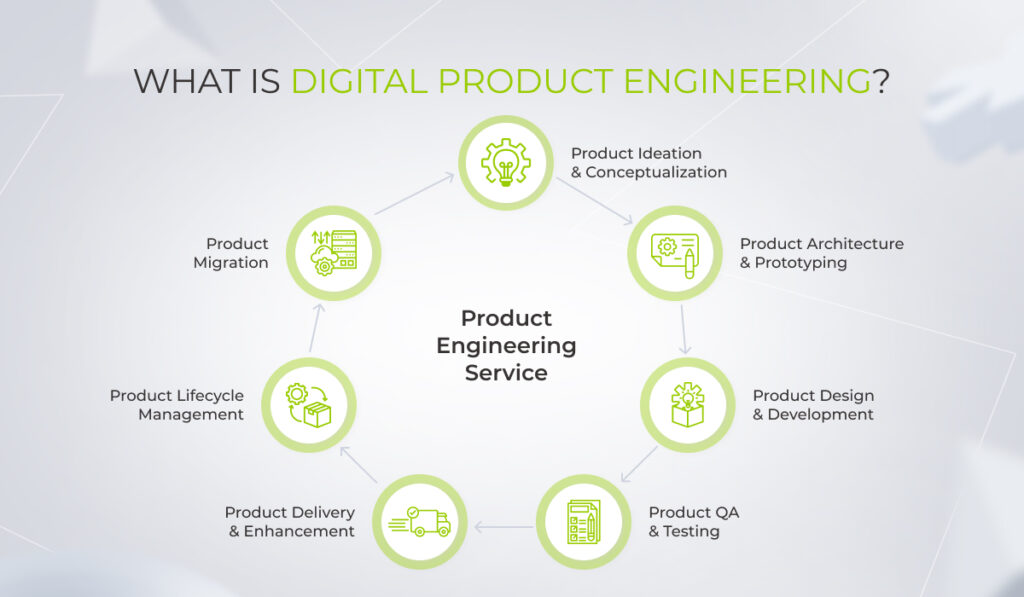
IT staff augmentation

Start scaling your business capacities on demand with staff augmentation. It’s the most affordable way to strengthen your IT department with high-qualified experts in software product development, business analysis, UX/UI design, quality assurance, etc., in a matter of days. However, consider that you’ll have to manage these employees by yourself and have the skills and project management tools to do so.

This model of cooperation may be suitable for different projects. For example, a company with its own IT department may lack a specific role for a project. However, it’s impractical to hire the needed domain specialist full-time, especially if no similar projects are planned any time soon. Or there might be the right specialists in place, but the project deadline is on fire, so the organization needs extra hands for a short time to cope with the workload. 

​​​​Another example is when startups seek maximum benefits at an affordable price and in a short timeframe. An IT staff augmentation model provides them with access to a wide range of skill sets and offers financial adaptability and cost-adequacy, which are critical for resource-constrained newcomers.

The advantage of IT staff augmentation is that you don’t just get industry or technology experts but proactive team members who communicate effectively and strive to find and offer the best solution. This is driven by high competition among technology vendors. Remote software engineers have to be proactive so that you want to hire them again for another project. This is why, you can choose the best of the best without compromising your project budget.

Dedicated team

With dedicated development, you hire a whole agile development remote team, so you won’t have to build it from scratch or worry about fitting new employees into the established squad. The dedicated team works as an independent unit whose activities are transparent. Remote dedicated software development teams can cover the whole software delivery process, including analysis, design, development, deployment, quality assurance, and support.

Such an approach is a good fit for long-term projects with frequently changing requirements. You get domain experts who take on IT tasks if you don’t have your own IT department. And if you have your own IT unit, but they are busy on another project, then you can enlist the help of a dedicated team. Moreover, if you fully entrust your vendor with software solution implementation and delivery, then you don’t even need to participate in technical interviews of candidates for the dedicated remote team.

Offshore development center

When the number of separate remote teams you’ve been hiring is growing, at some point, managing them becomes too big of a challenge, taking a toll on the overall project. 

Instead of dealing with multiple remote teams scattered across the globe, you can establish an offshore development center when an overseas business unit becomes an extension of your organization. This collaboration model suits companies with specific security requirements, the ones that handle sensitive data, and large projects that depend on hardware. 

Engagement model - Dedicated Teams

Still mulling over what collaboration model will be the best fit for your company?

Let’s discuss it

Four factors to consider when looking for a remote development team

Before hiring a development team, there are a number of things to take into account from a business and technical perspective. The more nuances you think through at the initial stage, the smoother the cooperation will be.

1. Identify limitations of your project and expectations from the remote team 

This information will help you find a highly professional remote development team that matches your budget, time-to-market, and security standards. 

  • Define your budget. Calculate the amount of money you are ready to spend on the project of product development before starting the negotiation process. It’s crucial to engage budget approval persons, and the CTO, who will help define the technical requirements that affect the development cost.
  • Spot the specific requirements for your project. For example, if your project necessitates particular security protocols, it may narrow down the number of software companies, from which you can request a team of remote developers. 
  • Decide on the collaboration and payment model type you need. Earlier, we mentioned collaboration models and use cases for each of them. But at this stage, you should also choose between a fixed price, and a time and material payment model.

Fixed price, with its strict costs, timeline limitations, and inflexibility, is a suitable option for well-specified projects with precise time to market. Ensuring that no new requirements or features will appear during development is a mandatory condition. Moreover, this payment model may include the absence of communication with the client.

But startups without complete specifications and complex long-term projects require a flexible time and material payment model, which implies adaptability to ever-changing requirements. 

  • Following coding standards. It’s not that hard to write code that will work for now. But will it be high-quality and consistent code that any developer can work with? 

When you hire remote software developers, especially at a Java development company, make sure they follow coding standards, such as PEP8 for Python, SEI CERT for Java, MISRA for C/C++, etc. It will save you from code refactoring and rewriting inconsistent or poorly written code in the future. Moreover, such an approach ensures easier code migration and integration with other systems.

Unlock the prospects of software development with a remote dedicated team

Get in touch!

2. Think twice before choosing a region where to hire a remote development team

Although the quality of services plays the first fiddle in choosing a team of remote developers, it’s important to think beyond that. The cost of software development, time zone differences, culture and work mentality of the country you’re hiring from, English proficiency level, can greatly impact the success of your project.

  • Quality of software development services. First things first, it makes no sense to hire a team of remote developers from a cheaper location if the software solutions they create cannot maintain acceptable performance levels consistently, show low average Mean Time Between Failure (MTBF) and Mean Time To Repair (MTTR), and have a high number of defects in the code. Quality shouldn’t be compromised, and solutions should be, first and foremost, holistic, reliable, correct, maintainable, and easy to use. 

Therefore, it’s worth choosing remote software developers in countries with a high level of education in IT disciplines. For instance, while only 41% of developers worldwide have a bachelor’s degree, in Poland the figure is almost twice higher,  reaching 73%.

  • Cost. Instead of hiring a remote development team in the USA, where you would pay $130K for each developer, seek the same services in Poland and pay $40K for a senior software engineer working remotely or $24K for a mid-level specialist. Meanwhile, Poland is one of the five countries with the highest level of tech skills. 

This reduces the project’s cost by three to five times without compromising the development quality — looks too attractive to leave it on read, right?

  • Time zone gaps. For example, the time zone difference between San Francisco and a country in Asia may reach up to 13-16 hours. With a time difference of more than ten hours, it will be challenging to sync with a team and ensure smooth communication and collaboration. 

That’s why, opting for a remote team whose time zone aligns with your work hours is the most beneficial solution. For instance, hiring software developers from Europe will be a lifesaver for US-based companies as the time gap between them is about only six hours. 

  • Mentality and work culture differences. The cultural distinctions between the client and contractor’s sides may lead to misunderstandings and misinterpretations, putting the whole software development undertaking at stake. 

In this respect, it is easier for organizations based in the United States and Western Europe to collaborate with developers from European countries with the same company culture, for instance, Poland, to avoid communication problems down the line and ensure both parties have the same expectations from the project. Statista indicates that Poland is one of the leading countries worldwide when it comes to offshore development services and remote work.

  • English language proficiency. Speaking the same language as your remote development team allows you to be on the same page regarding the project. Poland ranks 16 out of 112 as having a high English proficiency level. 

Experienced developers fly off the shelf in a day in your country?

Leverage our talents

3. Check the reliability of the companies that provide dedicated development team services

Are you sure about the trustworthiness of the companies you’re considering? Here are some steps to help you make a wise choice.

  • Check the reviews of the companies on business listings, such as Clutch, GoodFirms, Techbehemoths, SelectedFirms, etc. Read customer reviews to get an idea of what other clients think about the company and its remote workers. Also, look into their ratings and how long they’ve been in business. 
Expertise - Product Software Development
  • Investigate IT providers’ case studies. Check out their skills in a range of industries and their previous work to identify their area of expertise and see if it matches your needs. That way, you can cut the chaff in the initial stage. 
4. Clarify how companies secure the work of remote development teams

Verifying that your project is kept secure is another essential point to consider when you hire remote software developers. Therefore, ask potential vendors about the security protocols they follow and measures they take to protect the data, such as encryption and secure storage solutions. 

Additionally, inquire about their privacy and data access policies to confirm that they meet your company’s standards. With the right security protocols in place, you can rest assured that your data is safe with the remote development team. 
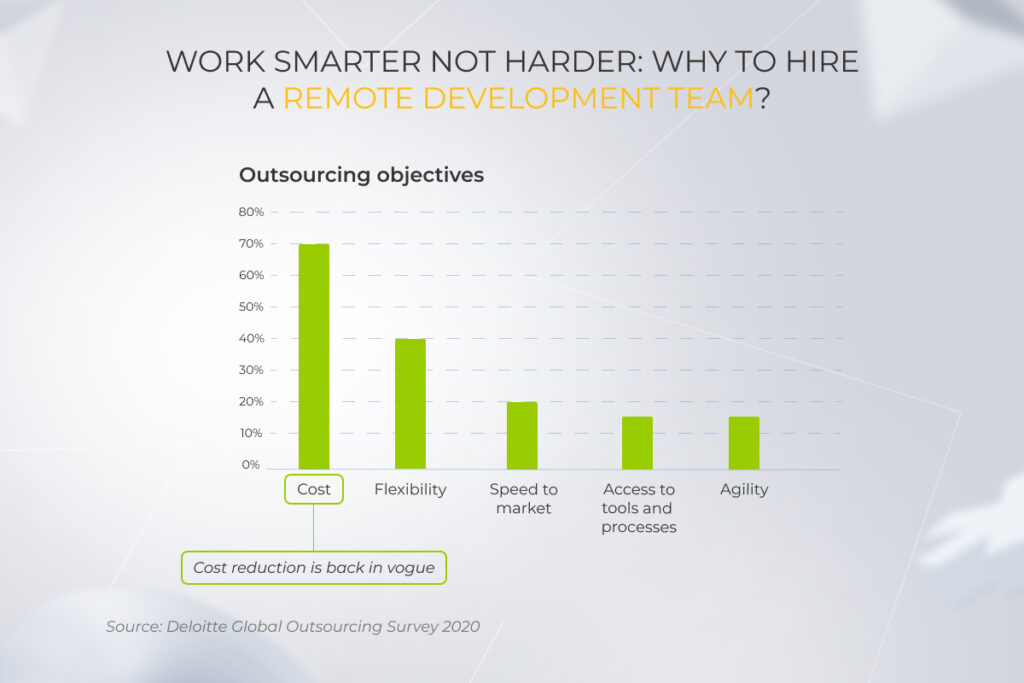
Your technical partner should take into account local legal regulations and security protocols. Moreover, your remote dedicated software development team needs to be certified and audited in line with your specifications to match your compliance requirements fully.
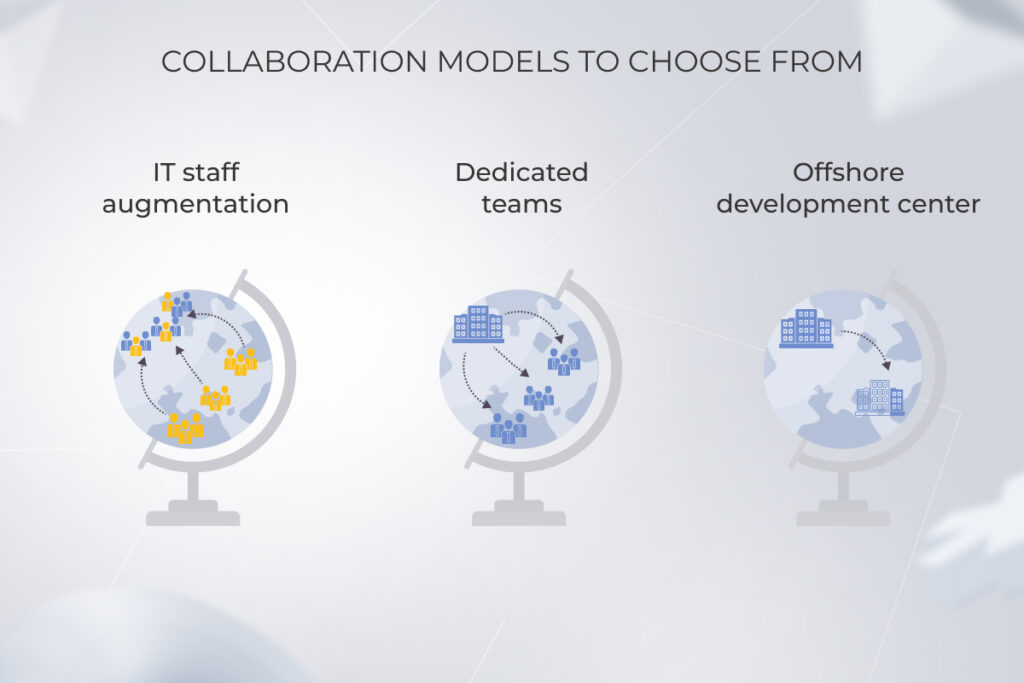
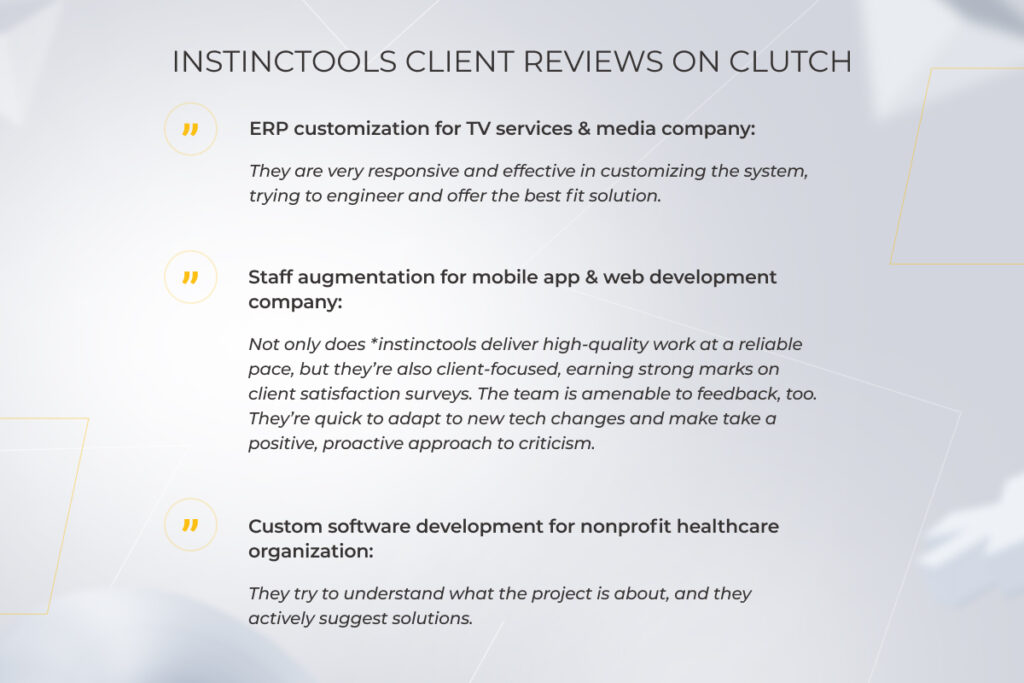
Speaking of Poland, it stands on par with EU- and US-based organizations and sticks closely to international regulations.

Is a remote development team your golden ticket?

Projects with restrictions related to budget, level of security, complexity, and time to market are the first in line to benefit from remote software development teams.

  • Large, long-term projects 

The challenge of large, long-term projects is that their requirements tend to change. In this case, a remote team of profile experts is your opportunity to quickly adjust the team’s skill set to permanently fluctuating requirements. 

The side benefit you get when augmenting your team with outside talents is knowledge transfer. For example, you have mid-level developers working on a project, and you expand the team with senior-level vendor developers. Working together, they will be able to enhance the expertise and skills of your employees.

  • Product development with limited time to market 

A fast start is key when you’re working on a project from scratch. When you come up with an idea that could influence your company’s position among competitors, it’s crucial not to miss the moment and implement it quickly. 

With an agile remote development team and efficient time management, you can get to the project in one to five days instead of investing up to three months to hire the in-house experts

Average time / Different types of development teamIn-house team*instinctools’ remote team
Recruit & hire talents56 days1 – 10 days
Start working on a project30 days1 – 5 days
Scale up the team40 days2 – 3 days
  • Projects with a limited budget

For startups and small companies, renting office space, recruiting and covering vacations, bonuses, and taxes for their IT department can become a significant part of the budget. Moreover, you’ll need to invest a great deal of time and energy into assembling your own team. 

Hiring a remote team of developers in different countries is an alternative to setting up and maintaining your own IT department and an easy way to obtain your goals while keeping development costs moderate. And if your organization is small or medium-sized and software development isn’t a core part of your competence, you may consider not creating an IT department at all and rely solely on the dedicated team.

Why freelance platforms, such as Upwork, Fiverr, etc., aren’t the best options even if you are short on budget? You can’t be confident in freelancers’ level of expertise. Hence, you run the risk of getting low-quality development.

Expertise - Product Software Development
  • Project with special data security requirements

When hiring remote developers in another country, you determine the desired level of security the team must meet. You state the conditions and choose the development unit that will provide built-in network security, private office space, authorized entry, and software access control. 

If security is the cornerstone of your project, you can send keys on flashcards to work with your architecture and even require your provider to have team members tested for substances — the team will follow these rules and ensure compliance.

Expertise - Product Software Development

Take your time choosing a remote software development team provider to find a reliable one you can trust to set up the team. An experienced partner will determine the needed roles and their seniority level to handle the task effectively. 

Instinctools experience in remote development team services

At *instinctools, we understand the challenges and opportunities of working with a remote development team. We capitalize on our 20+ years in software engineering and innovative consulting to build successful and sustainable agile software development remote teams for our clients. However, we don’t measure our experience solely in years. It’s also reflected in 650+ successful projects in more than ten industries. Besides ensuring the quality of development and providing you with proficient tech skills and industry knowledge, we develop our soft skills and adhere to a continuous learning culture.

Instinctools has extensive knowledge and expertise in all aspects of software development and remote work. Our skilled teams are ready to assist with any project at any stage, from ideation to development and ongoing support and maintenance, while ensuring our clients’ projects are completed on time and on budget.

Our core principle is bringing tangible value to your project, and that’s what our clients say after collaborating with us.

Time is now: access a skill set and expertise that you may not have had before

With the world becoming increasingly digital, businesses need to stay on top of technology. Therefore, they need reliable, professional, and experienced tech allies. And taking advantage of remote development teams is one of the ways to get the software development done faster, more efficiently, and, what’s important, cheaper. While searching for a tech partner might seem daunting, our tips will help you find a professional and affordable match for your project.  

Tap into remote software development and scale beyond borders

Get in touch

FAQ

What is a dedicated development team?

A dedicated remote development team is your autonomous tech squad in another country that either strengthens and scales up your in-house IT department or replaces it. It’s fully managed by your tech partner, which frees you from dealing with the paperwork. Just enjoy quick access to the expertise you need.

What is the role of a remote development team?

A remote development team takes on tasks to ease the workload and allow your employees to focus more closely on other undertakings. For example, you are just starting a project, and you need specialists who can manage the process and, at the same time, transfer their core knowledge to your team. Or a large company requires extra hands to sort out tasks in the backlog. Or you are entering a new market and want to hire a full-fledged team in a new location.

What is the advantage of hiring a remote developer?

When you hire a team of remote developers, you save time and money on hiring. You get a whole remote development team that is ready to start working on a project in a few days, while, in the case of in-house developers, you may need up to three months to set up the team and ensure they function in a coordinated way. Moreover, you can scale up your remote development team even by double in just 2-3 days if you need to speed up your time to market.

How to hire remote developers in 2023?

Start by identifying your requirements for a remote software development team. Then check business listings, such as Clutch and GoodFirms, to find companies that provide remote dedicated teams services and have relevant expertise. Dive deeper into their portfolios to narrow down the pool of potential technology partners and interview the remaining applicants.

How do you manage a remote software development team?

Negotiate this concern with your vendor before you start working with a remote development team. For example, you can use tracking tools like Jira and Microsoft Teams to ensure you stay up-to-date on the project’s progress and successful completion. However, working with a dedicated team is convenient precisely because you don’t have to engage in their coordination constantly, as they are self-managed.

Anna Vasilevskaya
AI modified real photo
Anna Vasilevskaya
Account Executive

Get in touch

Drop us a line about your project at
[email protected] or via the contact
form below, and we will contact you soon.