



















Speed from AI-assisted engineering buys you nothing if your build is showing cracks, which you’ve likely already seen, given that you’re here. Our AI code review company analyzes your vibe-coded prototype, knocks out the weak spots, and morphs it into a stable, secure, and scalable product. Backed by hands-on experience with modern AI engineering tools, Instinctools’ developers bring the technical mastery needed to make your AI-built solution user-ready and growth-ready.
Home Vibe Code Audit and Cleanup
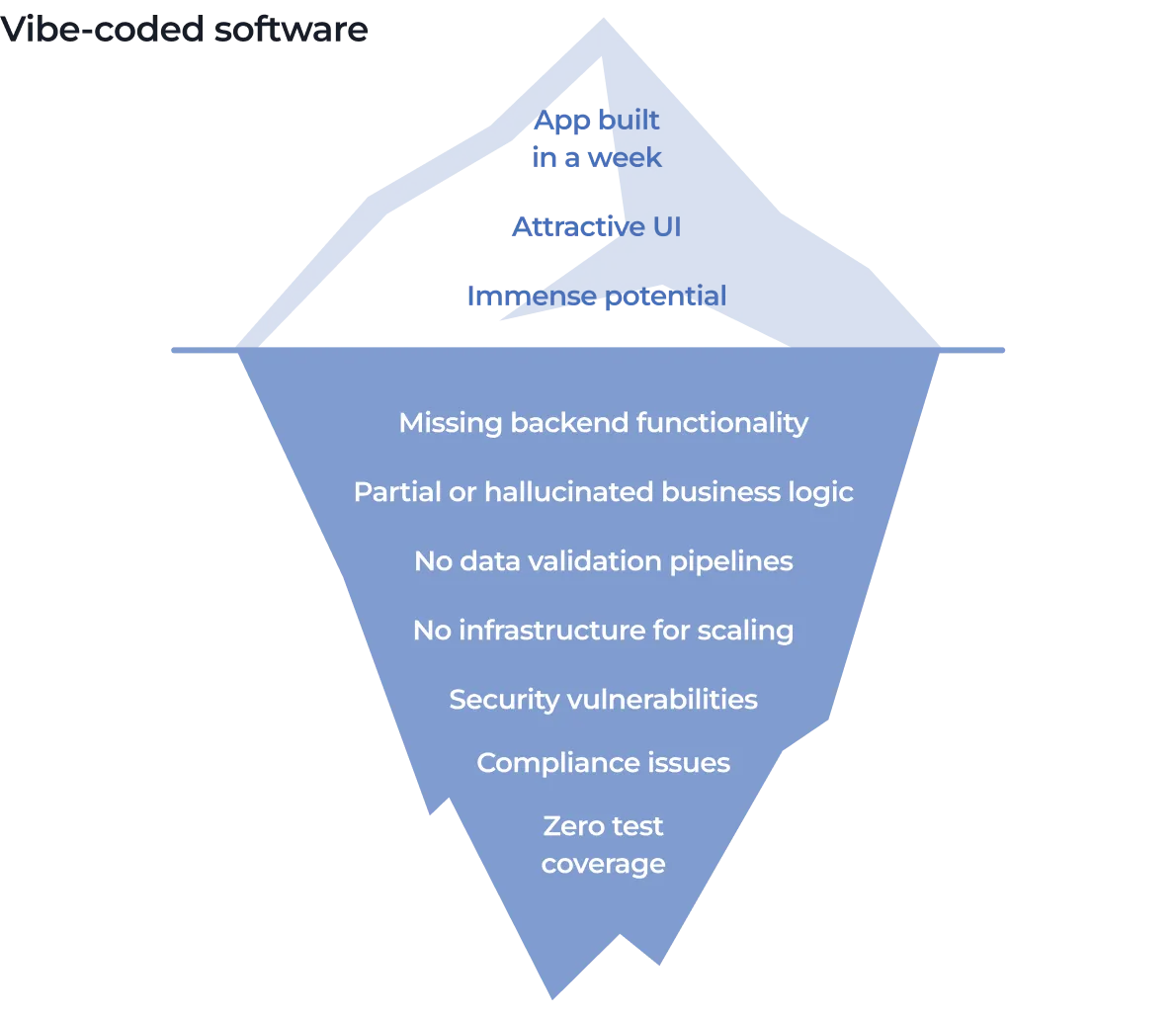
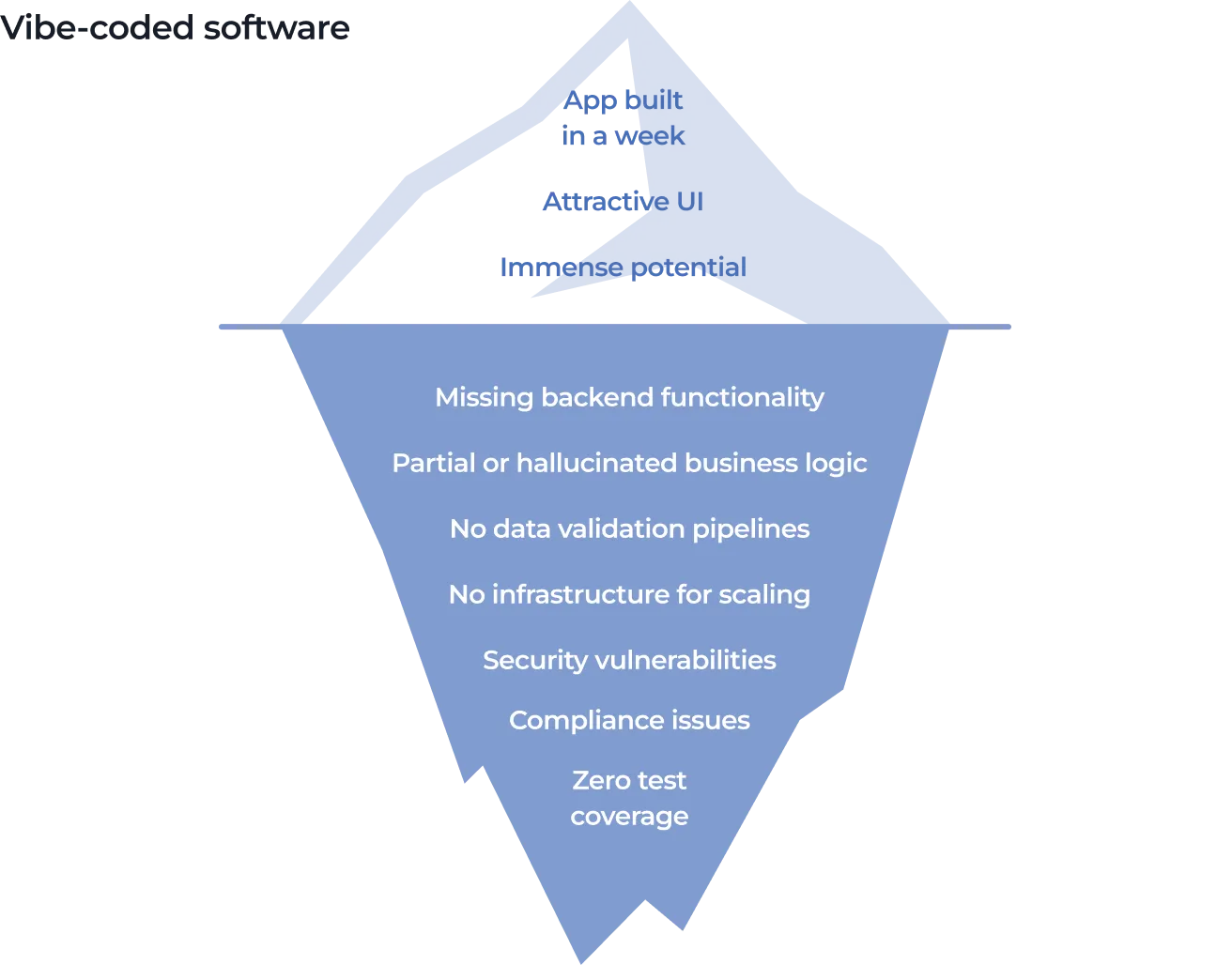
AI tools have a way of surprising teams not only with how quickly they deliver, but with the peculiar, inventive ways they fail. Many companies discover this only after deployment, when brittle prompts, inconsistent outputs, hidden edge cases, and scaling issues start surfacing in production. We help businesses identify where the mess hides and clean it up. Here are the most common problems our clients ask us to solve when turning their vibe-coded software into a trustworthy product:
Our engineers begin by validating that all underlying systems, services, and environments are operationally reliable and correctly provisioned. The review includes scanning all configuration artifacts for overly permissive settings and exposed credentials and API keys, as well as revoking any opt-in consent for model training on your proprietary data. Additionally, we check for missing memory limits that could lead to runtime instability or resource exhaustion.
To verify the recoverability of the environment on a new machine, we audit:
AI is the ultimate “yes-man,” eager to reach a successful execution state, even if that means inventing business rules. After aligning with your product vision, operating context and end goals, Instinctools’ engineers conduct a high-intensity investigation to identify where the model may have invented redundant logic that bypasses complex requirements to fill gaps in its own understanding. Our audit also focuses on untangling tightly coupled logic and stress-testing the ‘unhappy paths’ that agentic programming tools frequently overlook – missing data, malformed inputs, duplicate records, out-of-sequence events, and other edge cases.
By collaborating with your stakeholders, we reverse-engineer the rationale behind the proposed architecture to ensure the structural blueprint supports long-term strategic goals and adheres to enterprise standards. We specifically hunt for tight coupling, cascading failure, leaky abstractions, brittle orchestration and other architectural fragilities that turn minor changes into major incidents.
Any ambiguity in how and where data changes as it flows through your solution can signal a risk to long-term reliability and scaling. Instinctools’ data engineers assess whether your data foundations align with business goals and can grow and adapt to future changes without major rework. As part of that review, we look for normalization issues, misconfigured entity relationships, inconsistent naming standards usage, missing entities and attributes, broken ingestion pipelines and ineffective transformations. Regulatory compliance, including GDPR, CCPA, SOC2, or your industry-specific standards is audited as well.
Here we focus on the health of the codebase itself. AI-assisted development often introduces redundant abstractions and experimental code paths that never get used. We strip away this dead code and optimize the remaining logic to ensure it follows professional software engineering patterns. We also spot inefficient algorithmic patterns and spaghetti dependencies that make future manual intervention difficult.
With vibe coding, “security by design” often isn’t prioritized upfront, if at all. After ensuring only authorized users can access your AI coding agents and modify production codebases, our AI code reviewers shift to security validation. We check for prompt-injection risks in agentic workflows, hardcoded API keys, missing input sanitization, and weak authentication logic that can slip into AI-generated backend code. We also run a full sweep for OWASP Top 10 vulnerabilities that may appear when models reproduce insecure or outdated coding patterns learned from its training data.
Performance is one more casualty of vibe coding. We profile your application to identify algorithmic inefficiencies, such as N+1 query problems or memory-heavy data transformations that look fine in a dev environment but explode under production load.
We don’t want your ‘speed-to-market’ to transform into a permanent ‘cost of staying alive.’ That’s why we help you assess the vibe coding technical debt introduced during rapid AI-driven development against the cost and effort of stabilization, then translate that into a roadmap prioritizing the fixes with the highest impact.
Being platform-agnostic, we’re able to stabilize what you already have and make it safe to grow, wherever it’s been vibe coded.
We specialize in refactoring existing codebases, including AI-generated ones. Once the stabilization roadmap is greenlit, our engineers move into targeted cleanup to give your team a foundation it can confidently own and scale. The result is a production-solid build, with near-zero technical debt, complete, well-structured documentation, and a new dedicated repository.
To bring the solution in line with business goals and keep it maintainable as it evolves, Instinctools’ developers establish a clear dependency structure across modules, splitting overly coupled modules and removing circular dependencies. The codebase is modularized into well-defined layers, so that targeted architectural changes remain isolated and do not introduce unintended side effects elsewhere in the system.
Aligning coding standards across the codebase requires painstaking, in-depth refactoring carried out meticulously by our engineers. Instinctools’ code review service includes simplifying over-engineered abstractions, fixing flaky behavior, removing dead and duplicated code, normalizing runtime errors, and standardizing naming conventions, to name just a few.
Through so-called agentic testing, where we direct AI to test what AI has built, combined with human vibe checks, we form a solid QA suite that ensures your solution feels and works as intended. First, we use the app manually to spot UX inconsistencies and jarring glitches. Next, we verify that the high-level intent of your prompts was met, confirm that all parts of your prototype communicate correctly with your existing systems and third-party APIs, and validate that each new prompt does not accidentally revert a bug fix from a previous session.
Security hygiene is a baseline in all our vibe code cleanup projects. Using OWASP-aligned practices and secure-by-default configurations, our cybersecurity specialists implement missing data encryption mechanisms, rotate hardcoded secrets into vaults, upgrade vulnerable dependencies, patch authorization bypasses, and harden regression tests to preserve security fixes across prompt iterations. Additionally, security guardrails are added to continuously check for vulnerabilities and compliance gaps.
Performance optimization is partially addressed at the architecture fix stage, where we strip away the redundant middleware and recursive logic loops AI frequently generates to play it safe. This work continues during data preparation, where we replace heavy, generic data-fetching patterns that strain the database and inflate storage costs with more precise queries and intelligent caching layers. Overall, by reducing unnecessary resource overhead early on, we ensure the platform runs smoothly, responds faster, and scales efficiently as your user base grows.
You shouldn’t be crossing your fingers before deploying your vibe-coded app. For your launch-ready codebase, we establish a safe, standardized release process to match. We set up safe CI/CD pipelines with rollback support and all the right enterprise-level guardrails, add quality gates for tests, linting, and security scans so only stable, verified code makes it into production. Besides, we ensure recovery readiness with verifiable backups, RPO/RTO definitions, and a recovery playbook.
We identify and fix:
We audit:
Timeline: 1-2 weeks
Timeline: 1 week
Timeline: 3-6 weeks
Timeline: on request
The expectations for the quality of the initial product were very high. I think *instinctools did a great job ensuring those expectations are met. We met the developers we were going to be working with and it quickly became apparent that they are very qualified and were able to deliver the vision that we had from our side for the product. They clearly told us what they were going to do, and if there were questions or problems along the way, they clarified them really quickly thanks to transparent communication.

We had a tight delivery deadline and *instinctools has been able to find another developer and assign him to our project from one day to another. And we’ve been able to successfully deliver this project. When the partner is good, things are just getting done. And that was the case with *instinctools.

The quality has been good. It’s been on the expected level: things come on time, we have a good visibility on the things that *instinctools developers are doing and performing for us, communication is good. Wherever we see that we need some more exra resources, we have found *instinctools to be a good partner in helping us out on those areas.
I’ve been impressed by the available skillset, the flexibility to ramp up resources quickly, and the scalability to extend development teams on short notice. I look forward to continue collaboration with *instinctools and their contribution to our projects.

People at *instinctools are quite tech heads, which I like. They have used very advanced libraries, advanced techniques, advanced coding paradigms. So the advantage is that we get reusable code, that we get well-testable code, we get well-maintained code.

The *instinctools team exhibits the flexibility and professionality required for young companies. You can rely on their tested structures and processes that integrate nicely with your internal workflows. Being able to grow your team quickly with experienced professionals that start delivering value immediately and without a long interview process is a huge help. And personally, you will be working with a team of kind and interesting people.

The team is dependable when it comes to managing time and finances, consistently staying within the designated budget. We’re pleased with *instinctools. Their business analysts are exceptional. They serve as the spokespeople between technology and business, representing both sides effectively.

Instinctools is good at understanding the technical issues – once an issue is outlined, they do not need repeated explanation. They also do not simply accept a proposed solution, but they think about it and propose a better solution. I was really impressed by the custom interface they built for us – we outlined the requirements, and they implemented them in a user-friendly way that makes the interface a pleasure to use.

Instinctools does deliver on time and budget. The company proactively asks how they can support our efforts and provide ideas how to help us with very good candidates with expertise that either we requested or that instinctools identified to be missing.

The team demonstrated effective project management, timely delivery, and responsiveness to our needs. They established open communication to facilitate ongoing dialogue and held regular sprint meetings to keep stakeholders informed and engaged throughout the development process.
Instinctools delivered everything on time and was very flexible towards changes in scope during the project work. The team was easy to work with and had a quick response time.

In a still-uncharted field of vibe coding, there are no industry-aligned playbooks yet. But we work every day to write our own, shaped by new model releases, tooling shifts, and edge cases that only show up in production.
To help our clients squeeze the maximum value out of agentic engineering, we use our very own technology-agnostic multi-agent operating system. It is built around context engineering and cross-platform integration, so development tasks can be routed to the right agents with the right tools and the right working context. Security, privacy, compliance checks, AI governance, monitoring and token-usage controls are also embedded into our controlled agentic environment to help design fully production-ready and cost-efficient AI agents without starting from scratch every time models, tools or requirements change.

Models are highly sensitive to context quality, and your data foundation carries much of the weight in shaping it. That’s why, before any AI-assisted development begins, we focus on preparing the data your system will operate on. This includes cleaning inconsistencies, aligning formats, defining clear schemas, and building robust ingestion pipelines, in other words, removing any data ambiguity that could otherwise be amplified by model behavior.

To keep the quality bar of generated code consistently high, we introduce templates – repeatable architectural and coding patterns that define a clear frame for generation. Instead of reinventing the wheel for similar tasks, the model learns to recognize predefined context bundles and reliably produce consistent outputs.
What secure SDLC guidance has emphasized for years has become mandatory in a world where the speed of code generation is off the charts. That’s why we treat every AI-generated output as untrusted until validated. Automated checks such as SAST, dependency scanning, secret scanning, and SBOM generation are enforced by default. Besides, the codebase goes through multiple layers of testing so nothing slips through.
To avoid wasting time debugging issues that can and should be blocked in the first place, we establish all the right constraints early on. Our experts define strict architectural North Stars, draw clear boundaries for where AI can move fast safely, and configure automated gates to block non-compliant pull requests before they are merged.
Alongside our seasoned AI engineers performing code sanity checks, challenging AI assumptions, spotting weak logic, and calling out risky decisions, there are supervising models that evaluate whether coding agents work in line with the declared development approach. We build a lightweight peer review loop where one agent generates, another challenges, and a third validates structure, edge cases, and consistency. This creates more than one angle on overall quality, reducing blind spots and making it easier to correct issues early.
For engineering teams ready to bring agentic development into their workflow, we designed a clear, end-to-end vibe coding enablement program, covering:
Vibe coding at enterprise scale is what we offer teams who want to move at the speed of AI, without becoming experts in AI-assisted development. Whether you need to validate a concept in days or launch an investor-ready MVP in a week, we make it happen. Reduce costs and hit the market faster without compromising on quality or security.
Vibe code audit is a structured review of an AI-generated codebase to determine whether it is stable, secure, maintainable, and overall, ready for production. It typically covers checks to identify architecture, business logic, data model, code quality, security, and performance gaps.
A vibe coding cleanup specialist takes a fast-built prototype and makes it safer to launch and easier to scale. They decouple architecture, fix logic issues, eliminate dead code, refactor messy code, cover the solution with tests, resolve vulnerabilities and set up delivery workflows.
An effective AI code reviewer should combine deep software engineering experience with hands-on knowledge of AI-assisted development tools. They must understand how LLMs generate code, recognize common AI-induced anti-patterns, and know how to validate business logic that may have been hallucinated rather than explicitly programmed.
The timeline depends on the size and overall state of the codebase, but most AI code review engagements start with 1-2 week audit, followed by a week roadmap development phase and 3-6 weeks of focused cleanup sprints.
Yes. We work with digital products created in tools such as Cursor, Lovable, Bolt, Replit, Claude Code, OpenAI Codex, Base44, Gemini, and similar emerging agentic programming environments.
A regular code review company may focus only on refactoring code written by human engineers following traditional practices. Instinctools does that as well, but we also specialize in the unique challenges of AI-generated code: over‑abstractions, erratic dependencies, hidden security gaps, and regressions across prompt iterations.