A woman sits at a desk in an office, looking at a large computer monitor displaying graphs and charts. She types on a keyboard and smiles. A coffee cup sits nearby. The office background is modern and bright, with blurred coworkers and glass walls.

AI in Insurance Underwriting Solutions

Because of rigid yes-or-no thresholds, rule-based underwriting automation tends to leave money on the table. Our insurance software development team builds smart AI underwriting solutions that adapt to, learn, and scale with your risk taxonomy, so you can assess each case more precisely and price more intelligently.

  • Governance by design (version control, compliance, and audit trails in every quote)
  • Compliance with GDPR, CCPA, NAIC, IFRS17, NICB, HIPAA, and other regulations
  • Transparent, explainable AI reasoning, from insurance risk to AI credit decisioning

Underwriting, minus the drag

Most underwriting delays don’t come from risk. They originate from siloed data, repetitive tasks, and tools that weren’t made for the way insurers work today. AI has flipped the script.

The old way of handling underwriting

Manual review of emails, PDFs, and spreadsheets

Repeated manual data entry across systems for repeated quote submissions and resubmissions

Submissions triaged manually by inbox order

Pricing adjustments done manually in spreadsheets

Missing data disrupts the underwriting process

Underwriters search multiple sources for context

Exceptions spotted late during manual review

Referrals require manual documentation and explanation

Underwriting memos written from scratch

Slow broker responses and quote turnaround

The better, AI-driven way of managing underwriting

Automated submission intake and data extraction

Automated submission data capturing and reusing for quotes and resubmissions

AI triages submissions by risk, complexity, and priority

Model-driven pricing with automated adjustments and human underwriter override

Missing documents and inconsistencies are flagged proactively by AI

AI enriches submissions with internal and third-party data

AI detects guideline conflicts and risk anomalies early

AI generates structured referral packets with evidence

AI drafts underwriting summaries and quote memos

Faster quotes managed in one integrated platform and automated broker communication

Why Instinctools
Increase speed to market

01

Reduce development cost

02

Assure information security

03

Get high-quality software

04

Scale team up and down

05

Embedding AI into every stage of your insurance underwriting process

As an ML insurance underwriting software partner, Instinctools helps carriers bring automated intelligence to every step of the process, set up seamless hand-offs between automated underwriting systems, and ensure that every submission goes through a consistent accept/refer/decline pathway.

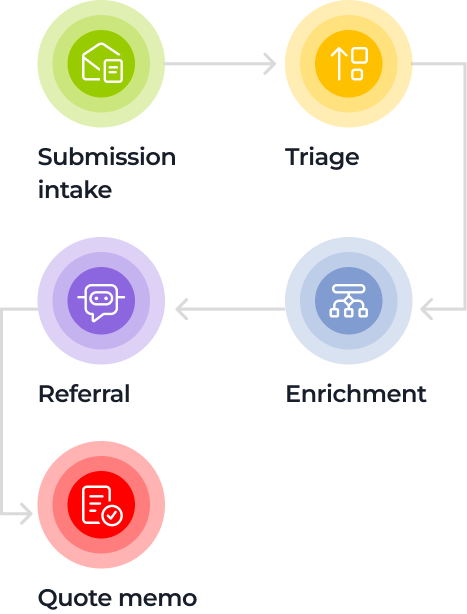
A horizontal flowchart with five colored circles: green for Submission intake with a house icon, yellow for Triage with a filter icon, blue for Enrichment with a data icon, purple for Referral with a chat icon, and red for Quote memo with a document icon.
A horizontal process flowchart with five colored circles: “Submission intake” (green), “Triage” (yellow), “Enrichment” (blue), “Referral” (purple), and “Quote memo” (red). Arrows connect each stage in order from left to right.
A flowchart with five colored circles in a sequence: Submission intake (green), Triage (yellow), Referral (purple), Enrichment (blue), and Quote memo (red), each with matching icons, connected by arrows showing process order.

Submission intake

Cut the processing time from days to hours by automating the ingestion, extraction, and structuring of emails, PDFs, spreadsheets, ACORD forms, and loss runs with advanced NLP and generative artificial intelligence.

  • Computer vision and OCR models scan input and transform it into a machine-readable text.
  • LLM models extract key data, such as coverage limits, loss history, and current premium.
  • Using an API, the AI model sends the extracted data to a digital workstation that then pre-fills a form with that data.
A woman with dark hair tied back stands indoors, holding a tablet. She looks thoughtful, with one hand touching her lips and the other holding the device. She wears a green blouse and is surrounded by sunlight streaming through large windows.
A person in business attire types on a white computer keyboard. Overlaid graphics show a digital AI icon in the center, surrounded by futuristic technology and data symbols, representing artificial intelligence and innovation.

Triage

Finally, your underwriters can zero in on high-risk cases, while AI handles routine prioritization.  Better submission-to-quote ratio, lower underwriting costs, and higher risk assessment accuracy also add up with AI triage. The same pipeline powers AI credit underwriting workflows, giving lenders a complete credit underwriting software layer built on the same explainable models.

  • As a core capability, an agentic system looks into the full context behind the submission to select best-fit deals in real time.
  • The agentic system calculates a priority score based on win probability, broker tier, and SLA risk, and also runs AI crediting scoring and risk checks on the applicant.
  • An AI triage agent routes submissions for straight-through processing or manual review.
  • Smart algorithms also flag issues, spot anomalies, and missing documents before they lead to a hold-up.

Enrichment

Your underwriting engine is only as strong as the data that feeds it. We design automated underwriting solutions that collate data across different sources, cross-reference it against your existing data, and augment each submission with critical context to support underwriters in making more confident underwriting decisions.

  • ETL/ELT pipelines and feature stores unite data from CRMs, repositories, transactional databases, and external data points.
  • AI reconciles and validates facts against underwriting guidelines, plus adds external intelligence and inferred signals.
  • An AI agent pieces all data together into a unified, enriched submission profile that is continuously updated.
A digital visualization shows interconnected blocks with red and blue binary code (0s and 1s), linked by glowing lines on a dark background, representing data flow, computer networks, or artificial intelligence processing.
A close-up of a robotic hand and a human hand typing together on a laptop keyboard. The scene suggests collaboration between artificial intelligence and humans, with a smartphone lying on the desk beside the laptop.

Referral

If a submission doesn’t align with the guidelines, falls into a grey zone, or triggers another exception, AI steps in to flag the outlier, explain the why behind it, and brief on the next best action, whether that’s re-populating a premium or suggesting specific questions to ask the broker.

  • ML classifiers and rules engines pull the exception conditions, such as limits, hazards, adverse history, guideline conflicts, and others.
  • Agents provide actionable referral packets that break down the reason for referral, supporting evidence, and suggested actions.
  • The package is referred to the correct queue by the agent.

Quote memo

Our custom AI for underwriting solutions generate audit-ready quote memos in seconds. They draw upon the entire underwriting rationale, from risk summaries to pricing recommendations, allowing your underwriting team to lean into decisions, not form-filling.

  • The gen AI engine drafts the underwriting memo in natural language, summarizing risk summary, key factors, guideline fit, pricing rationale, and outstanding conditions.
  • The AI co-pilot prepares broker emails, declinations, indications, and follow-ups.
  • Generative AI follows with decision justification artifacts to explain the reasoning behind every decision.
A person at a desk uses a laptop, with one hand touching a floating digital checklist. The checklist has glowing blue and white icons, with one box checked. Transparent digital documents and data overlays surround the scene, suggesting a high-tech workflow.
Faster submissions, smarter decisions, accurate quotes

Delivering outcomes that insurers are looking for in AI

62%

of our clients say that AI has improved underwriting quality and reduced fraud

31%

reduction in processing time for complex policies achieved with AI

90-99%+

accuracy in AI‑assisted risk scoring

Up to

40%

savings in underwriting costs driven by AI

Up to

15%

revenue growth unlocked by AI

Faster claims, smarter decisions enabled by agentic AI for underwriting

Full-fledged technology services to power AI-driven insurance underwriting

With 650+ projects under our belt, we bring together every discipline needed to design and deliver dependable AI in insurance underwriting.

Building a data foundation layer

From data pipelines to feature stores, our data engineers lay down a secure and scalable data groundwork that brings together internal and external data sources and turns structured and unstructured input into a single underwriting intelligence layer – ripe and ready for feeding AI models.

  • Production-ready ETL/ELT pipelines
  • Data collection, ingestion, and integration (policy, claims, third-party data, and more)
  • Data normalization, enrichment, and quality management
  • Data lake and feature store development for ML datasets
  • Data strategy and governance framework (lineage, privacy, and compliance)

ML model development

Our machine learning algorithms and actuarial models factor in the full sweep of insurance risks and are designed to measure up to technical metrics (AUC/ROC, Gini, etc.) and business outcomes that matter to underwriting performance. We also integrate explainability, data governance, and always-on drift monitoring to make sure your AI can catch high-impact patterns and stay regulator-ready time and again.

  • Model training, validation, and performance benchmarking against underwriting and pricing objectives
  • Deep Neural Networks (DNN), gradient boosting, and other advanced ML architectures
  • Explainable AI  integration, including decision rationale and audit trails
  • Model monitoring, drift detection, and continuous retraining pipelines
  • API-first model serving and integration with underwriting platforms

AI agent development

Deploy flexible logic you can calibrate, govern, and chat with to speed risk evaluation, ease policy review, and automate routine tasks. We design your AI agents with an automated ingestion system in mind to make sure they have timely access to underwriting submissions, supporting documents, and other data for context.

  • Built-in agentic workflow orchestration for multi-step workflow chaining
  • Agent component standardization and workflow reuse architecture
  • Automated data ingestion through system connectors
  • Memory and context management layer
  • Audit logging, traceability, and policy control enforcement

Modernizing tech infrastructure

Instinctools’ team helps carriers modernize and prepare their tech infrastructure for real-time AI underwriting. Whether you are a boutique MGA or a Tier-1 carrier, we help you leverage a modular architecture with a unified control layer and a flexible API middle layer that lets your company segue into AI-ready underwriting without ripping out core systems.

  • Technology infrastructure audit and modernization roadmap
  • Modular API and microservices architecture design
  • Underwriting workbench design and implementation
  • Legacy system integration through an API layer
  • IT operating model transformation for AI-enabled underwriting (MLOps, DataOps, model lifecycle management)

Integration engineering

We make your automated underwriting software work within your stack, not next to it. Our developers plug AI insurance underwriting capabilities directly into your existing infrastructure through API- and event-driven integrations, so new AI can easily join forces with whatever tools your teams already rely on.

  • API-based and event-driven connectivity with policy administration, underwriting systems, CRMs, and other data sources
  • Real-time data exchange pipelines
  • Middleware and API gateway implementation
  • Third-party data provider integrations

Continuous data and model management (MLOps/LLMOps)

Submission patterns, portfolio mix, and external conditions do not stand still, and neither should the models at the core of your artificial intelligence underwriting. Our AI insurance development team takes on the heavy lifting of data and model lifecycle management to keep your AI underwriting software aligned with evolving risk patterns.

  • MLOps and LLMOps platform implementation
  • Automation and deployment pipeline development
  • Model versioning and lifecycle governance
  • Retrieval-Augmented Generation (RAG) pipeline engineering
  • Domain adaptation and fine-tuning support for underwriting AI
Move from hindsight to foresight with our AI underwriting solutions

We build custom AI agents that never lose context, respond on the spot, and operate across data-ownership boundaries in multi-vendor architectures. How?

A white rectangle with rounded corners displays green text: Save up 30% on tokens. A green semicircular graphic emphasizes the 30%, visually highlighting the discount. The design is clean and modern.
Field-proven
methodology
Well-thought-out
agentic orchestration
Built-in AI governance
and compliance
Cross-platform
integration
High-fidelity data
preparation
Goal-oriented context
engineering
A green semi-circular progress bar surrounds large green text reading 30%. Smaller white text says Save up above and on tokens below. The design is set on a rounded rectangle with a light green border and subtle shadow.
Proprietary agentic solution accelerator GENiE

Automated underwriting software grounded in trust, regulatory compliance, and AI governance

Instinctools’ tech team has earned the right to implement underwriting AI solutions, as we handle everything that needs to be taken care of – data, models, compliance, and security – and do that with the rigor and diligence the insurance industry demands. The underwriting artificial intelligence we develop keeps every output transparent and stands up to both internal audits and external regulatory reviews.

Human-in-the-loop guardrails

When it comes to novel, complex, or high-value scenarios, human expertise must remain at the center even with AI behind the wheel. Instinctools’ AI engineers configure your software with confidence scores that automatically route such scenarios for human oversight, and any AI recommendation can be adjusted or overridden by a human underwriter in a fully auditable way.

Audit-ready AI models

Our AI solutions keep a time-stamped audit log, with score cards, model inputs, and a short explanation for every decision attached to it. We can also design your system to support the storing of underwriting records so that your underwriting team and regulators can look into historical data and precedents.

Full compliance

Built-in governance control, versioning, and automated compliance reporting within our systems let underwriters make decisions faster without worrying about regulatory filings. Our software development team also brings hands-on experience with GDPR, CCPA, NAIC, EU AI Act, NICB, and other key regulatory frameworks.

Responsible, fairness-aware AI (RAI)

We build AI as a clear, glass-box architecture that integrates proactive bias detection, model-agnostic XAI methods (SHAP and LIME), fairness metrics, and continuous monitoring to keep the decisioning engine equitable and defensible at all times.

Deployment options for sensitive data

With us, your data stays in the environments you designate, whether that means on-premises infrastructure, a private cloud, or a VPC. We apply jurisdiction-based segregation and strict rules for data transfer, replication, and backup, so data handling stays aligned with local regulations, internal policies, and enterprise compliance requirements. Where needed, we also support bring-your-own-model setups or deployment against an approved model allowlist.

Security controls that map to insurer expectations

Our development team aligns architecture and delivery practices with the security standards insurers already rely on to protect policyholder data and operational systems. That includes environments designed around least-privilege access, enterprise-grade identity and access management with role-based permissions and full audit trails, and encryption for data at rest and in transit. We also embed security into a documented software development lifecycle and map controls to recognized frameworks such as NIST CSF and CIS Controls.

Get smarter and fairer decisions across your portfolios
Certified to the highest ISO standards

The AI stack behind our automated underwriting solutions

Any AI technology you need – built to automate underwriting from submission to quote.

Optical character recognition (OCR)
  • High‑accuracy optical character recognition for PDFs, ACORD forms, broker emails, and loss runs
  • Structured data extraction and labeling from complex unstructured inputs
Machine learning (ML)
  • Supervised and ensemble models for risk scoring, pricing, and claims prediction
  • Deep learning, decision trees, gradient boosting for underwriting pattern detection
Large and small language models (LLMs/SLMs)
  • Solutions based on domain-specific large language models (Qwen, Mistral, GPT, and others)
  • Insurance‑specific SLMs fine‑tuned on your underwriting, policy forms, and regulatory datasets
Retrieval-Augmented Generation (RAG)
  • Graph RAG, multimodal RAG, and self-correcting systems
  • RAG-enhanced large language models
Natural language processing and generation (NLP/NLG)
  • Transformer-based models and embeddings (fine-tuned LLMs, domain-specific tokenization, contextual embeddings)
  • Information extraction pipelines (NER, dependency parsing, semantic role labeling for insurance entities)
  • Dialogue management and multi-turn state tracking (conversational agents, slot filling, intent classification)
  • Conversational AI frameworks (Rasa, LangChain, LlamaIndex) for orchestration

FAQ

Will AI replace underwriters?

In the near future, insurance underwriting AI will not take the place of human underwriters because of the industry’s high-stakes nature. Instead, it will streamline – and is already doing it – underwriting operations. It is transforming the way insurers assess risk, manage submission intake, and make underwriting decisions, acting as a decision-support and efficiency layer.

How long does the implementation of AI underwriting software take?

The timeline depends on the complexity of your project, data readiness, and the integration scope. To give you a ballpark idea, it takes our team from 3 to 5 months to implement an agentic system for insurance underwriting based on our proprietary vendor-agnostic AI agent platform. If there are specific compliance requirements, manual reviews, complex underwriting rules, or external APIs for risk assessment, the timeline could extend to 6-7 months.

How much does AI automated underwriting software cost?

The cost of developing automated software for underwriting varies by project. Overall, the costs range from $20,000 to $500,000+ for custom development. However, we scope each project individually to provide an accurate estimate.

Can AI underwriting software be used for loan underwriting?

Yes. The same core capabilities behind insurance underwriting AI can also support AI loan underwriting, from document intake and data extraction to risk assessment, eligibility checks, and decision support. Automated loan underwriting is already well established in lending, and the real question is not whether AI can be used, but how well the solution is tailored to your loan products, workflows, and decision logic.

Valery Kozhirnov
Valery Kozhirnov Account Executive

Get in touch

Drop us a line about your project at [email protected] or via the contact form below, and we will contact you soon.