


Spotify saw a 73% rise in premium subscriptions after launching their PWA. Meanwhile, Amazon and TikTok stay native, and not by accident. The difference between PWA and native apps isn’t about one being better, but rather about each being better at different things.
The PWA vs. native app debate has real stakes: going native gets you top-tier performance but costs more time, money, and dependency on app store approvals. The advantages of PWA over native apps are speed and reach, but they come with trade-offs in UX and device integration.
This guide breaks down the pros and cons of both approaches so you can pick the one that fits your business goals, not just your budget.
Difference between PWA and native app at a glance
The difference between a progressive web app and a native app comes down to trade-offs across cost, capability, and user experience. This table breaks it down point by point:
across cost, capability, and user experience. This table breaks it down point by point:
| Parameters | PWA | Native app |
| Installation | No download needed; add to Home Screen in two taps | Requires downloading and installation from an app store |
| Distribution channel | Open web (search engines, direct URL) | Apple App Store, Google Play |
| Discoverability | SEO + GEO (search engines and AI) | ASO (App Store Optimization) |
| Performance | Browser-level rendering; sufficient for most use cases | Hardware-level rendering; superior for graphics-heavy apps |
| Offline mode | Available via Service Workers caching | Full offline-first capability built into the OS |
| Push notifications | Full support on Android and desktop; limited on iOS | Full support across all platforms |
| Hardware access | Camera, mic, geolocation supported; Bluetooth and NFC limited | Unrestricted access to all device features |
| Development cost | Single codebase; ×3-4 cheaper than native development | Separate iOS/Android codebases; higher investment |
| Time to market | Weeks; no app store review | Months; app store approvals required |
| Maintenance | ~10% of development cost | ~15–20% of development cost |
In short, the key difference between PWA and native apps is scope vs. speed. PWAs get you to market faster and cheaper with strong discoverability, while native apps unlock the full potential of the device at a higher cost and longer timeline.
PWA vs. native app: all-round comparison from a business perspective
Time, cost, and security are probably the first things that come to your mind as a business owner when thinking about developing any software. Indeed, speaking of native apps vs PWAs, they are crucial, yet not the only factors to consider during app development requirements elicitation.
1. Development cost
Since their inception in 2015, progressive web apps have been a hot take, and the mobile app vs. PWA debate often starts with one question: cost. In essence, PWA is a website that offers user experience and visual aesthetic similar to that of a native mobile app, all while costing significantly less. This is achieved by using a single codebase and building a one-stop solution that performs equally across all platforms and devices. For those who already have a web application, migrating it to a progressive one seems like a viable option that can further reduce development costs.
Native apps are developed specifically for an operating system on which they will run. If you plan to create an application for two OS – Android and iOS – double the development cost. You’ll require a team with expertise in the main programming languages – Swift and Objective-C for iOS and Java and Kotlin for Android.
However, if your idea revolves around using Bluetooth connection, location tracking, camera features, etc., mobile development becomes the only option. It doesn’t mean though, that you’ll have to bid a farewell to a fortune. Cross-platform development empowers you to use best-of-the-breed frameworks (Flutter, React Native, Node.js, etc.) and craft native app-like look and feel solutions both for iOS and Android without breaking a bank.
Check out a robust healthcare platform we’ve created for both Android and iOS
View the case study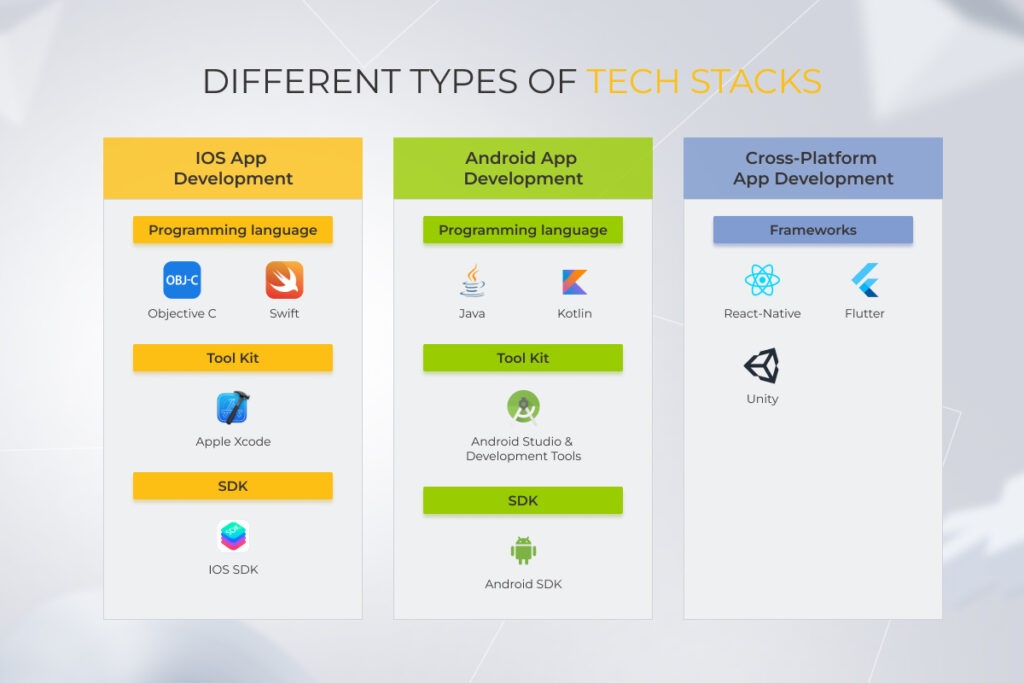
If you want to reduce the development cost for both PWA and a native app, look into hiring a remote development team in a more cost-effective and talent-rich location, such as Poland.
2. Maintenance
PWAs mean working with one codebase that suits multiple platforms. This alone makes maintaining a progressive web application more manageable and affordable. In our experience, support for PWA requires around 10% of its development cost.
Native apps: In addition to the impact on the project’s development cost, separate codebases lead to higher maintenance costs for your app. Statistics show you’ll need 15–20% of the development expenses to maintain your native mobile application.
Another nuance of PWA vs. native app maintenance, which often slips the mind in the beginning, is the fact that any changes made to a native application have to be submitted for a review in app marketplaces. Meanwhile, with a PWA, you completely control the delivery of updates and do not need to wait for third-party approvals, making the whole process more efficient and streamlined.
There is one more thing to keep in mind at the start, which applies to both PWAs and native apps. The application code should initially be clear and readable to make updates easier for developers. Maintaining the code written with multiple workarounds to cover the functionality you need will be tricky. Consider this when choosing a technical partner for mobile app development.
3. Security
PWAs run under HTTPS protocols that entail browser-to-server encryption. In addition, you can implement JSON Web Tokens (JWT) for authenticating users, Content Security Policy (CSP) to prevent cross-site scripting attacks and malicious code injection, etc.
As a result, progressive web apps can be as secure or vulnerable as any website is.
PWAs rely on server-side security measures, leaving no room for local storage. As for native apps, they become an integral part of the operating system, unlocking the ability to securely store data within the app.
All native apps published in the official store must pass the verification of the Apple App Store or Google Play Store. Only solutions with five-star security are allowed to be published.
One of the basic ways to ensure a proper security level for your application is leveraging Multi-Factor Authentication. Besides this feature, you can incorporate such native-app-specific options as Face ID and Touch ID.
If you want to put a premium on security, you can also build additional features into your mobile app:
- certificate pinning to prevent man-in-the-middle (MITM) type of security attacks;
- VPN or SSL tunnel to transfer sensitive information and protect it from data theft;
- runtime application self-protection (RASP) to monitor all the incoming requests and intercept attackers, etc.
The boon of a native app is that all these features can be built-in. For example, VPN cannot be integrated directly within a PWA, but in the case of native app development, it can be embedded in the application itself. In fact, we did just that in one of our projects so that the traffic would not be intercepted.
Therefore, if you are going to build a personal finance app, healthcare, or banking solution that constantly has to handle sensitive user data, with a native app you can implement as many advanced security control features as you want to hone the safety of the solution.
Any way you slice it, in the PWA vs. native matchup on security, native apps come out ahead.
But it’s worth remembering that the actual level of application security also depends on the experience and skills of the team responsible for it. Data breaches and vulnerabilities can occur because of human error within the development team. Therefore, battle-proven experts are the bedrock of your solution’s security.
4. Discoverability

Unfortunately, building a great product is not enough, and you should take care to adequately promote your solution to users. Both PWA and native apps offer options to do so.
PWAs are essentially websites that can be easily found through search engines. This means that SEO (Search Engine Optimization) and Generative Engine Optimization (GEO) are crucial components in ensuring that your PWA reaches its target audience. As a PWA is web-indexed by nature, its content can be crawled, parsed, and cited by generative AI, making GEO one of the key advantages of PWA for business that didn’t exist even a few years ago.
Among other benefits of progressive web apps is their inherent mobile-first design, so Google’s mobile-first indexing approach naturally favors them. Take the example of BMW, an automotive industry giant, that wanted to improve its website while staying customer-centric. By implementing a PWA, they saw a whopping 49% increase in site visits generated by SEO. On top of that, the PWA loaded 3-4 times faster than the old website, leading to a remarkable 50% increase in the number of mobile users.
In the case of native apps, you should pay attention to ASO (App Store Optimization) to increase the number of people who can find your application. Just as with PWA, where you have to mind SEO in your marketing strategy, you’ll face similar challenges with ASO. It includes putting your app in the correct category, providing quality and relevant screenshots of your app, writing a catchy title, investigating keywords to provide a results-oriented meta description, etc. These efforts should pay off with a higher rank among other similar applications.
Still, the PWA vs. native discoverability picture isn’t one-sided. It’s easier to beat the competition in app stores than to win the race among web applications.Here’s why. Two solutions with identical names cannot exist in an app stores. If a user is looking for your app, they will find exactly that one. Search engines operate differently and imply more hangups. For instance, even if users seek out your web application, there will be the lion’s share of pages not related to your app in search results. Moreover, your rivals can set up paid ads under your solution’s name to occupy the first pages and, thus, make looking for your web app a painstaking experience for customers.
5. Time to market
When it comes to time to market, the PWA vs. native difference is dramatic. PWAs adapt seamlessly to any platform, significantly reducing development time and effort – no more grappling with the technical nitty-gritty of multiple operating systems and their respective app stores. As a result, you can release your PWA in a timeframe that has never been possible for a native application.
When the pandemic struck and lockdowns became the norm, our team was approached by a US mental health startup that wanted to develop a mobile-friendly solution to connect people with psychological support via text chat. We’ve suggested betting on PWA to craft the application as soon as possible. Our team managed to roll out the progressive web app in just one month, an unimaginable feat when you think about developing a native mobile app for each paticular platform separately.
The fact that the native app should be developed for different operating systems delays the app’s time to market. Add to this the need to wait for approvals from app stores like Apple App Store and Google Play before putting your solution on display. Therefore, be prepared that it will take more than a few months from the start of the development to the point when users can download your app.
Want to join the list of companies with successful front-and-center solutions?
Let’s cooperateProgressive web apps vs. native apps: the user’s standpoint
When choosing how to implement your idea, it’s crucial to keep in mind that the final decision should rest with those, who will ultimately be interacting with the app – end users. Therefore, you need to consider what level of customer experience they may expect from your app when evaluating PWA vs native pros and cons. This refers to the ease of the app installation, updates convenience, functionality, performance, personalization level, required space, and battery consumption.
1. Installation approach
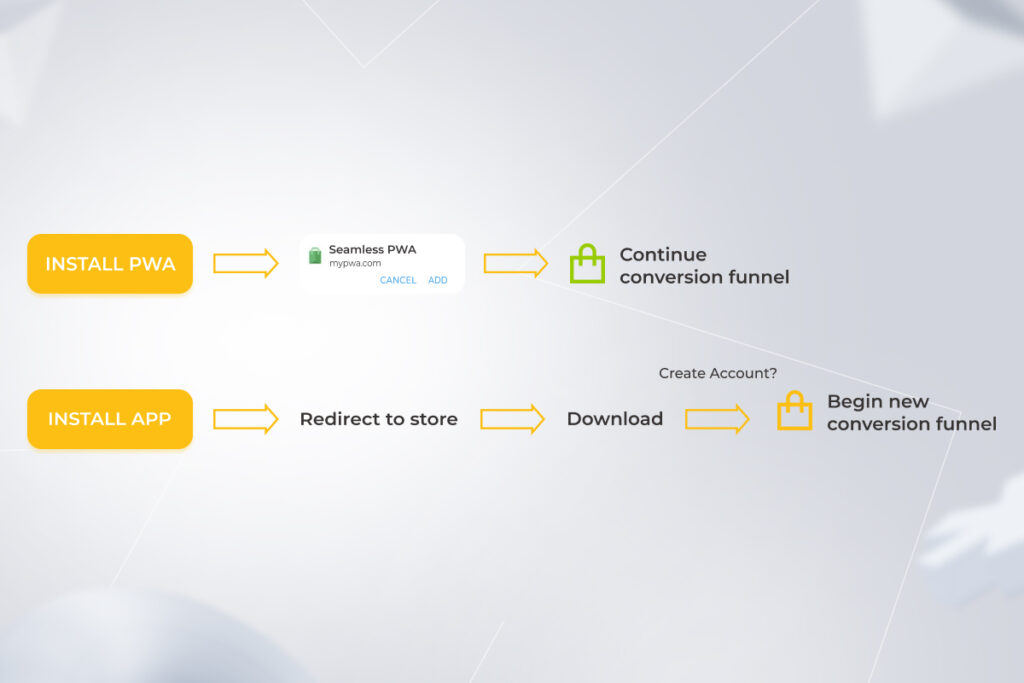
One of the key benefits of PWA is skipping the download and install altogether. Users need two clicks to bookmark it and add it to their home screen for direct access. Therefore, PWA can boost users’ engagement without the hassle of downloads and installations.
Enhancing readers’ engagement and digital media time is one of the top-of-mind goals for brands like Forbes. Thanks to introducing PWA, they experienced a 100% increase in engagement rates and raised readership by 12%.
Native apps require to be installed from official app stores. If you want to build an app that people will turn to frequently, such as social media or a parking app, then a native application is likely your best bet. But, let’s say you’re creating an app for something that people don’t use every day, like insurance claims. In that case, having to download and install a native app can be a real pain.
Here is a simple visualization to compare the convenience of both options from a user’s perspective.
2. Required memory space
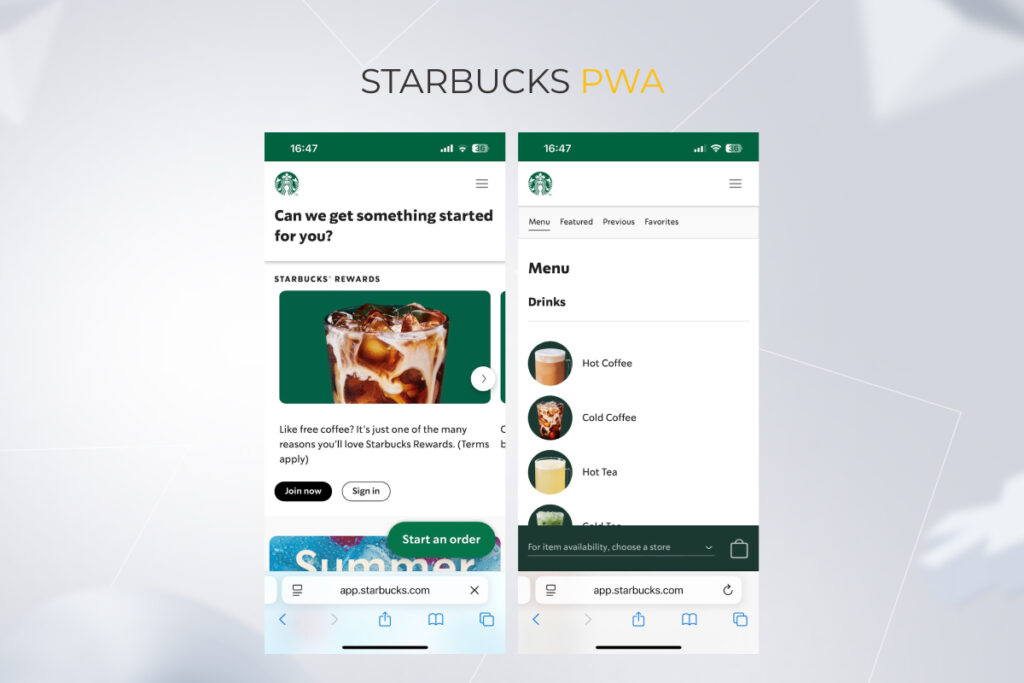
PWAs are designed to be lightweight, so they don’t take up as much space as native apps. For example, Starbucks’ PWA consumes 99.84% less space than its iOS app. It’s one of the most tangible advantages of progressive web apps, and there are other spectacular examples. For instance, Trivago PWA is equal to 1,5% of the size of the native app of this hotel search engine.
Native apps require more space as users need to install them on their devices. That’s the price users pay for the extensive functionality a native app can offer and the accessibility of their personal data which is stored on the devices.
3. Battery consumption
Higher battery consumption is among the notable cons of PWAs. As they run from web browsers, they drain more power than native apps.
Native apps: Native code is the fastest as it’s tied to the underlying OS. Therefore, native mobile applications won’t leave the user device’s battery dry as quickly as PWAs will do.
In native mobile development, you can create a feature-rich application while making sure it consumes as little battery power as possible. Let’s say, if you build a PWA with the same functionality as a native app, it’ll consume way more battery. That is one of the reasons why PWAs are packed with lighter functionality.
4. Functionality
PWA: Bounded flexibility and cumbersome access to mobile or desktop device features is one of the main progressive web app limitations.
Although utilizing Bluetooth and accessing the camera and microphone are already well-supported in PWAs, they still fall short on the background GPS tracking, NFC, and deep sensor integration that require persistent OS-level access. That said, the list of functionality-related cons of PWA is getting thinner every year. For use cases that don’t require always-on background hardware access, a PWA can now cover most of what users expect from a native app.
However, you can still use other ways for user engagement, such as push notifications. This feature is not available for iOS, but if most of your customers use Android OS, it’s worth trying PWA.
Native apps: When it comes to hardware interactions (GPS receivers, Bluetooth, camera, etc.), a native application is your best bet. From smart watches to smart houses, all these solutions require Bluetooth connectivity. This function is also vital for healthcare mobile apps such as the one for blood glucose measuring.
The same works for GPS. Bonnet, one of our clients, came up with a solution that helps EV drivers access the public charging infrastructure. Naturally, it requires the user’s geolocation data, so the solution could only be built in a native app.
Retailers can also benefit from GPS integration, using push notifications to promote in-store deals to nearby customers.
5. Personalization level
Personalization depends on how long you foster a relationship with a user. If they allow the native application to collect data, you can collect it from sensors and hardware. And in the case of PWA, you can only collect data at the browser level.
Speaking of other areas where asking “are PWAs better” gets a clear “not yet,” progressive web apps currently can’t offer extraordinary personalization to your users. Yes, you can provide personalized push notifications based on the customer’s activity on the web application, but only until the user resets the browser settings, and you’ll have to start building a personalized experience all over again.
Native apps: If you want to provide users with a first-class personalized experience, it’s better to invest in native app development. For instance, you can send push notifications based on the user’s personal data, location, purchase history, etc., and the only limitation will be the number of messages your users are willing to receive daily.
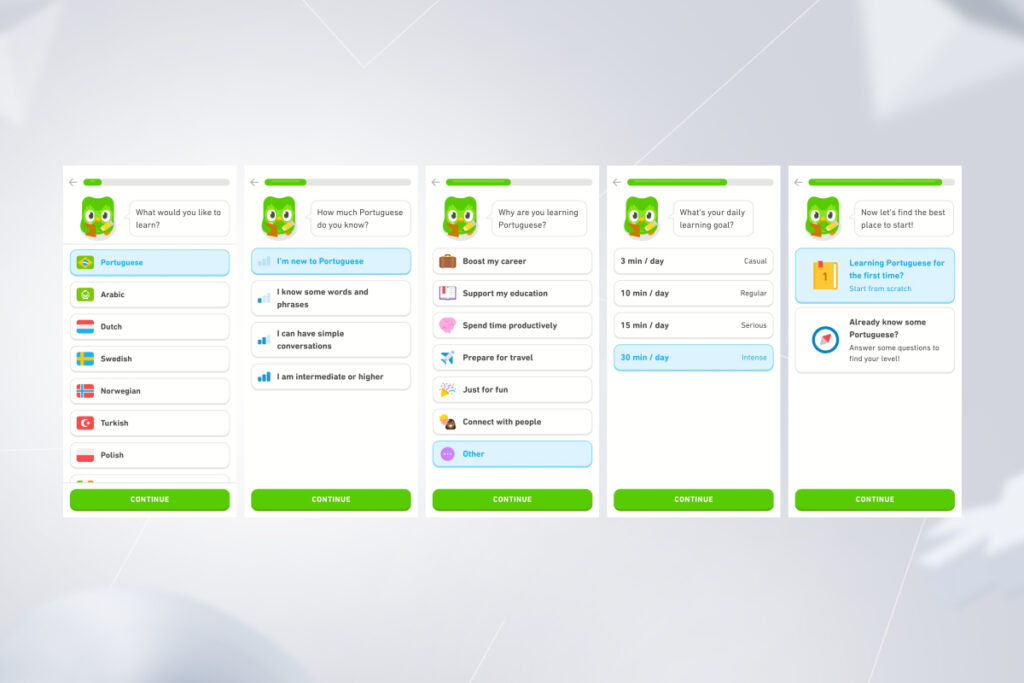
Furthermore, you can take advantage of other personalization strategies used in successful native apps, such as detailed segmentation during user onboarding. That’s the method Duolingo and other educational solutions follow. The app onboards a user with a series of questions to generate a curriculum tailored to the person’s learning goals.
The democratization of AI technologies has also reshaped the personalization game for both native apps and PWAs, but not equally. Native applications still have the upper hand when it comes to on-device AI that requires persistent access to sensors, health data, or background behavioral signals. However, PWAs in 2026 can tap into cloud-based LLMs, ML-driven recommendation engines, and even run lightweight models on-device via WebAssembly and WebGPU. For use cases like conversational chatbots, content recommendations, or AI-assisted search, a PWA can deliver a compelling personalized experience. Where native approach still wins is hyper-personalization that depends on deep device integration, such as agentic systems that perform actions on the user’s behalf, processes biometric data, or leverages multiple AI agents working with OS-level permissions.
For instance, one of our clients, a Czech bank, leveraged frontline technologies to transform their reactive chatbot into a full-fledged virtual financial advisor. A customer can voice the command to send money to a person from their contact list and click only one button to confirm the operation.
Another Instinctools’ client went further, creating a powerful travel assistant for GCC countries. Users can entrust the software to find an optimal flight, hotel, attractions, etc., book them, and pay with the customer’s bank card.
Have a similar project?
Let’s discuss6. Performance
PWA: One of the questions our clients, who are curious about the advantages of PWA over native apps, usually ask is “Can progressive web apps be used in offline mode?” Yes, thanks to the Service Workers caching system, PWAs offline capabilities can be used even when you’re not connected to the internet. In fact, PWAs can offer more efficient app experiences in low connectivity areas. Take the example of Flipkart, an ecommerce platform that needed to provide access to the website for users who only had a 2G connection. After introducing PWA, the time-on-site increased threefold, and the re-engagement rate spiked by 40%.
If you’re running a business presented online, you know that every second counts when it comes to application loading times. With progressive web applications, you can drastically improve your app’s loading speed and boost conversion rates. Statistics indicate that even a 0.1-second increase in website loading can result in a 10% increase in conversions.
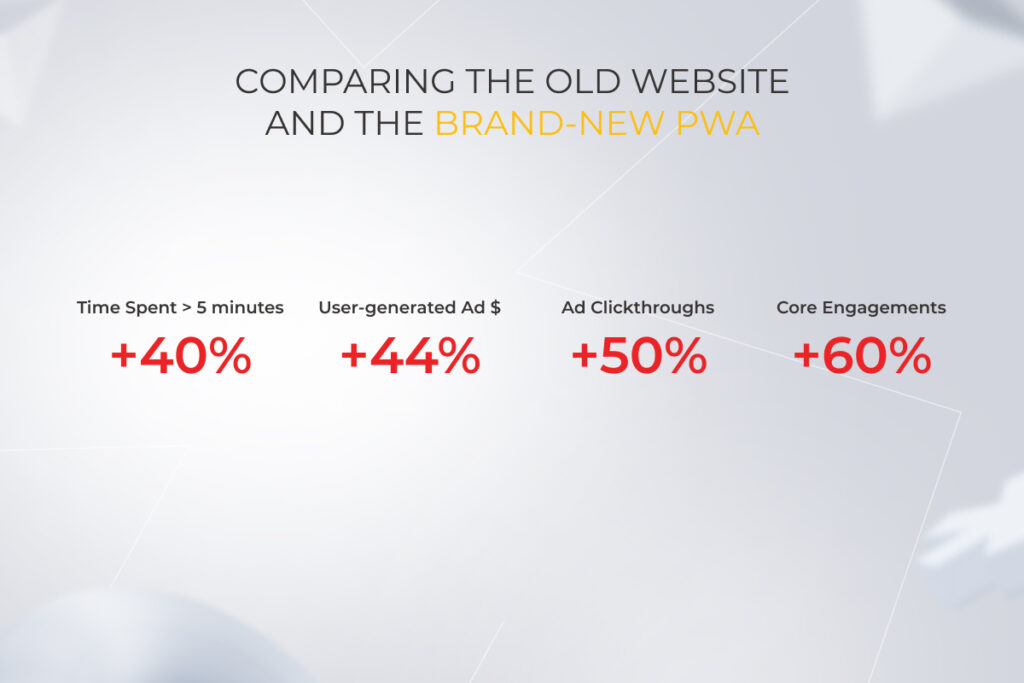
Real-life examples confirm this observation. Faster loading is a direct benefit of PWA that translates into measurable business results. Pinterest’s old website needed at least 23 seconds to respond to user inputs. With PWA, this time was reduced to six seconds, leading to an immediate performance metric enhancement.
Native apps leverage hardware and device features. Therefore, after installation, they integrate seamlessly as part of the user’s device and are more powerful when speaking about PWA vs native performance.
In terms of UX performance, native apps are vastly superior to PWAs. In a native application, rendering is carried out at the hardware level, while in PWA, it’s performed at the browser level. Since progressive web apps are made for all OSs, their UX needs to be unified and simplified. For example, smooth and responsive scrolling we have in iOS-based apps is beyond the reach for web applications.
7. Updates
Updates are a textbook example of progressive web app pros and cons at play. For PWAs, the entire process is automated and doesn’t require users’ participation — they always see the latest version in a browser. On a flip side, the customer cannot influence the app’s updates.
Native apps should be updated on both the company and customer sides.
Users can set up auto updates or manage them manually to keep under control. Managing updates manually empowers customers to choose whether to install a new app’s version or stay with the one they find most handy. With PWA, users don’t have such a luxury.
Advantages of PWA over native apps
Having read this far, you already know the details. Here’s a quick recap of the core advantages of PWA that make progressive web apps a compelling choice for business:
- Cross-platform single codebase. One codebase covers all devices and operating systems – build once, deploy everywhere. No need to maintain separate iOS and Android versions.
- Lower development cost. Crafting a PWA can cost three to four times less than building native apps for two platforms. For companies with an existing web application, migrating to a PWA reduces that gap even further.
- Faster time to market. Native apps have to go through app store submissions and platform-specific builds that take months, whereas a PWA can go live in weeks.
- Instant updates without app store review. With PWAs, you can push changes directly to users, skipping roundabout approval queues.
- Easier discoverability thanks to SEO and GEO. Unlike native apps locked behind app store walls, PWAs are indexable by search engines and citable by AI.
- No app store fees. Skip the 15-30% commission that Apple and Google charge on in-app purchases and subscriptions.
- Smaller storage footprint. PWAs take up a tiny fraction of the space a native app requires.
Each of these advantages of progressive web app development compounds over time: lower costs free up budget for features, faster releases mean quicker feedback loops, and web-native discoverability keeps acquisition costs down.
PWA disadvantages and limitations
No technology is without trade-offs. Here come the most significant PWA disadvantages to factor into your decision:
- Inconsistent support across platforms. Android offers near-full PWA capabilities, while iOS still lags behind with restrictions on push notifications, no background sync, and limited functionality in the EU.
- No full hardware access. Web Bluetooth works on Chrome and Edge but is blocked on iOS. NFC, advanced sensor APIs, and HealthKit integration remain native-only territory.
- Limited Play Store and no App Store presence. PWAs live outside app marketplaces, which means you miss out on this discovery channel. Google Play accepts TWA-wrapped PWAs, but Apple’s App Store does not.
- Browser-dependent performance. Your PWA is only as capable as the browser running it. Safari’s tighter storage quotas, shorter cache persistence, and missing APIs create a noticeably different experience compared to Chrome.
- Higher battery consumption. That’s one of the cons of PWA that matters most for high-frequency use cases, as running through a browser layer consumes more power than native code tied directly to the OS.
- Weaker personalization capabilities. Data collection is limited to the browser level, and resets when the user clears settings. Building a long-term personalized experience is harder without OS-level access to sensors and behavioral signals.
- Perceived trust gap. Users are accustomed to downloading apps from official stores. “Add to Home Screen” may still feel unfamiliar to many and be a reason behind lower install conversion rates.
Understanding these limitations is essential to an honest progressive web app pros and cons assessment. The goal isn’t to avoid PWAs, but to know exactly where they fall short so you can plan around it.
Native app pros and cons
For a balanced mobile app vs. PWA assessment, here’s a summary of where native apps shine and where they don’t.
| Pros | Cons |
| Premium security due to various in-built security features | Higher development cost as you need to develop an app for different OSs and various mobile devices |
| Efficient visibility with ASO | Bigger maintenance costs; updates may be tricky |
| Low battery consumption thanks to the fast native code | Slower time to market because of building solutions for different OSs |
| Boundless functionality (GPS receivers, Bluetooth, camera access, etc.) | Needs to be downloaded and installed by users |
| Unlimited personalization thanks to collecting user data from sensors and hardware | Requires more space on the customer’s devices |
| Higher performance due to using hardware and device features | Needs to be updated on both the company’s and the customer’s sides |
Native app pros and cons
For a balanced mobile app vs. PWA assessment, here’s a summary of where native apps shine and where they don’t.
| Pros | Cons |
| Premium security due to various in-built security features | Higher development cost as you need to develop an app for different OSs and various mobile devices |
| Efficient visibility with ASO | Bigger maintenance costs; updates may be tricky |
| Low battery consumption thanks to the fast native code | Slower time to market because of building solutions for different OSs |
| Boundless functionality (GPS receivers, Bluetooth, camera access, etc.) | Needs to be downloaded and installed by users |
| Unlimited personalization thanks to collecting user data from sensors and hardware | Requires more space on the customer’s devices |
| Higher performance due to using hardware and device features | Needs to be updated on both the company’s and the customer’s sides |
Native apps offer capabilities no other approach can match. Factor in the app cons early, and you can plan around them instead of running into them mid-project.
When to choose PWA over native (and vice versa)
The PWA vs. native decision comes down to what your product needs to do and who it needs to reach. Our mobile experts prepared a quick decision framework to rely on.
Choose PWA when:
- Your product is a content platform, media site, or ecommerce catalog where organic discoverability through SEO and GEO is a key growth driver
- You’re validating an idea with an MVP and speed to market is the priority
- Your audience is unlikely to download an app (think one-time or infrequent use cases like insurance claims, event guides, or booking tools)
- Budget is tight and maintaining separate iOS/Android codebases isn’t feasible
- You need to reach users in low-connectivity environments where lightweight, offline-capable apps matter most
- Your product doesn’t depend on hardware features beyond camera, microphone, and geolocation
Go native if:
- Your product relies on heavy graphics, real-time rendering, AR/VR, or gaming engines
- You need persistent access to Bluetooth, NFC, HealthKit, or advanced camera features
- Your app requires background processing, such as location tracking, data sync, or audio playback
- Push notifications are central to retention, and you need full reliability across iOS and Android
- Performance is non-negotiable as the end users expect smooth animations, hardware-level rendering, and platform-specific UX patterns
- You’re building agentic software that performs actions on the user’s behalf using OS-level permissions
So, are PWAs better? For reach, speed, and cost – often yes. For depth, performance, and device integration, native apps still win. The smartest advantages of PWA for business come from matching the technology to the use case, not picking a side.
PWA and native app examples in 2026
Many of the examples we’ve covered throughout this article speak for themselves. Starbucks, Pinterest, Forbes, BMW, Flipkart, and Trivago all bet on PWAs and saw measurable gains in engagement, load speed, and storage efficiency.
Other companies stay native for good reason. TikTok, Instagram, and Snapchat rely heavily on capabilities that still require full OS-level integration, such as camera access, real-time video processing, and background notifications. The same goes for mobile gaming, where hardware-level rendering isn’t optional.
And then there are companies that choose both. When expanding to new markets, Uber uncovered that they should offer an alternative to their native app for users in locations with 2G low-speed connections. Now, with an m.uber PWA, customers have to wait only two seconds for the app’s content to load, even under the weakest internet connection. As a result, 30% of Uber bookings are made through the web application.
The takeaway is simple: the most successful companies don’t pick sides, they match the technology to the audience.
Whether you decide to build a PWA or native app, Instinctools is your tech ally
Whichever side you choose in the PWA vs. native app standoff, don’t let any technical challenges hold you back. With vetted expertise in both native apps and PWA web technologies, Instinctools is committed to delivering best-in-class software, and we’re here to share our cutting-edge knowledge with you. With our hands-on guidance and forward-thinking approach to development, you can confidently choose the solution well-suited for your users and your budget.
Remove concerns and roadblocks in your app development journey
Reach outFAQ
The difference between PWA and native apps comes down to three things: technology, distribution, and capabilities.
A PWA is built on a web stack (HTML, CSS, JavaScript) enhanced with Service Workers for offline caching and a Web App Manifest for installability. It runs in a browser, is distributed via URL, and is discoverable through search engines. Twitter Lite is a well-known example.
A native app is built with platform-specific languages (Swift/Kotlin) or cross-platform frameworks (Flutter, React Native), distributed through the App Store or Google Play, and has full access to device hardware and system APIs. Instagram is a textbook native-first product.
In short, PWAs prioritize reach and speed, while native apps put depth and performance on the front burner.
The core advantages of PWA over native apps are: ×3-4 lower development cost, faster time to market, instant updates without app store review, SEO and GEO discoverability, smaller storage footprint, and no app store commissions. Pinterest saw +60% engagement after switching to PWA, and Twitter Lite cut data usage by 70%. These benefits of PWA matter most when reach and speed outweigh deep device integration.
The main PWA disadvantages are: inconsistent support across platforms (iOS still limits push notifications and lacks background sync), restricted access to hardware APIs like Bluetooth and NFC, browser-dependent performance, and weaker personalization capabilities compared to native. That said, the list of cons of PWA is getting shorter every year as browser capabilities expand and web standards mature.
In the mobile app vs. PWA decision, lean toward PWA if your product relies on organic traffic, targets infrequent use cases, needs a fast MVP, or operates on a tight budget. Go native if you need heavy graphics, AR/VR, Bluetooth/NFC, or background processing.
The difference between a PWA and a web app is four additional capabilities: a Service Worker for offline mode and caching, a Web App Manifest for installability on the Home Screen, mandatory HTTPS, and push notifications. A regular web app only works online in a browser tab. A PWA vs. web app comparison is essentially a standard vs. app-like web experience: same technology, different level of engagement.
A PWA MVP typically runs $25,000-$60,000 with one team over 3-4 months; a full-featured PWA falls in the $60,000-$150,000 range. Native development covering both iOS and Android starts at $80,000-$250,000 and can reach $400,000+ for complex products requiring two parallel teams. If you don’t need heavy hardware features, a PWA delivers roughly 80% of the result for 30-40% of the cost, making it one of the clearest advantages of PWA for business.
Yes. Every screen in a PWA has a URL, is crawlable by search bots, and supports meta tags and Schema.org markup, just like a regular website. In 2026, this extends to GEO as well: PWA content can be cited by AI-powered search platforms, while native app content cannot. For content-driven products and ecommerce, this organic discoverability is one of the most valuable progressive web app benefits.
Yes, both directions are possible. Converting a native app to a PWA means rebuilding on a web stack (React, Angular, Vue) and adding a Service Worker and Manifest. Going from PWA to native, you can use wrappers like Capacitor or do a full rewrite in Swift/Kotlin/React Native. Most businesses start with a PWA and move to native later when hardware features become a requirement.
Will cats replace dogs since they both are pets? The same is relevant for the debate regarding PWAs and native mobile apps. Each solution has its pros and cons, so one cannot fully replace the other. However, as a business owner, you should stay in the know of both options to find the golden mean between your budget limitations and users’ needs.
Let end-users guide you. If your audience is unlikely to download and install the app, invest in developing a progressive web app that doesn’t require these actions. And if you need to collect data from users’ devices to provide them with a first-class UX and CX, a native app wins. Also, consider building both a PWA and a native app to cover more customer groups.
There are several advantages of PWA over native apps, such as a no-installation approach, accessibility via any web browser, and platform compatibility without extra development efforts. Nevertheless, the progressive web app is not better than native apps. Each has its strengths and weaknesses. They are tools to achieve different goals and reach different targeted audiences.
Subscribe to
Instinctools blog