Context Engineering in AI: Techniques, Best Practices, and How It Differs From Prompt Engineering

Blame the model when your AI agent fails… That’s the instinct, but it’s almost always wrong. The model rarely breaks. What underdelivers is the information environment built around it: the wrong data at the wrong time, in the wrong shape, handed to a system with no memory of what came before. That’s a context engineering problem. And until it’s solved, no amount of prompt tuning can bridge the gap. 

Our AI Center of Excellence practitioners break down the context engineering techniques, strategies, and best practices that yield much-coveted results.

Key highlights

  • Context’s components determine what an AI model sees, what it remembers, and what it acts on.
  • Issues like context rot and “lost in the middle” quietly degrade AI systems’ reliability over time, but there are ways to address them.
  • Agentic workflows amplify both good and bad context-related decisions you make. A solid middleware infrastructure can help you keep that under control.

What is context engineering in AI?

Context engineering is the practice of controlling what information an AI model receives before generating a response. It’s about building the infrastructure that dynamically assembles the relevant context for each task, creating an environment where AI agents can work like humans: holding onto relevant conversation history, accessing external knowledge when needed, and adapting on the fly rather than treating each interaction as a blank slate. 

Context in AI: core components

Context goes far beyond the prompt you type. It’s everything the model has access to before generating a response: 

  • System instructions that set the model’s behavior upfront, including guardrails, tone, policies, and rules that shape how the model responds before it even sees your query.
  • User input that sets the immediate task and receives top attention priority from the AI model.
  • Conversation history from the same session, so the model stays consistent throughout the dialog.
  • External knowledge retrieved from documents or databases (RAG) and pulled in whenever the model needs up-to-date information stored outside its parameters, such as customer records for an AI support agent handling tickets.
  • Available Tools and integrations the model can invoke to take action, say, send an email, check inventory, or query real-time APIs. 
  • Structured output constraints like JSON schemas that ensure the model returns data in the format your system can parse and use. 

In practice, though, even the best models have a hard ceiling: they can’t (at least, not yet)  retain unlimited context with equal clarity. Every LLM operates within a finite context window – its active workspace that can contain only a fraction of the current conversation. As new information comes in, older details get pushed out, compressed, or overwritten entirely.  

Honing context’s components is a must, but it isn’t enough. You also need to organize and use them strategically to get the most out of the model capabilities despite the context window limitations.

 – Pavel Klapatsiuk, Lead AI Engineer, Instinctools
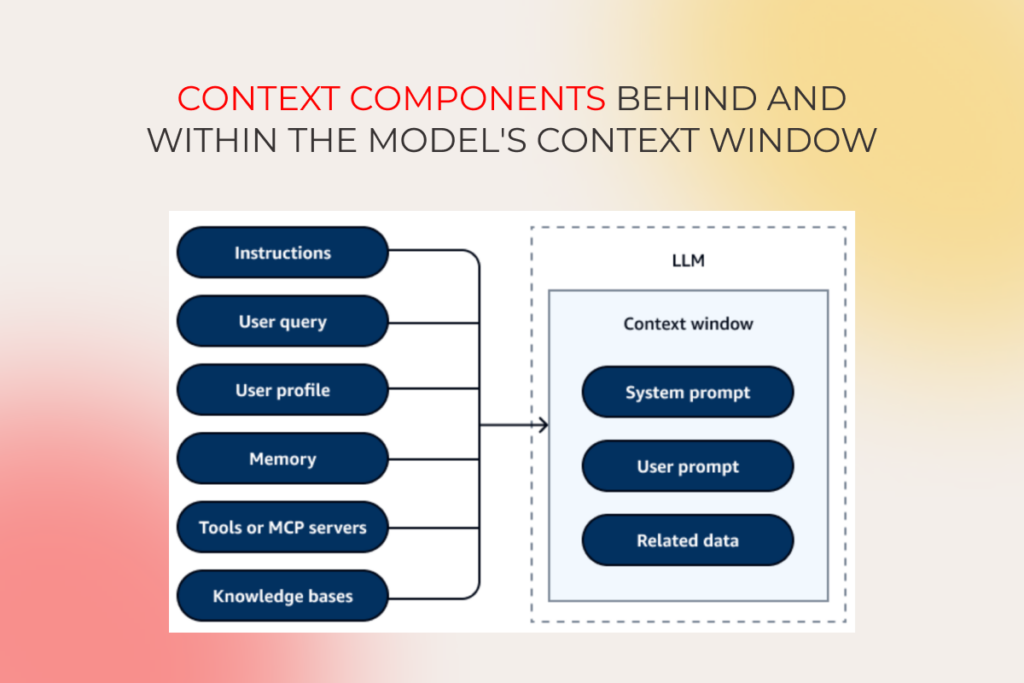
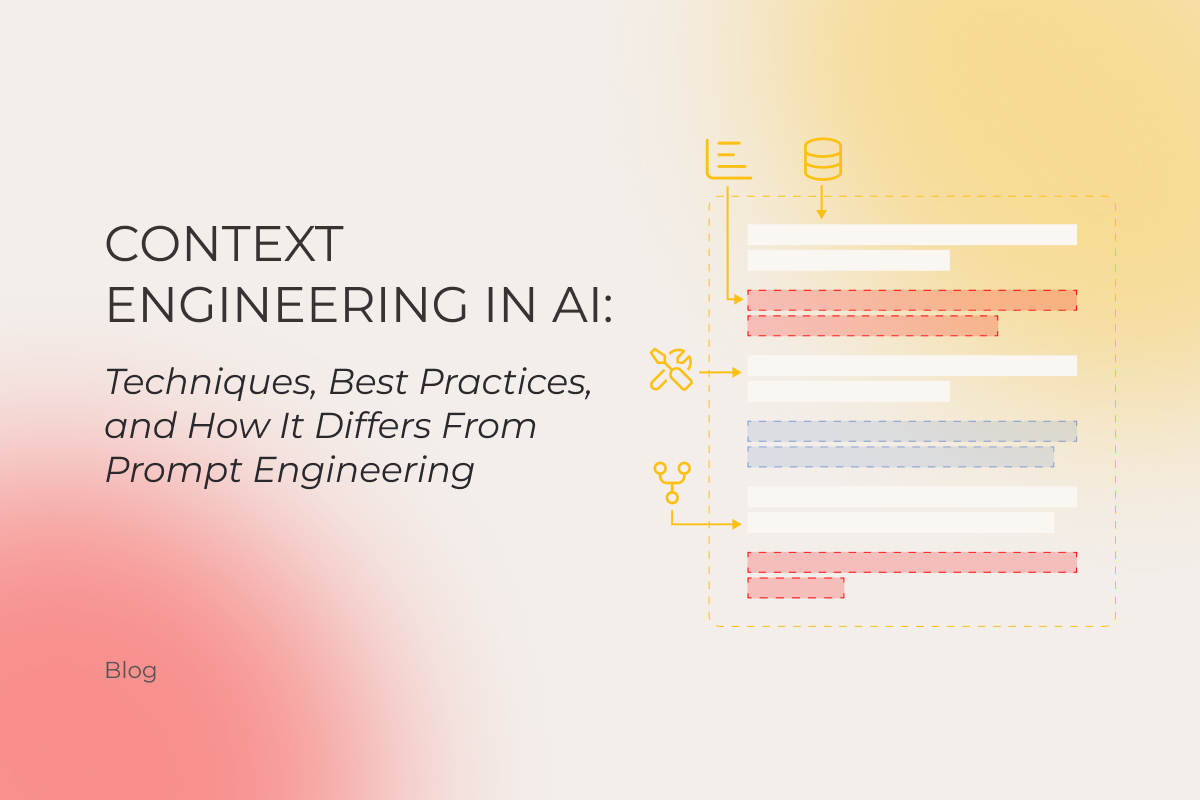
A diagram shows “CONTEXT COMPONENTS BEHIND AND WITHIN THE MODEL’S CONTEXT WINDOW.” It lists inputs like instructions, user query, and memory flowing into an LLM’s context window, which holds system prompt, user prompt, and related data.

The benefits of context engineering for GenAI systems

Without context engineering, a large language model can handle isolated queries, but underdelivers when it comes to workflows that stretch across days, teams, or systems. Context engineering is the power behind the models’ shift from mere responsiveness to durable continuity, which enables them to carry intent forward and support complex, multi-step processes.

More accurate and reliable outputs

Reliable AI outcomes don’t come from well-prepared data and clear prompts alone, but from precise context design. Context engineering filters, structures, and prioritizes what the model sees, reducing noise and ambiguity, so outputs stay consistent and grounded.

Less back-and-forth prompting

When the model has user preferences, project history, and available tools baked into its context, you no longer have to waste time explaining the same setup over and over. That way, one well-engineered context replaces multiple clarifying questions, bringing human employees closer to AI-enabled productivity. 

Higher consistency across files and repositories

AI coding assistants like Claude Code, Cursor, etc., work better the longer you use them because they build context about your codebase, naming conventions, architecture patterns, and dependencies between modules. Instead of suggesting solutions from scratch, they align with your style and the bigger picture spanning beyond a single conversation.

Longer flow state

Constant correcting of model outputs or rewriting prompts kills momentum. With context engineering handling the setup work, such as pulling in the right files, remembering your last changes, and understanding project structure, you spend less time micromanaging the model and can switch to strategic oversight mode.

Better token efficiency and AI context understanding 

Without smart contextual engineering, dumping raw information into the prompt dilutes the signal and forces the model to spend attention on irrelevant details. Context engineering improves token efficiency by increasing signal density and keeping the most decision-critical information in view, which reduces context drift, missed constraints, and confident-but-wrong answers.

Context engineering vs. prompt engineering: why prompts are not enough

Prompt engineering and context engineering aren’t rivals. Operating at different layers of the same system, prompt engineering focuses on crafting the perfect query, while context engineering prioritizes the ecosystem that makes that query work. You can wordsmith clear instructions all day, but if the model doesn’t have access to relevant history, external data, or the right tools, even the best prompt falls flat.

Prompt engineeringContext engineering
Focus on crafting individual instructionsFocus on designing systems that manage information flow
Query optimization inside the model’s context window limitShaping what fills the window and when
Separate tasksMulti-step workflows

As models evolve beyond simple Q&A into handling longer workflows and more complex tasks, the bottleneck shifts from “how do I phrase this?” to “how do I assemble and maintain the right context across dozens of interactions?” That’s where prompt engineering stops being enough, and context engineering becomes decisive. 

Core context engineering strategies and techniques 

Since effective context engineering is about deliberately controlling what goes into the model’s limited context window at each step, humans stay in charge of deciding what stays, what gets compressed, and what gets cut. There’re several techniques experienced AI engineers typically rely on to manage context at scale.

  • Tool loadout. The fewer tools a model has to choose from, the lower the decision noise and token consumption is, so instead of exposing it to numerous narrow-focused, likely overlapping tools, limit selection to several versatile, general-purpose ones. 
  • Context pruning. To keep the window focused on what’s relevant right now, continuously remove outdated and conflicting information as new details arrive.
  • Context summarization. Periodically distill accumulated history into a short decision log that preserves key facts, constraints, and rationale in the limited context window. LLM-based tools like Claude code and Cursor have an auto-compact feature, allowing great context compression after you’ve used 95% of the context window. 
  • Context offloading. Rather than holding all potentially useful information in the model’s active workspace, store relevant data outside the LLM’s context using external tools or memory systems and enable the model to reference a knowledge base when needed.

Context engineering best practices to save the day

While you can’t extend the model’s attention beyond its context window, it’s possible to reduce how often that limit becomes a problem. 

Build a memory system that keeps the context relevant by design

Even when stored in a dedicated database, memory tends to degrade over time. As outdated or low-signal entries accumulate, retrieval becomes noisier, and that noise can leak back into the context, distorting outputs. 

The best defense here is preventive: it implies building memory maintenance into your system from the onset. Track recency and retrieval frequency to decide what to keep, what to refresh, and what to retire. 

At Instinctools, we usually distill the conversations worth permanent storage into memory notesthat we can then inject back into the model context when necessary. It proved useful, so we enhanced and reused this approach when creating our own platform for building AI agents with strong context engineering mechanisms at its core. 

– Pavel Klapatsiuk, Lead AI Engineer, Instinctools

Prepare data for AI

Data preparation matters just as much as a well-governed memory system. Before an AI solution can perform reliably, the data it learns from has to be cleaned, structured, and aligned with the task it’s meant to support. That means auditing what you already have, filling gaps, removing errors and bias, and validating that the dataset reflects real-world conditions. Otherwise, even the most advanced model can’t deliver accurate, trustworthy insights if the data feeding it isn’t ready for AI.

Establish MCP-enabled tool usage

It takes tools for the models to go from reasoning to acting, for example, checking live stock prices, sending an email, or booking a flight.

Providing the model access to tools is no longer the hardest part. Open standards like Anthropic’s Model Context Protocol (MCP) provide a consistent way to connect assistants to the systems where data lives and the tools they can call. The real challenge is giving the model clear tool definitions and examples of proper usage to ensure it knows which tool callsto make and how to interpret the results.

– Pavel Klapatsiuk, Lead AI Engineer, Instinctools

Simpler and more reliable AI agent context engineering with a middleware infrastructure layer

Context engineering becomes mandatory when moving from ML models to agentic systems, because agents not only use context, but also create and reshape it through tool outputs, intermediate plans, and stored memories. So, in this loop, the rule of context engineering for AI agents holds true: agentic workflows amplify whatever context-related decisions you make, both good and bad. 

One poorly engineered agent can poison the entire system. In a multi-agent customer support setup, for example, a retrieval agent might pull outdated return policies or documentation for the wrong product. The response agent, trusting that input, will then draft a confident but incorrect answer or trigger an automated action based on the wrong policy. That’s how, in a split second, one bad context decision upstream will cascade into a system-level failure, degrading customer experience.

– Ivan Dubouski, Head of AI Center of Excellence, Instinctools

A dedicated middleware layer, like GENiE, helps keep multi-agent context disciplined and predictable through:

  • Context isolation. Splitting different contexts across sub-agents, each with its own context window, tools, and instructions. Such an approach enables agents to run in parallel and serves as a safeguard: if one fails, the others won’t be affected.
  • Adaptive context hierarchy with hot, warm, and cold layers. Frequently needed information stays in hot working memory for immediate access, warm context sits in near-term storage for quick retrieval, and cold context gets archived but remains accessible when workflows require historical depth.

Context engineering in action: 12× faster insurance partner onboarding with a context-aware agent system

How much faster can partner onboarding become with a well-orchestrated human-AI collaboration? For our client, a global insurance aggregator, we managed to cut it from three-six months to two weeks by adding agentic AI and designing how context is constructed, scoped, verified, and handed off between agents.

We used GENiE, our proprietary middleware infrastructure, to automate partner onboarding, a process that previously required manual data entry and cross-departmental coordination for document validation and compliance checks. The multi-agent system our AI team created handles context across multiple stages, extracting data from partner submissions, cross-referencing compliance databases, flagging missing information, and routing approvals. 

Context engineering was the central pillar of the project, ensuring each agent received only relevant information for its role, preventing document overload and keeping workflows moving. The result lives up to AI productivity promises: partner onboarding time dropped from months to weeks, accuracy improved through pre-validation and structured facts, and the need for manual interventions was kept to a minimum.

Want to try GENiE capabilities yourself?  

Book a demo

Common context engineering challenges (and remedies for them)

Philipp Schmid of Google DeepMind states that 80% of failures in AI agent development stem from context misinformation. Instinctools’ AI practitioners agree that the problem lies not with the models themselves, but with the information environment engineered around them. When context is bloated, contradictory, or poorly organized, even capable models produce garbage. Our AI CoE experts share their perspective on the two major challenges they faced and dealt with firsthand.

Lost in the middle issue

As we’ve mentioned before, LLMs operate on a limited processing bandwidth. The larger your context grows, the more selective their focus becomes. You can technically cram 100,000 tokens into context, but that doesn’t guarantee the model processes all of them equally. Our on-the-ground observations confirm that models pay close attention to what appears first and last in the context window, while the middle tends to be skimmed at best or ignored. 

One of the practical context strategy tips is to put critical information at the edges – up front and at the end. Everything in between should be structured with clear headings and formatting. When context balloons, compress the middle into summaries and keep only what’s immediately actionable in full detail.

– Ivan Dubouski, Head of AI Center of Excellence, Instinctools

Context rot

When AI agents take over longer workflows, context can accumulate faster than it can be curated. Over time, it degrades and starts working against you, leading to a phenomenon called context rot. 

Context rot typeHow it shows upPractical moves to fix it
Context poisoningA hallucination is saved as a reliable fact and then referenced repeatedly in outputs.Run separate context threads for different tasks. When errors surface, quarantine the thread and start clean rather than trying to correct within a contaminated context.
Context distractionOnce context nears 100K tokens, the model starts favoring accumulated history and repeating old patterns instead of focusing on what matters now. Compress ruthlessly. Turn 50,000 tokens of conversation into a 2,000-token summary that captures decisions, constraints, and current state without repetition.
Context confusion Too much extra information and access to too many tools blur the model’s focus and increase wrong or unnecessary actions. Keep the active tool set small and use retrieval techniques to surface only relevant tools for each task.
Context clashInformation arrives in stages, so early assumptions remain in context even after new facts contradict them. Delete outdated statements when new information arrives. Give models a scratchpad workspace, like Anthropic’s “think” tool for experimental reasoning, so it doesn’t pollute the main context thread.

Need expert help to combat context-related issues?

Let’s talk

A field-tested context engineering checklist

Before deploying an AI system, run through this checklist to catch the context failures that quietly derail otherwise capable solutions. 

1. Context design

1.1. Define the core components: system instructions, conversation history, retrieval sources, available tools, and output schemas

1.2. Put critical information at the start and end of the context window; compress the middle into summaries

1.3. Limit tool access to general-purpose tools rather than overlapping narrow-focused ones (under 30 tools, better even fewer)

2. Memory and retrieval

2.1. Build memory maintenance into the system from day one — track recency and retrieval frequency to retire stale entries

2.2. Use RAG to pull external knowledge only when the model needs it, not as a default data dump

3. Ongoing context hygiene

3.1. Prune outdated, conflicting, or irrelevant information as new details arrive

3.2. Summarize accumulated context 

3.3. Delete outdated conclusions the moment new information supersedes them

3.4. Validate information before committing it to memory to prevent context poisoning

3.5. Give agents a scratchpad workspace to process without cluttering the main context thread

4. Agent context architecture

4.1. Isolate context across sub-agents: separate context windows, tools, and instructions per role

4.2. Apply hot/warm/cold context hierarchy to balance long-term memory, speed, and historical depth for more effective AI agents

Make context engineering your competitive advantage 

Context engineering isn’t a one-time configuration. It’s a cross-functional challenge as much as a technical one, calling for understanding your business use case, defining expected outputs, and structuring everything so the model can accomplish the task. 

Сompanies that get this foundation right early build a compounding advantage, since a well-engineered context makes the next interaction faster, more accurate, and less dependent on human correction. It becomes a strategic asset that helps you outperform competitors in the AI adoption race. 

Ready to master context engineering?

Talk to our AI CoE

FAQs

Is context engineering just RAG?

No, retrieval-augmented generation (RAG) is one of the components of context engineering. Broadly, context engineering AI systems go much further, also including user instructions, message history, tools, external knowledge, and structured output.

Do small models benefit from context engineering?

Yes. Any model benefits from contextual engineering, as LLMs of any size are prone to context-related issues, but smaller models benefit the most. When model capacity is limited, disciplined context selection dramatically improves reliability and helps compact models punch above their weight.

How much context is too much?

Too much context is whatever triggers context poisoning, distraction, confusion, or clash. Model performance drops significantly around 32,000 tokens, even with million-token windows available, because the model starts looping through accumulated history instead of reasoning clearly. So context engineering principles like summarization, pruning, and selective injection remain necessary regardless of window size.

How does context engineering improve AI performance?

It improves accuracy by increasing signal density, reliability by reducing contradiction and drift, and efficiency by minimizing back-and-forth prompting. Instead of starting from scratch each turn, the model operates within a curated, task-aligned environment with strong AI context understanding.

How does context engineering improve AI models?

AI context engineering doesn’t change models themselves, but it improves the conditions under which models reason. A well-organized context provides the model with relevant history, precise system prompt, accurate external knowledge, clear tool definitions, and structured output constraints. The result is that the same base models operate with greater precision and accuracy, enabling more reliable, sustainable workflows rather than collapsing under accumulated noise.

Agentic Commerce: How Buying Behavior Is Being Radically Rewritten

How is AI changing ecommerce? For the first time in history, we are witnessing a paradigm shift in digital commerce that not just redefines the venue of shopping but also assigns a new actor. We’re talking about agentic AI commerce that is slated to have a major impact soon. By 2030, the US B2C retail market alone could see up to $1 trillion in orchestrated revenue from this new shopping mode.

For retailers, this is not the time to play it by ear, because any time soon, a lion’s share of their customers will not be human users but rather AI agents. So how can one prepare for the transformation on the scale of the prior web and mobile-commerce revolutions? Our ecommerce software development company has laid out all the whys and hows of agentic AI in commerce, with clear action points ecommerce companies can start implementing right away.

What is agentic commerce?

Agentic commerce is a retail model where autonomous AI agents can discover products, negotiate prices, and execute transactions on behalf of shoppers. Ecommerce agents rely on three specific capabilities that make them a distinctive category:

  • Reasoning and planning to break down a complex goal into a step-by-step checklist.
  • Cross-platform action to travel across the web to complete the action.
  • Tool usage by leveraging APIs to do specific actions autonomously.
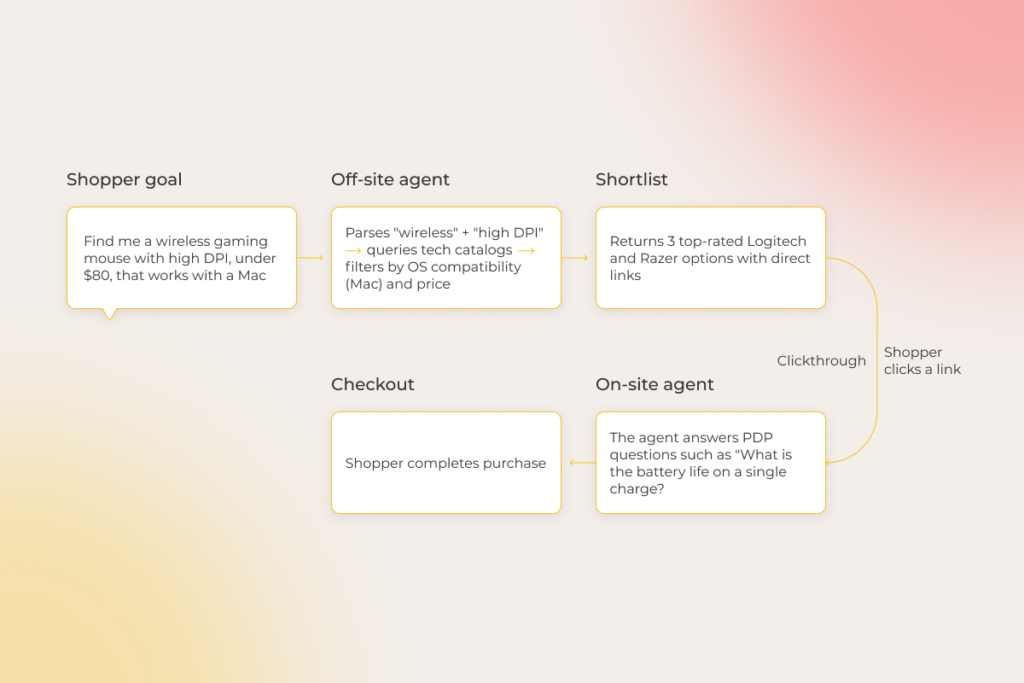
A flowchart on a soft pink-yellow gradient background showing steps to buy a wireless gaming mouse. Boxes labeled Shopper goal, Off-site agent, Shortlist, On-site agent, and Checkout describe the shopper’s process from searching to completing purchase.

Agentic AI commerce isn’t confined to online shopping only and can live within a wide range of commerce experiences, including travel, ticketing, subscriptions, and physical retail integrations.

From the interface point of view, agentic commerce tools come in two forms:

  • сonsumer-facing commerce agents that transact on behalf of the customers.
  • merchant-facing commerce agents designed to streamline retailer and service provider operations. 

As for the specific adoption approach, retailers can make their products and services readable to external agents, like ChatGPT or Perplexity, and also build their own branded agentic ecosystem to have an exclusive right over first-party customer data.

Core differences between agentic shopping and AI-powered commerce 

Earlier generations of retail AI, such as recommendation engines and chatbots, act mainly as a predictive layer whose reactivity is minimal if present at all. Such forms of AI assistance can guide human decision-making during the product discovery, evaluation, and purchase phases, but lack the authority to take the lead in the transaction.

While traditional AI is somewhat peripheral, agentic AI takes the central stage in the shopping journey and can trigger actions across multiple systems on the user’s behalf. Agents can search, compare, negotiate, decide, and transact within limitations set by the user.

FeatureAI-powered commerceAgentic commerce
Control and agencyHuman-first: AI assists, human controlsAI-led: AI acts autonomously with human approval on key decisions
User’s roleActive driverSupervisor
Core scopeA set of standalone tools, with each tool being dedicated to a specific taskAn end-to-end system that executes multi-step workflows from discovery to purchase
ArchitectureOperates on single-model inference embedded in fixed touchpointsRun multiple models, tools, and APIs
Primary purposeOptimize and elevate the traditional shopping journeyRe-engineer and automate the traditional shopping journey
ExampleRecommendation systems, botsAutonomous price-negotiators, cross-retailer personal shoppers.

Right now, both operating styles exist on the ecommerce spectrum, and each of these have their time and place. But if we were to draw a clear line between the two, traditional AI is more about persuading the customer, while agentic AI is about executing for the customer. 

Agentic commerce as a new, beneficial frontier for ecommerce teams

The benefits revealed by agentic commerce tools are as unique as the concept itself, and those who adopt early get to reap the best of them and learn the fastest.

Winning in new sales channels

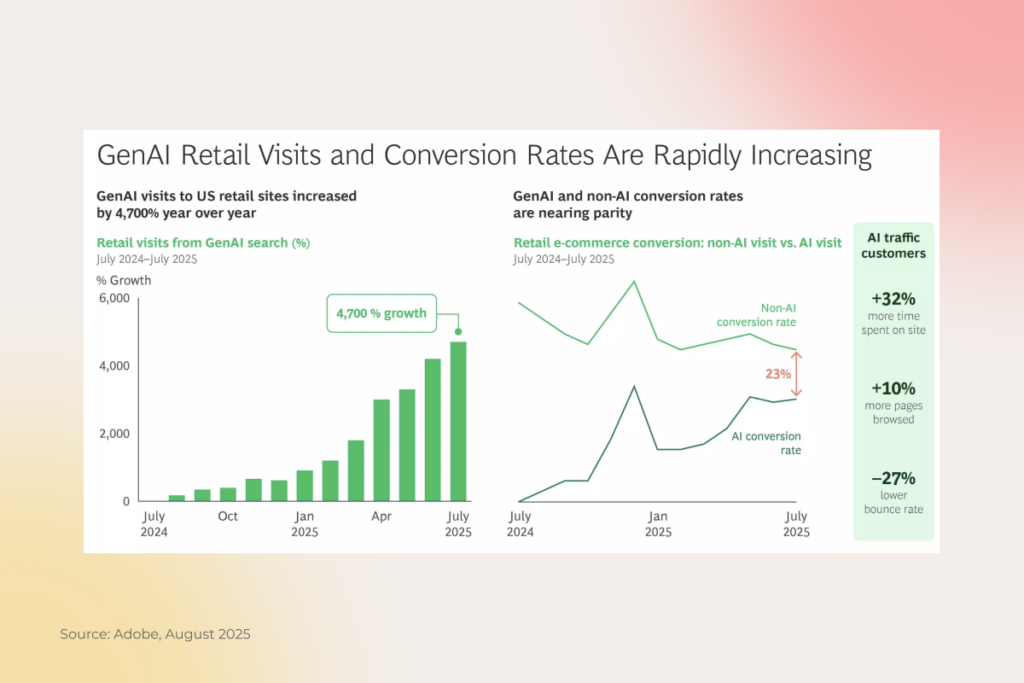
Traffic to US retail sites from GenAI browsers and chat services soared 4,700% year-over-year in July 2025. The engagement quality of such users is materially higher: they spend 32% more time on site, browse more pages, and bounce less often. 

A data graphic shows GenAI retail visits and conversion rates rising. Bar graph: GenAI visits up 4,700% from July 2024 to July 2025. Line graph: AI and non-AI conversion rates converge near 23%. Sidebar: Users spend 32% more time and have a 27% lower bounce rate.

If a retailer doesn’t establish a presence in these sales channels, they risk losing both traffic and decision-making influence on customers in the near future. Conversely, machine-readable and transaction-friendly products will boost AI agent visibility and drive higher conversions. 

Scaling hyper-personalized curation

Having branded commerce agents on hand allows retailers to offer the VIP concierge experience to every customer with no marginal costs. Unlike recommendation systems, agentic transactions make use of the context that goes beyond on-site behavior and includes other cross-platform sources of customer data, such as calendars, emails, wearables, and past receipts. 

So, when the shopper expresses an intent, the agent can return a purchase-ready basket – an all-in configuration that takes into account shipping windows, loyalty benefits, and substitutions. 

Going from reactive support to autonomous service 

Autonomous ecommerce agents don’t need an open ticket to spot a looming issue. Since they have the connection to the customer’s journey and the retailer’s supply chain on speed dial, they can locate friction before it impacts the customer experience. For example, if the package is canceled due to a logistics issue, the agent can proactively suggest a similar in-stock item from another store instead of sending the customer a disappointing cancel notification.

Frictionless checkout 

Agent payments protocols like UCP (Universal Commerce Protocol) and AP2 (Agent Payments Protocol) allow retailers’ systems to securely talk to multiple agents, payment providers, and platforms. Through these protocols, agents can pass along verified payment credentials, shipping information, and identity data to make purchases on behalf of the customer. This gives way to zero-click fulfillment, where customers don’t have to go through endless forms and logins to check out. 

Streamlining backend office tasks

Standard rule-driven automation is pretty much blind to evolving context, which means that it can suffice for repetitive backend office tasks, but needs manual recalibration for out-of-the-box changes. Agentic AI is more capable when it comes to complex inventory management, pricing, and support scenarios, because it can adjust reasoning on the fly based on the changing demand, supply, and customer context.

Ready to bring autonomous agents to your ecommerce?

Contact our AI team

How agentic commerce actually works

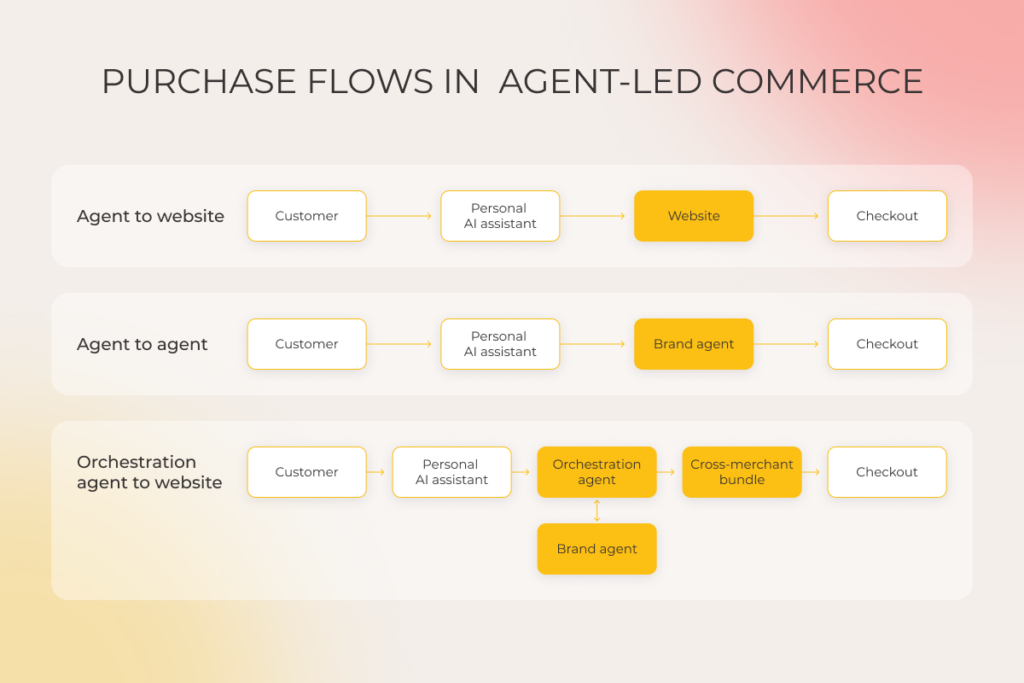
On a high level, agentic commerce is a multi-step process that bridges customer intent with the merchant’s data. But this can play out in different ways, because the specific operating pattern of ecommerce agents depends on the interaction model: agent to site, agent to agent, or orchestration agent to site. 

A flowchart titled Purchase Flows in Agent-Led Commerce shows three sequences: Agent to website, Agent to agent, and Orchestration agent to website. Each sequence involves a customer, AI assistant, agents, websites, bundles, and checkout steps in interconnected boxes.

Below, our AI agent development team has described a step-by-step flow of the agent-to-site model, which is enabled by Google’s Unified Commerce Protocol and OpenAI’s Agentic Commerce Protocol.

1. Goal definition 

Users prompt an intermediary system, such as ChatGPT or Google AI Mode, with a shopping brief in natural language. The brief can be anything from a specific technical request (“Find me a 4K OLED monitor with a 144Hz refresh rate”) to a complex lifestyle-driven problem (“I’m going on a 2-day trip to London next week, and I realized I don’t have a waterproof rain jacket”). From that brief, the system’s LLM distills defined parameters, like the size, budget, shipping time, and necessary specs.

If the user’s prompt is too vague or broad, the agent asks a series of follow-up questions to gain a deep understanding of the user’s preferences and hard or soft constraints.

2. Autonomous discovery 

Using protocols such as the MCP (Model Context Protocol) or specialized commerce APIs, the agent heads out to retailers’ databases to query product feeds. The agent can scan dozens of machine-readable stores simultaneously. However, it doesn’t look at marketing banners but goes straight to the retailer’s real-time inventory levels, SKU data, and shipping calculators to fish out accurate information.

3. Reasoning 

The agent studies the discovered options and pits them against the non-negotiables set by the user. If no option has a 100% match with the user’s query, the agent weighs the trade-offs and curates a list of products with the most optimal specifications.

4. Execution 

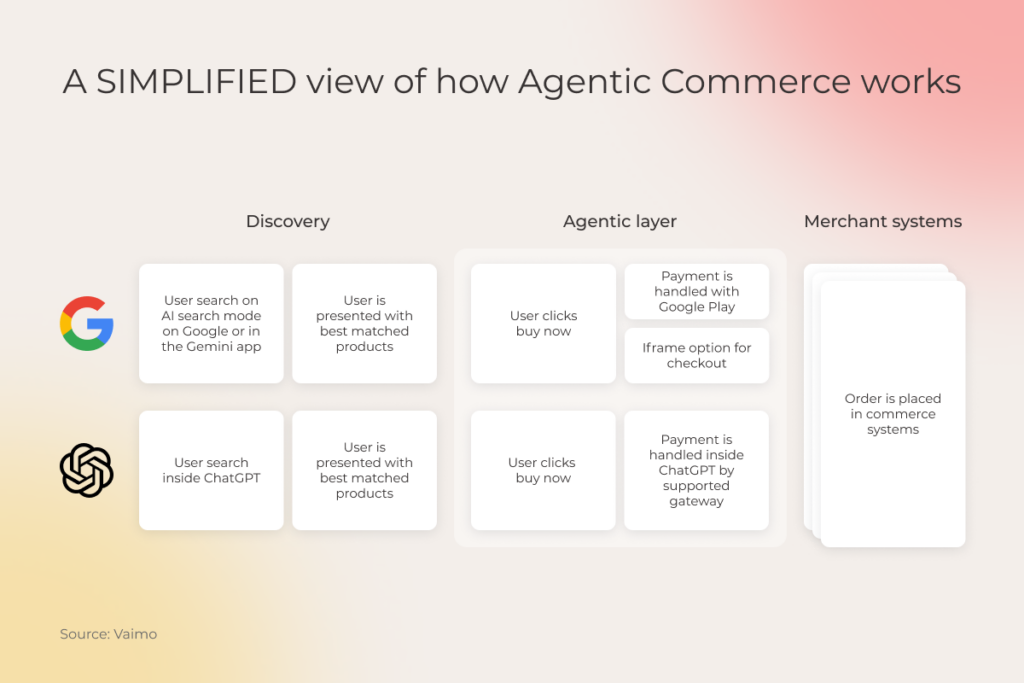
Once the user approves one of the offered options, the agent closes the loop. Via API, it hands over the order to the merchant’s system, using secure payment gateways like Google Pay to finalize the agent-led transaction. From a technical standpoint, agentic payments take place within the headless checkout environment, which means that the customer doesn’t have to leave the AI interface to have their order placed.

As for the security aspect, sensitive data such as the credit card number, shipping address, and other information is tokenized.

A flowchart explains Agentic Commerce: Users search on Google or ChatGPT, see matched products, click buy, use Google Pay or a ChatGPT-supported payment gateway, and an order is placed in merchant systems. Logos for Google and ChatGPT are shown. Source: Vaimo.

The reality check: current limitations of commerce agents

The workflow we’ve described earlier is a textbook representation of how agentic commerce should work in theory. In practice, though, AI shopping agents face constraints that stem not so much from the technology itself, but rather from an immature ecosystem.

AgentCapabilitiesLimitationsSpecs
GPT Instant CheckoutCan complete full checkout inside ChatGPT (single-item purchases) via the Agentic Commerce Protocol Initially supports single-item transactions; multi-item carts are planned but aren’t fully rolled out; no returns in chat; US only rollout.Needs headless commerce to operate; uses Stripe and OpenAI’s ACP
Perplexity AI shoppingUsers can search, review, and buy products directly in chat via PayPal or Venmo.Only for participating merchants/products; for single-item shopping only; US only/Pro Plan rollout.Payments are processed through PayPal/Venmo; merchants remain the seller of record.
Microsoft CopilotSupports checkout flows inside Copilot conversations across partners; users can complete purchases inside chat.Merchant participation required; supported partners include PayPal and Stripe; US-only rollout.Built on open standards and payment integrations; semi-autonomous flow.
Google Gemini/AI modeAllows users to discover products and complete purchases directly within the Gemini app or Google Search AI Mode using integrated checkout (Google Pay)Available initially in the U.S. only; only eligible merchants participate; requires Google Pay; limited coverage.Powered by Unified Commerce Protocol
Shopify AI agentEnables embedded checkout within AI agents like ChatGPT, Copilot, etc.; users can browse and complete purchases conversationally.Early access feature; merchants must enable it; available for US stores.Merchants see orders in Shopify admin and control data; integrates with broader AI ecosystems.

As you see from the table above, agentic commerce and agentic checkout are currently represented by several platforms in some form, but their availability is limited and conditional due to feature maturity, subscription requirements, and regional availability. 

Most importantly, only a handful of merchants have dabbled in agentic interfaces and made their products machine-readable, so the speed and magnitude of adoption are dependent both on the agent’s functionality and the merchant’s participation. This highlights where early innovators can differentiate by solving for trust, compliance, and integration at scale.

The tech foundation for AI ecommerce agents, four core layers

Retail agents can travel across different retailers without requiring custom integrations with every single shop. This capability of agentic AI tools is fuelled by a universal, interoperable technology stack that allows the participating systems to plug into each other and team up for transactional tasks. 

Function/layerKey componentsCore role
Intelligence Personalization, MemoryWho is buying? User profile, preferences, and needs.
Planning Dynamic Planning, ReasoningHow to buy? Strategy, step-by-step logic, and troubleshooting.
CommunicationMCP, A2AHow do agents/tools negotiate? Shared context, capability exchange, secure collaboration.
Transaction and actionComputer use, Headless APIs, AP2, UCPHow does execution happen? Cart/checkout/order actions, payment initiation, and UI automation when APIs aren’t available.
Infrastructure and governance Middleware infrastructure, orchestration framework How are agents built and controlled? Multi-agent coordination, guardrails, monitoring, and cost management.

The reasoning layer

As the brain behind the brawn, this layer gives the agent the reasoning power to capture the essence of the prompt, keep track of the interactions, and make decisions. Technically, this layer is what allows for zero-click commerce in the first place, because the agent can carry the context, both historical and real-time, and automatically bring it into the transaction. 

The interaction and intelligence tier of the AI agent tech stack is represented by:

  • Contextual AI-driven personalization – thanks to memory-driven architectures like RAG and Vector Databases, agent AI platforms can capture and infer exactly what the user needs based on real-time context. Instead of relying on static tags, the agent can store the user’s preferences as embeddings and form an identity vault for the user, which allows it to persist ground-truth parameters, such as shoe size and specific aesthetic, across different shopping sessions. 
  • Dynamic planning with real-time adjustment – this capability enables agents to adapt in the midst of a multi-step workflow when something changes (e.g., the product goes out of stock) and update the outcomes in real time without going off context. This component is powered by APIs, which allow the agent to regroup without engaging the user.

The interoperability layer

Open-source protocols for programmatic commerce, such as MCP, A2A, AP2, ACP, and UCP, equip ecommerce agents with the ability to communicate with other agents and the outside world in general. Thanks to this layer, agents can all speak a common language.

Key standards shaping this layer:

  • Model Context Protocol (MCP) allows AI agents and systems to exchange context, intent, and data about prior activities across models and tools. 
  • Agent2Agent (A2A) allows different agents to securely exchange capabilities, status, and context through standardized protocols like JSON-RPC and HTTP. 

The transaction and action layer

As the last mile of agentic commerce, this layer provides the digital or physical ways for agents to seal the transaction on the customer’s behalf. 

Two primary ways agents take action:

  • API-first commerce surfaces (headless commerce), which provides a direct, machine-to-machine interface, so that an agent can trigger checkout and inventory via API. 
  • Computer use as a fallback. If a retailer doesn’t have a UCP-compliant API, agents have the option of resorting to computer-use capabilities, such as UI automation, to go through the website. 


Open standards increasingly formalize the commerce and payment steps themselves:

  • Agent Payments Protocol enables semiautonomous and autonomous agents to make secure purchases on behalf of users.
  • Universal Commerce Protocol (UCP)  is designed to unlock seamless commerce journeys between consumer surfaces, businesses, and payment providers. UCP is compatible with AP2.
  • Agentic Commerce Protocol (ACP) for structured commerce conversations and programmatic purchase flows between buyers’ agents and businesses.

The infrastructure and governance layer

Along with other layers, the tech architecture of ecommerce agents can include a separate infrastructural overlay on which agents are built, deployed, and managed. For example, our vendor-agnostic multi-agent framework serves as a home base for all agents, keeps track of context and memory, and helps all agents work together without bumping into each other. 

On the governance side of things, multi-agent platforms also provide built-in guardrails for AI and make it easier for companies to monitor the performance of each agent, along with its interactions, performance, and token burn. 

Strategic use cases of agentic commerce with the highest ROI potential

When retail businesses decide to bring agentic ecommerce AI solutions into the fold, they need to identify the right adoption approach. Some solutions demand an innovation springboard built on the back of brand-new tech structures. Others can slot into the existing technology infrastructure, as long as it’s upgraded to be AI-native. Understanding the difference between the two is important because the winning agentic AI use cases in ecommerce are the ones that align with retailers’ tech readiness, not the ones chasing AI trends.

Customer engagement and product discovery

Use cases from this cohort are often the fastest paths to ROI for agentic commerce, because they revolve around the combination of intent, context, and conversion. In simple words, users already understand what they want, why they want it, and what constraints matter. All agents have to do is read those signals. 

As these use cases draw on existing product catalogs, customer data, and commerce workflows, they don’t require significant transformations in operating workflows from retailers. But that’s the case only when the retailer has accessible, machine-readable data at the ready. Otherwise, this application requires a data foundation setup.

Depending on the interaction model, agents can:

  • Curate product sets from the brand based on the user’s intent
  • Compare offerings based on multiple criteria and shortlist the most fit options
  • Communicate preferences to the brand’s agent to refine and retrieve options
  • Check in with other agents to fine-tune recommendations based on subtle or indirect user preferences

Clienteling and loyalty

Concierge agents are another application of agentic AI in the retail market that is picking up steam. Deploying agents into this area of impact, companies get new-era personal assistants that can:

  • Act as search engines that remember customers’ past purchases, favorite brands, sizing preferences, and style choices across multiple sessions and channels.
  • Proactively show up for customers ​​with timely reminders for upcoming life events, anniversaries, or seasonal needs.
  • Find personalized “just-for-you” offers for select customers based on their purchase history.
  • Negotiate with the shopper’s personal agent about the trade-offs in price, style, availability, or timing.

Here, retailers bake existing clienteling right into the agent’s reasoning to make the customer experience more hyper-personalized, enabling, and predictive. However, if the retailer’s data is fragmented or locked behind legacy systems without APIs, the company will need to revamp the existing data infrastructure before deploying such agents.

Payments and fraud detection

Beyond customer relationships, merchants can make agentic commerce a part of their backend team to make transactions safer, smarter, and more autonomous for all sides. 

For example, agents can:

  • Authenticate and greenlight payments on the user’s behalf according to the set limits and integrate with the merchant’s payment networks.
  • Enable Know Your Agent authentication that verifies whether the user’s agent is authorized and compliant with security policies.
  • Reject suspicious activity by reasoning over transactions in real time and analyzing patterns across devices, locations, and customer behaviors.
  • Automate routine reconciliation and settlement activities. 

The adoption approach varies based on the merchant’s tech readiness and the specific application. Some use cases, such as semi-autonomous transaction agents, can sit on top of the existing payment rails, as long as the company has modern APIs and clean data in its stack. However, as agent autonomy increases, retailers need to build out new capabilities, including agent-aware protocols, headless checkout, and trust layers, to harvest value from the technology.

Core commerce systems

Commerce companies can also fold agents into their pillar systems, such as product catalogs, inventory, checkout, orders, and fulfillment, to automate select processes. In this case, retailers let AI do the thinking and doing on their behalf – safely, at scale, and following all the rules.

Here are some examples of what agents can do without human intervention once deployed into the core commerce software:

  • Validate and complete orders based on the retailer’s business rules and inventory levels.
  • Route tasks across multiple internal and partner systems to select the fastest or cheapest shipping method across multiple warehouses.
  • Keep tabs on stock levels and initiate reallocation between warehouses to avoid overstock or stockouts.
  • Ensure all orders, returns, and transactions comply with internal policies, taxes, and shipping regulations.

Typically, retail companies don’t need to rebuild existing systems to augment them with agentic autonomy. However, retailers still need to make sure that APIs are accessible, data is well-prepared for AI, and business rules are readable by agents,  before they invest in the agentization of core platforms.

In-store point of service

Agentic AI can also go beyond the digital realm into physical commerce to elevate the in-store experience. Brands can equip the staff with agents that can go through multiple sources of information, like inventory, customer history, and such, to serve real-time insights on the shop floor.

For example, in-store agentic AI can:

  • Instantly check if the product is in stock, saving staff from the back-and-forth of searching through multiple systems.
  • Suggest products based on the customer’s past purchases, preferences, and loyalty data. 
  • Speed up checkout by pre-filling customer data and discounts.
  • Support staff with guidance on promotions, store policies, and special requests. 
  • Navigate the on-the-floor team and customers through the store to help them find the right items.

Gain a first-mover advantage in agentic commerce

Book a call

How ecommerce teams can prepare for the agentic AI in the retail market

For existing business models and tech architectures in the industry, ecommerce agents are a clear inflection point, one that pushes companies to disrupt their own processes to stay ahead. To dynamically adapt, ecommerce teams must double down on a small set of foundational readiness areas that determine whether this technological moat can be deployed safely and at scale.

Prepare data, APIs, logic, and architecture

Autonomous, multi-step reasoning places unique demands on data accessibility and system interoperability. Because of that, no matter what the retailer’s starting point is, AI agents almost always require some sort of technical regrouping. 

To build owned agentic capabilities, retailers have to get the following ducks in a row:

  • Make product data both human- and machine-readable
  • Standardize APIs and expose core services, such as inventory, pricing, promotions, and orders
  • Transform tribal knowledge into formalized business rules 
  • Tailor the architecture for the specific application (headless, composable, etc.)

Integrate open APIs to allow seamless cross-agent interactions

Open APIs allow retailers’ agents to communicate not just with the internal ecosystem but also to coordinate with third-party services, partners, and other AI agents. Without these APIs, agents have to use the manual interface, which limits their capabilities. 

Retailers don’t have to embed every open API they know. Instead, they should:

  • Determine high-impact, transaction-critical services (inventory, pricing, orders, etc.)
  • Select protocols based on the needs (e.g., AP2 for internal systems, MCP for marketplaces, etc.)
  • Implement solid authentication (OAuth2.0, API keys), authorization, and audit trails for all API interactions. 

Apply clear guardrails to uphold trust and compliance

When companies bestow AI with execution power, they must level up their security and ethics policies accordingly. We’re talking about a comprehensive trust architecture that consists of multiple dimensions:

  • Adopting identity verification for agents similar to human KYC
  • Embedding human-in-the-loop controls to override agent decisions when necessary
  • Setting up end-to-end encryption for all sensitive data and minimizing data sharing
  • Ensuring compliance with global standards such as GDPR and ISO 27001
  • Defining accountability for every stage of the autonomous transaction

Get your business ready for agentic commerce with Instinctools 

This year offers an early read on new shopping behaviors impacted by generative AI in ecommerce. One thing is clear, though: agentic commerce is a reset, and it’s only a matter of time before its widespread adoption hits home. To redesign around agent-mediated shopping, retailers must rearchitect the existing infrastructure, which, in practice, means making product data machine-readable, adopting transactional APIs, and introducing trust layers that are unprecedentedly comprehensive. 

But architecture alone is not a strategy. Retailers must also locate the right AI ecommerce use cases that tie in with their data maturity, platform, flexibility, and growth priorities. 

If you need help gearing up for the disproportionate value of agentic AI ecommerce, our AI agent development company can help you design, build, and scale production-ready AI agents tailored to your commerce infrastructure and use case.

Retool your business for agentic commerce, now

Talk to our AI team

AI Adoption Challenges: What Keeps Companies From Operationalizing AI In 2026

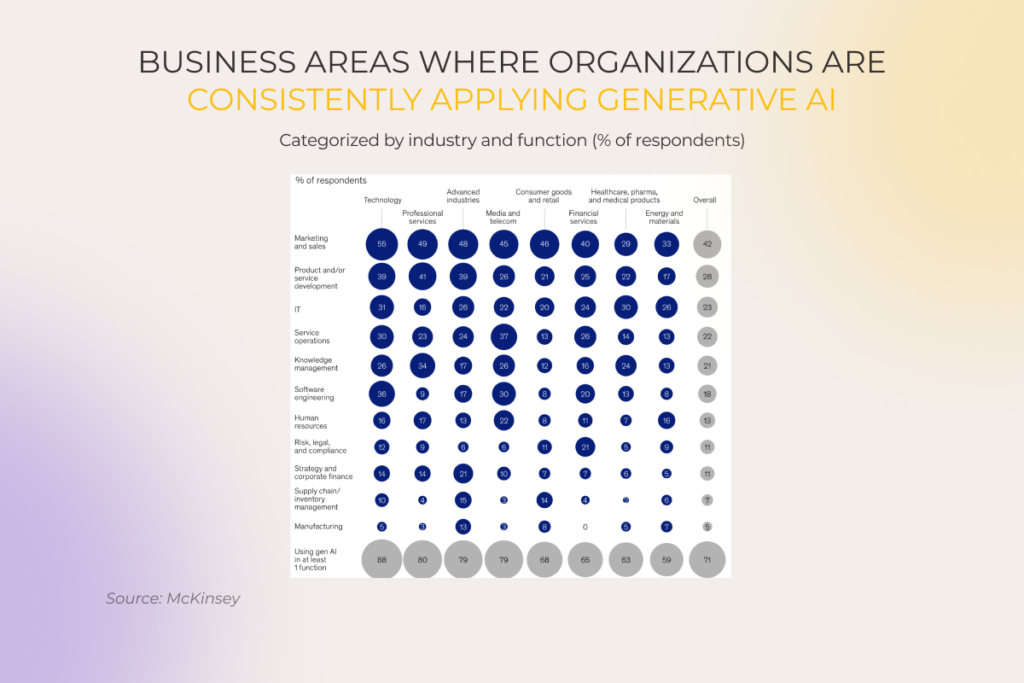
“AI adoption” is the phrase that simultaneously sends a jolt of excitement and a wave of dread up the spines of even the boldest innovators. But whatever the sentiment, AI and generative AI capabilities have long become a non-negotiable competitive necessity, now wielded by 88% of organizations. On the other hand, the failure rate of such projects is also high because of the ingrained complexity.

As an AI and ML development company that has walked 30+ organizations through AI implementation, we’ve noticed that some AI adoption challenges crop up more often than others. So, our very own AI Center of Excellence (CoE) team has curated the most recurring AI problems and solutions that we’ve addressed over the years. 

Key highlights

  • AI value is lost not in models, but in operations. Most companies fail to adopt and scale the technology because it is forced into environments without the right data foundation, governance guardrails, task-adaptive architecture, and legacy workflows.
  • Successful AI deployment equates to an enterprise-wide transformation, where clear strategy, change management, data hygiene, and cross-functional skills matter more than choosing the right model.
  • Agentic artificial intelligence raises the bar for operational readiness. While agentic AI continues to offer unprecedented scale and autonomy, it also introduces new challenges related to context management, autonomy control, and vendor lock-in.

Value potential versus the value-realization gap of artificial intelligence

AI’s theoretical potential often steals the spotlight in headlines and investor presentations. What is frequently glossed over, though, is the hard, gritty reality of plugging probabilistic AI models into deterministic business processes, which is usually the root cause behind the missing value. As many as 60% of companies report hardly any material value, revenue, and cost gains from the implementations, and that gap is widening.

AI systems are not just smarter software. These are a different beast that runs counter to standard IT playbooks:

  • The “10/90 rule of engineering”. In traditional software, the lion’s share of the work is dedicated to building the core logic. In AI projects, the model code constitutes around 10% of the total codebase, while the other 90% of effort is spent on preparing data, building the infrastructure, and setting up other plumbing. 
  • Integration into deterministic processes. In regulated contexts, AI requires task-adaptive architectures that would tame its probabilistic nature and allow it to operate within strict rules for compliance-critical tasks. Probabilistic reasoning stays reserved for flexible or creative activities. 
  • ROI lies in augmenting the capabilities of experts. AI’s strongest suit is relieving experts of menial tasks. But automation is brought up more often in AI narratives, which makes innovators misjudge the business value from the onset, overlooking human-AI collaboration.

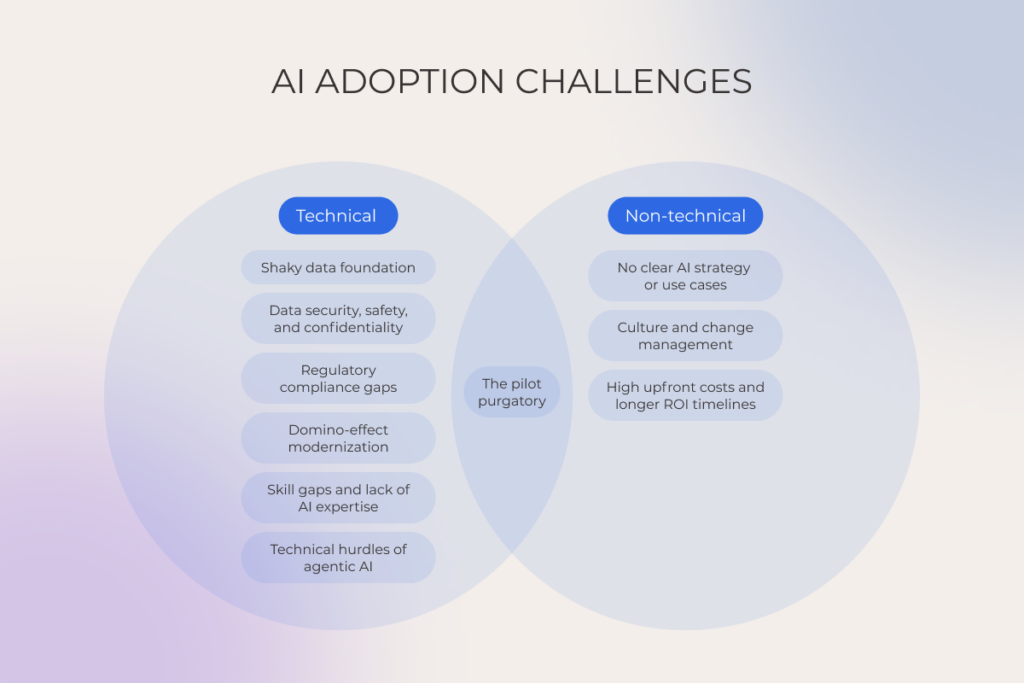
AI projects fail not because of technology alone. More often, failure results from a combination of factors, as operationalizing AI requires companies to rewire virtually every business aspect, from technical processes to organizational structures. Below, we’ve described the ten key barriers to AI adoption that stand between companies and reliable AI, based on our clients’ stories. 

AI adoption challenges

1. No clear AI strategy or use cases

There’s a lot of optics when it comes to agentization and AI-fication, which often makes businesses start from the technology rather than a business problem. For example, a common mistake we see many companies make is assigning AI agents to tasks that demand absolute accuracy or full compliance, such as financial transaction approvals or regulatory reporting. In this case, AI can create more work than it saves, as monitoring and troubleshooting may outweigh any efficiency gains. 

And even if the company has selected an appropriate use case, without a central strategy, the team risks accumulating a random mix of separate AI tools and apps with different data-processing layers that don’t talk to each other. The most successful AI deployments we’ve seen stem from a backward strategy: identifying the specific blocker first and then exploring whether AI can pick up the slack.

If you want to play it safe, AI implementation should be preceded by active exploratory and planning work, which can be held as part of an AI adoption workshop. Such an AI-specific activity will help you locate the right fit, outline the required tech environment, and do the math behind the project.

2. Shaky data foundation

Many organizations tend to over-index the model and skimp on preparing data for the AI leap. When the data is siloed, poor-quality, or scarce, all consequential decisions made by AI can be corrupted by hallucinations, biased outputs, and other systemic flaws that throw a shadow over the quality and reliability of smart solutions. In fact, that’s one of the most common enterprise AI adoption challenges we see across projects.

To avoid falling into the “garbage in, garbage out” trap, make sure your data checks the following boxes before becoming the fuel for AI development:

  • It’s easy to use: you have centralized data lakes and warehouses with ETL pipelines.
  • It’s easy to track: you can trace it through data lineage and see how it changes over time.
  • It’s easy to trust: the data is clean, accurate, and validated, with advanced data governance practices in place.

Gear up your data for the  AI reality

Talk to our AI team

3. Culture and change management

Organizations pilot AI without breaking too much sweat, but when it comes to value generation and following scale-ups, the ambitions hit institutional resistance – an issue faced by 50% of orgs integrating the technology. The natural pushback comes from employee resistance, because up to 20% of workers are concerned that AI could replace their jobs. 

This resistance is also exacerbated by the lack of leadership guidance, training, upskilling, and overall trust between the leaders and the front line. 

We see many companies put change management at the bottom of their priorities. However, it’s arguably one of the main enablers of a successful AI makeover. It lays the ground for open communication, helping everyone, from leaders to front-line employees, understand the bigger ‘why’ behind the transformation.

– Chad West, Managing Director USA, Instinctools

Promoting the adoption of AI across the board requires companies to realize that this technology is an organizational redesign, not a plug-and-play tool. Ethical guardrails, skills-first mentality, data literacy, and the rewiring of middle management – there are fundamentals to address before the “value” can enter the picture.

4. The tightrope of data security, safety, and confidentiality 

The absence of a data governance layer is easily one of the top challenges of AI, causing most pilots to die at the CISO’s desk. Or worse, AI tools can unintentionally leak sensitive data and protected customer information through unsecured prompts, training sets, or third-party model providers.

At Instinctools, we address this risk head-on by developing comprehensive governance frameworks that include data stewardship, security, quality, and metadata. In practice, the majority of these points can be covered by moving the data to a compliant environment or an accredited container. But companies still need to sort out specific layers of defense, such as data classification policies and automated PII masking.

5. Regulatory compliance gaps

Another one of the most painful AI/ML adoption challenges is translating high-level ethical principles outlined by the EU AI Act, NIST AI RMF, ISO/IEC 42001, and other regulations into enforceable, audit-ready mandates. Companies often have a hard time bridging the gap between theory and regulatory reality and struggle to provide the traceability and accountability that regulators expect in AI tools.

While specific safety measures depend on the compliance environment the adopter operates in, an AI Bill of Materials (AIBOM) is almost a universal requisite for establishing the paper trail auditors require. This artifact dives into every component of an AI system, from the model to risk controls, and provides an always-on record of compliance.

6. Domino-effect modernization

Most organizations underestimate the complexity that comes with ushering AI technologies into a legacy tech estate. The brittle business logic of old systems, the data availability, and the stale code under legacy systems snowball into multiple AI implementation challenges that can only be cleared with modernizing the heritage layer. But modernization is expensive and, most importantly, dependent on revamping organizational habits and business functions.

As an AI and machine learning tech partner, we usually advocate for the incremental evolution approach. In this case, AI evolution starts with a single, beachhead modernization targeted at one critical legacy component, which then creates a cascade and can be reused for modernizing downstream use cases. 

For example, in one of our latest projects, our team started with automating a manual reporting process for which we’ve created a standardized, high-fidelity data pipeline from the legacy inventory management system (IMS). This led our client to have a reusable asset that was later leveraged to unlock three downstream AI initiatives in under six months. The investment was justified, the modernization was controlled, and the budget was saved.

7. Skill gaps and lack of AI expertise

One of the most common AI challenges is the lack of in-house expertise. Usually, it doesn’t mean that the organization lacks capable hands – rather, it’s missing the right combination of product, governance, engineering, and deployment skills to take an idea from concept to production.

The most effective, AI-ready companies think of the AI skills gap not as a hiring crisis, but as a strategic capability-building expertise. They don’t rush into hiring a team of PhDs, but they take their time to build out a cross-functional, AI-first operating model that thrives on a mix of external talent and intentional internal upskilling for a certain, real AI project. 

8. The pilot purgatory

According to McKinsey, almost two-thirds of organizations have not yet begun scaling AI across the enterprise. Companies can get stuck in pilots for various reasons, with many of them being connected to strategic, operational, and technical misalignment. Inaccessible data, disconnect with the actual way of working, and a lack of unified step-by-step instructions often cause promising pilots to fizzle out.

AI adoption challenges

To turn their pilots into scalable success stories, companies should plan their AI adoption in phases, with learning and improvement sessions in between. Also, integrating AI into the tools the team is already using will also make it way easier for employees to actually pick up the technology and not leave the pilot to collect dust. Sharing best practices through user-submitted use cases and prompt libraries will further give the team a more tangible understanding of AI’s potential and practicality.

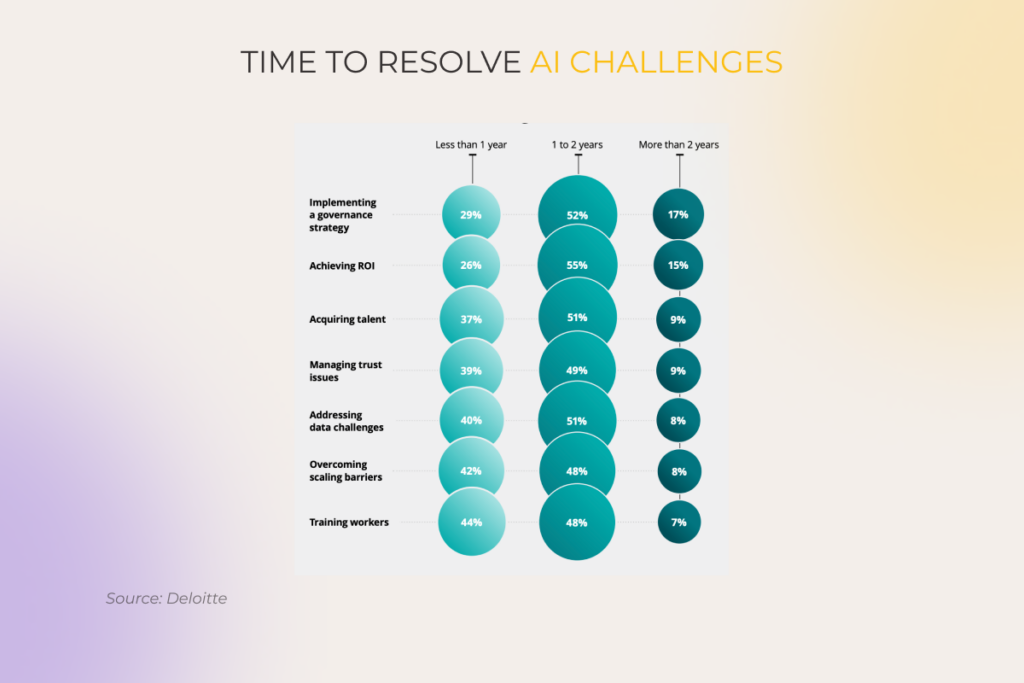
9. High upfront costs and longer ROI timelines

One of the challenges of artificial intelligence that directly impacts the EBIDTA is the combination of hefty initial investment and delayed returns. While high AI costs are a predictable hurdle, the real challenge often lies in the hard-to-quantify ROI. Conventional metrics don’t work for the company’s AI journey, because they measure standalone IT projects with linear returns. AI gains, on the contrary, are iterative, evolving, and often indirect, such as freeing expert time, improving decision quality, or enabling new revenue streams.

The easiest way to bridge this gap is to tie the metrics to broader business outcomes, rather than just implementation targets. Also, companies should look at all angles of AI impact instead of keeping it down to financial outcomes only, as most AI-fit business challenges have 360° value outcomes – financial and non-financial, such as efficiency wins or improved employee experiences. 

10. Technical hurdles of agentic AI

As one of the fastest-moving AI trends in 2026, agentic AI promises autonomy at scale but introduces an entirely new class of technical and governance challenges. Organizations have to solve the foundational challenges of AI, such as bias, data quality, and others, while also grappling with a new layer of agent-specific hurdles when developing AI agents. 

Vendor lock-in

Companies often opt for out-of-the-box agent infrastructure, such as Microsoft Copilot and Salesforce Agentforce, because their data is already in a certain tech stack. However, this convenience is a high-risk trade-off in disguise, because the agent becomes vertically shackled to the vendor’s ecosystem, and there is no easy way to integrate it with the rest of the business IT estate. 

One of our clients encountered this exact integration issue when they were trying to connect Microsoft Copilot Studio with the rest of their stack. Although their core systems were Microsoft-native, critical sales workflows were scattered across HubSpot, Jira, Power BI, and other non-Microsoft tools. Copilot’s native connectors failed to set up real-time context between the systems, so the company reached out to our team for a migration to a vendor-agnostic agent infrastructure.

See how we solved the integration challenge >>

At Instinctools, we have GENiE – our own proprietary AI agent infrastructure with a multi-vendor orchestration layer that connects data across tools and legacy systems with production-grade connectors. It allows companies to swap out underlying LLMs and software providers without rebuilding the entire agent system.

Task adaptivity

The reliability of AI agents and intelligent chatbots for organizations is linked directly to the autonomy balance. Constraining agentic systems too tightly can result in the loss of reasoning power, while granting too much freedom and flexibility can introduce unpredictability tax and the compliance risks that come with it. 

Being able to switch the level of autonomy based on the task will help the company to strike the right balance between determinism and probabilism without jeopardizing the data. For example, GENiE’s orchestration layer dials up LLM reasoning and tones down the rules for creative tasks, while compliance tasks will need the inverse. This makes sure the agent is auditable and explainable when it needs to be and flexible enough when the task calls for it.

Poor context management

Insufficient, poor-quality, and exhaustive grounding behind the underlying LLM is also among the most common agentic AI challenges we see companies grapple with. When an agent is fed the miscellany of data, including irrelevant logs, redundant data, and outdated docs, its reasoning power actually withers, because the agent can’t see the needed instructions behind the data noise.
The best way to account for this AI challenge is to dedicate the time and effort to solid context engineering. Usually, AI developers make sure to integrate tiered agent memory management that allows the agent to keep in mind the most critical information, while less urgent data is filed away till it’s needed. Along with context engineering, our developers also apply the following techniques to prevent context rot:

  • Information density. We apply semantic compression and summarization to smarten up the LLM without taxing its attention.
  • Sliding context windows. These continuously refresh the agent’s focus, making sure that outdated or irrelevant information is decommissioned and the most current goals come to the fore. 
  • Validation mechanisms. Our developers also integrate sanity check layers to keep the context up-to-date and accurate.

Address technical barriers to AI adoption with Instinctools

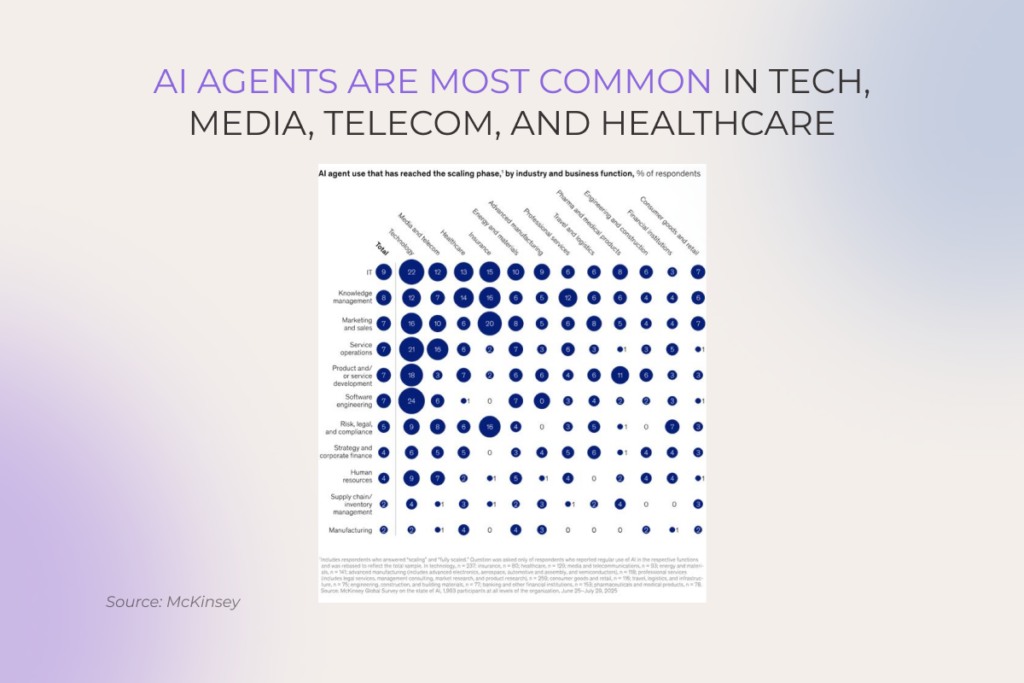
While the tech sector initially led the charge, the width and breadth of AI adoption by industry have dramatically increased over the last few years. As new business cases pop up and deployments are piloted, expectations are rising just as fast. 

But running AI at scale, especially at enterprise scale, is a different challenge altogether. Integration with outdated systems, ethical considerations, security concerns, and the drought of AI talent throw wrenches into AI adoption and stop pilots in their tracks.

With Instinctools, organizations can move beyond pilots and operationalize AI without the usual hiccups. From building proprietary context to integrating AI into existing ecosystems, our team helps companies design, deploy, and scale AI solutions that never fail to deliver actual business value and lay the reusable foundation for long-term innovation.

Stuck in pilots and proofs of concept? Scale AI into production

Let’s talk

FAQ

What is the biggest challenge with AI?

At the moment, one of the biggest challenges with AI is turning pilots into enterprise-wide scale-ups. Organizations tend to bolt AI onto an old process without redesigning the workflow and operating models around it. As a result, the siloed AI underdelivers and becomes difficult to govern.

What is the biggest barrier to AI adoption?

The biggest barrier to AI adoption is the lack of a solid foundation. While the technology itself is fairly easy to design and implement, fragmented data, legacy infrastructure, and unclear ownership are a heavy lift to overcome for companies.

What are the factors affecting the adoption of AI?

AI projects often stutter due to data quality and accessibility issues, legacy systems, and a shortage of skills needed to build and govern AI solutions. Ethical considerations, regulatory guardrails, and security concerns also add to the challenges in AI, especially for enterprises. To take off, AI initiatives also require alignment at the C-level, clear ownership, and adequate change management to accommodate new ways of working.

Why is AI adoption slow?

As a technology, artificial intelligence and agentic AI have created a precedent. Unlike any other system, AI demands clarity from an organization in terms of decision-making, accountability, and AI governance before it can be trusted at scale. The technology forces companies to bridge the gaps that were historically overlooked, including data hygiene, outdated processes, and fragmented ownership.

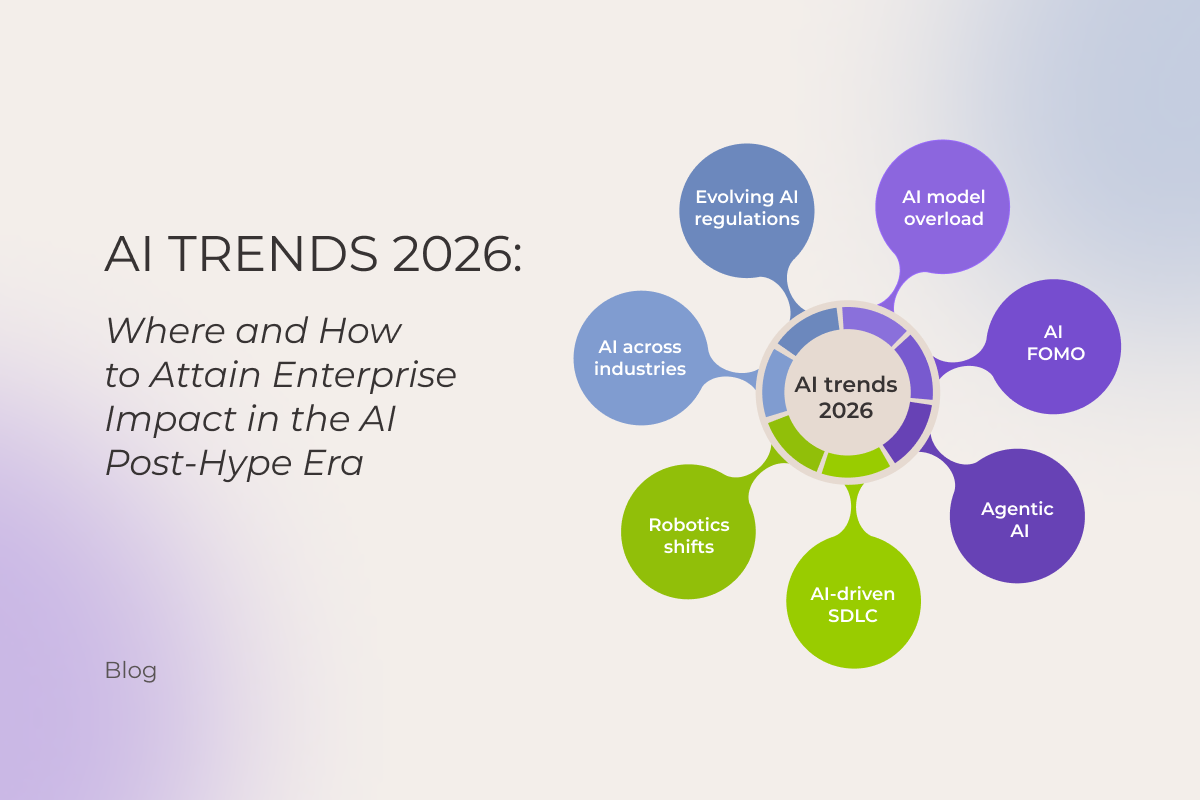
AI Trends 2026: Where and How to Attain Enterprise Impact in the AI Post-Hype Era

After several years of runaway hype, a fair dose of AI disillusionment has set in. Businesses are recalibrating AI’s role in terms of what it can realistically do and how to leverage it for measurable results.

Which industries are seeing the greatest impact? What methods are proving most effective? And which tools are quietly powering this transformation behind the scenes? Our exploration of these questions has led to a clear set of AI and machine learning trends​ that define the practical boundaries of today’s technology and will shape the path forward in the coming years. 

In this article, we’ve handpicked the latest and most impactful trends of AI technology. Instead of trying to cover every innovation out there, we’re zeroing in on the technologies that matter most for medium and large organizations that have moved past the AI testing phase.

The emerging trends we’re highlighting are based on a survey of experts from our AI Center of Excellence, along with valuable input from leading consulting firms like Deloitte, McKinsey, BCG, S&P, and KPMG.

Quick recap: 2023-2025 breakthroughs leading into 2026

The last few years have been filled with genuine “wow” moments. All of them together have calibrated business expectations towards AI results.

  • The foundation-model shifts

When OpenAI released ChatGPT in late 2022, it shifted the trajectory of the entire AI industry, and, in many ways, global economies. Throughout 2023, a wave of next-gen generative models from multiple labs followed, grabbing business attention. Besides, the first attempts to put guardrails around AI emerged.

  • Multimodal capabilities rise 

Alongside text-only models, multimodal AI made strides in 2024. With LLMs increasingly capable of jointly processing text, images, video, and audio, a larger range of applications and more complex use cases started to appear in enterprises across industries.

  • Agentic AI and its enterprise adoption

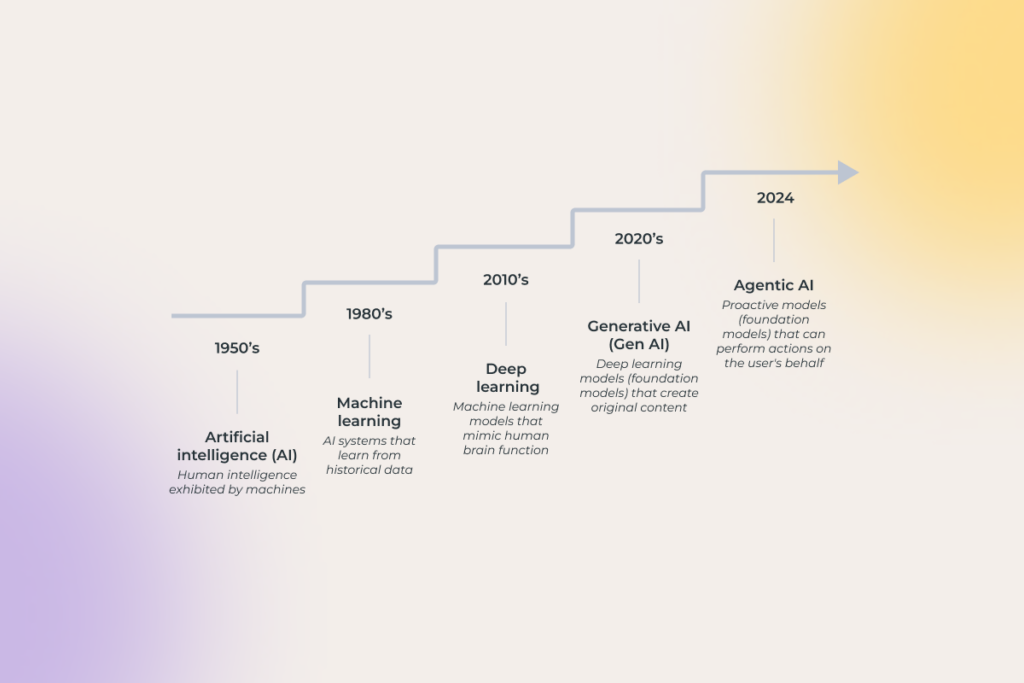
Organizations began deploying virtual AI agents to automate processes traditionally handled by human workers, to let the latter focus on higher-level tasks. Over time, it became clear that for complex workflows, coordinated networks of agents deliver greater precision, driving the shift toward multi-agent systems (MAS). Although enterprises are all in on the potential of MAS, foundational constraints in legacy systems and data architectures, as well as governance hurdles stand in the way of full-scale adoption.

Trend 1. Enterprises having hard times choosing from a myriad of AI models

If anything has been certain about AI so far, it’s that as soon as one vendor upgrades, others are hot on their heels.

For example, Claude Opus 4.5 by Anthropic has impressed many technology leaders with a step change in AI-assisted coding and long-horizon reasoning. Against the backdrop of increasingly capable models like Opus, Claude Sonnet, and Google’s Gemini 3, OpenAI went into code-red mode and pushed forward with ChatGPT 5.2, its “best model yet” (as of December 2025), promising notable progress in general intelligence and higher tool-calling performance. All of this happened in just a few weeks, leaving little time for anyone to catch their breath.

With no shortage of top-tier generative AI models to choose from, it might seem that enterprises can simply pick any one and hit the gas. But in practice, the flood of new releases tends to blur the decision rather than sharpen it. Public benchmarks, meant to guide those choices, rarely help. High scores look great on paper, but in practice? Not so meaningful. 

Before building the agentic pipeline for a global insurance aggregator, our AI team ran extensive tests across multiple large language models. Those were executed using reverse-engineered examples from existing API adapters to see which model would truly meet the client’s requirements. Out of GPT, Gemini, Grok, and Anthropic’s Opus and Sonnet, we found Claude Opus 4.1 to be the most reliable and production-ready, especially when paired with structured prompts and step-by-step checkpoints.

– Pavel Klapatsiuk, AI Lead Engineer, *instinctools

Trend 2. Ever-evolving AI capabilities are fanning the flames of AI obsession

Amid the decision paralysis that seems to grip so many enterprises, there’s also a certain awe surrounding what foundation models can now do today. The fascination is fueled by recent breakthroughs in multimodal capabilities. 2025 wraps up as a year where a significant shift occurred in how LLMs can perceive, reason over, and act on information across text, images, audio, and video. 

The release of Sora 2 at the end of September was the ‘GPT-3.5 moment’ for video generation. Likewise, built on the Gemini 3 Pro system, Nano Banana Pro is unnervingly excellent at image generation, bringing it to an entirely new, somewhat scary, level. And now OpenAI has caught up with its latest release, ChatGPT Images 1.5. The pace of progress in multimodal AI isn’t slowing anytime soon.

– Ivan Dubouski, AI Lead Engineer, *instinctools

However, the picture is not all rosy. You’ve probably heard of a huge backlash against AI‑generated ads. Take the recent McDonald’s case, which pulled a “creepy,” AI‑produced Christmas commercial after widespread viewer criticism. Similar consumer pushback affected Coca‑Cola and Valentino campaigns with AI-generated content. But despite these viral incidents, the bottom line for business is that companies are rapidly integrating multimodal AI into workflows and products. According to Gartner, trends in enterprise software point toward 80% of applications being multimodal by 2030.

Trend 3. AI agents proving their value across business functions

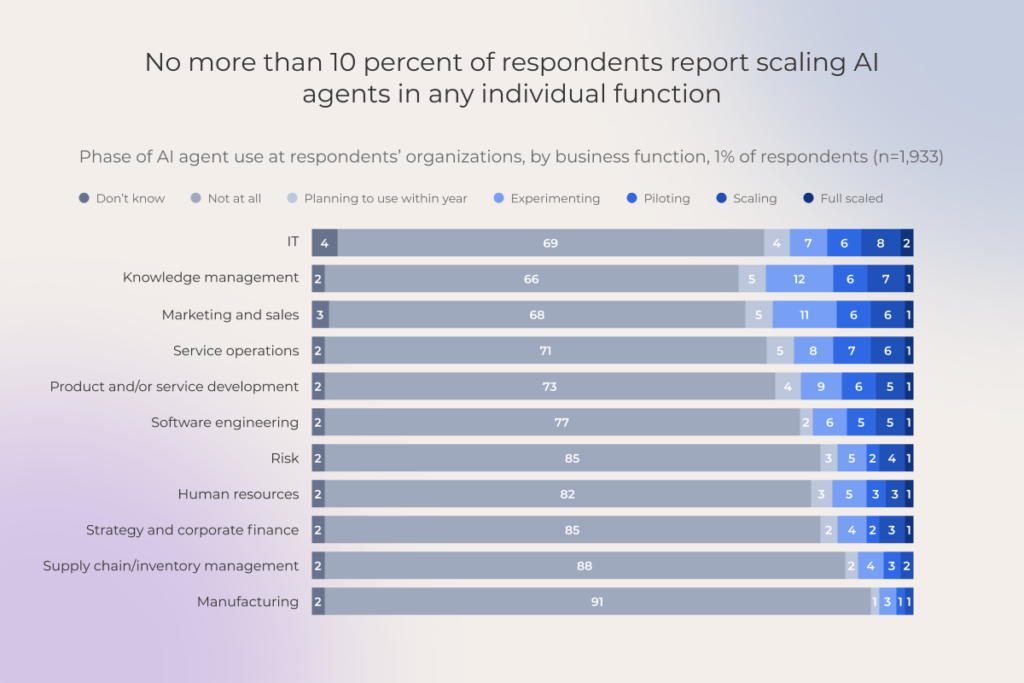
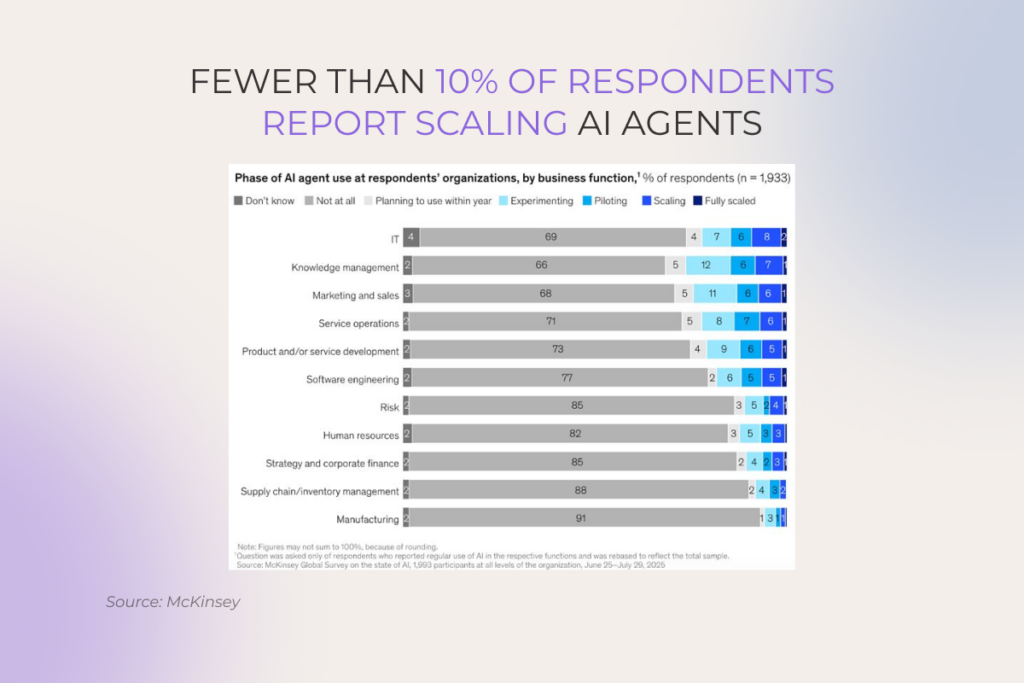
Agent-first workflows redesign and multi-agent systems are grabbing headlines as major agentic AI trends 2025. Down on the enterprise floor, the picture is less flashy: while 62% of organizations surveyed by McKinsey are experimenting with AI agents, no more than 10% report scaling them.

The slow pace of adoption tells you a lot about the challenge: it’s one thing to have a capable agent and quite another to plug it into decades-old enterprise infrastructure. Legacy systems create choke points that stop agents from functioning as they’re intended.

Similarly, the architecture of many organizations’ data repositories isn’t set up to let AI agents consume the data smoothly. Deloitte’s 2025 survey shows just how common this is: nearly half of companies say searchable data is a sticking point, and 47% hit walls when trying to reuse it for agentic automation… Which is yet another signal that careful data preparation is non-negotiable.

Gartner predicts that over 40% of agentic AI projects will be canceled by the end of 2027, due to escalating costs, unclear business value, or inadequate risk controls.

Even so, enterprises don’t appear likely to curtail their efforts. Over half of executives now rank agentic AI as their top AI investment priority for 2026. Once adoption barriers are knocked and initiatives are executed thoughtfully, agentic AI projects can move far beyond pilots with blurry potential. 

Using GENiE, our proprietary agentic solution accelerator, to build an autonomous AI worker, an Australian consulting firm processed 20% more leads, boosted upselling and cross-selling by 19%, and cut cost per lead by 15%.

– Vitaly Dulov, AI Solutions Lead, *instinctools

Deloitte predicts that if enterprises orchestrate agents better and thoughtfully address the adoption challenges and risks, the autonomous AI agent market could reach as high as $45 billion by 2030. 

Trend 4. Agentic software engineering marks the beginning of the end for the traditional SDLC

Who’s even coding in late 2025? Jokes aside, recent AI trends in software engineering have really pushed developers out of the trenches of hand-written boilerplate and onto the high ground of system design and careful governance of multi-agent systems.

Truth is, the SDLC isn’t what it used to be. Changes started from AI tools being seamlessly integrated into more and more of its stages. 

The way our dev team’s toolkit looks now shaves serious time off our clients’ projects. With AI-driven prototyping, we validated a business idea in just four days for a French startup, cutting demo costs by 60%. That’s the power of the right setup and the right tricks.

– Ivan Dubouski, AI Lead Engineer, *instinctools

Then, vibe coding took both business and engineering communities by storm. To cut through its chaos, spec-driven development (SDD) emerged as an approach to responsible AI development. Here, specifications serve as a single source of truth guiding what’s being built, boundaries, and how it’s all verified. With SDD in place, forward-thinking teams are finding power in agent swarms – fleets of specialized agents tackling complex engineering problems through decentralized, collaborative effort under human oversight. 

No wonder companies across industries are itching to integrate this into their development workflows to achieve more with less. But as with all innovations, the hard truth is that results come only when teams understand the craft. In inexperienced hands, most projects almost never leave the prototype land.

Our high-end AI practitioners at *instinctools has been doing what is essentially agentic programming since 2024. We’ve set up swarms of agents to back the SDLC, keeping an eye on every move they make without human intervention. Governance is built in. Everything AI does is reviewable, reversible, and compliant from the start.

– Pavel Klapatsiuk, AI Lead Engineer, *instinctools

So, the software development future is being written right before our eyes. Your edge in it depends on how fast you can adapt to new ways of building. The easiest way to get there is by teaming up with AI engineers, who are blazing the trail every day on real projects.

Get professional guidance on operationalizing vibe coding and other cutting-edge engineering practices

Talk to our experts

Trend 5. AI awakening a once-stagnant robotics industry

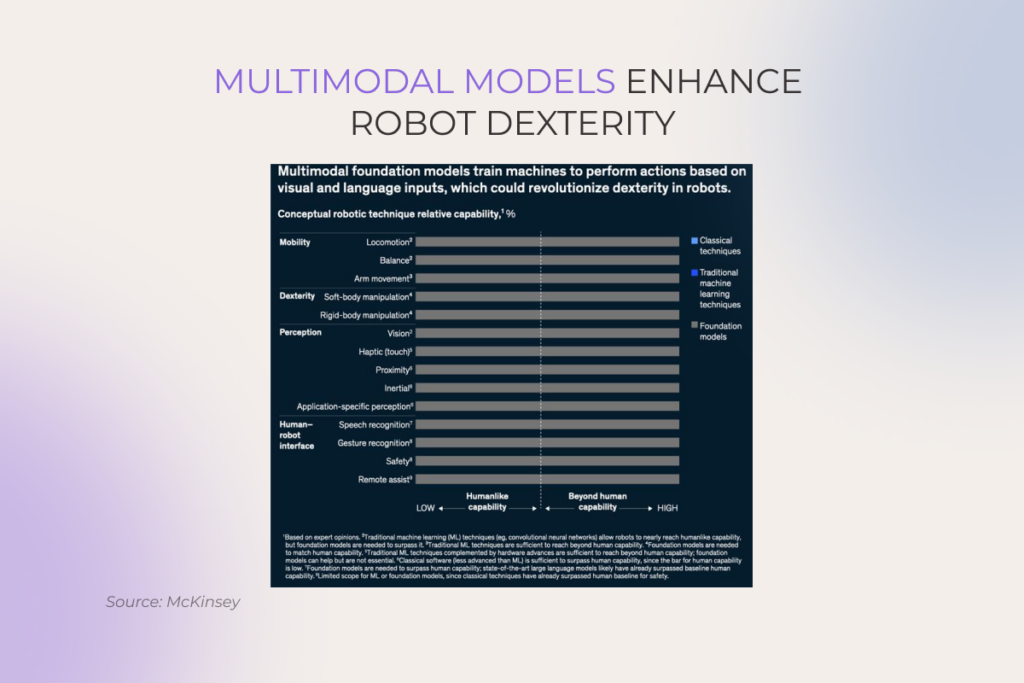
Thanks to advances in multimodal foundation models and cutting-edge chips, robots are now able to perceive, learn, and operate autonomously in complex environments. Adaptable general-purpose humanoid robots, autonomous vehicles, industrial robots, and drones are coming to life from science fiction books and movies.

  • Waymo continues its rollout of robotaxis.
  • Figure 02 robots have contributed to the production of 30000+ BMW X3 cars.
  • XPeng’s humanoid robot IRON went viral after the company literally cut it open on stage to prove it wasn’t human.
  • R1 from China-based Unitree Robotics, an ultra-agile humanoid robot, caters to researchers, educators, and software developers testing AI and robotics projects.
  • Tesla is preparing to unveil the Optimus Gen 3 as a production-intent prototype in Q1 2026. 

In fact, humanoid robots are expected to enter the mainstream in 2026, thanks in large part to Nvidia, which made several significant breakthroughs in the field this year, from rolling out the Jetson Thor platform to expanding the Omniverse platform for industrial AI simulation.

Looking ahead, the next wave of robotics may bring revolutionary developments like quantum robotics and bio-hybrid robots.

Hyper-digitized, data-packed finance, healthcare, automotive, energy, and consulting are at the frontier of applied AI in 2025. Here’s a peek at AI-powered, intelligent systems already being applied across those industries.

Healthcare

The Future Health Index 2025 survey commissioned by Philips reports that 62% of healthcare professionals associate AI adoption with gains in efficiency, diagnostic accuracy, readmission reduction, and overall patient outcomes. 

  • Leading medical systems, including Mayo Clinic, Northwell Health, Johns Hopkins Medicine, and UNC Health, are scaling the Abridge ambient AI platform to convert patient-clinician conversations into structured clinical notes embedded directly in the EHR.
  • Heavy use of conversational AI is seen across the industry through countless use cases, from appointment scheduling and remote patient monitoring to medication management.
  • Hospitals and imaging centers globally deploy centralized AI platforms to orchestrate and govern multiple imaging algorithms across CT, MRI, X-ray, and ultrasound.
  • Health systems scale AI-driven predictive analytics to unify clinical, claims, and operational data for better population health management, risk prediction, and operational efficiency.
  • Pharmaceutical companies apply AI to whole-genome cancer analysis to identify personalized treatment targets and accelerate drug discovery pipelines.
  • Gen AI tools significantly shorten R&D timelines, enabling faster hypothesis testing, trial design, and molecule optimization.

Automotive and transportation

Leading automakers are keeping pace with AI adoption to drive business growth. According to Volkswagen Group, human-AI collaboration established inside the corporation aids in the development of more competitive vehicles, enhances customer service, and improves production efficiency through better use of energy and materials, lowering costs and carbon emissions. Here are  other AI trends in the automotive industry:

  • Automakers are using digital twins to mirror vehicles and production systems in software so they can design, test, and optimize before anything gets built.
  • Suppliers like ZF have rolled out AI‑based solutions such as TempAI, which uses machine learning to model internal temperatures in electric motors more precisely than conventional methods. 
  • Thanks to hardware advances and lightweight models that enable low-latency inference directly in the vehicle, edge AI is gaining ground, reshaping the market for automotive semiconductors. The latter power infotainment and vehicle comfort systems, end-to-end ADAS systems, and battery electric vehicles (BEVs).

Consulting

Business models are becoming leaner, with smaller, more focused teams. Generative AI tools, predictive algorithms, and synthetic research platforms now handle the tedious research, modeling, and analysis tasks that once took consultants weeks to complete. Initially, human workers were ambivalent about AI, but consulting firms report that it has eventually freed up time for higher-value work. Large-scale partnerships with multiple AI vendors support this shift:

  • Deloitte is going to roll out Anthropic’s Claude to its 470,000 global employees. Companies will co-create compliance products and features for regulated industries including financial services, healthcare, and public services.
  • Deloitte also plans to create different AI agent “personas” to represent the different departments within the company, including accountants and software developers, according to reporting from CNBC. 
  • KPMG adopted the Microsoft AI stack to integrate AI into daily workflows and enable enterprise-wide agent development.
  • Almost 90% of the BCG’s employees use GENE, a GPT-4o-powered chatbot, and about half use it daily. 

Finance and insurance

Faster underwriting and claims processing. Fraud detection and risk modeling. Improving customer service and engagement. These are some of the most widely recognized ways AI has been recently applied in financial services. Others include:

  • A European bank deployed an AI-powered chatbot capable of handling complex inquiries about accounts, loans, and transactions, reducing the load on human agents and improving response times.
  • For a client, we’ve built an agentic system that automates partner integration for a global insurer, handling document parsing, adapter creation, and testing in a guided interface.

Energy 

AI’s impact in the energy sector continues to grow, especially in oil and gas. Notable AI applications include:

  • AI agents used to oversee complex workflows across drilling, production, and logistics and autonomously schedule maintenance.
  • Platforms like Methane.AI identify and quantify emissions sources across operations, enabling upstream companies to implement targeted, cost-effective reduction strategies using drones, sensors, and AI analytics.
  • ExxonMobil leverages machine learning algorithms to simulate refining reactions, optimize output, and minimize waste.
  • BP applies AI for emissions tracking and predictive maintenance, supporting sustainability objectives and operational performance.

Find more real-world examples of how enterprises successfully adopt AI

Explore now

Trend 7. Moving from a gray zone toward certainty in AI regulation, though fragmentation remains 

Many legal frameworks are moving beyond voluntary guidelines, but policies differ by region.

United States

While there is still no comprehensive federal AI law, agencies are enforcing existing statutes and implementing earlier safety and disclosure mandates from the 2023 “safe, secure, and trustworthy AI” executive order. In late 2025, the federal government issued a new executive order to assert a unified national AI policy and curb stricter state rules, even as states like California move ahead with targeted frontier-model transparency laws such as SB 53.

European Union

The EU’s AI regulation is grounded in the EU AI Act, which is already in force with bans on certain “unacceptable risk” uses. Governance and general-purpose AI rules were activated in August 2025, with full applicability expected in 2026. The Commission has also proposed a “Digital Omnibus” to streamline overlapping digital rules and delay high-risk AI obligations until 2027-2028, in response to implementation challenges and industry feedback.

United Kingdom

UK oversight in 2026 will only change significantly if the proposed Artificial Intelligence Bill creating an independent “AI Authority” actually passes, which remains uncertain as of late 2025. If enacted broadly in its current form, the document would centralize and coordinate AI supervision across sectoral regulators and enforce economy‑wide obligations for higher‑risk and frontier AI systems.

Asia

China enforces strict rules like the Interim Measures for Generative AI Services, which require service registration, security reviews, content labeling, and data compliance since 2023. South Korea’s AI Basic Act mandates risk assessments, disclosures, and human oversight for high-impact systems starting in 2026, while Japan maintains a voluntary principles-based approach. India and Australia rely on sectoral laws and privacy rules amid developing frameworks.

Still in flux, AI regulations have moved beyond the “Wild West,” becoming far more enforceable than they were a few years ago. The debate over AI ethics shows no signs of slowing down, evolving as fast as the technology itself. Risks persist and new ones come up daily. IBM put together an entire atlas featuring dozens of potential ones. Tech giants understand that and act accordingly. OpenAI and Microsoft team up with state law enforcers on the AI safety task force. More cooperation is expected in that regard.

Opportunities are still ahead

Shiny new foundational models and enterprise agentic AI systems grab attention, but taking them beyond pilots and trials requires work that doesn’t make headlines: data preparation, workflow integration, governance, and compliance. Even though experiences of 2025 have brought many organizations far up the learning curve, gaps are still glaring when we talk about adoption and scaling. 

Anyways, with a better sense of the key technology trends, it’s easier to see potential areas where AI initiatives can help you meet your ambitious business goals.

Teaming up with a trusted tech ally makes your AI journey safer

Get in touch

FAQ

What is the future of AI in 2026?

The future of AI trends 2026 is all about business-scale transformation, with agentic AI stepping in to handle complex, multi-step workflows on its own. On top of that, advanced multimodal AI will supercharge automation, efficiency, and decision-making across industries, while robotics powered by LLMs and cutting-edge semiconductors are finally going mainstream.

What are the latest trends and issues in information technology?

The latest trends in information technology include AI-driven process automation, cloud-native solutions, cybersecurity advancements, computer vision, edge computing, and the growing adoption of quantum computing, all reshaping how businesses operate and secure data.

AI Development: Be-All and End-All Leader’s Guide

Key highlights

  • AI development has moved to the stage where it shows measurable results across industries.
  • Artificial intelligence (AI) can meet your transformational expectations if your data, infrastructure, and workforce are ready.
  • Machine learning algorithms work better and safer with an AI governance framework in place.

Artificial intelligence is becoming more powerful and omnipresent day by day. 78% of companies already use artificial intelligence in at least one business function to minimize costs, speed up processes, reduce complexity, transform customer engagement, fuel innovation, and unlock new revenue streams. However, only 1% of these organizations describe their AI developing efforts as “mature.”

How to do AI development right on the first try and avoid the AI adoption plateau? This guide summarizes a decade of our hands-on AI expertise, as we were providing our clients with scalable, value-focused AI solutions long before LLMs hit the headlines. 

Read this comprehensive AI development guide to get the answers that spark action, and move from small-scale pilots to deploying AI at scale in a way that is sustainable, secure, and aligned with your business goals.

What is AI development?

AI development is the process of creating intelligent systems that can mimic human cognitive skills such as learning, comprehension, reasoning, problem solving, decision making, and creativity. Underpinned by capabilities like natural language processing, image and speech recognition, computer vision, machine learning, deep learning, and generative AI, these systems can create various types of content, analyze data, identify patterns, and make predictions faster than humanly possible. For companies looking to leverage these capabilities, professional artificial intelligence services development can provide the specialized expertise needed to navigate this complex undertaking.

 the evolution of AI development

Does AI development pay off? The true return on artificial intelligence investment

While AI technologies have generated years of hype and expectations of high ROI, there was little evidence to prove this promise. In 2026, however, the technology’s potential is backed by hard data.
statistics on the success of AI development initiatives

Yet, unlocking this value is only possible with a thoughtful approach, which starts with identifying relevant business use cases. That’s why, before rushing into AI-based development, companies often choose to invest in AI adoption workshops — intensive exploratory and planning activities which set the right project trajectory from day one.

Where is AI making the biggest impact?

Recent developments in AI empower companies to accelerate and enhance their front, middle, and back office processes by automating repetitive tasks within workflows, enriching them with personalization and problem-solving capabilities, and eliminating human errors.

AI makes an impact on front, middle, and back office processes

The shift toward action-oriented AI 

In 2023-2024, a new trend started gaining traction — large action models (LAM), better known as AI agents. This marked a fundamental shift from generative to actionable AI, where AI algorithms moved beyond providing output to performing tasks on the user’s behalf.    

However, so far, the potential of AI development technologies is still largely untapped —  only 11% of companies involved in the development of AI move from piloting to deploying AI agents.

AI Agents Will Advance AI From Decisioning To Action

Take the legal world. Our client, a global law firm, wanted to implement AI to analyze stacks of M&A data and extract key points in one click. A multimodal AI agent now interprets legal language, tables, and images, saving the client 47,000 hours of manual work annually.

On the retail side, Amazon is setting the standard, simplifying and streamlining the entire shopping journey. Its AI agents power highly personalized recommendations, automate fulfillment workflows, and even complete purchases across third-party sites via a “buy for me” feature. 

AI Development

Meanwhile, an organization from the travel sector partnered with our chatbots development company to overhaul their booking app by replacing a rule-based chatbot with a proactive virtual assistant that can handle all bookings and payments and track expenses on the user’s behalf. This upgrade spiked the annual retention rate from 28% to 41%.

Predictive equipment maintenance is another area where AI agent development solutions drive significant efficiency gains. Deploying them to orchestrate machinery maintenance for an electronics manufacturer led to a 20% drop in maintenance costs and a 15% boost in production uptime. 

Proven high-impact use cases across industries 

If you can imagine it, AI can do it. Moreover, chances are someone is already leveraging it. But with all the hype, many use cases can feel more like marketing fiction than practical solutions to real business needs. 

Indeed, artificial intelligence (AI) development promises are huge on a full-blown Midas scale, with everything it touches supposed to turn to gold, or rather, a fully autonomous workflow. We’ve cut through the noise and gathered real-world examples of our clients’ projects across industries and functions.

This list isn’t final, as there’s more to AI than meets the eye, and valid use cases keep multiplying, but it offers surefire ways to nail AI development right here, right now. 

AI Development

Ecommerce

IBM survey pinpoints that AI’s contribution to revenue growth in retail will more than double by 2027. The technology has permeated all ecommerce functions to some degree:

Most popular AI use cases in ecommerce

Tried and true generative AI applications in ecommerce include:

  • Hyper-personalization of every step of the customer journey, from custom advertising and recommendations to unique loyalty programs  
  • Virtual try-ons with computer vision and augmented reality under their hood
  • Human-like intelligent chatbots for accurate 24/7 customer support
  • Market research with AI combing through the vast amounts of customer data, feedback on social media platforms, competitors’ moves, and other valuable data
  • ML-powered demand forecasting backed by the EPoS and transactional data for 90%+ accurate predictions
  • Ad spend optimization by matching best-performing offerings to relevant consumers 
  • Supply chain and inventory data analysis carried by neural networks evaluating suppliers, optimizing logistics routes, improving last-mile delivery, and running what-if scenarios to foresee demand fluctuations
  • Gen AI-driven pricing based on customers’ behavior, market trends, seasonality, inflation rates, and other variables
  • Enhanced fraud detection thanks to simulating fraudulent activities and training AI algorithms to detect and counteract them

Technology

Gen AI-powered automation is the primary driver of changes in how software engineering companies deliver their services. Projects that earlier called for niche expertise can now be done automatically and at a way lower cost. Let’s take COBOL as an example. Our experience proves that by using generative AI tools to translate legacy COBOL code into Java, you can cut software modernization costs by 70%.

The range of time-tested AI usage in software development spans: 

  • Writing robust boilerplate code thanks to pattern recognition, contextual awareness, and code suggestion.
  • Explaining legacy code 
  • Computer code refactoring and modernization
  • Code translation aligned with the project’s specific coding style, patterns, and software libraries
  • Early-stage bug detection when fixing anomalies costs next to nothing and doesn’t affect your project budget
  • Testing where neural networks take over test planning, synthesizing test data, and generating and executing test cases 
  • Preparing comprehensive documentation and keeping it updated

Logistics 

The volatility of trade controls and reciprocal tariffs, with consequent supply chain disruptions and ambiguous tax regulations, introduces an uncertain business environment as a new normal.

Our AI center of excellence is developing an AI-driven strategic response to minimize the impact of tariff-associated risks. Here’re two solutions we’ve already tried with our clients:

  • A bill of materials analyzer built with the use of machine learning techniques can predict potential Harmonized Tariff Schedule (HTS) classifications, flag high-duty components, and recommend duty-efficient alternatives.
  • Thanks to natural language processing, fine-tuned LLMs can read CAD files and PDF spec sheets and suggest product specification optimizations to help classify items under lower-rate tariff categories. Early adopters of this approach report 3–5 % duty savings. 

The implications of AI in the logistics industry aren’t limited to the tariffs’ context. For instance, generative and conversational AI successfully cover the high-impact operational areas: 

  • Inventory management and demand planning, when ML-based predictive data analytics enables highly accurate stock replenishment
  • Real-time route optimization enabled by deep learning models analyzing the weather conditions, traffic density, and road restrictions
  • Real-time vehicle route optimization depending on the weather conditions, traffic density, and road restrictions
  • Customer service with AI chatbots handling routine customer queries
  • Finance and risk management, where artificial neural network monitors regulatory changes and factors in operational cost trends, such as rising fuel prices and increasing inflation, to suggest relevant budget adjustments
a chart of generative AI use cases in transportation

Our client, an Italian transportation company, used conversational AI within their mobile taxi booking app to provide smart, human-like customer support with 97% accuracy of intent recognition. This approach empowered them to resolve 78% of support requests without the involvement of human workers and gain a 4.8-star app rating.

Automotive

75% of automotive manufacturers already use gen AI at all stages of the R&D process and report up to a 30% productivity gain.  

Once confined to the pages of science fiction, autonomous vehicles are now a tangible reality, with generative AI and deep learning techniques working in tandem to process vast amounts of sensor data in real time. The rise of self-driving cars has pushed manufacturers to harness gen AI’s ability to create infinite synthetic driving scenarios, allowing models to train on millions of edge cases that would be too dangerous or rare to capture on real roads.

CarMax, the largest used car retailer in the United States, demonstrates another use case. Their GenAI tool scans and summarizes thousands of real customer reviews and updates the related section on the vehicle’s page, enabling buyers to instantly grasp the pros and cons of a particular car highlighted by other drivers. 
Finance

Banks, insurance agencies, accounting and tax firms, and mortgage companies benefit from adopting conversational AI tools for front, core, and back-office operations, increasing staff productivity by up to 35% while reducing cost-to-serve by 20%.

For instance, high-impact conversational AI use cases in banking include:

  • Customer onboarding with AI-powered image recognition taking care of ID validation checks and submitting the customers’ documents
  • Customer support with 60% of trivial inquiries, such as activating a card, resetting PINs or account passwords, and updating account information, being handled by AI bots 
  • Deep neural networks analyze customer data, identify patterns in saving and expense behavior to distill tailored insights delivered by personalized virtual financial advisors
  • Assistance to C-level executives to save them from spending ⅓ of their time on chasing down metrics from the management information systems team
  • Employee onboarding and training with a single AI chatbot trained on the company’s data instead of slogging through the corporate wiki

Manufacturing

AI and machine learning are the driving forces of Industry 4.0, and the speed of their adoption is accelerating by the day. 

Common real-world applications of AI in manufacturing cover:

  • Digital twins allowing for optimizing production lines, supply chains, and whole-factory workflows without disrupting physical assets 
  • Predictive machinery maintenance backed with deep learning models and IoT sensor data prevents failures before they occur, eliminating unexpected downtime
  • Advanced quality control systems powered by computer vision spot product defects in real time
  • Mass product customization becoming scalable, with artificial intelligence adjusting product designs on the fly based on customer feedback
  • Demand forecasting relying on augmented analytics helps maintain optimal stock levels and reduce carrying costs

Healthcare 

GenAI-driven solutions, from text-based chatbots to voice-enabled interfaces, reshape user experience for both patients and healthcare providers by making medical care more affordable while driving operational cost-efficiency. For instance, AI-based claims processing speeds up resolution time by 40%, creating a better patient experience. At the same time, delegating this and other administrative, repetitive tasks to AI saves up to 25% of total healthcare spending.
Key use cases for AI in healthcare including conversational tools are:

  • Proactive appointment scheduling
  • Medical triaging to take symptoms gathering and identifying diagnoses off the shoulders of over-loaded primary care doctors
  • Clinical decision support, where even general-purpose LLMs can cut hours of preparing the clinical recommendations down to minutes 
  • Remote patient monitoring
  • Post-visit patient support and engagement, for instance, outlining care summaries, estimating out-of-the-pocket costs for patients, walking them through the insurance coverage and billing process, and other complex tasks
  • Medication management with an AI assistant serving as a personalized medication encyclopedia
  • Reimbursement, where AI prioritizes claims, submits them to insurance providers, monitors payments from providers, and offers guidance on bills to patients  
  • Clerical operations, like churning out post-visit summaries, organizing clinical notes, and creating personalized learning plans for clinicians
  • Clinical trials with AI handling a broad range of tasks, from candidate screening to checking for missing data points in incoming clinical trial data and lab results
  • Back-office work and administrative functions, such as finance, staffing, and legal activities

Oil & gas 

The margin for error in the oil and gas industry is razor-thin. A delayed maintenance check, a misjudged drill path, or a supply chain hiccup can lead to millions lost. In such a high-stakes environment, AI adoption is your chance to stay on top of your game.  

The range of AI use cases in the oil and gas:

  • Reservoir exploration with AI augmenting human fieldwork by interpreting seismic images and creating geo-models of hydrocarbon reservoirs in hours instead of months
  • Drilling optimization, when ML algorithms and neural networks are used to prevent drill-bit failures 
  • Automated E&P equipment scanning with computer vision at its core to schedule maintenance on time and decrease operational expenses
  • Field workers’ support with virtual assistants proves to be more efficient than human-staffed call centers
  • By using robots with OGI cameras and summaries generated by AI, operators can perform tasks typically done through dangerous manual entries, such as inspecting storage facilities and taking remedial actions
  • Route planning and adjustments can be done on the go without increasing the planned transit time
  • Refinery optimization with AI systems monitoring distillation, catalytic cracking, and hydrogenation to spot safety hazards 
  • Quality control done by AI models ensures that fuels and petrochemicals meet key standards, such as ISO, ASTM, and API
  • Accelerated and cheaper product R&D thanks to AI-based simulations
  • Supply chain automation, as ML algorithms take over configuring distribution networks, monitoring inventory levels at each facility, and optimizing transportation routes

3 questions to assess your AI readiness 

Everyone is talking AI, a medley of use cases prove its efficiency… And here comes the ‘but’: is your data, infrastructure, and employees ready for artificial intelligence?

Business owners tend to feel optimistic hearing that developing artificial intelligence can take something between a few months and a year. However, the reality shows there are quite a lot of things to be taken care of prior to AI technology development, and they take time too.

47% of C-suite respondents believe that overcoming AI adoption barriers, such as data concerns, trust issues, risk management, governance, regulatory compliance, and workforce training, can be achieved within 12+ months. Meanwhile,  Deloitte’s AI research indicates a 1–2 year timeline as more realistic, with some challenges extending up to five years. 

an approximate timeline for resolving different AI adoption challenges

Is your data AI-ready? 

Lack of easy access to data from different systems, incorrect and missing data, bias, and other issues increase the AI development and maintenance costs, not to mention affecting the solution’s quality. 

Since data is the difference maker, 75% of companies have already increased their investments in organizing, streamlining, and protecting their data. How can you strengthen your data lifecycle management to keep up with them? Building on experience gained through delivering professional data preparation services, we’ve listed data-related challenges standing in the way of AI adoption and shared practical tips for addressing them.

Inadequate data quality 

Clean and validate data regularly to spot and remove duplicates and incomplete records before they affect the accuracy of machine learning models. The frequency depends on the data type and its importance for decision-making:

  • High-velocity data, like financial transactions, should be validated daily. 
  • Operational business data, such as supply chain and inventory records, can be checked weekly.
  • Customer data, like CRM records and customer profiles, can be reviewed for inaccuracies once a month. 

Use resources like the Great Expectations data quality framework, dbt tests, or the Deequ library to automate and schedule validation checks for each type of your data. 

Lack of data 

If you don’t have enough proprietary data to fine-tune deep learning models or cannot use real data because of privacy concerns, your limited dataset may fail to reflect the reality and result in an algorithmic bias. 

Discriminatory outcomes lead to missed business opportunities and severe legal and regulatory penalties, as it was with UnitedHealth Group. The health insurance provider used a faulty AI tool for post-acute care predictions that denied elderly patients coverage for extended care. 

To combat these risks:

  • Augment your existing data with its modified versions if your dataset lacks diversity. Say, you are training a customer sentiment classifier on a limited set of customer reviews. You can diversify the dataset by replacing some words in reviews with synonyms. Changing ‘fast shipping’ to ‘quick delivery’ doesn’t compromise the original review, but is essential for training a highly accurate AI classifier.
  • Generate synthetic data that mimics the characteristics of the existing data without jeopardizing its privacy. This is a silver bullet for accelerating medtech R&D efforts without exposing patients’ information. 

Generating synthetic data is also a go-to option for simulating rare events. For example, a traffic management company may not have enough data on accidents to create a solid AI-driven accident prediction and prevention system. Synthetic data empowers them to immediately get realistic scenarios in any weather and lighting conditions for different road types, traffic density, and driver behavior.   

  • Use bias-detection tools like AI Fairness 360, Fairlearn Aequitas, etc., to ensure you have a diverse, equitable dataset. In cases when there’s no quick way to get more high-quality data on the underrepresented group, you can oversample minority classes to balance the dataset.

Data privacy 

With the EU Artificial Intelligence Act going into effect in 2026 and the shifting status of AI-specific legislation in the US (Colorado and Virginia AI Acts), companies have to stay alert about how their AI systems store and use personal data and other confidential information. 

Better safe than sorry (and on the front pages) — confront data privacy concerns by embedding privacy-by-design principles in data collection, storage, and usage processes:

  • Reduce data usage to the essential minimum
  • Encrypt sensitive data at rest 
  • Anonymize private data before feeding it into AI models
  • Incorporate human review mechanisms to oversee AI decision-making

No data governance 

AI can’t scale without robust governance guardrails. Therefore, the development of artificial intelligence requires an end-to-end data lifecycle strategy, from secure data gathering to its safe disposal.

  • Implement data quality monitoring procedures
  • Establish clear data ownership 
  • Impose strict data access rules
  • Develop data privacy policies to protect data from misuse 
  • Set up templates to enable data traceability
  • Ensure you have a centralized data storage
  • Arrange data inventory mechanisms
  • Enforce clear data disposal practices

Is your infrastructure AI-ready? 

Infrastructure to support the AI development process includes cloud services, data storage, and network security. Our AI engineers share insights on optimizing each component.

Cloud services 

The type of model you pick directly affects cloud costs and storage needs. And that’s the reason behind 77% of companies using smaller models (13B parameters and below) rather than large ones. 

The challenge of using the right tool for the right job is especially valid when choosing between LLMs and SLMs. LLMs shine when it comes to answering general queries. But SLMs can be quickly trained on a small, ​​highly curated dataset to address your specific use cases.

Apart from so-called narrow AI, designed for a specific task or limited set of tasks, organizations can also use industry-specific models tailored to the needs of a particular domain. There’s already a whole range, from BloombergGPT for finance to BioNeMo for biotech to ClimateBERT for climate change research.

— Pavel Klapatsiuk, AI Lead Engineer, *instinctools

There’s also a question of API-based vs. self-hosted models. When accessing AI capabilities via API, you avoid costly infrastructure investments, but lack control. Self-hosting AI models, on the other hand, come with high compute demands but offer complete control over the model and airtight-secure data pipelines. 

Data storage 

Traditional data lakes and warehouses fall short in supporting the agility, governance, and scalability requirements of AI initiatives. New architectures like data lakehouses, data mesh, and data fabric have brought AI development from hype to reality. 

Each data architecture type has its highs and lows, and choosing the right one involves balancing various trade-offs, including limited scalability and flexibility, weaker data governance capabilities, lower data security, and higher cost.

Data storage

Our AI projects show that a data lakehouse often meets most business needs — single data storage with built-in data governance controls for different kinds of big data, seamless scalability, and adequate functional security.

— Ivan Dubouski, Head of AI CoE, *instinctools

Network security 

Last but not least in your infrastructure assessment is network security. Robust policies and controls are vital for protecting your resources (data storage, models, APIs) from external or internal threats, such as data exfiltration, model poisoning, adversarial inputs, unauthorized API access, etc.

Our recommendations for secure AI development include:

  • Adopting a zero trust security posture with granular access controls and centralized identity management (IAM)  
  • Integrating network security tools (SIEM, SOAR, or XDR) to centralize signals from an automated anomaly detection system and enable fast, coordinated incident response across your AI infrastructure.

Can your staff take on AI roles?

IBM pinpoints that 84% of companies considering AI development lack AI-specific technical competence and resort to augmenting their team as they don’t have months to hunt for and win over top talents in computer science, data science, ML engineering, and other AI-specific areas. 

The AI roles companies need most to close the expertise gap

Raising strong in-house AI expertise isn’t a weekend bootcamp. While some professionals can pivot into AI-related roles relatively quickly, upskilling takes time. 

For instance, given the widespread use of Python in deep learning, ML, and NLP, your in-house Python developers already have a head start. With focused upskilling, they can transition into roles like prompt engineers or AI/ML engineers. In my experience, the first option will require 3+ weeks of full-scale training, and the second will take 3+ months of full-time learning and hands-on practice. 

So the question is: can you afford investing in the employees’ reskilling without compromising the momentum of your current projects? 

— Ivan Dubouski, Head of AI CoE, *instinctools

Struggling with data, infrastructure, or talent?

Delegate it

Navigating AI development risks

The same AI software that can increase your revenue by more than 10% can also expose the company to various data, model, operational, and ethics risks. While many consulting firms warn about AI dangers in vague terms, we draw from hands-on project experience and offer targeted, actionable ways to handle them, all aligned with the NIST AI risk management framework.

Cybersecurity threats

Only 24% of AI initiatives are secured against AI-related threats, such as data poisoning, data tampering, API security breaches, model inversion attacks, prompt injections, etc.  

a chart of AI security threats by complexity and potential impact

Secure all the stages of the AI pipeline to enable the safe development of AI solutions. 

  • Data collection and handling. Data encryption at rest and in transit and strict access controls are the basic best practices.
  • ML model training. If you access open-source models via APIs, use strong authentication protocols like OAuth, OpenID Connect, etc. 
  • ML model usage. Use a machine learning detection and response (MLDR) solution to monitor the models’ behavior and quickly detect and quarantine or disconnect compromised models.  

Data privacy issues 

Inform users about data collection practices for your AI system, such as what personally identifiable information (PII) you want to collect, for what purposes, how it’ll be stored and used, Then, let customers decide if they want to share their data. 

In highly regulated industries like finance and healthcare, where companies are obliged to comply with specific regulatory acts, such as HIPAA and GLBA, organizations should consider replacing real information with synthetic data.  

Intellectual property infringement 

Even though AI-centered copyright laws, such as the Generative AI Copyright Disclosure Act in the US, the EU AI Act, and the Generative AI Training Licence in the UK, are still in the legislative process, you’d better play it safe. 

To weed out the possibility of intellectual property violation while developing AI systems:

  • Check your datasets for potential copyrighted content with copyright detection software, such as DE-COP for text, Google Vision AI for images, Audible Magic for audio, etc.
  • Use publicly available data or data that’s explicitly licensed for use, distribution, modification, and commercial use (for example, has a Creative Commons BY license).

Lack of explainability and transparency 

The complex nature of machine learning algorithms is a double-edged sword. On the bright side, it contributes to delivering highly accurate outputs. On the dark side, the logic behind these algorithms is challenging to understand and explain. 

If you want neural networks and deep learning algorithms to be an open book, adopt explainable AI techniques tailored to your model type:

  • Feature importance, LIME, and SHAP for simpler machine learning models, such as decision trees, gradient boosting, and random forests.
  • DeepLIFT and integrated gradients for more complex deep neural networks with deep learning and neural networks at their core.

Misinformation and manipulation 

AI hallucinations are one of the examples of misinformation that damages the reputation of AI systems. Malicious manipulations, like reverse engineering and model hacking, are even more harmful, as attackers can expose sensitive or confidential information or poison your ML model with bias. 

Safeguard your AI development process by:

  • Using high-quality data for model training
  • Rigorously testing your ML model
  • Continually evaluating and refining the ML model 
  • Keeping humans in the loop to review and validate the accuracy of the model’s outputs

AI-specific technical debt 

Quickly patched data pipelines, rushed model deployments, and poorly documented feature engineering slow down future iterations of your AI software, raise its maintenance costs, and increase the risk of model failures. 

To minimize the amount of AI-related tech debt that builds up around data, models, and infrastructure, strengthen all of the weak points:

  • Set up automated data validation, standardize data pipelines, and track data lineage to get high-quality, consistent, and reliable data.
  • Use monitoring tools with auto alerts to catch model drift immediately.
  • Prioritize building solid MLOps pipelines and scalable infrastructure that support deployment, monitoring, and retraining to ensure consistent behavior of the ML model in production.

Can’t wrap your head around all possible AI risks?

We’ve got you covered

Solid AI governance as your clear-cut to risk-free, responsible AI

AI governance should be established from day one rather than tabled and taken care of later.  Without well-documented rules and standards for aligning your AI development with ethical and human values, your AI initiatives are doomed to face the aforementioned risks. 

Deloitte’s AI research highlights that the lack of a sound AI governance framework is one of the most widespread roadblock companies bump into when adopting artificial intelligence. Another survey pinpoints the chasm between what organizations declare about AI governance and what they actually do. If you’re in the same boat as 79% of businesses that don’t have a robust AI governance framework yet, mind that the boat is rocking, and it’s time to act. 

an infographic illustrating the gap between stated and implemented AI governance

Here’s a set of responsible-by-design AI principles to use as a blueprint for your AI governance framework:

  1. Build an AI ethics code around principles, such as fairness, interpretability, and human oversight.
  2. Keep an eye on local and global AI regulations and align your internal AI policies with new standards before they come into force.  
  3. Raise in-house data stewards and risk officers who’ll be in charge of overseeing AI development and deployment. 
  4. Create a compliance checklist and run regular audits to ensure policy adherence — quarterly for AI systems used in finance and healthcare, and annually for less regulated cases.
  5. Address AI-specific failure scenarios, such as model bias, drift, misuse, etc., with on-point risk mitigation practices (AI model optimization, pre-deployment bias audit, automated drift detection, detailed audit logs).
  6. Incorporate responsible AI best practices, such as model explainability, data encryption and anonymization, bias monitoring, etc.

These AI development principles should be established from day one. Yet, keep in mind that your AI governance policies aren’t set in stone. You should review and refresh them whenever you add new machine learning models to your tech stack, spot even minor incidents or failures, and if new AI regulations emerge.

— Pavel Klapatsiuk, AI Lead Engineer, *instinctools

Stages of the AI development lifecycle

As tempting as it is to jump straight into the development of AI technology, selecting ML models, and fine-tuning them on your data, the right place to start is by defining your business problem. Only then can you clearly see high-value, low-risk AI use cases capable of moving the needle. 

That’s why AI projects should begin with an exploratory and planning workshop focused on the following:

  • Articulating your business problem to set clear goals and requirements for your AI development project
  • Identifying low-barrier, high-impact use cases and establishing their success metrics
  • Creating technology and business risk profiles for selected AI use cases

After strategic preparation is done, move to the development steps:

  • Selecting an AI model compatible with your existing infrastructure and matching your performance metrics
  • Customizing the AI model to tailor it to your particular use case 
  • Integrating the fine-tuned model into your infrastructure by connecting it to relevant databases, data pipelines, and APIs
  • Verifying the model’s performance under production conditions and fine-tuning it further with model distillation techniques if needed
  • Deploying your AI solution and monitoring its performance in real-world scenarios
  • Continuously improving the software’s performance by collecting user feedback and retraining or updating the underlying model to enhance output quality and accuracy 

Here’s a thing. You don’t need to reinvent the wheel with every new use case. If you invest in robust MLOps practices, you’ll always have a scalable, low-friction AI development process.

— Ivan Dubouski, Head of AI CoE, *instinctools

Get your AI initiative rolling

Schedule a call

How to decrease AI development cost? Bonus cheat sheet from our AI engineers 

AI development doesn’t have to break the bank. Our AI development company in the USA has battle-tested tips for building high-performing and accurate AI solutions at half the cost.

  • Use API-based foundation models instead of self-hosted ones. This way, you pay as you go instead of investing in computing power upfront. If you decide on self-hosting, you can still save by adopting optimized inference engines (vLLM, TensorRT) to slash inference costs by up to 60–80%.
  • Apply transfer learning instead of full training and use PEFT techniques (LoRA, QLoRA, or QDoRA) for cost-efficient fine-tuning.
  • Use SLMs whenever possible to pay a lower per-token cost.
  • Store and reuse model outputs for solutions like AI-powered FAQ bots to avoid paying for the same answer 1000 times. This way, you cut API costs by 30–60% and improve response speed.

AI becomes valuable when it is strategic

Just like the cloud changed the game last decade, artificial intelligence is set to define the next, completely rewriting the rules of how businesses operate. If you’re wondering when to explore AI development, the answer is yesterday. And the next best time is now, with a clear strategy, not scattered experimentation.  While tackling individual use cases is a natural starting point, long-term success comes from embedding AI development into your broader business strategy. Adoption at scale isn’t just a tech upgrade, but rather a company-wide transformation spanning data, infrastructure, and workforce.

If you struggle to move from planning and scattered experimentation to structured execution and scaling, it’s time to bring in expert guidance from a trusted artificial intelligence development company.

Ready to start your AI journey?

Let’s strategize

FAQ

Which industries does AI benefit the most?

From our experience, AI development delivers most benefits in ecommerce, finance, healthcare, manufacturing, transportation, energy, media, and telecommunications sectors. However, there are a lot of low-barrier, high-impact AI applications across other industries.

What is the timeline for implementing AI?

Depending on the current state of your data, infrastructure, and workforce readiness, AI implementation takes 12 to 36 months.

How can I accelerate my AI adoption?

To accelerate the development of AI you can use API-based foundation models to kick off your project quickly. But to speed up the evolution of your AI initiative in the long run, you should invest in building solid MLOps pipelines and regular staff reskilling and upskilling programs.

What is the smartest AI right now?

New developments in AI, such as AI agents, are considered the smartest and most advanced AI form, as agentic systems can initiate and perform complex tasks, including multi-step ones, within a diverse software ecosystem without human intervention.

What to expect from AI in the next 5 years? 

Recent development in artificial intelligence indicates that AI’s level of responsibility and autonomy will increase. That means that AI agents will keep dominating the AI industry in the foreseeable future, causing a shift from application architecture to AI agent architecture.
Current trends, such as further domain and industry customization of the foundational models and exponential evolution of generative AI, conversational AI, and edge AI use cases, will keep unfolding. 

Conversational AI In Banking: Real-World Use Cases and Challenges

Key highlights

  • Over the decades conversational tools in banking went from reactive to proactive servicing, driving personalization and customer satisfaction while reducing cost-to-serve. 
  • There are numerous go-to conversational AI use cases for financial institutions to drive customer and employee experience, from the front to the back office and core banking products.
  • Data, cloud, and APIs are the tech basics you should cover to hit it big with conversational AI.

Conversational AI in banking holds the promise of transforming customer experiences by reducing Customer Effort Score (CES) while boosting Customer Lifetime Value (CLV) and Net Promoter Score (NPS). A clear win… on paper. Yet, for many banks, the road from potential to payoff is riddled with obstacles.

Capgemini highlights that 39% of banking institutions can’t get AI software development right and end up dissatisfied with adoption outcomes. In our guide, we’ll show you how to move beyond experimenting with conversational AI for banks to implementing it at scale — unlocking its capabilities and delivering real, lasting value. 

The evolution of human-free communication within the banking sector: from reactive servicing to proactive conversations 

The history of conversational tools used by financial institutions starts with inglorious automated voicemails, that left customers more annoyed than satisfied. But how far have we come since those days? Let’s dive through the three major eras of conversational banking:

  • Traditional script-based chatbots and automated voice assistants marked the rise of conversational banking. While they were supposed to make dealing with customer requests easier, their rule-based nature often left users frustrated and seeking help from customer service representatives. Those early solutions were characterized by inefficient communication, a lack of memory for past interactions, and limited personalization value.   
  • AI chatbots backed by machine learning algorithms made a breakthrough in addressing basic queries without involving human agents. Along with saving time (and headaches) for both customers and bank staff, AI-driven chatbots excel at gathering customer data. By analyzing user needs, spending habits, and behavior patterns, banks can level up personalization of their offerings and services. However, these chatbots serve mainly as trusted information sources and can’t act on the customer’s behalf.
  • Intelligent virtual assistants became the next frontier of banking conversational AI. Akin to large action models (LAM) that have been gaining momentum since 2024, their capabilities go beyond understanding natural language queries and providing instant, relevant responses. Powered by multiagent architectures, virtual assistants can execute tasks for users, like transferring funds, creating savings accounts, and setting up investments. With machine learning at their core, they deliver hyper-personalized experiences, proactively offering suggestions and solutions that align with individual financial goals. 
The evolution of conversational banking before the era of conversational AI and after it

From human-like chatting to ROI: top 5 conversational AI use cases in banking 

Initially, conversational AI usage in the banking sector was limited to front-office operations, covering customer support and personalized offerings for customers. However, since generative AI hit the mainstream in late 2022, the technology gradually made it to core banking services and back-office activities. 

Conversational AI use cases across banking front, core, and back office operations

1. Customer onboarding 

You snooze, you lose — that’s how it works with customers who are getting harder to impress than ever. For banking institutions’ online services, customer engagement and retention are pressing challenges, especially since banks naturally lag behind other industries like, let’s say, ecommerce, where the average visit to an app lasts twice as long as to a banking app. 

Therefore, rethinking interactions with users at every touchpoint is vital, and conversational AI can improve your statistics. Harnessing the technology to guide users through the onboarding process is one of the scenarios. Be it opening a first bank account for a B2C user or registering an e-signature for a B2B customer, an AI-driven bot or virtual assistant ensures a smooth experience by: 

  • Requesting IDs for initial validity checks 
  • Walking customers through document submission step-by-step or submitting the documents by itself
  • Providing real-time updates on account setup progress     
screenshots of a banking app with onboarding process guided by an AI chatbot

2. Customer support  

First-rate customer support is another pillar for ROI-boosting user retention and building consumer loyalty. Implementing AI-powered solutions on the front line of customer interactions benefits both sides:

  • Consumers get human-like, instant support 
  • Banking institutions cut costs by covering more requests with automated customer service 

Statistics indicate that up to 60% of customer interactions can be seamlessly handled by digital assistants. For instance, conversational AI tools shine in areas like account management and credit card services, freeing up your app support and call center specialists from dealing with numerous trivial inquiries, such as:

  • Updating account information
  • Transferring funds
  • Disputing transactions
  • Checking credit scores
  • Resetting account passwords
  • Activating card
  • Resetting PINs
  • Reporting lost or stolen cards

The more accurate the chatbot, the higher the ROI from the technology, and this approach applies to any industry. When crafting an AI-powered customer support solution for a mobile taxi app, we achieved 97% accuracy in answers thanks to training an underlying LLM on a dataset that also included user queries with foreseeable common typos.  

3. Advisory services for personal finances

In-depth, fulfilling individualization of customer experience with the help of financial assistants ignites the growth of customer engagement in two directions:

  • Longer sessions in a banking app
  • More interactions with the app

AI-powered assistants actively decode customer behavior, predicting their needs and making relevant, proactive nudges before they even ask. For example, if a customer has a deposit for traveling, a bot can initiate a conversation, offering a timely deal on travel insurance. This way,  the customer gets insurance on favorable terms, and the bank cross-sells their partner’s products. 

“Companies must establish a ‘responsible by design’ framework to maintain trust and compliance. Implementation should include robust user consent management systems and clear data retention and deletion policies,” – said Alexey Spas, Founder and CEO at Instinctools.

Another real-world example of how financial organizations drive greater value for users comes from Bank of America. They trained their chatbot to jump in when a customer’s credit score drops, offering tailored advice to improve it. 

While AI systems provide extensive opportunities for ordinary customers, they truly shine when it comes to enhancing investment experience. For instance, chatbots and virtual assistants can analyze market events and prepare risk profiles for traders. 

4. Assistance to C-level executives

Along with personal assistants stepping up customer convenience, conversational AI tools are changing the game for C-suites. Assistants to high-level managers empower them to make informed, error-free decisions faster.

Let’s take a virtual assistant to a chief experience officer (CXO) as an example. PwC survey highlights that a third of the time in this role is spent on operations, related routine tasks, and follow-ups. In fact, up to 60% of that time goes into chasing down metrics from the management information systems team. But with an AI assistant, all those hours could be saved for focusing on strategy, not on tracking down information.   

Instead of diving into endless reports or sifting through folders on the company drive, what if the CXO could just ask the AI for the latest insights on sales, partner performance, customer profitability, market benchmarks, customer lifecycle, or even the NPS across different channels? Now that’s what we call efficiency.

A summary of the customer feedback on the eKYC offering, highlighting strengths, improvement areas, and insights by channel

5. Employee onboarding and training

Onboarding just got a whole lot easier, thanks to conversational AI. Gone are the days of employees drowning in a sea of tabs and apps to find answers. Now, new hires can get up to speed on core banking systems and processes with a simple chat — no more endless searching. The AI chatbot becomes their go-to source for all things info-related, reducing mental load and making their transition smoother.  

Besides onboarding, banking conversational AI takes employee training to a whole new level. Let’s say you have established customer personas that require different communication styles and strategies. With an educational chatbot, you can simulate interactions with all these personas to train sales and customer service staff for high-stakes conversations beyond the reach of AI-powered customer support. 

Conversational AI in action: charting a new frontier for a Czech bank 

Financial institutions aim to rewire customer services by relying on advanced data analytics and technologies such as natural language processing and AI (be it generative AI, conversational AI, or both). Our client — a next-gen Czech bank — decided to transform their traditional in-app chatbot into a powerful text- and voice-based sidekick to boost customer retention and satisfaction. 

Instinctools’ team deployed a private instance of GPT-4 and worked on two features with different levels of access to banking and customer data:

1. By default, the chatbot has access only to a sanitized dataset of internal banking data, such as answers to the FAQs, information about bank offerings, instructions for performing various operations, etc. It’s enough to guide customers through basic card management, transactions, insurance claims, etc. 

voice interface of a banking AI customer support chatbot

2. When the chatbot is given explicit customer consent to access some of their profile data, it turns into a full-scale personalized financial advisor ready to proactively help users and provide tailored insights on any banking topic. 

the pipeline of a banking AI voice assistant handling the lost card query

How has conversational AI implementation influenced our client’s FCR, NPC, retention rate, and other metrics?

See for yourself 

Risk it for a biscuit… But is the biscuit worth it? 

Can conversational AI deliver much-coveted ROI? A closer look into possible financial and operational benefits, backed by Deloitte and McKinsey surveys, indicates the benchmarks to look up to:  

  • Up to 35% increase in front-office staff productivity
  • Up to 15% improvement in the cost-income ratio over the five after conversational AI adoption
  • 40% to 50% reduction in service interactions
  • 20% to 30% lower incident rate 
  • 20% reduction in cost-to-serve

Tech foundation and challenges of adopting conversational AI in banking: remedies provided 

As you see, the rewards of implementing conversational AI are high. But so are the risks. You cannot magic away challenges such as source code deficiency, data security issues, LLMs’ bias, limited visibility into the AI system’s function, AI privacy concerns, inadequate scalability of legacy software, intellectual property violations, or maintenance difficulties. However, recognizing the perils upfront makes dealing with them easier. 

The core of most of these hurdles boils down to three pillars of software development: data, cloud, and APIs. Rewarding conversational AI adoption is off the table while this bottom line isn’t covered. 

statistics on banks spendings driven by the use of generative AI

The good news is that the future of your solution is yours to shape: 

  • Data. Your AI engine is only as good as the data it’s trained on. Therefore, clean, comprehensive, and bias-free data is fundamental when it comes to crafting an accurate and trustworthy AI solution. Prioritize top-notch data management to create a single source of truth and provide role-based access that empowers every team member, from entry-level employees to the C-suite.
  • Cloud. There’s a reason why companies with the highest profit margins are the ones with 30+% of their workloads running in the cloud infrastructure. The resilience, scalability, and budget savings cloud computing offers are too enticing to ignore. 
    Imagine being able to set up a new environment for your AI-driven chatbot or assistant in minutes instead of days and how it may speed up time to market for your software. Not to mention cloud automation and the ease of maintenance when it’s delegated to a trusted cloud implementation partner. 
  • API. Well-documented APIs are easy to use and empower banks to seamlessly integrate conversational AI tools with their other products. 

When the baseline is covered, make sure to address other important aspects of your risk management plan. For instance, adopting a responsible AI (RAI) framework is one of the best practices for safeguarding your AI-powered banking software. This approach spans over six risk categories — put all of them on the front burner when implementing conversational AI. 

  • Set up a human feedback mechanism for reviewing automated decisions to ensure fruitful human-machine collaboration.
  • Keep documentation on implemented conversational AI tools in order to make their usage transparent and traceable.
  • Source and scrutinize training data properly and adopt a mechanism like Reinforcement Learning with Human Feedback (RLHF) to wipe out the probability of biased outcomes.
  • Safeguard end-user confidentiality by separating sensitive information from public data and anonymizing and/or encrypting it to ensure top-level privacy.
  • Organize your AI computational resources the way to impact the environment as little as possible. 
6 responsible AI principles for successful adoption of conversational AI in banking

Don’t miss the chance to hop on the conversational AI express – get your ticket to the future of banking 

The era of conversational AI in banking is here, and it’s moving fast. If you want to keep up and be truly customer-oriented, you cannot opt out of it. 

However, conversational AI isn’t a simple plug-and-play technology. You need subject matter experts with battle-proven experience to hit it big with a next-gen chatbot or digital assistant.  

No in-house AI expertise? No problem

Talk to our AI team

FAQ

What is conversational AI in banking?

Any artificial intelligence technology that enables financial institutions to communicate with customers falls under the conversational AI umbrella. The two most widespread examples are: 

– Chatbots focused on answering FAQs and providing accurate information about bank offerings for consumers and reports-based insights for bank employees.
– Proactive digital assistants that can take actions on the user’s behalf, such as transferring money in a customer-facing app or booking a meeting for the company’s top managers.

What are the benefits of AI chatbots in banking?

Conversational AI is the quickest and most successful way to deliver a highly personalized customer experience, deepen relationships with your consumers, and boost overall customer satisfaction and engagement while reducing the cost of user support.  

Besides enhancing the customer journey with round-the-clock availability of human-like assistance, conversational AI can reshape banks’ internal processes and routine tasks, such as employee onboarding and training. 

What is the future of conversational AI in banking?

The future of conversational AI in such a regulated industry as banking depends on the strictness of AI legislation in different countries and customers’ willingness to share their data with financial institutions. However, it’s already safe to say that AI will keep revolutionizing banking processes from front to back office. 

The capabilities of chatbots and virtual assistants with secure access to user personal and financial data are unlimited, with the potential to make AI tools a go-to conversation option for consumers and the ultimate player in service personalization. 

Conversational AI for Healthcare: 10 use cases and real-world examples

Key highlights

  • Conversational AI in healthcare provides a more natural, flexible user experience that can significantly expand areas of use for healthcare chatbots.
  • Conversational AI solutions can introduce gains in a raft of areas, both in the healthcare settings and outside hospitals.
  • To successfully implement the technology, healthcare organizations must tidy up the data, shore up tech foundations, and draw up a risk mitigation strategy.

If there’s one thing to be said about healthcare today, it’s that the healthcare system is buckling under the weight of increasing costs, staff shortages, and growing patient numbers. Against this challenging backdrop, the potential of conversational AI in healthcare is touted as a much-needed lifeline that offers a promising solution to healthcare’s toughest burdens.

However, as healthcare providers consider which conversational AI solution to bank on, it’s important to avoid the shiny object syndrome and invest in resilient tools. So, let’s see what conversational AI healthcare solutions are here to stay. 

What is conversational AI technology in healthcare?

Healthcare conversational AI relies on advanced natural language processing to interact with patients and other healthcare stakeholders in a natural way. The technology can manifest as text-based conversational chatbots, virtual assistants, or voice-enabled interfaces that act as co-pilots, automating various tasks.

Compared with traditional, rule-based chatbots, conversational AI interfaces offer a significant leap forward, providing a more natural, adaptable user experience.

FeatureRule-based chatbotsConversational AI interfaces
TaskNavigation-focusedDialog-focused
Type of input dataCannot directly process unstructured dataCan leverage unstructured data (e.g. purchasing and accounts payable data) to shape outputs 
Language understandingPre-determined and scripted with limited understanding of contextAdvanced natural language processing, understands nuances and context
Response generationPredefined responses, limited flexibilityDynamic response generation, can adapt to various queries
AdaptationLimited learning capabilities, requires explicit trainingContinuous learning, improves over time through machine learning
PersonalizationProvides generic responsesPersonalized responses based on user history and preferences
Complexity of interactionsHandles linear, predictable queriesCan handle complex, multi-turn conversations
Flexibility of deploymentTrained for a specific taskGeneralizable nature, can be integrated into multiple healthcare settings

Proven benefits of healthcare conversational AI

Over 70% of leading healthcare companies are experimenting with or planning to scale generative AI — a core conversational AI enabler — across the enterprise. Let’s probe into the gains they can already reap by implementing conversational AI solutions.

Bringing patient self-service into the practice

Whether it’s due to high costs, inherent stigma, or shortage of healthcare professionals, 29% of the US population choose not to seek needed medical care. Patient-facing conversational AI agents and chatbots can remove the obstacles in the path to healthcare services and give patients the autonomy to manage health on their own terms.

Conversational AI systems interact directly with patients to perform tasks that span from mental health support to appointment scheduling and medication management. With conversational interfaces in tow, individuals can get the necessary support and direction, even when the care organization’s resources are spread thin.

Looking to automate Rx management, a US-based healthcare provider reached out to *instinctools. Our team developed a custom virtual medical assistant that handles repeat prescription refills from patients autonomously and proactively notifies patients when the refill is due. The result was an estimated 120% increase in patient satisfaction and slashed admin costs.

Driving administrative cost-efficiency 

While evaluating the high-value areas lined up for gen AI disruption, 60% of healthcare leaders deem administrative efficiency to be one of them. From automated patient data extraction to medical record management, conversational agents can execute administrative tasks related to revenue cycle, reporting, and approval processes.

By automating these operations, healthcare organizations can potentially save up to 15% to 25% of total healthcare spending.

Making patients feel heard

Patients often waste hours on getting their issues resolved through IVRs and other systems. The lack of contextual understanding, long wait times, and inaccessible interfaces result in low first-call resolution percentages and leave patients feeling abandoned. 

Healthcare conversational AI can flip the script. By building on structured and unstructured patient data, past interactions, and real-time contextual cues, conversational AI interfaces can bring humanity back into the experience and share the workload with human agents.

One of our clients, a health insurance provider, implemented conversational AI to handle a growing volume of claims processing calls. By automating the initial intake, claim status updates, and document verification, our AI-powered solution helped the client decrease resolution time by 40%, increase deflection rate by 25%, and lower costs by 20%.

Enhancing health outcomes

Conversational AI in healthcare wears many hats — with each of them contributing to enhanced patient outcomes. Whether it’s through personalized medication reminders, symptom checking, or billing assistance, human-like AI interfaces can positively transform the way patients interact with existing healthcare systems.

More importantly, conversational AI healthcare solutions help clinicians fill the gaps in patient data — both directly and indirectly — by enabling proactive patient engagement and facilitating comprehensive data collection. Having more validated patient data on hand allows healthcare providers to make more informed decisions about diagnosis, treatment, and preventative measures.

More efficient assistance for patients and doctors, when it matters most

From code to cure: 10 applications of conversational AI in healthcare

While the storm is gathering in the healthcare sector, opportunities abound for private payers, hospitals, and labs to drive conversational AI innovation and usher in a brighter future. Let’s have a look at how conversational artificial intelligence can shake the healthcare status quo for the better.

1. Appointment scheduling

Conversational AI can not only make care easier to find but also easier to schedule. Available 24/7, AI appointment setters and schedulers align patients’ needs with provider-specific data to bring forth a speedier search and scheduling experience.

Along with scheduling appointments, conversational AI interfaces can:

  • Offer a self-reschedule path to patients and alternative time slots.
  • Update patients on the time and location of the upcoming appointment.
  • Automatically serve canceled appointments to other patients on the waitlist.
  • Sync online appointments, digital forms, insurance verification, payments, and patient interactions.
Appointment booking and confirmation with a scheduling AI assistant.

We made the strategic decision to invest in a conversational AI interface to reduce no-shows and keep calendars full without headaches. The solution allowed us to reduce missed appointments by 34 percent and streamline the process of pointing patients to the right care, at the right place and time.

2. Medical triaging 

In the US, primary care doctors deal with an average of 53 patient calls per day — and not all of those calls require immediate medical attention. Alleviating this burden is conversational AI that can streamline patient triage by assessing patient symptoms and determining the level of care they need. An AI chatbot can even defeat doctors at diagnosing illnesses — provided it’s properly prompted.

Discussing symptoms of a headache and fever with a healthcare conversational chatbot.

By integrating conversational AI into the triaging process, care providers can create autonomous patient entry points that:

  • Gather symptoms and identify potential diagnoses.
  • Provide patients with the most clinically appropriate care based on the symptoms.
  • Automate the referral process, including scheduling appointments and coordinating with other healthcare providers.
  • Integrate with internal systems, providing triaging nurses with access to relevant patient data.
  • Shift to an accelerated lane for assistance if the patient needs urgent help and/or requests it.

3. Clinical decision support

To give the right clinical recommendation, doctors have to factor in and analyze patient context, clinical guidelines, and research literature. This time-consuming process can take hours upon hours, holding back timely interventions and leading to inappropriate treatments, if any piece of the puzzle is missed. 

No wonder, 76% of doctors reported using general-purpose LLMs in clinical decision-making. While the safety of this very method is dubious, custom healthcare-specific conversational AI solutions can amplify the doctor’s expertise and intuition by delivering real-time, evidence-based insights at the point of care.

For example, AI-powered interfaces can aid doctors in making dosing decisions based on individual patients’ profiles, identify high-risk patients, and determine personalized treatment plans, based on factors such as age, comorbidities, and drug allergies.

Aiming to address the clinical evidence challenge, Atropos Health released ChatRWD, a specialized medical language model that combines chat-to-database capability and AI agents. The model reduces the time needed for high-quality publication-grade real-world evidence from months to 5.23 minutes.

4. Remote patient monitoring

Traditionally, remote patient monitoring is considered a challenging care delivery mode due to logistical hurdles and the amount of data generated. Multimodal conversational agents can minimize the complexity of RPM and aid in monitoring a patient’s health status beyond healthcare settings. 

With the human-in-the-loop, such agents can conduct on-demand automated screening interviews over the phone or web browser and deliver explicit insights into the patient’s progress, risk factors, and treatment adherence — invaluable data for effective chronic disease management.

A medical conversational assistant guides a patient through consents, form submission, and medical history intake.

Along with assisted interviews, conversational AI can pitch in to support the following RPM activities:

  • Automated check-ins — conversational agents can check up on a patient’s medication adherence, symptoms, and well-being.
  • Wearable device data collection — AI-powered systems can team up with RPM devices to vacuum and analyze data on vital signs, activity levels, and sleep patterns.
  • Personalized health coaching — conversational AI interfaces can deliver clear, actionable advice tailored to the patient’s specific health conditions, reducing the need for emergency room visits.
  • Early intervention — by analyzing wearable devices, sensors, and patient-reported health data, agents can spot early signs of potential issues and notify care teams of such.
  • Telehealth stunts — smart agents can support patients in between remote consultations and assist doctors during telehealth sessions by jotting down patient interactions, summarizing key points, and updating EHRs.

A healthcare conversational chatbot discusses a patient’s blood sugar levels, diet, exercise, and fatigue concerns.

5. Post-visit patient support and engagement

Lots of patients leave doctor’s offices without understanding how to care for themselves once they get home and what comes next. Disjointed care pathways add to the information divide, making it challenging for patients to navigate further care.

Advanced conversational AI systems can bridge this informational divide and enhance patient engagement post-visit and after discharge by:

  • Integrating visit notes and discharge summaries with insurance coverage information to generate clear action plans for patients.
  • Outlining care summaries for referrals and consolidating healthcare data such as medical records, lab results, and clinical notes.
  • Extracting key information from specialist notes for primary-care physician teams.
  • Estimating out-of-the-pocket costs for patients, including deductibles, copayments, and coinsurance.
  • Walking the patient through insurance coverage and billing process.

Kaiser Permanente reported that its AI-powered patient messaging system resolved 32% of patient messages with no manual intervention, freeing up physicians’ time and timely attending to patient queries. 

6. Medication management

Only about 50% of patients stick to their prescribed medication regimen, while the other 25% are unsure about their post-prescription next steps. Polypharmacy patients have it the hardest: they have to keep a mental note of multiple medications, dosages, and timing. 

Virtual assistants equipped with conversational AI capabilities can ease the medication management burden for all sides of care: 

  • They can serve as a personalized medication encyclopedia that breaks down information about prescriptions, including dosages, frequency, and potential side effects. 
  • Conversational AI solutions can also send refill reminders, cross-reference medications, and pull patient medical data right from EHRs.
  • They can help pharmacists reconcile medication lists to avoid medication errors.
  • For doctors, such interfaces can provide evidence-based recommendations for medication prescribing, dosage adjustments, and treatment plans.
MediMate chatbot helps a user set a daily reminder to take medication, confirming the schedule details.

7. Reimbursement

In healthcare, reimbursement is a field full of speed bumps, with denied claims, complex coding, and inefficient billing processes being chief among them. No wonder this activity lends itself well to conversational AI and its unrivaled automation superpowers.

The technology can take over the following reimbursement tasks:

  • Prioritizing claims for payer follow-up and generating automated responses, using physician’s notes.
  • Automating the process of submitting claims to insurance providers and tracking their status.
  • Verifying codes to improve coding accuracy.
  • Identifying potential appeal opportunities by validating payer contracts.
  • Monitoring payments from insurance providers and updating on any delays.
  • Providing guidance on bills, insurance coverage, and payment options to patients.

8. Clinical operations

Today, doctors have to spend twice as much time on computers as they do with patients. Post-visit notes, patient forms, and other paperwork drain healthcare professionals and leave them with little time on their hands. Much of this paperwork is identical, and therefore redundant.

Clerical tasks are another strong suit for conversational AI in healthcare that can:

  • Churn out post-visit summaries, care summaries for referrals, standardized consent forms, utilization reports, and rate comparisons.
  • Create and organize clinical notes, EMR updates, dictations, and messages.
  • Outline workflow materials and schedules for processes.
  • Develop training materials and personalized learning plans for clinicians.
  • Create educational content on disease diagnosis and treatment.

Conversational solutions can also work alongside a clinician during a patient visit to transcribe the clinician’s dictation into a structured note and auto-populate notes with EHR data. 

9. Clinical trials

With decentralized clinical trials sloping upwards and traditional clinical research grappling with patient maintenance, there’s much on the plate for AI-driven conversational agents. 

Conversational AI can address many shortcomings of both conventional clinical trial execution and decentralized clinical trials:

  • Screening candidates based on eligibility criteria.
  • Handling incoming clinical trial data, marrying it with images and lab results, and adding missing data points.
  • Interacting with patients throughout the trial period to offer guidance on medication and prevent drop-outs.
  • Identifying the right combination of drugs for an indication or the right patients.
  • Fetching relevant data from clinical trial reports to prepare documentation for the FDA.

10. Back-office work and administrative functions

Finance, staffing, legal activities, and other picks and shovels of healthcare keep a hospital system running. However, the majority of healthcare operations in the industry are siloed and rely on manual inputs that lead to errors, gaps, and discrepancies.

Stepping up to the plate, conversational AI can shoulder the burden of repetitive tasks and introduce the following improvements across the board:

  • Automating the onboarding process, enabling self-serve HR functions, and streamlining feedback collection.
  • Optimizing staff schedules based on availability, skills, and workload.
  • Automating invoice processing, payment tracking, and account reconciliation.
  • Validating contracts for compliance with legal and regulatory requirements.
  • Updating on evolving compliance regulations and regulatory changes.

Create a healthier tomorrow, powered by conversational AI

Activate holistic healthcare conversational AI for your organization in 5 steps

Bringing conversational AI to healthcare can alleviate a slew of pressure points, provided HCPs deploy the right tech, operational, and talent resources to develop a robust conversational AI strategy.

Identify the right use case

A successful conversational AI project starts with prioritizing potential use cases based on six key areas, including its impact, function, measurability, permission space, time to market, and extensibility. After identifying promising automation areas, organizations should design AI solutions to implement high-value use cases and determine any functional and technical gaps.

Tackle the 70 percent problem of data readiness

Data wrangling makes up 70% of all AI development efforts. Although healthcare has an edge over other industries in terms of data volume, most of this data is buried across fragmented systems in varying formats. Along with consolidating clinical and patient data, organizations might also need other data points to develop conversational AI solutions, such as PGHD, retail purchases, and wearable data.

Specific use cases such as medication management and clinical decision support also require healthcare organizations to tap into literature and knowledge bases, pharmacy data, and clinical trial data.

Address risks and biases

If mishandled, conversational AI can exacerbate existing data risks in healthcare — as well as usher in new ones, such as its inclination to hallucinate. For example, if the training data skews towards certain patient populations, then the output of the conversational AI solution is likely to be biased, providing patients with inaccurate and potentially harmful insights. 

So, before making headway with the technology, make sure to outline risk and legal frameworks that will govern the use of conversational AI and account for its risks in organizations. 

Plan integrations

If your conversational AI solution needs to interface with other healthcare systems (and it probably does), you need to account for additional layers around it to integrate the solution with EHRs, CDSS, telehealth, and other platforms. Here, you need to identify the integration points, design integration architecture, and determine what types of connectors your solution needs.

Test and iterate

Instead of going all in and scaling your conversational AI solutions to adjacent use cases — test, evaluate, and refine the performance of your initial AI model. Make sure the output of the model is accurate, aligned with the healthcare domains, and performs well across multiple dimensions. If necessary, you can iterate to fine-tune the model performance and revisit your data management strategy.

Challenges of putting conversational AI to work in healthcare

Conversational AI might be one of the most potent technologies to address the gaps in healthcare, but it’s not the easiest to adopt. For example, a mere 10% of patient interactions with healthcare conversational AI turn out to be successful and self-served. The following barriers might be to blame.

Data management

Healthcare notably has a data problem: its data is unstructured, sprinkled across siloed systems, and stored in varying formats. Moreover, many healthcare organizations lack the data maturity muscle, falling behind in data completeness, availability, and governance frameworks. For conversational AI, this data slump is not an option as it demands sufficient data for effective learning and prediction.

To maximize the use of internal data, healthcare organizations must invest in a comprehensive data management strategy, including data standardization, data security, governance, and integration. 

Regulatory compliance

The healthcare sector is a regulation-heavy industry with strict AI compliance standards. To demonstrate commitment to PHI and PII security, your conversational AI solution must comply with HIPAA, GDPR, CCPA, and other applicable regulations. The majority of these regulations require your solutions to integrate specific data security measures, such as data minimization, data encryption at rest and in transit, and other mechanisms.

Technical limitations

Over 73% of healthcare providers still rely on legacy information systems and architectures, making AI scale-ups a tough nut to crack. Complex integrations, data migration challenges, and even staff adoption reluctance — all stem from the tech stone age in healthcare. To break out of the tech rut and effectively leverage any type of artificial intelligence, healthcare leaders require an AI-ready tech infrastructure that includes centralized data repositories, cloud computing set-ups, and data controls and guardrails.

Ethical considerations

When it comes to something as high-stakes as conversational AI in healthcare, consumer trust hangs in the balance. Not all patients are enthusiastic about trading clinician advice for AI wisdom — and you need to address that if you plan to dabble in the technology. To address the skepticism, you can engage clinicians as change agents to demonstrate the credibility and clinical utility of AI.

To warm up customers to the solution, your organization should also be explicit about how it uses conversational AI to assist doctors and what patient data it feeds on. The human-in-the-loop approach is essential in such critical areas as healthcare to mitigate the risks associated with AI and build trust with patients.

Conversational AI in healthcare, a new pill for the future

With the repetitive task burden and the imperative for value-based care, the healthcare industry could benefit from conversational AI implementation. The latter, thanks to its unmatched automation potential and human-like interactions, can revolutionize healthcare delivery, boost operational efficiency, and put patients where they belong — at the center of care.

Around 59% of healthcare leaders are already partnering with third-party vendors providing AI development services in USA to develop customized solutions. Those who succeed with scaling their conversational AI solutions past proof of concepts and to other use cases stand to gain early benefits that turn into long-term, flexible value.

Prescribe a dose of AI innovation to your healthcare organization

Contact our team

FAQ

How is conversational AI used in healthcare?

Conversational AI tools take many forms in healthcare. They can be used to enhance patient care, support clinical decision-making, improve patient experience, streamline insurance claims, analyze patient data, and supplement remote healthcare delivery.

Which is the best conversational AI?

The choice of the model for a conversational AI solution depends on your unique needs. The quantity of training data, computational resources, model complexity, and other variables impact the selection.

Which type of AI is currently being used in medical care?

Machine learning, natural language processing, generative AI, and conversational AI are some of the modalities currently in use in the healthcare industry.

Conversational AI Chatbots vs Virtual Assistants: Siblings or Distant Cousins?

Conversational AI has many faces, with virtual assistants and conversational AI chatbots being the most common kins. These two — and the dilemma of conversational AI chatbot vs assistants in particular — spark up the most debates. Some experts say conversational AI chatbots and virtual assistants in the same breath, while others pigeonhole AI chatbots as a rule-driven chat based interface that dates back to the pre-generative and pre-conversational AI era.

So which one is it? Instinctools’ AI experts believe that virtual assistants and AI chatbots are different after all, serving distinct purposes and functions.

Exhibit #1: What is a conversational AI chatbot?

Let’s start from the basics and gradually build up the term. A chatbot is a blanket definition used to describe any software that can simulate human conversation, from traditional rule-based systems to cutting-edge conversational AI. 

Traditional rule-based chatbots were our first move toward the world of advanced conversational technology we know today. These systems, represented by simple FAQ bots and basic customer support bots, draw on a decision tree structure, where each user input triggers a specific conversation flow, based on predefined rules. The rules may be determined by the keywords, phrases, or specific patterns — whichever is scripted by developers. 

As you might guess, rule-based chatbots are limited to simple tasks, such as notifying the users of the order status or redirecting the user to a menu list.

But once a chatbot is powered by conversational AI, it evolves into a problem solver, capable of cracking more complex tasks and getting to the bottom of user intent. Conversational AI chatbots are an advancement from rule-based systems as they leverage such AI technologies as machine learning and natural language processing to interact with users in a human-like manner. 

Unlike pre-programmed chatbots designed for scripted responses, a conversational chatbot’s user interface can respond to a wider range of out-of-scope user inputs, including complex questions and open-ended sentences, and infer subtle nuances in language.

The comparison between rule-based chatbots and AI chatbots, showing different approaches to processing order status queries

In the last few years, the democratization of large language models spurred a new generation of conversational interfaces. Built on the back of LLMs, generative AI chatbots can not only understand and respond organically to the input but are also capable of generating new content as the output. The output is not limited to high-quality text only as generative AI chatbots can also push out images, videos, and sounds.

Exhibit #2: What is a virtual assistant?

Both virtual assistants and cutting-edge conversational chatbots know who they’re talking to, predict where the conversation is headed, and self-improve over time. What differentiates intelligent virtual assistants from a text-oriented conversational user interface is their ability to act autonomously upon the user’s intent. To become active, virtual assistants use a combination of AI technologies and robotic process automation.

Let’s imagine you’re craving Italian food and looking for a nice Italian restaurant to enjoy your evening. With a traditional chatbot, a user needs to input a specific phrase “List Italian restaurants in the X area” to get the recommendations. With a conversational AI chatbot, the user can type in, “I’m in the mood for Italian food. Where’s a good restaurant nearby?” and the chatbot churns out a list of Italian restaurants in the user’s area. Virtual agents can check out online reviews, suggest five-star restaurants, and even make a reservation for the user.

The devil is in the differences: key functions of conversational AI chatbots vs assistants

If we contrast the two, we’ll find out that both conversational AI chatbots and virtual assistants are adept at processing complex queries due to cutting-edge NLP — hence the overlap in functions. However, the action-oriented nature of virtual assistants makes them well-positioned to address a wider range of functions, unattainable for AI chatbots.

Here’s what conversational AI chatbots are capable of

Conversational interfaces, powered by generative responses from LLMs, are perfect for information-oriented and data-driven tasks. Conversational AI chatbots excel at pulling targeted self-service solutions and tailored guidance to address a specific user query. Such systems comprehend natural language commands, retain context, interpret dynamic user inputs, and enhance their output based on previous user interactions.

As for their data-driven function, AI chatbots can also capture essential user data or feedback, analyze it in real time, and identify trends or patterns that companies can use to improve their services or products.

The core capabilities of virtual assistants

Just like conversational AI, virtual assistants can also take over tasks that require deep analysis capabilities and dynamic, context-based interaction. However, AI personal assistants can go the extra mile and adjust to transactional scenarios. 

Moreover, a virtual AI agent thrives in a setting that requires proactive intelligence whereby the system sets in motion particular mechanisms based on specific triggers or predictive analytics. For example, virtual assistants may automatically schedule maintenance appointments or tasks based on the maintenance history in a CMMS system.

Under the hood of conversational AI chatbots vs assistants

Custom conversational AI chatbots and virtual assistants are like fingerprints — they are unique in their complexity, training data, and industry focus. But what remains consistent is their multi-layered foundation that enables both to fly through the assigned task. 

The plumbing behind conversational AI chatbots

AI chatbots have two sides to them: the one visible to the user and the one hidden in the background. A user interface makes the client side of conversational systems, acting as a bridge and enabling users to communicate and interact with a chatbot. 

Core to the chatbot’s offstage architecture is the NLP engine that comprises advanced Natural Language Understanding (NLU) and Natural Language Generation (NLG) components to establish a free-flowing, two-way communication with the end user. The NLU part is focused on tokenization, part-of-speech tagging, semantic analysis, and other behind-the-scenes mechanisms that allow a chatbot to understand human language in every manifestation. 

The NLG layer builds on pre-trained language models to generate authentic text responses based on the input and the chatbot’s understanding of the context. It’s also where chatbots’ text summarization capabilities come from that allows for accurate and concise summaries from input documents.

The architecture of an AI chatbot, with components like the NLP engine, dialogue manager, and knowledge database

Once the user’s intent is deciphered by the system, an AI chatbot initiates a dialog manager to monitor and update the conversation context. A dialog manager is a building block in conversational interfaces that stores the current intent along with the identified entities throughout the conversation, asking for additional context from the user when needed.

To respond to user queries, intelligent chatbots connect to a dynamic knowledge or backend systems, sourcing relevant data and personalizing the response based on, say, integrated CRM data. Additionally, the conversational system is augmented with machine learning capabilities that allow for continuous learning based on textual data.

The underlying technology behind virtual assistants

Virtual agents inherit the architecture of conversational AI chatbots, but extend it to the actionable realm with robotic process automation. Unlike talk-only AI chatbots, given a goal, virtual assistants walk the talk, breaking down the task into a sequence of subtasks and acting on them until the mission is completed. 

The process flow of goal completion in a virtual assistant, detailing steps from input to execution and memory management

Besides RPA and machine learning techs, many virtual assistants are also kitted out with reinforcement learning from human feedback (RHFL) and neuro-symbolic AI capabilities to level up their performance and supercharge their decision-making engine.

Unlike chatbots, virtual assistants can also interact with the real world to gather the necessary data and perform actions. For example, enterprise-grade virtual assistants are usually integrated with mission-critical systems, such as CRMs and ERPs, to orchestrate workflows inside and outside of these platforms. So once a new user signs up for a service,  an AI agent can collect their information and create a new contact in the CRM without further human intervention.

FeatureConversational AI chatbotsVirtual assistants
Core functionMainly focused on natural language understanding and generationDesigned to execute specific tasks and automate workflows
PurposeGeneral-purpose or tailored to a specific domainTargeted at specific tasks or industries
Level of autonomyMore limited in terms of decision-making and task executionCan perform autonomous actions on behalf of the user
Learning capabilityLimited to the LLM training dataCan interact with the real world and adapt in real-time
Task complexityResponds to complex input  with a deep understanding of context and user intentPerforms advanced tasks that require decision-making capabilities, proactive assistance, task automation, and/or integration with other systems
Input/output methodRequire a user interface to interact with the userCan function without an interface

Intelligent assistance in action: the difference between chatbots and virtual assistants reflected in five use cases

While both conversational AI chatbots and virtual assistants prove to be effective in the wild, the suitability of these co-pilot technologies for your project depends on the application.

Timely, always-on assistance for customer service

According to Gartner, in 2025, 80% of customer service and support organizations will be employing generative AI technology in some form to reduce the workload on agents and improve customer experience (CX). The surge in demand is predictable: both AI chatbots and virtual assistants allow companies to do more with less, delivering an estimated 94% in cost savings.

Purpose-built for specific use cases, grounded in company data and integrated with backend systems, both technologies can make sense of complex customer queries, enable customer self-service, and support intelligent routing and information capture. By scaling versatile conversational interfaces across all channels and touchpoints, companies can also make their heartfelt presence seen through and through.

But when it comes to specific use cases, these technologies hit different.

Conversational AI chatbots have a flair for customer service tasks that include:

  • Providing information — answering questions about different features, attributes, or plans, offering product recommendations based on customer preferences, sharing company/product/order updates, and redirecting to the company’s resources.
  • Handling routine inquiries — addressing customer concerns and issues, prioritizing queries and escalating them to human agents, and offering self-service solutions and specialized guidance.
  • Gathering feedback — collecting customer feedback and insights.
  • Integration with other systems — obtaining necessary data from the connected business systems.

Example: A customer reaches out to a company via chatbot to get comprehensive information about one of their products. The chatbot quickly provides the necessary product specs, recommends alternatives if necessary, and references the customer to the ordering page.

The conversation shows a chatbot helping a customer with smartphone features, including camera tech, screen size, and order placement

As for virtual assistants, they operate in the actionable realm, assisting customers with tasks associated with:

  • Complex interactions — responding to in-depth textual-, audio- and video-based conversations with customers, recognizing the sentiment in customer input, predicting the conversation flow, and offering proactive guidance.
  • Task automation — completing tasks on behalf of the customer, such as placing orders, making appointments, or troubleshooting technical issues.
  • Integration with other systems — performing actions in the connected business systems and applications — either on the customer’s behalf or based on specific triggers. 

Example: A customer asks the company’s virtual assistant about one of their products. The assistant provides comprehensive product information, recommends alternatives if necessary, and proceeds with ordering the product on the customer’s behalf. 

The conversation shows a virtual assistant helping a customer place an online order, confirm the shipping address, and schedule delivery.

For one of our clients, an Italian transportation company looking to revolutionize their mobile taxi app, we combined natural language understanding with generative AI to build an intelligent virtual assistant. By training the bot on the client’s support manuals, we enabled it to tackle key issues like forgotten items, billing disputes, and ride cancellations — processing over 100 different ways users might phrase their requests. Just a month after launch, the assistant was handling 51% of customer support sessions without human intervention. As it continued to learn and adapt, that number skyrocketed to 78%, significantly cutting support costs while ensuring top-notch service quality.

Personalized recommendations in an ecommerce context

Over 71% of buyers want personalized experiences and companies are responding with personalized searches and product recommendations lined up at the bottom of the page. But what if a company could provide a dedicated shopping assistant that can tap into the customer’s mind? Customer satisfaction would go through the roof. That’s what both conversational AI chatbots and virtual assistants are made for.

By dispatching a conversational shopping assistant chatbot on their sales channels, companies can automate the following tasks: 

  • Product recommendations —  seamless integrations to backend systems enable AI chatbots to inform their recommendations with data on user preferences, search history, previous interactions, cart items, customer location, and purchase history.
  • Data collection — custom layers in conversational chatbots can analyze interactions with customers, gather insights on customer preferences, pain points, blockers, and feedback, and consolidate it in a dedicated system.
  • Action recommendation — after suggesting relevant items, conversational chatbots can list tasks or actions that are relevant to the user’s goals, such as placing an order.
  • Product comparisons — intelligent chatbots can make comparisons on the fly, resort to product databases, pricing information, and other systems to provide up-to-date product comparisons, and drone on specific characteristics.

An AI virtual assistant has no problem completing the same scope of tasks as AI chatbots do, but it also raises the bar, resembling a personal human assistant customers crave when shopping:

  • Actionable product recommendations — providing a hands-off shopping experience where an approved product recommendation is followed by automated order placement.

Personalized to a tee, scaled to the max

Build your AI agent

Marketing and sales automation

If there’s one match made in heaven for automation, it’s marketing and sales. However,  merging artificial intelligence with marketing and sales is a balancing act as teams have to keep it personalized, yet at scale. 

Equipped with unrivaled language understanding superpowers, conversational interfaces can subtly promote company products and services by integrating them into natural conversations with customers. In particular, AI chatbots can:

  • Clock in customer engagement stats and conversational history to inform granular marketing and sales activities.
  • Nurture potential leads by following with prompts about specific company’s offerings.
  • Qualify leads based on predetermined criteria and report this data to a connected system.
  • Support strategic upselling and cross-selling by recommending complementary products or services.

Virtual assistants take up where AI chatbots left off by directly contributing to marketing and sales goals. For example, virtual assistants can automate simple and repetitive tasks such as streamlining follow-ups based on lead quality, distributing campaigns across channels, adding new customers to a CRM, and more.

Example: A customer looking for additional product information is greeted by a virtual assistant on a company’s website. The assistant provides detailed product information, answers the customer’s questions, and offers to compare three products to help the customer make the right choice. The assistant then collects the customer’s email to send them comparison details along with personalized recommendations while also subscribing the customer to a newsletter. After a few days, the virtual assistant follows up with the customer.

Streamlining HR processes

Any company’s journey is peppered with challenges, many of which are rooted in managing human resources. Bringing conversational AI on board allows companies to ease the strain on HR workers and offload routine tasks to smart company based solutions.

Conversational AI chatbots can pick up the slack in a raft of HR areas, including:

  • Onboarding — providing information about company policies and functions, collecting necessary documents, and answering often-asked questions.
  • Employee support — providing round-the-clock assistance for inquiries related to benefits, time off requests, vacations, bank information, accounting data, coverage, and more.
  • Performance management — conducting surveys and helping employees track their milestones
  • Talent acquisition — vetting candidates and collecting basic information.

Following in the footsteps of chatbots, virtual assistants can not only provide and track HR data but also log the changes in the integrated HR and business systems. For example, along with informing employees about their PTO balance, virtual assistants can punch in PTO dates in a PTO tracking software and track the status of the PTO approval.

Tackling the data and task overload in banking and finance

No single industry provides a better foundation to demonstrate conversational AI success than the embattled banking and finance domain that’s grappling with thousands of transactions per month. 

Financial organizations bank on AI banking chatbots for capability building across more than 50 support functions, including:

  • Account management services — empowering customer self-service by handling processes such as verifying and authenticating customers, reviewing account balances, and updating account information.
  • Customer support — handling routine help tasks, such as reporting lost or stolen cards, disputing transactions, checking credit scores, and more.
  • Mortgage and lending — pre-qualifying applicants, checking loan application status, and collecting documents.
  • Trading and investment — providing real-time market analysis, directing customers to educational resources, and offering personalized investment advice based on risk tolerance and other data points.
The conversation shows a chatbot helping a customer learn about upgraded savings benefits and guiding them to sign up

Working backward from the customer, virtual assistants can undertake a similar range of tasks, but besides coming back with a static response, they can also initiate actions on the customer’s behalf: 

  • Account management services — resetting account passwords/PIN, transferring funds, making payments, paying bills, and blocking lost or stolen cards.
  • Customer support — processing refunds and chargebacks, troubleshooting technical issues, and scheduling appointments with financial advisors.
  • Mortgage and lending — making a payment, submitting loan applications, and coordinating the closing process.
  • Trading and investment — placing buy or sell orders, rebalancing and adjusting asset allocation, and acting on investment strategies.
The conversation shows a virtual assistant helping a customer set up autopay by gathering information about frequency and payment amount.

Go from overwhelmed to empowered with smart automation. Tell us about your AI chatbot project

Get in touch 

Intaking and appointment scheduling for healthcare offices

Understaffed and overstretched, healthcare organizations have to reimagine care delivery ways, with conversational AI being a central piece in redefining patient experiences and boosting operational efficiency.

Dispatched across key digital channels such as websites, online portals, SMS, and email, gen AI-enabled chatbots can provide 24/7 patient support and take on the following critical functions:

  • Patient and symptom intake — jotting down initial patient information, such as symptoms, medical history, and contact details.
  • Triage — sorting and prioritizing patients based on the urgency and severity of their condition.
  • Appointment scheduling — suggesting appointment times based on patient availability and provider schedules
  • Information provision — tailoring treatment options and personalized self-care advice based on specific patient needs and EHR data.
  • Hand-off to medical professionals — referring a patient to a medical professional, when a patient’s condition requires medical evaluation, along with the data logged during the interaction.

Built to take action, rather than reflecting on it, autonomous virtual assistants ease even more burdens healthcare professionals have on their shoulders:

  • Сollecting patient information and recording it in the EHR system.
  • Allocating healthcare resources, such as staff and equipment to meet the needs of the urgent patients. 
  • Sending appointment confirmations to the patient and updating the HCP’s schedule, rescheduling or canceling appointments, if needed.
  • Referring a patient to a medical professional and booking appointments in the EHR appointment scheduling module.

So, who’s talking? It depends on your needs

Both conversational AI chatbots and virtual assistants allow companies to slash cost, improve customer satisfaction, simulate a high-touch experience, and be there for the customers at all times. But while conversational AI chatbots talk your customers through a problem, virtual assistants take direct action to tackle the problem head-on. 

Whichever type of automation you choose, it’s equally important for both solutions to build on precise prompt engineering to enable more human-like conversations. As for data security, we recommend deploying the solution and the LLM behind it on a local server to prevent data sharing with third parties. With data security best practices such as data minimization, encryption, data privacy compliance and others at the core of your software, you can also make sure your AI solution is both effective and secure.

As an ISO 27001:2022 certified artificial intelligence development company, *instinctools specializes in developing secure multimodal AI chatbots and virtual agents rooted in your company’s data and designed to meet your specific needs.

Build conversational AI solutions of any complexity with our AI team

Reach out 

Large Action Models Walked So AI Agents Could Run? 

Before AI agents became mainstream, large action models framed the idea of AI that acts –  an action AI model capable of moving from user intent to real-world execution. Conceptually, LAM in AI represents a shift from language generation to autonomous execution, bridging the gap between understanding and action. Popularized by the tech company Rabbit, the term large action model (LAM) was never widely adopted across the broader AI community and carried a certain marketing flavor from the start. It emerged before frontier LLMs had multimodal processing, tool use, intent decoding, or task decomposition capabilities. 

Still, even as the label itself faded from general AI discourse, the underlying concept became foundational to today’s agentic AI systems. Instinctools’ AI experts revisit this idea to assess which LAM capabilities have proven durable and practical in modern AI agents.

What is a large action model?

A large action model is an AI system capable of understanding natural language intent and autonomously translating it into real-world actions across digital or physical environments. The primary focus of a LAM (large action model) is to autonomously execute actions – completing tasks on behalf of the user. Building on the natural language understanding capabilities of Large Language Models (LLMs), interact with software interfaces, trigger workflows, make context-aware decisions, and adapt based on feedback and observed behavior. Unlike robotic process automation (RPA), which follows rigid, pre-programmed scripts, LAMs adapt dynamically to interface changes and unexpected scenarios.

LAM may not be a fashionable term anymore, and current vendor consensus instead converges on a different framing – these systems are usually LLM-based agents, – but Rabbit, the one that put it on the map, never really left it behind. DLAM is their latest pass at it: a plug-and-play controller that carries out tasks on behalf of a user across their computer’s operating system, browser, and applications. They’ve also added voice integration with OpenClaw, a prominent brand in personal agentic AI assistance.

Don’t miss out on the agentic AI, transform your processes

Schedule a consultation

Large action model architecture: key capabilities to move from words into action

Similar to an AI robotics system, LAMs go by the hierarchical approach to action representation and execution. To perform tasks, large action models decompose complex actions into smaller, more manageable sub-actions. The latter can then be reused in different contexts, supercharging the flexibility and planning capability of LAMs.

Processing multimodal input

Large action models are activated by user input, which serves as the starting point for their operations. Made possible in large part by the multimodal capacity of generative AI and foundation models, LAMs can process multimodal data like text, voice, video, audio, code, and more simultaneously.

Decoding human intention

Once user input enters the LAM’s bloodstream, the system infers the meaning behind it, leveraging neuro-symbolic AI – a hybrid approach combining symbolic reasoning with neural networks. This fusion enables LAMs to handle both structured logic and ambiguous human intent. Large action models analyze the whole spectrum of cues, such as language, past behavior, external context, and other signals to determine the underlying human intentions behind the input.

Interpreting user interface

To execute complex tasks and effectively interact with interfaces, large action models need to analyze what they see on screen. Thanks to their GUI automation capability, LAMs get a thorough understanding of buttons, fields, and images in application interfaces to accurately identify the purpose and functionality of UI elements within a given application. After that, the system can seamlessly interact with the appropriate element based on what it has learned.

Decomposing the task and performing action sequencing

Once assigned to action oriented tasks, a large action model first breaks them down into steps, creating a hierarchical structure. Symbolic reasoning allows the system to model actions and determine an optimal sequence of actions that will get the model from point A to point B. 

Based on the analysis of the input and the identified tasks, the LAM generates precise prompts, augmented by data on prior experiences and codified domain knowledge, that guide the subsequent actions and allow the system to draw upon.

Acting

On its final leg, a LAM can execute actions either independently or by connecting to external systems and tools such as web automation frameworks. API orchestration is central to LAM execution. Large action models can use APIs to communicate with third-party systems, for example, they can access a weather API to analyze the current weather conditions. But most importantly, some LAMs can also send commands to devices, while others can interact with web applications by simulating user actions, such as clicking buttons, filling out forms, and navigating between pages.

Analyzing the results and learning from feedback

The best large action models are lifelong learners, always evolving and responding to feedback. Thanks to reinforcement learning, LAMs can create an iterative learning loop that improves by simulating actions, evaluating their outcomes, and adjusting future behavior accordingly.

Also, large action models allow for human oversight that helps drift the model in the right direction and improve their performance over time by injecting feedback into LAMs.

The inner mechanics of LAMs take after those of AI agent systems. However, in agent systems, there is more of a hierarchical structure, where subagents have specific roles, and a manager subagent assigns and coordinates tasks, whereas LAMs typically handle decomposition and planning within a more unified framework.

Large action model architecture
AI agent system scheme

Need proven AI expertise for your upcoming project?

Let’s talk

LAM use cases: where the value is already tangible

The use of AI agents as the primary driver behind enterprise automation overall is broadening within organizations across industries. And although many still struggle to scale agentic automation initiatives enterprise-wide, the number of use cases is staggering.

Healthcare

The sheer volume of admin tasks, patients’ and admissions make the healthcare industry clamor for automation – a demand that previous-generation AI was able to partially satisfy. 

Large action models can further mend some of the mounting problems faced by healthcare providers, in accordance with applicable regulations, care models, reimbursement approaches, and specific organizational blueprints.

Task execution in EHR processes, documentation, and scheduling is one of those areas where LAM systems can take more clerical tasks off the providers’ shoulders. LAMs can handle dynamic scheduling adjustments based on changing circumstances, factoring in patient preferences, doctor availability, and facility resources.

AI agents can also check on elderly patients outside healthcare facilities, assisting them with minor health issues and booking appointments with healthcare professionals, if necessary.

Besides, large action models can support clinical decisions by providing personalized treatment plans based on the interplay of different factors, including specific treatment guidelines, patient data, and patient preferences. Unlike traditional conversational AI, LAM-style systems can reduce the need for tightly predefined conversational integrations by interacting more flexibly with software interfaces and toolchains, though they still require governed access to systems like EHRs via APIs or compliant connectors.

Finance

40% of investors regret their investment decisions. A highly personalized LAM-based support system can prevent those costly investment mistakes by providing tailored investment recommendations based on an investor’s financial situation, risk tolerances, goals, and market data. It can then bring these recommendations into action, i.e. by making trades or transferring funds on behalf of the investor.

For banks and financial institutions, an agentic system bodes well for enhancing customer service. When human agent resources are stretched too thin, LAMs can engage in complex voice interactions to provide immediate support and offer recommendations based on user preferences and prior interactions.

One of our clients, a Czech bank, experienced first-hand the disruptive potential of AI agents. Our custom AI chatbot that has an LLM and actionable AI at the core, supplemented with pattern identification, speech recognition, and advanced deep learning algorithms, delivered a 60% increase in First Contact Resolution and took 98% of customer queries off human agents’ hands.

Read the full case study here.

Loan underwriting is another process that can benefit from the implementation of LAM solutions. To create a credit memo, relationship managers and credit analysts have to sift through 15+ sources on the borrower, loan type, and other factors, and then, after a few more sweats and back-and-forths, write the document.

Credit-risk memos generation with and without gen AI agents

Large action models can relieve managers and analysts of extensive data analysis, enhancing productivity and reducing the time spent on credit-risk memo generation. Leveraging agentic AI, a human user can outline the overall workflow, including specific rules, standards, and conditions, through natural language. The ecosystem of AI agents takes it from there by handling the communication with the borrower, gathering documents, calculating financial ratios, and executing the rest of the leg work.

Supply chain management

The current challenges in supply chain management create a breeding ground for innovation, a task LAMs are up to. As SCM systems usually comprise a whole variety of software, including ERP, WMS, TMS, IoT applications, and others, automation solutions require a whole lot of integrations to access and analyze consolidated real-time data. 

Conversely, multi-agent systems have no problem integrating with industrial control systems and IoT devices. They can execute actions directly, such as collecting data from sensors or triggering maintenance alerts. Here are potential areas for LAM application in supply chains:

  • Predictive maintenance: large action models can accumulate data from sensors and other resources to predict equipment failures and send maintenance alerts.
  • Quality control: using the combination of computer vision, sensor data, machine learning, and reference data, LAMs can flag quality issues and perform immediate corrective actions.
  • Inventory optimization: not only can LAM systems take over complex data analysis tasks, such as recognizing patterns and anomalies in demand data, but they can autonomously respond to changes in demand or supply by adjusting inventory levels, placing orders, and managing transportation. 
  • Industrial robotics: LAMs can transform human robot interaction, enabling automated systems to understand human intentions and work safely alongside humans.

Along with these real world scenarios, agentic capabilities can improve virtually all logistics processes, from route optimization to transportation resource management and vehicle safety systems. For example, agentic AI systems can dynamically adjust routes based on real-time traffic conditions and TMS data. They can then identify the most optimal mode of transportation according to the analyzed data and assign routes to each vehicle based on factors such as vehicle capacity, location, and driver availability.

Literally any enterprise

There is not a single incumbent that wouldn’t benefit from strategic planning capabilities brought into the fold by LAMs. Large action models delve deeper than any other analytics solution, closing the gap between enhanced decision-making and subsequent action.

Let’s have a look at feasible large action model examples that can flip the script in enterprises:

  • Customer experience: LAM-enabled chatbots can automate many routine customer service tasks, providing targeted support in real time. By identifying possible equipment failures or customer concerns before they happen, LAMs can automatically initiate tasks like notifying the maintenance crew or placing orders for replacement parts.
  • Fraud detection: agentic AI systems can detect fraudulent activity in large datasets of transaction data and automatically implement safeguarding measures in case of emergency.
  • Process automation: LAMs can do the heavy lifting of time-consuming tasks, including automated data entry, payment processing, financial analysis, contract management, and document review.
  • IT support: action-oriented systems can act as tech co-pilots, solving troubleshooting technical issues and providing necessary user support. 
  • Compliance management: large action models can streamline routine compliance tasks, such as generating reports, conducting audits, and even updating records.

Take a page from our book: three success stories with an agentic AI linchpin

Give it a few years, and multi-agent systems will be standard enterprise AI infrastructure. And if there are still companies cautiously eyeing the agent-led automation trend, the only ones with a real competitive moat will be those who are not sitting back, but actively exploring how to raise the bar on operational efficiency using the technologies already at hand. Just see how it played out for our recent clients.

  • 12× faster partner onboarding in insurance

For one of our clients, a global insurance aggregator, onboarding new partners across regions was slow, fragmented, and heavily dependent on manual engineering effort. We built a UI-first, multi-agent AI system that ingests partner documentation, interprets heterogeneous API formats, and automatically generates working integration adapters with tests and deployment-ready artifacts. The agentic pipeline, supported by structured validation, model governance, and human-in-the-loop checkpoints, cut partner onboarding from 3-6 months to 2 weeks, while facilitating a 10× decrease in operational costs.

  • Agentic AI sales representative slashing CPL by 15%

An Australia-based consulting firm wanted to automate early-stage sales without losing conversion quality. We developed an autonomous AI virtual worker that engages prospects, qualifies leads, maintains context across conversations, and advances opportunities inside existing CRM and communication tools. The system handles outreach, follow-ups, and basic deal progression with minimal human input, while escalating only high-value cases to sales teams. After deployment, the solutionincreased lead processing capacity by 20%,improved upsell and cross-sell rates by 19%, and reduced cost per lead by 15%.

  • Delegating customer support ticket triage to multi-agent system

Another client, a US online store, serving over 3 million yearly customers faced critical bottlenecks with 5,000-10,000 daily support requests, leading to 12-minute wait times and low CSAT. By implementing a multi-agent system with six specialized microservices, handling tasks from PII removal to policy compliance, we helped the retailer reduce ticket processing time from 6-12 minutes to just 1-3 minutes. This allowed each support specialist to handle 200-250 tickets daily (up from 50-70), achieving 75% faster first responses and a15% CSAT uplift without increasing headcount.

Giving AI the power to act should only be done with a control layer

LAMs are not immune to errors and biases that can creep into the systems as a result of insufficient prompting, inaccurate data quality, or unforeseen circumstances they were not trained to handle. So before entitling agentic AI to automate workflows, make sure you have a solid AI agent orchestration system in place. One with all the essential safeguards, including well-defined unified data standards, access to complete, accurate, and up-to-date data, and data security guardrails such as data minimization, anonymization, and encryption.

Adversarial testing that simulates real-world attacks on a system and identifies its vulnerabilities, can also shield your company from harmful fallout and make sure the output of actionable AI is free from sensitive data, biases, and inaccuracies.

A trusted engineering partner ensures those best practices are fully implemented, so agents operate safely within clear, well-defined boundaries.

Ready to upscale your business with controllable, custom AI agents?

Contact our AI team

FAQ

What is the primary focus of a LAM?

The primary focus of a large action model (LAM) is autonomous action execution — translating user intent into real-world or software-based tasks. Instead of only generating text, it understands context, plans steps, and performs actions across interfaces and applications to complete goals with minimal human intervention.

How does a large action model work?

It begins with input processing, followed by intent inference, where the model maps ambiguous user requests into structured goals. Next, the system performs environment grounding, interpreting UI states, available controls, and API surfaces. Based on this, it generates a task decomposition plan, splitting the objective into ordered, executable sub-steps. Each step is translated into concrete actions such as API calls, UI interactions, or system commands. During execution, the model operates in an iterative feedback loop: it observes system responses, validates intermediate outcomes against the target state, and dynamically replans if discrepancies occur. This continuous perception-action cycle enables LAMs to maintain goal alignment while operating across multi-step workflows.

LAM vs LLM – what’s the difference?

A Large Language Model (LLM) is designed to generate and understand language. It predicts the next token based on context, producing outputs like text, summaries, code, or answers. Its role is primarily descriptive and generative, it responds to prompts but does not inherently act on external systems. A Large Action Model (LAM) extends this idea into execution.

What is the architecture of a large action model?

A large action model architecture combines perception, reasoning, planning, action, and feedback layers into a continuous loop.

What are real-world use cases for large action models?

Real-world use cases for large action models include automating healthcare tasks like scheduling and EHR processes, providing personalized financial investment recommendations, optimizing supply chain management, and enhancing enterprise functions like customer service and fraud detection.

How is a LAM different from an AI agent?

A LAM is generally viewed as an action-oriented model that can interact with interfaces, tools, APIs, or software to perform actions, while an AI agent is the broader autonomous system that reasons, plans, maintains memory, adapts to feedback, and decides which actions to take to achieve a goal.

What is the focus of LAM in AI?

The focus of LAM in AI is autonomous, goal-directed action execution. Triggered by the user’s natural language commands, LAM models navigate interfaces, orchestrate APIs, and complete multi-step tasks with minimal supervision.

AI Privacy Concerns: Profiling Through the Risks and Finding Solutions

Today, artificial intelligence is billed as a superpower that brings about unprecedented technological advancements in virtually every industry — and rightly so. The advent of gen AI and LLMs have put AI on an even higher pedestal, extending its applications and impact on modern organizations. But with this incredible progress comes a growing concern: is AI infringing on our privacy? AI privacy concerns have been the subject of many debates and news headlines lately, with one clear takeaway: protecting consumer privacy in AI solutions must be a top business priority.

Is your privacy governance ready for AI? Let’s find out.

A pulse check on AI and privacy in 2025

The heady growth of generative AI tools has revived concerns about the security of AI technology. The data chills it triggers have been long plaguing AI adopters — except they’re now exacerbated by unique gen AI capabilities. 

Inaccuracy, cybersecurity problems, intellectual property infringement, and lack of explainability are some of the most common generative AI privacy concerns that refrain 50% of organizations from scaling gen AI responsibly.

Generative AI-related risks firms consider relevant and are working to mitigate

The worldwide community is echoing a security-focused approach of AI leading players, with a sweeping set of new comprehensive regulations, national policies, focused legislations for specific use cases, etc., advocating for more responsible AI development. These global efforts are initiated by actors ranging from the European Commission to the Organization for Economic Co-operation and Development to consortia like the Global Partnership on AI.

For the first time in history we might be prioritizing security over innovativeness, as we should. Microsoft has finally sorted the wheat from the chaff and started to pay deserved attention to security:

“If you’re faced with the tradeoff between security and another priority, your answer is clear: Do security,” Microsoft CEO Satya Nadella said in a memo issued to his employees last month.

“In some cases, this will mean prioritizing security above other things we do, such as releasing new features or providing ongoing support for legacy systems.“

The dark side of AI: how can it jeopardize your organization’s data security?

No matter what type of AI solutions you are integrating into your business, prebuilt AI applications or self-built ones, the adoption of AI systems demands a heightened level of vigilance. When left unattended, AI-related privacy risks can metastasize, potentially causing a range of dire consequences, including regulatory fines, algorithmic bias, and other pitfalls.

Lack of control over what happens to the input data or who has access to it

Once an organization’s data enters the gen AI intelligence stream, it becomes extremely difficult to pinpoint how it is used and secured due to unclear ownership and access rights. Along with black box issues, reliance on third-party AI vendors places companies at the mercy of external data security practices that may not always live up to the company’s standards, potentially exposing business data to vulnerabilities.

Unclear data residency

An overwhelming majority of generative AI applications offer little oversight of data storage and processing destinations, which may be an inconvenient circumstance if your organization has strict requirements around data residency. Your company’s legal or regulatory obligations might conflict with relevant data privacy laws in your jurisdiction, potentially putting you at risk of hefty fines.

So unless you indicate a specific preference or turn to regionally hosted models, your AI solution places your data in the red zone. 

Reuse of your data for training the vendor’s model

When a company signs up for a vendor-owned AI system, they unknowingly consent to a hidden curriculum. Most third-party models collect data and reuse it to train vendor’s foundational models, not just your specific use case. This may raise significant privacy concerns associated with sensitive data. Data reuse also works in reverse, introducing biases into your model’s output. 

Dubious quality of data sources used to fine-tune the model

‘Garbage in, garbage out’ — this adage holds true even for the most advanced AI models. Poor quality of the source data used for fine-tuning can trigger inaccurate outputs. In most cases, there’s little a company can do to head off this pitfall since organizations have limited control over the origin and quality of data used by vendors during fine-tuning.

Personally Identifiable Information (PII) violations

You might think that data anonymization techniques place PII under wraps. In reality, even anonymized and scrubbed of all identifiers data can be effectively re-identified by AI based on users’ behavioral patterns. Not to mention, that some smart models struggle to anonymize information properly, leading to privacy violations and serious repercussions for organizations.

Also, the General Data Protection Regulation, California Consumer Privacy Act, and other bodies set a very high bar, unreachable for most AI models, when it comes to the effectiveness of anonymization.

Security in AI supply chains

Any AI infrastructure is a complex puzzle consisting of hardware, data sources, and the model itself. Ensuring all-around data privacy demands the vendor or the company to introduce safeguards and privacy protections into all components as any breach in the AI supply chain can have a far-flung effect on the entire ecosystem, including poisoned training data, biases, or derailed AI applications.

Leverage our expertise in responsible AI development

Schedule a call

Front-page data breaches involving AI: lessons learned?

If there’s one thing we can learn from the tech news is that even high-profile companies fail to effectively protect user data. And with AI technologies, this mission becomes even more formidable due to the expanded vulnerability surface.

Microsoft’s massive data exposure incident that took place in 2023 is one of the many stark reminders, highlighting AI and data privacy concerns. In this incident, Microsoft’s AI research team accidentally exposed 38 terabytes of data from employee workstations. As a result, a wide range of highly sensitive information slipped through the cracks, including personal computer backups, passwords, secret keys, and other data. Consequently, the attacker gained complete control over the system, including the ability to delete and manipulate existing files at will.

Foundational model owners aren’t immune to data bridges either. Recently, OpenAI faced scrutiny after its ChatGPT model made payment-related and other personal information of 1.2% of users visible to some users. This incident underscored concerns from industry experts who have previously criticized OpenAI’s insufficient data security practices.

Undoubtedly, every A-list company that has been exposed to any kind of data breach was quick to take crucial post-breach responses  — by patching, adjusting cloud configurations, or taking their applications offline. But considering the ever-high cost of data breaches, no measure is more effective than proactive prevention.

Tech players like Accenture, AWS, and IBM take prevention to a whole new level by shoring up capabilities and processes for responsible AI development and use. While specific points in their blueprints may differ, a common thread runs through their strategies — an unwavering commitment to compliance, data privacy, and cybersecurity.

Not all AI products are inherently flawed, some popular solutions like Simplifai, Glean, and Hippocratic AI demonstrate that success can be achieved while meeting privacy regulations and paying due diligence to privacy protection. But we get it: the regulatory landscape is changing fast, making AI development an uncharted territory for first-time technology adopters. 

The good news is there are key principles that can drift your development efforts in the right direction and save you a lot of headaches down the road.

Reducing data usage to the essential minimum

First and foremost, you can get a lion’s share of AI data privacy concerns out of the way by keeping the amount of training and operating data to the necessary minimum from the get-go. 

There’s a lot you can do to achieve minimal data usage in AI applications:

  • Give your data a good scrub — clean and filter the data to get rid of duplicated input, structural errors, and noisy information before training the model. 
  • Double down on the most relevant variables — leverage feature engineering and distill the most useful patterns from the data.
  • Piggyback pre-trained models with larger datasets — turn to transfer learning to train your data on a smaller, specialized dataset.
  • Artificially create new data points — use data augmentation techniques to increase the training dataset without collecting additional input.

Providing understandable explanations of how AI systems function and make decisions

A bad reputation associated with the lack of data privacy demonstrated by AI can be partly attributed to the black-box nature of the latter. Safeguarding data becomes a tall order when there’s little explainability in the decisions of machine learning algorithms and deep learning techniques. That’s why building a transparent and explainable system with clear underlying mechanisms and decision-making processes is crucial for an organization to build trust and confidence in emerging technologies.

Making your AI systems explainable boils down to the main three features, including prediction accuracy, traceability, and decision understanding. 

Incorporating human review mechanisms to oversee AI decisions

Different regulations, the GDPR and EU AI Act in particular, set out certain obligations for human intervention or human oversight as a means of preventing decision-making based solely on machine intelligence. To meet the requirement, organizations should employ robust review practices to avoid perpetual biases.

There are four main ways to put a rein on the outputs of the smart solution. The most common one is a human-in-the-loop system that is often used in high-risk applications. In this case, a human reviewer is directly involved in the decision-making process alongside AI algorithms. Organizations can also apply post-hoc reviews and exception-handling rules, to promote more accurate output and make sure the system doesn’t disclose any personal data.

Identifying and understanding different risk levels associated with AI systems

Just as the old saying goes ‘forewarned is forearmed’, knowing the risks and possible doomsday scenarios beforehand allows companies to devise effective mitigation strategies. 

While there is no one-size-fits-all for conducting a risk assessment for artificial intelligence tools, most frameworks require companies to assign a category of risk to the system and draw up a risk mitigation strategy based on the risk profile.

Ongoing monitoring and system refinement are other non-negotiables of a holistic risk assessment framework that can give you a heads-up about any emerging risks.

Paying special attention to profiling workloads

Some AI applications like facial recognition software or customer services chatbots scan personal user data to create audience profiles based on user’s behavior, preferences, and other criteria. As this exercise involves processing large amounts of personal information, US companies must make sure their profiling is conducted in line with the CCPA, GDPR, DPDP Act, or any other relevant regulation.

When building a conversational AI chatbot for a leading Czech bank, we needed an LLM capable of handling a flood of customer queries (the client’s app serves over 100,000 users). ChatGPT 4.0 was a go-to option, as it can process 12,000+ inquiries and transactions per second, even in peak hours. However, using the open-source model was off the table in such a heavily regulated banking industry.

To meet compliance standards, we deployed a private instance of GPT-4 within the client’s controllable Azure environment. By connecting their initial platform-based chatbot to the LLM through the API, we delivered a secure, high-performing solution fully aligned with GDPR requirements.

In reality, though, users might not be in the know about their data being used for profiling purposes, which is a hard no for ethical and responsible AI use. Also, profiling datasets may become an easy target for hackers, especially if the system has rickety security controls.

Robust safeguards such as anonymization or pseudonymisation as well as technical and organizational security controls are among the go-to safe nets when it comes to shielding profiling data. Also, transparency around profiling methods and data controls in place is important to alleviate users’ concerns.

Ensuring AI systems operate reliably and do not pose risks to users or the environment

According to ISO 42001:2023, AI systems must behave safely under any circumstances without putting human life, health, property, or the environment at risk. To meet these requirements, smart systems shouldn’t operate in silos — they must be weaved into a broader ethical framework that prevents biases in decision-making and mitigates environmental footprint stemming from resource-intensive model training.

Proactive risk management coupled with the explainability of algorithms and traceability in your workloads empowers organizations to shore up capabilities and safeguards instrumental to building trustworthy AI systems that benefit society as a whole.

De-risk your AI development, avoid regulatory roadblocks

Get a free consultation

6 practices to wipe out AI data privacy concerns

While some companies grapple with AI risk management, 68% of high performers address gen-AI-related concerns head-on by locking risk management best practices into their AI strategies.

Practices of mitigating generative AI-related risks: gen AI high performers vs other respondents

Standards and regulations provide a strong ground zero for data privacy in smart systems, but putting foundational principles in action also requires practical strategies. Below, our AI team has curated six battle-tested practices to effectively manage AI and privacy concerns. 

1. Establish AI vulnerability management strategy

Just like any tech solution, an AI tool can have technology-specific vulnerabilities that spawn biases, trigger security branches, and reveal sensitive data to the prying eyes. To prevent this havoc, you need a cyclical, comprehensive vulnerability management process in place that focuses on the three core components of any AI system, including its inputs, model, and outputs.

  • Input vulnerability management — by validating the input and implementing granular data access controls, you can minimize the risk of the input vulnerability. 
  • Model vulnerability management — threat modeling will help you harden your model by mitigating known documented threats. If you have commercial generative AI models in your infrastructure, make sure to perform close inspection of data sources, terms of use, and third-party libraries to prevent bias and vulnerabilities from permeating your systems.
  • Output vulnerability management — strip the output of sensitive data or hidden code to ensure it can’t be inferred and to mitigate cross-site vulnerabilities.

2. Take a hard stance on AI security governance

Along with vulnerability management, you need a secure foundation for your AI workloads, rooted in the wraparound security governance practices. Thus, your security policies, standards, and roles shouldn’t be confined to proprietary models but also extend to commercial and open-source models.

Water-tight security starts with a strong AI environment, amplified with encryption, multi-factor authentication, and alignment to best industry frameworks such as NIST AI RMF. Just like vulnerability management, effective security requires continuous attention to three components of an AI system:

  • Input security — check applicable data privacy regulations, validate data residency, and establish Privacy Impact Assessments (PIA) or similar processes for each use of regulated data.
  • Model security — make sure you have clear user consent or another reason allowed by law to process data. You can use the PIA framework to evaluate the privacy risks associated with your AI model.
  • Output security — revisit the regulations to see whether the regulated data is available for secondary processing. Your AI system should also have a way to erase data on request.

3. Build in a threat detection program

To defend your AI set-up against cyber attacks, you should apply a three-sided threat detection and mitigation strategy that addresses potential data threats, model weaknesses, and involuntary data leaks in the model’s outputs. Such practices as data sanitization, threat modeling, and automated security testing will help your AI team to pinpoint and neutralize potential security threats or unexpected behaviors in AI workloads.

4. Secure the infrastructure behind AI

Manual security practices might do the trick for small environments, but complex and ever-evolving AI workloads demand an MLOps approach. The latter provides a baseline and tools to automate security tasks, usher in best practices, and continuously improve the security posture of AI workloads.

Among other things, MLOps helps companies integrate a holistic API security management framework that solidifies authentication and authorization practices, input validation, and monitoring. You can also design MLOps workflows to encrypt data transfers between different parts of the AI system across networks and servers. Using CI/CD pipelines, you can securely transfer your data between development, testing, and production environments.

5. Keep your AI data safe and secure

Data that powers your machine learning models and algorithms is susceptible to a broader range of attacks and security breaches. That’s why end-to-end data protection is a critical priority that should be implemented throughout the entire AI development process — from initial data collection to model training and deployment.

Here are some of the data safeguarding techniques you can leverage for your AI projects:

  • Data tokenization — protect sensitive data by replacing it with non-sensitive data tokens as surrogates for the actual information. 
  • Holistic data security — make sure you secure all data used for AI development, including at-rest, in-transit and in-use data.
  • Documented data provenance — create verifiable mechanisms to confirm the origin and history of all data used by the models, especially inference data used for model training. Make sure data lineage and data access in non-production and development regions are in check to stave off data manipulation.
  • Loss prevention — apply data loss prevention (DLP) techniques to prevent sensitive or confidential data from being lost, stolen, or leaked outside the perimeter.
  • Security level assessment — continuously monitor the sensitivity of your model’s outputs and take corrective actions if the sensitivity level increases. Extra vigilance won’t hurt when using new input datasets for training or inference. 

And by no means, do not use data directly as input for commercial pre-trained gen AI models, unless you intend to put sensitive information into the limelight.

6. Emphasize security during AI software development lifecycle

Last but not least, your ML consulting and development team should create a safe, controllable engineering environment, complete with secure model storage, data auditability, and limited access to model and data backups. 

Security scans should be integrated into data and model pipelines throughout the entire process, from data pre-processing to model deployment. Model developers should also run prompt testing locally in their environment and also in the CI/CD pipelines to assess how the model responds to different user inputs and nip potential biases or unintended behavior in the bud.

Balancing innovation and privacy

To remain top of the game amidst the growing competition, companies in nearly every industry are venturing into AI development to tap its innovative potential. But with great power comes great responsibility. As they pioneer AI-driven innovation, organizations must also address the evolving risks associated with AI’s rapid development. 

Responsible AI development demands from organizations a holistic risk management and data privacy approach, paired with a mix of risk-specific controls. By partnering with an experienced AI development company and keeping privacy and ethics in AI development and deployment top of mind, you can enjoy the benefits of AI while prioritizing data privacy and promoting trust and accountability in the use of AI technologies.

Partner with us to build compliant, future-proof AI solutions

Contact our AI team
Anna Vasilevskaya
AI modified real photo
Anna Vasilevskaya
Account Executive

Get in touch

Drop us a line about your project at
[email protected] or via the contact
form below, and we will contact you soon.