How to Calculate and Optimize Agentic AI ROI: A Framework for Enterprise Decision-Makers

Every AI ROI calculator on the market will hand you a clean percentage. Almost none will admit it’s fiction, because the number was never anchored to a baseline you captured before the agent went live. That gap is the quiet reason 95% of AI pilots show no measurable P&L impact, and more than 40% of agentic projects are on track to be scrapped by 2027: the math holds up right until finance asks where the baseline came from. Our guide walks you through how to calculate AI ROI for agents in a way that answers that question.

Key highlights

  • Measuring agent ROI means judging the effectiveness and relevance of the actions an agent takes — not grading a finished feature against a fixed spec, the way traditional software ROI does.
  • The ROI case is won before deployment — set a baseline and KPIs first, or the returns become impossible to prove after the fact.
  • The real cost hides after the first draft, in the verification, rework, and compounding chain errors that quietly erode returns.

What agentic AI ROI actually measures?

The answer depends on which of three architectures you’re actually paying for, because the word “agent” covers entities with different cost behavior.

What it is under the hoodHow is its cost calculated
Agentic workflowExisting software with a generative model bolted into a single step.Cost stays bounded per invocation.
Agentic pipelineA predetermined sequence of steps that calls an LLM at fixed points. Most AI chatbots belong to this category.Cost is bounded per call, multiplied by a known count.
AI agentAn autonomous software system that uses artificial intelligence to perceive its environment, make decisions, and take independent actions to achieve specific goals set by a user. Coding assistants are the most common true agents running in production today.Cost is unbounded per task, and running it twice can swing the price by up to 30 times.

The agentic race pushes companies to invest in all three, and calculating ROI for such a mix means budgeting a range instead of a single figure. 

The ROI reality check: why most agentic AI initiatives fail to show return on investment?

Adoption is running well ahead of proof. About 62% of organizations are already experimenting with AI agents, and 23% have moved at least one into production in a business function. Yet more than 40% of agentic AI projects are expected to be canceled by the end of 2027. The distance between those two numbers is the real story — enthusiasm scales faster than the ability to measure what the agents are actually worth.

And remember, nobody deploys just one workflow, one pipeline, or one agent. They spin up dozens, and that’s how you get agent sprawl. When different teams independently deploy autonomous AI, each without a shared owner, the costs tend to surface long after the tools do. 

Why traditional ROI metrics don’t work for AI agents and how you should measure their impact instead?

Software ROI templates grade a shipped feature against a fixed spec. Meanwhile, agents are evaluated based on the effectiveness of the decisions they made under uncertainty. Therefore, an agent is worth deploying when it clears one threshold: how often it succeeds has to exceed the ratio of human verification time to human do-it-yourself time. 

Take a task that needs two hours to complete but only six minutes to verify, like drafting a first-pass contract summary a lawyer can skim against the source, or localizing copy into a language a native speaker can quickly proof. That ratio is about 5%, so the agent only has to succeed five times out of a hundred to be net-positive.

That clean math holds under one condition: a failure leaves the environment unchanged and a bad output simply gets discarded. It collapses the moment failure changes something real, for example, an agent wrongly tells a customer a nonrefundable trip is refundable. Once that happens, two cost factors break the formula above:

  • Recovery cost. When a wrong output changes something in reality, you pay to catch and undo it, and that verification-plus-rework overhead is the agency tax — rarely zero in practice. Because autonomy lets the agent take different paths or retry, the same task can swing up to 30x in cost between runs.
  • Chain length. The more steps there’re in an agent’s workflow, the more places it can go wrong, and small per-step errors compound and turn catastrophic at scale. At 99% per-step accuracy, a 50-step chain succeeds roughly 60% of the time; drop to 95% per step and success falls to about 8%.

An AI adoption workshop is one way to size the probability of success against verification cost  before you commit to a build. 

That upfront work matters because first-draft quality is only part of the picture: judge an agent on its first output alone and you’re tracking maybe 40% of the true cost, while the agency tax accounts for the rest.

— Ivan Dubouski, Head of AI Center of Excellence, Instinctools

None of this means agentic ROI is unmeasurable. It needs its own measurement architecture, built before deployment, not after.

Inside a production-ready agentic AI ROI measurement architecture

The architecture we use at Instinctools runs as a loop: capture a baseline, instrument against value drivers, convert the result into Agent Assisted Hours, monitor KPIs continuously, then make a fund-or-scale call that feeds the next baseline.
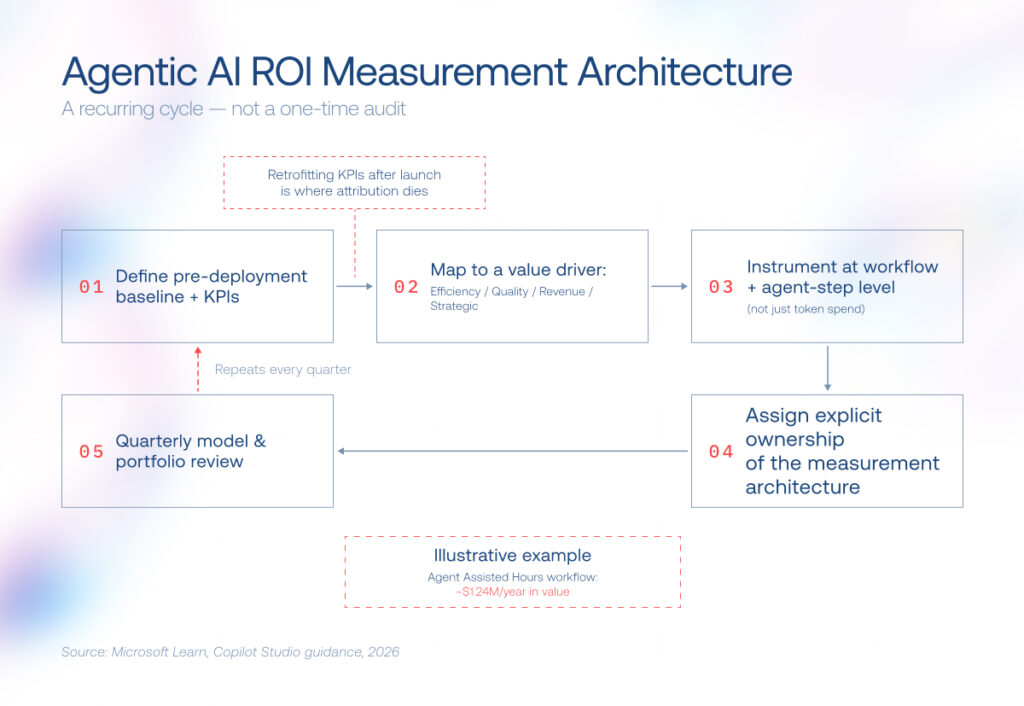
agentic AI ROI measurement architecture

In practice, we structure measurement around four value drivers — Efficiency, Quality, Revenue, and Strategic — each with its own indicators and pricing formula. Together they turn “the agent helped” into a figure finance can check.

Value driverWhat it capturesHow we put a number on it
EfficiencyTime your team wins back and can redirect toward work that genuinely needs a human.Hours freed × fully loaded cost of an hour.
QualityFewer mistakes, steadier output, and tighter compliance.Error-rate improvement × task volume × cost of a single error.
RevenueTop-line gains from the business you keep, grow, or win.Change in conversion or deflection × volume × revenue per unit, discounted for attribution.
StrategicFaster decisions, more confident teams, more room to maneuver, and resilience when things go sideways.Option value of the new capability + value of retained talent + resilience gained.

That collapses into a single number: Agent Assisted Hours (AAH) — the human-equivalent capacity the agent hands back each month. The nuance that keeps it honest is that not every session counts the same. A session where the agent fully resolves a customer’s issue is worth more than one it escalates to a human, so the sessions get weighted by how much work the agent actually took off the team’s plate. 

Run that weighting across a customer-service agent handling 10,000 sessions a month, and it comes out to about 1,440 hours of capacity returned. At a $72 fully loaded hourly rate, those 1,440 hours are worth $103,680 a month — roughly $1.24 million a year. And it’s not abstract capacity: it’s the time a team redirects to complex cases, proactive outreach, coaching, and the judgment-heavy work that actually moves retention. It’s also proof a conversational AI ROI claim can survive finance scrutiny.

Make value drivers built-in for your next agentic AI project?

Talk to our experts

How to calculate AI ROI: a step-by-step framework

We talked architecture, and here’s how to run the math. Get the order below right, and the ROI arithmetic will hold up.

1. Define your pre-deployment baseline and KPIs

Before you write a single prompt, work out what the task costs today: hours, error rate, and rework, calculated with the AAH method above. Set target KPIs against that baseline and tie each one to an existing value driver. 

2. Instrument before launch

Wire up logging at the agent-step level before the first production run: which action the agent took, what it cost in tokens, and what a human would have spent on the same step. Wait until after launch and you’re guessing backward through logs nobody built for the purpose — the baseline and the instrumentation have to share the same units from day one.

3. Run the AAH-style arithmetic

Two calculations do the work here, answering questions of different audiences.

The first is a quick sanity check for the team building the agent — is this thing even worth the tokens?

Model choice moves that denominator fast — top-tier reasoning models cost roughly 24 times as much as small ones — so this tells you quickly whether an agent is even worth its tokens.

The second is the number your CFO and the board care about, because it nets out everything the first one ignores:

Score it across three value vectors: productivity, quality and outcome, and risk aversion. An AI ROI calculator can rough out the first pass, but treat it as a starting estimate rather than the figure you bring to a CFO.

4. Fund and scale against hard value cases

The ROI timeline for AI agents rarely matches the vendor pitch, so fund each agent against a hard value case — a specific, quantified problem with a dollar figure attached rather than a broad vision statement.

In our delivery experience, pilot value shows in four to eight weeks and full deployment lands in two to six months, with payback typically following in six to 18 months. The range depends on how much of the workflow the agent absorbs and how heavy the verification load turns out to be.

— Ivan Dubouski, Head of AI Center of Excellence, Instinctools

Key metrics and KPIs to track before, during, and after deployment

ROI doesn’t hold on its own; you have to track it before deployment, during it, and after.

Before deployment

Set baselines for cycle time, error rate, cost per transaction, and staff hours per case. Define your success criteria in writing before the demo, so nobody can move the goalposts later.

During deployment 

Watch how often a human has to step in, and how you’re checking the agent’s work in the first place. Nearly 70% of agents in production still need a person to intervene within their first handful of steps, and about three-quarters of teams still lean mainly on human review to catch problems.

How you review matters just as much as how often. Agent failures rarely show up in the final output alone; the root cause usually sits several steps upstream, so checking only the end result tends to miss the real problem. That makes intervention frequency and evaluation-method choice your true leading indicators of whether the ROI will hold.

After deployment 

Track outcomes against the four value drivers. Whatever dashboard or AI agent ROI calculator you use, feed it intervention and evaluation data rather than raw completion counts. In our experience, the AI sales agents with the highest ROI are usually lead-qualification and follow-up use cases, since verification cost is low relative to the value of a closed deal.

Which of these metrics matter most depends on a decision most teams make too early: whether to build, buy, or partner for the agent itself.

Build vs. buy: how the decision shapes your ROI math

Where you get the agent — build it, buy it, or have it built for you — shapes your agentic AI ROI more than most teams expect, because it decides who owns the cost structure, the verification layer, and the data the agent generates over time.

Internal development only pays off in four scenarios:

  • Proprietary “glue layers” connecting enterprise-specific data and workflows
  • Differentiated capabilities where the agent itself is the competitive advantage
  • Strategic learning investments a company needs regardless of near-term payback
  • Regulated or data-residency-bound work (HIPAA, SOX, PCI DSS, the EU AI Act), where compliance requires a controlled build, whatever the ROI math says

The thread connecting them is ownership of the data the agent produces. Industry research frames this as “compounded context”: the data an agent captures compounds into a strategic asset over roughly a three-year horizon, but only if you own the pipeline gathering it. That’s why the build case is really a data-ownership case.

Outside those three scenarios, buying usually wins, specifically when:

  • The task is a commodity and well-defined, with no enterprise-specific quirks
  • Speed to value matters more than long-term ownership of context
  • The use case isn’t a source of competitive differentiation
  • You don’t have (or don’t want to tie up) engineering capacity to build and maintain it

There’s a third path between the two: partner-built. Unlike buying an off-the-shelf product, a partner-built agent is developed around your workflows and data by an outside team, so you get build-level fit and context ownership without standing up and maintaining an in-house AI engineering function. GENiE — Instinctools’ proprietary solution accelerator for building custom AI agents — is one example. The table below compares all three.
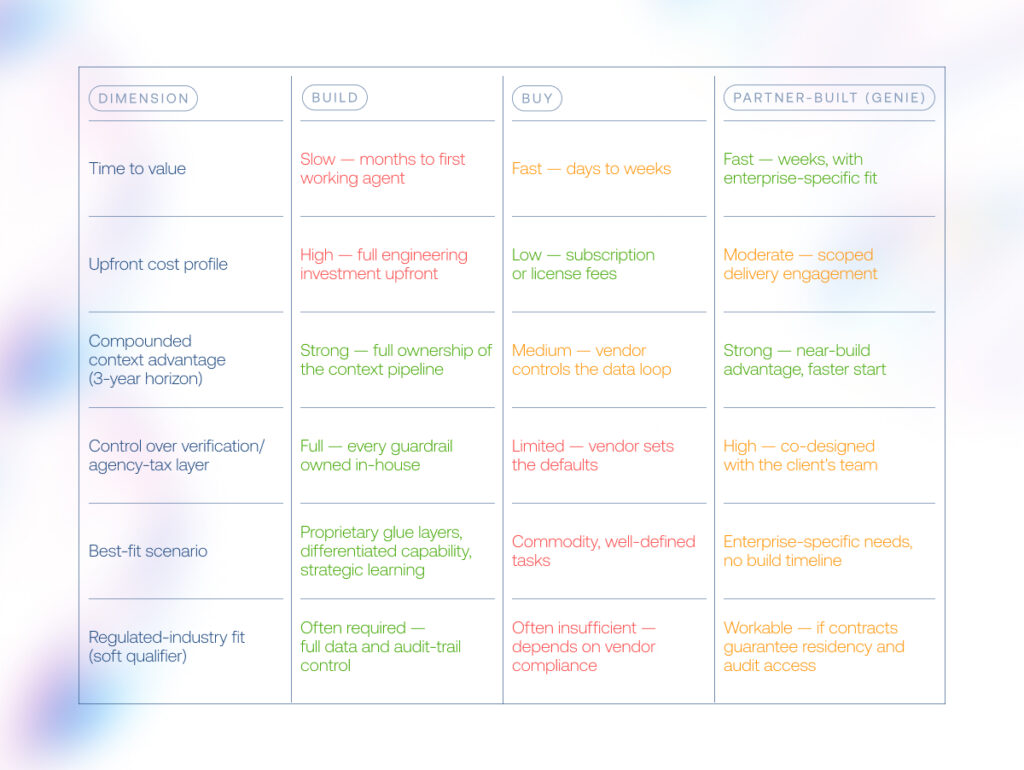
agentic AI ROI

In a nutshell, buy wins on speed. Build wins on long-run compounded context, but only in the three scenarios above. Partner-built approaches, like our GENiE model, capture most of the build’s context advantage without its full timeline or risk thanks to being vendor-agnostic by design and fast to stand up.

— Ivan Dubouski, Head of AI Center of Excellence, Instinctools

Real-world agentic AI ROI: how we cut a six-month onboarding to two weeks

A global insurance aggregator hit the wall most enterprises face when they scale into new markets: partner onboarding. Each new one arrived with a different API, schema, language, and regulatory regime, and reconciling that by hand took three to six months per partner, across dozens of countries.

We created a production multi-agent system around an Analyze → Plan → Generate pipeline, using our GENiE framework, so the guardrails that keep agentic ROI from eroding, such as model governance, orchestration, and human-in-the-loop validation, were part of the design from day one. 

The payoff: 

  • Onboarding time fell from three to six months to two weeks, up to 12x faster
  • Operational cost dropped 10x, and repetitive developer work fell by 80–90%
  • Engineers now spend roughly $50–100 and two to three hours of effort per large endpoint, checked by about 20 minutes of human review

Run those figures through the success probability weighed against verification cost ROI formula, and you get exactly this in production: 20 minutes of review time buying back months of manual onboarding work.

Try GENiE for your agetic AI use case

Book a demo

Turn agentic AI ROI from a guess into a number

Agentic AI ROI is won or lost before deployment: in how carefully you baseline the work, scope the verification layer, and tie each agent to a value driver a CFO already recognizes. The model behind the agent matters far less than the measurement wrapped around it. 

Get the baseline, the instrumentation, and the build-buy-partner call right, and every gain you claim traces back to a number finance can check. Get them wrong, and no dashboard will reconstruct the story after the fact. Measure first and deploy second — that order is the whole game.

Want real numbers behind your agents before you commit?

Book a call

FAQ

How long does it typically take to see ROI from agentic AI?

In our delivery experience, pilots surface value in four to eight weeks, full deployment lands in two to six months, and payback typically follows in six to 18 months, but only when the baseline and KPIs are set before launch. Most enterprises plan for returns on a one- to five-year horizon, and the teams that beat that timeline are almost always the ones that started measuring on day one.

What percentage of agentic AI projects fail to show measurable ROI?

Up to 95% of them by the current numbers: the large majority of AI pilots never show measurable P&L impact, and 40% of agentic projects get canceled before they ever scale. But that failure rate rarely indicts the technology itself. In lots of cases we see, it traces back to measurement that started after deployment instead of before it, which leaves no baseline to attribute gains against.

How do you actually measure ROI for an AI agent?

Start with four value drivers — efficiency, quality, revenue, and strategic — each with its own indicators. Convert efficiency into Agent Assisted Hours: productive hours returned multiplied by fully loaded hourly value. Instrument at the workflow-step level before launch, so the numbers track the same units as your baseline.

Should we build, buy, or partner for our agentic AI ROI case?

Build only pays off in four scenarios: proprietary glue layers connecting enterprise-specific data, differentiated capability where the agent itself is your competitive advantage, strategic learning you need regardless of near-term payback, and regulated and data-residency-bound work where the rules leave you no real alternative. Outside those, buying wins on speed. Partner-built approaches, like our GENiE model, capture most of the build’s context advantage without the full timeline or cost.

What are the hidden costs that hurt agentic AI ROI?

The biggest is the agency tax: the verification and rework cost stacked on top of a wrong output, since a large share of an agentic task’s cost sits in refining answers rather than producing the first draft. Add agent sprawl and weak governance, and realized ROI erodes fast even when the underlying model performs perfectly well.

Which KPIs should we track to prove agentic AI ROI to leadership?

Before deployment, monitor baseline cycle time, error rate, cost per transaction, and staff hours per case. During deployment, watch intervention frequency and which evaluation method you’re relying on, as most agents still need a human to step in within their first several steps in production. After deployment, track outcomes against the four value drivers rather than raw task volume or completion counts.

Which use cases show the strongest agentic AI ROI?

Agentic AI platforms show measurable ROI in customer service first, since call volume is high and the value driver is obvious. Back-office workflows with clear audit trails, such as partner onboarding or invoice processing, follow close behind once governance is in place.


AI in Learning and Development Has Come a Long Way From Disconnected Tools to Adaptive Learning Systems

AI learning and development is becoming less about producing more training content and more about using AI to connect learning with skills data, role expectations, knowledge bases, performance signals, manager interventions, compliance requirements, and business priorities. Why? Because, according to the World Economic Forum’s Future of Jobs Report 2025, 39% of workers’ existing skill sets are expected to be transformed or become outdated between 2025 and 2030. For L&D teams, it means that continuous learning has become a must-have, without which employees won’t be able to keep pace with changing roles and execute business strategy

In this context, the old model – build a course, publish it in the LMS, wait for completion data – cannot carry the load on its own. AI for employee training and development gives organizations a chance to rebuild the learning function around continuous adaptation, but only if they stop treating AI as a collection of disconnected tools.

Key highlights

  • AI in learning and development is shifting from isolated content-generation tools to connected systems that support skills, performance, and business adaptability.
  • Besides course creation, the highest-value AI corporate training use cases include skill-gap detection, personalized learning, practice simulations, manager coaching, knowledge retrieval, compliance support, and learning analytics.
  • Enterprise success depends less on the model itself and more on the architecture around it: governance, context, integrations, orchestration, monitoring, and role-specific user experiences.

Where AI in L&D fits today

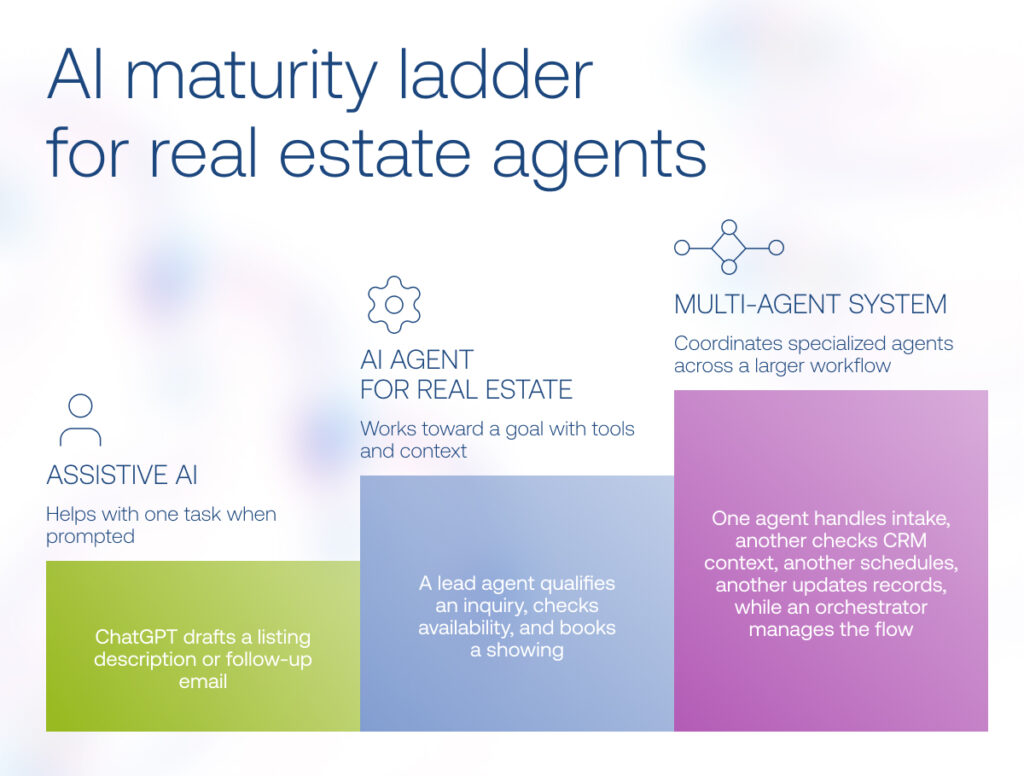
The role of AI for learning and development is easiest to understand as a maturity curve.

At the first level, AI works as a copilot. It drafts, summarizes, and suggests, but a person stays in the loop on every output. In practice that looks like a generative draft of a course module or a quiz built from a short brief, which an instructional designer then reviews before anything reaches a learner.

At the second level, there is a single AI agent. Give it a goal and a set of tools, and it executes one bounded task from start to finish. A working L&D example is an agent that auto-grades assessments and returns structured feedback, while your team sets the guardrails and audits the outcomes.

At the third level, AI supports workflows through multi-agent systems. Specialized agents run a chained workflow under a supervisor: one builds the course, another maps it to your skills graph, all of it gated by human sign-off. Counterintuitively, autonomy does not reduce the human role here. It raises it, because more moving parts demand more governance, not less.

LevelWhat it doesL&D exampleHuman role
Assistive (copilot)Drafts, summarizes, suggests; human in the loop on every outputGenerative draft of a course module or quiz from a briefReviews and approves each output
Single AI agentExecutes a bounded task end-to-end with goals plus toolsAuto-grades assessments and returns structured feedbackSets guardrails, audits outcomes
Multi-agent systemsSpecialized agents under a supervisor run a chained workflowEnd-to-end course build plus skills mapping under human sign-offOwns governance, sign-off gates

Knowing where you sit matters. Most enterprises live on the assistive level, experimenting rather than running production agents. In our delivery work, the jump from assistive to agentic is a governance and data problem long before it is a model problem. Clients who tried to skip straight to autonomous agents, without the orchestration and sign-off layer, stalled. That adoption reality is the whole reason this article argues for orchestrating a supervised workflow over buying autonomous tools. So where does this land across the day-to-day of L&D?

AI corporate training use cases that create measurable value

AI augments five stages of the L&D workflow. Across content, personalization, delivery, skills intelligence, and operations, the same pattern holds: each capability multiplies the others only when orchestrated over shared, clean learning data, not bought as disconnected point tools. Here is what AI actually does at each stage:

  • Faster content production: drafting modules, quizzes, and assessments from a brief in hours instead of weeks.
  • Personalization at scale: adaptive learning paths tuned to each learner’s role, history, and pace.
  • 24/7 tutoring and coaching: an always-on assistant that answers questions and walks learners through hard concepts.
  • Real-time skills visibility: continuous mapping of what your workforce can do against what the business needs.
  • Automated L&D operations: enrollment, scheduling, reminders, and compliance 

The engineering win is wiring these stages to a shared skills graph and learning record so they reinforce one another.

Content and course generation

Generative AI in learning and development has made content creation one of the most common examples of AI in learning and development. L&D teams can use AI to draft course outlines, convert long-form documents into microlearning, generate knowledge checks, adapt examples for different roles, rewrite materials for different reading levels, and localize content across languages or regions.

But there is a trap. An AI-generated lesson can be polished and still be wrong, outdated, too generic, or misaligned with the company’s policies. That is why the strongest content workflows keep humans in the loop. AI drafts, restructures, adapts, or localizes. Subject-matter experts validate accuracy. L&D teams check instructional quality. Governance rules ensure the right version is published.

Used this way, AI for training and development helps teams scale content operations without turning the learning ecosystem into a flood of unverified material.

Personalization and adaptive learning

Adaptive learning turns a static catalog into a path that responds to the individual. The system reads role, prior completions, assessment results, and on-the-job behavior, then sequences what each learner sees next. We built this directly into an EdTech mobile app for an educational ecosystem, where a machine-learning recommendation engine matched learners to the right next module and raised learner engagement 43%. 

It’s important to note that for enterprises, personalization works only when the system has reliable context. If the skills taxonomy is weak, job roles are inconsistent, learning assets are poorly tagged, or performance signals are unavailable, AI recommendations become educated guesses. This is why the knowledge layer matters as much as the model.

AI tutoring, performance support, and knowledge retrieval

Many L&D problems are really knowledge-access problems. The organization already has the answer, but employees cannot find it when they need it.

A grounded AI tutor or learning assistant can help employees ask questions and receive answers based on approved internal sources. It can cite the relevant document, explain the policy, suggest a next step, and escalate low-confidence cases.

For example, a frontline worker could get guidance on handling a specific service exception. A software engineer may need a concept explained through the lens of the company’s internal framework. For a sales rep, the assistant can help position a new feature for a regulated customer. In finance, it can point an employee to the policy that applies to a particular approval scenario. In those environments, people need the right answer at the right moment more than they need another hour-long learning module.

Skills intelligence and analytics

Many companies still struggle to see their workforce capabilities clearly: which skills they have, which are fading, where roles are changing fastest, who could move into adjacent positions, where capability gaps are forming, and which learning investments actually support strategic priorities.

AI in talent development can help by connecting job architecture, skills taxonomies, learning records, project data, manager input, performance signals, and internal mobility patterns.

In this case, AI in HR learning and development becomes strategic, as it can support career pathing, succession planning, workforce planning, project staffing, reskilling, and internal mobility. Instead of offering the same training catalog to everyone, the organization can build more targeted development pathways.

L&D operations automation

The least glamorous stage is often where leaders feel the value first. AI handles enrollment, scheduling, nudge reminders, and certification tracking, and it generates the compliance reports that used to consume coordinator hours. 

In regulated settings, automated certification tracking and audit-ready reporting are not conveniences; they are the difference between passing an inspection and scrambling for evidence. This is where the workflow stops being an internal efficiency story and becomes an enterprise risk-and-compliance story, with stakes high enough to reshape how the whole system gets built.

What a production-ready AI L&D system looks like

Once AI starts recommending learning paths, interpreting skills data, nudging managers, reinforcing compliance, or updating records in the LMS, it becomes part of the company’s capability infrastructure and needs clear rules, trusted context, secure integrations, coordinated AI workflows, performance feedback, and user experiences built around real L&D work.

These requirements translate into six architecture layers, each answering a specific implementation question and preparing the ground for the next one:

  • what AI is allowed to do,
  • what knowledge it can trust,
  • which systems it can interact with,
  • how AI-enabled steps are coordinated,
  • how performance is monitored,
  • how learners, managers, and L&D teams experience the system.

1. Governance and control layer

Governance should come first because AI in L&D often touches sensitive areas: employee data, learning records, skills profiles, performance signals, compliance status, career recommendations, and manager decisions.

This layer defines what the system is allowed to do, what requires human approval, which data each role can access, and how outputs are reviewed.

It includes role-based permissions, privacy rules, content approval workflows, audit trails, source provenance, bias checks, escalation logic, human-in-the-loop review, and a clear separation between suggestions and decisions.

2. Knowledge and context layer

Once the rules are clear, the system needs reliable context.

This layer brings together the information AI will use to support learning decisions: skills taxonomies, competency models, role profiles, learning content, internal policies, SOPs, knowledge articles, assessment data, employee learning history, manager feedback, and business priorities.

Without it, personalization remains shallow. The system may generate a fluent answer or suggest a polished course, but it may not be relevant, current, approved, or aligned with the employee’s role.

For many companies, applying AI for learning and development becomes difficult because their data is not prepared: content, metadata, skills data, and business context are scattered.

3. Integration and action layer

AI becomes useful at enterprise scale when it connects to the systems where learning and work already happen.

This layer integrates the AI system with LMS, LXP, HRIS, talent marketplaces, collaboration tools, knowledge bases, content repositories, assessment platforms, performance management systems, ticketing tools, CRM systems, and business applications.

The integration layer allows AI to move beyond recommendations. It can assign a learning path, update completion records, trigger manager nudges, schedule coaching, retrieve policy content, recommend practice, create a learning task, or route an item for review.

But action increases risk. Reading from a knowledge base is one thing. Updating an employee record, assigning compliance training, or nudging a manager is another. Actions should be permissioned, logged, reversible where possible, and tied to clear approval paths.

4. Agent orchestration layer

Only after governance, context, and integrations are defined does it make sense to design agents.

Agentic AI in learning and development is useful when the workflow requires multiple steps, changing context, system access, handoffs, and human review. The orchestration layer coordinates how specialized AI capabilities work together across a learning workflow.

For example, an onboarding workflow might involve several agents or AI-enabled steps: a role-context agent identifies what the new hire needs to know, a knowledge agent retrieves approved company materials, a content agent adapts them into a learning path, a practice agent generates realistic exercises, a manager-support agent prepares coaching prompts, and an analytics agent tracks progress.

The value is not in calling everything an agent. The value is coordination. When workflows are simple, orchestration may be unnecessary. When learning depends on multiple systems, approvals, roles, and feedback loops, orchestration prevents AI from becoming another set of disconnected point tools.

5. Monitoring and optimization layer

AI learning systems need continuous monitoring because their quality depends on changing inputs: content, roles, policies, skills, learner behavior, and business needs.

This layer tracks usage, learner engagement, content accuracy, retrieval quality, human overrides, escalation rates, assessment performance, completion, transfer signals, manager adoption, skills progress, business outcomes, drift, and failure patterns.

Every AI-supported workflow should leave a trace: what context was used, what output was produced, what action was taken, whether a human approved it, and what happened next.

Without monitoring, companies manage AI by anecdote. With monitoring, they can manage it as a business capability.

6. User and business interface layer

The interface is the final expression of the architecture.

For learners, it may look like a role-aware assistant, a personalized learning path, a simulation environment, or a support experience embedded in the flow of work. For managers, it may show coaching prompts, team capability gaps, readiness signals, recommended interventions, and conversation guides. For L&D teams, it may provide dashboards for content quality, workflow performance, learner engagement, governance review, and program impact.

How to use AI in learning and development without creating another fragmented stack

The best way to use AI tools for learning and development is to start with one workflow where the business already feels friction.

Begin with the operating problem. 

Here AI adoption needs a strategic pause. Without one, L&D teams can easily end up with a content generator here, a chatbot there, a coaching assistant somewhere else, and no shared logic connecting them to skills, systems, governance, or measurable business outcomes. A structured, tailored AI adoption workshop helps prevent that pattern by bringing business, L&D, HR, and technology stakeholders into the same conversation before tools are selected or pilots are launched.

The goal is to identify the few that are valuable, feasible, and safe enough to move forward and then translate them into a practical roadmap.

A practical rollout has six steps:

  1. Choose one capability domain, such as onboarding, sales enablement, customer support training, compliance, manager development, technical upskilling, or frontline knowledge support.
  2. Map the workflow end to end: triggers, systems, content, approvals, learner struggles, manager interventions, and business outcomes.
  3. Audit the data and knowledge foundation: learning content, skills taxonomy, role profiles, metadata, policies, knowledge bases, HR data, and permissions.
  4. Define human judgment moments: where humans review, approve, coach, or make the final decision.
  5. Build the measurement loop around time to proficiency, search success, learner engagement, manager adoption, reduced support tickets, internal mobility, or performance improvement.
  6. Decide what to buy, extend, or build.

Using AI tools for learning and development effectively does not mean automating everything. It means redesigning the right workflows so AI supports capability development without weakening quality, accountability, or trust.

AI in L&D governance: risks, controls, and responsible adoption

The risks of AI in L&D are not theoretical.

The first failure mode is hallucinated course or compliance content. A model that drafts a safety module from open-web priors will, sooner or later, state something confidently wrong, and in regulated training a wrong answer carries legal weight. The fix is structural: RAG over governed content so the model answers from your curated learning library, paired with human-in-the-loop sign-off on anything that ships. No compliance module reaches a learner without a person approving it.

The second is recommendation bias. Skills-graph and adaptive-path engines learn from historical data, and historical data encodes who got promoted, trained, and sponsored in the past. Left unchecked, the system steers opportunity toward the groups it already favors. The mitigation is routine skills-graph audits and fairness checks on recommendation outputs, treated as a standing process, not a one-time launch task.

The third is employee-data privacy. Learning records are PII: role history, assessment scores, performance signals. Personalization needs that data, but it must stay inside controlled environments with defined PII residency, and it must never enter a public model context. Residency and access boundaries are design constraints set before the first agent runs.

The fourth is a distrust of autonomy, and leaders are right to be cautious. The answer is supervised orchestration with a full audit trail rather than black-box autonomy: agents get bounded authority, sign-off gates, and a logged record of every decision a reviewer can defend later.

The market backs this posture. Only 15% of IT application leaders are considering, piloting, or deploying fully autonomous AI agents. Read that caution as sound judgment about where unsupervised systems belong, rather than a lag to overcome.

Future of AI in learning and development: from content tools to capability infrastructure

The next generation of learning systems will not only recommend courses. They will detect skill gaps, retrieve trusted knowledge, create practice opportunities, support managers, monitor progress, update content, route approvals, and connect learning outcomes to business performance.

Counterintuitively, this makes human work even more important. People still define the skills that matter. Experts still validate knowledge. Managers still coach. Leaders still make workforce bets. Employees still need to practice, reflect, and build judgment.

The generative AI in the learning and development market is already moving beyond content tools toward systems that combine skills intelligence, workflow automation, coaching, analytics, and performance support. In other words, the future of learning and development is a better infrastructure for helping people adapt.

Ready to move from point tools to an orchestrated Lu0026D system?

Let’s scope it

FAQ

What is AI in learning and development?

AI in L&D is the use of generative and agentic AI across the learning workflow: drafting content, personalizing paths, tutoring, mapping skills, and automating L&D operations, layered over an LMS or LXP and clean learning data. According to McKinsey, about 80% of organizations use generative AI somewhere, but fewer than 10% scale AI agents in any function, so most real value today is assistive and supervised, not autonomous.

How is AI used in corporate training?

AI handles content generation, adaptive and personalized paths, 24/7 tutoring, skills intelligence and analytics, and operations automation such as enrollment and compliance reporting.

What are the benefits of AI in L&D?

The benefits compound across the workflow: faster content production, personalization at scale, always-on tutoring, real-time skills visibility, and automated operations. They reinforce one another only when orchestrated over clean data. The energy-corporation compliance LMS is the proof point, where a governed, integrated build drove the task-automation, engagement, and budget gains cited above.

What are the challenges and risks of AI in L&D?

Four risks recur: hallucinated course or compliance content, biased recommendations, employee-data privacy breaches, and leader distrust of autonomy. The mitigations are RAG over governed content with human sign-off, routine fairness audits, strict PII residency, and supervised orchestration with audit trails.

Will AI replace L&D professionals?

No, but it is shifting the work. According to the LinkedIn Workplace Learning Report, 71% of L&D professionals are already exploring, experimenting with, or integrating, which actually raises demand for human-led L&D to design, govern, and review AI-assisted learning rather than reducing it.

Should we build or buy an AI LMS?

Buy off-the-shelf when needs are generic and data is clean; build or extend custom when you need deep HRIS, LMS, and compliance integration, regulated data residency, or orchestration across systems. Gartner predicts over 40% of agentic AI projects will be canceled by end of 2027 on cost, unclear value, and weak risk controls, so readiness and governance decide success more than the tool.

What is the difference between SCORM and xAPI?

SCORM is the legacy, LMS-bound packaging and tracking standard focused on course completion. xAPI (IEEE 9274.1.1-2023) records any learning experience, including mobile, simulations, and on-the-job tasks, as noun-verb-object statements sent to a Learning Record Store (LRS) that can live inside or outside an LMS. xAPI and the LRS are the richer data substrate adaptive AI needs.

AI Real Estate Agent Tools in 2026: Expert’s Guide On What Works Now and What’s Coming Next

Not that long ago an AI real estate agent used to sound like a futuristic replacement for a human realtor. In 2026, the term can describe a single AI tool that helps an agent write a listing description, an AI voice agent for real estate that answers inbound calls, or a more advanced system that qualifies leads, schedules showings, updates a real estate CRM, and keeps the workflow moving with human oversight.

That difference matters. For now, most AI in real estate acts like a helpful assistant, taking care of isolated tasks such as writing, summarizing, transcription, recommendations, and reminders. The next generation of AI tools for real estate agents will go further, helping humans coordinate entire workflows across lead generation, nurturing, showings, transaction tasks, documents, and follow-up.

Built on our experts’ hands-on experience with AI real estate solution implementation, this guide explains which AI tools for real estate agents are useful today, where agentic AI in real estate is heading, and how brokerages, teams, and proptech companies can prepare their data, workflows, and governance for the shift from point tools to coordinated AI-powered operations.

Key highlights

  • The AI real estate agent is no longer a single tool, but a workflow-driven system that connects leads, listings, transactions, and operations into one coordinated process.
  • The real impact of AI in real estate comes from orchestrated execution, where AI moves work across systems, while humans stay in control of judgment, approvals, and client relationships.
  • Companies that want to benefit from AI real estate agents must first redesign their workflows, data, and governance, not just adopt new tools.

What is an AI real estate agent?

An AI real estate agent is software that uses artificial intelligence to support, automate, or coordinate work across the real estate lifecycle. In its simplest form, it may be an AI assistant for real estate agents that drafts emails, writes property listings, summarizes calls, or answers common buyer questions. In their more advanced form, AI agents for real estate can act on a goal: capture a lead, qualify the buyer, book a showing, send reminders, update the CRM, and route exceptions to a licensed agent. In other words, the system takes over parts of the workflow that are repetitive, time-sensitive, or rules-based, while humans stay responsible for fiduciary duty, negotiation, compliance, client trust, and final decisions.

Maturity curve of AI tools for real estate agents

How to use AI for real estate agents: 7 high-impact use cases

The most useful AI tools for real estate agents are defined by the workflow – not just a single task – they improve.

1. Lead response and tour scheduling

Lead response is one of the clearest use cases for an AI real estate agent because the workflow is time-sensitive, repetitive, and easy to measure. When a buyer, renter, or seller inquiry comes in, someone has to answer, qualify intent, collect preferences, check availability, schedule the next step, and update the CRM.

An AI voice agent for real estate can handle the first part of that workflow when a human agent is unavailable. It can answer inbound calls, ask basic qualification questions, capture budget and timeline, transcribe the conversation, and trigger follow-up automation. In text channels, the same role can be played by an AI chatbot that answers website, SMS, or portal inquiries and routes serious prospects to the right person.

For residential agents and brokerages, this is where AI delivers immediate value, as it contributes to fewer missed leads, faster replies, cleaner CRM records, and more consistent follow-up. 

2. Leasing and renewals

Leasing is often treated as a marketing process, but operationally it is a sequence of handoffs, such as inquiry, qualification, availability check, tour scheduling, application support, document collection, approval, move-in, and renewal. Every delay creates friction for the prospect, the leasing team, and the property owner.

A real estate AI agent can support this process by handling routine leasing conversations, answering property questions, collecting applicant details, booking tours, sending reminders, and routing exceptions to a human leasing specialist. For renewals, AI agents can monitor signals such as unresolved maintenance issues, negative feedback, missed appointments, or slower response behavior, then prompt the team to intervene before the tenant decides to leave.

For larger operators, this can become a multi-agent workflow, where a communication agent handles tenant-facing messages, a knowledge agent retrieves policy and lease context, a scheduling agent coordinates tours, a compliance agent checks escalation rules, and a CRM agent logs the result.

3. Maintenance and resident service

Maintenance is one of the strongest examples of agentic AI in real estate because the work rarely ends with answering a question. When a resident reports a problem, the business has to classify the issue, assess urgency, check property rules, coordinate access, dispatch a technician or vendor, communicate updates, approve costs, and close the loop.

A simple AI chatbot for real estate agents can collect a maintenance request. A more capable AI agent can move the ticket through the process: ask clarifying questions, categorize the issue, identify emergency cases, read attached photos, suggest troubleshooting steps, route the job to the right technician, notify the resident, and update the property management system.

4. Transaction coordination and document management

Real estate transactions depend on documents: listing agreements, disclosures, contracts, inspection reports, amendments, financing documents, lease files, closing checklists, and compliance records. Delays usually happen because someone has to find the right document, extract the right detail, confirm the deadline, or chase the next signature.

An AI assistant for real estate agents can summarize a contract or draft an email. A more advanced real estate AI agent can help coordinate the transaction workflow: extract key dates, compare checklist requirements against available documents, flag missing signatures, draft client updates, prepare reminders, and route questions to the licensed agent or transaction coordinator.

For brokerages and proptech companies, this is a strong candidate for custom AI agent development because the workflow often depends on local rules, brokerage-specific processes, document templates, and compliance requirements. The agent should not make legal decisions or interpret obligations without review, but it can reduce the administrative drag around those decisions.

5. Property valuation and market analysis

AI can help collect comparable sales, summarize neighborhood trends, analyze property attributes, identify anomalies, and turn market data into a first draft of a pricing narrative.

But this is not a use case where AI should become the decision-maker. Automated valuation models and predictive analytics can support the analysis, while the licensed agent brings local judgment: property condition, buyer psychology, micro-location, renovations, inventory pressure, seller urgency, and negotiation strategy.

The best AI tools for real estate agents in this area work as decision support. They help agents move faster from raw MLS data, public records, and market signals to a defensible recommendation. They do not remove the need for a professional who understands the market and can explain the pricing logic to a client.

6. Asset management and portfolio operations

In commercial real estate and larger residential portfolios, the AI real estate agent concept expands beyond individual buyer or seller support. Here, AI agents can help asset managers, owner-operators, and property management teams coordinate portfolio-level work.

For example, one agent can extract lease terms and key dates, another can pull operating performance, another can summarize tenant or resident issues, another can prepare a draft investment memo, and another can flag risks that require review.

This use case matters because it shows the enterprise direction of real estate AI agents. The value lies in connecting documents, systems, workflows, and approvals so that teams spend less time rebuilding the facts and more time making judgment calls.

7. Construction, capital projects, and vendor coordination

Construction and capital projects are full of documents, dependencies, approvals, vendors, and exceptions. AI agents can support this domain by organizing RFIs, submittals, meeting notes, bids, permits, change orders, schedules, and closeout documents.

A project-support agent might classify incoming documents, extract action items from meeting minutes, check whether a submittal package is complete, draft a vendor update, flag a change order above an approval threshold, or remind stakeholders about missing closeout materials.

Best AI tools for real estate agents: how to choose

The best AI tools for realtors are the ones that remove bottlenecks in the agent’s actual week.

For solo agents, the best fit is usually a practical stack: a writing assistant, an AI voice or chatbot tool, CRM follow-up automation, transcription, and a simple listing description generator. For teams and brokerages, the decision is different. They need shared data, role-based access, workflow visibility, brand controls, and integrations with the CRM, transaction coordination, document management, and marketing systems.

Before choosing a tool, answer the following questions:

  • Does it connect to the systems where work already happens?
  • Does it improve lead response, follow-up, documentation, or conversion?
  • Can humans review sensitive actions before they happen?
  • Does it leave an audit trail?
  • Can it scale from one agent to a team or brokerage?
  • Does it support your brand voice and compliance requirements?
  • Does it make the CRM cleaner or messier?

What production-ready AI real estate agent architecture looks like

A production-ready AI real estate agent depends on a well-defined architecture, particularly when it interacts with business systems, schedules showings, sends client communications, or updates records in real time. Reliable execution at scale requires these capabilities to be organized across several coordinated layers.

1. User and business interface layer

This is where agents, brokers, property managers, leasing teams, or asset managers interact with the system. It may be a chat interface, CRM sidebar, mobile app, dashboard, or workflow queue.

The interface should match the job: lead response, showing scheduling, transaction coordination, maintenance triage, or portfolio review.

2. Agent orchestration layer

This layer coordinates the work. It decides which agent should act, what context it needs, when to route work to another agent, and when to stop for human review. For simple tasks, orchestration may be unnecessary. Meanwhile, for complex workflows, it prevents AI agents from becoming disconnected point tools.

3. Knowledge and context layer

Weak context produces weak automation. If the data is outdated, duplicated, or disconnected, the AI may sound confident while moving the workflow in the wrong direction. So this layer is designed to provide the system with reliable information: CRM history, property listings, MLS data, client preferences, transaction documents, lease terms, vendor records, policies, and prior communications.

4. Integration and action layer

At this point,  the AI connects to real estate CRM, calendars, email, SMS, transaction management software, document stores, virtual tour tools, property management systems, and marketing platforms. That’s how AI agents can create tasks, update records, schedule showings, trigger reminders, or route approvals.

5. Control layer

This layer defines what the AI is allowed to do. It includes permissions, approval rules, audit trails, escalation logic, compliance checks, and human-in-the-loop controls.

For real estate, AI governance is essential. AI should not make unauthorized promises, change contract terms, approve concessions, or handle sensitive client matters without clear boundaries.

6. Monitoring and optimization layer

AI gets better only when the business can see what happened, why it happened, and where the workflow broke. That’s why it needs to be possible to track whether the system is working: response times, booking rates, lead conversion, CRM accuracy, escalation rates, human overrides, failed actions, and user adoption.

Build vs. buy: AI real estate agents

There is a ceiling on what rented tools can do. Off-the-shelf apps solve isolated tasks well, a chatbot here, a follow-up sequence there, but each one runs in its own silo. A custom AI agent can orchestrate the whole brokerage workflow end to end, moving a lead from first contact through qualification, scheduling, and CRM updates without a human stitching the apps together. That difference is what separates buying a tool from building a system.

For an individual agent, buying is almost always the right call. For a brokerage or a proptech company with volume, its own data, and strict compliance rules, a purpose-built system on a multi-agent framework for real estate workflows can fit the exact process instead of forcing the process to fit the app. The honest answer depends on your size, your data, and how custom your workflow really is. In regulated workflows with sensitive client data, that calculus also has to account for data residency and audit-trail requirements, which can push a team toward building even when an app would be cheaper to start.

FactorBuy (off-the-shelf)Build (custom)
Time to launchFast, ready out of the boxSlower, a real project
CustomizationLimited to the vendor’s roadmapAny workflow you can define
Cost modelPredictable subscriptionHigher upfront, lower long-run at scale
Data and complianceVendor-controlledFull control over data and audit trails
Best fitIndividual agents and small teamsBrokerages and proptech with scale

How brokerages and proptech companies can prepare to use AI as a real estate agent

While individual agents can start with separate, out-of-the-box tools, brokerages and proptech companies need full AI readiness. Here’s the checklist our AI experts suggest following:

  • First, clean the data foundation. AI needs reliable records for leads, clients, properties, listings, transactions, documents, vendors, and communications. If your data is messy, AI will scale the mess.
  • Second, map workflows before automating them. Lead generation, lead nurturing, showing scheduling, transaction coordination, document management, and follow-up automation should be broken into repeatable steps, judgment points, and escalation moments.
  • Third, define governance early. Who can approve AI-sent messages? Which actions require human review? What data can each user access? What gets logged? What happens when confidence is low?
  • Fourth, decide what to buy, extend, or build. Most individual agents should buy. Teams may extend existing platforms. Proptech companies and larger brokerages may build custom AI agents when workflow intelligence, proprietary data, or brand experience becomes a competitive advantage. 

Will AI replace real estate agents?

The short answer is no – at least, not now. 

The question itself confuses tasks with the job. Goldman Sachs estimates that 46% of tasks in office and administrative support roles are exposed to automation by generative AI, the highest share of any occupation group. Much of an agent’s week is exactly that kind of work: paperwork, scheduling, data entry, and first-draft writing. Automating those tasks does not remove the agent. It clears the calendar for the parts of the job a machine cannot do.

Those parts are real, and they are defined in part by law. Under Article 1 of the NAR Code of Ethics, agents pledge to “protect and promote the interests of their client”. A model cannot hold that obligation, carry the license behind it, or answer for a bad outcome. So the question of whether real estate agents will be replaced by AI runs into a wall: accountability has to rest with a person.

Three constraints keep the human in the seat. Licensing ties the transaction to a credentialed individual. Legal liability needs someone who can be held responsible. And the emotional weight of the largest purchase in most people’s lives still calls for a person who can read a room and steady a nervous buyer. So will AI take over real estate agents entirely? Not on any near-term roadmap, which is why that worry is aimed at the wrong target.

The clearest way to see the boundary is to lay the two columns side by side.

What AI can doWhat AI can’t do (yet)
Qualify leads 24/7Negotiate the terms of a deal
Generate listing descriptionsHold fiduciary responsibility
Answer neighborhood questionsRead a buyer’s emotion at a showing
Automate follow-upBuild trust through an in-person meeting
Analyze market dataSign a legal document

The left column is where AI compounds your output. The right column is where your value lives. Human real estate agents who automate the left and double down on the right are the ones who pull ahead.

The future of the AI real estate agent is workflow, not tools

AI automation for real estate agents is not one thing, but a category of tools that has moved from simple assistance to coordinated execution. The most valuable real estate AI agents coordinate full workflows: capturing leads, scheduling showings, updating systems, routing approvals, supporting transaction coordination, and learning from every completed step.

In this landscape, the winning move is to choose the workflow where speed, consistency, and better handoffs matter most, then build the data, integrations, governance, and monitoring around it. For agents, teams, and brokerages, that is where the real advantage starts.

Ready to build your own AI agent for real estate?

Let’s talk

FAQ

What is agentic AI in real estate?

Agentic AI in real estate is software that plans and acts toward a goal instead of just answering a prompt. Given a target, it chains steps together, for example capturing a lead, qualifying it, booking a showing, and updating the CRM, while a human supervises the outcome.

What AI tools do real estate agents use?

They fall into six categories: voice agents, chatbots, listing and marketing generators, AI-powered CRM and lead automation, valuation and market-analysis models, and free general tools like ChatGPT. Per NAR’s 2025 survey, ChatGPT is the most-used, at 58% (NAR, 2025).

What is the best AI voice agent for real estate?

There is no single best AI voice agent for real estate; the right one depends on your CRM and call volume. Widely used options include Structurely, Roof AI, and CINC. The shared value is speed: these tools answer and qualify a lead in seconds rather than hours.

Will AI replace real estate agents?

No, real estate agents will not be replaced by AI as a profession. Generative AI automates routine tasks, yet it cannot hold a license, carry fiduciary responsibility, or build trust in person. Goldman Sachs estimates 46% of office and administrative tasks are exposed to automation (Goldman Sachs, 2023), but the licensed, accountable, and emotional parts of a transaction still require a person under the NAR Code of Ethics. Yet, the agents who automate routine work and focus on judgment and relationships will outperform those who do not.

How do I use AI as a real estate agent?

To use AI as a real estate agent, start small: audit your routine, pick one tool, test it on real work, then integrate it. Begin with high-return tasks like listing copy, lead qualification, and follow-up. Free tiers of ChatGPT, Gemini, and Zapier are a low-risk place to start.

What are the best free AI tools for real estate agents?

The best free AI tools for real estate agents include ChatGPT’s free tier for writing, Canva AI for marketing graphics, Google Gemini for research, and Zapier’s free tier for connecting apps. Together they automate listings, social content, and basic lead handling at no cost.

What Is Palantir AIP? A Deep Dive into Its Architecture, Use Cases, and Alternatives

Palantir AIP has become one of the enterprise AI platforms companies consider when they want to operationalize large language models without building the entire AI infrastructure from scratch. For many organizations, the question is no longer whether LLMs belong in day-to-day operations, but how to connect them securely to business data, workflows, decisions, and actions.

This guide covers what Palantir AIP is, how it works under the hood, what capabilities it provides out of the box, when adopting it can be more practical than building a custom stack, and when a lighter-weight alternative may be the better fit. 

Key highlights

  • AIP’s value comes from the infrastructure around AI, not AI itself.
  • Intertwined with the Ontology, off-the-shelf governance and security mechanisms, and production-proven action layer are the reasons AIP behaves differently from a self-assembled enterprise AI stack.
  • AIP Palantir shines in large-scale operational environments and becomes overkill outside them.

Palantir AIP is an enterprise-targeted Artificial Intelligence Platform businesses can use on top of their existing tech stack without modernizing legacy components. It belongs to Palantir’s enterprise AI operating system, alongside Palantir Foundry (a data operations platform), the Ontology (a living map of a company’s data, logic, and processes), and Apollo (a deployment engine). Thanks to working in concert with these systems, AIP provides decision intelligence and enables AI agents to act on a company’s live operational data, such as updating an order, routing financial transactions for approval, or flagging gaps in patients’ records. 

Palantir AIP at a glance
ParameterDetails
Full formArtificial Intelligence Platform
Launched2023
Built onPalantir Foundry and the Ontology
Supported modelsModel-agnostic: OpenAI GPT, Anthropic Claude, Google Gemini, Meta Llama, xAI, and any open-source, self-hosted, and bring-your-own models
Core building blocksAIP Logic, AIP Chatbot Studio, AIP Evals, AIP Assist, Model Catalog, Actions and Workflows
Deployment​​Cloud (AWS, Azure, GCP) for commercial use; Palantir Federal Cloud, air-gapped and edge environments for government, defense, and other regulated industries
ComplianceFedRAMP High, DoD IL5 and IL6; supports ITAR- and HIPAA-aligned deployments

Palantir AIP is an enterprise-targeted Artificial Intelligence Platform businesses can use on top of their existing tech stack without modernizing legacy components. It belongs to Palantir’s enterprise AI operating system, alongside Palantir Foundry (a data operations platform), the Ontology (a living map of a company’s data, logic, and processes), and Apollo (a deployment engine). Thanks to working in concert with these systems, AIP provides decision intelligence and enables AI agents to act on a company’s live operational data, such as updating an order, routing financial transactions for approval, or flagging gaps in patients’ records. Which companies need Palantir AIP?  

Palantir AIP is a strong fit for companies willing to pay a premium for a platform that has already solved the hardest AI adoption challenges enterprises face:

  • Can’t afford gambling on AI that hasn’t proved reliable and safe in enterprise production, as a single compliance failure, operational mistake, or governance lapse will expose them to multi-million-dollar fees
  • Have software ecosystems with legacy tools that can’t be modernized or replaced without introducing major disruption to business processes 
  • Expect a solution to fit into a complex enterprise software landscape without extensive customization and start delivering value right away

Palantir AIP is designed for enterprises with sprawling operations and fragmented technology landscapes. The bill tends to match the ambition, so the question is more like: Which companies need Palantir AIP and can afford it? 

For mid-size businesses that only want to automate a handful of workflows, deploy AI agents in a specific department, or improve access to internal knowledge, lighter alternatives, like an accelerator for building custom AI agents, will be a better choice. 

— Alexej Spas, CEO, Instinctools

Benefits of Palantir AIP you wouldn’t want to miss

The reasons a business picks AIP over the alternatives come down to the following list:

  • No need to modernize outdated software. The best part of AIP Palantir is that it can be layered over custom-built legacy systems thanks to a large integration framework and enterprise connectors, saving companies from the budget- and time-intensive modernization.
  • No vendor lock-in. Palantir AIP is a technology-agnostic platform in the broadest sense. You can switch between or combine any LLMs and tools they call to perform tasks as the field and business needs shift.
  • Rapid time-to-value. Palantir’s five-day AIP Bootcamp aims to land a working use case in a live environment within days, compared to the months a from-scratch build demands.
  • One platform instead of a toolchain. The capabilities that would otherwise be separate tools you need to integrate and maintain arrive as one system.
  • Operational proactivity over analytics alone. Where BI platforms stop at insight, AIP can execute approved actions directly in ERP, CRM, SCM software, and other systems, updating records or triggering workflows where appropriate.
  • Proven success where the stakes are highest. A customer base spanning defense, national governments, and Fortune Global 500 industrials leaves little doubt it holds up in production.

How Palantir AIP works: platform overview 

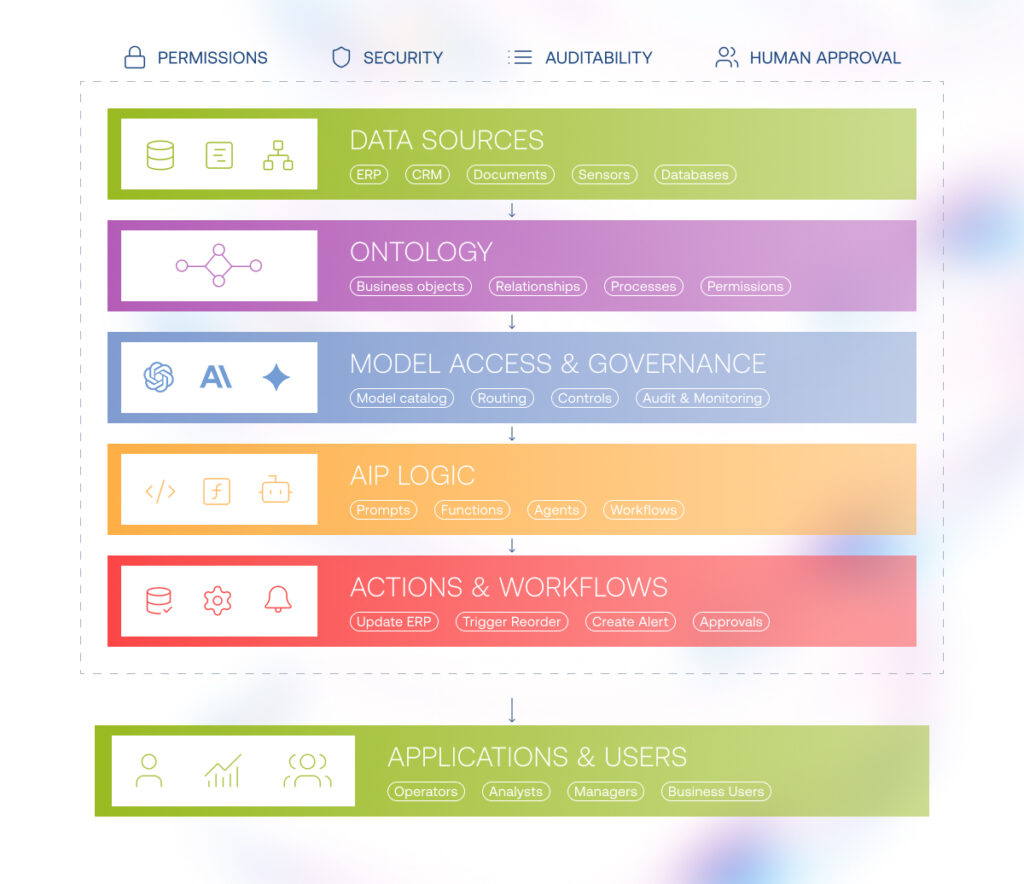
Several connected layers make up AIP, each tackling a problem that tends to sink enterprise AI projects, such as a lack of business context, fragmented model access and governance, workflow logic scattered across prompts and scripts, and AI outputs that stop short of controlled operational action.

 Palantir AIP architecture overview

1. The data and semantic layer: the Ontology

This is where AIP parts ways with a generic LLM setup. Instead of pointing a model at bare files, AIP connects it to the Foundry Ontology, a live operational layer that represents the business through objects, properties, relationships, logic, and actions. 

Those business connections are also governed by access controls. In Palantir AIP, permissions can be managed at the Ontology level, so the AI works only with the data, objects, and actions the user is authorized to access.

Consider an insurance claims adjuster reviewing a policyholder’s case. If that employee only has access to claims data for a specific region, an AI agent working on their behalf cannot suddenly pull records from another jurisdiction, access executive reports, or review unrelated customers’ policies. The agent inherits the same permissions as the adjuster and operates within the same boundaries. 

2. The model-access and governance layer

AIP stays model-agnostic, so enterprises are not tied to a single provider. The platform can run GPT, Claude, Gemini, Llama, open-source models, or ones organizations host themselves, and switch hitch-free when a task calls for it. 

The Model Catalog and admin controls handle the governance around those models, deciding: 

  • which models are available
  • how requests are routed between them
  • how much capacity each request gets
  • how model activity is monitored 

Governance plumbing like this sits on most AI roadmaps now – we see it first-hand as on-the-ground AI practitioners. The challenge is that building it from scratch can take months. Meanwhile, with AIP Palantir, much of that foundation is already in place, so the team’s time goes to the use case itself.

— Alexej Spas, CEO, Instinctools

3. The logic layer: AIP Logic 

Every enterprise process needs a set of rules, and AI-driven workflows are no exception. AIP Logic defines what the AI should do for a given task: what information to use, what checks to perform, what conditions to evaluate, and when to act. As a no-code development environment, it allows people like business analysts and operations leads who know the process as much as engineers to build that logic by assembling steps rather than hand-coding them. 

For example, business users might lay out how the AI reads an incoming invoice, compares it against contract terms, flags anything unusual, and routes low-risk items for approval. Developers who want tighter control can write the same logic in code.

4. The action layer: Actions and Workflows

What the AI decides changes nothing until it leads to an action. In Palantir AIP, actions connect AI-assisted decisions back to the systems you run: updating an ERP record, triggering a reorder, issuing a refund, etc. Every action leaves an audit trail, and the high-stakes ones wait for a human reviewer to approve them before execution.

Palantir AIP out-of-the-box capabilities

While ready-made solutions usually come with downsides like limited flexibility, rigid workflows, and vendor-imposed constraints, Palantir AIP cannot be ranked alongside other off-the-shelf tools, as it completely reimagines what “out-of-the-box” delivers. The fastest way to gauge it is to look at what you don’t have to build yourself. The list runs long:

  • Industry-specific templates give you configurable starting points for insurance, manufacturing, supply chain, and other domains, so you adapt a working setup instead of starting from a blank page.
  • A no-code environment enables non-tech users to build and deploy custom AI chatbots and assistants that draw on the company’s data, documents, and tools.
  • Safety guardrails apply content filtering, PII handling, and policy controls to every model call.
  • A testing environment is designed with the LLMs’ non-deterministic nature in mind. It measures how reliably a function gets the right answer across many runs, so you know how much trust you can put into AI outputs and actions.
  • Enterprise compliance is already covered for the most heavily regulated settings. For instance, AIP Palantir is cleared for US federal agencies (FedRAMP) and defense workloads up to classified levels (DoD IL5/IL6), and supports deployments that handle export-controlled defense data (ITAR) and protected health information (HIPAA). Credentials like these can take years to earn on your own.
  • Flexible deployment options include cloud for commercial use and air-gapped or edge environments for defense and other highly regulated industries.
  • Multimodal support lets AIP work across text, tables, documents, and images alike, so an agent can read a scanned contract or a chart as readily as a line of text.

Building these capabilities from the ground up will keep an AI team busy for up to 18 months. The question is: can you afford such a delay in the world of vibe coding and rapid AI prototyping, where new products are sprouting up faster than mushrooms after the rain? While ready-made software has its trade-offs, nothing else can give you a comparable head start. 

— Alexej Spas, CEO, Instinctools

Palantir AIP as an agentic AI platform

Enterprise workflows rarely end with finding information. Someone still has to make a decision, approve the next step, and carry the work forward inside operational systems. That gap between insight and execution is where Palantir AIP’s agentic AI earns its keep.

Palantir AIP agentic AI platform can coordinate multiple specialized agents through multi-agent orchestration. One agent retrieves information, another analyzes it, and a third executes the tasks, while a coordinator agent keeps tabs on the overall process to move toward the same objective.

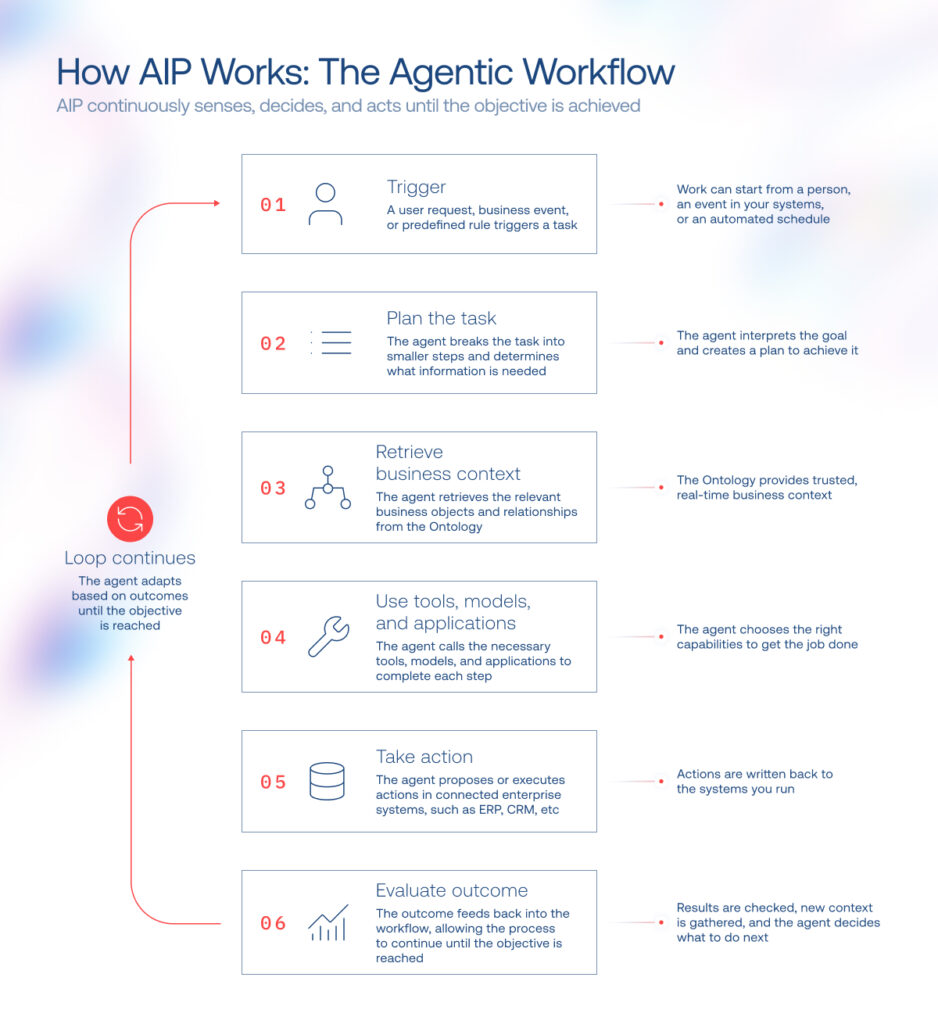
The easiest way to understand the Palantir AIP end-to-end agentic architecture is to follow a task through the system: from data retrieval and analysis to recommendation, approval, and action.

  1. A user request, business event, or predefined rule triggers a task.
  2. Next, the agent breaks that task into smaller steps and determines what information is needed to carry it out.
  3. It then retrieves the relevant business objects and relationships from the Ontology.
  4. With the context in place, the agent calls the necessary tools, models, and applications to complete each step.
  5. Based on the outcome, it proposes or executes actions in connected enterprise systems, such as ERP, CRM, etc.
  6. Finally, the results feed back into the workflow, allowing the process to continue until the objective is reached.
Palantir AIP

Human oversight remains central to the agentic pipeline. Agents can prepare recommendations, trigger actions, and move work forward, but companies decide where people stay in the approval chain. That balance between autonomy and control is what makes Palantir AIP suitable for operational environments where errors disrupt operations, compliance, or customer experience.

Palantir AIP use cases across industries

Reading a feature list is a bit like judging a Formula 1 car by its spec sheet. The most interesting part starts when the car leaves the garage. The same applies to Palantir AIP. Looking at how organizations already use it in production reveals how the platform fits into real operational workflows.

Finance and professional services

Processing vast amounts of data is all in a day’s work for any business, but when said data is related to money, the margin for error shrinks. Banks, law firms, audit practices, tax advisory firms, and consultancies rely on workflows built around document review, risk assessment, transaction checks, and tightly managed approvals. These processes are often repetitive, but they are rarely simple enough to automate blindly. 

AIP Palantir lightens this burden by handling fraud detection, transaction risk assessment, regulatory checks, and other document-intensive operations. For example, law firm Kirkland & Ellis adopted AIP to support end-to-end private funds workflows, from drafting fund documentation and supporting investor onboarding to obligation tracking, closing commitments, and verifying compliance. 

One of our clients, a leading US life and annuity insurer, also implemented Foundry and AIP combo within their contact center workflows to address peak tax-season inquiries faster and improve overall seasonal staff readiness.

Defense and government

Palantir’s roots are in the defense and government sectors, where AI systems need to operate under strict security and access-control constraints. The company works with organizations like NATO and the U.S. Army, including the TITAN battlefield program for 10 next-gen intelligence and reconnaissance ground stations, and supports deployments in highly restricted environments.

In these settings, Palantir AIP defense use cases include intelligence analysis, mission planning, logistics coordination, and battlefield awareness. Government agencies use the platform for areas such as emergency response, critical infrastructure monitoring, public-sector operations, and interagency coordination.

Healthcare and life sciences

Clinical records, scheduling info, lab results, and treatment plans rarely live in one place, forcing medical staff to assemble the full picture of a patient’s condition and care history piece by piece.

Healthcare organizations apply Palantir AIP capabilities to clinical decision support, clinical-trial operations, resource planning, and patient-flow management, all while keeping access to sensitive data under strict control. Public examples include NHS England, which uses Palantir technology to help hospitals and care providers coordinate resources, manage patient demand, and improve visibility across the healthcare system. By the company’s estimate, the platform returns about five times what it costs. 

Manufacturing

A machine failure on a production line can create quality issues downstream and throw maintenance schedules off course long before it shows up in a dashboard. In the environment where spotting the signals of potential collapse before they cause costly disruptions is vital, Palantir AIP’s digital twin approach comes into its own. By combining production data, asset information, maintenance records, and business context inside the Ontology, AIP can reason about how changes in one part of the system affect the rest.

Companies such as Airbus use Palantir technology in industrial environments. Building on that foundation, Palantir AIP manufacturing use cases include predictive maintenance, production planning, throughput improvement, and scenario modeling before changes reach the factory floor.

Supply chain

One way to judge the efficiency of supply chain operations is to look at its least trackable part. Palantir AIP in supply chain operations builds on the visibility provided by Foundry and the Ontology, allowing AI to reason across that operational context and participate in decisions that previously required teams to piece information together manually.

Rio Tinto offers a real-life example. The mining giant recently renewed its long-term partnership with Palantir and expanded its use of AIP on top of an existing Foundry Ontology. The company applies the platform across plant operations, geotechnical risk monitoring, and the coordination of 53 autonomous ore trains, each with 240 wagons, across the Pilbara rail network.

Many Palantir AIP supply chain use cases follow the same pattern: establish a shared operational picture first, then let AI participate in decisions that previously required teams to piece information together manually.

Build vs. buy: build your own stack or adopt Palantir AIP

There’s a valid argument for each path, and a class of issues where AIP is the wrong call entirely. The clearest way to think about Palantir AIP product market fit is through the build-vs-buy lens. Our AI practitioners prepared a memo on when to build your own, shell out a hefty sum for AIP, or reach for something lighter than Palantir AIP technology.

Cases when building your own AI stack wins over Palantir AIP

Building gives you complete control that none of the off-the-shelf options can fully match, but only if you’re prepared to take full ownership of the company’s operations. 

  • The AI layer is your core product asset. When you offer AI capabilities directly to customers as part of the product, ownership matters more than implementation speed. Handing a core piece of the stack to a third-party platform may limit future flexibility as the product evolves.
  • You already have a mature data and AI foundation. Companies that have invested in building modern data platforms, governance, orchestration, and vector infrastructure may gain little from replacing existing components midway.

Scenarios when it’s wiser to adopt Palantir AIP than invest in building your own enterprise AI layer

AIP carries a substantial price tag, so buying it makes sense only when building your own alternative would cost even more in time, risk, or missed opportunities.

  • Time-to-market outweighs long-term flexibility. Crafting an operational AI layer often means assembling and integrating dozens of moving parts before the first production use case goes live. Businesses under pressure to deliver results within a quarter rather than a year may decide that a ready-made platform is worth the cost.
  • You need operational AI with a proven enterprise track record. Setting up the AI ecosystem is only half of the challenge. The hardest part begins once it starts interacting with live business processes. If the cost of downtime, incorrect actions, or governance failures is high, adopting a platform with years of production experience is a safer path.

When AIP is overkill

Palantir AIP can solve genuinely difficult problems. The question is whether you have ones. Your AI appetite may not require the level of operational infrastructure AIP was built to provide.

  • The platform’s cost can’t be justified at the current scale. AIP is designed for large operational environments with complex processes, extensive integrations, and substantial governance requirements. The AI needs of smaller companies can be met with simpler tools.  
  • The problem doesn’t require an operational model of the business. AIP’s biggest differentiator is the Ontology with its structured representation of business objects, relationships, processes, and actions, making it possible to reason about workflows with many moving parts, such as inventory reallocation, claims processing, or supply-chain coordination. If your use case revolves around simple document search, content generation, coding assistance, knowledge retrieval, or a handful of narrowly scoped agents, a lighter architecture gets the job done.
  • Your business processes aren’t mature enough. AIP works best when the underlying business process already exists, and you have a clear idea of how it should operate. Applying AI to a process that changes every month will only scale confusion.
Build vs. buy in a nutshell
ParameterBuild your own platformAdopt Palantir AIP
Time to first production use case6–18 monthsAs little as five days (AIP Bootcamp)
Data platform setupCustom build requiredFoundry- and Ontology-ready
Agent orchestrationCustom AI-engineering stackAIP Logic + Workflows
Best suited forProprietary AI workflows, companies with a mature AI foundationTangled enterprise-scale workflows, organizations prioritizing speed 
Main advantageFull control and architectural freedomTech stack-agnostic, faster path to production and reduced implementation risk
Main trade-offLonger implementation timelineLicense and adoption costs

The right decision starts with the right diagnosis 

Palantir AIP isn’t a mere wrapper around large language models. Its real value comes from connecting AI to the operational reality of the business through the Ontology, governance controls, and enterprise integrations. That combination can shorten the path to production for companies that need AI to work inside live business processes and act on what it finds.

At the same time, AIP is neither the only option for operationalizing AI nor the right fit for every company. The decision depends on cost, process maturity, implementation timelines, and how closely the platform’s strengths match the problem at hand.

Get the diagnosis right with Instinctools

Reach out

FAQ

What is Palantir AIP, and what does AIP stand for?

Palantir AIP in its full form is an artificial intelligence platform. The company launched it as an AI layer that connects LLMs and AI agents to live enterprise data, workflows, and operational systems via the Ontology (a living map of a company’s data, logic, and processes), enabling AI to understand business context and act within existing processes.

How does Palantir AIP work technically?

AIP combines four layers: the Ontology, model access and governance, AIP Logic, and Actions. Together, they connect AI models to business data, define how tasks are executed, enforce security controls, and enable approved actions in enterprise ecosystems.

What are the core features and out-of-the-box capabilities of Palantir AIP?

The top out-of-the-box capabilities include AIP Logic for low-code function building, AIP Chatbot Studio for agents, AIP Evals for testing, AIP Assist, a model-agnostic Model Catalog, the Ontology integration with built-in access controls, safety guardrails with full audit logs, and pre-built industry templates.

Is Palantir AIP an agentic AI platform?

Yes, AIP supports end-to-end agentic architecture that enables AI agents to retrieve information, reason over business context, call tools, and execute approved actions inside operational systems. Human approval checkpoints remain part of the workflow at critical decision points.

What industries and use cases is Palantir AIP used for?

Public examples of AIP in production include supply chain, manufacturing, defense, healthcare, financial services, and professional services. Common use cases span predictive maintenance, logistics coordination, fraud detection, compliance workflows, clinical operations, resource planning, and operational decision support.

What are the benefits of Palantir AIP over building an in-house AI platform?

The main advantages are speed and reduced implementation risk thanks to enterprise security and governance out of the box. Instead of spending months orchestrating AI tools and setting up governance and security mechanisms from square one, businesses get a production-ready operational AI platform right away.

What is the Palantir Ontology, and how does it connect to AIP?

The Ontology is a real-time representation of business objects, relationships, processes, and actions. AIP uses it as the context layer that allows AI models and agents to understand how the business operates instead of interacting with scattered, isolated datasets.

When should a company choose Palantir AIP instead of building its own AI platform?

Palantir AIP is a game-changer for large-scale operational environments where AI needs to work across multiple systems running on a heterogeneous tech stack, including legacy applications that are impractical to replace and difficult to modernize. AIP is also a sensible investment when implementation speed, operational risk reduction, and a proven enterprise track record outweigh the benefits of full architectural control.

AI Agent Orchestration: Your Guide On How to Make Agents Work Together

AI adoption at enterprise scale feels like a moving target. Just as companies begin getting their first generative AI applications beyond the prototype stage, the conversation shifts again, this time to AI agent orchestration – the coordination layer that makes multi-agent systems efficient, secure, and governable in real-world enterprise settings. 

Standing still is not an option, and even moving half as fast as the market is still a form of falling behind. Deloitte puts numbers to the gap: only 14% of organizations have deployable agentic AI, and a mere 11% are actively using these systems in production.

The opportunity is there, but what’s missing is the infrastructure that allows multiple agents, tools, and workflows to operate as one coherent system. With years of hands-on experience as an AI development company, Instinctools walks you through what multi-agent orchestration is, why it’s non-negotiable for agentic setups, how it works in practice, and what it takes to implement it right.

Key highlights

  • Artificial intelligence is no longer enough. Coordinated intelligence with a centralized platform to manage multiple AI employees is the new competitive edge for enterprises and anyone considering agents’ adoption.
  • Software built on an AI agent orchestration platform goes from smarter automation to coordinated execution, as a network of specialized autonomous agents can collaborate across complex tasks, fully following workflow-level and overall business context.
  • The biggest obstacles to implementing and scaling AI systems with multiple agents in production are data readiness, workflow redesign, governance gaps, and others.

What is AI agent orchestration? 

AI agent orchestration is the process of coordinating several specialized AI agents within a complex, multi-step workflow. As enterprises move from single agents to multi-agent systems (MASs), orchestration becomes what makes those systems usable in practice. It assigns and sequences tasks, passes context between agents, reroutes work when something fails, and enforces the governance needed for production use, enabling multiple AI agents to operate as a full-scale digital worker. 

Why can’t an AI agent setup do without orchestration?

Agent capabilities without control over how they’re applied are no better than an abstraction. Orchestration is what operationalizes them, making agentic systems observable, governable, cost-controlled, auditable, and maintainable. The key benefits you don’t want to leave on the table include:

  • The ability to handle real-world workflows. Through AI agent task delegation and coordination, the orchestration layer accommodates the imperfections and complexities of enterprise business processes that span multiple systems, departments, and decision points. 
  • A shift from automation to coordinated autonomy. A single AI agent can automate a task. An orchestrated system of agents can own an entire process, making context-aware decisions, adapting to exceptions, and completing multi-step, complex workflows with minimal human intervention.
  • Resilience under failure. If one agent breaks, an AI orchestrator prevents the entire ecosystem from going down with a single weak link, whether by retrying a failed step, rerouting the task to another agent, falling back to a safer predefined response, or escalating to a human when needed.
  • Next-level performance. Our track record of agentic projects proves that with specialized agents handling their subtasks in parallel, multi-agent setups get things done up to 4x faster, boosting overall system performance.
  • Scalability without linear headcount growth. Agents can absorb more routine work as demand rises, as long as they are controlled by a multi-agent orchestrator and paired with human oversight, which can take the form of a human-in-the-loop (approves every action) or human-on-the-loop (only monitors and intervenes on exceptions) model.
  • Compounding adaptability. Multi-agent collaboration via evolving orchestration lets you reshape workflows as business requirements change. Orchestration makes it easier to reassign existing agents, adjust sequencing, as well as add new agents and steps without dismantling the underlying architecture.

Core components of a solid AI agent orchestration system 

What does it take to orchestrate agents at enterprise scale? Spoiler: far more than deciding which tasks each agent performs and in what order. Agent orchestration and management demand a combination of strategic and technological factors, something we learned firsthand while building and fine-tuning GENiE, our infrastructure for AI agents that can function as a full-scale agent operating system. Here’s what holds up.

Multi-agent coordination

As the name suggests, it determines how to coordinate agents: which are invoked, whether they run sequentially or in parallel, how responsibilities are assigned, and how outputs are combined. In GENiE, this means supporting multiple agent orchestration patterns, from straightforward pipelines to dynamic hierarchical orchestration setups where a manager agent delegates work to execution agents on the fly.

Tool integration

Whenever an agent needs to call an API, run a function, trigger a webhook, etc., it relies on a tool. The agent orchestrator manages the tools available to the agents, handles authentication, and helps prevent and resolve conflicts. Enriching that layer with metadata and usage scenarios, as we did in GENiE, improves the accuracy with which agents select the right tools for right subtasks.

Context management

An agent handling step eight needs to understand what happened across multiple interactions in the previous seven. That’s why it’s crucial for the orchestration framework to direct what agents keep in short-term memory, such as conversation state and recent execution history, and what they retain across sessions in long-term memory, for example, user preferences, rules, or persistent workflow context. Done well, this keeps context windows relevant and lean without depriving agents of the information they need to act coherently. 

Governance and compliance

A solid multi-agent orchestrator in place is what helps answer the question agents never will on their own: can you prove this decision is compliant? Without built-in mechanisms of responsible AI, such as bias detection, compliance checks, and dashboards for continuous monitoring of agents’ interactions, performance, and spending, every agent-made decision becomes a liability the moment a regulator stops by.

Cross-vendor flexibility

Very few (if any) enterprises operate in a clean, single-vendor environment. What we usually witness as an AI agent service provider, is a tangle of tools and platforms from different vendors, and locking AI orchestration to yet another one will only compound the mess. An agent orchestration framework has to be vendor-agnostic, leaving companies free to work with whatever agent-building external tools fit across the broader ecosystem, be it frameworks like CrewAI and LangChain, platforms like Azure AI Foundry and AWS Bedrock AgentCore, and more.

How multi-agent orchestration works: a real-world example

Ok, enough theory for now. The easiest way to understand multi-agent orchestration is to look at it in action.

An insurance aggregator operating in a heavily regulated market came to us to optimize their partner onboarding that was slowly suffocating their business growth. Every new member had to pass through compliance verification, document processing, data extraction, and a chain of back-and-forth communications. Managed largely by hand with very limited automation assists, the process used to take three to six months per partner. As the partner network grew by hundreds, even six months became an optimistic scenario.

Instinctools’ AI team mapped the onboarding workflow to its natural stages – document parsing, compliance verification, data extraction, partner communications – then assigned a specialized AI agent to automate tasks at each one. But step-specific agents alone don’t solve much. The part that makes many agents function as one system is the AI agent orchestrator sitting above them. 

When a new partner submission arrives, the central orchestrator reads the documents and routes them to the appropriate agent. Where tasks don’t depend on each other, like extracting financial data while a separate agent verifies licensing, it runs them in parallel to speed up the overall onboarding cycle. Where dependencies matter, the orchestrator queues the agents in sequence, making sure no step begins until the one it depends on is complete and validated. 

When something goes wrong, orchestration carries even more weight. If the compliance agent flags a gap, the orchestrator does not simply pass that flag downstream. It pauses all dependent tasks, escalates the case for human review, and then picks up exactly where it left off once the issue is resolved.

The well-orchestrated multi-agent system proved to be the right call: seamless collaboration between agents compressed onboarding that once stretched across months to roughly two weeks, with every compliance safeguard intact, and operational costs decreased tenfold.

Challenges of implementing multi-agent orchestration and first-hand ways to solve them 

Multi-agent systems promise a lot, but delivering on that promise is where things get complicated. For an AI agent orchestrator to work reliably at enterprise scale, the surrounding layers of infrastructure, data, operations, and overall organizational readiness all have to be in shape. Here’s what we’ve dealt with in practice so far.

Pre-AI data infrastructure can’t meet agentic demands

A multi-agent system is only as capable as the data infrastructure underneath it. If agents that can’t find, access, or trust the enterprise data, their outputs become unreliable, and in a multi-agent workflow, one agent’s bad output cascades into every downstream step. It’s no surprise that 48% of companies considering multi-agent collaboration via evolving orchestration cite data searchability as a top barrier to AI automation. Pre-AI data architecture simply wasn’t built for the kind of real-time, cross-system access that orchestrated agents demand, which is why data readiness becomes the first bottleneck teams hit once they move past the pilot stage.

The practical starting point is a data audit scoped to agentic workflows: 

  • Which data sources will your agents need? 
  • Can they access those sources in real time?
  • Are outputs structured and tagged well enough to enable agents to interpret them without additional human input? 

Teams that skip this step end up retrofitting data pipelines mid-deployment, which is slower and costlier than getting it right upfront.

Context doesn’t move cleanly between agents on its own

Giving agents access to data is one thing, but making sure they understand the task they’re performing is another. In a multi-agent workflow, each agent picks up work the other agents shaped, meaning the workflow context has to travel between them hitch-free, in the right format, at the right moment. Too little context leads to uninformed decisions. Too much context wastes tokens and muddies execution. 

Creating structured workflows requires deliberate context engineering, which means deciding what each agent keeps in short-term memory, what it retains across sessions, and what gets filtered out entirely. 

For instance, in the agent-powered customer support system we built to improve customer experience for a US-based online store, the triage and routing agents handling customer inquiries needed only the current ticket’s text, categorization result, and urgency markers – all short-term context that could be discarded once the ticket was resolved. Everything irrelevant to the active workflow, such as raw product catalog pages, was stripped away. The response drafting agent, on the other hand, needed a persistent profile of the customer with order history, previous complaint resolutions, and communication preferences to tailor a context-aware answer without asking the customer to repeat themselves, so this data landed in the long-term memory.

Workflows built for human minds, not human-agent collaboration

A tempting shortcut both AI beginners and AI explorers fall for is to take an existing workflow, bolt agents on it, and call it an agentic system. Such a strategy worked for chatbot development, where a model owns a single conversational task, but agentic setups operate differently. 

The tricky part is that many business workflows rely on human judgment that was never written down in a structured way. And, to a certain point, that works just fine, since people connect distant signals, read between the lines, and fill in gaps with experience. But, unlike humans, agents can’t replicate those decisions unless the logic behind them is made explicit first. 

AI Agent Orchestration

Orchestration begins with mapping how people reason through each step, then translating that reasoning into structured workflows with crystal clear instructions and decision logic agents can follow reliably. 

AI governance and security lag behind deployment 

In 4 out of 5 companies, the push for ROI and speed gets ahead of solid AI governance, human oversight, and security guardrails. The consequences show up quickly: token consumption isn’t tracked, decisions are made outside the approved scope, and compliance risk is discovered only after the fact. 

On the security side, agents that access sensitive data and call external APIs create attack surfaces that traditional security models weren’t designed for, including prompt injection, data poisoning, adding to AI adoption challenges.

The solution lies in building observability and traceability through centralized orchestration. That means real-time dashboards tracking overall system performance metrics like token consumption and cost breakdowns per workflow, alongside audit trails, standard security controls monitoring, and innovative security measures, such as digital identity for agents. 

Your AI tools don’t speak the same language

With the AI adoption trend dominating software development, you may already have a zoo of AI tools from different vendors. Building agentic systems [with shared context] atop such a diverse tech stack and coordinating all the pieces to perform coherently is no small feat. 

While emerging interoperability standards like the Model Context Protocol (MCP) and Agent-to-agent (A2A) aim to address the challenge, both are still maturing. Until they settle, your best shot at controlling how your AI tech stack behaves under the hood of the MASs is a vendor-agnostic AI agent orchestration platform that provides a shared coordination layer for agents, regardless of what they were built on. 

The future is multi-agentic

Agentic AI is moving fast, and the trajectory is clear: multi-agent systems will become standard enterprise AI infrastructure within the next few years. What’s less clear is how many companies will have a reliable AI agent orchestration layer to keep agentic initiatives controlled and secure. Businesses that treat orchestration as foundational infrastructure rather than a later-stage optimization are the ones to build MASs that can scale across the entire organization and hold up under real-life workflows and scrupulous compliance reviews.

Have a multi-agent system to orchestrate?

Talk to our AI experts

FAQ

What is an AI orchestrator?

An AI agent orchestrator is the coordination layer that manages how multiple AI agents work together within a particular workflow. It handles natural language understanding, task routing, sequencing, context sharing between agents, failure recovery, and governance enforcement, turning a collection of individual agents into a coherent system.

What is LLM orchestration?

LLM orchestration is the process of managing workflows for large language models, including routing prompts, sequencing model calls, selecting the right model for each task, and controlling token budgets.

What is the best agent orchestration tool?

The right AI orchestration platform checks several boxes: vendor-agnostic architecture so you’re free to combine open-source and proprietary tools, support for multiple agent orchestration patterns, built-in governance and observability, and solid context management capabilities. Anything that locks you into a single vendor’s ecosystem will become a liability as your agent landscape evolves. Instinctools’ GENiE was built with these exact principles in mind.

What are the different AI agent orchestration patterns?

There’re four orchestration patterns, and most MASs mix several of them. Sequential orchestration runs agents one after another, best for approval workflows. Concurrent orchestration runs them in parallel, ideal when tasks are independent. Handoff orchestration passes control between agents based on context, like routing a support ticket to a specialist. Group chat orchestration lets agents collaborate in a shared conversation for complex problem-solving.

What Makes Palantir a One-Of-A-Kind Technology?

Few companies that provide enterprise platforms are as famous and misunderstood as Palantir Technologies Inc. The software behind a $370B company powering the US defence sector and the Fortune 500 alike is shrouded in myths. No wonder many tech companies are struggling to figure out whether it belongs in their tech stacks. 

Our Palantir developers break down what’s under the hood of Palantir technologies like Foundry and AIP, and what they can do for commercial enterprises. Buckle up for no-hype, insider perspective.

Key highlights

  • Palantir isn’t a data company, though Palantir software implies working with companies’ big data.
  • What sets Palantir apart from other enterprise-grade SaaS offerings is its non-disruptive approach to large- and broad-scale automation and software modernization.
  • At the core of Palantir’s consumer products is the data-logic-action triad that enables AI to see your data, understand your business rules, and act on them.

What Palantir actually is (and is not)

A data broker selling your information to the highest bidder? A data miner scraping the web? A surveillance company hoarding massive amounts of data in one place? 

All wrong. 

Palantir got misidentified so often, they had to explicitly state that they’re not a data company. Twice for good measure. 

So what is it then? In short, Palantir is an AI-native company offering an operating system that connects enterprise scattered apps, organizes the data coming from them, and helps teams make decisions and take actions in one place. Though they started with government contracts, their products are now available to companies across industries. 

What enterprise never-healing sore does Palantir address?

Enterprise software rarely breaks all at once. More often, it becomes harder and harder to change without disrupting how the business works. It is a bit like renovating a house where you know every creak in every floorboard and can navigate the place with your eyes closed. The contractor updates everything, but now the shelves are in the wrong place, the light switches feel off, and you keep bumping into a new couch that does not quite fit. The house is better on paper, but harder to live in, and you catch yourself thinking: was the old state of things really that bad?

This is what software modernization often feels like at Fortune 500 scale. Decades of homegrown tools, off-the-shelf software, and relic, Stonehenge-like systems duct-taped together into something nobody fully understands. Replacing them is expensive and risky, yet leaving them as they are makes automation and AI coverage much harder. Every SaaS vendor swears a painless fit, but that promise rarely survives contact with reality. 

But what if the contractor worked differently? What if they walked through the house first, studied how you live in it, then fixed only what needed fixing, without rearranging your life and pushing their idea of the “right” on you? And if the old sofa was beyond saving, they built you a custom replica so your toes stayed safe.

That’s a new perspective on enterprise automation and agentization that Palantir developed. The value of their approach is that companies don’t have to rip out and replace existing systems. Instead, Palantir sits on top of those systems as an orchestration layer, modeling how the business actually operates and enabling AI workflows without forcing costly overhauls underneath.

How does Palantir handle enterprise operations? It puts the business context in the spotlight 

Adoption of any enterprise-grade SaaS platform starts with a conversation about data: where it lives, how it is stored, and how it moves between systems. Palantir starts somewhere else entirely: how does your business make decisions? In Palantir’s framing, the answer comes down to three connected elements – data, logic, and actions – that together form a complete picture of how an organization operates.

Data 

Palantir offers over 300 out-of-the-box connectors to set up hitch-free data flows between cloud platforms, databases, file systems, legacy environments, and external applications. 

So far, that might sound like a baseline any SaaS provider offers, just with a longer connector list. However, Palantir takes integration capabilities further with their Multimodal Data Plane (MMDP), an open data and compute architecture. 

Traditional data platforms like Databricks or Snowflake require your data to be ingested into their ecosystem for optimal performance. Palantir’s MMDP flips the script by processing your multi-format data right where it resides, be it public or private cloud, data lakehouses, or edge environments, all without performance trade-offs. 

— Alexey Spas, Instinctools’ CEO

Logic 

If data tells a company what’s happening, then logic determines what organizations should do with that information. Every enterprise already has logic, whether it is described that way or not. It spans the rules, models, and reasoning a business applies before making a decision. 

The sources of logic are usually scattered across the organization: an Excel spreadsheet a procurement team has relied on for years, a rules-based engine inside an ERP, an ML forecasting model built by data scientists, a third-party optimizer for supply chain planning. We bet you know firsthand how abundant and diverse the sources can be. 

Palantir enables companies to register all their logic sources as building blocks that can talk to each other. This way, anyone can chain them together in one workflow. Say, pull a demand forecast from the ML model, cross-check it against inventory thresholds a procurement team set in Excel, and route the result to a supply chain manager for approval. 

— Alexey Spas, Instinctools’ CEO

Action 

Actions are what companies do to affect the real world, such as approving a vendor contract, updating a purchase order in their ERP system, triggering a reorder before stock runs dry, etc. To do them, employees have to switch software windows, which adds unnecessary cognitive load. 

Palantir’s AI-native architecture makes it possible for AI agents to step inand propose actions based on the company’s business rules, stage them for human review, or, where permissions allow, execute them autonomously. MMDP is a central piece of actionable AI, as it connects ML models directly to your operational workflows, so the executed action is written back into the organization’s systems, becomes new data, and the cycle starts again.

— Alexey Spas, Instinctools’ CEO

How it all comes together: the Ontology

Data, Logic, and Actions don’t exist in isolation. Together, they combine into what Palantir calls the Ontology – a dynamic digital twin of the business that serves as a shared source of truth for decision-making across the enterprise. It maps a company’s real-world entities (products, orders, equipment, customers, etc.) to their underlying data sources, connects them through the logic that governs decisions, ties in the actions that execute those decisions, and wraps it all in granular security controls governing who can access, modify, and act on what.

As every decision and action feeds back into Ontology, it compounds, making the digital twin sharper over time.

What solutions does Palantir offer commercial organizations? 

Everything described above – the data connections, the logic layer, the actions, the Ontology – lives inside Palantir’s core products. For commercial companies, three matter most: Palantir Foundry, Artificial Intelligence Platform (AIP), and Apollo. Each addresses a different layer of the same goal: how to run a data-driven, AI-enabled business without tearing apart what already exists. 

Foundry: the operating system for enterprise operations

Palantir Foundry is a data platform that gives different teams a shared environment to work in, each through the lens that fits their role. That way, the data-logic-action triad becomes tangible and useful across the company:

  • Data engineers build and manage pipelines that clean and transform incoming data.
  • Analysts explore the data through interactive dashboards and run ad hoc queries.
  • Operations teams use Workshop, Foundry’s low-code app-building tool, to create custom applications, say, a real-time view of resource allocation, warehouse throughput, or an approval workflow for procurement.
  • Developers who need more flexibility work directly in code repositories. 

And here’s what closes the deal for enterprise buyers: everything operates within the same Ontology, under the same security model, with full audit trails.

AIP: the AI layer that connects models to operations

88% of companies trying to adopt artificial intelligence hit a wall between “an impressive prototype” and “production use that delivered both cost and revenue benefits.” A model may work in a sandbox, but getting it to interact with real business data, respect company-specific rules, and execute decisions inside governed workflows requires specific infrastructure, and Palantir AIP, as the AI layer built on top of Foundry, is that infrastructure. 

  • AIP Logic is a no-code environment for building, testing, and releasing LLM-powered functions that determine how an AI evaluates data and reaches a conclusion. In practice, that means companies can define how AI should reason through a task. For instance, defining how an LLM should check a vendor invoice against contract terms, flag anomalies, and auto-approve anything within policy. 
  • AIP Agent Studio is where organizations create AI agents that handle multi-step tasks spanning several systems, such as investigating a supply delay by checking inventory levels, reading shipping updates, and proposing an alternative supplier.
  • AIP Evals is a testing layer for measuring how AI behaves before it touches production. Thanks to it, LLM outputs are auditable and accountable rather than a black box. 

Apollo: the delivery engine behind the scenes 

Apollo is less visible to end users, but being a control panel for shipping automatic software updates to Foundry and AIP, it’s what keeps everything up and running. 

Here’s a hands-on example. A global manufacturer might have Foundry deployed across a public cloud, several private data centers, and edge devices on factory floors, some in air-gapped environments with limited connectivity. Apollo is used to ship updates, monitor rollouts, support rollbacks if something breaks across dozens of environments without requiring a dedicated DevOps team at the client’s end.

— Alexey Spas, Instinctools’ CEO 

Which companies need and can justify Palantir? 

Not every enterprise needs a digital twin of its entire operation. But for some, a platform like Palantir makes strategic sense. It is best suited to organizations that:

  • Run a maze of software systems accumulated through mergers, acquisitions, and decades of patching, without a complete picture of how they all connect
  • Store data across hundreds of sources, including custom-built legacy systems with little to no documentation
  • Make decisions that influence multiple geographies with different security levels every day
  • Face compliance stakes where a single failure cost starts at eight figures

National security and healthcare, energy, financial services, and global manufacturing are Palantir’s natural habitat, and the price tag reflects it. Walmart, Amazon, ExxonMobil, Bank of America, and Cardinal Health are all Palantir corporate clients, and all rank in the top 20 of the Fortune 500. 

For companies outside that league, say, mid-size businesses that need AI agents for specific workflows rather than modeling the business as a whole, paying for Foundry, AIP, and Apollo is like hiring an architect to hang a shelf. The good news is that there are lighter alternatives, from well-calibrated, AI-powered data analytics to focused accelerators like GENiE for building custom AI agents and multi-agent systems. 

What does Palantir implementation look like? 

The biggest risk with a platform of Palantir’s scale isn’t the technology, but committing to a multi-year license before knowing whether it fits. Instinctools’ delivery model is built to eliminate that risk. 

The implementation process itself follows seven stages:

  1. Discovery and use-case selection. Working with executive and domain leaders to identify where Foundry and AIP can make the most measurable impact.
  2. Data integration and pipeline design. Connecting ERP, CRM, IoT, legacy systems, and other relevant sources into Foundry’s data layer.
  3. Ontology modeling. Mapping your real-world entities, relationships, and business rules into a digital twin.
  4. AIP workflow and agent design. Building AI-powered functions and agents that reason over Ontology and act on the results.
  5. Governance and human-in-the-loop controls. Defining permissions, audit trails, and pre-production review mechanisms.
  6. Rollout and adoption. Migrating to a dedicated client instance, expanding across teams and domains, and embedding change management for long-term adoption.
  7. Support and scaling. Monitoring Foundry and AIP performance, onboarding new data sources, broadening use cases, and optimizing existing workflows based on user feedback.

Don’t take our word for it, look at our projects: how Instinctools helps companies implement Palantir Foundry and AIP

Theory is one thing, here’s what delivery looks like.

One of our clients, a US life and annuity insurer, was drowning in calls every tax season. Their call center staff had to hunt across multiple disconnected systems to piece together answers, as no single source held the complete policy information they needed. The company brought in seasonal contractors to cope with the workload, but this measure wasn’t enough to ensure a consistent customer experience for everyone. 

Instinctools’ team used Foundry and AIP to build an AI assistant that did the hunting for call center specialists, pulling the right policy data in real time, so staff could answer without putting customers on hold. Built-in guardrails ensured the assistant never crossed into actual tax advice, which would be a compliance breach. Within ten weeks, the solution was in production, leading to a double-digit drop in handle time and fewer call transfers.

A very different example comes from a warehouse floor. A global logistics operator was managing thousands of frontline workers across multiple sites with handwritten attendance logs. Every morning, shift leaders spent hours figuring out who was available, certified, and in the right place. 

We brought all of that data into a single Ontology-aware Foundry, then built AIP agents that could rank backfill candidates by certification, proximity, and recent shift load the moment someone called in sick. In eight weeks after kickoff, unfilled critical roles were minimized, and staffing decisions that used to take half an hour were happening in under two minutes.

One AI-native operating system to rule the whole enterprise software ecosystem

As the script goes, “one Ring to rule them all, one Ring to bring them all.” That’s roughly how Palantir software gets talked about – powerful, mysterious, not fully understood. But strip away the mystique, and what you’re looking at is an enterprise operating platform that gives organizations control over their data, logic, and actions at scale, with that power remaining with the company, not the ring bearer. 

So the real question is whether your organization has the right implementation strategy to turn that power into outcomes.

Opt for risk-free and cost-aware Palantir adoption

Let’s talk

FAQ

What does Palantir do?

Palantir is an AI-native software company providing an operating system for enterprises with diverse software landscapes. Their products (Palantir Foundry and AIP) take the data their clients already have and wire it into how those businesses think, decide, and act, all without collecting, reselling, or mining that data for their own purposes.

How does Palantir integrate data?

Palantir offers 300+ ready-made connectors for enterprise systems. On top of that, their Multimodal Data Plane (MMDP) enables processing data right where it already sits (clouds, data lakehouses, edge devices, etc.), eliminating the need for painful enterprise-grade data migration.

What kind of AI is Palantir?

Palantir is decision-centric AI designed to make artificial intelligence operationally useful, not just analytically interesting. The goal is a context-aware, proactive AI that understands how a specific business runs and can participate in decision-making.

Does Palantir use agentic AI?

Yes, Palantir puts agents at the core of their AIP offering. Agents built on the platform can perform multi-step tasks, propose and execute decisions, and write results back into operational systems.

Context Engineering in AI: Techniques, Best Practices, and How It Differs From Prompt Engineering

Blame the model when your AI agent fails… That’s the instinct, but it’s almost always wrong. The model rarely breaks. What underdelivers is the information environment built around it: the wrong data at the wrong time, in the wrong shape, handed to a system with no memory of what came before. That’s a context engineering problem. And until it’s solved, no amount of prompt tuning can bridge the gap. 

Our AI Center of Excellence practitioners break down the context engineering techniques, strategies, and best practices that yield much-coveted results.

Key highlights

  • Context’s components determine what an AI model sees, what it remembers, and what it acts on.
  • Issues like context rot and “lost in the middle” quietly degrade AI systems’ reliability over time, but there are ways to address them.
  • Agentic workflows amplify both good and bad context-related decisions you make. A solid middleware infrastructure can help you keep that under control.

What is context engineering in AI?

Context engineering is the practice of controlling what information an AI model receives before generating a response. It’s about building the infrastructure that dynamically assembles the relevant context for each task, creating an environment where AI agents can work like humans: holding onto relevant conversation history, accessing external knowledge when needed, and adapting on the fly rather than treating each interaction as a blank slate. 

Context in AI: core components

Context goes far beyond the prompt you type. It’s everything the model has access to before generating a response: 

  • System instructions that set the model’s behavior upfront, including guardrails, tone, policies, and rules that shape how the model responds before it even sees your query.
  • User input that sets the immediate task and receives top attention priority from the AI model.
  • Conversation history from the same session, so the model stays consistent throughout the dialog.
  • External knowledge retrieved from documents or databases (RAG) and pulled in whenever the model needs up-to-date information stored outside its parameters, such as customer records for an AI support agent handling tickets.
  • Available Tools and integrations the model can invoke to take action, say, send an email, check inventory, or query real-time APIs. 
  • Structured output constraints like JSON schemas that ensure the model returns data in the format your system can parse and use. 

In practice, though, even the best models have a hard ceiling: they can’t (at least, not yet)  retain unlimited context with equal clarity. Every LLM operates within a finite context window – its active workspace that can contain only a fraction of the current conversation. As new information comes in, older details get pushed out, compressed, or overwritten entirely.  

Honing context’s components is a must, but it isn’t enough. You also need to organize and use them strategically to get the most out of the model capabilities despite the context window limitations.

 – Pavel Klapatsiuk, Lead AI Engineer, Instinctools

A diagram shows “CONTEXT COMPONENTS BEHIND AND WITHIN THE MODEL’S CONTEXT WINDOW.” It lists inputs like instructions, user query, and memory flowing into an LLM’s context window, which holds system prompt, user prompt, and related data.

The benefits of context engineering for GenAI systems

Without context engineering, a large language model can handle isolated queries, but underdelivers when it comes to workflows that stretch across days, teams, or systems. Context engineering is the power behind the models’ shift from mere responsiveness to durable continuity, which enables them to carry intent forward and support complex, multi-step processes.

More accurate and reliable outputs

Reliable AI outcomes don’t come from well-prepared data and clear prompts alone, but from precise context design. Context engineering filters, structures, and prioritizes what the model sees, reducing noise and ambiguity, so outputs stay consistent and grounded.

Less back-and-forth prompting

When the model has user preferences, project history, and available tools baked into its context, you no longer have to waste time explaining the same setup over and over. That way, one well-engineered context replaces multiple clarifying questions, bringing human employees closer to AI-enabled productivity. 

Higher consistency across files and repositories

AI coding assistants like Claude Code, Cursor, etc., work better the longer you use them because they build context about your codebase, naming conventions, architecture patterns, and dependencies between modules. Instead of suggesting solutions from scratch, they align with your style and the bigger picture spanning beyond a single conversation.

Longer flow state

Constant correcting of model outputs or rewriting prompts kills momentum. With context engineering handling the setup work, such as pulling in the right files, remembering your last changes, and understanding project structure, you spend less time micromanaging the model and can switch to strategic oversight mode.

Better token efficiency and AI context understanding 

Without smart contextual engineering, dumping raw information into the prompt dilutes the signal and forces the model to spend attention on irrelevant details. Context engineering improves token efficiency by increasing signal density and keeping the most decision-critical information in view, which reduces context drift, missed constraints, and confident-but-wrong answers.

Context engineering vs. prompt engineering: why prompts are not enough

Prompt engineering and context engineering aren’t rivals. Operating at different layers of the same system, prompt engineering focuses on crafting the perfect query, while context engineering prioritizes the ecosystem that makes that query work. You can wordsmith clear instructions all day, but if the model doesn’t have access to relevant history, external data, or the right tools, even the best prompt falls flat.

Prompt engineeringContext engineering
Focus on crafting individual instructionsFocus on designing systems that manage information flow
Query optimization inside the model’s context window limitShaping what fills the window and when
Separate tasksMulti-step workflows

As models evolve beyond simple Q&A into handling longer workflows and more complex tasks, the bottleneck shifts from “how do I phrase this?” to “how do I assemble and maintain the right context across dozens of interactions?” That’s where prompt engineering stops being enough, and context engineering becomes decisive. 

Core context engineering strategies and techniques 

Since effective context engineering is about deliberately controlling what goes into the model’s limited context window at each step, humans stay in charge of deciding what stays, what gets compressed, and what gets cut. There’re several techniques experienced AI engineers typically rely on to manage context at scale.

  • Tool loadout. The fewer tools a model has to choose from, the lower the decision noise and token consumption is, so instead of exposing it to numerous narrow-focused, likely overlapping tools, limit selection to several versatile, general-purpose ones. 
  • Context pruning. To keep the window focused on what’s relevant right now, continuously remove outdated and conflicting information as new details arrive.
  • Context summarization. Periodically distill accumulated history into a short decision log that preserves key facts, constraints, and rationale in the limited context window. LLM-based tools like Claude code and Cursor have an auto-compact feature, allowing great context compression after you’ve used 95% of the context window. 
  • Context offloading. Rather than holding all potentially useful information in the model’s active workspace, store relevant data outside the LLM’s context using external tools or memory systems and enable the model to reference a knowledge base when needed.

Context engineering best practices to save the day

While you can’t extend the model’s attention beyond its context window, it’s possible to reduce how often that limit becomes a problem. 

Build a memory system that keeps the context relevant by design

Even when stored in a dedicated database, memory tends to degrade over time. As outdated or low-signal entries accumulate, retrieval becomes noisier, and that noise can leak back into the context, distorting outputs. 

The best defense here is preventive: it implies building memory maintenance into your system from the onset. Track recency and retrieval frequency to decide what to keep, what to refresh, and what to retire. 

At Instinctools, we usually distill the conversations worth permanent storage into memory notesthat we can then inject back into the model context when necessary. It proved useful, so we enhanced and reused this approach when creating our own platform for building AI agents with strong context engineering mechanisms at its core. 

– Pavel Klapatsiuk, Lead AI Engineer, Instinctools

Prepare data for AI

Data preparation matters just as much as a well-governed memory system. Before an AI solution can perform reliably, the data it learns from has to be cleaned, structured, and aligned with the task it’s meant to support. That means auditing what you already have, filling gaps, removing errors and bias, and validating that the dataset reflects real-world conditions. Otherwise, even the most advanced model can’t deliver accurate, trustworthy insights if the data feeding it isn’t ready for AI.

Establish MCP-enabled tool usage

It takes tools for the models to go from reasoning to acting, for example, checking live stock prices, sending an email, or booking a flight.

Providing the model access to tools is no longer the hardest part. Open standards like Anthropic’s Model Context Protocol (MCP) provide a consistent way to connect assistants to the systems where data lives and the tools they can call. The real challenge is giving the model clear tool definitions and examples of proper usage to ensure it knows which tool callsto make and how to interpret the results.

– Pavel Klapatsiuk, Lead AI Engineer, Instinctools

Simpler and more reliable AI agent context engineering with a middleware infrastructure layer

Context engineering becomes mandatory when moving from ML models to agentic systems, because agents not only use context, but also create and reshape it through tool outputs, intermediate plans, and stored memories. So, in this loop, the rule of context engineering for AI agents holds true: agentic workflows amplify whatever context-related decisions you make, both good and bad. 

One poorly engineered agent can poison the entire system. In a multi-agent customer support setup, for example, a retrieval agent might pull outdated return policies or documentation for the wrong product. The response agent, trusting that input, will then draft a confident but incorrect answer or trigger an automated action based on the wrong policy. That’s how, in a split second, one bad context decision upstream will cascade into a system-level failure, degrading customer experience.

– Ivan Dubouski, Head of AI Center of Excellence, Instinctools

A dedicated middleware layer, like GENiE, helps keep multi-agent context disciplined and predictable through:

  • Context isolation. Splitting different contexts across sub-agents, each with its own context window, tools, and instructions. Such an approach enables agents to run in parallel and serves as a safeguard: if one fails, the others won’t be affected.
  • Adaptive context hierarchy with hot, warm, and cold layers. Frequently needed information stays in hot working memory for immediate access, warm context sits in near-term storage for quick retrieval, and cold context gets archived but remains accessible when workflows require historical depth.

Context engineering in action: 12× faster insurance partner onboarding with a context-aware agent system

How much faster can partner onboarding become with a well-orchestrated human-AI collaboration? For our client, a global insurance aggregator, we managed to cut it from three-six months to two weeks by adding agentic AI and designing how context is constructed, scoped, verified, and handed off between agents.

We used GENiE, our proprietary middleware infrastructure, to automate partner onboarding, a process that previously required manual data entry and cross-departmental coordination for document validation and compliance checks. The multi-agent system our AI team created handles context across multiple stages, extracting data from partner submissions, cross-referencing compliance databases, flagging missing information, and routing approvals. 

Context engineering was the central pillar of the project, ensuring each agent received only relevant information for its role, preventing document overload and keeping workflows moving. The result lives up to AI productivity promises: partner onboarding time dropped from months to weeks, accuracy improved through pre-validation and structured facts, and the need for manual interventions was kept to a minimum.

Want to try GENiE capabilities yourself?  

Book a demo

Common context engineering challenges (and remedies for them)

Philipp Schmid of Google DeepMind states that 80% of failures in AI agent development stem from context misinformation. Instinctools’ AI practitioners agree that the problem lies not with the models themselves, but with the information environment engineered around them. When context is bloated, contradictory, or poorly organized, even capable models produce garbage. Our AI CoE experts share their perspective on the two major challenges they faced and dealt with firsthand.

Lost in the middle issue

As we’ve mentioned before, LLMs operate on a limited processing bandwidth. The larger your context grows, the more selective their focus becomes. You can technically cram 100,000 tokens into context, but that doesn’t guarantee the model processes all of them equally. Our on-the-ground observations confirm that models pay close attention to what appears first and last in the context window, while the middle tends to be skimmed at best or ignored. 

One of the practical context strategy tips is to put critical information at the edges – up front and at the end. Everything in between should be structured with clear headings and formatting. When context balloons, compress the middle into summaries and keep only what’s immediately actionable in full detail.

– Ivan Dubouski, Head of AI Center of Excellence, Instinctools

Context rot

When AI agents take over longer workflows, context can accumulate faster than it can be curated. Over time, it degrades and starts working against you, leading to a phenomenon called context rot. 

Context rot typeHow it shows upPractical moves to fix it
Context poisoningA hallucination is saved as a reliable fact and then referenced repeatedly in outputs.Run separate context threads for different tasks. When errors surface, quarantine the thread and start clean rather than trying to correct within a contaminated context.
Context distractionOnce context nears 100K tokens, the model starts favoring accumulated history and repeating old patterns instead of focusing on what matters now. Compress ruthlessly. Turn 50,000 tokens of conversation into a 2,000-token summary that captures decisions, constraints, and current state without repetition.
Context confusion Too much extra information and access to too many tools blur the model’s focus and increase wrong or unnecessary actions. Keep the active tool set small and use retrieval techniques to surface only relevant tools for each task.
Context clashInformation arrives in stages, so early assumptions remain in context even after new facts contradict them. Delete outdated statements when new information arrives. Give models a scratchpad workspace, like Anthropic’s “think” tool for experimental reasoning, so it doesn’t pollute the main context thread.

Need expert help to combat context-related issues?

Let’s talk

A field-tested context engineering checklist

Before deploying an AI system, run through this checklist to catch the context failures that quietly derail otherwise capable solutions. 

1. Context design

1.1. Define the core components: system instructions, conversation history, retrieval sources, available tools, and output schemas

1.2. Put critical information at the start and end of the context window; compress the middle into summaries

1.3. Limit tool access to general-purpose tools rather than overlapping narrow-focused ones (under 30 tools, better even fewer)

2. Memory and retrieval

2.1. Build memory maintenance into the system from day one — track recency and retrieval frequency to retire stale entries

2.2. Use RAG to pull external knowledge only when the model needs it, not as a default data dump

3. Ongoing context hygiene

3.1. Prune outdated, conflicting, or irrelevant information as new details arrive

3.2. Summarize accumulated context 

3.3. Delete outdated conclusions the moment new information supersedes them

3.4. Validate information before committing it to memory to prevent context poisoning

3.5. Give agents a scratchpad workspace to process without cluttering the main context thread

4. Agent context architecture

4.1. Isolate context across sub-agents: separate context windows, tools, and instructions per role

4.2. Apply hot/warm/cold context hierarchy to balance long-term memory, speed, and historical depth for more effective AI agents

Make context engineering your competitive advantage 

Context engineering isn’t a one-time configuration. It’s a cross-functional challenge as much as a technical one, calling for understanding your business use case, defining expected outputs, and structuring everything so the model can accomplish the task. 

Сompanies that get this foundation right early build a compounding advantage, since a well-engineered context makes the next interaction faster, more accurate, and less dependent on human correction. It becomes a strategic asset that helps you outperform competitors in the AI adoption race. 

Ready to master context engineering?

Talk to our AI CoE

FAQs

Is context engineering just RAG?

No, retrieval-augmented generation (RAG) is one of the components of context engineering. Broadly, context engineering AI systems go much further, also including user instructions, message history, tools, external knowledge, and structured output.

Do small models benefit from context engineering?

Yes. Any model benefits from contextual engineering, as LLMs of any size are prone to context-related issues, but smaller models benefit the most. When model capacity is limited, disciplined context selection dramatically improves reliability and helps compact models punch above their weight.

How much context is too much?

Too much context is whatever triggers context poisoning, distraction, confusion, or clash. Model performance drops significantly around 32,000 tokens, even with million-token windows available, because the model starts looping through accumulated history instead of reasoning clearly. So context engineering principles like summarization, pruning, and selective injection remain necessary regardless of window size.

How does context engineering improve AI performance?

It improves accuracy by increasing signal density, reliability by reducing contradiction and drift, and efficiency by minimizing back-and-forth prompting. Instead of starting from scratch each turn, the model operates within a curated, task-aligned environment with strong AI context understanding.

How does context engineering improve AI models?

AI context engineering doesn’t change models themselves, but it improves the conditions under which models reason. A well-organized context provides the model with relevant history, precise system prompt, accurate external knowledge, clear tool definitions, and structured output constraints. The result is that the same base models operate with greater precision and accuracy, enabling more reliable, sustainable workflows rather than collapsing under accumulated noise.

Expert Guide on Implementing an AI-based Knowledge Management System

McKinsey’s recent survey shows that AI knowledge management (KM) is emerging as a key focus for implementation and scaling of intelligent agents. And it makes sense: somewhere between SharePoint and Teams, there’s a mountain of document wrangling, summarization, cleanup, and other tedious-yet-unavoidable routine tasks just waiting to be automated. AI is already capable enough to take them off everyone’s plate, giving employees hours back for higher-order work, so the business can actually move faster and more efficiently.

Think your company’s knowledge is a fertile ground for agentic AI perks? It probably is. This guide on implementing an AI-based knowledge management system will show you how to get started and make it work.

Key highlights

  • With knowledge management tools enhanced by AI capabilities, employees access hidden knowledge and get accurate answers instantly. Automating routine tasks in KM reduces expert workload and builds a clear competitive advantage.
  • Some of the key agentic automation areas of KM include intelligent content ingestion, semantic discovery, autonomous curation, and the deployment of multi-agent systems where specialized AI agents handle distinct sub-processes like compliance checks or real-time synthesis.
  • The success of AI and knowledge management depends on a crawl-walk-run approach: audit knowledge sprawl, build a single source of truth, choose fit-for-purpose technologies, and embed governance from day one.

What is AI-powered knowledge management?

AI in knowledge management enables a fundamentally different – compared to traditional knowledge management – level of navigating the vast amounts of information sprawled across a company.

By facilitating interaction through human language, AI helps capture knowledge intelligently, find relevant information fast, and extract key insights from the knowledge base. This draws on advances in:

  • generative AI and large language models that understand context,
  • natural language processing that parses human queries accurately,
  • machine learning that detects patterns across documents,
  • and agentic AI that can autonomously connect, update, and act on organizational knowledge across systems.

Speaking of the most common AI-powered knowledge management software in enterprises, it usually takes three forms:

  • AI agents embedded as add-ons in enterprise software that employees already use: CRMs, ERPs, or other systems,
  • Conversational AI chatbots integrated into collaboration tools like Slack or Teams, or websites to answer routine questions, guide workflows, and surface relevant documentation,
  • Centralized knowledge hubs or portals enhanced with AI-powered search and recommendation engines.

Agentic AI for knowledge management: key automation areas and use cases

While generative AI for knowledge management has served as a smarter way to find relevant search results, agentic AI turns it into something more ambitious: a system that can act on your behalf. Some KM operations practically beg for this kind of automation.

Content curation 

Manual knowledge assets curation burdens every employee’s move or decision with cognitive overhead from the outset. AI absorbs that load.

  • Automated knowledge capture from different kinds of unstructured data, such as meetings, resolved support tickets or internal Q&A chats, change logs in product/engineering systems, etc.
  • Automated content tagging and classification. NLP is used to read, understand, and automatically classify new and existing content, ensuring consistency.
  • Maintenance. AI identifies outdated, redundant, or missing content, flagging it for review or suggesting updates.

Intelligent search and information delivery

Not exactly breaking news – searching for information has changed a lot in the last couple of years. So why make your team members stumble through random AI chatbots, or worse, feeding them with your internal docs, when they could get what they want instantly, all within the boundaries of your knowledge ecosystem?

  • NLP-based semantic search moves beyond keywords to understand natural language queries, providing contextually relevant answers.
  • Summarization condenses long documents or multiple sources into quick summaries.
  • Personalized content delivery recommends relevant articles or snippets to users based on their role, behavior, and current context (e.g., during a support call).

Proactive support and self-service insights

Knowledge that once required digging through documents or asking the right person can now reach the people who need it, as soon as they need it.

  • Generative responses and smart suggestions. Through AI chatbots and virtual agents, organizations can provide 24/7 assistance to customers and answer their FAQs instantly, reducing support load.
  • Knowledge gap analysis. LLMs identify themes in queries that reveal missing or unclear content.
  • Trend and pattern discovery. AI algorithms analyze large datasets to surface hidden knowledge insights.

Audit your enterprise knowledge management for the highest-impact agentic automation use cases

Get expert guidance

Proven benefits of AI in knowledge management, backed by real-life examples

AI-powered knowledge management pulls multiple levers at once. What your team actually gains depends on the concrete use case, but these are some enterprise-wide wins that have already made a habit of appearing across organizations.

BenefitExample
Enhanced employee productivityAn Australian startup partnered with IBM to build an AI-driven enterprise KM platform aimed at content generation. After one year of internal use, their 5-person team plus an AI assistant (KIRA) accumulated ~2,000 articles (~500K words) inside their enterprise knowledge base. Usage stats are striking: on average each employee reads ~9.3 articles and writes ~0.9 articles per day, enabled by having every aspect of business documented. It’s been reported a 3.8x increase in employee productivity since deploying the platform.
Improved knowledge discovery and reuse The electric vehicle maker Rivian has Gemini integrated with Google Workspace, enabling employees to conduct instant research, master complex topics quickly, and accelerate skill-building.
Faster decision-makingThe use of NotebookLM by, again, Rivian, shortens decision loops. By reducing repetitive FAQs and quickly aggregating needed information, employees spend less time gathering facts. This means decisions – from technical troubleshooting to design planning – can be made faster because the underlying knowledge is immediately accessible.
Time and cost efficiencyHanding support ticket triage to a multi-agent AI system allowed a US online retailer to slash processing time by 4x and cut first-response times by 75%, all without adding extra customer support staff.
Faster onboarding and trainingA luxury fashion retailer, Tapestry, created an internal AI knowledge assistant based on AWS Bedrock/Titan models and Claude 3. The solution is now used by six teams and around 300 people, who can quickly access information through a single interface instead of hunting across multiple documents and portals. This effective knowledge management system reduces the load on subject matter experts by handling repetitive questions and empowers both new hires and employees switching teams to get up to speed independently.

Case in point: how we automated knowledge management with agentic AI for ourselves

The appeal of automating knowledge-intensive work was too strong to ignore, so at *instinctools, we built a solution that dramatically simplifies one of the most tedious tasks in IT services and consulting – resource management.

Using the GENiE™ platform, our proprietary solution accelerator for building custom AI agents, we’ve developed a Resource Management chatbot, which is basically an AI-powered assistant integrated into Microsoft Teams, designed to automate and streamline resource management, staffing, and team coordination. It serves as a centralized, intelligent interface for tasks like finding available employees, parsing CVs, scheduling meetings, collecting feedback, and more, all through natural language chat interactions.

The platform consists of eight specialized agents, each handling distinct aspects of the resource management value chain:

  • Chat context agent enables our Resource Management platform to understand and retain conversation context, especially when files are shared, allowing it to answer questions based on uploaded documents.
  • Team composition agent helps generate CVs, match skills to roles, align CV formatting, parse job descriptions, and suggest team structures based on historical data.
  • Resource availability agent finds available employees by skills, time periods, or project needs using data from internal availability sheets (e.g., Google Sheets).
  • Meeting creation agent automates the scheduling of meetings by finding free time slots and creating calendar events in MS Teams.
  • History cleanup agent cleans chat history and resets conversation context when the bot is removed or re-added to a chat.
  • Feedback agent collects user feedback automatically and logs it into a structured file for developers and stakeholders.
  • Logging of failed requests agent logs errors, access issues, and out-of-scope requests for troubleshooting and improvement.
  • CV Parser Agent parses uploaded CVs into a standardized company format and allows queries based on CV content.
Building an agentic AI system for knowledge management

Need a similar solution?

Request a demo

How to automate enterprise knowledge management with AI 

The shortcut to disappointment is thinking of AI knowledge management projects as crafting a dumbed-down ChatGPT version with your logo slapped on it and deployed in your corporate IT ecosystem. Achieving a positive ROI, regardless of the use case you pursue, calls for a solution architected for your unique operational realities, grounded in your proprietary data, and implemented with expert oversight throughout.

Step 1. Assess the current state

Start with an audit. Is there already some level of knowledge management automation that AI can extend? Or are knowledge sharing practices undefined, with information scattered and processes improvised? If it’s the latter, take a closer look at where your knowledge assets live. Review collaboration tools, shared folders, and even the informal networks built around a few experienced employees. 

For our clients, this work usually unfolds over a two-day AI adoption workshop. Beforehand, participants fill out a short brief that gives us a quick snapshot of AI readiness across data, technology, and talent while highlighting the pressure points. During the live strategy workshop, either in-person or online, we identify knowledge managementareas where AI can truly drive impact, anchor them in concrete use cases, and outline a direction that reflects current constraints. From there, we work through technical feasibility and shape a roadmap with defined budgets, timelines, and validation steps.

– Chad West, Managing Director USA, *instinctools

Step 2. Prepare your data

This is the unglamorous, yet critical, foundation. Garbage in,gospel truth out is a fantasy. A rigorous data preparation process consists of collecting, labeling, cleaning, and, sometimes, augmenting your raw information. Our experience shows this step often consumes 70-80% of the AI-powered knowledge management automation effort but dictates 100% of the eventual output quality.

If your data already sits in one place – a data warehouse, a data lake, or, even, if you’ve taken it further with a modern data platform – you are definitely ahead of the game. However, just because your data is consolidated doesn’t mean it’s ready for AI. So don’t skip this step if you expect those much-coveted insights to be not just actionable but truly reliable.

Step 3. Choose the best-fit AI tech stack 

While the specific stack can vary depending on whether your solution is a set of lightweight, context-aware agents bolted onto existing tools or a centralized, standalone conversational application, the key technological pillars remain similar:

  • The foundational AI model (e.g., OpenAI’s GPT, Anthropic’s Claude, open-source Llama/Mistral) that powers reasoning and language understanding.
  • Orchestration framework, acting as an architectural layer (e.g., LangChain, LlamaIndex, Semantic Kernel) that manages workflows, tools, and multi-step interactions with the LLM.
  • Knowledge base and retrieval, representing where your company data lives, combined with a system to find it. This is typically a vector database (e.g., Pinecone, Weaviate) for semantic search paired with traditional storage.
  • Application integration layer, aka the interface users interact with (e.g., a web app, chatbot in Slack/Teams) and its backend infrastructure (e.g., FastAPI, cloud functions).

This stage is one of the most time-consuming and demanding, as it calls for deep AI expertise that must be continuously built up and kept current as new bells and whistles roll out. Businesses that do not focus on AI development and lack a strong bench of AI specialists are unlikely to pull this off on their own. 

To speed up the development and delivery of AI agents and get more out of them in practice, we’ve brought our hands-on experience and a solid, battle-tested methodology together in our GENiE™ solution accelerator. It sits on top of your existing software foundation, works with what you already have, and avoids locking you into a broad set of expensive add-ons.

Step 4. Train and govern your AI models 

The AI models you choose don’t magically know your business. They require guardrails before they touch your employees’ workflows and need to be trained on your operational nitty-gritty.

At this stage, you decide whether to go for model fine-tuning or rely on retrieval augmented generation (RAG). 

The choice is usually driven by cost and technical fit: fine-tuning makes sense when you have a stable, well-defined dataset and you need the model to behave in a very specific way, but it can be expensive and time-consuming because every update requires re-training and redeploying.

RAG, on the other hand, is often cheaper and faster to maintain because you can keep the model general and simply update the knowledge base as new information arrives, though it may require more engineering work around indexing, retrieval, and ensuring the system stays reliable when the source documents change.

Either way, the decision shapes how your AI interacts with users and how governance and monitoring are implemented downstream.

Next, set up governance. Define who owns the models and approves changes, and how updates get validated. Track confidence scores and error rates on critical knowledge tasks, and log outputs for auditing. Without this, even a technically capable model becomes a liability.

Step 5. Roll out, monitor, and support

Start small, with a pilot group that’s willing to poke holes in the system and say out loud when something feels off. Watch closely how comfortable people feel using it and whether everyday work actually speeds up or just shifts shape. Besides, track how often the AI confidently gets things wrong. Adjust the system according to early feedback and let it eventually earn its place. Then scale. And, never skimp on employee training. 

AI knowledge managementis as much a change in habits and trust as it is a technical rollout. You’re asking people to rethink how they move work forward. Build this new habit with engaging education formats like interactive workshops, hands-on simulation sandboxes, dedicated help desk channels for real-time support, etc.

– Chad West, Managing Director USA, *instinctools

Challenges of knowledge management automation with AI

Even the most carefully planned projects from the technical perspective can bump into either operational friction or the inherent constraints of underlying AI technologies. Yet, professional AI engineering and consulting teams keep building their chops to push right past them.

LLM hallucinations or inaccuracy

For all their brilliance, LLMs are masters at dressing up authoritative-sounding nonsense as facts, which is a headache for enterprise knowledge systems. Key engineering practices to combat this and polishing up model performance include:

  • implementing RAG architectures to ground outputs in verified sources,
  • establishing comprehensive guardrail and validation frameworks for output filtering,
  • maintaining continuous human-in-the-loop review processes,
  • and applying meticulous prompt engineering alongside fine-tuning on domain-specific, high-quality corpora.

Need for governance 

AI might surface a piece of information that is technically correct but is inappropriate for a specific user, a sensitive internal situation, or a regulated context. Well-planned governance to prevent this is built on practices such as:

  • model update management, prompt governance, and monitoring for unintended behavior,
  • training and awareness programs to ensure users understand responsible AI use rules,
  • role-based access control to limit who sees what, 
  • content classification to flag sensitive or confidential data, 
  • automated compliance checks to enforce regulations, 
  • AI outputs accuracy, relevance, and suitability checks and approvals (if needed),
  • bias checks and safeguards against discriminatory or harmful content,
  • and audit logs to track what was shared, when, and by whom.

Cost management

Workloads used to power up AI-powered KM systems can scale unpredictably, when underlying models and data retrieval workloads grow. Cloud compute, storage, and API token usage all contribute to variable costs that are difficult to forecast without controls.

Managing this process is possible with specialized tools such as AWS Auto Scaling for compute, Datadog or Prometheus for monitoring usage spikes, Kubernetes or Docker Swarm to orchestrate containerized workloads efficiently, and cost-alerting dashboards in platforms like Azure Cost Management or GCP’s Cloud Billing to maintain financial visibility and efficiency.

Change management 

If there’s one thing that can derail even a flawlessly automated knowledge management process, it’s resistance from the people who are supposed to use it. 

Automate enterprise knowledge management with agentic AI

AI changes the equation for how organizations capture, share, and apply what they know. Its payoffs show up in distinct, measurable ways: support tickets that deflate, projects that move without waiting for information, and decisions made with full context at hand. The journey towards implementing agentic, or any other kind of AI in your knowledge management strategy should start with a clear-eyed assessment of your company’s knowledge landscape. From there, it’s a matter of engineering the foundation, assembling the right digital team of AI agents, and guiding your human team to work alongside them. 

Transform knowledge management with agentic AI

Start now

FAQ

What is AI in knowledge management?

It’s the application of artificial intelligence, specifically machine learning, natural language processing, and agentic automation, to intelligently capture, organize, retrieve, and maintain an organization’s knowledge. Static document repositories serve as a basis for interactive and proactive AI-powered systems that understand and act on information.

What is the 30% rule in AI?

A pragmatic guideline, suggesting that to see a 30% improvement in a key metric (e.g., process speed, cost reduction), you typically need to automate about 70% of the process steps with high reliability. It underscores that partial automation can yield significant, but not infinite, returns.

What is the 10-20-70 rule for AI?

A framework for AI investment allocation: roughly 10% of effort/resources on the AI algorithms and models themselves, 20% on the technology and data infrastructure, and 70% on business process integration, change management, and fostering adoption among people. It highlights that the technical model is the smallest piece of the puzzle.

How to measure ROI of AI in knowledge management?

You can measure AI ROI in knowledge management by looking at time saved on searching for the information and support, improved productivity and customer satisfaction, fewer mistakes from outdated data, and lower costs from reduced manual work, all translated into financial value.

Agentic RAG: what it is and its role in truly usable enterprise AI

Large language models are great at synthesizing and less great at knowing. Ask “How did we do on revenue yesterday?” and a base LLM hits its knowledge cutoff, then confidently guesses.  Retrieval Augmented Generation (RAG) fixed part of this by accessing relevant information to produce more accurate responses. Yet, baseline RAG still struggles when queries are ambiguous, multi-step, or spread across systems.

Agentic RAG closes the gap by layering AI agents on top of RAG so the system can plan, decide what to retrieve, where to retrieve it from, how to validate it, and when to try again. In short, it graduates from “search + summarize” to “reason + act.” Instinctools’ AI engineers break it down and give hands-on advice on implementing Agentic RAG architectures.

Quick refresher: what RAG is and where it breaks

RAG is an architecture that lets a language model pull in the information it needs from external knowledge sources. Instead of answering from its own parametric memory, the model with RAG on board guides the prompt straight to the information retrieval component, or retriever. The relevant data, fetched from documents, internal company data, or specialized datasets are then passed to the generator, the second RAG component, which combines it with the model’s own memory to formulate the answer.

RAG architecture

This way, RAG enables LLMs to ground answers in up-to-date knowledge.

In the typical RAG setup for a single app, say, a customer support chatbot, you park all your info in one vector database. Both retrieval and generation operate exclusively within that repository. In such cases, where your knowledge is already under one roof, a simple retrieve-then-generate pipeline is the shortest, cheapest path to production.

— Vitaly Dulov, AI Solutions Engineer, *instinctools

Limitations of traditional RAG 

While RAG systems handle simple, clear-cut questions brilliantly, reasoning-intensive ones still tend to trigger the model’s dreaded hallucinations, due to inherent constraints:

  • Limited reasoning. While LLMs use RAG for reasoning, retrieval alone can’t merge overlapping or conflicting facts from different data sources. Queries that go beyond a single fact (or where the user’s language doesn’t match how the knowledge is stored) often surface gaps or contradictions. 
  • Static, one-pass retrieval. Whatever the retriever pulls is what goes straight into the answer. If it’s wrong or outdated, the system won’t flag it.
  • Fragile traceability. Source citations are not automatic or foolproof because the LLM might paraphrase, merge, or ignore parts of the retrieved content.
  • Context window constraints. In a RAG system, retrieved documents are fed into the model along with the user query. If those are too long or numerous, they may exceed context window limit, and parts of the retrieved content may get truncated or ignored. 

What is Agentic RAG and how does it work? 

When the standard retrieval framework is enriched with different types of AI agents, it takes on the shape of Agentic RAG. The agents’ memory, reasoning and planning capabilities, and context-driven decision-making elevate a RAG pipeline, so that actions and external tool calls (except those that are pre-programmed or rule-based) are guided by explicit reasoning steps.

That way, instead of simply pulling in documents and passing them to the model without much judgment, once the system is fed a query, the flow takes on several distinct turns:

1. Query pre-processing

Before retrieval, thanks to natural language processing capabilities, query planning agents, clarify vague or multi-meaning queries, expand them with synonyms, related terms, or context, segment complex queries into smaller, manageable sub-queries, and inject session or metadata context for more precise retrieval.

2. Routing and retrieval 

Routing agents determine which knowledge sources and external tools (vector stores, SQL databases, calculators, APIs, web search, etc.) are used to address a user query. From here, information retrieval agents rank documents or chunks based on relevance, deduplicate and cluster similar content, and synthesize evidence across multiple sources for coherent context.

3. Multi-step reasoning over retrieved context

Reasoning agents perform higher-order operations on retrieved chunks, such as ranking, clustering, or synthesizing evidence across multiple documents rather than passing raw context directly to the model. It reduces noise and contradictions, so generated answers are better grounded and easier to trust.

4. Validation and control

Validation agents apply consistency checks, source verification, confidence scoring, or other evaluation mechanisms to filter and refine retrieved context before it informs generation. This lowers the risk of hallucinations and reinforces factual correctness in the generated output.

5. Orchestration of output generation

To ensure that the final response is not just a raw aggregation of retrieved content but a cohesive, context-aware answer that leverages multiple sources while minimizing contradictions or hallucinations, agents guide how the LLM produces the final output, structure answers (summaries, step-by-step, bullet points), select which evidence to emphasize, and trigger follow-up retrieval if gaps are detected.

So, with RAG agents folded into retrieval and generation processes, the constraints we talked about earlier lose much of their grip. 

Agentic RAG architecture

It’s worth noting that the division of labor across intelligent agents is an architectural choice. Some Agentic RAG setups rely on a single agent that plans, retrieves, reasons, and validates in sequence. This is called a single-agent RAG system. It keeps the pipeline simple and easier to maintain, though it lacks the modularity and parallelism of multi-agent systems, those with a team of specialized agents, each dedicated to a particular function in the pipeline. It’s usually a task complexity that dictates the breadth of agent involvement. 

For example, in customer support, for FAQs like “How do I reset my password if I’ve lost access to my email?” which can be answered straight from one knowledge base, a single-agent setup does the job just fine. But once a request gets messy, touches multiple systems, or has more than one ask, like: “I was double charged for my subscription last month, and I also need to update my billing address. Can you fix this and tell me when my refund will arrive?” – that’s where you need more than one brain at work. A multi-agent setup can split the load, tackle each piece, and give the customer a cleaner, more accurate answer. 

Map out Agentic RAG architecture for your project

Book a call

Traditional RAG vs. Agentic RAG

Each enhances LLMs’ outputs, but in different ways. While classic RAG provides passive, linear access to external knowledge, agentic RAG operates in a dynamic way as agents perform tasks autonomously. RAG agents become the next logical step to break through the constraints of their predecessor. Here’s exactly how the two techniques stack up:

CapabilitiesTraditional RAG (also known as simple, naive, or vanilla RAG) Agentic RAG
Query pre-processing (an agent autonomously determines, expands, and tailors the user’s raw query into a retrieval-ready form)–+
Access to multiple data sources and external tools
(Vector search engine, web search, calculator, APIs)
–+
Multi-step retrieval (agent reasoning → retrieval → evaluation → refinement → retrieval … → generation)–+
Validation of retrieved information (an agent checks and filters what’s retrieved before it reaches the generator)–
+

See which RAG technique fits your specific tasks

Talk to AI experts

What Agentic RAG brings to the enterprise table 

The ultimate payoff of agentic RAG is response accuracy so high it raises the ceiling for enterprise AI, moving from surface-level questions to nuanced, high-stakes queries. This goes beyond what traditional RAG or RAG-free LLMs can deliver. It comes from agentic-powered iterative, self-directed retrieval, on-the-fly fusion of structured data and unstructured text, autonomous tool usage, and built-in verification.

Besides, agentic RAG is easy to scale. Without overhauling the infrastructure, agents can be brought in for tougher, more complex work requiring extra parallelism or specialized skills and pulled back when tasks lighten. Building on the customer support example we mentioned above: suppose the current multi-agent RAG system has two agents – one handling FAQs (password resets, account setup) and the other managing billing issues (simple refunds, payment verification).

Now, the company launches a loyalty program. Customers soon start asking questions like “How do I redeem my points?” or “Can I combine coupons with loyalty rewards?” This is where a specialized agent can be added quickly, thanks to the system’s modular design.

Each additional agent increases token usage and tool calls. Costs will scale roughly linearly and you’ll eventually run into context-window limits. So it’s ‘easy to scale’ operationally (compute can expand), but not costless or limitless.

— Vitaly Dulov, AI engineer, *instinctools

Where Agentic RAG is already paying off

Delivering faster, highly accurate responses with almost no human hand on the wheel, Agentic RAG is quietly becoming the backbone of reliable AI-powered solutions across industries.

Customer support automation

Agentic RAG is arguably the real breakthrough in hyper-personalized customer support. While reading a client’s intent, mood, and the context behind their issue, agents simultaneously pull in every record from the CRM and unstructured data like emails, PDFs, etc. to build a complete picture of the customer. This context-rich background allows them to craft responses that don’t just tick off a request, but wow the client with the level of service and lock in their loyalty.

Employee support optimization

To level up IT support, enterprises plug a RAG helper into the helpdesk so tickets get answered quicker and employees can get back to work. As soon as IT support bot hears “VPN drops every afternoon,” it decides whether to pull VPN logs, DHCP lease tables, or the user’s laptop event history, then pre-assembles a ticket with the likeliest fix and any sibling issues.

Clinical decision support systems

Retrieval agents help healthcare professionals synthesize vast amounts of medical information, research papers, patient records, and drug databases, to produce more reliable, context-aware recommendations when needed. Simple LLM searches or traditional RAG would struggle with multi-step reasoning, cross-referencing symptoms, treatments, and contraindications.

With Agentic RAG, days-long legal drudge-work shrinks into a ten-minute chat. The agentic-powered LLM dives through statutes, rulings, and filings, surfaces the cases that matter, maps how they hang together, and hands the lawyer a ready-made argument trail.

Investment analysis

Multiple agents pull Form 10-K, the latest Fed minutes, and internal risk models, cross-check trends, and synthesize a one-page brief explaining why spreads are widening. Analysts skim, click “agree,” and move on.

Two ways of implementing Agentic RAG

There are two main approaches to building agentic RAG pipelines: directly via LLM function calling and through orchestrators. Choosing one depends on how complex your use case is and how much visibility you need into what’s happening under the hood.

Function calling in LLMs

Some modern LLMs like GPT-4-turbo or GPT-5 allow the model to invoke external functions during generation. If your use case is all about getting answers the shortest way possible, without extra layers of coordination or heavy orchestration, then direct function calling is the way to go. The big win here is faster responses: the model can fire off those tool calls instantly, without detours.

Minimal orchestration from your side is needed. As soon as you define a set of functions, the LLM itself decides when and which function to call based on the query and intermediate reasoning. After the function returns a result, the LLM continues reasoning using the retrieved data. 

Orchestration frameworks

More complex multi-agent workflows would benefit from deployment within external AI agent frameworks. They shine in scenarios with lots of external tools in play, branching logic, and where you need maximum visibility.

  • LangChain: Widely used for chaining LLMs with tools, planning, and memory. Its LangGraph library supports building agentic RAG flows.
  • LlamaIndex: Provides data connectors and a “Query Engine” abstraction for RAG. It can orchestrate retrieval over multiple indices and supports agentic patterns. 
  • DSPy: A newer framework focused on ReAct-style agents. It supports building multi-agent pipelines with optimization (DSPy’s ReAct agents and “Avatar” prompt optimization).
  • IBM watsonx Orchestrate: This one helps to govern the overall functioning of an AI system, Agentic RAG architectures included.
  • LangGraph: An open-source orchestration graph engine by LangChain developers, tailored for developing multi-agent systems.
  • CrewAI, MetaGPT: Other multi-agent orchestrators for complex workflows. CrewAI enables agent collaboration, while MetaGPT provides templates for engineering tasks.
  • Swarm: An experimental multi-agent framework from OpenAI focusing on ergonomic tool usage and agent cooperation.

Yet some enterprises opt for writing custom orchestration logic from scratch. Often in Python, defining “if/else” routing logic, parallel calls, and aggregation strategies. Not without the higher engineering complexity, though, this gives them total freedom in:

  • swapping retrieval methods, embeddings, or validation steps
  • logging, monitoring, and debugging multi-step retrieval loops
  • supporting multi-agent collaboration

Agentic RAG development by high-end experts is just a line away

Drop one now

Pro tips from the field for implementing an Agentic RAG system (so you don’t learn the hard way)

To lock in better results from your LLM-based enterprise solutions, consider these field-tested guidelines for building Agentic RAG architectures.

  • The key challenge of any RAG implementation is ensuring a robust data pipeline and secure data storage. Always ensure that databases are protected and access to them is tightly controlled.
  • Take the time to provide agents with a full picture of each tool’s capabilities. Explain how it works and what it’s best suited for, enabling agents to choose the right tool for the job.
  • Regularly review a subset of agent decisions to ensure reasoning aligns with expected business logic. If the agent’s confidence in a tool choice or document relevance is low, trigger either a human-in-the-loop review or fallback logic.
  • Remember GIGO: if external data don’t provide clear, detailed context, even the smartest agent will churn out poor results. To enhance response accuracy, look after your data quality and make sure your knowledge base documents pack enough relevant context, so agents pull the accurate information instead of garbage.
  • With more autonomy comes the need for oversight. Set up detailed logging, monitoring, and alerting in your RAG model so you can track agent actions, detect issues, and continuously improve system performance.

No matter how solid your agentic RAG setup is, hallucinations can still pop up. Agents can step on each other’s toes and compete for resources, and the more of them you throw in, the harder it is to keep things running cleanly. As a rule of thumb, keep the agent team as lean as possible for the task at hand.

— Vitaly Dulov, AI Solutions Engineer, *instinctools

Where to take it next

Agentic RAG can already push quality and speed up a noticeable notch, but it still slams into the same ceiling every enterprise AI hits: garbage data, brittle tools, compliance walls, and cost caps. Our team can map an Agentic RAG architecture to your stack (connectors, security, KPIs) and prototype a path to production in weeks, not quarters. 

Planning for an enterprise AI app? Let’s ground it in your enterprise truth

Book a call

FAQ

What is agentic RAG?

Agentic RAG augments the LLM with autonomous, tool-calling loops that retrieve, rank, and inject external knowledge on demand, so it can churn out context-aware responses.

What is the difference between vanilla RAG and agentic RAG?

Vanilla, or traditional RAG systems, pull data once and provide an answer. Agentic RAG keeps asking, “What else do I need?” and calls multiple knowledge tools until its reasoning lands. As a result, RAG agents can execute complex tasks, whereas vanilla RAG is cut out for straightforward, clear-cut Q&A.

What is a RAG agent?

A retrieval augmented generation agent is a program that (1) grabs the chunks of external text that are most relevant to a user’s question and (2) feeds those chunks to a large language model so the final answer is grounded in real, up-to-date knowledge instead of the model’s stale parametric memory.

What is the difference between MCP and agentic RAG?

MCP (Model Context Protocol) is just the spec that standardizes how any tool or data source can plug into any LLM so they can talk to each other without custom glue code. Meanwhile, Agentic RAG is the whole “robot” that uses that “cable” (or any other plug) to decide on its own, which tools to whip out, what to look up, and how to stitch the answers together into a plan it keeps executing until your original task is solved.

What is the purpose of RAG?

As standalone LLMs are frozen in their training data during generation processes, RAG “defrosts” them so that, with the help of intelligent agents, they can retrieve data that’s appeared after the knowledge cutoff date on demand.

Is agentic RAG production-ready for enterprise-scale deployment?

Traditional retrieval-augmented question answering is already in Fortune-500 production, but the “agentic” loop (self-chaining, tool-picking, plan-revising) is still more demo-grade than SLA-grade. Expect to spend months on guardrails, evaluations, and ops glue before you’ll bet the business on it.

Are there open-source tools or libraries to build agentic RAG systems?

Yes. There’re many tools like LangGraph (orchestrate the reasoning loop), LlamaIndex (chunk/store/search), etc. to get an open-source agentic RAG stack you can ship.

How does agentic RAG handle dynamic or frequently changing data?

On each user query, the retrieval step hits the live data store (relational database, search index, API, etc.) and pulls the latest vectors/documents. The agent then reasons over that up-to-the-second context before it generates an answer, so output always reflects the current state.

Autogen vs LangChain vs CrewAI: Our AI Engineers’ Ultimate Comparison Guide

Do you even need frameworks for AI agents in the first place? Not necessarily. You can build a capable AI agent from scratch: one that uses an LLM, performs complex tasks, and interacts with other modules. With Python, queues, async logic, direct calls to vLLM, it’s all possible.

But the moment you need to move fast, let’s say, ship a prototype, plug in retrieval, manage agent coordination, or just avoid reinventing the wheel, frameworks start pulling their weight. They give you ready-made pieces: memory modules, agent logic, chains, integrations… Everything that makes your life a whole lot easier.

Still, one question hangs in the air: which framework is worth  using? Our AI engineers put CrewAI vs LangChain vs AutoGen head to head to answer that. 

At-a-glance overview of AI agent frameworks: LangChain vs AutoGen vs CrewAI

All three frameworks are designed to take the pain out of AI agent development, but each of them takes a drastically different route to get there.

  • AutoGen lends itself well to structured multi-agent collaboration. 
  • LangChain hands a huge, flexible toolbox to developers, which fares well in complex, multi-step workflows, but can get bloated fast.
  • CrewAI keeps things lean, which is a good match for rapid prototyping or small-to-mid-scale agent setups.
Quick AI agent framework overview
FeatureAutoGenLangChainCrewAI
Best forMulti-agent conversationsLLM apps and agent chainsMulti-role automation crews
Multi-agent supportYesEnabled by LangGraphNative
Open-sourceYes (MIT)Yes (MIT)Yes (MIT)
Commercial licenseNoYesYes
Enterprise suiteNoYesYes

Now, let’s zoom in on CrewAI vs AutoGen vs LangChain, breaking down their architecture, core capabilities, and trip-ups. 

AutoGen: the engine behind multi-agent capabilities

In our work developing multi-agent systems, we’ve found AutoGen to be one of the most flexible and developer-friendly agent frameworks. It’s conversation-centric, comes with a low-code interface for agent prototyping, and it’s cut out for building multi-agent systems. 

AutoGen allows developers to compose conversational agents that chat with each other to complete tasks. What’s unique about this framework is that agents turn out to be both highly customizable and well-suited for natural interaction, which enables them to run across modes and integrate with LLMs, human inputs, and tools. Thanks to their nature, AutoGen agents can operate both in deterministic and dynamic, LLM-driven workflows.

On the flip side, building with AutoGen doesn’t eliminate orchestration, which means the developer has to manually design the way agents interact and take care of the decision flow between them. 

LangChain: a multitool with a learning curve

When you first do a spike on LangChain, it looks like a set of pretty basic abstractions. In practice, LangChain is more like a universal, modular SDK that gives developers building blocks for linking LLMs to tools, APIs, memory, retrievers, and structured reasoning flows.

Recently, the ecosystem has been supplemented with LangGraph and LangSmith. LangGraph allows developers to define agent workflows as stateful graphs, which steers the framework towards multi-agent systems, iterative refinement loops, and deterministic task orchestration. LangSmith is a debugging and tracing layer for when your project grows beyond a prototype.

Overall, LangChain is a Swiss army knife of AI agent frameworks – yet, it has no prescribed workflows, which leaves the developer to design the agent logic or flow. Also, it tends to overengineer simple tasks, unnecessarily pushing them through all the layers of abstractions.

CrewAI: the new kid on the block that keeps it simple

CrewAI is a shiny new framework that has gained traction thanks to a lower learning curve and extensive documentation. Called an enabler of multi-agent automation, it’s made to let developers engineer teams of intelligent agents that work in tandem. 

Unlike LangGraph, CrewAI runs at a higher level of abstraction, allowing developers to double down on role assignment and goal specification. The multiagent orchestration framework also comes with a set of built-in functionalities for task delegation, sequencing, and state management.

Architecture and design differences

The way the framework structures the interaction and the level of developer control are different for LangChain vs AutoGen vs CrewAI. AutoGen gives you the bricks, LangChain puts a toolkit on the table, and CrewAI lends you the crew and a mission briefing.

  • AutoGen’s architecture consists of a low-level Core for event-driven messaging and orchestration and a high-level AgentChat interface for developing conversational agents. AutoGen’s design prefers conversation orchestration over structured flowcharts, which adds flexibility, but at the cost of growing complexity.  AutoGen agents own outcomes, while developers watch and refine. 
  • Initially, LangChain was a modular framework with two core orchestration modes, including Chains and Agents. Thanks to LangGraph, the architecture became graph-based, enabling multi-agent workflows where each node is an agent with its own prompt, tools, and logic. This addition delivered finer control and outcome ownership, but backfired in terms of state management overhead for developers.
  • CrewAI uses a two-layer architecture, consisting of Crews and Flows, which balances out high-level autonomy with low-level control. Crews are responsible for dynamic, role-based agent collaboration, while Flows ensure deterministic, event-driven task orchestration. In other words, developers can start with simple agent teams and layer in control logic as they progress.

Integrations capabilities

Among all contenders, AutoGen stands out thanks to its impressive flexibility at the tool and LLM level. LangChain lives up to its ‘Swiss army knife’ label with broad integrations out of the box. Striking the middle ground, CrewAI features both canned tools for common use cases and an easy way to define custom ones, plus Python function calls.

  • AutoGen is known for its mix-and-match ability, letting developers easily combine agents using different LLMs (OpenAI + Claude), supplement them with tools (Code Exec + DB Access + Web Surfing), and even include human input. AutoGen offers essential pre-built extensions (OpenAI, Docker execution, WebSurfer), but its library is younger compared to LangChain.
  • LangChain has over 600+ integrations and can connect to virtually every major LLM, tool, and database via a standardized interface. The framework easily beats other frameworks due to the sheer breadth of ready-to-use integrations.
  • CrewAI takes a hybrid approach to integration. On the one hand, CrewAI offers the Tools package with ready-made tools. On the other hand, CrewAI’s Flows allows for more complex integrations through custom logic, branching, and external Python functions.

Performance, scalability, and flexibility

Microsoft AutoGen vs Langchain vs CrewAI each takes a different approach to managing concurrency, orchestration, and runtime efficiency, which impacts the way they scale in real-world deployments.

  • The core philosophy of AutoGen is centered around scalability, with an asynchronous event loop and RPC extensions to back up low-overhead, high-throughput multi-agent workflows. Although there are no exhaustive hard numbers to support its resilience, AutoGen has already proven its durability in production use cases. For example, at Novo Nordisk, AutoGen powers production-grade agent orchestration in data science environments, with the team extending it to meet strict pharmaceutical data compliance standards. 
  • LangChain pulls its weight within basic, straightforward flows. However, the overhead is inevitable once you start chaining multiple agents or tools. The LangGraph extension makes up for the setback with stateful agent loops and more efficient graph execution. For enterprise-grade deployments, you’ll want to either go with the hosted LangChain platform or calibrate your deployment.
  • Since CrewAI operates with minimal abstractions, it beats other frameworks in raw speed and simplicity. CrewAI runs fast, marries well with async flows, and can handle concurrent agents by default. You can scale it from a local script to a full-on enterprise cluster, with observability and deployment flexibility built in.

Security and reliability

Like with other criteria, the Langchain vs CrewAI vs AutoGen trio each brings a different mindset to safety nets. AutoGen’s autonomy inherently leads to larger potential risks, especially in critical applications, yet baked-in isolation and kill switches stave off the risks. LangChain offers composability with guardrails you build in, and CrewAI pushes for enterprise-grade discipline from the start.

  • By confining the high-risk code to Docker containers, AutoGen makes sure the main system is surrounded by a moat. Unlike other frameworks, AutoGen lets developers set custom termination conditions for multi-agent loops, so no runaway agent behavior can creep in. Also, the event-driven nature enables fine-grained error handling, though you have to DIY it. Open-source and self-hosted, it leaves security entirely to the developer, but with Microsoft’s backing as a stand-in.
  • LangChain’s flexibility means your agents are only as safe and reliable as the rules you define. LangChain leans on ecosystem tools like LangSmith for tracing and guardrails, but sandboxing is on the developer. Reliability patterns such as output parsers, retries, and callback hooks are available to the developer, but LangChain doesn’t enforce them.
  • CrewAI ships with role-based access control, encrypted data, and on-prem deployment options by default. The framework doesn’t sandbox code out of the box, so the developer has to isolate risky operations in their own tools or containers. CrewAI allows for real-time agent monitoring, task limits, and fallbacks, which makes it solid for production and mission-critical workflows.

Pricing

The core orchestration engine of each of the three frameworks is open-source – free to use and ripe for tinkering. However, in some cases, a developer will have to pony up for accessing premium features or multiple tools.

  • AutoGen. The only out-of-pocket costs a developer covers are for the infrastructure they deploy it on and any API calls to LLM providers. AutoGen is a great option for teams that need deep, no-cost customization as long as they can roll up their sleeves.
AutoGen pricing
  • LangChain. While the framework core is entirely free, with no usage limits at the library level, developers will have to fork out for LangChain commercial products. Both LangSmith and LangGraph have free tiers but scale with usage or team size. For example, if the team needs more than 5K traces per month, they’ll have to upgrade the pricing from free to around $39/month per seat.
LangChain pricing
  • CrewAI. Paid plans start at $99/month for 100 executions and scale up to Enterprise and Ultra tiers advanced features and heavy usage. Low-frequency tasks like occasional reports fall into the Standard plan with 1,000 monthly executions. However, if your agents run in real-time pipelines or at scale, you will need a higher-tier plan with increased execution limits.
CrewAI pricing

Ease of use: developer experience

Most developers look past LangChain’s complexity because of its unmatched control over the code. AutoGen generally gets high marks from developers for its quick setup and the drag-and-drop interface. The sentiment around CrewAI is somewhat mixed, with documentation gaps putting a damper on the overall experience.

  • As the most beginner-friendly framework out of the three, AutoGen’s web-based UI makes it easy to experiment with agents, even for those less tech-savvy. The learning curve for AutoGen is moderate, but if you’re a Python developer familiar with async patterns, you’ll have no problem finding your way around the framework. However, the documentation is scattered.
  • Many developers like LangChain the way they like a starter repository, because it gives a basic foundation for getting from zero to prototype fast. Its learning curve is pretty steep, especially if you’re dabbling in custom agent orchestration, but you can tap community support to get the hang of it. That said, the documentation is ever-evolving. Also, many criticize it for being over-engineered due to excessive dependencies and unnecessary complexity.
  • CrewAI’s well-documented API and a straightforward developer workflow aim to keep things simple and rookie-friendly, which seems to suffice for rapid prototyping and small-to-mid-scale projects. However, the black-box feel and its relative newness mean that production-grade agents might become a headache to manage.

Where each framework shines (or fails) across use cases

Choosing between multi-agent frameworks comes down to how well the framework’s design philosophy marries with your specific industry demands, workflow DNA (linear, dynamic, or modular), and collaboration patterns (hierarchical, equal-peer debate, human-in-the-loop). Let’s break down the optimal use cases for each framework.

1. Technology

Use cases: developer assistants, CI/CD analyzers, automated testing agents, and release note generation.

  • AutoGen is ideal for code-heavy tasks, such as developer assistants, thanks to automated code execution, debugging, and multi-agent collaboration. However, you’d want to combine it with LangChain for full CI/CD coverage.
  • LangChain shines for building API-driven assistants and workloads focused on Retrieval Augmented Generation. 
  • CrewAI’s rigid workflows are more suitable for approval-heavy pipelines, so the framework conflicts with iterative dev workflows.

2. Customer service

Use cases: ticket triage, escalation handling, LLM-powered helpdesk agents, and sentiment-based routing.

  • AutoGen is not a good fit for customer-facing communication, yet it can be leveraged for internal support automation, such as analyzing error logs submitted via tickets.
  • LangChain is a top choice for automated FAQ bots, semantic search over knowledge bases, and dynamic response generation, since it easily integrates with third party services and external tools like CRMs and databases.
  • CrewAI performs well in tiered support systems, where you model agents as Level 1, Level 2, or Supervisor roles.

3. Sales and marketing

Use cases: campaign planning, lead scoring, personalized outreach, content generation, and sales funnel optimization.

  • AutoGen is not a natural fit for sales and marketing tasks, unless it’s used for internal tooling, like report generation or iterative optimization loops.
  • Although LangChain falls short in collaborative, multi-agent campaign planning, it can be used for developing standalone content generation apps or research bots that summarize competitors, spot trends, or generate ideas through external APIs.
  • CrewAI has an edge here thanks to its role-based agent model, which organically aligns with a standard marketing team structure.

4. Human resources

Use cases: Employee onboarding automation, report scheduling, and leave processing bots.

  • AutoGen can do the heavy lifting of backend HR workflows, such as data parsing or automated reporting, but is a bit of a stretch because of its lower-level orchestration.
  • LangChain makes sense for building HR assistants that fetch policy information or automate structured requests, but is usually too taxing for approvals or multi-role processes.
  • CrewAI’s role-based design and built-in task orchestration make it a nice fit for HR workflows that have to do with onboarding, scheduling, and multi-step approvals.

5. Financial services

Use cases: regulatory report generation, data validation, scenario modeling, and automated financial briefings.

  • AutoGen works wonders in scenario modeling with multi-agent simulations that demand dynamic data validation and iterative analysis.
  • LangChain can generate reports or pull live data from APIs, but lacks out-of-the-box capabilities for multi-agent validation, auditable workflows, and business rule enforcement.
  • CrewAI is an organic match for automating regulatory compliance and approval chains.

6. Supply chain

Use cases: shipment tracking bots, demand forecasting, supplier performance comparison, and delay predictions.

  • Overall, AutoGen misses the mark here, but has a moderate fit for demand forecasting, provided it’s done via Python-based statistical agents.
  • LangChain plays to its strength in analytical dashboards or assistants that feed on live supply chain data.
  • CrewAI is a logical choice for tiered, role-based workflows, such as Supplier Analyst → Risk Evaluator → Procurement Approver.

7. Healthcare and life sciences

Use cases: research support, clinical document summarization, internal knowledge agents, and care plan automation.

  • AutoGen is well-suited for peer-review-style workflows common in life sciences. Also, AutoGen’s support for human-in-the-loop and dynamic back-and-forth uniquely positions it for research-heavy tasks.
  • LangChain leads in clinical document summarization using RAG on medical databases.
  • CrewAI hasn’t gained traction in the industry because of absent compliance tooling and fine-grained error validation.

Use cases: contract review, clause extraction, policy drafting, and redline automation.

  • AutoGen can be used to support interactive, conversation-driven tasks, such as simulating internal consultations.
  • LangChain is right for the mission when paired with data retrieval tools for advanced search and semantic analysis.
  • CrewAI is a debatable choice since the framework has fewer ready-made compliance features.

Pros and cons of AutoGen vs CrewAI vs LangChain from our AI engineering team

Summing up, here’s how our artificial intelligence team sizes up each framework after hands-on experience building production-ready multi-agent systems: 

FrameworkSummary ProsCons
CrewAIRole-based agent framework with collaborative agents (a “crew”). Built for simplicity.– Easy to pick up
– Role-based abstraction
– Beginner-friendly 
– Can feel opinionated or rigid
– Hidden abstractions make deep control harder
LangChain / LangGraphModular agent/toolchain framework with graph-based workflow support. Best for structured workflows with heavy external tool usage.– Highly flexible
– Good for RAGs and DAGs
– Ecosystem size
– Explicit control and monitoring
– Complexity and steep learning curve
– Verbose wrappers lead to developers’ frustration
– Overengineering risk for simple tasks
– A moving target in terms of tool compatibility
AutoGenMicrosoft-backed multi-agent framework focused on LLM-to-LLM collaboration and orchestration.– Supports multi-agent chats natively
– Good for autonomous multi-agent collaboration and task management
– Ideal if you’re deep in the Microsoft ecosystem
– Not beginner-friendly
– Challenges with documentation consistency
– Needs manual orchestration

FAQ

Can you combine these frameworks in one project?

Yes, you can build a hybrid setup to accommodate complex interactions. For example, in customer service agents, you can use LangChain for sentiment analysis, while CrewAI will be responsible for triage and escalation capabilities. AutoGen can be integrated to enable human escalation with code-backed diagnostics and context-based insights.

Are these tools open-source?

AutoGen, LangChain, and CrewAI are all open-source, but have different levels of commercial licensing and support.

How mature is the community support?

As LangChain is the most adopted framework out of all, it has high ecosystem gravity, backed up with integrations, community support, and community channels. AutoGen benefits from Microsoft’s backing – its GitHub repo is active, but the intel outside the core Microsoft team is limited. CrewAI’s community is still nascent, so when things break, you may have to comb through the code yourself.

How fast are new features released?

LangChain gets updated daily to weekly. AutoGen’s release cadence is slower compared to LangChain – roughly monthly or per milestone. CrewAI gets a facelift every week, with fast iteration on core APIs and bug fixes.

Anna Vasilevskaya
AI modified real photo
Anna Vasilevskaya
Account Executive

Get in touch

Drop us a line about your project at
[email protected] or via the contact
form below, and we will contact you soon.