

Every AI ROI calculator on the market will hand you a clean percentage. Almost none will admit it’s fiction, because the number was never anchored to a baseline you captured before the agent went live. That gap is the quiet reason 95% of AI pilots show no measurable P&L impact, and more than 40% of agentic projects are on track to be scrapped by 2027: the math holds up right until finance asks where the baseline came from. Our guide walks you through how to calculate AI ROI for agents in a way that answers that question.
Key highlights
- Measuring agent ROI means judging the effectiveness and relevance of the actions an agent takes — not grading a finished feature against a fixed spec, the way traditional software ROI does.
- The ROI case is won before deployment — set a baseline and KPIs first, or the returns become impossible to prove after the fact.
- The real cost hides after the first draft, in the verification, rework, and compounding chain errors that quietly erode returns.
What agentic AI ROI actually measures?
The answer depends on which of three architectures you’re actually paying for, because the word “agent” covers entities with different cost behavior.
| What it is under the hood | How is its cost calculated | |
| Agentic workflow | Existing software with a generative model bolted into a single step. | Cost stays bounded per invocation. |
| Agentic pipeline | A predetermined sequence of steps that calls an LLM at fixed points. Most AI chatbots belong to this category. | Cost is bounded per call, multiplied by a known count. |
| AI agent | An autonomous software system that uses artificial intelligence to perceive its environment, make decisions, and take independent actions to achieve specific goals set by a user. Coding assistants are the most common true agents running in production today. | Cost is unbounded per task, and running it twice can swing the price by up to 30 times. |
The agentic race pushes companies to invest in all three, and calculating ROI for such a mix means budgeting a range instead of a single figure.
The ROI reality check: why most agentic AI initiatives fail to show return on investment?
Adoption is running well ahead of proof. About 62% of organizations are already experimenting with AI agents, and 23% have moved at least one into production in a business function. Yet more than 40% of agentic AI projects are expected to be canceled by the end of 2027. The distance between those two numbers is the real story — enthusiasm scales faster than the ability to measure what the agents are actually worth.
Agentic project failures rarely trace back to the model. They trace back to costs the pilot never accounted for.
And remember, nobody deploys just one workflow, one pipeline, or one agent. They spin up dozens, and that’s how you get agent sprawl. When different teams independently deploy autonomous AI, each without a shared owner, the costs tend to surface long after the tools do.
Why traditional ROI metrics don’t work for AI agents and how you should measure their impact instead?
Software ROI templates grade a shipped feature against a fixed spec. Meanwhile, agents are evaluated based on the effectiveness of the decisions they made under uncertainty. Therefore, an agent is worth deploying when it clears one threshold: how often it succeeds has to exceed the ratio of human verification time to human do-it-yourself time.
P(success) > T(verify) / T(do)
Take a task that needs two hours to complete but only six minutes to verify, like drafting a first-pass contract summary a lawyer can skim against the source, or localizing copy into a language a native speaker can quickly proof. That ratio is about 5%, so the agent only has to succeed five times out of a hundred to be net-positive.
That clean math holds under one condition: a failure leaves the environment unchanged and a bad output simply gets discarded. It collapses the moment failure changes something real, for example, an agent wrongly tells a customer a nonrefundable trip is refundable. Once that happens, two cost factors break the formula above:
- Recovery cost. When a wrong output changes something in reality, you pay to catch and undo it, and that verification-plus-rework overhead is the agency tax — rarely zero in practice. Because autonomy lets the agent take different paths or retry, the same task can swing up to 30x in cost between runs.
- Chain length. The more steps there’re in an agent’s workflow, the more places it can go wrong, and small per-step errors compound and turn catastrophic at scale. At 99% per-step accuracy, a 50-step chain succeeds roughly 60% of the time; drop to 95% per step and success falls to about 8%.
An AI adoption workshop is one way to size the probability of success against verification cost before you commit to a build.
That upfront work matters because first-draft quality is only part of the picture: judge an agent on its first output alone and you’re tracking maybe 40% of the true cost, while the agency tax accounts for the rest.
— Ivan Dubouski, Head of AI Center of Excellence, Instinctools
None of this means agentic ROI is unmeasurable. It needs its own measurement architecture, built before deployment, not after.
Inside a production-ready agentic AI ROI measurement architecture
The architecture we use at Instinctools runs as a loop: capture a baseline, instrument against value drivers, convert the result into Agent Assisted Hours, monitor KPIs continuously, then make a fund-or-scale call that feeds the next baseline.
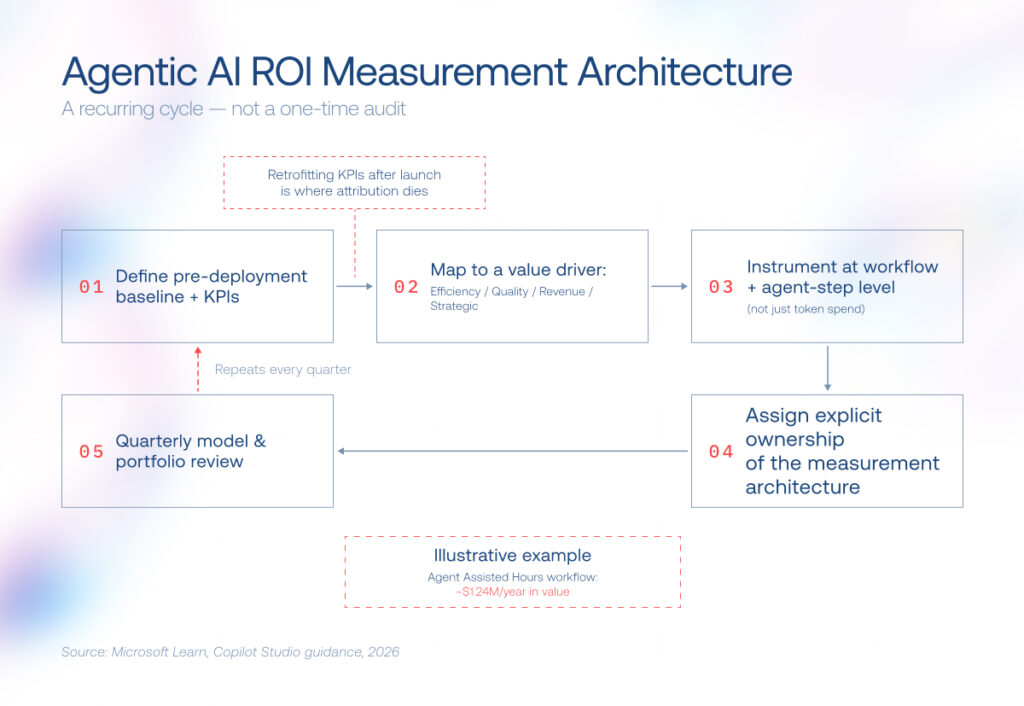
In practice, we structure measurement around four value drivers — Efficiency, Quality, Revenue, and Strategic — each with its own indicators and pricing formula. Together they turn “the agent helped” into a figure finance can check.
| Value driver | What it captures | How we put a number on it |
| Efficiency | Time your team wins back and can redirect toward work that genuinely needs a human. | Hours freed × fully loaded cost of an hour. |
| Quality | Fewer mistakes, steadier output, and tighter compliance. | Error-rate improvement × task volume × cost of a single error. |
| Revenue | Top-line gains from the business you keep, grow, or win. | Change in conversion or deflection × volume × revenue per unit, discounted for attribution. |
| Strategic | Faster decisions, more confident teams, more room to maneuver, and resilience when things go sideways. | Option value of the new capability + value of retained talent + resilience gained. |
That collapses into a single number: Agent Assisted Hours (AAH) — the human-equivalent capacity the agent hands back each month. The nuance that keeps it honest is that not every session counts the same. A session where the agent fully resolves a customer’s issue is worth more than one it escalates to a human, so the sessions get weighted by how much work the agent actually took off the team’s plate.
Run that weighting across a customer-service agent handling 10,000 sessions a month, and it comes out to about 1,440 hours of capacity returned. At a $72 fully loaded hourly rate, those 1,440 hours are worth $103,680 a month — roughly $1.24 million a year. And it’s not abstract capacity: it’s the time a team redirects to complex cases, proactive outreach, coaching, and the judgment-heavy work that actually moves retention. It’s also proof a conversational AI ROI claim can survive finance scrutiny.
Make value drivers built-in for your next agentic AI project?
Talk to our expertsHow to calculate AI ROI: a step-by-step framework
We talked architecture, and here’s how to run the math. Get the order below right, and the ROI arithmetic will hold up.
1. Define your pre-deployment baseline and KPIs
Before you write a single prompt, work out what the task costs today: hours, error rate, and rework, calculated with the AAH method above. Set target KPIs against that baseline and tie each one to an existing value driver.
2. Instrument before launch
Wire up logging at the agent-step level before the first production run: which action the agent took, what it cost in tokens, and what a human would have spent on the same step. Wait until after launch and you’re guessing backward through logs nobody built for the purpose — the baseline and the instrumentation have to share the same units from day one.
3. Run the AAH-style arithmetic
Two calculations do the work here, answering questions of different audiences.
The first is a quick sanity check for the team building the agent — is this thing even worth the tokens?
(Value of Agent Output − Token Cost) / Token Cost × 100%
Model choice moves that denominator fast — top-tier reasoning models cost roughly 24 times as much as small ones — so this tells you quickly whether an agent is even worth its tokens.
The second is the number your CFO and the board care about, because it nets out everything the first one ignores:
Agentic ROI = (Financial Value driven − Operational costs) / Total investments needed
Score it across three value vectors: productivity, quality and outcome, and risk aversion. An AI ROI calculator can rough out the first pass, but treat it as a starting estimate rather than the figure you bring to a CFO.
4. Fund and scale against hard value cases
The ROI timeline for AI agents rarely matches the vendor pitch, so fund each agent against a hard value case — a specific, quantified problem with a dollar figure attached rather than a broad vision statement.
In our delivery experience, pilot value shows in four to eight weeks and full deployment lands in two to six months, with payback typically following in six to 18 months. The range depends on how much of the workflow the agent absorbs and how heavy the verification load turns out to be.
— Ivan Dubouski, Head of AI Center of Excellence, Instinctools
Key metrics and KPIs to track before, during, and after deployment
ROI doesn’t hold on its own; you have to track it before deployment, during it, and after.
Before deployment
Set baselines for cycle time, error rate, cost per transaction, and staff hours per case. Define your success criteria in writing before the demo, so nobody can move the goalposts later.
During deployment
Watch how often a human has to step in, and how you’re checking the agent’s work in the first place. Nearly 70% of agents in production still need a person to intervene within their first handful of steps, and about three-quarters of teams still lean mainly on human review to catch problems.
How you review matters just as much as how often. Agent failures rarely show up in the final output alone; the root cause usually sits several steps upstream, so checking only the end result tends to miss the real problem. That makes intervention frequency and evaluation-method choice your true leading indicators of whether the ROI will hold.
After deployment
Track outcomes against the four value drivers. Whatever dashboard or AI agent ROI calculator you use, feed it intervention and evaluation data rather than raw completion counts. In our experience, the AI sales agents with the highest ROI are usually lead-qualification and follow-up use cases, since verification cost is low relative to the value of a closed deal.
Which of these metrics matter most depends on a decision most teams make too early: whether to build, buy, or partner for the agent itself.
Build vs. buy: how the decision shapes your ROI math
Where you get the agent — build it, buy it, or have it built for you — shapes your agentic AI ROI more than most teams expect, because it decides who owns the cost structure, the verification layer, and the data the agent generates over time.
Internal development only pays off in four scenarios:
- Proprietary “glue layers” connecting enterprise-specific data and workflows
- Differentiated capabilities where the agent itself is the competitive advantage
- Strategic learning investments a company needs regardless of near-term payback
- Regulated or data-residency-bound work (HIPAA, SOX, PCI DSS, the EU AI Act), where compliance requires a controlled build, whatever the ROI math says
The thread connecting them is ownership of the data the agent produces. Industry research frames this as “compounded context”: the data an agent captures compounds into a strategic asset over roughly a three-year horizon, but only if you own the pipeline gathering it. That’s why the build case is really a data-ownership case.
Outside those three scenarios, buying usually wins, specifically when:
- The task is a commodity and well-defined, with no enterprise-specific quirks
- Speed to value matters more than long-term ownership of context
- The use case isn’t a source of competitive differentiation
- You don’t have (or don’t want to tie up) engineering capacity to build and maintain it
There’s a third path between the two: partner-built. Unlike buying an off-the-shelf product, a partner-built agent is developed around your workflows and data by an outside team, so you get build-level fit and context ownership without standing up and maintaining an in-house AI engineering function. GENiE — Instinctools’ proprietary solution accelerator for building custom AI agents — is one example. The table below compares all three.
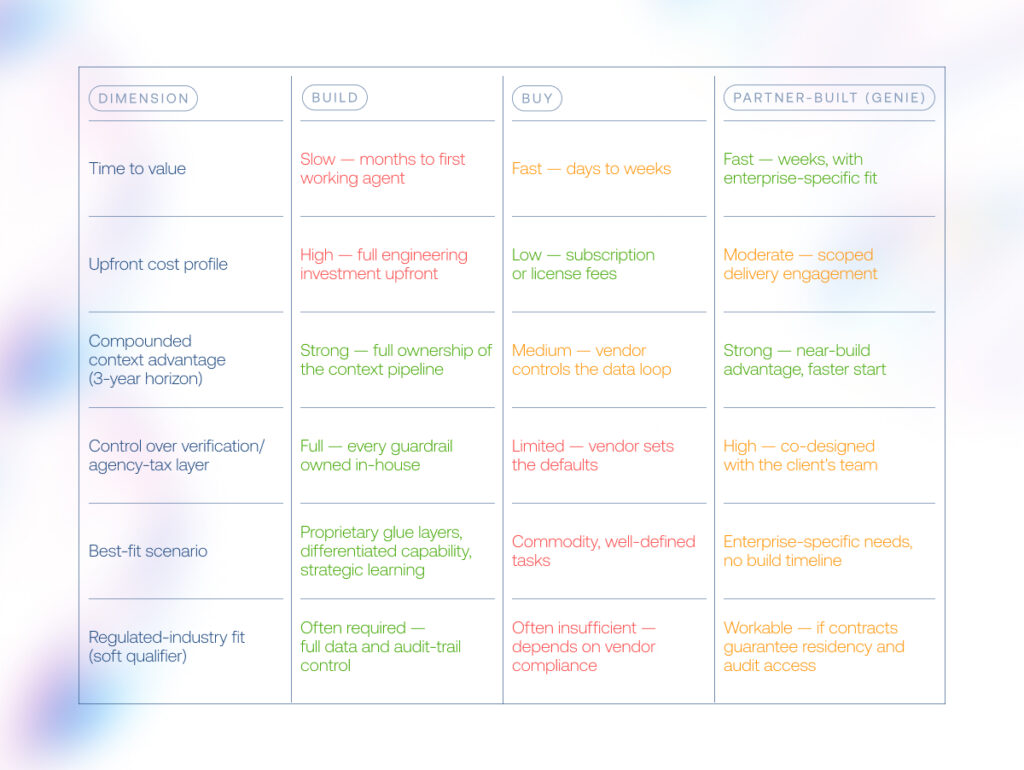
In a nutshell, buy wins on speed. Build wins on long-run compounded context, but only in the three scenarios above. Partner-built approaches, like our GENiE model, capture most of the build’s context advantage without its full timeline or risk thanks to being vendor-agnostic by design and fast to stand up.
— Ivan Dubouski, Head of AI Center of Excellence, Instinctools
Real-world agentic AI ROI: how we cut a six-month onboarding to two weeks
A global insurance aggregator hit the wall most enterprises face when they scale into new markets: partner onboarding. Each new one arrived with a different API, schema, language, and regulatory regime, and reconciling that by hand took three to six months per partner, across dozens of countries.
We created a production multi-agent system around an Analyze → Plan → Generate pipeline, using our GENiE framework, so the guardrails that keep agentic ROI from eroding, such as model governance, orchestration, and human-in-the-loop validation, were part of the design from day one.
The payoff:
- Onboarding time fell from three to six months to two weeks, up to 12x faster
- Operational cost dropped 10x, and repetitive developer work fell by 80–90%
- Engineers now spend roughly $50–100 and two to three hours of effort per large endpoint, checked by about 20 minutes of human review
Run those figures through the success probability weighed against verification cost ROI formula, and you get exactly this in production: 20 minutes of review time buying back months of manual onboarding work.
Try GENiE for your agetic AI use case
Book a demoTurn agentic AI ROI from a guess into a number
Agentic AI ROI is won or lost before deployment: in how carefully you baseline the work, scope the verification layer, and tie each agent to a value driver a CFO already recognizes. The model behind the agent matters far less than the measurement wrapped around it.
Get the baseline, the instrumentation, and the build-buy-partner call right, and every gain you claim traces back to a number finance can check. Get them wrong, and no dashboard will reconstruct the story after the fact. Measure first and deploy second — that order is the whole game.
Want real numbers behind your agents before you commit?
Book a callFAQ
In our delivery experience, pilots surface value in four to eight weeks, full deployment lands in two to six months, and payback typically follows in six to 18 months, but only when the baseline and KPIs are set before launch. Most enterprises plan for returns on a one- to five-year horizon, and the teams that beat that timeline are almost always the ones that started measuring on day one.
Up to 95% of them by the current numbers: the large majority of AI pilots never show measurable P&L impact, and 40% of agentic projects get canceled before they ever scale. But that failure rate rarely indicts the technology itself. In lots of cases we see, it traces back to measurement that started after deployment instead of before it, which leaves no baseline to attribute gains against.
Start with four value drivers — efficiency, quality, revenue, and strategic — each with its own indicators. Convert efficiency into Agent Assisted Hours: productive hours returned multiplied by fully loaded hourly value. Instrument at the workflow-step level before launch, so the numbers track the same units as your baseline.
Build only pays off in four scenarios: proprietary glue layers connecting enterprise-specific data, differentiated capability where the agent itself is your competitive advantage, strategic learning you need regardless of near-term payback, and regulated and data-residency-bound work where the rules leave you no real alternative. Outside those, buying wins on speed. Partner-built approaches, like our GENiE model, capture most of the build’s context advantage without the full timeline or cost.
The biggest is the agency tax: the verification and rework cost stacked on top of a wrong output, since a large share of an agentic task’s cost sits in refining answers rather than producing the first draft. Add agent sprawl and weak governance, and realized ROI erodes fast even when the underlying model performs perfectly well.
Before deployment, monitor baseline cycle time, error rate, cost per transaction, and staff hours per case. During deployment, watch intervention frequency and which evaluation method you’re relying on, as most agents still need a human to step in within their first several steps in production. After deployment, track outcomes against the four value drivers rather than raw task volume or completion counts.
Agentic AI platforms show measurable ROI in customer service first, since call volume is high and the value driver is obvious. Back-office workflows with clear audit trails, such as partner onboarding or invoice processing, follow close behind once governance is in place.
Subscribe to
Instinctools blog