

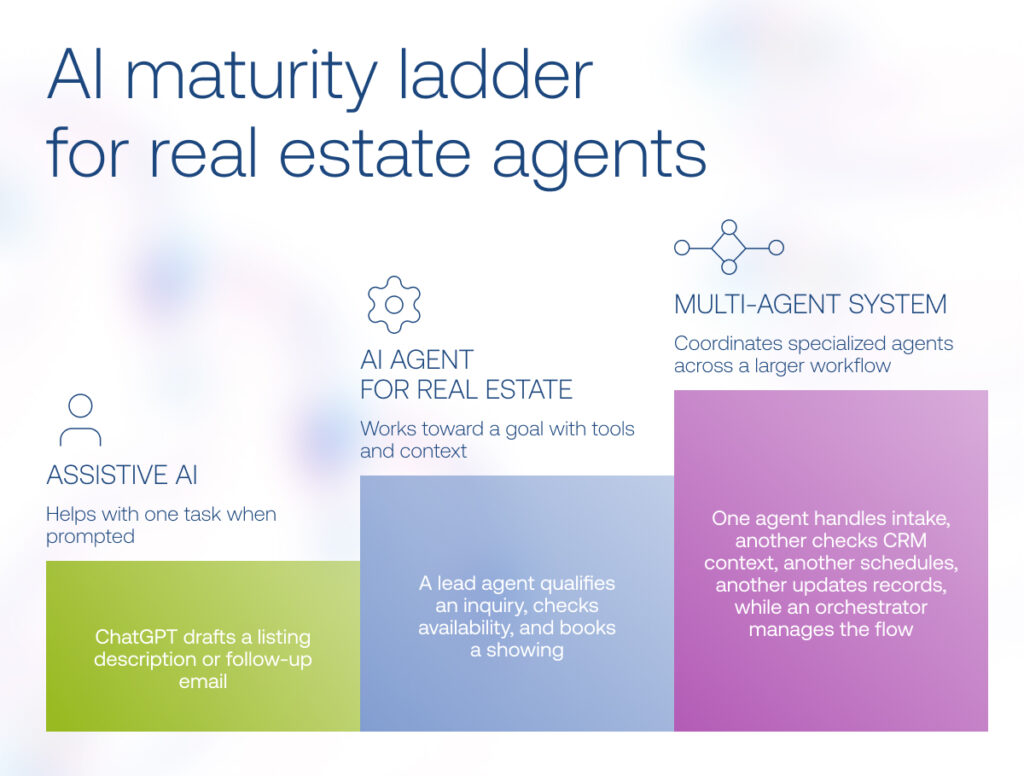
Not that long ago an AI real estate agent used to sound like a futuristic replacement for a human realtor. In 2026, the term can describe a single AI tool that helps an agent write a listing description, an AI voice agent for real estate that answers inbound calls, or a more advanced system that qualifies leads, schedules showings, updates a real estate CRM, and keeps the workflow moving with human oversight.
That difference matters. For now, most AI in real estate acts like a helpful assistant, taking care of isolated tasks such as writing, summarizing, transcription, recommendations, and reminders. The next generation of AI tools for real estate agents will go further, helping humans coordinate entire workflows across lead generation, nurturing, showings, transaction tasks, documents, and follow-up.
Built on our experts’ hands-on experience with AI real estate solution implementation, this guide explains which AI tools for real estate agents are useful today, where agentic AI in real estate is heading, and how brokerages, teams, and proptech companies can prepare their data, workflows, and governance for the shift from point tools to coordinated AI-powered operations.
Key highlights
- The AI real estate agent is no longer a single tool, but a workflow-driven system that connects leads, listings, transactions, and operations into one coordinated process.
- The real impact of AI in real estate comes from orchestrated execution, where AI moves work across systems, while humans stay in control of judgment, approvals, and client relationships.
- Companies that want to benefit from AI real estate agents must first redesign their workflows, data, and governance, not just adopt new tools.
What is an AI real estate agent?
An AI real estate agent is software that uses artificial intelligence to support, automate, or coordinate work across the real estate lifecycle. In its simplest form, it may be an AI assistant for real estate agents that drafts emails, writes property listings, summarizes calls, or answers common buyer questions. In their more advanced form, AI agents for real estate can act on a goal: capture a lead, qualify the buyer, book a showing, send reminders, update the CRM, and route exceptions to a licensed agent. In other words, the system takes over parts of the workflow that are repetitive, time-sensitive, or rules-based, while humans stay responsible for fiduciary duty, negotiation, compliance, client trust, and final decisions.
How to use AI for real estate agents: 7 high-impact use cases
The most useful AI tools for real estate agents are defined by the workflow – not just a single task – they improve.
1. Lead response and tour scheduling
Lead response is one of the clearest use cases for an AI real estate agent because the workflow is time-sensitive, repetitive, and easy to measure. When a buyer, renter, or seller inquiry comes in, someone has to answer, qualify intent, collect preferences, check availability, schedule the next step, and update the CRM.
An AI voice agent for real estate can handle the first part of that workflow when a human agent is unavailable. It can answer inbound calls, ask basic qualification questions, capture budget and timeline, transcribe the conversation, and trigger follow-up automation. In text channels, the same role can be played by an AI chatbot that answers website, SMS, or portal inquiries and routes serious prospects to the right person.
For residential agents and brokerages, this is where AI delivers immediate value, as it contributes to fewer missed leads, faster replies, cleaner CRM records, and more consistent follow-up.
2. Leasing and renewals
Leasing is often treated as a marketing process, but operationally it is a sequence of handoffs, such as inquiry, qualification, availability check, tour scheduling, application support, document collection, approval, move-in, and renewal. Every delay creates friction for the prospect, the leasing team, and the property owner.
A real estate AI agent can support this process by handling routine leasing conversations, answering property questions, collecting applicant details, booking tours, sending reminders, and routing exceptions to a human leasing specialist. For renewals, AI agents can monitor signals such as unresolved maintenance issues, negative feedback, missed appointments, or slower response behavior, then prompt the team to intervene before the tenant decides to leave.
For larger operators, this can become a multi-agent workflow, where a communication agent handles tenant-facing messages, a knowledge agent retrieves policy and lease context, a scheduling agent coordinates tours, a compliance agent checks escalation rules, and a CRM agent logs the result.
3. Maintenance and resident service
Maintenance is one of the strongest examples of agentic AI in real estate because the work rarely ends with answering a question. When a resident reports a problem, the business has to classify the issue, assess urgency, check property rules, coordinate access, dispatch a technician or vendor, communicate updates, approve costs, and close the loop.
A simple AI chatbot for real estate agents can collect a maintenance request. A more capable AI agent can move the ticket through the process: ask clarifying questions, categorize the issue, identify emergency cases, read attached photos, suggest troubleshooting steps, route the job to the right technician, notify the resident, and update the property management system.
4. Transaction coordination and document management
Real estate transactions depend on documents: listing agreements, disclosures, contracts, inspection reports, amendments, financing documents, lease files, closing checklists, and compliance records. Delays usually happen because someone has to find the right document, extract the right detail, confirm the deadline, or chase the next signature.
An AI assistant for real estate agents can summarize a contract or draft an email. A more advanced real estate AI agent can help coordinate the transaction workflow: extract key dates, compare checklist requirements against available documents, flag missing signatures, draft client updates, prepare reminders, and route questions to the licensed agent or transaction coordinator.
For brokerages and proptech companies, this is a strong candidate for custom AI agent development because the workflow often depends on local rules, brokerage-specific processes, document templates, and compliance requirements. The agent should not make legal decisions or interpret obligations without review, but it can reduce the administrative drag around those decisions.
5. Property valuation and market analysis
AI can help collect comparable sales, summarize neighborhood trends, analyze property attributes, identify anomalies, and turn market data into a first draft of a pricing narrative.
But this is not a use case where AI should become the decision-maker. Automated valuation models and predictive analytics can support the analysis, while the licensed agent brings local judgment: property condition, buyer psychology, micro-location, renovations, inventory pressure, seller urgency, and negotiation strategy.
The best AI tools for real estate agents in this area work as decision support. They help agents move faster from raw MLS data, public records, and market signals to a defensible recommendation. They do not remove the need for a professional who understands the market and can explain the pricing logic to a client.
6. Asset management and portfolio operations
In commercial real estate and larger residential portfolios, the AI real estate agent concept expands beyond individual buyer or seller support. Here, AI agents can help asset managers, owner-operators, and property management teams coordinate portfolio-level work.
For example, one agent can extract lease terms and key dates, another can pull operating performance, another can summarize tenant or resident issues, another can prepare a draft investment memo, and another can flag risks that require review.
This use case matters because it shows the enterprise direction of real estate AI agents. The value lies in connecting documents, systems, workflows, and approvals so that teams spend less time rebuilding the facts and more time making judgment calls.
7. Construction, capital projects, and vendor coordination
Construction and capital projects are full of documents, dependencies, approvals, vendors, and exceptions. AI agents can support this domain by organizing RFIs, submittals, meeting notes, bids, permits, change orders, schedules, and closeout documents.
A project-support agent might classify incoming documents, extract action items from meeting minutes, check whether a submittal package is complete, draft a vendor update, flag a change order above an approval threshold, or remind stakeholders about missing closeout materials.
Best AI tools for real estate agents: how to choose
The best AI tools for realtors are the ones that remove bottlenecks in the agent’s actual week.
For solo agents, the best fit is usually a practical stack: a writing assistant, an AI voice or chatbot tool, CRM follow-up automation, transcription, and a simple listing description generator. For teams and brokerages, the decision is different. They need shared data, role-based access, workflow visibility, brand controls, and integrations with the CRM, transaction coordination, document management, and marketing systems.
Before choosing a tool, answer the following questions:
- Does it connect to the systems where work already happens?
- Does it improve lead response, follow-up, documentation, or conversion?
- Can humans review sensitive actions before they happen?
- Does it leave an audit trail?
- Can it scale from one agent to a team or brokerage?
- Does it support your brand voice and compliance requirements?
- Does it make the CRM cleaner or messier?
What production-ready AI real estate agent architecture looks like
A production-ready AI real estate agent depends on a well-defined architecture, particularly when it interacts with business systems, schedules showings, sends client communications, or updates records in real time. Reliable execution at scale requires these capabilities to be organized across several coordinated layers.
1. User and business interface layer
This is where agents, brokers, property managers, leasing teams, or asset managers interact with the system. It may be a chat interface, CRM sidebar, mobile app, dashboard, or workflow queue.
The interface should match the job: lead response, showing scheduling, transaction coordination, maintenance triage, or portfolio review.
2. Agent orchestration layer
This layer coordinates the work. It decides which agent should act, what context it needs, when to route work to another agent, and when to stop for human review. For simple tasks, orchestration may be unnecessary. Meanwhile, for complex workflows, it prevents AI agents from becoming disconnected point tools.
3. Knowledge and context layer
Weak context produces weak automation. If the data is outdated, duplicated, or disconnected, the AI may sound confident while moving the workflow in the wrong direction. So this layer is designed to provide the system with reliable information: CRM history, property listings, MLS data, client preferences, transaction documents, lease terms, vendor records, policies, and prior communications.
4. Integration and action layer
At this point, the AI connects to real estate CRM, calendars, email, SMS, transaction management software, document stores, virtual tour tools, property management systems, and marketing platforms. That’s how AI agents can create tasks, update records, schedule showings, trigger reminders, or route approvals.
5. Control layer
This layer defines what the AI is allowed to do. It includes permissions, approval rules, audit trails, escalation logic, compliance checks, and human-in-the-loop controls.
For real estate, AI governance is essential. AI should not make unauthorized promises, change contract terms, approve concessions, or handle sensitive client matters without clear boundaries.
6. Monitoring and optimization layer
AI gets better only when the business can see what happened, why it happened, and where the workflow broke. That’s why it needs to be possible to track whether the system is working: response times, booking rates, lead conversion, CRM accuracy, escalation rates, human overrides, failed actions, and user adoption.
Build vs. buy: AI real estate agents
There is a ceiling on what rented tools can do. Off-the-shelf apps solve isolated tasks well, a chatbot here, a follow-up sequence there, but each one runs in its own silo. A custom AI agent can orchestrate the whole brokerage workflow end to end, moving a lead from first contact through qualification, scheduling, and CRM updates without a human stitching the apps together. That difference is what separates buying a tool from building a system.
For an individual agent, buying is almost always the right call. For a brokerage or a proptech company with volume, its own data, and strict compliance rules, a purpose-built system on a multi-agent framework for real estate workflows can fit the exact process instead of forcing the process to fit the app. The honest answer depends on your size, your data, and how custom your workflow really is. In regulated workflows with sensitive client data, that calculus also has to account for data residency and audit-trail requirements, which can push a team toward building even when an app would be cheaper to start.
| Factor | Buy (off-the-shelf) | Build (custom) |
| Time to launch | Fast, ready out of the box | Slower, a real project |
| Customization | Limited to the vendor’s roadmap | Any workflow you can define |
| Cost model | Predictable subscription | Higher upfront, lower long-run at scale |
| Data and compliance | Vendor-controlled | Full control over data and audit trails |
| Best fit | Individual agents and small teams | Brokerages and proptech with scale |
How brokerages and proptech companies can prepare to use AI as a real estate agent
While individual agents can start with separate, out-of-the-box tools, brokerages and proptech companies need full AI readiness. Here’s the checklist our AI experts suggest following:
- First, clean the data foundation. AI needs reliable records for leads, clients, properties, listings, transactions, documents, vendors, and communications. If your data is messy, AI will scale the mess.
- Second, map workflows before automating them. Lead generation, lead nurturing, showing scheduling, transaction coordination, document management, and follow-up automation should be broken into repeatable steps, judgment points, and escalation moments.
- Third, define governance early. Who can approve AI-sent messages? Which actions require human review? What data can each user access? What gets logged? What happens when confidence is low?
- Fourth, decide what to buy, extend, or build. Most individual agents should buy. Teams may extend existing platforms. Proptech companies and larger brokerages may build custom AI agents when workflow intelligence, proprietary data, or brand experience becomes a competitive advantage.
Will AI replace real estate agents?
The short answer is no – at least, not now.
The question itself confuses tasks with the job. Goldman Sachs estimates that 46% of tasks in office and administrative support roles are exposed to automation by generative AI, the highest share of any occupation group. Much of an agent’s week is exactly that kind of work: paperwork, scheduling, data entry, and first-draft writing. Automating those tasks does not remove the agent. It clears the calendar for the parts of the job a machine cannot do.
Those parts are real, and they are defined in part by law. Under Article 1 of the NAR Code of Ethics, agents pledge to “protect and promote the interests of their client”. A model cannot hold that obligation, carry the license behind it, or answer for a bad outcome. So the question of whether real estate agents will be replaced by AI runs into a wall: accountability has to rest with a person.
Three constraints keep the human in the seat. Licensing ties the transaction to a credentialed individual. Legal liability needs someone who can be held responsible. And the emotional weight of the largest purchase in most people’s lives still calls for a person who can read a room and steady a nervous buyer. So will AI take over real estate agents entirely? Not on any near-term roadmap, which is why that worry is aimed at the wrong target.
The clearest way to see the boundary is to lay the two columns side by side.
| What AI can do | What AI can’t do (yet) |
| Qualify leads 24/7 | Negotiate the terms of a deal |
| Generate listing descriptions | Hold fiduciary responsibility |
| Answer neighborhood questions | Read a buyer’s emotion at a showing |
| Automate follow-up | Build trust through an in-person meeting |
| Analyze market data | Sign a legal document |
The left column is where AI compounds your output. The right column is where your value lives. Human real estate agents who automate the left and double down on the right are the ones who pull ahead.
The future of the AI real estate agent is workflow, not tools
AI automation for real estate agents is not one thing, but a category of tools that has moved from simple assistance to coordinated execution. The most valuable real estate AI agents coordinate full workflows: capturing leads, scheduling showings, updating systems, routing approvals, supporting transaction coordination, and learning from every completed step.
In this landscape, the winning move is to choose the workflow where speed, consistency, and better handoffs matter most, then build the data, integrations, governance, and monitoring around it. For agents, teams, and brokerages, that is where the real advantage starts.
Ready to build your own AI agent for real estate?
Let’s talkFAQ
Agentic AI in real estate is software that plans and acts toward a goal instead of just answering a prompt. Given a target, it chains steps together, for example capturing a lead, qualifying it, booking a showing, and updating the CRM, while a human supervises the outcome.
They fall into six categories: voice agents, chatbots, listing and marketing generators, AI-powered CRM and lead automation, valuation and market-analysis models, and free general tools like ChatGPT. Per NAR’s 2025 survey, ChatGPT is the most-used, at 58% (NAR, 2025).
There is no single best AI voice agent for real estate; the right one depends on your CRM and call volume. Widely used options include Structurely, Roof AI, and CINC. The shared value is speed: these tools answer and qualify a lead in seconds rather than hours.
No, real estate agents will not be replaced by AI as a profession. Generative AI automates routine tasks, yet it cannot hold a license, carry fiduciary responsibility, or build trust in person. Goldman Sachs estimates 46% of office and administrative tasks are exposed to automation (Goldman Sachs, 2023), but the licensed, accountable, and emotional parts of a transaction still require a person under the NAR Code of Ethics. Yet, the agents who automate routine work and focus on judgment and relationships will outperform those who do not.
To use AI as a real estate agent, start small: audit your routine, pick one tool, test it on real work, then integrate it. Begin with high-return tasks like listing copy, lead qualification, and follow-up. Free tiers of ChatGPT, Gemini, and Zapier are a low-risk place to start.
The best free AI tools for real estate agents include ChatGPT’s free tier for writing, Canva AI for marketing graphics, Google Gemini for research, and Zapier’s free tier for connecting apps. Together they automate listings, social content, and basic lead handling at no cost.
Subscribe to
Instinctools blog