

The lack of enterprise AI governance is the ceiling companies hit when adopting and scaling AI. They invest in pilots, deploy tools across teams, but freeze the moment someone in legal or the board asks: who signed off on this?
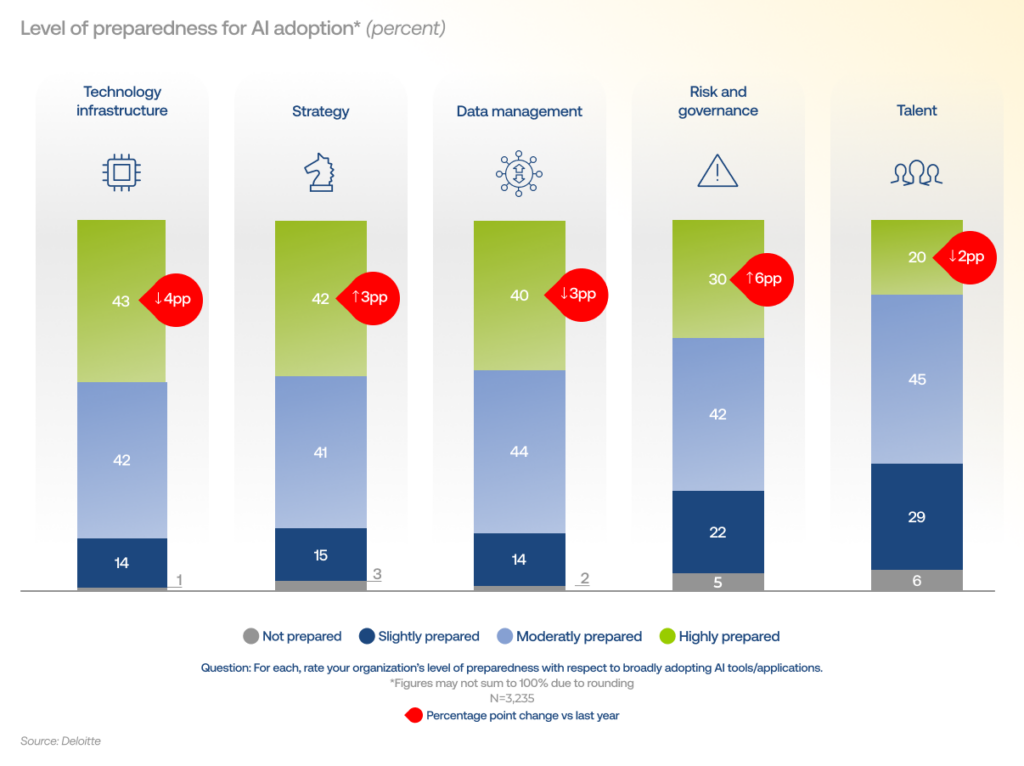
Without a solid AI governance framework, promising demos are as good as a feast eaten in a dream: impressive at first, but hard to hold onto when it comes to accountability. Only 1 in 5 companies can scale AI without waking up to compliance, security, and reputational consequences.
This guide lays out a practical AI governance framework for enforcing consistent risk management, preventing model bias, and keeping control over your AI projects as they multiply.
Key highlights
- AI governance becomes the real differentiator in the AI race: how well you govern the technology matters more than how fast you adopt it.
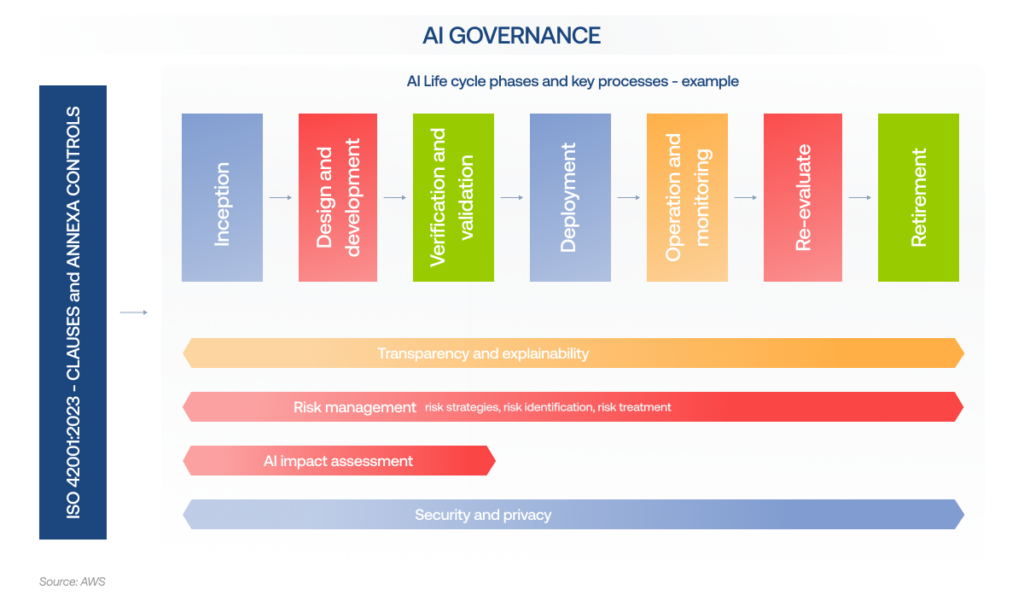
- Governance cannot survive as a bolt-on measure. Enterprises need centralized oversight covering all stages of the AI lifecycle, from inception to retirement.
- Agentic AI systems have outgrown static controls, calling for dynamic governance.
What is AI enterprise governance?
Enterprise AI governance is a system of standards, policies, and controls that determines how a company builds, deploys, monitors, and retires AI to keep the technology safe and ethical at scale. Done well, it defines where AI can and can’t be used, manages data and model risks, ensures bias mitigation and explainability, and gives every system a clear owner. In short, AI governance is what turns an experimental capability into a responsible technology.
Why now? Corporate AI governance as a risk factor and a competitive lever
Ask a CTO why AI governance standards matter, and they’ll tell you about scaling faster with confidence. Ask a compliance officer, and you’ll hear about preventing fines and audit failures. Both are right, but each is looking at only part of the picture. Meanwhile, the urgency around AI and governance is being shaped by three forces at once:
- AI has left the sandbox. The technology has moved past the experimental stage and entered customer service, marketing, product design, finance, procurement, software engineering, HR, and operations. AI-backed decisions now directly affect customers and employees, brand trust, and financial outcomes.
- The regulatory pressure keeps building. The regulatory stack is growing on both sides of the Atlantic, with the EU AI Act and Colorado’s AI Act to prepare for, NIST AI RMF as voluntary guidance to follow, and ISO/IEC 42001 as a certification to prove your AI governance is strong. Businesses have to comply, and the penalties for those that don’t are already on the books.
- Governance enables AI to scale. Companies with established responsible AI programs report a 42% improvement in business efficiency and a 34% increase in consumer trust. Clear risk tiers, reusable policies, and automated checks let organizations deploy faster without reinventing compliance for every new use case.
Seven strategic pillars of an enterprise AI governance framework
To get AI right, companies need an AI governance structure that covers strategy, execution, and ongoing oversight. Drawing on our work with enterprise AI programs, we’ve settled on seven components that make responsible AI real.
1. AI strategy alignment and policy architecture
Governance without a business anchor drifts into annoying bureaucracy that only throws a wrench in the works. Strategy alignment starts with leadership defining how AI serves business objectives and how much risk the organization is willing to carry. That direction drives all the downstream actions:
- AI use case inventory capturing what AI is in use, where, and for what purpose
- AI initiatives risk classification from low- to middle- to high-risk categories
- Company internal AI policies specifying acceptable use of AI tools, safety evaluation criteria for third-party AI models, and procurement standards for them
2. Risk management throughout the entire AI lifecycle
AI risk moves with the AI development cycle. Early on, the concern may be poor training data, weak consent records, or hidden bias. During development, it may be unsafe model behavior or insufficient testing. In production, the risk can shift toward drift, hallucinations, adversarial inputs, or business logic that no longer matches reality.
It’s better to set the bar high early and move risk review left, to the beginning of the project. Security should be involved early, then pulled back in whenever the model, architecture, data, vendor setup, or policy context changes.
So what to build on? Governance moves from principles to practice through emerging frameworks and standards. For instance, NIST AI RMF guides on-the-ground actions related to AI system inventory, impact assessment, bias testing, performance benchmarks, risk prioritization, incident response plans, ownership, policies, and team training. On the certification side, ISO 42001 is about to follow the ISO 27001 trajectory and become a procurement checkbox enterprise buyers screen for when looking for an AI engineering partner. Companies that already hold ISO 27001 have a head start, as both certifications demand the same organizational groundwork, including documented policies, internal audits, regular management reviews, and risk treatment procedures.
3. Regulatory compliance and cross-jurisdiction alignment
AI regulation is becoming a patchwork. A company operating across markets may have to account for the EU AI Act, GDPR, CCPA, and sector-specific rules. Handling compliance region by region multiplies the cost and complexity with every new market the business enters. The current chaos complicates matters for both software companies and policymakers, and the G7 and OECD push for global AI governance harmonization and moving toward modular compliance.
In practice, it means building one set of principle-based controls mapped to each jurisdiction’s requirements, and fine-tuning the mapping as new regulations appear, rather than starting the whole effort from scratch.
4. Data quality assurance
Data infrastructure from the pre-AI era was designed for storage and batch processing. Bolting AI governance on top of that foundation and expecting it to support real-time, autonomous AI is building on sand.
Most governance failures we see in the field trace back not to model behavior but to ungoverned data with wrong lineage, missing consent records, and no clear ownership.
– Ivan Dubouski, Head of AI Center of Excellence, Instinctools
A solid data foundation to build enterprise AI compliance on requires:
- Data lineage to trace where information originated
- Provenance tracking across transformations
- Data quality standards for accuracy and completeness
- Clear consent management
- Bias screening in training datasets
- Metadata cataloging
- Privacy-by-design as a default
5. Accountability and human oversight
As AI spreads across departments, governance responsibility lands in the gaps between existing roles. An engineering team is responsible for the model, a data team manages the pipelines, and a product team defines the workflow. Compliance owns the policy. But when something goes wrong, nobody is quite sure who owns the outcome. The catch is that AI enterprise governance can’t be assigned to a single role and calls for a layered accountability spanning all AI-related activities:
- AI and ML engineering teams manage risk at the build level, validating training data, documenting model decisions, and monitoring system behavior in production
- Risk managers and AI governance officers provide independent oversight, checking whether the controls the engineering teams put in place hold up
- The internal audit team periodically verifies whether controls at the build and oversight levels work as designed and reports findings to leadership
- Chief AI Officer sets the direction across all the three layers
For high-risk AI systems, the EU AI Act mandates human oversight as a legal requirement. It can take two forms depending on the risk level:
- Human in the loop, where a person reviews and approves each decision before AI executes it
- Human on the loop, where AI operates autonomously while a person monitors the process and can intervene when something goes off track
Matching the level of oversight to the risk tier keeps the review useful without slowing every AI-assisted workflow to a crawl.
6. Training and change management
Employees are already using AI, whether the organization has a formal program or not. Some have developed good habits. Others are experimenting in ways that create security, privacy, or quality risks. The aim is to bring everyone onto a shared standard for safe, effective AI use.
Centralized reskilling and training programs close this gap with a shared baseline covering:
- Policies like approved tool lists and acceptable use guidelines
- Practices around data privacy and cybersecurity in AI workflows
- Escalation protocols
A side benefit of such an approach is that people who understand a technology and see how it fits into their work are far less likely to push back against it.
7. Ongoing monitoring and compliance
AI governance isn’t a set-it-and-forget-it initiative. Your AI tech stack is likely to get updated every few months as models change, vendors update their tools, your AI use cases evolve and new regulations appear, so you’ll have to fine-tune your AI governance tools enterprise compliance standards as well. Ongoing monitoring for drift, hallucinations, bias, security vulnerabilities, and privacy erosion is what AI governance continuous improvement looks like in practice.
A cadence to aim for:
- Review policies after every major system change
- Run internal compliance audits quarterly, with automated monitoring running between cycles
- Schedule annual external audits if ISO certification is on the agenda
Agentic AI governance best practices for enterprises
Three out of four companies have agentic AI on their two-year roadmap. However, a governance playbook written for generative AI won’t be enough for AI systems that make multi-step decisions and act on them across a live business environment. The companies to capture and tame agentic power will be the ones that put governance at the center of their custom AI agent development.
To avoid risk compounding 24/7 at machine speed, you should raise the bar beyond traditional controls:
- Risk-tiered autonomy. A knowledge assistant and a procurement agent approving purchases carry different risks. Classify agents by autonomy level, business impact, and risk type, and match governance intensity accordingly.
- Enforceable guardrails. What happens when guardrails are voluntary? Controls that exist on paper get bypassed, spawning shadow agents. For agentic AI, guardrails like risk-based triage, automated compliance checks, bias monitoring, and factual accuracy verification better be mandatory.
- Controlled agent-to-agent communication. When agents access tools and data through open-ended channels, the attack surface becomes difficult to govern. Standardized gateways with situational access and policy-enforced permissions keep multi-agent interactions auditable.
- Agent-level visibility and observability. Every agent needs a clear owner and a verifiable identity. Without that foundation, it becomes impossible to reconstruct the multi-step workflows agents execute across systems. And failures that can’t be investigated can’t be analyzed and prevented in the future.
- Kill switches and rollback plans. By the time you notice something is wrong, an agent may have already executed transactions, sent emails, or modified records, so the ability to stop it mid-action and undo the damage has to exist before the agent goes live.
- Human accountability for high-impact decisions. Start with bounded autonomy, keep people accountable for consequential decisions, and expand an agent’s freedom only when monitoring proves its behavior is predictable and safe over time.
Agentic AI requires companies to take care of a lot at once: who the agent is, what it can access, which actions it can take, when a human needs to step in and how to undo mistakes. Building the full control layer from scratch in-house can become a tall order. A partner with a governed agentic AI framework already in place can make the path to production shorter, safer and easier to manage.
AI governance self-diagnosing: where do you stand now?
Before building an agentic and generative AI governance framework, it helps to know your starting point. These ten questions take 60 seconds and will show you where the gaps are.
- Do you maintain a registry of all AI use cases across the organization?
- Is accountability for AI governance assigned across layers, with named owners at the build, oversight, and audit levels?
- Can you trace the lineage of the data feeding your AI systems?
- Can your compliance team map your AI systems to the risk categories in applicable regulations?
- Are your governance controls triggered automatically during model development, or do they require manual reviews?
- Have you defined escalation protocols for unexpected AI behavior in production?
- Are your AI agents registered with documented identities, owners, and permission boundaries?
- Can you stop an AI agent mid-action and reverse what it has done?
- Is there a set cadence for reviewing and updating your AI governance policies?
- Have your teams received structured training on responsible AI use and approved tool policies?
If you answered “yes” to one or two questions, you’re still at square one. Three-four positive answers suggest you’ve built some initial processes, but governance still lives in silos. Five and more signals you have the bones of an enterprise-wide governance initiative, with the next challenge being consistent, automated, and enforceable controls.
From theory to action: step-by-step enterprise AI governance roadmap
Every company’s starting point is different: some have AI systems in production with no oversight structure, others have policies that don’t keep up with how fast their teams adopt new tools. The AI governance framework development process below works regardless of where you are, breaking AI governance implementation into practical steps to follow.
1. Inventory and classify every AI use case
The first thing to do is to find out what you’re about to govern. Start by building a complete picture of AI use across the organization:
- Audit every AI tool, model, and agent across the organization
- Build a central registry that captures what each system does, who owns it, and what data it touches
- Tag each entry by autonomy level and applicable risk category (unacceptable, high, limited, minimal)
2. Define and codify responsible AI principles
While clear principles set the direction, to make them work, you should transform them into enterprise policies:
- Establish what responsible AI means for your organization: fairness, transparency, accountability, safety, privacy
- Translate those principles into an operating discipline teams can follow: acceptable use guidelines, procurement and vendor evaluation standards, data handling requirements, third-party model assessment criteria
- Get executive and board sign-off, because governance without visible top-down sponsorship stays a memo
3. Create the AI governance operating model
Less than 1% of companies have fully operationalized responsible AI, and one of the reasons behind it are haphazard governance efforts without clear accountability. To avoid that, define who makes decisions, who executes controls, and who verifies that the controls are working.:
- Appoint a senior AI governance leader with governance as their primary responsibility, rather than a side job stacked on top of existing duties
- Assemble a cross-functional governance committee bringing together business leaders, data and AI teams, legal and procurement teams to align on policy and oversight decisions
- Separate delivery from quality assurance at the operational level, so that no one holds unchecked control over all AI processes and assets
- Start with a centralized governance structure for consistency and accountability, then evolve toward a federated or hybrid model as practices mature and business units develop context-aware oversight
4. Automate governance at enterprise scale
AI governance cannot depend on manual review alone. The goal is to make governance run in the background, much like automated testing does in modern software delivery.
- Embed governance checkpoints into the CI/CD pipeline so they trigger on every code commit or architecture change, running alongside deployment
- Automate the routine work: evidence collection for audits, scheduled bias checks, compliance report generation, and explainability logging
- Set up monitoring dashboards for drift, performance degradation, and policy violations
- Track governance KPIs, such as time from model submission to production approval, incident rates, and compliance gaps closed per cycle
5. Implement AI-specific testing and validation
Standard software testing doesn’t address the failure modes specific to artificial intelligence. The baseline should cover:
- Hallucination testing
- Prompt-injection resistance
- Toxicity screening
- IP and copyright checks
If you want to adopt agentic AI, expand the scope with agent boundary and multi-agent interaction tests.
6. Set up continuous governance monitoring
Regulations evolve, and the AI governance compliance framework has to keep pace. These steps prevent your policies from falling behind:
- Track regulatory changes across all relevant jurisdictions on a continuous basis
- Map new requirements against existing controls to spot shortfalls early
- Keep a documented trail of policy updates and make sure they reach everyone affected
- Review whether current governance controls still satisfy updated regulatory requirements
- Feed findings from audits and incidents back into the policy update cycle so the framework learns from experience
Either you turn AI governance into your turbo button, or AI becomes the handbrake you forgot to release
AI enterprise governance is still young enough that getting it right now can put you ahead of companies that are still figuring it out. Those that treat governance as a capability to build and refine deploy AI faster, face fewer incidents in production, and pass audits without a fire drill.
You don’t need a perfect framework to start. What you need is an inventory of every AI system in use, a set of principles turned into enforceable policies, and a named human who owns the outcome. Everything else builds from there. An AI development company that already has governance woven into its delivery process can shorten the path.
Let’s get you started on AI governance
Book a free consultationFAQ
Governance artificial intelligence is the broader discipline that covers how an organization builds, deploys, and oversees AI. That includes principles, policies, roles, and controls. Enterprise AI compliance is narrower. It focuses on proving your AI systems meet specific legal requirements.
The most widely adopted frameworks include NIST AI RMF (risk-based, voluntary), ISO 42001 (certifiable management system), and the EU AI Act (mandatory for companies operating in the EU). Since no single framework provides a complete, ready-made enterprise AI governance program by itself yet, most companies combine elements from several sources, tailoring the mix to their industry and adjusting as new requirements take shape.
At Instinctools, we roll out AI governance initiatives in two stages. AI use case inventory, policy drafting, legal review, executive approvals, and team briefings on the policies take 4-6 weeks. Then comes governance infrastructure: automated controls, monitoring, and audit trails built into your existing AI stack. The timeline here depends on how many AI systems are in production and how diverse the technology landscape is, but expect three months at a minimum.
The EU AI Act classifies AI systems by risk category and sets mandatory requirements for high-risk applications, including transparency into how AI systems make decisions, human oversight mechanisms, data quality standards, and technical documentation of system behavior and performance. Companies operating in the EU need to map their AI systems against the Act’s risk tiers and build controls that match each tier’s obligations.
AI governance ROI shows up in three places: avoided costs, operational efficiency, and speed to market. Avoided costs include fines, incident remediation, legal exposure, and reputational damage. Efficiency gains come from automated compliance reporting, fewer manual audits, and reusable evidence trails. Speed-to-market improves when new AI features can move through review, approval, and deployment without every project becoming a one-off governance exercise.
The exact structure depends on organizations’ AI governance models, but at a minimum, you should have an executive sponsor, a governance lead who owns policy, data stewards, legal or compliance representatives, and risk owners who can assess business impact. If you craft AI-powered products and agents, AI/ML engineers, either in-house or from a tech partner, should stay responsible for model-level controls. As your framework matures, enterprise AI governance platform features like automated monitoring and audit trails can absorb some of the manual workload, but human accountability can’t be automated away.
Subscribe to
Instinctools blog