

AI adoption at enterprise scale feels like a moving target. Just as companies begin getting their first generative AI applications beyond the prototype stage, the conversation shifts again, this time to AI agent orchestration – the coordination layer that makes multi-agent systems efficient, secure, and governable in real-world enterprise settings.
Standing still is not an option, and even moving half as fast as the market is still a form of falling behind. Deloitte puts numbers to the gap: only 14% of organizations have deployable agentic AI, and a mere 11% are actively using these systems in production.
The opportunity is there, but what’s missing is the infrastructure that allows multiple agents, tools, and workflows to operate as one coherent system. With years of hands-on experience as an AI development company, Instinctools walks you through what multi-agent orchestration is, why it’s non-negotiable for agentic setups, how it works in practice, and what it takes to implement it right.
Key highlights
- Artificial intelligence is no longer enough. Coordinated intelligence with a centralized platform to manage multiple AI employees is the new competitive edge for enterprises and anyone considering agents’ adoption.
- Software built on an AI agent orchestration platform goes from smarter automation to coordinated execution, as a network of specialized autonomous agents can collaborate across complex tasks, fully following workflow-level and overall business context.
- The biggest obstacles to implementing and scaling AI systems with multiple agents in production are data readiness, workflow redesign, governance gaps, and others.
What is AI agent orchestration?
AI agent orchestration is the process of coordinating several specialized AI agents within a complex, multi-step workflow. As enterprises move from single agents to multi-agent systems (MASs), orchestration becomes what makes those systems usable in practice. It assigns and sequences tasks, passes context between agents, reroutes work when something fails, and enforces the governance needed for production use, enabling multiple AI agents to operate as a full-scale digital worker.
Why can’t an AI agent setup do without orchestration?
Agent capabilities without control over how they’re applied are no better than an abstraction. Orchestration is what operationalizes them, making agentic systems observable, governable, cost-controlled, auditable, and maintainable. The key benefits you don’t want to leave on the table include:
- The ability to handle real-world workflows. Through AI agent task delegation and coordination, the orchestration layer accommodates the imperfections and complexities of enterprise business processes that span multiple systems, departments, and decision points.
- A shift from automation to coordinated autonomy. A single AI agent can automate a task. An orchestrated system of agents can own an entire process, making context-aware decisions, adapting to exceptions, and completing multi-step, complex workflows with minimal human intervention.
- Resilience under failure. If one agent breaks, an AI orchestrator prevents the entire ecosystem from going down with a single weak link, whether by retrying a failed step, rerouting the task to another agent, falling back to a safer predefined response, or escalating to a human when needed.
- Next-level performance. Our track record of agentic projects proves that with specialized agents handling their subtasks in parallel, multi-agent setups get things done up to 4x faster, boosting overall system performance.
- Scalability without linear headcount growth. Agents can absorb more routine work as demand rises, as long as they are controlled by a multi-agent orchestrator and paired with human oversight, which can take the form of a human-in-the-loop (approves every action) or human-on-the-loop (only monitors and intervenes on exceptions) model.
- Compounding adaptability. Multi-agent collaboration via evolving orchestration lets you reshape workflows as business requirements change. Orchestration makes it easier to reassign existing agents, adjust sequencing, as well as add new agents and steps without dismantling the underlying architecture.
Core components of a solid AI agent orchestration system
What does it take to orchestrate agents at enterprise scale? Spoiler: far more than deciding which tasks each agent performs and in what order. Agent orchestration and management demand a combination of strategic and technological factors, something we learned firsthand while building and fine-tuning GENiE, our infrastructure for AI agents that can function as a full-scale agent operating system. Here’s what holds up.
Multi-agent coordination
As the name suggests, it determines how to coordinate agents: which are invoked, whether they run sequentially or in parallel, how responsibilities are assigned, and how outputs are combined. In GENiE, this means supporting multiple agent orchestration patterns, from straightforward pipelines to dynamic hierarchical orchestration setups where a manager agent delegates work to execution agents on the fly.
Tool integration
Whenever an agent needs to call an API, run a function, trigger a webhook, etc., it relies on a tool. The agent orchestrator manages the tools available to the agents, handles authentication, and helps prevent and resolve conflicts. Enriching that layer with metadata and usage scenarios, as we did in GENiE, improves the accuracy with which agents select the right tools for right subtasks.
Context management
An agent handling step eight needs to understand what happened across multiple interactions in the previous seven. That’s why it’s crucial for the orchestration framework to direct what agents keep in short-term memory, such as conversation state and recent execution history, and what they retain across sessions in long-term memory, for example, user preferences, rules, or persistent workflow context. Done well, this keeps context windows relevant and lean without depriving agents of the information they need to act coherently.
Governance and compliance
A solid multi-agent orchestrator in place is what helps answer the question agents never will on their own: can you prove this decision is compliant? Without built-in mechanisms of responsible AI, such as bias detection, compliance checks, and dashboards for continuous monitoring of agents’ interactions, performance, and spending, every agent-made decision becomes a liability the moment a regulator stops by.
Cross-vendor flexibility
Very few (if any) enterprises operate in a clean, single-vendor environment. What we usually witness as an AI agent service provider, is a tangle of tools and platforms from different vendors, and locking AI orchestration to yet another one will only compound the mess. An agent orchestration framework has to be vendor-agnostic, leaving companies free to work with whatever agent-building external tools fit across the broader ecosystem, be it frameworks like CrewAI and LangChain, platforms like Azure AI Foundry and AWS Bedrock AgentCore, and more.
How multi-agent orchestration works: a real-world example
Ok, enough theory for now. The easiest way to understand multi-agent orchestration is to look at it in action.
An insurance aggregator operating in a heavily regulated market came to us to optimize their partner onboarding that was slowly suffocating their business growth. Every new member had to pass through compliance verification, document processing, data extraction, and a chain of back-and-forth communications. Managed largely by hand with very limited automation assists, the process used to take three to six months per partner. As the partner network grew by hundreds, even six months became an optimistic scenario.
Instinctools’ AI team mapped the onboarding workflow to its natural stages – document parsing, compliance verification, data extraction, partner communications – then assigned a specialized AI agent to automate tasks at each one. But step-specific agents alone don’t solve much. The part that makes many agents function as one system is the AI agent orchestrator sitting above them.
When a new partner submission arrives, the central orchestrator reads the documents and routes them to the appropriate agent. Where tasks don’t depend on each other, like extracting financial data while a separate agent verifies licensing, it runs them in parallel to speed up the overall onboarding cycle. Where dependencies matter, the orchestrator queues the agents in sequence, making sure no step begins until the one it depends on is complete and validated.
When something goes wrong, orchestration carries even more weight. If the compliance agent flags a gap, the orchestrator does not simply pass that flag downstream. It pauses all dependent tasks, escalates the case for human review, and then picks up exactly where it left off once the issue is resolved.
The well-orchestrated multi-agent system proved to be the right call: seamless collaboration between agents compressed onboarding that once stretched across months to roughly two weeks, with every compliance safeguard intact, and operational costs decreased tenfold.
Challenges of implementing multi-agent orchestration and first-hand ways to solve them
Multi-agent systems promise a lot, but delivering on that promise is where things get complicated. For an AI agent orchestrator to work reliably at enterprise scale, the surrounding layers of infrastructure, data, operations, and overall organizational readiness all have to be in shape. Here’s what we’ve dealt with in practice so far.
Pre-AI data infrastructure can’t meet agentic demands
A multi-agent system is only as capable as the data infrastructure underneath it. If agents that can’t find, access, or trust the enterprise data, their outputs become unreliable, and in a multi-agent workflow, one agent’s bad output cascades into every downstream step. It’s no surprise that 48% of companies considering multi-agent collaboration via evolving orchestration cite data searchability as a top barrier to AI automation. Pre-AI data architecture simply wasn’t built for the kind of real-time, cross-system access that orchestrated agents demand, which is why data readiness becomes the first bottleneck teams hit once they move past the pilot stage.
The practical starting point is a data audit scoped to agentic workflows:
- Which data sources will your agents need?
- Can they access those sources in real time?
- Are outputs structured and tagged well enough to enable agents to interpret them without additional human input?
Teams that skip this step end up retrofitting data pipelines mid-deployment, which is slower and costlier than getting it right upfront.
Context doesn’t move cleanly between agents on its own
Giving agents access to data is one thing, but making sure they understand the task they’re performing is another. In a multi-agent workflow, each agent picks up work the other agents shaped, meaning the workflow context has to travel between them hitch-free, in the right format, at the right moment. Too little context leads to uninformed decisions. Too much context wastes tokens and muddies execution.
Creating structured workflows requires deliberate context engineering, which means deciding what each agent keeps in short-term memory, what it retains across sessions, and what gets filtered out entirely.
For instance, in the agent-powered customer support system we built to improve customer experience for a US-based online store, the triage and routing agents handling customer inquiries needed only the current ticket’s text, categorization result, and urgency markers – all short-term context that could be discarded once the ticket was resolved. Everything irrelevant to the active workflow, such as raw product catalog pages, was stripped away. The response drafting agent, on the other hand, needed a persistent profile of the customer with order history, previous complaint resolutions, and communication preferences to tailor a context-aware answer without asking the customer to repeat themselves, so this data landed in the long-term memory.
Workflows built for human minds, not human-agent collaboration
A tempting shortcut both AI beginners and AI explorers fall for is to take an existing workflow, bolt agents on it, and call it an agentic system. Such a strategy worked for chatbot development, where a model owns a single conversational task, but agentic setups operate differently.
The tricky part is that many business workflows rely on human judgment that was never written down in a structured way. And, to a certain point, that works just fine, since people connect distant signals, read between the lines, and fill in gaps with experience. But, unlike humans, agents can’t replicate those decisions unless the logic behind them is made explicit first.
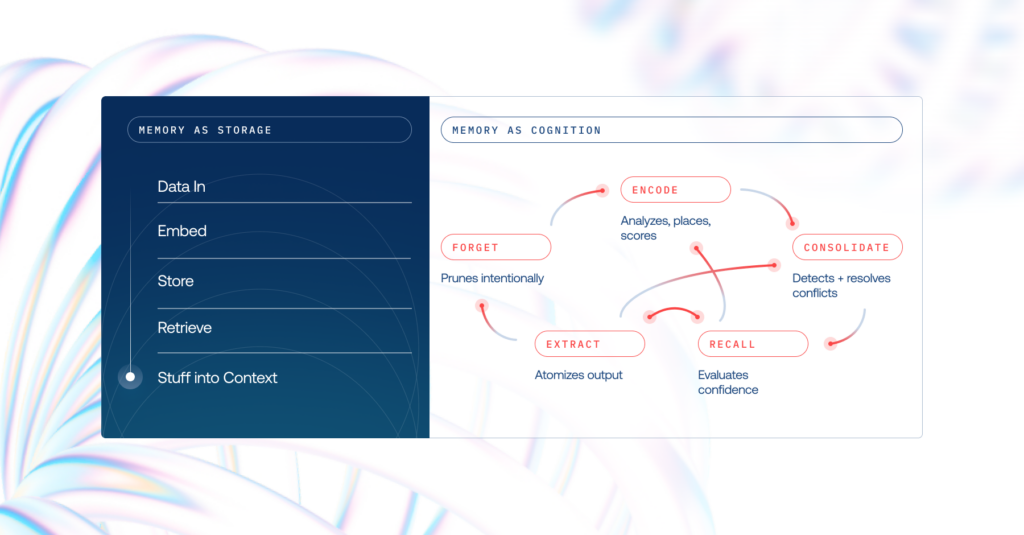
Orchestration begins with mapping how people reason through each step, then translating that reasoning into structured workflows with crystal clear instructions and decision logic agents can follow reliably.
AI governance and security lag behind deployment
In 4 out of 5 companies, the push for ROI and speed gets ahead of solid AI governance, human oversight, and security guardrails. The consequences show up quickly: token consumption isn’t tracked, decisions are made outside the approved scope, and compliance risk is discovered only after the fact.
On the security side, agents that access sensitive data and call external APIs create attack surfaces that traditional security models weren’t designed for, including prompt injection, data poisoning, adding to AI adoption challenges.
The solution lies in building observability and traceability through centralized orchestration. That means real-time dashboards tracking overall system performance metrics like token consumption and cost breakdowns per workflow, alongside audit trails, standard security controls monitoring, and innovative security measures, such as digital identity for agents.
Your AI tools don’t speak the same language
With the AI adoption trend dominating software development, you may already have a zoo of AI tools from different vendors. Building agentic systems [with shared context] atop such a diverse tech stack and coordinating all the pieces to perform coherently is no small feat.
While emerging interoperability standards like the Model Context Protocol (MCP) and Agent-to-agent (A2A) aim to address the challenge, both are still maturing. Until they settle, your best shot at controlling how your AI tech stack behaves under the hood of the MASs is a vendor-agnostic AI agent orchestration platform that provides a shared coordination layer for agents, regardless of what they were built on.
The future is multi-agentic
Agentic AI is moving fast, and the trajectory is clear: multi-agent systems will become standard enterprise AI infrastructure within the next few years. What’s less clear is how many companies will have a reliable AI agent orchestration layer to keep agentic initiatives controlled and secure. Businesses that treat orchestration as foundational infrastructure rather than a later-stage optimization are the ones to build MASs that can scale across the entire organization and hold up under real-life workflows and scrupulous compliance reviews.
Have a multi-agent system to orchestrate?
Talk to our AI expertsFAQ
An AI agent orchestrator is the coordination layer that manages how multiple AI agents work together within a particular workflow. It handles natural language understanding, task routing, sequencing, context sharing between agents, failure recovery, and governance enforcement, turning a collection of individual agents into a coherent system.
LLM orchestration is the process of managing workflows for large language models, including routing prompts, sequencing model calls, selecting the right model for each task, and controlling token budgets.
The right AI orchestration platform checks several boxes: vendor-agnostic architecture so you’re free to combine open-source and proprietary tools, support for multiple agent orchestration patterns, built-in governance and observability, and solid context management capabilities. Anything that locks you into a single vendor’s ecosystem will become a liability as your agent landscape evolves. Instinctools’ GENiE was built with these exact principles in mind.
There’re four orchestration patterns, and most MASs mix several of them. Sequential orchestration runs agents one after another, best for approval workflows. Concurrent orchestration runs them in parallel, ideal when tasks are independent. Handoff orchestration passes control between agents based on context, like routing a support ticket to a specialist. Group chat orchestration lets agents collaborate in a shared conversation for complex problem-solving.
Subscribe to
Instinctools blog