

Dark store management is becoming essential as grocery retailers move inventory closer to customers to support faster delivery. Walmart, for example, continued testing closed-to-the-public micro-fulfillment depots in 2026. Its U.S. ecommerce business had reached nearly $100 billion the previous year, while more than 36% of store-fulfilled orders in Q1 FY2027 arrived in under three hours. But proximity alone does not make a dark store efficient.
Each location still needs accurate inventory, fast picking, timely replenishment, and smooth delivery handoffs. At scale, fragmented tools create costly manual coordination, increasing the risk of stockouts, errors, wasted capacity, and missed delivery windows.
Having built a custom platform to orchestrate 25+ dark stores across five cities for a major grocery retailer, we’ve distilled what works into this guide. Here’s an insider look at everything from system architecture and core mechanics to the operational factors that determine whether a dark store network can scale profitably.
Key highlights
- The real value of dark store management software lies in controlling the operational chain end to end, where better coordination can translate directly into fewer errors, less waste and, ultimately, lower cost per order.
- A comprehensive platform connects inventory, fulfillment, delivery, suppliers, workforce, and customers, while AI adds an intelligence layer to replenishment, pricing, waste prevention, dispatch, and customer support.
- Choosing between off-the-shelf and custom dark store software means weighing more than upfront cost and launch time. You need to define which option will continue to fit as your processes, integrations, and dark store network evolve.
What is dark store management?
Dark store management is the end-to-end orchestration of micro-fulfillment centers through a centralized software platform. The platform handles everything from inventory control and pick-and-pack workflows to dispatch and last-mile delivery, supported by specialized modules for workforce management and operational analytics.
As quick-commerce unit economics hinge on rapid order-to-dispatch cycles, a high-performing system optimizes store layouts, pick paths, replenishment triggers, inventory slotting, and courier handoffs for speed.
Unlike traditional retail, which can generate foot-traffic sales independently of digital infrastructure, a dark store exists solely to fulfill digital demand. Its operations rely entirely on software to seamlessly bridge the gap between a customer placing an order and the package leaving the store.
How is managing a dark store different from managing a traditional retail distribution center?
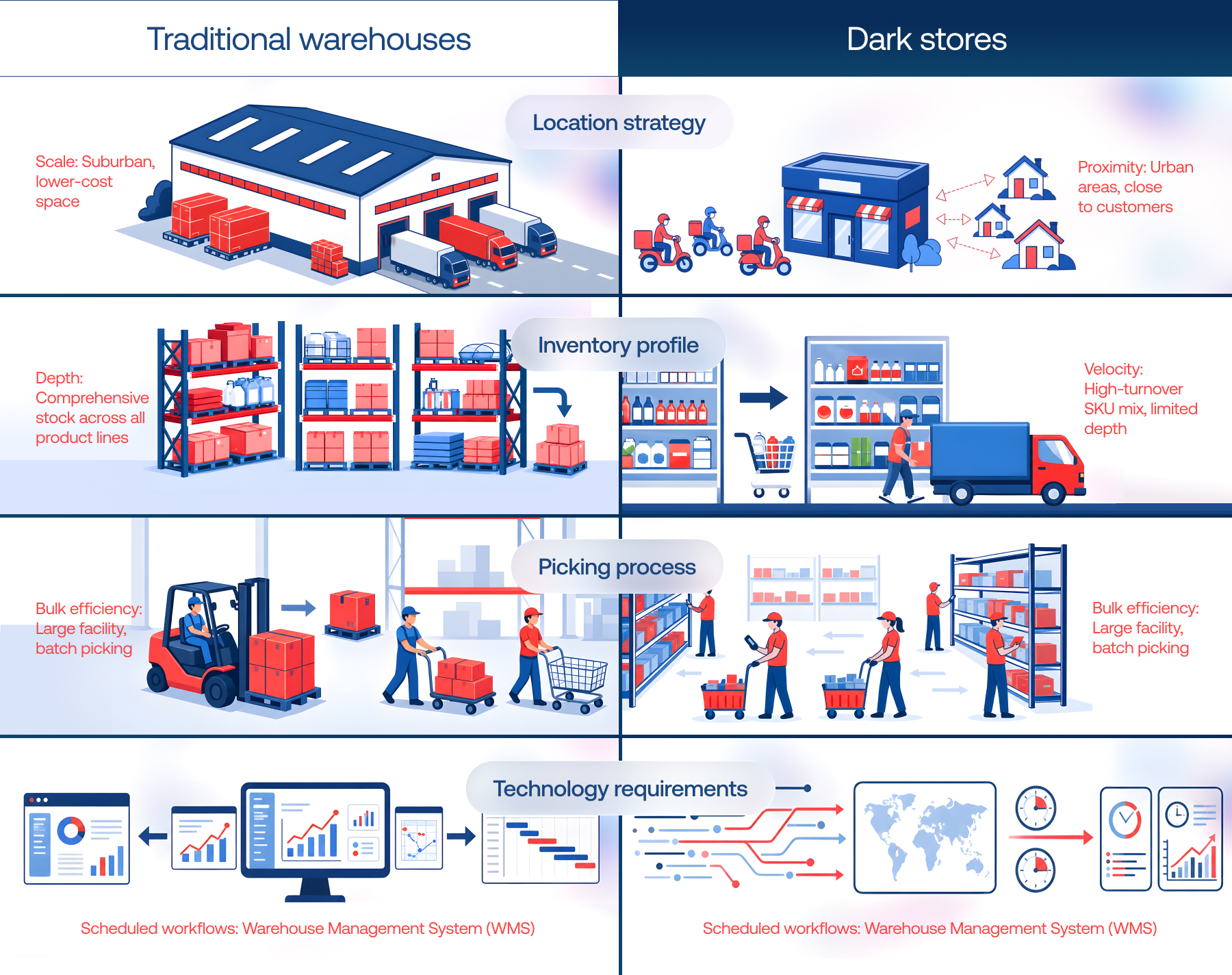
Dark stores and warehouses may look similar: both hold inventory and fulfill orders. Operationally, however, they are built for different jobs. As dark stores handle frequent, small-basket orders under much tighter fulfillment windows, it changes everything from location and inventory strategy to picking workflows and the software needed to orchestrate them.
Location strategy: proximity vs. scale
Traditional warehouses typically occupy large industrial facilities where low-cost space and highway access matter more than proximity to individual customers. Dark stores trade some of that scale for proximity. They are typically located closer to dense residential areas, where higher real-estate costs can be justified by shorter delivery distances and faster fulfillment.
Inventory profile: velocity vs. depth
If warehouses can hold deep reserves of both slow- and fast-moving products, space-constrained dark stores need a much tighter SKU mix. They put greater emphasis on high-turnover inventory and frequent replenishment from central distribution centers (CDCs) or direct-store-delivery (DSD) vendors.
Picking: speed vs. bulk efficiency
Warehouse operations often optimize for pallets, bulk movements, and batch picking across relatively large facilities. Dark stores are cut out for small baskets and short fulfillment cycles, with pickers typically following system-generated routes that minimize walking time.
The cost of an error is different, too. A dark store mispick can trigger repicking, refunds, customer support work, and even an additional delivery, quickly eating into already thin margins.
Technology requirements: real-time orchestration vs. scheduled workflows
To manage inventory tracking, put-away, and scheduled order release efficiently, traditional retail distribution centers rely primarily on warehouse management systems connected to ERP, transportation software, scanning infrastructure, and automation equipment.
However, dark stores require an event-driven, low-latency technology ecosystem. Since orders arrive continuously and must be dispatched within 10 to 15 minutes, dark store software must balance picker availability, live shelf inventory, packing station queues, and courier proximity in real time.
The cost of inefficient dark store management
Some dark store failures are impossible to ignore. Others quietly eat into margins one order at a time.
The first kind can require immediate crisis management. For example, the recent suspension of a Blinkit dark store’s food license in Mumbai followed serious hygiene violations, including cockroach infestation and expired stock.
Far less visible but no less damaging problem is operational leakage. Without well-engineered, end-to-end workflow automation, minor friction points across order picking, shelving, packing, delivery, workforce and customer management compound quickly, which inflates your Cost Per Order (CPO) and erodes margins. Quick commerce’s low-margin structure simply cannot absorb that kind of inefficiency.
| Area | Errors caused by lack of proper management and automation | Direct financial impact |
| Order picking and packing | • Picking errors (missing, wrong, or extra items) • No completeness verification • Packing mistakes (damaged products, incorrect packaging, mixed-up bags) | • Re-picking and re-delivery costs • Refunds and customer compensation • Additional workload for customer support teams |
| Shelf-life management | • No FIFO/FEFO control • Late identification of near-expiry products • Expired products reaching customers | • Inventory write-offs • Product markdowns • Customer compensation • Lost repeat purchases |
| Delivery operations | • Inefficient courier assignment • Poor route optimization • No dynamic order reassignment • Empty runs / unnecessary mileage • Missed delivery time windows | • Higher last-mile delivery costs • Overtime expenses • Fewer deliveries per courier • SLA penalties |
| Workforce management | • Inefficient shift planning • Uneven employee workload • No productivity monitoring | • Excess labor costs • Idle time • Overtime expenses • Lower operational efficiency |
| Inventory management | • Phantom inventory • Inaccurate demand forecasting • Delayed replenishment • Suboptimal reorder points • Overstocking | • Lost sales • Inventory write-offs • Emergency replenishment • Higher storage costs |
| Returns and customer claims | • Manual handling of customer requests • No classification of issue types • No analysis of recurring problems | • Higher cost of claims processing • Customer refunds and compensation • Lost repeat purchases |
The silver lining is that these errors are entirely preventable, provided you have an effective dark store management platform in place.
Based on our experience working with retail and ecommerce businesses, the investment in operational control can quickly justify itself through savings across multiple areas.
After Instinctools developed and implemented our end-to-end dark store management system, the operational ROI exceeded our expectations. Across a single location, we now save roughly $57K/month in logistics by eliminating manual stock and inventory errors, $26K/month by preventing mispicks with continuous QR-scanning, and $36K/month by optimizing near-expiry markdowns and reducing product write-offs.
— Head of Operations, Major Grocery Retailer
Plug your operational leaks and unlock the capital to scale
Let’s talkWhat dark store management software should cover
There is no single universal architecture for managing a dark store. The exact software components depend on the retailer’s operating model, SKU mix, automation level, and existing technology stack. However, a mature operational layer typically covers six interconnected domains.
1. Inventory management
The first priority is knowing exactly what stock is available, where it is, and how its status changes. A centralized dark store inventory management layer provides a consistent view of stock as products move through receiving, storage, replenishment, picking, counting, and disposal. It also keeps shelf-life rules such as FIFO and FEFO embedded in day-to-day inventory decisions.
The module closes the gap between physical stock and what the system says is available, which is among the most damaging sources of failed orders and unnecessary write-offs. With accurate stock visibility and controlled replenishment, dark store operators can keep fast-moving products available without overstocking and reduce the risk of stock ending up as lost sales or write-offs.
2. Order fulfillment
Order fulfillment coordinates what happens between an order entering the system and the completed package being handed over for delivery. This includes order routing, picking, batching, picking paths, substitutions, packing, verification, and handoff.
The shorter the promised delivery window, the less room there is for manual coordination. Omnichannel order management capabilities therefore need to determine what should be picked, where it is located, who should pick it, and when it needs to be ready – all while orders continue to arrive.
3. Delivery management
Delivery management connects fulfilled orders with the last-mile network. It can cover courier assignment, dispatch, route planning, delivery status, order prioritization, and dynamic reassignment.
The challenge is that courier availability, traffic, order volumes, delivery windows, and geographic demand can change within minutes, so dispatch decisions need to adjust in real time. Otherwise, a dark store can fulfill an order efficiently and still miss the delivery promise.
4. Supplier collaboration and procurement
Supplier coordination becomes much easier when purchasing decisions, inventory signals, and promotional plans live in the same operational flow. Instead of exchanging updates and purchase orders through email or messengers, suppliers can work through a self-service portal with direct visibility into relevant orders, stock information, and upcoming promotions.
The same layer can automate routine procurement tasks, from purchase order processing to generating barcodes and labels for incoming products. This gives suppliers clearer instructions and retailers better control over what is ordered, promoted, and received, while reducing the manual coordination that tends to slow replenishment down.
5. Workforce management
In a dark store, labor capacity has to move with demand. A quiet afternoon and a sudden evening order surge may require very different staffing levels, while couriers add another layer of constantly changing availability.
A workforce module brings these moving parts into one operational picture. Managers can plan shifts around expected order volumes, track attendance, account for actual hours worked, process payroll, and monitor individual and team performance. Instead of staffing by habit or reacting when queues build up, they can see where capacity is needed, rebalance workloads, and get more output from the workforce already on hand.
6. Sales and customer management
This module covers the commercial side of dark store operations, bringing sales and customer data from mobile apps, POS, marketplaces, CRM, and loyalty programs into one place. As a result, managers gain a clear view of orders and sales activity across channels while seamlessly handling all customer service processes.
Let’s put together the perfect tech solution to power up your dark store strategy
Contact usThe technology layer behind dark store management
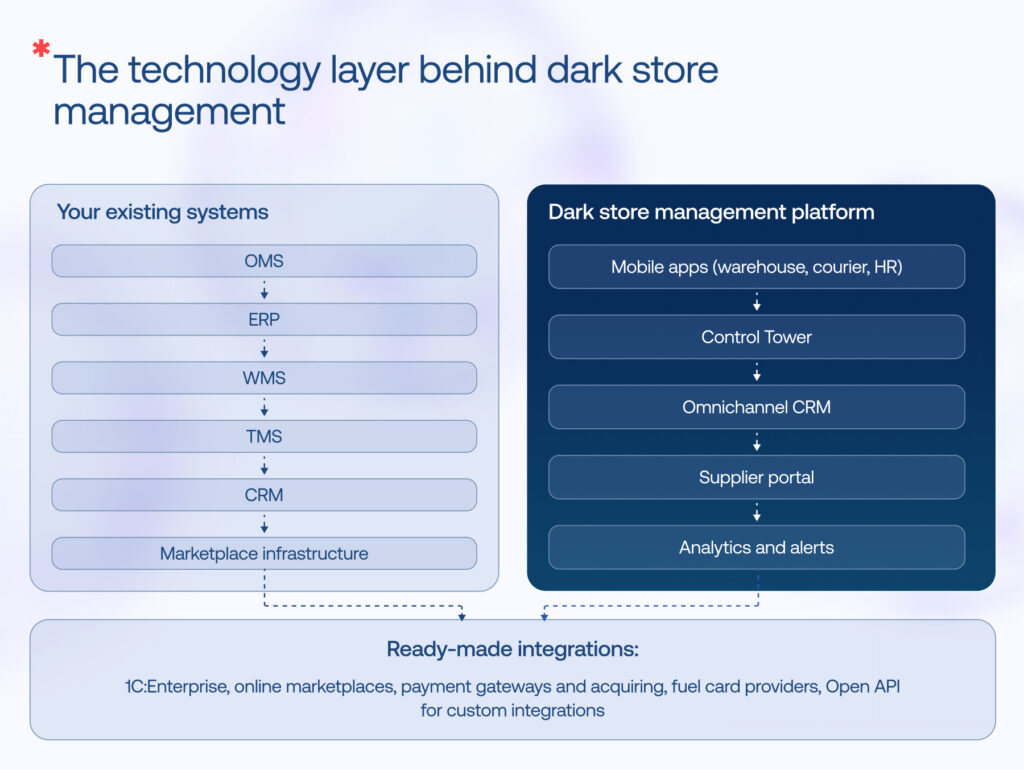
Digitizing dark store operations is hardly uncharted territory. The market already has plenty of capable platforms, such as OrderGrid, Hubler, or ShapeSoft. But when we evaluated available solutions, one limitation became clear:
Many platforms are strong in specific areas but cover other parts of the operation only partially or not at all.
In our experience designing dark store systems, this makes integration and architectural flexibility just as important as individual features. Rather than forcing every process into a single rigid product, the technology layer needs to connect operational capabilities end to end while fitting into the retailer’s existing ecosystem. Three architectural principles are particularly important:
- Standardized APIs: Consistent interfaces connect consumer-facing apps, enterprise systems such as SAP or NetSuite, and third-party logistics providers, reducing reliance on custom point-to-point integrations.
- Asynchronous event processing: Inventory updates, order assignments, and status changes are processed independently of the request-response cycle, preventing integration workloads from blocking operational transactions or slowing picker-facing applications.
- Loosely coupled modules: Individual capabilities remain independent, allowing new modules and integrations to be added, or existing ones modified, without extensive changes across the rest of the platform.
How our clients use AI to advance dark store automation
Once the operational foundation is connected, AI can move dark store management from reactive automation toward prediction and optimization. In our work with retail clients, we’ve implemented AI-powered workflows that turn live operational signals into concrete actions. Here’s what that looks like in practice:
- Predictive replenishment: Historical sales velocity and real-time basket trends indicate that a fast-moving SKU is approaching its safety-stock level → the system drafts a supplier purchase order before availability becomes a problem.
- Waste prevention: A SKU crosses the 7-day expiration threshold → the system automatically applies a 20% markdown in the app to increase sell-through before the product becomes a write-off.
- Dispatch optimization: Traffic, order weight, and courier proximity change in real time → a VRP engine recalculates assignments and can batch up to three nearby orders onto one rider in under 10 seconds.
- Dynamic pricing: Available stock for a fast-moving item drops below 15 units during peak hours → the system adjusts the retail price within predefined rules to balance availability and margin.
- AI-enabled customer support: A customer asks, “Where is my order?” → the system instantly returns live courier location data. A missing-item complaint → the case is escalated to a human agent with the relevant packed-box scan logs already attached.
Explore more AI-powered capabilities in inventory management >>
Level up your micro-fulfillment operations with AI
Get started nowDark store management software: buy or build?
Off-the-shelf software can cover a lot of ground without the time and cost of building from scratch. But when your processes, integrations, or scale requirements fall outside the standard model, that convenience can come with compromises.
The right choice ultimately depends on how closely the software needs to fit your operating model, how much control you need over integrations and future development, and how quickly you need to launch. The comparison below puts the key trade-offs side by side.
| Evaluation criteria | Buying off-the-shelf platform | Building a custom solution |
| Time to launch | Faster (Weeks to 1-2 months) | Slower (9 to 18+ months, depending on scope) |
| Fit to operating model | Standardized (best suited to common workflows and established operating pattern) | Tailored(designed around your specific workflows and requirements) |
| Customization ceiling | Low to moderate (Configurable via APIs & UI settings) | Unlimited (Complete control over code, design, and logic) |
| Cost model | OpEx(Recurring SaaS fees that increase with usage, users, locations, or order volume) | CapEx + OpEx (Development cost + ongoing maintenance) |
| Data and compliance control | More vendor-dependent(Vendor cloud, SOC2 compliance delegated) | Absolute (100% owned infrastructure and raw data) |
| Integration effort | Low to moderate (Depends on available connectors; custom integrations may still be required) | High (Building all APIs and bridges from scratch) |
| External dependencies | High (reliance on the software vendor’s roadmap, pricing, support, and platform capabilities) | Low (no core platform vendor lock-in, though dependencies on cloud services, third-party tools, or development partners may remain) |
| Best fit for | Early-stage dark stores, smaller operators, and businesses entering new markets with relatively standard operations | Fast-growing companies and established businesses with unique IP, proprietary hardware, or massive scale |
As you can see, turnkey solutions certainly have their place, but real-world execution frequently reveals their glass ceiling. Off-the-shelf platforms are built for average workflows, yet dark store margins are won or lost in the non-standard details – the localized delivery specifics, regional compliance factors, unique supplier collaboration nuances, and more.
Standard off-the-shelf software couldn’t natively integrate with our local ERPs, regional payment gateways, or custom courier routing rules. Moving to a bespoke system built for our exact architecture changed everything: we reduced our cost per order by 15%, cut picking errors by 68%, and pushed our on-time delivery rate to 95% for bikes and 90% for cars.
— Head of Operations, Major Grocery Retailer
So, choosing the right path requires stepping back and looking beyond the initial investment. An experienced engineering partner can help you assess how both custom and off-the-shelf approaches will play out over time, balancing faster deployment today against long-term flexibility, operational control, and scalability before you make a foundational technology decision.
Ready to reap the benefits of proper q-commerce automation?
Quick-commerce dark stores are only as effective as the technology backbone powering their operations. Building that backbone means bringing critical micro-fulfillment functions – inventory, order, supplier, workforce, customer, and delivery management – into one connected system, enhancing them with AI-powered capabilities, and integrating the whole stack into your existing operational ecosystem. Having designed and implemented custom dark store management platforms as well as advanced retail and ecommerce solutions, we’re ready to tackle your dark store logistics challenges if you’re looking for a reliable engineering partner.
Your dark store business model needs a robust platform to keep pace with ever-growing demand?
Reach outFAQ
A dark store is a micro-fulfillment center structured like a conventional supermarket but closed to the public. It is dedicated exclusively to fulfilling online purchases, where staff or automated systems pick, pack, and ship items for quick home delivery or local curbside pickup.
Dark stores operate as compact fulfillment hubs built around online orders. A customer places an order through an app or website, the system routes it to the nearest suitable location, and staff or automated systems pick and pack the items. Delivery is then assigned and dispatched, with inventory updated throughout the process.
Mostly manual labor today, with automation layered in selectively. Most dark stores rely on human pickers walking aisles, guided by handheld scanners or picking apps that optimize routes. Some operators add automation – conveyor sorters, robotic picking arms, or micro-fulfillment tech – but full automation is capital-intensive, so it’s typically reserved for larger, high-volume hubs rather than the norm.
Dark store management is the digital and physical orchestration of micro-fulfillment centers optimized exclusively for online orders. Driven by dark store management systems, it automates routing, batch picking, and stock replenishment to minimize order-to-delivery latency for rapid ecommerce and quick-commerce operations.
Dark store operations are the day-to-day processes that keep a fulfillment-only location running: receiving and shelving inventory, picking and packing orders, managing staff shifts, syncing stock levels in real time, and coordinating handoffs to delivery riders.
A dark store typically needs software for inventory and warehouse management, order processing, picking and packing, delivery orchestration, workforce management, and analytics. These systems should work as one operational layer, connecting orders, stock, staff, and couriers in real time to keep fulfillment accurate, efficient, and responsive.
The dark store model is a retail setup where a dedicated facility holds inventory and fulfills online orders for a defined local area. Staffing depends on store size, SKU count, order volume, operating hours, and automation. A small site may run with a handful of employees per shift, while high-volume locations require larger teams across fulfillment and operations.
Subscribe to
Instinctools blog