

Palantir AIP has become one of the enterprise AI platforms companies consider when they want to operationalize large language models without building the entire AI infrastructure from scratch. For many organizations, the question is no longer whether LLMs belong in day-to-day operations, but how to connect them securely to business data, workflows, decisions, and actions.
This guide covers what Palantir AIP is, how it works under the hood, what capabilities it provides out of the box, when adopting it can be more practical than building a custom stack, and when a lighter-weight alternative may be the better fit.
Key highlights
- AIP’s value comes from the infrastructure around AI, not AI itself.
- Intertwined with the Ontology, off-the-shelf governance and security mechanisms, and production-proven action layer are the reasons AIP behaves differently from a self-assembled enterprise AI stack.
- AIP Palantir shines in large-scale operational environments and becomes overkill outside them.
Palantir AIP is an enterprise-targeted Artificial Intelligence Platform businesses can use on top of their existing tech stack without modernizing legacy components. It belongs to Palantir’s enterprise AI operating system, alongside Palantir Foundry (a data operations platform), the Ontology (a living map of a company’s data, logic, and processes), and Apollo (a deployment engine). Thanks to working in concert with these systems, AIP provides decision intelligence and enables AI agents to act on a company’s live operational data, such as updating an order, routing financial transactions for approval, or flagging gaps in patients’ records.
| Palantir AIP at a glance | |
|---|---|
| Parameter | Details |
| Full form | Artificial Intelligence Platform |
| Launched | 2023 |
| Built on | Palantir Foundry and the Ontology |
| Supported models | Model-agnostic: OpenAI GPT, Anthropic Claude, Google Gemini, Meta Llama, xAI, and any open-source, self-hosted, and bring-your-own models |
| Core building blocks | AIP Logic, AIP Chatbot Studio, AIP Evals, AIP Assist, Model Catalog, Actions and Workflows |
| Deployment | Cloud (AWS, Azure, GCP) for commercial use; Palantir Federal Cloud, air-gapped and edge environments for government, defense, and other regulated industries |
| Compliance | FedRAMP High, DoD IL5 and IL6; supports ITAR- and HIPAA-aligned deployments |
Palantir AIP is an enterprise-targeted Artificial Intelligence Platform businesses can use on top of their existing tech stack without modernizing legacy components. It belongs to Palantir’s enterprise AI operating system, alongside Palantir Foundry (a data operations platform), the Ontology (a living map of a company’s data, logic, and processes), and Apollo (a deployment engine). Thanks to working in concert with these systems, AIP provides decision intelligence and enables AI agents to act on a company’s live operational data, such as updating an order, routing financial transactions for approval, or flagging gaps in patients’ records. Which companies need Palantir AIP?
Palantir AIP is a strong fit for companies willing to pay a premium for a platform that has already solved the hardest AI adoption challenges enterprises face:
- Can’t afford gambling on AI that hasn’t proved reliable and safe in enterprise production, as a single compliance failure, operational mistake, or governance lapse will expose them to multi-million-dollar fees
- Have software ecosystems with legacy tools that can’t be modernized or replaced without introducing major disruption to business processes
- Expect a solution to fit into a complex enterprise software landscape without extensive customization and start delivering value right away
Palantir AIP is designed for enterprises with sprawling operations and fragmented technology landscapes. The bill tends to match the ambition, so the question is more like: Which companies need Palantir AIP and can afford it?
For mid-size businesses that only want to automate a handful of workflows, deploy AI agents in a specific department, or improve access to internal knowledge, lighter alternatives, like an accelerator for building custom AI agents, will be a better choice.
— Alexej Spas, CEO, Instinctools
Benefits of Palantir AIP you wouldn’t want to miss
The reasons a business picks AIP over the alternatives come down to the following list:
- No need to modernize outdated software. The best part of AIP Palantir is that it can be layered over custom-built legacy systems thanks to a large integration framework and enterprise connectors, saving companies from the budget- and time-intensive modernization.
- No vendor lock-in. Palantir AIP is a technology-agnostic platform in the broadest sense. You can switch between or combine any LLMs and tools they call to perform tasks as the field and business needs shift.
- Rapid time-to-value. Palantir’s five-day AIP Bootcamp aims to land a working use case in a live environment within days, compared to the months a from-scratch build demands.
- One platform instead of a toolchain. The capabilities that would otherwise be separate tools you need to integrate and maintain arrive as one system.
- Operational proactivity over analytics alone. Where BI platforms stop at insight, AIP can execute approved actions directly in ERP, CRM, SCM software, and other systems, updating records or triggering workflows where appropriate.
- Proven success where the stakes are highest. A customer base spanning defense, national governments, and Fortune Global 500 industrials leaves little doubt it holds up in production.
How Palantir AIP works: platform overview
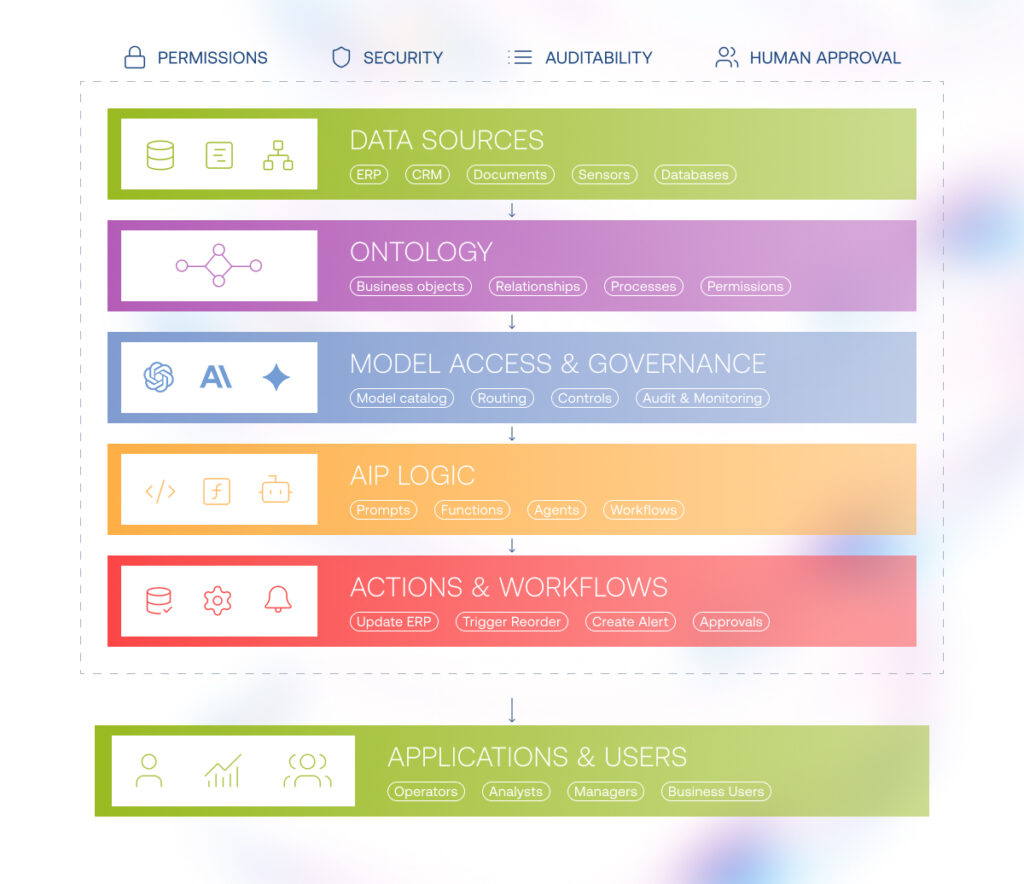
Several connected layers make up AIP, each tackling a problem that tends to sink enterprise AI projects, such as a lack of business context, fragmented model access and governance, workflow logic scattered across prompts and scripts, and AI outputs that stop short of controlled operational action.
1. The data and semantic layer: the Ontology
This is where AIP parts ways with a generic LLM setup. Instead of pointing a model at bare files, AIP connects it to the Foundry Ontology, a live operational layer that represents the business through objects, properties, relationships, logic, and actions.
Where a generic LLM sees raw data, Palantir AIP sees your business as a living body with a brain, nerves, organs, and muscles, and stays aware of how one part moves the others.
Those business connections are also governed by access controls. In Palantir AIP, permissions can be managed at the Ontology level, so the AI works only with the data, objects, and actions the user is authorized to access.
Consider an insurance claims adjuster reviewing a policyholder’s case. If that employee only has access to claims data for a specific region, an AI agent working on their behalf cannot suddenly pull records from another jurisdiction, access executive reports, or review unrelated customers’ policies. The agent inherits the same permissions as the adjuster and operates within the same boundaries.
2. The model-access and governance layer
AIP stays model-agnostic, so enterprises are not tied to a single provider. The platform can run GPT, Claude, Gemini, Llama, open-source models, or ones organizations host themselves, and switch hitch-free when a task calls for it.
The Model Catalog and admin controls handle the governance around those models, deciding:
- which models are available
- how requests are routed between them
- how much capacity each request gets
- how model activity is monitored
Governance plumbing like this sits on most AI roadmaps now – we see it first-hand as on-the-ground AI practitioners. The challenge is that building it from scratch can take months. Meanwhile, with AIP Palantir, much of that foundation is already in place, so the team’s time goes to the use case itself.
— Alexej Spas, CEO, Instinctools
3. The logic layer: AIP Logic
Every enterprise process needs a set of rules, and AI-driven workflows are no exception. AIP Logic defines what the AI should do for a given task: what information to use, what checks to perform, what conditions to evaluate, and when to act. As a no-code development environment, it allows people like business analysts and operations leads who know the process as much as engineers to build that logic by assembling steps rather than hand-coding them.
For example, business users might lay out how the AI reads an incoming invoice, compares it against contract terms, flags anything unusual, and routes low-risk items for approval. Developers who want tighter control can write the same logic in code.
4. The action layer: Actions and Workflows
What the AI decides changes nothing until it leads to an action. In Palantir AIP, actions connect AI-assisted decisions back to the systems you run: updating an ERP record, triggering a reorder, issuing a refund, etc. Every action leaves an audit trail, and the high-stakes ones wait for a human reviewer to approve them before execution.
Palantir AIP out-of-the-box capabilities
While ready-made solutions usually come with downsides like limited flexibility, rigid workflows, and vendor-imposed constraints, Palantir AIP cannot be ranked alongside other off-the-shelf tools, as it completely reimagines what “out-of-the-box” delivers. The fastest way to gauge it is to look at what you don’t have to build yourself. The list runs long:
- Industry-specific templates give you configurable starting points for insurance, manufacturing, supply chain, and other domains, so you adapt a working setup instead of starting from a blank page.
- A no-code environment enables non-tech users to build and deploy custom AI chatbots and assistants that draw on the company’s data, documents, and tools.
- Safety guardrails apply content filtering, PII handling, and policy controls to every model call.
- A testing environment is designed with the LLMs’ non-deterministic nature in mind. It measures how reliably a function gets the right answer across many runs, so you know how much trust you can put into AI outputs and actions.
- Enterprise compliance is already covered for the most heavily regulated settings. For instance, AIP Palantir is cleared for US federal agencies (FedRAMP) and defense workloads up to classified levels (DoD IL5/IL6), and supports deployments that handle export-controlled defense data (ITAR) and protected health information (HIPAA). Credentials like these can take years to earn on your own.
- Flexible deployment options include cloud for commercial use and air-gapped or edge environments for defense and other highly regulated industries.
- Multimodal support lets AIP work across text, tables, documents, and images alike, so an agent can read a scanned contract or a chart as readily as a line of text.
Building these capabilities from the ground up will keep an AI team busy for up to 18 months. The question is: can you afford such a delay in the world of vibe coding and rapid AI prototyping, where new products are sprouting up faster than mushrooms after the rain? While ready-made software has its trade-offs, nothing else can give you a comparable head start.
— Alexej Spas, CEO, Instinctools
Palantir AIP as an agentic AI platform
Enterprise workflows rarely end with finding information. Someone still has to make a decision, approve the next step, and carry the work forward inside operational systems. That gap between insight and execution is where Palantir AIP’s agentic AI earns its keep.
Palantir AIP agentic AI platform can coordinate multiple specialized agents through multi-agent orchestration. One agent retrieves information, another analyzes it, and a third executes the tasks, while a coordinator agent keeps tabs on the overall process to move toward the same objective.
The easiest way to understand the Palantir AIP end-to-end agentic architecture is to follow a task through the system: from data retrieval and analysis to recommendation, approval, and action.
- A user request, business event, or predefined rule triggers a task.
- Next, the agent breaks that task into smaller steps and determines what information is needed to carry it out.
- It then retrieves the relevant business objects and relationships from the Ontology.
- With the context in place, the agent calls the necessary tools, models, and applications to complete each step.
- Based on the outcome, it proposes or executes actions in connected enterprise systems, such as ERP, CRM, etc.
- Finally, the results feed back into the workflow, allowing the process to continue until the objective is reached.
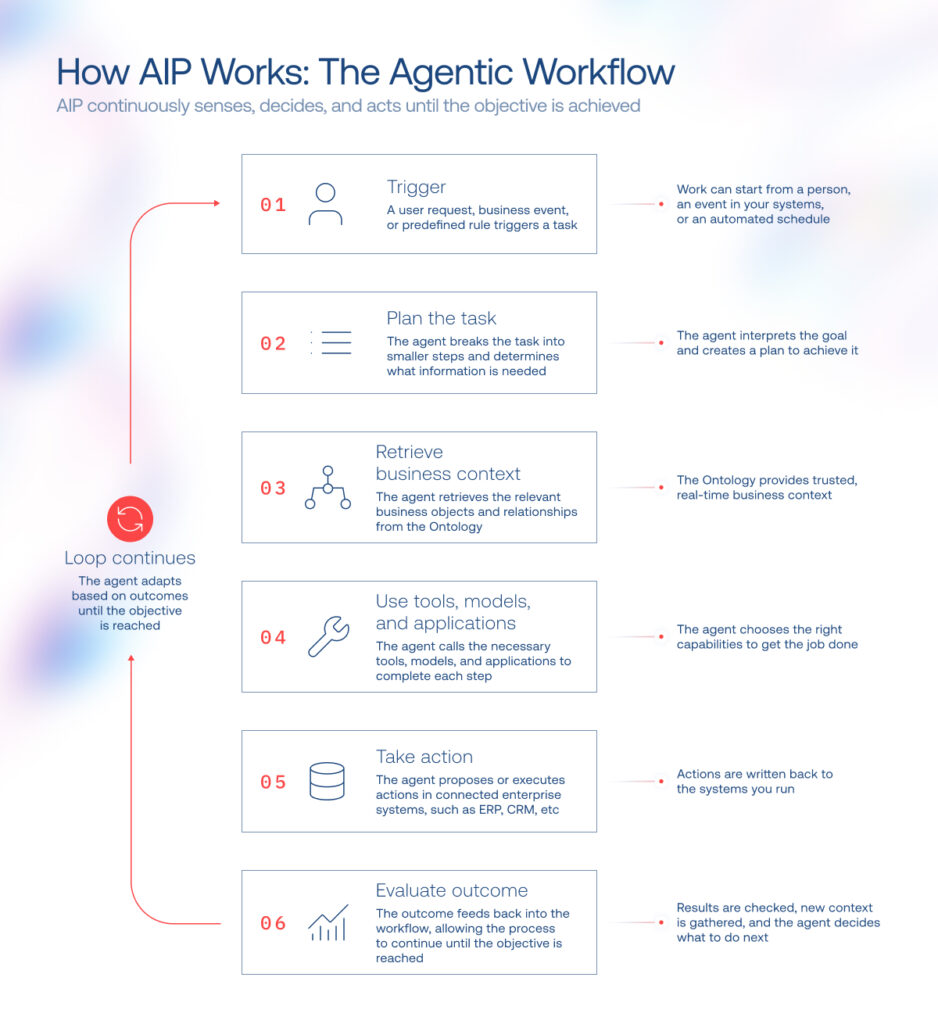
Human oversight remains central to the agentic pipeline. Agents can prepare recommendations, trigger actions, and move work forward, but companies decide where people stay in the approval chain. That balance between autonomy and control is what makes Palantir AIP suitable for operational environments where errors disrupt operations, compliance, or customer experience.
Palantir AIP use cases across industries
Reading a feature list is a bit like judging a Formula 1 car by its spec sheet. The most interesting part starts when the car leaves the garage. The same applies to Palantir AIP. Looking at how organizations already use it in production reveals how the platform fits into real operational workflows.
Finance and professional services
Processing vast amounts of data is all in a day’s work for any business, but when said data is related to money, the margin for error shrinks. Banks, law firms, audit practices, tax advisory firms, and consultancies rely on workflows built around document review, risk assessment, transaction checks, and tightly managed approvals. These processes are often repetitive, but they are rarely simple enough to automate blindly.
AIP Palantir lightens this burden by handling fraud detection, transaction risk assessment, regulatory checks, and other document-intensive operations. For example, law firm Kirkland & Ellis adopted AIP to support end-to-end private funds workflows, from drafting fund documentation and supporting investor onboarding to obligation tracking, closing commitments, and verifying compliance.
One of our clients, a leading US life and annuity insurer, also implemented Foundry and AIP combo within their contact center workflows to address peak tax-season inquiries faster and improve overall seasonal staff readiness.
Defense and government
Palantir’s roots are in the defense and government sectors, where AI systems need to operate under strict security and access-control constraints. The company works with organizations like NATO and the U.S. Army, including the TITAN battlefield program for 10 next-gen intelligence and reconnaissance ground stations, and supports deployments in highly restricted environments.
In these settings, Palantir AIP defense use cases include intelligence analysis, mission planning, logistics coordination, and battlefield awareness. Government agencies use the platform for areas such as emergency response, critical infrastructure monitoring, public-sector operations, and interagency coordination.
Healthcare and life sciences
Clinical records, scheduling info, lab results, and treatment plans rarely live in one place, forcing medical staff to assemble the full picture of a patient’s condition and care history piece by piece.
Healthcare organizations apply Palantir AIP capabilities to clinical decision support, clinical-trial operations, resource planning, and patient-flow management, all while keeping access to sensitive data under strict control. Public examples include NHS England, which uses Palantir technology to help hospitals and care providers coordinate resources, manage patient demand, and improve visibility across the healthcare system. By the company’s estimate, the platform returns about five times what it costs.
Manufacturing
A machine failure on a production line can create quality issues downstream and throw maintenance schedules off course long before it shows up in a dashboard. In the environment where spotting the signals of potential collapse before they cause costly disruptions is vital, Palantir AIP’s digital twin approach comes into its own. By combining production data, asset information, maintenance records, and business context inside the Ontology, AIP can reason about how changes in one part of the system affect the rest.
Companies such as Airbus use Palantir technology in industrial environments. Building on that foundation, Palantir AIP manufacturing use cases include predictive maintenance, production planning, throughput improvement, and scenario modeling before changes reach the factory floor.
Supply chain
One way to judge the efficiency of supply chain operations is to look at its least trackable part. Palantir AIP in supply chain operations builds on the visibility provided by Foundry and the Ontology, allowing AI to reason across that operational context and participate in decisions that previously required teams to piece information together manually.
Rio Tinto offers a real-life example. The mining giant recently renewed its long-term partnership with Palantir and expanded its use of AIP on top of an existing Foundry Ontology. The company applies the platform across plant operations, geotechnical risk monitoring, and the coordination of 53 autonomous ore trains, each with 240 wagons, across the Pilbara rail network.
Many Palantir AIP supply chain use cases follow the same pattern: establish a shared operational picture first, then let AI participate in decisions that previously required teams to piece information together manually.
Build vs. buy: build your own stack or adopt Palantir AIP
There’s a valid argument for each path, and a class of issues where AIP is the wrong call entirely. The clearest way to think about Palantir AIP product market fit is through the build-vs-buy lens. Our AI practitioners prepared a memo on when to build your own, shell out a hefty sum for AIP, or reach for something lighter than Palantir AIP technology.
Cases when building your own AI stack wins over Palantir AIP
Building gives you complete control that none of the off-the-shelf options can fully match, but only if you’re prepared to take full ownership of the company’s operations.
- The AI layer is your core product asset. When you offer AI capabilities directly to customers as part of the product, ownership matters more than implementation speed. Handing a core piece of the stack to a third-party platform may limit future flexibility as the product evolves.
- You already have a mature data and AI foundation. Companies that have invested in building modern data platforms, governance, orchestration, and vector infrastructure may gain little from replacing existing components midway.
Scenarios when it’s wiser to adopt Palantir AIP than invest in building your own enterprise AI layer
AIP carries a substantial price tag, so buying it makes sense only when building your own alternative would cost even more in time, risk, or missed opportunities.
- Time-to-market outweighs long-term flexibility. Crafting an operational AI layer often means assembling and integrating dozens of moving parts before the first production use case goes live. Businesses under pressure to deliver results within a quarter rather than a year may decide that a ready-made platform is worth the cost.
- You need operational AI with a proven enterprise track record. Setting up the AI ecosystem is only half of the challenge. The hardest part begins once it starts interacting with live business processes. If the cost of downtime, incorrect actions, or governance failures is high, adopting a platform with years of production experience is a safer path.
There’s a way to get access to the AIP’s full capabilities without having to purchase a license. If you want to give Palantir technology a try before committing, look for a Palantir implementation partner authorized to provide Palantir AIP servicesand build production-grade applications on their Foundry and AIP instances.
When AIP is overkill
Palantir AIP can solve genuinely difficult problems. The question is whether you have ones. Your AI appetite may not require the level of operational infrastructure AIP was built to provide.
- The platform’s cost can’t be justified at the current scale. AIP is designed for large operational environments with complex processes, extensive integrations, and substantial governance requirements. The AI needs of smaller companies can be met with simpler tools.
- The problem doesn’t require an operational model of the business. AIP’s biggest differentiator is the Ontology with its structured representation of business objects, relationships, processes, and actions, making it possible to reason about workflows with many moving parts, such as inventory reallocation, claims processing, or supply-chain coordination. If your use case revolves around simple document search, content generation, coding assistance, knowledge retrieval, or a handful of narrowly scoped agents, a lighter architecture gets the job done.
- Your business processes aren’t mature enough. AIP works best when the underlying business process already exists, and you have a clear idea of how it should operate. Applying AI to a process that changes every month will only scale confusion.
| Build vs. buy in a nutshell | ||
|---|---|---|
| Parameter | Build your own platform | Adopt Palantir AIP |
| Time to first production use case | 6–18 months | As little as five days (AIP Bootcamp) |
| Data platform setup | Custom build required | Foundry- and Ontology-ready |
| Agent orchestration | Custom AI-engineering stack | AIP Logic + Workflows |
| Best suited for | Proprietary AI workflows, companies with a mature AI foundation | Tangled enterprise-scale workflows, organizations prioritizing speed |
| Main advantage | Full control and architectural freedom | Tech stack-agnostic, faster path to production and reduced implementation risk |
| Main trade-off | Longer implementation timeline | License and adoption costs |
The right decision starts with the right diagnosis
Palantir AIP isn’t a mere wrapper around large language models. Its real value comes from connecting AI to the operational reality of the business through the Ontology, governance controls, and enterprise integrations. That combination can shorten the path to production for companies that need AI to work inside live business processes and act on what it finds.
At the same time, AIP is neither the only option for operationalizing AI nor the right fit for every company. The decision depends on cost, process maturity, implementation timelines, and how closely the platform’s strengths match the problem at hand.
Get the diagnosis right with Instinctools
Reach outFAQ
Palantir AIP in its full form is an artificial intelligence platform. The company launched it as an AI layer that connects LLMs and AI agents to live enterprise data, workflows, and operational systems via the Ontology (a living map of a company’s data, logic, and processes), enabling AI to understand business context and act within existing processes.
AIP combines four layers: the Ontology, model access and governance, AIP Logic, and Actions. Together, they connect AI models to business data, define how tasks are executed, enforce security controls, and enable approved actions in enterprise ecosystems.
The top out-of-the-box capabilities include AIP Logic for low-code function building, AIP Chatbot Studio for agents, AIP Evals for testing, AIP Assist, a model-agnostic Model Catalog, the Ontology integration with built-in access controls, safety guardrails with full audit logs, and pre-built industry templates.
Yes, AIP supports end-to-end agentic architecture that enables AI agents to retrieve information, reason over business context, call tools, and execute approved actions inside operational systems. Human approval checkpoints remain part of the workflow at critical decision points.
Public examples of AIP in production include supply chain, manufacturing, defense, healthcare, financial services, and professional services. Common use cases span predictive maintenance, logistics coordination, fraud detection, compliance workflows, clinical operations, resource planning, and operational decision support.
The main advantages are speed and reduced implementation risk thanks to enterprise security and governance out of the box. Instead of spending months orchestrating AI tools and setting up governance and security mechanisms from square one, businesses get a production-ready operational AI platform right away.
The Ontology is a real-time representation of business objects, relationships, processes, and actions. AIP uses it as the context layer that allows AI models and agents to understand how the business operates instead of interacting with scattered, isolated datasets.
Palantir AIP is a game-changer for large-scale operational environments where AI needs to work across multiple systems running on a heterogeneous tech stack, including legacy applications that are impractical to replace and difficult to modernize. AIP is also a sensible investment when implementation speed, operational risk reduction, and a proven enterprise track record outweigh the benefits of full architectural control.
Subscribe to
Instinctools blog