

For all the visibility dashboards bring to the enterprise, they stop at showing what is happening. Meanwhile, agentic analytics takes the next step by helping explain why and suggesting which possible actions we could take. When conversion drops, churn spikes, support tickets rise, or margins erode, it’s AI agents that can step in, drill into the underlying data, connect related metrics, and trace the chain of events behind the anomaly.
What does this shift mean for analytical work at enterprise scale? Which analytical scenarios stand to benefit most from agentic capabilities? And, perhaps most importantly, what foundations do agents need to operate within for their conclusions to be genuinely trustworthy?
In this article, we examine these questions drawing on the expertise of our AI Center of Excellence, a team of 30+ AI and data experts.
Key highlights
- Within agentic analytics, agents can move from detecting a metric deviation to investigating its causes, testing competing hypotheses, and explain what drove a change. Where authorized, they can also trigger follow-up actions.
- The reliability of an analytics agent depends on clear metric definitions, accessible and trustworthy data, and strong controls over access and agent behavior.
- There is no plug-and-play route to enterprise-grade agentic analytics. It only works when it is engineered for the realities of your data, business logic, security requirements, and analytical workflows.
What is agentic analytics?
Agentic analytics is an approach to data analysis in which AI agents take on tasks across the data-to-insight workflow and coordinate them toward a certain analytical goal. That goal can be provided by a person or derived by the agent from a higher-level objective or trigger. The agent can then determine and orchestrate the steps needed to pursue the goal, adapt the analysis based on intermediate results, and, within its authorized scope, initiate subsequent analysis or actions.
The degree of autonomy can range from assisting with individual analytical tasks to driving a multi-step analysis with little human intervention.
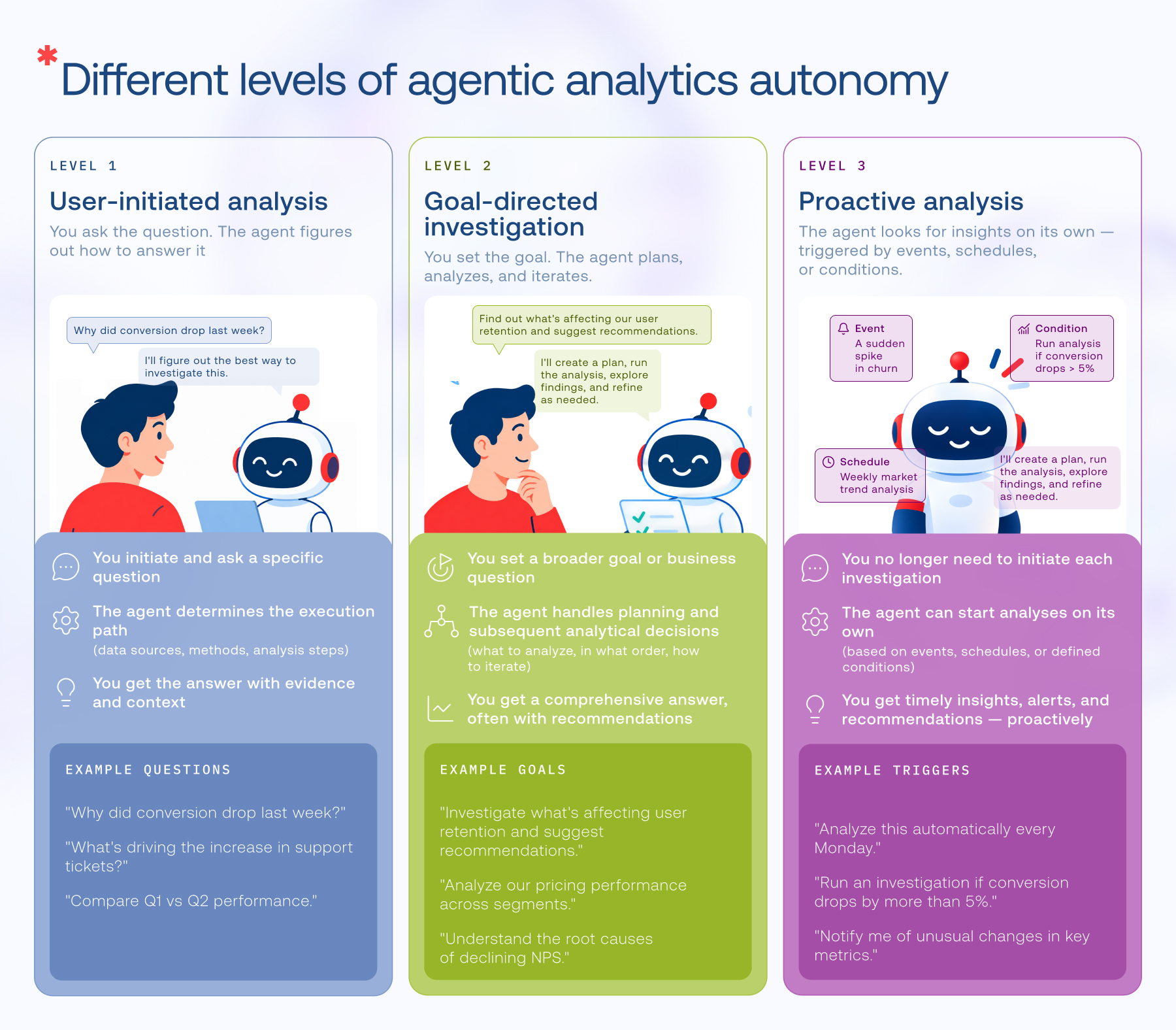
Under the hood, agentic analytics tools bring together the orchestration logic and execution infrastructure needed to run agent-driven analysis:
- An agent workflow framework that governs how agents coordinate analytical work – planning tasks, deciding what to do next, using tools, interpreting intermediate results, and iterating across multiple steps toward a specific objective.
- An underlying technology foundation that provides the environment in which those workflows operate, connecting agents to the data, compute, tools, and governance mechanisms they need to execute analytical tasks reliably and at scale.
The benefits of agentic analytics and what makes them possible
Putting data insights within reach of a plain-English question brings several payoffs at once, reshaping both how fast insights get generated and what happens once they’re in hand.
Wider access to sophisticated analysis
Questions that used to be routed through the data team can now be answered directly by the business user who’s asking them. Getting to an answer no longer requires knowing SQL or waiting in a data team’s queue.
More time for high-value analytical work
Handing off this often rote, repetitive investigative work to agents frees data science teams to spend their time on the work that actually needs human expertise – designing experiments, building forecasting models, and stress-testing causal claims – rather than re-running the same slice-and-dice investigation every time a stakeholder has a question.
Shorter path from question to insight
What used to be a multi-hour (or multi-day) round trip between a business user and an analyst becomes an on-demand conversation with an AI agent, which dynamically resolves initial queries and iterative clarifications on the spot, cutting out the back-and-forth friction that delays decision-making.
Proactive decision support
An agent can monitor defined metrics or events, detect meaningful deviations, investigate their likely causes, and bring the findings to the relevant people or systems. In more mature implementations, these insights can also feed into predefined operational workflows.
These benefits, however, do not come out of the box. Every single advantage listed above rests on a foundational assumption that your underlying data ecosystem is built for AI-driven analysis. Without unambiguous metric definitions, machine-readable access permissions, and fresh, reliable data pipelines, an agent, instead of accelerating dependable decision-making, simply accelerates the production of confident miscalculations.
Agentic analytics gains are only as real as the data foundation underneath them
Talk to an expertWhere agentic analytics earns its keep
Agents’ ability to plan, reason, and act, when applied within analytical workflows, opens up a range of scenarios that traditional analytics can’t fully support.
Ad hoc investigation and hypothesis testing
When unexpected shifts occur in business metrics, human analysts often spend hours or days pivoting tables, writing custom SQL queries, and cross-referencing disparate datasets to figure out why. Agentic systems compress this diagnostic cycle into seconds. Given a high-level query, an agent breaks the problem down into a dynamic execution plan:
- it formulates competing hypotheses,
- queries underlying data warehouses,
- isolates confounding variables,
- and continuously adjusts its search path based on intermediate results.
Proactive anomaly monitoring and triage
Agents can also monitor for triggers and act when one occurs, without anyone having to open a data analytics tool. When detecting an unusual change in a KPI, an agent can gather relevant context, assess its significance, investigate likely causes, and prioritize the anomaly for human attention.
For instance, a sudden increase in order cancellations could trigger analysis across inventory, fulfillment times, delivery regions, and individual stores. Instead of simply flagging the anomaly, the system can provide a preliminary assessment of what changed, where the issue is concentrated, and which factors are most strongly associated with it.
Recurring analytical workflows
Senior analysts frequently spend significant bandwidth on repetitive, routine reporting tasks, such as weekly performance reviews, conversion funnel analyses, cohort retention updates, or answering recurring stakeholder requests.
Agentic analytics automates these structured, multi-step procedures while applying consistent analytical logic every time. Agents can pull refreshed data, evaluate historical trends, execute standard diagnostic models, and draft localized narrative summaries for business unit leaders.
Decision support and scenario analysis
Beyond explaining the past, agents can also help teams look forward, modeling the likely impact of a price change, a budget reallocation, or a marketing shift by reasoning across historical data and relevant variables. This doesn’t replace human judgment on the decision itself, but it compresses the time it takes to get a reasonably well-supported set of scenarios in front of the person who has to decide.
Controlled decision execution
In some environments, the analytical workflow does not have to end with a recommendation. Where the action is sufficiently bounded and the risks are understood, agentic analytics can connect approved insights to operational workflows.
That might mean opening a replenishment request when inventory falls below defined thresholds or routing a qualified lead to a predefined workflow.
Consequential actions, however, should remain permissioned, auditable, and subject to human approval unless they are sufficiently constrained and low-risk. The higher the consequences of an error, the tighter the control should be.
The challenges behind reliable agentic analytics: what can go wrong?
Agentic analytics becomes difficult, when a data analytics AI agent has to reason across enterprise data that is ambiguous, hard to retrieve, or constantly changing. Some problems show up repeatedly:
- Overlapping metrics create ambiguity. A data model with a dozen fields that all contain something called “revenue” gives an agent no reliable way to know which one actually answers the user’s question. The agent has to choose among hundreds of viable fields with no clear signal for which is correct.
- Context goes stale. Data sources, business definitions, and schemas change constantly, and an agent’s understanding of them doesn’t update on its own. The result is a system that keeps answering fluently while quietly drifting out of sync with reality, producing fluent answers based on outdated assumptions.
- Access and permissions get harder to control at scale. The more tools and systems an agent can reach – more databases, more internal APIs, more downstream actions – the more carefully identity, permissions, and action scope have to be managed. Overly broad access can expose data or enable actions the agent was never meant to take.
- Small errors can compound across multiple steps. An investigation that chains several steps together gives an early mistake ten opportunities to propagate. An agent that misreads one filter or misapplies one metric definition at the beginning of an investigation builds the rest of it on that flawed foundation, arriving at a confidently wrong conclusion that looks, on the surface, just as well-reasoned as a correct one.
Taken together, these risks make agentic analytics fundamentally harder than slapping a chat interface on a BI tool, pointing a large language model at your data warehouse, and calling it a day.
A useful illustration comes from Spider 2.0, a benchmark designed to evaluate AI models on real-world enterprise text-to-SQL workflows. The results highlight the gap between generating plausible SQL and reliably performing enterprise analysis. When Spider 2.0 was introduced, the authors reported that GPT-4o solved 10.1% of tasks, compared with 86.6% on the original Spider benchmark. The point is not that SQL generation is inherently unreliable, but that enterprise analytics requires an agent to understand far more than SQL syntax: it has to identify the right data, interpret metadata and business context, navigate complex schemas, and execute a sequence of analytical steps correctly.
– Pavel Klapatsiuk, AI Lead Engineer, Instinctools
Reliable agentic analytics starts with foundations that keep enterprise data understandable, retrievable, and governed, while giving agents the context and guardrails to reason within the right boundaries. And that’s where strong data engineering becomes a must-have.
Agentic analytics is only trustworthy when built on the right foundation
Get it rightFour layers for trustworthy agentic analytics
An analytics agent can only work with what the architecture around it makes accessible and understandable. In an enterprise environment, that usually means connecting distributed structured, semi-structured, and unstructured data, giving the agent enough semantic and business context to interpret it, providing the processing capabilities to investigate a question, and controlling how results are delivered or acted upon. A practical agentic analytics platform architecture therefore has four layers.
1. Data and context: knowing what to trust
Enterprise data almost never sits in one place. It is split across cloud warehouses, object stores, operational databases, and SaaS platforms. For companies looking to adopt agentic analytics, moving all that data into a single centralized warehouse is a non-starter: the migration project alone can take months or years, cost millions, and be out of date by the time it finishes.
Instead of forcing a massive data consolidation project before you can even run your first query, an agentic stack meets your data where it lives. It relies on two core fundamentals:
- Dedicated cross-cloud networks: High-bandwidth, low-latency private pipelines between cloud providers.
- Catalog federation and zero-copy reads: Query engines read data directly from remote object storage in its native format.
Just as important is the context around that data. Metadata such as schema, lineage, ownership, freshness, and relationships between datasets helps the system locate relevant assets. A semantic layer takes this further by connecting technical structures to business meaning: which metric represents revenue, what constitutes an active customer, which dimensions can be compared, and which source is authoritative. This is where context engineering earns its place.
All this gives the agentic framework a unified view across the entire organization. The AI agent can query raw event logs in one cloud and structured financial tables in another without waiting on a data engineering team to build a custom pipeline.
Of course, if your organization already operates on a modern data platform or has a mature BI semantic layer in place, the path forward is even easier. The underlying modeling is already done, meaning you can bypass the storage unification layer entirely and focus on configuring multi-agent orchestration.
2. Processing: turning questions into analysis
You cannot simply give a large language model access to a production database and hope for the best. LLMs are not execution environments, they plan or select analytical operations and invoke tools, while dedicated systems perform the computation.are reasoning engines that need specialized compute platforms to do the work and structured interfaces to stay safe. This is why the processing layer acts as the computational bridge, handling three essential jobs:
- Analytical execution: When an investigation involves millions of rows, the heavy lifting stays with the systems built for it. Data warehouses, query engines, and distributed compute platforms execute joins, filters, aggregations, transformations, and statistical operations against the underlying data. The agent determines what needs to be calculated and submits a SQL query or structured tool request; the execution engine performs the computation and returns the result.
- Unstructured data processing and retrieval: Analytical context often lives outside tables: in documents, support tickets, reports, transcripts, and other files. These sources can be parsed, chunked, enriched with metadata, indexed, and, where useful, represented as embeddings for semantic retrieval. Rather than forcing that information into SQL-shaped structures, the agent can retrieve the relevant content and reason over it alongside results from structured data sources.
- Tool interfaces and execution gateways: Agents need controlled ways to invoke warehouses, compute engines, catalogs, and other analytical services. These can be exposed through native APIs, function-calling interfaces, or standards such as the Model Context Protocol (MCP). An MCP server, for example, can describe available tools and their input schemas so an agent can issue structured calls instead of interacting with an underlying system directly. Authentication, authorization, validation, and execution controls still need to be enforced by the surrounding system, as MCP standardizes the interface, not the security policy itself.
3. Consumption: how users interact with analytics agents
None of complex data transformations matter if an end user still has to write code or know which system holds which table. So the top of the architecture is usually built around a natural-language interface: an environment where a user states what they want, plainly, the way they’d ask a data analyst. Behind that interface, two main components drive the interaction:
- The foundation model takes a vague user request, breaks it down into logical hypotheses, and plans a multi-step execution path.
- The agentic runtime coordinates execution around the model. It handles error recovery, tracks conversation context, and coordinates sequential calls down to the MCP servers. If an initial query returns unexpected results, the runtime lets the agent adjust its approach and run a follow-up query automatically.
4. Governance and control: keeping autonomy within bounds
Autonomy is the entire point of an agentic analytics architecture, and also its greatest liability. If an AI agent is empowered to execute multi-step analysis, it cannot be bound by static, human-gated approvals for every single query. Yet, granting agents unrestricted access to enterprise data assets is an unacceptable operational and security risk.
The architectural principle is therefore mediated, least-privilege access: agents interact with data and tools through controlled interfaces, under explicitly scoped identities and permissions.
Three practices make that possible:
- Protocol-enforced boundaries: The agent operates strictly through protocol interfaces (like MCP wrappers). It does not “connect” to a data warehouse or object bucket directly, but makes a structured request to a mediated tool endpoint. The tool executes the operation inside its own pre-configured, permissioned container and returns only the narrow output requested.
- Scoped identity and delegation: Rather than granting the agent broad admin rights, every tool call inherits the strict identity, role-based access controls (RBAC), and row/column-level security of the human user initiating the session. If a user cannot view salary data or cross-cloud regional logs, the agent invoking tools on their behalf cannot access them either.
- End-to-end auditability by design: Because every action flows through standardized, typed protocol endpoints rather than open-ended code execution, every step the agent takes – from catalog lookups to query invocations – leaves a deterministic, readable audit trace.
All in all, agentic analytics rests on the same basic logic: give agents access to the right data, engines to process it, a reasoning layer to turn questions into analytical steps, and governance controls that keep every action traceable.
Is your data ready for agentic analytics?
Before you hand an agent the keys to your data estate, check whether it has what it needs to work reliably on its own. Unlike your data analysts, agents don’t possess human intuition to spot a broken pipeline, resolve conflicting definitions, or question outdated assumptions. They work with the data and context available to them. For reliable agentic analytics, your data needs to be discoverable, consistent, meaningful, trustworthy, and traceable. Here’s what that means in practice.
The agent can access the right data, and only the right data
An agent needs to find the relevant data without having to guess which source to trust. At the same time, its access should be limited to what it needs for the task.
- Relevant data sources, tables, and fields are catalogued and discoverable.
- Authoritative sources and competing or duplicate sources are clearly identified.
Your data has clear business meaning
An agent needs business context to interpret data correctly, not just metadata describing what each field contains. Definitions, relationships, and business rules give that context.
- Key metrics and business terms have canonical definitions, with calculation rules, units, and owners documented.
- Relationships between entities and valid aggregation rules are clearly defined.
- Relevant business rules and assumptions are documented alongside the data.
- Common business terms and synonyms map to the relevant metrics and data.
Gartner forecasts that by 2027, organizations that prioritize semantic foundations in AI-ready data could improve the accuracy of agentic AI by up to 80% while reducing costs by as much as 60%.
Your data meets the quality bar
Human analysts often spot anomalies because they know what the data should look like. Agents need those expectations to be built into the data and quality controls.
- Data quality is monitored for the datasets the agent relies on.
- Missing, duplicated, invalid, or anomalous data is detected and flagged before it affects the analysis.
- Quality requirements are defined for the specific analytical use case.
See how to get your data ready for agentic AI >>
7 best practices for building agentic analytics software: field-tested insights from our AI team
Trust in agentic analytics does not come from the model alone. It comes from the system around the model that determines what the agent can access, how business meaning is represented, what actions it can take, and how its outputs are checked over time. From our hands-on experience, six practices stand out.
1. Start with a bounded analytical job
Define the problem before defining the agent. Specify the users, analytical questions, data sources, decisions involved, expected outputs, acceptable error, and boundaries of what the agent is allowed to investigate or do.
A bounded scope also makes the system easier to evaluate. It gives you a concrete target for measuring whether the agent reaches the right conclusion, follows the intended analytical procedure, and stays within scope.
2. Reduce ambiguity before increasing autonomy
More data and more tools do not automatically make an analytical agent better. In many cases, they can simply give it more plausible ways to go wrong.
Start with governed, relevant data and a constrained toolset. Give the agent access to canonical metrics, trusted data products, and only the sources and capabilities required for the job. Enterprise data-agent implementations increasingly follow this pattern by grounding agents in governed semantic models and data sources while enforcing source-level permissions.
The goal is not to expose the entire enterprise data estate and hope the model works things out. It is to narrow the space of possible answers before asking the agent to reason within it.
3. Make business meaning and analytical logic explicit
An agent should not have to reconstruct proprietary business logic from table names, column descriptions, or examples of past queries. Define what metrics mean, which dimensions are valid, how calculations should be performed, which data source is authoritative, and what analytical steps apply to recurring investigations.
Semantic models, metadata, domain instructions, examples, and reusable analytical procedures need to be built into the system itself, so the agent can use them when interpreting data and deciding how to analyze it.
4. Enforce least privilege and increase autonomy gradually
An analytical agent should have only the permissions required for its current job. Start with read access wherever possible, and separate the ability to observe from the ability to change.
Autonomy can then expand in stages:
answers → recommendations → approval-gated actions → narrowly autonomous actions
Each step should be earned through demonstrated reliability and weighed against the consequences of failure, not granted simply because the underlying model appears capable.
5. Make every result inspectable
A convincing answer is not necessarily the one you should trust. Users need enough evidence to understand where a result came from and whether it is safe to act on.
For important outputs, expose the relevant data sources, metric definitions, data freshness indicators, assumptions, and supporting evidence.
Preserve an audit trail of significant agent activity and decisions, particularly when the agent can trigger downstream actions.
The system should also be able to ask for clarification, flag uncertainty, or abstain when the available context is insufficient.
6. Treat context, evaluation, and controls as living products
An agentic analytics system does not remain reliable simply because it worked at launch. Data models change, metrics are redefined, source systems are replaced, permissions evolve, and agent behavior can shift as models and multi-agent orchestration logic are updated.
Treat the surrounding context and controls as versioned, testable assets. Regression-test representative analytical questions, evaluate changes before release, monitor behavior after deployment, and turn meaningful user corrections and observed failures into new test cases.
In other words, the evaluation has to evolve with the agentic system itself.
7. Calculate the cost of an analytical task before scaling it
Before building an agentic workflow, estimate what a typical investigation will cost based on the expected number of model calls, token volume, query executions, data scanned, retrieval operations, and other compute-intensive steps.
Then establish a target cost per analytical task and test the workflow against it. If an investigation requires five model calls and several expensive warehouse queries to answer a question that could be resolved with one or two cheaper steps, redesign the workflow before increasing its autonomy or user base.
This also means making explicit trade-offs during architecture design: which tasks require a more capable model, where smaller models are sufficient, when results can be cached or reused, and which analytical steps should run only when previous results justify them.
By calculating the expected cost of an agentic workflow from the beginning, teams can estimate the financial impact of scaling from hundreds to millions of analytical requests, and identify expensive design choices before they become embedded in production.
Three paths to agentic analytics: build, extend, or buy. Which one is right for you?
A growing number of data and analytics platforms now offer agentic capabilities out of the box, from natural-language querying and multi-step reasoning to semantic modeling, governed data access, and agent orchestration.
Databricks, for example, has introduced Agent Bricks, a unified platform for building and governing AI agents that continuously improve. Microsoft enables users to build AI agents directly in Fabric that can autonomously analyze data and answer business questions. Meanwhile, agentic analytics tools like ThoughtSpot can be layered on top of existing data infrastructure, adding agentic capabilities for exploring, reasoning about, modeling, and visualizing enterprise data.
With these capabilities increasingly available off the shelf, building an agentic analytics system from scratch is no longer the only path, or necessarily the starting point. Organizations can broadly choose between three approaches: buying a ready-made platform, extending their existing data stack with an agentic layer, or building their own agentic analytics software.
The right choice depends on what is genuinely differentiated for your organization, what you already have in place, and which parts of the stack you are willing to own. For some, the differentiator may be proprietary semantic models, domain-specific reasoning, specialized workflows, or deep integration with internal systems. For others, building those capabilities in-house may mean taking on infrastructure, governance, evaluation, and ongoing maintenance that commercial platforms increasingly provide out of the box.
The table below compares the three approaches across the key dimensions, including time to launch, semantic fit, cost, compliance, integrations, and vendor dependency.
| Criterion | Buying a ready-made agentic analytics platform | Extending existing platforms with a custom agentic layer | Building your own platform |
| Time to launch | 2-6 weeks | 1-3 months, depending on integration and customization | 3-6+ months |
| Fit with your semantics | Typically constrained by the platform’s semantic model, with some customization | Leverages your existing semantic layer while adding an agentic engine | Full control over definitions, logic, and reasoning |
| Cost model | Primarily subscription/licensing costs; costs may increase with users, usage, or scale | Platform costs + integration and development effort | Development + infrastructure + ongoing maintenance costs |
| Compliance | Governed largely by the platform’s architecture and deployment model; may involve vendor-hosted infrastructure | Greater ability to keep data and governance within your existing environment, depending on the solution | Maximum control over data, deployment, and governance, including on-premises environments where required |
| Ability to act on your data and systems | Limited to the platform’s native integrations and supported connectors | Can leverage your existing integrations and APIs, with additional custom integrations where needed | Maximum flexibility to integrate with internal, custom, or legacy systems |
| Vendor dependency | High | Medium | Lower, but with greater dependence on your own engineering capabilities and infrastructure |
| Best fit | Organizations looking for fast deployment and standard analytics on supported data platforms | Organizations that already have a data/BI stack and want to add agentic capabilities while retaining their existing semantics, governance, and integrations | Organizations with highly proprietary metrics, specialized workflows, strict control requirements, or a need for deeply customized agent behavior |
Time to put agentic analytics to work
With 50% of business decisions predicted to be augmented or automated by AI agents by 2027, agentic analytics is quickly moving from experimentation toward practical adoption. Early adopters are already compounding their advantage with every cycle of learning and improvement. The time to rethink your approach is now.
But as simple as the idea sounds – point some agents at your existing analytics environment and let them run – making it actually work reliably, securely, and in a way you can trust for both the insights generated and the actions taken autonomously requires something less flashy: solid data engineering chops.
That’s where Instinctools comes in. Our engineering team builds the foundation that agentic analytics depends on: reliable data storage, a consistent semantic layer, context engineering, well-orchestrated agents, and permission scaffolding that lets autonomy grow safely.
Ready to bring agentic analytics into your data environment?
Talk to our AI teamFAQ
Agentic analytics is an approach to data analysis in which AI agents plan and execute multi-step analytical work toward a defined goal. Depending on their design and permissions, agents can select relevant data and tools, run queries, interpret intermediate results, adjust their next steps, synthesize findings, and, where authorized, trigger downstream actions. Human oversight and guardrails can be scaled to the risk and autonomy of each use case.
Traditional analytics relies primarily on human-led analysis and predefined analytical workflows, with people determining what to investigate, which analyses to run, and how to interpret the results. Agentic analytics introduces AI agents that can determine and orchestrate analytical steps dynamically, adapting the workflow as findings emerge and, where authorized, acting on the results.
There’s no fixed timeline. It depends on how bounded the initial use case is and how ready your data foundation already is. Industry benchmarks suggest a first production-ready agent typically takes 6-10 weeks to set up. With GENiE, our proprietary agentic AI accelerator, we deliver agentic solutions 2× faster than the mid-market average. However, when the underlying data foundation also needs to be built or modernized, additional time has to be factored into delivery.
AI agents can work with many of the sources used in traditional analytics, including data warehouses and lakehouses, operational databases, SaaS applications, APIs, files, and streaming data. The key is not the number of sources, but whether the agent can access trusted, well-defined, and sufficiently current data through governed interfaces.
Yes. A semantic layer is effectively a prerequisite. Without one, an agent is left inferring metric definitions and business logic directly from raw schemas and query history, which is exactly where ambiguous, confidently wrong answers come from. Agents need consistent definitions for metrics, dimensions, relationships, and business terms to translate natural-language questions into the right analytical operations.
Security starts with carrying the user’s existing permissions into the agent workflow, so agents can access only the data that user is authorized to see. Limit agents to a defined set of tools and actions, log their queries, decisions, and downstream actions, and keep humans in the loop for consequential decisions. This creates a controlled, traceable path from data access to agent output and action.
No. Agentic analytics and agent analytics are not identical terms. Agentic analytics refers to AI agents that autonomously plan, investigate, interpret data, and potentially take actions across multi-step analytical workflows. Agent analytics is a broader, less standardized term that can simply describe analytics performed by or about AI agents.
Subscribe to
Instinctools blog