Dark Store Management Explained: How to Run a Network of Dark Stores

Dark store management is becoming essential as grocery retailers move inventory closer to customers to support faster delivery. Walmart, for example, continued testing closed-to-the-public micro-fulfillment depots in 2026. Its U.S. ecommerce business had reached nearly $100 billion the previous year, while more than 36% of store-fulfilled orders in Q1 FY2027 arrived in under three hours. But proximity alone does not make a dark store efficient.

Each location still needs accurate inventory, fast picking, timely replenishment, and smooth delivery handoffs. At scale, fragmented tools create costly manual coordination, increasing the risk of stockouts, errors, wasted capacity, and missed delivery windows. 

Having built a custom platform to orchestrate 25+ dark stores across five cities for a major grocery retailer, we’ve distilled what works into this guide. Here’s an insider look at everything from system architecture and core mechanics to the operational factors that determine whether a dark store network can scale profitably.

Key highlights

  • The real value of dark store management software lies in controlling the operational chain end to end, where better coordination can translate directly into fewer errors, less waste and, ultimately, lower cost per order.
  • A comprehensive platform connects inventory, fulfillment, delivery, suppliers, workforce, and customers, while AI adds an intelligence layer to replenishment, pricing, waste prevention, dispatch, and customer support.
  • Choosing between off-the-shelf and custom dark store software means weighing more than upfront cost and launch time. You need to define which option will continue to fit as your processes, integrations, and dark store network evolve.

What is dark store management?

Dark store management is the end-to-end orchestration of micro-fulfillment centers through a centralized software platform. The platform handles everything from inventory control and pick-and-pack workflows to dispatch and last-mile delivery, supported by specialized modules for workforce management and operational analytics.

As quick-commerce unit economics hinge on rapid order-to-dispatch cycles, a high-performing system optimizes store layouts, pick paths, replenishment triggers, inventory slotting, and courier handoffs for speed.

How is managing a dark store different from managing a traditional retail distribution center? 

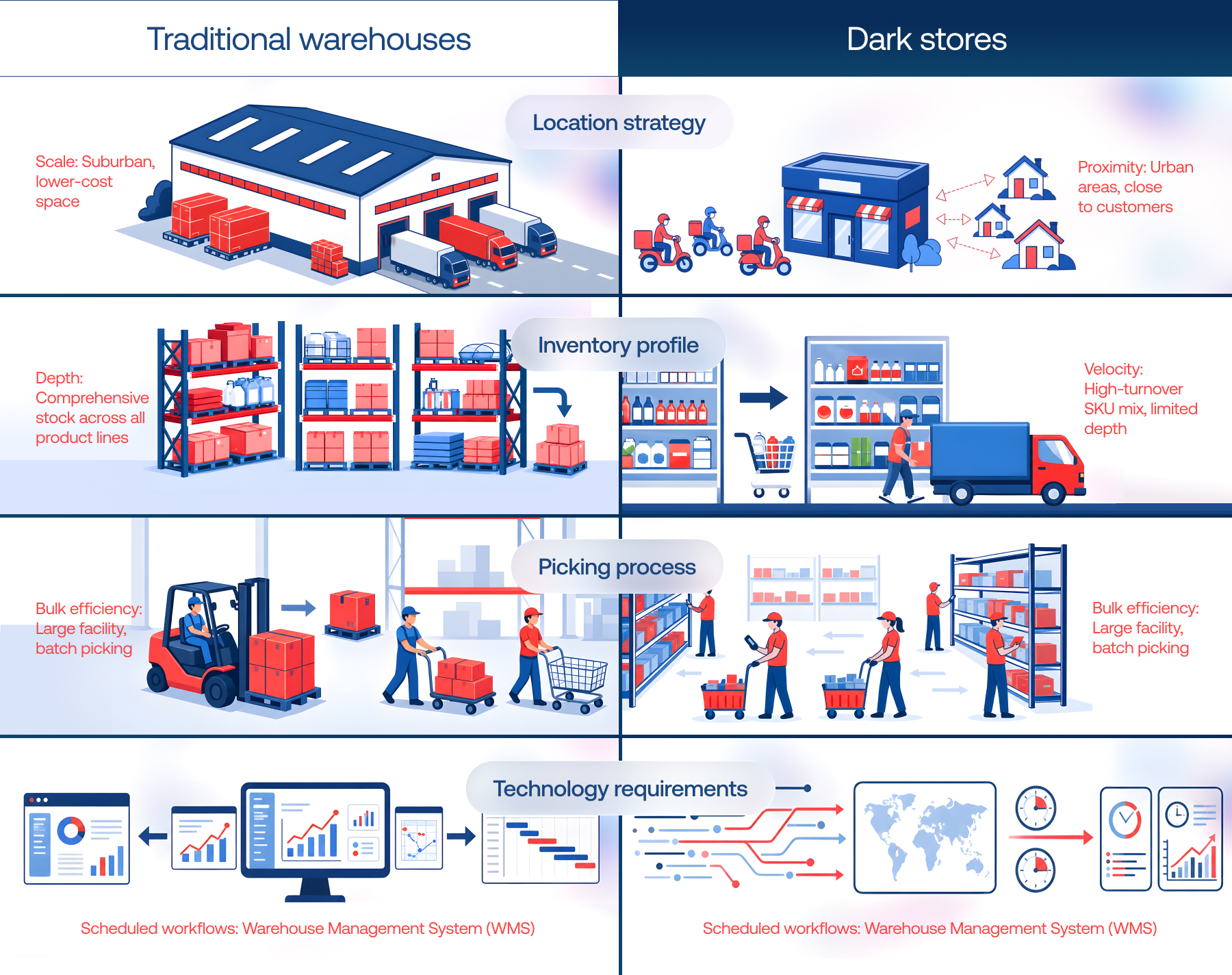
Dark stores and warehouses may look similar: both hold inventory and fulfill orders. Operationally, however, they are built for different jobs. As dark stores handle frequent, small-basket orders under much tighter fulfillment windows, it changes everything from location and inventory strategy to picking workflows and the software needed to orchestrate them.

Location strategy: proximity vs. scale

Traditional warehouses typically occupy large industrial facilities where low-cost space and highway access matter more than proximity to individual customers. Dark stores trade some of that scale for proximity. They are typically located closer to dense residential areas, where higher real-estate costs can be justified by shorter delivery distances and faster fulfillment.

Inventory profile: velocity vs. depth 

If warehouses can hold deep reserves of both slow- and fast-moving products, space-constrained dark stores need a much tighter SKU mix. They put greater emphasis on high-turnover inventory and frequent replenishment from central distribution centers (CDCs) or direct-store-delivery (DSD) vendors.

Picking: speed vs. bulk efficiency

Warehouse operations often optimize for pallets, bulk movements, and batch picking across relatively large facilities. Dark stores are cut out for small baskets and short fulfillment cycles, with pickers typically following system-generated routes that minimize walking time.

The cost of an error is different, too. A dark store mispick can trigger repicking, refunds, customer support work, and even an additional delivery, quickly eating into already thin margins.

Technology requirements: real-time orchestration vs. scheduled workflows

To manage inventory tracking, put-away, and scheduled order release efficiently, traditional retail distribution centers rely primarily on warehouse management systems connected to ERP, transportation software, scanning infrastructure, and automation equipment.

However, dark stores require an event-driven, low-latency technology ecosystem. Since orders arrive continuously and must be dispatched within 10 to 15 minutes, dark store software must balance picker availability, live shelf inventory, packing station queues, and courier proximity in real time.
dark store

The cost of inefficient dark store management

Some dark store failures are impossible to ignore. Others quietly eat into margins one order at a time.

The first kind can require immediate crisis management. For example, the recent suspension of a Blinkit dark store’s food license in Mumbai followed serious hygiene violations, including cockroach infestation and expired stock. 

Far less visible but no less damaging problem is operational leakage. Without well-engineered, end-to-end workflow automation, minor friction points across order picking, shelving, packing, delivery, workforce and customer management compound quickly, which inflates your Cost Per Order (CPO) and erodes margins. Quick commerce’s low-margin structure simply cannot absorb that kind of inefficiency.

AreaErrors caused by lack of proper management and automationDirect financial impact
Order picking and packing• Picking errors (missing, wrong, or extra items)
• No completeness verification
• Packing mistakes (damaged products, incorrect packaging, mixed-up bags)
• Re-picking and re-delivery costs
• Refunds and customer compensation
• Additional workload for customer support teams
Shelf-life management• No FIFO/FEFO control
• Late identification of near-expiry products 
• Expired products reaching customers
• Inventory write-offs
• Product markdowns
• Customer compensation
• Lost repeat purchases
Delivery operations• Inefficient courier assignment
• Poor route optimization
• No dynamic order reassignment
• Empty runs / unnecessary mileage
• Missed delivery time windows
• Higher last-mile delivery costs
• Overtime expenses
• Fewer deliveries per courier
• SLA penalties
Workforce management• Inefficient shift planning
• Uneven employee workload 
• No productivity monitoring
• Excess labor costs
• Idle time
• Overtime expenses
• Lower operational efficiency
Inventory management• Phantom inventory
• Inaccurate demand forecasting
• Delayed replenishment
• Suboptimal reorder points
• Overstocking
• Lost sales
• Inventory write-offs
• Emergency replenishment
• Higher storage costs
Returns and customer claims• Manual handling of customer requests
• No classification of issue types
• No analysis of recurring problems
• Higher cost of claims processing
• Customer refunds and compensation
• Lost repeat purchases

Based on our experience working with retail and ecommerce businesses, the investment in operational control can quickly justify itself through savings across multiple areas. 

After Instinctools developed and implemented our end-to-end dark store management system, the operational ROI exceeded our expectations. Across a single location, we now save roughly $57K/month in logistics by eliminating manual stock and inventory errors, $26K/month by preventing mispicks with continuous QR-scanning, and $36K/month by optimizing near-expiry markdowns and reducing product write-offs.

— Head of Operations, Major Grocery Retailer 

> Explore the case study

What if your next dark store was funded by the savings from your current one? Plug your operational leaks and unlock the capital to scale

Let’s talk 

What dark store management software should cover 

There is no single universal architecture for managing a dark store. The exact software components depend on the retailer’s operating model, SKU mix, automation level, and existing technology stack. However, a mature operational layer typically covers six interconnected domains.

1. Inventory management

The first priority is knowing exactly what stock is available, where it is, and how its status changes. A centralized dark store inventory management layer provides a consistent view of stock as products move through receiving, storage, replenishment, picking, counting, and disposal. It also keeps shelf-life rules such as FIFO and FEFO embedded in day-to-day inventory decisions.

The module closes the gap between physical stock and what the system says is available, which is among the most damaging sources of failed orders and unnecessary write-offs. With accurate stock visibility and controlled replenishment, dark store operators can keep fast-moving products available without overstocking and reduce the risk of stock ending up as lost sales or write-offs.

2. Order fulfillment

Order fulfillment coordinates what happens between an order entering the system and the completed package being handed over for delivery. This includes order routing, picking, batching, picking paths, substitutions, packing, verification, and handoff.

The shorter the promised delivery window, the less room there is for manual coordination. Omnichannel order management capabilities therefore need to determine what should be picked, where it is located, who should pick it, and when it needs to be ready – all while orders continue to arrive.

3. Delivery management

Delivery management connects fulfilled orders with the last-mile network. It can cover courier assignment, dispatch, route planning, delivery status, order prioritization, and dynamic reassignment.

The challenge is that courier availability, traffic, order volumes, delivery windows, and geographic demand can change within minutes, so dispatch decisions need to adjust in real time. Otherwise, a dark store can fulfill an order efficiently and still miss the delivery promise.

4. Supplier collaboration and procurement

Supplier coordination becomes much easier when purchasing decisions, inventory signals, and promotional plans live in the same operational flow. Instead of exchanging updates and purchase orders through email or messengers, suppliers can work through a self-service portal with direct visibility into relevant orders, stock information, and upcoming promotions.

The same layer can automate routine procurement tasks, from purchase order processing to generating barcodes and labels for incoming products. This gives suppliers clearer instructions and retailers better control over what is ordered, promoted, and received, while reducing the manual coordination that tends to slow replenishment down.

5. Workforce management

In a dark store, labor capacity has to move with demand. A quiet afternoon and a sudden evening order surge may require very different staffing levels, while couriers add another layer of constantly changing availability.

A workforce module brings these moving parts into one operational picture. Managers can plan shifts around expected order volumes, track attendance, account for actual hours worked, process payroll, and monitor individual and team performance. Instead of staffing by habit or reacting when queues build up, they can see where capacity is needed, rebalance workloads, and get more output from the workforce already on hand.

6. Sales and customer management

This module covers the commercial side of dark store operations, bringing sales and customer data from mobile apps, POS, marketplaces, CRM, and loyalty programs into one place. As a result, managers gain a clear view of orders and sales activity across channels while seamlessly handling all customer service processes.

Let’s put together the perfect tech solution to power up your dark store strategy, module by module

Contact us

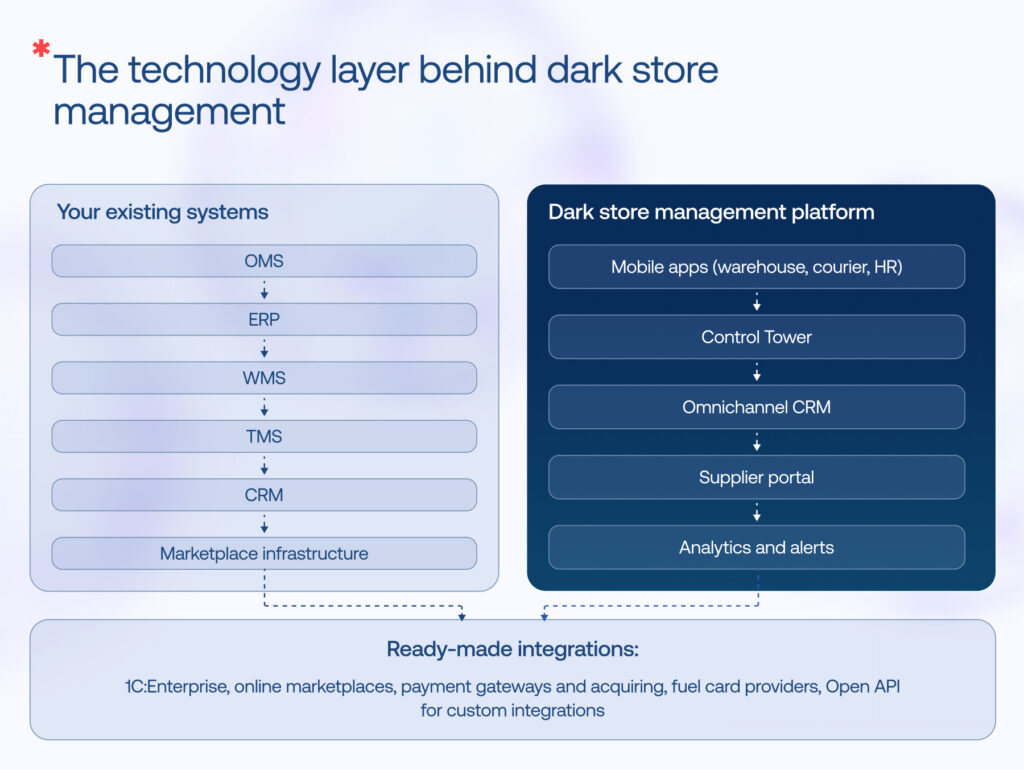
The technology layer behind dark store management

Digitizing dark store operations is hardly uncharted territory. The market already has plenty of capable platforms, such as OrderGrid, Hubler, or ShapeSoft. But when we evaluated available solutions, one limitation became clear:

In our experience designing dark store systems, this makes integration and architectural flexibility just as important as individual features. Rather than forcing every process into a single rigid product, the technology layer needs to connect operational capabilities end to end while fitting into the retailer’s existing ecosystem. Three architectural principles are particularly important:

  • Standardized APIs: Consistent interfaces connect consumer-facing apps, enterprise systems such as SAP or NetSuite, and third-party logistics providers, reducing reliance on custom point-to-point integrations.
  • Asynchronous event processing: Inventory updates, order assignments, and status changes are processed independently of the request-response cycle, preventing integration workloads from blocking operational transactions or slowing picker-facing applications.
  • Loosely coupled modules: Individual capabilities remain independent, allowing new modules and integrations to be added, or existing ones modified, without extensive changes across the rest of the platform.
dark store automation

How our clients use AI to advance dark store automation

Once the operational foundation is connected, AI can move dark store management from reactive automation toward prediction and optimization. In our work with retail clients, we’ve implemented AI-powered workflows that turn live operational signals into concrete actions. Here’s what that looks like in practice:

  • Predictive replenishment: Historical sales velocity and real-time basket trends indicate that a fast-moving SKU is approaching its safety-stock level → the system drafts a supplier purchase order before availability becomes a problem.
  • Waste prevention: A SKU crosses the 7-day expiration threshold → the system automatically applies a 20% markdown in the app to increase sell-through before the product becomes a write-off.
  • Dispatch optimization: Traffic, order weight, and courier proximity change in real time → a VRP engine recalculates assignments and can batch up to three nearby orders onto one rider in under 10 seconds.
  • Dynamic pricing: Available stock for a fast-moving item drops below 15 units during peak hours → the system adjusts the retail price within predefined rules to balance availability and margin.
  • AI-enabled customer support: A customer asks, “Where is my order?” → the system instantly returns live courier location data. A missing-item complaint → the case is escalated to a human agent with the relevant packed-box scan logs already attached.

Explore more AI-powered capabilities in inventory management >>

Level up your micro-fulfillment operations with AI

Get started now

Dark store management software: buy or build?

Off-the-shelf software can cover a lot of ground without the time and cost of building from scratch. But when your processes, integrations, or scale requirements fall outside the standard model, that convenience can come with compromises. 

The right choice ultimately depends on how closely the software needs to fit your operating model, how much control you need over integrations and future development, and how quickly you need to launch. The comparison below puts the key trade-offs side by side.

Evaluation criteriaBuying off-the-shelf platformBuilding a custom solution
Time to launchFaster
(Weeks to 1-2 months)
Slower
(9 to 18+ months, depending on scope)
Fit to operating modelStandardized (best suited to common workflows and established operating pattern)Tailored(designed around your specific workflows and requirements)
Customization ceilingLow to moderate (Configurable via APIs & UI settings)Unlimited (Complete control over code, design, and logic)
Cost modelOpEx(Recurring SaaS fees that increase with usage, users, locations, or order volume)CapEx + OpEx (Development cost + ongoing maintenance)
Data and compliance controlMore vendor-dependent(Vendor cloud, SOC2 compliance delegated)Absolute (100% owned infrastructure and raw data)
Integration effortLow to moderate (Depends on available connectors; custom integrations may still be required)High (Building all APIs and bridges from scratch)
External dependenciesHigh (reliance on the software vendor’s roadmap, pricing, support, and platform capabilities)Low (no core platform vendor lock-in, though dependencies on cloud services, third-party tools, or development partners may remain)
Best fit forEarly-stage dark stores, smaller operators, and businesses entering new markets with relatively standard operationsFast-growing companies and established businesses with unique IP, proprietary hardware, or massive scale

As you can see, turnkey solutions certainly have their place, but real-world execution frequently reveals their glass ceiling. Off-the-shelf platforms are built for average workflows, yet dark store margins are won or lost in the non-standard details – the localized delivery specifics, regional compliance factors, unique supplier collaboration nuances, and more. 

Standard off-the-shelf software couldn’t natively integrate with our local ERPs, regional payment gateways, or custom courier routing rules. Moving to a bespoke system built for our exact architecture changed everything: we reduced our cost per order by 15%, cut picking errors by 68%, and pushed our on-time delivery rate to 95% for bikes and 90% for cars.

— Head of Operations, Major Grocery Retailer 

So, choosing the right path requires stepping back and looking beyond the initial investment. An experienced engineering partner can help you assess how both custom and off-the-shelf approaches will play out over time, balancing faster deployment today against long-term flexibility, operational control, and scalability before you make a foundational technology decision.

Ready to reap the benefits of proper q-commerce automation?

Quick-commerce dark stores are only as effective as the technology backbone powering their operations. Building that backbone means bringing critical micro-fulfillment functions – inventory, order, supplier, workforce, customer, and delivery management – into one connected system, enhancing them with AI-powered capabilities, and integrating the whole stack into your existing operational ecosystem. Having designed and implemented custom dark store management platforms as well as advanced retail and ecommerce solutions, we’re ready to tackle your dark store logistics challenges if you’re looking for a reliable engineering partner.

Your dark store business model needs a robust platform to keep pace with ever-growing demand? We can help

Reach out 

FAQ

What is a dark store?

A dark store is a micro-fulfillment center structured like a conventional supermarket but closed to the public. It is dedicated exclusively to fulfilling online purchases, where staff or automated systems pick, pack, and ship items for quick home delivery or local curbside pickup.

How do dark stores work?

Dark stores operate as compact fulfillment hubs built around online orders. A customer places an order through an app or website, the system routes it to the nearest suitable location, and staff or automated systems pick and pack the items. Delivery is then assigned and dispatched, with inventory updated throughout the process.

Are dark stores automated or run by manual labor?

Mostly manual labor today, with automation layered in selectively. Most dark stores rely on human pickers walking aisles, guided by handheld scanners or picking apps that optimize routes. Some operators add automation – conveyor sorters, robotic picking arms, or micro-fulfillment tech – but full automation is capital-intensive, so it’s typically reserved for larger, high-volume hubs rather than the norm.

What is dark store management?

Dark store management is the digital and physical orchestration of micro-fulfillment centers optimized exclusively for online orders. Driven by dark store management systems, it automates routing, batch picking, and stock replenishment to minimize order-to-delivery latency for rapid ecommerce and quick-commerce operations.

What are dark store operations?

Dark store operations are the day-to-day processes that keep a fulfillment-only location running: receiving and shelving inventory, picking and packing orders, managing staff shifts, syncing stock levels in real time, and coordinating handoffs to delivery riders.

What software do you need to manage a dark store?

A dark store typically needs software for inventory and warehouse management, order processing, picking and packing, delivery orchestration, workforce management, and analytics. These systems should work as one operational layer, connecting orders, stock, staff, and couriers in real time to keep fulfillment accurate, efficient, and responsive.

What is the dark store model, and how many people does one location need?

The dark store model is a retail setup where a dedicated facility holds inventory and fulfills online orders for a defined local area. Staffing depends on store size, SKU count, order volume, operating hours, and automation. A small site may run with a handful of employees per shift, while high-volume locations require larger teams across fulfillment and operations.

How to Calculate and Optimize Agentic AI ROI: A Framework for Enterprise Decision-Makers

Every AI ROI calculator on the market will hand you a clean percentage. Almost none will admit it’s fiction, because the number was never anchored to a baseline you captured before the agent went live. That gap is the quiet reason 95% of AI pilots show no measurable P&L impact, and more than 40% of agentic projects are on track to be scrapped by 2027: the math holds up right until finance asks where the baseline came from. Our guide walks you through how to calculate AI ROI for agents in a way that answers that question.

Key highlights

  • Measuring agent ROI means judging the effectiveness and relevance of the actions an agent takes — not grading a finished feature against a fixed spec, the way traditional software ROI does.
  • The ROI case is won before deployment — set a baseline and KPIs first, or the returns become impossible to prove after the fact.
  • The real cost hides after the first draft, in the verification, rework, and compounding chain errors that quietly erode returns.

What agentic AI ROI actually measures?

The answer depends on which of three architectures you’re actually paying for, because the word “agent” covers entities with different cost behavior.

What it is under the hoodHow is its cost calculated
Agentic workflowExisting software with a generative model bolted into a single step.Cost stays bounded per invocation.
Agentic pipelineA predetermined sequence of steps that calls an LLM at fixed points. Most AI chatbots belong to this category.Cost is bounded per call, multiplied by a known count.
AI agentAn autonomous software system that uses artificial intelligence to perceive its environment, make decisions, and take independent actions to achieve specific goals set by a user. Coding assistants are the most common true agents running in production today.Cost is unbounded per task, and running it twice can swing the price by up to 30 times.

The agentic race pushes companies to invest in all three, and calculating ROI for such a mix means budgeting a range instead of a single figure. 

The ROI reality check: why most agentic AI initiatives fail to show return on investment?

Adoption is running well ahead of proof. About 62% of organizations are already experimenting with AI agents, and 23% have moved at least one into production in a business function. Yet more than 40% of agentic AI projects are expected to be canceled by the end of 2027. The distance between those two numbers is the real story — enthusiasm scales faster than the ability to measure what the agents are actually worth.

And remember, nobody deploys just one workflow, one pipeline, or one agent. They spin up dozens, and that’s how you get agent sprawl. When different teams independently deploy autonomous AI, each without a shared owner, the costs tend to surface long after the tools do. 

Why traditional ROI metrics don’t work for AI agents and how you should measure their impact instead?

Software ROI templates grade a shipped feature against a fixed spec. Meanwhile, agents are evaluated based on the effectiveness of the decisions they made under uncertainty. Therefore, an agent is worth deploying when it clears one threshold: how often it succeeds has to exceed the ratio of human verification time to human do-it-yourself time. 

Take a task that needs two hours to complete but only six minutes to verify, like drafting a first-pass contract summary a lawyer can skim against the source, or localizing copy into a language a native speaker can quickly proof. That ratio is about 5%, so the agent only has to succeed five times out of a hundred to be net-positive.

That clean math holds under one condition: a failure leaves the environment unchanged and a bad output simply gets discarded. It collapses the moment failure changes something real, for example, an agent wrongly tells a customer a nonrefundable trip is refundable. Once that happens, two cost factors break the formula above:

  • Recovery cost. When a wrong output changes something in reality, you pay to catch and undo it, and that verification-plus-rework overhead is the agency tax — rarely zero in practice. Because autonomy lets the agent take different paths or retry, the same task can swing up to 30x in cost between runs.
  • Chain length. The more steps there’re in an agent’s workflow, the more places it can go wrong, and small per-step errors compound and turn catastrophic at scale. At 99% per-step accuracy, a 50-step chain succeeds roughly 60% of the time; drop to 95% per step and success falls to about 8%.

An AI adoption workshop is one way to size the probability of success against verification cost  before you commit to a build. 

That upfront work matters because first-draft quality is only part of the picture: judge an agent on its first output alone and you’re tracking maybe 40% of the true cost, while the agency tax accounts for the rest.

— Ivan Dubouski, Head of AI Center of Excellence, Instinctools

None of this means agentic ROI is unmeasurable. It needs its own measurement architecture, built before deployment, not after.

Inside a production-ready agentic AI ROI measurement architecture

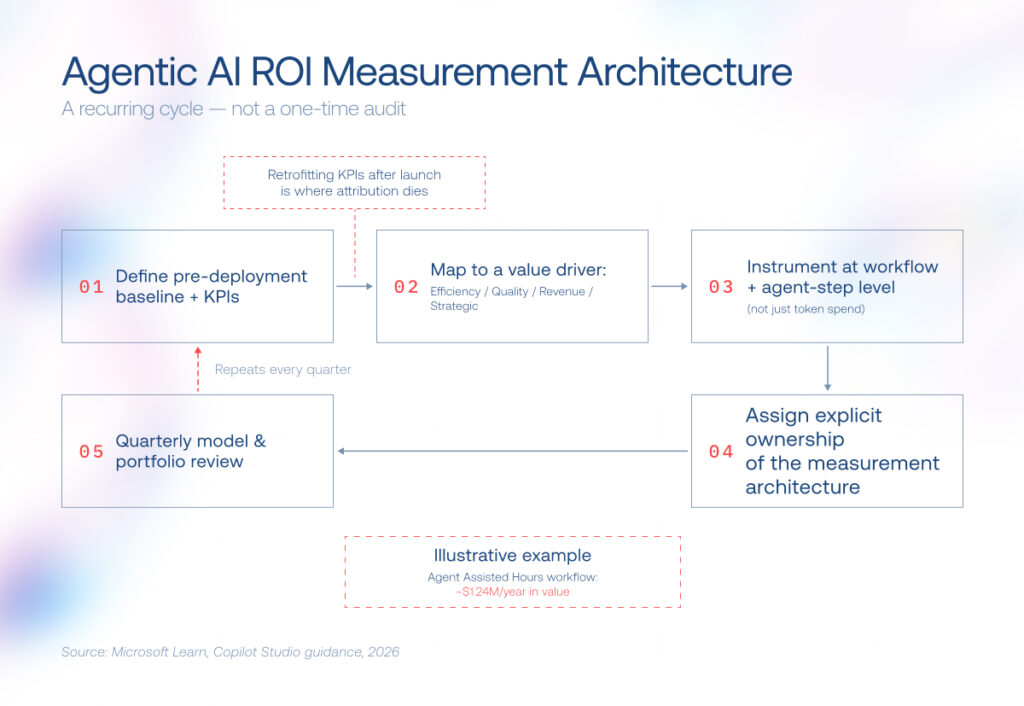
The architecture we use at Instinctools runs as a loop: capture a baseline, instrument against value drivers, convert the result into Agent Assisted Hours, monitor KPIs continuously, then make a fund-or-scale call that feeds the next baseline.

agentic AI ROI measurement architecture

In practice, we structure measurement around four value drivers — Efficiency, Quality, Revenue, and Strategic — each with its own indicators and pricing formula. Together they turn “the agent helped” into a figure finance can check.

Value driverWhat it capturesHow we put a number on it
EfficiencyTime your team wins back and can redirect toward work that genuinely needs a human.Hours freed × fully loaded cost of an hour.
QualityFewer mistakes, steadier output, and tighter compliance.Error-rate improvement × task volume × cost of a single error.
RevenueTop-line gains from the business you keep, grow, or win.Change in conversion or deflection × volume × revenue per unit, discounted for attribution.
StrategicFaster decisions, more confident teams, more room to maneuver, and resilience when things go sideways.Option value of the new capability + value of retained talent + resilience gained.

That collapses into a single number: Agent Assisted Hours (AAH) — the human-equivalent capacity the agent hands back each month. The nuance that keeps it honest is that not every session counts the same. A session where the agent fully resolves a customer’s issue is worth more than one it escalates to a human, so the sessions get weighted by how much work the agent actually took off the team’s plate. 

Run that weighting across a customer-service agent handling 10,000 sessions a month, and it comes out to about 1,440 hours of capacity returned. At a $72 fully loaded hourly rate, those 1,440 hours are worth $103,680 a month — roughly $1.24 million a year. And it’s not abstract capacity: it’s the time a team redirects to complex cases, proactive outreach, coaching, and the judgment-heavy work that actually moves retention. It’s also proof a conversational AI ROI claim can survive finance scrutiny.

Make value drivers built-in for your next agentic AI project?

Talk to our experts

How to calculate AI ROI: a step-by-step framework

We talked architecture, and here’s how to run the math. Get the order below right, and the ROI arithmetic will hold up.

1. Define your pre-deployment baseline and KPIs

Before you write a single prompt, work out what the task costs today: hours, error rate, and rework, calculated with the AAH method above. Set target KPIs against that baseline and tie each one to an existing value driver. 

2. Instrument before launch

Wire up logging at the agent-step level before the first production run: which action the agent took, what it cost in tokens, and what a human would have spent on the same step. Wait until after launch and you’re guessing backward through logs nobody built for the purpose — the baseline and the instrumentation have to share the same units from day one.

3. Run the AAH-style arithmetic

Two calculations do the work here, answering questions of different audiences.

The first is a quick sanity check for the team building the agent — is this thing even worth the tokens?

Model choice moves that denominator fast — top-tier reasoning models cost roughly 24 times as much as small ones — so this tells you quickly whether an agent is even worth its tokens.

The second is the number your CFO and the board care about, because it nets out everything the first one ignores:

Score it across three value vectors: productivity, quality and outcome, and risk aversion. An AI ROI calculator can rough out the first pass, but treat it as a starting estimate rather than the figure you bring to a CFO.

4. Fund and scale against hard value cases

The ROI timeline for AI agents rarely matches the vendor pitch, so fund each agent against a hard value case — a specific, quantified problem with a dollar figure attached rather than a broad vision statement.

In our delivery experience, pilot value shows in four to eight weeks and full deployment lands in two to six months, with payback typically following in six to 18 months. The range depends on how much of the workflow the agent absorbs and how heavy the verification load turns out to be.

— Ivan Dubouski, Head of AI Center of Excellence, Instinctools

Key metrics and KPIs to track before, during, and after deployment

ROI doesn’t hold on its own; you have to track it before deployment, during it, and after.

Before deployment

Set baselines for cycle time, error rate, cost per transaction, and staff hours per case. Define your success criteria in writing before the demo, so nobody can move the goalposts later.

During deployment 

Watch how often a human has to step in, and how you’re checking the agent’s work in the first place. Nearly 70% of agents in production still need a person to intervene within their first handful of steps, and about three-quarters of teams still lean mainly on human review to catch problems.

How you review matters just as much as how often. Agent failures rarely show up in the final output alone; the root cause usually sits several steps upstream, so checking only the end result tends to miss the real problem. That makes intervention frequency and evaluation-method choice your true leading indicators of whether the ROI will hold.

After deployment 

Track outcomes against the four value drivers. Whatever dashboard or AI agent ROI calculator you use, feed it intervention and evaluation data rather than raw completion counts. In our experience, the AI sales agents with the highest ROI are usually lead-qualification and follow-up use cases, since verification cost is low relative to the value of a closed deal.

Which of these metrics matter most depends on a decision most teams make too early: whether to build, buy, or partner for the agent itself.

Build vs. buy: how the decision shapes your ROI math

Where you get the agent — build it, buy it, or have it built for you — shapes your agentic AI ROI more than most teams expect, because it decides who owns the cost structure, the verification layer, and the data the agent generates over time.

Internal development only pays off in four scenarios:

  • Proprietary “glue layers” connecting enterprise-specific data and workflows
  • Differentiated capabilities where the agent itself is the competitive advantage
  • Strategic learning investments a company needs regardless of near-term payback
  • Regulated or data-residency-bound work (HIPAA, SOX, PCI DSS, the EU AI Act), where compliance requires a controlled build, whatever the ROI math says

The thread connecting them is ownership of the data the agent produces. Industry research frames this as “compounded context”: the data an agent captures compounds into a strategic asset over roughly a three-year horizon, but only if you own the pipeline gathering it. That’s why the build case is really a data-ownership case.

Outside those three scenarios, buying usually wins, specifically when:

  • The task is a commodity and well-defined, with no enterprise-specific quirks
  • Speed to value matters more than long-term ownership of context
  • The use case isn’t a source of competitive differentiation
  • You don’t have (or don’t want to tie up) engineering capacity to build and maintain it

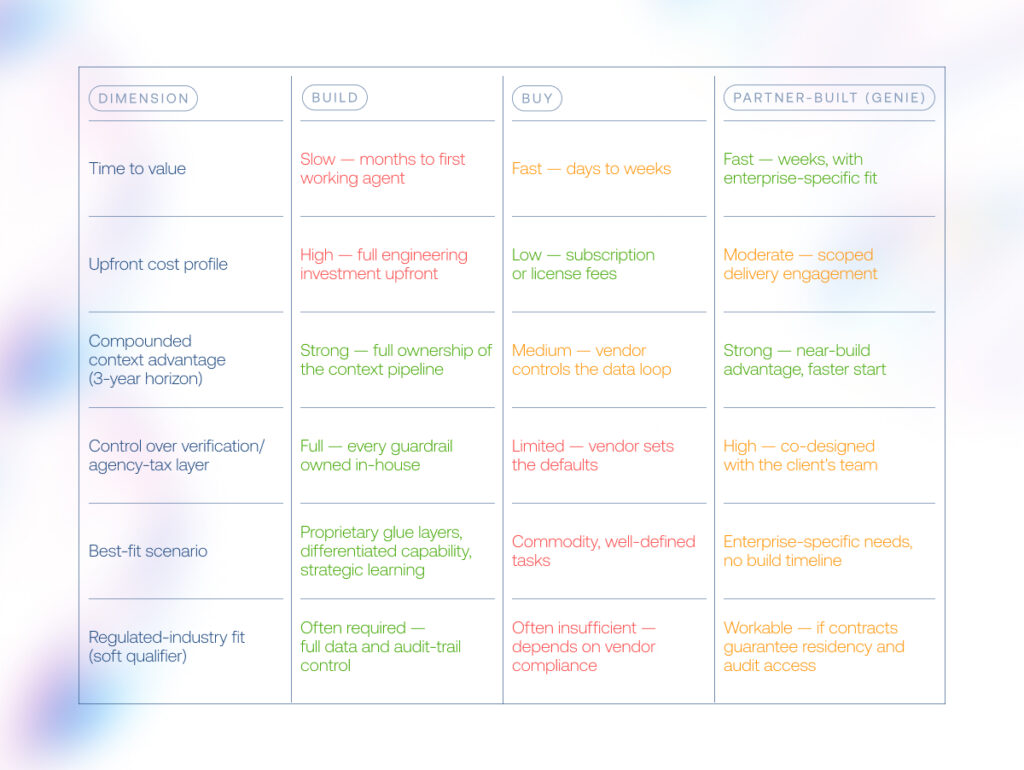
There’s a third path between the two: partner-built. Unlike buying an off-the-shelf product, a partner-built agent is developed around your workflows and data by an outside team, so you get build-level fit and context ownership without standing up and maintaining an in-house AI engineering function. GENiE — Instinctools’ proprietary solution accelerator for building custom AI agents — is one example. The table below compares all three.

agentic AI ROI

In a nutshell, buy wins on speed. Build wins on long-run compounded context, but only in the three scenarios above. Partner-built approaches, like our GENiE model, capture most of the build’s context advantage without its full timeline or risk thanks to being vendor-agnostic by design and fast to stand up.

— Ivan Dubouski, Head of AI Center of Excellence, Instinctools

Real-world agentic AI ROI: how we cut a six-month onboarding to two weeks

A global insurance aggregator hit the wall most enterprises face when they scale into new markets: partner onboarding. Each new one arrived with a different API, schema, language, and regulatory regime, and reconciling that by hand took three to six months per partner, across dozens of countries.

We created a production multi-agent system around an Analyze → Plan → Generate pipeline, using our GENiE framework, so the guardrails that keep agentic ROI from eroding, such as model governance, orchestration, and human-in-the-loop validation, were part of the design from day one. 

The payoff: 

  • Onboarding time fell from three to six months to two weeks, up to 12x faster
  • Operational cost dropped 10x, and repetitive developer work fell by 80–90%
  • Engineers now spend roughly $50–100 and two to three hours of effort per large endpoint, checked by about 20 minutes of human review

Run those figures through the success probability weighed against verification cost ROI formula, and you get exactly this in production: 20 minutes of review time buying back months of manual onboarding work.

Try GENiE for your agetic AI use case

Book a demo

Turn agentic AI ROI from a guess into a number

Agentic AI ROI is won or lost before deployment: in how carefully you baseline the work, scope the verification layer, and tie each agent to a value driver a CFO already recognizes. The model behind the agent matters far less than the measurement wrapped around it. 

Get the baseline, the instrumentation, and the build-buy-partner call right, and every gain you claim traces back to a number finance can check. Get them wrong, and no dashboard will reconstruct the story after the fact. Measure first and deploy second — that order is the whole game.

Want real numbers behind your agents before you commit?

Book a call

FAQ

How long does it typically take to see ROI from agentic AI?

In our delivery experience, pilots surface value in four to eight weeks, full deployment lands in two to six months, and payback typically follows in six to 18 months, but only when the baseline and KPIs are set before launch. Most enterprises plan for returns on a one- to five-year horizon, and the teams that beat that timeline are almost always the ones that started measuring on day one.

What percentage of agentic AI projects fail to show measurable ROI?

Up to 95% of them by the current numbers: the large majority of AI pilots never show measurable P&L impact, and 40% of agentic projects get canceled before they ever scale. But that failure rate rarely indicts the technology itself. In lots of cases we see, it traces back to measurement that started after deployment instead of before it, which leaves no baseline to attribute gains against.

How do you actually measure ROI for an AI agent?

Start with four value drivers — efficiency, quality, revenue, and strategic — each with its own indicators. Convert efficiency into Agent Assisted Hours: productive hours returned multiplied by fully loaded hourly value. Instrument at the workflow-step level before launch, so the numbers track the same units as your baseline.

Should we build, buy, or partner for our agentic AI ROI case?

Build only pays off in four scenarios: proprietary glue layers connecting enterprise-specific data, differentiated capability where the agent itself is your competitive advantage, strategic learning you need regardless of near-term payback, and regulated and data-residency-bound work where the rules leave you no real alternative. Outside those, buying wins on speed. Partner-built approaches, like our GENiE model, capture most of the build’s context advantage without the full timeline or cost.

What are the hidden costs that hurt agentic AI ROI?

The biggest is the agency tax: the verification and rework cost stacked on top of a wrong output, since a large share of an agentic task’s cost sits in refining answers rather than producing the first draft. Add agent sprawl and weak governance, and realized ROI erodes fast even when the underlying model performs perfectly well.

Which KPIs should we track to prove agentic AI ROI to leadership?

Before deployment, monitor baseline cycle time, error rate, cost per transaction, and staff hours per case. During deployment, watch intervention frequency and which evaluation method you’re relying on, as most agents still need a human to step in within their first several steps in production. After deployment, track outcomes against the four value drivers rather than raw task volume or completion counts.

Which use cases show the strongest agentic AI ROI?

Agentic AI platforms show measurable ROI in customer service first, since call volume is high and the value driver is obvious. Back-office workflows with clear audit trails, such as partner onboarding or invoice processing, follow close behind once governance is in place.

Instinctools History: From Ambitious Start-Up To Tech Partner of Fortune 500 Companies

Parlaying expertise, talent, and commitment into measurable business outcomes since 2000. 

See how an initiative of young IT professionals transformed into a global custom software development company with engineering hubs across three continents.

History milestones

Founding and early years

Founded in 2000 by Alexey Spas and Diethard Sohn, the company originated in Stuttgart, Germany. 

Initially, the start-up focused solely on custom web development of high-loads. In its early years, *instinctools secured a deal with its first client from the Fortune 500 list — Mercedes-Benz Group AG (former Daimler). Crafting a web-based user support system for one of the leading global automotive companies became a turning point for a five-year-old start-up. 

Growth and diversification

Over the next fifteen years, *instinctools expanded its services to include mobile app development, enterprise automation, legacy software modernization, cloud computing, and more. This shift enabled the company to attract mid-sized companies and large enterprises and bring other big-name clients, such as Helvar, Nostrum, CANet, and Fujitsu, among others.

2015 became a tipping point in the company’s history. Instinctools outgrew the boundaries of a strictly outsourcing software development company and presented DITAworks Webtop, their first enterprise-grade SaaS product for technical documentation management. This product helped *instinctools win two top-level clients — SAP and DEIF.

Educational initiatives

At the same time, witnessing the emerging global talent shortage in the software development industry, *instinctools launched several educational projects to share their hands-on knowledge with young specialists. The company established a Growth academy for promising students in IT-related disciplines, organized offline coding competitions, and delivered lectures for adult professionals in Hrodna, Belarus, where one of the development centers was located. In 2021, the company began hosting online conferences “Tech Times”, discussing technological trends with industry leaders from all over the world.

International expansion

The years 2010–2020 were fruitful in many ways. New offices were opened in Minsk, Belarus,  Moscow, Russia, and Warsaw, Poland. Instinctools also kept expanding their partnership network and signed agreements with Google Cloud, OVHcloud, and Odoo. From 2021, *instinctools operates as a trusted Microsoft Partner.

Team: from 7 to 400+

Instinctools brings together proactive, business-like, and determined doers who shape the company’s DNA as an international software product development and consulting company. Starting with a team of seven, *instinctools has grown to over 400+ employees across ten countries. Key team members:

  • Alexey Spas, CEO 
  • Gunthilde Sohn, Managing Director, DACH
  • Chad West, Managing Director, USA
  • Alexey Astakhov, VP of Engineering
  • Tatsiana Astakhava, CFO

Along with the increasing number of tech and business talents on board, the company’s expertise area and hands-on experience in working with various industries also kept expanding. To date, *instinctools provides services over a broad technology stack, including Java, Python, Javascript, React, Angular, Microsoft Azure, Power BI, Odoo, HubSpot, AWS, and more, delivering robust technological solutions for businesses across many industries:

  • Healthcare
  • Fintech
  • Ecommerce
  • Manufacturing
  • Logistics
  • Automotive
  • Energy
  • Entertainment and media
  • Education and e-learning 
  • Technology
  • Ad-tech
  • Cryptocurrency 

Offices

In the middle of 2024, *instinctools had two headquarters on both sides of the Atlantic: in Stuttgart, Germany, and Potomac, MD, USA. The main development hub is located now in Warsaw, Poland. The company has growing development centers in LATAM, Kazakhstan, and India. The offices in Belarus and Russia operated in the 2010th, were closed. To date, the company provides seamless collaboration to customers across the globe and operates within 20+ time zones.

Awards

Instinctools regularly receives awards on the B2B review platforms, such as Clutch, Manifest, TechBehemoths, SelectedFirms, etc. The company’s expertise has been recognized in a number of categories, including but not limited to the following ones: 

  • Top Custom Software Development Company
  • Top Web Development Company
  • Top Mobile App Development Company
  • Top Ecommerce Development Company

How to Create a Crypto Payment Gateway: Our Hands-on Experience

The question of how to create a crypto payment gateway has gained popularity across a wide array of industries for a reason. This is not surprising since the number of blockchain transactions has been growing steadily over the past ten years. For example, from 2012 to 2024, the number of operations with Bitcoin increased 8.5 times.

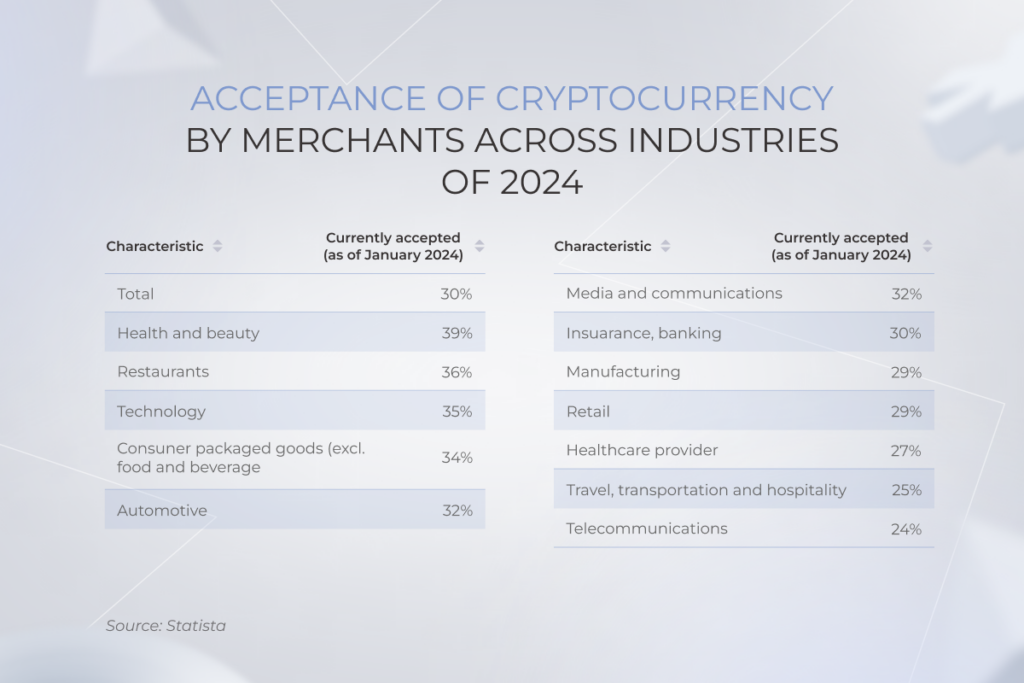
Using crypto allows companies to enable real-time, accurate, and completely secure transactions. Doesn’t that sound like a compelling reason to consider cryptocurrencies for your transactional and operational purposes? Statista indicates that the degree of acceptance of payments in crypto varies from 24% to 39% across industries.

Acceptance of cryptocurrency across industries

Already sparked your organization’s interest in crypto and want to benefit from a crypto payment gateway but don’t know where to start, what it takes to develop and implement a crypto payment processor, and how to choose a reliable partner? We are here to help you cut through the noise about crypto payment gateway development and get straight to work. 

How does a crypto payment gateway work?

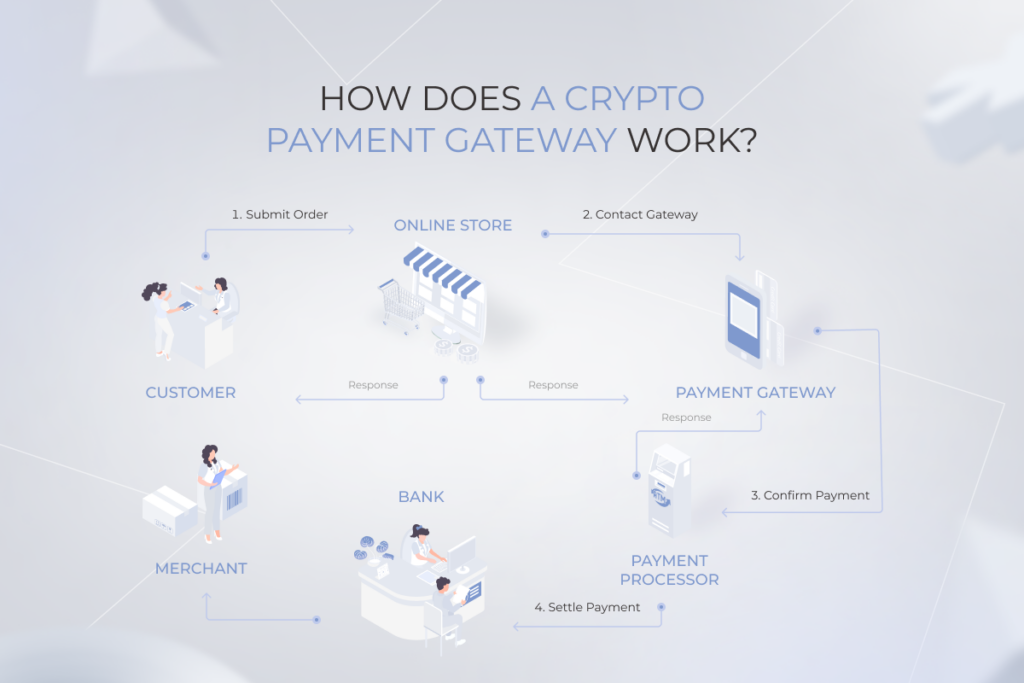
A crypto payment gateway is a payment processor, similar to its traditional alternative. The difference is that it accepts cryptocurrencies instead of conventional money and converts them into fiat, or vice versa. If you implement a crypto payment gateway, the exchange process goes like this:

1. Customers pay in crypto or in fiat for their purchases.

2. If your crypto payment gateway receives Bitcoins, Ethereum, or other cryptocurrencies, it immediately converts them into fiat according to the digital currency’s market value at that moment. If the gateway receives fiat money, then, similarly, they are converted into cryptocurrency at the current rate.

3. That amount of fiat money is sent to your account. Speaking of crypto, it goes into your crypto wallet.

scheme showing how a crypto payment gateway works

It’s vital to know how to create a crypto payment gateway step by step to ensure your solution works securely, without a glitch, and provides the necessary features. To succeed, you should meet the market demand, have a clear vision of your product, and choose the right technologies to develop an appropriate solution. Take a closer look at the process so you won’t miss anything when the time comes.

Strategize how your cryptocurrency payment gateway will fit into the market

Investigating the needs of the market you’re interested in is key to determining whether your solution will be in demand. For example, Morocco is one of the countries most reliant on cash – 74% of the population is unbanked. But at the same time, 84% of people have internet access. So, if you want to reach possible customers from Morocco, it’s easier to do it with crypto. The fact this country is now known as the second leading crypto-trading nation in the MENA region only proves the point.

Delve into the specifics of the regulatory requirements

Figuring out the regulators’ requirements is one of the most challenging tasks when creating a crypto payment gateway. First of all, you should check the legislations of the countries you are interested in and learn how they regulate operations with cryptocurrency.

Let’s take, for example, that you are located in Europe and want to use crypto to expand your business capabilities in the Asian market. If you have experience with a crypto payment gateway in France, where it’s enough to be an officially registered company and fulfill local AML obligations, it doesn’t mean that the same rules are applicable to another jurisdiction. 

The attitude to cryptocurrencies might vary even within a region (as it is in Asia), not to mention different continents. For instance, Japan recognizes Bitcoin and other digital currencies as legal property, and has the most progressive regulatory climate for cryptocurrencies. At the same time, China and Vietnam have prohibited crypto transactions. 

Don’t struggle while deciphering regulators' requirements

Get in touch

Find banks to cooperate with

Picking out a bank to partner with is usually the biggest stumbling block on your way to crypto payment gateway development. When a bank starts working with cryptocurrency, it gets a high-risk score from payment systems (Visa, Mastercard, etc.) it depends on. So consider the possibility that you may need a couple of FTEs to search for banks open to cooperation. Another option though is to take advantage of a partnership with a consulting company that has experience in building crypto gateways and can help you negotiate with the bank’s decision-makers.

Identify what will make you stand out from the crowd

The odds are that your idea of “the best crypto payment gateway” has already been embodied by another company, and you’re reinventing the wheel. To come up with an eligible solution, you should distinguish your business from the competitors either by the unique functionality of your gateway or by certain privileges, such as support from the authorities or access to a loyal bank that other organizations don’t have. Take a look at your competitors, and analyze their pros and cons to highlight how your solution may differ from theirs.

Take into account the costs of maintaining a crypto payment gateway solution

A crypto gateway is a solution tightly linked to a multitude of services that keep it alive — we’ll describe this in more detail a little later — and that’s why you also have to maintain all of these integrations. 

Technical intricacy is far from the only thing you’ll have to spend money on. Speaking of building a white label crypto payment gateway, your regulator may have specific requirements for your AML (Anti-Money Laundering) and KYC (Know Your Customer) department. The regulator can determine the composition of the team and the required level of expertise for its members, which might cost you a pretty penny.

Does thinking about how to build a crypto payment gateway cause chills down your spine?

We can help

Crystallizing the product vision

Once you’ve solidified your decision to create a crypto payment gateway, it’s time to move on to detailing the vision of your product. Do you want to follow a “hands-off” approach to your fiat-to-crypto payment gateway where you don’t keep your customers’ money in your accounts? Or would you like to be more “hands-on” and deal with custodial storage? The last one is way more complicated and expensive as a “hands-on” approach drastically increases the infrastructure costs and expenses for security specialists. So it’s vital to choose what level of responsibility you’re ready to take and how much you’re ready to spend on a crypto payment gateway solution from the outset. 

Come up with unique features for your crypto gateway

Who is your target audience? What do your customers expect from you? Will you set limits on the sums your customers can operate with? These, and many other questions, demand answers before your project kicks off.

The choice of features for a top crypto payment gateway depends equally on your customers’ needs regarding the convenience of the service, and your administrative needs when it comes to the internal processes of exchange management such as rates, liquidity, control, reporting, and others, including:

  • The number of cryptocurrencies.
    Hypothetically, it’s possible to support any number of cryptocurrencies, but how feasible is it on the technical side? As blockchain is the technology behind crypto, the more cryptocurrencies there are within your exchange, the more blockchains you’ll have to process. It might be more appropriate to choose a few of the most popular cryptocurrencies among your targeted audience, such as Bitcoin, Ethereum, Litecoin, etc., and invest your budget into developing more specific features. 
  • Available payment methods.
    Cards, electronic money transfers, etc. — you should find out what options your customers truly need so that you won’t overload your crypto solution with unnecessary features that will only delay your time-to-market. 
  • Peculiarities of exchange rates.
    You can set the same fee for using your cryptocurrency gateway or create a gradation depending on the increase of the amount of exchange. For example, for the transaction which is under $10,000, it might be 0.6%, over $50,000 – 0.25%, over $100,000 – 0.15%, and so on. Moreover, you can offer personal discounts for transactions of large sums to stimulate customers to opt for your service. Such gradation can be automated so that you don’t waste your employees’ time on tedious, repetitive tasks.
  • Payments automation.
    Because of the cryptocurrency volatility, it’s crucial to convert crypto to fiat and vice versa instantly before the rate changes. You can set up automatic payment cancellation if customers don’t manage to make it in the allotted time. Or you can provide them with a checkout and recalculate the money at the new rate, so you don’t have to transfer them back and forth

Features required on the administrative side can be compared to the underwater part of an iceberg. While the cryptocurrency exchange operation is duck soup for the customer, it’s far from being that easy under the hood due to the complexity of banking internal processes.
In my experience, business owners often have to deal with reality at this stage and accept that it’s more profitable to give up unnecessary and overly sophisticated ideas, such as supporting 100+ cryptocurrencies, so that the development of the gateway won’t be delayed. 

What features would you like your white label crypto payment gateway to have?

Let’s discuss!

Think of integrations with vendors and banks

A crypto payment gateway is a system that cannot live on its own. It requires a plethora of integrations with other systems, tools, etc., through the crypto payment gateway API to keep the platform running. For instance, if your website is built on WordPress and you want to implement a crypto solution in it, you should have a crypto payment gateway for WordPress API. All the required integrations should be well-thought-out so that the whole crypto payment gateway system works harmoniously and securely. 

Balance product features with expected time-to-market

The critical point in any business idea is its timely implementation. You can come up with a crypto exchange unicorn, but does the development of such a solution fit into your go-to-market timeline? Your current plans on crypto payment gateway development will unlikely be relevant in ten years when you’ve finally got to its release. Therefore, balancing the gateway’s functionality and time-to-market is crucial to effectively compete with other crypto solutions providers.  

Developing a technical solution

You can enter the technical development stage only after you’ve clearly understood which regulations work in your target markets, determined the product features you need, and got your bank partner’s approval. The tricky part is the vast number of integrations, especially those involving banks, AML, and KYC processes. While developing the solution, you should keep in mind your business strategy and clear product vision, which we have reviewed above, but, with the support of your technical partner, you’ll be able to bring your idea to life. 

Now let’s see the magic happen…but not quite yet. Before you send your project to market, get ready to deal with add-ons required by the regulator. For instance, they can request to build some extra verification modules on top to strengthen the security of the solution’s infrastructure. Keep in mind this is part of the process and be prepared for some extra work at this stage.

three steps to creating a crypto payment gateway

Go gradually when creating your crypto payment gateway

To build a reliable, efficient, and secure crypto payment gateway, you must tie together your business strategy, product vision, and technical solution while keeping regulations in mind.

Still, puzzling over developing an efficient and secure solution that would allow users to make cryptocurrency transactions legally and transparently and meet the requirements of the banks and payment systems? We are ready to share our expertise and help you build a cryptocurrency payment gateway. Get in touch

Right Here, Right Now: Reap the Benefits of RPA Implementation

It is estimated that a large majority of businesses, roughly 60%, conduct a minimum of a third of their operations and duties manually. Nonetheless, this can be altered through the use of robotic process automation (RPA) – a software solution that has great potential to improve a company’s productivity and efficacy. The benefits of RPA technology extend far and wide. When integrated with traditional business solutions, it can help support digital transformation by helping organizations to enhance end-to-end operations and, at the end of the day, ensure your company’s prosperity. What are some other unsurpassed RPA advantages? To explore how automation can become a critical aspect of your business’ success, let’s look into it further. 

Ensuring uniformity in operations and preventing human error

Can you guarantee that all the staff in each branch of your business adheres to rigid regulations for every process without exception? People tend to customize processes to suit their convenience, which can lead to detrimental results when security is concerned. For instance, omitting the stage of sandbox scanning for all the emails an employee receives makes your organization more susceptible to social engineering attacks. In that regard, RPA technology is of much help as it follows an algorithm ensuring that security requirements are consistently met across all units and offices.

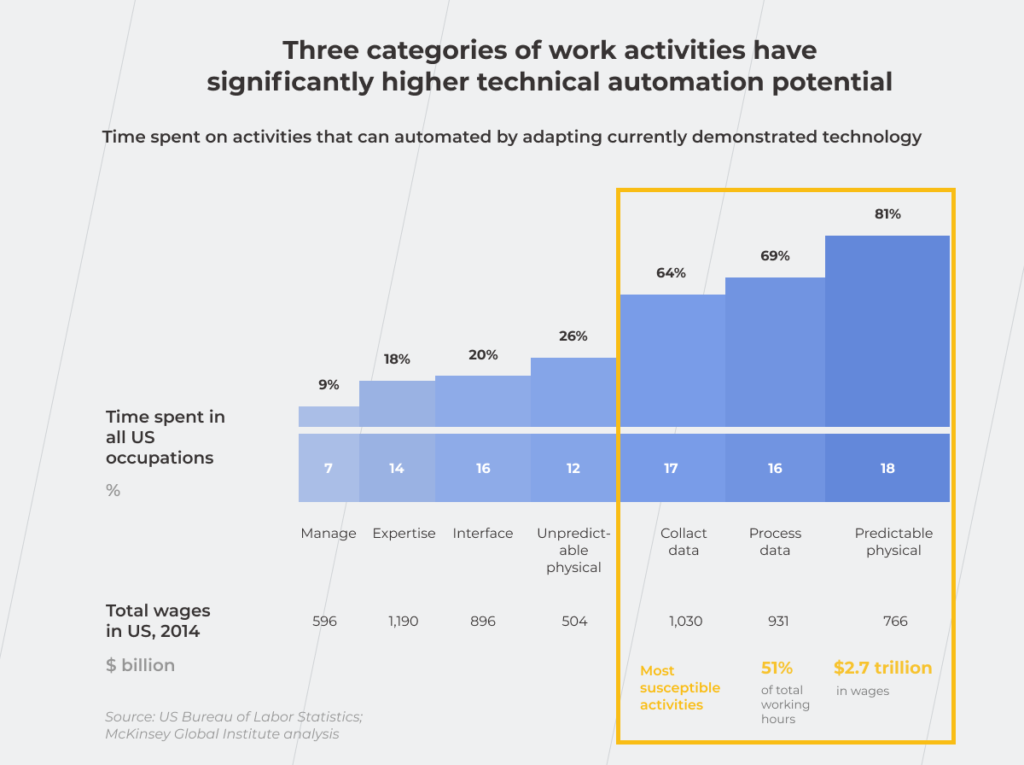
Accurate processing and collecting data, improved analytics

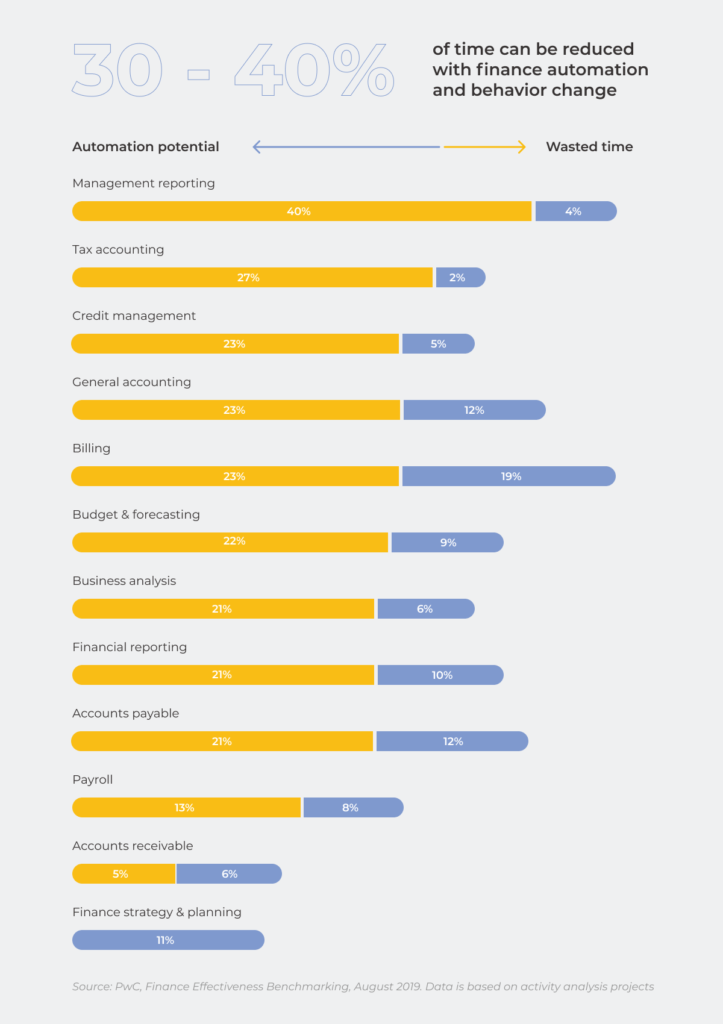
Collecting and processing information can take up a lot of working time. On the bright side, they also have the highest automation potential compared with other time-consuming activities. 

technical automation

Other operations that relate to data, such as data entry, verification, management, sorting, cleansing, integration, and migration can also be simplified thanks to the process automation. 

For instance, during data collection, the main advantages of RPA are accuracy and elimination of human error. At the stage of data cleansing, RPA helps automate data deduplication, data monitoring for anomalies, and data migration between disparate enterprise applications.

Here’s an example of how RPA can be used to improve the analytics of an e-commerce solution: 

Bots collect information about the customers, such as the amount of money being spent, buying habits, etc. to help you personalize customer experience. During the stages that follow data processing, automation can be used to analyze the data, build reports, and compare information from them with the store’s product inventory. Such an approach will help facilitate and accelerate the work of the sales and marketing teams.

RPA technologies also provide organizations with a bonus benefit — task execution data that can enhance analytics. It’s useful for uncovering hidden patterns and drawbacks in your business processes to find an appropriate way to optimize the supply chain. Also, bots notify you about the exceptions they cannot handle within their algorithm during task execution so that you can more efficiently ​​develop the BPM strategy. 

Compatibility with existing systems

Let’s take a real-life example from the healthcare industry. Clinics have Electronic Medical Records (EMR) with patients’ medical history and treatment. They also have Clinical Decision Support (CDS) systems that help doctors predict drug interactions and prepare diagnoses for patients by analyzing data from various systems, including EMR. So it’s crucial to organize an error-free data flow between these systems. RPA technology handles this task faster and more efficiently than a human, who can make mistakes when copying data from EMR to CDS. 

A bot copies human actions. This means it acts just like a human would. With one difference, the technology operates according to a well-designed algorithm and doesn’t make mistakes. It’s also important to acknowledge that it completes these operations even outside business hours. As a result, organizations process data faster and don’t need to replace or reengineer existing systems when implementing RPA because this technology isn’t built into them but layered on them — you can adjust processes in a blink of an eye, and start taking advantage of their agility and efficiency straight away. Such an approach allows companies to adopt process automation in a non-interruptive way, which makes RPA unique among other types of automation. 

Increased productivity and higher efficiency

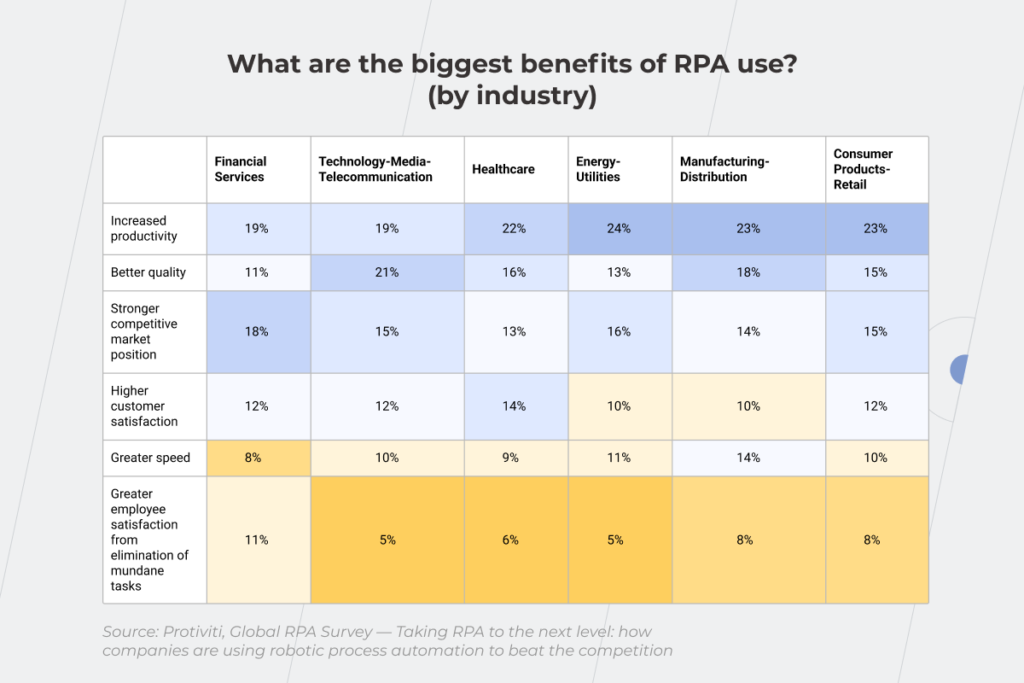
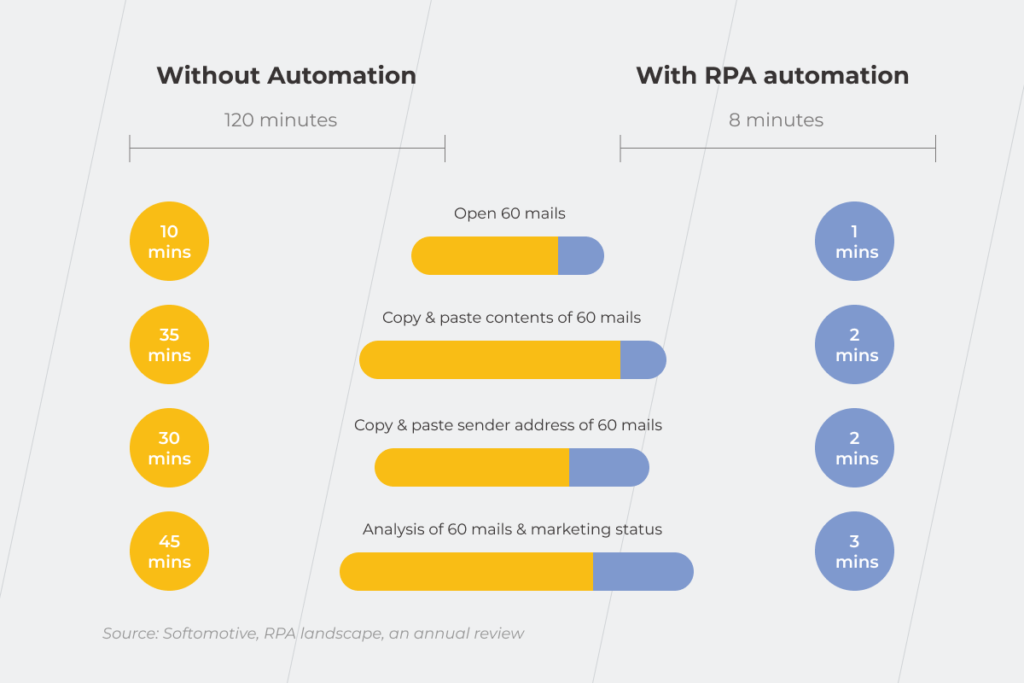
Productivity is the most noticeable benefit of RPA implementation in any industry, which is not surprising at all. Bots can complete operations more quickly than people, and often at a lower cost. 

RPA benefits

It’s hard for humans to compete with a technology that doesn’t need sick days and vacations and works 24/7. Luckily, there’s no need to measure up. Instead, your staff can use their time and talent for tasks that robots can’t handle. Combine the capabilities of people and machines to obtain better outcomes. The PwC Finance Benchmarking Report reveals that you can save up to 40% of working time thanks to automation. Take eBay with its complicated accounts system as an example. Creating a month-end financial close report manually took up to 10 days, and after RPA adoption this time decreased to three days. Now imagine how helpful RPA technology can be in banking when coupled with another powerful technology such as business intelligence. 

automation potential

When the robotic part of the work is done, the document is reviewed by the person responsible for its preparation. So, adopting automation doesn’t mean you can fully replace an employee with an RPA technology. However, it allows you to free your staff from boring, monotonous operations and use their abilities for advanced tasks where RPA fails. 

RPA automation

Higher security level

Speed is the cornerstone of successful defence against cyberattacks. The faster you identify an invasion of your system, the faster you’ll deal with it and minimize its influence. CISOs and security leaders who were the respondents of the EY Global Information Security Survey stated that they’d seen a clear rise in attacks over the previous 12 months. RPA implementation is a way to cope with this situation because the technology speeds up threat identification and response processes. 

Even if an attack occurs, RPA helps mitigate its impact, creating backup copies of core processes in case of the system’s shutdown is another function that bots perform. They record even small actions with data, so that you always have complete audit trails with every click logged. This way, later it’s easier to find out which part of the system was the weak link and strengthen it. 

RPA contributes to improving security, but human experts still play a key role as most organization would prefer their security analysts to make the final calls about security issues, not a machine. When it comes to shutting down a critical server, who would you trust with the final decision-making — an RPA bot or a person?

Better regulatory compliance

For some industries, being compliant with regulations is vital. For example, high compliance level is a compulsory condition for healthcare where organizations should meet a variety of standards, such as HIPAA, HITECH act, PSQIA, etc. as it’s a matter of profitability, reputation, and legality. In these cases, working without specific software that ensures all the requirements are met is impossible.

The undeniable RPA advantage is that it facilitates business processes in heavily regulated environments. RPA bots are worth looking into as you can hard-code compliance checks in their logic to prevent the possibility of data breaches. The collateral damage for HIPAA violations that vary from $1,000 per mild accident to $100,000 for serious breaches.

Improved customer experience

Customer experience is one of the main areas of competition right now. If you failed to attract a client via a couple of touch-points, then consider you missed them. RPA is exceedingly important in retail, where 63% of consumers expect businesses to know their unique needs and expectations. 

For claims processing, the results of automation adoption are tangible indeed. The faster the reaction to a claim is, the higher customer satisfaction level will be. Think of it in numbers:

Simply checking the claim’s status takes about 85 seconds of the employee’s time. And how many claims do you get every day? Multiply those 85 seconds by the number of requests — that’s how much time your staff waste on a primitive mechanical task. What if you automate this part of the operation to speed up claim processing and give the employees more time to get to the bottom of things and meet customers’ expectations? Care1st Health Plan Arizona also thought about it and decided to use RPA advantages in their practice. The technology allowed the organization to process 20 requests in 1 minute. On a workday scale, such an approach reduced 8-10-hour work to 1 hour. With this approach to improving customer experience, clients get the information they need quickly and easily, and become loyal customers who can recommend your organization.

If it comes to the financial benefits of RPA implementation, McKinsey states that replacing humans with bots for 60-70% of operations related to claims processing leads to a 30% reduction in claims processing costs. 

RPA also helps you personalize the customer experience. For example, in the education sector, you can use robotic algorithms to determine which teaching methods are likely to work on each student.

Increased employee satisfaction

When your staff is engaged in high-value work, which requires a deep dive into the issues surrounding the topic, switching to small routine tasks can give the brain a break — no one can be equally efficient all day long. But what if dealing with those mundane operations takes up most of your employees’ time, slowing them down and hindering their productivity? Will they be satisfied with groundhog-day-like work? Deloitte’s report indicates that 42% of employees who plan to leave their current employer don’t believe their talents and abilities are being used effectively and don’t find their work worthwhile. And being buried under the flurry of repetitive mechanical actions is one of the reasons for it. RPA takes over mundane repetitive operations and helps to keep highly-qualified employees focused on meaningful tasks. 

Since RPA software is user-friendly and flexible enough to allow non-technical employees to adjust the software to their needs, you gain one more advantage of the RPA adoption — it decreases the workload of your IT department.

RPA in business is a way to boost your productivity while decreasing costs

Robotic process automation is a key enabler for digital transformation initiatives within any industry. Implementing RPA you kill two birds with one stone —speed up routine operations and keep your employees engaged in meaningful tasks. The business value of such changes is also obvious — cost savings by industry vary from 40% for operational tasks in manufacturing to 30-70% for processing activities in the banking sector. The general trend is clear — RPA adoptions meet or even exceed expectations in cost reduction for 81% of organizations that have implemented the technology.

Wondering how far you can go by adopting RPA in your business?

Reach out

FAQ

Why do businesses need RPA?

If you think you don’t need RPA, it means you are ready to give up on a number of opportunities this technology offers. RPA helps achieve process standardization, higher efficiency, better security level and regulatory compliance, increased customer experience and improved staff satisfaction. The cherry on top of the cake is cost reduction. If you want to get more by spending less then you need RPA. 

What companies benefit from RPA?

RPA plays an essential role for organizations that want to streamline their processes while reducing their costs. But adopting robotic process automation is especially valuable for industries that have to meet regulatory requirements, such as healthcare and fintech.

How to Implement a Sales and Operations Process: 6 Business-Critical Steps to Take

‘How to implement the S&OP process?’ should be one of the most critical questions that companies ask. Here’s why.

Managing supply and demand is a notorious hurdle for many businesses, which requires finance, sales, and operations to work in close cooperation. In today’s uncertain political and economic climate, the synchronization of supply and demand has gained even more importance. 

Sales and operations planning enables companies to improve their visibility into short-term and long-term demand as well as supply trends while proactively managing the potential challenges that come with unpredictable events. Through S&OP, businesses can develop strategies to ensure they are prepared for any possible disruptions in the supply chain or unexpected changes in customer demands.

In this article, we will discuss what effective S&OP looks like, how to implement S&OP process, outline common adoption challenges and solutions, and discuss the benefits of sales and operations planning. 

What does an effective S&OP process look like?

S&OP process

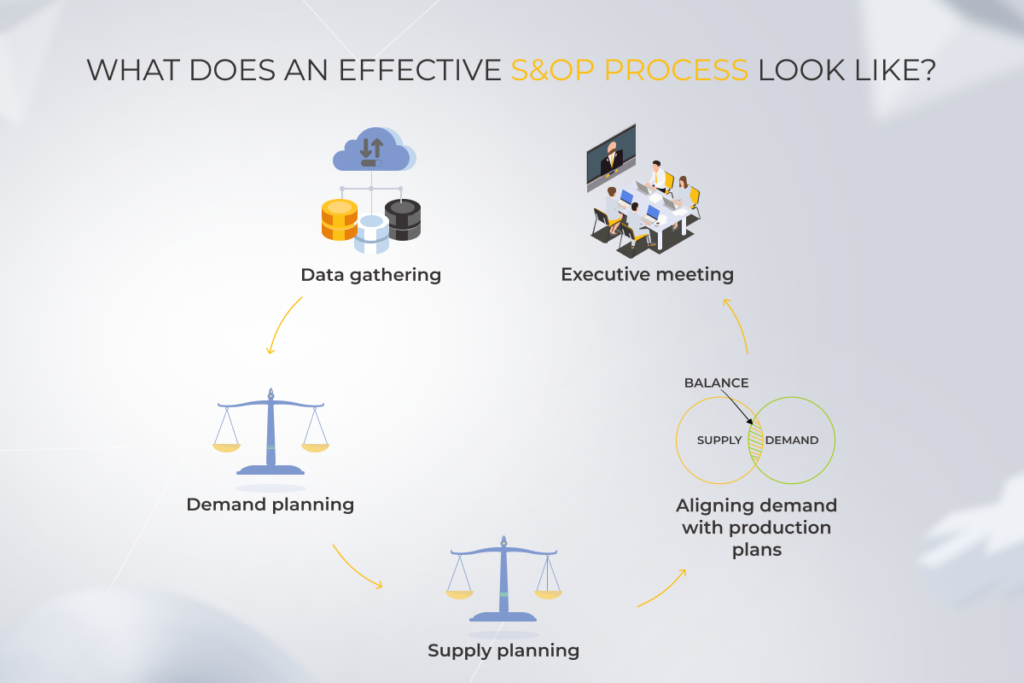
An effective S&OP is critical to success in any business. It helps organizations coordinate, plan, and optimize their operations across all departments to align demand with production and manage costs and inventory levels.

Here is what an effective S&OP process consists of: 

Data gathering

It would be great to have all the data you need in one place, right? For instance, information from internal and external sources, such as customer orders, market trends, sales forecasts, and production plans. But unfortunately, it does not work like that. In 99% of companies, analysts should consolidate this data from many sources into a single analytics platform to ensure accuracy and uniformity.

Demand planning

With the data gathered, businesses can create accurate demand forecasts to better understand customer needs and expectations, which will allow them to anticipate how much inventory they should have on hand at any given time.

Supply planning 

Businesses need to plan for the raw materials, production capacity, and labor required for each order or product line to meet customer demand. This will help the organization anticipate any potential supply issues and find solutions to prevent disruptions.

Aligning demand with production plans

An S&OP specialist must take into account capacity constraints, production lead times, and resource availability when creating a plan of action for each order or product line, ensuring that customer demand is aligned with production goals. 

Executive meeting

This critical stage brings together decision-makers from across all the departments to review the data gathered, forecasts generated, and plans created during the enterprise sales and operations planning process. Thus, they can assess whether current plans are on track to meet customer needs while adhering to budget and resource constraints.

What stands in the way of solid S&OP? The main challenges to address

The implementation of S&OP is a complex process that can be hampered by various challenges that organizations may encounter along the way. In this section, we will explore some of the common issues associated with S&OP implementation. 

Inadequate strategizing

A poor strategy is one of the most recurring problems in sales and operations planning. Without a thorough understanding of the current capabilities and the capacity to expand, businesses will hardly come up with feasible plans that will meet customer demands. Additionally, organizations have to consider factors such as labor availability, budget constraints, supply chain disruptions, and seasonality when strategizing for an S&OP process map. 

Lack of understanding and support from the stakeholders

Lack of support from the primary stakeholders is another common issue faced in S&OP implementation. Businesses must ensure that all decision-makers are on board with the process and understand its importance for success. Most importantly, organizations should leverage data visualization to help stakeholders better understand the implications of their decisions.

Insufficient visibility and transparency across departments

S&OP success heavily depends on communication and collaboration between departments. Without visibility into all the departments’ operations, businesses cannot create plans that align with their overall objectives. That is why it’s paramount to facilitate cross-department operation visibility by maintaining up-to-date data and granting the necessary level of access to appropriate digital systems for everyone involved in the process.  

Complicated process design

Paradoxically, complicated process design often arises from our inherited desire to optimize operations and make them more efficient. Accounting for all the exceptions and nuances in the  S&OP process often leads to more complications than efficiencies. Rather than attempting to make an overly complex system that covers all possible scenarios, prioritize what is essential for success and build on that foundation. Any non-essential requirements can be built upon over time as the process matures. When designing S&OP, make simplicity a priority. 

Lack of technologies that support the process

To maximize the potential of S&OP, businesses must have access to the software that can facilitate data gathering and analysis, such as enterprise resource planning (ERP) or supply chain management (SCM) systems. Without these tools, businesses lack the ability to accurately assess customer demand and plan for resources.

Ready to reap the benefits of S&OP?

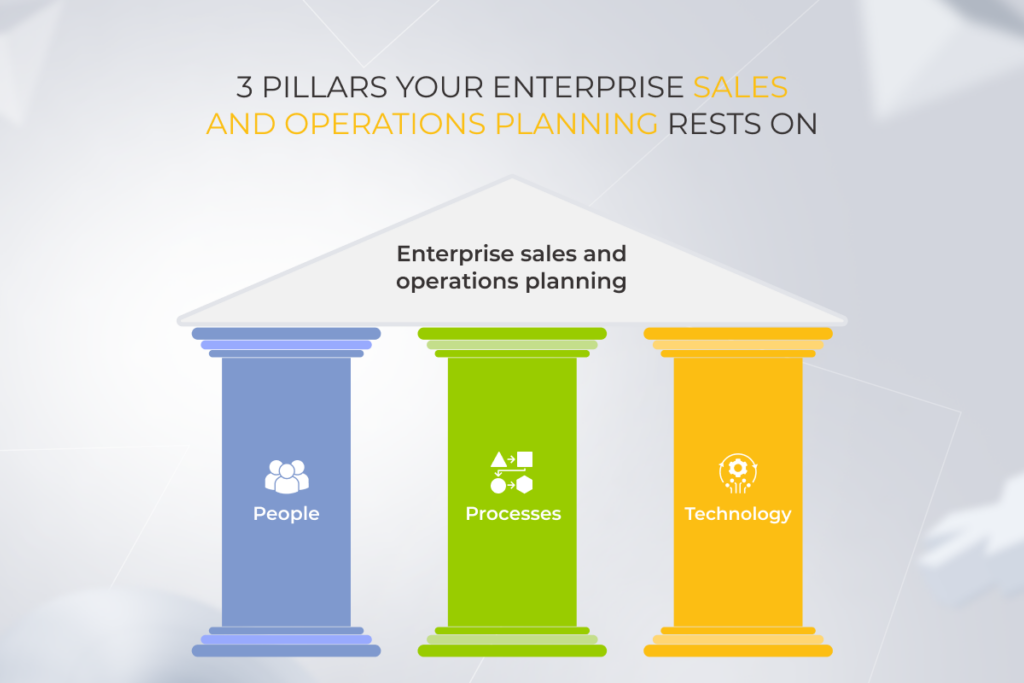
3 pillars your enterprise sales and operations planning rests on

enterprise sales and operations planning

In a way, the end goal of establishing a solid S&OP process is not about finding the perfect balance between sales and operations but ensuring that people, technologies, and processes are so in tune with each other that sales and operations align naturally. 

  • People 

Successful S&OP leans on stakeholder buy-in, cross-functional engagement, and continuous negotiation. Getting support from key decision-makers is vital to creating a unified process with everyone on the same page. A fully invested chief demand officer, along with other members of the C-suite, need to step to the forefront and clearly communicate vision and a sense of urgency to all relevant staff. 

  • Processes

In a nutshell, processes need to be driven by data. Process design should stem from quantifiable and measurable information rather than be based on a generic template. Value-adding S&OP is about coming up with multiple scenarios and strategizing for each of them. Again, making multiple long-term decisions in advance is possible when the right people have seamless access to advanced analytics tools. 

  • Technology

Ensuring that your software systems are correctly configured and seamlessly integrated is as important as defining roles and establishing operations. Successful S&OP hinges on access to real-time operational data presented in an easily-digestible format within one platform. The right technology infrastructure is also a key enabler for fruitful collaboration, as everyone makes decisions based on the same set of inputs. 
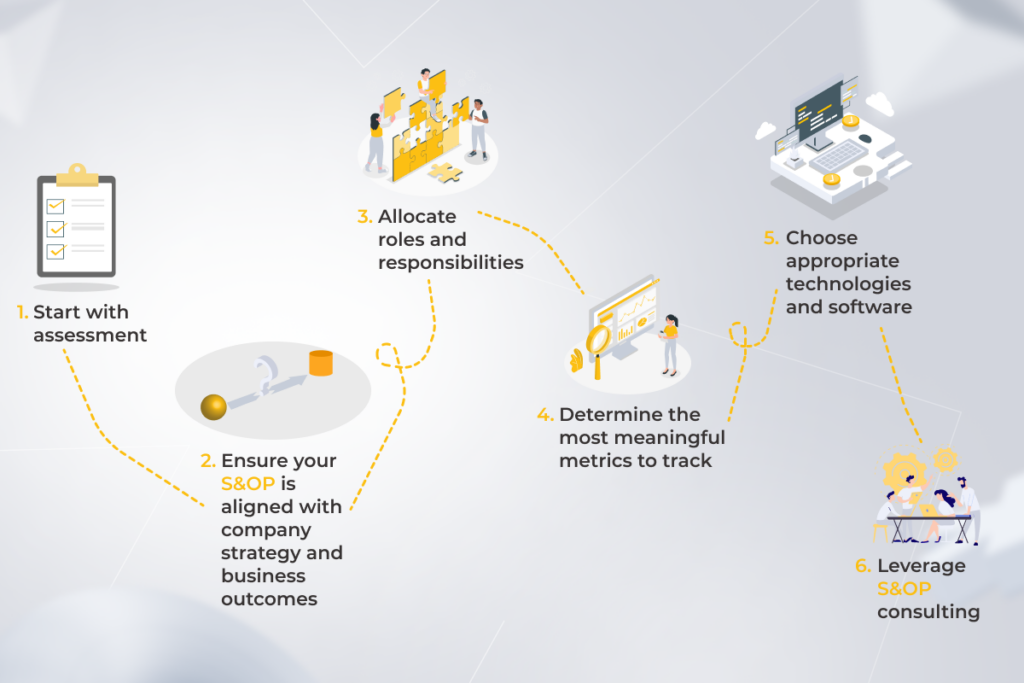
6 STEPS ON HOW TO IMPLEMENT AN S&OP PROCESS

Now that we have discussed the challenges and identified the three pillars of successful enterprise sales and operations planning, it’s time to dive into the details of creating an S&OP roadmap. Here’s your step-by-step guide on how to implement an S&OP process that yields tangible results.

how to implement an S&OP process

1. Start with assessment

Universal to many other technology and process implementations, it’s essential to create a common understanding of the ‘as-is’ situation in the beginning. The current state of your processes should be defined both qualitatively and quantitatively. Qualitative assessments involve evaluating the existing processes and structure within your organization, while quantitative assessments require measuring the performance of existing activities. It’s as important to define product hierarchy as it is to survey key decision-makers and identify their pain points. 

2. Ensure your S&OP is aligned with company strategy and business outcomes

Once the current state is properly evaluated, it’s important to tie S&OP processes to company objectives. This should include customer service goals, supplier and partner relationships, pricing objectives, and production/manufacturing capabilities. Forming synapses between sales, operations, and finance teams is instrumental to making sure that everyone is working toward the same goals. 

3. Allocate roles and responsibilities

Too many organizations struggle to unlock S&OP’s potential because there is no clear understanding of who does what. Each party needs to be aware of the role they play in S&OP and can regularly communicate their insights. Having well-defined roles and responsibilities helps establish ownership and accountability of the S&OP process. This can be further enhanced by establishing regular reporting cycles and outlines on how to best utilize data sources.

4. Determine the most meaningful metrics to track

Next, you should make S&OP performance measurable by defining the most meaningful metrics. These metrics should be defined based on the overall business objectives; for example, if customer service is a priority, then inventory levels and order fill rate are likely to be tracked more closely than production costs. Here are some other examples of important S&OP metrics: 

Forecast accuracy 

The accuracy of your demand and production cycles is one of the most important metrics to consider, as it communicates the success of your planning efforts. 

On-time delivery (OTD) to the customer

OTD is defined by the ratio of products delivered on time to total deliveries made over a specific period. OTD indicates the efficiency of your supply chain and is closely correlated with overall customer satisfaction. 

Production plan adherence

The adherence to the production plan reflects how closely the production output follows the planned production. This metric can help expose production bottlenecks, tighten delivery windows, and determine how well the machinery is performing. 

5. Choose appropriate technologies and software

According to an APQC survey, almost 70% of S&OP professionals consider technology to be a mission-critical part of the success of S&OP initiatives. Choosing the right technologies and software is vital for gathering and analyzing pertinent information and reaping the most benefits of sales and operations planning. 

Cloud computing

Having cloud capabilities in place allows organizations to easily collect, store and analyze the data necessary for effective S&OP decision-making.  Cloud computing also offers scalability advantages over traditional on-premises solutions, making it easy for companies to expand their storage needs or quickly adjust capacity as business conditions change.

Business Intelligence  

In general, business intelligence is the most critical component of S&OP. It enables organizations to track KPIs, access important data at the right time, improve prediction accuracy, model scenarios, and improve visibility into your processes overall. With comprehensive data visualization solutions, BI becomes more accessible and further facilitates data-driven decision-making. 

Artificial intelligence and machine learning

​​The combination of AI and S&OP can significantly improve prediction accuracy and help organizations consider market trends, consumer patterns, and external factors when making decisions. Additionally, AI can be used to automate administrative processes such as sales order approval, enabling S&OP teams to focus on more important tasks.

IoT

Incorporating the IoT into S&OP can give companies an unprecedented level of detail and visibility into their operations. With IoT, companies can remotely monitor inventory levels across multiple locations, track delivery, and proactively plan for future demand. In most cases, adopting IoT usually calls for unique technological infrastructure, which is why many organizations opt for custom enterprise application development. This allows businesses to integrate IoT with other technologies into a single system. 
ERP and SCM 

ERP and SCM systems are fundamental to enterprise sales and operations planning, as they ensure a comprehensive view of the entire supply chain process. ERP solutions enable organizations to track demand and optimize inventory management, manage customer orders and deliveries, integrate logistics operations, and monitor transportation costs. SCM systems provide organizations with important information about order-to-cash cycle times, product lead times, and delivery performance. Essentially, ERP and SCM gather crucial demand and supply data that is essential to S&OP success. 

6. Leverage S&OP consulting

Filled with many intricacies, S&OP implementation should not be taken lightly.  Quite the contrary, it’s an integral component of technology-enabled business transformation that enables organizations to gain economies of scale, drive efficiency, and increase customer satisfaction. To guarantee the success of the initiative, it is critical to work with a reliable S&OP consulting and technology partner who will guide you every step along the way.

Build resilience in times of upheaval with well-thought-out S&OP

Having an effective S&OP process in place helps organizations to gain better visibility into their supply chain, reduce costs, and make decisions that are informed by data rather than based on simple hunches. With the right strategies and technologies for managing uncertainty due to external factors, such as pandemics or shifting regulations, businesses will be able to remain agile and resilient in the face of change.

Ultimately, a well-planned S&OP process contributes to an organization’s overall success. To achieve maximum benefits from S&OP initiatives, companies must address all the key components outlined above and implement appropriate technology solutions that enable efficient decision-making across all levels of the organization.

It’s time to reinvent your sales and operations processes

Business Process Transformation: The Ultimate Guide on Accelerating Out of Crisis

Business process transformation is the key for companies to gain an edge over the competition and create new sources of value.
In response to the anxiety-provoking combination of war in Europe, soaring inflation, and energy crisis, companies might be tempted to turn on a survival mode. However, this single tactic will hardly protect them from the continuous changes coming their way. Companies that pay too much attention to temporary defensive initiatives risk neglecting activities essential to gaining ground on rivals, reaching long-term objectives, and even getting some unexpected immediate triumphs.

Today, the business process transformation framework is what can take you from stagnation to revitalization and help you safely transition into the future. But how can you make this shift? Let’s find out.

stages of business transformation

What is business process transformation?

Business process transformation is an integral, holistic, and long-term endeavor that involves the complete modernization of a company’s IT backbone and associated business processes. The business transformation process model also triggers cultural shifts in the mindsets of both decision-makers and employees to alter the way a business operates on a cellular level.

Why do the majority of transformational projects fall short?

The gap between expectations and the outcome of technology-enabled business transformation is often enormous. A discouraging 52% of companies stated they missed their target. The high failure rate of the business process of digital transformation stems from multiple pitfalls.

1. Poor strategizing

Although implicitly understood by executives, a company’s strategic objectives are sometimes poorly translated into implementation choices. This leads to diluted value and hampers a successful business transformation.

2. Lack of skills

Lack of skills. While having the right talents on board and effective workforce planning results in a 10% increase in productivity over five years, 90% of company leaders admit that recruiting and allocating top talent to support the digital technology behind the transition remains a challenge.

3. Inability to grasp the business problem

Inability to grasp the business problem. Poor requirements gathering at the planning and targeting stages of the transformation business process is the reason behind 39% of failed projects. It means that transformation initiatives lack solid business analysis, as a result, failing to identify areas of improvement, the scale of change, risks, key performance indicators, and other precursors of the new business strategy. A lack of a feasible use case also increases the risk of scattershot resource allocation.

4. Inefficient investment

Unlike traditional operational and capital budgets, the budget for business process improvement is a flexible figure with many unknowns. Without a predictable budgeting model, companies may end up pouring more budgets into standalone software or any other innovative solution with a low impact on desired outcomes.

5. Change fatigue

Change fatigue. Around 39% of employees experience resistance to organizational changes, which negatively impacts employee buy-in during any transition. This change burnout can result either from low workplace morale or poorly communicated value of transformation initiatives.

The pitfalls we mentioned above tend to fracture your transformation success. However, it’s something else that breaks it.

Set up your transformation for success

Contact our experts

Which is more critical in delivering value for business: process transformation, technology implementation, or the cultural shift?

To get the business process transformation model right, you need an integrated approach that links business strategy to transformation ambition to execution discipline and all the way to employee engagement. 

While tangible value can be achieved through measurable process optimization, employee buy-in is supported by effective change management and incremental mindset shifts. Therefore, business process management and digital transformation rest on three equally important pillars: process redesign, technology enablement, and a clearly communicated vision across the whole company. 

Process optimization

Optimized processes lead to optimized business goals and increased organizational efficiency, setting the stage for disruption-free changes. Optimizing a process also presupposes automating key repeatable aspects of that process and removing bottlenecks. 

In this case, technology consulting emerges as a strategic partnership for a company that aims to improve operational agility with automated and governed workflows. We’ve curated common business process transformation examples that can be achieved with automated processes.

AreaOptimization at workOutcome
FinanceAutomated month-end reporting
Finance data management

ERP systems implementation
Real-time analytics
Faster and more reliable reporting
Better regulatory compliance
Faster finance decisions

Minimized risk and instantaneous decision making
Sales and marketingClient segmentation

Email automation
Dedicated CRM platform

Sales forecasting
Insights into cross-, up-, and re-selling potential
Lead nurturing
Targeted offers and granular marketing initiatives
Streamlined cash flows and demand-driven production planning
Logistics operationsSmart warehouse system

Automated inventory management
Integrated order management

Data-driven resource allocation
Cost cutting and operation visibility
Real-time insights and asset tracking

Simplified sales process 
Talent managementAutomated employee performance

Streamlined onboarding 

Internal innovation hubs
Easier progress tracking and increased employee satisfaction
Better document management 

Reduced costs of training

Technology enablement

At-scale technology implementation is among the main levers of business process transformation. CIOs can drive real, technology-driven change based on a more flexible, modernized infrastructure that adjusts to the evolving business needs and markets. 

Business transformation tools in a digital era include, but are not limited to:

  • Cloud-based solutions reduce the costs of data processing, promote business continuity, and ensure easier scalability and access to innovation.
  • Enterprise applications increase the portability of mission-critical data and amplify collaborative workflows.
  • Integrated data analytics, business intelligence, and visualization tools inform business decision-making in near real-time and help companies identify the correlation between operations and results faster.
  • AI-enabled process automation increases the ability to scale, streamlines manual tasks, and reduces operational costs.

However, technology can only deliver anticipated value if it is designed to help you solve your business challenges from the start. On that same note, you don’t have to inject money into complex custom solutions at the onset of your transformation. An experienced technology partner can make standard solutions work for you by customizing them to your needs.

We make the most of generic solutions by customizing your options

Reach out

The involvement of employees

People are your strategy in motion. Employees’ mindsets are ingrained by past management practices and cannot look into the future. Yet, paradoxically, people are also the organization’s most underestimated asset. Only 50% of employees are satisfied with the resources they have at their disposal to learn how to use new technology. 

To galvanize employees during the leap, business leaders should provide ongoing internal opportunities to upskill and reskill. This will help staff to build up adaptability as an evergreen competency and reduce change anxiety. Having training, documentation, and subject matter experts also eases the strain on employees and helps them better adapt to new settings.

Organizations at the transition stage should also think of employees as the end users (or stakeholders, if you will) of transformation. Knowing exactly how your employees will interact with and use new tools and how new technology will help them drive superior performance is essential to a successful digital transformation.

What to start with? First business process transformation steps

The right performance transformation efforts should have an all-in agenda. They cut across business units and functions, have a dual effect on both the top and bottom lines, and engage the workforce.

However, all great things start small, and so does the path to a successful business process transformation.

Spot gaps and inefficiencies

You cannot improve what you can’t measure. To improve your company’s performance, you need to know exactly what to work on and have a clear understanding of the current business situation. 

A solid performance gap analysis will help you define what aspects are lacking in the performance of your company in comparison with your competitors and industry benchmarks.

When you are well aware of your current business posture, you should proceed with setting S.M.A.R.T. goals for your destination. Goal-setting will enable you to locate specific objectives that can be achieved in a 1-2 year horizon, thus creating lighthouses that can be scaled later.

value-complexity matrix for a business transformation initiative

A properly executed performance gap analysis and informed ambitions provide a starting point for developing a plan of action. If you’re struggling with any of these planning activities, our experts will provide you with a vantage point by conducting a step-by-step gap analysis based on best agile practices.

Create a strategy

A holistic and well-defined strategy is one of the main drivers of the transition’s momentum that helps shape an achievable transformation ambition through actionable guidelines.

A plan of action, in this case, is premised on accurate resource allocations, business evaluation, metrics, and bottom-up planning. Organizations that have invested in articulating their strategy can then translate strategy into an incremental delivery plan with defined roles and measurable outcomes.

Business transformation strategy implementation

Estimate your resources

And the trickiest part? Breakthrough projects must be performed and delivered under specific constraints. Likewise, resources are one such constraint that should be strategically and dynamically shifted. 

Whether it’s reallocating existing assets (talent, technology, and investment) or injecting new ones, organizations should prioritize areas where resource boosts would generate the greatest impact for the transformation. Therefore, business leaders should start by assessing the profitability and resource projections for every meaningful business cell.

If companies do not have enough expertise to assess the value creation potential, they can turn to third-party business transformation analysts to find ROI outliers and determine the right magnitude of action needed for a shift. 

We, at *instinctools, help companies drive technology-enabled business transformation with a consistent transformation strategy, thorough gap analysis, and effective employee training.

For those who want to accelerate maximum business value from their transformation initiative, in one of our upcoming articles, we’ll share *instinctools’ unique approach to make it happen.

A real-world example of how transforming a single process flipped the script in our client’s SDLC

Instinctools’ client, an EdTech company, initially low-prioritized software testing of their SaaS learning management system (LMS). However, several years post-rollout, this decision led to unstable, underperforming, and costly-to-maintain software. Therefore, they decided to make quality assurance a mandatory pre-release step to level up solution quality. 

First and foremost, our team of QA engineers set up a clear workflow for various types of manual functional testing, a mandatory step to ensure a hiccup-free transition to automation. This solid groundwork helped us cover 85% of the LMS functionality with automated tests, empowering the client to:

  • Nip x40 defects in the bud stages of SDLC
  • Cut bug repair costs x160
  • Speed up development cycles x5 

Go into the project’s details

Read the case study

Make the leap, take the lead

In a business environment, change is inevitable, but growth is optional. Business process digital transformation allows organizations to embrace, govern, and benefit from this change. A business transformation arena unites each organizational, institutional, and digital effort into a cohesive and agile organism to foster groundbreaking overhaul in processes, IT infrastructure, and business culture.

Done right, this collective effort can help a company to adopt a “better, faster, cheaper” approach and accelerate the pace of decision-making at optimized costs. However, this leap requires solid groundwork manifested in a transformation strategy, effective resource allocation, and training programs. Miscalculating any of these components can lead to insolvency, instead of business-led growth.

Embarking on a transformation journey?

Secure the right talent

Cloud ERP vs. On-Premise ERP: Which One Wins the Duel?| Expert’s Opinion

Over the last few years, ERP systems have become imperative for streamlining enterprise operations and maintaining business resilience. The pandemic-induced shock has also contributed to an upswing in resource planning software. As a result, the global market of ERP digital solutions is projected to hit over $93 billion in 2028. But while the bright prospects of ERP systems are statistically proven, the dilemma of cloud ERP vs on-premise hosting remains unsolved.

Each option has its advantages and limitations, and you have to find a balance between a bunch of factors. You need to consider the cost of ERP ownership, your requirements for system performance, its customizability, and many more. In this article, we’ll look at these and other main debating points of cloud ERP vs. on-premises ERP through an expert prism.

Key considerations before going for cloud vs. on-premise ERP

According to Accenture, around 58% of companies prefer private or public cloud-based ERP systems. On-site platforms make up 25% of all ERP software. While these figures may already suggest the winner, the choice of cloud vs on-premise ERP depends on a whole range of factors.

Cost of ownership

Comparison table on cloud ERP vs. on-premise ERP costs of ownership

The question of costs is one of the first to surface when debating cloud ERP vs on-premise one. Cloud-based enterprise systems can be purchased and governed without large upfront costs. Cloud users are charged a recurring fee which can go up or down based on the resources used and the number of users.

Operating expenses such as infrastructure maintenance, recovery, updates, and others lie on cloud providers as well and are distributed among all cloud adopters. It means that cloud-based ERP software translates into total cost-of-ownership savings thanks to the shared business model.

Moreover, the absence of additional IT infrastructure costs for the cloud solution also contributes to the cost-saving potential of a cloud ecosystem. This has been highlighted in the TCO case by NetSuite, where small and medium businesses have seen lower overall TCO for a cloud-based NetSuite system compared to on-premise enterprise platforms.

Statistics on the four-year TCO distribution within cloud-based and on-premise systems

Conversely, local systems imply a higher initial investment for adopters. Companies also cover hardware costs, database maintenance, security, and other capital expenditures, all combined into a significant initial outlay. However, there are more and less cost-efficient options among on-premise ERPs. Let’s take SAP vs. Odoo as an example. When opting for SAP, you have to pay for maintaining servers and a license fee, while on-premise Odoo is license fee-free.

Therefore, cloud solutions are more affordable for businesses looking for a lower initial bid price.

System performance

Critical business applications must be available 24/7, making uptime and reliability paramount for enterprise business management systems. At first sight, cloud servers give odds to on-site systems due to automated monitoring, disaster recovery, easier back-ups, and downtime expectations which are the core prerequisites in cloud SLAs. 

Moreover, data centers scattered across different locations eliminate a single point of failure, making your data accessible even if one of the cloud servers shuts down. 

Unlike cloud-based solutions, with your data backed up by different instances, an on-premise system won’t work if your server crashes. Therefore, an on-site enterprise takes diligence and dedicated resources to ensure minimized downtime and stable performance.

Yet, distributed servers aren’t immune to unplanned outages, leaving business owners at the mercy of connectivity issues. And in this case, an outage or unstable internet connection can knock out your access to important files and enterprise applications.

Security

Companies seem to place a high degree of trust in cloud data security, with 48% of organizations storing their critical data in the cloud. Indeed, cloud ERPs come with in-built advanced security measures beyond what most businesses can afford. Role-based access controls, end-to-end encryption, threat detection, and other safeguards reduce the risk of a data breach or unauthorized data access for cloud adopters, and thus, minimize your data security concerns in general.

However, cloud-based solutions do not grant full control over your software and threat landscape. Also, if any sensitive data spills through the cracks, it’s the business that faces incurring costs and legal repercussions. Cloud misconfigurations also account for 15% of breaches.

With on-premise ERP applications, you are in charge of data governance and the entire infrastructure, which makes it possible to implement tailored security measures and meet strict security requirements relevant to financial institutions or governmental organizations.

Integration

Cloud ERP solutions offer rich integration capabilities that help connect software applications for better visibility and data interoperability. With low maintenance and easy deployment, companies can set up the cloud ERP infrastructure from a variety of stand-alone modules based on their business processes and needs. Odoo-based ERP solutions, for example, allow businesses to join a broad spectrum of business apps into a centralized well-integrated system.

But despite a plethora of integration options, cloud integrations are still tied to a limited number of connectors. Therefore, you might not be able to cover all the integration needs or establish a seamless connection with other internal business systems.

On-premise ERP solutions, on the contrary, bode well for bespoke integrations that do not need an Internet connection. Yet, on-premise data connectivity calls for a dedicated IT team and a significant one-time investment.

Customization

Cloud ERP vendors offer customizable innovation as paid a-la-carte options. Since around 85% of business processes are the same across companies, standard cloud modules and extensions meet the majority of customization needs and best business practices.

But despite their diversity, cloud extensions tend to be more rigid, especially when it comes to individual ERP deployment. The collection of unique design changes, e-forms, integrations, and system dependencies are impossible to take into account with the generic cloud approach.

Local platforms take the lead in terms of customizations since your development team can adjust your ERP system to internal processes. Yet, custom deployments and configurations come at a high cost and require rich tech expertise.

Let’s make your ERP a success together

Get in touch!

Control

Ownership of data is another big rub in the duel of ERP cloud vs on premises. Legal concerns, vendor lock-in, and unpredicted fees incur risks to business operations and a company’s well-being. Since the cloud provider can be legally considered a custodian of the data, your access to data assets can be suspended at the provider’s sole discretion during an investigation of any suspected violation.

On-premise ERP systems are based on single-tenancy infrastructure which keeps your critical data assets away from prying eyes. This way you have higher control over data configuration, security, and management because you can access the data physically. Full data control is especially important for mature enterprises with strict internal security standards.

Compliance with standards and regulations

Data governance and compliance issues have been plaguing cloud systems since the dawn of time. Over 50% of the companies struggle to meet compliance and audit requirements when employing Infrastructure as a Service cloud solutions. The root of compliance worries is often the shared nature of the cloud. Once an organization moves to the cloud, managing access controls or keeping an eye on the available compliance enablers becomes much more difficult.

But despite higher compliance risks, distributed cloud systems cover the majority of data protection regulations, including GDPR, CCPA, HIPAA, and others.

On-premise solutions help meet the evolving regulatory landscape thanks to full control over user access policies, security patches, and other compliance measures. Moreover, data localization regulations prohibit data from being processed in the cloud, making on-premise hosting the only option.

Updates

Dubbed better than on-premise software due to its flexibility, the cloud eliminates the hassle of maintaining software. Cloud ERP providers make sure you’re always running the latest ERP version with cutting-edge functionality, while your IT department can save the time and effort of installing new patches. However, the choice of updates is left to the vendor, putting you in a subjective position.

On-premise infrastructure makes updates more resource-intensive, yet grants full control over the choice of innovation.

Mobility and accessibility

Finally, ERP on premises vs in the cloud differs in how portable they are for users and applications. On-site platforms can usually be accessed locally. Remote access is only possible using VPN or remote desktop technologies. It can complicate the team’s collaboration and limit the accessibility of the system.

Conversely, the cloud is accessible from anywhere provided you have a stable internet connection.

To sum up the differences between both systems, we’ve curated the main differentiators in a concise table below.

On-premise vs cloud ERP compared

Comparing cloud ERP vs on-premise software according to a variety of criteria

On-premise vs. cloud ERP dilemma: three questions to ask

Along with the criteria mentioned above, there are additional factors that should guide your choice.

What project timeline can you sign up for?

Cloud resource planning software is almost a synonym for fast and easy implementation. On average, an experienced development team can get your cloud solution up and running within a few days to a couple of weeks. The specific timeline can vary based on your migration needs and system maturity. On-site infrastructure is more time-consuming since it is built from scratch.

Therefore, if you’re aiming for reduced development time, the cloud is a great tradeoff between fast deployment and decent customization.

Do you need a unique solution?

The next thing to look at is whether the ready-made functionality covers your business and development needs in full. Contacting a team of specialists is the easiest way to validate each building block for your cloud ERP system.

However, if your business vision runs counter to a ready-made suite, a custom on-premise infrastructure is the best way to fill in the functionality gaps.

Should your system be able to scale?

Usually, resource planning platforms do not have ambitions for rapid growth or high workloads. However, scalability is still important to help your enterprise systems adapt to the changing needs and demands of your business.

In this case, cloud elasticity can easily attend to your scalability needs. On-demand cloud scaling allows you to ramp up or down your IT resources without building out more hardware. Conversely, on-site software is more challenging to scale, since it requires additional hardware, CPU, RAM, or other boosters.

In terms of scalability, cloud infrastructure grabs the trophy as an easily scalable enterprise solution.

Cloud vs on-premise ERP: which one is right for you?

The best ERP hosting solution will be unique for each company based on the budget, time constraints, compliance requirements, and other prerequisites. Cloud ERP infrastructure is the preferred solution for a quick and easy take-off that doesn’t need a large upfront investment. Locally installed systems grant full control over your assets along with unmatched customization and integration options.

If you are struggling to choose between on-premise and cloud, our vetted experts are ready to help you make the big decision. We can also take over your deployment needs and set up an ERP platform fully tailored to your business requirements. 

Ready to build an ERP on time and on budget? Reach out.

CMO Priority in the Next Normal: Specify a Revenue Technology Team in Your Budget

Economic news shows tech giants are cutting back their budgets and staff, including highly coveted developers from product engineering teams. The marketing budget is suspected to face some headwinds in 2025 too. 

However, the most rewarding outcome arises from growth initiatives, not cost reduction, layoffs, or other slash-and-burn strategies. So now’s not the time to curl up in the fetal position. Instead, let’s be bold and build a revenue technology team.

So, what’s the best way to get ahead of the competition, while, given the economic situation, keeping costs under control? 

It’s high time to end the chaos and make massive gains in revenue again. The best place to start — your data. Chaos is caused by bad data. Bad data that should never have existed in the first place. Chaos, made by integrations that are no longer in use, SaaS subscriptions that no one touches, etc.  

But, when we dig deeper, we get to the heart of what that chaos really is: not having a clue as to where your next largest deal comes from or when it may arrive. Within all of the contacts you’ve collected and across all of the technologies being paid for, no one has the same answer of who is likely to become the next exciting customer and when to expect an even better deal. That’s the turmoil you feel every day. Unless…

A revenue technology team is a group responsible for your sales and marketing technology stack, aka MarTech. This might include a CRM, some call center software, an analytics tool (or three), a contact-information subscription, an email automation tool, etc. The revenue technology team’s job is to make more money sooner and cheaper through the use of technology, documentation, and training.

Do you want to know more?

Book a call

For revenue growth, they’ll vastly improve the identification of the very best prospects at the top of the funnel and then move those prospects to closure sooner and for a higher average dollar amount. What would a modest increase, let’s say 15%, in the average order value result in for your company?

Let’s focus on the savings. Imagine what more automation and more intelligence would do in terms of cost efficiency. Here are some examples:

  • What if you cut down your digital ad budget by 20% while surpassing sales goals?  
  • What if you reduced the number of screens and the number of clicks during an average support staff’s day by 50%? 
  • What if you could eliminate horrible customers by 90%?
Unveil the full revenue potential of your marketing and sales activities with a revenue technology team.

There are a ton of possibilities that are adding up fast. Here’s one more: what are the cost savings if you identified young affordable sales talent and promoted them to leadership positions, who teach even younger, even more affordable employees how to sell better? 

These are all real things people attain, which are critical for achieving scale no matter what the year is. The key to massive wins is having a holistic group of professionals working full-time on turbocharging your marketing and sales initiatives. The team basically looks like a software development squad. There’s a person to gather requirements from stakeholders, a person that codes within the platforms and integrates them with others, a person that does data analysis, a person to test the work, and someone to manage the process. Some of the roles can be combined, but you’re looking at a team of 3-5.  

And this small team has huge potential. By getting more money in the door sooner and for less cost and effort, they will provide the throughput needed to hit evermore challenging goals, is revenue throughput. There are two ways to increase throughput. You can either scrape away at the pipe’s walls bit by bit with a hanger you untwisted or install a bigger pipe. Seems like a no-brainer, doesn’t it? The latter option is much more favorable in terms of time and effort investments.

During any year-end, the time most suitable for setting new ambitious resolutions for the coming year, all CMOs should not only dream about, but advocate for a revenue technology team of their own. One that will not get sucked into product engineering and be obsessed with revenue operations. 2025 is no exception for this encouragement, and it’s a great year to highlight how a revenue technology team will improve the bottom line. 
Need a piece of advice?

Get a free consultation

How *instinctools delivers solutions – customers’ reviews

One of the most important factors in choosing the right web development company is making sure the two companies are on the same page. That means setting expectations and goals between your company and its web developers and making sure both sides envision the same end goal.

At *instinctools, we keep open lines of communication to make sure we are always on the same page as our clients. We keep full transparency with clients through daily reporting and deep involvement in the client’s processes.

A few of our clients have recently reviewed us on Clutch, a ratings and review website for B2B service providers. Client feedback is so important to us at *instinctools, which is why we are grateful for these reviews. We’re proud of our Clutch ranking as a top web development company in Germany.

One of our most recent clients was a nonprofit healthcare organization called CANet. We helped the organization with custom software development, including a mobile application with associated dashboards and web portals. This client wanted to allow patients and healthcare professionals to track the flow of patient information more easily.

Client testimonial decorative graphic

CANet gave us a perfect 5 stars and also noted that we actively suggested solutions for their company. At *instinctools, we always strive to be communicative and ensure that we’re meeting our clients’ goals.

The self-management healthcare app that we built for CANet was well-received at an industry event! We are going to continue on an IT project with CANet to optimize processes for patients and clinicians.

Read a full-text review from Dimitri Popolov, CANet Technical Lead, on Clutch.

Another satisfied client was Morebis, an advertising and marketing firm. We worked with them on app creation and development. An executive assistant at Morebis left the following review:

Second client testimonial graphic design

We are very glad this client acknowledged our professionalism, language proficiency, high-quality deliverables, and flexible pricing. Those are aspects of our business that we try to uphold, and getting that type of feedback helps us affirm that we’re doing things right!

There is another website called The Manifest, which is a guide for practical business wisdom about various B2B service providers. Of all the software developers in Germany, The Manifest lists us at the top!

You can find us on Visual Objects as well, where you can get a sense for some of the clients we have worked for.

We take client feedback very seriously, and we factor it into our business model so that we get better and better at what we do.

Contact us if you’d like to hear about how we can help your business grow with custom software/app/web development solutions!

Anna Vasilevskaya
AI modified real photo
Anna Vasilevskaya
Account Executive

Get in touch

Drop us a line about your project at
[email protected] or via the contact
form below, and we will contact you soon.