

Before AI agents became mainstream, large action models framed the idea of AI that acts – an action AI model capable of moving from user intent to real-world execution. Conceptually, LAM in AI represents a shift from language generation to autonomous execution, bridging the gap between understanding and action. Popularized by the tech company Rabbit, the term large action model (LAM) was never widely adopted across the broader AI community and carried a certain marketing flavor from the start. It emerged before frontier LLMs had multimodal processing, tool use, intent decoding, or task decomposition capabilities.
Still, even as the label itself faded from general AI discourse, the underlying concept became foundational to today’s agentic AI systems. Instinctools’ AI experts revisit this idea to assess which LAM capabilities have proven durable and practical in modern AI agents.
What is a large action model?
A large action model is an AI system capable of understanding natural language intent and autonomously translating it into real-world actions across digital or physical environments. The primary focus of a LAM (large action model) is to autonomously execute actions – completing tasks on behalf of the user. Building on the natural language understanding capabilities of Large Language Models (LLMs), interact with software interfaces, trigger workflows, make context-aware decisions, and adapt based on feedback and observed behavior. Unlike robotic process automation (RPA), which follows rigid, pre-programmed scripts, LAMs adapt dynamically to interface changes and unexpected scenarios.
In enterprise settings, LAM large action models function as autonomous agents that operationalize workflow automation, yielding quantifiable benefits, including reduction of manual cognitive and motor overhead, accelerated task completion, and more.
LAM may not be a fashionable term anymore, and current vendor consensus instead converges on a different framing – these systems are usually LLM-based agents, – but Rabbit, the one that put it on the map, never really left it behind. DLAM is their latest pass at it: a plug-and-play controller that carries out tasks on behalf of a user across their computer’s operating system, browser, and applications. They’ve also added voice integration with OpenClaw, a prominent brand in personal agentic AI assistance.
Don’t miss out on the agentic AI, transform your processes
Schedule a consultationLarge action model architecture: key capabilities to move from words into action
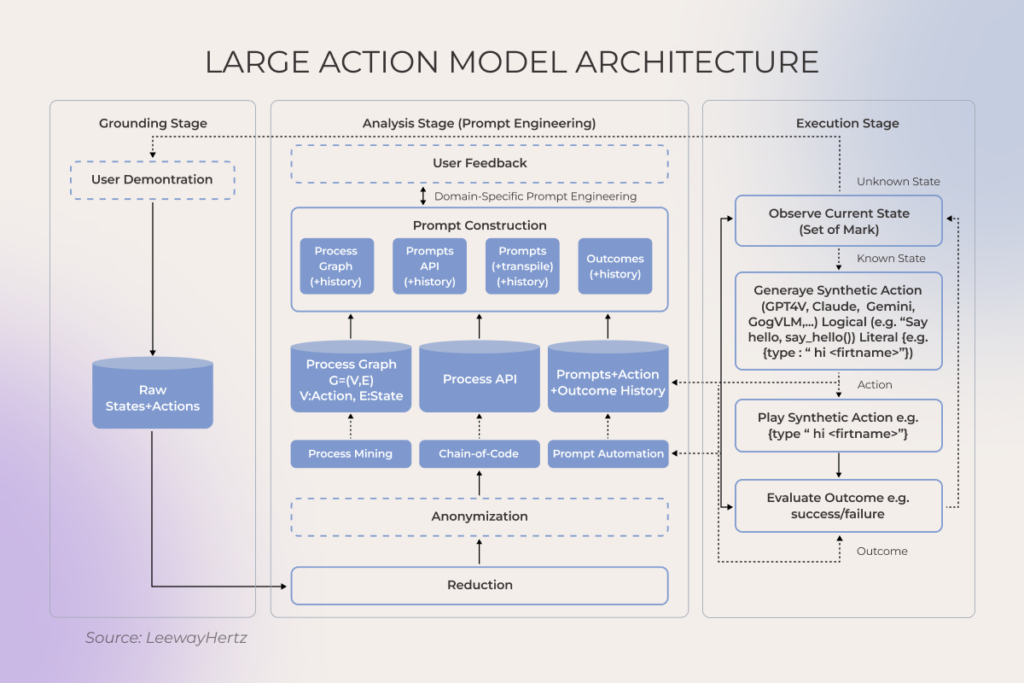
Similar to an AI robotics system, LAMs go by the hierarchical approach to action representation and execution. To perform tasks, large action models decompose complex actions into smaller, more manageable sub-actions. The latter can then be reused in different contexts, supercharging the flexibility and planning capability of LAMs.
Processing multimodal input
Large action models are activated by user input, which serves as the starting point for their operations. Made possible in large part by the multimodal capacity of generative AI and foundation models, LAMs can process multimodal data like text, voice, video, audio, code, and more simultaneously.
Decoding human intention
Once user input enters the LAM’s bloodstream, the system infers the meaning behind it, leveraging neuro-symbolic AI – a hybrid approach combining symbolic reasoning with neural networks. This fusion enables LAMs to handle both structured logic and ambiguous human intent. Large action models analyze the whole spectrum of cues, such as language, past behavior, external context, and other signals to determine the underlying human intentions behind the input.
Interpreting user interface
To execute complex tasks and effectively interact with interfaces, large action models need to analyze what they see on screen. Thanks to their GUI automation capability, LAMs get a thorough understanding of buttons, fields, and images in application interfaces to accurately identify the purpose and functionality of UI elements within a given application. After that, the system can seamlessly interact with the appropriate element based on what it has learned.
Decomposing the task and performing action sequencing
Once assigned to action oriented tasks, a large action model first breaks them down into steps, creating a hierarchical structure. Symbolic reasoning allows the system to model actions and determine an optimal sequence of actions that will get the model from point A to point B.
Based on the analysis of the input and the identified tasks, the LAM generates precise prompts, augmented by data on prior experiences and codified domain knowledge, that guide the subsequent actions and allow the system to draw upon.
Acting
On its final leg, a LAM can execute actions either independently or by connecting to external systems and tools such as web automation frameworks. API orchestration is central to LAM execution. Large action models can use APIs to communicate with third-party systems, for example, they can access a weather API to analyze the current weather conditions. But most importantly, some LAMs can also send commands to devices, while others can interact with web applications by simulating user actions, such as clicking buttons, filling out forms, and navigating between pages.
Analyzing the results and learning from feedback
The best large action models are lifelong learners, always evolving and responding to feedback. Thanks to reinforcement learning, LAMs can create an iterative learning loop that improves by simulating actions, evaluating their outcomes, and adjusting future behavior accordingly.
Also, large action models allow for human oversight that helps drift the model in the right direction and improve their performance over time by injecting feedback into LAMs.
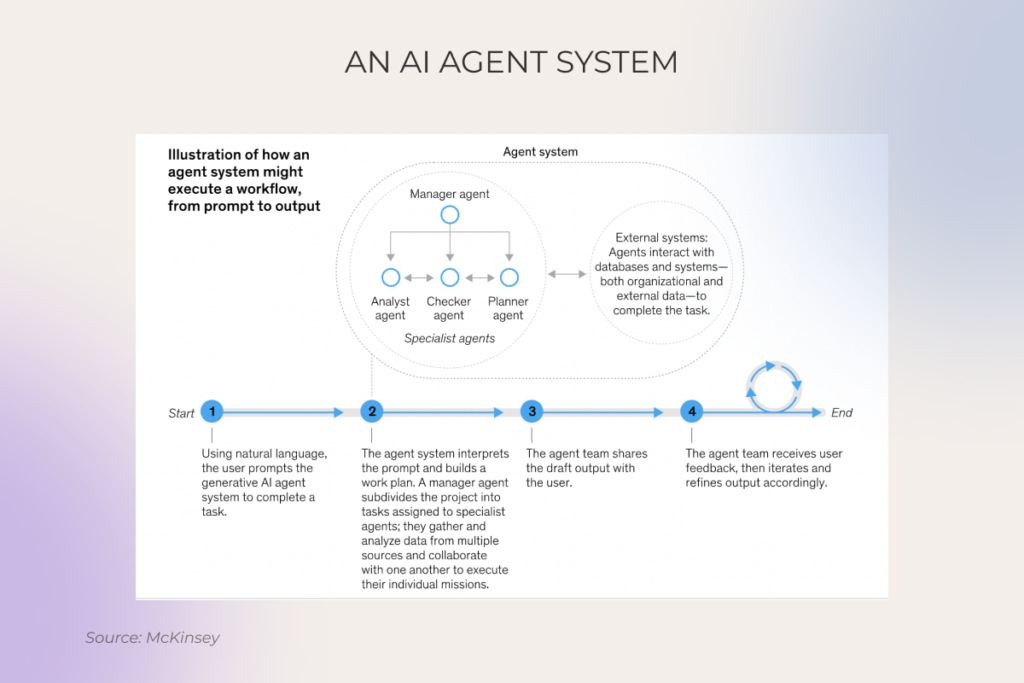
The inner mechanics of LAMs take after those of AI agent systems. However, in agent systems, there is more of a hierarchical structure, where subagents have specific roles, and a manager subagent assigns and coordinates tasks, whereas LAMs typically handle decomposition and planning within a more unified framework.
Need proven AI expertise for your upcoming project?
Let’s talkLAM use cases: where the value is already tangible
The use of AI agents as the primary driver behind enterprise automation overall is broadening within organizations across industries. And although many still struggle to scale agentic automation initiatives enterprise-wide, the number of use cases is staggering.
Healthcare
The sheer volume of admin tasks, patients’ and admissions make the healthcare industry clamor for automation – a demand that previous-generation AI was able to partially satisfy.
Large action models can further mend some of the mounting problems faced by healthcare providers, in accordance with applicable regulations, care models, reimbursement approaches, and specific organizational blueprints.
Task execution in EHR processes, documentation, and scheduling is one of those areas where LAM systems can take more clerical tasks off the providers’ shoulders. LAMs can handle dynamic scheduling adjustments based on changing circumstances, factoring in patient preferences, doctor availability, and facility resources.
AI agents can also check on elderly patients outside healthcare facilities, assisting them with minor health issues and booking appointments with healthcare professionals, if necessary.
Besides, large action models can support clinical decisions by providing personalized treatment plans based on the interplay of different factors, including specific treatment guidelines, patient data, and patient preferences. Unlike traditional conversational AI, LAM-style systems can reduce the need for tightly predefined conversational integrations by interacting more flexibly with software interfaces and toolchains, though they still require governed access to systems like EHRs via APIs or compliant connectors.
Finance
40% of investors regret their investment decisions. A highly personalized LAM-based support system can prevent those costly investment mistakes by providing tailored investment recommendations based on an investor’s financial situation, risk tolerances, goals, and market data. It can then bring these recommendations into action, i.e. by making trades or transferring funds on behalf of the investor.
For banks and financial institutions, an agentic system bodes well for enhancing customer service. When human agent resources are stretched too thin, LAMs can engage in complex voice interactions to provide immediate support and offer recommendations based on user preferences and prior interactions.
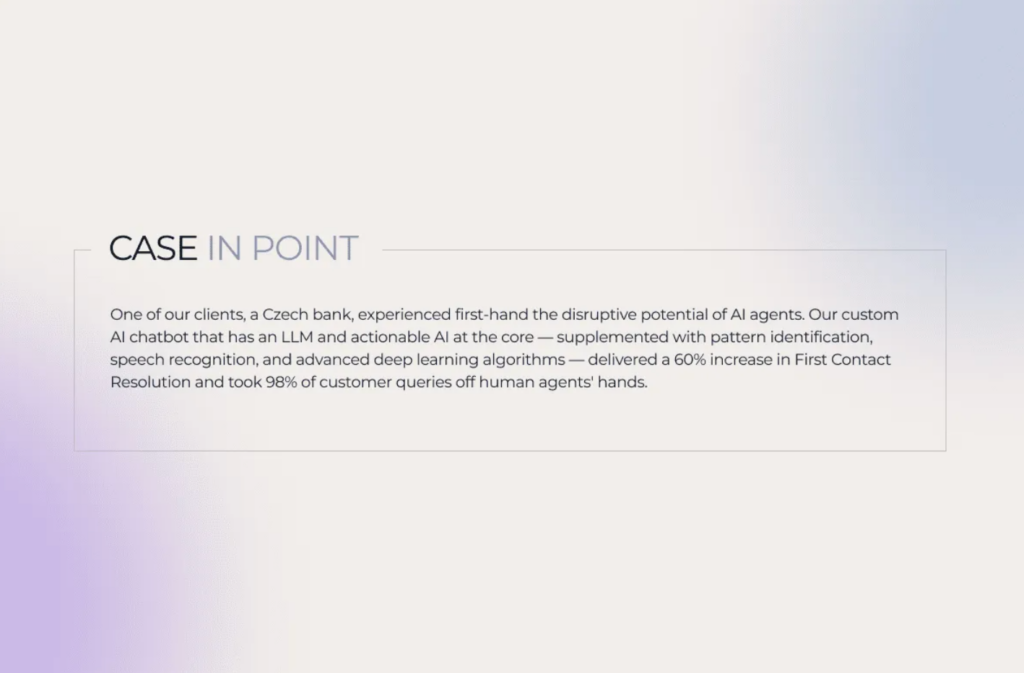
One of our clients, a Czech bank, experienced first-hand the disruptive potential of AI agents. Our custom AI chatbot that has an LLM and actionable AI at the core, supplemented with pattern identification, speech recognition, and advanced deep learning algorithms, delivered a 60% increase in First Contact Resolution and took 98% of customer queries off human agents’ hands.
Read the full case study here.
Loan underwriting is another process that can benefit from the implementation of LAM solutions. To create a credit memo, relationship managers and credit analysts have to sift through 15+ sources on the borrower, loan type, and other factors, and then, after a few more sweats and back-and-forths, write the document.
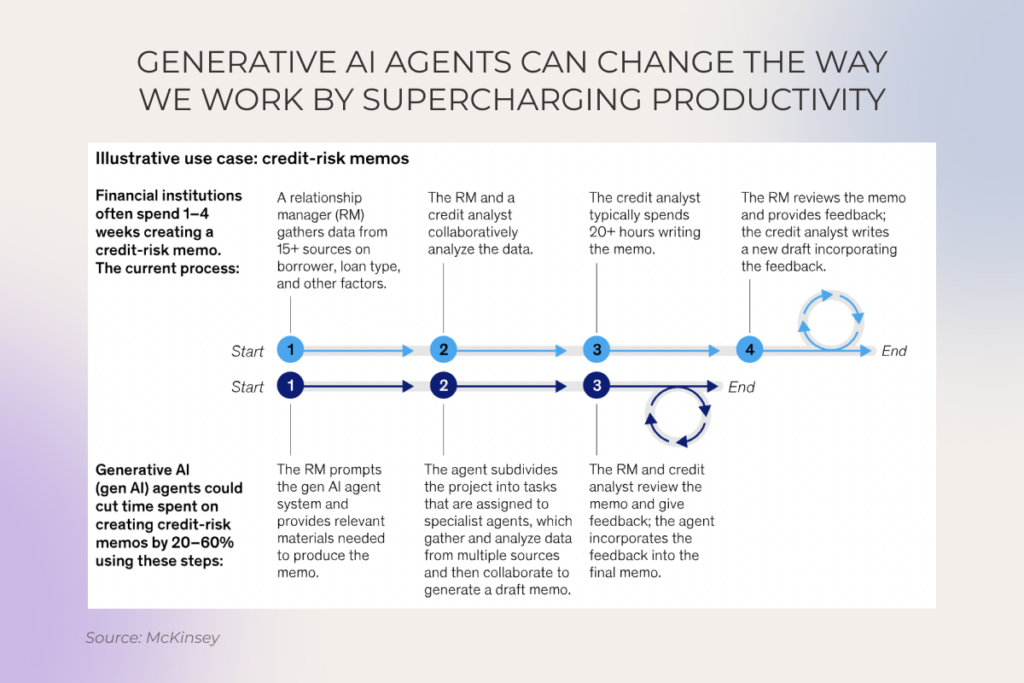
Large action models can relieve managers and analysts of extensive data analysis, enhancing productivity and reducing the time spent on credit-risk memo generation. Leveraging agentic AI, a human user can outline the overall workflow, including specific rules, standards, and conditions, through natural language. The ecosystem of AI agents takes it from there by handling the communication with the borrower, gathering documents, calculating financial ratios, and executing the rest of the leg work.
Supply chain management
The current challenges in supply chain management create a breeding ground for innovation, a task LAMs are up to. As SCM systems usually comprise a whole variety of software, including ERP, WMS, TMS, IoT applications, and others, automation solutions require a whole lot of integrations to access and analyze consolidated real-time data.
Conversely, multi-agent systems have no problem integrating with industrial control systems and IoT devices. They can execute actions directly, such as collecting data from sensors or triggering maintenance alerts. Here are potential areas for LAM application in supply chains:
- Predictive maintenance: large action models can accumulate data from sensors and other resources to predict equipment failures and send maintenance alerts.
- Quality control: using the combination of computer vision, sensor data, machine learning, and reference data, LAMs can flag quality issues and perform immediate corrective actions.
- Inventory optimization: not only can LAM systems take over complex data analysis tasks, such as recognizing patterns and anomalies in demand data, but they can autonomously respond to changes in demand or supply by adjusting inventory levels, placing orders, and managing transportation.
- Industrial robotics: LAMs can transform human robot interaction, enabling automated systems to understand human intentions and work safely alongside humans.
Along with these real world scenarios, agentic capabilities can improve virtually all logistics processes, from route optimization to transportation resource management and vehicle safety systems. For example, agentic AI systems can dynamically adjust routes based on real-time traffic conditions and TMS data. They can then identify the most optimal mode of transportation according to the analyzed data and assign routes to each vehicle based on factors such as vehicle capacity, location, and driver availability.
Literally any enterprise
There is not a single incumbent that wouldn’t benefit from strategic planning capabilities brought into the fold by LAMs. Large action models delve deeper than any other analytics solution, closing the gap between enhanced decision-making and subsequent action.
Let’s have a look at feasible large action model examples that can flip the script in enterprises:
- Customer experience: LAM-enabled chatbots can automate many routine customer service tasks, providing targeted support in real time. By identifying possible equipment failures or customer concerns before they happen, LAMs can automatically initiate tasks like notifying the maintenance crew or placing orders for replacement parts.
- Fraud detection: agentic AI systems can detect fraudulent activity in large datasets of transaction data and automatically implement safeguarding measures in case of emergency.
- Process automation: LAMs can do the heavy lifting of time-consuming tasks, including automated data entry, payment processing, financial analysis, contract management, and document review.
- IT support: action-oriented systems can act as tech co-pilots, solving troubleshooting technical issues and providing necessary user support.
- Compliance management: large action models can streamline routine compliance tasks, such as generating reports, conducting audits, and even updating records.
Take a page from our book: three success stories with an agentic AI linchpin
Give it a few years, and multi-agent systems will be standard enterprise AI infrastructure. And if there are still companies cautiously eyeing the agent-led automation trend, the only ones with a real competitive moat will be those who are not sitting back, but actively exploring how to raise the bar on operational efficiency using the technologies already at hand. Just see how it played out for our recent clients.
- 12× faster partner onboarding in insurance
For one of our clients, a global insurance aggregator, onboarding new partners across regions was slow, fragmented, and heavily dependent on manual engineering effort. We built a UI-first, multi-agent AI system that ingests partner documentation, interprets heterogeneous API formats, and automatically generates working integration adapters with tests and deployment-ready artifacts. The agentic pipeline, supported by structured validation, model governance, and human-in-the-loop checkpoints, cut partner onboarding from 3-6 months to 2 weeks, while facilitating a 10× decrease in operational costs.
- Agentic AI sales representative slashing CPL by 15%
An Australia-based consulting firm wanted to automate early-stage sales without losing conversion quality. We developed an autonomous AI virtual worker that engages prospects, qualifies leads, maintains context across conversations, and advances opportunities inside existing CRM and communication tools. The system handles outreach, follow-ups, and basic deal progression with minimal human input, while escalating only high-value cases to sales teams. After deployment, the solutionincreased lead processing capacity by 20%,improved upsell and cross-sell rates by 19%, and reduced cost per lead by 15%.
- Delegating customer support ticket triage to multi-agent system
Another client, a US online store, serving over 3 million yearly customers faced critical bottlenecks with 5,000-10,000 daily support requests, leading to 12-minute wait times and low CSAT. By implementing a multi-agent system with six specialized microservices, handling tasks from PII removal to policy compliance, we helped the retailer reduce ticket processing time from 6-12 minutes to just 1-3 minutes. This allowed each support specialist to handle 200-250 tickets daily (up from 50-70), achieving 75% faster first responses and a15% CSAT uplift without increasing headcount.
Giving AI the power to act should only be done with a control layer
LAMs are not immune to errors and biases that can creep into the systems as a result of insufficient prompting, inaccurate data quality, or unforeseen circumstances they were not trained to handle. So before entitling agentic AI to automate workflows, make sure you have a solid AI agent orchestration system in place. One with all the essential safeguards, including well-defined unified data standards, access to complete, accurate, and up-to-date data, and data security guardrails such as data minimization, anonymization, and encryption.
As for LAM-specific risk prevention measures, it’s recommended to isolate LAMs from host systems to protect the infrastructure from unintended consequences and provide a controlled environment for LAM testing and experimentation.
Adversarial testing that simulates real-world attacks on a system and identifies its vulnerabilities, can also shield your company from harmful fallout and make sure the output of actionable AI is free from sensitive data, biases, and inaccuracies.
A trusted engineering partner ensures those best practices are fully implemented, so agents operate safely within clear, well-defined boundaries.
Ready to upscale your business with controllable, custom AI agents?
Contact our AI teamFAQ
The primary focus of a large action model (LAM) is autonomous action execution — translating user intent into real-world or software-based tasks. Instead of only generating text, it understands context, plans steps, and performs actions across interfaces and applications to complete goals with minimal human intervention.
It begins with input processing, followed by intent inference, where the model maps ambiguous user requests into structured goals. Next, the system performs environment grounding, interpreting UI states, available controls, and API surfaces. Based on this, it generates a task decomposition plan, splitting the objective into ordered, executable sub-steps. Each step is translated into concrete actions such as API calls, UI interactions, or system commands. During execution, the model operates in an iterative feedback loop: it observes system responses, validates intermediate outcomes against the target state, and dynamically replans if discrepancies occur. This continuous perception-action cycle enables LAMs to maintain goal alignment while operating across multi-step workflows.
A Large Language Model (LLM) is designed to generate and understand language. It predicts the next token based on context, producing outputs like text, summaries, code, or answers. Its role is primarily descriptive and generative, it responds to prompts but does not inherently act on external systems. A Large Action Model (LAM) extends this idea into execution.
A large action model architecture combines perception, reasoning, planning, action, and feedback layers into a continuous loop.
Real-world use cases for large action models include automating healthcare tasks like scheduling and EHR processes, providing personalized financial investment recommendations, optimizing supply chain management, and enhancing enterprise functions like customer service and fraud detection.
A LAM is generally viewed as an action-oriented model that can interact with interfaces, tools, APIs, or software to perform actions, while an AI agent is the broader autonomous system that reasons, plans, maintains memory, adapts to feedback, and decides which actions to take to achieve a goal.
The focus of LAM in AI is autonomous, goal-directed action execution. Triggered by the user’s natural language commands, LAM models navigate interfaces, orchestrate APIs, and complete multi-step tasks with minimal supervision.
Subscribe to
Instinctools blog