Polishing Up Your AI Model: Optimization That Drives Success

When the honeymoon stage is over, you may find your AI model under-deliver on its promises. Model drift, operational inefficiency, and other hitches creep into the system, nullifying the initial gains. That’s why it’s crucial to pour an equal amount of resources both AI development and AI model optimization to maximize the performance of your smart solution and prevent it from going south.

In this article, our AI engineers have curated practical advice about the selection of artificial intelligence optimization techniques along with real-world examples of optimization in artificial intelligence — all grounded in our hands-on experience delivering AI development services.

What is optimization in AI? Turning your models from good to great

Artificial intelligence optimization is a process of refining the performance and efficiency of existing machine learning models. Although fine-tuning is considered to be an optional, after-the-fact step, it’s the brushstroke that turns your pre-trained AI model from a generalist into a niche expert.

More importantly, optimization algorithms allow your model to bypass data, time, and computational limitations, improving its abilities without eating into your resources.

What problems does AI optimization address?

On a high level, AI optimization aims to slash computational load and memory usage along with improving the model’s performance. Beyond this overarching objective, companies can leverage this technique to tackle a raft of other challenges inherent to AI initiatives.

1. High costs of training and running AI models

The power of large and complex deep learning models usually comes at a cost as their sophisticated architecture and formidable data requirements make them expensive to train and run. Optimization techniques can slim down the necessary computational resources, helping companies save money — especially on cloud deployments based on pay-as-you-go models.

2. Slow performance and latency

Low latency is an essential prerequisite for real-time data analysis solutions, such as autonomous vehicles and real-time fraud detection systems. However, increasing prediction accuracy often leads to longer prediction times. AI optimization techniques can enhance model speed and reduce inference time, maintaining both low latency and high prediction precision without compromising either.

3. Overfitting

Overfitting often plagues AI models, hindering their ability to perform well when faced with an unseen set of data. The reasons for that are manifold, including high model complexity, small training data size, and dominance of noisy data. 

Optimization techniques such as data augmentation (creating more diverse training data), early stopping (preventing overtraining), and others can offset this defect, improving the model’s ability to generalize to new data. This, in turn, enhances the model’s accuracy for real-world scenarios.

4. Lack of interpretability

The more advanced your model is, the harder it will be to trace its decision-making process. The black-box nature of sophisticated algorithms also makes models hard to debug and undermines trust in their results.

Although AI model optimization isn’t a cure-all solution, this exercise can usher in more transparency into the opaque nature of artificial intelligence. For example, companies can apply rule extraction techniques, gaining more insight into the behind-the-scenes of the model. Combined with explainable AI, these techniques can peer deep into the model and rationalize specific predictions.

​​5. Deployment challenges

Large deep learning models guzzle a truckload of processing power and device memory, which makes their deployment challenging for resource-constrained environments such as those involving IoT devices. AI fine-tuning makes smart models leaner by trimming away unnecessary parameters and refining the model’s architecture. 

Some techniques also enable the model to use lower-precision data types instead of the bulky high-precision formats. Unlike their heavyweight counterparts, lightweight AI models have more deployment options and can integrate with new applications and devices.

Key techniques for AI model optimization

To choose the right optimization technique for your model, you need to analyze several factors, including the model’s type, the deployment environment, and your optimization goals. Below, our data science team has broken down the key optimization techniques along with their ideal use cases.

Model architecture optimization

Whenever your model is facing resource constraints, like limited memory or computational power limitations, it’s in for an architecture touchup. Architecture optimization is also beneficial for the deployment efficiency and the accuracy of predictions.

Pruning

Similar to tree pruning, this technique optimizes the model by selectively removing redundant or unimportant parameters, artificial neurons, weights, or deep learning network layers, thus improving the model’s core structure. A proper prune is an investment in the speed and nimbleness of the model. Pruning can also be used as a regularization technique to prevent overfitting.
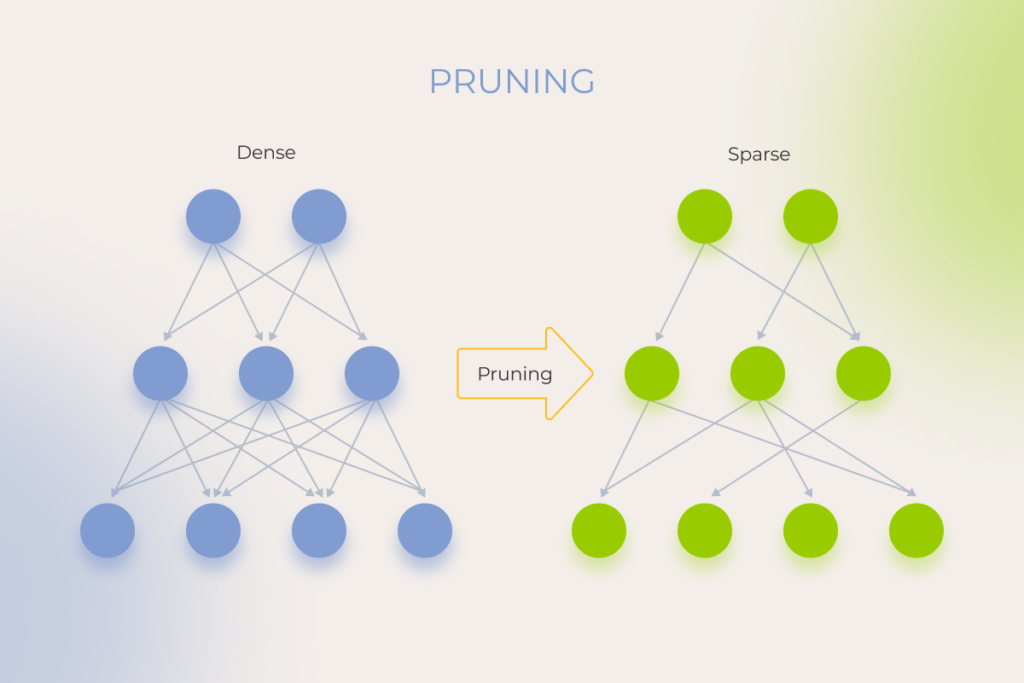
pruning as an AI model optimization technique

When to use? Use pruning when you need to reduce computational complexity and inference time. This is typically the case with tight deployment constraints, such as limited memory or processing power on edge devices. For example, mobile phone manufacturers apply pruning to enable on-device image recognition, reducing battery consumption and improving responsiveness.

Keep in mind that this optimization technique can lead to a slight drop in accuracy.

Quantization

Quantization allows you to substitute floating-point weights and/or activations with low precision compact representations. In simple words, this technique transforms a heavyweight AI model, which employs a lot of numbers to make predictions, into a more agile model with a reduced number of bits used for those numbers. 

By paring down the model, quantization makes it faster while also reducing memory footprint. However, the boost in speed may come at the expense of prediction accuracy so you should select this optimization technique for tasks where you can keep the accuracy loss to the minimum.
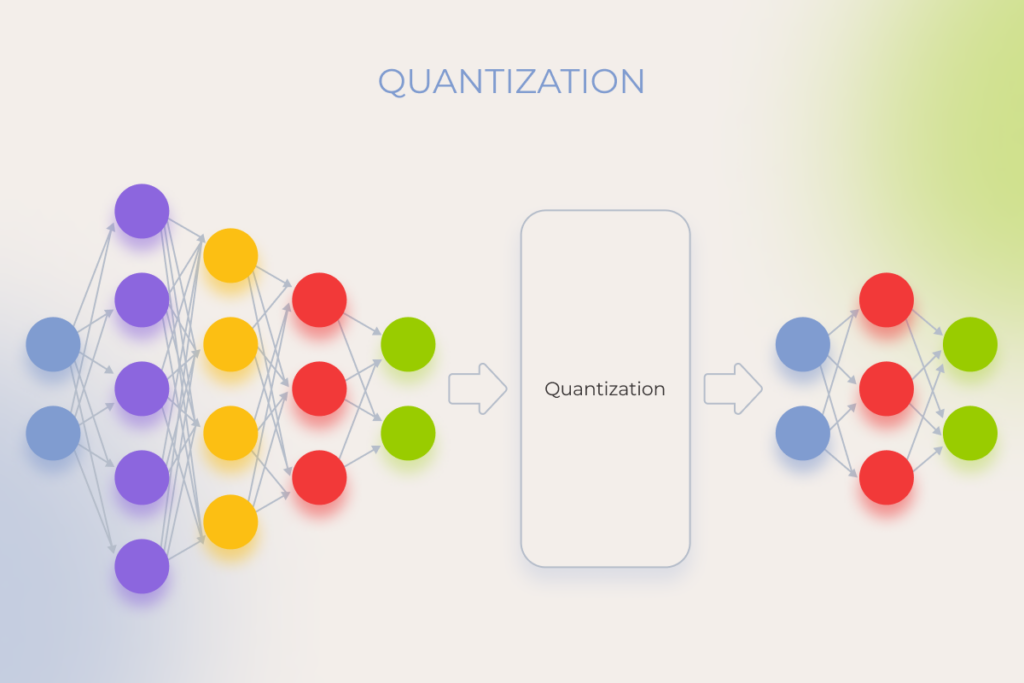
Quantization as an AI model optimization technique

When to use? Quantization is the go-to option for on-device machine learning tasks, resource-constrained environments, like embedded systems and IoT devices, and cloud-based AI.

For instance, quantization is the secret behind real-time voice interactions on smart speakers that leverage the technique to operate efficiently on low-power hardware.

Knowledge distillation

Knowledge distillation is one of the general-purpose optimization algorithms in artificial intelligence popular for model compression. This technique condenses knowledge from a pre-trained, complex ‘teacher’ model into a simpler and smaller ‘student’ model to improve the performance of the latter. By building on the teacher’s wisdom, the optimized model can achieve comparable performance on the same task, but at less cost.
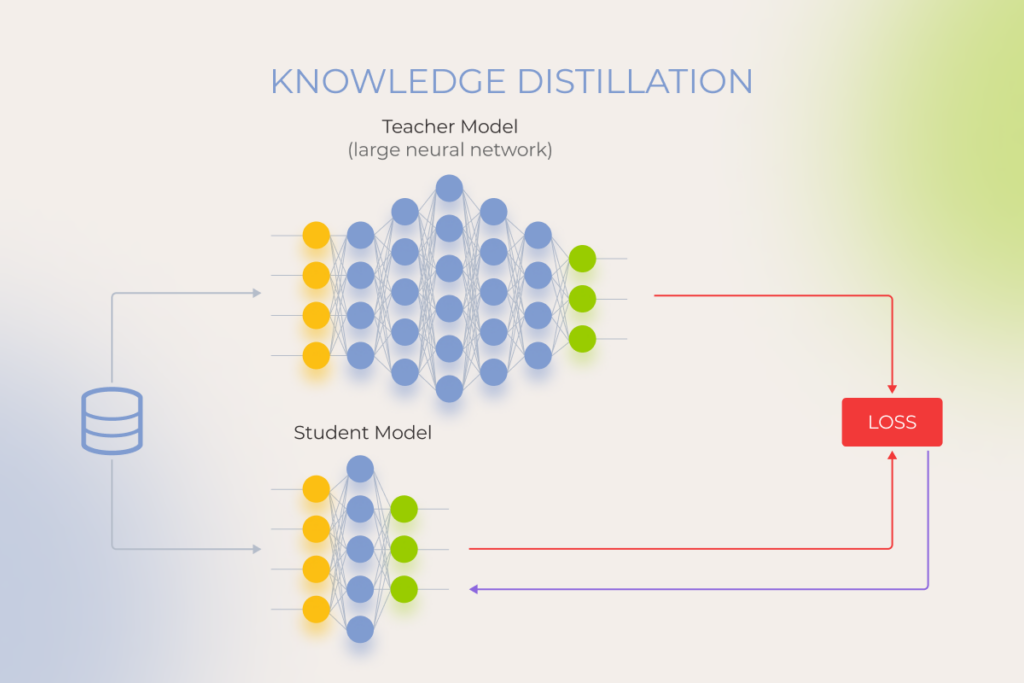
knowledge distillation as an AI model optimization technique

When to use? Knowledge distillation can benefit multiple AI solutions, including natural language processing, speech recognition, image recognition and object detection. You can use this optimization technique for one of these tasks, provided you have a pre-trained, high-performance model that can then power a smaller model for real-time applications.

For example, knowledge distillation enables a small chatbot model to increase response time and refine its conversation flow by using a large, pre-trained language model as a ‘teacher’.

Source code modification

Switching a model’s framework, such as transitioning from TensorFlow to PyTorch, can enhance the development workflow, especially for projects prioritizing fast experimentation and iteration. PyTorch’s dynamic computation graph and developer-friendly design often make it a preferred choice for research and prototyping. However, this AI model optimization technique is applicable only to open-source models, such as BERT, Mixtral, or Llama, where the source code is accessible and modifiable. It’s important to note though that switching frameworks may not directly improve model performance. Actual gains depend on factors like architecture, training data, hyperparameter tuning, and compatibility with your team’s expertise and project goals.

When to use? In most cases, modification of the model’s algorithm is a last-resort step, as source code enhancements require retraining the updated model. You need to have seasoned AI engineers on board to pull off the task smoothly. 

Data optimization

In a perfect world, all AI models are fed on accurate, high-quality, and balanced data that lays the ground for impeccable performance. In reality, training data often falls short, causing insufficient model adaptability and subpar performance. Data optimization techniques can alleviate issues caused by poor training data while also promoting better results.

Data augmentation

Data augmentation allows data science teams to artificially ramp up the training set by creating new training data from existing data samples. This technique increases the volume, equality, and diversity of training data, allowing the model to bypass the limitations caused by small or imbalanced datasets. Expanded sets of training data, in turn, mitigate overfitting and reduce data dependency.
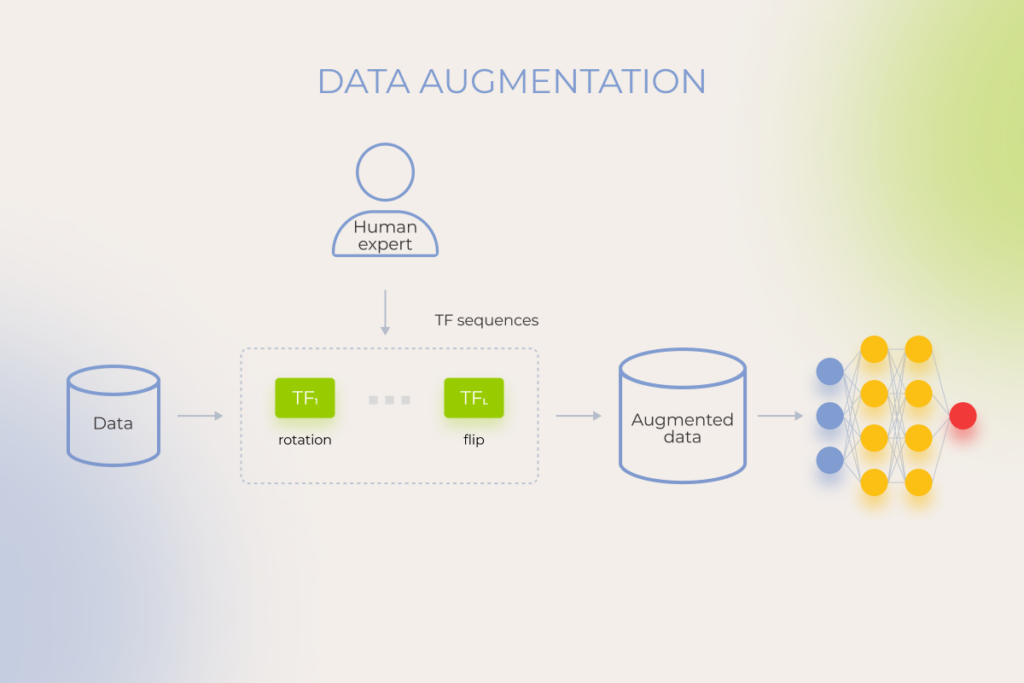
data augmentation as an AI model optimization technique

When to use? Data augmentation helps your model fare well against the backdrop of limited training data, which is a common issue in tasks like image recognition.

For example, data augmentation makes up for limited data variations, which is a well-known hurdle for medical imaging models targeted at rare disease detection. 

Autonomous vehicles also rely on augmented datasets to overcome limitations in real-world data and, ultimately, navigate in diverse weather conditions.

Data distillation

Akin to knowledge distillation for models, dataset distillation helps a smaller model pick the brains of a larger model trained on a massive dataset. This optimization technique allows the smaller model to transfer specific data points, relationships, and internal representations of the data from the larger one, making the smaller model faster and less computationally expensive.
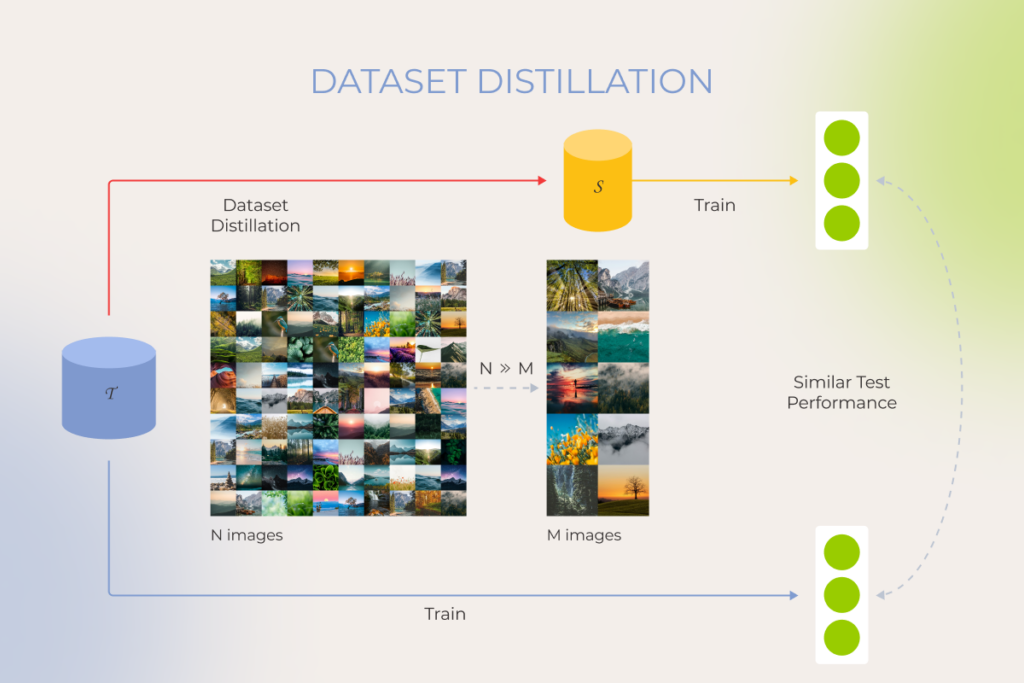
dataset distillation as an AI model optimization technique

When to use? Data distillation comes to the rescue when you have limited access to a large dataset due to privacy concerns or storage constraints, but you can leverage a pre-trained model, already enriched by a vast dataset on a similar task.  

For example, dataset distillation is a game-changer in the development of customer service chatbots that often lack training data due to the dynamic nature of customer interactions. 

Training optimization

As our experience shows, companies often look for ways to train a model on a dime due to the limited computational resources and budget considerations. Training optimization techniques help strike a balance between the cost and quality of training, without performance trade-offs.

Hyperparameter tuning

Hyperparameter tuning allows you to train your model sequentially with different sets of hyperparameters to increase its training speed, convergence, and generalization capabilities. During this process, the team selects the optimal values for a machine learning model’s hyperparameters, such as learning rate, batch size, number of epochs, and others.

Hyperparameter tuning is an iterative process where data scientists experiment with different hyperparameter settings, assess the model performance, and iterate accordingly.
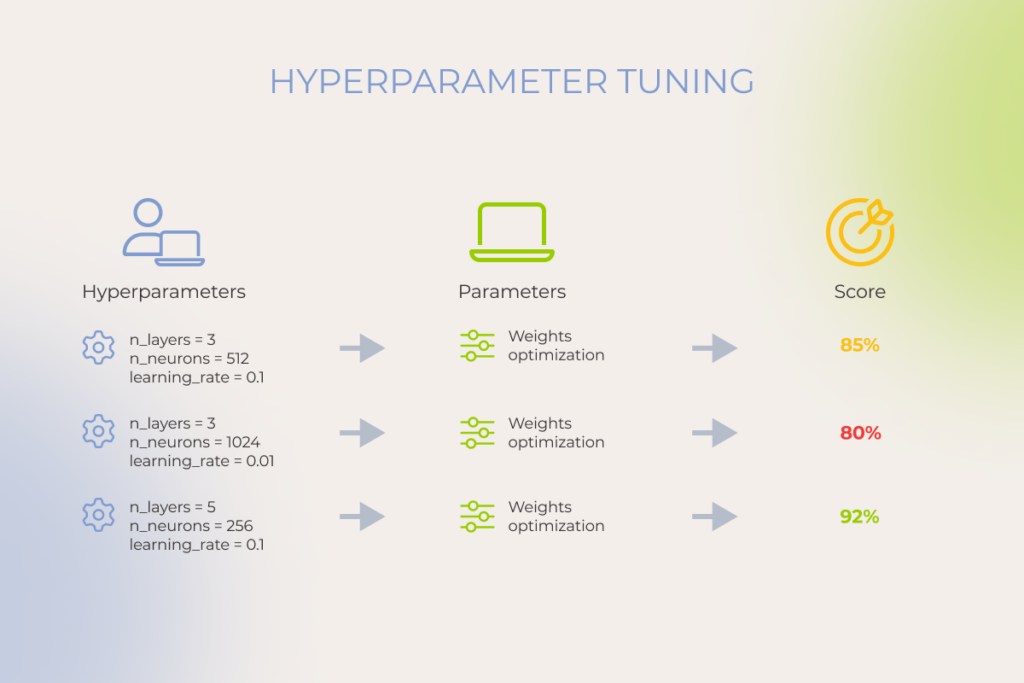
hyperparameter tuning as an AI model optimization technique

When to use? You can resort to hyperparameter tuning whenever you need to squeeze out the best possible performance or solve complex optimization problems in artificial intelligence. This optimization technique also allows teams to work around limited datasets and facilitate model adaptation when working with a new dataset. 

Hyperparameter tuning proves beneficial for different ML tasks, including stock price forecasting, fraud detection, drug response prediction, and more. 

Early stopping

This optimization algorithm helps avoid overfitting that typically occurs when training a learner with an iterative method such as gradient descent. Early stopping monitors the model’s performance on a validation set and shuts down training when the validation accuracy starts to degrade. 
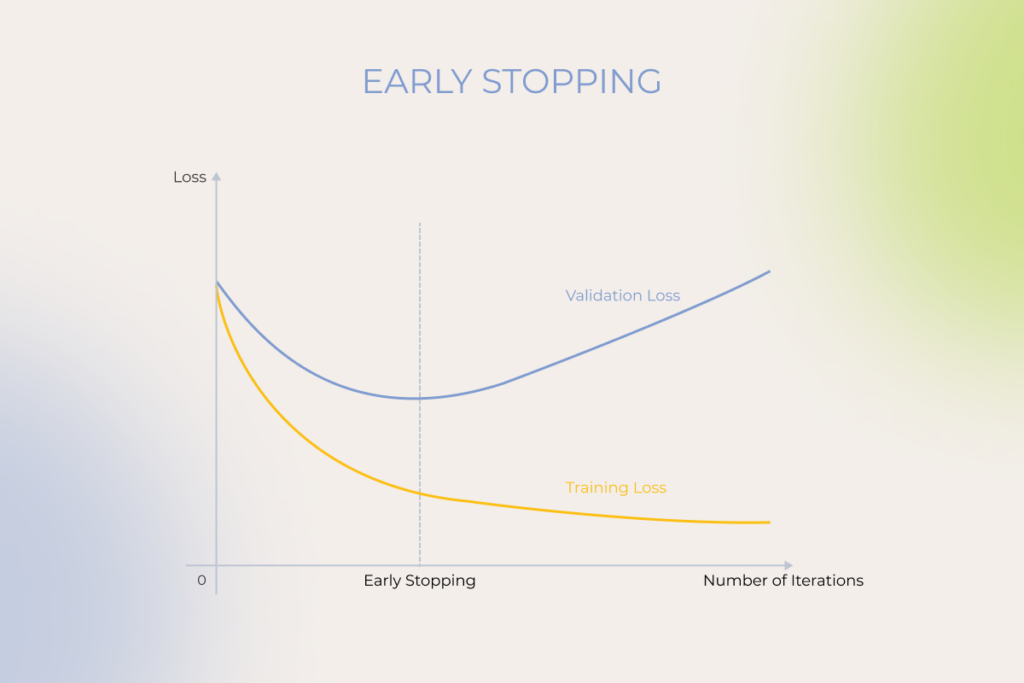
early stopping as an AI model optimization technique

When to use? Early stopping helps data science teams deal with complex models or limited training data — when it becomes critical to prevent overfitting.

For example, this fine-tuning technique helps optimize training time for computationally expensive models.

Gradient clipping

During training, the model adjusts its weights based on the calculated gradients. Gradient clipping ‘clips’ the size of the slopes and sets a threshold — maximum value — for them to tackle the exploding gradients problem and improve the stability of the training process. In some cases, this technique can also keep the training process from oscillating and potentially result in faster convergence.

gradient clipping as an AI model optimization technique

When to use? Gradient clipping is a linchpin technique for any neural architecture that is prone to grow too big.

The application area of gradient clipping is massive, ranging from NLP tasks to reinforcement learning environments and other machine learning techniques. For example, by stabilizing the training process, gradient clipping smooths training for NLP models, enabling them to achieve a nuanced understanding and generation of natural language.

How much does it cost to optimize an AI model?

It’s hard to pin down an exact figure when talking about optimization cost as the final pricing varies greatly based on several variables, including: 

  • The complexity of the AI model — sophisticated deep learning models demand more effort and resources to optimize.
  • Optimization techniques — some techniques like data distillation require significant computational resources and specific hardware.
  • Deployment scale — large-scale deployments increase optimization costs.
  • Data storage — large datasets require cloud or on-premise storage solutions.
  • Data labeling — manual labeling can increase your optimization costs.

Instinctools’ data science team employs automation tools within our MLOps approach to reduce the time and effort needed for tasks like data pre-processing or hyperparameter search. We also recommend optimizing for the most important metrics, instead of spreading the optimization efforts too thin, to make the entire process easier on the budget.

AI optimization is a balancing act

While artificial intelligence and optimization make a powerful duo, excessive fine-tuning can lead to diminishing returns and drops in model performance. To get AI model optimization right, you also have to strike the right balance between accuracy and computational demand — or else you’ll end up with longer training times, higher costs, and limited deployment options.

Solve the challenges of AI optimization with an experienced AI team

Let’s discuss

AI in the Oil and Gas Industry: 15+ Use Cases Across Upstream, Midstream, and Downstream

AI in the oil and gas industry is becoming critical to the sector’s resilience, even as concerns grow around the technology’s own energy demand. With margins tightening and growth under pressure, leading O&G firms are turning to generative and agentic AI to stabilize performance across extraction, refining, and sales. 

Recent market analysis of artificial intelligence in the oil and gas industry across the US companies points to increased spending on AI, gen AI, and agentic AI by 40% in 2025. The payoff case is equally strong: BCG estimates that those leaning hardest into AI could lift EBIT by 30-70% over five years, while also minimizing carbon footprint.

Instinctools’ AI CoE members have gathered some of the most notable applications of AI in the oil and gas industry across the value chain.

Key highlights

  • Beyond enhancing efficiency and driving cost savings, artificial intelligence in the oil and gas industry plays a central role in strengthening operational resilience and supply chain safety.
  • AI in the oil and gas industry spans the full value chain: upstream exploration and drilling, midstream logistics and leak detection, downstream refining and sales, plus cross-stream asset predictive maintenance and supply chain optimization.
  • Massive AI adoption in oil and gas is held back by fragmented, poorly governed data, legacy systems that resist integration, and uneven digital readiness across operations.

AI in all its forms to serve the needs of the oil and gas industry

Capturing value from massive amounts of data generated during hydrocarbon exploration and production is made possible with these forms of AI used in the oil and gas industry:

  • Machine learning: Identifies patterns in large operational and geological datasets to improve predictions and support better decision-making across the oil and gas value chain. Common AI & ML applications in oil and gas industry include reservoir exploration, drilling optimization, production forecasting, and predictive maintenance.
  • Deep learning: As a subset of machine learning based on multi-layer neural networks, deep learning is especially valuable for complex subsurface analysis. It is used in oil and gas to analyze seismic data, combine seismic insights with well logs and production data, detect subsurface structures, classify geological features, and predict reservoir properties for exploration decisions.
  • Generative AI: Learning from existing datasets, gen AI-powered systems can help create 3D reservoir models from sparse well data, produce synthetic data samples, map drilling trajectories with associated risks, create emergency response instructions, and summarize complex technical reports, field notes, or maintenance records.
  • Agentic AI: Grounded in LLM-based reasoning, planning, and tool-use capabilities, AI agents and multi-agent systems execute tasks across workflows. Maintenance triage, inspection planning, pipeline monitoring, supply chain, and finance workflows autonomous execution are just several examples of agentic AI in the oil and gas industry with the strongest near-term value.
  • Computer vision: Interprets visual data from cameras, drones, satellites, and sensors in real time to accelerate tasks such as equipment inspections and verifying workers’ PPE compliance.
  • Edge AI: Processes data locally on IoT devices without relying on cloud storage or internet connectivity. This greatly aids in adjusting machinery settings, tracking sensor readings, collecting seismic data, and continuously monitoring operations and safety conditions remotely.

The ways AI in oil and gas optimizes operations across the value chain

Permeating into each stage of the supply chain, AI adoption in the oil and gas industry enables companies to achieve operational efficiency, reduce costs, and come closer to sustainable development and net zero.

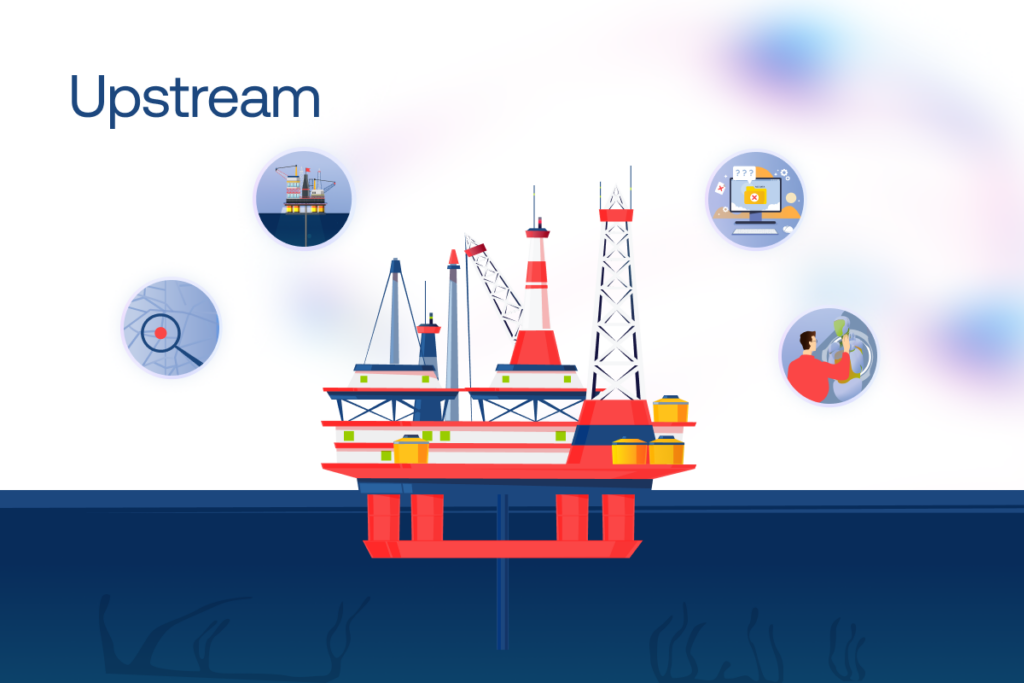
Upstream AI use cases in oil and gas exploration and production

Upstream

Top-tier oil and gas producers are claiming major gains from AI adoption in upstream operations, already compressing exploration timelines by weeks and saving billions in related spending.

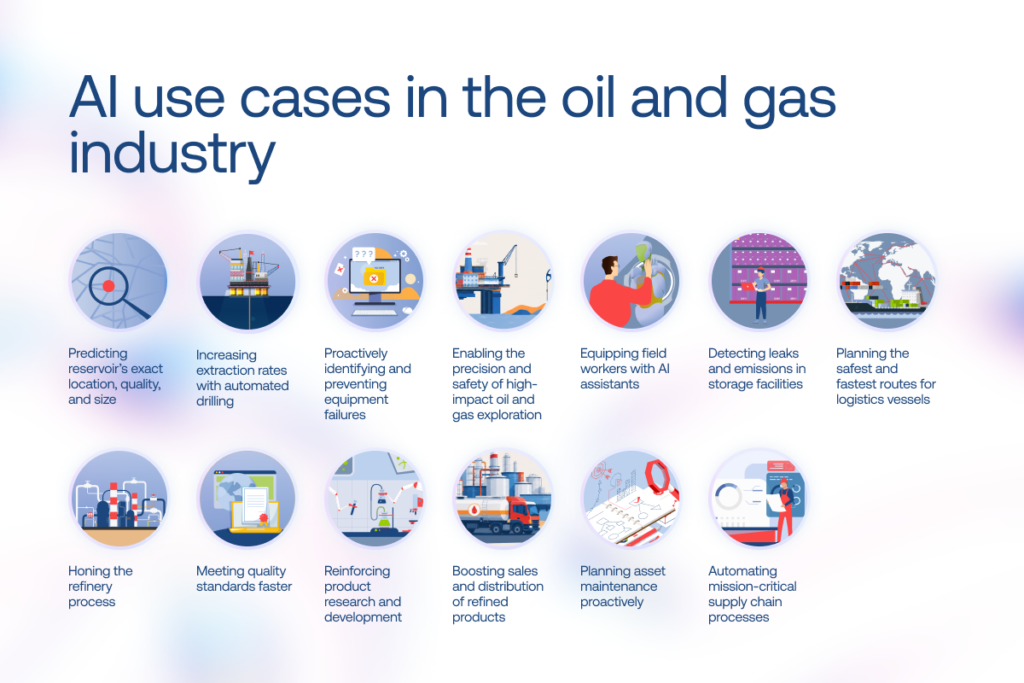
Predicting reservoir’s exact location, quality, and size

Exploration budgets still account for the possibility of drilling dry holes. “That’s the game, and players know the risks,” as Andrew Latham, SVP Energy Research at Wood Mackenzie rightly points out. AI, however, is emerging as one of the tools helping reduce the odds of such costly surprises. Traditional, largely manual and error-prone analysis of vast volumes of electromagnetic and seismic data used to identify new hydrocarbon deposits is increasingly giving way to AI-powered capabilities:

  • Streamlined access to exploration data: With a single natural language query, explorationists can pull the needed insights from scattered surveys, well logs, images, subsurface analyses, maps, technical reports, and other sources. Chevron, for example, rolled out this concept through its in-house ApEX multi-agent framework, where specialized AI search agents comb through more than a million exploration files and generate recommendations, risk assessments, and next-step actions within seconds. The ApEX’s exploration review agent assesses a drill site’s success potential, while a geospatial agent executes map-related tasks.
  • Reservoir modeling: To guide the decision-making in the direction of achieving optimal development plans, engineers create geo-models of crude oil or natural gas reserves using generative AI-powered visualization tools. Such models help control fluid movement and predict the long-term performance of a well. Powered with sophisticated ML algorithms, they are constantly refreshed with newly acquired well drilling and production data. Striving to improve access to hydrocarbon resources, Aramco developed its reservoir and basin simulator TeraPOWERS to model the entire hydrocarbon system of the Arabian Peninsula. 
  • Seismic images interpretation: Geo- and data scientists can remove noise, improve resolution, detect subtle features, or even generate additional data samples with AI if imagery quality is poor or incomplete.

Increasing extraction rates with automated drilling

With hefty costs involved, no wonder oil and gas companies seek to hammer drilling operations home on the first try. A helping hand here is drilling optimization, another application of artificial intelligence in the oil and gas industry. It spans multiple stages of the workflow, from planning and execution to real-time risk management:

  • Pre-drilling layer: Predictive intelligence allows engineers to convert cross-sourced historical and real-time data into actionable insights for drilling preparation. 
  • Drilling parameter optimization: Armed with advanced ML algorithms, geosteering teams analyze terabytes of historical data to configure optimal parameters, such as weight on bit, rate of penetration, rotary speed, mud flow, torque, and drilling angle.
  • Real-time monitoring and safety intervention: AI in oil refinery leverages real-time drilling data to predict the likelihood of stuck pipe events, enabling proactive measures. 

As a result, AI and ML in the oil and gas industry reduce the risk of drill-bit failures and optimize extraction rates.

Proactively identifying and preventing equipment failures

Disruption risk tends to be more pronounced in legacy pipelines, offshore platforms, and refining facilities. And today, even short-lived outages can compress already thinning margins and destabilize supply in already constrained markets. The solution is automated equipment inspections carried out by “zero-touch” sensors, drones, and robots, as well as AI-enabled proactive, self-healing maintenance. Early adopters of these solutions have reported up to a 40% reduction in equipment failures and annual savings of up to $10M. Worth noting, predictive maintenance for heavy machinery has long remained one of the most beneficial use cases of AI in the oil industry, according to oil and gas leaders.

How does it work? Drones and robots with tiny sensors and cameras scan each equipment component with laser precision. Cracks, corrosion, and other potential signs of wear are identified by pre-trained ML models. Thus, AI systems perform 24/7 meticulous real-time inspection without human intervention, minimizing operational risks and expenses.

An example of AI-enabled asset maintenance in action can be found at Shell. They utilize an ML-based predictive analytics solution that helps avoid critical equipment outages and identify cases when maintenance is needed. Now, its staff have more time for engineering instead of analyzing mountains of data, while the company reduces production losses and maintenance costs.

Equipping field workers with AI assistants 

High pressures, heat, flammable substances, basic human error, and other factors have led to many tragic safety incidents during gas and oil exploration. With virtual field assistants, drilling rig crews, well operators, and technicians have quicker and easier access to critical information.

For field staff, bpx, bp’s nimble US onshore oil and gas business, is piloting an AI-powered agent called Perfect Lap Xecute or PLX. It can generate daily to-do checklists and summaries of key production insights, so nothing slips through the cracks, reducing the chance of missed steps in environments where small oversights can quickly become safety incidents.

— Ivan Dubouski, AI Lead Engineer, Instinctools

Voice-enabled AI assistants are easily integrated into field-friendly devices, guaranteeing round-the-clock availability and proving to be more effective for emergencies than human-staffed call centers.

Enabling the precision and safety of high-impact oil and gas exploration

As the industry faces a potential 300-billion-barrel supply gap by 2050, major oil companies are reviving investment in high-impact exploration. AI-related technologies are transforming ultra-deepwater drilling by enabling autonomous operations, enhancing safety, and optimizing efficiency in challenging environments exceeding 5,000 feet below the ocean surface.

AI-enabled deep-water reservoir development can be seen at operators such as Shell, which uses remotely operated vehicles (ROVs), advanced subsea systems, and state-of-the-art drilling techniques.

— Ivan Dubouski, AI Lead Engineer, Instinctools

Midstream use cases of AI in the oil and gas industry: storage and transportation

midstream

Here are practical applications of artificial intelligence in midstream oil and gas leaders should know.

Detecting leaks and emissions in storage facilities

Generative AI tools can sum up large amounts of data captured by optical gas imaging (OGI) cameras installed on inspecting robots or unmanned drones in natural language, saving hours that used to be spent on the manual review of the footage. Those AI-generated assistive summaries enhance the efficiency of oil & gas operations, especially in large industrial facilities or outdoor environments. Moreover, operators can take remedial actions without entering potentially dangerous areas.

With its AI-powered flare monitoring system, Aramco manages to maintain an industry-leading flare volume of below 1% of total raw gas production. It allows the petroleum leader to visualize the entire gas processing system at once and predict when a certain facility is going to exceed its flaring targets so that remedial action can be taken in advance.

— Ivan Dubouski, AI Lead Engineer, Instinctools

Planning the safest and fastest routes for logistics vessels

Advanced analytics help logistics specialists extract insights from vast amounts of data related to weather, route hazards, port congestions, vessel conditions, and other operational factors to plan the most cost-effective tank routes.

Not only do AI optimization algorithms ensure on-time delivery, but they also identify risks and adjust the route on the go without increasing the planned transit time.

A great example of using algorithmic shipping and maritime route optimization can also be observed at Shell. Their LNG Shipping Accelerator gathers all critical infrastructure data in a single place for freight operators to reduce waiting time at ports and fuel usage, resulting in timely and nature-positive energy delivery.

Downstream artificial intelligence applications in the oil and gas industry: refinery and distribution

downstream

By embracing AI, downstream firms achieve refinery & distribution cost reduction and reach regulatory compliance faster in several ways.

Honing the refinery process

The application of AI in downstream oil and gas companies involves real-time monitoring systems that optimize refineries. Those systems monitor operations and collect data during distillation, catalytic cracking, and hydrogenation. They also screen data from energy meters and equipment sensors.

All this contributes to boosting petrochemical throughput, minimizing energy consumption, and identifying potential safety hazards.

Meeting quality standards faster

Application of AI in the oil and gas industry aids refinery companies to meet key quality standards, including ISO, API, ASTM, and others.

Straight from the production lines, ML algorithms and predictive AI models analyze the produced diesel, lubricants, jet fuel, natural gas, liquefied petroleum gas, oil petrochemicals, etc., against the standards. 

By predicting deviations in product quality before they occur, production specialists can make corrections to minimize waste and ensure production reliability and environmental sustainability.

Furthermore, to turn ESG reporting from a yearly burden into a real-time strategic capability, agentic AI automates data capture, question answering, and other reporting tasks for compliance teams.

Reinforcing product research and development 

Generative AI in the oil and gas industry allows petrochemical engineers to accelerate the materials development process and bring down R&D costs by:

  • designing new chemical compounds with diverse compositions, simulating how these virtual assets behave under different conditions before actual physical production;
  • establishing the most efficient experimental procedures for probing or optimizing materials;
  • developing high-entropy alloys (HEAs) with excellent physical, chemical, and mechanical properties.

Boosting sales and distribution of refined products

Beyond pretty standard demand forecasting and pricing, cutting-edge AI in refined oil and gas distribution leverages autonomous agentic systems for real-time, multi-step decision-making across downstream chains. Autonomous AI sales agents streamline workflows such as personalized customer engagement, quote handling, order management, reporting, and documentation.

Besides, advanced analytics is actively used for data-driven sales decision support:

  • Refinery output optimization aligned with market conditions, adjusting production mix based on real-time crude pricing and margin signals
  • Integrated demand-supply matching across regions, coordinating fuel production, inventory levels, and downstream logistics to ensure timely delivery to retailers and industrial buyers

Cross-stream AI applications in the oil and gas industry

Some AI use cases in oil and gas are so versatile that they cover more than just one segment, functioning across multiple layers of the industry.

Planning asset maintenance proactively

AI-powered predictive maintenance goes beyond upstream. 

It forecasts failure in pipelines, pump stations, or processing plant equipment to prevent costly repairs. Casting their nets wide, predictive maintenance models optimize performance and extend the infrastructure life across the whole oil and gas supply chain. 

With agentic AI layered in, AI agents can autonomously analyze sensor anomalies to generate optimized maintenance schedules, factoring in crew availability, parts inventory, and production impact, then directly execute them through ERP integration, taking on tasks like dispatching work orders, adjusting equipment parameters, and confirming completions with real-time feedback loops.

Automating mission-critical supply chain processes

Apart from eliminating costly downtime and optimizing transits of crude oil or LNG via barges and tankers, advanced analytics algorithms enhance the following:

  • energy transition via other transportation methods, such as pipelines, trucks, and railroads,
  • distribution network configuration, including the number and locations of storage facilities, transportation routes, and inventory levels at each facility.

Using gen AI, oil and gas companies and logistics providers automate mission-critical supply chain processes:

  • procurement: materials demand forecasting, identifying the most suitable suppliers, handling price fluctuations;
  • on-shore and off-shore inventory management: improving asset tracking;
  • route planning: identifying current traffic conditions, tuning optimal delivery timing, vehicle tracking, fuel-efficient routing;
  • contingency planning: running what-if scenarios in a digital twin environment to develop custom multi-purpose mitigation strategies.
11 remarkable AI use cases in oil and gas industry

Overall, application of AI in the oil and gas industry improves planning resilience and helps keep supply chain operations more predictable.

Explore smarter, produce more efficiently, and predict end users needs’ like never before by wielding AI power

Rewire to win

AI for oil and gas: impact at a glance

Here’s a pack with all the examined AI use cases in the oil and gas industry to highlight the impact AI solutions make on different tasks of O&G professionals.

SegmentOperationsImpactTechnologies involved
UpstreamReservoir exploration– faster, more informed decision-making
– targeted wells placements
– reduced environmental impact
– enhanced energy efficiency
– extended oil field lifecycle
Agentic AI, neural networks, machine learning and AI algorithms, edge AI, generative AI
Drilling automation– minimized drilling costs
– increased extraction rates
Predictive analytics and decision trees, digital twins, machine learning
Automated fault detection– extended equipment lifetime
– minimized disruptions
– reduced expenses
– automated maintenance scheduling
Computer vision and convolutional neural networks
Field workers’ support– reduced operational costs
– 24/7 availability
– enhanced safety
NLP, generative AI
Ultra-deepwater exploration– automated operations
– enhanced safety
Computer vision, machine learning algorithms
MidstreamLeak/emission detection– accelerated anomaly detection
– automated safety measures
– reduced environmental impact
Computer vision, edge AI, generative AI
Routes planning– reduced delivery delays
– lower fuel usage
– enhanced safety
Optimization algorithms, ML, generative AI
DownstreamRefinery optimization– increased output
– minimized energy consumption
– enhanced safety
– improved risk management
AI-powered monitoring systems, IoT & smart sensors
Quality control– accelerated compliance 
– minimized waste
Agentic AI, ML algorithms, predictive models, IoT & smart sensors
Product R&D– reduced experiment consumables
– minimized guesswork
– greater scope for experimentation
Generative AI
Boosting sales and distribution of refined products– enhanced decision-making
– increased revenue
Agentic AI, generative AI, predictive algorithms, ML
Cross-streamAsset maintenance planning– extended equipment lifetime
– minimized disruptions
– reduced expenses
– automated maintenance scheduling
Agentic AI, Edge AI, predictive algorithms, generative AI
Supply chain optimization– reduced delivery delays
– lower fuel usage
– automated risk mitigation 
– enhanced operational efficiency
Optimization algorithms, digital twins, generative AI

A pAI in the sky? What’s holding O&G companies back in adopting artificial intelligence

AI adoption in oil and gas is partly slowed down by the industry’s own constraints: its heavy physical orientation, plus senior leadership often shaped by cautiousness toward digital technologies. On top of that sit the usual, industry-agnostic barriers to AI adoption:

  • Shaky data foundations. It’s not that oil and gas companies lack data across their various operations. Far from it. But what you do see all too often is a complete mess in how that data is managed and governed. AI-enabled outcomes are only as good as the data foundations beneath them, which makes data readiness a prerequisite for any serious AI initiative.
  • Legacy software infrastructure. No one wants to touch aging ERPs, CRMs, etc. because “if it ain’t broke, don’t fix it”, except they are broken, just not in ways that show up until you try to plug in a modern AI model. You can’t efficiently run sophisticated multi-agent workflow automation on a foundation of duct tape and despair. The challenge is even greater in oil and gas, where operations depend on close coordination across operators, service companies, suppliers, logistics partners, and regulators. Without integration-ready systems and shared data flows, AI remains trapped in isolated pilots instead of scaling across the value chain.
  • Safety monitoring and compliance. O&G companies have always adhered to a web of local rules, environmental regulations, and international treaties. Institutional pressures and enormous attention to safety make decision-makers slow to adopt flashy AI-driven tools.

These factors, flavored by geopolitical instability, shifting trade flows and route disruptions, slower production growth, and margin compression, account for decision-making inertia regarding AI use in the oil and gas industry.

Want to fast-track your AI readiness? Let’s start with a tailored, two-day AI adoption workshop

Request details

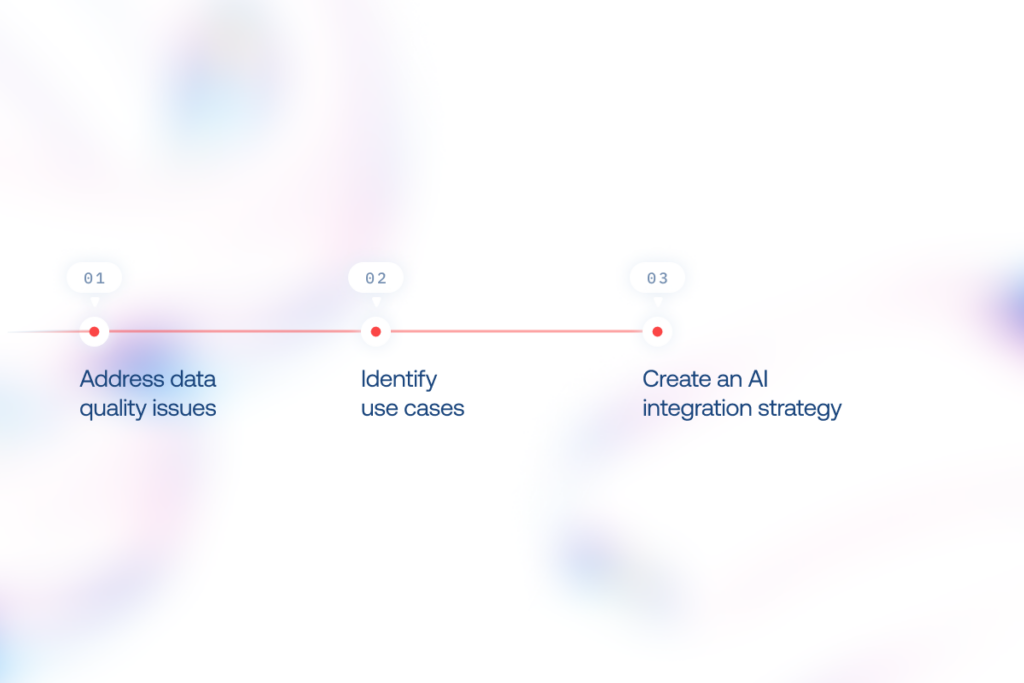
3 steps to start your AI project in the oil and gas sector

All the above challenges should not necessarily hold you back.

McKinsey partners state that to generate value post-2030, against the never-before-seen push to balance sustainability, affordability, and supply security, oil and gas companies need to answer a number of questions in their AI strategy, one of which is:

So what should oil and gas executives start with to achieve AI payoffs?

1. Address data quality issues

The most critical factor in laying the solid groundwork for driving AI adoption is high-quality data.

What can you do? 

  • Identify all your raw data sources (equipment, sensors, satellite imagery, etc.). 
  • Review the ways you collect and store geological data, historical maintenance records, etc.
  • Assess the state of your data pipelines (ingestion latency, schema consistency, transformation logic, orchestration layers, and end-to-end data lineage).
  • Enrich your data science and big data competencies, if needed, to facilitate security and quality.

2. Identify use cases

While artificial intelligence in the oil and gas industry can be a powerful tool, it won’t be a silver bullet that transforms every process overnight.

Forget the idea of a one-size-fits-all enterprise AI solution that magically fixes everything in your company.

Instead, start with pilot projects focused on business areas that rely on high volumes of raw data and directly impact revenue, costs, risk management, or other crucial aspects.

Quick wins from improving bit-sized processes will create room for larger AI initiatives.

3. Create an AI integration strategy

Deployment of artificial intelligence in oil and gas varies by the industry segment, but these five criteria are universal to consider in your AI strategy:

  • draw on a cost-benefit analysis 
  • consider the impact on people and operations 
  • create a responsible implementation framework 
  • ensure data integrity 
  • establish effective governance

These considerations help build a win-win deployment strategy for business growth and a sustainable future.

3 steps to start implementing artificial intelligence in oil and gas industry

If AI adoption seems a hassle, you can always rely on an experienced tech partner to make things easier and more predictable

Request a free consultation

FAQ

What is the role of AI in the oil and gas industry?

AI models analyze diverse data to predict key parameters and identify pre-configured events, ultimately shaping crucial decisions. Indeed, that’s a fundamental “engine” of nearly all Artificial Intelligence use cases in oil and gas, from reservoir exploration and drilling optimization to automated anomaly detection and supply chain management.

How is generative AI used in oil and gas?

Large language models’ capabilities in data analysis, modeling, reporting, and simulation enhance understanding of operations and provide instant access to actionable AI driven insights. This unlocks numerous generative AI use cases in the oil and gas industry, including seismic data analysis, reservoir characterization, virtual field assistance & safety, storage facilities inspection, materials R&D, asset maintenance planning, and supply chain optimization.

Which oil companies are using AI?

Among oil companies that leverage AI technologies for different needs are industry front-runners , such as Shell (materials discovery), BP (choosing spots for plants), TotalEnergies (conversational AI assistance), Chevron (reservoir images interpretation), ExxonMobil (drilling data collection, vessels tracking), Petronas (predicting equipment failures), and Saudi Aramco (reservoir modeling, oil spills detection).

What are the most common AI use cases in oil and gas?

AI, GenAI, and agentic AI are widely used for predictive maintenance, reservoir modeling, drilling optimization, leak detection, supply chain forecasting, refinery optimization, and ESG reporting automation.

What is agentic AI and how is it applied in oil and gas operations?

Agentic AI refers to systems that can plan, decide, and execute multi-step workflows using tools and enterprise systems. In oil and gas, it powers maintenance scheduling, field assistance, sales operations and compliance reporting automation.

What are the main challenges of AI adoption in oil and gas?

Key challenges of deploying AI for oil and gas infrastructure include legacy infrastructure, poor data quality and storage, weak governance, and integrating AI into safety-critical, physically grounded operations without disrupting existing workflows.

How does AI improve safety and predictive maintenance?

Predictive maintenance models forecast equipment failures before they happen, reducing downtime and accidents. AI also automates inspections in dangerous environments and supports field workers with real-time alerts and decision guidance.

What is the AI adoption rate in EPC oil and gas projects?

While an industry-revealed AI adoption rate in EPC oil and gas projects is not explicitly available, BCG revealed that 72% of O&G companies support adoption of GenAI tools, 47% redesign end-to-end workflows and processes to facilitate agent-led automation, and as much as 22% build new business models and products to drive growth (e.g. personalized AI agents that help retail energy clients optimize consumption, AI tools that support real-time adjustment of prices based on customer behavior and context, AI systems that propose new exploration targets using basin analogs and constraints).

How do oil and gas companies start implementing AI?

Implementation of AI in the petroleum industry unfolds in stages. Companies start by fixing their data foundations, then target high-impact use cases like maintenance, forecasting, or emissions tracking. Next come pilot projects with measurable ROI, followed by integration into core systems. Scaling requires governance, MLOps, and a gradual shift toward automated or agent-driven workflows.

Generative AI in Ecommerce Business: 11 Use Cases and Implementation Path

Key highlights

  • From customized product visualizations to conversational chatbots and at-scale content generation, generative AI in ecommerce has become a fixture.
  • Adopting AI solutions for ecommerce takes dedicated effort, scale-ready tech infrastructure, and a careful selection of training and deployment methods to keep sensitive data secure.
  • The path from LLM to ROI lies through specific use cases and point gen AI solutions that can later be scaled to fit broader business needs and functions.

Retail leaders act like pioneers, diving headfirst into cutting-edge technologies and innovative sales channels to satisfy discerning customers. Generative AI in ecommerce has quickly proved to be yet another powerful and cost-effective tool for them to woo loyal buyers, impress would-be customers, and master the three Rs of top-grade ecommerce — serving the right offer at the right time for the right person.

But despite its no-regret efficiency gains and broad appeal, machine learning and generative AI require careful navigation. There are still risks to consider, tech capabilities to embrace, and ethical considerations to take heed of.

So here we are, exploring the concept of AI in ecommerce, breaking down the latest proven use cases of gen AI in ecommerce, sharing the secrets of how to boost revenue growth with generative AI, and outlining an implementation roadmap for faster gen AI wins.

What is generative AI in ecommerce?

Where traditional AI finds insights in data, Generative AI acts on them, producing tailored marketing content from product descriptions and ad creatives to email campaigns and landing pages. It also aids in creating personalized product suggestions, real-time chat replies, and even new virtual experiences.

Benefits of adopting generative AI for your ecommerce business

For ecommerce high-performers (those growing at least 10% faster than the industry average) generative AI has become the number one priority. In fact, over a third plan to allocate up to 25% of their budgets toward incorporating generative AI across business operations by the end of 2025. The rationale behind this stems from tangible perks companies anticipate.

Higher customer satisfaction

Typically, retailers cover only three of the seven steps of the customer journey, leaving the rest of customer interactions unattended. Ecommerce AI solutions can pick up the slack by turning unstructured data into clear insights about what consumer expectations really are across the entire value chain. With these insights, brands can deliver personalized customer experiences from initial product discovery to after-sales support, helping shoppers:

  • find what they want faster with tailored product suggestions or detailed, adaptive descriptions based on their queries
  • easily compare options and choose the best fit thanks to review summarizations and feature-based comparisons
  • secure better deals as gen AI tools can adjust pricing on the fly based on competitor pricing and customer behavior data
  • resolve issues more efficiently or get on-point clarifications 24/7 with context-aware AI-powered chat assistance

Faster, error-free operations

Ecommerce businesses can also implement generative AI solutions to automate time-consuming routine tasks such as product data entry, sales reporting, customer assistance, and others. Not only do gen AI tools speed these tasks up, but they also complete them with near 100% precision.

Besides, with drudgery handed off to generative AI algorithms, companies unlock cost savings and shift their focus to perfecting marketing strategies, adding innovative product features, and other profit-driving areas that hinge on the creative process. 

Better efficiency

Another reason why businesses are rushing to employ generative AI is its potential to deliver both short- and long-term efficiency gains.

From delivery route planning and inventory management to the generation of product visuals at scale, gen AI-powered tasks execution brings substantial impact with fewer resources.

Before gen AI, running targeted marketing campaigns, for instance, required a full team and weeks of preparation. Now, a single FTE armed with a custom pre-trained generative transformer can ideate and launch a campaign in a day. Whether it’s creating unique concepts, running A/B tests, selecting optimal timing, or refining targeting strategies, generative AI tools handle every task, ensuring conversion rates are maximized.

— Chad West, Managing Director USA, *instinctools

Sharper decision making

Retailers often race against the clock, trying to analyze what caused sales dips, what market trends to gear up for, and what specific smart moves their competitors made to hit it big with their last marketing campaign. And not all of this data is easy and fast to measure and monitor.

Paired with a robust AI core and a comprehensive data engine, generative AI can deliver whatever insights your ecommerce company needs at the moment and do it in a straightforward, conversational, and actionable way.

Many faces of generative AI in ecommerce

According to Precedence Research, the generative AI for ecommerce is expected to grow by over 320% by 2034. The growth this rapid owes much to its cross-modal versatility.

Gen AI content can be delivered in text, images, videos, audio, and even 3D representations. Below, we’ve broken down specific use cases each representation targets in ecommerce.

ModalityApplicationUse case
TextContent production– Product descriptions
– Personalized AI ecommerce marketing
– Messaging and notifications
Chatbots– Ecommerce customer service tasks and support
– Personalized online shopping journey
Search– Personalized product search
– Product recommendations
Analysis– Supply chain and inventory management
– Fraud detection
– Sentiment analysis
– Social listening
– Customer and market analysis
– New product analysis
ImageImage generator– Product images and ads generation
AudioVoicebots– Voice search
– Voice-based product recommendations
– Voice-activated shopping carts
– Soundtrack generation for marketing purposes
VideoVideo creation– Video generation for marketing purposes
– Video product description
– Product tutorials and manuals
3D representationProduct representation– 3D product catalogs
– Virtual fashion design
– New product design
Product design– Turning text descriptions into 3D product models

Although multi-functional, a gen AI model’s application layer fine-tunes it to complete a specific task. 

11 generative AI use cases in ecommerce

Retailers juggle too much to boost margins and keep customers happy — inventory glut, fragile supply chains, ever-increasing number of distribution channels. But now, generative AI systems take the complexity and tedium off their plate.

1. Personalized product visualization

Hyper-personalization is the new status quo for the ecommerce industry, with the majority of customers favoring a curated shopping experience in online stores. Generative AI lives up to the demand and allows customers to customize and play with the styles, colors, and fabrics of the products.

  • Stitch Fix, an online personal styling service, uses its Outfit Creation Model (OCM) to compile and visualize personalized outfit suggestions based on a consumer’s previous purchases, customer preferences, size, budget, and style.

Sephora and Ulta Beauty are using generative AI to develop personalized skincare product recommendations.

Stitch Fix's gen AI-powered personalized outfit generator

2. Virtual try-ons

Around 19% of US beauty consumers say that virtual product try-ons would help them feel more confident purchasing products digitally. Generative AI brings the visual try-on experience to each screen, allowing consumers to create realistic representations of clothes and other products. 

Unlike traditional virtual try-on tools, generative AI applications make the fitting experience more mindful of a body shape, skin tone, and personal style. 

  • Google constantly enhances its virtual try-on feature that demonstrates how clothes look on real models with different hair types, body types, skin types, ethnicities, and sizes.
  • Ulta Beauty uses style transfer technique, another gen AI offshoot allowing the customer to take two images — a self-portrait and a style reference image — and blend them together to offer a virtual hair style and colour try-on experience.
Ulta Beauty's hair style try-on, built with generative AI

3. Human-like chatbots

Traditional ecommerce chatbots and virtual assistants guide customers through basic linear flows but have a hard time thinking outside the predefined boundaries. With generative AI chatbots, it’s all different. Retailers swap generic responses for human-like interactions and provide accurate 24/7 support to users, boosting customer service efficiency.  

Generative AI can also supplement chatbots with natural language processing capabilities, enabling the bots to process natural language inputs (voice or text) and serve up empathetic outputs for after-sales support and issue resolution.

4. Product discovery and search personalization

In product discovery, generative AI can analyze customer preferences, behavior, and past purchase history to offer personalized product suggestions. Helping customers find relevant new products led to higher spend in 69% of instances.

On the same line, gen AI tools reduce search time as they can anticipate user preferences and search intent.

a screenshot of Zalando's virtual assistant powered with ChatGPT

Besides, with more intuitive, conversational search, discovering products gets easier. Instead of browsing hundreds of product names, customers can describe what they are looking for in their own words, and the virtual assistant will make recommendations. Generative AI powered tools can also interpret uploaded images and process short videos.

5. Content generation assistant

Creating accurate product content for thousands of SKUs is not for the faint-hearted. That’s why AI-generated content was among the first use cases that picked up steam in ecommerce. Gen AI powered solutions have simplified content production for product descriptions, listings, tailored marketing messages, and even social media posts.

  • Amazon was among the first to bridge AI content and ecommerce, helping sellers write product descriptions at scale.
  • Heinz uses generative AI to create images for advertising.
  • Shoplazza, an ecommerce website builder, has implemented gen AI models to transform mannequin models into real models.
Heinz's AI-generated ketchup ad creatives

Whatever it is, AI development services reduce the cost of content creation and streamline manual tasks.

6. Market research

When testing the waters of new markets and customer cohorts, ecommerce businesses need to comb through vast amounts of data to inform their strategies. Customer feedback on social media platforms, extensive customer data, competitors’ ecommerce companies’ moves, and other valuable data have to be made sense of.

Here’s how generative AI can help with analysis-related tasks in ecommerce:

  • Market intelligence — gen AI can help simulate market scenarios, produce synthetic data to fill data gaps, and forecast customer responses based on historical data. 
  • Information summarization — instead of spending months on research, ecommerce brands can employ AI tools to read and analyze existing material.
  • Novel market and customer segmentation or product opportunities — gen AI algorithms can uncover untapped market and customer segments as well as identify new product niches within the target market. 

7. Planning for promotions and marketing campaigns

Generative AI can supercharge sales and marketing campaigns with personalized loyalty programs and discount structures. Smart generative AI algorithms analyze customer data to create tailored rewards and incentives. 

Additionally, gen AI tools can extract valuable insights from EPoS and transactional data using predictive analytics, informing promotional efforts, pricing strategies, and production processes based on expected demand.

8. Boosting retail media networks

Retail media networks rely on loyalty and transaction data to sell ad inventory to third-party brands. By analyzing and deriving insights from customer data, gen AI tools can tell ecommerce businesses what advertiser categories to draw to their RMNs.

Within the network, generative AI tools can help advertisers tie together and optimize their ad spend. Generative artificial intelligence can also

  • analyze the best-performing offerings of advertisers,
  • match them to relevant consumers,
  • and generate campaign configurations to replicate ad success.

It’s a win-win for both: advertisers get the bang for the buck, while retailers get to generate more RMN revenue.

9. Supply chain and inventory management

Out of all industries, retail supply chains are the most dynamic due to ever-evolving customer demand, a large number of products, and rapid product life cycles. Generative AI adds simplicity to supply chain management by taking over the analytics inherent in the process.

AI ecommerce startups today offer many Gen AI tools that can analyze historical and real-time sales data to predict demand, calculate safety stock levels, and identify slow-moving stock. These tools can also assist gen AI ecommerce businesses in:

  • Running what-if scenarios to get prepared for supply chain disruptions and fluctuations in demand
  • Evaluating suppliers by analyzing financial reports, performance metrics, and other data 
  • Optimizing logistics routes by analyzing warehouse locations, transport links, and demand patterns
  • Improving last-mile delivery by selecting the right delivery or pickup routes based on traffic conditions, weather, and other data.

10. Gen AI-driven pricing

Generative AI models support AI-driven tools in identifying the optimal path to a retailer’s sustainable financial health. To do that, AI tools perform price simulations where they create various market scenarios based on: historical data, competitors’ behavior, market trends, etc.

Price simulations also allow ecommerce businesses to locate key-value categories and items in their portfolio, refine their pricing strategy, and spot implicit cross-dependencies between products.

Moreover, with demand-based pricing, ecommerce owners can model demand curves based on seasonality, inflation rates, income levels, and other variables to optimize pricing during spikes or slowdowns in demand.

11. Fraud detection

Generative AI and ecommerce make a powerful combo when it comes to anomaly detection. Traditional methods don’t catch fast-changing fraud tactics. Conversely, generative AI stays adaptive to new fraud patterns by constantly vacuuming up consumer data and analyzing it with past customer interactions.

By understanding genuine past customer behavior and previously detected fraud patterns, generative AI can simulate fraudulent activities and train AI algorithms to detect and counteract them. Paired with a conversational interface, generative AI can also notify fraud engineers about risk flow and give reliable recommendations on what to do next.

Don’t miss a chance to uncover new opportunities with gen AI

Capture its value

Leveraging generative AI for ecommerce takes dedicated effort

The promise of generative AI is enticing. But it can only deliver on its promise if implemented with your unique business strategy, needs, and constraints accounted for.

Get ready for generative AI transformation

A convincing, measurable business case is the foundation for any AI-based adoption. It should define:

  • a specific business challenge
  • the outcomes to measure gen AI implementation’s effectiveness

Without a business case outlined, you won’t get a clear understanding of the data needed to train the model and the technical expertise required to set the AI infrastructure in place.

Choose the right model

The choice of a foundational model and the technologies powering it depends on:

  • your use case,
  • the type and quality of your data,
  • and the limitations of your infrastructure.

You might consider implementing Generative Adversarial Networks (GANs) models for image generation, while models like GPT are more suitable for text-only applications.

Gen AI tools aren’t automatically compliant with industry rules, so choose the right training and deployment method to keep customer and sales data safe.

Train, evaluate, and fine-tune the model

The training process begins after collecting and preprocessing data. A lot of back-and-forth  identifies the optimal model architecture, hyperparameters, and training algorithm to achieve stable and safe performance. Once the model is trained, you should consistently evaluate its performance and fine-tune the model based on periodic test results.

Deploy and monitor

When the model is up and running, it’s time to make it a part of your ecommerce architecture.  

Based on your objectives, you may need to deploy it to a cloud-based service, create a dedicated user interface, or integrate the documents and knowledge databases of your ecommerce business with the model. Once the model is deployed, it needs regular performance monitoring to make sure it lives up to expectations.

Maintain and improve

AI-based models are only as good as the data powering them. Therefore, make sure to refine data patterns to prevent model drifting and update the model as and when necessary. In some cases, your model may need retraining, in other times, new monitoring processes may keep your model up to date. As your ecommerce business grows, be sure to scale the model accordingly.

Keep in mind that AI adoption success goes beyond the pilot. You need to embrace a mature and calibrated practice supported by tailored tactics and hands-on advice from an experienced vendor.

Challenges to clear before gen AI implementation

To see value from generative AI solutions, ecommerce businesses have to take heed of the following considerations.

Data quality and bias

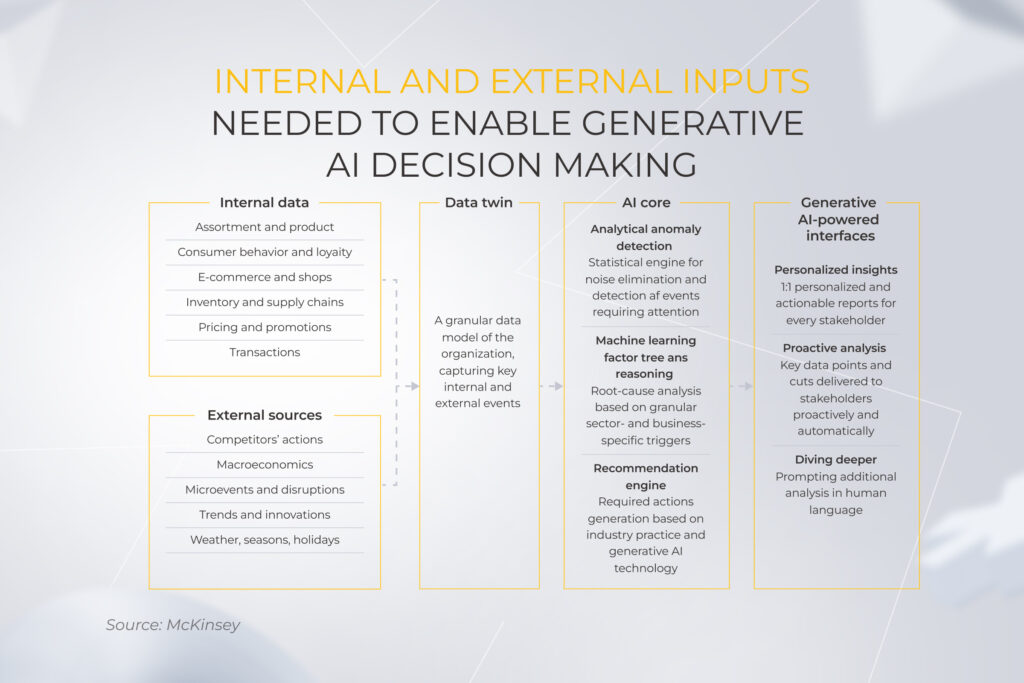
Your gen AI application is only as good as your data. To work effectively, it requires a rich palette of internal and external data that’s accurate, diverse, and representative of real-world scenarios and customer queries.

Internal and external data sources necessary for building generative AI-powered interfaces, according to McKinsey

If any of these boxes are left unchecked, your generative AI solution can perpetuate biases and churn out irrelevant outputs, hurting customer engagement and harming your bottom line.

Scale-ready adoption environment

You may already have a tech estate ready for gen AI adoption, but unless it’s scalable, you will end up with costly gen AI replications that will also be hard to upsize. The optimal gen AI architecture for retailers is function-agnostic and market-agnostic, meaning it can augment various business functions across different markets.

Techwise, an agile generative AI architecture requires the implementation of modular components that will allow for easy LLM swapping and scaling.

Data security and ethical considerations

As generative AI applications thrive on customer data, you must make sure they do it in a secure and responsible way. This includes adherence to relevant data privacy regulations such as GDPR, CCPA, PCI DSS, CalFIPA, and others.

Along with regulation-induced security measures, your gen AI applications must also have data encryption at rest and in transit, role-based access controls, network security, and other data security safeguards if you want your gen AI solutions to be ethically sound and good at maintaining customer trust.

Wrapping up

When powered with AI, an ecommerce business model is more efficient, customer-centric, and future-ready. AI can increase ecommerce sales, deliver unparalleled customer experiences, and more. Instead of getting carried away with the persuasive abilities of AI technologies, retailers should rely on a specific business case to spearhead their gen AI journey focused on fostering customer loyalty.

The right choice of a generative AI model, infrastructure readiness, and dedicated human expertise cracks the code of adoption and makes generative AI a low-risk investment for ecommerce businesses and commerce media professionals.

Let’s begin your gen AI journey together

Schedule a call

FAQ

What is the future of AI in ecommerce?

According to Precedence Research, the global artificial intelligence in ecommerce market size is expected to achieve $22.60 billion by 2032. We can assume that the ecommerce and AI duo will gain even more traction, ushering in new, competitive capabilities.

How is generative AI being used in ecommerce?

In ecommerce, generative AI has taken over a lot of repetitive tasks, including customer support, product descriptions, and ad generation. The technology also assists retailers in forecasting demand, maintaining optimal inventory levels, and providing novel shopping experiences.

How is AI transforming the ecommerce industry today?

Artificial intelligence elevates the customer experience, improves the accuracy of sales forecasts, amplifies marketing with personalized messaging, automates follow-up abandoned cart inquiries, and more.

How can AI boost sales in ecommerce?

Artificial intelligence improves lead retargeting, enhances customer experience, optimizes dynamic pricing strategies, and enables hyper-personalization in marketing. This increases conversion, leading to more sales.

What are the risks of AI in ecommerce?

Before adopting AI models, retailers need to make sure models are compliant with applicable regulations and have enough training data to prevent model bias.

The Perfect Match: Four Time-Tested Pro Tips on Finding a Remote Development Team

Building an in-house software development team is a challenging undertaking. From finding decent specialists to onboarding and managing them, you have to take on tons of things. The talent crunch in the tech industry does not make that any easier. There were only 65 potential candidates for every 100 vacancies in the US last year. 

All these and a number of other factors put remote teams in a favorable light in terms of software development quality, expenses, and time to market. If the idea of hiring a remote development team has crossed your mind, check yourself against our list of actions to pick a reliable technology partner.

What is a remote software development team?

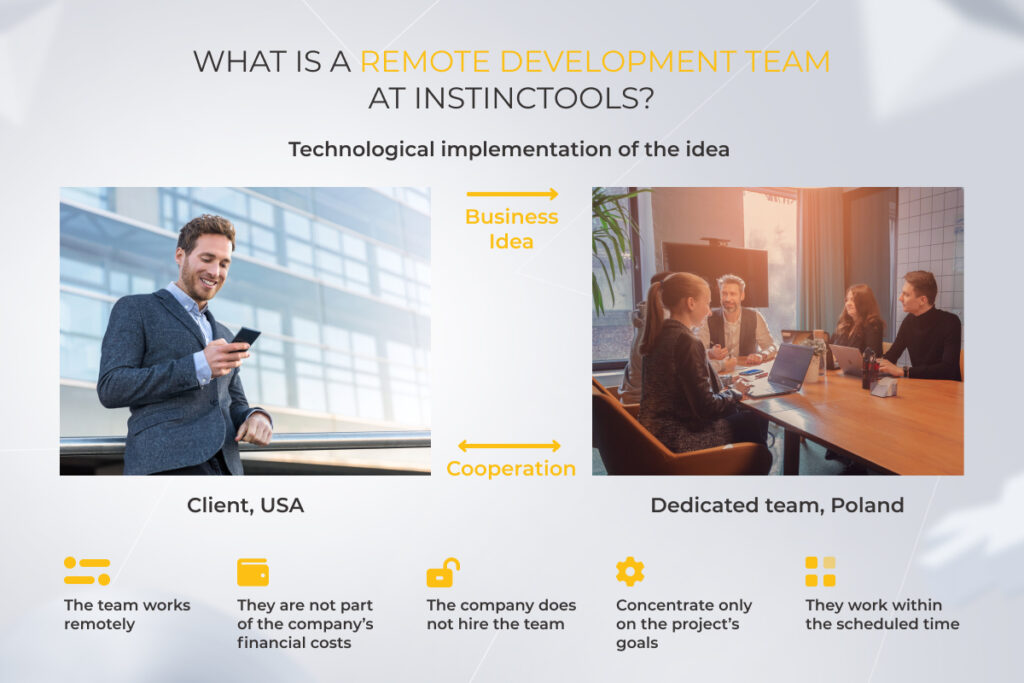
Remote development is a business partnership model in software development. It involves using the services of a technology vendor located in another country. The vendor sets up a remote development team based on your budget and project requirements to solve your IT challenges. Team composition and seniority levels for different roles are determined by your project complexity and the scope of the tasks. 

Engagement model - Dedicated Teams

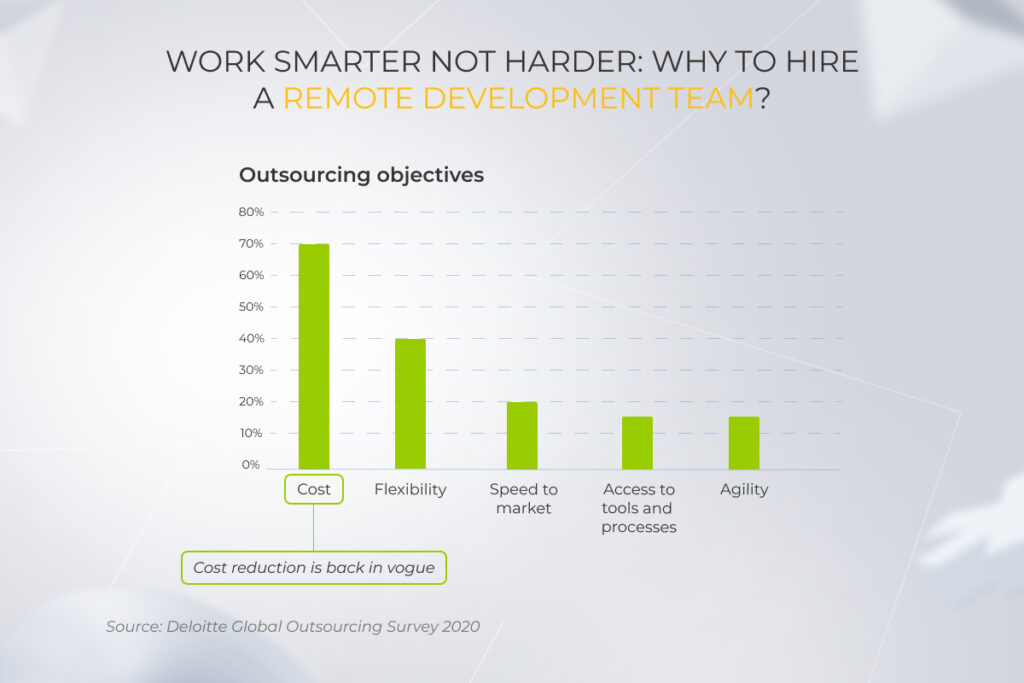
Work smarter not harder: why hire a remote development team?

Delving into new initiatives becomes easier when we understand the deliverables. When it comes to the remote software development process and remote workers, these are reduced costs, greater flexibility, and a faster time to market. 

Engagement model - Dedicated Teams

Whether you’re a CTO of a large corporation or a small business owner, outsourcing can become your way to kill two birds with one stone, saving your time, and project budget. 

If you hire a remote team, you don’t waste time setting up processes within the team as it’s self-managed. Just take advantage of ready-to-work, talented software engineers embedded into your IT department. 

For instance, tech giants like McKinsey and Deloitte locate their R&D centers in Poland, where the outsourcing framework is flexible, mature, and tax-friendly. You can also take advantage of local talent and hire specialists or an entire team to develop innovative products.

Looking for experienced software developers to meet your project needs?

Get a quote

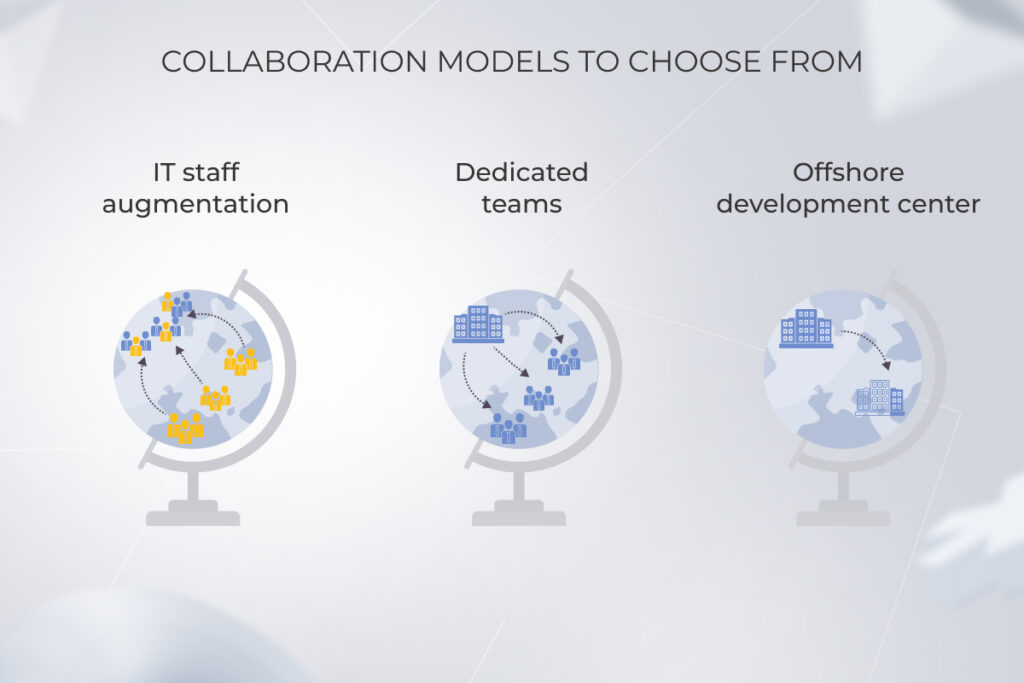
Collaboration models to choose from

No project can be handled by following the same playbook. Successful remote development calls for flexible collaboration methods, calibrated for your business needs. For a company that wants to launch their own product and has no developers onboard, for an organization that craves extra hands to offload their tech backlog, or a corporation which needs a full-scale development center as its numerous project teams have spiraled out of control, there are different team extension options to benefit from. 

IT staff augmentation

Start scaling your business capacities on demand with staff augmentation. It’s the most affordable way to strengthen your IT department with high-qualified experts in software product development, business analysis, UX/UI design, quality assurance, etc., in a matter of days. However, consider that you’ll have to manage these employees by yourself and have the skills and project management tools to do so.

This model of cooperation may be suitable for different projects. For example, a company with its own IT department may lack a specific role for a project. However, it’s impractical to hire the needed domain specialist full-time, especially if no similar projects are planned any time soon. Or there might be the right specialists in place, but the project deadline is on fire, so the organization needs extra hands for a short time to cope with the workload. 

​​​​Another example is when startups seek maximum benefits at an affordable price and in a short timeframe. An IT staff augmentation model provides them with access to a wide range of skill sets and offers financial adaptability and cost-adequacy, which are critical for resource-constrained newcomers.

The advantage of IT staff augmentation is that you don’t just get industry or technology experts but proactive team members who communicate effectively and strive to find and offer the best solution. This is driven by high competition among technology vendors. Remote software engineers have to be proactive so that you want to hire them again for another project. This is why, you can choose the best of the best without compromising your project budget.

Dedicated team

With dedicated development, you hire a whole agile development remote team, so you won’t have to build it from scratch or worry about fitting new employees into the established squad. The dedicated team works as an independent unit whose activities are transparent. Remote dedicated software development teams can cover the whole software delivery process, including analysis, design, development, deployment, quality assurance, and support.

Such an approach is a good fit for long-term projects with frequently changing requirements. You get domain experts who take on IT tasks if you don’t have your own IT department. And if you have your own IT unit, but they are busy on another project, then you can enlist the help of a dedicated team. Moreover, if you fully entrust your vendor with software solution implementation and delivery, then you don’t even need to participate in technical interviews of candidates for the dedicated remote team.

Offshore development center

When the number of separate remote teams you’ve been hiring is growing, at some point, managing them becomes too big of a challenge, taking a toll on the overall project. 

Instead of dealing with multiple remote teams scattered across the globe, you can establish an offshore development center when an overseas business unit becomes an extension of your organization. This collaboration model suits companies with specific security requirements, the ones that handle sensitive data, and large projects that depend on hardware. 

Engagement model - Dedicated Teams

Are you still mulling over what collaboration model will be the best fit for your company?

Let’s discuss it
Four factors to consider when looking for a remote development team

Before hiring a development team, there are a number of things to take into account from a business and technical perspective. The more nuances you think through at the initial stage, the smoother the cooperation will be.

1. Identify limitations of your project and expectations from the remote team 

This information will help you find a highly professional remote development team that matches your budget, time-to-market, and security standards. 

  • Define your budget. Calculate the amount of money you are ready to spend on the project of product development before starting the negotiation process. It’s crucial to engage budget approval persons, and the CTO, who will help define the technical requirements that affect the development cost.
  • Spot the specific requirements for your project. For example, if your project necessitates particular security protocols, it may narrow down the number of software companies, from which you can request a team of remote developers. 
  • Decide on the collaboration and payment model type you need. Earlier, we mentioned collaboration models and use cases for each of them. But at this stage, you should also choose between a fixed price, and a time and material payment model.

Fixed price, with its strict costs, timeline limitations, and inflexibility, is a suitable option for well-specified projects with precise time to market. Ensuring that no new requirements or features will appear during development is a mandatory condition. Moreover, this payment model may include the absence of communication with the client.

But startups without complete specifications and complex long-term projects require a flexible time and material payment model, which implies adaptability to ever-changing requirements. 

  • Following coding standards. It’s not that hard to write code that will work for now. But will it be high-quality and consistent code that any developer can work with? 

When you hire remote software developers, especially at a Java development company, make sure they follow coding standards, such as PEP8 for Python, SEI CERT for Java, MISRA for C/C++, etc. It will save you from code refactoring and rewriting inconsistent or poorly written code in the future. Moreover, such an approach ensures easier code migration and integration with other systems.

Unlock the prospects of software development with a remote dedicated team

Get in touch!

2. Think twice before choosing a region where to hire a remote development team

Although the quality of services plays the first fiddle in choosing a team of remote developers, it’s important to think beyond that. The cost of software development, time zone differences, culture and work mentality of the country you’re hiring from, English proficiency level, can greatly impact the success of your project.

  • Quality of software development services. First things first, it makes no sense to hire a team of remote developers from a cheaper location if the software solutions they create cannot maintain acceptable performance levels consistently, show low average Mean Time Between Failure (MTBF) and Mean Time To Repair (MTTR), and have a high number of defects in the code. Quality shouldn’t be compromised, and solutions should be, first and foremost, holistic, reliable, correct, maintainable, and easy to use. 

Therefore, it’s worth choosing remote software developers in countries with a high level of education in IT disciplines. For instance, while only 41% of developers worldwide have a bachelor’s degree, in Poland the figure is almost twice higher,  reaching 73%.

  • Cost. Instead of hiring a remote development team in the USA, where you would pay $130K for each developer, seek the same services in Poland and pay $40K for a senior software engineer working remotely or $24K for a mid-level specialist. Meanwhile, Poland is one of the five countries with the highest level of tech skills. 

This reduces the project’s cost by three to five times without compromising the development quality — looks too attractive to leave it on read, right?

  • Time zone gaps. For example, the time zone difference between San Francisco and a country in Asia may reach up to 13-16 hours. With a time difference of more than ten hours, it will be challenging to sync with a team and ensure smooth communication and collaboration. 

That’s why, opting for a remote team whose time zone aligns with your work hours is the most beneficial solution. For instance, hiring software developers from Europe will be a lifesaver for US-based companies as the time gap between them is about only six hours. 

  • Mentality and work culture differences. The cultural distinctions between the client and contractor’s sides may lead to misunderstandings and misinterpretations, putting the whole software development undertaking at stake. 

In this respect, it is easier for organizations based in the United States and Western Europe to collaborate with developers from European countries with the same company culture, for instance, Poland, to avoid communication problems down the line and ensure both parties have the same expectations from the project. Statista indicates that Poland is one of the leading countries worldwide when it comes to offshore development services and remote work.

  • English language proficiency. Speaking the same language as your remote development team allows you to be on the same page regarding the project. Poland ranks 16 out of 112 as having a high English proficiency level. 

Experienced developers fly off the shelf in a day in your country?

Leverage our talents

3. Check the reliability of the companies that provide dedicated development team services

Are you sure about the trustworthiness of the companies you’re considering? Here are some steps to help you make a wise choice.

  • Check the reviews of the companies on business listings, such as Clutch, GoodFirms, Techbehemoths, SelectedFirms, etc. Read customer reviews to get an idea of what other clients think about the company and its remote workers. Also, look into their ratings and how long they’ve been in business. 
Expertise - Product Software Development
  • Investigate IT providers’ case studies. Check out their skills in a range of industries and their previous work to identify their area of expertise and see if it matches your needs. That way, you can cut the chaff in the initial stage. 

4. Clarify how companies secure the work of remote development teams

Verifying that your project is kept secure is another essential point to consider when you hire remote software developers. Therefore, ask potential vendors about the security protocols they follow and measures they take to protect the data, such as encryption and secure storage solutions. 

Additionally, inquire about their privacy and data access policies to confirm that they meet your company’s standards. With the right security protocols in place, you can rest assured that your data is safe with the remote development team. 

Your technical partner should take into account local legal regulations and security protocols. Moreover, your remote dedicated software development team needs to be certified and audited in line with your specifications to match your compliance requirements fully.

Speaking of Poland, it stands on par with EU- and US-based organizations and sticks closely to international regulations.

Is a remote development team your golden ticket?

Projects with restrictions related to budget, level of security, complexity, and time to market are the first in line to benefit from remote software development teams.

  • Large, long-term projects 

The challenge of large, long-term projects is that their requirements tend to change. In this case, a remote team of profile experts is your opportunity to quickly adjust the team’s skill set to permanently fluctuating requirements. 

The side benefit you get when augmenting your team with outside talents is knowledge transfer. For example, you have mid-level developers working on a project, and you expand the team with senior-level vendor developers. Working together, they will be able to enhance the expertise and skills of your employees.

  • Product development with limited time to market 

A fast start is key when you’re working on a project from scratch. When you come up with an idea that could influence your company’s position among competitors, it’s crucial not to miss the moment and implement it quickly. 

With an agile remote development team and efficient time management, you can get to the project in one to five days instead of investing up to three months to hire the in-house experts

Average time / Different types of development teamIn-house team*instinctools’ remote team
Recruit & hire talents56 days1 – 10 days
Start working on a project30 days1 – 5 days
Scale up the team40 days2 – 3 days
  • Projects with a limited budget

For startups and small companies, renting office space, recruiting and covering vacations, bonuses, and taxes for their IT department can become a significant part of the budget. Moreover, you’ll need to invest a great deal of time and energy into assembling your own team. 

Hiring a remote team of developers in different countries is an alternative to setting up and maintaining your own IT department and an easy way to obtain your goals while keeping development costs moderate. And if your organization is small or medium-sized and software development isn’t a core part of your competence, you may consider not creating an IT department at all and rely solely on the dedicated team.

Why freelance platforms, such as Upwork, Fiverr, etc., aren’t the best options even if you are short on budget? You can’t be confident in freelancers’ level of expertise. Hence, you run the risk of getting low-quality development.

Expertise - Product Software Development
  • Project with special data security requirements

When hiring remote developers in another country, you determine the desired level of security the team must meet. You state the conditions and choose the development unit that will provide built-in network security, private office space, authorized entry, and software access control. 

If security is the cornerstone of your project, you can send keys on flashcards to work with your architecture and even require your provider to have team members tested for substances — the team will follow these rules and ensure compliance.

Expertise - Product Software Development

Take your time choosing a remote software development team provider to find a reliable one you can trust to set up the team. An experienced partner will determine the needed roles and their seniority level to handle the task effectively. 

Instinctools experience in remote development team services

At *instinctools, we understand the challenges and opportunities of working with a remote development team. We capitalize on our 20+ years in software engineering and innovative consulting to build successful and sustainable agile software development remote teams for our clients. However, we don’t measure our experience solely in years. It’s also reflected in 650+ successful projects in more than ten industries. Besides ensuring the quality of development and providing you with proficient tech skills and industry knowledge, we develop our soft skills and adhere to a continuous learning culture.

Instinctools has extensive knowledge and expertise in all aspects of software development and remote work. Our skilled teams are ready to assist with any project at any stage, from ideation to development and ongoing support and maintenance, while ensuring our clients’ projects are completed on time and on budget.

Our core principle is bringing tangible value to your project, and that’s what our clients say after collaborating with us.

Time is now: access a skill set and expertise that you may not have had before

With the world becoming increasingly digital, businesses need to stay on top of technology. Therefore, they need reliable, professional, and experienced tech allies. And taking advantage of remote development teams is one of the ways to get the software development done faster, more efficiently, and, what’s important, cheaper. While searching for a tech partner might seem daunting, our tips will help you find a professional and affordable match for your project.  

Tap into remote software development and scale beyond borders with us

Get in touch

FAQ

What is a dedicated development team?

A dedicated remote development team is your autonomous tech squad in another country that either strengthens and scales up your in-house IT department or replaces it. It’s fully managed by your tech partner, which frees you from dealing with the paperwork. Just enjoy quick access to the expertise you need.

What is the role of a remote development team?

A remote development team takes on tasks to ease the workload and allow your employees to focus more closely on other undertakings. For example, you are just starting a project, and you need specialists who can manage the process and, at the same time, transfer their core knowledge to your team. Or a large company requires extra hands to sort out tasks in the backlog. Or you are entering a new market and want to hire a full-fledged team in a new location.

What is the advantage of hiring a remote developer?

When you hire a team of remote developers, you save time and money on hiring. You get a whole remote development team that is ready to start working on a project in a few days, while, in the case of in-house developers, you may need up to three months to set up the team and ensure they function in a coordinated way. Moreover, you can scale up your remote development team even by double in just 2-3 days if you need to speed up your time to market.

How to hire remote developers in 2023?

Start by identifying your requirements for a remote software development team. Then check business listings, such as Clutch and GoodFirms, to find companies that provide remote dedicated teams services and have relevant expertise. Dive deeper into their portfolios to narrow down the pool of potential technology partners and interview the remaining applicants.

How do you manage a remote software development team?

Negotiate this concern with your vendor before you start working with a remote development team. For example, you can use tracking tools like Jira and Microsoft Teams to ensure you stay up-to-date on the project’s progress and successful completion. However, working with a dedicated team is convenient precisely because you don’t have to engage in their coordination constantly, as they are self-managed.

Revealing EdTech Trends That Shape the Future of Education

How will education evolve in 2025 and beyond, and where does that leave educational institutions and edtech companies? Discover the biggest EdTech trends to shape the industry.

Education is one of the few industries that inimitably resists change and ignores the needs of its stakeholders.

To illustrate this, it is enough to trace how school was adjusting to the ever-transforming world over the last hundred years. In short, it wasn’t. From the early 1900s up to pre-pandemic times — the same designated classrooms, the same teachers towering over the audience, and the same students performing the role of silent listeners.

schools from 1910s to 1950s to 2010s

The situation with higher and postgraduate education was not much better. However, 2020 made the industry develop at an overwhelming pace. On-site learning, the role of the teacher as the main expert and content provider, and one-fits-all approach — all these pillars that had supported education for centuries fell. So what are going to be the next ones to take their place? Here are some of the top trends in education technology to look out for in 2025.

What does the future hold? EdTech ideas

While the world outside classrooms is changing faster and faster, we aim to create a new model of education suited to the needs of the future that’s coming. Technology let the genie out of the bottle, allowing ideas that have been brewing for quite a while, evolve and be implemented at breakneck speed.

The total market for eLearning worldwide (in billion U.S. dollars)

1. Hybrid learning is here to stay

Although the idea of hybrid learning gained its momentum back during the first COVID-19 outbreak, it’s naive to think that it’ll go away any time soon. With so much money spent on the transition to eLearning (devices, infrastructure, etc.), educational institutions want to get more out of their investments. So rather than being a fleeting thing just for the pandemic, hybrid learning becomes a long-lasting movement that has provided a new setting for other education technology trends to occur. 

Shaping this new landscape for more groundbreaking ideas to be implemented and thrive, hybrid learning is not in a perfect shape itself. At the beginning of 2020, when the world was suddenly awoken to one of the dystopian scenarios of the future, the pain points of education that had remained unnoticed for so long, had to be dealt with immediately. With such a rapid and abrupt shift from in-person to remote learning, making a bunch of mistakes was unavoidable. Some teachers, for example, state that switching to a partially online format has doubled their workload. 

“With the amount of stuff we are juggling, it feels like it’s impossible to always kind of keep your head above water. The sort of administrative stuff really piles up. So even if we’re doing our best, we’re still dropping balls left and right,” says Kristine Harootunian, a math teacher at South Burlington High, Williston, Vermont.

Does it mean though that we need to give up on the idea of teaching children outside the classroom? Not at all. One of the possible solutions might be the use of refined learning management systems (LMS). They simplify lesson-building for educators, allow them to  consolidate administrative tasks in one place, automate routine, and offer access anywhere. Yet, so far, LMS have been more about management and less about learning, but the balance can be found.

Thanks to technology advancements, the LMS of tomorrow has every chance to turn into truly intelligent learning platforms. Whether we think about employees in a workplace setting, or kids in a classroom talking about a new lesson, people need both social interaction and some solitary work in order to successfully learn everything from a formal course. xAPI (Experience API) makes it possible to measure all types of learning experiences, and it can do so within an LMS. So it’s just a matter of time until xAPI becomes a standard for all learning management systems.

2. Creating life-long learning experience

With the ever-growing demand for new skills conditioned by rapid world changes, learners have been put under pressure of continuous acquisition of new skills. Those who are not agile enough to adjust will end up on the sidelines of their career opportunities.

The problem with the current state of things is that the education levels are absurdly detached from each other. What students are taught in high school barely correlates with what they do at college or university, just as getting a degree doesn’t guarantee that their knowledge will be applicable in the workplace.

But an EdTech company that’ll break these silos and find the way to navigate learners throughout their life-long educational process could become the next Netflix for educational systems. Sounds impossible? Until it’s done. 

Most breakthroughs once started with a ‘what if?’ question. So what if there was a system that would ‘meet’ a learner at a pre-school and help acquire the skills (alphabet, numbers, colors, etc.) appropriate for this developmental stage. Imagine that the system can link a kid’s school and home accounts so that the progress could be more easily tracked. The same model can work for K-12, and apart from supporting pupils in their studies, it will be able to track not only what is being learned but also how, and, thus, ensure smooth transition from school classes to assignments done at home. Thanks to predictive analytics, the system will also anticipate the student’s future needs and advise on the right college to apply to, and, when the time comes, all the data gathered in the system could be very helpful to match with employers. 

As the range of the user’s devices extends (a smart speaker, smart phone, laptop), all the apps track the learner’s progress collectively, delivering perfectly calibrated lessons via audio mini-lessons, or quizzes, or games.

Once a job has been landed, the person’s account can be connected to the employer’s LMS and ensure appropriate professional development. The best thing about the system is that it evolves along with the user, adjusting to their changing needs.

Machine learning (ML) technology makes it possible to build an educational system that will grow and mature with the user, using the data gathered from them for unprecedented customization. Throughout their whole lives people will be able to leverage a smart system’s assistance, which is especially beneficial for those, who suddenly find themselves needing to switch jobs or even industries.

EdTech companies can start moving in this direction by partnering with a vendor that already has expertise in building strategies for educational system development, data analytics, and experience design. 

3. Reversing the lecture-homework routine with flipped learning

A flipped classroom overturns conventional learning by focusing on practical content that is delivered online and often outside the classroom. It leads to more collaborative environments as students get an opportunity to interact with each other instead of being silent listeners to what their teachers say.

traditional teaching vs. flipped focus

By removing the one-size-fits-all lecture from the classroom and allowing students to have a self-paced lecture at home, they are encouraged to do the actual work in the classroom, interacting with their teacher and classmates. 

Technology is used to humanize the classroom.

Such an approach encourages experimentation, whereas the traditional model doesn’t have time for that. It overconcentrates on the result, missing though that the truly great result can’t be achieved without experimentation and failure.

The technology makes flipped learning not only possible but genuinely effective. Its concept is not limited to simply recording videos and letting students watch them as many times as they’d like. The whole idea is that learning should be based on well-thought-out software ideally bolstered with BI dashboards to help teachers track their students’ academic progress. You can convert the entire curriculum along with the data on students’ performance into the form of a dashboard.

Let’s take a look at how it’s done at Khan Academy.

an example of flipped learning

Every row is a student, every column is one of the concepts within a discipline. Green means that students are already proficient, blue means they are working on it, red indicates they are stuck. With this solution, teachers can easily decipher which kids need their active participation or, even better, which can be tutored by their “green-area” peers. Interestingly enough, it seamlessly flows into another education tech trend – peer-to-peer learning. The idea is not cutting-edge in itself, but with the help of technology it has reached a whole new level. Peer-to-peer learning goes beyond the classroom and becomes a global platform where students from different corners of the world can tutor each other, expanding their minds.

an example of peer-to-peer learning
A circular progress chart for a math exercise on dividing decimals, displaying completion stats and categories

Getting back to flipped learning, it’s worth mentioning that with so much data about students wrapped into comprehensible dashboards, educators can make the process as productive as possible. Teachers know exactly what students are up to: how long they’ve been spending watching videos, when they pause videos, when they stop watching, what exercises they do, the areas they focus on. The data is pretty granular so that the teacher can see where a student’s Achilles’ heel is.

As valuable as this model is at secondary schools, imagine what it does for adult learners who might be embarrassed to learn stuff they think they should have learned ages ago or to a kid from a disadvantaged community, who doesn’t have the opportunity to attend a brick-and-mortar school on a daily basis.  

Furthermore, in a traditional model, teachers spend most of their time doing lectures, grading, and whatnot, whereas in a flipped classroom, the student-to-valuable-human-time-with-the-teacher ratio increases.

4. Scaling up personalization with adaptive learning

The model of education we have now is a mass production model, a factory model. It doesn’t provide any individualized experience.

In a personalized school, each child defines their own learning path in a way that feels natural. Technologies play a foundational role here versus a superficial role in a traditional model. 

Adaptive learning software uses Artificial Intelligence to move students up and down through a grade’s level content based on their performance.

For example, in AltSchool, there are two main tools that enable personalization. The first one, called “portrait”, is a student’s profile. It is a representation of all things that are important about each child, with the data being constantly updated to curate the day-to-day education experience. The second tool – “playlist” – is kind of a basis for each child’s day. It contains a to-do list and a calendar, and allows each child to decide in what order they want to do things, and, as they get older they are allowed to choose what’s on that playlist. 

Apart from significant academic progress validated by national tests, kids advance in their ability to work with others and manage their time, set goals, and think critically so that they can successfully enter a working world that demands these characteristics from them.

Adaptive learning is a win-win both for teachers, who get the possibility to refocus their attention from simply giving instructions to curriculum design, motivation, mentoring, and students as they are given the chance to explore the subject through the prism of their personal interest and abilities.

The idea of eliminating the one-size-fits-all approach and ‘meeting students where they are’ can be applied to learners of different ages. But the earlier it’s integrated in the learning process, the better and faster results can be expected.

“We focus on the practical application of AI in tasks related to scientific work or tasks that students will later perform in their jobs. We can be flexible in the design and launch of programs, meaning that we can respond quickly to student needs for upskilling or reskilling and add to our portfolio of courses,” says Dr. Sven Schütt, CEO of the European university group IU Group (IUG), explaining how they leverage gen AI to fulfill the ‘education-for-all’ principle.

The recipe for a groundbreaking educational platform

The reason why a lot of outstanding education ideas fell on deaf ears was not so much in the reluctance to change something, but rather in the impossibility of realizing the change. After all, it is only a technological breakthrough that makes these ideas feasible.

Unleash the potential of cloud-based infrastructure

Cloud technology gained its momentum in education during the lockdown, as lots of schools didn’t have infrastructure built to support remote learning. Admittedly, cloud-based environments provide hassle-free solutions for deployment, management and safety administration, leaving more room for consistent learning experiences instead.

Speaking of safety, it wouldn’t be amiss to mention that back in the pre-pandemic times, many schools used to store their data in-house in file cabinets, and it was easy enough for someone to take a file and walk out with that data. Now, when adopting the cloud and partnering with reliable cloud vendors who adhere to the strictest security guidelines, school tech directors can be sure that school data is adequately protected.

The up-and-coming EdTech trend of cloud adoption is not likely to stop growing in popularity. On the contrary, it’ll maintain its foothold in education thanks to its ability to access work from any device and the ease of scaling deployed applications to meet students’ needs.

Ensure data privacy

Cybersecurity has been a hot topic in the education sector since the ‘record-breaking’ 2020. Cyberattacks have hit schools and colleges really hard and cost educational institutions millions of dollars.

Some of the most popular cybersecurity tools to surface in response to these cyberattacks are next-generation protections powered by AI and ML. These include endpoint security solutions and next-generation firewalls. Security orchestration, automation and response tools specifically use automation to detect and remediate possible cybersecurity breaches. 

The automated component in SOAR (Security Orchestration, Automation, and Response) helps make cybersecurity more manageable for understaffed IT teams in K–12 environments. Incorporating multifactor authentication is also strongly recommended.

Not only has the number of cyberthreats increased greatly, but the requirements to educational institutions in terms of data protection have become more rigid too. As schools and universities process many types of data, they need to comply with requirements that also apply to healthcare, financial, and government organizations. FEPRA, HEOA, PPRA, GDPR are just some of the regulations that educational organizations have to follow. And, yet, the authorities go even further to mitigate the risks of exposing personal data. In October, 2021, the US President Joe Biden signed the K-12 Cybersecurity Act, which is the first cybersecurity-focused law for secondary schools.

This type of regulatory compliance is becoming more challenging for educational institutions of all kinds, which makes it extremely important to choose a tech partner able to protect your software from breaches and data losses as well as develop solutions in strict compliance with the current data management regulations and major quality standards.

Add value to the learning process with Extended Reality (XR)

While more people have got access to knowledge, the current approach to education has two significant problems. First of all, teaching is still based on fact retention, whereas being informed is not the same as being educated. And, secondly, the old ways of providing information make it difficult for some students (especially those with ADHD, that is 10.5% of children in the US according to the latest data) to comprehend it. Struggling to process and memorize large amounts of information can become extremely disengaging. This applies to all types of learners, whether it’s in a school setting, on a workplace training course, or in lifelong learning.

The possibilities of XR, an umbrella term that covers Augmented Reality (AR), Virtual Reality (VR), and Mixed Reality (MR), empower students to stay inside their learning process with full control over their experience.

AR/VR technologies are a promising addition to the EdTech space due to their immersive nature, ability to share information in new and engaging ways, and potential to offer virtual experiences that can mitigate barriers from cost or distance.

The concept of the traditional educational classroom has gone stale and will eventually be swapped with the idea of a ‘global class’. Students will hardly opt against an opportunity to learn science on the International Space Station with their peers from all over the world, or shrinking to the size of a DNA strand to collaboratively manipulate molecules in a virtual hands-on way, or traveling back in time to explore ancient Rome and role-play out important historic events.

The role of XR in K-12 and higher education is going to grow exponentially but it won’t be limited to school or college environments alone. Workplace training will be enhanced due to this technology as well. For example, the Australian company FLAIM Systems has developed a VR learning solution for training firefighters in hazardous and emergency situations. The same works for lifelong learning. Whatever you want to learn in your everyday life, AR or VR could improve the experience. Take public speaking for example. Award-winning VR provider VirtualSpeech has created a VR tool to help people practice public speaking in a near-real way.

Understanding the impact these technologies have on the learning process, EdTech companies spare no expense in VR/AR solutions. According to Statista, the investments in augmented and virtual reality in the education segment will have more than doubled by 2025, and made 700 million dollars, compared to 300 million in 2020. And that’s not to mention, that only in the US, the number of residents who started using VR increased to 65.9 million people in 2023 and the number of AR users jumped to 110.1 million.

If that is not the reason to bolster your education solution with some form of XR, then what is?

Make the educational process easier & more efficient for both teachers and learners with generative Artificial Intelligence (AI)

AI-powered solutions have been among the top EdTech trends for quite a while. A plethora of opportunities, from task automation and smart content creation to personalized learning and 24/7 assistance, have become available for both students and teachers. Despite drastic shifts having already been done so far, Artificial Intelligence, NLP algorithms, and large language models (LLMs) show no signs of slowing down their rapid transformation of education, bringing even more promising developmental perspectives to the table.

  • Gen AI-assisted immersive classrooms

The combined power of Artificial Intelligence and the technology of extended reality allowed IBM Research and Rensselaer Polytechnic Institute to create a next generation teaching environment, providing a study-abroad-like experience with no travel required. The students learn Mandarin Chinese by conversing with AI avatars that can recognize not only what they say but their gestures and expressions, all against a computer-generated backdrop of Chinese street markets, restaurants and other scenes. 

“Students in the immersion lab mastered Mandarin about twice as fast as their counterparts in conventional classrooms,” assures Shirley Ann Jackson, the president of Rensselaer.

  • Proactive chatbots 

Designed to simplify the interaction between the participants of the educational process, chatbots provide a wide range of benefits, including spaced interval learning, immediate feedback, performance tracking, and, in the case of schoolchildren, communication with parents. AI assistants are also being used to watch for signs that students might be struggling, and to alert their academic advisers.

“If we could catch early signals, we could go to them much earlier and say, ‘Hey, you’re still in the window’ to pass,” says Donna Kidwell, CTO of the university’s digital teaching and learning lab, EdPlus.

Besides shaping a personalized learning experience for schoolchildren and students, tools like virtual assistants help facilities. For instance, data gathered from the gen AI-driven software empowers methodologists to clarify and enhance course materials. 

how AI-powered chatbots improve the learning process for teachers, students, and parents
  • AI grading 

NLP algorithms are powerful enough to assess students’ written responses and provide real-time feedback. It can be applied to online courses with thousands of students studying simultaneously.

Stanford researchers built a neural network that spent hours analyzing examples from old exams on computer programming, learning from a decade of possibilities. When given just a handful of extra examples from the new exam offered, it could quickly grasp the task. After the new exam had been taken, the system provided 16,000 pieces of feedback, and students agreed with the feedback 97.9 percent of the time. To compare, students agreed with the feedback from human instructors 96.7 percent of the time.

As you can see, coming up with ideas for leveling up studying and teaching experience with gen AI isn’t challenging. The tricky part is laying a safe, trustworthy, and ethical foundation for technology adoption, omitting AI-related risks. A UNESCO survey unveiled that only 13% of educational institutions worldwide established clear guidance regarding using gen AI applications.  

Having an AI-literate tech partner by your side will help you set up a transparent, explainable, and secure AI system and draw up robust policies.

Turn to gamification to engage young learners

Adults are often puzzled as to if children are able to store whole databases in their heads about a universe within a computer game, then why do they have so much trouble with the multiplication table? The trick is in constant practice and gamification, that makes the process truly engaging.

Education has long had, in a sense, elements of a game: good and bad grades for completing an assignment are like points in finishing a quest. And at the end of a school year, everyone has a Level Up, the transition to the next level of difficulty.

Speaking of gamification, as one of the trends in education technology, we no longer mean basic stuff that has existed for quite a while.

In online projects, gamification is much more complex. Originally structured programs, coupled, for example, with a detective story, make the learning process more engaging, children want to return to classes regularly and learn new things. For completing tasks, achieving goals, as in a computer game, they can receive points, additional rewards, and enter new levels.

The theoretical knowledge that students gain in class, can be immediately applied when they complete game challenges. This helps children look at knowledge and learning in general from an entirely different perspective.

The main benefit of gamified online learning is the motivation to learn. Students can see and self-evaluate their progress and achievement of the goals set. This helps nurture such qualities as independence, responsibility, and decision-making. For example, at the 

University of California, one study found that students who participated in an educational cybersports program showed much more impressive learning results than their peers, who are not involved in esports.

Drive the mission of learning with mobile technology

According to figures from the tech research company, Technavio, the education apps market is poised to grow by $6.08 billion and is estimated to grow at a CAGR of 14.5% between 2024 and 2029. All signs point to a permanent shift in how people access education.

For Generation Z, also known as generation digital, who learnt how to type before they learnt to write, using smartphones or tablets for their studies is as natural as breathing. They value the freedom that comes with mobile apps to study whenever and wherever, and willingly pay for it with a high level of engagement.

However, the education technology trend of mobile learning applies not only to Zoomers. For the past few years, mLearning has flipped the view of delivering quality content. You’ve probably heard of MasterClass, an online learning platform that allows taking classes from some of the biggest names in the business. It offers a multitude of options to consume their courses, you can watch it on a desktop, TV, phone, or tablet. Still, being more about “edutainment” rather than strictly education, MasterClass is something you’re not going to turn on your computer for (unless it’s already turned on), but are more likely to open on a smartphone or tablet sitting in a traffic jam, lining up in a coffee shop, or passing that quarter of an hour before falling asleep at night. A great-quality mobile application, Android and iOS users have rated the apps with great feedback (4.8 and 4.9 respectively for the platforms), is definitely one of the clues that contributes to the success of this costly platform.

Moreover, mobile learning complements the idea of bite-sized lessons that can seamlessly fit into your schedule, which in turn makes the subscription-based educational model more attractive. When students don’t have to wait for that perfect time (which may never come) to start or continue the course and can study “right here right now”, they won’t feel as if they are blowing their money. 

In addition, mobile technology not only makes learning more comfortable for those who can’t imagine their lives without a smartphone or tablet, but also makes it the only option for people who otherwise wouldn’t have access to educational resources.

Education is the mission and mobile is the means.

Smartphones are now available to a large part of the world’s population, in the future perhaps to the majority, even in the least developed countries. The spread and cheapening of technology, as UNESCO notes, “gives marginalized people and communities, people with disabilities, refugees, those out of school, and those living in isolated communities access to appropriate learning opportunities’’, making education global and crisis-resistant.

how EdTech solutions transform the use of smartphones and tablets from passive to active

Engaging, sophisticated, and, most importantly, effective education will always resonate with learners. But it’s not enough. A VUCA world (short for volatility, uncertainty, complexity, and ambiguity) gives us little faith that things will stay the way they are, which means the only correct strategy is to be flexible and agile. Education – at all levels – must evolve to teach people the skills they need to thrive in our changing world. 

Get a better grasp of your students’ needs and adapt to how, what and where they want to learn

Let’s discuss
Automated Data Lineage: Remove Chaos From Your Data

Impeccable data quality and accuracy are deemed vital precursors in the quest for data-driven decisions. This strategic reliance on information leaves no room for error and places input transparency at the heart of the data management process. Automated data lineage is what gives you confidence in your assets and helps eliminate any errors throughout your data flows.

Data lineage tools allow companies to look into the “what”, “when”, and “where” of their data. They give the full context to the final insights, be it the input source or the evolution cycle. Let’s see what else this data-related practice can bring to the table.

What is automated data lineage?

Data lineage refers to the process of tracking and visualizing data flows throughout the organization – from the source to the ultimate destination. Lineage graphs tell the story of your company’s data and demonstrate how it took its current shape, whether it’s by merging, transforming, or integrating.

Origin tracing goes hand in hand with metadata. The latter summarizes information about the data itself, including its type, format, author, date created and updated, etc.

Because of this, data lineage produces a data mapping framework by gathering metadata from each step of the pipeline. Lineage tools then store these insights in a metadata repository and demonstrate over-time changes via metadata through simple visual flows.

Automated data lineage

How can data lineage bolster your analytics?

Over 80% of companies report revenue growth after adopting real-time analytics systems and processes. But how can you get your analytics right against the odds of multiple business systems and applications? Data lineage (and not just some lineage, but an automated one) can save you a lot of effort when it comes to business analysis.

Simplify root cause analysis

It’s common for different business units to act on the same metric. However, when it comes to quarterly planning meetings, each department head suddenly reports a different number on the same KPI. Let’s take ‘sales per quarter,’ as an example. The sales department might claim that they’ve made $1m, while the finance department says it’s $0.75m, as that’s the amount of money that has been deposited into the account As a result, the persistence of erroneous data throughout the enterprise’s systems and robs decision-makers of time and productivity, as they must continuously vet data to ensure it remains accurate.

By automating data lineage, business leaders can easily trace the origin of reporting errors. The stepwise record of data assets sheds light on the black box of insight generation and builds trust in the data estate of the given organization.

In particular, up-to-date data lineage helps you locate the most upstream nodes of your system that experience the issue. Most likely, this would be ground zero for your problem. The following lineage graph visualizes the hierarchy of data within the organization.

Automated data lineage

Also, if your data and BI management are in good shape, you won’t even need the help of a BI team to trace it back. Meanwhile, mature data architectures that saw little maintenance might need a dedicated BI unit to restore the origins.

Achieve and maintain compliance

The complex data landscape makes adherence to regulations an uphill struggle for compliance-heavy organizations. Companies just cannot provide the required level of transparency needed to meet HIPAA, GDPR, and other guidelines.

Data-lineage documents help organizations map data flow pathways with Personally Identifiable Information to store and transmit it according to applicable regulations. In this case, companies can capture the entire end-to-end data lineage (including depth and granularity) for critical data elements.

Get answers as questions arise

Although pipeline mapping alone cannot ensure data accuracy, automated data lineages can at least deliver a full view of the metadata so that you can see why exactly you have this number in your report. Put simply; you can locate a given business term and trace it to multiple applications, data sources, models, analytics, and other elements of your digital estate.

Unlike manual data tracing, automated data lineage tools minimize errors and return the result in seconds with each manipulation logged.

Simplify data migration

Data integrity and quality issues tend to haunt the majority of migration projects. According to the study, 44% of U.S. organizations admit that poor data quality slows down the migration process. Moreover, unless eliminated, these issues can affect downstream systems and manifest themselves when it comes to the end user. Also, these are tricky to spot during data testing.

To tackle migration challenges, data engineers need to identify the location and lifecycle of data sources. By using automated data lineage, your data migration team can obtain this information flat out, minimizing migration risks. Your engineers can leave all duplicate, outdated, and redundant data behind and identify the structure of a data asset slated for migration.

Instant impact analysis

To estimate the scale of data change, tech specialists resort to impact analysis that demonstrates which downstream systems will be affected in the process. Automated lineage helps pinpoint dependencies and identify the exact stages under impact – with little to no manual effort. Those stages can then be revised to accommodate the changes and promote data consistency across systems.

The following data lineage diagram example demonstrates how data flows through four different applications:

Automated data lineage

This is why if you introduce changes to your data warehouse, you can easily see which dashboards the alterations will impact.

Leverage the power of data lineage for analytics

Contact our data analytics team

Manual vs. automated data lineage: which does it better?

When it comes to origin tracing, companies and their IT departments have two options. They can either delegate this task to automated data lineage tools or rely on manual, also known as descriptive, data lineage.

Descriptive data lineage

A descriptive data lineage is one documented manually. In this case, data analysts dedicate effort to recording the information about how the data element is updated over time and how it ends up in a warehouse. This type of lineage is extremely time-consuming and prone to errors stemming from manual input.

Automated data lineage

By delegating lineage to a tool, you automatically handle the metadata recording process. Automated tools trace the asset changes and transformations throughout its lifecycle and make that information readily available via visualizations. From a tech standpoint, you provide meta-integration components to the tool and can then access the visualizations even with no prior knowledge of ETL processes.

However, data lineage automation calls for careful scope selection as this initiative can turn out quite expensive with the wrong choices. Also, the more legacy systems you have, the more data lineage challenges you will face, as aging ecosystems cannot provide metadata sources.

Tracing automation allows you to reduce the expense and effort required to document data lineage. Tools offer autodiscovery and integrations based on machine-learning techniques for creating metadata and building interactive data-lineage flows. Conversely, manual tracing has its inherent challenges linked with resource intensity and isolated workflows as it sits within the remit of the data governance team.

Сommercial or open source data lineage tools: which one to choose?

Data is a man of a thousand faces. And it’s either canned solutions or open-source data lineage tools that can reveal the true face of your assets. Let’s have a closer look at the dichotomy between the two.

Costs

Although it’s impossible to put an accurate price tag on both, making your data lineage open source appears to have more cost-saving potential, at least at first sight. However, free lineage tools typically cannot suffice your unique business needs, thus requiring pricey customizations to an indefinite extent. Commercial tools have all pricing options laid out for you.

Ease of use

Open-source data lineage tools usually require more time and effort from users to navigate due to complex user interfaces and little onboarding guidance. Contrarily, commercial tools tend to walk the user through the interface with more intuitive flows, solid documentation support, and managed pathways.

Alignment with your architecture

If your tech ecosystem already revolves around a particular provider, such as Microsoft Azure, it’s only logical to choose a lineage tool from the same supplier. In this case, the tool will integrate natively into your ecosystem and have no compatibility issues. However, if your stack isn’t centered around a specific offering or you don’t want to go big with your lineage efforts, you can opt for open-source tracing.

For example, one of our clients has a well-calibrated data management process where the team has almost complete visibility into how the data circulates between the systems. The client’s team injects lineage graphs only when they need to dig deep into the data. In this case, open-source tools will be enough.

Integrations and scope of visualizations

As lineage involves tracing the data footprint throughout its entire journey, data lineage tools should be able to integrate easily with your current stack. This includes everything from storage, injection, and visualization and all other stages where your data is originated, stored, or transformed.

Commercial software usually takes over the whole data lifecycle, thus having access to all processing stages via proprietary APIs. As a result, canned software visualizes detailed, all-encompassing insights about your data lineage.

For example, data lineage in Power BI integrates natively with the entire Azure ecosystem, while open-source software requires you to build custom APIs to access metadata.

Struggling to choose the right lineage tool?

Ask our experts

Adopting data lineage: best practices

The main rule of thumb in implementing lineage is to balance this practice against your unique needs and existing capacities. For example, in some cases, the project agenda of our clients requires our data engineers to resort to dedicated lineage tools such as Monte Carlo. In other cases, we build and connect this feature on top of other tools like Apache Airflow.

While lineage experience varies by company, we still have some universal advice on how to track your data origins in the most holistic and comprehensive way.

Keep it omnipresent

To remain authoritative, data lineage should permeate each stage of your data journey, including the phases of sourcing, ingesting, storing, analyzing, and visualizing. However, its presence at each stage should be meaningful and insight-rich, contributing unique nuggets of information to the knowledge body. So when deciding on the integrations, make sure you map data elements at every stage.

Prioritize quality over quantity

Over the last few years, there has been a dramatic shift from vast reams of data to knowledge centered around individual data components. The same trend applies to lineage automation. Instead of embracing the entire data landscape, it’s better to look into relevant metadata details, such as the asset owner and the presence of the asset in downstream sources. This way, you can define the value of each asset for your analysis.

Have the lineage view at the field level

Field-level lineage is key to understanding the relationship between the fields in the data set, thus facilitating root cause analysis. When your pipeline cracks, field-level lineage automation allows your data teams to see exactly how each field of your data circulates in your system and which transformation it has been subject to.

Automated data lineage

Keeping it at the field level helps to ensure the accuracy and quality of insights, point out errors in a revenue report, and trace columns with sensitive information to downstream dashboards.

Decide on the unified data lineage language

Just like any business communication, data lineage should be based on the common dictionary of terms to spread knowledge within the company. To establish a common understanding, your data lineage should rely on clear naming, which represents the data it’s describing. Naming conventions and style guides help people analyze data consistently, making data lineage diagrams easily digestible for all team members.

You can also streamline communication about data lineage between multiple stakeholders to maintain a shared understanding and get feedback on your graphs. To do that, your lineage tools should include built-in collaboration capabilities and notify asset owners about data changes.

Collect, store and prioritize metadata

While troves of high-level data hardly translate into accurate data lineage graphs, substantial amounts of metadata are beneficial to your tracing efforts. Therefore, having a rich metadata repository leads to a more comprehensive snapshot of all report components and faster troubleshooting. Also, including the relevant metadata for a given data asset makes your lineage graph exhaustive and helps you fully realize how potential changes will turn out in reports.

Let data lineage grow with your business

As your business expands, the data footprint of your business processes also builds up. To maintain data tracing complete and full coverage, your lineage architecture should be scalable and include an ever-evolving input stretch. This is why, no matter the analysis area, your lineage tool should look into every pipeline, report, and stack layer at the field level, joined by ample metadata.

Solving the mystery of data discrepancies

Knowing what goes into your report gives you confidence in your data and guarantees the right course of action afterward. Automated data lineage helps you develop a full view of your data evolution and track an individual number to its place of origin, preventing errors in decision-making. However, getting an accurate lineage graph requires a well-balanced data architecture to let the lineage tool mine metadata throughout the entire data lifecycle.

On the journey to better data quality?

Contact our data experts
Anna Vasilevskaya
AI modified real photo
Anna Vasilevskaya
Account Executive

Get in touch

Drop us a line about your project at
[email protected] or via the contact
form below, and we will contact you soon.