Software development trends 2025: Are you keeping up?

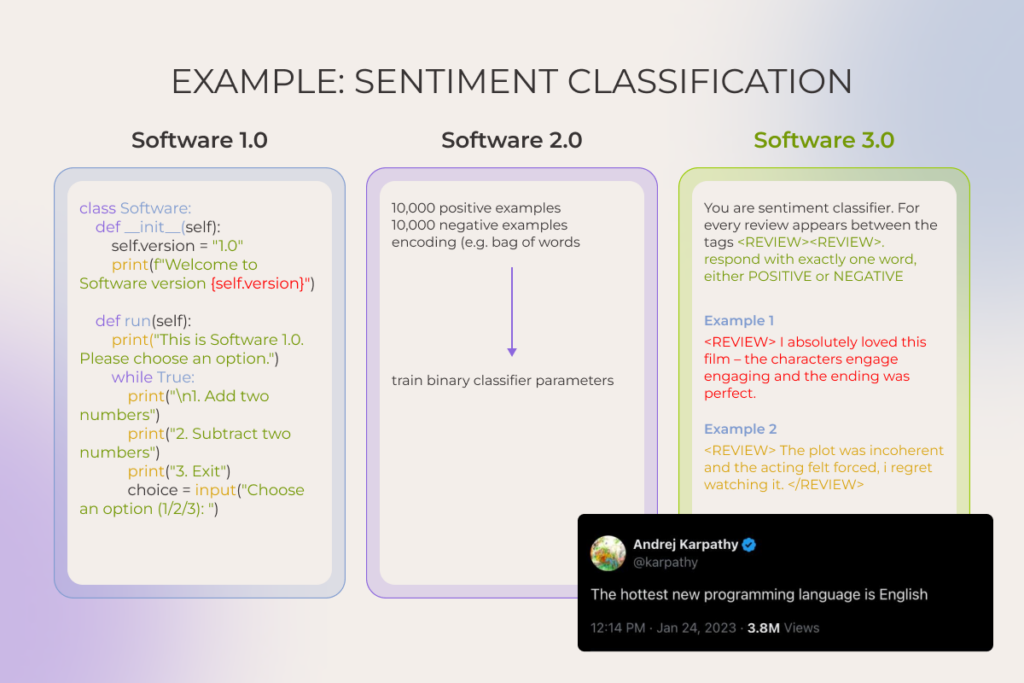
Software development is in the middle of a step-change. Andrej Karpathy’s framing captures it well: we’ve long passed the point where humans explicitly instructed a compiler in different programming languages (≈ Software 1.0) or even where they shipped software programs by training models instead of hand-coding (≈Software 2.0). Today, we’re in Software 3.0, where AI-assisted development takes the stage and the hottest programming language is… English.

Should you care? After all, companies that are used to clinging to old playbooks don’t vanish overnight. But history is brutal: many stuck-in-their-ways teams eventually dump millions into late pivots while faster players eat their lunch.

That’s why it’s essential to stay on top of what’s happening in the software industry, even if only a tiny part of your business touches it, let alone when you have engineering projects underway. Keep reading to see how you measure up against the latest software development trends in 2025.

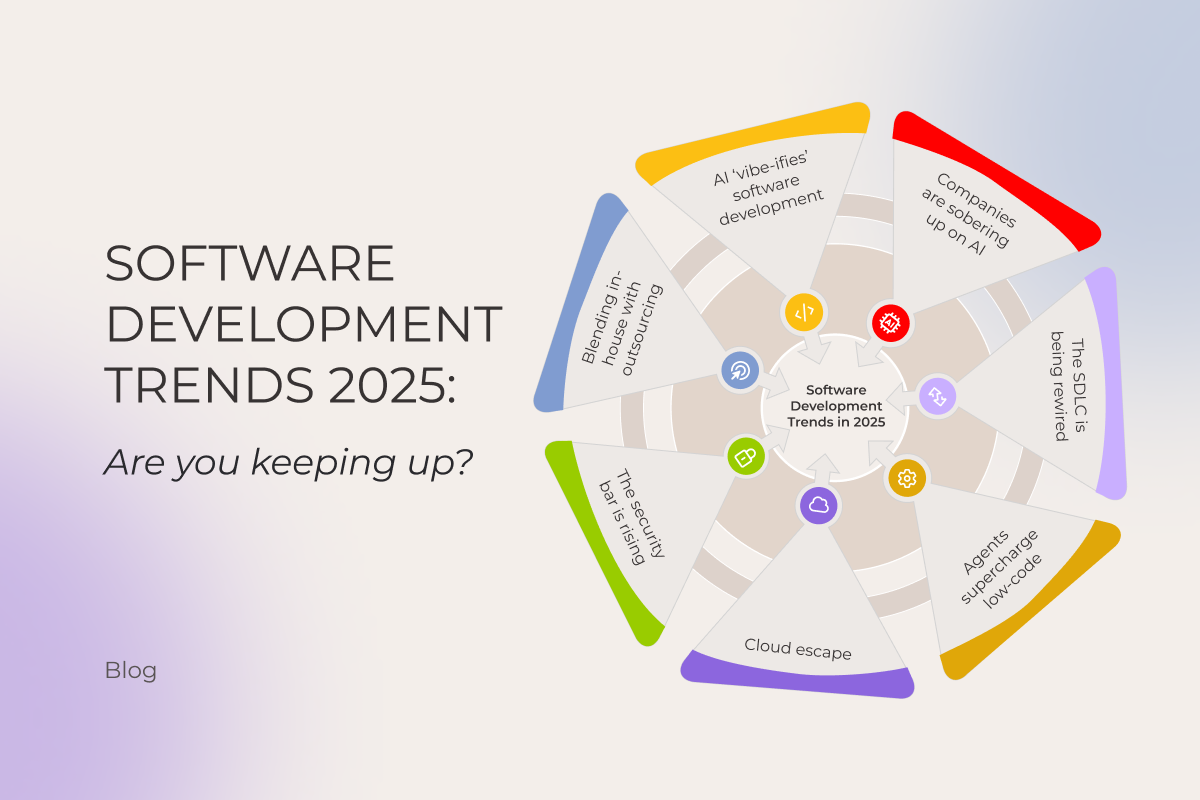
1. As AI ‘vibe-ifies’ software development, engineers have to drop the boilerplate and own the vision

Artificial intelligence now sits in every developer’s toolbelt (at least among those who bother to notice what’s happening in the tech industry). Forums and tech blogs have been flooded with posts like ‘My AI fixed the bug before I even saw it.’ Chiseling code with AI copilots has become the new baseline. But if just a year ago all eyes were on AI coding assistants speeding up isolated tasks, today it’s vibe coding that takes center stage.
Software development trends

Coined by (again) Karpathy in early 2025, it expresses the idea of ‘setting the vibe’ and, just like that, getting the app. But jokes aside, what’s really going on is more like agentic-powered coding inside tools like Claude Code or Cursor, where developers prompt the product vision and constraints and agents write code, complete PRs, and push to production while a human oversees the whole process.

Honestly, the split view of the community on this one is understandable. In the hands of newbies who can’t navigate the nuances of coding, agentic tools are basically the devil’s plaything. A junior developer, no matter how eager, just doesn’t have the knowledge and experience to feed LLMs with the “don’t do it this way, it’ll bite you later” kind of vibes. They can write something that technically works, sure. But the solution probably won’t fit certain project goals, won’t scale, and will quickly get overrun with technical debt. The funny part is, they can shove that messy code into production without even realizing it’s messy. 

However, in expert hands these tools are a real force multiplier. Ideas buried in the graveyard of “we need $10-100K just to see if this is even feasible” can now get off the ground in days and at a fraction of the cost. But “the capacity to be a good editor is the reward you get from being a good doer,” after all. So it only works if engineers know their stuff and follow best practices. And yes, even though the field’s still pretty green, some rules of thumb are already clear:

  • Breaking tasks down into bite-sized, verifiable chunks and giving crisp, unambiguous instructions
  • Doubling down on context: rich prompts, detailed specs, external context sources. Developers should stay in control of what the system sees
  • Setting up security guardrails, including sandboxed execution, file system restrictions (allowing read/write only to designated databases and blocking access to sensitive files), running linting and security scanners on generated code, human-in-the-loop approvals, and regular commits
  • Acing token math and memory management

In fact, this is arguably what the industry’s future in terms of coding will look like. System architecture design, task planning, context-rich prompt engineering, and orchestration – for the human, mind-numbing drudgery – for AI. It’s a given that most enterprises will run hybrid, pairing AI agents with human engineers in the loop, and such a split in workflow responsibilities and shift in mindset is perhaps one of the standout, can’t-miss trends in software development.

It’s safer to vibe on top of 25+ years of old-school coding. Start now

2. Companies are sobering up on artificial intelligence

In 2019-2022, before the major breakthroughs in natural language processing and generation, AI adoption was mostly feature-level. Hyper-personalized recommendations, fraud detection, demand forecasting powered with machine learning, etc. – that was the flavor of most projects. But ever since ChatGPT went public in late 2022, AI has become a boardroom-level obsession for most enterprises.

Leaders greenlit massive investments in AI, whether for building entirely new digital products, restuffing existing ones, or sprinkling AI assistants into daily workflows to speed things up. 

And now? With some of the dust settling, we are not in the place many hoped. Study after study points to sobering results:

  • The latest and the most viral one from MIT found that despite roughly $30-40B in enterprise investments into generative AI, about 95% of AI pilot projects haven’t come even close to delivering measurable savings or profit gains.
  • Replacing employees with clever bots and agents hasn’t paid off either: 55% of executives regret layoffs made in the name of AI.

So it makes sense that heating talks of an “AI bubble” make investors feel like they’re in troubled waters. Does that signal the end of AI? Hardly. Companies that rushed in headfirst are now moving from hype-driven use to more deliberate, pragmatic AI adoption, and it’s one of 2025’s emerging software development trends.

From our observations and those of industry leaders, two root causes derail AI projects again and again:

  1. Too many companies are chasing AI for its own sake. When businesses start with chasing AI instead of defining the problem, it leads to costly projects with no real link to business needs. By contrast, the small share of success stories tells a very different tale. Some pilots went from zero to $20M in revenue within a year. As the above-mentioned MIT report author put it perfectly: “they chose one clear pain point, executed well, and partnered smartly with companies who use their tools”.
  2. There’s a severe lack of internal expertise. Many organizations simply don’t know how to use AI tools properly or design workflows that capture value while managing risks. Besides, some large firms, especially in regulated industries, felt compelled to build their own software systems for legal or privacy reasons. Such a “control at all costs” mindset, flavoured by flimsy engineering know-how, led to dead-end initiatives and wasted budgets. 

As of 2025, rather than rushing blindly toward AI, more businesses rely on expert support to identify the most profitable AI use cases, confirm data readiness and context, and only then chart a clear journey from prototype to an MVP to scalable rollout.

Schedule a two-day session with experts to build a custom roadmap for AI adoption

Get the details

3. Software supply chains are being seriously rewired

The whole software development process is moving away from what we’re used to. And AI, being a catalyst of this change, is not running the show alone though.

Broad, AI-enabled overhaul of the software development lifecycle

Given how much AI assistants speed up software development and boost the quality of the final product, it’s no wonder companies are shifting from the traditional development process toward what’s being called an AI-driven SDLC.

Rather than just plugging in smart tools here and there, it takes coordinated action across three levels:

  • Strategic: сhoosing the value pools to pursue, defining the outcomes that matter, and deciding where AI will (and won’t) differentiate.
  • Operational: building a strong data foundation (prioritizing sources, improving data quality, etc.), investing in AI-powered tools and integrated orchestration platforms, and redesigning processes to embed the tooling end-to-end.  
  • Organizational: cultivating AI talent and upskilling existing teams to keep up with shifting labour market demands.

Only such a holistic setup can truly deliver the AI perks everyone’s been buzzing about:

Our experts see, coding is sped up by 60%, drafting docs like user guides or high-level acceptance criteria takes half the time, integration scaffolding slims down by ~80%, and QA reclaims 30-40% to hunt the tricky edge cases.

Enhancing developer experience (DevEx)

Though it definitely plays a role, AI alone can’t dissolve the friction that persists in the SDLC. In 2025, software developers continue to fight against the organizational drag – still getting swallowed by endless email chains, still ping-ponging between pointless meetings, and still digging through scattered documentation to get their work done…. Half of developers lose 10+ hours, while 90% lose 6+ hours, mostly to red tape. For a company with 500 devs, that’s nearly $8M lost annually.

More and more businesses in the software development industry are realizing the need to make life easier for their software developers by cutting through the clutter and putting DevEx front and center. One of the best practices is ramping up platform engineering capabilities via a centralized Internal Developer Platform (IDP), which is basically a hub for APIs, reusable components, infrastructure products, development tooling, documentation, tutorials, demo environments, curated learning paths, and a real-time view of all assets’ statuses, etc.

When a new hire logs in, they click “create project,” pick a ready-made template, and the IDP spins up the environment, hands over API keys, and sets permissions without tickets, meetings, or waiting.

Case in point: After a SaaS provider replaced its patchwork toolchains with a single, secure CI/CD pipeline and baked-in guardrails, 2000 software developers stopped wrestling with infrastructure and started shipping. Code velocity rose 10-20%, the number of critical incidents fell 20%, and security vulnerabilities shrank 15-20 %.

4. Rapid delivery with low-code / no-code tools, now even more rapid with AI capabilities

Gone are the days when a months-long software development cycle was an acceptable price for just an MVP. To be fair, speed has always been table stakes. But what’s different now is that it no longer requires cutting corners on quality.

Against this backdrop, something companies have been desperately waiting for finally hits home: the ability to quickly test whether a software idea actually flies before pouring effort and money into thin air. Prototyping has become lightning-fast.

That’s largely because low-code/no-code platforms (LCNC), once mostly clunky drag-and-drop website builders, have matured and now can assemble complex systems, complete with integrations, APIs, forms, etc., with minimal-to-zero coding required. And they’re quickly embedding AI:

  • Back in 2023, the no-code tool Bubble rolled out its Azure OpenAI Service plugin, letting businesses connect their apps to OpenAI’s models. Soon after, support was added for other popular models such as Claude, Grok, and Gemini.
  • In October 2024, OutSystems brought out Mentor, an AI-powered digital assistant built to step in with context-aware help across the software development workflow, able to carry out sequential tasks and even take entire processes out of users’ hands.
  • And just recently, in July 2025, Microsoft announced a shift in its low-code Power Apps tool toward agent-first app generation, to enable developers to quickly create custom AI agents to manage repetitive tasks. Its integration with Copilot makes the whole process faster by suggesting workflows primed for agentic automation. Yet, this out-of-the-box approach has its limits, and in one of our recent case studies we show how a custom agentic setup helped our client break through those constraints.

Anyway, building a core, heavyweight enterprise system LCNC-only is hardly the wisest strategy. Because the moment a new regulation, merger, or black-swan event forces you to change a core assumption in the solution’s architecture, that change ends up moving at the speed of a full-on manual rewrite anyway. All you can do is export the LCNC-generated code (if the tool even lets you), only to find it’s a spaghetti tangle of platform-specific runtime calls your developers refuse to touch.

But for a lot of non-mission-critical business apps, when there’s no decent off-the-shelf fit, low- and no-code platforms allow getting the job done with a small team of skilled people, who can keep the system evolving, supported, and refined in a low-lift way.

5. Companies are falling out of love with public cloud (hello, giant bills) and moving back to private cloud

A major cloud computing shake-up stands out among the latest software development trends. In the year ahead, we’ll likely see businesses take a hard look at the private cloud again and double down on hybrid stacks (a mix of private – on premises or hosted – infrastructure, edge nodes, and yes, still, some bits of public cloud).

As sweet as cloud providers’  promises of cost efficiency, scalability, and speed sounded made (no wonder forecasts put worldwide public cloud spending near $1.6 trillion by 2028, doubling its 2024 level), the reality of unexpected operational costs hit just as hard.

A recent survey shows 53% of IT decision-makers at companies with 100+ employees overshot their planned cloud storage spend. The main reasons cited are using more storage than planned, migrating more apps and data than expected, and unanticipated egress or API fees.

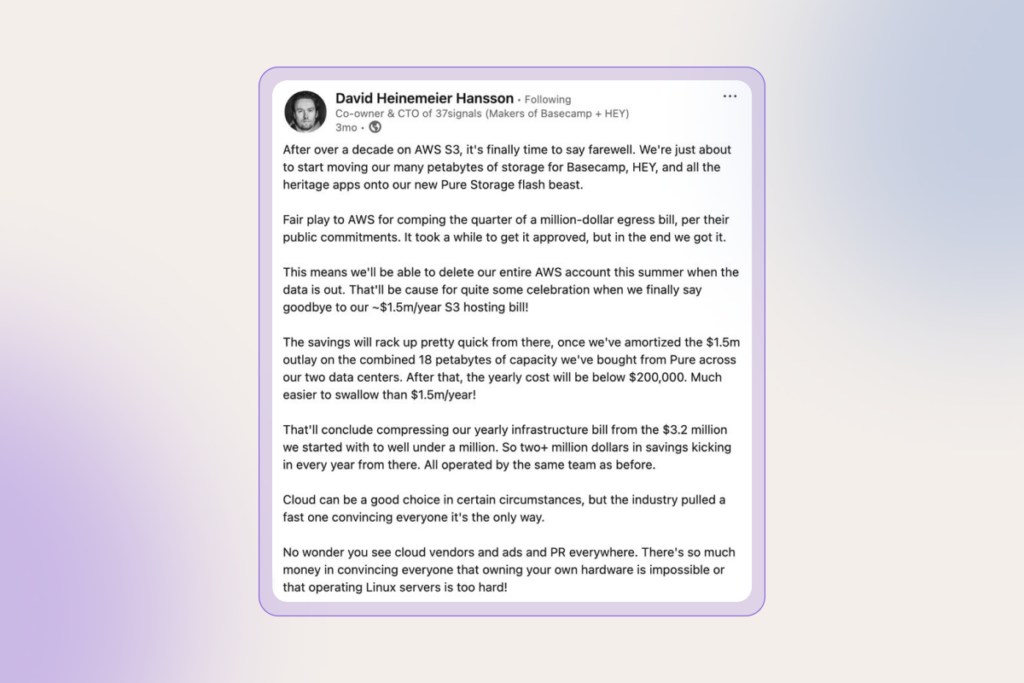
David Heinemeier Hansson, co-owner and CTO of 37signals, publicly shared his ‘exit the cloud’ story (and reasons behind it). Horrified by seven-figure annual bills, their team abandoned AWS S3 in favor of an on-prem setup. By their calculation, it will cost under $200K per year instead of $3.2 million spent on cloud computing.
cloud computing

But it’s not just the cost that is steering companies off the public cloud. The now chronic geopolitical uncertainty has sparked the sovereign-cloud debate in Europe. Public sector and highly regulated industries, such as finance and healthcare, increasingly require digital autonomy, often meaning private cloud and data residency by country or region. 

On top of that, growing demand for AI inference, machine learning, IoT, and autonomous systems that need ultra-low latency is driving the need for edge computing instead of distant mega-clouds.

6. Digital trust and security are still the backbone of enterprise tech

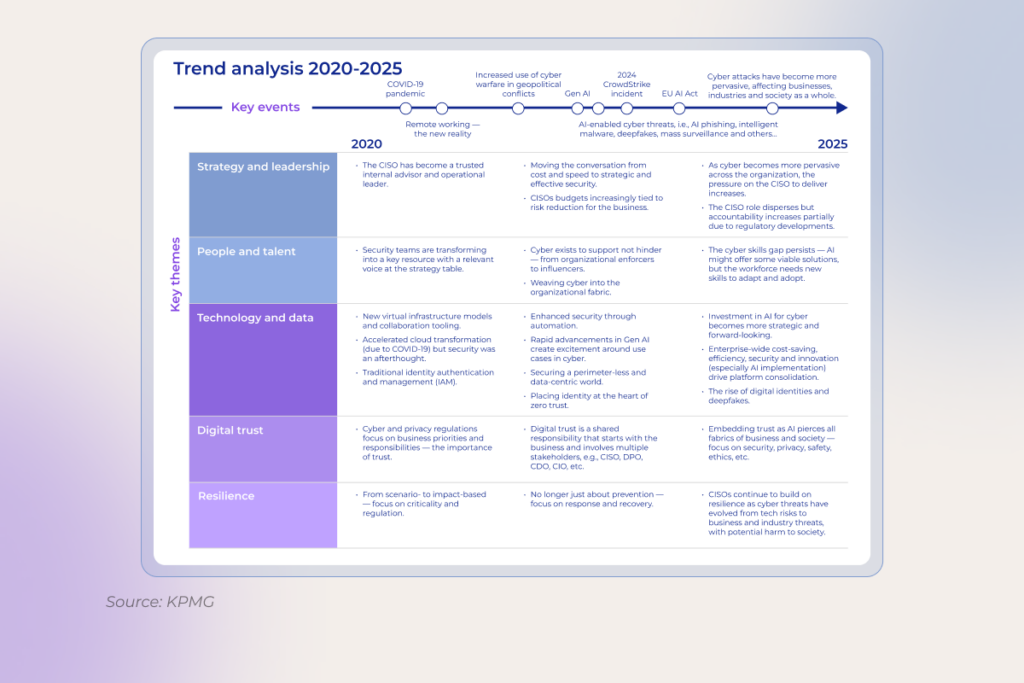
No matter how many times the “cybersecurity is vital” mantra is drilled in, yet – boom – another CrowdStrike-scale mess hits the fan. The stakes are only getting higher with AI, which is bringing new pressure points for security. 

Companies that once dragged their feet on data management now realize that training large language models requires clean, well-governed, and secure data from the start. Storage, processing, and classification all have to be tightened to make the initiative worth it. As Erin Hughes, Head of Cybersecurity Advisory, North America SAP, notes, CISOs often aren’t the data owners, so security and data teams need shared classification definitions and common rules of engagement, especially for AI.

The challenge doesn’t stop there. As enterprises stitch together sprawling ecosystems of third-party software, many overlook the basics of safe usage and resilience. So, lately,  companies have been getting dead serious about their data security posture, normally through:

  • continuous employee education
  • robust tech safeguards like identity and access management or multifactor authentication
  • continuous threat monitoring
  • clear understanding of regulatory obligations and compliance requirements related to the implementation of innovative solutions
  • practiced crisis response and recovery plans

As for software development, one of the most defining shifts is integrating security by design. Practically speaking, that means treating DevSecOps less as a buzzword and more as the baseline.

Read also: DevSecOps: How to Integrate Security into DevOps >>

And once the controls are rolled out everywhere, it’s just the beginning. Security mechanisms must evolve alongside advancements in emerging technologies, ideally a step ahead. 
software development trends

7. Hybrid approach to outsourcing is becoming the default

In 2025, many large corporations still seem convinced they can go back to the “good old days” of office life. They’re tightening their RTO policies, but the toothpaste is already out of the tube. Software engineers who’ve tasted the flexibility of remote work simply aren’t flocking back.

Besides, this whole return-to-office push seems counterproductive for a market where the cohort of senior engineers who can design, debug, and own production-grade AI systems is so tiny that companies struggle to fill those seats.

Regardless of your stance on remote work, one pattern is clear in 2025. When it comes to planning digital transformation initiatives, it is often faster, cheaper, and way more effective to tap into specialized dev shops offering self-managed, distributed development teams with AI-native, best-of-breed technical expertise. 

Most Fortune 500s are realizing just how flexible outsourcing has become. Pragmatic leaders now use hybrid models, keeping some projects in-house while handing off routine work to cost-savvy external distributed teams.

The bottom line

The future of the software development industry is rewritten by AI. It’s agent-powered. It’s security-centered. And… It’s nothing like what we’re used to. Those who grasp it and keep pace with these Formula-1-speed changes are best positioned to ride on competitive advantage.

FAQ

How is AI changing the way software is developed?

Artificial intelligence has become a true copilot across the entire software development process, helping with requirements, coding, reviews, testing, and what not. Engineers and managers delegate the tedious yet unavoidable grind to these new tools, keeping their attention locked on the high-impact, strategic work. This way, along with speed, teams squeeze more quality out of the same headcount

Are low-code tools replacing traditional development?

Not replacing – augmenting. Low-code tools are great at prototyping, line-of-business apps, and internal tooling. But when you’re dealing with complex logic, performance constraints, or avoiding vendor lock-in, you still want full-code engineering. The future looks hybrid: using low- and/or no-code development platforms for quick wins at the edges, and sticking with traditional engineering where durability and control matter.

What are the trends for software development jobs?

Job openings are down globally, full-remote roles keep shrinking, and junior seats are tight. All industries demand expertise in AI infrastructure, machine learning operations (MLOps), data analysis, and generative AI applications development, while classic frontend, backend, and mobile dev roles face stiffer competition and longer interview cycles across mid-level and managerial tiers.

What is the next big thing in software development?

Vibe coding and agentic workflows are the biggest emerging trends in software development. They collapse time-to-prototype curve to near-zero, providing the steepest drop in iteration latency software engineers have ever seen. With agentic setups, the cost of throwing code away is lower than the cost of refining it. And when waste becomes cheaper than polish, the entire product-culture flips and that’s why every major platform and VC firm is treating it as the next structural shift in how software gets built. Awesome solutions like Cursor, Claude Code, Windsurf, Lovable, Replit Agent, etc. are increasingly integrated into the tooling stack.

What is a major trend expected in the future of SDLC?

AI assistants will be embedded across all SDLC stages. From shaping user stories and system architecture through coding, automated testing, and deployment, over to continuous re-factoring. Meanwhile, developers’ roles move away from writing code toward curating prompt libraries, setting AI policies, and providing high-level strategic oversight.
MVP vs MMP: Choosing the Right Strategy for Your Product to Pan Out

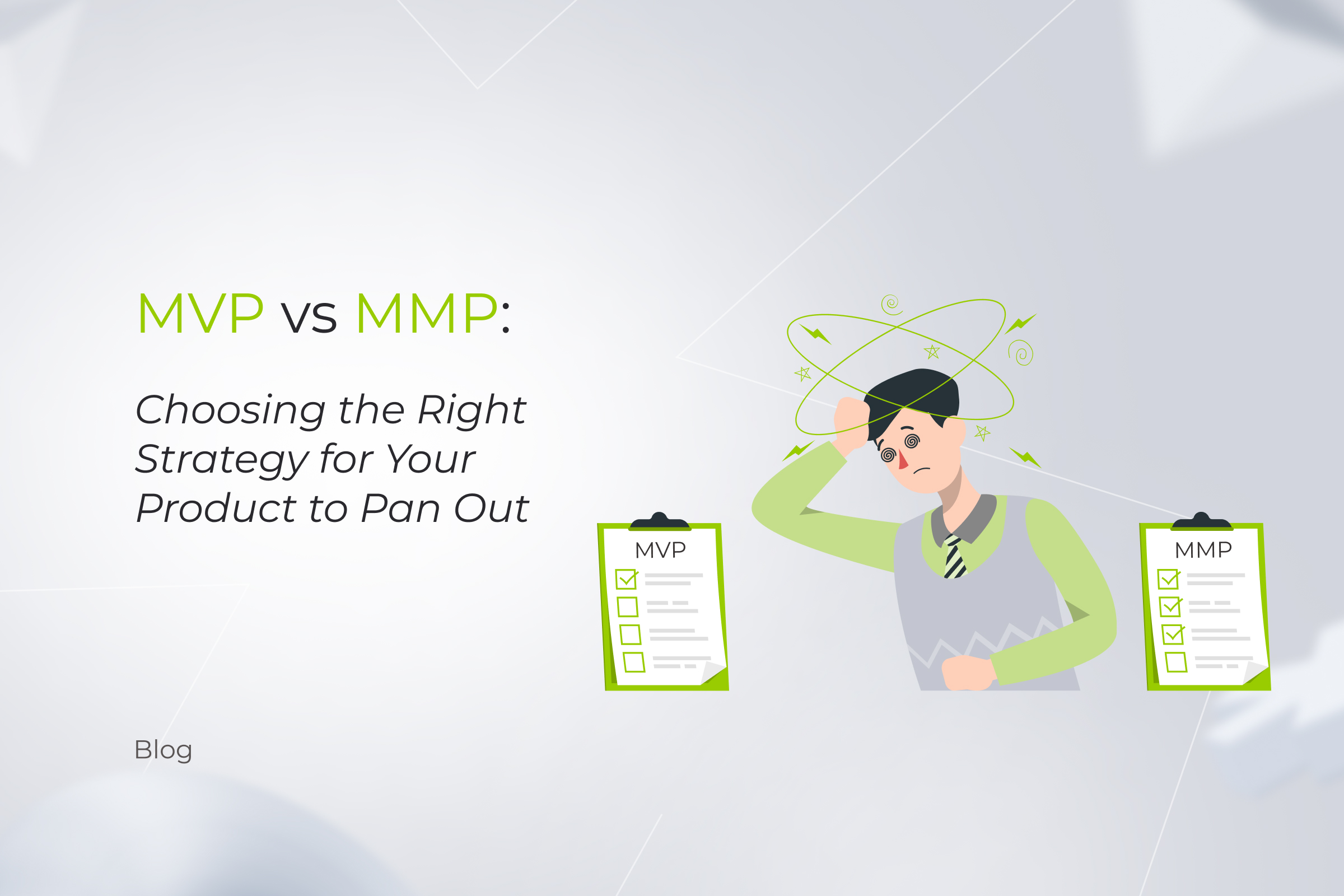
MVP vs. MMP development – which is worth investing in? Stakeholders face this dilemma when coming up with the idea of a brand-new digital product or exploring ways to build on top of an existing solution.  

Where do a minimum viable product and a minimum marketable one fit in the software product development path? Can you leverage MMP and MVP concepts, or do you have to pick one option and stick to it as your North Star? And more importantly, let’s talk money — which approach can your business cash in on? Our experts’ battle-tested experience will help to make the right choice. 

Contrast or cohesion: what is the difference between MMP and MVP?

Right off the bat: MVP and MMP aren’t opposites. In the Agile approach, they represent consecutive phases of the software product development process. 

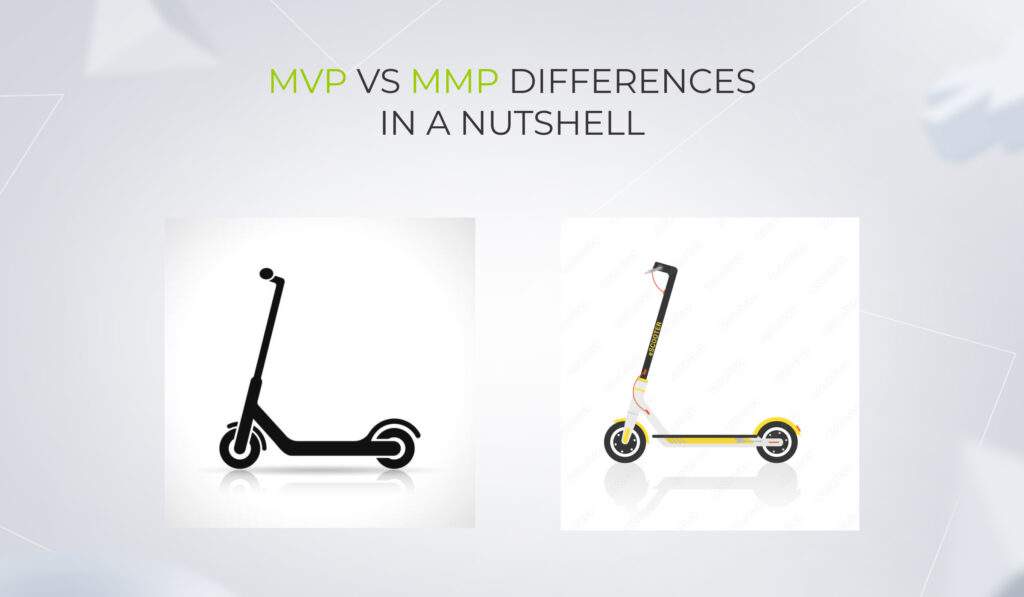
Imagine a basic self-riding scooter. Minimum features, no frills. That’s your MVP. It’s all about giving early adopters a taste, a hook — something they can’t resist even if it isn’t perfect and has limited functionality. It’s the spark that ignites their interest despite its raw design. MVP’s charm? It gets users moving through the city. And as a scooter innovator, it’s your golden ticket to leverage validated learning, gather real-world feedback from the product’s initial users, and evolve.

Now, let’s upgrade.

Enter the MMP. Think electric scooter: sleeker design, adjustable handlebars, and the thrill of choosing between multiple speeds. It’s not just about mobility anymore — it’s about zooming around town in style, tailored to target users’ individual preferences. The MMP isn’t a rough draft. It’s a polished piece with new features, primed to conquer the market and meet user needs with its enhanced value proposition. Plus, it tackles distribution challenges head-on.

In essence, while an MVP is the product’s early version with just enough features to capture initial interest, an MMP is the showstopper – refined, feature-rich, and ready for the spotlight.

Difference between MVP and MMP

Decoding MMP vs MVP: a face-to-face analysis

Even though MVP and MMP are rungs of the same product development ladder, it still makes sense to gauge them against various parameters. Consider that choosing one option over the other may have a knock-on effect on the desirable outcome.

1. Purpose and focus

MVP’s primary purpose is confirming your product’s viability, checking the product-market fit, gathering the first real feedback, and identifying areas for improvement. MVP also empowers companies in their startup phase, seeking investors’ financing support, to be more convincing.  

When crafting a minimum viable product, a dedicated team has a narrow focus on laying the groundwork for the future final version of full-fledged software.  

Generating revenue isn’t necessarily a goal at this stage. Yet, if your product is groundbreaking, odds are high for profits to roll in. Maybe you’ll be the next unicorn startup to join the ranks of successful minimum viable products that hit it big with no-frills MVPs, such as Spotify, Uber, and Airbnb.

As for MMP, its paramount purpose is a successful product launch and drawing customers’ attention to it. Along with product development, it focuses on marketing activities to promote the solution. 

2. Target audience

MVP is directed towards early adopters or potential investors if you’re looking for additional funding to develop your product idea. 

You can test the MVP concept on your established users if you run a company with a loyal customer base.

One of our clients – a healthcare corporation – developed MVPs to release to their devoted clients first. Not only did those clients gain access to the new products and features ahead of the rest, but the company reaped the rewards of detailed feedback from engaged users.

MMP aims to engage a broad audience of end users. Backed by blow-by-blow market research, you should know your target users better than anyone — what customer expectations have to be met, what pain points need to be addressed, etc., to enable surefire market entrance.

3. Feature set

You don’t need to build a penthouse if all your customers want is a camping tent. 

Keep this in mind when crafting your MVP, as its essence is in simplicity and precision. 

Our recent collaboration with our client, SpexAI, in developing the MVP of the frontline AgTech solution has once again proven it to be the right approach. We didn’t drown in features. Instead, we sharpened our focus on a singular game-changer: real-time monitoring of nutrient levels in crops.

When it comes to MVP vs. MMP comparison regarding their functional diversity, MMP truly shines. Packed with a richer array of features, minimum marketable product not only provides end-users with key features but also brilliantly caters to a wider spectrum of customer expectations and requirements, and tackles market demand more efficiently. 

For instance, here’s how PillPack – an online pharmacy – has rewired the shopping experience for elderly patients with an MMP. Pre-sorted packaging allows each client to receive their medicines arranged according to the individual intake schedule. PillPack’s MMP also covers home delivery, eliminating those pesky pharmacy visits. Add to that effortless collaboration with insurance companies, which simplifies purchasing drugs, and you’ll get the product that wins customers’ hearts and wallets.  

4. Development time & cost

Being built around a single killer feature, MVP development spans 2 to 6 months, making it a faster and often more cost-effective option compared to a full-blown MMP. However, the time frame can vary based on the project’s intricacies. For instance, if a company reuses its existing solution with legacy architecture for an MVP, the development process might take longer. 

With an MMP, which can take place after MVP rollout, you have to consider time for implementing should-have and could-have features. 

So, any way you slice it, crafting a minimum marketable product takes more time and money, than developing a minimum viable product.

5. Risks 

MVP and MMP are not just idle undertakings. Think of them as your protective shields against massive expenses and risky ventures. Instead of pouring heaps of money into a full-blown product, MVP and MMP offer a savvy path, ensuring you don’t break the bank or release something that doesn’t resonate with users and can’t generate revenue. 

But here’s the fun twist: an MVP, as a minimal offering, is like a sneak peek for early adopters. Even if it’s not perfect, you’ve got a golden opportunity to jazz it up based on the user feedback. It’s your solution’s debut, yet, with room for improvement.

But an MMP? It’s out there for a vast audience, and first impressions matter big time. No do-overs, no second acts to captivate users with your product.   

6. Monetization and revenue 

Even though the direct purpose of an MVP is to confirm the product’s viability and gather feedback from the early adopters for further development, it doesn’t mean it can’t bring you tangible value. Gartner warns against underpricing the MVP or positioning it as a freemium version of the product unless you use a freemium strategy.

If your solution with minimal features can be monetized and bring you ROI without investing a bundle of money in marketing promotion, such an opportunity shouldn’t be sniffed at. 

Unlike the MVP, which only lays the foundation for the future product, the MMP captivates a wider audience and is meticulously crafted to drive monetization and boost revenue. As MMP is closer to a full-fledged final product in terms of functionality and UX than MVP, its ROI potential is higher. 

7. Marketing investments 

MVP is the most cost-conscious option you can choose, as you invest only in software development. Banking on it in the MVP vs. MMP puzzle empowers you to keep the budget in check and save more of it for the upcoming feature releases and product fine-tuning.

There’s a reason for the second ‘M’ in the MMP — it stands for ‘marketable’, implying marketing investments. 

Odoo is a living example of a successful minimum marketable product that invested in marketing promotion ⅔ of the funds raised from investors and managed to get into high gear. Now it can compete with ERP titans. 

On the flip side, MMP’s expensive launch may consume budgets, leaving insufficient resources to launch the complex product later properly.

We’ve rounded up MMP vs. MVP key differences in a brief table to make it easier for you to grasp these two concepts.  

CriteriaMVPMMP
Purpose and focus– Confirming your product’s viability
– Checking the product-market fit
– Gathering the first real feedback
– Identifying areas for improvement 
– Checking if all the areas for improvement are covered, and primary should-have and could-have features are implemented alongside the must-have ones
– Gathering feedback from a wide range of actual customers
– Conquering the market 
Target audienceEarly adopters or potential investors for startups — a loyal customer base of midsize companies and enterprises.Any end user 
Feature setMust-have features onlyMust-have, should-have, and could-have features to ensure market success
Development time & costIt typically takes 2 to 6 months to craft an MVP and costs less compared to MMPRequires more time and investments as it involves developing more than the bare minimum features and planning marketing activities
RisksYou always have room for improvement based on the early adopters’ feedbackYou have to be quite sure that your product will pan out, as MMP is introduced to a wide audience and won’t have a second chance to reel in users
Monetization and revenueCan be monetized and bring ROI, but, in the first place, is designed to check the product’s viability Is designed for monetization and delivering quantifiable value and revenue
Marketing investmentsDoesn’t include marketing activities Requires marketing investment

Real-world examples of MVP vs MMP: when one approach works over another

McKinsey unveils that only 20% of start-ups reach product and market fit and can boast about hitting it big. Although each situation calls for unique approaches, not the standard playbook, you can learn from other established businesses’ experience. Here are two stories of the *instinctools’ clients.

  • Social media startup picks MMP over MVP to enter a highly competitive market  

That’s one of the projects we are currently working on. A client reached us with an idea of a new social media platform. At first, they wanted to develop an MVP. However, given that there are a lot of established players in this field, it would be challenging to entice users with just some basic features. 

Therefore, the client decided to craft a more advanced solution and up their game with marketing promotion to highlight the launch of a new social media platform to a broader audience. 

  • An innovative startup conquers the market with an MVP for aggregating EV charging points

Another client, Bonnet, considered going with an MMP from the start. However, as they were a trailblazer with a laser-focused mobile application for gathering EV charging points all over Europe, at first, there was no need for extensive functionality and a large-scale advertising campaign for the app. Therefore, they opted for MVP development and reallocated the funds earmarked for marketing activities for the product’s future versions and releases.

And it was a smart choice. Even the pilot version of the app turned out to be just what the market and users were hungry for. The MVP received support from prominent and influential investors like Lightspeed Venture Partners, Tier Mobility, Wise, etc., and from the product’s initial users, who were willing to participate in Bonnet’s crowdfunding campaign. The company exceeded the goal with 115% of capital raised and continues its thriving growth across the UK and Europe. 

Choosing between or going from MVP to MMP

While MVP and MMP aren’t the final versions of a product, they are key players when it comes to testing the market waters. 

An MVP allows you to pilot your idea, securing genuine feedback without breaking the bank.
On the other hand, an MMP is your ticket to rapidly wooing customers and accelerating your ROI.

If you aren’t tight on budget, why not let MMP use MVP as a launchpad for a double impact? 

The good thing is that you don’t have to deal with the MMP vs. MVP dilemma on your own either way. Partnering with an MVP development company in USA ensures you have the right expertise to navigate the transition smoothly. With a reliable tech ally by your side, you are doomed to succeed.   

Are you still in two minds?

Let’s discuss

FAQ

What is a minimum viable product (MVP)?

An MVP is a pilot version with a single killer feature that reflects an idea of a future final product and requires minimum investment. It’s a sneak peek at the solution to get feedback from early adopters and/or to attract investors and prove that your idea is worth their financial support.

What is a minimum marketable product (MMP)?

An MMP is a version of a product you can introduce to end users being sure that it will have a positive impression on them. MMP is more feature-rich than MVP and, along with investments in development, should include a budget for marketing promotion.

How does the development process of an MVP and MMP differ?

For an MVP, you have to identify must-have features and center on them, while with an MMP, you need to take care of should-have and could-have features on top of the core one. This difference in feature prioritization impacts the development process as well – you’ll need more sprints to develop and test the features above the bare minimum with the MMP.

How do MVP and MMP contribute to the success of a business?

Both an MVP and MMP can put your business on the fast track to success. In both cases, you start with a small feature set and move iteratively, staying in the loop of customers’ feedback. That way, you ensure crafting a product your target audience is hungry for.

How do MVP and MMP validate a product idea?

Validating the product’s idea is one of the primary purposes of an MVP. It’s designed to confirm the product’s viability by gathering and analyzing feedback from early adopters. And MMP aims to prove that end users will accept the product.

What is the role of user feedback in the MVP and MMP process?

For an MVP, feedback from the early adopters is a guiding star to unveil the areas for improvement before releasing your product to end users. And for an MMP, user feedback is the way to evaluate what kind of first impression the product has made and measure the product’s success.

How do you choose between MVP and MMP for your business?

The choice between MVP vs. MMP depends on a number of criteria — your target customers, purpose and focus of the product’s development, your budget, and if it can cover activities besides development, available time for crafting a software product, expectations of the product’s monetization, acceptable risk level, etc.

Can a product be both an MVP and an MMP?

Don’t bite off more than you can chew – this principle can be applied to software product development. MVP and MMP are close and related stages in the product’s SDLC but aren’t the same. You can craft a few MVPs that will later become an MMP’s components.

Building an MVP: an Expert Guide to Product Triumph

MVP development is all about providing a reality check for your business idea. You come up with a lofty ambition but don’t want to waste time and money on building something that nobody needs. That’s where developing an MVP can help. 

However, just building an MVP is not enough to make sure your idea pays off. There are a lot of prerequisites that define the outcome you get from your minimum viable product. In some cases, you don’t need an MVP at all. 

We address all your concerns about the MVP development process and share actionable advice on how to give your MVP its best chance, with real-world examples thrown in.

MVP development: a minimum viable product to solve an actual problem

A minimum viable product or MVP is a barebone version of your product with a minimum set of features that allow you to implement the critical functionality of your software. 

An MVP is not a polished or final product. It’s more about testing the market ground, getting feedback and data from early adopters, and learning what works and what doesn’t.

Although not a full-fledged product, an MVP can still generate value, whether it’s revenue or some other kind of pay-off if its business model is viable. Once the MVP gathers enough data to validate your idea, you can then iterate based on the findings and evolve your MVP into a fully marketable solution.

You should start with an MVP. Or should you?

Test it before you implement it — that’s what the golden rule of successful products says. But jumping right into testing is a sure path to draining your budget and bloating your feature scope. You and your product development team need to lay the groundwork and distill the must-have features that constitute the core of your minimum viable product. Here’s how you do it.

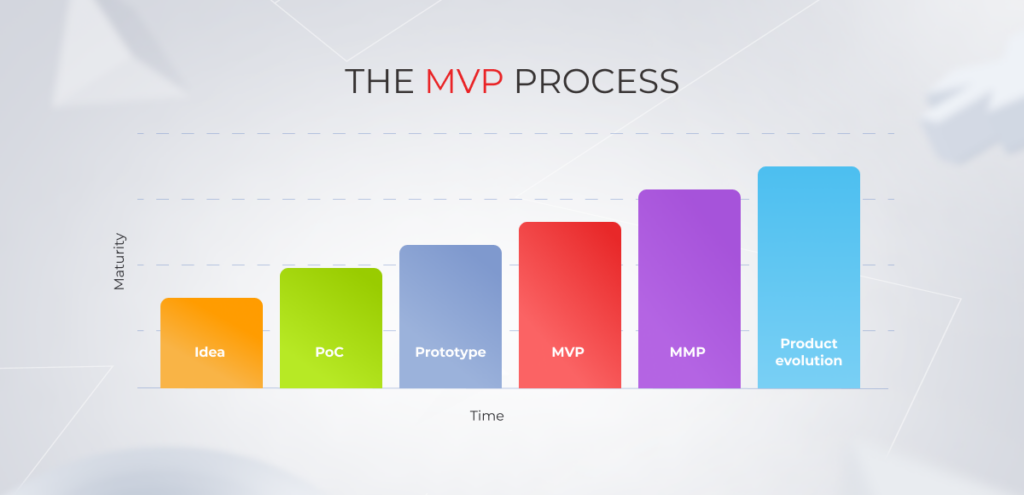
MVP Process

Idea

Every product starts with an idea, but 99% of ideas go through significant changes under the market’s impact. That is why your MVP development process kicks off with the Ideation or Discovery stage that helps de-risk your initiative, while also laying the foundation for a consistent, disruption-free development process. At this stage, your MVP development team sees whether your idea aligns with your budget and time requirements. 

To do that, the team strips down your concept to non-negotiables and transforms them into software requirements. The latter describes must-have features and functionalities of the end product. The features are then sized and prioritized to see how they lay out over the sprints.

Proof of Concept (PoC)

A Proof of Concept is essentially a model used to test everything from technical feasibility to market demand. PoCs reduce the risk of failure for new products and services by validating concepts early. 

You’ve got a one-of-a-kind, innovative solution and need to make sense of its technical complexity? PoC is the way to go. 

A Proof of Concept typically occurs during the late phase of the Ideation stage — before the team gets down to full-scale design and coding. A PoC usually consists of a small, basic, or undeveloped version of the product. At the end of the PoC phase, the team knows exactly how to create an MVP.

At one of our projects, the PoC stage helped our team to identify the most optimal library and backend framework for implementing the idea. The preliminary stages before the MVP also gave us more time to decide on the most cost-effective third-party integrations for our сlient.

Prototype

The MVP product development process usually starts with prototyping. A high-fidelity prototype looks like a real app, yet it’s still a pilot version of the MVP intended for internal use. It delivers a clear demonstration of how a product works so that stakeholders can decide whether it is ready for full production. 

The prototype also helps align the expectations and ensures that developers and stakeholders are on the same line. It can be used to test the solution and gather feedback from the end users.

Minimum Viable Product

After testing the technical viability of the solution and deciding on the look and feel of the product, your team continues with building a minimum viable product.

An MVP is a PoC and prototype combined in one — brushed up and brought to the production-ready state. 

Your team upgrades the UX as well as fine-tunes and expands the solution’s functionality. 

Minimum Marketable Product

While an MVP is the bare minimum, an MMP, or Minimum Marketable Product, is the minimum required to bring your solution to the market. An MMP includes one or a few killer features to make the product valuable for end users and put your company on track to high profit. It’s an upgraded version of an MVP that addresses user demands, delivers the intended user experience, and, as a result, can be easily sold.

The launch of an MMP is typically supported with a full-scale marketing campaign to attract more users from the get-go and improve the profitability of an MMP.

Product evolution

A digital product is never final and so is its development cycle. After releasing an MMP, the development team performs continuous maintenance and support as well as identifies the scope for future releases based on the user feedback or client’s preferences. Features are then prioritized and scheduled for release.

Check our all-encompassing guide on how to launch an app, crafted by engineers with 15+ years of experience.

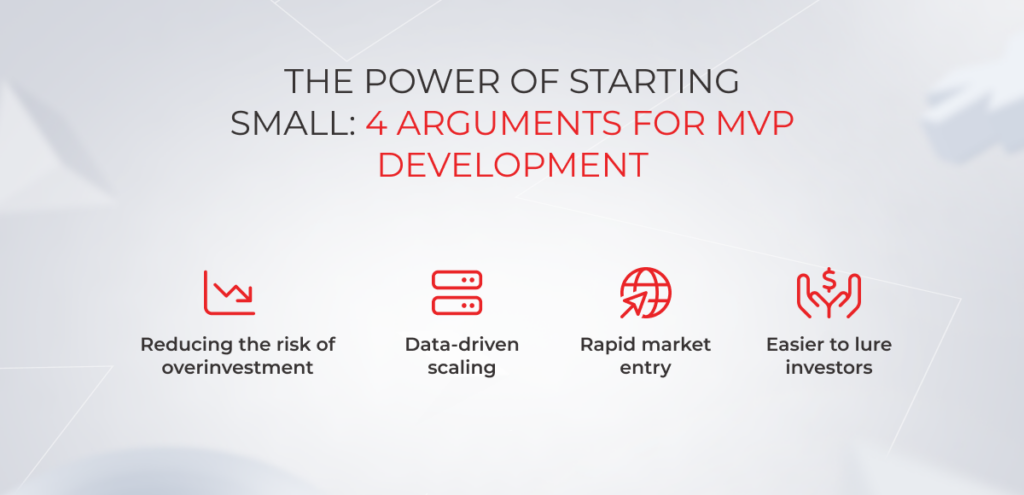
The million-dollar question: why build an MVP?

Almost every great product we use today started its journey as an MVP. And the rationale behind this trend is simple: creating an MVP results in cost efficiency, minimal risks, product clarity, and some other benefits featured below.

Reducing the risk of overinvestment

MVP Development

Building a minimum viable product means building it with minimum investment and in minimum time. Thanks to documented specifications and a clear understanding of the core functionalities, you and your development team can hop over to developing only the bare minimum of features with high utility. And less guessing means fewer resources spent on developing and testing.

Data-driven scaling

The first step to scaling your product is to get into the heads of your end users. What do they think about your product? What improvements and features do they want to see in the future? And the only way to get your hands on this information is to collect customer feedback through a minimum viable product. 

By tracking your user behavior and collecting their feedback, you can chart out your scaling strategy with a clear understanding of high-value features. An MVP release will also bear out an addressable market and validate that buyers will pay to solve their problem, in the first place.

Rapid market entry

The MVP approach allows you to get projects through your pipeline more quickly since you focus on developing only the core features and functionalities that are necessary for the product to be usable. 

By putting an early product in the hands of users as soon as possible, you can collate early feedback and use it for further iterations and improvements. As a result, you not only hit the market rapidly, but you also have a user-centered product to secure your place there.

Easier to lure investors

Getting investors on board from pitching an idea alone doesn’t work anymore. They need to see a tangible product that solves a real-world problem and has a good chance of gaining traction. So instead of going with a verbal pitch, you can use MVP to secure funding. 

A minimum viable product born and bred from a well-conceived idea is an indicator of high potential for investors, meaning they can get a profit from it.

Maximize the success of your product from day one

Hire our MVP team

Sometimes, MVP development is not worth the candle

MVP building is generally recommended for any new product with a poorly defined scope and market to minimize the risk of investing in capabilities that users may not need. However, MVP creation is not a silver bullet for all new products, and there are cases when companies can do without it.

MVP recommendedMVP not recommended
Initial product release based on an innovative ideaNew feature for an existing, well-established product
Product release for an emerging market whereby product features are not clearly definedA well-defined product with clear-cut requirements, validated product idea, and existing market
New product release from an established provider, based on the existing technology, but designed for untapped user base and use casesEnterprise products that are intended for internal use and are not meant for sale

Overall, a minimum viable product comes into the picture whenever one or all of the project variables (scope, market, or users) are not explicitly stated and are expected to evolve during product development. 

One of the reasons not to build an MVP is when the business owner knows exactly what kind of product they are going to implement. Specifically, all product requirements must be gathered and documented, the risks of a poor product-market fit must be low, and the product concept must be final.

As for new features launched in well-established products, providers usually skip the MVP development stage, knowing their users’ needs well. Also, in this case, MVPs with subpar user experience may result in reputational risks for an established provider. 

However, our expert provides a different perspective on the importance of MVP for well-established products:

Today, global businesses have shifted from long-term planning to a more adaptive and flexible approach in pursuing new initiatives. This applies to existing products and new feature releases, too. Whether it’s a brand-new product or a new feature for an existing solution, a Minimum Viable Product helps established companies to win the competition and be ahead of it as they implement new viable ideas.

Designed initially for startups, MVPs are now widely used in enterprise projects, too, as part of the agile methodology. Yet, if the product in question is designed to optimize internal business processes, enterprises can skip the MVP stage and move on to gathering product requirements, creating a roadmap, and executing the idea. In this case, a product can even be implemented according to a sequential model instead of an agile workflow.

How to build an MVP: 5 steps that make your idea go from raw to well-done

Minimum viable product development might come across as an anything-goes process, but there’s a defined framework involved. Here’s how to build a minimum viable product step-by-step.

1. Define a problem your product will solve

An MVP development process kicks off with gaining a clear understanding of value addition to early adopters. To define value, start with identifying the problem your solution will solve and work on your product concept from there. Product goals, user personas, features — your product statement shapes all other building blocks of MVP development. 

2. Study the market

How to make a minimum viable product without an existing market for it? There’s no way, unless you want to run out of money. That’s why market research is one of the crucial steps to build an MVP. You need to thoroughly analyze the target market, see how your product idea stacks up against competitors, and identify your potential customers. For trail-blazing products, it’s also recommended to assess the market size. 

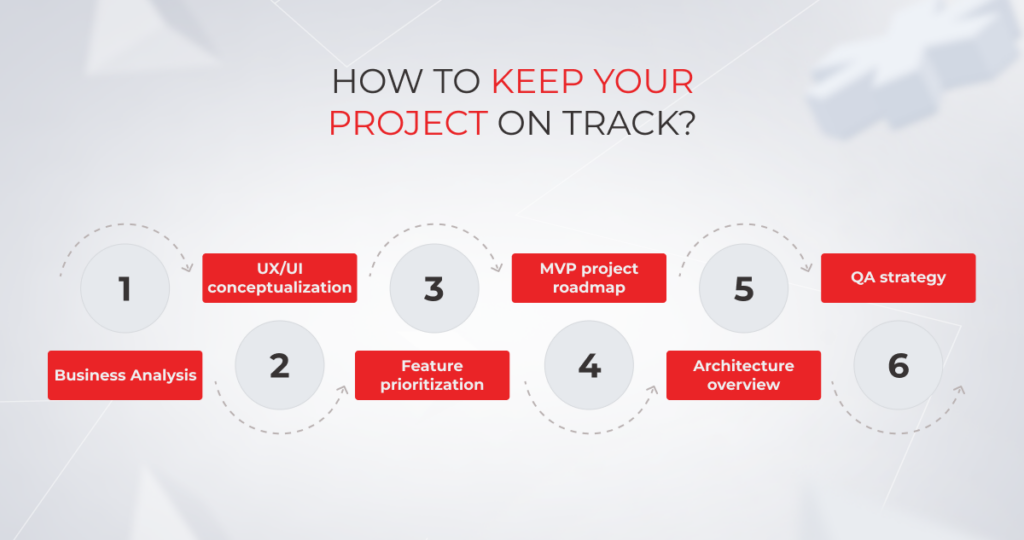
3. Run a Discovery phase

MVP

A Discovery phase sets the tone for the entire development process, saves your resources spent on MVP development, and makes sure your product delivery is on time, on point, and on budget. Basically, it ensures that every minute of development time, and every dollar of your budget goes into building a solution that people need.

Project discovery is an essential step for every brand-new venture. It helps the development team ease themselves into the business context, assess the organizational and infrastructure enablers, and estimate the product backlog. Without it, your developers will spend hours brainstorming ideas instead of implementing them.

  • Conduct Business Analysis

The value of business analysis is triple. First, business analysts help companies arrive at a clear understanding of the business idea by eliciting product requirements. Second, they dive deep into the user needs to identify relevant features for a solution like yours. And third, they prepare critical documentation that drives your development process to risk-free and cost-effective completion.

  • Conceptualize UX and design

The conceptualization process is an initial stage of the design-thinking approach that finalizes a user-centered picture of the final product design. Here, designers frame a problem, create user personas, and come up with scenarios and storyboards or a clickable prototype of a future product. The goal of this stage is to find a middle ground between user needs and the overall goals of the company. 

  • Prioritize features

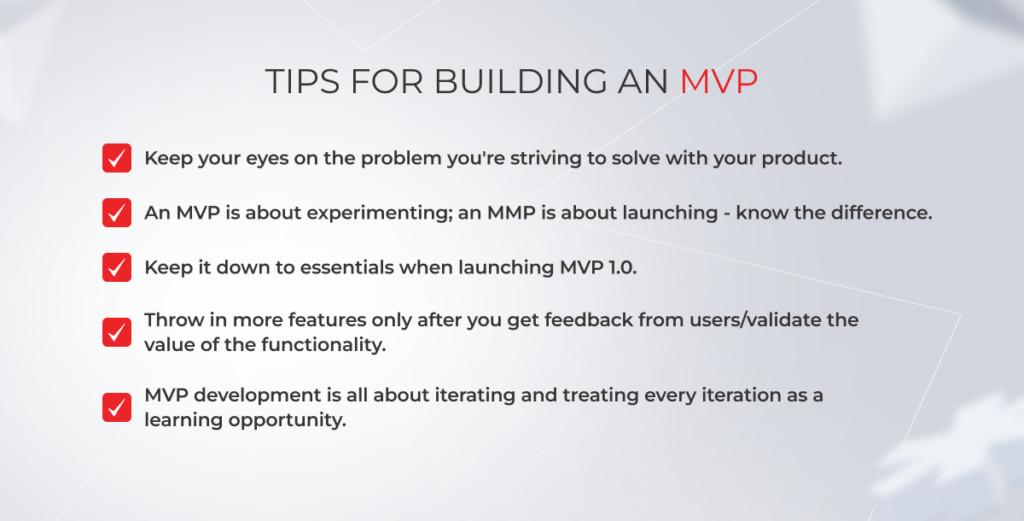
The more features, the merrier is not exactly how you develop a minimum viable product. As it includes the bare minimum of features, your product development team first determines essential functionality that will make it into MVP 1.0. 

There are several approaches to point out the must-have features for a pilot version, feature prioritization being the most effective of them. At *instinctools, our experts favor the MoSCoW prioritization method as it’s a capable way of dividing features into must-haves, should-haves, could-haves, and won’t-haves. 

  • Create an MVP project roadmap

Once you decide on the deliverables, the product development team creates a plan of action that outlines the vision, priorities, and progress of a solution over time. It’s a shared source of truth that brings each stakeholder under one roof. The roadmap should reflect your product strategy and goals, while also remaining responsive to customer feedback and project changes. 

  • Describe Architecture overview

An Architecture overview is created to share the governing ideas of a future solution. The document communicates architectural decisions to the team, including technologies, system environment, and other building blocks of a solution’s architecture. As there may be multiple architectural approaches to implementing your product idea, an Architecture overview makes sure everyone in the team executes according to the pre-agreed approach.

  • Work out a QA strategy

During the Discovery stage, the QA team also sets the baseline for the quality assurance process, decides on the priorities, and selects tools that overlap with the developer tools. QA engineers also define the approach to test management and clarify software acceptance criteria. 

4. Build & release an MVP

A deployed product available to end users is the ultimate goal of this stage and the MVP development process in general. This stage is carried out according to the Incremental and Iterative approach whereby the project scope is sliced into pieces (increments), with each increment building on top of the previous deliverable. Product features are built through repeated cycles of iterations. The result of one iteration may be refined in subsequent iterations. 

  • Proceed with UX and design

Now, it’s time to flesh out your MVP look and feel with more details. While the Discovery stage helps designers establish a crystal-clear vision of what the target audience looks like and how they interact with similar products, during this phase, the UI/UX design team creates a few prototypes to demonstrate the look and feel of the future solution.

Once the client decides on the exterior of the product, UI/UX designers create layouts for each screen and share them with the developers.

  • Take care of the product’s back end and front end

Frontend developers transform layouts into user-facing features and make sure the visual and interactive aspects of a product are user-friendly and lightning-fast. While frontend development is concerned with a product’s appearance, backend developers set up all the behind-the-scenes processes. These include database interactions, user requests, APIs, architecture patterns, and other core units of your product.

  • Wrap it up with quality assurance

Within the Incremental and Iterative approach, quality assurance is not a phase, but rather a continuous activity that overlaps with the development. It means that QA specialists can check and validate a new functionality right from the oven, which accelerates development and speeds up the time-to-market.

DevOps approach makes sure your devs and QAs are on the same page. While employing DevOps, teams also take advantage of the CI/CD pipelines that bring automated testing to the table and allow QAs to spot critical bugs in the early stages.

  • Celebrate release

Finally, a production-ready solution is deployed into the target environment and made available to users. At this stage, your team also performs user acceptance testing and sets up software monitoring processes. 

  • Ensure easier adoption with post-release hyper-care

After a software launch, your product development team goes into hyper-care by providing application support to address your immediate post-implementation needs. Hyper-care may include minor fixes, software troubleshooting, employee training, and the production of manuals. 

Post-release support is essential to maintain the error-free performance of the product and maximize adoption among users.

5. Measure, learn, and optimize

A successful MVP is your first step to a high-impact full-fledged product. After your MVP is pushed out, the development team analyzes user feedback, behavior data, and other metrics to inform future releases and enhance your understanding of what an ideal product should look like. 

At this stage, you can either pivot your idea if you’ve misfired or persevere — either way, an MVP results in less effort wasted on things your target users don’t care about.

Go from concept to a full-fledged product

Schedule a call

Building an MVP is a slippery slope, keep away from these  mistakes

Emerging businesses have an incredibly high failure rate. More than two-thirds of them fail to live up to the lofty investor expectations when it comes to ROI. And although it’s startup flops that get the most airtime, established businesses aren’t immune to MVP failures as well. 

If you’re going at it for the first time, beware of the typical pitfalls that await your MVP on the way to a successful product.

Market ignorance

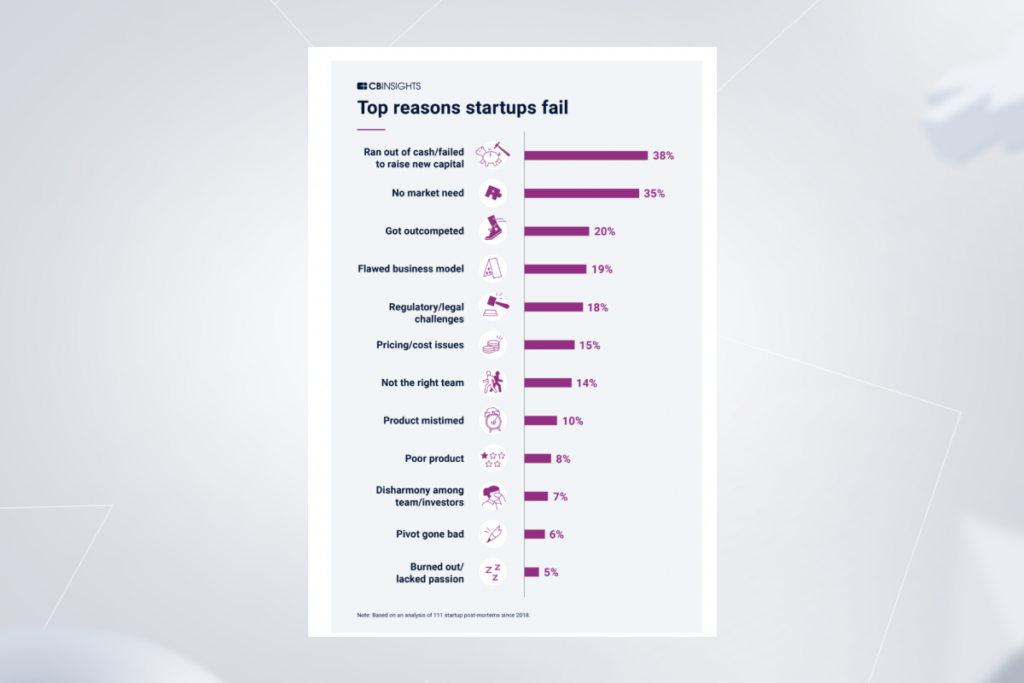
According to CB Insights, the absence of an actual market need is what makes 35% of startups fall down the hill. Your belief in the idea needs to be backed by existing market demand, otherwise, your product won’t get traction. Also, the market evolves at a blistering pace at the moment, so the need for a particular service or product can vapor quicker than you think.

Reasons startups fail

One simple thing you can do to avoid this mistake is to run deep market research and analysis to identify the exact need of the target market. 

Not knowing your target audience

Finding an ideal product-market fit calls for a deep understanding of the target audience. Target audience research involves collating insights about the users who are most likely to adopt your product. You can get this information through focus groups, surveys, and independent research — whatever it is, make sure to paint a clear picture of your ideal user.

Lack of clarity regarding the problem that your product should solve

Your product cannot be everything to everyone, it has to be designed to solve a specific problem. Otherwise, you’ll end up with a bloated solution that lacks a utilitarian use case.

To reduce the odds of a crash, you must first identify the problem, then find a solution to it, and wrap the solution into a digital form. 

Haphazard Discovery phase

Around 38% of startups run out of budget even before they take off, and ill-considered ideation is why it happens. Let us hammer this point home: skimping on the Discovery phase is the shortcut to project mishaps, blown budgets, and ruined stakeholder expectations.

In particular, a jerry-rigged Discovery phase or lack thereof can lead to:

  • A software architecture conflicting with project requirements (you opt for a trendy microservices architecture, but your solution is better off with a monolithic architecture);
  • An exhausted project budget due to the absence of a prioritized feature backlog and constant switching between ideas and features;
  • The absence of a project roadmap, in turn, can result in a scattershot software development process ;
  • Lack of a well-designed CI/CD pipeline, which robs your product of an ongoing flow of new features and bug fixes.

Misalignment of expectations among the stakeholders

Product developers can implement the most ambitious dreams of business owners. The question here is: Do you know exactly what it takes to implement yours? Sometimes, building minimum viable products entails major transformations in the existing IT infrastructure, especially if we are talking about established businesses.

That’s why each expectation should be communicated and managed upfront, before jumping into the development process. This way, all stakeholders will know exactly what has to be done to implement a product idea.

Adding too many features

Overcomplicating a product is one of the biggest mistakes that budding entrepreneurs make. By adding too many features, they make the product harder to use, which hampers easy adoption among users. In other cases, companies’ budgets dry up even before they release the product into the wild as they spread themselves too thin.

To strike the right balance between features and their value, make sure to slim down your business idea and single out a minimum set of features to assess your product against real user needs.

Inexperienced team

There exist a hundred scenarios when an inexperienced product development team drives a project into the ground. Fail squads set the wrong priorities, allocating, already limited, resources to the wrong places. 

Teams that lack product development experience may bet on the wrong technical solutions, which results in a sub-par project with limited scaling. Whatever the team’s gray area is, the result will always be the same — and that’s a derailed project.

Your MVP is incomplete

Whether it’s because of execs or investors, companies may be pushed to release an undercooked product. You should postpone your MVP release if you nod to any of these points:

  • You struggle to identify the target custom, the problem, or your product’s USP (unique selling proposition).
  • Your MVP lacks critical functionality responsible for delivering value to the end user.
  • Insufficient security, performance, or scalability will take a toll on the user experience.
  • The product’s quality is not yet at the level users expect.
  • The current quality of a product can damage its profitability.

Overinvestment in sales and marketing

Pre-launch and launch campaigns are important to spread the word about your product and funnel in more lighthouse users. Except, a minimum viable product cannot be considered a full product launch. It’s more about testing your product idea and gathering market response. That’s why it’s better to hold the marketing dollars until you decide to go ahead with a minimum marketable product.

Don’t leave your MVP development to chance

Secure a reliable team
building an MVP

Key to MVP development success — hiring an experienced cross-functional team

In an attempt to slash the costs of MVP development, companies may opt for hiring low-skilled teams. In other cases, they take the word ‘minimum’ literally and hire a two-people team of developers that make bold promises of delivering a high-quality product in two months.

In reality, MVP development requires a collaborative approach that involves cross-functional dedicated teams, including business analysts, designers, product managers, and other experts. 

In-depth business analysis, competent project management, and well-balanced technological decisions will make up for your lack of expertise and increase the odds of your product going big.

You have two options when it comes to searching for an experienced team. You can do the heavy lifting on your own and scour the common habitats of bright minds, including freelance platforms, job boards, and industry events. The search may take an eternity, and there’s no guarantee that you’ll come across decent professionals.

Turning to a seasoned software development company with a track of projects is a smarter move that will save you money, time, and effort. A full-cycle product development partner can drive your idea from concept to growth — faster, more effectively, and expertly.

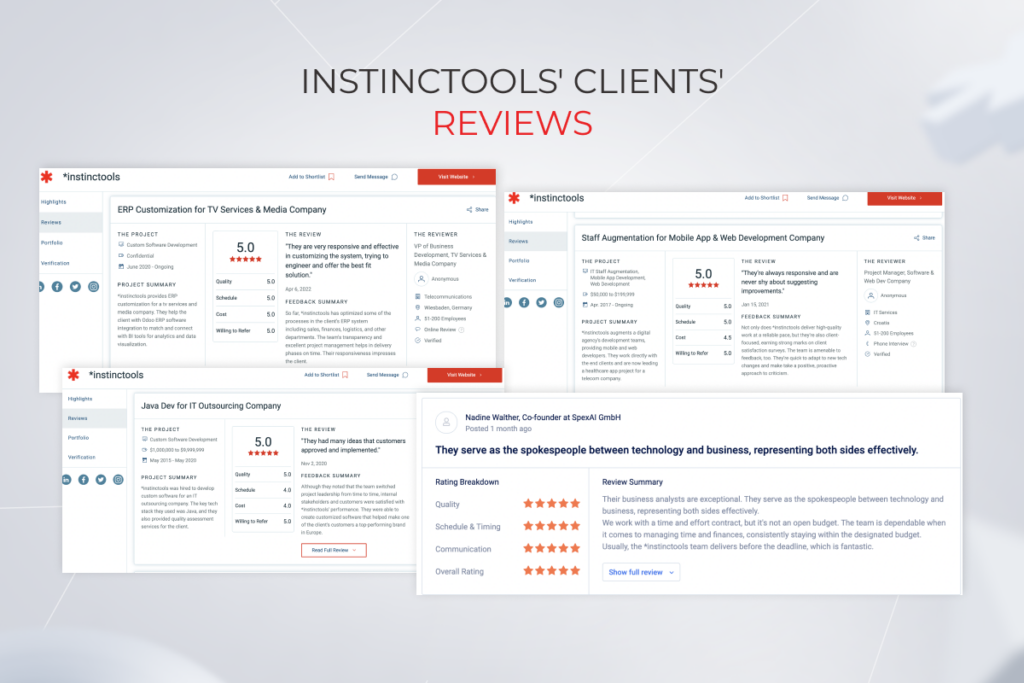
Clients' reviews

MVP app development: *instinctools’ experience

How to build an MVP app that can rewire modern farming? That’s the exact kind of challenge SpexAI faced. The company is a provider of automated AI-powered plant monitoring services and they were looking to develop an MVP for a flagship web application that can receive the data from the AI-powered robot and visualize it for end users. 

SpexAI reached out to *instinctools as they needed an experienced product development partner with a proven track record of projects and a vast portfolio of MVP solutions. Along with MVP development, the client hoped to minimize the risk inherent to new products launched. So we decided to move incrementally, from the proof of concept to the prototype to a robust MVP. With the company’s consent, we also went the extra mile by making the MVP more feature-rich and appealing to investors and users.  

Thanks to our solution the company sped up time to market and validated its business idea. Together, we’ve created the very first solution for harmless monitoring and analyzing the state of medical cannabis plants in greenhouses with 10,000–15,000 plants.

From a minimum viable product to maximum value

Having a well-thought-out MVP on your hands is a great start, but you should start earlier. To get the most out of your early product version, you need to see beyond the end result and into the problem you’re trying to solve with your solution. Partnering with an MVP development company in USA can help you lay the necessary groundwork, ensuring proper Discovery and planning phases. With comprehensive preparation, your product will be able to meet the needs of active users and help your business idea catch up with the market.

Secure a team of MVP development experts for your next project

Contact us

FAQ

What is an MVP?

An MVP is a stripped-down version of your product that bundles just enough features to satisfy early customers and gather feedback for future iterations. It usually focuses on delivering the core value proposition of the product.

How do I build an MVP?

The MVP development process starts with getting a good grasp of your product idea. You should research the market, identify your target audience, and analyze the competition. Based on your understanding, you then identify the must-have features for your MVP and start implementing them.

What is the purpose of an MVP?

An MVP is designed to test your business idea, validate it against real user needs, and attract investors.

What are the benefits of an MVP?

One of the main benefits of an MVP is that it allows companies to experiment with new initiatives, test their ideas, and vacuum up valuable feedback from real-world customers before fully developing a product. On the same note, building an MVP can save time and resources.

What is the development process for an MVP?

Ideally, a minimum viable product should be developed incrementally and iteratively. This way, your development team constructs and hones your MVP piece-by-piece by building on the previous deliverables to achieve high product quality.

How much does MVP development cost?

The costs differ based on the project scope and the complexity of your MVP.

How do I choose a development partner for my MVP?

You should choose a development partner with solid experience in delivering MVPs, time-tested domain knowledge, and a cross-functional team of experts. Industry platforms like Clutch and Glassdoor can aid you with selecting a partner.

What are the key features of an MVP?

Each MVP has its own key features. A key feature is the core functionality of your product that makes your solution valuable to the users.

How long does it take to build an MVP?

Based on our experience, developing an MVP may take up to 6 months depending on the complexity of your project.

Anna Vasilevskaya
AI modified real photo
Anna Vasilevskaya
Account Executive

Get in touch

Drop us a line about your project at
[email protected] or via the contact
form below, and we will contact you soon.