How to Create a Cryptocurrency Exchange: *instinctools Ultimate Guide

Despite the up-and-down nature of the cryptocurrency market, many startups are determined to capitalize on it and want to know  how to create a crypto exchange of their own.

Statistics project that the yearly growth rate (CAGR 2022-2027) of income in the cryptocurrency sector will be 16.43%. This is welcome news for those who are looking to take advantage of the digital currencies market in the long-term. Furthermore, at the “Future of the crypto exchange” panel held in London this September, leaders of renowned crypto trading platforms like Binance and Huobi shared the impressive results they had achieved in spite of the difficult year.

Global payment systems are also moving in the crypto direction and forging new connections between digital and fiat money. For instance, Mastercard enables settlements using crypto on its network, and Visa has become the first major payment network to settle transactions in USDC. 

Huge brands, including TAG Heuer, Hublot, and Breitling, also accept cryptocurrencies for payment with the help of special crypto payment processors that allow customers to make purchases with, let’s say, Bitcoin or Ethereum, while the company can instantly get the equivalent sum paid in fiat money.

If you want to know how to create a crypto exchange and make it a truly lucrative solution, check how we’ve dealt with challenges while building one of the first white label crypto exchanges in Europe. 

What is a cryptocurrency exchange platform?

Determining what you want to end up with is crucial since “a cryptocurrency exchange” can imply different things. 

  • A full-fledged trading platform where users have more than a basic understanding of crypto and are willing to become successful crypto traders. It’s a sophisticated technical solution and a serious investment of resources and money. For instance, you’ll need to develop crypto exchange software such as an order matching engine (OME), which is the backbone and beating heart of a crypto trading platform that gathers and synchronizes data across multiple trading pairs.
  • An instant crypto exchange for crypto-to-fiat and fiat-to-crypto transactions. Unlike a crypto payment gateway, embedded into your existing solution, a crypto exchange is a full-fledged business with its own business model. It’s a practical high-demand option with easy access for users who don’t want to trade and need to convert one cryptocurrency to another or into fiat currencies. In this case, you have to deal with challenges such as integrations with financial institutions. But, the workload is much smaller compared to a trading platform. 

Either solution can become a profitable opportunity for your business. In this article, we mainly focus on instant crypto exchanges. Let’s investigate the pain points our experts have highlighted in more detail.

Types of cryptocurrency exchange platforms

Crypto exchanges can be centralized (CEX, managed privately) or decentralized (DEX, without central ownership). Many companies speak about DEX without knowing what it really means and whether a business can truly benefit from such an option. 

Choosing between a centralized or decentralized exchange is a no-brainer, as DEX is still the utopia of crypto enthusiasts. Decentralized crypto exchange platforms are tricky to manage because of the distributed assets. Also, they often have problems with a lack of liquidity.

If in CEX, centralized management ensures liquidity thanks to your partner banks, DEX mostly relies on the client’s money and uses complicated schemes to fulfill the liquidity pool. So, if users suddenly rush to sell cryptocurrencies, a decentralized exchange platform will most likely run for a few hours and stop, as the money will be gone, and there will be nowhere to get it from.

On top of that, DEX implies anonymity, which is synonymous with the unregulated zone, and one of the biggest challenges in cryptocurrency today. And this, in turn, completely contradicts the legal conduct of business. 

Cryptocurrency exchange architecture explained

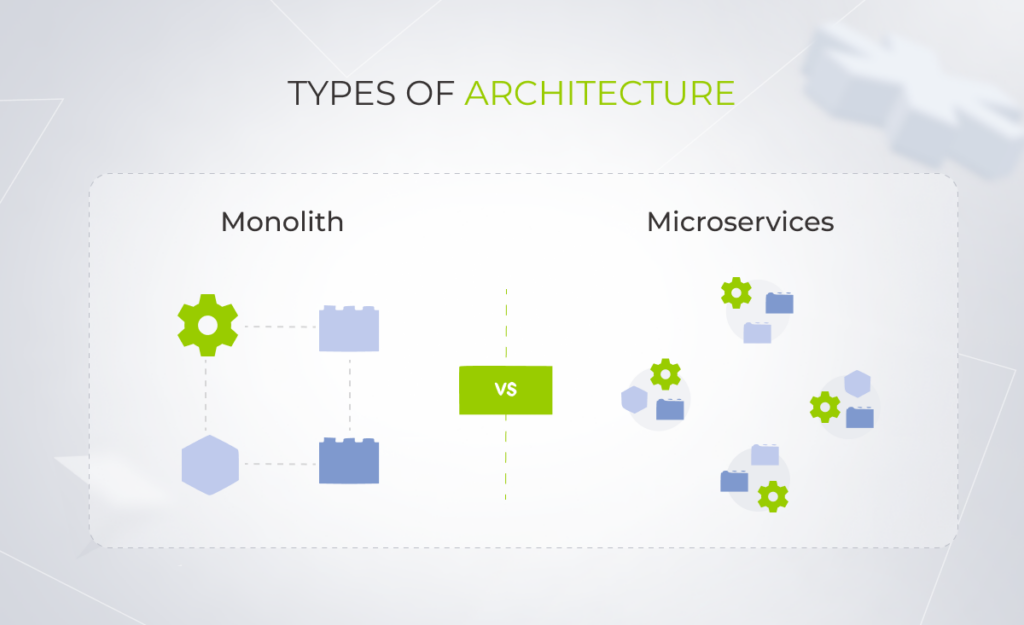
Let’s talk about how to build a crypto exchange platform in terms of architecture. Your solution can be monolithic (built on a single server) or based on microservices (each component is located on a separate server). 

Monolithic architecture

With such an approach, all the code is stored in a single repository instead of being fragmented across different services. So you will need top-tier development team as not everyone can operate with such a volume of code. 

Because of the high connectivity, monolithic architecture is hard to test. But it is possible to divide data into layers and work with them to speed up the process. Moreover, you’ll spend much less on support compared to microservices. 

This type of architecture is especially suitable for MVP projects, testing a hypothesis, and market research. For example, will your targeted audience use your solution to the extent you expect, if you make your own crypto exchange?

Microservices

A microservice architecture is known for its flexibility and scalability. It makes operating easier in a distributed system or when many changes are required. Furthermore, you’re not limited to one programming language and can leverage different ones for separate microservices.

You have a wide choice of specialists who can create separate microservices for your solution as different languages suit this. Be it PHP outsourcing, Python, Java, or another language; you can implement the crypto part functionality in almost any of them.

A microservice architecture also paves the way to creating solutions with a high workload and performance speed, such as crypto trading platforms, because you can rely on Kubernetes (K8s). This orchestration system ensures the creation of self-healing environments while the system scales. Whenever K8s detects an infrastructure failure, the system can auto-restart, auto-replicate, or auto-scale to keep the infrastructure reliable.

But consider that you need a strong DevOps team to set up Kubernetes and that a microservice architecture is expensive to build and maintain. Additional costs are conditioned by the complexity that microservices cast on the system and the necessity to hire more developers with first-rate skills.

In general, this option is suitable for organizations that already have a mature product with a growth trend and have developed the requirements for the technical solution in detail. 
how to create a crypto exchange

If your system is not supposed to accept a million messages per second, you can comfortably and efficiently run it on a monolith. Microservices are more convenient if we’re talking about a very distributed team, like 50 developers working on different features in different time zones. Microservices are easier to deal with as each microservice is a dedicated piece of logic. And it’s always easier to work with a small amount of code than with a large one. 

So the question is always about the scale of your solution and the size of your team. From my experience, 90% of startups have a monolithic architecture. Yes, microservices scale better and faster, but it doesn’t mean that large-scale projects can’t be built on a monolith. Even banks run successfully on a monolithic architecture. 

Whichever you choose, remember that you have room for change. A monolith can be divided into microservices. It’s possible to design the solution architecture in such a way that moving to microservices will take no more than a month. And, vice versa, microservices can be assembled into a monolithic architecture if they are too troublesome to manage.

Want to identify the best architecture match for your cryptocurrency exchange platform?

Get in touch

Four challenges to deal with when building a crypto exchange

Here comes the trickiest part, where you have to solve issues at a granular level. It involves choosing appropriate functional blocks for the solution, developing an intuitive UX/UI design, ensuring proper security measures, and testing the platform before going live. 

Functional modules selection based on our client’s success story

Each crypto exchange platform is made up of functional blocks. Their selection depends on your business goals, desire to stand out from the competition, customer needs, and regulatory requirements.

For example, you should investigate whether you can store users’ sensitive information in the cloud. In the case of crypto-to-crypto exchange platforms, it may be acceptable and won’t cause regulatory compliance issues. But in the case of crypto-to-fiat solutions, cloud services are most likely not an option, as it happened with our crypto exchange project in Europe when the regulator imposed a ban on storing users’ sensitive data in the cloud. 

In addition to limitations related to building a white label crypto exchange, we had to consider the client’s expectations regarding the technical features of the solution. It had to include highly intelligent hedging and a high degree of the calculator’s personalization depending on various parameters while keeping the user interface simple. Intrigued? Then let’s dive deeper into what’s under the hood and what’s on the surface in this case. 

Cryptocurrency exchange software, like any software, includes backend and frontend development.

The back end 

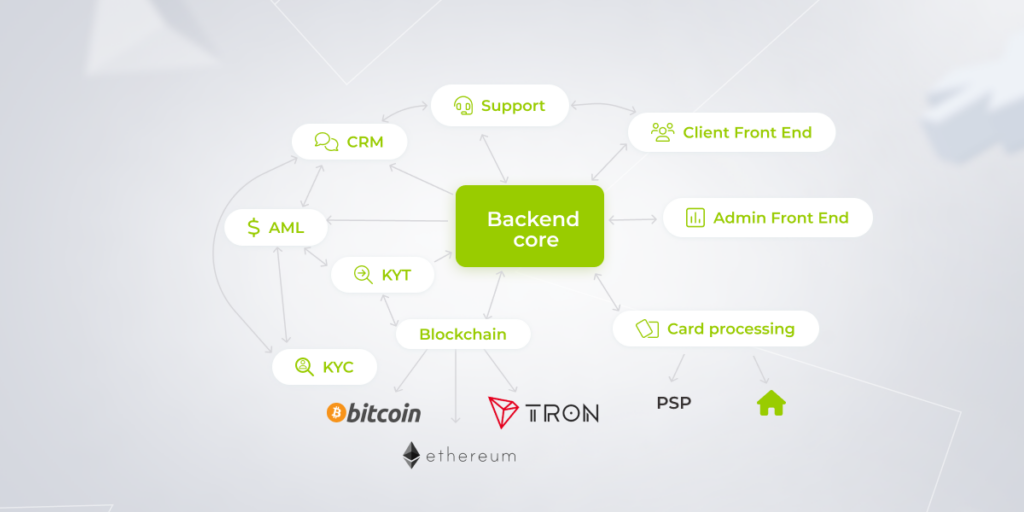
In the crypto exchange solution we’ve created, the following functional blocks are linked to the back end:

  • Blockchain processors. This module is responsible for blockchain integrations and provides access to cryptocurrency operations. 
  • Card processors. An additional module if you want to reach more users and offer a crypto exchange for fiat. It’s the block of integrations with the financial institutions – banks or PSP service providers, such as PayPal in the US and Europe, and Alipay in Asia. 
  • Admin module. Here you manage depersonalized users, transactions (and fix suspended transactions), and the exchange itself (you handle fees, commission, etc.). There are two points you should pay special attention to hedging and interacting with your liquidity provider.

Hedging. It’s an automated process of balancing your fiat and crypto assets at the level of daily transactions. When a user exchanges $100 for crypto, automatic hedging is responsible for a mirror purchase of cryptocurrency from your liquidity provider. 

In the crypto exchange software we’ve created, hedging is not just automated but intelligent. Instead of hedging every transaction, the system keeps a certain corridor of fiat and cryptocurrency balance. We’ve streamlined the hedging process so that the system can interact with the liquidity provider only when transactions step out of the balance corridor.

Interactions with your liquidity providers. You need them to fuel your crypto exchange platform with cryptocurrencies and fiat money. In contrast to hedging, here we’re talking about balancing an amount of money within a 2-3 days turnover of your crypto exchange platform.

In a dream world, exchange operations are balanced. However, reality interferes with this dream, showing a constant disproportion either on the side of cryptocurrency or on the side of fiat. That’s why you should keep your finger on the pulse to reach out to your liquidity providers in time. 

  • CRM. As we’ve mentioned before, in the case of our client, the regulator had a strict requirement to store customers’ personal data only in the country of their citizenship. Furthermore, due to security reasons, only a limited group of employees have access to the CRM module, where all the sensitive information about the users and the history of the interactions with each of them is stored. 
  • Customer support. This service is interlinked with the CRM, since, to access tickets of a particular user, you first need to get their data from the CRM. 

The client’s front end

It’s the web version of your cryptocurrency exchange platform that users interact with. In addition to the main service window, it includes a personal account that functions similarly to a personal account in a typical banking application. 

A calculator is crucial to the crypto exchange software’s front end. 

A calculator can be simple when the cryptocurrency exchange rate is the same for all registered users. However, in our crypto exchange solution, the calculator is highly personalized and calculates the exchange rate individually for each user considering a plethora of parameters.

For example, the rate will be different for cardholders of different banks, owners of basic and premium cards, ordinary and VIP clients. It also will depend on a transfer method (card or a bank account), the availability of a one-time or permanent promo code, etc.

The calculator, in this case, is a microservice that is tricky to build at the code level as you have to handle a mind-boggling number of possible errors. For instance, with all the personalization, you must consider AML and card limits for each user.

Here is the interconnection scheme between the backend and frontend modules in the crypto exchange solution we’ve built for our client.
how to create a crypto exchange

Struggling to build proper functional modules for your crypto exchange platform?

We can help

Intuitive UX/UI

Exchanging crypto for fiat and vice versa raises more questions than regular exchange transactions. That’s why proper UX/UI design is vital to provide users with all the necessary information while not overloading them with information. 

Never underestimate the complexity of creating a simple solution. On the one hand, you might want to put as much meaningful information on the calculator’s screen as possible. Payment methods, service and blockchain fees, standard exchange rates and exclusive rates for the cardholders of a particular bank, limits, customer support, etc. – all seem equally important. On the other hand, you had to create a concise crypto exchange platform that users can grasp intuitively.

Here are the final desktop and mobile user interfaces of the white label cryptocurrency exchange created by our client.  

how to create a crypto exchange

Security issues

The challenge here is not only how to create a crypto exchange platform but also how to build a secure solution both externally and internally. Let’s sort things out.

External security of a crypto exchange refers to infrastructure and service.

  • Infrastructural security. You can host your crypto solution on AWS, Azure, Google Cloud, or similar cloud services. Any cloud provider will offer you basic protection against external cyberattacks. If we use AWS as an example, it can automatically detect and mitigate most external attacks. 

Your provider guarantees a complete set of protection mechanisms against various hazardous events. And if you’re building a self-hosted solution, you’ll have to take responsibility and ensure protection against different risks by yourself or with the help of a reliable development partner. 

  • Service security. It applies to handling your database, customers’ sensitive information, and private and public keys. Let’s look at each case.

Your database should be stored appropriately on a separate server. Take into account your regulator’s storage requirements when building a crypto exchange. For instance, even if your code is stored in the Cloud, the regulators may insist on keeping the database on your company’s servers locally. Also, ensure that your code interacts with the database securely and that information can’t be intercepted.

A breach of your customers’ data (e.g., a list of your clients’ names) can’t result in a withdrawal of money, but it has reputational risks for your company. So, there are general steps you should take to ensure sensitive data safety, such as having de-personalized databases and storing personal data in a separate location. 

When creating a crypto exchange, one more point to consider is the security of public keys (used for users’ identification) and private keys (needed for authentication and encryption). For instance, all private keys must be encrypted and stored in a distributed way to make them inaccessible from the outside.

Internal security also includes working with personal data and ensuring proper protection against your administrators, as they have access to system addresses. The rights of access and disposal of these addresses must be automated. Otherwise, if employees are allowed to carry out payments, their rights need to be strictly limited or double-checked with a multi-signature system, meaning another employee, such as a security officer, approves the transaction.

We’ve already mentioned the importance of a strong DevOps team in your crypto solution’s architecture. DevOps specialists are also in charge of setting up and securing the internal infrastructure. They ensure that the databases remain unchanged – any attempt to break into the data is logged and monitored to prevent intruders from covering their traces.

Testing peculiarities

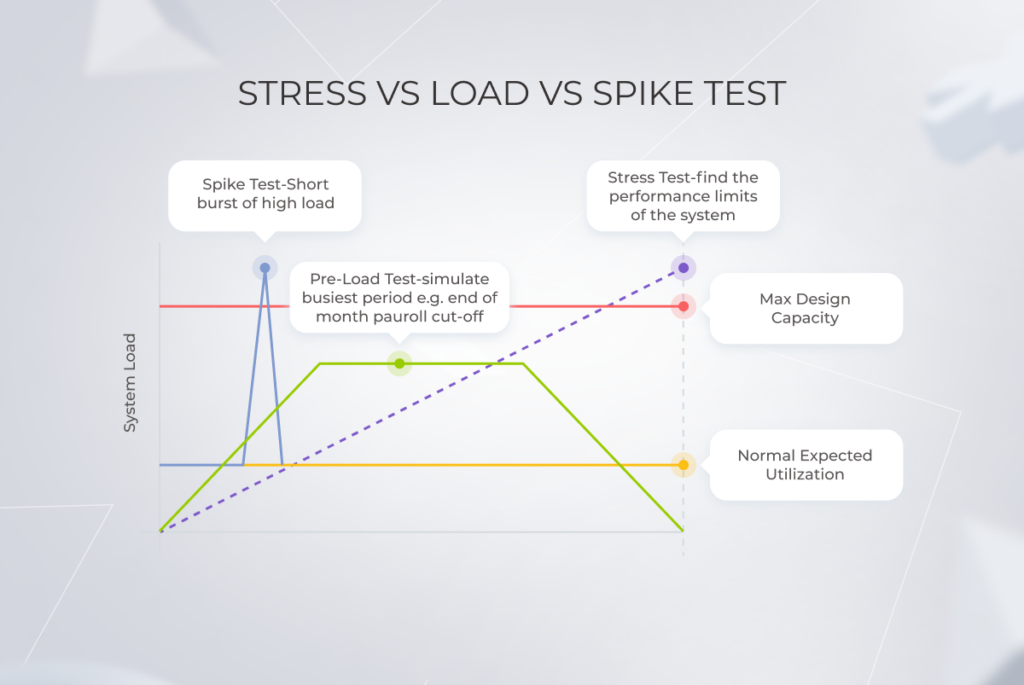
Testing is an indispensable part of cryptocurrency exchange software development projects. There are different types of tests, which we scrutinized in the article about performance testing. However, you don’t have to run them all. Choose the ones that are particularly crucial for your requirements. Based on the experience of our crypto specialists, we can say that it’s vital to perform load, stress, and spike tests. 

For example, you’ve initially chosen a microservices architecture for your crypto exchange platform that can handle a thousand transactions per second. In this case, you need to test whether the solution can sustain such a load. It’s the load type of testing. Stress and spike tests are next in line. 
how to create a crypto exchange

Most blockchains have a testnet. It is a copy of the mainchain, a live environment where you can perform transactions with any amount of tokens using your test addresses and nodes with zero risk. 

Working with the testnet has its own peculiarities. So it’s better to have an experienced tech partner by your side who knows how to set up a development process accordingly. 

If your crypto exchange platform allows not only crypto-to-crypto operations but also crypto-to-fiat transactions, you’ll need testing on the fiat side as well. If you integrate with banks, they’ll offer you their sandboxes to run transactions in a testing mode. 

Finding a reliable tech partner to create a cryptocurrency exchange is half the battle

Starting your own centralized cryptocurrency exchange may look tricky and scary. Until you find an experienced technology partner who can create a crypto exchange in a form that best suits your business needs and customers’ expectations. A reliable tech ally chooses the appropriate architecture and identifies the suitable functional modules for your solution as well as creates an intuitive UX/UI design, provides the crypto exchange platform with a proper level of security, and runs testing responsibly.

Puzzling over how to start a cryptocurrency exchange?

Let's chat
Acquire and Retain: How To Nail Personalization In Banking and Build Customer Loyalty

When personalization feels baked into every scroll and click on platforms like Netflix or Amazon, customers no longer see tailored treatment as a premium perk. What once felt like a VIP touch is now simply the baseline across all areas of life, banking included.

Interestingly enough, the demand for personalized banking cuts across generations. 74% of respondents, including Gen Z, Millennials, Gen X, and Baby Boomers, want banking services that feel made-just-for-them.

Ironically, banking institutions remain the last bastion of personalization with 94% of financial institutions acknowledging their inability to provide the kind of hyper-personalization customers desire.

Every day, banks generate a huge amount of customer data that can be turned into competitive advantages through delivering unique offers. Yet, it often remains untapped.

So what’s the problem? Why don’t banks use their abundant data assets to the fullest? Let’s uncover the main challenges of personalization in banking and how to overcome them to attract and retain more clients.

What is personalization in banking?

Banking personalization is the use of data collected from customer financial transactions, behaviors, preferences, customer feedback, and life events to identify needs, predict intents, segment dynamically, and deliver timely, relevant products, offers, and advice across channels.

For example, if the bank detects a new parent, it might recommend education savings plans or family insurance. Frequent online shoppers can see cashback rewards and real-time fraud alerts. A customer saving for a home might get personalized mortgage options tailored to their budget and timeline.

Benefits of financial services personalization

Nearly 92% of banking executives are ramping up investments in personalization efforts, betting it’s the key to reach customer satisfaction from the very first interaction through to long-term loyalty.

  • More effective customer acquisition

Offering the right product at the right time improves engagement and conversions, all while reducing customer acquisition costs (CAC).

For example, a Brazilian bank’s dynamic, personalized online banking menu drove a 56% surge in monthly loan applications and a 30% higher conversion rate. Similarly, the U.S. Bank’s tailored marketing campaigns, powered by a real-time customer data platform, resulted in a 127% increase in annual booked accounts. Moreover, as stated by Mastercard, leveraging available data in a right way to deliver personalized customer experiences from the very first page view helps banks optimize acquisition ROI and reduce CAC.

  • Higher customer retention

Today, 72% of banking customers prefer to stay with banks that anticipate their needs even before they’re articulated. When every interaction feels genuinely relevant and helpful, account holders remain loyal to such a level of care. Conversely, even the slightest hiccup in the way a bank develops its sales and marketing communication with a customer can drive churn.

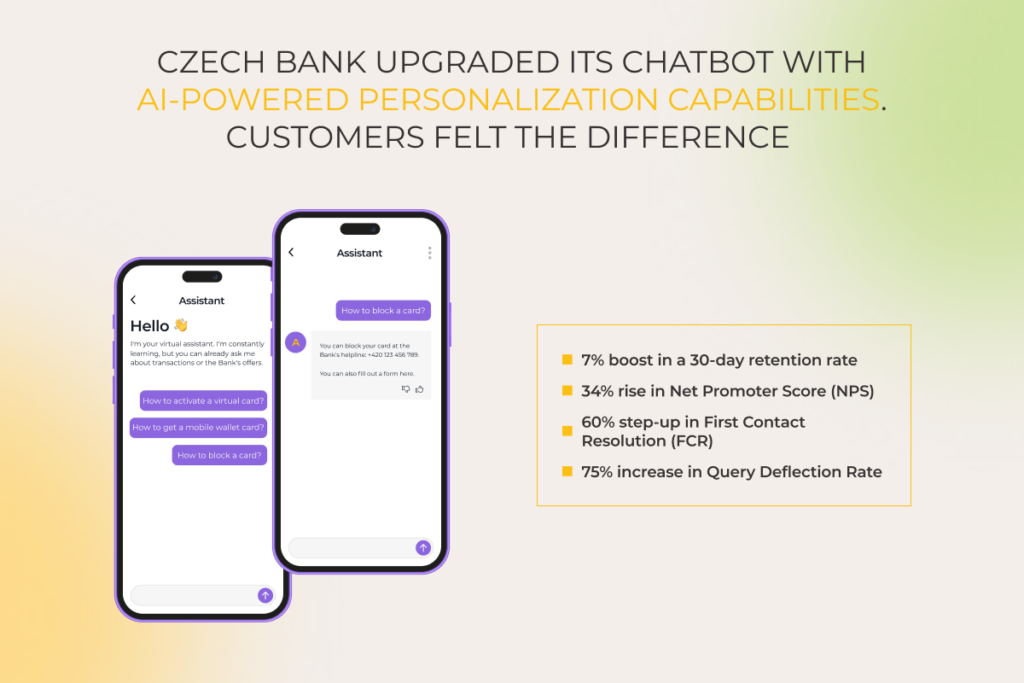
We helped one of our clients, a prominent Czech bank, enrich their new conversational AI chatbot with a personalized virtual financial advisor. Pattern recognition under its hood allows the bot to anticipate customer needs and spot keywords, such as “pay”, “send”, “transfer”, etc. to give users faster access to relevant financial products.

By analyzing customer data, the chatbot provides tailored insights, proactively helping users reach their financial goals. A trial pre-subscription run of an AI-powered solution exceeded expectations, helping increase 30-day user retention by 7%. Read the full case study >>

Czech bank upgraded its chatbot with AI-powered personalization capabilities. Customers felt the difference
  • Revenue growth

By building personalized relationships with clients, banks get an additional revenue stream through up- and cross-selling their financial products, thus increasing customer lifetime value. In fact, banks excelling at personalization generate 40% more revenue from marketing activities compared to their peers, who rely on generic campaigns and broad segmentation. 

Win and retain customers with smart banking personalization

Get started now

Challenges on the way to a personalized banking experience

A deep understanding of customer persona and customer expectations across all touchpoints of the customer journey is what leads to a seamless and personalized experience in financial services. As more and more customers want their bank to be as personalized as Amazon, financial institutions need to step up and deliver.

However, obtaining it isn’t easy as granular offerings are often hampered by common limitations present in the banking sector.

Legacy software

According to Deloitte, outdated technologies are considered the main bottleneck on the road to deeper personalization. Tech debt, the absence of real-time advanced analytics, and inflexible customer databases leave customers’ behavior unmotivated to finance organizations. As a result, companies lack strong cross-channel offerings, revenue growth, and, most importantly, a holistic vision of their customers.

Moreover, the lack of consistent data analytics stops banks from leveraging customer data as a competitive advantage. This means that banking institutions are unable to compete with tech-savvy banks by default, thus losing profit and potential regulars.

Organizational silos

Siloed data and isolated departments also hobble the successful adoption of a customer-first mindset and big data analytics. Silo mentality is detrimental to both internal and external policies since it limits data flows to a specific branch or employee. As a result, no uniform data governance approach is possible, making personalization and advanced analytics unviable at all stages of customer journey.

Typically, organizational silos refer to incompatible tech systems that cannot programmatically interact with each other. As a result, data is fixed in one department and segregated from other parts of the system architecture. Therefore, before implementing a new setup, companies can either update their whole infrastructure or connect legacy systems to the new infrastructure component.

Neglected customer needs

All too often, the banking industry focuses on products and financial solutions rather than customer needs. However, profound customer needs research is intrinsic to top-selling initiatives in digital banking. Without good customer experience, it is impossible to sell effectively and achieve business growth.

A well-shaped customer vision lays the ground for:

  • Competitive customer service
  • Smart digital banking
  • Relevant fees on banking accounts
  • Convenient branch locations
  • In-demand types of services
  • Positive brand image
  • Stronger customer relationships
  • Well-defined interest rates
  • Branch sales productivity

Luckily, the challenges above can be eliminated. Tech companies solve these problems by helping banks create and implement robust personalization strategies by putting all their existing data in place, analyzing it and offering personalized solutions at the right time and place.

Five secrets of acquiring and retaining customers through personalization in digital banking

The good news is that personalization in banking is attainable. By implementing advanced tech tools and digital-savvy approaches, financial institutions can tap into the hearts and minds of their customers and deliver initiatives polished to a tee. Here’s your secret sauce that will help you reel in clients and drive more value.

Establish a single source of truth

Some financial businesses have their customer data siloed across departments, which makes it isolated from the rest of the organization. As a result, the customer journey and personas are incomplete if created at all.

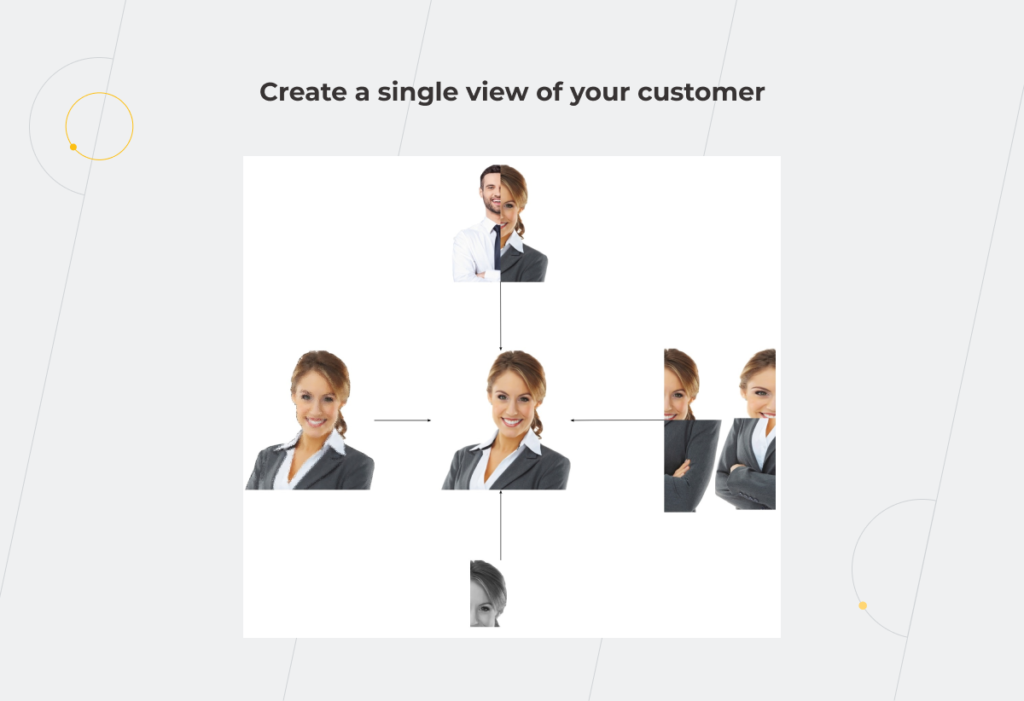
Clean, relevant, and accessible data is key to discerning the stimuli, preferences, and financial behavior of your customers. To create a single view of the client, financial services companies should unify and activate the miscellany of the operational data at hand. 

However, data unification and activation require the elimination of organizational silos and system modernization. Data lakes and warehouses contribute to delivering a 360° customer view and promote interoperability and immutability of data. Within them, data is drawn from multiple locations across departments, with all input being analyzed by specific criteria. 

Once the analysis results are ready for use, custom or platform-based Business Intelligence tools visualize the insights and prepare new reports so that businesses can monitor and compare crucial metrics and KPIs. For example, a loan department can source specific transaction data from a huge data repository to amplify loan decision-making at any time.

Moreover, comprehensive data governance policies will maximize the use of big data and align data collection and classification across organizational boundaries. Data governance also connects the data points in a cohesive whole and standardizes them across warehouses, lakes, cloud storage, and databases.

To better understand a customer, banking leaders also enrich their data collection through external APIs. This increases access to additional customer insights premised in enterprise and accounting systems as well as partner and public datasets such as PSD2 account information.

personalization

Tap into generative AI capabilities

Follow the lead of forward-thinking banks doubling down on generative AI across multiple use cases to freshen up customer experience, cut out tedious tasks, and stay competitive with digital-first challengers.

  • Personalized experiences on a frontline

Old-school, rule-based banking chatbots are frustratingly limited and rarely solve problems on the first try. The architecture of these solutions fundamentally prevents personalization. In contrast, virtual assistants with robust NLP under the hood are a whole different ball game when it comes to providing customers with effective, individualized care. Rather than just repeating scripted answers, they understand context, detect intent, and anticipate needs. Beyond hyper-personalized customer service, your banking app can also be boosted with features like:

  1. Instant account updates (“Show me last month’s dining expenses”)
  2. Proactive push notifications (“You’re nearing your budget limit. Want to adjust?”)
  3. Personalized financial advice (“Based on your spending, you could save $200/month by refinancing.”) 
  • Personalized marketing content at scale

When you let deep neural networks and machine learning algorithms process structured and unstructured data, say, customers’ transaction history, social media activity, or demographic info, you dig into the very fabric of personalized messaging across your marketing collateral.

Not only does the quality level up, but the quantity does too, thanks to LLMs’ powerful natural language generation capabilities. Accenture shared how a retail bank they worked with managed to produce 30x more high-converting marketing content with no delay in turnaround.

  • Risk assessment

Traditionally, evaluating a borrower’s creditworthiness involved manual reviews, gut instincts, and incomplete data. Mistakes were costly, either in the form of bad loans or missed opportunities.

Generative AI changes that. By analyzing vast datasets including spending patterns, market trends, and even subtle behavioral signals, machine learning models can predict risk with startling accuracy and generate further informed guidance in a couple of seconds. That way, banks approve loans faster, with fewer defaults, while customers benefit from fairer, more tailored terms.

Build lookalike audiences with ML

Since it’s really hard to yield tailored experiences for each client, financial institutions often implement look-alike models. This classification technique helps identify customer groups that share similar segment-specific data, be it spending habits or age ranges. 

By analyzing a wide array of metrics, ML-based look-alike models produce evolving customer profiles. Accurate segmentation, in turn, allows banks to predict the clients who are most likely to respond to particular financial services. In simple terms, finance companies get a smart opportunity index that allows them to create accurate marketing strategies and build a personalized banking experience that drive true value to clients.

Integrate life-event data

Customer profiling can never be too deep. Therefore, any bit of valuable information contributes to more awareness about customers’ behavior. On this line, event data, which describes actions performed by a client, can yield measurable or otherwise analyzable insights. As a result, finance firms can immediately react to new customer interactions and offer personalized services.

Companies from the financial services industry can leverage data from third-party events to hunt for new customers. These may include communication tools, social media data, and other third party financial apps. To enable automated processes and real-time data tracking, finance institutions must have this data integrated with in-house tools.

However, as third-party data sharing practices are tightening, integration approaches are subject to a wide range of regulatory acts that include GDPR, Dodd-Frank, MiFID II, and others.

Alternatively, banks can collect and integrate in-house event data to retain loyalty. On-site financial infrastructure with event-based architecture and event streaming are already awash in data coming from corporate sources. That being so, by sharing events across the company, finance businesses have an event data set ready for analysis. If we combine historical data with real-time insights, this further adds predictive capability to event streams.

Moreover, event data on its own can help create contextualized customer engagement opportunities in real-time. It means that when the client decides to choose new banking products when checking their account balances, for example, and leaves the application form unfilled, the system will notify the bank of the lost opportunity. This, in turn, allows banks to re-engage the client right away.

Another example of well-done event data management in digital banking includes real-time spending categorization. When a client makes a purchase at a grocery shop or gets gas, the bank’s money monitoring tools notify the client of the spending type and budget portfolio, keeping the client aware of their spending pattern. This nice touch on a customer’s financial well being nurtures brand connection even with no real interaction with the client.

Be where your customers are

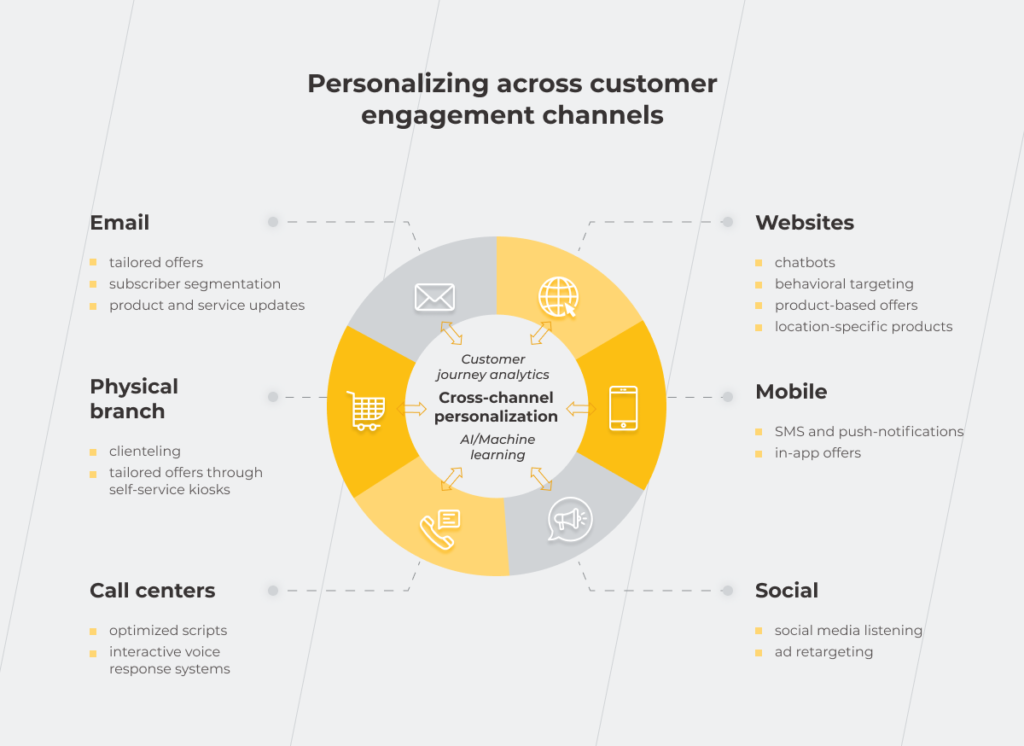
70% of banking customers expect consistent interactions across all digital channels. Therefore, omnichannel excellence isn’t just one of the buzzword industry trends, but a necessity. Digital-first finance companies should deliver uniform experience and service to clients across multiple digital channels simultaneously. This, in turn, intertwines all client touchpoints and allows organizations to target the user with bespoke offerings based on previous customer interactions with the company’s platforms.

For example, customers can be served with granular ads on social media or ad-friendly websites after browsing information on a certain bank credit card or loan offers. Also, interrupted application processes can be remediated with personalized mobile notifications if a client has a banking app on their smartphone.

cross-chanel personalization

Major banks are already following the omnichannel principle. For instance, U.S. Bank has created a unified customer information database to ensure an omnichannel experience for users across 3,000+ branches in 25 states.

To ease the strain on the marketing department, banks can resort to marketing automation. The latter takes over multifunctional marketing efforts and facilitates sending personalized offers across the channels, whether it’s a mortgage loan or a retirement plan. Businesses that leverage marketing automation tend to land +451% of qualified leads.

From a tech standpoint, marketing automated tools lean on cross-channel data, feeding on email, website, app, and other interactions. The software then streams segmentation and targeting processes to group the right audiences and calibrate messaging to each customer automatically based on their profile. Being a competitive asset, marketing automation reaches customers on a personalized level, no matter the audience size.

Reimagine customer experience through personalized banking services

Banks of all kinds – traditional financial institutions and digital challengers alike – are realizing big gains by treating customers as individuals. By putting customer data to work (safely and ethically) to generate personalized financial advice, alerts and offers, banks can measurably raise retention rates, increase cross-selling/up-selling, and establish stronger account holder relationships.

To enable personalized banking initiatives, financial institutions need to establish an updated data infrastructure that allows for real-time analysis, exhaustive data collection, and intelligent capabilities. A concise data governance strategy will glue all components of your setup and initiate a data flywheel to get continuous valuable insights.

Build personalization and strengthen your data-to-decisions capabilities

Get in touch

Accessibility For Apps: Guidelines, Examples, and Best Practices of How to Care About the User

According to the WHO, 15% of the world’s population experiences some form of disability. In most cases, aware societies strive to balance health disparity so that this population cohort doesn’t feel any barriers to an acknowledged quality of life. And it works just fine until a person with a disability faces a situation when something is out of their reach because of poor mobile app accessibility. 

Our developers and UX/UI designers will walk you through what can be done to increase the accessibility of your mobile app and provide time-tested tips on simplifying the task with the help of generative AI.

Why does mobile accessibility matter?

Making your applications inclusive isn’t a matter of social responsibility only. Along with diversity cultivation, accessible mobile applications unlock an additional revenue stream, give your company competitive tailwinds and help meet compliance regulations.

Empathy

As we age, we all face some limitations, be it impaired hearing, lowered sense of vision, or motor impairment. Moreover, situational and temporary disabilities can put all of us into similar settings that individuals with a long-term disability have. Therefore, mobile accessibility is a long-term investment that, among other things, helps us take care of the older generation, our older selves, and those struggling with the temporary condition.

Assistive technology is also an important strategy to better integrate people who face additional challenges into the modern world and online communities.

Competitive advantage

According to statistics, one in six people has a disability. By making your solution inclusive, you cover an additional 61 million users, which expands the user reach of your application. 

Besides, tech inclusion is commercially interesting. The buying power of people with disabilities is around $13 trillion. Considering the number of inaccessible apps, your app and mobile device accessibility can reel in this additional revenue stream.

Mobile phone accessibility also reduces the operational costs of your business. A Dutch SNS Bank reduced the number of call center calls and associated expenses by over 15%. The savings are associated with mobile web accessibility changes the bank made earlier.

Accessibility makes better tech for everyone

Tech inclusion is essential to some, but useful for all. Closed captions, virtual assistants, and speech recognition software are the go-to features for all users, including people with disabilities. Voice route directions, for example, are both an accessibility feature and a hand-free option for drivers. Therefore, making your solution all-in will benefit everyone.

Compliance with standards and regulations 

In many cases, mobile app accessibility standards are required by law. The Americans with Disabilities Act Standards for Accessible Design, or ADA, mandates the inclusion of all people, in all areas of public life, including web-based businesses and their applications.

The ADA law also works alongside the Web Content Accessibility Guidelines (WCAG) which documents a single shared standard for web content accessibility. The current WCAG version 2.2 was published in October 2023.

By 2025, all EU-based companies must also optimize their services and products for accessibility to comply with the European mobile app accessibility guidelines.

Better brand image

Finally, digital accessibility benefits your brand and creates more opportunities for brand advocates, as up to 73% of customers believe that a company should take a clear stand on social issues.

How to ensure mobile app accessibility?

As of today, Web Content Accessibility Guidelines, or WCAG, are considered to be the benchmark for website accessibility. The guidelines also feature WCAG for mobile, which outlines mobile accessibility best practices. Below, we’ll talk about what your application should be like to be truly accessible according to WCAG.

Keep in mind that each principle includes three levels of conformance, where A is the minimum level and AAA stands for full conformance. Most organizations strive to score AA as a golden mean. 

Perceivable

Making your solution perceivable means that users must be able to perceive it with one or a few senses. In simple words, if your app’s content is geared towards a visual experience, it should have an alternative that involves auditory perception or any other sensory modality.

What can be the problem here?

  • No text alternatives 

Some solutions may fail to offer text alternatives for non-text content featured on screen, be it controls or images, in a way that is perceivable by the screen’s reader. It inherently makes the app unreadable for TalkBack or VoiceOver, which are default screen readers on Android and iOS respectively. 

On the contrary, speech descriptions make all non-text data accessible for the blind or people with low or weak vision. Facebook, for example, has rolled out automatic ALT text to describe visual content for screen readers.

an example of automatic ALT text describing visual content on Facebook
  • No adaptability

A mobile solution overlooks accessibility when its structure isn’t readily adjustable to different content presentation structures and orientations. In particular, an inclusive product can switch to both landscape and portrait without sacrificing content or elements just like the example below.

an example of an adaptable user interface

Native mobile app accessibility guidelines also require your product to mark up information, structure, and hierarchy between elements. This way, headings, tables, and lists will remain intact when the presentation changes, keeping your layouts simple and consistent.

Adaptability is essential for people with motor impairments, screen reader users, as well as people with learning difficulties and cognitive fatigue.

  • No distinguishing features

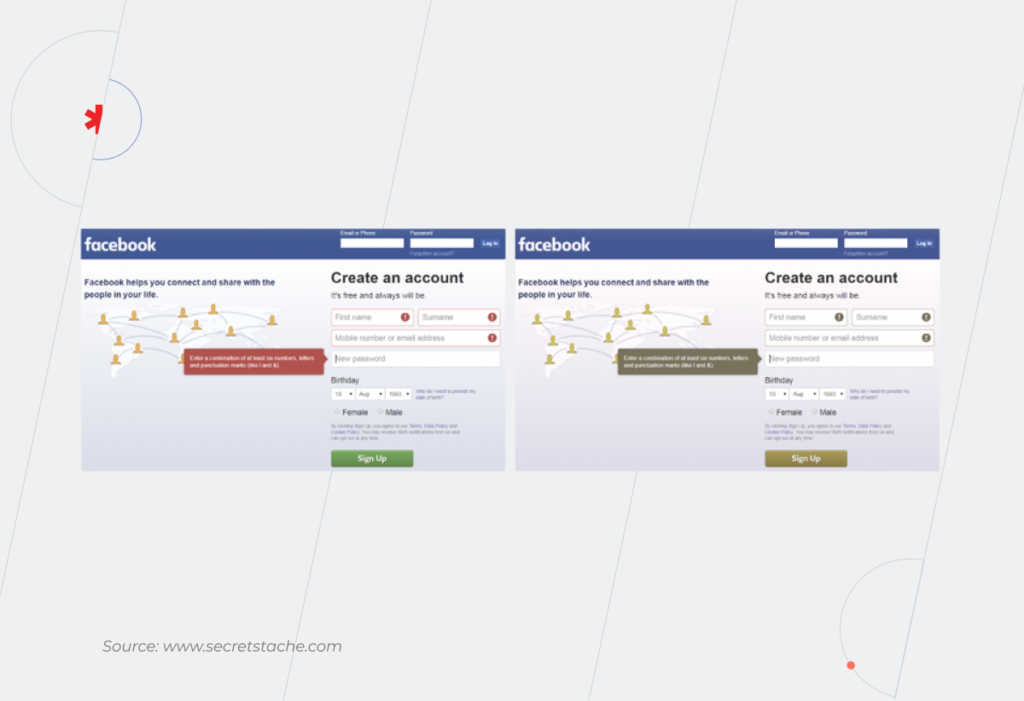
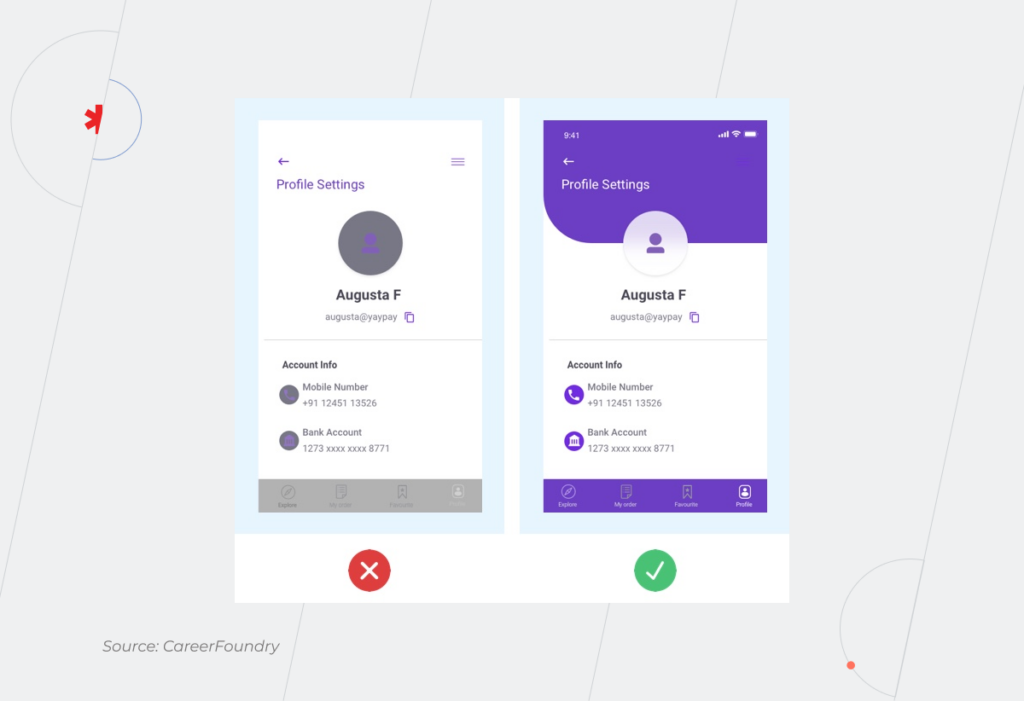
Inadequate contrast, a poor choice of colors, or the absence of text resizing take a toll on users’ perception. For instance, people with color perception issues struggle to distinguish between certain colors. Therefore, colors shouldn’t be the only way to convey differences or prompt action. Instead, combine color and text or character cues to convey information.

a juxtaposition of two illustrations highlighting the importance of text and character cues for interface accessibility
a juxtaposition of two illustrations highlighting the importance of a right choice of colors

Loss of content or functionality is another common accessibility issue that typically occurs when a visually impaired user zooms the text. Your mobile accessibility settings must allow for increasing by up to 200% while retaining all content and elements.

Operable

This principle necessitates your application to include fully-operable interface and navigation elements so that the user can make use of every feature regardless of impairments or disabilities.

What can be the problem here?

  • Lack of time

Given the diversity among people, it’s difficult to predict how much time it takes to browse through the app or find a specific section. Most banking applications, for example, have a maximum session time as a security measure. However, time limits or time-sensitive content makes it inconvenient for a screen reader or an elderly user to process information.

Flexible time limits or the turn-off option, on the contrary, make your application more friendly to seniors, sight-impaired persons, or foreign speakers.

  • Flashing content 

Blinking content is a red flag for inclusive applications as it can provoke seizures or other undesirable effects. Thus, individuals who have photosensitive seizure disorders simply cannot look at flashing lights or contrasting visual patterns without having an adverse physical reaction triggered by them. That’s why it’s important to avoid content that flashes over 3 times in 1 second and limit the area of flashing to a small portion of a smartphone’s screen.

an example of a flashing content warning
  • Navigation

Navigation that is neither programmatically tagged nor structured can also prevent a user from consuming the content. It holds especially true for visually disabled users that can only navigate your application with assistive technology as well as people with cognitive and motor disabilities.

Landmark regions, descriptive headers, unique screen titles, and labeled controls enable both users and screen readers to locate the needed section quickly and with fewer keystrokes. The application can also be coded to skip graphics and navigation links when consuming the content with a screen reader.

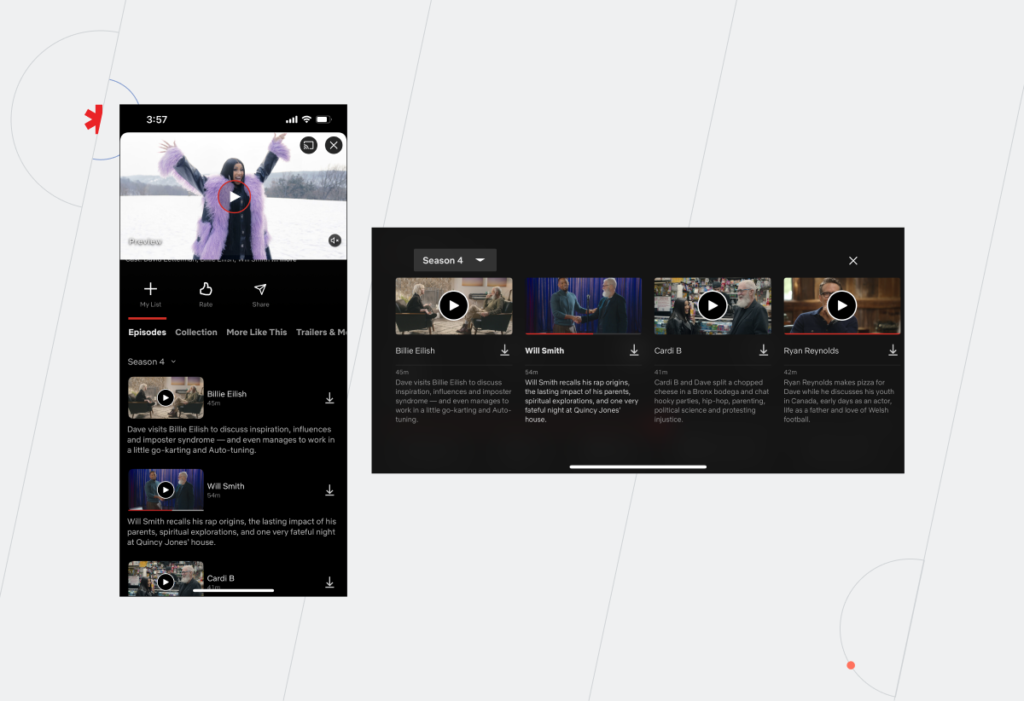
Tastemade, for instance, is a great example of full-screen navigation at work, while the example on the right sacrificed discoverability for a sleek design.

an illustration pointing the importance of a full-screen navigation

Understandable 

According to this accessibility principle, all information and your entire user interface must be easy to grasp for any person regardless of their health status. Simply put, the more intuitive and straightforward your application is, the more chances it has to score the AAA conformance level.

What can be the problem here?

  • Predictability

Some applications prefer to hide design elements behind sophisticated icons or employ futuristic user flows. While such designs are admirable works of art, they lack clarity. 

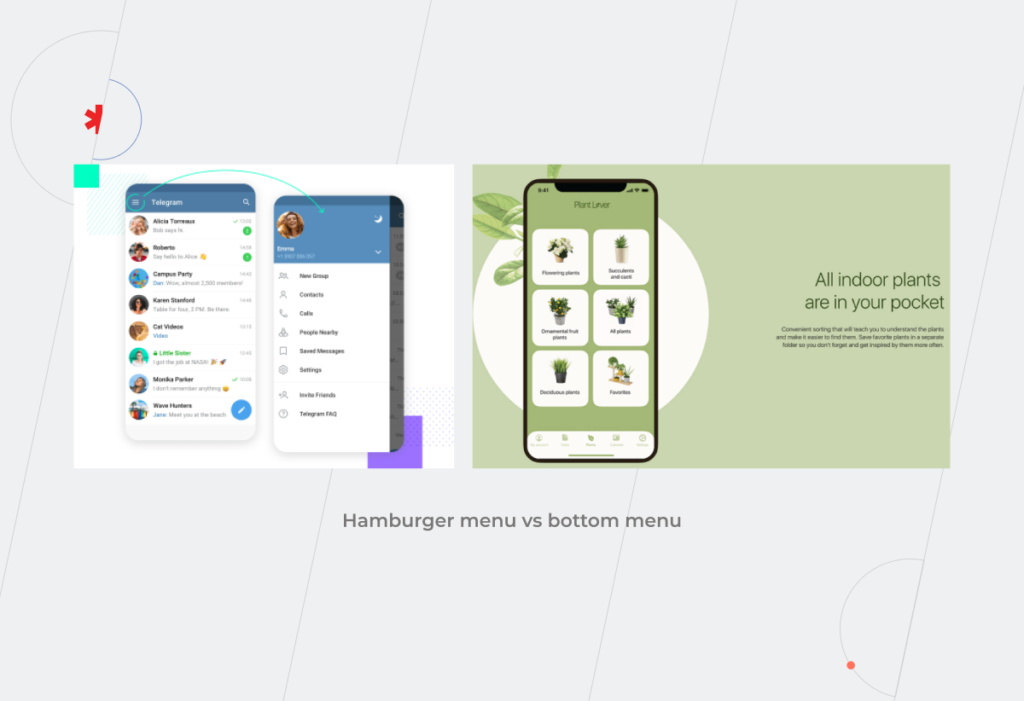
Hamburger menus, for example, are a widely accepted standard for mobile app development that simplifies menus for compact screens. However, they are neither navigable nor predictable for people with visual disabilities, cognitive limitations, motor impairments, and reduced dexterity. The desktop version of Telegram, for example, has a hamburger menu button.

Hamburger menu vs bottom menu

The overriding objective of predictable design is to set accurate expectations about what will happen next through consistent design patterns, standard semantic elements, and ordered information structure. An accessible application should also have all elements easily discoverable on the screen to give an accurate understanding of where the user is now. Bottom navigation, vertical sidebar, or sticky menus play it right.

  • Input assistance

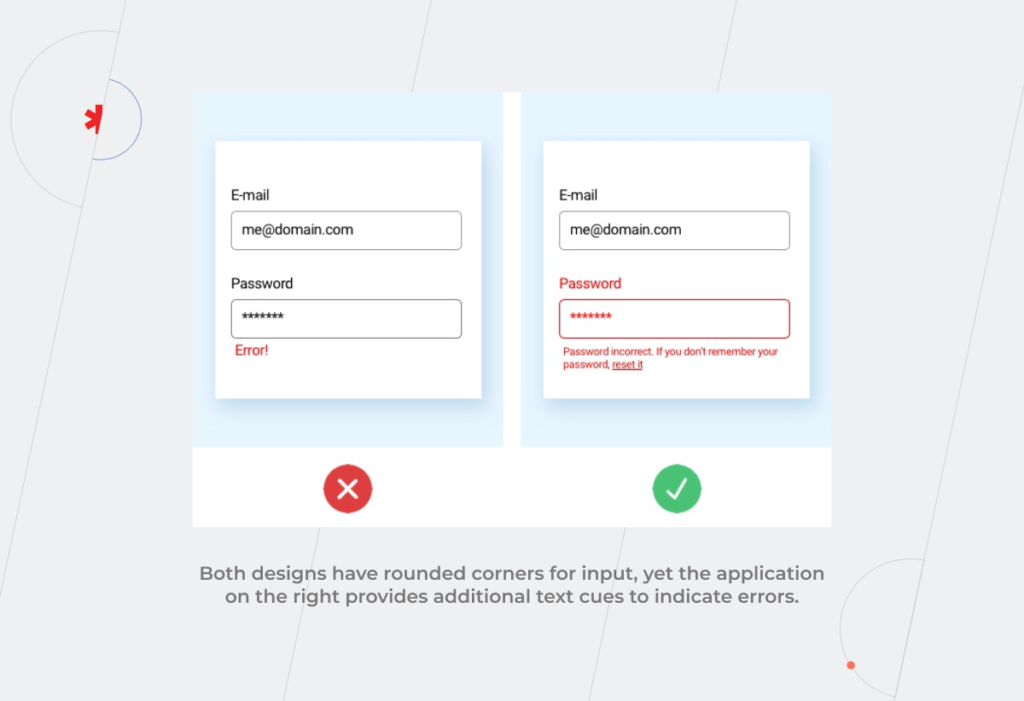
Some users with lower quality vision, and with reading and intellectual disabilities may find it challenging to enter the information error-free or differentiate between mandatory and optional fields. To provide assistance, an application interface can include cues in the fields to reinforce important information.

The cues may range from labeled attributes for screen readers to select states and rounded corners. 

examples of bad and good design in terms of input assistance
  • Error prevention

On the same note, typical error indication methods may not work for individuals with low or impaired vision or color-blind people. Likewise, users with reading or motor disabilities have a higher chance of entering the wrong input, which can lead to serious consequences, including financial liabilities. Therefore, if the application doesn’t provide user-controllable data, it is not accessible.

Reversible submissions, order confirmation, deleting a record, or unsending a message are some examples of safeguards that will keep users from making a mistake.

Robust

Accessibility features should be seamlessly delivered across platforms and devices, including different versions of screen readers, braille terminals, or text magnification software. In simple words, robust design is immune to coding errors that can distort the content or functions in a web-enabled device or assistive technology. 

What can be the problem here?

  • Poor coding

If the HTML code behind your application lacks complete start and end tags, the app’s content may display differently across devices, not display at all, or be unreadable to assistive technologies. Well-formed HTML code that conforms to all markup language specifications makes sure that the accessible content structure will remain as intended across all platforms and devices.

Can cross-platform development provide a proper level of accessibility?

Cross-platform development is a Swiss army knife that accelerates time to market and kills two platforms with a one-code base. However, the accessibility potential of cross-platform development lags behind native applications. Therefore, cross-platform technologies are a tradeoff between accessibility and cost reduction, which can still guarantee at least a basic level of mobile accessibility on Android and iOS. 

Thus, Flutter app development is committed to making apps more accessible and includes built-in support for accessibility combined with the same capabilities of the operating system. Flutter can help you implement such accessibility features as large fonts, screen reader compatibility, sufficient contrast, and more. 

But keep in mind that mobile accessibility is a collective result of your whole development team, including Flutter developers. While UX/UI designers are dedicated to building inclusive interfaces, QA specialists make sure your final app version passes accessibility testing. 

Trust gen AI tools to review your app for accessibility issues

In the pre-AI era, accessibility excellence required intensive research and know-how from the development team. Tuning together inclusive features and a crispy interface may still be tricky, but the rise of AI-powered tools has fast-tracked resolving accessibility-related issues. 

For instance, UX/UI designers don’t have to manually review apps’ interfaces to spot accessibility defects. Software such as Stark, Userway, and Google’s Accessibility Scanner can automate the task. 

These tools are indispensable at the product design stage, where they scan Figma, Adobe, or Sketch files for compliance with WGAG and ADA requirements, fix minor issues, and highlight violations that require the UX designer’s input. 

There’s no need to decide between accessibility and design

Equal access to technology allows all people to actively participate in society and leverage tech comforts. Along with compliance conformity, mobile accessibility also contributes to a larger user base and competitive edge of your company. 

If you struggle to strike a balance between accessibility and design, our company knows how to score on both. Based on your unique requirements and accessibility standards, we seamlessly integrate inclusivity into a top-notch app design. Drop us a line to create a top-grade mobile solution that caters to all. 

The Future of Software Development in 2021 and Beyond

The year 2020 stormed into our lives, bringing changes that most of us were not ready for. Businesses had to either take the path of overwhelmingly rapid digitalization or put their very existence at risk. We reached an unprecedented milestone when technologies were once and for all to become the heart of even very traditional businesses. 

While organizations were flying blind through the dark times of the lockdown, software development came under the spotlight – helping companies to embrace agility and resilience. Considering massive shifts that happened last year, a lot of which are going to stay with us forever, more software innovations are likely to be seen in the near future.

So what’s going to be in the software engineering news in the coming years? Let’s take a stab at it.

Digital skills will remain in high demand

The Covid-19 pandemic has accelerated digital transformation. It resulted in a rapid embrace of technologies and, in the meantime, revealed a shortage of people whose job it is to deliver them – software developers. 

According to the US Bureau of Labor Statistics (BLS), demand for this role is projected to grow 22% by 2029. Today, not only tech companies cry out for software engineers. Many organizations have shifted their business processes online and started to launch services on the Internet from scratch. They are in need of technical talent. As more and more companies want to renew their services and develop new technologies to meet their customers’ fast-evolving needs, the lack of specialists will get even bigger. Furthermore, the skills recruiters are expecting from the applicants now are different from those before the quarantine. 

All this is likely to put small and mid-sized businesses, looking for candidates with the right skill set, into a difficult position. No wonder 41% of organizations intend to increase their spending on software outsourcing, as a Harvey Nash/KPMG CIO survey shows. Not to lose in the race of constantly changing demands, partnering with software development experts sounds like a pretty wise plan – it’ll help businesses to be better equipped with new tools in the software industry to keep the pace of digitization.

Remote work is here to stay

remote work

For the past one and a half years, a number of companies have adopted – not by choice – unprecedented workplace flexibility with all the advantages and drawbacks it entails. What once seemed like a temporary situation is now clearly the new normal and won’t be going anywhere. Since the genie can’t be put back in the bottle, there’s nothing we can do but learn how to effectively deal with more people working remotely.

The Terminal-commissioned research finds the vast majority of employees love the benefits that remote work offers and don’t want to get back to the old ways. The top reported advantages of remote work for software engineers include a lack of a commute, enhanced work-life balance, and increased autonomy. 

At the same time, a lot of respondents admit that it’s become harder to collaborate or feel part of a team. Indeed, no matter how difficult it is to imagine developers’ work without over-the-shoulder reviews, yet here we are – this form of collaboration has become a thing of the past. But if code reviews can be completed through a specialized tool, unstructured, organic interactions that occur due to the physical proximity of employees in the office are difficult to recreate. 

The way software engineering has changed is especially tough for managers and new hires. The former are more likely to face burnout; the latter suffer from the lack of valuable team building and learning that takes place at natural moments of “collision.” New ways of encouraging team collaboration are likely to be found to build more inclusive remote environments for employees.

Proprietary software will be outnumbered by open-source 

Since its emergence in the ’90s and up until recently, open-source software has been disparaged as lower in quality and security than proprietary solutions. With time, these myths were dispelled though, and the situation has changed drastically. Today, business use of open-source software is soaring. 

Although proprietary software providers still dominate the market, open-source software plays an equally important role. Moreover, a number of factors show that more is yet to come for open-source development. The first one is that it’s fast. Increasing the speed of time-to-market and pushing out updates on a frequent basis are no longer issues. Secondly, open-source software is decentralized. As long as open-source projects have multiple backers and stakeholders, businesses won’t suffer from vendor lock-in. Finally, since the code is open, this software is easy to customize, which means that the solution can be tailored to meet customers’ specific needs.

A Red Hat report shows that about 80% of IT departments plan to increase their use of open-source software over the next year, with 95% of IT specialists saying that open-source has become strategically important to their business. While proprietary software use is expected to be down to 32%, the use of open-source, in contrast, will increase to 44%. Using open-source solutions is a software trend for a reason – they offer companies powerful capabilities without having to invest heavily straight away. 

Low-code platforms will be taken more seriously

low-code platforms

High demand for software solutions and the lack of qualified developers have brought low-code platforms to the forefront. These platforms help businesses quickly react to the changes and rapidly deploy new solutions due to the simplification of the development process. Instead of laboring over raw code forever and a day, engineers can focus on adding more value to the product.

Taking into account the growing gap between developer supply and demand, it’s expected that low-code tools will get even more popular as their adoption doesn’t require any special qualifications. Writing “everything” or “almost everything” from scratch is no longer relevant merely because “almost everything” is already there. Does it mean, however, that programming we got used to will vanish into thin air? Not at all. It’ll just transform from a kind of craft into an act of art. 

The significance of developers is still rising because they are not swamped with low-level programming and integration and have an opportunity to concentrate more on customers’ problems rather than snags in the code. For the past two years, a lot of companies across industries have optimized their business processes, cut development costs, and scaled fast with the help of low-code platforms. 

Because of the pandemic, businesses started massively switching to online operations and needed suitable instruments for that. Creating applications in a traditional way could lead customers to bankruptcy. Meanwhile, with low-code, development has become several times faster and cheaper. Solutions based on low-code are more flexible, which means that companies can effortlessly adapt their software to any changes.

Taking advantage of future software development technologies

The last year put us on a fast track to a completely new world. The future of software development turned into the present in the blink of an eye. Far from everybody was ready to keep afloat – the rest is history. 

Do you want to leverage the changes that the future holds? Contact us for a free consultation on choosing the best software development strategy for your business.

Role and functions of an architect in a software development project

In this article, we clear up some of the popular questions about the roles, functions, and responsibilities of an architect in a software development project. 

At the stage of a new software project evaluation, it is crucial to analyze and define the main technical characteristics of the future product and how well it achieves a customer’s business goals. In the IT industry, such functions are performed by the software architect, whose role may be distributed among different team members.

Who is an architect?

The architect in the IT-sphere is a person responsible for making technological decisions regarding the software solution and its compliance with customer business needs. Such an expert knows the systems and methodologies applied in the development process, the languages used for coding and the architecture building process as a whole. The architect plays an important role in the process of discussing, developing and implementing a technological product meeting the business needs of a customer.

Architect functions on a project

The architect’s work and decisions directly affect the activities at every stage of the project. Basically, a major part of the architect’s responsibilities relates to the early identification of the concerns regarding product delivery. The architect makes decisions to mitigate the detected risks for each process: business needs capturing, planning, implementation, testing and deployment.

In a nutshell, the architect’s activities include defining the results of each development stage to get the expected product. The following function set expresses such activities in more detail.

Understanding the purpose

The main interest of the architect is to understand the customers’ needs and the goals they want to achieve by implementing a new system (or reworking an existing one). For example, such needs or goals could be sales increasing, entering a new market, costs optimization, etc. While gathering this information, the architect focuses on finding potential failures in the technical aspects of the software.

Here at *instinctools, often a customer has an existing system that was developed considering only the functional requirements. The previous vendor (or in-house specialists) could have delivered all the required functionality, but the product doesn’t satisfy the customer anyway. Why? In most of the cases, the system wasn’t aimed to solve the business problem. No one validated that the required functionality provided the required solution.

To minimize such risks, we suggest that the architect be involved from the first clarification call. Together with business analysts, architects can identify the purpose and possible “pain points” at the earliest stages of the future project.

Defining quality attributes

From a customer or a user perspective, any software system can be defined by its functionality. But there is an aspect that is often omitted while considering the system requirements: the system’s quality, i.e. how well the functions are provided. Each quality aspect is expressed by the term quality attribute. Here are some examples of such attributes:

  • performance (response time, hardware resources required, max number of users working with the system at the moment, etc.)
  • usability (UI simplicity, easiness of operation, user error protection, etc.)
  • reliability (max possible downtime per year, fault tolerance, etc.)
  • maintainability (efforts for the system modification).

It’s a common wish to implement a system with ideal quality. But in reality, it would be quite costly, extremely time-consuming, and, in general, impossible. The good thing is that software, being in a specific environment, doesn’t need to be ideal in all aspects. For example, a CRM system in a 10,000-employee company doesn’t need the functionality for a billion users access as a worldwide social network do. But also the CRM requires much less human and hardware resources to support it.

That’s why it’s important to have clear quality attribute requirements during software development. And it’s the architect’s job to identify them. Understanding the purpose of the product and the customer’s goals, the architect prioritizes and emphasizes the crucial quality attributes for further product implementation.

Building a technical solution (architecture)

An architect deals with different technological aspects: existing programming practices, development frameworks, data storage engines, cloud technologies, testing strategies, etc. Such an expert uses this knowledge to compose a vision of the system that will solve the business problem. The common word for this vision is the solution or architecture.

Since a single problem can have multiple solutions, the architect has to validate each of them, test hypotheses, and build required prototypes. As a result of this work, the architect proposes the most suitable option. It implies the reasoning that includes:

  • cost estimates,
  • justification of the technologies used,
  • potential risks,
  • mitigation activities,
  • the number of teams required,
  • development stage priorities, and many other implementation details.

Bridging the communication gap

It’s no secret business people and IT specialists speak different languages. Both sides often complain that it’s difficult to communicate with each other. However, it’s crucial to have an unambiguous understanding of the developing system. That’s why there should be a person that will understand both sides and make a “communication bridge” between them. An architect is that person who can bring an understanding of the business domain aspects to engineers and explain to business people what the system really is.

Architect: Role vs. Job

Here at *instinctools, we have a strong belief that any software project requires someone responsible for the activities mentioned above. But it doesn’t mean that any development team must have a member with a special “badge” to make the architectural decisions.

For example, a lead software developer with deep expertise in the project domain who has already earned the customer trust can determine the solution for the product as a whole. It would be also more effective to delegate architectural decisions to a specialist in a specific technological stack if the solution is completely based on it.

Another common case is when the architect’s functions are distributed among other project participants. For instance, a project manager with a technical background defines the functional and quality attribute requirements. Meanwhile, a lead developer is responsible for building a technical solution. Both of them are capturing the business purpose and bridging the communication gap.

The distribution of an architect’s role among team members depends on the project itself. A system’s complexity, the developer’s background, the terms of cooperation, and other conditions can affect it. But in general, when the project has many unknowns and requires more technical engagement, the role is assigned to a solution architect, who is an expert in such tasks.


Within several years of delivering software solutions, *instinctools has gained certain experience in optimizing processes for achieving customer goals. That implies an understanding of technical requirements and how they correlate with customer business goals. Here at *instinctools, an architect performs such expertise at different stages of a software development project. Whether a person or a role, the architect uses their expertise to better analyze business problems or the current system’s drawbacks and suggest the best possible solutions for the future that we are ready to deliver. Now.

Pre-discovery workshop: turning problems into opportunities. Part 2.

The start of a project can be disturbing, not to say even intimidating, especially if the questions are piling up and the answers aren’t readily coming in. During the Pre-Discovery workshop, we delve deeply into the customer’s anxieties, frustrating problems, and haunting questions, not letting a single detail slip our mind. As here, in *instinctools, we know for sure: it’s the details that matter.

The Pre-Discovery phase is a package solution. It consists of 3 parts: preparation, workshop, and post-analysis.

THE PREPARATION

Preparation starts well in advance. The time we spend on it depends on the inputs. The information we get during the Clarification Call with the customer and documentation provided by them are carefully processed and analyzed. If needs be – for instance, the customer has a start-up company – we conduct a competitive analysis as well. Then, based on this data, the agenda is developed.

Throughout the entire process, we remain in close contact with our customers to agree on the contract terms, the participants, and the agenda. After the agenda is confirmed, we work out a Pre-Discovery Question list, which is unique for each customer. It helps to elaborate on the issues declared on the agenda. We can also pitch a preliminary solution which may include Initial UI/UX Concepts, Business solution options, Implementation and delivery options, the sketch of a technical solution, etc. 

THE WORKSHOP

The main goal during this stage is to discuss the vision of the solution and define risks, dependencies, tools, and other limiting factors of the project. The Pre-Discovery workshop itself lasts  3-4 days, depending on each particular case. Each day of the workshop starts with specially designed warming-up activities aimed at setting the work on the right track. Then the agenda is announced. Sometimes the agenda can be changed throughout the discussion. However, we never fail to keep in mind, how it contributes to the end goal. In the course of the day, our team dives into the current state of the customer’s business with the help of relevant questions. We discuss business processes, use cases and scenarios, problem vision, infrastructure, etc., and set up goals and tasks. 

At the end of the day, summing-up and reflection is a must. Not only do we provide our customers with proper feedback, but we also ask for feedback from them. It helps not to get bogged down and drive the work further towards success.

THE POST-ANALYSIS

As part of the post-analysis, the customer gets the results of the workshop packed in Vision and Scope Document and Architecture Overview Documentation, the pitch of UI/UX concepts and Infrastructure and license costs – if they exist. On top of that, taking into account the outputs of the Pre-Discovery phase, we prepare an offer for the Discovery phase.

We try our best to meet the requirements of each and every customer. Being part of the Delivery-as-a-service (DaaS) approach, the Pre-Discovery Workshop is highly customized. Activities may vary from case to case. But what remains unchanged is our devotion to what we do and a strong desire to deliver value. We create a solution, unveiling the details our customers miss. In the long run, it’s truly the details that count!

Pre-discovery workshop: turning problems into opportunities. Part 1

The idea that your business can benefit from technological solutions has already settled in your mind, but do you still fail to picture the whole project? Seriously, that’s ok. According to Delivery-as-a-service (DaaS) approach, a project is divided into particular phases. The thing is to work properly on these phases so that, in the end, they will create a seamless scheme.

Each phase paves the way for the next one, making the project more stable. At the same time,  it becomes more valuable in itself, as it provides the customer with a real, obvious result of our work.

We have already defined the starting point of a project – which is a Clarification Call. The next important step, flowing naturally from the previous one, is a Pre-Discovery workshop. It is here, where we reconfigure the customer’s task from our expert perspective. This has become possible since we plunge into the business context of the customer to realize what their problems are.

As DaaS implies partnership, the Pre-Discovery workshop can be referred to as a core activity, which helps to start building up a trusting relationship with the customer. 

That’s just one of the numerous reasons why we have chosen the format of a workshop. Here are some others:

  • Live communication is a total win-win. It helps us understand the customer’s needs better, while the customer can evaluate our team’s knowledge and experience in person;
  • The encouragement of proactivity results in highlighting the problems and offering solutions;
  • A high level of involvement at an early stage gives the project a solid start; 
  • There is always participant interaction, which makes workshops dynamic and efficient;
  • The possibility to handle the questions as they arise and often turn them into group discussions, which will definitely clear up your vision on the current state of your business;
  • Open dialogue between participants reinforces fundamental concepts, while also providing fresh perspectives and varying methods;
  • The atmosphere that is lighthearted, exciting, and inspiring creates an environment where ideas flow freely, and people enjoy the process;
  • The capacity of the team is way bigger than that of one person and it often leads to new insights. It’s hardly possible that there is one person out there, who is confident and qualified enough to embrace all the functions;
  • Immediate feedback. There’s no need to wait for ages. Participants can exchange feedback, as well as the ideas, on the spot;
  • There’s a clear link between new ways of thinking, the workshop provides, and the motivation to move forward, it encourages.

The perks of the Pre-Discovery workshop are crucial for those who want to set their projects on the right track from the very beginning, as well as for those, overwhelmed by the number of problems they have. Our team is ready to prove that within each problem, there’s always an opportunity.

AGILE software development and business management: main highlights

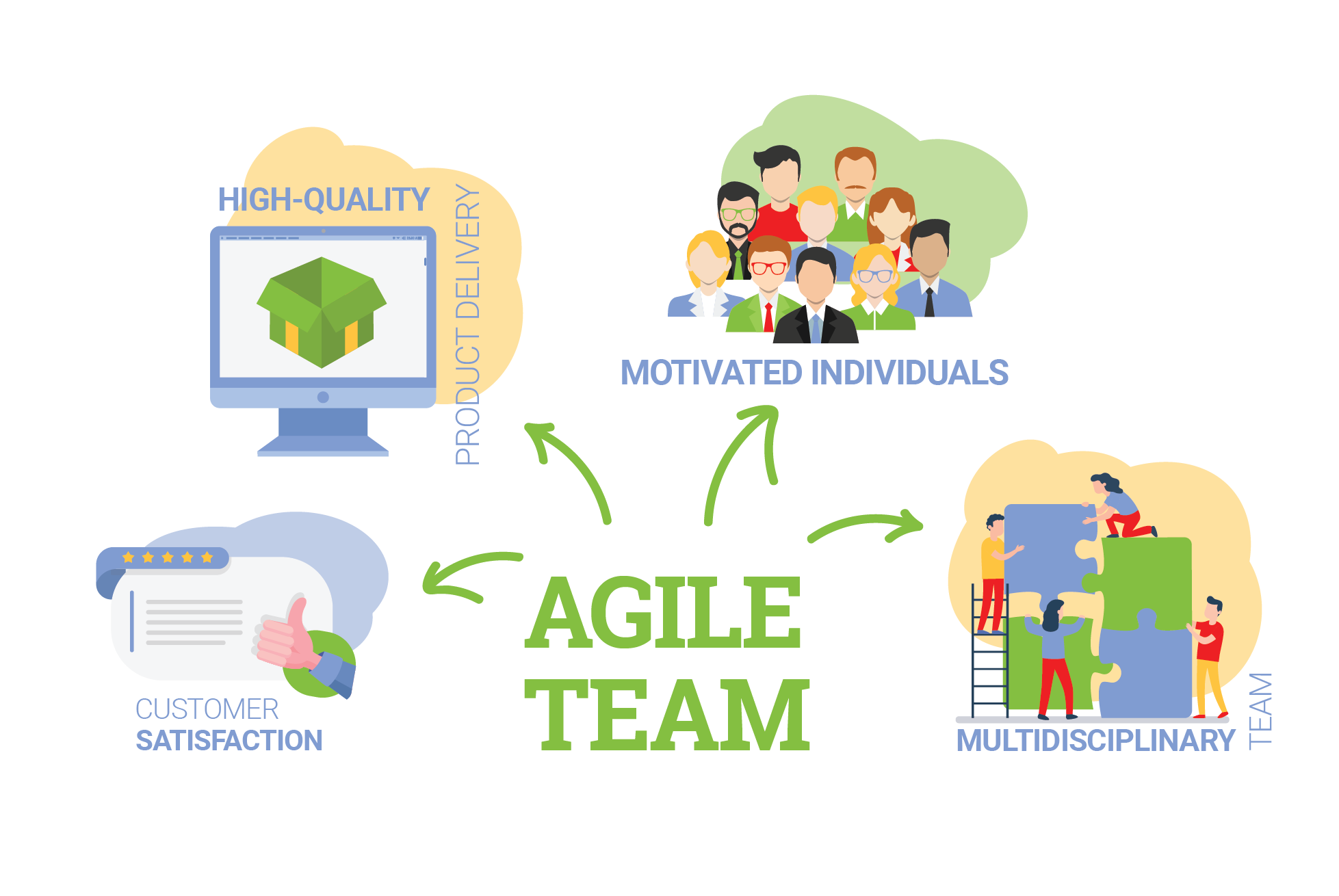
In today’s fast-paced and ever-changing environment, software development companies need and even have to be agile. An agile approach implies the rapid delivery of a valuable product through quick response to customer’s needs and requirements. We have defined 5 key principles of Agile methodology, which are applied to software development processes and companies as a whole.

Changing priorities

Customer satisfaction through early and continuous delivery of highly valuable software becomes a major principle of agile software development. Frequent iterations between requirements specifications facilitate rapid response to changes in scope and priorities. Adjustments are therefore recognized sooner rather than later. The sooner customers receive the final product, the earlier they get benefits from it!

Adaptability

Agile as a tool helps developers effectively handle new requests so as to provide services faster, thereby meeting or even exceeding customer’s expectations. Flexibility and ability to adapt to changing requirements and market conditions help businesses stay competitive and focused.

Self-organizing teams

Such teams are multidisciplinary in nature. They can figure out the necessary skill set and distribute knowledge across the members. This ensures the provision of best architecture, requirements, and designs. In this case, co-working and face-to-face communication make development processes faster and more effective.

Working software

The main documentation that helps to understand how the software should work is important. However, the main focus is on the creation of a helpful software solution for the customer. Through face-to-face communication between team members, documentation can be minimized.

Agile mindset

In an agile working environment, it is very important to have high-performing teams delivering a valuable product to customers. The performance of every team member depends not only on his/her skill set but also on the mindset, which comprises such attitudes as respect, collaboration, learning, and improvement, focus on value and adaptability.

Both in software development and company management, an agile approach becomes a part of the corporate culture. It requires understanding and sticking to the main principles of agile philosophy, as well as having an agile mindset. Any business that is based on such an approach should be able to adapt to the changing market, be fast-moving and flexible; it should build team communication on trust and respect, encourage knowledge exchange and improvements, do everything possible to minimize time-consuming processes.

*instinctools centers its company policy around agile methods of development and business management, providing high-quality products within agreed deadlines, meeting customers’ ever-changing needs, and satisfying their expectations!

Why QA Is So Important For Software Project

The Consequences Of Lack Of Testing

Far back in 1999, NASA lost its Mars Climate Orbiter, which came too close to Mars, entered the atmosphere and disintegrated because of atmospheric stresses. While investigating the causes of this accident, it was found that one of the company’s contractors – when developing one of the terrestrial modules of the software serving the satellite – used the English units of measurement as the output values ​​instead of the expected more conventional metric system used by the agency’s team. This mistake led to the failure of the $327.6 million mission. One of the reasons for this discrepancy was that the device systems were not tested enough.

There is a saying that It’s only those who do nothing who make no mistakes. Learning from your own mistakes gives you experience and wisdom. But in software, it is too expensive to learn from your own mistakes. The price of such errors is not only in the higher cost of developing the product or in the need to rework an already finished product. You will also lose your orders, your business reputation will be damaged and user confidence will decrease.

How costly is an error?

In 2002, a study commissioned by the US Department of Commerce’s National Institute of Standards and Technology showed that software errors cost the US economy an estimated $59.5 billion annually.

In 2004, NASA conducted a study to determine the relative cost of fixing errors discovered at different phases of a project life cycle. The results of this study, carried out via three different approaches, showed that the cost of fixing an error in the product escalates at the stage of mass use of the product compared to the initial stage of setting, collecting and validating the requirements.

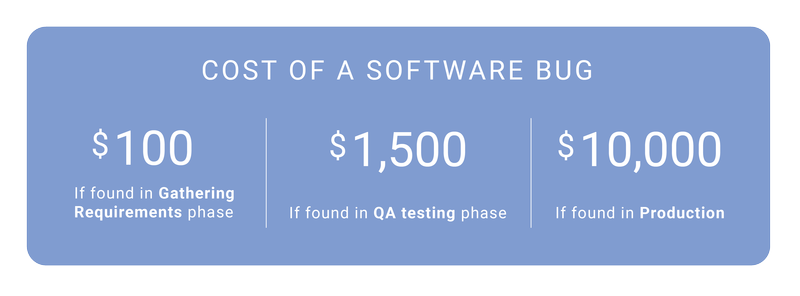
In one article posted on Celerity Blog, the following example is given: a software bug error detected in the gathering requirements phase can cost $100. A bug found at the testing stage can cost $1,500. An error detected after release can cost the customer $10,000.

All this suggests that to reduce the huge costs that come with software bugs in the finished product, it is necessary to make efforts to find such bugs at the earliest phases of the software development life cycle (SDLC). After all, these costs are borne by users in one way or the other – for example, in the form of increased cost of subscribing to a product. Ultimately, such factors can create customer dissatisfaction, weak competitiveness of the product, and, consequently, loss of target audience.

The job of a tester

When it comes to software development, nobody is immune to errors, no matter how well-weighed the project is, how detailed the technical task is and how competent the project manager is. There are just things that cannot be controlled. That’s why software companies test their products to reduce the number of errors and the financial losses that come with these errors.

The main tasks of a software tester are:

  • checking whether the product meets the customer’s requirements
  • detecting errors, thereby minimizing customers’ risks of using the product
  • providing maximum information about the current state of the product.

Thus, software testers enable managers to make timely decisions and release the product on time. After all, the purpose of development is precisely to provide the customer with a suitable and efficient product within a specific deadline.

If you’re interested in more, read Mobile application automated testing

What does a tester do?

A tester performs diverse functions, from planning the testing of separate product modules, to evaluating the finished product as a whole and detecting errors.

  • He checks the product for compliance with the requirements specifications.

It is really important that the product is exactly in the form in which it was conceived, so as to solve the customer’s problems.

  • He checks the product in rare or improbable conditions of use.

Testers find faults in a product which can be detected only in special cases or years of use. For example, it is important to check how the application will behave on February 29 – this day appears every four years in the calendar. Will the reports be properly generated? Can different calculations be carried out? Errors in such “bottlenecks” that were not detected during testing and which did not immediately reveal themselves, could subsequently lead to financial losses, and even to rejection of the product and reduction in the product audience.

  • He explores non-obvious ways of using the product.

A software tester finds areas of the product that need improvement. He does so by performing non-typical actions, that, under the industrial use of the product, can disrupt embedded business processes or the overall performance of the product.

  • He checks data security and product safety.

This is necessary in order to avoid outside interference or unauthorized access to confidential information.

  • He checks the product performance on different devices and platforms.

It is often a requirement that a product works efficiently on different devices and platforms: desktop, mobile apps, different browsers, and, moreover, different versions of browsers. This is typically a rather large task, and it is simply inefficient and unprofitable for developers to spend resources on such a task. A software tester performs this task.

  • He studies interactions with other products.

During testing, the tester checks the interaction between the product and the other products of the customer. Integration with popular social networks, payment aggregators, multimedia portals, etc. is checked, depending on the product requirements.

  • He prepares and submits a product status report to stakeholders.

By so doing, stakeholders receive information about the state of the product. This information enables them to take further decisions on product development and release.

Why can’t developers be good testers?

At first glance, it may seem that developers can test their own product, and this would be an opportunity to save costs on recruiting testers. But actually, this is not the case – developers alone cannot test a product sufficiently.

  • It’s very difficult to check yourself. Certainly, you wouldn’t be objective when you check your own work. In testing his own code, the developer often focuses on the positive aspects, not paying due attention to the negative and problematic side. After all, the task of a tester is to focus on product risks and to search for errors and discrepancies. The developer finds it more difficult to do this, for psychological reasons.
  • Testers have special expertise that developers do not have. Testers know and use various methods and testing techniques, and they prepare sets of typical test cases or checklists, which then help to detect errors or discrepancies with project documentation. Often it is the tester, as an independent party, who discovers bugs in a software product, arising from the fact that the developer initially misinterpreted the requirements.
  • A tester is cheaper than a developer. Therefore, the use of testers is also a cost-saving measure for the customer.

If you’re interested in more, read Automated Testing ROI

How to organize work efficiently?

Engaging a tester for your project after completion of development and before the release of the product may not be sufficient to ensure that the product is delivered exactly as the customer wants and within the agreed timeframe. For efficient testing of a complex and multifaceted process, there is a need for close interaction between the tester and developers, project managers, business analysts, technical writers and other specialists. Therefore, it is important to involve testers in the early stages of development, which will help to avoid discrepancies and ambiguity of requirements, and to introduce a critical view of the product at all its life stages.

Testers should also participate in trials at the end of testing. Problems can be identified based on customer feedback. Testers could take part in addressing such problems: they will reproduce situations and errors that the users encountered, test bug fixes to make sure that these fixes did not create new errors in other places, etc. These specialists have knowledge of the entire complex application and business process.

So, do we test or not?

Testing is a compulsory phase in a product’s life cycle. Both the designer and the builder of a new aircraft, who want to test their creation by themselves, risk their lives. Test pilots solve this problem. They do this before mass production starts and pilots start flying the aircraft.

Both in business and in everyday life, people achieve their goals by taking certain steps and assessing their progress. If your goal were to get an effective, high-quality product, then impeccable organization and testing would enable you to achieve this goal.

.NET Core Framework Complete Review

Developing Cross-Platform Apps Faster and on Any Platform

At the end of the last century, Microsoft, one of the most successful software development corporations, faced the problem of a huge number of incompatible languages, environments and programming technologies. At the same time, the development process was rigidly focused on a specific programming language. Also, across different languages, there was a different set of incompatible technologies. Above all, these technologies were gradually becoming obsolete.

There was a need to implement new programming tools that would fully support the object-oriented approach, exceptions handling and garbage collection. The growing popularity of the new Java software platform by Sun Microsystems surely added some fuel to the fire.

What was there before .NET Core?

In 1999, Microsoft began the development of a new unified platform, NWGS, later called the .NET Framework. This software platform, despite all the weaknesses and inoperability of the first versions, has become a unique product, combining many benefits. The main advantages of the platform:

  • Hardware-independent execution environment with the ability to compile just-in-time (JIT). This means that an application written in languages that support .NET can be run on processors of different architectures, in case there is a translator from the .NET MSIL language into the command codes of this processor.
  • Support for compatibility of program fragments written in different languages. For example, in C#, you can create your own class, inherited from a class written in Visual Basic, and call a method written in Managed C++. This all works without error.

As the .NET Framework evolved, it acquired new technologies and development capabilities. In version 2.0 there were WinForms and ASP.NET, in the 3.0 version there were WPF and WCF, the 3.5 version gave us LInQ, in version 4.0 TPL and PLInQ saw the light, and in version 4.5 API for Windows Store applications was added.

In 2002, the first version of the .NET Compact Framework was released. It was intended for mobile devices run by Windows Mobile. The .NET Compact Framework is formally a subset of the .NET Framework, but it actually contains its own application model, framework, and runtime environment, that is significantly different from the similar .NET Framework model.

Subsequently, all new “subsets” of the .NET Framework were born. They were architecturally and functionally different from the desktop .NET version. These subsets are familiar to all .NET developers. They are: Silverlight, Windows Phone, Windows Store, .NET Micro Framework, and ASP.NET. The situation is even stranger for the last one: ASP.NET of version 4 and ASP.NET of version 5 are two different platforms, each with its own application model, framework, and execution environment (Figure 1).

Figure 1. Example of the different .NET verticals

Of course, all the platforms mentioned have a number of common APIs because they all once were separated from the desktop version of the .NET Framework. But their evolution caused the growth of differences between them, and Microsoft had to come up with increasingly sophisticated “crutches” to ensure compatibility and uniformity of their APIs. The compatibility problem arises when you need a software product that can work on several platforms. This raises the question of the availability and compatibility of the API in each of these platforms.

In addition to the mentioned “subsets” of .NET that run exclusively on Windows, there are also implementations of the .NET Framework for Linux systems, the most famous of which are Mono and DotGNU. These are created by communities of enthusiasts; Microsoft did not participate in their development in any way. Each of these implementations also represents a “subset” of .NET, with its own application model, framework, and runtime. Porting applications from the Windows version of the .NET Framework to Mono or DotGNU is as difficult as the development of an ASP.NET application version based on its desktop implementation.

It turned out that Microsoft eventually gave birth to a whole “zoo” of similar, but at the same time different, platforms with different APIs, application models, and execution environments in order to create a single software platform with full language and technology compatibilities. The .NET Framework, which Microsoft considered a salvation from the “zoo” of incompatible languages and technologies, eventually itself became the “zoo” of APIs and implementations. Microsoft again faced the challenge of creating a single software platform for all development methods that exist in the .NET Framework. This platform is .NET Core.

What is .NET Core?

.NET Core is a modular cross-platform version of .NET Framework with the ability to port applications to other platforms and operating systems. In this case, the already created code is used to the maximum during the porting process, while the use of APIs specified for a particular platform is minimized. However, .NET Core does not replace the .NET Framework, but is just a version of it (a subset). Also, .NET Core does not replace Mono on Linux-like operating systems – both projects are developing in parallel.

This is achieved by using portable class libraries (PCL) with the most common form of API for all target platforms. At the same time, implementations of the application, including the framework itself and the execution environment, remain different, although they are subsets of .NET. Appeals to the API are particular for a specific platform (in the case of designing a cross-platform project) and are separated by special preprocessor directives:

#if WINDOWS_PHONE_APP
Windows.Phone.UI.Input.HardwareButtons.BackPressed
+= HardwareButtons_BackPressed;
#elif WINDOWS_APP
// Ignore. Windows Store doesn't have support for this.
#else
#error Unknown platform
#endif

where WINDOWS_PHONE_APP is the preprocessor symbol declared in the project. It can be found in the project properties (the Build section).

Beginning with 2013 Update 2 version in Visual Studio, it became possible to create universal applications for Windows that can be run on several platforms, due to PCL.

.NET Core is creating by the .NET Foundation community, which, in addition to Microsoft programmers, includes many independent developers, including the Mono Community developers.

Everyone can participate in the creation of .NET Core. The participation rules are published on GitHub. The project with open source is published on GitHub as well. .NET Core is a free software under the licenses of MIT, Apache 2.0 and Creative Attribution 4.0 (for some modules).

Portable Class Libraries (PCL)

In the .NET Framework, the core of the system is the extensive mscorlib library. It contains a lot of APIs and their implementations, some of which are not required in other target platforms (which differ from the desktop version) and others are not supported by these platforms. It turns out that on another target platform (for example, in Silverlight) there is a completely different mscorlib library. The situation is the same for other .NET libraries. Unlike the .NET Framework, the .NET Core has a flexible architecture of PCL, designed with significant code decomposition. At the same time, the dependencies between the libraries are clearly monitored by the .NET Core itself.

Each PCL is responsible for a specific .NET module and no more than that. Each PCL has its own independent assembly version, and new APIs are available only in new PCL versions.

This allows the target platform to choose the PCL modules independently. It is also important to note that the platform cannot support any PCL partially – it either supports it or it does not.

Also, the main principle of .NET Core is based on PCL, and there are uniform APIs for various .NET implementations. However the .NET implementations have not disappeared. They continue to exist and they are as different as before, but access to them can be done through APIs which are common to all of these implementations.

PCL allows you to implement the same code in several target .NET Core platforms.

If you’re interested in more, read How an IT Pro Makes His Life Easier Using TFS 2015

Unified BCL is the Cross-platform Kernel for .NET Core

BCL contains an API that is uniform for the entire .NET Core and for all its implementations. For example, most of the .NET Native API used to create applications for mobile devices and ASP.NET 5, on which the server side of web applications is written, contains BCL, and it is the same for both technologies.

BCL is an intermediate layer of assemblies on MSIL, common for all .NET implementations. Above BCL, there are APIs specific for each particular platform (so-called “application models”), for example, WinRT interop for .NET Native and MVC for ASP.NET 5.

Below BCL there is a layer of adaptation to various .NET implementations to the performing environments, for example, CLR (CoreCLR) or .NET Native. The CLR compiles the MSIL code into the target platform command system during the execution of the application (JIT compilation).

Unlike the CLR, .NET Native compiles the MSIL code, together with the .NET libraries, into the target platform command system, even before it reaches this platform, and launches on it. As you can see from the description above, CoreCLR and .NET Native are two completely different .NET execution environments, but the BCL is the same for both and interacts with them only through the adaptation layer.

Currently, .NET Core BCL is being developed under the name of .NET Standard.

Compatibility Issues in the .NET Framework

The traditional .NET Framework is distributed as a single, indivisible software product. It is installed on the device entirely and it is removed from the device entirely. The new version replaces the previous one, with all the ensuing consequences. However, the new version of the .NET Framework can disrupt the normal operation of the application written in an older version. For example:

  • If a new interface is added in the new version to the existing type of the .NET Framework, there may be problems with the serializing of this type;
  • If an additional overload has been added to the existing method in the new version of the .NET Framework, then there may be a problem with the reflection of this method;
  • In the case of renaming an internal type to the .NET Framework, the application’s performance may also be compromised if the type name is determined by the toString() method.

Since the release of the new version of the .NET Framework, Microsoft has been trying to make it compatible with the previous version. But even if the probability of failure is extremely low (less than 0.1%), then there may be millions of such failures, because the .NET Framework is currently used on billions of devices.

NuGet – Distribution Mechanism and Modularization Basis of .NET Core

Unlike .NET Framework, .NET Core is presented as small NuGet packages, and each of them, as a rule, is responsible for any library or namespace. For example, if in .NET Framework the System.Colections.Generic namespace was a part of a large mscorlib library, then in .NET Core it is a certain NuGet package.

  • Every NuGet package has its own name and version.
  • Every NuGet package can be updated to a new version without updating other .NET Core components.
  • NuGet packages can be downloaded and installed individually from the website nuget.org without installation of a new .NET Core version.

Currently the nuget.org web page contains more than 800,000 .NET Core libraries. But this doesn’t mean that you would have to download .NET Core components from the website and install them separately every time a new application on .NET Core needs to be developed. All the NuGet packages included in .NET Core are installed alongside the installation of .NET Core and have the same version as the current version of .NET Core. Additional packages or packages of a newer version are downloaded and installed separately from the installation of .NET Core.

Additional NuGet packages that are not included in the current .NET Core version are circulated with the application after downloading. There is no need for NuGet to download its packages from the Internet. There is an autonomous installer for NuGet that is included in Visual Studio. Any plug-in in .NET Core can be replaced by a newer one without the installation of a new version of the framework. If a .NET Core plug-in works insecurely, NuGet can roll it back to an older version without disrupting the work of other .NET Core components.

Thus, .NET Core is a framework adjusted for every application. Every .NET application uses only these .NET Core libraries, which are required. The libraries that are common for all .NET applications are presented as NuGet packages within .NET Core. Additional .NET Core libraries are circulated together with applications.

Integration with Other .NET Platforms

.NET Core is a subset of .NET Framework and must be compatible with its other subsettings. The .NET platform is fully compatible with .NET Framework 4.6 and fully realizes its function. In time, .NET Core will develop faster than .NET Framework, but both projects will develop simultaneously. All the new technologies will be tested on .NET Core, and only then will they be adapted to .NET Framework.

Mono is a subset of .NET Framework released in Linux and MacOS. The Mono community is building up support for .Net Core release on these operating systems, at most, integrated with Mono.

Windows Store and Windows Phone are subsets of .NET Core as well, and contain their own models of applications over BCL and their own runtime (.NET Native).

Other .NET platforms can be compatible with .NET Core as well. It is achieved either by the usage of PCL or by the creation of a common project and the adaptation of code with the help of #if directives.

.NET Compiler Roslyn as a .NET Core Part

Particularly in .NET Core, a new compiler, Roslyn, is used, written for usage in .NET Core. Roslyn allows the connecting of each stage of code compilation and .NET application building through API.

The possibilities of Roslyn are described in more detail in the article Microsoft Roslyn – using the compiler as a service.

Among the most interesting Roslyn possibilities we can point out are the building and reprogramming of a syntactic tree, the generation of source code by this tree and the possibility of using C# and Visual Basic as script languages (with the use of REPL).

.NET Core gave Roslyn its own namespace of Microsoft.Net.Compilers and its own NuGet package, which corresponds to this namespace. On the basis of Roslyn, a freely distributable cross-platform IDE with Visual Studio Code open source code was developed.

ASP.NET Core – a New Framework for Web Applications

Despite its crudity, the ASP.NET becomes a prospective platform for web service development. This is facilitated by more compact code, better scalability and the very high efficiency of a new platform. Along with that, Microsoft has refused many technologies in ASP.NET Core which were used in ASP.NET. These are System.Web namespace, Web Forms, Transaction Scope, WPF, and WinForms. Instead, .NET Framework provides a flexible web application model, with the use of MVC and WebAPI subsystems.

If the earlier ASP.NET, based on System.Web.dll, ran only on Windows and IIS, then at present, relying on benchmarks, it ranks among the top Linux web frameworks in terms of efficiency.

Microsoft’s aspiration to make ASP.NET Core cross-platform led to ASP.NET Core depending on neither the operating system nor the web server which it will run on. ASP .Net Core will run equally well on either Windows, Mac, or Linux, and its projects will be able to run both in Windows Azure Web App or in Docker on Linux, and everything will work correctly in both cases.

Further .NET Core (Roadmap) Development

Nowadays .NET Core is developing actively. .NET Core is adopting more and more common APIs from .NET Framework and Xamarin to make an application portable to all .NET platforms. Microsoft and .NET Foundation are pursuing the following aims in developing upgrades for the framework:

  1. To make .NET appropriate for most of the current development tasks;
  2. To develop high-quality .NET Core versions for Windows, Linux, and MacOS operating systems;
  3. To create high-quality .NET Core versions for processor architectures: x86, x64 arm32, and arm64;
  4. To perform releases of new .NET Core versions at least several times per year;
  5. To allow developers to develop applications as quickly as possible, using intuitive .NET Core tools;
  6. To improve application building productivity in .NET Core to make the development cycle (making changes in code and subsequent code execution on a compiler) as quick as possible;
  7. To improve the work of .NET applications in the cloud – to improve logging algorithms, tracings, and error diagnosis;
  8. To allow the user to assemble .NET Core from source code files independently, including those modified by the user.

The release of the 2.0 version of .NET Core is expected in 3Q 2017. The next version of cross-platform framework by Microsoft is expected to have many improvements. The utility of the second .NET Core version has been proclaimed for the following operating systems:

  • Windows (starting from 7 SP1);
  • Windows Server (starting from 2008 R2 SP1);
  • Red Hat Enterprise Linux (from version 7.3);
  • Fedora (from version 25);
  • Debian (from version 8.7);
  • Ubuntu (from version 14.04);
  • OpenSuse (starting from version 42.2);
  • Tizen (from version 4);
  • MacOs X (from version 10.12).

Microsoft continues to develop other .NET tools, together with .NET Core. These are: ASP.NET, .NET Framework, programming languages for .NET, and others. The project .NET Standard, developed from Unified BCL, is developing actively. .NET Standard is a set of common specifications for all .NET platforms: .NET Core, .NET Framework, Mono, Xamarin, and others. .NET Standard guarantees the usage of its libraries in all .NET runtime environments.

Summary

The contribution of Microsoft to the progress of development tools is, of course, wonderful, but at the same time, the progress of these tools was ambiguous. The tendency to use a huge number of different technologies and approaches to software development resulted in many incompatible languages and development tools. This led to the problem of unification and compatibility of all languages, development tools and technologies ever developed by Microsoft.

Microsoft, having resolved this issue once and having created .NET Framework, faced the problem again. Now this issue presents as different verticals of .NET subsettings, which have originated from one framework but are different, and have become more and more distant from each other as they developed. The colossal effort of developers was needed to create a single software platform. The result of such work was .NET Core – one framework for all .NET verticals.

.NET Core is not just another .NET Framework. As opposed to .NET Framework, it is an absolutely new .NET platform with technologies and work principles entirely different from .NET. Absolutely everything has changed in .NET Core: the framework and its core building principles, the distribution and upgrade scheme (NuGet), development frameworks (Visual Studio 2015/2017 and Visual Studio Code), web development platforms (Asp.NET Core), and even the compiler *(Roslyn). However, Microsoft and .NET Foundation have not hurried to switch fully to .NET Core; they are developing it along with other .NET platforms.

Anna Vasilevskaya
AI modified real photo
Anna Vasilevskaya
Account Executive

Get in touch

Drop us a line about your project at
[email protected] or via the contact
form below, and we will contact you soon.