How to Create a Cryptocurrency Exchange: *instinctools Ultimate Guide

Despite the up-and-down nature of the cryptocurrency market, many startups are determined to capitalize on it and want to know  how to create a crypto exchange of their own.

Statistics project that the yearly growth rate (CAGR 2022-2027) of income in the cryptocurrency sector will be 16.43%. This is welcome news for those who are looking to take advantage of the digital currencies market in the long-term. Furthermore, at the “Future of the crypto exchange” panel held in London this September, leaders of renowned crypto trading platforms like Binance and Huobi shared the impressive results they had achieved in spite of the difficult year.

Global payment systems are also moving in the crypto direction and forging new connections between digital and fiat money. For instance, Mastercard enables settlements using crypto on its network, and Visa has become the first major payment network to settle transactions in USDC. 

Huge brands, including TAG Heuer, Hublot, and Breitling, also accept cryptocurrencies for payment with the help of special crypto payment processors that allow customers to make purchases with, let’s say, Bitcoin or Ethereum, while the company can instantly get the equivalent sum paid in fiat money.

If you want to know how to create a crypto exchange and make it a truly lucrative solution, check how we’ve dealt with challenges while building one of the first white label crypto exchanges in Europe. 

What is a cryptocurrency exchange platform?

Determining what you want to end up with is crucial since “a cryptocurrency exchange” can imply different things. 

  • A full-fledged trading platform where users have more than a basic understanding of crypto and are willing to become successful crypto traders. It’s a sophisticated technical solution and a serious investment of resources and money. For instance, you’ll need to develop crypto exchange software such as an order matching engine (OME), which is the backbone and beating heart of a crypto trading platform that gathers and synchronizes data across multiple trading pairs.
  • An instant crypto exchange for crypto-to-fiat and fiat-to-crypto transactions. Unlike a crypto payment gateway, embedded into your existing solution, a crypto exchange is a full-fledged business with its own business model. It’s a practical high-demand option with easy access for users who don’t want to trade and need to convert one cryptocurrency to another or into fiat currencies. In this case, you have to deal with challenges such as integrations with financial institutions. But, the workload is much smaller compared to a trading platform. 

Either solution can become a profitable opportunity for your business. In this article, we mainly focus on instant crypto exchanges. Let’s investigate the pain points our experts have highlighted in more detail.

Types of cryptocurrency exchange platforms

Crypto exchanges can be centralized (CEX, managed privately) or decentralized (DEX, without central ownership). Many companies speak about DEX without knowing what it really means and whether a business can truly benefit from such an option. 

Choosing between a centralized or decentralized exchange is a no-brainer, as DEX is still the utopia of crypto enthusiasts. Decentralized crypto exchange platforms are tricky to manage because of the distributed assets. Also, they often have problems with a lack of liquidity.

If in CEX, centralized management ensures liquidity thanks to your partner banks, DEX mostly relies on the client’s money and uses complicated schemes to fulfill the liquidity pool. So, if users suddenly rush to sell cryptocurrencies, a decentralized exchange platform will most likely run for a few hours and stop, as the money will be gone, and there will be nowhere to get it from.

On top of that, DEX implies anonymity, which is synonymous with the unregulated zone, and one of the biggest challenges in cryptocurrency today. And this, in turn, completely contradicts the legal conduct of business. 

Cryptocurrency exchange architecture explained

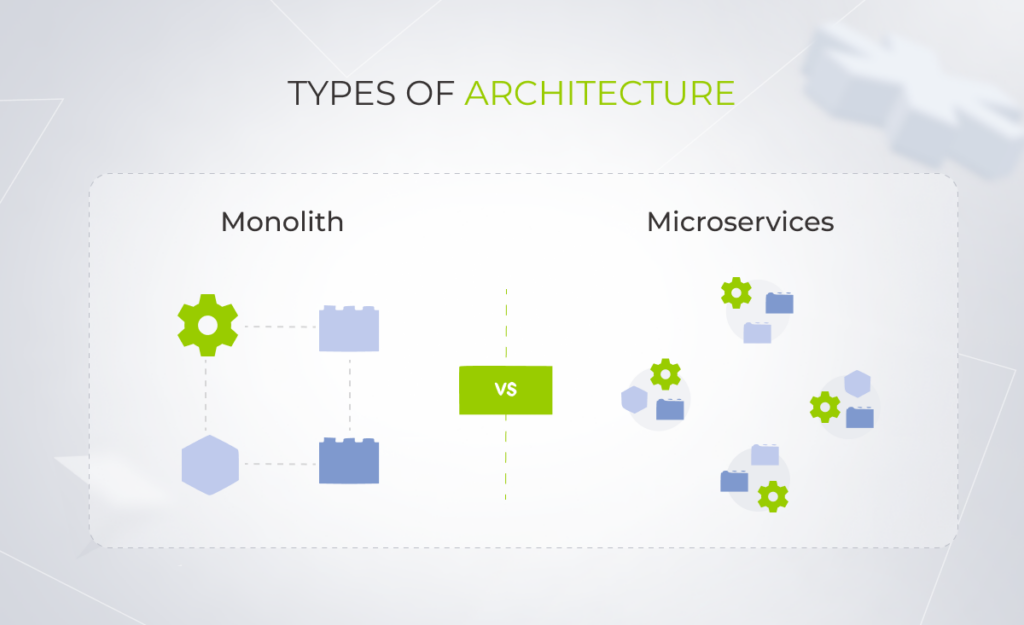
Let’s talk about how to build a crypto exchange platform in terms of architecture. Your solution can be monolithic (built on a single server) or based on microservices (each component is located on a separate server). 

Monolithic architecture

With such an approach, all the code is stored in a single repository instead of being fragmented across different services. So you will need top-tier development team as not everyone can operate with such a volume of code. 

Because of the high connectivity, monolithic architecture is hard to test. But it is possible to divide data into layers and work with them to speed up the process. Moreover, you’ll spend much less on support compared to microservices. 

This type of architecture is especially suitable for MVP projects, testing a hypothesis, and market research. For example, will your targeted audience use your solution to the extent you expect, if you make your own crypto exchange?

Microservices

A microservice architecture is known for its flexibility and scalability. It makes operating easier in a distributed system or when many changes are required. Furthermore, you’re not limited to one programming language and can leverage different ones for separate microservices.

You have a wide choice of specialists who can create separate microservices for your solution as different languages suit this. Be it PHP outsourcing, Python, Java, or another language; you can implement the crypto part functionality in almost any of them.

A microservice architecture also paves the way to creating solutions with a high workload and performance speed, such as crypto trading platforms, because you can rely on Kubernetes (K8s). This orchestration system ensures the creation of self-healing environments while the system scales. Whenever K8s detects an infrastructure failure, the system can auto-restart, auto-replicate, or auto-scale to keep the infrastructure reliable.

But consider that you need a strong DevOps team to set up Kubernetes and that a microservice architecture is expensive to build and maintain. Additional costs are conditioned by the complexity that microservices cast on the system and the necessity to hire more developers with first-rate skills.

In general, this option is suitable for organizations that already have a mature product with a growth trend and have developed the requirements for the technical solution in detail. 
how to create a crypto exchange

If your system is not supposed to accept a million messages per second, you can comfortably and efficiently run it on a monolith. Microservices are more convenient if we’re talking about a very distributed team, like 50 developers working on different features in different time zones. Microservices are easier to deal with as each microservice is a dedicated piece of logic. And it’s always easier to work with a small amount of code than with a large one. 

So the question is always about the scale of your solution and the size of your team. From my experience, 90% of startups have a monolithic architecture. Yes, microservices scale better and faster, but it doesn’t mean that large-scale projects can’t be built on a monolith. Even banks run successfully on a monolithic architecture. 

Whichever you choose, remember that you have room for change. A monolith can be divided into microservices. It’s possible to design the solution architecture in such a way that moving to microservices will take no more than a month. And, vice versa, microservices can be assembled into a monolithic architecture if they are too troublesome to manage.

Want to identify the best architecture match for your cryptocurrency exchange platform?

Get in touch

Four challenges to deal with when building a crypto exchange

Here comes the trickiest part, where you have to solve issues at a granular level. It involves choosing appropriate functional blocks for the solution, developing an intuitive UX/UI design, ensuring proper security measures, and testing the platform before going live. 

Functional modules selection based on our client’s success story

Each crypto exchange platform is made up of functional blocks. Their selection depends on your business goals, desire to stand out from the competition, customer needs, and regulatory requirements.

For example, you should investigate whether you can store users’ sensitive information in the cloud. In the case of crypto-to-crypto exchange platforms, it may be acceptable and won’t cause regulatory compliance issues. But in the case of crypto-to-fiat solutions, cloud services are most likely not an option, as it happened with our crypto exchange project in Europe when the regulator imposed a ban on storing users’ sensitive data in the cloud. 

In addition to limitations related to building a white label crypto exchange, we had to consider the client’s expectations regarding the technical features of the solution. It had to include highly intelligent hedging and a high degree of the calculator’s personalization depending on various parameters while keeping the user interface simple. Intrigued? Then let’s dive deeper into what’s under the hood and what’s on the surface in this case. 

Cryptocurrency exchange software, like any software, includes backend and frontend development.

The back end 

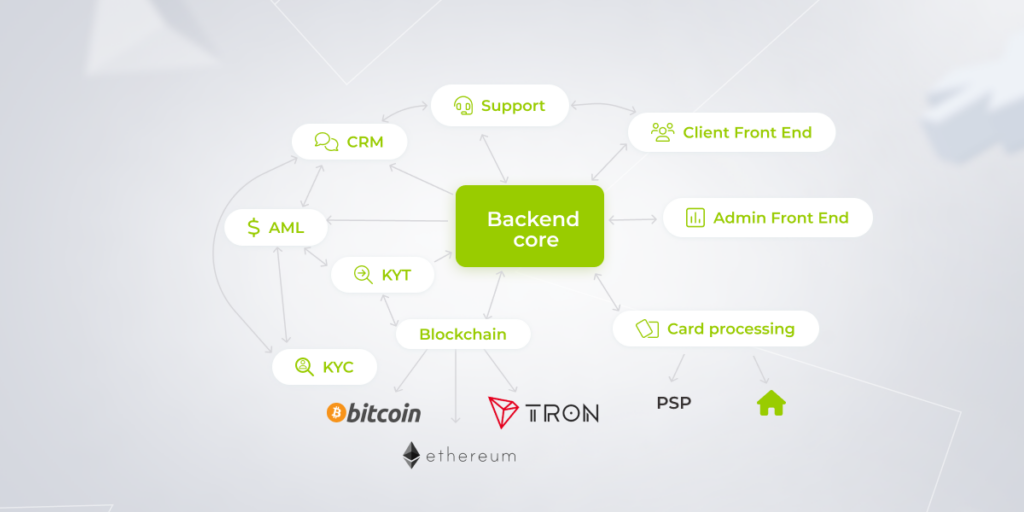
In the crypto exchange solution we’ve created, the following functional blocks are linked to the back end:

  • Blockchain processors. This module is responsible for blockchain integrations and provides access to cryptocurrency operations. 
  • Card processors. An additional module if you want to reach more users and offer a crypto exchange for fiat. It’s the block of integrations with the financial institutions – banks or PSP service providers, such as PayPal in the US and Europe, and Alipay in Asia. 
  • Admin module. Here you manage depersonalized users, transactions (and fix suspended transactions), and the exchange itself (you handle fees, commission, etc.). There are two points you should pay special attention to hedging and interacting with your liquidity provider.

Hedging. It’s an automated process of balancing your fiat and crypto assets at the level of daily transactions. When a user exchanges $100 for crypto, automatic hedging is responsible for a mirror purchase of cryptocurrency from your liquidity provider. 

In the crypto exchange software we’ve created, hedging is not just automated but intelligent. Instead of hedging every transaction, the system keeps a certain corridor of fiat and cryptocurrency balance. We’ve streamlined the hedging process so that the system can interact with the liquidity provider only when transactions step out of the balance corridor.

Interactions with your liquidity providers. You need them to fuel your crypto exchange platform with cryptocurrencies and fiat money. In contrast to hedging, here we’re talking about balancing an amount of money within a 2-3 days turnover of your crypto exchange platform.

In a dream world, exchange operations are balanced. However, reality interferes with this dream, showing a constant disproportion either on the side of cryptocurrency or on the side of fiat. That’s why you should keep your finger on the pulse to reach out to your liquidity providers in time. 

  • CRM. As we’ve mentioned before, in the case of our client, the regulator had a strict requirement to store customers’ personal data only in the country of their citizenship. Furthermore, due to security reasons, only a limited group of employees have access to the CRM module, where all the sensitive information about the users and the history of the interactions with each of them is stored. 
  • Customer support. This service is interlinked with the CRM, since, to access tickets of a particular user, you first need to get their data from the CRM. 

The client’s front end

It’s the web version of your cryptocurrency exchange platform that users interact with. In addition to the main service window, it includes a personal account that functions similarly to a personal account in a typical banking application. 

A calculator is crucial to the crypto exchange software’s front end. 

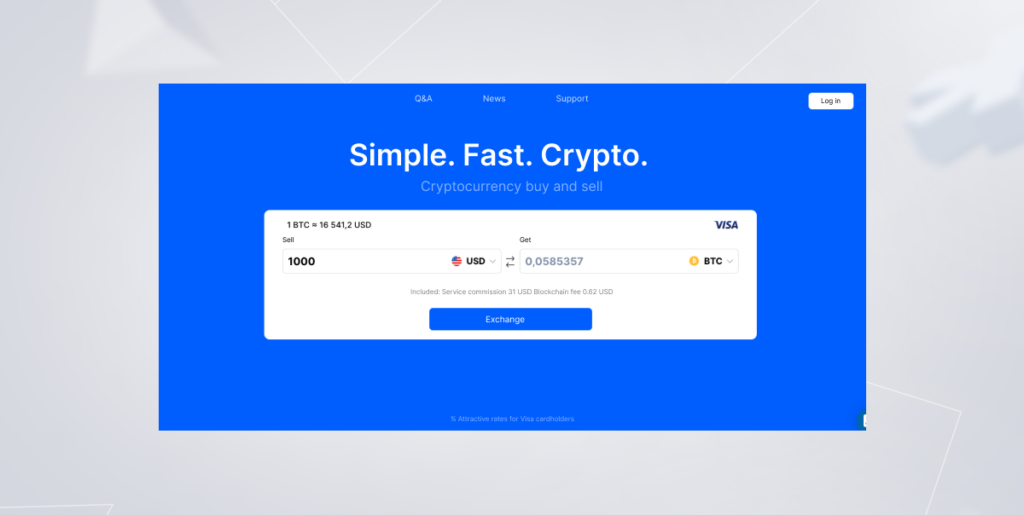
A calculator can be simple when the cryptocurrency exchange rate is the same for all registered users. However, in our crypto exchange solution, the calculator is highly personalized and calculates the exchange rate individually for each user considering a plethora of parameters.

For example, the rate will be different for cardholders of different banks, owners of basic and premium cards, ordinary and VIP clients. It also will depend on a transfer method (card or a bank account), the availability of a one-time or permanent promo code, etc.

The calculator, in this case, is a microservice that is tricky to build at the code level as you have to handle a mind-boggling number of possible errors. For instance, with all the personalization, you must consider AML and card limits for each user.

Here is the interconnection scheme between the backend and frontend modules in the crypto exchange solution we’ve built for our client.
how to create a crypto exchange

Struggling to build proper functional modules for your crypto exchange platform?

We can help

Intuitive UX/UI

Exchanging crypto for fiat and vice versa raises more questions than regular exchange transactions. That’s why proper UX/UI design is vital to provide users with all the necessary information while not overloading them with information. 

Never underestimate the complexity of creating a simple solution. On the one hand, you might want to put as much meaningful information on the calculator’s screen as possible. Payment methods, service and blockchain fees, standard exchange rates and exclusive rates for the cardholders of a particular bank, limits, customer support, etc. – all seem equally important. On the other hand, you had to create a concise crypto exchange platform that users can grasp intuitively.

Here are the final desktop and mobile user interfaces of the white label cryptocurrency exchange created by our client.  
how to create a crypto exchange

Security issues

The challenge here is not only how to create a crypto exchange platform but also how to build a secure solution both externally and internally. Let’s sort things out.

External security of a crypto exchange refers to infrastructure and service.

  • Infrastructural security. You can host your crypto solution on AWS, Azure, Google Cloud, or similar cloud services. Any cloud provider will offer you basic protection against external cyberattacks. If we use AWS as an example, it can automatically detect and mitigate most external attacks. 

Your provider guarantees a complete set of protection mechanisms against various hazardous events. And if you’re building a self-hosted solution, you’ll have to take responsibility and ensure protection against different risks by yourself or with the help of a reliable development partner. 

  • Service security. It applies to handling your database, customers’ sensitive information, and private and public keys. Let’s look at each case.

Your database should be stored appropriately on a separate server. Take into account your regulator’s storage requirements when building a crypto exchange. For instance, even if your code is stored in the Cloud, the regulators may insist on keeping the database on your company’s servers locally. Also, ensure that your code interacts with the database securely and that information can’t be intercepted.

A breach of your customers’ data (e.g., a list of your clients’ names) can’t result in a withdrawal of money, but it has reputational risks for your company. So, there are general steps you should take to ensure sensitive data safety, such as having de-personalized databases and storing personal data in a separate location. 

When creating a crypto exchange, one more point to consider is the security of public keys (used for users’ identification) and private keys (needed for authentication and encryption). For instance, all private keys must be encrypted and stored in a distributed way to make them inaccessible from the outside.

Internal security also includes working with personal data and ensuring proper protection against your administrators, as they have access to system addresses. The rights of access and disposal of these addresses must be automated. Otherwise, if employees are allowed to carry out payments, their rights need to be strictly limited or double-checked with a multi-signature system, meaning another employee, such as a security officer, approves the transaction.

We’ve already mentioned the importance of a strong DevOps team in your crypto solution’s architecture. DevOps specialists are also in charge of setting up and securing the internal infrastructure. They ensure that the databases remain unchanged – any attempt to break into the data is logged and monitored to prevent intruders from covering their traces.

Testing peculiarities

Testing is an indispensable part of cryptocurrency exchange software development projects. There are different types of tests, which we scrutinized in the article about performance testing. However, you don’t have to run them all. Choose the ones that are particularly crucial for your requirements. Based on the experience of our crypto specialists, we can say that it’s vital to perform load, stress, and spike tests. 

For example, you’ve initially chosen a microservices architecture for your crypto exchange platform that can handle a thousand transactions per second. In this case, you need to test whether the solution can sustain such a load. It’s the load type of testing. Stress and spike tests are next in line. 

how to create a crypto exchange

Most blockchains have a testnet. It is a copy of the mainchain, a live environment where you can perform transactions with any amount of tokens using your test addresses and nodes with zero risk. 

Working with the testnet has its own peculiarities. So it’s better to have an experienced tech partner by your side who knows how to set up a development process accordingly. 

If your crypto exchange platform allows not only crypto-to-crypto operations but also crypto-to-fiat transactions, you’ll need testing on the fiat side as well. If you integrate with banks, they’ll offer you their sandboxes to run transactions in a testing mode. 

Finding a reliable tech partner to create a cryptocurrency exchange is half the battle

Starting your own centralized cryptocurrency exchange may look tricky and scary. Until you find an experienced technology partner who can create a crypto exchange in a form that best suits your business needs and customers’ expectations. A reliable tech ally chooses the appropriate architecture and identifies the suitable functional modules for your solution as well as creates an intuitive UX/UI design, provides the crypto exchange platform with a proper level of security, and runs testing responsibly.

Puzzling over how to start a cryptocurrency exchange?

Let's chat
RPA in Banking: Hop On The Train Before It Gets Too Fast

Automation is the focus of many industries, and banking is surely one of them. Banks are actively implementing Robotic Process Automation (RPA) that can take on tedious tasks. Imagine how much faster and more efficient your work can be, even if you leverage RPA in banking only to automate data entry and report generation. 

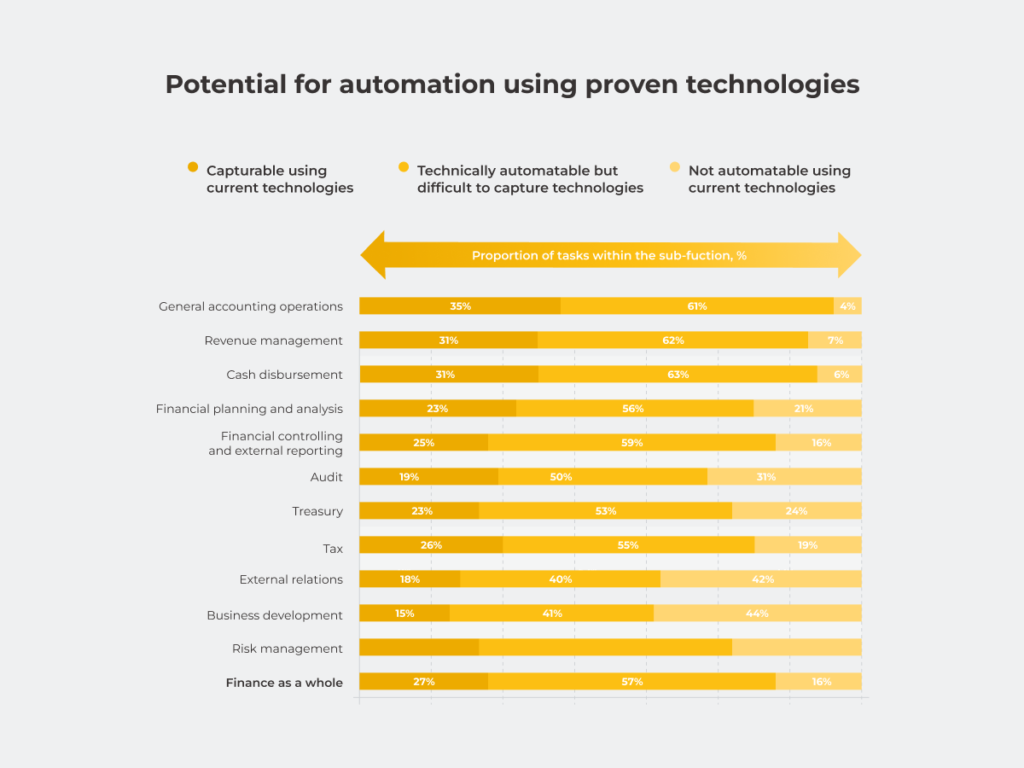
McKinsey’s research reveals that in finance, only 16% of tasks cannot be automated using current technologies. The rest can be safely left to RPA software. And your competitors are already taking advantage of this — RPA has been one of the top technology trends among financial institutions since 2020.

In this article, we review the banking processes and operations, where implementing this technology can bring you the most benefits.

Source: McKinsey, Driving impact at scale from automation and AI

Part of a cost-saving initiative or a step toward a bank’s digital transformation strategy? RPA is your ally either way

If you don’t feel like starting a full-scale digital transformation, you can still tap into robotic process automation in banking. The main benefit of RPA for any industry is that it’s a minimally invasive solution. There’s no need to build a new IT infrastructure and completely reshape your financial institution to leverage multiple advantages of RPA in banking operations, such as lower expenses, boosted productivity, and eliminated the possibility of human error.

There are four main areas in the banking industry where robotic process automation can be used: reporting and audit, risk and compliance, lending and mortgage operations, and customer servicing. Let’s investigate them in detail and uncover RPA use cases in banking. 

Reporting and audit

Streamlining the entire document processing approach is a sore point for the banking system as accurate data and report automation are fundamental to gain operational efficiency and make well-informed financial decisions.

Any bank is constantly coping with a myriad of documents that come from CRM, ERP, and legacy systems. In addition, the documents may not correlate with each other, be of different formats, and along with solving these issues, employees have to keep an eye on security. When done manually, processing unstructured documents, categorizing different document types, validating multiple data points, etc. overwhelm the staff. With this approach, it’s challenging to avoid document inaccuracies that result in financial loss. On average, human error in the banking sector costs $878,000 per year. 

What can you achieve by adopting RPA in banking? Let’s look at how robotic process automation helps save time and unburden your employees who already have a lot of manual work on their plates.

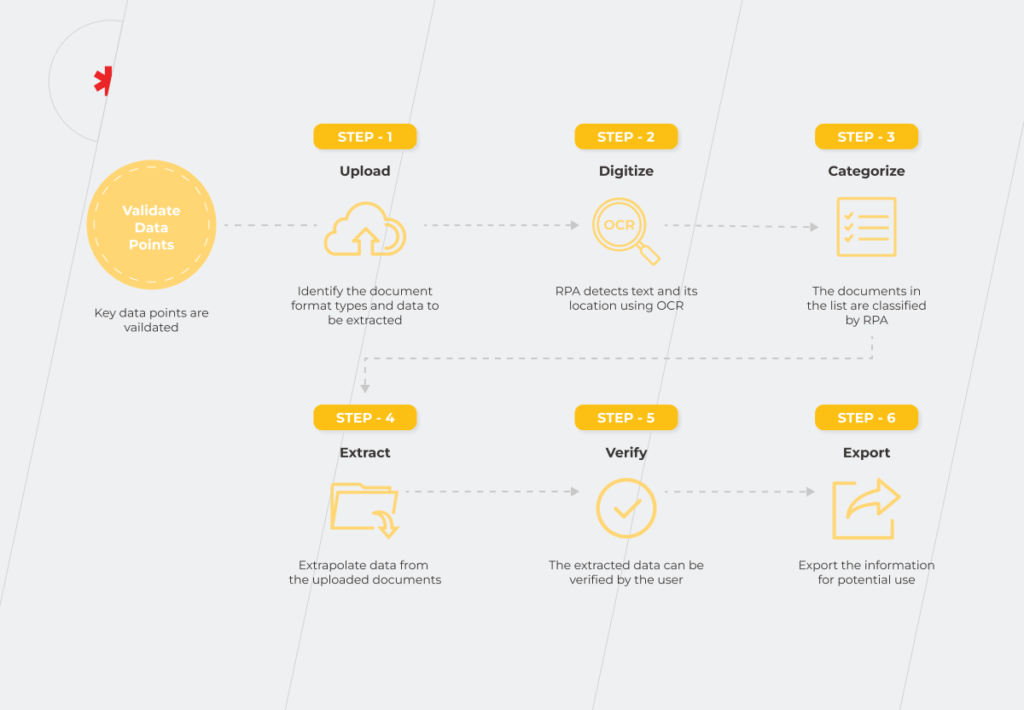
The new technology empowers you with end-to-end document processing. The RPA bot, which extracts data from various documents and interprets them using Optical Character Recognition (OCR) technology, can scan a set of documents in seconds and identify gaps and inconsistencies.

This is how it looks:

Source: Softweb Solutions, Reducing business downtime by RPA implementation in banking

Besides document processing, legal and audit operations include control activities. Digital Workforce research reveals that more than 90% of internal controls, such as data extraction from different IT systems, are still performed manually despite the possibility to easily automate up to 90% of the operations with the help of RPA technology.

Risk and compliance

Banking is one of the most regulated industries, alongside the healthcare sector. It’s no wonder compatibility with tons of compliance requirements is among the top priorities for these types of organizations. Implementing RPA is helpful for:

1. Know Your Customer (KYC) and Suspicious Activity Reporting (SAR)

KYC process is a mandatory standard in the banking sector designed to establish customers’ identities and understand the nature of their activities to prevent threats such as money laundering. Thus, banks do background checks on customer data during customer onboarding. It may require up to a week for the KYC documents to be approved by the KYC Registration Agency.

Another part of the risk mitigation process is an AML (Anti-Money Laundering) investigation process that requires 30-40 minutes for each case and drains your employees’ time if done manually. At the same time, this mundane task easily follows the rules and unfolds into an algorithm, and it takes only three minutes to complete with RPA.

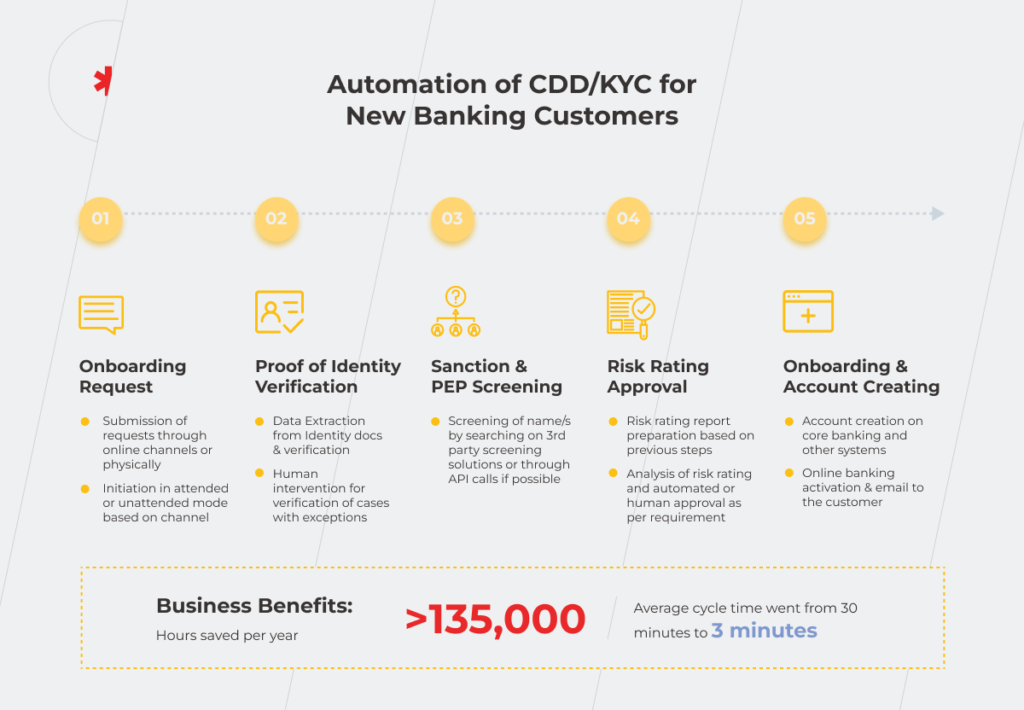
An RPA tool works according to the ‘if-then’ principle. If some activity in a customer’s profile looks like a potential threat, such as making numerous transactions in a short period, the bot flags it and reports it as a suspicious activity (SAR) to the concerned department. With this approach, bank staff only invest time examining and investigating suspicious accounts. Here’s a system that demonstrates the advantage of using RPA in banking and finance.

Source: UiPath, Automate Banking Compliance and Scale Innovation

2. Regulatory compliance 

When aligning business practices with regulations and maintaining records to be ready for audits, RPA in corporate banking comes in handy for such tasks as:

  • Automating audit report generation for regulatory agencies. Bots centralize data collection and create reports in the required format, simultaneously eliminating the influence of human error. The bot can do 6-7 hours of manual work in a minute, saving time for staff.
  • Checking if data is regulatory compliant.  Leverage an RPA software to track regulatory updates in real-time by cross-comparing notifications. In this case, you can react quickly to changes in requirements, avoiding penalties that can put the depth of your pockets to the test.

Moreover, if you marry RPA technology with machine learning (ML) and artificial intelligence (AI), you can benefit from intelligent automation. With such an approach, you create an additional layer of human-like perception and prediction to make accurate decisions faster.

Lending and mortgage operations

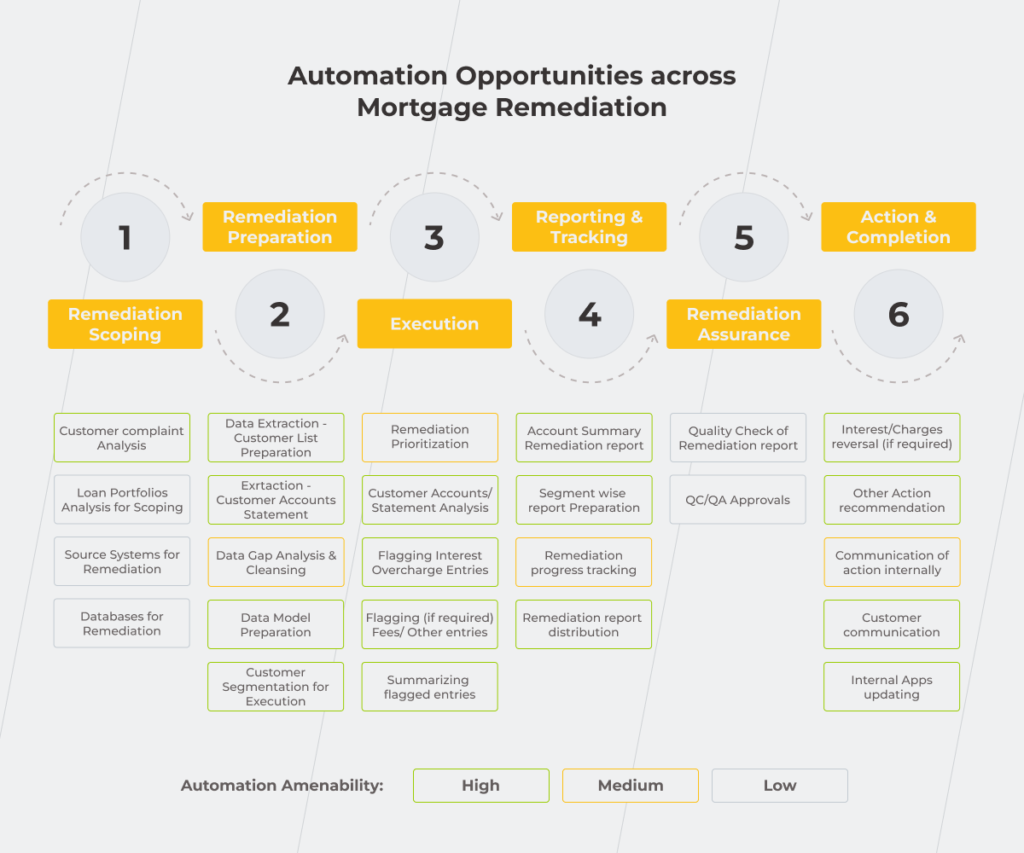
The majority of mortgage operations have a high automation potential. Thanks to RPA, banks can alleviate the burden of the mortgage processing placed on the staff and free them up to deal with more sophisticated tasks and operations that can’t be handled without human involvement.

Source: UiPath, Automate Banking Compliance and Scale Innovation

As for loans, RPA implementation in banking can reduce circle time for a loan by half.

Let’s take a closer look at the loan processing. One of its initial stages is the extraction of the inputs from the loan documents created by the loan officers. It takes 5 minutes per form when done manually. And if you let RPA handle this operation, it will be done ten times faster. 

There’s more to come. Radius Financial Group’s example of RPA in banking reveals how you can achieve positive results thanks to the technology even in unfavorable market conditions, such as the pandemic. Before RPA implementation, employees could take care of 30 loans in their pipeline and felt overwhelmed and stressed. Adoption of the new technology allowed it to almost double the number of processed loans — it reached 50 without affecting the staff’s well-being and, at the same time, cut operational costs by 70%. 

Mortgage loans are tricky both in terms of opening and closing. The latter appears to be more challenging for banking staff. On average, closing a mortgage loan requires 45 to 60 days. It takes quite a bit of time, as before approving an application, bank staff has to check the client’s employment, creditworthiness, etc. Even a minor typo in data submission on the customer’s or bank’s side can lead to a delay, not to mention other complications in the application processing. Banks using RPA can eliminate bottlenecks like this and cut loan processing time by 80%. 

Customer servicing

A customer-centric approach is no longer just desirable but critical if you want to succeed in the banking sector. At the end of the day, even digital transformation is a customer-first process, not technology-first. 

Here are two robotic process automation examples in banking for customer servicing:

  • Automatic classification of emails and auto-reply setup. Opening, copying and pasting contents, and analyzing 60 mails requires 90 minutes of your employees’ time. With RPA, they can finish these tasks 15 times faster.
  • Single automation interface. Your staff doesn’t have to open applications by hand, cut and paste customers’ data from different apps, and manually perform basic calculations — RPA use cases in financial services show that all these operations can be easily devolved to the technology. Moreover, bots complete these tasks four to five times faster than humans, positively impacting the customer experience.

With RPA technology, you can improve the customer experience and save time and money. 

Want to automate your banking processes to accelerate your business growth?

Let's get started today

Augment your employees’ efforts with RPA technology to achieve remarkable results faster

According to McKinsey, the banking industry is now experiencing a second wave of automation. But consider that RPA isn’t a silver bullet — it’ll be only useful if you fix the processes that are non-standardized or broken in the first place. Automation should be done wisely to empower your employees and boost your organization’s productivity and profit. Some banks start implementing RPA without a long-term plan and understanding of their capabilities and resources. Others make a plan, but it can turn out to be ill-conceived. That’s why banks end up with hundreds of bots that were supposed to automate numerous repetitive tasks, but statistics says that 30-50% of RPA projects fail to be effective. Instead, if unsure about how to implement RPA correctly, it’s best to turn to RPA specialists that are proficient in the technology and processes needed to get tangible results.

Ready to outline your automation plan?

Get in touch

FAQ

How does RPA work in finance?

RPA in banking works the same way as it does in other industries — it’s a minimally invasive solution that allows you to lower expenses, boost your productivity, and minimize the possibility of human error without reshaping your IT infrastructure. But consider, the financial sector has its peculiarities, one of which is a long phase of defining requirements. In one of our RPA projects for a bank, developing, testing, implementing, fine-tuning, and fixing bot bugs took about a month. But that month was preceded by half a year of defining requirements.

Why banks must bank on RPA?

RPA is about speed and quality. Robotic process automation in the banking industry helps get work done faster. The implementation of this technology reduces the time required to complete tasks by 4 to 15 times and eliminates the possibility of human error.

Where can RPA be used in the banking industry? 

Almost everywhere. 84% of banking tasks can be entrusted entirely or partially to this technology. You can benefit from RPA adoption for any recurring operations that can be reduced to a sequential algorithm. For instance, there are examples of RPA in banking for customer servicing, lending and mortgage operations, reporting and audit, risk, and compliance.

Top 8 reasons why modernizing your applications should be a priority

Nowadays almost all businesses depend on applications in one form or another. Those who don’t will hardly survive the competition unfolding in the digital era.

However, simply running an application is not enough to actually succeed. The challenge that many companies are currently facing is that they use legacy applications, which were created for a different world and aren’t of much help for their users now. The flexibility of those apps is so negligible that they can’t integrate with systems of the digital age. And that’s, by the way, exactly what they are supposed to do.

So, ‘what’s the move?’, you may ask. Fortunately, an urgent need for smooth-running, high-performance internal processes can be covered with application modernization.

WHAT IS APPLICATION MODERNIZATION?

In a nutshell, application modernization is the transformation of a legacy app for its better alignment with an organization’s requirements. 

There are various options for applications to be modernized – from relatively simple rehosting to complete rebuilding.

Making up your mind on which approach to go with, as well as looking for a reliable vendor takes some time, but it’s definitely worth it. So if you’re still lacking the application modernization initiative and don’t understand why fix something that isn’t broken, check out the reasons we’ve zeroed in on.

WHY INVEST IN APPLICATION MODERNIZATION?

Cutting operational costs 

Operational costs optimization is perhaps one of the biggest drivers for modernizing business applications. Today more and more companies are adopting the Software as a Service (SaaS) model because it enables them to centrally host their apps for a subscription. Such an approach tends to be really tempting for many businesses since they get access to a plethora of new features as well as don’t have to carry the burden for keeping applications running 24/7.

Overcoming compatibility issues

Many applications still lean on archaic infrastructures, outdated programming code or operating systems – and sometimes on people who are no longer available to maintain them. Consequently, it requires a lot of resources to make these old-fashioned apps compatible with new technologies, modules, and tools. Another crucial detail that often slips our mind, is that time spares no one. Just like everything else, applications age on a permanent basis. Please, don’t deceive yourself into thinking that at some point your app can’t be “more legacy,” because it can and it surely will. And while applications are inexorably aging, the effort put into converting them to new and more efficient ones is – inevitably – going up along with the cost of that process. 

Meeting integration and scalability challenges

Legacy apps are often difficult to change and expand to greater capabilities because of the outdated technology stack or/and overcomplicated inner architecture. A minor update can lead to multiple conflicts across the system. If even one component of an app has load and performance problems, it may become necessary to scale up the entire app only to serve this single component. As long as such a process requires a lot of time and effort from an IT team, needless to say, that adding even the teeny-tiny feature to your app will end up in a huge waste of money. Therefore, your application needs to be capable of handling integrations in a manner that does not break your processes.

Contributing to your employees’ satisfaction.

A good employee is the one who’s satisfied with their job. There’s a bunch of things that contribute to employees’ satisfaction. However, dealing with legacy applications is merely one of them. People don’t want to stay with a business that insists on maintaining the status quo. Instead of working with user-unfriendly technology that doesn’t cover the latest UX/UI standards or device specifics, some employees are more likely to look for better opportunities within other companies. The others, meanwhile, will struggle to use outdated and clumsy applications efficiently, which can significantly slow down the operations.

Making your applications future-ready

Application modernization can become the first step for your company to adopt cloud technology. If you think that to take full advantage of the cloud,  it’s enough to simply lift-and-shift your applications there, think again.  Legacy applications can only function in the cloud to a certain extent, which eventually results in ever-growing performance problems rather than solutions for your business – problems that your IT team will have to solve instead of focusing on more important errands. Not only will it deprive you of the possibility to access greater functionality at a minimal cost but also fail to meet your employees’ expectations and make them feel frustrated. So before spending tons of money over nothing, it’s better to make your applications cloud-ready in advance and let your business leverage all the possibilities that the cloud environment entails.

Improving decision-making through innovation

Meeting the needs of today’s business is barely possible without using real-time data. Application modernization addresses this issue by installing analytics into the application so that employees can operate with the information or KPIs whenever they need it.

Increasing agility

Business success depends on how fast you can respond to the market challenges and how long it takes you to adopt new technologies. Modernization opens up a number of opportunities for the team to be more efficient. For example, they’ll have access to the system from anywhere, anytime. Furthermore, with a modernized system, you will be able to develop and launch new products quicker than ever before. Scaling and sustaining agility is not just crucial but the only possible way to gain customers’ loyalty and competitive advantage.

Unlocking hidden value

After having been modernized, no-longer-obsolete applications are able to perform adequately within the modern digital ecosystem. You’ll get new opportunities for unlocking value in data analysis and workflow through interactions with Artificial Intelligence (AI) and other groundbreaking tools. Whether to leverage them or not is up to you, but isn’t it heartwarming to have an ace up your sleeve?

MAKING ALL THE DIFFERENCE

Since cutting-edge technologies firmly settled in literally every pocket, we’ve had neither a chance nor an option to ignore them, because the moment we do, we’ll be replaced by our more advanced competitors. 

Running a business in a usual, ‘orthodox’, the way is far from a great choice. Business applications have to keep pace with the technology changes and easily embrace the latest and greatest features to help run the business in an effective manner. 

So why are you waiting?

Get in touch with our experts now to find out more about how modernization can drive your company success.

The Impact of DevOps on Financial Services

JPMorgan, Capital One, and America Express. These are just some of the big names adopting DevOps as an essential tool in their technology kit. Recently, Development Operations, or DevOps for short, has been trending in the financial world. Known for its speed and to-market time, it appears to answer financial organizations’ prayers, ensuring their products meet their clients’ rapidly developing demands. But why choose DevOps for your finance organization? And how does DevOps in finance keep a company up to date?

What is DevOps?

DevOps is the unification of software development and its operations, with a little bit of QA thrown in to ensure quality. It involves a circular set of processes and practices to get a solution on the market faster than ever before. With the Agile Development methodology at its core, the typical project development cycle is an ongoing infinity look which priorities forward-thinking tech. Essentially, DevOps is an ongoing software development process that involves continuous integration, continuous deployment, and continuous delivery at its core. 

5 Ways DevOps is changing the financial world

It’s clear that a faster-to-market time allows financial organizations to quickly capitalize on market gaps and address their clients’ changing demands. As a result of the pandemic in 2020, it’s estimated that the global usage of digital financial services is up somewhere between 5% and 20%. With an urgent need to access clients, combined with a reduction in brick and mortar branches, it’s vital that financial organizations are able to get their digital products to the market as fast as possible. DevOps for finance provides a potential solution. 

Here’s the five reasons why DevOps is leading the way. 

Modernizing outdated systems

Digital banking is nothing new. In fact, according to one source, it dates way back to 1994. However, technology has come a long way since then. Aside from some significant advancements, there’s one other thing that’s built up too – legacy tech. This is the outdated code that some essential services still hang on. While your old tech might be too outdated to work efficiently, it’s not always possible just to throw it out and start afresh. It’s integral to your operations. This is where DevOps comes in handy. It allows you to continuously work to modernize your systems while not jeopardizing taking your business offline to do so. 

Alternatively, if you are starting from scratch, DevOps allows you to modernize as you build, adapting to the latest trends without the feeling that your just-released solution is already out-of-date. 

Improving security and compliance

In recent years, many within the financial world viewed DevOps as a security risk. Surely, such rapid development left companies vulnerable to compliance and security errors. However, by 2020, this has definitely all changed. Contrastingly to being vulnerable, DevOps aids fintech in staying current and implementing the latest security solutions. Frequent releases address the latest security threats and help stay current with changing compliance regulations. This can be anything from implementing automated document checking processes to securing client details against data hacks.  

Increasing transparency

Previously, financial software was developed in isolation following a relatively strict hierarchical process. Participants were working essentially in silos, concerned only with their own area of the task and nothing else, which was great for information security, but created challenges in effectiveness. That has all changed. DevOps in finance requires teams from across the board – QA, engineering, content, compliance, legal, etc. – to participate and work together to ensure the software solution is up to scratch. By drawing expertise from all areas, the solution becomes more robust and effective. Meanwhile, with greater transparency, processes can occur faster and lead to a more successful outcome. 

Automating anything that can be automated

Automation is a growing trend. And that doesn’t just concern DevOps for finance technology. By automating repetitive processes, companies are finding themselves more efficient and better able to serve their clients. In the world of finance, automation processes can be developed more swiftly than ever before, allowing your staff to concentrate on delivering customer service, not paperwork. For example, Capital One is automating quality checks in their services and proving that essentially, anything that can be automated will be automated.  

Altering the financial industry culture forever

But it’s not just technological processes that are changing due to DevOps. In fact, the entire financial landscape is noticing a change. Industry culture itself is shifting, from top-down hierarchical processes to flexibility akin to Agile development’s adaptable working methodology. So, what does this mean in practice? 

Although like any cultural shift, it will take time, the dynamics of traditional finance are being altered in a big way. Overall, the industry is becoming more adaptable and adjusting its staunch approach to finance and exclusivity to greater inclusivity and client-focus. Considering the growth of digital-only banks and greater accessibility overall, and despite brick-and-mortar closures, the industry is surely but slowly shifting.

As DevOps and similar Agile methodologies penetrate the strict world of finance, what we will see is a sure but substantial transformation to a more fitting financial system, adjusted to the needs of the modern world. 

DevOps, finance and the future: What’s next?

As the financial world dives deeper into the realm of technology, we are likely to see more extensive usage of DevOps services and a greater connection with customer needs. Client demand will dictate the direction of changes and how quickly they will need to happen for an organization to stay relevant. With the rapid changes that occurred in 2020 due to the pandemic, it’s no surprise that the world is gripped by the potential of shorter software development cycles and the potential they hold for getting solutions out there when and where they are needed.

How to choose a private blockchain… kind of thing

As soon as you’ve decided that blockchain or distributed ledger is the technology your business cannot flourish without, the question of choosing the right one between those two comes up. There are plenty of promising projects out there that can be adjusted to your needs. The only way of making up your mind is to take into account all the important criteria.

Structure & Data

If you want to share some data between nodes (connection points) and don’t need to keep an entire history of all the transactions (append-only data structure) you can go for a Distributed Ledger. It is a database that exists across several locations or among different participants. Although it doesn’t hit the headlines as Blockchain does, Blockchain is just one type of a Distributed Ledger. The main difference between them is that, unlike blockchain, a DL does not necessarily need to have a data structure in blocks. Being not dependent on the previous block, DL reaches a very good speed of transactions. The most vivid example of DL is R3 Corda. 

Storing big files in the blockchain is not a great idea. Information is added in blocks, limited in size, so it is impossible to add a big package of data at a time. If you are sure you need not just hashes, but also tamper resistance, visibility, decentralization for your files, consider Storj and Sia.

Permissions

All enterprise-focused systems assure to be permissioned ones, but in most cases, it’s simple role management. Multichain – an open platform for building blockchains – has the following list of permissions: connect, send, receive, issue, mine, activate, admin. It’s a pretty good and flexible list, but when you create a smart contract with completely different entities and roles, this list won’t help. You won’t be able to specify the existing permissions, for instance, to grant different access according to the hierarchy (admin, super admin, owner, staff, guest) or ban a particular group of people from buying your product (e.g. to forbid those who are underage to buy alcohol), etc… So be ready to implement your own permissions system.

Database

Most chains save data in key-value storages like LevelDB. They are very fast and good at simultaneous writing, but to find and sort the information out you have to duplicate all the data in a separate general-purpose database and keep this copy up to date. However, there are blockchains where you don’t have have to do it. Hyperledger Fabric supports extended queries thanks to CouchDb, EOS, and BigchainDB thanks to MongoDB. Also, Credits has query capabilities with Credits DBMS.

Upgradability

Market conditions are changing and the conditions of deals are changing along with them. In this respect, immutability – one of the main advantages of blockchain – becomes a disadvantage that developers should cope with when they want to upgrade a smart contract. Migrating data to a new contract can take a lot of resources and lead to unwanted issues like errors, stealing the money from the contract account, changing the data by someone who isn’t supposed to do it, and many others. Thus, if these procedures might occur quite often, then it’s important to choose a blockchain that will handle this problem as fast and smoothly as possible.

In Hyperledger Fabric you can change the contract or even write a new one independently on a channel state. As Hyperledger Fabric splits into channels, the modifications you want to make will be applied only to the channel with an existing contract. Similar to this, you can upgrade a contract in your private installation of EOS.

CAP theorem of a distributed system: decentralization, scalability, consistency.
CAP theorem states the impossibility of simultaneously satisfying more than 2 out of 3 guarantees in a distributed system: consistency, decentralization, and scalability.

Consensus

The term is self-defining: it’s a mutual agreement among the participants on the state of all data. The type of consensus depends on the way it is reached, for example by a voting requirement of a simple majority or by using some validators, etc. Although you might hear about many types of consensus, in reality, there’re just a few that make sense within a private blockchain. These are PoA, BFT, Raft.

Privacy

Not all blockchains have the same requirements for privacy. In some of them, the process of adding new participants may cause certain inconveniences.  E.g. in Hyperledger Fabric you will have to update a channel block and upgrade a chaincode. Also to make sure a participant has got encrypted data you have to wait for him to be online otherwise the information can be lost. The only chain that natively allows to revoke access to the previously granted data is Hyperledger Iroha. To make a private transaction in Quorum you have to wait for all the participants mentioned in the privateFor field. That’s not a good choice if you want to restrict access to some information within a chain, for example, to interact with a particular participant without other participants seeing it.

Asset

If exchanging the assets is your priority consider financial chains. They are fast and easy to understand. Some of them even support creating your own native assets, e.g. Stellar, Credits, BigchainDB, NEO, NEM, MultiChain, Hyperledger Iroha, Chain Core, Openchain.

Customization

There are three projects that allow you to create your own transaction handler and do absolutely what you want, e.g. work with the state on a low level or run any code, Substrate, Tendermint, Hyperledger Sawtooth. These frameworks allow you to focus on business logic of your chain, not on consensus, validating blocks, and storing them. If you want to create your own consensus and exchange special signals, instead of blocks, consider libp2p.

Energy consumption

Here’s the inconvenient truth: the amount of energy consumed by blockchain technology is comparable to that of a small country. The good news is that it relates to chains based on Proof-of-Work consensus (e.g. Bitcoin). PoW is the first consensus algorithm for a blockchain to secure data, but, fortunately, not the only one. There are other options such as a Proof-of-Authority consensus which allows pre-selected nodes to run a chain, using about the equivalent energy of a light bulb. Hyperledger is a good example of a private blockchain that uses PoA.

The ability to directly interact with peers like in R3 Corda also significantly decreases energy consumption, because there is no necessity to broadcast and validate blocks.

Speed

Again, it depends on the types of consensus. The only slow one is PoW. The others are fast enough. Of course, it’s hard to compare the speed of a really decentralized system with a highly optimized and scaled database cluster, so keep in mind that interacting within a blockchain still can be a bottleneck in your architecture.

There’s no one-size-fits-all solution. But it doesn’t mean that you have to tolerate the features you don’t really need. Feel free to combine! By adding something you are interested in and cutting off anything useless, you will eventually come to what is best for your business!

You don’t need blockchain… until you do!

Being ready for blockchain means being ready for the future.

As this technology is still in its infancy, we twist, whirl and test it in all possible variations to see whether it actually works as billed. And you know what? It does. For plenty of our customers, who want to lift their business up to a whole new level of functionality, blockchain – or at least some aspect of it – is a total must.

Blockchain is not your cup of tea if you’re afraid of changes – even the positive ones. Or, if you don’t pursue ambitious goals. Maybe, you’re simply not ready for the great responsibility it entails.

Anyway, you can stop reading this article right now if you don’t want to find out the advantages of blockchain our clients already enjoy.

Transparency

The problem in many companies, especially those that produce something complicated is that they’re managing different vendors across a horizontal supply chain. All of these people that go into making a product don’t have the same database. They don’t use the same infrastructure, so it becomes really hard to see a product evolve over time. Using blockchain, we can create a shared reality across non-trusting entities. It means all of these nodes in the network have the ability to monitor and validate the chain for themselves.

Ability to create smart contracts

Smart contracts have a number of advantages over traditional ones. These are lower price, efficient implementation, absence of middlemen and automatic payment. All the actions are transparent, there’re no loopholes in contracts, which makes it impossible to interpret them to one’s benefit. A perfect solution indeed, for the financial market (banks, insurance), accounting and auditing, logistics, registration of property rights, etc. 

Peer-to-peer connection

Using peer-to-peer networks you kill two birds with one stone. No, wait a sec – even three of the feathered creatures. Let’s see.      

  • Getting rid of the vulnerability of the client-server network, where everything depends on a central agent. In this model when something goes wrong everyone suffers. If the server doesn’t work, no one can gain access to it. And, moreover, the server deals with a great volume of clients’ private information. That’s why companies that depend on this model have to spend A LOT of money to protect themselves from being hacked. But with a peer-to-peer connection that blockchain provides, there’s no need to rely on a central point of storage.
  • Efficiency. When it comes to the financial sector everyone wants a faster output. You can make a transaction in a few seconds, while traditionally it takes up to a few days.
  • Cost reduction. How can blockchain help to cut costs?  Spoiler alert: by removing intermediaries.

Cryptography

Quite a bonus to everything mentioned above, isn’t it? But if all you need from blockchain is cryptography, why not start things off with the special libraries or hardware wallets that can sign, encrypt, decrypt and verify signatures? It’ll be enough for authentication/authorization users and hiding data.   

Transaction register

Details of the transactions are recorded, verified and settled within seconds across all nodes, which, on top of that, have shared write access.

Opportunity to control personal data back to the owner

With blockchain, it has become possible to create “identity in a black box”, which only gives a piece of information that’s required to do something. And, what’s even more important, belongs to the immediate owner.

Simple and clear as it might seem, blockchain is definitely not something you need to dive into without giving it careful thought. There are plenty of specific issues – business and technological ones – you have to deal with beforehand. 

“What type of blockchain/distributed ledger should I go for?”, 

“Is it necessary to write my own chain or had I better choose one out of the existing projects?”,

 “And if so, HOW can I do it?”…

In the upcoming articles, we’ll help you figure out these and many other problems which refer to the adoption of blockchain technology. We’ll give you experience-based tips and consider the real cases so that you will see in what way blockchain can meet your expectations.

Follow our news or contact us right now to embrace the technology of the future for your today’s success.

ICO. Part 2. Getting funding through ICO. How to attract money to your project

In this article, we will look at how to attract money to your project using cryptocurrencies. ICO provides an opportunity to raise millions of dollars even if your startup is limited only by ambition and a good idea. It is an excellent chance for companies that are just preparing to demonstrate their product or technology but are not able to obtain financing in the traditional way – through large facilities and business incubators.

For any question on what an ICO is, please read the article “What is an ICO?”. We now move to the heart of the problem.

Algorithm for starting a successful ICO

In order to attract funding, we advise you study the proven experience of soaring ICOs along with the mistakes of the failed ones.

  1. Development of an economic model and concept;
  2. Marketing PR campaign;
  3. Launching the project and entering the exchange system.

Let’s look at the key points of each phase to understand what to focus on and what to worry about first.

Concept

ICO’s popularity as a tool for collecting money is based on development and widespread introduction of cryptocurrencies and blockchain technologies. An ICO can hardly succeed if you cannot clearly state how your project is connected with blockchain and why your tokens are produced.

Theoretically, a bookstore or a bicycle rental store can conduct an ICO but it is unlikely that they will be able to attract $16 million from investors within half an hour, as it was possible for the Token Card startup, which issues cryptocurrency-based Visa debit cards. The reason is that your project must use blockchain technology to generate interest in the community.

The project tokencard.io allows you to keep Ethereum and other cryptocurrencies on a debit card and pay with the card when making purchases in stores, as well as when making transfers.

Marketing

In a PR campaign, your task is to convey convincing arguments to potential investors that the released product needs your tokens, and that the demand for them will increase, making it possible to earn on the exchange.

Cryptoeconomics is very similar to the subcultural get-togethers, where there are authoritative opinion leaders. Therefore, no one will convince your investors better than those people who are listened to in the environment of blockchain technologies and cryptocurrencies.

Mobile payment platform tenx.tech sold 245,000 ETH within 5 minutes in its ICO thanks to support from Vitalik Buterin, co-founder of Ethereum.

There are free or at least fairly cheap methods to promote your ICO project. The first thing to pay attention to is social networks, forums and thematic blogs.

The main platform where you will need to present your project is the Bitcointalk forum. Create several branches to discuss your project in different languages. By so doing, you will be able to bring your idea to the audience, attract attention to yourself and get a feedback.

bitcointalk.org — world’s most popular cryptocurrency forum.

Apart from Bitcointalk, there are hundreds of special-purpose online media outlets and private blogs that cover the subject of cryptocurrency. Send your press releases and articles to these media so that people could recognize your ICO and experts could talk about you.

Entering the exchange

Most investors would like to use your tokens as cryptocurrency, which can be profitable to trade on the exchange after the ICO. All cryptocurrency exchanges are independent, so you will face a complex and multifaceted negotiation process with the owners of these platforms.

World’s most popular cryptocurrency exchanges:
– poloniex.com
– c-cex.com
– exmo.me
– cex.io

However, not all exchange systems charge transaction commissions. Some monetize by listing tokens. Be prepared for the fact that you will need a whole team of managers, as well as additional huge cash in order to prepare for the process of issuing a new cryptocurrency for bidding.

Who and why invests in ICO?

The purpose of investment is quite obvious – by purchasing the project tokens during the initial offering, you can make good money by selling them at some later time on the exchange. Despite the fact that the cryptocurrency market is still very young, dynamic and poorly regulated, ordinary users as well as large investment funds are increasingly showing a major interest in ICO investing today.

Venture company blockchain.capital was in 2013 one of the first to consider financing requests from cryptocurrency startups.

Venture companies that are focused on ICO investment emerge from around the world. Large companies show interest due to the high liquidity of almost any cryptocurrency, which is signaled by the huge turnover of exchange systems. ICO is attractive in many respects due to the fact that tokens can be exchanged at any time for another cryptocurrency or for traditional money.

The legal status of ICO is poorly regulated by legislation. This method of financing can be called gray. Relationship between the investor and the founder of an ICO project are difficult to consider classical in the economic sense because it is mostly based on reputation and trust.

Today, there are no jurisdictions that would regulate ICOs, which relieves organizers of a lot of headaches. But states, for example, EU countries, are trying to take this niche under control. If ICO projects are required in the future to comply with many laws and bureaucratic procedures, many of the advantages of ICO over traditional methods of financing will simply disappear. But in the absence of regulation, there is also a shortcoming – there is nobody to fight against numerous scam.

Differences between ICO and securities trading:

  • Investors do not receive a share in an ICO project;
  • In fact, the cryptocurrency is a digital commodity and not a security;
  • ICO is a decentralized and international instrument;
  • Tokens can be used to get the products developed by the startup.

Investor risks

Regulation of the young cryptocurrency market provides a serious technical challenge. Online transactions under a new virtual economy, where the buyer often cannot contact the seller in person, are fraught with many risks. This is directly related to ICO.

The ICO boom provided many investment opportunities and greatly simplified the investment process, making it available to everyone. There is an interesting article in CryptoCompare that a considerable part of ICO projects being announced and conducted is a scam. Also, the article gives good advice on how to distinguish scammers from honest developers. So we recommend you read it!

Rating agencies that migrate to cryptoeconomy from traditional ones are trying to minimize investor risks. The agencies conduct an independent ICO due diligence and describe both the strengths and weaknesses of projects.

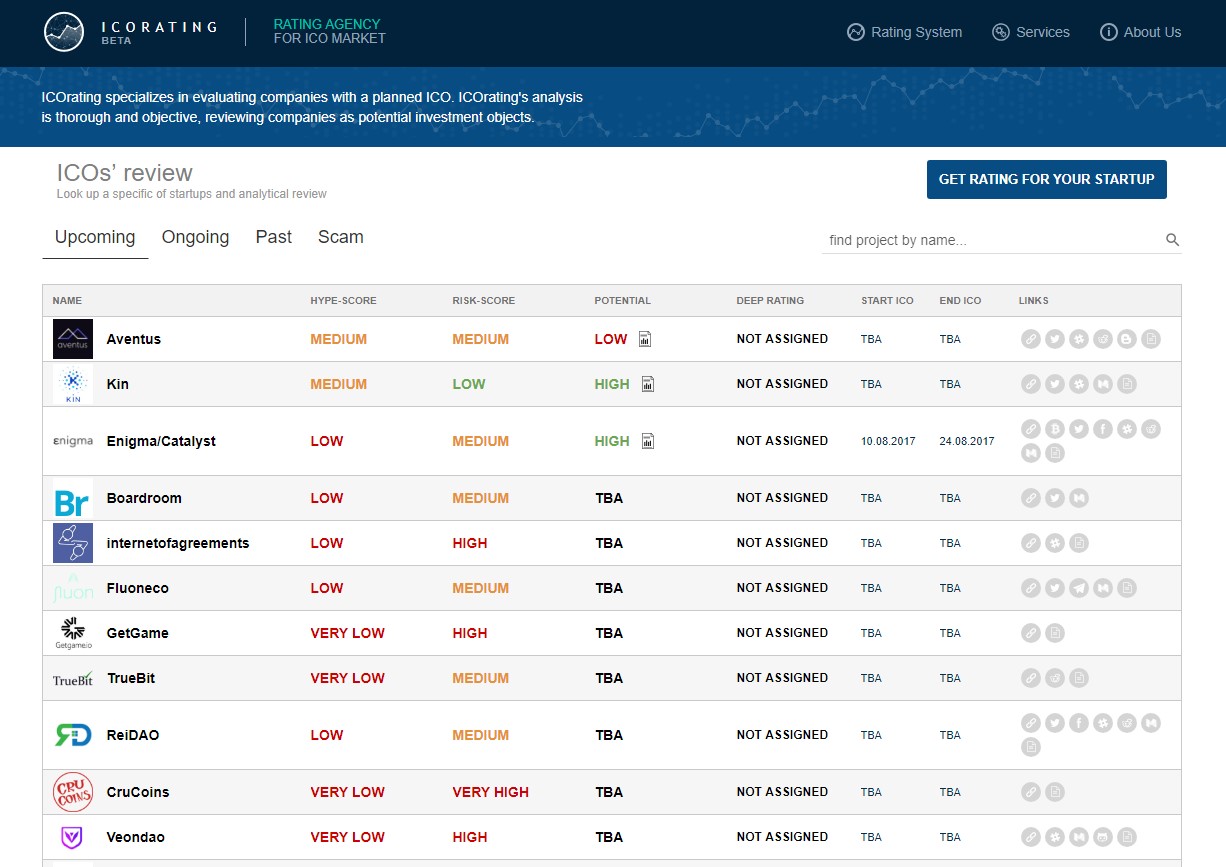
Rating agency icorating.com describes in a simple form the popularity, potential and risks of ICO projects being conducted and announced.

Companies that launch and conduct ICOs for startups willingly cooperate with rating agencies. This increases the transparency of the project in the eyes of potential investors. Publication of a deep and independent due diligence for your ICO will significantly increase the chances of successful fundraising.

Summary

Remember that the success of any promotion can be provisionally divided into two components – conveying information about your ICO to maximum number of people and convincing this audience of your honesty and reliability. In the end, you will need to secure your tokens with a presence on all popular exchanges. It is through such exchanges that the public would learn about the emergence of a new cryptocurrency.

In the next article, we’ll talk about the merits and demerits of ICO, and you’ll be able to find out if this method of attracting investments is suitable for your project.

ICO. Part 1. What is an ICO? A new way to attract investment

Initial coin offering (ICO) is equivalent to initial public offering (IPO) from the world of cryptocurrency. ICOs are conducted by blockchain startups – fund raising is announced at the early stage, and then investors receive a share of the new cryptocurrency in proportion to their respective investments. After the ICO, investors will earn if the price of that cryptocurrency rises.
And the price rises if the startup succeeds in business or if it earns from speculation on the exchange.

The purpose of any ICO is to raise funds for a project. Investors are attracted by any opportunity to enrich themselves.

In the first half of 2017 alone, ICOs organized by startups around the world raised $180 million, which is 80% more than for the entire 2016. Obviously, this upward trend will continue, and for now there are no signs it will stop or fall.

The boom around ICO and cryptocurrencies is very similar to the IPO boom of Internet projects in the late 90’s. Many projects that conduct ICOs just try to make money on the emerging excitement, but there are startups, nobly using the new tool to develop a variety of markets and technologies.

Philosophically speaking, the cryptocurrency boom is driven by the idea of information and financial anarchism that is soaring in the air and captivating the youth. This reminds us of the popularity of 3D-printed guns!

Economically speaking, the popularity of ICO is very simple: it is an opportunity for any interesting project to attract huge amounts of money, at the same time bypassing greedy corporations and business funds. For ordinary people, it is a chance to earn real money from investment, bypassing exchange brokers, licenses and the taxation system.

Comparing ICO, IPO and crowdfunding

A common feature of ICO, IPO and crowdfunding is the goal. All these three events are aimed at attracting investment for a project.

The main difference between an ICO and crowdfunding is that for you to successfully raise funds in crowdfunding on sites like Kickstarter, you will need either already produced goods or a prototype. But with an ICO, you can attract investment at the earliest, embryonic stage of a project.

Despite this, ICO can be considered a variety of crowdfunding, but instead of having a physical product (in fact pre-order of goods), participants are offered to receive (to invest in) a new cryptocurrency. Participants invest money in a project, hoping to make some dividends from it in the future: most often in the form of an opportunity to sell coins at an increased price.

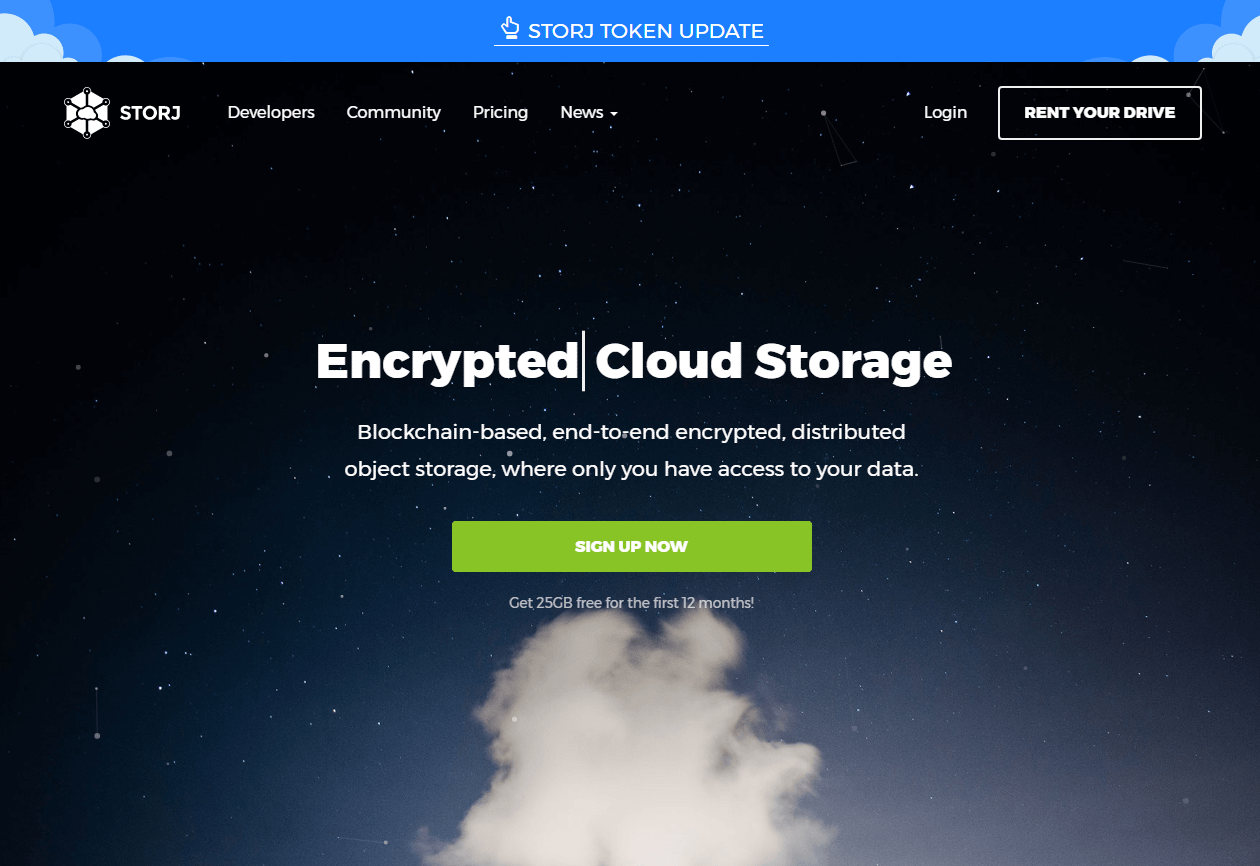
For the tokens of the project storj.io, you can buy disk space on the service, tokens can also be earned by leasing a part of your hard drive.

The main difference between ICO and the traditional IPO is that ICO has no government regulation. This provides a boom, since any high schooler can launch his or her own ICO, but also retain major investors. After all, absence of regulatory legislation in the field of ICO makes such investments based purely on trust and enthusiasm, which is often not suitable for major transactions.

But there are exceptions. During the initial offering of the Brave web browser, one investor alone acquired the equivalent of 20,000 ETH, which was $4.7 million then.

Investors pursue one of the following three goals or even more than one at once:

  • To support their favorite startup;
  • To get the product at a low price;
  • To earn on speculation with tokens on the exchange in the future.

ICO differs from IPO also in the fact that buying tokens at the initial offering does not give investors a share in the company.
Therefore, ICO still looks more like a crowdfunding than an IPO model.

Examples of successful ICOs

An ICO can be considered successful if it is able to raise financing, and investors succeed when the value of tokens further increases. Therefore, large ICOs are successful from the point of view of startups, while the profitable ones, for which the token value grows on the exchange, are successful for investors. But one does not contradict or interfere with the other.

Most profitable ICOs

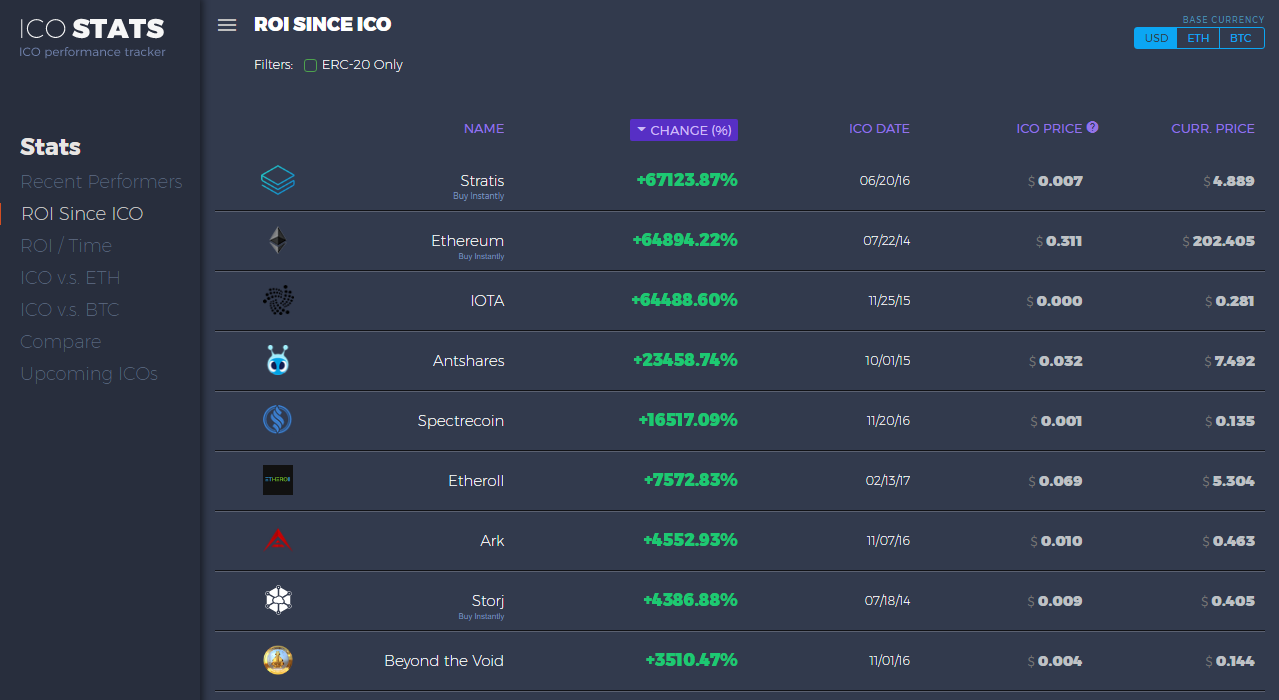
  1. Stratis.
    In June 2016, this blockchain platform raised almost $600,000 in funds, selling 84 million tokens to ICO investors at a starting price of $0.007. After the project was launched, the price of 1 token reached $10, and as of July 2017, it was selling at $5, recording a 67410% growth.
  2. Ethereum.
    It is an example of not only one of the most lucrative but at the same time one of the largest ICOs. The blockchain platform raised over $15.5 million in 2014, selling 50 million tokens at a price of $0.311. As of July 2017, one token was selling at $202. Growth was 64980%.
  3. IOTA.
    The project is an exchange network for the Internet of things and closes the top three. A distinctive feature of IOTA is that there are no commissions for micropayments. Since its offering, the price of tokens has increased by 64480%.

The most profitable ICO according to icostats.com

Largest ICOs

  1. Brave web browser.
    The project was created by Mozilla co-founder Brendan Eich and raised $35 million from its ICO in just 24 seconds. For a week, the return on investment from ICO for investors after the sale of tokens on the exchange was almost 700%.
  2. Aragon.
    The startup develops a platform for managing blockchain-based business processes. In May 2017, the startup sucked in the targeted $25 million in just 15 minutes.

Upcoming ICOs

There are thematic sites on the network that track upcoming ICOs. They help to achieve better results and attract the attention of investors and the public.

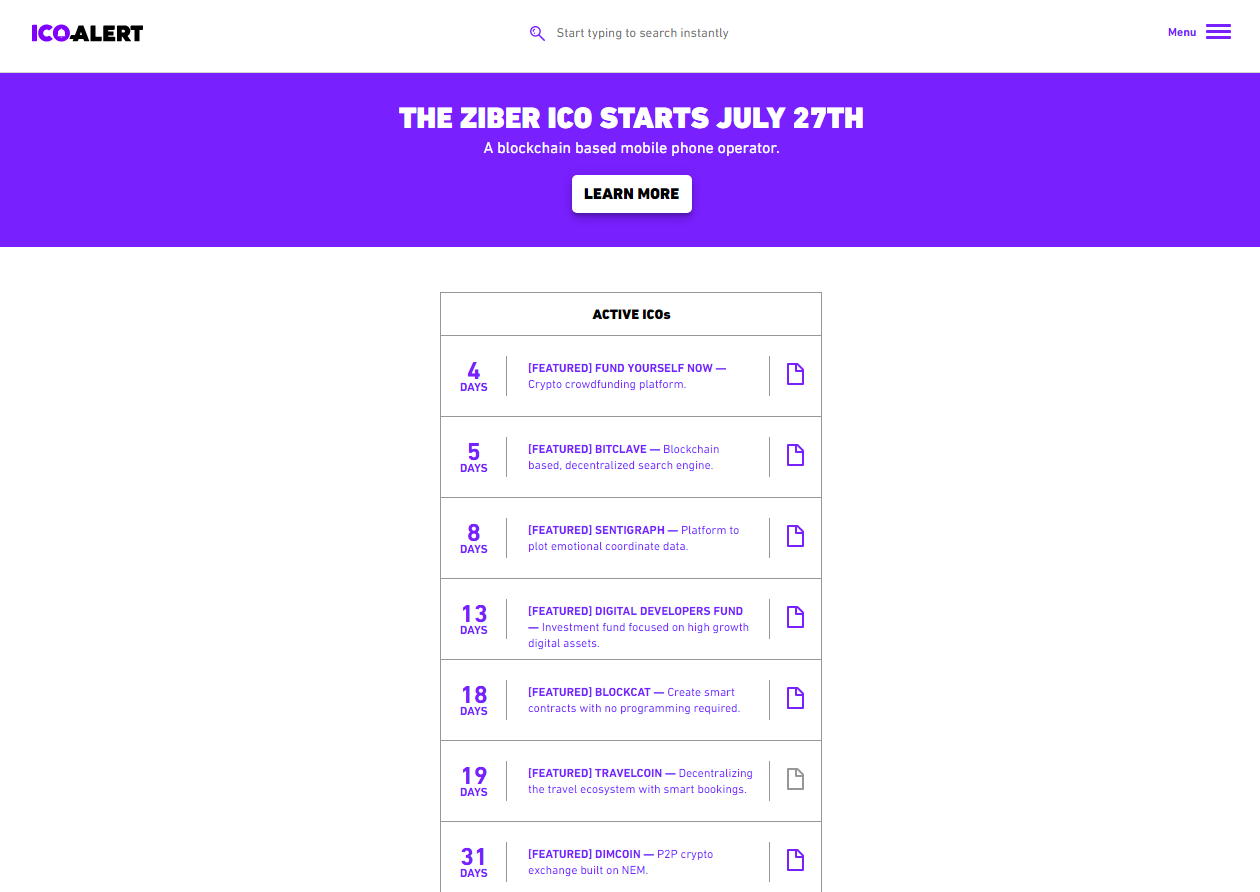
The site icoalert.com shows upcoming ICOs in a convenient manner.

Conclusions and practical tips

The cryptocurrency market is on the rise and ICO’s are constantly setting new records. This new financial tool enables young projects to start and investors to earn. But ICO investments carry some risk for investors.

Your project will inspire confidence and attract investors’ attention if:

  1. The required funding amount is clearly stated.
  2. Direct cryptocurrency mining is possible.
  3. A test version of the product is implemented.
  4. There is a clear development plan for the startup after receiving investment.
  5. There is a set of expert estimates for the project.
  6. The identity of the organizers is known.
  7. The need for ICO and the launching of a new cryptocurrency is well-reasoned.

Owing to the nature of a particular project, some of the requirements listed above can of course be ignored, but most often they are mandatory. There are several cases of major ICO scam. This severely undermines investor confidence in each new project. So it is always important to prove that the project is a reliable one.

Anna Vasilevskaya
AI modified real photo
Anna Vasilevskaya
Account Executive

Get in touch

Drop us a line about your project at
[email protected] or via the contact
form below, and we will contact you soon.