Building an MVP: an Expert Guide to Product Triumph

MVP development is all about providing a reality check for your business idea. You come up with a lofty ambition but don’t want to waste time and money on building something that nobody needs. That’s where developing an MVP can help. 

However, just building an MVP is not enough to make sure your idea pays off. There are a lot of prerequisites that define the outcome you get from your minimum viable product. In some cases, you don’t need an MVP at all. 

We address all your concerns about the MVP development process and share actionable advice on how to give your MVP its best chance, with real-world examples thrown in.

MVP development: a minimum viable product to solve an actual problem

A minimum viable product or MVP is a barebone version of your product with a minimum set of features that allow you to implement the critical functionality of your software. 

An MVP is not a polished or final product. It’s more about testing the market ground, getting feedback and data from early adopters, and learning what works and what doesn’t.

Although not a full-fledged product, an MVP can still generate value, whether it’s revenue or some other kind of pay-off if its business model is viable. Once the MVP gathers enough data to validate your idea, you can then iterate based on the findings and evolve your MVP into a fully marketable solution.

You should start with an MVP. Or should you?

Test it before you implement it — that’s what the golden rule of successful products says. But jumping right into testing is a sure path to draining your budget and bloating your feature scope. You and your product development team need to lay the groundwork and distill the must-have features that constitute the core of your minimum viable product. Here’s how you do it.
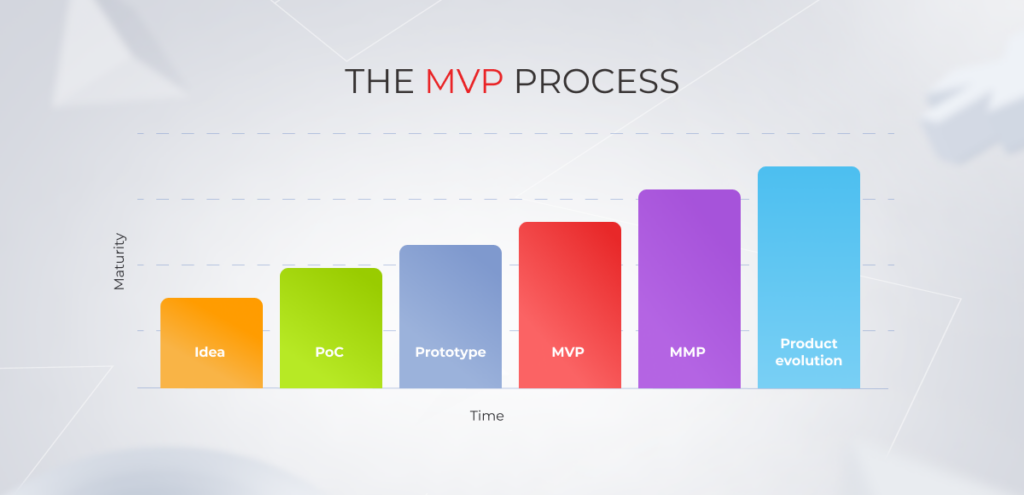
MVP Process

Idea

Every product starts with an idea, but 99% of ideas go through significant changes under the market’s impact. That is why your MVP development process kicks off with the Ideation or Discovery stage that helps de-risk your initiative, while also laying the foundation for a consistent, disruption-free development process. At this stage, your MVP development team sees whether your idea aligns with your budget and time requirements. 

To do that, the team strips down your concept to non-negotiables and transforms them into software requirements. The latter describes must-have features and functionalities of the end product. The features are then sized and prioritized to see how they lay out over the sprints.

Proof of Concept (PoC)

A Proof of Concept is essentially a model used to test everything from technical feasibility to market demand. PoCs reduce the risk of failure for new products and services by validating concepts early. 

You’ve got a one-of-a-kind, innovative solution and need to make sense of its technical complexity? PoC is the way to go. 

A Proof of Concept typically occurs during the late phase of the Ideation stage — before the team gets down to full-scale design and coding. A PoC usually consists of a small, basic, or undeveloped version of the product. At the end of the PoC phase, the team knows exactly how to create an MVP.

At one of our projects, the PoC stage helped our team to identify the most optimal library and backend framework for implementing the idea. The preliminary stages before the MVP also gave us more time to decide on the most cost-effective third-party integrations for our сlient.

Prototype

The MVP product development process usually starts with prototyping. A high-fidelity prototype looks like a real app, yet it’s still a pilot version of the MVP intended for internal use. It delivers a clear demonstration of how a product works so that stakeholders can decide whether it is ready for full production. 

The prototype also helps align the expectations and ensures that developers and stakeholders are on the same line. It can be used to test the solution and gather feedback from the end users.

Minimum Viable Product

After testing the technical viability of the solution and deciding on the look and feel of the product, your team continues with building a minimum viable product.

An MVP is a PoC and prototype combined in one — brushed up and brought to the production-ready state. 

Your team upgrades the UX as well as fine-tunes and expands the solution’s functionality. 

Minimum Marketable Product

While an MVP is the bare minimum, an MMP, or Minimum Marketable Product, is the minimum required to bring your solution to the market. An MMP includes one or a few killer features to make the product valuable for end users and put your company on track to high profit. It’s an upgraded version of an MVP that addresses user demands, delivers the intended user experience, and, as a result, can be easily sold.

The launch of an MMP is typically supported with a full-scale marketing campaign to attract more users from the get-go and improve the profitability of an MMP.

Product evolution

A digital product is never final and so is its development cycle. After releasing an MMP, the development team performs continuous maintenance and support as well as identifies the scope for future releases based on the user feedback or client’s preferences. Features are then prioritized and scheduled for release.

Check our all-encompassing guide on how to launch an app, crafted by engineers with 15+ years of experience.

The million-dollar question: why build an MVP?

Almost every great product we use today started its journey as an MVP. And the rationale behind this trend is simple: creating an MVP results in cost efficiency, minimal risks, product clarity, and some other benefits featured below.

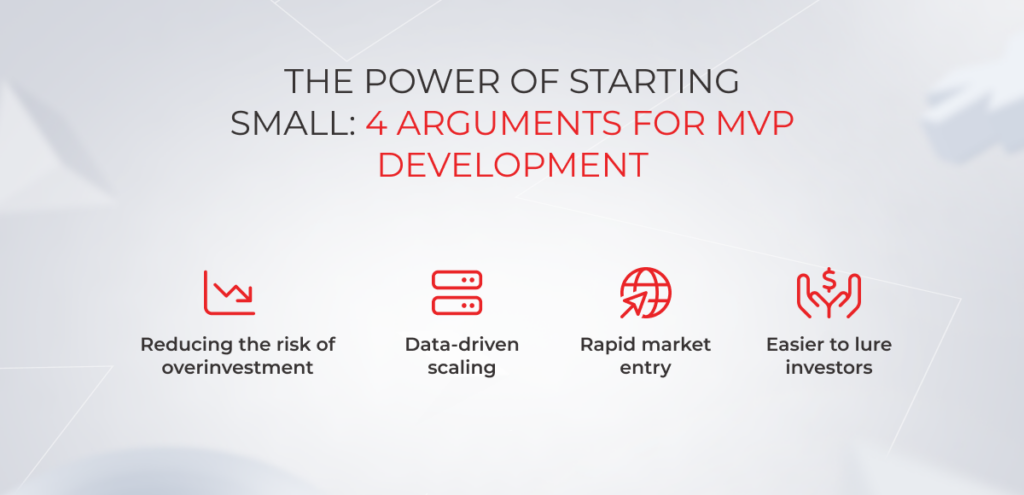
Reducing the risk of overinvestment
MVP Development

Building a minimum viable product means building it with minimum investment and in minimum time. Thanks to documented specifications and a clear understanding of the core functionalities, you and your development team can hop over to developing only the bare minimum of features with high utility. And less guessing means fewer resources spent on developing and testing.

Data-driven scaling

The first step to scaling your product is to get into the heads of your end users. What do they think about your product? What improvements and features do they want to see in the future? And the only way to get your hands on this information is to collect customer feedback through a minimum viable product. 

By tracking your user behavior and collecting their feedback, you can chart out your scaling strategy with a clear understanding of high-value features. An MVP release will also bear out an addressable market and validate that buyers will pay to solve their problem, in the first place.

Rapid market entry

The MVP approach allows you to get projects through your pipeline more quickly since you focus on developing only the core features and functionalities that are necessary for the product to be usable. 

By putting an early product in the hands of users as soon as possible, you can collate early feedback and use it for further iterations and improvements. As a result, you not only hit the market rapidly, but you also have a user-centered product to secure your place there.

Easier to lure investors

Getting investors on board from pitching an idea alone doesn’t work anymore. They need to see a tangible product that solves a real-world problem and has a good chance of gaining traction. So instead of going with a verbal pitch, you can use MVP to secure funding. 

A minimum viable product born and bred from a well-conceived idea is an indicator of high potential for investors, meaning they can get a profit from it.

Maximize the success of your product from day one

Hire our MVP team

Sometimes, MVP development is not worth the candle

MVP building is generally recommended for any new product with a poorly defined scope and market to minimize the risk of investing in capabilities that users may not need. However, MVP creation is not a silver bullet for all new products, and there are cases when companies can do without it.

MVP recommendedMVP not recommended
Initial product release based on an innovative ideaNew feature for an existing, well-established product
Product release for an emerging market whereby product features are not clearly definedA well-defined product with clear-cut requirements, validated product idea, and existing market
New product release from an established provider, based on the existing technology, but designed for untapped user base and use casesEnterprise products that are intended for internal use and are not meant for sale

Overall, a minimum viable product comes into the picture whenever one or all of the project variables (scope, market, or users) are not explicitly stated and are expected to evolve during product development. 

One of the reasons not to build an MVP is when the business owner knows exactly what kind of product they are going to implement. Specifically, all product requirements must be gathered and documented, the risks of a poor product-market fit must be low, and the product concept must be final.

As for new features launched in well-established products, providers usually skip the MVP development stage, knowing their users’ needs well. Also, in this case, MVPs with subpar user experience may result in reputational risks for an established provider. 

However, our expert provides a different perspective on the importance of MVP for well-established products:

Today, global businesses have shifted from long-term planning to a more adaptive and flexible approach in pursuing new initiatives. This applies to existing products and new feature releases, too. Whether it’s a brand-new product or a new feature for an existing solution, a Minimum Viable Product helps established companies to win the competition and be ahead of it as they implement new viable ideas.

Designed initially for startups, MVPs are now widely used in enterprise projects, too, as part of the agile methodology. Yet, if the product in question is designed to optimize internal business processes, enterprises can skip the MVP stage and move on to gathering product requirements, creating a roadmap, and executing the idea. In this case, a product can even be implemented according to a sequential model instead of an agile workflow.

How to build an MVP: 5 steps that make your idea go from raw to well-done

Minimum viable product development might come across as an anything-goes process, but there’s a defined framework involved. Here’s how to build a minimum viable product step-by-step.

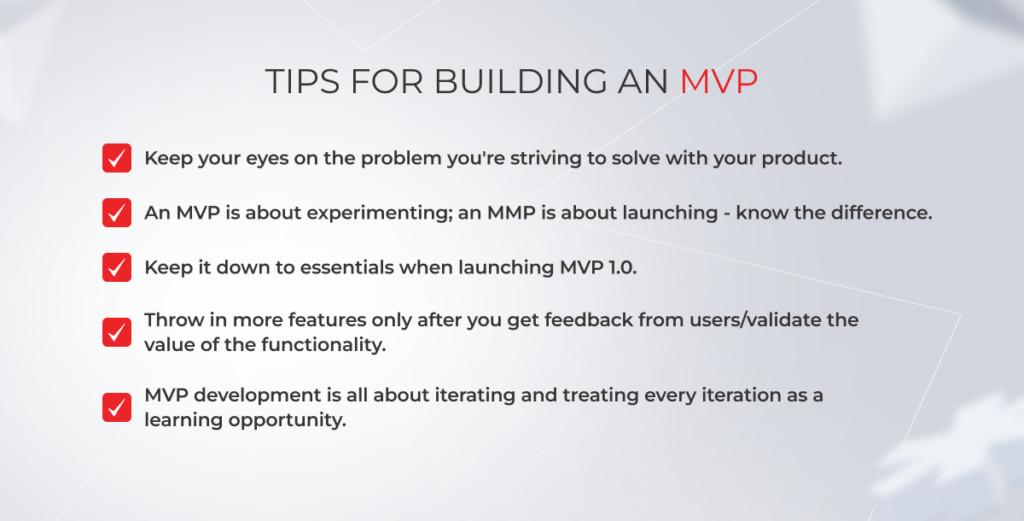
1. Define a problem your product will solve

An MVP development process kicks off with gaining a clear understanding of value addition to early adopters. To define value, start with identifying the problem your solution will solve and work on your product concept from there. Product goals, user personas, features — your product statement shapes all other building blocks of MVP development. 

2. Study the market

How to make a minimum viable product without an existing market for it? There’s no way, unless you want to run out of money. That’s why market research is one of the crucial steps to build an MVP. You need to thoroughly analyze the target market, see how your product idea stacks up against competitors, and identify your potential customers. For trail-blazing products, it’s also recommended to assess the market size. 

3. Run a Discovery phase
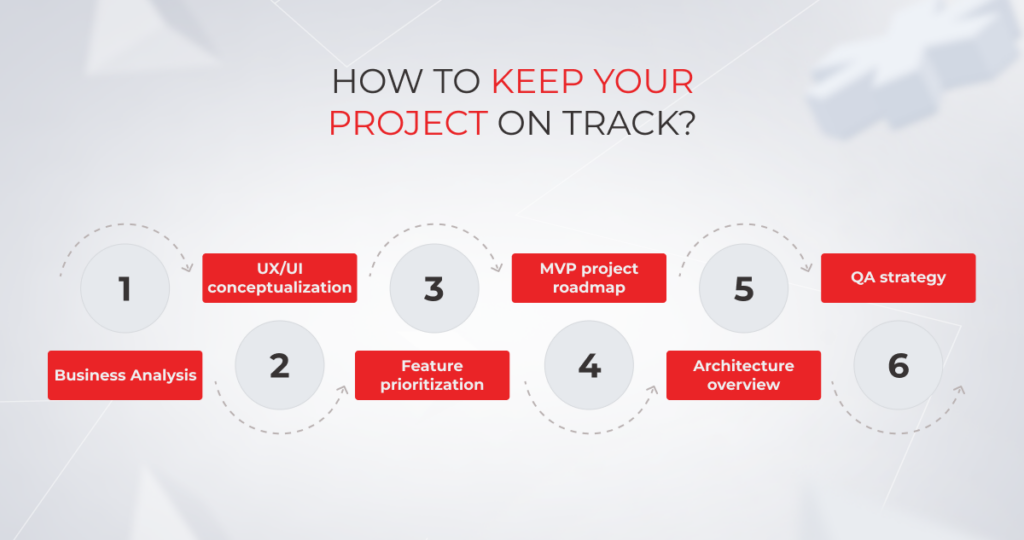
MVP

A Discovery phase sets the tone for the entire development process, saves your resources spent on MVP development, and makes sure your product delivery is on time, on point, and on budget. Basically, it ensures that every minute of development time, and every dollar of your budget goes into building a solution that people need.

Project discovery is an essential step for every brand-new venture. It helps the development team ease themselves into the business context, assess the organizational and infrastructure enablers, and estimate the product backlog. Without it, your developers will spend hours brainstorming ideas instead of implementing them.

  • Conduct Business Analysis

The value of business analysis is triple. First, business analysts help companies arrive at a clear understanding of the business idea by eliciting product requirements. Second, they dive deep into the user needs to identify relevant features for a solution like yours. And third, they prepare critical documentation that drives your development process to risk-free and cost-effective completion.

  • Conceptualize UX and design

The conceptualization process is an initial stage of the design-thinking approach that finalizes a user-centered picture of the final product design. Here, designers frame a problem, create user personas, and come up with scenarios and storyboards or a clickable prototype of a future product. The goal of this stage is to find a middle ground between user needs and the overall goals of the company. 

  • Prioritize features

The more features, the merrier is not exactly how you develop a minimum viable product. As it includes the bare minimum of features, your product development team first determines essential functionality that will make it into MVP 1.0. 

There are several approaches to point out the must-have features for a pilot version, feature prioritization being the most effective of them. At *instinctools, our experts favor the MoSCoW prioritization method as it’s a capable way of dividing features into must-haves, should-haves, could-haves, and won’t-haves. 

  • Create an MVP project roadmap

Once you decide on the deliverables, the product development team creates a plan of action that outlines the vision, priorities, and progress of a solution over time. It’s a shared source of truth that brings each stakeholder under one roof. The roadmap should reflect your product strategy and goals, while also remaining responsive to customer feedback and project changes. 

  • Describe Architecture overview

An Architecture overview is created to share the governing ideas of a future solution. The document communicates architectural decisions to the team, including technologies, system environment, and other building blocks of a solution’s architecture. As there may be multiple architectural approaches to implementing your product idea, an Architecture overview makes sure everyone in the team executes according to the pre-agreed approach.

  • Work out a QA strategy

During the Discovery stage, the QA team also sets the baseline for the quality assurance process, decides on the priorities, and selects tools that overlap with the developer tools. QA engineers also define the approach to test management and clarify software acceptance criteria. 

4. Build & release an MVP

A deployed product available to end users is the ultimate goal of this stage and the MVP development process in general. This stage is carried out according to the Incremental and Iterative approach whereby the project scope is sliced into pieces (increments), with each increment building on top of the previous deliverable. Product features are built through repeated cycles of iterations. The result of one iteration may be refined in subsequent iterations. 

  • Proceed with UX and design

Now, it’s time to flesh out your MVP look and feel with more details. While the Discovery stage helps designers establish a crystal-clear vision of what the target audience looks like and how they interact with similar products, during this phase, the UI/UX design team creates a few prototypes to demonstrate the look and feel of the future solution.

Once the client decides on the exterior of the product, UI/UX designers create layouts for each screen and share them with the developers.

  • Take care of the product’s back end and front end

Frontend developers transform layouts into user-facing features and make sure the visual and interactive aspects of a product are user-friendly and lightning-fast. While frontend development is concerned with a product’s appearance, backend developers set up all the behind-the-scenes processes. These include database interactions, user requests, APIs, architecture patterns, and other core units of your product.

  • Wrap it up with quality assurance

Within the Incremental and Iterative approach, quality assurance is not a phase, but rather a continuous activity that overlaps with the development. It means that QA specialists can check and validate a new functionality right from the oven, which accelerates development and speeds up the time-to-market.

DevOps approach makes sure your devs and QAs are on the same page. While employing DevOps, teams also take advantage of the CI/CD pipelines that bring automated testing to the table and allow QAs to spot critical bugs in the early stages.

  • Celebrate release

Finally, a production-ready solution is deployed into the target environment and made available to users. At this stage, your team also performs user acceptance testing and sets up software monitoring processes. 

  • Ensure easier adoption with post-release hyper-care

After a software launch, your product development team goes into hyper-care by providing application support to address your immediate post-implementation needs. Hyper-care may include minor fixes, software troubleshooting, employee training, and the production of manuals. 

Post-release support is essential to maintain the error-free performance of the product and maximize adoption among users.

5. Measure, learn, and optimize

A successful MVP is your first step to a high-impact full-fledged product. After your MVP is pushed out, the development team analyzes user feedback, behavior data, and other metrics to inform future releases and enhance your understanding of what an ideal product should look like. 

At this stage, you can either pivot your idea if you’ve misfired or persevere — either way, an MVP results in less effort wasted on things your target users don’t care about.

Go from concept to a full-fledged product

Schedule a call

Building an MVP is a slippery slope, keep away from these  mistakes

Emerging businesses have an incredibly high failure rate. More than two-thirds of them fail to live up to the lofty investor expectations when it comes to ROI. And although it’s startup flops that get the most airtime, established businesses aren’t immune to MVP failures as well. 

If you’re going at it for the first time, beware of the typical pitfalls that await your MVP on the way to a successful product.

Market ignorance

According to CB Insights, the absence of an actual market need is what makes 35% of startups fall down the hill. Your belief in the idea needs to be backed by existing market demand, otherwise, your product won’t get traction. Also, the market evolves at a blistering pace at the moment, so the need for a particular service or product can vapor quicker than you think.
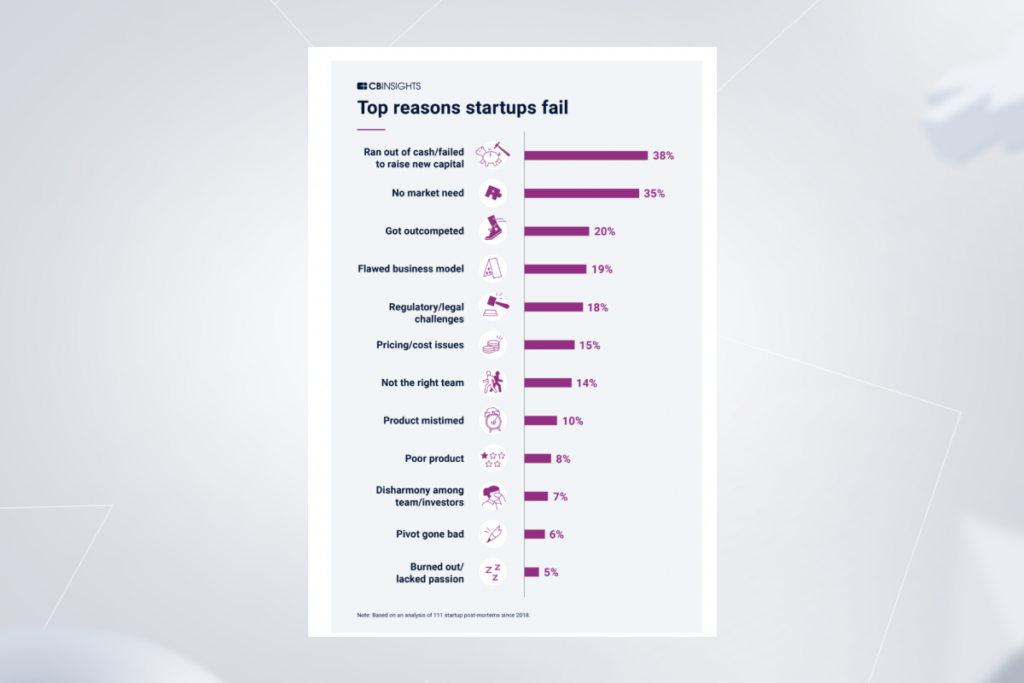
Reasons startups fail

One simple thing you can do to avoid this mistake is to run deep market research and analysis to identify the exact need of the target market. 

Not knowing your target audience

Finding an ideal product-market fit calls for a deep understanding of the target audience. Target audience research involves collating insights about the users who are most likely to adopt your product. You can get this information through focus groups, surveys, and independent research — whatever it is, make sure to paint a clear picture of your ideal user.

Lack of clarity regarding the problem that your product should solve

Your product cannot be everything to everyone, it has to be designed to solve a specific problem. Otherwise, you’ll end up with a bloated solution that lacks a utilitarian use case.

To reduce the odds of a crash, you must first identify the problem, then find a solution to it, and wrap the solution into a digital form. 

Haphazard Discovery phase

Around 38% of startups run out of budget even before they take off, and ill-considered ideation is why it happens. Let us hammer this point home: skimping on the Discovery phase is the shortcut to project mishaps, blown budgets, and ruined stakeholder expectations.

In particular, a jerry-rigged Discovery phase or lack thereof can lead to:

  • A software architecture conflicting with project requirements (you opt for a trendy microservices architecture, but your solution is better off with a monolithic architecture);
  • An exhausted project budget due to the absence of a prioritized feature backlog and constant switching between ideas and features;
  • The absence of a project roadmap, in turn, can result in a scattershot software development process ;
  • Lack of a well-designed CI/CD pipeline, which robs your product of an ongoing flow of new features and bug fixes.

Misalignment of expectations among the stakeholders

Product developers can implement the most ambitious dreams of business owners. The question here is: Do you know exactly what it takes to implement yours? Sometimes, building minimum viable products entails major transformations in the existing IT infrastructure, especially if we are talking about established businesses.

That’s why each expectation should be communicated and managed upfront, before jumping into the development process. This way, all stakeholders will know exactly what has to be done to implement a product idea.

Adding too many features

Overcomplicating a product is one of the biggest mistakes that budding entrepreneurs make. By adding too many features, they make the product harder to use, which hampers easy adoption among users. In other cases, companies’ budgets dry up even before they release the product into the wild as they spread themselves too thin.

To strike the right balance between features and their value, make sure to slim down your business idea and single out a minimum set of features to assess your product against real user needs.

Inexperienced team

There exist a hundred scenarios when an inexperienced product development team drives a project into the ground. Fail squads set the wrong priorities, allocating, already limited, resources to the wrong places. 

Teams that lack product development experience may bet on the wrong technical solutions, which results in a sub-par project with limited scaling. Whatever the team’s gray area is, the result will always be the same — and that’s a derailed project.

Your MVP is incomplete

Whether it’s because of execs or investors, companies may be pushed to release an undercooked product. You should postpone your MVP release if you nod to any of these points:

  • You struggle to identify the target custom, the problem, or your product’s USP (unique selling proposition).
  • Your MVP lacks critical functionality responsible for delivering value to the end user.
  • Insufficient security, performance, or scalability will take a toll on the user experience.
  • The product’s quality is not yet at the level users expect.
  • The current quality of a product can damage its profitability.

Overinvestment in sales and marketing

Pre-launch and launch campaigns are important to spread the word about your product and funnel in more lighthouse users. Except, a minimum viable product cannot be considered a full product launch. It’s more about testing your product idea and gathering market response. That’s why it’s better to hold the marketing dollars until you decide to go ahead with a minimum marketable product.

Don’t leave your MVP development to chance

Secure a reliable team
building an MVP

Key to MVP development success — hiring an experienced cross-functional team

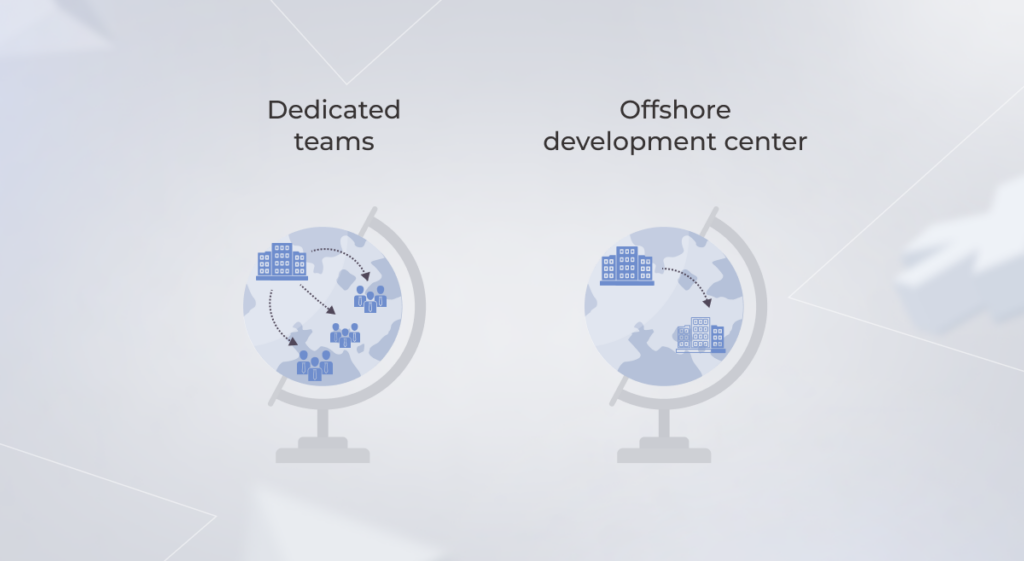
In an attempt to slash the costs of MVP development, companies may opt for hiring low-skilled teams. In other cases, they take the word ‘minimum’ literally and hire a two-people team of developers that make bold promises of delivering a high-quality product in two months.

In reality, MVP development requires a collaborative approach that involves cross-functional dedicated teams, including business analysts, designers, product managers, and other experts. 

In-depth business analysis, competent project management, and well-balanced technological decisions will make up for your lack of expertise and increase the odds of your product going big.

You have two options when it comes to searching for an experienced team. You can do the heavy lifting on your own and scour the common habitats of bright minds, including freelance platforms, job boards, and industry events. The search may take an eternity, and there’s no guarantee that you’ll come across decent professionals.

Turning to a seasoned software development company with a track of projects is a smarter move that will save you money, time, and effort. A full-cycle product development partner can drive your idea from concept to growth — faster, more effectively, and expertly.
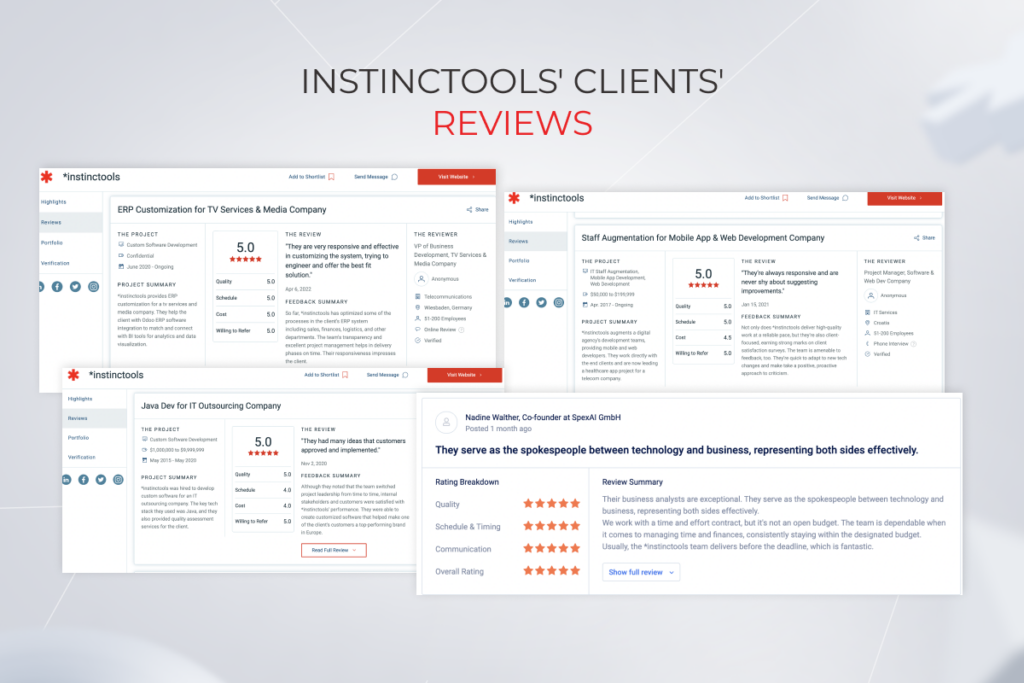
Clients' reviews

MVP app development: *instinctools’ experience

How to build an MVP app that can rewire modern farming? That’s the exact kind of challenge SpexAI faced. The company is a provider of automated AI-powered plant monitoring services and they were looking to develop an MVP for a flagship web application that can receive the data from the AI-powered robot and visualize it for end users. 

SpexAI reached out to *instinctools as they needed an experienced product development partner with a proven track record of projects and a vast portfolio of MVP solutions. Along with MVP development, the client hoped to minimize the risk inherent to new products launched. So we decided to move incrementally, from the proof of concept to the prototype to a robust MVP. With the company’s consent, we also went the extra mile by making the MVP more feature-rich and appealing to investors and users.  

Thanks to our solution the company sped up time to market and validated its business idea. Together, we’ve created the very first solution for harmless monitoring and analyzing the state of medical cannabis plants in greenhouses with 10,000–15,000 plants.

From a minimum viable product to maximum value

Having a well-thought-out MVP on your hands is a great start, but you should start earlier. To get the most out of your early product version, you need to see beyond the end result and into the problem you’re trying to solve with your solution. Partnering with an MVP development company in USA can help you lay the necessary groundwork, ensuring proper Discovery and planning phases. With comprehensive preparation, your product will be able to meet the needs of active users and help your business idea catch up with the market.

Secure a team of MVP development experts for your next project

Contact us

FAQ

What is an MVP?

An MVP is a stripped-down version of your product that bundles just enough features to satisfy early customers and gather feedback for future iterations. It usually focuses on delivering the core value proposition of the product.

How do I build an MVP?

The MVP development process starts with getting a good grasp of your product idea. You should research the market, identify your target audience, and analyze the competition. Based on your understanding, you then identify the must-have features for your MVP and start implementing them.

What is the purpose of an MVP?

An MVP is designed to test your business idea, validate it against real user needs, and attract investors.

What are the benefits of an MVP?

One of the main benefits of an MVP is that it allows companies to experiment with new initiatives, test their ideas, and vacuum up valuable feedback from real-world customers before fully developing a product. On the same note, building an MVP can save time and resources.

What is the development process for an MVP?

Ideally, a minimum viable product should be developed incrementally and iteratively. This way, your development team constructs and hones your MVP piece-by-piece by building on the previous deliverables to achieve high product quality.

How much does MVP development cost?

The costs differ based on the project scope and the complexity of your MVP.

How do I choose a development partner for my MVP?

You should choose a development partner with solid experience in delivering MVPs, time-tested domain knowledge, and a cross-functional team of experts. Industry platforms like Clutch and Glassdoor can aid you with selecting a partner.

What are the key features of an MVP?

Each MVP has its own key features. A key feature is the core functionality of your product that makes your solution valuable to the users.

How long does it take to build an MVP?

Based on our experience, developing an MVP may take up to 6 months depending on the complexity of your project.
16 SaaS Trends to Stay Relevant in 2025: Curated by Our Experts

The SaaS ecosystem  might not be growing at breakneck speed like it used to, but it’s nowhere near hitting the brakes. Valued at ~$273 billion in 2024, the SaaS industry drives a giant share of the overall tech landscape. Big forces are steering this ship: AI and machine learning are weaving into everything, major players are making strategic acquisition moves, and APIs are making it easier than ever to connect the dots. And that’s just scratching the surface (we’ll dig into more SaaS trends for 2025 and beyond soon).

In this blog post, our experts share their perspectives on the upcoming SaaS market trends and cut to the chase on where as-a-service companies should zero in to get a competitive edge.

SaaS industry trends can’t emerge from a vacuum. They stem from a range of important objective factors, which cause changes in how individuals and organizations perceive SaaS businesses.

Customer demand

As the SaaS landscape is maturing, user expectations are settling in. Today, SaaS users are adamant about the experiences they’re seeking, favoring dynamic pricing, personalization, and on-demand SaaS offerings. To fit the bill, SaaS market leaders engage on-demand experts to increase customer satisfaction and retention, revolutionize customer experience, gather user feedback, and iterate on it to release new features.

According to KPMG, SaaS vendors now have to balance personalization with generic features, demonstrate a clear stand on Environmental, Social, and Governance (ESG) issues, and develop a clear understanding of what value means for SaaS customers. It’s not about software anymore, it’s about a branded digital product with a personal, yet subtle touch.

Competitive environment

With market leaders such as Adobe, Salesforce, and Oracle accounting for $221 billion to $325 billion of total market value, it might seem challenging for new businesses to make a statement and try to thrive within a growing SaaS market consolidation trend. However, while certain segments are oversaturated, there is still a market entry for niche products, or vertical SaaS.

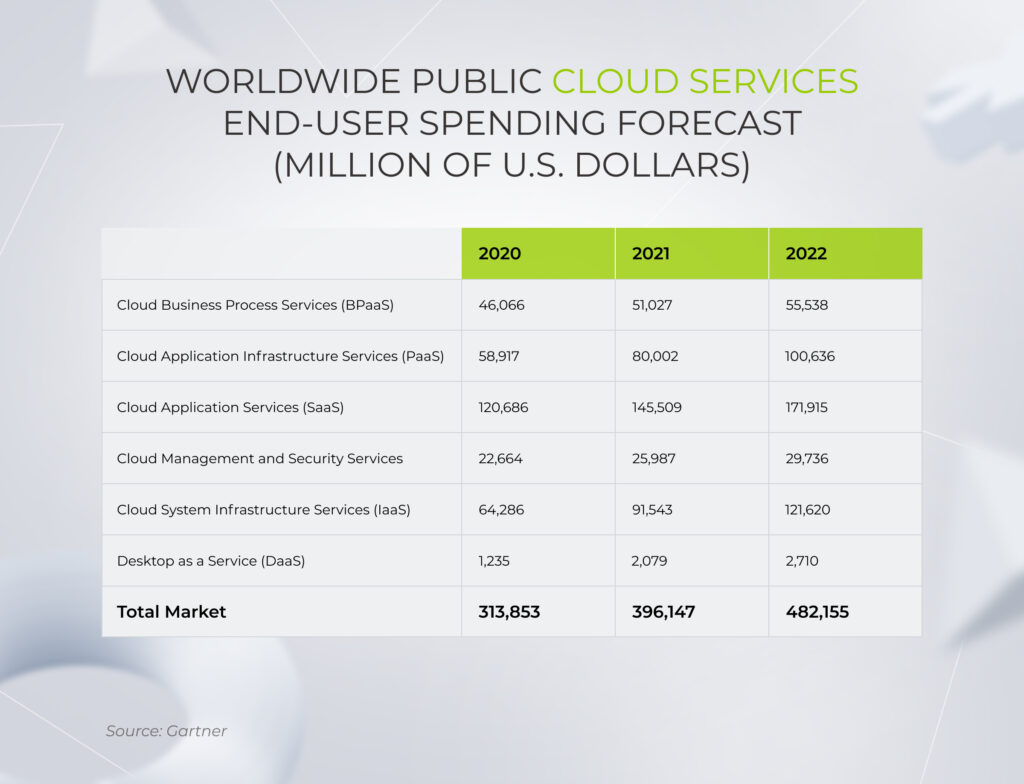
Worldwide public cloud services end-user spending forecast, 2020-2022

Concentrated categories with growth potential also include databases, artificial intelligence, and content management. A micro-SaaS model is another SaaS opportunity to hit it big. Similar to vertical SaaS, it’s tailored to a specific industry, but on a more granular level. Also, micro-SaaS solutions can be paired with existing as-a-service products, enriching their functionality.

Evolving regulatory conditions

A patchwork of compliance regulations and data security standards make it hard for SaaS providers to operate on both local and global scale. Along with well-known regulations such as HIPAA, GDPR, and others, new AI regulations have entered the scene. As a result, security and data governance audits have become more of a legal requirement rather than an optional state of checks and balances for as-a-service companies.

Providers have to comply with customer security requirements first, before any legal audits take place. SaaS clients demand a transparent data policy, records on IT security audits, root cause analysis, and other safeguards. Without thorough regulatory and data security knowledge, providers are likely to lose their grip on this tumultuous landscape.

Technology advancements

Organizations are looking to further their digital transformation agenda and experiment with cutting-edge technologies like generative AI, edge computing, and IoT. Offered over the SaaS model, these technologies become easily accessible, persuading global businesses to choose ready-made solutions over from-scratch software development.

To offer technological advancements as an a la carte option, SaaS companies have to make product design and development their top business priority to embrace cutting-edge tech and improve operational efficiency. By the same token, an impressive 90% of businesses adopt the DevSecOps methodology to create a continuous integration and delivery pipeline apt for fast and secure releases.

Economic factors

It hardly needs saying that the economic landscape has real clout in shaping opportunities and challenges faced by SaaS providers.

During economic upswings, they may have more room to maintain or even increase their prices due to higher demand and market stability. In the same way, favorable market conditions nudge investors to provide more funding to SaaS companies, enabling the latter to expand their operations and develop new features.

Conversely, in tough times of belt-tightening caused by economic shake-ups, SaaS businesses have to deal with difficulties in customer acquisition and retention as well as investors’ concerns.  

That’s why, to facilitate revenue recognition, SaaS providers should better define their offerings and value that comes with the cost of their solutions.

Investor expectations

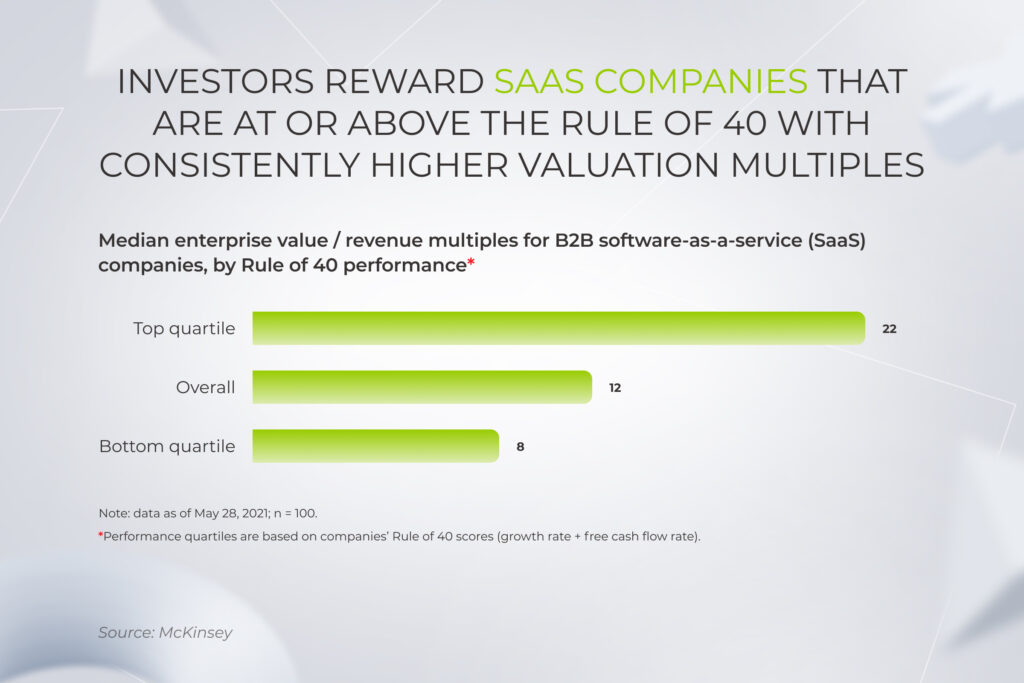
Even though the VC landscape for SaaS in 2024 showed signs of recovery — reaching a five-quarter high of $79 billion in Q2 — after a downturn in previous years, it’s still challenging for SaaS startups to nab investor dollars. Yet, companies that generate profit at a sustainable rate and meet the bar of the Rule of 40 are still of interest to VCs.

According to The Rule of 40, the growth of a software company is deemed sustainable only when its combined revenue growth rate and profit margin equals or surpasses 40%. If the company isn’t able to beat the Rule of 40, then it doesn’t pass the health check and falls into the category of risky software investments.

Median enterprise value multiples for B2B SaaS companies, by Rule of 40 performance

To operate at the Rule of 40, budding businesses have to establish a predictive view of customer health via advanced data analytics and proactively identify cross and upsell opportunities through AI-based analysis.

Moreover, leading players operate at a higher speed-to-market, incubating new ventures faster than competitors. Available tech competence and IT talent are a must to grow fast and resiliently as companies are launching new features and business lines. 

Make the pivot to as-a-service business

Tell us about your project

Over 85% of organizations expect an unprecedented 80 percent of all of their apps to be SaaS in the upcoming years. Let’s see what else the future of SaaS holds and what technologies to adopt now to stay prepared for the times ahead.

1. Vertical SaaS

Being industry-specific, vertical SaaS solutions tackle the problems a generic, ready-made application can’t. As opposed to horizontal SaaS, vertical SaaS providers have a thorough understanding of your business challenges, just like an industry insider, and allow you to consume an off-the-shelf application without complicated customization and plugins.

According to research, the global market for these SaaS platforms is projected to reach $229,7 billion by 2030, at a CAGR of 17.7%. Since the availability of industry-based cloud services is still low, providers can take advantage of the young market and capture promising niches with their SaaS offerings. As for the vertical SaaS trends, healthcare, insurance, and finance are now one of the most popular industries being redefined by vertical as-a-service solutions.

2. Micro-SaaS

Akin to vertical software as a service, micro SaaS products are skewed towards a specific industry, audience, and even specific use case. This business model has emerged in recent years as a response to the overcrowded SaaS market dominated by recognized players. As smaller SaaS businesses have little chance of competing with established solutions, they build add-ons and plugins on the back of larger SaaS players.

Micro-SaaS businesses typically offer a single product or service, which is highly targeted to a specific market segment with unique business operations that are not being covered by more established players in the industry. One of the benefits of micro-SaaS companies is their ability to launch quickly, with minimal investment in time and resources.

Another advantage of micro-SaaS is the flexibility it offers. Because these businesses do not have the overhead costs of larger companies, they can be more agile and responsive to changes in the market, customer needs, and technological advancements.

3. RevOps

Amidst the dramatic shift in market dynamics, SaaS app companies struggle to grow while also maintaining profitability. The significant upfront investment, challenges of net retention, and competitors may take a toll on as-a-service companies unless they are strategic in managing their sales and marketing functions. 

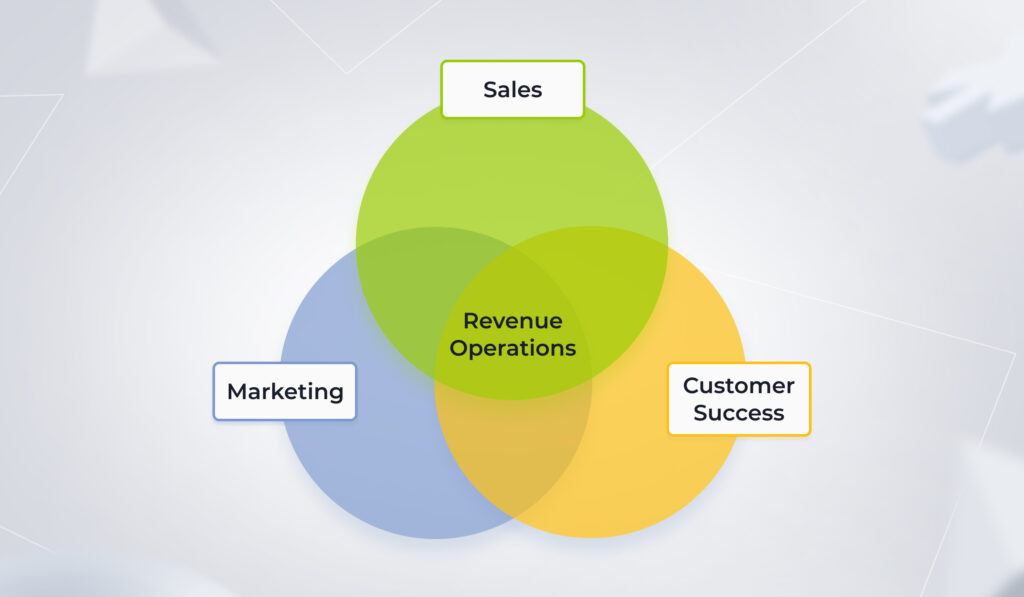
RevOps, or revenue-operations tools, is hailed as the next evolution of sales forecasting, and marketing analytics software — all rolled into one. These platforms provide businesses with a holistic, end-to-end approach to everything related to sales, marketing, and customer success. To achieve that bird’s-eye view, RevOps tools should be weaved into the entire lifecycle of the aforementioned functions and be equipped with AI-powered capabilities.

the basics of RevOps (revenue-operations tools)

Along with the AI integration, the RevOps framework is predicated on the following enablers:

  • Focus on automation to scale demand generation
  • End-to-end visibility through the full sales funnel, marketing, and customer service
  • Equipping sellers and marketers with relevant collateral to boost conversion rates
  • Implementing a data-driven customer success program to measure the value and scale cross- and upselling opportunities 
  • Moving from siloed capabilities to a central hub of efficient solutions
  • Optimizing go-to-market spends through integrated data view

Advanced lead scoring system is one of the RevOps linchpins that leverages ML-based algorithms to evaluate leads based on a wide variety of data points and behavioral indicators. The goal of an advanced lead scoring system is to provide sales teams with a more targeted list of leads, allowing them to focus their efforts on those prospects who are most likely to engage and convert. 

Leading-edge sales funnel automation is another example of the RevOps approach. Using predictive analytics, sales funnel automation solutions offer personalized recommendations to the customer and upsell them on complimentary services or products. The trick here is to establish selling strategies around your product. To achieve that, you can integrate tracking mechanisms at almost every feature level in SaaS tools to identify what capabilities click with the customer the most. 

4. Prioritizing net retention

As consumers hold back on non-essential spending, customer retention becomes one of the strategically important trends in the SaaS industry. Top-performing SaaS businesses are paying due diligence to the existing customers, investing in marketing analytics and follow-up competencies. 

From a technical standpoint, median net retention rates can be increased with granular automation directed toward retention strategies. By relying on SaaS analytics and artificial intelligence, SaaS companies can execute a contextual net retention strategy, including:

  • Applying advanced customer segmentation
  • Identifying the right timeline for upselling or cross-selling maneuvers  
  • Preventing churn based on customer behavior
  • Making personalized offers to customers planning to cancel based on their usage dynamics
  • Promoting account expansion with contextual upgrade modals and in-app messages

Paired with dynamic pricing and product support, a contextual retention ecosystem can cut your churn to a minimum and set a win-win post sale construct in place to maximize revenue growth.

5. Building new products based on a deep understanding of customer personas

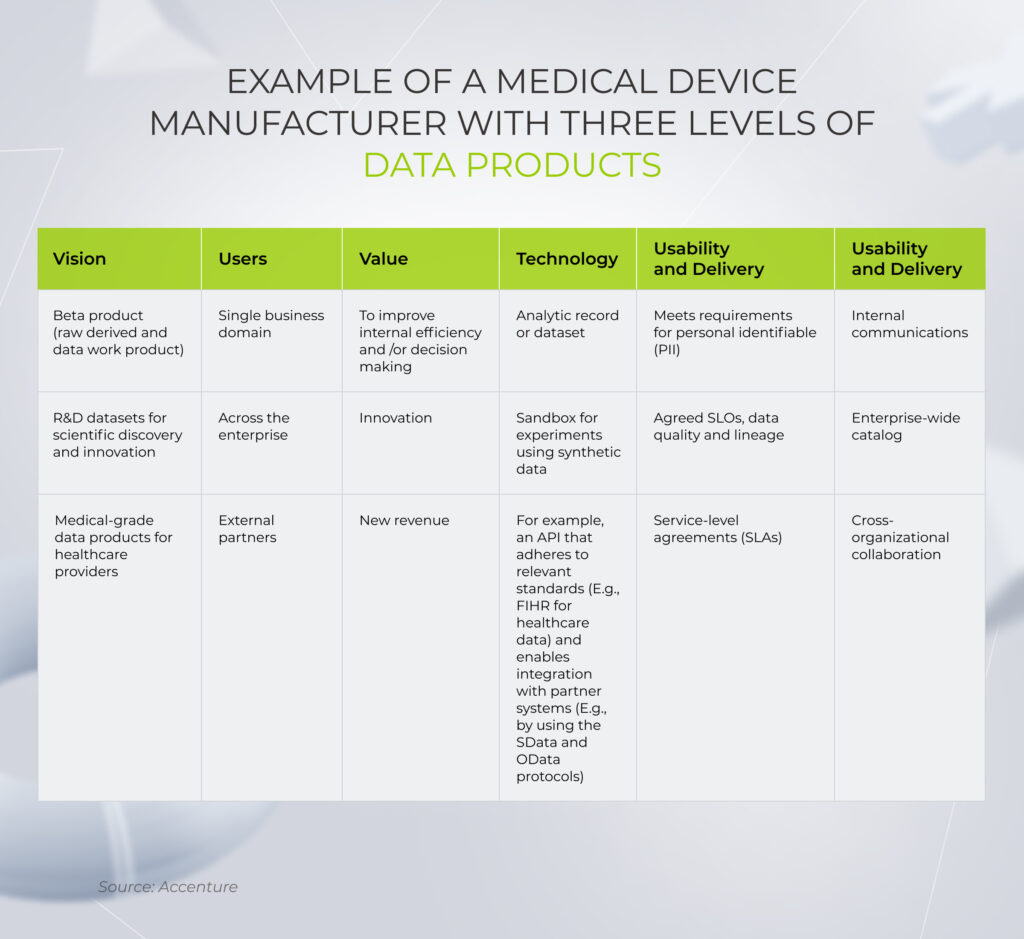
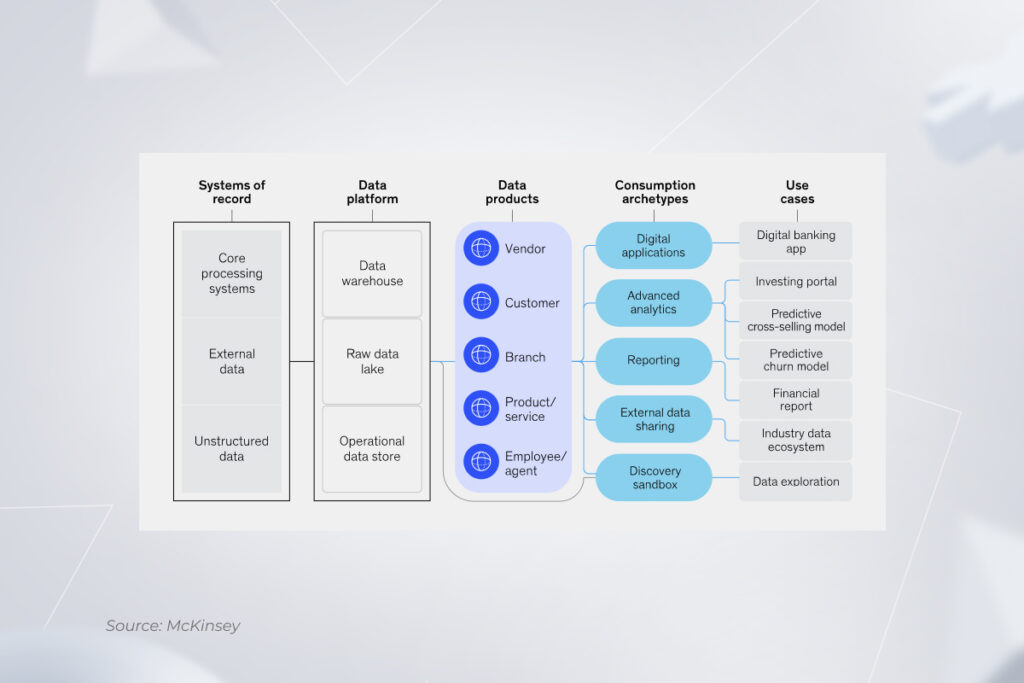
Building new offerings on the back of a company’s existing data is among other SaaS trends in 2025 that differentiate agile, resilient businesses. Market front-runners such as Google and Netflix have based their trending SaaS products around the available customer data, which leads to new revenue streams and more granular products.

Likewise, other companies, irrespective of the domain, can capitalize on the core data assets they already have and branch out into new data products.

data products of a medical device manufacturer

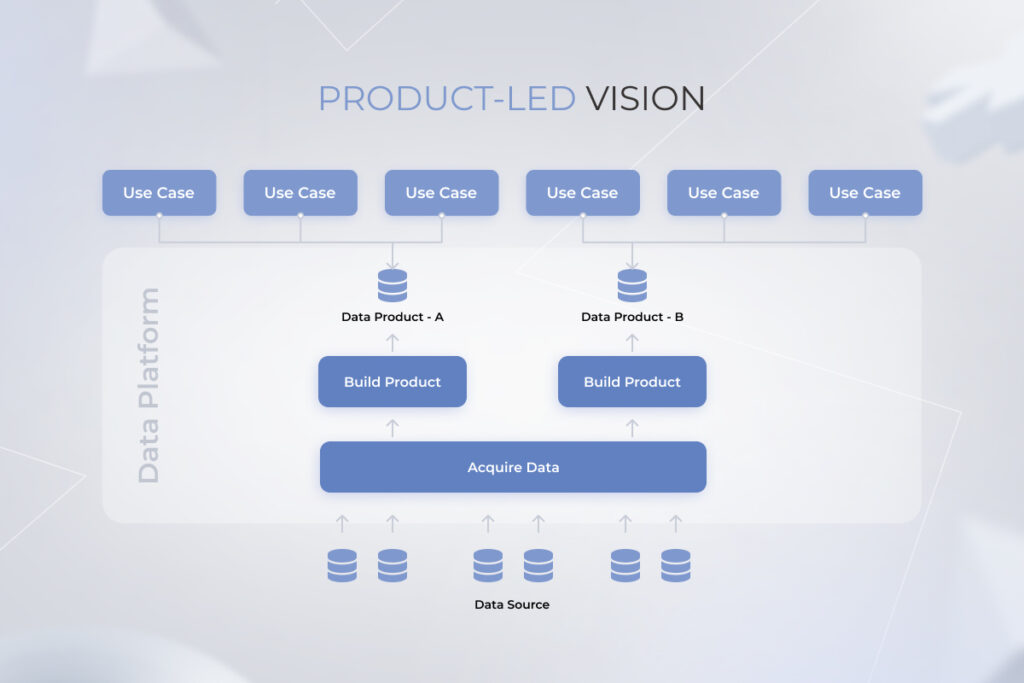
The trick here is to build new lines of business based on a thorough understanding of a customer. To do that, companies must develop and nurture cross-functional capabilities for in-house data product management, including data experts, DevOps engineers, and other skills. The data landscape of an organization should be integrated, interoperable, and transparent as opposed to fragmented, siloed data that sits within an isolated team.

6. SaaS with no exceptions

Although providers still offer a hybrid setup as an intermediate architecture for businesses, the future of SaaS is cloud-native. Born from the roots of cloud computing, this SaaS trend allows users to embrace all advantages of software as a service, including rapid scalability, high availability, and easy maintenance. Full-on SaaS also paves the way for a more holistic cloud migration that doesn’t require any in-between setups. 

We believe in “SaaS with no exceptions”, which means writing truly cloud-native software. Exceptions are the death of pure SaaS because they lead to issues with software maintenance and disrupt customer service.

For a provider, a cloud-native architecture means the independence of each service, which allows for rapid deployment cycles and horizontal scaling. This, in turn, translates into a more swift response to the shifting customer demand and reduced costs of rolling out new features. As a result, cloud-native architecture changes the anatomy of as-a-service solutions, both for a user and provider, supporting the change that comes with the digital transformation of a certain business.

7. Laying the groundwork for scalability from the get-go 

An innate capacity of a SaaS solution implies easier scaling compared to traditional software deployed on premises. However, providers can only seize this benefit when they plan for scalability in the early development stages of their SaaS applications.

In particular, a detailed roadmap should drift development toward flexible, rapid turnarounds focused on problem-solving as opposed to fixed, solution-oriented flows. Flexible product roadmaps don’t stifle product creativity, they are cut out for changing the trajectory of product development based on user feedback. 

Moreover, to achieve seamless growth in the future, you should have clear plans for feature innovation outlined in a roadmap. New releases should be based on explicit KPIs that align with how customers perceive value in your product.

A flexible architecture is also a crucial enabler of friction-free scalability that helps SaaS tools evolve. On the same line, a microservices-based architecture is one of the significant SaaS industry trends that breaks an application into separate components which are then loosely connected via APIs. This allows for high scalability, better fault isolation, and faster time to market.

8. Сontinuous innovation, delivery, and security

To win in a competitive market and over the customer, you need a quality product with the freedom of fast and continuous innovation. DevOps automation is what initiates uninterrupted product delivery, creates a resilient application environment, and brings customer-centered products to the table. By streamlining every environment build, DevOps allows providers to roll out new code as frequently as they need to instead of scheduled releases.

However, today, it’s not enough to combine software development with DevOps.

According to PwC’s 2025 Global Digital Trust Insights survey, 77% of companies are upping their cybersecurity budgets to guard against evolving threats better. Likewise, SaaS providers are bringing security back into DevOps, placing DevSecOps on top of the 2025 SaaS trends.

The DevSecOps approach introduces security testing at every stage of the development process. Bringing developers, security engineers, and operation teams together, this framework promotes product development that is both efficient and secure. Everyone involved in the SDLC has a role to play in building security into the DevOps continuous integration and continuous delivery (CI/CD) workflow.

9. Low-code and no-code platforms

Among other things, the imperative of data democratization also sets the tone for SaaS future trends, shifting the focus to easy access and distribution of SaaS products. More inclusive, accessible, and compatible SaaS products are top of mind for global companies, and providers are scrambling to meet the demand.

In doing so, SaaS businesses rely on microservice architecture that makes as-a-service platforms easily deployable and organized around business capabilities. In an attempt to make digital transformation more accessible, SaaS companies also center their offerings around low- and no-code platforms. The latter allows non-technical users (and businesses) to build and deploy applications without a coding background. 

Low-code products experience a lot of footfall today as they offer a more cost-effective way to innovate, satisfy the rising demand for excellent internal workflow apps, and enhance user experiences. By 2028, the low-code platform market is projected to reach a value of $94 billion.

10. Self-service and self-heal environments

As over 81% of customers are seeking more autonomy, self-service capabilities are becoming a fixture in SaaS trends for 2025. Being a non-intrusive support option, self-service capabilities in SaaS tools give users the freedom to learn, explore and solve issues at their convenience without the need for human agents.

Over the last few years, providers have been gravitating from traditional, static self-service options to more natural, AI-powered customer engagement methods. FAQs, customer portals, and tutorials made way for chatbots and voice-enabled conversational AI. 

AI-enabled self-healing platforms are one of the self-service innovations that help SaaS users navigate the complexity of platforms. Self-healing solutions are designed to automatically detect and fix problems within a system without human intervention. They leverage machine learning, artificial intelligence, and predictive analytics to quickly identify issues before they become major problems, and proactively repair them without any manual effort.

Based on a full-cycle Artificial Intelligence for IT operations (AIOps) process, self-healing environments also reduce downtime and increase productivity by automatically fixing issues, which means that employees can focus on core tasks instead of troubleshooting. 

11. API-first approach

The secret recipe of growth for SaaS companies lies in making their product compatible with the existing app portfolio of their customers. By combining different SaaS solutions, businesses can create a robust, integrated ecosystem that fits their unique requirements. And as companies are doubling down on as-a-service applications, integration has become one of the strategic software as a service trends for providers.

Open APIs play a crucial role in making a combination of compatible SaaS services possible for users. When providers make their offerings available via open APIs, they allow companies to fine-tune the offering and sync it with existing systems, reducing costs and increasing efficiency. A SaaS program with ample integration operational capabilities also eliminates the need for a third party, thus becoming another reason your potential customer can say “yes”.

Conversely, a lack of integrations in a SaaS product means that the adopters have to develop custom APIs and cover additional development costs. Without integration, your SaaS product also becomes another siloed asset for the company that keeps critical data under wraps for other applications.

12. Generative AI 

One of the SaaS opportunities that have got a big word of mouth lately is generative AI and its offshoot – large language models. While AI is not novel to SaaS providers, the introduction of ChatGPT and the like has widened the application area of artificial intelligence in the SaaS model. 

Due to the growing popularity of gen AI models, the global generative AI market size is expected to grow at an impressive CAGR of 35.6% from 2023 to 2030. Touted as a new AI frontier, generative AI brings unprecedented out-of-the-box capabilities to SaaS companies, including content generation, sentiment analysis, market research, customer support, and others. And providers don’t think twice to consume and customize gen AI tools, changing the game for their users.

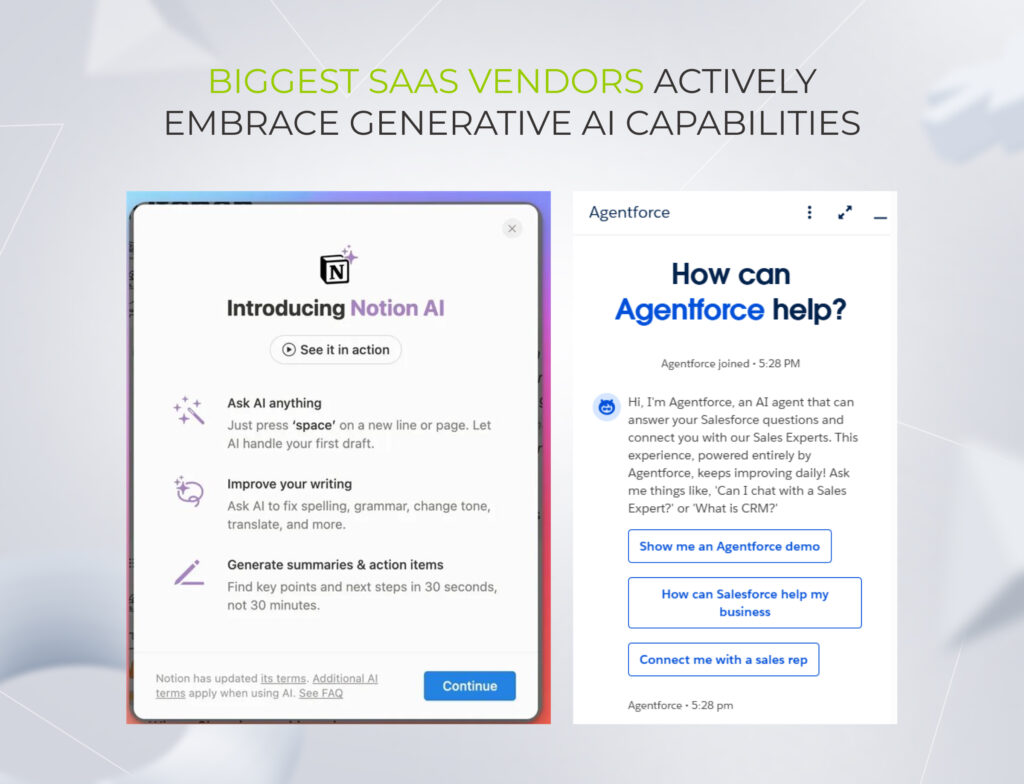
For example, in October 2024, Salesforce announced the public release of Agentforce, a platform that lets companies develop and launch autonomous AI agents across all operational areas, including sales, customer relationship management, marketing, IT, finance and commerce.

Notion, another SaaS giant, has upgraded its Notion AI — it now can pull insights from lengthy PDF docs, suggest schedules based on a proposal, or describe any uploaded images.

Biggest SaaS vendors actively embrace generative AI capabilities

13. BI-powered SaaS 

Today, businesses across industry sectors are guided by big data to improve virtually every aspect of their operations. The increasing reliance on data-driven strategies in the business landscape is what drives the demand for SaaS-based business intelligence solutions. By 2030, the market of SaaS BI solutions is slated to hit over $35.71 billion, ushering in an opportunity with an untapped value for providers.

From a user standpoint, cloud-based analytics platforms, unlike on-premises analytics tools, enable businesses to uncover insights in their data right in the place where this data is generated. Supplemented with built-in AI and machine learning capabilities, SaaS BI platforms let decision-makers use those insights to automatically drive actions.

With cloud-based analytics tools, companies can access their data on the go, analyzing it from a single point of truth.

This trend is not limited to offering SaaS-based BI tools as a standalone tool, it’s more about enriching existing SaaS with analytics capabilities to deliver added value in the form of dashboards and reports to business users. 

14. Mobile first SaaS solutions

Given the nature of a hybrid environment, mobile is becoming the primary interface for many field employees all over the world. This makes mobile-first and mobile-native SaaS solutions pronounced B2B SaaS trends that help address the needs of flexible work settings.

By enabling employees to access business data and applications while on the go, mobile on-demand SaaS helps to improve accessibility and eliminate downtime, allowing employees to work more efficiently. Collaboration is facilitated as team members can access and share data in real time, no matter where they are located.

However, to bring SaaS on mobile, providers need to cover at least the minimum level of complexity necessary to meet their core business process roles. In a perfect case scenario, a mobile as-a-service application should boast unique features that are available on mobile only. In less-than-perfect cases, mobiles might serve as an extension for certain parts of an app or have limited functionality.

15. White-label SaaS

White-label SaaS is gaining traction for a simple reason: not every company needs to reinvent the wheel to offer great software. When the core functionality already exists, the real value often lies in strategic distribution, branding, and customer relationships.

This model gives niche players a fast track to market with fully functional, customizable products.

Ecommerce has become ground zero for the rise of white-label SaaS. Platforms like Shopify, and WooCommerce have shown that retailers don’t need to build their own infrastructure to launch a compelling digital storefront. Instead, they can rebrand and customize pre-packaged platforms to match their unique identity. And go live in days, not months.

16. Consumption-based pricing

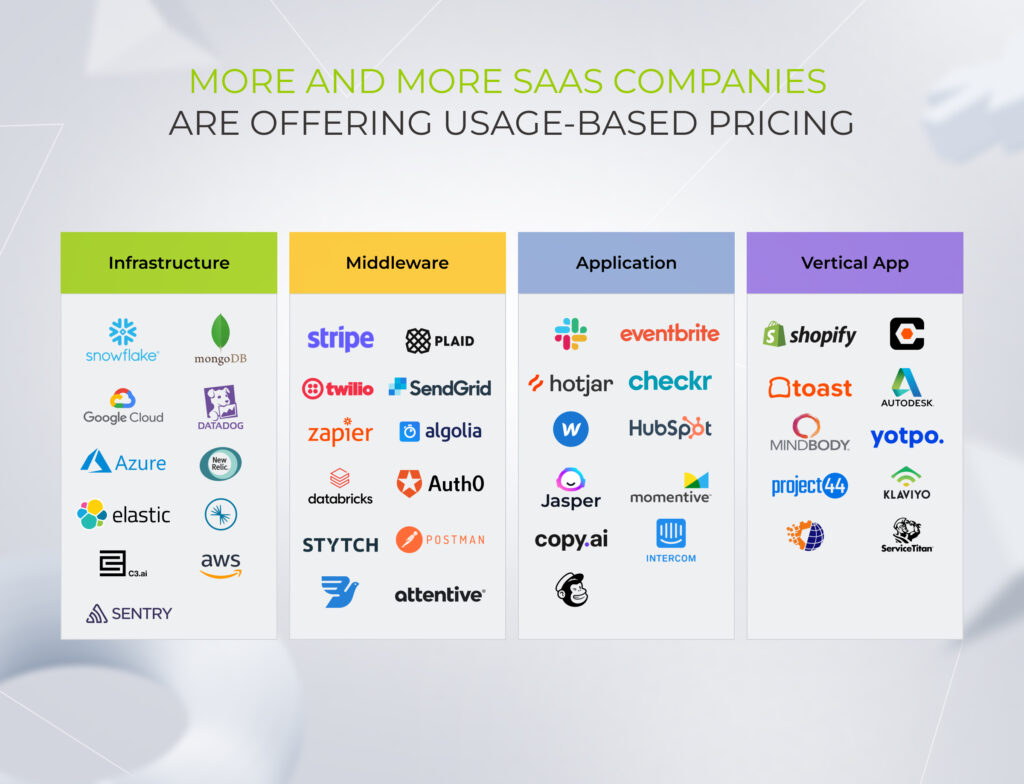
The shift toward usage-based pricing in SaaS is a natural response to how modern software is built and consumed — dynamic, scalable, and tied to actual value. Flat subscription fees (like $X/user/month) made sense when software was a static product, but cloud infrastructure and API-driven tools operate differently.

Alternative pricing strategies, like AWS’s pay-as-you-go, Twilio’s per-message pricing, or OpenAI’s pay-per-token, remove upfront friction by letting customers start small and understand the product’s value. It’s a win for vendors too, as revenue naturally scales with customer success.

More and more SaaS companies are offering usage-based pricing

What makes a SaaS champion?

The share of the SaaS market is growing at a blistering pace driven by increasing cloud based solutions’ adoption and rising infrastructure costs. ​​But despite the glowing potential, launching and growing a software-as-a-service company is not an easy task. Stiff competition, complex regulations, and economic turbulence prevent providers from gaining ground.

But just like opportunities dim for some providers, other forward-looking SaaS businesses can effectively plot a course to success by taking advantage of the top SaaS trends. The proliferation of AI technologies, easily scalable architectures, resilient innovation, and a wealth of integrations will set the standard in the SaaS niche in the upcoming years. 

High performers will achieve business success by focusing on the detailed knowledge of the customer, pursuing high-value features, and adopting the latest tech comforts. To make it happen, SaaS providers should integrate advanced tools and develop tech expertise, supported by domain proficiency and always-on availability of the IT talent.

Let our company make you a SaaS champion

Contact our team today

FAQ

Is the SaaS industry growing?

According to statistics, the SaaS industry is expected to grow at a CAGR of 13.7% from 2023 to 2030. The rising adoption of cloud services, the added overhead of on-premise infrastructures, and the digital imperative of continuous innovation will secure the popularity of as-a-service solutions well into the future. Moreover, as vertical SaaS platforms are still scarce, companies can seize this opportunity to enter the market.

Is SaaS still relevant?

Thanks to advanced scalability, managed security and minimized management challenges, SaaS platforms remain a popular option for fast-growing companies.

What is the future of SaaS?

The next generation of SaaS is all about built-in compliance, plug-and-play adaptability, and seamless integration between apps through API-first design. And while generic platforms still chase scale, niche SaaS applications are pulling ahead by solving real problems, in the language each vertical speaks.

SaaS Product Development Process: Out-and-Out Guide for 2026 and Beyond

Making a foray into SaaS product development seems like a license to print money for both startups and established businesses. The rationale behind this craze is simple: according to Gartner, the global public cloud end-user spending is projected to surpass $850 billion in 2026, with SaaS remaining one of the largest segments alongside IaaS and PaaS.

Composability, flexibility, and 24/7 accessibility make SaaS products a mandate for businesses that want to thrive through disruption and prevent a headlong tumble into the red. So, if you want to benefit from the steady velocity of software-as-a-service, our comprehensive SaaS product development guide is here to answer all of your questions, from what SaaS product development is to how to build an AI-ready solution that can stand out and scaleI.

What is a SaaS product?

Software as a service refers to a software distribution model that is hosted centrally on the cloud and grants users instant access to an application, usually on a subscription or pay-per-use basis. Users can reach software as a service products from multiple devices at their convenience, provided devices have an internet connection. SaaS product development is what brings a SaaS product to life.

AI is rewriting the SaaS playbook

SaaS solutions have grown in demand, with their market size projected to reach $793.1 billion in 2029, but the nature of that demand has shifted.

While earlier SaaS products won customers with their cloud accessibility, composability, and automation, now it’s table stakes, and vendors have to up the ante with architectures that can seamlessly capitalize on AI capabilities and expand automation coverage.  

Pre-AI SaaS could streamline a process, but AI-powered SaaS can act on the user’s behalf, interpreting context, making judgment calls, and executing multi-step workflows that were previously beyond any software’s reach. Gartner predicts that 40% of enterprise applications will integrate task-specific AI agents by the end of 2026, up from under 5% just a year prior, signaling a new product category emerging in real time.

The market is already repricing around this shift. In February 2026, roughly $285 billion in market capitalization was erased from SaaS companies in a 48-hour window the financial press dubbed the “SaaSpocalypse” – a reckoning driven by agentic AI launches. 

While the doomsday narrative writes SaaS off entirely, it misses a practical reality: AI agents don’t operate in a vacuum. They need structured data, permission layers, and reliable process logic to act on. Sounds familiar, right? That’s what well-thought-out SaaS products provide, so the reality is more nuanced than the headlines put it: agents are changing who does the work inside SaaS products, setting a new SaaS solutions development agenda, where software-as-a-service is less of a tool to click through and more of a solid infrastructure for AI agents to operate within. And companies that go deep with tailored, AI-native solutions still have a once-in-a-lifetime opportunity to blaze a trail with tailored solutions.

SaaS development challenges may pave a bumpy road to success

Building a perfect SaaS product becomes less painful when you know what to expect. Below are the recurring challenges in SaaS-based product development across product, engineering, and operations.

Delivering value to customers

The SaaS industry grows exponentially and so do the customer’s expectations. No matter how innovative, feature-packed, or aesthetically pleasing your software solution is, misalignment with your target audience will take its toll.

To overcome this challenge, you should never skimp on conducting market research and analyzing your target users. These will allow for a deep dive into the customers’ requirements, goals, and expectations. A customer-first product SaaS product development strategy is what helps you stand out among competitors and paves the way for a value-packed SaaS product with long-term value.

Service mindset

It’s not enough for your solution to cover the needs of your customers. To strike it rich, your product has to create an impactful experience that develops long-term loyalty. A product-first, service-oriented mindset is what enables you to create that indelible imprint on the user’s mind.

A service-first mindset encourages your product team to thoroughly understand the specifics of the project, the limitations of your product, its current goals, and potential areas for improvement. Everything that can possibly impact the value of the solution should come into the equation.

Scaling

A SaaS product development process is a journey of evolution. As your solution gains traction, it grows an impressive customer base around it. To accommodate new users, your software requires a scalable, easily adjustable architecture.

Therefore, it’s crucial to build a strong foundation early on to handle larger volumes of business with less disruption and cost. Modularity, minimized latency, and system resilience will help you grow pain-free and with less cost.

Information security and privacy

Unlike traditional software, SaaS applications do not have a corporate-security perimeter of firewalls around them. They need a whole lot of security configurations, including encryption, access management, incident response, and more to keep hackers at bay. In 2026, the security surface has expanded further: AI-powered cyberattacks, prompt injection, data poisoning, and model exploitation are now front-and-center threats for any AI-enabled SaaS product. On the governance front, frameworks such as the EU AI Act impose new compliance obligations on how AI collects, processes, and acts on user data.

Also, as this software distribution model often targets a wide audience across geographies, the challenge of meeting local data regulations, industry-specific compliance requirements, and other data standards turn SaaS product development into a never-ending chase.

Knowing the security landscape of your target market and an enhanced focus on data security and AI governance from the get-go will prevent costly violations and keep the data of your users safe and sound.

Tech talent shortage

72% of employers globally report difficulty finding skilled talent, with AI literacy outranking traditional engineering skills on the hardest-to-fill capabilities list.

Due to the competitive and scarce hiring market, finding and employing a local product development team costs business owners time, money, and other valuable resources that a company may not have an abundance of or be willing to risk.

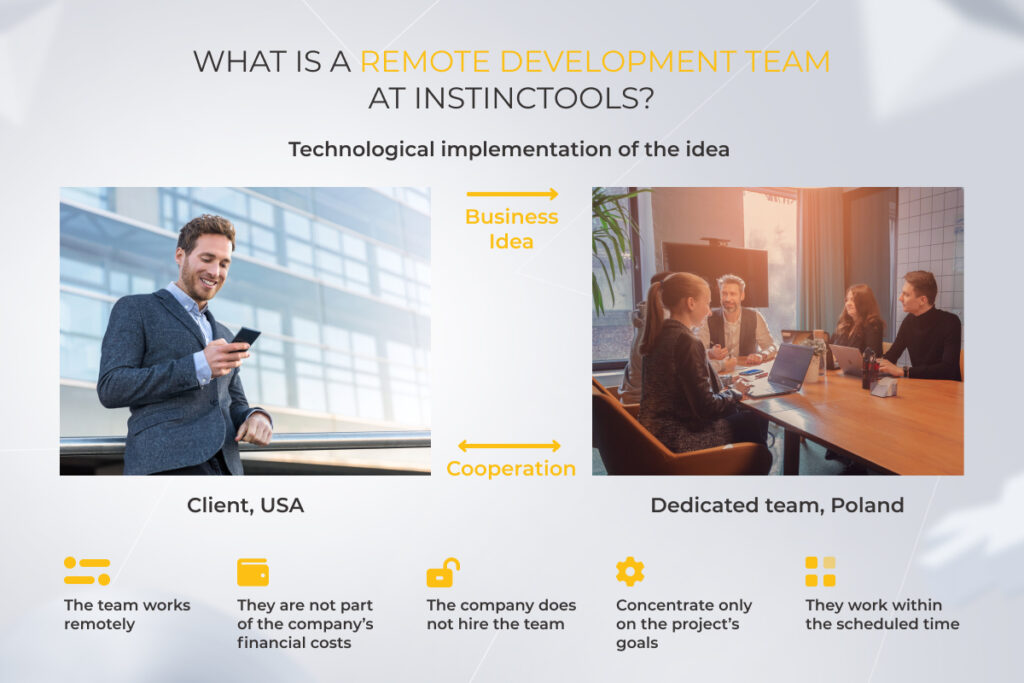
To ease the strain, many companies resort to SaaS outsourcing which offers more flexible models for building development teams. Along with larger talent pools, companies can tap into unique product expertise, including specialized AI and ML engineering skills, and accelerate time to market thanks to the high availability of outsourced talent.

Overcome the complexity of product development with us

Contact our team

4 surefire approaches to building a SaaS product

58% of business leaders are prioritizing new products or services as their top growth strategy for 2026, and software as a service products, among other revenue streams, can put companies on track to increased growth, provided you know how to wrap your arms around this venture. We’ve curated best practices for SaaS product development – pillars of a successful SaaS development methodology.

Rapid test-and-learn cycles

Customer feedback is often deemed to be an input that forms the basis for product requirements. It’s important to establish a deep understanding of customers’ pain points and make them the heart of your SaaS software development life cycle.

From ideation to post-MVP improvements, it’s crucial to iterate based on the voice of your customer before making a full-fledged product. This approach is 101 in Agile, allowing companies to test with real customers and learn what needs to be improved. This way, you build around knowledge, not tasks, and establish a continuous cycle of improvements. Rapid AI prototyping and vibe coding have sped up these cycles, empowering companies to test new products and features with real users in days and weeks instead of months.

Capitalizing on existing digital and data assets

If you’re an established company, chances are you already have all the necessary ingredients to build a value-packed product that targets the needs of your customers. By tapping into existing digital and data assets, you can uncover new opportunities based on customers’ previous interactions with your business and seize them to reduce your costs and effort of development.

To craft products on the back of the existing assets, SaaS companies need a complete and transparent data infrastructure where no silos can stand in the way of innovation. Once isolated, data points become the legacy of select departments and cannot be leveraged in full to create a comprehensive data view. Also, you might need to fill in the data gaps or enrich proprietary data with third-party resources to make it exhaustive for a new product.

This data groundwork is twice as important in the age of AI models and agentic systems that are only as good as the data they’re trained on and the context they can access.

Planning for scale

Easy, on-demand scalability is what makes SaaS platforms emerge from the pack. Building with scalability in mind requires a dynamic and detailed roadmap that matches the pace of changes and allows the team to pivot with ease. Unlike static SaaS product planning, dynamic roadmaps are designed to be adaptive, thriving on real-time feedback from users in order to innovate quickly.

From a tech standpoint, a growth-ready product should rely on flexible architecture based on microservices and APIs that allow for simple interfaces to data, algorithms, and processes. Decoupled architecture is what enables the team to deploy features independently and dynamically allocate resources to services as needed. In 2026, this also means designing your architecture to support autonomous AI agents that can be orchestrated, scaled, and governed independently, much like microservices themselves.

Being responsive to customers’ actual needs

Product development for SaaS is never final. To be successful, your SaaS solution should constantly evolve to match the shifting needs of your customers. Baking tracking and analytics into the software allows you to gain a better view of both high-value and low-value features, doubling down on what matters the most for your customers.

Tracking tools help your product team measure new releases in terms of performance and positive customer response, making your solution customer-first and value-packed.

Set up your product development for success

Schedule a discovery call

From thought to bought: navigating the stages of SaaS development

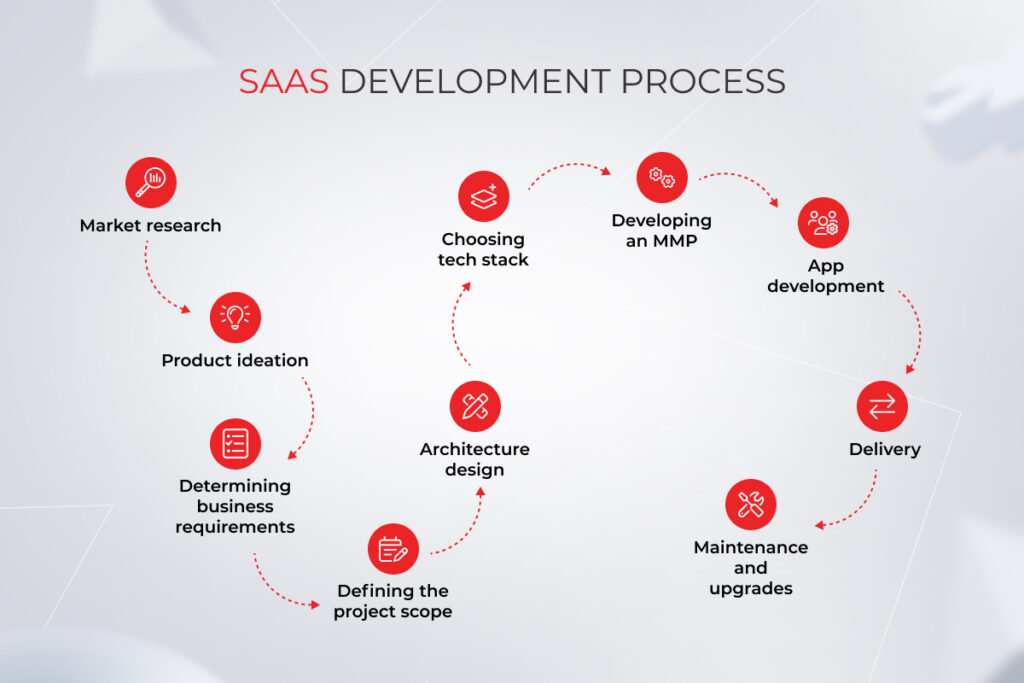
A typical, Agile-first development process encourages development teams to iteratively execute the product vision, breaking each challenge down into smaller, solvable problems. The SaaS development process – sometimes called the SaaS development life cycle or SaaS development workflow – moves through ten clear stages, from market research to maintenance. Following this lifecycle structure helps SaaS product developers avoid scope creep and deliver value at every stage.

SaaS

Market research

Everything starts with an idea, but not every idea is worth pursuing. So before you march forward, it’s important to estimate how your product idea aligns with customer needs, industry trends, and market demand. You should also understand how your future product stacks up against competitors and what makes it stand out in the saturated market. Consider involving a focus group of real customers in the research to gather qualitative data and in-depth insights that would reveal true customer demands and opinions.

During early-stage SaaS product development, this research also involves assessing where generative and agentic AI capabilities can do the heaviest lifting for the users.

Product ideation

With market data on hand, you can further shape your product idea through a prism of different stakeholders steeped in customer needs — from a SaaS product manager to a SaaS product developer to a product designer. An ideation cohort can provide their unique perspectives on how customer insights can be implemented into the product and help you adjust the prototypes correspondingly.

Ideally, participants should be diverse, with representatives from each department or business function to give their relevant experience. At this stage, you and your product team generate and filter out ideas, prioritize user insights to identify opportunities, and group ideas into distinct buckets that may end up in a future product roadmap.

Ideation sessions should also revolve around focus groups, user surveys, and customer interviews whose input can later be aggregated and analyzed. If you are building a SaaS product on top of an existing business, you should pull in user feedback from existing customers, including sales calls, marketing data, and data from other touchpoints. This helps you gain a baseline understanding of the real-world users and potential new customers.

Determining business requirements

Once you’ve gathered customer requirements, it’s time to think of how this software project can bring you closer to your business goals. Business requirements define the strategic path of the project and describe what a system or a solution should do and why. They give a high-level, yet detail-oriented understanding of the scope of your solution, its overriding goal, and project constraints.

Business requirements should be agreed upon and reflected in the Business Requirements Document. Keep in mind that requirements gathering is a dynamic process that can bring new variables into the picture. Therefore, make sure to make space for future requirements gathering early on in the SaaS development lifecycle to keep the scope of the project easily adaptable.

Defining the project scope

A well-defined project scope keeps the project on track and ensures all deliverables are turned in on time, within budget, and up to your expectations. The level of detail on your project scope statement is directly linked to the complexity of your project. Either way, it should consist of three major parts, including project justification, main deliverables, and project objectives.
A scope statement also provides a detailed outline of all aspects of a project, including timelines, key stakeholders, constraints, and other key elements of the SaaS development workflow.

Architecture design

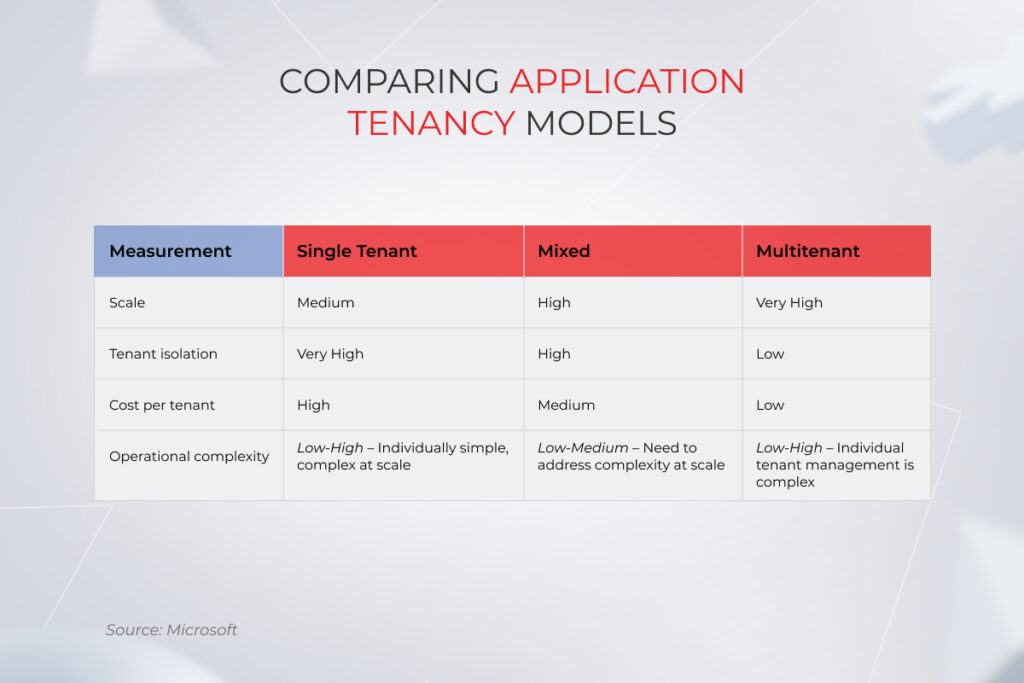
A well-balanced SaaS system architecture is the backbone of a scalable and reliable software-as-a-service solution. Typically, this is dictated by your customer requirements and business goals. For example, a multi-tenant SaaS architecture is a great option for commercial software products as it’s maintenance-free for the customer and requires less upfront infrastructure procurement.

You can also base your solutions on a single-tenant or a mixed-tenant architecture that allows for more dedicated resources deployed for each customer. Overall, the tenancy model makes no difference for the functionality of an application, but it impacts other aspects, such as the number of concurrent customers and operational complexity.

Software as a Service

Mixing these models to cover the diversity of customer needs is on the list too. For example, the basic tier of the solution can run on a multi-tenant architecture, while customers with higher performance needs can be billed for a dedicated service tier based on a single-tenant delivery model.

Architecture decisions now also extend to the AI layer: how agentic workflows will be orchestrated, where context and memory will be stored, which LLM providers to integrate with, and how to design agent-to-agent communication patterns. This layer of SaaS product engineering requires a clear SaaS product development framework for architectural choices, from vector databases for context retrieval to orchestration frameworks that manage multi-agent collaboration.

Choosing tech stack

The tech stack for SaaS solutions development usually includes client-side technologies, server-side technologies, and cloud services. The right combination of tech will secure your product well into the future and enable it to evolve and scale with fewer costs. When choosing your IT stack, our team takes into account your existing IT suite, the complexity of your software, and maintenance requirements. For AI-enabled products, the stack should include LLM platforms, agent orchestration frameworks, vector databases, and observability tooling for monitoring agent behavior and token consumption.

Developing an MMP

Once we lay the groundwork for product development, our team proceeds with identifying high-value features and setting priorities for feature releases. Must-have features are then incorporated into a Minimum Marketable Product or MMP, an upgraded version of an MVP, a product version with minimum functionality that should still be enough to enter the market and gain traction among end users.

MMP development is also preceded by prototyping whereby our UX/UI design teams create a visual representation of your MMP and prepare the final layouts for further development. At this stage, each MMP feature is also thoroughly tested through continuous testing cycles, enabling our team to obtain critical feedback earlier and ensure faster deliveries. AI-assisted prototyping has made rapid SaaS development a reality at this stage, allowing teams to validate products with real users at a fraction of the time it used to take.

App development

Your SaaS product lifecycle follows through with an MMP release that will allow your team to collect valuable customer feedback and chalk out a roadmap for product enhancement. At this stage, your product teams add good-to-have functionalities into the SaaS offering, iterate on an MMP based on the user sentiments, and transform the application into a full-fledged solution ready to offer a plethora of features.

This stage also benefits from continuous integration and testing cycles that enable your team to evaluate the quality of each deliverable as part of a continuous delivery process, by testing early and often. This testing culture determines the quality of your releases, so make sure your team doesn’t skimp on this part.

Delivery and SaaS product commercialization

New features and updates are delivered continuously in small batches which allows your development team to easily troubleshoot issues and release as often as you need. Continuous delivery cycles also increase the speed to market as your team doesn’t have to pause development for releases. As a result, users can enjoy an uninterrupted stream of improvements, with daily enhancements and feature fixes.

Commercialization also involves choosing the right monetization model, as AI features can generate value in ways that don’t map neatly to traditional per-seat pricing. For instance, when a multi-agent system takes over a whole workflow, there’re fewer humans in the loop to apply per-seat pricing to, and usage-based or outcome-based models capture the value better.

Maintenance and upgrades

The development of SaaS products is never final. It’s a continuous engine of improvements delivered through an ongoing effort of your support team. Your product management SaaS unit should monitor customer behavior, unearth valuable insights, and communicate them to a support team that can then transform this feedback into a software upgrade plan.

Moreover, you need a dedicated team for maintaining your SaaS product, ensuring it delivers an impeccable experience to the users and can accommodate the growing workloads. For AI-powered SaaS, software upkeep also includes monitoring agent performance, fine-tuning models as user patterns evolve, managing context drift, and keeping up with the pace of LLM and framework updates.

Get your SaaS product driven from A to Z

Reach out

Hiring well isn’t enough, but building an effective SaaS development team is

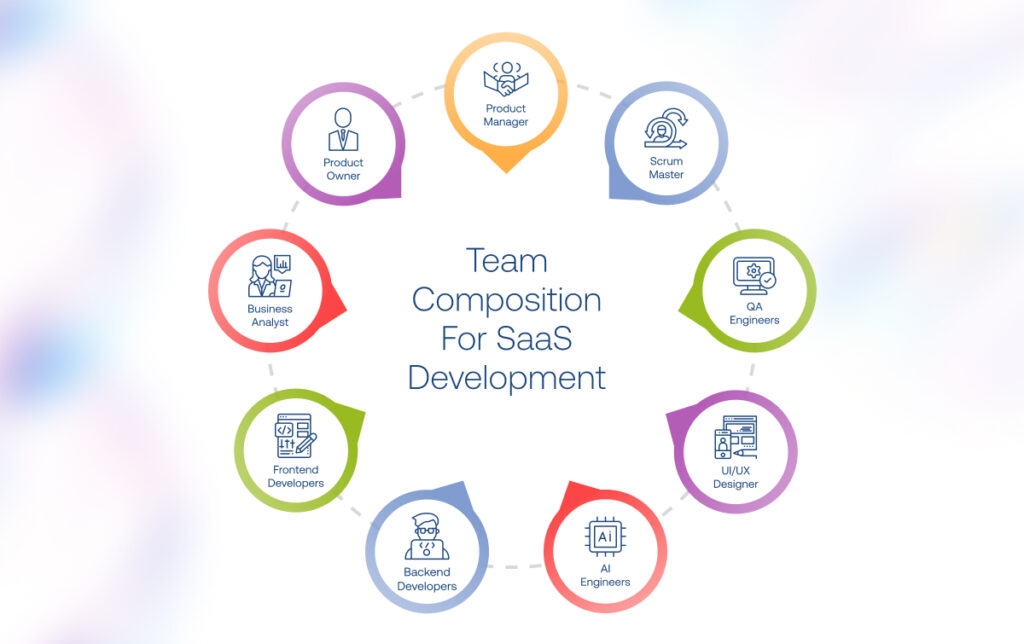
To build a SaaS product with long-term potential, you need more than just a development team. A close-knit, autonomous squad of high performers with a business mindset and product vision is more likely to fit the bill, holistically growing and elevating your product idea. Here is what a well-balanced product team structure looks like.

Product manager

A SaaS product manager is in charge of the entire SaaS product management process, tackling product-related tasks and communicating product strategy to the engineering, design, and marketing teams. Together with product managers, SaaS product managers oversee the entire cycle of product development, making sure the final deliverables meet business and customer needs.

Project manager

SaaS project management differs from regular software development projects, but you still need a person with an all-seeing eye that can shepherd the project to completion. Project managers oversee the project from start to finish, keeping an eye on the budget, deadlines, and overall project progress. They are doers who maintain SaaS processes for changes in the project and coordinate complex project dependencies and team resources.

Business analyst

Business analysts are field workers who strategize your business idea, conduct market research, and participate in defining the scope of your project. Without thorough business analysis, it’s impossible to elicit project requirements and prepare detailed software documentation for the successful development and delivery of the product.
Solution architect

These specialists come on stage during large-scale projects and map the overall technical vision for your SaaS product. They bridge the chasm between business problems and technology solutions and match the solution with your corporate environment. For well-established companies, a solution architect can pinpoint areas where a SaaS solution can support business goals.

UI/UX designers

A user-centered experience remains a top purchase driver, and your UI/UX team is who makes that happen. From a smooth onboarding process to the ease of use, SaaS product design should cover all touchpoints, mimicking the workflow of your users.

Designers map that workflow, tap into the minds of your users, and create other foundations of the successful design process. Based on the user data, they then create a fully clickable prototype, test it with end-users, and send the final layouts into development.

Software engineers

Software developers are the ones who roll up their sleeves and put your business vision into practice. They set up the front end of your solution, its server-side and backend storage. Software engineers also weigh into creating and maintaining project documentation as well as weed out the bugs in the existing code. The number of software developers and their specialty is directly linked to your project requirements and scope.

AI engineers

With AI now embedded in the majority of new SaaS products, dedicated AI and ML engineers have become essential members of the product team. They handle model selection and fine-tuning, prompt engineering, design agentic workflows, engineer context hierarchies, and ensure AI features perform reliably in production. Depending on the scope, this role may also cover RAG pipeline development and AI governance implementation.

QA

Quality assurance engineers are vigilant gatekeepers of bug-free, user-centered, and business-led software experiences. They check and validate each aspect of your product, running it through multiple functional and non-functional kinds of tests. QAs, worth their salt, run and design automated tests as early as possible and then consistently throughout the entire development process. For AI-enabled features, QA specialists now also include evaluating agent behavior, testing for hallucinations and context drift, and validating that AI outputs meet accuracy and safety thresholds.

DevOps

Faster releases and delivery cycles cannot happen without the hands-on participation of a DevOps team. They design and implement continuous integration and continuous deployment strategies, automate builds and releases as well as take the silos out of your development team. The result of DevOps enablement is a nimble, adaptable, and friction-free development cycle guided by the real needs of users.

Delivery manager

A delivery manager is the ultimate middleman who works closely both with the product and the technology team. While a project manager keeps tabs on the progress of the project, a delivery manager oversees the project team. They keep everyone on the same page, ensure common priorities, participate in project planning, and update stakeholders on the status of product development.

5 reasons to outsource SaaS product development

For many companies, the call to outsource SaaS product development comes after the first hire-and-burn cycle. These five reasons cover what an outsourced SaaS development project actually delivers beyond just headcount.

Faster time to market

The ability to bring a product or service to market quickly and efficiently can give a company a significant competitive advantage. And outsourcing is an excellent catalyst for product development. From faster hiring cycles to 24/7 availability of developer talent, outsourcing gives you a head start on product development and helps snatch leadership in the market by being first. Having a strategic outsourcing partner with a team at the ready also allows you to respond to market demand faster, avoiding fragmentation in releases.

This advantage compounds when your outsourcing partner brings proprietary AI tooling to the table. For example, at Instinctools, we use GENiE, our very own agentic AI accelerator with pre-built context engineering, orchestration patterns, and cost optimization mechanisms that enable us to compress the timeline for AI-powered SaaS solutions development to 6-8 weeks.

Slashed development costs

In most geographies, the cost of hiring an in-house developer can reach twice the size of the base salary with employee costs added up. Not to mention the upfront investment in equipment and infrastructure required to develop a software product.

Outsourcing vendors are usually based in low-cost locations with accessible developer rates. Also, as the outsourced team is on a vendor’s payroll, you don’t have to cover benefits and other administrative costs, but pay exactly for the job done. Office space, infrastructure, software licensing, and other expenditure items are on the vendor as well.

Technological and methodological flexibility

Outsourced IT services give organizations the flexibility they need to deliver a trail-blazing solution based on the custom stack of technologies. Companies that outsource are not locked into limited in-house expertise and can land niche skills to solve problems and create new opportunities. Methodology- and technology-agnostic vendors can also help companies choose the tools and processes that suit the unique requirements of their projects. It becomes a critical advantage for companies building AI-native SaaS, where the landscape of frameworks, models, and orchestration tools shifts rapidly.

Compliance with industry best practices

Partnering with external software engineering companies lets you unleash expertise in a particular business domain or area, such as healthcare or automotive. Experienced technology partners have a time-tested arsenal of practices and workflows that come as a bonus to technological proficiency. You don’t have to delve into regulatory compliance, standards in data sharing, data security requirements, and more — your vendor has got it covered. In the age of AI, this extends to AI governance, responsible AI implementation, and compliance with frameworks like the EU AI Act.

Customer-centricity

The culture of customer-centricity doesn’t just appear out of nowhere, you need years to perfect and hone it. From calibrated market research to high-value features to user-driven design, customer-centricity stems from a batch of competencies that should live in your company. An outsourcing partner already has the skills and talent to focus on customer research and use the data gathered to build products/features your customers want.

Kick-start your SaaS development project

The SaaS model is only going to keep gaining prominence. As exciting as this opportunity is, you need much more than a business idea to gain your footing in the market. Lack of available talent, unfit solution architecture, subpar user experience, and other prerequisites could stand in the way of launching your SaaS business. Instinctools is a leading SaaS product development company with an end-to-end approach, deep AI and agentic expertise, and an exclusive GENiE accelerator that will get you on the track to a successful SaaS product.

Start your SaaS-powered journey to innovation

Book a meeting

FAQ

What is a SaaS product?

It is a business model that consists of software, hosted by the vendor, which is sold to customers. SaaS products don’t have to be downloaded and installed on devices. Instead, they offer instant access to users.

What is SaaS product development?

SaaS product development is the full cycle of designing, building, and improving a cloud-hosted software product. It covers market research, SaaS product planning, architecture design, AI integration, and post-launch iteration.

What is considered a SaaS product?

All SaaS products are hosted by a central provider and delivered to end users through the Internet. Multi-tenancy architecture, subscription-based billing, and elastic infrastructure are also commonly associated with these solutions.

What is SaaS development?

It is the process of designing and developing a complete software solution that can then be sold to customers at scale. Customers buy the right to use the software as a service instead of owning it outright.

What is SaaS product development?

It is an end-to-end process for launching a new SaaS product that requires not only technological expertise but also the knowledge of product development. Here, your team has their eyes on the value of the product, rather than focusing solely on deliverables.

How long does it take to build a SaaS product?

Timelines for developing a SaaS product vary significantly based on complexity, team size, and whether AI capabilities are involved. A focused MVP can be ready for market testing in 3-4 months with an experienced team. Full-featured SaaS products typically take 6-8 months to reach production readiness. AI-powered features may add time for data preparation, model tuning, and agent orchestration, though proprietary accelerators and SaaS product development frameworks, such as Insticntools’ GENiE, can compress these timelines considerably.

What kind of developers are needed to build a SaaS product?

A typical SaaS team includes frontend and backend engineers, a solution architect, UI/UX designers, QA engineers, and DevOps. For AI-powered products, add AI/ML engineers who handle model selection, agentic workflow design, and context engineering. The exact mix depends on your product’s scope. When outsourcing SaaS product development, you can always scale the team up or down to match the project’s needs.

What are the stages of SaaS development?

The process to create a SaaS product starts with meticulous market analysis and user research. Derived insights will allow you to ideate your product, select core features, and distill the unique value of your future product. From there, your development team elicits business and product requirements, plans the development process, and gets down to high-level design. They then develop a Minimum Marketable Product, release it into the wild, and collect feedback for further iterations. Post-release maintenance and support are also essential to guarantee a friction-free user experience and resilient growth.

What gives a SaaS product lasting competitive advantage?

Long-term advantage in SaaS comes from a combination of deep domain expertise, unique data assets, and responsible use of AI capabilities that compound over time. Products built around vertical workflows with domain-specific models and rich operational context are significantly harder to displace than generic horizontal tools.

PWA vs. Native App: Pros and Cons in 2026. Our Experts Weigh In

Spotify saw a 73% rise in premium subscriptions after launching their PWA. Meanwhile, Amazon and TikTok stay native, and not by accident. The difference between PWA and native apps isn’t about one being better, but rather about each being better at different things.

The PWA vs. native app debate has real stakes: going native gets you top-tier performance but costs more time, money, and dependency on app store approvals. The advantages of PWA over native apps are speed and reach, but they come with trade-offs in UX and device integration.

This guide breaks down the pros and cons of both approaches so you can pick the one that fits your business goals, not just your budget.

Difference between PWA and native app at a glance

The difference between a progressive web app and a native app comes down to trade-offs across cost, capability, and user experience. This table breaks it down point by point:

across cost, capability, and user experience. This table breaks it down point by point:

ParametersPWANative app
InstallationNo download needed; add to Home Screen in two tapsRequires downloading and installation from an app store
Distribution channelOpen web (search engines, direct URL)Apple App Store, Google Play
DiscoverabilitySEO + GEO (search engines and AI)ASO (App Store Optimization)
PerformanceBrowser-level rendering; sufficient for most use casesHardware-level rendering; superior for graphics-heavy apps
Offline modeAvailable via Service Workers cachingFull offline-first capability built into the OS
Push notificationsFull support on Android and desktop; limited on iOSFull support across all platforms
Hardware accessCamera, mic, geolocation supported; Bluetooth and NFC limitedUnrestricted access to all device features
Development costSingle codebase; ×3-4 cheaper than native developmentSeparate iOS/Android codebases; higher investment
Time to marketWeeks; no app store reviewMonths; app store approvals required
Maintenance~10% of development cost~15–20% of development cost

In short, the key difference between PWA and native apps is scope vs. speed. PWAs get you to market faster and cheaper with strong discoverability, while native apps unlock the full potential of the device at a higher cost and longer timeline.

PWA vs. native app: all-round comparison from a business perspective

Time, cost, and security are probably the first things that come to your mind as a business owner when thinking about developing any software. Indeed, speaking of native apps vs PWAs, they are crucial, yet not the only factors to consider during app development requirements elicitation.

1. Development cost 

Since their inception in 2015, progressive web apps have been a hot take, and the mobile app vs. PWA debate often starts with one question: cost. In essence, PWA is a website that offers user experience and visual aesthetic similar to that of a native mobile app, all while costing significantly less. This is achieved by using a single codebase and building a one-stop solution that performs equally across all platforms and devices. For those who already have a web application, migrating it to a progressive one seems like a viable option that can further reduce development costs.

Native apps are developed specifically for an operating system on which they will run. If you plan to create an application for two OS – Android and iOS – double the development cost. You’ll require a team with expertise in the main programming languages – Swift and Objective-C for iOS and Java and Kotlin for Android.

However, if your idea revolves around using Bluetooth connection, location tracking, camera features, etc., mobile development becomes the only option. It doesn’t mean though, that you’ll have to bid a farewell to a fortune. Cross-platform development empowers you to use best-of-the-breed frameworks (Flutter, React Native, Node.js, etc.) and craft native app-like look and feel solutions both for iOS and Android without breaking a bank. 

Check out a robust healthcare platform we’ve created for both Android and iOS

View the case study
Native iOS, Android, and cross-platform development toolkit

If you want to reduce the development cost for both PWA and a native app, look into hiring a remote development team in a more cost-effective and talent-rich location, such as Poland. 

2. Maintenance 

PWAs mean working with one codebase that suits multiple platforms. This alone makes maintaining a progressive web application more manageable and affordable. In our experience, support for PWA requires around 10% of its development cost. 

Native apps: In addition to the impact on the project’s development cost, separate codebases lead to higher maintenance costs for your app. Statistics show you’ll need 15–20% of the development expenses to maintain your native mobile application.

Another nuance of PWA vs. native app maintenance, which often slips the mind in the beginning, is the fact that any changes made to a native application have to be submitted for a review in app marketplaces. Meanwhile, with a PWA, you completely control the delivery of updates and do not need to wait for third-party approvals, making the whole process more efficient and streamlined.

There is one more thing to keep in mind at the start, which applies to both PWAs and native apps. The application code should initially be clear and readable to make updates easier for developers. Maintaining the code written with multiple workarounds to cover the functionality you need will be tricky. Consider this when choosing a technical partner for mobile app development. 

3. Security 

PWAs run under HTTPS protocols that entail browser-to-server encryption. In addition, you can implement JSON Web Tokens (JWT) for authenticating users, Content Security Policy (CSP) to prevent cross-site scripting attacks and malicious code injection, etc. 

As a result, progressive web apps can be as secure or vulnerable as any website is. 

PWAs rely on server-side security measures, leaving no room for local storage. As for native apps, they become an integral part of the operating system, unlocking the ability to securely store data within the app. 

All native apps published in the official store must pass the verification of the Apple App Store or Google Play Store. Only solutions with five-star security are allowed to be published.

One of the basic ways to ensure a proper security level for your application is leveraging Multi-Factor Authentication. Besides this feature, you can incorporate such native-app-specific options as Face ID and Touch ID.

If you want to put a premium on security, you can also build additional features into your mobile app:

  • certificate pinning to prevent man-in-the-middle (MITM) type of security attacks;
  • VPN or SSL tunnel to transfer sensitive information and protect it from data theft;
  • runtime application self-protection (RASP) to monitor all the incoming requests and intercept attackers, etc. 

The boon of a native app is that all these features can be built-in. For example, VPN cannot be integrated directly within a PWA, but in the case of native app development, it can be embedded in the application itself. In fact, we did just that in one of our projects so that the traffic would not be intercepted.

Therefore, if you are going to build a personal finance app, healthcare, or banking solution that constantly has to handle sensitive user data, with a native app you can implement as many advanced security control features as you want to hone the safety of the solution.

Any way you slice it, in the PWA vs. native matchup on security, native apps come out ahead.

But it’s worth remembering that the actual level of application security also depends on the experience and skills of the team responsible for it. Data breaches and vulnerabilities can occur because of human error within the development team. Therefore, battle-proven experts are the bedrock of your solution’s security.

4. Discoverability 

meme on the importance of strategy for a successful software product launch

Unfortunately, building a great product is not enough, and you should take care to adequately promote your solution to users. Both PWA and native apps offer options to do so.

PWAs are essentially websites that can be easily found through search engines. This means that SEO (Search Engine Optimization) and Generative Engine Optimization (GEO) are crucial components in ensuring that your PWA reaches its target audience. As a PWA is web-indexed by nature, its content can be crawled, parsed, and cited by generative AI, making GEO one of the key advantages of PWA for business that didn’t exist even a few years ago.

Among other benefits of progressive web apps is their inherent mobile-first design, so Google’s mobile-first indexing approach naturally favors them. Take the example of BMW, an automotive industry giant, that wanted to improve its website while staying customer-centric. By implementing a PWA, they saw a whopping 49% increase in site visits generated by SEO. On top of that, the PWA loaded 3-4 times faster than the old website, leading to a remarkable 50% increase in the number of mobile users.

In the case of native apps, you should pay attention to ASO (App Store Optimization) to increase the number of people who can find your application. Just as with PWA, where you have to mind SEO in your marketing strategy, you’ll face similar challenges with ASO. It includes putting your app in the correct category, providing quality and relevant screenshots of your app, writing a catchy title, investigating keywords to provide a results-oriented meta description, etc. These efforts should pay off with a higher rank among other similar applications.

Still, the PWA vs. native discoverability picture isn’t one-sided. It’s easier to beat the competition in app stores than to win the race among web applications.Here’s why. Two solutions with identical names cannot exist in an app stores. If a user is looking for your app, they will find exactly that one. Search engines operate differently and imply more hangups. For instance, even if users seek out your web application, there will be the lion’s share of pages not related to your app in search results. Moreover, your rivals can set up paid ads under your solution’s name to occupy the first pages and, thus, make looking for your web app a painstaking experience for customers.

5. Time to market 

When it comes to time to market, the PWA vs. native difference is dramatic. PWAs adapt seamlessly to any platform, significantly reducing development time and effort – no more grappling with the technical nitty-gritty of multiple operating systems and their respective app stores. As a result, you can release your PWA in a timeframe that has never been possible for a native application.

When the pandemic struck and lockdowns became the norm, our team was approached by a US mental health startup that wanted to develop a mobile-friendly solution to connect people with psychological support via text chat. We’ve suggested betting on PWA to craft the application as soon as possible. Our team managed to roll out the progressive web app in just one month, an unimaginable feat when you think about developing a native mobile app for each paticular platform separately.

The fact that the native app should be developed for different operating systems delays the app’s time to market. Add to this the need to wait for approvals from app stores like Apple App Store and Google Play before putting your solution on display. Therefore, be prepared that it will take more than a few months from the start of the development to the point when users can download your app.

Want to join the list of companies with successful front-and-center solutions?

Let’s cooperate

Progressive web apps vs. native apps: the user’s standpoint

When choosing how to implement your idea, it’s crucial to keep in mind that the final decision should rest with those, who will ultimately be interacting with the app – end users. Therefore, you need to consider what level of customer experience they may expect from your app when evaluating PWA vs native pros and cons. This refers to the ease of the app installation, updates convenience, functionality, performance, personalization level, required space, and battery consumption.

1. Installation approach 

One of the key benefits of PWA is skipping the download and install altogether. Users need two clicks to bookmark it and add it to their home screen for direct access. Therefore, PWA can boost users’ engagement without the hassle of downloads and installations.

Enhancing readers’ engagement and digital media time is one of the top-of-mind goals for brands like Forbes. Thanks to introducing PWA, they experienced a 100% increase in engagement rates and raised readership by 12%.

Native apps require to be installed from official app stores. If you want to build an app that people will turn to frequently, such as social media or a parking app, then a native application is likely your best bet. But, let’s say you’re creating an app for something that people don’t use every day, like insurance claims. In that case, having to download and install a native app can be a real pain.

Here is a simple visualization to compare the convenience of both options from a user’s perspective. 

native app vs. PWA: the ease of the installation process from a user perspective

2. Required memory space 

PWAs are designed to be lightweight, so they don’t take up as much space as native apps. For example, Starbucks’ PWA consumes 99.84% less space than its iOS app. It’s one of the most tangible advantages of progressive web apps, and there are other spectacular examples. For instance, Trivago PWA is equal to 1,5% of the size of the native app of this hotel search engine.

Starbucks PWA

Native apps require more space as users need to install them on their devices. That’s the price users pay for the extensive functionality a native app can offer and the accessibility of their personal data which is stored on the devices.

3. Battery consumption 

Higher battery consumption is among the notable cons of PWAs. As they run from web browsers, they drain more power than native apps.

Native apps: Native code is the fastest as it’s tied to the underlying OS. Therefore, native mobile applications won’t leave the user device’s battery dry as quickly as PWAs will do. 

In native mobile development, you can create a feature-rich application while making sure it consumes as little battery power as possible. Let’s say, if you build a PWA with the same functionality as a native app, it’ll consume way more battery. That is one of the reasons why PWAs are packed with lighter functionality.

4. Functionality 

PWA: Bounded flexibility and cumbersome access to mobile or desktop device features is one of the main progressive web app limitations.

Although utilizing Bluetooth and accessing the camera and microphone are already well-supported in PWAs, they still fall short on the background GPS tracking, NFC, and deep sensor integration that require persistent OS-level access. That said, the list of functionality-related cons of PWA is getting thinner every year. For use cases that don’t require always-on background hardware access, a PWA can now cover most of what users expect from a native app.

However, you can still use other ways for user engagement, such as push notifications. This feature is not available for iOS, but if most of your customers use Android OS, it’s worth trying PWA.

Native apps: When it comes to hardware interactions (GPS receivers, Bluetooth, camera, etc.), a native application is your best bet. From smart watches to smart houses, all these solutions require Bluetooth connectivity. This function is also vital for healthcare mobile apps such as the one for blood glucose measuring.

The same works for GPS. Bonnet, one of our clients, came up with a solution that helps EV drivers access the public charging infrastructure. Naturally, it requires the user’s geolocation data, so the solution could only be built in a native app. 

Retailers can also benefit from GPS integration, using push notifications to promote in-store deals to nearby customers.

5. Personalization level 

Personalization depends on how long you foster a relationship with a user. If they allow the native application to collect data, you can collect it from sensors and hardware. And in the case of PWA, you can only collect data at the browser level. 

Speaking of other areas where asking “are PWAs better” gets a clear “not yet,” progressive web apps currently can’t offer extraordinary personalization to your users. Yes, you can provide personalized push notifications based on the customer’s activity on the web application, but only until the user resets the browser settings, and you’ll have to start building a personalized experience all over again.

Native apps: If you want to provide users with a first-class personalized experience, it’s better to invest in native app development. For instance, you can send push notifications based on the user’s personal data, location, purchase history, etc., and the only limitation will be the number of messages your users are willing to receive daily. 

Furthermore, you can take advantage of other personalization strategies used in successful native apps, such as detailed segmentation during user onboarding. That’s the method Duolingo and other educational solutions follow. The app onboards a user with a series of questions to generate a curriculum tailored to the person’s learning goals.

Duolingo's personalization process

The democratization of AI technologies has also reshaped the personalization game for both native apps and PWAs, but not equally. Native applications still have the upper hand when it comes to on-device AI that requires persistent access to sensors, health data, or background behavioral signals. However, PWAs in 2026 can tap into cloud-based LLMs, ML-driven recommendation engines, and even run lightweight models on-device via WebAssembly and WebGPU. For use cases like conversational chatbots, content recommendations, or AI-assisted search, a PWA can deliver a compelling personalized experience. Where native approach still wins is hyper-personalization that depends on deep device integration, such as agentic systems that perform actions on the user’s behalf, processes biometric data, or leverages multiple AI agents working with OS-level permissions.

For instance, one of our clients, a Czech bank, leveraged frontline technologies to transform their reactive chatbot into a full-fledged virtual financial advisor. A customer can voice the command to send money to a person from their contact list and click only one button to confirm the operation. 

Another Instinctools’ client went further, creating a powerful travel assistant for GCC countries. Users can entrust the software to find an optimal flight, hotel, attractions, etc., book them, and pay with the customer’s bank card. 

Have a similar project?

Let’s discuss

6. Performance 

PWA: One of the questions our clients, who are curious about the advantages of PWA over native apps, usually ask is “Can progressive web apps be used in offline mode?” Yes, thanks to the Service Workers caching system, PWAs offline capabilities can be used even when you’re not connected to the internet. In fact, PWAs can offer more efficient app experiences in low connectivity areas. Take the example of Flipkart, an ecommerce platform that needed to provide access to the website for users who only had a 2G connection. After introducing PWA, the time-on-site increased threefold, and the re-engagement rate spiked by 40%.

If you’re running a business presented online, you know that every second counts when it comes to application loading times. With progressive web applications, you can drastically improve your app’s loading speed and boost conversion rates. Statistics indicate that even a 0.1-second increase in website loading can result in a 10% increase in conversions.

Real-life examples confirm this observation. Faster loading is a direct benefit of PWA that translates into measurable business results. Pinterest’s old website needed at least 23 seconds to respond to user inputs. With PWA, this time was reduced to six seconds, leading to an immediate performance metric enhancement.

statistics on the performance of Pinterest's PWA

Native apps leverage hardware and device features. Therefore, after installation, they integrate seamlessly as part of the user’s device and are more powerful when speaking about PWA vs native performance.

In terms of UX performance, native apps are vastly superior to PWAs. In a native application, rendering is carried out at the hardware level, while in PWA, it’s performed at the browser level. Since progressive web apps are made for all OSs, their UX needs to be unified and simplified. For example, smooth and responsive scrolling we have in iOS-based apps is beyond the reach for web applications.

7. Updates  

Updates are a textbook example of progressive web app pros and cons at play. For PWAs, the entire process is automated and doesn’t require users’ participation — they always see the latest version in a browser. On a flip side, the customer cannot influence the app’s updates.

Native apps should be updated on both the company and customer sides.

Users can set up auto updates or manage them manually to keep under control. Managing updates manually empowers customers to choose whether to install a new app’s version or stay with the one they find most handy. With PWA, users don’t have such a luxury.

Advantages of PWA over native apps

Having read this far, you already know the details. Here’s a quick recap of the core advantages of PWA that make progressive web apps a compelling choice for business:

  • Cross-platform single codebase. One codebase covers all devices and operating systems – build once, deploy everywhere. No need to maintain separate iOS and Android versions.
  • Lower development cost. Crafting a PWA can cost three to four times less than building native apps for two platforms. For companies with an existing web application, migrating to a PWA reduces that gap even further.
  • Faster time to market. Native apps have to go through app store submissions and platform-specific builds that take months, whereas a PWA can go live in weeks.
  • Instant updates without app store review. With PWAs, you can push changes directly to users, skipping roundabout approval queues.
  • Easier discoverability thanks to SEO and GEO. Unlike native apps locked behind app store walls, PWAs are indexable by search engines and citable by AI.
  • No app store fees. Skip the 15-30% commission that Apple and Google charge on in-app purchases and subscriptions.
  • Smaller storage footprint. PWAs take up a tiny fraction of the space a native app requires.

Each of these advantages of progressive web app development compounds over time: lower costs free up budget for features, faster releases mean quicker feedback loops, and web-native discoverability keeps acquisition costs down.

PWA disadvantages and limitations

No technology is without trade-offs. Here come the most significant PWA disadvantages to factor into your decision:

  • Inconsistent support across platforms. Android offers near-full PWA capabilities, while iOS still lags behind with restrictions on push notifications, no background sync, and limited functionality in the EU.
  • No full hardware access. Web Bluetooth works on Chrome and Edge but is blocked on iOS. NFC, advanced sensor APIs, and HealthKit integration remain native-only territory.
  • Limited Play Store and no App Store presence. PWAs live outside app marketplaces, which means you miss out on this discovery channel. Google Play accepts TWA-wrapped PWAs, but Apple’s App Store does not.
  • Browser-dependent performance. Your PWA is only as capable as the browser running it. Safari’s tighter storage quotas, shorter cache persistence, and missing APIs create a noticeably different experience compared to Chrome.
  • Higher battery consumption. That’s one of the cons of PWA that matters most for high-frequency use cases, as running through a browser layer consumes more power than native code tied directly to the OS.
  • Weaker personalization capabilities. Data collection is limited to the browser level, and resets when the user clears settings. Building a long-term personalized experience is harder without OS-level access to sensors and behavioral signals.
  • Perceived trust gap. Users are accustomed to downloading apps from official stores. “Add to Home Screen” may still feel unfamiliar to many and be a reason behind lower install conversion rates.

Understanding these limitations is essential to an honest progressive web app pros and cons assessment. The goal isn’t to avoid PWAs, but to know exactly where they fall short so you can plan around it.

Native app pros and cons

For a balanced mobile app vs. PWA assessment, here’s a summary of where native apps shine and where they don’t.

ProsCons
Premium security due to various in-built security featuresHigher development cost as you need to develop an app for different OSs and various mobile devices
Efficient visibility with ASOBigger maintenance costs; updates may be tricky
Low battery consumption thanks to the fast native codeSlower time to market because of building solutions for different OSs
Boundless functionality (GPS receivers, Bluetooth, camera access, etc.)Needs to be downloaded and installed by users
Unlimited personalization thanks to collecting user data from sensors and hardwareRequires more space on the customer’s devices
Higher performance due to using hardware and device featuresNeeds to be updated on both the company’s and the customer’s sides

Native app pros and cons

For a balanced mobile app vs. PWA assessment, here’s a summary of where native apps shine and where they don’t.

ProsCons
Premium security due to various in-built security featuresHigher development cost as you need to develop an app for different OSs and various mobile devices
Efficient visibility with ASOBigger maintenance costs; updates may be tricky
Low battery consumption thanks to the fast native codeSlower time to market because of building solutions for different OSs
Boundless functionality (GPS receivers, Bluetooth, camera access, etc.)Needs to be downloaded and installed by users
Unlimited personalization thanks to collecting user data from sensors and hardwareRequires more space on the customer’s devices
Higher performance due to using hardware and device featuresNeeds to be updated on both the company’s and the customer’s sides

Native apps offer capabilities no other approach can match. Factor in the app cons early, and you can plan around them instead of running into them mid-project.

When to choose PWA over native (and vice versa)

The PWA vs. native decision comes down to what your product needs to do and who it needs to reach. Our mobile experts prepared a quick decision framework to rely on.

Choose PWA when:

  • Your product is a content platform, media site, or ecommerce catalog where organic discoverability through SEO and GEO is a key growth driver
  • You’re validating an idea with an MVP and speed to market is the priority
  • Your audience is unlikely to download an app (think one-time or infrequent use cases like insurance claims, event guides, or booking tools)
  • Budget is tight and maintaining separate iOS/Android codebases isn’t feasible
  • You need to reach users in low-connectivity environments where lightweight, offline-capable apps matter most
  • Your product doesn’t depend on hardware features beyond camera, microphone, and geolocation

Go native if: 

  • Your product relies on heavy graphics, real-time rendering, AR/VR, or gaming engines
  • You need persistent access to Bluetooth, NFC, HealthKit, or advanced camera features
  • Your app requires background processing, such as location tracking, data sync, or audio playback
  • Push notifications are central to retention, and you need full reliability across iOS and Android
  • Performance is non-negotiable as the end users expect smooth animations, hardware-level rendering, and platform-specific UX patterns
  • You’re building agentic software that performs actions on the user’s behalf using OS-level permissions

So, are PWAs better? For reach, speed, and cost – often yes. For depth, performance, and device integration, native apps still win. The smartest advantages of PWA for business come from matching the technology to the use case, not picking a side.

PWA and native app examples in 2026

Many of the examples we’ve covered throughout this article speak for themselves. Starbucks, Pinterest, Forbes, BMW, Flipkart, and Trivago all bet on PWAs and saw measurable gains in engagement, load speed, and storage efficiency.

Other companies stay native for good reason. TikTok, Instagram, and Snapchat rely heavily on capabilities that still require full OS-level integration, such as camera access, real-time video processing, and background notifications. The same goes for mobile gaming, where hardware-level rendering isn’t optional.

And then there are companies that choose both. When expanding to new markets, Uber uncovered that they should offer an alternative to their native app for users in locations with 2G low-speed connections. Now, with an m.uber PWA, customers have to wait only two seconds for the app’s content to load, even under the weakest internet connection. As a result, 30% of Uber bookings are made through the web application.

The takeaway is simple: the most successful companies don’t pick sides, they match the technology to the audience. 

Whether you decide to build a PWA or native app, Instinctools is your tech ally

Whichever side you choose in the PWA vs. native app standoff, don’t let any technical challenges hold you back. With vetted expertise in both native apps and PWA web technologies, Instinctools is committed to delivering best-in-class software, and we’re here to share our cutting-edge knowledge with you. With our hands-on guidance and forward-thinking approach to development, you can confidently choose the solution well-suited for your users and your budget.

Remove concerns and roadblocks in your app development journey

Reach out

FAQ

What is the difference between progressive web apps and native apps?

The difference between PWA and native apps comes down to three things: technology, distribution, and capabilities.

A PWA is built on a web stack (HTML, CSS, JavaScript) enhanced with Service Workers for offline caching and a Web App Manifest for installability. It runs in a browser, is distributed via URL, and is discoverable through search engines. Twitter Lite is a well-known example.

A native app is built with platform-specific languages (Swift/Kotlin) or cross-platform frameworks (Flutter, React Native), distributed through the App Store or Google Play, and has full access to device hardware and system APIs. Instagram is a textbook native-first product.

In short, PWAs prioritize reach and speed, while native apps put depth and performance on the front burner.

What are the advantages of PWA over native apps?

The core advantages of PWA over native apps are: ×3-4 lower development cost, faster time to market, instant updates without app store review, SEO and GEO discoverability, smaller storage footprint, and no app store commissions. Pinterest saw +60% engagement after switching to PWA, and Twitter Lite cut data usage by 70%. These benefits of PWA matter most when reach and speed outweigh deep device integration.

What are the disadvantages of PWA over native apps?

The main PWA disadvantages are: inconsistent support across platforms (iOS still limits push notifications and lacks background sync), restricted access to hardware APIs like Bluetooth and NFC, browser-dependent performance, and weaker personalization capabilities compared to native. That said, the list of cons of PWA is getting shorter every year as browser capabilities expand and web standards mature.

When should I choose PWA over a native app?

In the mobile app vs. PWA decision, lean toward PWA if your product relies on organic traffic, targets infrequent use cases, needs a fast MVP, or operates on a tight budget. Go native if you need heavy graphics, AR/VR, Bluetooth/NFC, or background processing.

What is the difference between PWA and a regular web app?

The difference between a PWA and a web app is four additional capabilities: a Service Worker for offline mode and caching, a Web App Manifest for installability on the Home Screen, mandatory HTTPS, and push notifications. A regular web app only works online in a browser tab. A PWA vs. web app comparison is essentially a standard vs. app-like web experience: same technology, different level of engagement.

How much does it cost to develop a PWA vs. a native app?

A PWA MVP typically runs $25,000-$60,000 with one team over 3-4 months; a full-featured PWA falls in the $60,000-$150,000 range. Native development covering both iOS and Android starts at $80,000-$250,000 and can reach $400,000+ for complex products requiring two parallel teams. If you don’t need heavy hardware features, a PWA delivers roughly 80% of the result for 30-40% of the cost, making it one of the clearest advantages of PWA for business.

Is PWA better for SEO than a native app?

Yes. Every screen in a PWA has a URL, is crawlable by search bots, and supports meta tags and Schema.org markup, just like a regular website. In 2026, this extends to GEO as well: PWA content can be cited by AI-powered search platforms, while native app content cannot. For content-driven products and ecommerce, this organic discoverability is one of the most valuable progressive web app benefits.

Can I convert my native app to a PWA (or vice versa)?

Yes, both directions are possible. Converting a native app to a PWA means rebuilding on a web stack (React, Angular, Vue) and adding a Service Worker and Manifest. Going from PWA to native, you can use wrappers like Capacitor or do a full rewrite in Swift/Kotlin/React Native. Most businesses start with a PWA and move to native later when hardware features become a requirement.

Will PWA replace native apps? 

Will cats replace dogs since they both are pets? The same is relevant for the debate regarding PWAs and native mobile apps. Each solution has its pros and cons, so one cannot fully replace the other. However, as a business owner, you should stay in the know of both options to find the golden mean between your budget limitations and users’ needs.

Should I build a PWA or a native app?

Let end-users guide you. If your audience is unlikely to download and install the app, invest in developing a progressive web app that doesn’t require these actions. And if you need to collect data from users’ devices to provide them with a first-class UX and CX, a native app wins. Also, consider building both a PWA and a native app to cover more customer groups.

Why is PWA better than native apps?

There are several advantages of PWA over native apps, such as a no-installation approach, accessibility via any web browser, and platform compatibility without extra development efforts. Nevertheless, the progressive web app is not better than native apps. Each has its strengths and weaknesses. They are tools to achieve different goals and reach different targeted audiences.

A Not-to-Miss Opportunity: How to Build Data Products

Becoming data-driven has been a long-standing ambition for companies since lavish amounts of data came into sight. But the transition to a data-centric company is not that simple. Today, top performers are setting the bar high — thinking of data as a stand-alone product rather than a side activity. 

A data product strategy is hailed as the fastest way to realize near-time value from data and pave the way for new revenue streams. Around 84% of the market value of S&P 500 companies stems from intangible assets, including data and software. 

Any company can build a data product, so why not grasp this opportunity and get the most out of the insights you already have? Let’s dive deep into data product development and its benefits.

Why does a project mindset no longer work?

Over the past few years, companies have changed their perspective on how teams operate to better position them for adopting new technologies. A transition from a project-driven to a product-based mindset takes center stage in this transformation. Why? Because a project approach has been rendered ineffective in managing data assets.

Takes more time than it could

Whenever a business function stumbles, the team kicks off a project to solve the problem through data technologies. The project initiation sets in motion the entire lifecycle of data collecting, cleansing, and aligning it with a specific use case. In this context, each business case requires a separate data preparation cycle.

Focuses on completing tasks rather than delivering value to customers

A project is born and planned to deliver a clearly defined scope, within budget and on time. Rather than focusing on evolving customer needs, it is rooted in a specific business case, task, and process. There is no place for personas or recipients of value, while data products are wired to solve a core user need.

Fails to connect the dots across the company’s data sources

A project mindset supports a silo mentality where data exists in isolated applications and is taken as a necessary step for project needs. Therefore, a project framework neither channels data opportunities to the entire organization nor provides employees from different units with easy access to data.

Conversely, a product-first vision allows teams to set up their data estate as an interoperable organism, with each asset contributing to the whole picture.

Makes it impossible to reuse the outputs to address other use cases

As a project originates as a response to a specific task, its outcomes can hardly be repurposed for other projects. In this case, both data sets and technologies are stored as use case-specific assets instead of becoming a unified hub. This fragmented structure doesn’t accommodate evolving requirements or support multiple outcomes.

data product strategy

Leads to a heavy reliance on the data team and an array of bottlenecks

Within a project framework, data is a luxury kept in the hands of data science teams. Individual teams have to collate the data they need, which results in effort duplication and a raft of dependencies. Most of the time, the input isn’t aligned with business use cases and doesn’t scale to end-user needs.

What is a data product?

A data product is a self-adaptive and versatile power plant built at the intersection of data, industry insights, software engineering, and analytics. The input it produces can fuel the development of brand-new data products designed for other business contexts. Data products are built on top of data management systems such as warehouses or lakes.

data product strategy

Spotting opportunities for new value through different types of data products

Data products come in different forms and shapes. Based on their granularity, organizations can make them available within a specific business unit, hand out to the entire company, or market beyond the company’s settings. Let’s go over these top three data products examples:

Used within a single business unit

This group of products provides data as it is, with some level of processing. The main goal of this product cohort is to improve internal efficiency and augment decision making within a given area of business activity.

Most examples of data products in this category revolve around an analytical record or dataset, such as customer data. For instance, this can be a customer 360 dataset added to your CRM application to support the decision-making process of the sales department.

Cross-organizational

This group of products isn’t limited to a single business domain. With innovation as their core value, such data products make data available to users across the entire organization, enabling them to come up with ideas for other breakthrough products and services. As a result, this product category supports a business unit’s decision making and accelerates time-to-insight for other units.

Data governance plays an important role here as all business units must agree on the right levels of service level objectives, data quality, and lineage. The usability of enterprise-wide data analytics solutions can be enhanced through experiment sandboxes that allow for exploring new data use cases.

Used outside the organization

At this level, an organization gives access to the data product to external or third-party providers to drive new revenue streams. A central data team makes datasets compliant with relevant regulations and governance rules. Authenticated and easy data access is an important prerequisite for an external data product.

For example, a medical device manufacturer can develop a new monetization opportunity by providing device data to healthcare providers via compliant APIs.

Anatomy of a data product: four core components

When building data products, organizations can present them to end users through different types of interfaces and interactions.

Datasets

A dataset is the most basic and well-known type of data product presentation. In this case, it should be a reusable dataset, stream, feed, or API that backs up various business objectives.

Code

Data as a product may come in the form of a transformation code that changes an existing solution or creates the data product on top of the existing basis. You can also pack it into out-of-the-box data models that can be combined to construct flexible, scalable data models for different business domains.

Algorithms and analytics models

Reusable machine learning models are another way to pack data products. Instead of locating a suitable model from an external resource and training it with the data, organizations can apply reusable machine algorithms to solve a variety of different problems. The algorithm feeds on the underlying data foundations while improving the applications.

Dashboards

Most data visualizations and dashboards available through interactive visual interfaces do not cover domain-specific needs, such as a healthcare context. Reusable data visualization components and dashboards, on the contrary, can be customized and extended to meet end users’ specific needs.

Uncork the success of the product-led vision

According to Harvard Business Review, companies with a data-led product vision reduce the time it takes to adopt existing data heritage in new business cases by 90%. But along with accelerated innovation, creating data products allows companies to tap into other, equally essential business benefits.

Drive customer value

The product mindset places customer feedback at the heart of all processes and bases your application on real-time insights, rather than static data sets. Moreover, it enables you to serve data in ways that your customers can leverage, be it a warehouse for a data analyst or dashboards for business users.

Open up new revenue streams

Core data products are based on foundational data aggregated by your company. You can generate incremental revenue for and from every department or derive it from external customers by repurposing this data for other business use cases. For example, Apple shares users’ Health app data with healthcare organizations participating in the Health app.

Speed up time-to-insight

Data products enable more speed and efficiency as they are essentially pre-built. Teams don’t have to spend much time collecting and preparing raw data as it’s available on data platforms in a ready-to-use format.

data product strategy

Leverage real-time data

Data-as-a-product approach reinforces real-time business intelligence, allowing you to analyze data as soon as it’s available. As fresh-baked input is stored in a structured format in an integrated database, companies can both provide a real-time response for operational use cases and get updated about shifting consumer behaviors.

Make data available for everyone in the business who needs it

Product-led is a part of the data mesh architecture that empowers domain teams to perform cross-domain data analysis on their own. This approach democratizes data accessibility, making relevant enterprise data readily accessible for all teams.

Consume data easily

Treating data as a product involves understanding how to make the input easily digestible for the end user. Unlike raw datasets, data products are wrapped into a well-defined interface (e.g. visuals, apps, and others), which improves comprehensibility of insights for both internal teams and external customers.

Don’t let your data go to waste – productize it

Find out how

Crafting a data product

A data-as-a-product mindset organizes the data life cycle along the lines of a production process. Just like any other commercial offering, a data-based product follows an iterative path to make sure it delivers the desired business outcome.

data product strategy

Ideation

The ideation stage in data product development is the first point of entry into the design process. It is where business objectives and requirements are defined, documented, and analyzed. At this stage, a product owner is assigned.

Design

Following the defined requirements, the team decides on whether they are developing a from-scratch foundational product or a derived one based on other core data models. The product’s granularity also plays a central role in defining the high-level design. The more granular it is, the more effort end users have to make to navigate it. This stage also finalizes the creation of a conceptual data model.

Engineering

At this stage, a cross-functional team drives the product from the idea phase to the actual building. This stage results in an MVP, an early product version that collects the feedback of a select group of lighthouse users.

Release

As the team iterates on the users’ feedback, the product gets new features and updates. The new versions, such as MMP, are then rolled out to the customer.

Maintenance

Once the product is out into the wild, a support team is assigned for troubleshooting and ongoing maintenance and support. Center of excellence teams disseminates best practices for easier product adoption, while the support team monitors the data pipelines associated with the product.

The bedrock of effective data products: expertise as the foundation

To create data products, companies need to develop a wide range of data management capabilities supported by data-first technologies, hands-on technological expertise, and profound domain knowledge.

Technology and data governance backbone

An efficient data strategy allows organizations to derive sustainable value from enterprise data and make it easily available for creating data products.

  • Data gathering — systems of records that collect quality and valuable data from internal and external resources.
  • Data storage and integration — domain-agnostic, shared data platforms for both long- and short-term storage, including data warehouses, lakes, and operational data stores.
  • Data product management — a new organizational function to manage data quality, service level objectives, architectural improvements, and more.
  • Data visualization — visuals and dashboards that display a specific data product.
  • Cloud computing — scalable and flexible architectures that distribute data pipeline workloads.
  • Artificial intelligence — ML models that consume data products to assist decision-making.

Cross-functional skills

To create successful and compliant products, an organization also needs a data utility group. The latter includes product managers and stream-aligned domain data teams that provide operational and process assistance to data product teams. Business analysts, DevOps, and product managers, in turn, enable rapid iteration and product alignment with business needs.

Domain knowledge

To execute a high-performing data monetization strategy, you also need profound expertise in the area you’re developing for. This way, you can accurately assess the feasibility and value of use cases in the domain.

The key to sustainable value creation

Data has become on par with financial capital that helps businesses thrive in the digital age. Data products come with greater ROI, fit into multiple use cases, and bring multiple objectives over the goal line — with lower cost-per-use.

But to unleash the potential value, you need to lead with architecture that brings your enterprise data together, makes it traceable and easily accessible. Coupled with the right expertise and operating model, it helps generate reusable data products with future-proof value.

Let’s make your data more valuable

Schedule a call

How Digital Product Engineering Services Help in Growing Your Business

With more eyes on technology innovation than ever before, industry leaders have rapidly cruised toward product engineering. However, having innovative products in your portfolio doesn’t cut it anymore. Today, it’s more about building a perpetual circle of scalable innovation with future-proof digital solutions that grow in lockstep with your business.

This particularly applies to organizations that revolve around technology or have digital products as their main revenue source. So if you’re a digital-first retailer, healthcare provider, or an agriculture techpreneur, you should take no chances when it comes to the quality of your software. 

Let’s see how a digital product engineering company can maximize the value of your digital estate and accelerate your response to shifting industry trends.

What is digital product engineering?

Digital product engineering services mean the full scope of IT architectures, technologies, and development processes to design, implement and adopt high-value digital products in high-load environments. The process takes over the entire development lifecycle — from conception to implementation — and advances in fast iterations. 

This uninterrupted flow ushers in ceaseless innovation, enabling companies to release lasting products and adjust them with added speed.

product engineering

The five Pillars of digital product development services

According to Gartner, worldwide IT spending is on pace to grow by 5.1% in 2023. But not each IT endeavor turns into a profitable venture. Around 70% of digital transformation projects go downhill, falling short of their objectives, which often has a knock-on effect across business operations. 

Having your project implemented within a product engineering framework increases the odds of technology success. Supplemented by quality processes, automation, continuous integration, and deployment, product engineering maximizes the value you get from the development lifecycle.

Velocity: increasing your speed to market for more impact

A double squeeze of scarcity and high rates has made talent sourcing an uphill battle for companies. IT executives list talent shortages as the most significant roadblock to the adoption of 64% of new technologies. 

Long and tiresome hiring cycles prevent companies from hitting the market first and claiming leadership. To overcome this headwind in local markets, businesses either augment their in-house teams with outsourced talent or delegate the entire project to a dedicated team of developers. 

We, at *instinctools, help global organizations get resource elasticity for product engineering by offering on-demand workforce scaling. Talent expandability allows your company to create new products fast and adapt swiftly to evolving goals and market demand.

Accelerate your innovation efforts

Get in touch

Flexibility: holding the door open for new opportunities

A narrow product engineering mindset goes only so far. Conversely, a technology- and methodology-agnostic approach is the crown jewel for product creation as there are a lot of variables that go into the process. Therefore, flexibility as a philosophy is essential to move with the changes that are inevitable during the product development cycle. 

Ultimately, your development team should be able to identify the best methods to achieve the desired results based on mutually clear goals — regardless of their subjective preferences. It means that a team embeds natively into your company, inheriting processes, values, and passion for excellence. 

Quality and reliability: increasing your speed without sacrificing, sometimes even improving, your quality standards

A digital product is not solely in the tech, it’s in the processes and techniques. Your product development team must follow industry-best engineering standards and practices, followed by calibrated management practices. 

A great emphasis in software product engineering should be put on the following aspects: 

  • Ultimate security — threat modeling, compliance, test automation, and vulnerability technologies.
  • DevOps practices — continuous development, integration, delivery, and deployment. 
  • Testing — test-driven development, i.e. writing unit test cases based on software requirements.
  • Compliance — developing products to meet the applicable market compliance requirements.
  • Agile-driven development — iterative frameworks with tools and adaptability to changing requirements.

Paired with the deep expertise of your dev team, these building blocks build a culture of continuous growth and excellence, focused on identifying, prioritizing, and delivering new opportunities.

Cost-efficiency: reducing the complexity and cost of innovation

Along with high quality, digital product engineering should have a value-based pricing structure that aligns the cost of innovation with the benefits it entails for the business. And you can reach the optimal value-cost ratio by cutting costs, increasing value, and leveraging economies of scale.

Setting up an offshore development center for your product engineering is one of the ways to bring down costs while enhancing the quality and speed of innovation. ODCs are not usually packed with the same overhead costs that in-house offices are, and they have access to unlimited talent pools for each skill and technology.

Customer-centricity: putting your business goals at the heart of all processes

Great product management demands a near-obsessive focus on business value and a personalized approach. It’s also about delivering value already in the development process, by enhancing the quality of your solution through experienced delivery management and the team’s concerted effort.

Product engineering teams at *instinctools take an extra step to make the client a focal point of all processes. From long-term collaboration to excellent delivery management to workplace flexibility, our dedicated teams know what it takes to create the best experience for the customer.

Hire a dedicated team of professionals

Book a call

Accelerating reinvention and value-creation for companies of all sizes across multiple industries

As a digital product consulting and development company with 23+ years of experience, *instinctools has been working across all areas of product engineering. Whether it’s automotive, healthcare, or education, we put our knowledge and experience to deliver game-changing solutions — from ideation to delivery and growth.

Create new products

Companies have to continually ideate and deliver new products to cater to changing customer demands and markets. But when software development is not your core, it’s quite challenging to get the bandwidth for product development on-site and manage this process directly.

We get a lot of requests from clients who are looking for a turnkey development team with cross-functional skills to minimize the burden of product engineering. That was precisely the case with one of our recent projects where our experts built a multi-module application for a school. 

Over the course of two years, our team worked side by side with the client to deliver a feature-rich solution with a transportation web dashboard, iOS and Android applications, and other complementary functionality to ensure the safety of students.

Investing in quality product development from the start will also ensure customer satisfaction, loyalty, and success for any fledgling business. Our other project, implemented for the Bonnet company, demonstrated the value of the product engineering mindset for a start-up business. 

Backed by the profound expertise of our mobile app development team, the startup delivered a high-quality solution to the market and carved out a niche with a unique tech application for millions of EV drivers all around Europe.

Transform existing processes

As companies age, so do their products. But you don’t have to create a new product from scratch to inject a new-age technology stack into your services. Sometimes, it’s enough to upgrade an existing legacy product to reclaim market dominance. In this case, you need a skilled team on board that can integrate the new technology into your existing solution.

Some time ago, *instinctools was approached by IPwe, a smart intangible asset management platform, to add new functionality to their existing marketplace. The company wanted to leverage the NFT economy and monetize patents encased in non-fungible tokens. Talent scalability and a swift hiring process were the core consideration points for the IPwe’s project and we gladly offered our on-demand hiring model for a fast team launch.

Our team revamped the existing marketplace and transformed it into a stable and secure web platform with extended, blockchain-based functionality. The new solution contributed to revenue growth for the company and expanded the company’s service line.

Currently, the *instinctools team is providing maintenance services for the platform, enriching it with new functionality and monitoring the solution’s health.

Advance your offerings

Sometimes, your existing solution portfolio needs a little boost or auxiliary service to reach more customers and become more valuable from the user’s perspective. Here, the process of turning an idea into a fully manufacturable product should be aligned with the existing technology stack. 

This was the case for one of our products, where compatibility with a certain technology stack was the primary requirement. Our team was hired by Daimler AG to build the Help and Support System for the GLOBUS user community. The solution had to be integrated with the GLOBUS-native technology and provide different workflows for content creators, editors, and publishers.

To meet all tech requirements, our team decided to premise the solution on the pre-packaged CMS version of the *instinctools’ GateOne framework. It allowed us to reduce the time to market and build a compatible product, adept and responsive to real-time and dynamic customer needs.

On the road to success with digital product engineering services

To deliver a successful and commercially viable product against the odds, you need a consistent, wide-comprehensive development framework. A product engineering mindset improves your chances of creating products with long-lasting value that consumers love.

Keep in mind that the product engineering approach is only possible if you have a self-managed, cross-functional team of experts with deep expertise and solid industry knowledge. Successful product engineering rests on the right talent, calibrated flows, and a framework that leads to consistently great results.

Looking for a product engineering partner?

Reach out

The Perfect Match: Four Time-Tested Pro Tips on Finding a Remote Development Team

Building an in-house software development team is a challenging undertaking. From finding decent specialists to onboarding and managing them, you have to take on tons of things. The talent crunch in the tech industry does not make that any easier. There were only 65 potential candidates for every 100 vacancies in the US last year. 

All these and a number of other factors put remote teams in a favorable light in terms of software development quality, expenses, and time to market. If the idea of hiring a remote development team has crossed your mind, check yourself against our list of actions to pick a reliable technology partner.

What is a remote software development team?

Remote development is a business partnership model in software development. It involves using the services of a technology vendor located in another country. The vendor sets up a remote development team based on your budget and project requirements to solve your IT challenges. Team composition and seniority levels for different roles are determined by your project complexity and the scope of the tasks. 

Engagement model - Dedicated Teams

Work smarter not harder: why hire a remote development team?

Delving into new initiatives becomes easier when we understand the deliverables. When it comes to the remote software development process and remote workers, these are reduced costs, greater flexibility, and a faster time to market. 

Engagement model - Dedicated Teams

Whether you’re a CTO of a large corporation or a small business owner, outsourcing can become your way to kill two birds with one stone, saving your time, and project budget. 

If you hire a remote team, you don’t waste time setting up processes within the team as it’s self-managed. Just take advantage of ready-to-work, talented software engineers embedded into your IT department. 

For instance, tech giants like McKinsey and Deloitte locate their R&D centers in Poland, where the outsourcing framework is flexible, mature, and tax-friendly. You can also take advantage of local talent and hire specialists or an entire team to develop innovative products.

Looking for experienced software developers to meet your project needs?

Get a quote

Collaboration models to choose from

No project can be handled by following the same playbook. Successful remote development calls for flexible collaboration methods, calibrated for your business needs. For a company that wants to launch their own product and has no developers onboard, for an organization that craves extra hands to offload their tech backlog, or a corporation which needs a full-scale development center as its numerous project teams have spiraled out of control, there are different team extension options to benefit from. 

IT staff augmentation

Start scaling your business capacities on demand with staff augmentation. It’s the most affordable way to strengthen your IT department with high-qualified experts in software product development, business analysis, UX/UI design, quality assurance, etc., in a matter of days. However, consider that you’ll have to manage these employees by yourself and have the skills and project management tools to do so.

This model of cooperation may be suitable for different projects. For example, a company with its own IT department may lack a specific role for a project. However, it’s impractical to hire the needed domain specialist full-time, especially if no similar projects are planned any time soon. Or there might be the right specialists in place, but the project deadline is on fire, so the organization needs extra hands for a short time to cope with the workload. 

​​​​Another example is when startups seek maximum benefits at an affordable price and in a short timeframe. An IT staff augmentation model provides them with access to a wide range of skill sets and offers financial adaptability and cost-adequacy, which are critical for resource-constrained newcomers.

The advantage of IT staff augmentation is that you don’t just get industry or technology experts but proactive team members who communicate effectively and strive to find and offer the best solution. This is driven by high competition among technology vendors. Remote software engineers have to be proactive so that you want to hire them again for another project. This is why, you can choose the best of the best without compromising your project budget.

Dedicated team

With dedicated development, you hire a whole agile development remote team, so you won’t have to build it from scratch or worry about fitting new employees into the established squad. The dedicated team works as an independent unit whose activities are transparent. Remote dedicated software development teams can cover the whole software delivery process, including analysis, design, development, deployment, quality assurance, and support.

Such an approach is a good fit for long-term projects with frequently changing requirements. You get domain experts who take on IT tasks if you don’t have your own IT department. And if you have your own IT unit, but they are busy on another project, then you can enlist the help of a dedicated team. Moreover, if you fully entrust your vendor with software solution implementation and delivery, then you don’t even need to participate in technical interviews of candidates for the dedicated remote team.

Offshore development center

When the number of separate remote teams you’ve been hiring is growing, at some point, managing them becomes too big of a challenge, taking a toll on the overall project. 

Instead of dealing with multiple remote teams scattered across the globe, you can establish an offshore development center when an overseas business unit becomes an extension of your organization. This collaboration model suits companies with specific security requirements, the ones that handle sensitive data, and large projects that depend on hardware. 

Engagement model - Dedicated Teams

Still mulling over what collaboration model will be the best fit for your company?

Let’s discuss it

Four factors to consider when looking for a remote development team

Before hiring a development team, there are a number of things to take into account from a business and technical perspective. The more nuances you think through at the initial stage, the smoother the cooperation will be.

1. Identify limitations of your project and expectations from the remote team 

This information will help you find a highly professional remote development team that matches your budget, time-to-market, and security standards. 

  • Define your budget. Calculate the amount of money you are ready to spend on the project of product development before starting the negotiation process. It’s crucial to engage budget approval persons, and the CTO, who will help define the technical requirements that affect the development cost.
  • Spot the specific requirements for your project. For example, if your project necessitates particular security protocols, it may narrow down the number of software companies, from which you can request a team of remote developers. 
  • Decide on the collaboration and payment model type you need. Earlier, we mentioned collaboration models and use cases for each of them. But at this stage, you should also choose between a fixed price, and a time and material payment model.

Fixed price, with its strict costs, timeline limitations, and inflexibility, is a suitable option for well-specified projects with precise time to market. Ensuring that no new requirements or features will appear during development is a mandatory condition. Moreover, this payment model may include the absence of communication with the client.

But startups without complete specifications and complex long-term projects require a flexible time and material payment model, which implies adaptability to ever-changing requirements. 

  • Following coding standards. It’s not that hard to write code that will work for now. But will it be high-quality and consistent code that any developer can work with? 

When you hire remote software developers, especially at a Java development company, make sure they follow coding standards, such as PEP8 for Python, SEI CERT for Java, MISRA for C/C++, etc. It will save you from code refactoring and rewriting inconsistent or poorly written code in the future. Moreover, such an approach ensures easier code migration and integration with other systems.

Unlock the prospects of software development with a remote dedicated team

Get in touch!

2. Think twice before choosing a region where to hire a remote development team

Although the quality of services plays the first fiddle in choosing a team of remote developers, it’s important to think beyond that. The cost of software development, time zone differences, culture and work mentality of the country you’re hiring from, English proficiency level, can greatly impact the success of your project.
  • Quality of software development services. First things first, it makes no sense to hire a team of remote developers from a cheaper location if the software solutions they create cannot maintain acceptable performance levels consistently, show low average Mean Time Between Failure (MTBF) and Mean Time To Repair (MTTR), and have a high number of defects in the code. Quality shouldn’t be compromised, and solutions should be, first and foremost, holistic, reliable, correct, maintainable, and easy to use. 

Therefore, it’s worth choosing remote software developers in countries with a high level of education in IT disciplines. For instance, while only 41% of developers worldwide have a bachelor’s degree, in Poland the figure is almost twice higher,  reaching 73%.

  • Cost. Instead of hiring a remote development team in the USA, where you would pay $130K for each developer, seek the same services in Poland and pay $40K for a senior software engineer working remotely or $24K for a mid-level specialist. Meanwhile, Poland is one of the five countries with the highest level of tech skills. 

This reduces the project’s cost by three to five times without compromising the development quality — looks too attractive to leave it on read, right?

  • Time zone gaps. For example, the time zone difference between San Francisco and a country in Asia may reach up to 13-16 hours. With a time difference of more than ten hours, it will be challenging to sync with a team and ensure smooth communication and collaboration. 

That’s why, opting for a remote team whose time zone aligns with your work hours is the most beneficial solution. For instance, hiring software developers from Europe will be a lifesaver for US-based companies as the time gap between them is about only six hours. 

  • Mentality and work culture differences. The cultural distinctions between the client and contractor’s sides may lead to misunderstandings and misinterpretations, putting the whole software development undertaking at stake. 

In this respect, it is easier for organizations based in the United States and Western Europe to collaborate with developers from European countries with the same company culture, for instance, Poland, to avoid communication problems down the line and ensure both parties have the same expectations from the project. Statista indicates that Poland is one of the leading countries worldwide when it comes to offshore development services and remote work.

  • English language proficiency. Speaking the same language as your remote development team allows you to be on the same page regarding the project. Poland ranks 16 out of 112 as having a high English proficiency level. 

Experienced developers fly off the shelf in a day in your country?

Leverage our talents

3. Check the reliability of the companies that provide dedicated development team services

Are you sure about the trustworthiness of the companies you’re considering? Here are some steps to help you make a wise choice.

  • Check the reviews of the companies on business listings, such as Clutch, GoodFirms, Techbehemoths, SelectedFirms, etc. Read customer reviews to get an idea of what other clients think about the company and its remote workers. Also, look into their ratings and how long they’ve been in business. 
Expertise - Product Software Development
  • Investigate IT providers’ case studies. Check out their skills in a range of industries and their previous work to identify their area of expertise and see if it matches your needs. That way, you can cut the chaff in the initial stage. 

4. Clarify how companies secure the work of remote development teams

Verifying that your project is kept secure is another essential point to consider when you hire remote software developers. Therefore, ask potential vendors about the security protocols they follow and measures they take to protect the data, such as encryption and secure storage solutions. 

Additionally, inquire about their privacy and data access policies to confirm that they meet your company’s standards. With the right security protocols in place, you can rest assured that your data is safe with the remote development team. 

Your technical partner should take into account local legal regulations and security protocols. Moreover, your remote dedicated software development team needs to be certified and audited in line with your specifications to match your compliance requirements fully.

Speaking of Poland, it stands on par with EU- and US-based organizations and sticks closely to international regulations.

Is a remote development team your golden ticket?

Projects with restrictions related to budget, level of security, complexity, and time to market are the first in line to benefit from remote software development teams.

  • Large, long-term projects 

The challenge of large, long-term projects is that their requirements tend to change. In this case, a remote team of profile experts is your opportunity to quickly adjust the team’s skill set to permanently fluctuating requirements. 

The side benefit you get when augmenting your team with outside talents is knowledge transfer. For example, you have mid-level developers working on a project, and you expand the team with senior-level vendor developers. Working together, they will be able to enhance the expertise and skills of your employees.

  • Product development with limited time to market 

A fast start is key when you’re working on a project from scratch. When you come up with an idea that could influence your company’s position among competitors, it’s crucial not to miss the moment and implement it quickly. 

With an agile remote development team and efficient time management, you can get to the project in one to five days instead of investing up to three months to hire the in-house experts

Average time / Different types of development teamIn-house team*instinctools’ remote team
Recruit & hire talents56 days1 – 10 days
Start working on a project30 days1 – 5 days
Scale up the team40 days2 – 3 days
  • Projects with a limited budget

For startups and small companies, renting office space, recruiting and covering vacations, bonuses, and taxes for their IT department can become a significant part of the budget. Moreover, you’ll need to invest a great deal of time and energy into assembling your own team. 

Hiring a remote team of developers in different countries is an alternative to setting up and maintaining your own IT department and an easy way to obtain your goals while keeping development costs moderate. And if your organization is small or medium-sized and software development isn’t a core part of your competence, you may consider not creating an IT department at all and rely solely on the dedicated team.

Why freelance platforms, such as Upwork, Fiverr, etc., aren’t the best options even if you are short on budget? You can’t be confident in freelancers’ level of expertise. Hence, you run the risk of getting low-quality development.

Expertise - Product Software Development
  • Project with special data security requirements

When hiring remote developers in another country, you determine the desired level of security the team must meet. You state the conditions and choose the development unit that will provide built-in network security, private office space, authorized entry, and software access control. 

If security is the cornerstone of your project, you can send keys on flashcards to work with your architecture and even require your provider to have team members tested for substances — the team will follow these rules and ensure compliance.

Expertise - Product Software Development

Take your time choosing a remote software development team provider to find a reliable one you can trust to set up the team. An experienced partner will determine the needed roles and their seniority level to handle the task effectively. 

Instinctools experience in remote development team services

At *instinctools, we understand the challenges and opportunities of working with a remote development team. We capitalize on our 20+ years in software engineering and innovative consulting to build successful and sustainable agile software development remote teams for our clients. However, we don’t measure our experience solely in years. It’s also reflected in 650+ successful projects in more than ten industries. Besides ensuring the quality of development and providing you with proficient tech skills and industry knowledge, we develop our soft skills and adhere to a continuous learning culture.

Instinctools has extensive knowledge and expertise in all aspects of software development and remote work. Our skilled teams are ready to assist with any project at any stage, from ideation to development and ongoing support and maintenance, while ensuring our clients’ projects are completed on time and on budget.

Our core principle is bringing tangible value to your project, and that’s what our clients say after collaborating with us.

Time is now: access a skill set and expertise that you may not have had before

With the world becoming increasingly digital, businesses need to stay on top of technology. Therefore, they need reliable, professional, and experienced tech allies. And taking advantage of remote development teams is one of the ways to get the software development done faster, more efficiently, and, what’s important, cheaper. While searching for a tech partner might seem daunting, our tips will help you find a professional and affordable match for your project.  

Tap into remote software development and scale beyond borders

Get in touch

FAQ

What is a dedicated development team?

A dedicated remote development team is your autonomous tech squad in another country that either strengthens and scales up your in-house IT department or replaces it. It’s fully managed by your tech partner, which frees you from dealing with the paperwork. Just enjoy quick access to the expertise you need.

What is the role of a remote development team?

A remote development team takes on tasks to ease the workload and allow your employees to focus more closely on other undertakings. For example, you are just starting a project, and you need specialists who can manage the process and, at the same time, transfer their core knowledge to your team. Or a large company requires extra hands to sort out tasks in the backlog. Or you are entering a new market and want to hire a full-fledged team in a new location.

What is the advantage of hiring a remote developer?

When you hire a team of remote developers, you save time and money on hiring. You get a whole remote development team that is ready to start working on a project in a few days, while, in the case of in-house developers, you may need up to three months to set up the team and ensure they function in a coordinated way. Moreover, you can scale up your remote development team even by double in just 2-3 days if you need to speed up your time to market.

How to hire remote developers in 2023?

Start by identifying your requirements for a remote software development team. Then check business listings, such as Clutch and GoodFirms, to find companies that provide remote dedicated teams services and have relevant expertise. Dive deeper into their portfolios to narrow down the pool of potential technology partners and interview the remaining applicants.

How do you manage a remote software development team?

Negotiate this concern with your vendor before you start working with a remote development team. For example, you can use tracking tools like Jira and Microsoft Teams to ensure you stay up-to-date on the project’s progress and successful completion. However, working with a dedicated team is convenient precisely because you don’t have to engage in their coordination constantly, as they are self-managed.

The Ultimate Guide on Software Product Development Process 2025

The journey to a market-winning product rarely goes down a linear path. Unclear objectives, vague user persona, scarce documentation, and other snags haunt enthusiastic businesses. As a result, around 26% of projects make a nosedive, unable to weather the hectic development process.

However, there’s a way to simplify the lion’s share of your software product development process. A methodical approach combined with the right team structure will set up your project for success and increase the odds of high-grade deliverables.

What is software product development and how does it differ from software development?

While both processes revolve around software deliverables, they differ in goals, stages, and even team composition. The software product development strategy is anchored in customer needs. This often involves creating prototypes and running market analysis to determine the viability of the future product. Hence, along with traditional design and development steps, software product development stages also include product ideation, prototyping, and pilot production.

Software product development challenges that shackle your project

Building a consumable product is the ultimate challenge of the software product development process. The thing is, it implies a myriad of other significant roadblocks that might imperil your undertaking right from the get-go. 

a list of software product development roadblocks

No clear vision

A vague understanding of the end product is a typical pitfall for both startups and well-established businesses. To create a value-packed solution, a team should know the purpose of building a product and the problems it should solve. This long-term mission of the product should be clarified in a product development plan and supported by accurate deliverables and estimates.

Lack of proper documentation

Poorly made software documentation can end up being an expensive headache down the road. From budget overruns to stretched deadlines to irrelevant features, the lack of a unified process for each step directly results from documentation gaps. Also, document inconsistency makes it far more difficult to switch software vendors.

Wrong way of working

Although Agile is billed as a de-facto standard for project management, it can’t be successfully applied by following one-size-fits-all guidelines. And when textbook Agile planning goes awry, teams get frustrated. But the art of Agile adoption lies in understanding the core principles of this management approach and adjusting an Agile-based framework of your choice to fit your unique project needs.

Product inflexibility

New and innovative products usually come with evolving requirements. And if the system design is inflexible and monolithic, you won’t be able to add new features or modify the existing functionality. This also applies to your project management techniques, unless open to change, they won’t let you respond to changing project assumptions safely and effectively.

Poor prioritization

Requirement prioritization is critical for planning, budget control, and scheduling software projects. Therefore, the project backlog should clearly list tasks by priority for the development team. Otherwise, you’ll end up with wasted resources and increased costs of development.

Failure to ensure psychological safety

The central pillar of the agile approach is neither Scrum nor Kanban, but a healthy dialogic process for your development team. Unless fostered positively, intellectual friction will not drive innovation or collaboration. Instead, each team member will be afraid to speak up and suggest new solutions to the problem.

Talent pool shortage

As 1 in 4 organizations are having trouble finding tech talent, skill scarcity can adversely impact your project’s progress. This problem becomes even more critical in competitive domestic markets and is typical for niche skills, meaning that you may spend a large portion of time seeking mythical unicorn staff.

Struggling to find a quality balance

Failed attempts to strike the right quality-cost ratio can also lead to project flops. That’s why teams may struggle to allocate the right amount of resources to prevent product defects or, conversely, spend too many resources on polishing their product. The key here is to reach a compromise between the cost of quality and a usable product.

Supercharge your product development process

Book a call

The four constituents of a well-organized software product development process

Planning a consistent product development journey requires a holistic approach where all variables — from team to technology — operate for the benefit of your product. Here are the four elements that can energize your success potential in the product field. 

The four constituents of a well-organized software product development process

Engineering ingenuity

Developing an innovation-friendly culture calls for a collaboration-ready environment where self-managed teams are encouraged to generate out-of-the-box ideas. An engineering culture helps drive your product forward and creates a breeding ground for trailblazing solutions.

Agile approach

Adopting an Agile mindset is paramount for building from-scratch products with evolving requirements. This approach prioritizes value and achieves it through dynamic, customer-focused practices. But keep in mind that Agile cannot operate in silos, it thrives when viewed as a collective effort.

Digital platforms

Besides agile process management, your technology stack should also support changeability and give your team the freedom to make any alterations into production in a safe and sustainable manner. Microservices architecture, cloud, and open-source APIs are prominent examples of highly adaptable digital components.

Data-driven product management

Finally, your development team should be autonomous, yet KPI-driven and aligned. This includes tracking and visually representing software product development metrics that measure delivery performance (deployment frequency, lead time, and others).

Agile software product development lifecycle to build great products

Agile software product development cycle and user-centricity go together like bread and butter. An iterative sequence of development steps helps you meet user expectations by delivering products quickly, yet in a predictable way. Below, you will find the common software product development phases present in Agile. 

software product development steps in Agile

Product ideation

Everything starts with an idea, but a software product development roadmap kicks off with a crystal clear vision. Working closely with stakeholders, developers, and even future product users, the team first puts together a comprehensive overview of the project. 

From the long-term mission of your product to more detailed business analysis, the ideation process is used to provide clarity around the development of product software and nurture a business concept.

Discovery phase

The Discovery phase also focuses on research-based activities. But unlike ideation, this phase not only delivers hypotheses, but also takes them to the market for a reality check.  During the Discovery phase, you and your team determine business requirements, define the project scope, and suggest possible solutions to validate your product-market fit in the real world.

Below, you will find the milestones of the Discovery phase.

  • Proof of concept

All software product development ideas are worthy until proven otherwise. Therefore, a theoretical demo, or a proof of concept, is required to validate the feasibility of your solution. A PoC is an empirical exercise focused on demonstrating the viability of your solution — from market top-heaviness to risky features.

Once your idea is validated, your team identifies the development scope and proceeds with the design. 

  • Product UX/UI design

In collaboration with business analysts, UX/UI designers create a high-level product prototype, based on customer research. The prototype is then tested with the users, approved by a client, and refined if needed. After that, the final designs are distributed to production.

  • MVP development

A Minimum Viable Product (MVP) is the final destination of your idea verification. An MVP is an early version of your product with just enough features to make it usable for real customers. It helps the product team glean user feedback as quickly as possible to iterate the product. By leveraging MVP development services in USA, businesses can efficiently build, test, and refine their products based on real user feedback, ensuring a faster path to market success.

three milestones of a discovery phase in software product developpment

Development

The Development stage helps enhance your MVP with other, nice-to-have features empowering you to turn it into MMP later. In Agile, it’s an iterative, cyclical process that consists of smaller, more manageable increments. Iteration by iteration, your development team builds up the features. Testing happens continuously as new features are added. 

Maintenance and upgrades

Once your product is released into the wild, your development team monitors its health and performs troubleshooting and necessary upgrades. Perfective maintenance is also important at the post-production stage as it allows you to change existing product functionality by refining, deleting, or adding new features

Let’s build great products together

Contact us

The many faces of Agile software product development

The agile software development process is mostly an umbrella term that refers to applying Agile-driven frameworks during development. However, it’s all about matching the development methodology to the project, not fitting the project to the methodology. Below, we flesh out some of the most popular Agile frameworks and techniques to guide your software development lifecycle.

Well-defined system requirements are a luxury commodity for new software products. Frameworks based on the Agile methodology give project teams the platform, culture, and tools to manage changing requirements.

Scrum

According to the report, Scrum gets the highest marks in software development with 63% of teams leveraging it. This framework helps teams deliver value incrementally in short sprints which typically last 2-4 weeks during which the product is designed, coded, and tested. Scrum doesn’t stray from Agile philosophy, instead, it enriches it with rules, roles, events, and artifacts to facilitate the Agile way of development.

Scrum process in software product development

Scaled agile frameworks (SAFe)

Scaled Agile frameworks are Scrum for enterprises, based on 10 Lean-Agile principles. While Scrum is used to organize small teams, the SAFe framework applies to the whole organization or large, multi-geography teams. The basic construct of SAFe is the Agile Release Train.

Kanban method

Kanban is a popular workflow optimization method that adds more visualization to almost all software development processes — from feature prioritization to testing. Many Scrum teams also use select principles of Kanban as a visual process and project management tool. 

Extreme programming

Extreme programming is a software engineering paradigm that improves the quality and efficiency of your software development process. It is based on a set of values and principles that prioritize customer satisfaction, teamwork, and continuous improvement. 

extreme programming (XP) methodology for software product development

Lean

This Agile framework prioritizes addressing what must be worked on at the time, leavingno room for multitasking. With a linchpin idea of cutting waste in mind, product development teams book general meetings only if the issue can’t be resolved otherwise, set a straightforward approval process, and put features prioritization on the front burner to pack software with the most coveted functionality.

Crystal

Crystal is a highly adjustable framework that works for teams of 10 to 1000 people. It banks on osmotic communication, promoting background information sharing among team members. Fundamental rules of this approach imply using development cycles less than 4 months long and running reflection workshops to regulate the methodology with the project priorities.

Other Agile practices

Due to the emerging requirements, Agile teams often bake additional Agile practices into frameworks. Here are a few examples of curated techniques:

  • Test-driven development (TDD) — writing unit test cases for the software before writing the code itself.
  • Code review — involving one or more developers checking another developer’s work.
  • Pair programming — includes two developers teaming up together on one workstation. 
  • Prioritization techniques (MoSCoW) — a four-step technique that ranks project requirements by priority.

How to decide on a software product development team structure?

The right software product development team structure will determine how well your product is built. But although you need a cross-functional squad of software professionals, a mixed assembly of characters doesn’t automatically drive you to success. Here’s how to select your team members strategically.

Typical software product development team

To facilitate a dynamic development process, you’ll need to have the following professionals on board:

  • Product Owner — holds the voice of the customer and keeps the team backlog aligned with customer and stakeholder needs (usually on the client’s side).
  • Delivery Manager/Scrum Master — caretakers that ensure the project is delivered on time and within budget, while also enforcing the best Agile practices.
  • Development Team (Developers, QA, Designers, Solution Architect, DevOps specialist) — hands-on front players that turn requirements into a fully functional software product.

What does a product team structure depend on?

The set of roles in your development team does not fluctuate much from project to project. The only variable is the number of developers and QA engineers that can differ based on the volume of tasks and deadlines. 

Therefore, before you go into hiring, you have to define the scope of your project. So, if you’re in for a proof of concept, your development team will not be bigger than five specialists (PM, Product Owner, business analyst, software architect, UI/UX designer).  Conversely, full-blown product development requires up to nine specialists to complete as software engineers and testers step onto the scene.
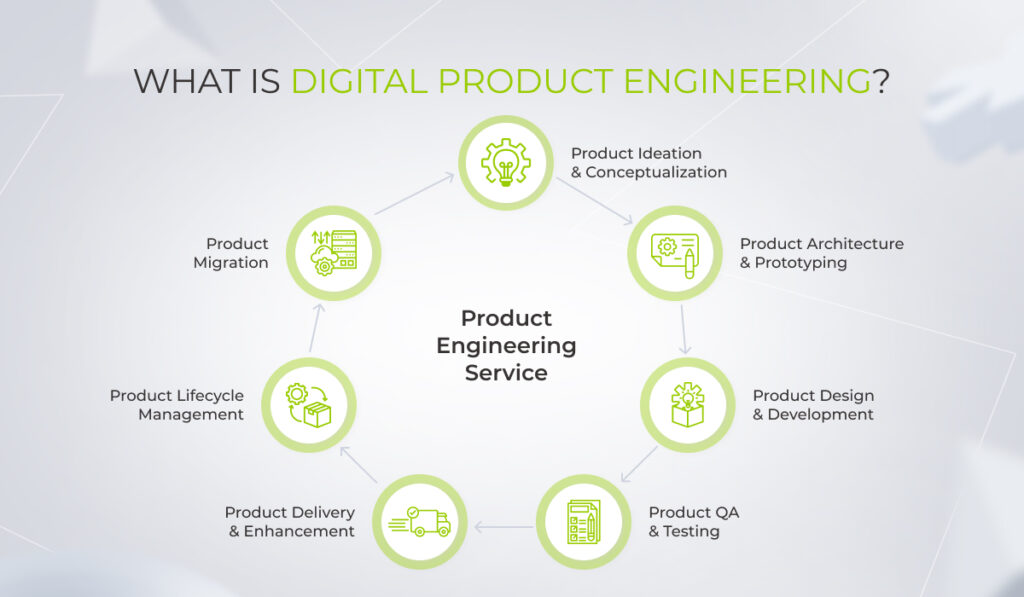
Need a team of product development pros?

Reach out!

Key artifacts of efficient product management

To ship the right product successfully to users, your team has to be guided by lighthouses, or artifacts, that refer to project documents, outputs, and specific deliverables. Let’s see the core landmarks that indicate your product management is on the right track.

ArtifactMeaningDocument contents
Competitive analysisDescription of your business’s target market.– Direct/indirect competitors
– Market share and average revenues
– Industry benchmarks
– Monetization models, etc.
Product visionOutlines the long-term mission of your product. – Business goals
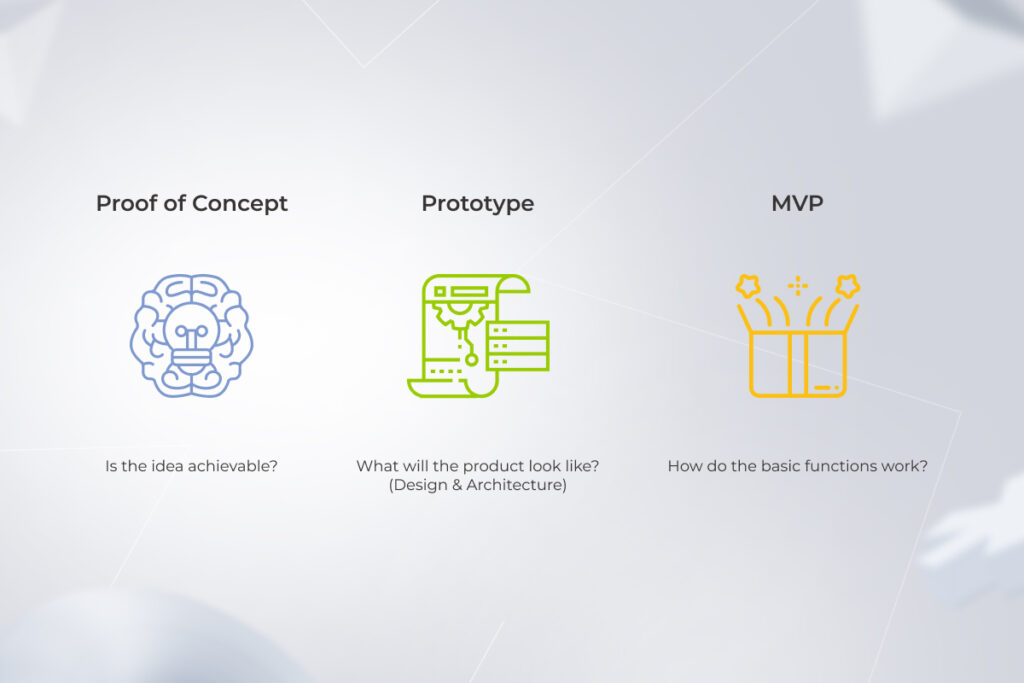
– Target audience and needs
– High-level product description
OKRs and KPIsIncludes performance measurement values.– KPI description and measures
– Objectives and Key Results 
Product roadmapDescribes a detailed vision and direction for a product. 
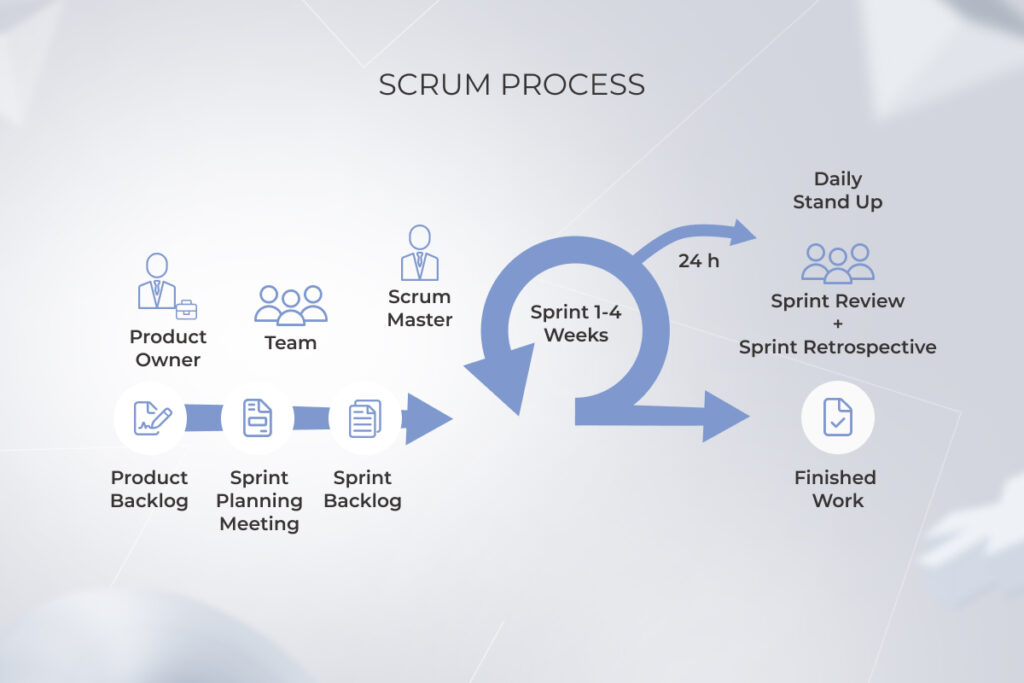
– Product features
– Release schedule
– Short- and long-term goals
– Product features and milestones
Customer Journey MapIllustrates the stages users go through when interacting with your product.– User persona
– User actions
– Touchpoints
– Pain points
Product Requirements DocumentDefines the necessary features and functionality of a product.– MVP features list
– Engineering implementation details
– Functional requirements
– Product development timeline
Product designs and prototyping documentsCovers all aspects of your product design.– User flow and design
– User stories
– Project specifics
Product release planProvides details of all the features of an upcoming product release.– Upcoming features and enhancements
– Timeline

Back in the day, product development firms managed the entire process from ideation to delivery onshore. But supporting the entire process from A to Z is becoming increasingly expensive and counter-productive. As a result, 79% of companies outsource their IT projects.

With offshore software product development, businesses access a global pool of talent at lower costs. Besides getting expertise that might not be available in your country, you can also tap into the latest technologies to ensure the best quality for your product. 

We at *instinctools take over end-to-end product development projects, allowing you to leverage leading-edge expertise, drive down development costs, and build a high-quality product hassle-free.

Mastering software product development process: from ideation to excellence

It takes a lot to create impactful products that win over customers. A properly structured software product development process is half the battle when it comes to success. An Agile-first, customer-centered, and client-oriented workflow, managed by a dedicated development team, grants you better control, improves project predictability, and saves your resources.

Deliver innovative products with ease

Get in touch!

FAQ

What is the product development process in software?

It’s a multi-step process designed to take a product from the initial concept to the final market launch.

What is Agile software product development?

It is an incremental approach to software development that focuses on shipping digital products in a timely and effective manner. The Agile-based process is characterized by short development cycles, or sprints, that allow for quick feedback and constant evolution of the product.

Is Agile only for product development?

This philosophy isn’t limited to building products. The Agile mentality and Agile-driven methods are also helpful in the development and management of services.

What are the 4 pillars of Agile?

This management approach is founded on four key principles:
1. Processes and tools are no replacement for individuals.
2. A functional product is more important than detailed documentation.
3. A collaborative solution is better than a rigid contract.
4. The team should welcome change.

What is the Agile software development life cycle?

The software product development process flow flow can be roughly divided into five phases, including conceptualization, inception, development, release, and maintenance. Each phase leads to the creation of numerous software iterations.

Revealing EdTech Trends That Shape the Future of Education

How will education evolve in 2025 and beyond, and where does that leave educational institutions and edtech companies? Discover the biggest EdTech trends to shape the industry.

Education is one of the few industries that inimitably resists change and ignores the needs of its stakeholders.

To illustrate this, it is enough to trace how school was adjusting to the ever-transforming world over the last hundred years. In short, it wasn’t. From the early 1900s up to pre-pandemic times — the same designated classrooms, the same teachers towering over the audience, and the same students performing the role of silent listeners.

schools from 1910s to 1950s to 2010s

The situation with higher and postgraduate education was not much better. However, 2020 made the industry develop at an overwhelming pace. On-site learning, the role of the teacher as the main expert and content provider, and one-fits-all approach — all these pillars that had supported education for centuries fell. So what are going to be the next ones to take their place? Here are some of the top trends in education technology to look out for in 2025.

What does the future hold? EdTech ideas

While the world outside classrooms is changing faster and faster, we aim to create a new model of education suited to the needs of the future that’s coming. Technology let the genie out of the bottle, allowing ideas that have been brewing for quite a while, evolve and be implemented at breakneck speed.

The total market for eLearning worldwide (in billion U.S. dollars)

1. Hybrid learning is here to stay

Although the idea of hybrid learning gained its momentum back during the first COVID-19 outbreak, it’s naive to think that it’ll go away any time soon. With so much money spent on the transition to eLearning (devices, infrastructure, etc.), educational institutions want to get more out of their investments. So rather than being a fleeting thing just for the pandemic, hybrid learning becomes a long-lasting movement that has provided a new setting for other education technology trends to occur. 

Shaping this new landscape for more groundbreaking ideas to be implemented and thrive, hybrid learning is not in a perfect shape itself. At the beginning of 2020, when the world was suddenly awoken to one of the dystopian scenarios of the future, the pain points of education that had remained unnoticed for so long, had to be dealt with immediately. With such a rapid and abrupt shift from in-person to remote learning, making a bunch of mistakes was unavoidable. Some teachers, for example, state that switching to a partially online format has doubled their workload. 

“With the amount of stuff we are juggling, it feels like it’s impossible to always kind of keep your head above water. The sort of administrative stuff really piles up. So even if we’re doing our best, we’re still dropping balls left and right,” says Kristine Harootunian, a math teacher at South Burlington High, Williston, Vermont.

Does it mean though that we need to give up on the idea of teaching children outside the classroom? Not at all. One of the possible solutions might be the use of refined learning management systems (LMS). They simplify lesson-building for educators, allow them to  consolidate administrative tasks in one place, automate routine, and offer access anywhere. Yet, so far, LMS have been more about management and less about learning, but the balance can be found.

Thanks to technology advancements, the LMS of tomorrow has every chance to turn into truly intelligent learning platforms. Whether we think about employees in a workplace setting, or kids in a classroom talking about a new lesson, people need both social interaction and some solitary work in order to successfully learn everything from a formal course. xAPI (Experience API) makes it possible to measure all types of learning experiences, and it can do so within an LMS. So it’s just a matter of time until xAPI becomes a standard for all learning management systems.

2. Creating life-long learning experience

With the ever-growing demand for new skills conditioned by rapid world changes, learners have been put under pressure of continuous acquisition of new skills. Those who are not agile enough to adjust will end up on the sidelines of their career opportunities.

The problem with the current state of things is that the education levels are absurdly detached from each other. What students are taught in high school barely correlates with what they do at college or university, just as getting a degree doesn’t guarantee that their knowledge will be applicable in the workplace.

But an EdTech company that’ll break these silos and find the way to navigate learners throughout their life-long educational process could become the next Netflix for educational systems. Sounds impossible? Until it’s done. 

Most breakthroughs once started with a ‘what if?’ question. So what if there was a system that would ‘meet’ a learner at a pre-school and help acquire the skills (alphabet, numbers, colors, etc.) appropriate for this developmental stage. Imagine that the system can link a kid’s school and home accounts so that the progress could be more easily tracked. The same model can work for K-12, and apart from supporting pupils in their studies, it will be able to track not only what is being learned but also how, and, thus, ensure smooth transition from school classes to assignments done at home. Thanks to predictive analytics, the system will also anticipate the student’s future needs and advise on the right college to apply to, and, when the time comes, all the data gathered in the system could be very helpful to match with employers. 

As the range of the user’s devices extends (a smart speaker, smart phone, laptop), all the apps track the learner’s progress collectively, delivering perfectly calibrated lessons via audio mini-lessons, or quizzes, or games.

Once a job has been landed, the person’s account can be connected to the employer’s LMS and ensure appropriate professional development. The best thing about the system is that it evolves along with the user, adjusting to their changing needs.

Machine learning (ML) technology makes it possible to build an educational system that will grow and mature with the user, using the data gathered from them for unprecedented customization. Throughout their whole lives people will be able to leverage a smart system’s assistance, which is especially beneficial for those, who suddenly find themselves needing to switch jobs or even industries.

EdTech companies can start moving in this direction by partnering with a vendor that already has expertise in building strategies for educational system development, data analytics, and experience design. 

3. Reversing the lecture-homework routine with flipped learning

A flipped classroom overturns conventional learning by focusing on practical content that is delivered online and often outside the classroom. It leads to more collaborative environments as students get an opportunity to interact with each other instead of being silent listeners to what their teachers say.

traditional teaching vs. flipped focus

By removing the one-size-fits-all lecture from the classroom and allowing students to have a self-paced lecture at home, they are encouraged to do the actual work in the classroom, interacting with their teacher and classmates. 

Technology is used to humanize the classroom.

Such an approach encourages experimentation, whereas the traditional model doesn’t have time for that. It overconcentrates on the result, missing though that the truly great result can’t be achieved without experimentation and failure.

The technology makes flipped learning not only possible but genuinely effective. Its concept is not limited to simply recording videos and letting students watch them as many times as they’d like. The whole idea is that learning should be based on well-thought-out software ideally bolstered with BI dashboards to help teachers track their students’ academic progress. You can convert the entire curriculum along with the data on students’ performance into the form of a dashboard.

Let’s take a look at how it’s done at Khan Academy.

an example of flipped learning

Every row is a student, every column is one of the concepts within a discipline. Green means that students are already proficient, blue means they are working on it, red indicates they are stuck. With this solution, teachers can easily decipher which kids need their active participation or, even better, which can be tutored by their “green-area” peers. Interestingly enough, it seamlessly flows into another education tech trend – peer-to-peer learning. The idea is not cutting-edge in itself, but with the help of technology it has reached a whole new level. Peer-to-peer learning goes beyond the classroom and becomes a global platform where students from different corners of the world can tutor each other, expanding their minds.

an example of peer-to-peer learning
A circular progress chart for a math exercise on dividing decimals, displaying completion stats and categories

Getting back to flipped learning, it’s worth mentioning that with so much data about students wrapped into comprehensible dashboards, educators can make the process as productive as possible. Teachers know exactly what students are up to: how long they’ve been spending watching videos, when they pause videos, when they stop watching, what exercises they do, the areas they focus on. The data is pretty granular so that the teacher can see where a student’s Achilles’ heel is.

As valuable as this model is at secondary schools, imagine what it does for adult learners who might be embarrassed to learn stuff they think they should have learned ages ago or to a kid from a disadvantaged community, who doesn’t have the opportunity to attend a brick-and-mortar school on a daily basis.  

Furthermore, in a traditional model, teachers spend most of their time doing lectures, grading, and whatnot, whereas in a flipped classroom, the student-to-valuable-human-time-with-the-teacher ratio increases.

4. Scaling up personalization with adaptive learning

The model of education we have now is a mass production model, a factory model. It doesn’t provide any individualized experience.

In a personalized school, each child defines their own learning path in a way that feels natural. Technologies play a foundational role here versus a superficial role in a traditional model. 

Adaptive learning software uses Artificial Intelligence to move students up and down through a grade’s level content based on their performance.

For example, in AltSchool, there are two main tools that enable personalization. The first one, called “portrait”, is a student’s profile. It is a representation of all things that are important about each child, with the data being constantly updated to curate the day-to-day education experience. The second tool – “playlist” – is kind of a basis for each child’s day. It contains a to-do list and a calendar, and allows each child to decide in what order they want to do things, and, as they get older they are allowed to choose what’s on that playlist. 

Apart from significant academic progress validated by national tests, kids advance in their ability to work with others and manage their time, set goals, and think critically so that they can successfully enter a working world that demands these characteristics from them.

Adaptive learning is a win-win both for teachers, who get the possibility to refocus their attention from simply giving instructions to curriculum design, motivation, mentoring, and students as they are given the chance to explore the subject through the prism of their personal interest and abilities.

The idea of eliminating the one-size-fits-all approach and ‘meeting students where they are’ can be applied to learners of different ages. But the earlier it’s integrated in the learning process, the better and faster results can be expected.

“We focus on the practical application of AI in tasks related to scientific work or tasks that students will later perform in their jobs. We can be flexible in the design and launch of programs, meaning that we can respond quickly to student needs for upskilling or reskilling and add to our portfolio of courses,” says Dr. Sven Schütt, CEO of the European university group IU Group (IUG), explaining how they leverage gen AI to fulfill the ‘education-for-all’ principle.

The recipe for a groundbreaking educational platform

The reason why a lot of outstanding education ideas fell on deaf ears was not so much in the reluctance to change something, but rather in the impossibility of realizing the change. After all, it is only a technological breakthrough that makes these ideas feasible.

Unleash the potential of cloud-based infrastructure

Cloud technology gained its momentum in education during the lockdown, as lots of schools didn’t have infrastructure built to support remote learning. Admittedly, cloud-based environments provide hassle-free solutions for deployment, management and safety administration, leaving more room for consistent learning experiences instead.

Speaking of safety, it wouldn’t be amiss to mention that back in the pre-pandemic times, many schools used to store their data in-house in file cabinets, and it was easy enough for someone to take a file and walk out with that data. Now, when adopting the cloud and partnering with reliable cloud vendors who adhere to the strictest security guidelines, school tech directors can be sure that school data is adequately protected.

The up-and-coming EdTech trend of cloud adoption is not likely to stop growing in popularity. On the contrary, it’ll maintain its foothold in education thanks to its ability to access work from any device and the ease of scaling deployed applications to meet students’ needs.

Ensure data privacy

Cybersecurity has been a hot topic in the education sector since the ‘record-breaking’ 2020. Cyberattacks have hit schools and colleges really hard and cost educational institutions millions of dollars.

Some of the most popular cybersecurity tools to surface in response to these cyberattacks are next-generation protections powered by AI and ML. These include endpoint security solutions and next-generation firewalls. Security orchestration, automation and response tools specifically use automation to detect and remediate possible cybersecurity breaches. 

The automated component in SOAR (Security Orchestration, Automation, and Response) helps make cybersecurity more manageable for understaffed IT teams in K–12 environments. Incorporating multifactor authentication is also strongly recommended.

Not only has the number of cyberthreats increased greatly, but the requirements to educational institutions in terms of data protection have become more rigid too. As schools and universities process many types of data, they need to comply with requirements that also apply to healthcare, financial, and government organizations. FEPRA, HEOA, PPRA, GDPR are just some of the regulations that educational organizations have to follow. And, yet, the authorities go even further to mitigate the risks of exposing personal data. In October, 2021, the US President Joe Biden signed the K-12 Cybersecurity Act, which is the first cybersecurity-focused law for secondary schools.

This type of regulatory compliance is becoming more challenging for educational institutions of all kinds, which makes it extremely important to choose a tech partner able to protect your software from breaches and data losses as well as develop solutions in strict compliance with the current data management regulations and major quality standards.

Add value to the learning process with Extended Reality (XR)

While more people have got access to knowledge, the current approach to education has two significant problems. First of all, teaching is still based on fact retention, whereas being informed is not the same as being educated. And, secondly, the old ways of providing information make it difficult for some students (especially those with ADHD, that is 10.5% of children in the US according to the latest data) to comprehend it. Struggling to process and memorize large amounts of information can become extremely disengaging. This applies to all types of learners, whether it’s in a school setting, on a workplace training course, or in lifelong learning.

The possibilities of XR, an umbrella term that covers Augmented Reality (AR), Virtual Reality (VR), and Mixed Reality (MR), empower students to stay inside their learning process with full control over their experience.

AR/VR technologies are a promising addition to the EdTech space due to their immersive nature, ability to share information in new and engaging ways, and potential to offer virtual experiences that can mitigate barriers from cost or distance.

The concept of the traditional educational classroom has gone stale and will eventually be swapped with the idea of a ‘global class’. Students will hardly opt against an opportunity to learn science on the International Space Station with their peers from all over the world, or shrinking to the size of a DNA strand to collaboratively manipulate molecules in a virtual hands-on way, or traveling back in time to explore ancient Rome and role-play out important historic events.

The role of XR in K-12 and higher education is going to grow exponentially but it won’t be limited to school or college environments alone. Workplace training will be enhanced due to this technology as well. For example, the Australian company FLAIM Systems has developed a VR learning solution for training firefighters in hazardous and emergency situations. The same works for lifelong learning. Whatever you want to learn in your everyday life, AR or VR could improve the experience. Take public speaking for example. Award-winning VR provider VirtualSpeech has created a VR tool to help people practice public speaking in a near-real way.

Understanding the impact these technologies have on the learning process, EdTech companies spare no expense in VR/AR solutions. According to Statista, the investments in augmented and virtual reality in the education segment will have more than doubled by 2025, and made 700 million dollars, compared to 300 million in 2020. And that’s not to mention, that only in the US, the number of residents who started using VR increased to 65.9 million people in 2023 and the number of AR users jumped to 110.1 million.

If that is not the reason to bolster your education solution with some form of XR, then what is?

Make the educational process easier & more efficient for both teachers and learners with generative Artificial Intelligence (AI)

AI-powered solutions have been among the top EdTech trends for quite a while. A plethora of opportunities, from task automation and smart content creation to personalized learning and 24/7 assistance, have become available for both students and teachers. Despite drastic shifts having already been done so far, Artificial Intelligence, NLP algorithms, and large language models (LLMs) show no signs of slowing down their rapid transformation of education, bringing even more promising developmental perspectives to the table.

  • Gen AI-assisted immersive classrooms

The combined power of Artificial Intelligence and the technology of extended reality allowed IBM Research and Rensselaer Polytechnic Institute to create a next generation teaching environment, providing a study-abroad-like experience with no travel required. The students learn Mandarin Chinese by conversing with AI avatars that can recognize not only what they say but their gestures and expressions, all against a computer-generated backdrop of Chinese street markets, restaurants and other scenes. 

“Students in the immersion lab mastered Mandarin about twice as fast as their counterparts in conventional classrooms,” assures Shirley Ann Jackson, the president of Rensselaer.

  • Proactive chatbots 

Designed to simplify the interaction between the participants of the educational process, chatbots provide a wide range of benefits, including spaced interval learning, immediate feedback, performance tracking, and, in the case of schoolchildren, communication with parents. AI assistants are also being used to watch for signs that students might be struggling, and to alert their academic advisers.

“If we could catch early signals, we could go to them much earlier and say, ‘Hey, you’re still in the window’ to pass,” says Donna Kidwell, CTO of the university’s digital teaching and learning lab, EdPlus.

Besides shaping a personalized learning experience for schoolchildren and students, tools like virtual assistants help facilities. For instance, data gathered from the gen AI-driven software empowers methodologists to clarify and enhance course materials. 

how AI-powered chatbots improve the learning process for teachers, students, and parents
  • AI grading 

NLP algorithms are powerful enough to assess students’ written responses and provide real-time feedback. It can be applied to online courses with thousands of students studying simultaneously.

Stanford researchers built a neural network that spent hours analyzing examples from old exams on computer programming, learning from a decade of possibilities. When given just a handful of extra examples from the new exam offered, it could quickly grasp the task. After the new exam had been taken, the system provided 16,000 pieces of feedback, and students agreed with the feedback 97.9 percent of the time. To compare, students agreed with the feedback from human instructors 96.7 percent of the time.

As you can see, coming up with ideas for leveling up studying and teaching experience with gen AI isn’t challenging. The tricky part is laying a safe, trustworthy, and ethical foundation for technology adoption, omitting AI-related risks. A UNESCO survey unveiled that only 13% of educational institutions worldwide established clear guidance regarding using gen AI applications.  

Having an AI-literate tech partner by your side will help you set up a transparent, explainable, and secure AI system and draw up robust policies.

Turn to gamification to engage young learners

Adults are often puzzled as to if children are able to store whole databases in their heads about a universe within a computer game, then why do they have so much trouble with the multiplication table? The trick is in constant practice and gamification, that makes the process truly engaging.

Education has long had, in a sense, elements of a game: good and bad grades for completing an assignment are like points in finishing a quest. And at the end of a school year, everyone has a Level Up, the transition to the next level of difficulty.

Speaking of gamification, as one of the trends in education technology, we no longer mean basic stuff that has existed for quite a while.

In online projects, gamification is much more complex. Originally structured programs, coupled, for example, with a detective story, make the learning process more engaging, children want to return to classes regularly and learn new things. For completing tasks, achieving goals, as in a computer game, they can receive points, additional rewards, and enter new levels.

The theoretical knowledge that students gain in class, can be immediately applied when they complete game challenges. This helps children look at knowledge and learning in general from an entirely different perspective.

The main benefit of gamified online learning is the motivation to learn. Students can see and self-evaluate their progress and achievement of the goals set. This helps nurture such qualities as independence, responsibility, and decision-making. For example, at the 

University of California, one study found that students who participated in an educational cybersports program showed much more impressive learning results than their peers, who are not involved in esports.

Drive the mission of learning with mobile technology

According to figures from the tech research company, Technavio, the education apps market is poised to grow by $6.08 billion and is estimated to grow at a CAGR of 14.5% between 2024 and 2029. All signs point to a permanent shift in how people access education.

For Generation Z, also known as generation digital, who learnt how to type before they learnt to write, using smartphones or tablets for their studies is as natural as breathing. They value the freedom that comes with mobile apps to study whenever and wherever, and willingly pay for it with a high level of engagement.

However, the education technology trend of mobile learning applies not only to Zoomers. For the past few years, mLearning has flipped the view of delivering quality content. You’ve probably heard of MasterClass, an online learning platform that allows taking classes from some of the biggest names in the business. It offers a multitude of options to consume their courses, you can watch it on a desktop, TV, phone, or tablet. Still, being more about “edutainment” rather than strictly education, MasterClass is something you’re not going to turn on your computer for (unless it’s already turned on), but are more likely to open on a smartphone or tablet sitting in a traffic jam, lining up in a coffee shop, or passing that quarter of an hour before falling asleep at night. A great-quality mobile application, Android and iOS users have rated the apps with great feedback (4.8 and 4.9 respectively for the platforms), is definitely one of the clues that contributes to the success of this costly platform.

Moreover, mobile learning complements the idea of bite-sized lessons that can seamlessly fit into your schedule, which in turn makes the subscription-based educational model more attractive. When students don’t have to wait for that perfect time (which may never come) to start or continue the course and can study “right here right now”, they won’t feel as if they are blowing their money. 

In addition, mobile technology not only makes learning more comfortable for those who can’t imagine their lives without a smartphone or tablet, but also makes it the only option for people who otherwise wouldn’t have access to educational resources.

Education is the mission and mobile is the means.

Smartphones are now available to a large part of the world’s population, in the future perhaps to the majority, even in the least developed countries. The spread and cheapening of technology, as UNESCO notes, “gives marginalized people and communities, people with disabilities, refugees, those out of school, and those living in isolated communities access to appropriate learning opportunities’’, making education global and crisis-resistant.

how EdTech solutions transform the use of smartphones and tablets from passive to active

Engaging, sophisticated, and, most importantly, effective education will always resonate with learners. But it’s not enough. A VUCA world (short for volatility, uncertainty, complexity, and ambiguity) gives us little faith that things will stay the way they are, which means the only correct strategy is to be flexible and agile. Education – at all levels – must evolve to teach people the skills they need to thrive in our changing world. 

Understand students’ needs and adapt to how, what, and where they learn

Let’s discuss

Offshore Development Center: Taking Offshoring to the Next Level

When economic turmoil takes a toll on the outlook of business innovation, an offshore development center appears to be the backbone of cost-efficient technological advancements. 

The already tough situation gets even more complicated due to huge IT skill gaps. Out of about four million job openings in the US tech market, 200.000 positions remain unfilled. The lack of talent goes hand in hand with the rising costs of technological innovation. To battle all-time high salaries and a talent crunch, organizations move technology production to other, more cost-efficient locations.

Outsourcing has been a well-established practice in pre-pandemic times and will continue its reign for years beyond. The rationale is simple: why would you pay $125K to get your software built in the US if you can hire a developer for $36K in Poland? After all, 2020 forced all of us to switch to remote collaboration mode.

But can an offshore development team suffice multiple long-term innovation imperatives? Unfortunately, the answer is probably no, so you might need another option.

What is an offshore development center?

An offshore development center (ODC) refers to an overseas development facility with a cross-functional team, the required office equipment and amenities, and fully managed processes — all tailored to the needs of a client. Opening an overseas development center allows you to save development budgets, accelerate time to market, and grow your market reach even if you face a lack of talent in your country.

Dedicated team as your first step to the offshore development center

Most companies don’t have the need to commit to full-grown centers in the early days of outsourcing. In this case, the dedicated team model can act as the middle ground between an IT staff augmentation and offshore software center. A dedicated team helps you counter the headwinds of talent shortages and skill scarcities, but with fewer resources compared to a full-scale offshore development branch.

offshore development center

A dedicated team carries the development process from ideation to completion as an autonomous agile squad allocated exclusively to your business needs and development tasks. This hiring model can cover both end-to-end development and specific processes such as design, testing, or business analysis.

Regardless of the area of competence, a dedicated development team brings to the table the following value:

  • Self-management and process setup;
  • Relevant expertise and domain knowledge;
  • Focused approach and transparent collaboration;
  • The flexibility and ease of hiring;
  • Bespoke hiring according to your unique job requirements;
  • Reduced cost of innovation as the vendor takes over overhead expenses, hiring costs, training, and employee benefits.

As you see from the impressive list of advantages, this collaboration option works best for long-term software projects with dynamic requirements. But what if you have specific security requirements or have to handle sensitive health or finance data? Or your project is hardware-dependent? In this case, you might find yourself grappling with a whole lot of security, equipment, and other overheads.

The bright prospects of dedicated development also dim when you need a whole software development hub to address your large-scale project needs. Managing a motley crew of 20 dedicated teams across different geographies and time zones becomes more trouble than it is worth. Outsourcing doesn’t seem like such a win-win solution anymore.

Make software dev outsourcing a breeze

Contact the right vendor

When is an offshore development center your best bet?

So how can you build up your outsourcing capabilities and take the hassle out of team management? Go one step further and switch a dedicated team for a dedicated offshore development center. Along with the ease of crewing, an ODC extends your production capacity without increasing the risks.

Here’s when offshore development services can help you reap the biggest benefits.

Your business has special data security requirements

An offshore development center is like a new offshoot of your company, except that it is premised overseas. Therefore, it has everything you’d need in a traditional office to meet the required level of security. A private office space, authorized entry, software access control, and built-in network security make your ODC space the guarded fortress of product development.

As you have a single development unit, you won’t have to hire multiple management security information officers or compliance officers to track compliance adherence and security.

You require bespoke tech expertise

Niche skills might be expensive to secure or nurture unless trained in a more affordable location. Offshore dev centers allow you to set up a training center without spending your resources on third-party upskilling programs. 

In this case, the training course contents are customized to meet company-specific goals and do not expose your organization to additional security risks. In-house training also guarantees the right level of knowledge and is a perfect match for existing technology gaps.

Your project is huge

One-time or minor projects are often better off with a dedicated development unit, while large-scope development initiatives require continuous support, updates, and limitless scaling. An offshore center allows you to establish a continuous loop of delivery and scale your development facilities for multiple projects — all in one place.

You want to achieve more by spending less

If software development is not the core competence of your company, an offshore development location becomes the best option to keep your development costs moderate. ODCs are not typically packed with the same overhead costs that internal offices are. This way you get to reduce expenses such as office space rent, infrastructure, electricity bills, office maintenance, and, most importantly, salaries and taxes.

Unbeatable triad: benefits of offshore development services

You know there’s something to it when A-list companies resort to offshore development offices. Google, Microsoft, Apple Inc, and other giants have their technology development sites located in other countries, far away from their head offices. So, why do forward-looking businesses flock to offshore teams? We have the answer.

Providing domain expertise and vetted specialists at a lower cost

Offshore development services allow you to tap into the global talent pool, whatever the niche or domain knowledge you need. While your in-house candidate base is limited by geography, an ODC vendor has access to an infinite supply of vetted candidates from a rich, local talent database.

As ODC offices are typically premised in low-cost economies, a vendor helps you secure a local team of professionals at the fraction of the price you’d pay in-house. You don’t also have to deal with the pain of hiring and onboarding a new team, leave, insurance, and other employee costs, which significantly lowers your bill.

Taking care of complex administrative functions

From a legal standpoint, establishing an offshore development center requires you to create a new legal entity. However, you don’t need a degree in Legal Studies to make that happen. Instead, your local ODC partner does the heavy lifting of legal regulations, taxes, HR-related issues, and other administrative burdens.

It also means that you don’t have to dispatch operational resources overseas to solve issues like office renovations and payroll taxes or wade through the jungle of local laws and business processes.

Ensuring full compliance with your requirements

An offshore software team operates in full compliance with your industry regulations following documented development processes. As the team augments your in-house unit, you have full control over its performance and every operation of your projects. Moreover, an offshore software development office gets certified and audited in line with your specifications.

Investing in your own offshore development center: is the game worth the candle?

Offshore development centers have got a lot in store for fast-growing companies. However, you must go a long way to create a development center in an overseas location, especially if you decide to go on your own.

offshore development center

Choose your ODC destination

You first need to decide on the optimal location of your offshore development center. There are a lot of factors to take into consideration — from the tax policy to the English language proficiency.

A professional consultant is needed to help you look into the legalities of a business entity and select the right legal structure.

Once you’ve decided on a legal form, you need to submit a package of documents to the territorial registration authority for state registration.

Find, rent, and renovate an office

After all the paperwork is done, you have to find a workspace for your offshore unit. In most cases, the office will need renovation, new equipment, and other office materials.

Grapple with the local tax system

Now it’s time to dive into the tax mystery and find out more about your tax liabilities.

Hire recruiters, administrative, and support staff

As it’s a full-fledged office, your center requires trained personnel to take care of the workspace and handle your business processes.

Run a brand-building campaign

When you’re all set, your new branch needs some exposure to establish its market presence and get a headstart in the unknown business landscape.

Recruit and retain developers

And now, if you’re persistent enough to complete this arc, you get the final prize — the never-ending dread of hiring local specialists from the uncharted local market.

By this time, you might think that initiating an overseas office is an overlong, expensive, and challenging endeavor. You’re right, it is. But it doesn’t have to be if you have a trusted ODC vendor onboard that has a decade-long experience in setting up offshore centers. In this case, your responsibility area (and expenses) shrinks down to choosing your ODC location and validating completed tasks.

offshore development center

Looking for an experienced ODC vendor?

You’ve got one

What location to choose for your offshore software development center?

When scaling beyond borders with an ODC, the location choice can either make or break your undertaking. An ideal destination should offer a sizable talent market not to limit the growth of your center. The price-value ratio is also important to gain from the new office and innovate at lower costs. Moreover, your ODC team must be on the same wavelength as you, which is impossible with cultural and language gaps.

Eastern and Central Europe is traditionally considered to be a cost-affordable offshoring mecca. This is why Bulgaria, Romania, and Poland are among the most favored offshoring locations where all criteria are aligned. So let’s have a closer look at one of the leaders — Poland.

Extensive developers’ skill sets

Poland is home to software developers with high proficiency in multidisciplinary fields. The expertise and knowledge of Polish software engineers have earned them third place among locations with top developers. Moreover, Poland hosts the largest IT talent pool in Europe with over 400,000 IT professionals on the market, which makes this location a key IT powerhouse.

offshore development center

Dynamically growing IT market

While being a mature outsourcing market, Poland continues to gain more steam in the IT sector. According to Statista, the revenue in both IT and IT outsourcing markets has followed the growth trajectory over the last few years.

offshore development center

The country’s IT services market increased to a projected $6.45 billion in 2022, with outsourcing being the largest segment, valued at $2.29 billion. The resilient economy of Poland contributes to the overall image of a breeding business ground.

Strategic location in Europe

Poland’s EU positioning translates into a convenient time zone. Warsaw has a six-hour time difference from New York, which allows software providers to deal with their clients’ requests without delay. To put it into perspective, India is up to 12 hours away from the USA. As for other countries, such as the UK and the rest of Europe, Poland’s prime location allows for frictionless communication with no time lags.

Low development costs

Unlike other Western European countries, Poland offers vetted talent at affordable rates. According to PayScale, the average yearly rate for Poland-based software engineers stands at over $21,000 per year, while the average US developer is paid x6 times more. 

However, lower rates do not come at the cost of lower quality. Instead, the quality of software development is on the same or higher level than in top-paid locations. 

Compliance with EU and US data protection standards

Due to its strategic location, Poland is subject to the same data protection regulations as other EU countries, such as Germany or the Netherlands. Hence, the data protection regime in Poland is mostly governed by the General Data Protection Regulation or GDPR, a well-known compliance standard for EU companies.

HIPAA certification is also commonplace in the country, validating the skills of Certified HIPAA Professionals (CHPs), Certified HIPAA Administrators (CHAs), and Certified HIPAA Security Specialists (CHSSs). This means that compliance-wise, Poland stands on par with EU- and US-based organizations, suggesting high compliance literacy of local developers.

No communication gaps

Poland is a part of European culture, so there’s no cultural gap between the team and the client. The influence of European culture in Poland is combined with the global mindset of operating businesses. Therefore, business operations aren’t compromised when local teams communicate with people from different backgrounds.

Moreover, the country is well-known for its outstanding English proficiency. According to the EF English Proficiency Index, Poland ranks 11th out of 100 counties in the world for the knowledge of the English language. So as long as you speak English, you’ll be fully aligned with your Poland-based ODC team.

Mature R&D hub

Global tech leaders, including Microsoft, Google, Oracle, and others have located their research and development centers (R&Ds) in Poland. It proves that this ODC location offers a mature, affordable, and tax-friendly outsourcing framework that encourages foreign investment for the development of innovative products.

However, even the best setting can be rendered ineffective with the wrong team onboard. Therefore, the choice of a reputable and experienced partner is yet the most important success factor for establishing your foreign presence.

Setting up an ODC in Poland?

Consult an expert

What to look for when choosing a vendor for offshore development services?

The stakes are high when it comes to confiding a fully functional business unit to a third party. It means that your ODC partner should act as an extension of your company, know the ins and outs of your domain, and keep your business bar high.

And the easiest way to forecast the reliability of your offshore development center vendor is to look at its track record. The more ODC projects they have under their belt, the more likely your initiative to pan out. Here are some other ways you can validate the credibility of your partner.

Evaluate IT expertise

Besides English, your team should speak the language of innovation to power your products with the latest technologies. Usually, the main reason for one business to resort to a third party is the lack of high costs of technical knowledge and domain expertise on site. For instance, a company wanting to drive digital transformation doesn’t have what it takes to build a BI and analytics system, so they farm out the function to the vendor.

On this front, you should consider the particular tech stack and the focused domains that you are interested in. For example, *instinctools is a great fit for cloud-based projects (with Google Cloud, Microsoft Azure, and OVHcloud partnerships under our belt), custom enterprise software development, and Business Intelligence powered by Power BI, Tableau, and Qlik. On top of our tech expertise, we also offer a wide array of consulting services crowned with an end-to-end technology-enabled business transformation.

Besides the broad and in-depth technical knowledge, your partner should know the ins and outs of your industry to align technology with business value. With domain expertise, developers can also contribute on a conceptual level and minimize development risks. We, at *instinctools, have accumulated extensive industry proficiency that spans virtually all domains — from manufacturing to healthcare to entertainment.

Investigate relevant experience

No matter how far and wide your vendor’s technology command spans, it’s feeble without real-world experience. Therefore, the best way to set up your initiative for success is to drill down into the vendor’s portfolio. 

Ideally, the portfolio should feature similar projects in the same or an adjacent domain. Make sure that your selected partner also boasts hands-on experience in establishing offshore development centers and associated processes.

You can also reach out to the partner directly if you cannot find relevant projects — not all projects end up in the Clients section due to confidentiality issues. Client testimonials on Clutch, GoodFirms, and other directories can also give you an idea of the vendor’s maturity.

Focus on cost-effectiveness, not cost

A fully managed operational center holds great promise in terms of lower development expenses and ease of management. However, only a few deals grow into worthwhile investments, and the ODC model is no exception. Low-cost labor is often a key element of price calculations, yet is not the only one to help assess the viability of the offshore development center idea.

In some cases, procurement, project management, travel, and other hidden costs may backfire and get your cost gains to zero. So, the key to landing the right development partner is to understand the value you expect to generate from the offshore center and to correlate this value with the involved effort and investment.

Going beyond cost borders with offshore software development center

The competitive market dynamic cripples any business that isn’t fast enough to adapt and accelerate growth. To maintain a competitive edge, companies accelerate their technological initiatives and supplement traditional services with digital-first experiences. 

However, digital transformation is a costly journey unless taken to a more affordable setting. Offshore development centers help companies innovate and scale their technological offers at lower costs and less administrative hassle.

But despite the outward glitter, an ODC idea has a specific application area and doesn’t cater to all needs. Large-scale projects, niche skills, high-security requirements, and clear economic gain in your particular situation should be the main precursors to setting up a fully operational center in another country.

Scale beyond borders

Contact an ODC partner
Anna Vasilevskaya
AI modified real photo
Anna Vasilevskaya
Account Executive

Get in touch

Drop us a line about your project at
[email protected] or via the contact
form below, and we will contact you soon.