Managing numerous in-house and outsourced development teams within a long-term strategic partnership is too big of a burden to bear. Who on earth can seamlessly assemble project teams, establish smooth communication between them, mitigate risks, and give strategic advice on software development at a scale of two and more full-fledged projects?
A software delivery manager can become your silver bullet for dealing with a diverse range of challenges. What value does this role bring to a project, and in which scenarios is a need for a service delivery manager non-negotiable?
Our leading delivery managers and the head of the Delivery unit have given in-depth, yet easy-to-grasp answers to those questions.
Who is a software delivery manager?
The delivery manager (DM) at the software services company is a multifaceted expert, who ensures the client gets a digital product that fully meets both technological and business expectations. The cooperation spans overvarious projects.
Usually, delivery managers are senior and lead specialists with tech, strategizing, and project coordination backgrounds and have 8+ years of proven experience in a managing position.
A role with such an impressive track record may look like an eye-catching marketing hook that turns into a pumpkin the moment those delivery management specialists have to deal with real-life head-scratchers on the projects. So do those unicorns even exist?
Professionals whose background and accomplishments speak for themselves arise in companies known for decades-long experience in digital product engineering and building their own delivery frameworks.
Four scenarios when a service delivery manager is a mandatory role
As a DM has a knack for tackling a broad range of tasks, this role will resonate with your needs in several cases.
Have several project teams.
The delivery manager is at the helm of efficient strategic oversight of different development teams and talent rotation to achieve desirable outcomes.
One of our clients started small, partnering with *instinctools to create an app for in-store consultants. But what began as a single project quickly evolved into a thriving collaboration. Today, we’re supporting them with multiple teams working on a customer-facing mobile app, a custom ERP, an inventory management system, tailored healthcare software for specific countries, and even a website migration from WordPress to Shopify.
Need to align in-house and outsourced development.
With a massive backlog hanging over your head, you might seek support from the outside to bring all your project ideas to life. By delegating some engineering initiatives to dedicated teams outside your company, you’ll need a high-level role, such as a DM, to ensure efficient collaboration between in-house and outsourcing teams.
With a strict trade show deadline and only one sample robot for teams spread across different countries, our client, a robotics manufacturer, was under immense pressure.
When our Delivery Manager noticed the client’s team falling behind schedule, we quickly stepped in to create a custom emulator for robot testing. This solution not only resolved the bottleneck but also accelerated the entire process, ensuring the project stayed on track. It was a testament to how technical expertise and proactive support can turn potential setbacks into success stories.
Require industry-specific knowledge.
A delivery manager with years-long hands-on experience in your business domain or related fields is a guarantee that your projects are moving in the right direction and will bring you the expected results.
This was the case for one of the first white label crypto exchanges in the EAEU countries. To make crypto transactions as reliable and trustworthy as fiat ones, they needed a seasoned tech partner with experience in meeting country-specific crypto regulations and establishing secure integrations with banking and payment systems. Thanks to the industry experts’ commitment, the software seamlessly fit FATF and Visa requirements and passed the Ernst & Young software quality audit.
Look for a long-term strategic partnership.
DM’s participation in planning sessions and their ability to delve into the business and technical aspects of the future digital product and then combine them is a sure-fire way to broaden the horizons for your products and win more customers’ hearts and wallets.
Let’s take one of our AI projects as an example. A Czech bank was eager to ride the wave of conversational AI and sought a top-tier partner to make it happen. We started by enriching their customer support chatbot with NLP and gen AI capabilities. Knowing that the technologies had already stepped further and could deliver more value, the DM suggested taking the chatbot idea to the next level. Hence, we also added a personalized virtual financial advisor feature available for users who gave explicit consent to access some of their profile data.
Software delivery manager responsibilities: everything, everywhere, all at once
Thanks to their battle-tested knowledge of business, tech, project and people management, software delivery managers become universal soldiers capable of handling a medley of tasks.
Setting up several project teams
Delivery managers take care of the aspects that contribute to consistent, high-quality software product delivery and crafting a sustainable solution:
Providing team members with the required skill set and level of expertise
Ensuring flexibility in scaling the development teams up and down
Defining responsibility areas for project managers and tech leads
Establishing smooth and transparent workflows for each project
Creating a dynamic delivery environment with effective communication between in-house and outsourced teams
A delivery manager has a hand in identifying the client’s expectations about the projects and setting up corresponding agreements. Software delivery manager skills enable them to choose the appropriate communication format to keep internal, external, and mixed development teams in the loop.
Having high-level project ownership, the delivery manager continuously and proactively monitors key priority areas, such as client satisfaction and customer expectations.
The delivery manager ensures your projects are rolled out successfully and remain up to par throughout their lifetime.
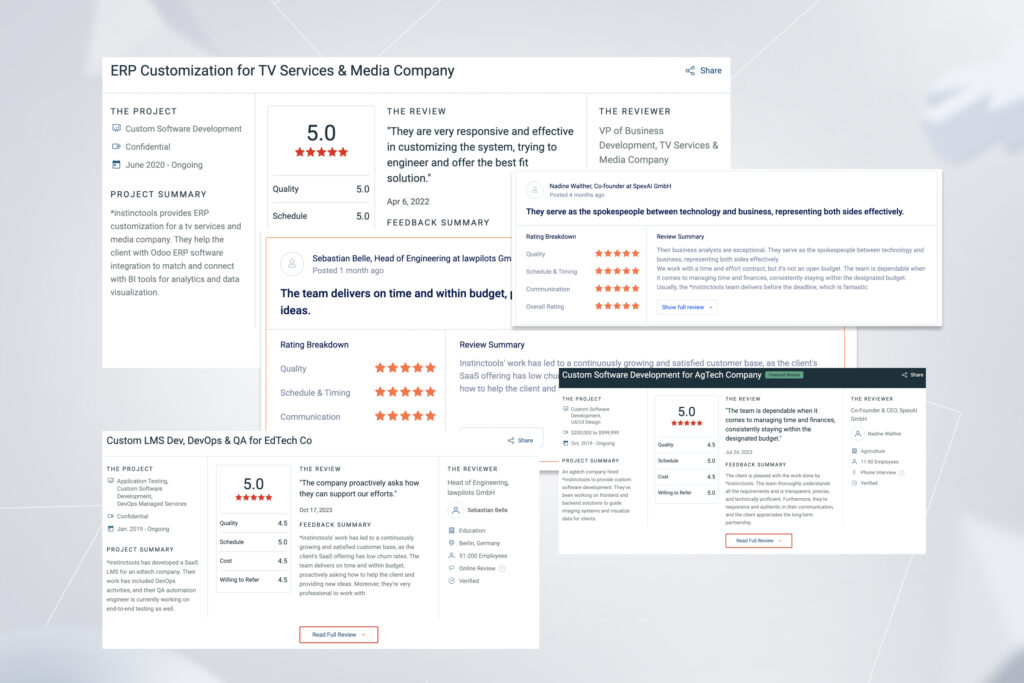
With such an approach, clients can rest assured that all the agreements will be fulfilled, leading to the expected result on time and on budget. Here’s how one of our clients describes cooperation with *instinctools:
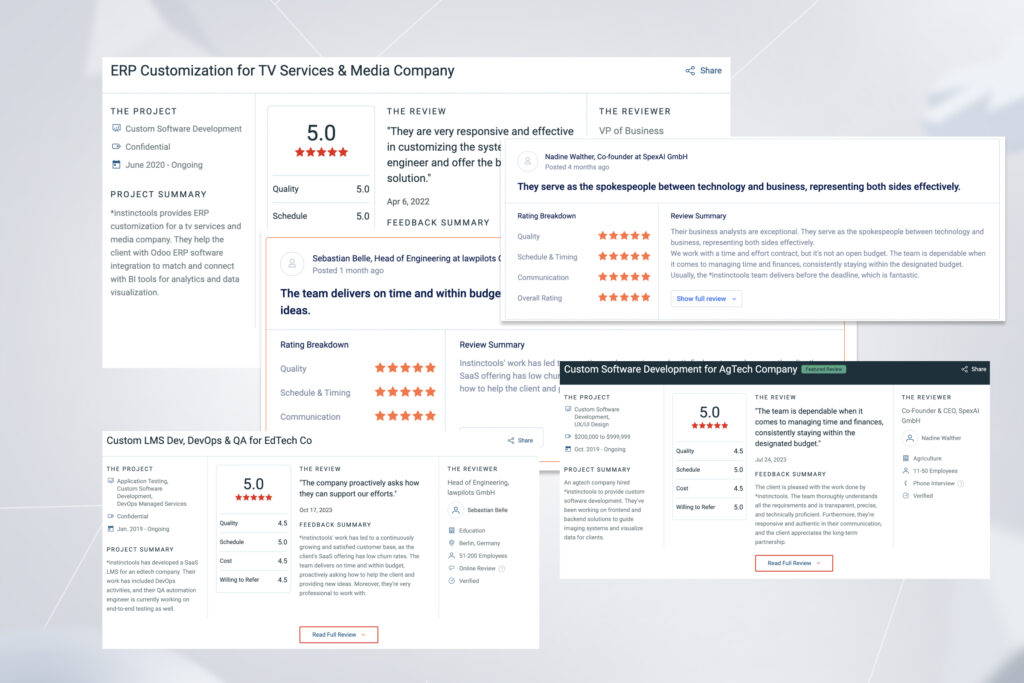
When the partner is good, things are just getting done. And that was the case with *instinctools.
Undertaking strategic planning within the projects’ micro contexts and macro business context
As a tech expert with years of experience and a project management professional, the delivery manager is well-versed in the projects’ business and technical aspects. Moreover, since operational tasks are covered by the project managers and other roles within the dedicated teams, the DM can focus on analyzing the bigger picture.
Through a deep exploration of the client’s business background and domain-specific data, the delivery manager ties the micro-level projects’ contexts and the client’s macro-level business backdrop together to draw up relevant mid- and long-term plans for the projects’ evolution.
Case in point
Hiring a DM with solid domain expertise is one of the ways to fast-track your digital product engineering. Proceeding with the example of the e-health platform for CANet we mentioned earlier, the role of a service delivery manager, skilled in laying hold of the business side and guiding digital healthcare projects, was crucial. The DM quickly got to the heart of the project and brought it to the team, greatly facilitating the whole delivery process.
See the birth of a virtual platform for clinics, research centers, and patients that rewired the monitoring of patients with complex cardiovascular conditions in the entire country. Read the full case study
Uncovering and preventing strategic risks
To help you excel in a risk-prone world, delivery managers:
Scan economic, political, industrial, regulatory, and other external changes
Spot internal risk-bearing issues at the feedback sessions with the client, at the teams’ retrospectives, and during the one-on-one meetings with employees
Evaluate the likelihood and severity of each risk and build a risk matrix for each project
Create comprehensive risk management plans with clearly defined roles and responsibilities within the team
Plan risk scenarios for each case and connect them within the overall company’s resilience agenda
Factor in these risk scenarios to proactively reduce the likelihood or impact of high risks
Update the risk register regularly to reflect the latest information and status of each risk
Implement risk reporting mechanisms to keep all stakeholders informed
Empowering your projects to tackle a slew of risks today to secure a resilient future showcases the exceptional skill of the delivery manager.
At *instinctools, we adhere to the adaptive delivery approach which implies running regular reviews and feedback sessions with stakeholders to engage them in risk management and foster a culture of continuous improvement and risk awareness.
Guiding change management initiatives
Delivery managers are the ones accountable for strategizing and driving change management programs.
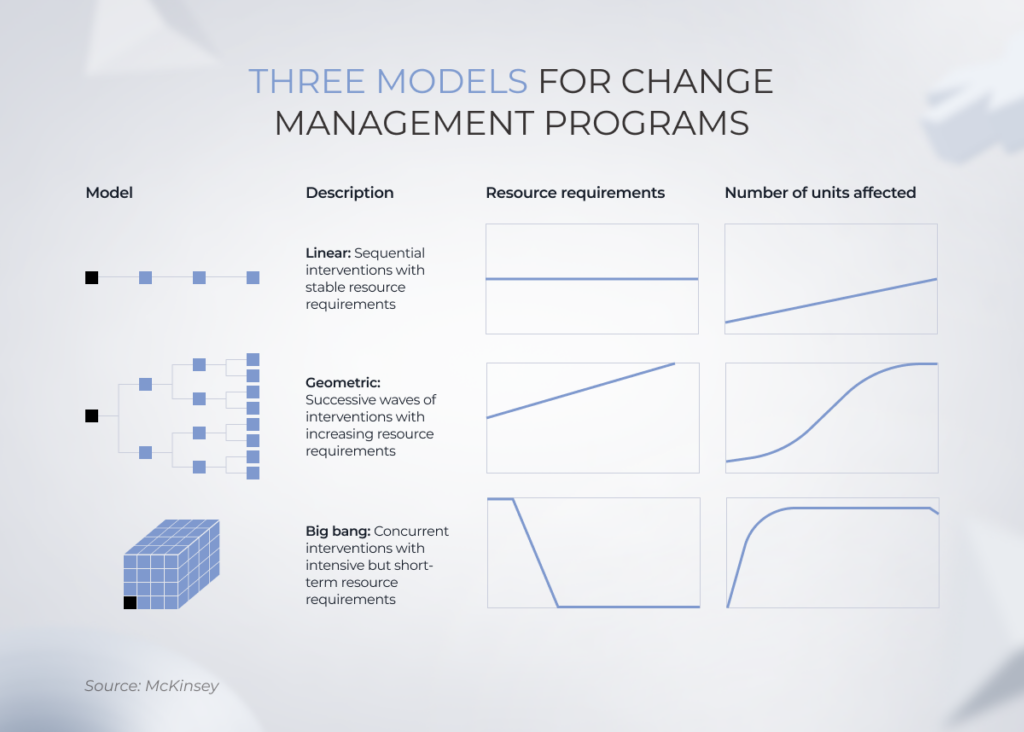
Where does a client want to go with these projects? How ready are they to go there? What do the client’s in-house and dedicated teams have to do to get there?” By answering these questions and regularly reviewing the answers, the DM identifies the most beneficial model for a change management initiative.
Our clients’ cases reveal that in uncertain market conditions, even enterprise-grade companies are more likely to choose a linear or geometric model than a bold big-bang move.
Discover why our client decided to move slowly but surely on their way to legacy system modernization
Besides firing up change programs, the service delivery manager regularly evaluates their efficiency by scanning project success on three levels monthly or quarterly:
Initiative level that includes tracking the projects’ milestones, resource allocation, budget expenditure, and delivery deadlines
Business performance level with key outcomes such as costs, revenue, etc.
Value level, helping constantly focus on stakeholders’ ultimate goals
Based on the results, the software delivery manager brings in subject matter experts when necessary and dynamically tailors the change program to the updated project status, stakeholders’ goals, market demand, etc. KPMG research pinpoints that initiatives that constantly align their daily decisions with long-term strategic goals and follow an “always-on” approach to performance management increase their odds of flourishing by 12%.
Driving knowledge sharing with a client at the tech and product levels
Early-initiated knowledge sharing contributes to optimizing the whole delivery process. Here’s a real-life example.
When working on multiple related projects for an eyewear manufacturer and retailer, our delivery manager created a single, easily accessible knowledge base from the ground up. Encouraging knowledge sharing and accurate, detailed documentation allowed the team to run regular architecture assessments and implement new features without breaking a beat in the rolled-out applications.
Following knowledge-sharing best practices, the delivery manager is responsible for:
Assisting in creating a single knowledge base
Providing consistent and all-encompassing project documentation
Organizing technical and product round-table discussions to ensure regular knowledge transfer to the client’s team
Such an approach results in maintaining staff productivity and development speed regardless of changes in team composition both on the vendor’s and client’s sides. The clients get software solutions that are easy-to-grasp and support for newly onboarded software developers. You can even switch to another tech partner with no disruption in your development plans.
Monitoring the team health
Last but far from least, the DM stands behind tracking project teams’ health, as healthy teams deliver three times the total shareholder returns (TSR) compared to unhealthy ones.
By running monthly or quarterly checks of vital areas, such as motivation and communication within the teams, the delivery manager ensures the client has the right talents on board to execute their strategy successfully.
The bottom-up approach, when team members proactively suggest improvements is also possible. In such cases, the DM is the one who collects ideas, escalates issues, and supervises changes’ adoption.
Still have questions about the DM’s key responsibilities?
Head-to-head comparison: service delivery manager vs. project manager
The delivery manager’s strengths and the value they add to the project become more vivid when compared to another role within the development team. That’s how *instinctools’ service delivery director outlines the differences between DM and PM.
Criteria / Role
Project manager
Service delivery manager
Background
PMs don’t usually have a solid technical background. However, their role requires them to know the solution’s basic architectural aspects.
DMs commonly grow out of senior tech experts, whose expertise extends beyond basic technical concepts and who can dive deep into the solution’s architecture.
Operating context
PMs operate at the project’s micro level; they are in charge of a specific project, its team dynamics, and timelines.
DMs take the projects’ micro levels into account while overseeing the macro business level. They work on the strategic product vision to align it with the client’s business plans and ambitions.
Planning focus
PMs do short- and mid-term planning within a particular project.
DMs create long-term strategies for several complex projects.
The number of teams under management
PMs are responsible for one dedicated team.
DMs are experienced in managing several development teams within multiple projects.
Long-lasting benefits of having a DM on board
Hiring a service delivery manager may seem pricey until you have evidence of the value this role brings to the table:
Unwavering focus on providing expected business value. A delivery manager maintains a clear vision of your long-term projects, helping them stay on the right track and bring much-coveted results.
Hitch-free delivery processes at the scale of multiple projects. As a high-level firefighter, a DM removes any bottlenecks, be it technology hurdles, staff issues, or communication difficulties.
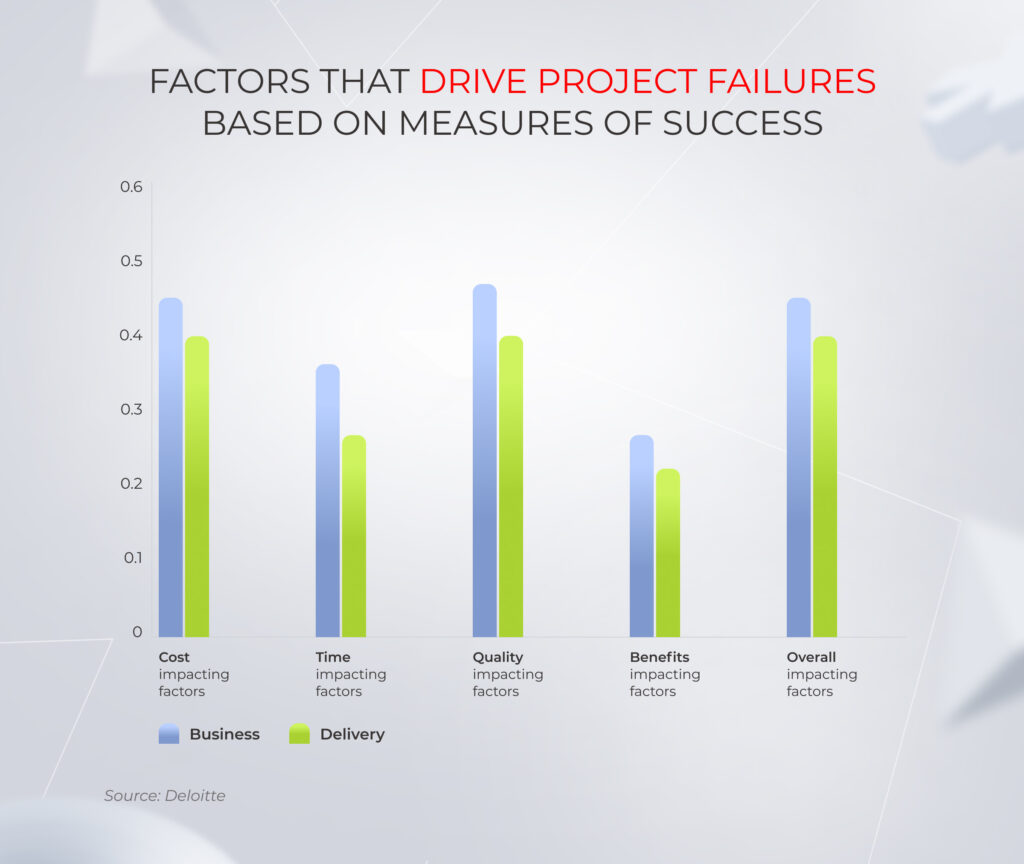
Seamless collaboration between in-house and outsourced teams. The efficiency of cross-team communication and team health can impact the projects’ results positively or negatively. A delivery manager covers these areas, eliminating internal factors of the projects’ failure.
New growth opportunities in your domain. Backed up with DM’s industry-specific knowledge and strategic advising, you can easily unlock new evolution and ROI-generating scenarios.
Would you turn down the opportunity to multiply your project’s value when it’s just a click away?
Imagine having a committed ‘someone’ who takes care of the project vision’s consistency, monitors development team dynamics at several projects, ensures seamless communication between all the stakeholders, and handles unexpected challenges – all within delivery deadlines and estimated budget. Developing and rolling out a software solution with such an expert will be a breeze for sure. And that’s the reality waiting for you, with *instinctools’ delivery manager on board.
A delivery manager is an expert whose skill set combines technical and managerial aspects as well as deep domain knowledge. They ensure a client gets a digital product that fully meets their tech and business expectations. Delivery manager roles and responsibilities in software development life cycle can vary, but at *instinctools, we provide:
– Coordinators to manage project managers within several projects – Visionary leaders to uncover new value-creation opportunities on your project journey – Responsible for the entire delivery as the main driver of your software solution to success
Is a delivery manager the same as a project manager?
The service delivery manager can take over the PM’s responsibilities, but the capabilities of the former span much broader. Most importantly, a DM takes over multiple projects, not just one, as a PM does. Thanks to their extensive background, DMs have a deep understanding of the solution’s architecture and business analysis-related questions and can outline the project vision. They also focus on the long-term plans rather than on short- and mid-term planning.
Nearshore vs offshore? Although outsourcing has been deeply ingrained in the world of digital engineering, there are still many questions unanswered when it comes to the right outsourcing type. Lots of companies bask under the sun of offshoring, banking on dev talent abroad to deliver their products. But then there’s nearshoring — with its promise to build cost-effective solutions in geographical proximity to your company.
So which outsourcing model bodes well for your software development?
Outsourcing models: onshore vs nearshore vs offshore
Location-wise, we can distinguish three types of outsourcing — these include onshore, nearshore, and offshore models.
When companies opt for onshoring, they source tech services within the same national borders — for example, a US-based company can outsource to a vendor located in the US too.
In the pre-pandemic times, onshore outsourcing used to stand high with companies due to its convenience. But after 2020, it lost its appeal as remote and hybrid work took over. Coupled with distributed teams becoming the norm, the need to tighten the budgets pushed most businesses to turn to borderless talent. The math was hard to ignore: hiring abroad often means big savings. Developers in the US, for instance, cost 2-5 times higher than their Eastern European counterparts.
As of 2025, though, onshoring seems to be back in vogue. With political tensions rising and global uncertainty shaking things up, leaders are inclined to focus more on domestic hires to cut risks. However, many are struggling to fill the skill gaps due to a shrinking pool of qualified candidates on-site. To that end, in this article, we decided to focus on nearshore and offshore models.
Even if you’re ready to pay double, you might not be able to fill the skill gaps due to a shrinking pool of qualified candidates on-site. To that end, in this article, we decided to focus on nearshore and offshore models.
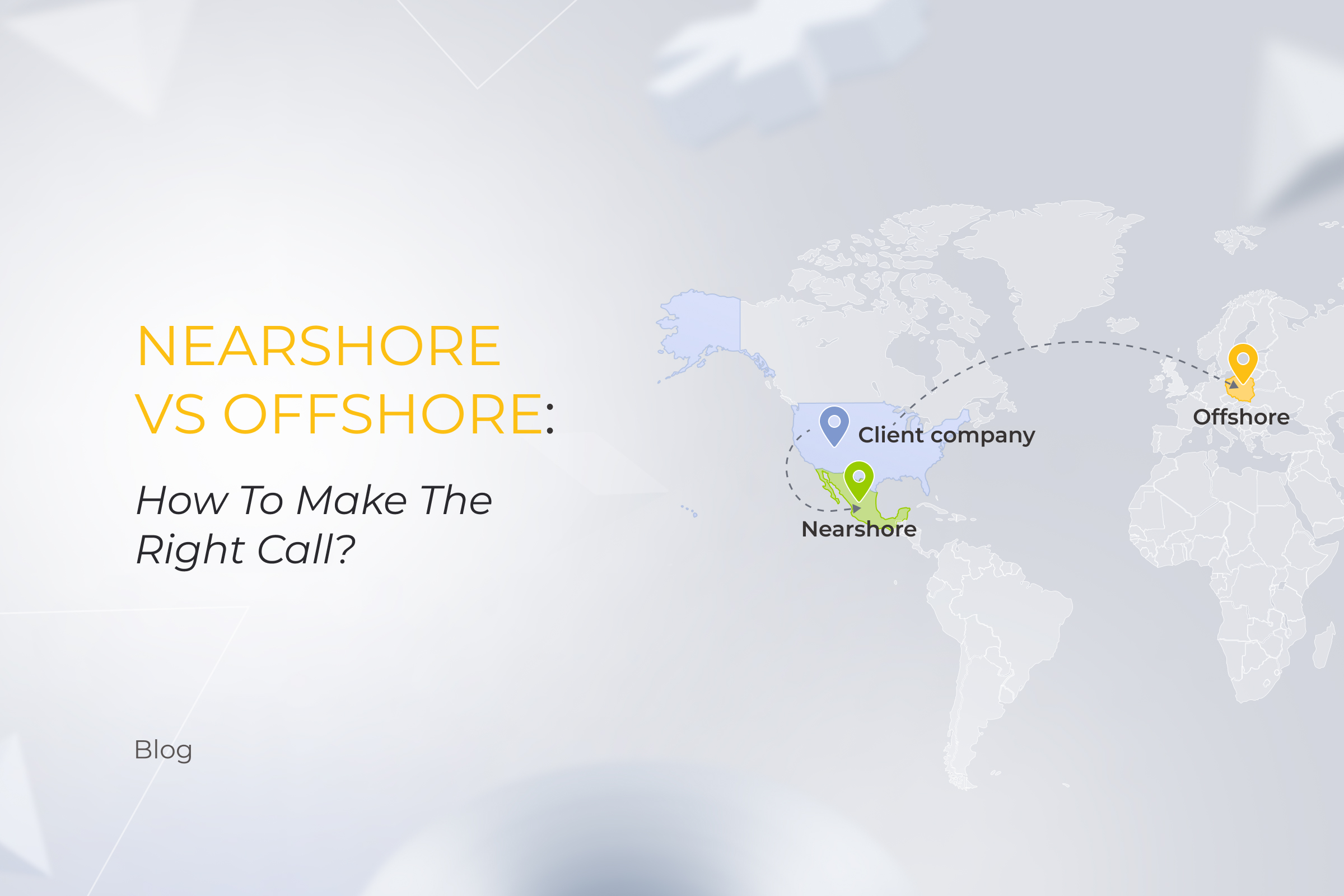
The concept behind nearshoring outsourcing involves transferring digital product development to a country that is close to the home base of the company. In this case, vendors are located within or close to the same time zone and have generally lower labor rates compared with those of the client’s home country. An example of nearshoring would be a tech company in the US outsourcing its development operations to Mexico.
Offshoring means offloading development processes to a geographically distant market, typically several time zones away, with significantly lower rates as compared to the home location of the company. Here’s an example of offshoring: a US-based company moves its tech functions to Eastern Europe.
But how to choose between nearshore vs offshore outsourcing? Let’s compare the two options according to the criteria essential to any project.
Nearshore vs offshore competition: choosing the winner in 5 categories
Just by looking at nearshoring and offshoring definitions, it’s hard to pin down the value of each for your specific business case. That’s why, we’re giving the skinny on both models to help you choose the right path.
1. Cost efficiency
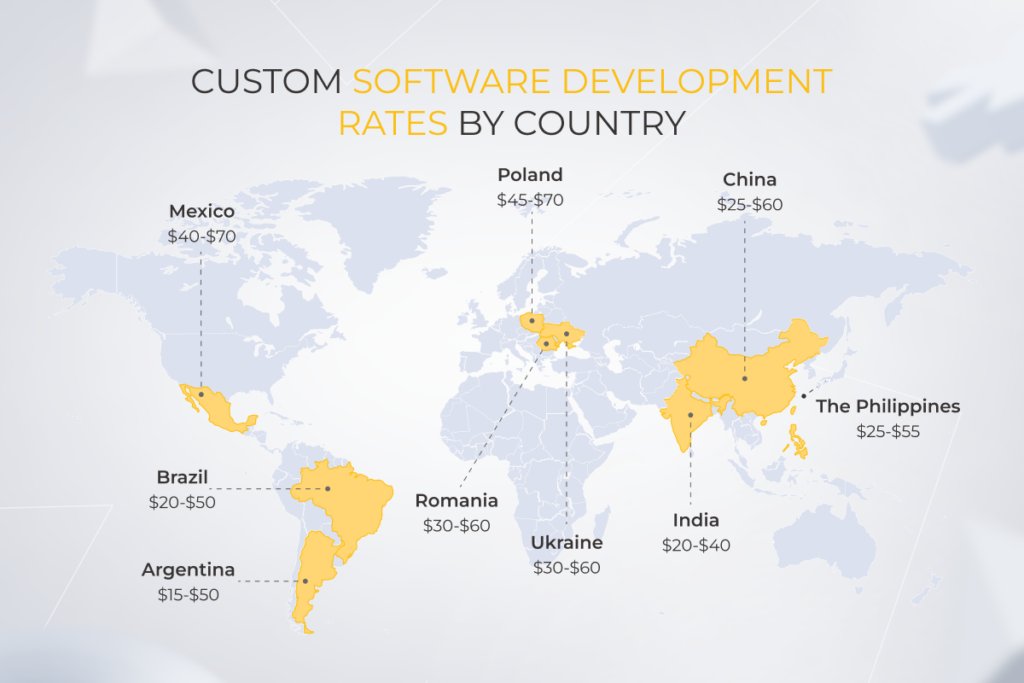
When it comes to the price, we don’t have a clear winner in the nearshoring vs offshoring battle: it all comes down to the exact location. If we look at the most popular outsourcing locations, we’ll see that the majority of them fall into the same range of $40-$60 per hour. India and the Philippines seem to offer the best deals for labor cost per hour — $20-$40 — but there’s a catch.
The unusually low median rates stem from a large number of junior or underqualified talent in the country. In low-cost Asian countries, the percentage of junior developers is much higher than in Eastern Europe, where software specialists move up the ladder faster.
Also, the lower price might come at the cost of jerry-built products, broken deadlines, and false expectations, so the price shouldn’t be an overriding factor when choosing a vendor.
2. Communication and collaboration
If we approach the offshore vs nearshore dilemma from the communication perspective, it’s easy to conclude that nearshore outsourcing beats offshoring.
Indeed, farming out software development to nearby countries allows you to collaborate with nearshore development teams in similar or slightly different time zones. This, in turn, facilitates real-time communication during overlapping working hours.
Conversely, offshore moves your project further away, so differences in time zones are more significant. But despite that, in most cases, you can easily offset the time zone differences for both nearshore and offshore outsourcing.
Regular check-ins with engineers, a consistent delivery process, a calibrated development flow, and availability of up-to-date collaboration tools help overcome the erstwhile insurmountable hurdles of time difference. This idea is backed up by thousands of effective collaborations between Northern American clients and Eastern European vendors (the size and quality of the Eastern European outsourcing market also proves the point).
3. Visa restrictions and location accessibility
A possibility of regular on-site meetings at your or your vendor’s office might be a critical step in selecting an outsourcing software development service provider. In this context, rather than making the distance-based choice, you should look into the visa requirements for the vendor’s country residents and vice versa as well as the ease and cost of travel and political stability in the region. Ask yourself if you really want to fly there regularly.
4. Access to talent pool
The difference in access to talent between nearshore and offshore services lies in the availability of tech experts in different areas. Mind that the time zone and geographical proximity come second here, as the level of tech expertise in the area correlates with the level and accessibility of local education.
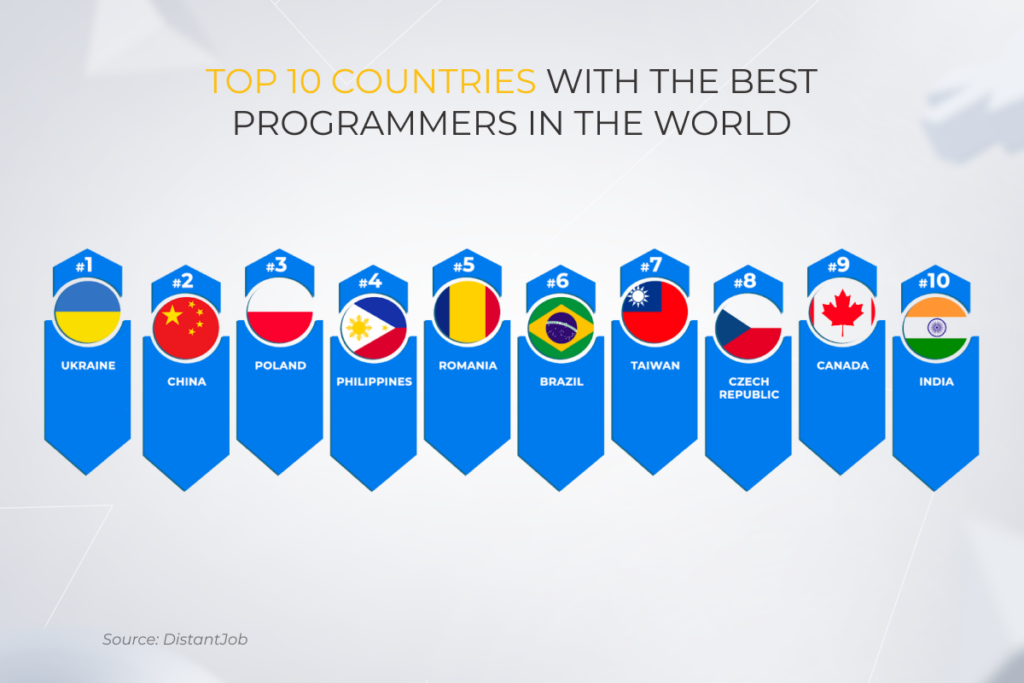
For example, Poland ranks third among the countries with the best developer talent, while the Polish education system is ranked fifth in Europe and tenth in the world. The country also has the largest pool of technology talent in Europe, with more than 295,000 programmers. See the connection? The Polish talent pool expands thanks to the continuous inflow of university graduates into the labor market.
5. Security and compliance
It might seem that in this case, the ball is in the onshore court, but not necessarily. Both your offshore and nearshore software development team can meet your stringent security requirements if the vendor’s commitment is confirmed by security certifications such as ISO 27001, ISO 22301, and the like. A dedicated seasoned team and an adequate security approach increase the odds of the vendor addressing your security needs.
Keep in mind that some developing countries have radically different laws about intellectual property rights, offering very little protection against intellectual property theft. Make sure to examine the legal landscape before letting the vendor into your data pipeline.
Adherence to local regulations is another aspect that comes to the fore. If you’re building a product that’s subject to EU regulations such as GDPR, PSD2, and others, it makes perfect sense to choose a tech partner located in the European Union as you’re bound by the financial and legal constraints. But even this factor is arguable as vendors’ hands-on experience with regulatory compliance counts more than their location.
When your project is large and complex or calls for stringent security measures, the offshore vs nearshore showdown doesn’t really matter, as, with the help of your tech partner, you can set up a dedicated development center, regardless of the location. The center comes with private office space, authorized entry, software access control, and built-in network security — an unbeatable combo to ensure full adherence to your company’s quality standards and protocols.
Power your software projects with *instinctools’ proven expertise
The good and the bad of nearshore vs offshore outsourcing
It’s difficult to nail down the universal benefits and challenges of nearshore outsourcing and offshore software development as the experience varies depending on a client’s location. For US companies, nearshoring often means partnering with Latin American firms, whereas offshoring might involve collaboration with a software development company in Eastern Europe or Southeast Asia. Conversely, British organizations might find their nearshore options in Eastern Europe, with offshore opportunities in Latin America.
We’ve highlighted the potential advantages and hurdles of each model, focusing on the geographical closeness and remoteness of the outsourcing destination.
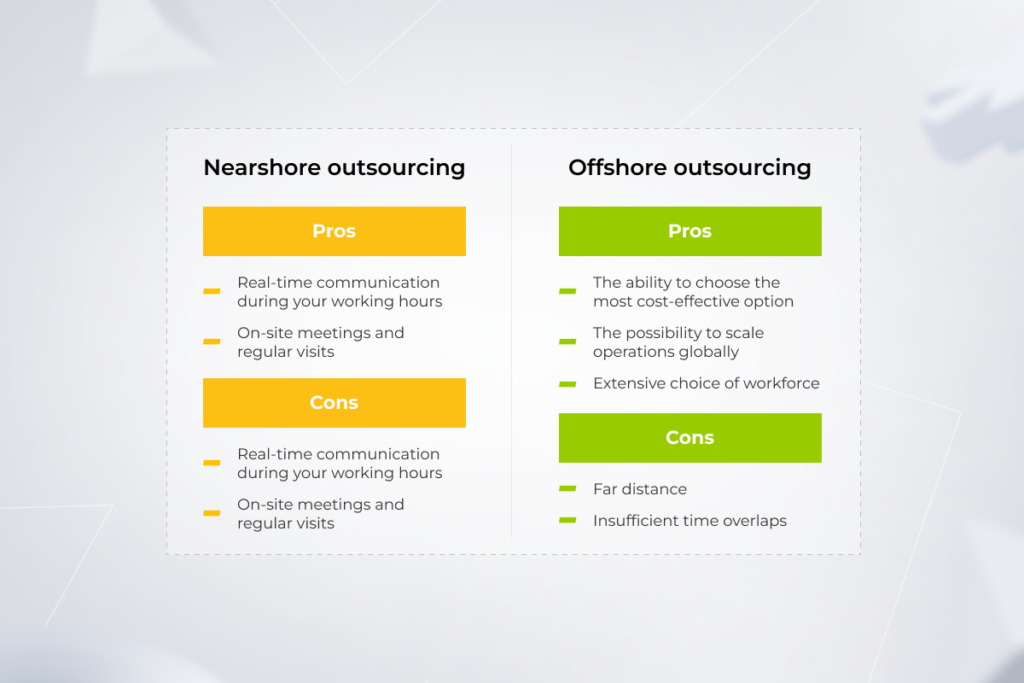
Pros of nearshore software development services
Real-time communication during your working hours
Working with nearshore outsourcing companies, you can minimize the challenges of coordinating work across different time zones. No midnight calls or unproductive business hours — similar time zones allow communication and decision-making to happen in real time, reducing delays and maximizing the efficiency of the development process. Better yet, if you share a similar cultural background with your nearshore developers, you can connect on a visceral level.
On-site meetings and regular visits
For projects requiring frequent face-to-face interactions or the ability to quickly arrange in-person meetings, nearshoring offers a logistical advantage. For instance, a Canadian tech firm needing regular integration sessions with its development team could choose a nearshore provider in Mexico or Colombia over an offshore provider in Southeast Asia.
Cons of nearshore software outsourcing
Limited choice of potential partners
Narrowing down your search to nearby locations, you trim down your pool of vendors to a few nearshore development teams. The unsubstantial supply of expertise might take a toll on projects sensitive to niche skills, leading to unsatisfactory collaboration between the company and the vendor.
Risk of backdoor offshoring
Turning to the nearshore software development model, you expect a high level of services and top-grade products. However, this doesn’t mean you eventually get what you paid for. Some vendors contract out some of their development to offshore locations to cut down costs and benefit from the price difference. No benefits for the clients though — backdoor offshoring often results in sub-par deliverables.
Pros of offshore software development
The ability to choose the most cost-effective option
Offshore development partners are known for delivering big-time features without big-time investments. That’s probably why Google, Microsoft, Oracle, and other tech giants gravitate towards offshore outsourcing services. Most importantly, offshoring software development allows you to cast your net wide and reel in the vendor that promises the most value for the money.
The possibility to scale operations globally
Companies aiming to expand their presence in international markets may use offshore development teams as a heavy hitter on their way to new markets. For example, a European company planning to launch products in Asia might establish an offshore development center in Singapore to gain insights into the Asian market and tailor their offerings accordingly.
Extensive choice of workforce
The main difference between nearshore and offshore (and the biggest benefit of the latter) is a great selection of development partners and software engineers. With offshoring, you’re not shackled to specific locations, you can embrace international talent in all its diversity and extend your teams however much you need to.
Cons of offshore software development
Far distance
Naturally, offshoring comes with a large geographical distance which makes on-site visits more difficult compared to nearshoring. Therefore, offshoring may not be the strongest suit for your business if regular face-to-face meetings with your partner are essential.
Insufficient time overlaps
If you want to bring it on with an offshore team, you might need to go the extra mile to manage your overseas talent and make up for different time zones. In particular, you should be intentional and consistent in communicating with your offshore company and have dedicated project management tools in place to track the project’s progress. Also, unless you or your partner commit to working outside business hours, real time collaboration will be hard to nail.
Move forward with *instinctools’ team of software development experts
Nearshoring vs offshoring: it’s all about the right vendor
You want to hear the big secret? It makes no big difference whether you work with a nearshore team or an offshore team until you have an experienced tech partner. The right outsourcing company should check all the boxes in terms of process maturity, expertise, cultural compatibility, time zone alignment, and cost efficiency — and that’s the secret recipe for a successful collaboration. Let’s see how you can come across this breed of outsourcing partner.
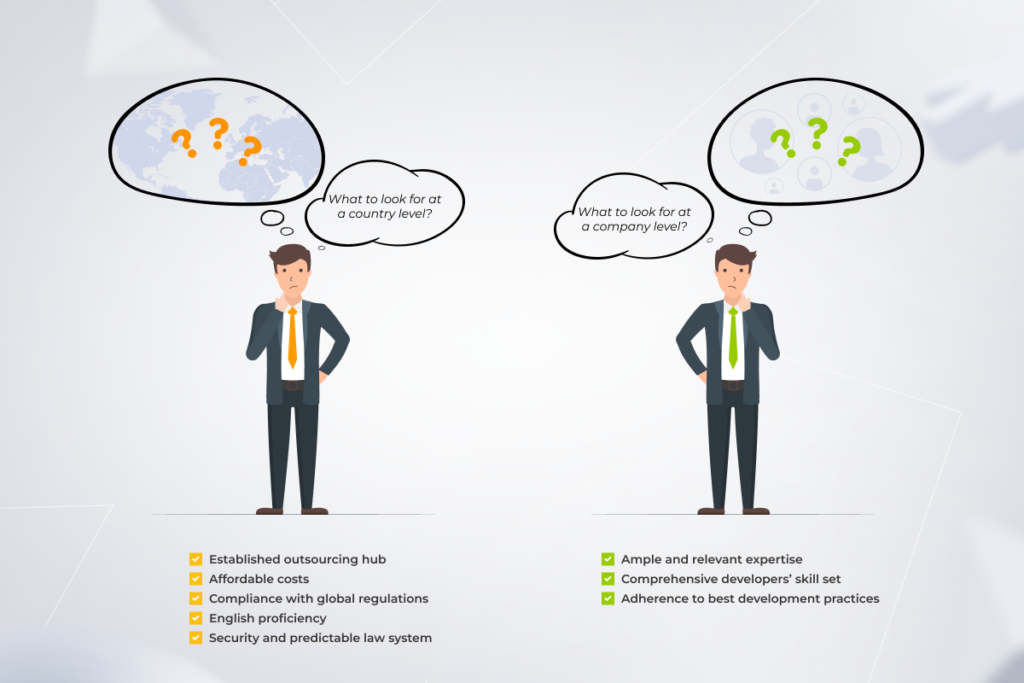
What to look for at a country level?
Although the right outsourcing location is a story of different strokes for different folks, several important data points hold true for all great outsourcing destinations.
Established outsourcing hub
Prioritize sites featured on the global IT map as frontrunners in the outsourcing industry. Typically, mature outsourcing destinations have an advantageous geographical position, a large base of qualified workforce, a favorable investment climate, and modern business-related infrastructure. When the country’s IT sector is on an upswing, it also means that this sphere is likely supported by the country’s government, resulting in more tax preferences and fewer trade restrictions for foreign companies.
Affordable costs
You don’t want to trade quality for price, but choosing the right outsourcing location can help you get the best of both worlds. Look toward the country where the cost of living is lower than in developed countries but the quality of talent and services is high. Remember that the more accessible and high-level local education is, the more qualified tech talent is in the area — and you can get it at a fraction of the cost.
Compliance with global regulations
When choosing a location for an outsourced software development team, you need to make sure the country recognizes international standards and complies with global regulations such as ISO 27001, PCI DSS, SOX-type regulations, and others. Failing to adhere to the standards and regulations may result in derailed projects, hefty penalties, loss of reputation, data breaches, and other misfortunes.
English proficiency
Imagine being not able to communicate your vision to your development team because of the language barriers. To head off this scenario, go for a location with a high level of English proficiency. Poland, for example, is ranked 15th based on English language skills with other European countries following.
Security and predictable law system
A key to successful outsourcing is choosing a country with strict data protection and a transparent law system. Ideally, you should contract out your projects to a country where business laws closely match those in your location. But legislation transparency isn’t the only consideration: as a client, you will likely bear the tax costs of an outsourcing transaction, so we recommend choosing a country with fewer tax implications.
What to look for at a company level?
The choice of a tech partner can be kill-or-cure for your outsourcing experience. That’s why calling on the right tech ally is crucial to get your project off on the right foot.
Ample and relevant expertise
An ideal outsourcing company should have a proven track record of delivering similar projects, while also possessing the necessary skills and domain knowledge to handle your unique requirements. You can get a broad-strokes idea of their expertise by reviewing references, case studies, and client testimonials.
Comprehensive developers’ skill set
It pays to have a cross-functional development team with the depth and scale of the skill pool in case your project requirements or product vision evolve. Therefore, give priority consideration to tech companies with complementary skills that may come in handy during software development (for example, AI for mobile and web development projects).
Adherence to best development practices
Technical skills aside, the product development outsourcing process has to include an element of trust. Nothing better than a time-tested delivery framework of your tech partner can give you that peace of mind. Best Agile practices, product-first mindset, and DevOps tools are a big green flag for a vendor and an indicator that your outsourcing project is in good hands. And don’t forget information security — your potential tech partner should have multi-layer quality assurance practices, secure coding practices, and other guardrails for Fort Knox-like development.
It’s a toss-up between nearshore and offshore
Both nearshore custom software development and offshore outsourcing open up opportunities for companies looking for high-value cost-effective product development and innovation opportunities. It all depends on the angle you look at both options, your unique objectives, and the outsourcing location. Both collaboration models bring forth a set of benefits that can turn into disadvantages if executed wrong.
More importantly, the success of both options is contingent on the expertise and commitment of your outsourcing partner. A seasoned, committed vendor can crack the hard nut of outsourcing and make it almost as easy as a cakewalk.
Hire a dedicated software development team you can trust
The inverse of offshoring, nearshore outsourcing services involve contracting out your software development project to a nearby country. A nearshore software development company is typically located within the same region so that businesses can benefit from the geographical proximity of development teams.
What is an example of nearshore outsourcing?
An example of nearshoring would be a US-based company hiring nearshore software developers from Mexico.
What is the difference between offshore and onshore services?
An onshore company is located in the client’s home region, usually within a 2-5-hour driving distance, while the offshore model means hiring developers from a foreign country.
What is the difference between nearshore and offshore software development?
The main difference between these two models lies in the geographical proximity of the outsourcing location. Nearshore software development teams are usually based close to the company and within similar time zones. Offshore teams operate in an overseas, low-cost location, many time zones away.
Why is nearshore better than offshore?
Both models have their pros and cons. Engaging a nearshore company enables businesses to reduce the costs of development and expand their access to developer talent. This option also allows for on-site visits and real-time collaboration. However, the pool of nearshore talent is limited to a few locations. Outsourcing your project to an offshore dedicated team lets you significantly lower the cost, rely on global talent, and establish your presence in foreign markets.
Regardless of your location or business domain, having a web presence is non-negotiable in today’s interconnected world. This realization frequently evokes the question of how to skillfully and efficiently establish and uphold this presence. For many, the answer is to outsource web development.
Web development outsourcing has become a compelling alternative to in-house teams because of an optimal benefit-cost ratio of the former. In fact, an increasing number of companies contracted out their web engineering in 2024 — and the trend persists in 2025. As the IT outsourcing sector is projected to reach $701 billion by 2028, the shift towards outsourcing web development isn’t just a passing fad — it’s a strategic move for companies looking to speed up their growth and refine operational productivity.
As an outsourcing company with 25+ years of experience, *instinctools has collaborated with companies of all sizes to assist them with web and mobile app development. In this blog post, we share tips, hacks, and main considerations that will make outsourcing web development projects easier for your company.
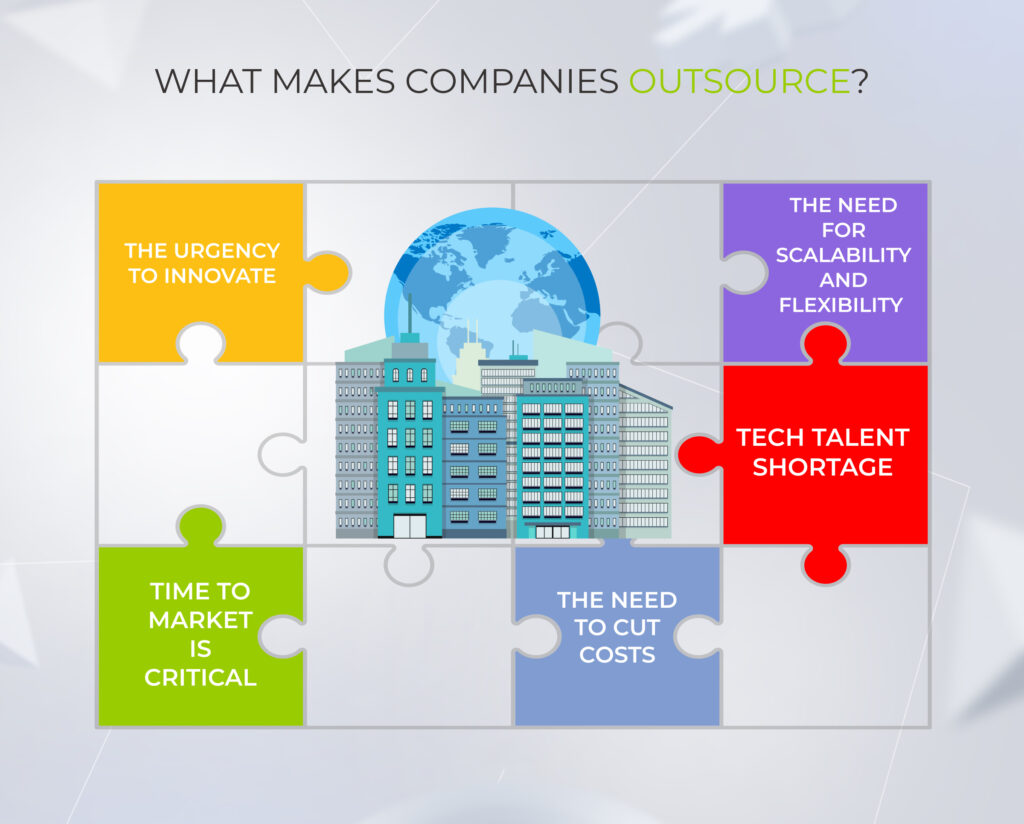
What makes 60% of companies opt for outsourced web development?
3 in 5 organizations turn to outsourcing for software development and that alone is quite an endorsement for this business model. But let’s dive deeper and single out five core reasons for outsourcing web development as stated by our clients.
The urgency to innovate
Over time, outsourcing has evolved into a catalyst for innovation that gives companies access to niche skills and advanced technologies that may not be readily available in-house. Companies that outsource web development pick the brains of lead web engineers and deliver digital products faster, thanks to the added bandwidth. This agility, in turn, fosters a culture of continuous innovation and puts companies ahead of the competition.
The need to cut costs
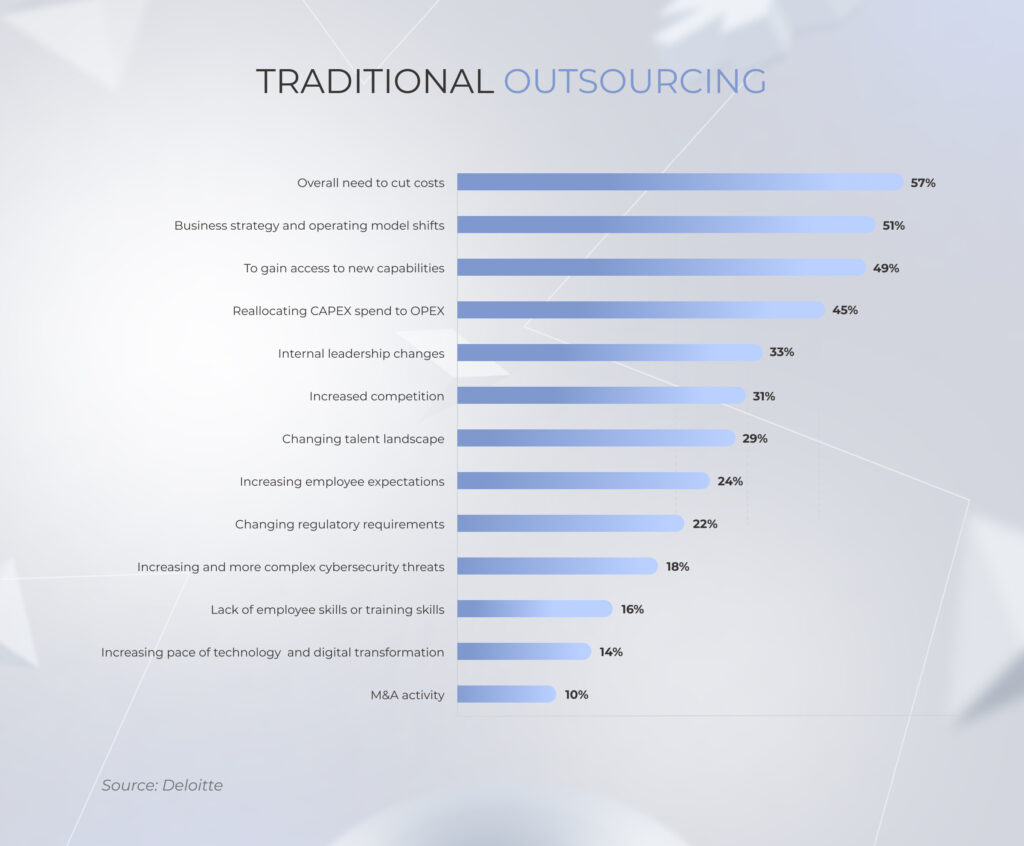
In the face of economic turbulence and rising talent costs, companies lean toward outsourcing web development projects to reduce the cost of custom software development and innovation in general. According to Deloitte, over 60% of companies choose outsourcing because of its cost-saving potential.
Not only does this approach allow you to hire a web development team at an affordable cost, but it also eliminates expenses related to non-essential resources and infrastructure.
Tech talent shortage
A large talent pool is usually cited among other core benefits of outsourcing web development services. The tech industry is moving towards more specialized skills, such as artificial intelligence and data science, which are quite expensive and hard to get on-site. This skill shortage can be outflanked by using outsourcing strategies.
Unlike in-house hiring and associated recruiting headaches, outsourcing reduces your time-to-hire and increases the odds of landing the right talent. Considering the growing concern around tech talent shortage, this might be a fine option to beat the talent crunch.
The need for scalability and flexibility
Usually, an outsourcing vendor has developer talent on tap, allowing companies to extend their teams without the financial commitment of hiring in-house employees. So once the busy stage of the project is over, you can easily scale down to a smaller team. It also means that your ideas aren’t limited by the number of employees you have on staff.
Time to market is critical
In digital product development, “yesterday” is an ideal timeline. When outsourcing website development to a reliable outsourcing partner, you don’t start from scratch or spend much time on hiring and onboarding. Instead, you get your project off the ground within days or weeks, hooking into the capacity needed to speed the heavy lifting of software product development and beat your competitors to market.
In most cases, there is no single reason why global companies farm out their engineering initiatives. It’s usually a whole suite of aspects that tip the scales towards outsourcing. At *instinctools, we have asked our clients what seemed to be the determining factor of outsourcing for them. In our case, 55% cited cost reduction along with an easily accessible and competent talent to have the most tangible effect on their operations. Over 25% singled out innovation speed, while the remaining 20% said that faster time-to-market has been the most beneficial for them.
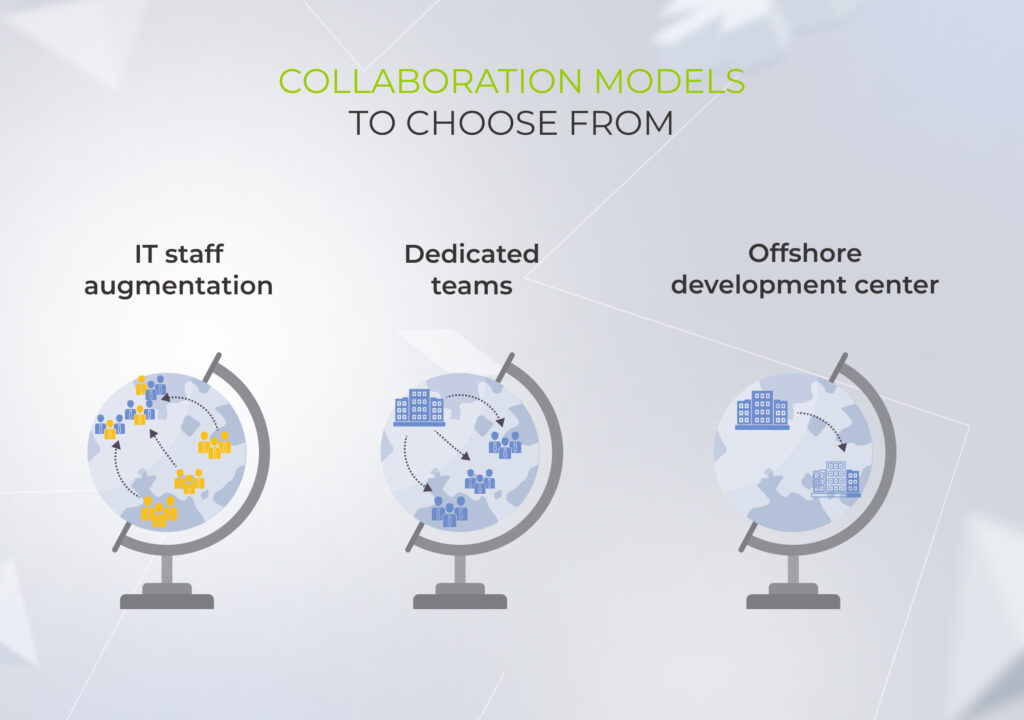
Outsourced web development has many flavors: what engagement model should you go for?
To outsource web development successfully, the right engagement model with the tech partner is important. The engagement model defines project expectations such as the level of scalability, commitments, pricing, and other aspects.
Team augmentation
IT staff augmentation allows you to extend your team temporarily by hiring developers to handle a specific part of the project. Depending on the project’s complexity, scale, and specific needs, you can involve as many individual professionals as you need.
You can bring in additional talent when you need to:
Fill skill gaps fast and at a lower cost
Tap into specialized tech expertise
Improve your web development process by adopting new practices
Increase the productivity of the team when faced with a tight deadline.
The main benefits of hiring web developers based on this engagement model include:
Better project control — the vendor’s developers work as a part of your in-house team
Cost savings — you just pay for what you require, excluding employee benefit expenses and such
Faster project execution — you add additional capacity to your team and can accelerate the project delivery
Talent agility — you can respond quickly to business needs, meaning scaling your team up and down, without the burden of in-house hiring
For example, this strategy was a go-to option for an EdTech company that needed only frontend developers to help with their mounting LMS backlog and QA engineers to set up manual and automated software testing.
Dedicated team
Within this engagement model, you outsource web development services to a cross-functional team of skilled professionals who work exclusively on your project or set of projects. A dedicated team functions as a self-managed unit, responsible for maintaining and improving all the software development processes, from new member onboarding and knowledge sharing to delivery management.
You need to delegate the implementation of a long-term project with frequent scope modifications
You want your product to be developed end-to-end by an outside team
If you are a startup and lack technological expertise in-house
When software development isn’t included in your core business activities and you want to outsource the entire tech function
You need to hire a multi-disciplinary development team at short notice
The dedicated team model brings the following benefits to your table:
Consistent software delivery — the team is committed solely to your project and shares responsibility for project outcomes
Seamless team integration — the team works closely with the client, allowing for day-to-day interactions and knowledge sharing
Flexibility in project scope and timeline — the team easily adapts to changing requirements and priorities
Easy project management — you can stay as involved in product development as you want
This model clicked with our another client, a French eyewear manufacturer and retailer , who wanted to delegate all of their software development and upkeep tasks to a team of cross-functional experts located in a more budget-friendly European region. Instinctools’ Poland-based dedicated team took on their web development projects, speeding up the process while cutting costs.
Offshore development center
This collaboration model is radically different from the other two, as it enables companies to establish an entire setup in another country. An offshore development center (ODC) is usually located in a country that offers low labor costs and a diverse pool of skilled IT professionals. The offshore development center allows you to outsource the whole practice, construct and evolve it according to your product growth strategy. Any specific security procedures and personnel training can be implemented flexibly within this engagement model.
Companies think of setting up an ODC in an offshore location when:
They have special data security requirements
The project is huge and the company needs a continuous loop of delivery
They want to expand their operations to another country and/or market
The most common benefits of ODCs include:
Reduction of operational and innovation costs — organizations can significantly save on salaries and overhead expenses when transferring their operations to low-cost destinations.
Focus on the core business needs — companies can keep their in-house teams busy with high-priority tasks.
Full compliance with your requirements — your ODC team is fully aligned with your industry regulations and business processes.
This approach was the only option for a crypto startup that wanted to make crypto transactions as reliable and trustworthy, as traditional fiat operations. The client needed subject matter experts who know crypto-specific security standards and compliance requirements as the back of their hands and can set up a development center with a secure physical perimeter. We met all the requirements, empowering the software to become a hit for EAEU countries.
Below, we’ve summed up the main data points about top outsourcing web development models.
Criteria
Team augmentation
Dedicated Team
ODC
Cost-efficiency
Medium
High
High
Control & oversight
High level of control
Medium level of control
Highest level of control
Scalability
High
High
High
Vendor’s responsibility
Low
Medium
High
Commitment/Duration
Short-run projects and select tasks
Medium and long-term
Long-term strategic projects
Project Management communication
On the client’s side
On the vendor’s side
Flexible, depending on the specific requirements
Cultural fit
Low
Medium
High
As you see, there is no definite answer when it comes to choosing the right engagement model. Everything comes down to your business goals and project specifics.
Let’s talk numbers: what factors influence the cost of outsourcing web development?
However much we’d like to deduce a hard-and-fast formula to calculate the costs of web app development , it’s difficult due to a large number of variables; however, we can follow some general guidelines.
The web outsourcing team involved, project scope, location, and many other factors influence the costs. Below, our web development outsourcing company has listed the main cost drivers to give you a better grasp of what makes your outsource web development projects.
Project-related aspects
These are costs directly associated with your solution and with the effort it takes to implement it.
The number and complexity of application features.
The more complex your web application is, the more hours it will take your web outsourcing team to build it. For example, you’ll spend less for outsourcing Shopify web app development services compared to a custom blockchain platform. The complexity of your project doesn’t boil down to the number of features and screens only. Unclear requirements and novelty of your idea also increase the development and testing effort required from the team.
Requirements to software performance, availability, security, latency, and scalability.
Adapting your web application to meet predefined requirements, whether it’s security or scalability, means that your outsourcing provider has to employ additional expertise, infrastructure, or workforce to hit the mark.
The complexity of the application logic and architecture
Complex software architecture with highly interdependent components implies spending more time on planning, designing, implementing, and debugging the solution. The more technologically diverse your architecture is set to be, the more specialists you need to involve.
The number and complexity of integrations with other software
The variety of data formats and communication protocols can make the integration of third-party services, legacy systems, and various data sources more resource-intensive, translating into additional costs. A custom, from-scratch integration is another expenditure item in your development.
Cutting-edge technologies (machine learning, gen AI, AR/VR, and others)
If you want to integrate the latest and greatest tech into your application, be ready to cover related hardware, software, and labor costs.
The need to migrate data from legacy software
The data you need to migrate can be poorly formatted or incomplete, making your development team clean and process it first. Also, larger datasets require more time to migrate, especially if developers have to write complicated scripts to migrate them.
Regulatory compliance requirements
If your application falls under some kind of regulation such as HIPAA, PCI DSS, GDPR, and others, your project development process must include the implementation of specific data security safeguards, running network and security audits, and other measures that incur additional costs.
The uniqueness and complexity of UI design
More sophisticated, fully custom web app design calls for considerable effort from designers and developers, while OS-provided elements trim the development cost. Also, the more screens, platforms, and devices your app is intended to cover, the greater your total is.
Development-related aspects
It may seem like development and testing expenses are the only cost drivers that shape the web development total. However, some less obvious factors can also lift the costs.
The team involved
Outsourcing your web project to a cross-functional development team with specialized skills will cost you more than augmenting your in-house team with a solo developer. Projects with a large number of stakeholders require more support roles to improve communication, which also makes your initiative more expensive.
The development approach
Some web development companies rely on low-code development platforms or ready-built components to reduce development costs. Conversely, fully custom solutions will cost you a pretty penny.
The location of the outsourcing web development company
Where the development team is based geographically can considerably impact the cost. For example, an outsourcing web development company located in North America or MVP development company in USA will have far higher rates than one positioned in Eastern Europe or Asia. Hold onto this thought — we’ll dwell upon that later.
Three types of pricing models: which one to choose?
Choosing a suitable pricing model is akin to choosing a pricing plan for any digital tool: strike the right balance between dollars paid and outcomes you get. Opting for a plan that doesn’t align with your project scope, duration, and specific business needs can lead to wasted resources, missed opportunities, and unnecessary expenses.
Let us make this choice easier for you.
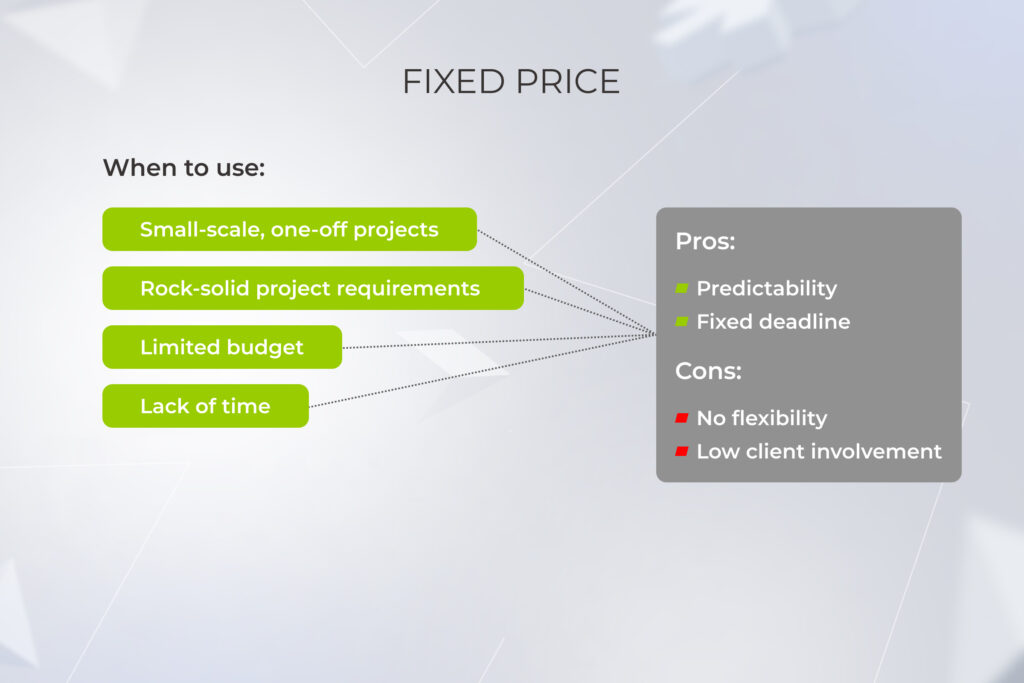
Fixed Price
A fixed price contract means that the client and the software development company agree on a fixed price for the custom software development project before it begins. The price is calculated based on the scope of work, requirements, and deliverables agreed upon by both parties.
Advantages of the fixed price contracts include:
Predictability — you know the exact cost of the project upfront and can plan your budget accordingly.
Fixed deadline — this model implies certainty in requirements and final deliverables, making it easy to estimate the timeline for the project.
Cons of the fixed price model include:
No flexibility — once defined, product requirements cannot be changed so no modifications are allowed during the development process.
Less client involvement — although it may be considered an advantage, less involvement sometimes leads to miscommunication and unmet expectations.
Here’s when it makes sense to engage in this type of contract:
When you have a small-scale, one-off project such as an MVP or a PoC.
When your project requirements are rock-solid and unlikely to change.
When your web development project budget is limited and/or you’re pressed for time.
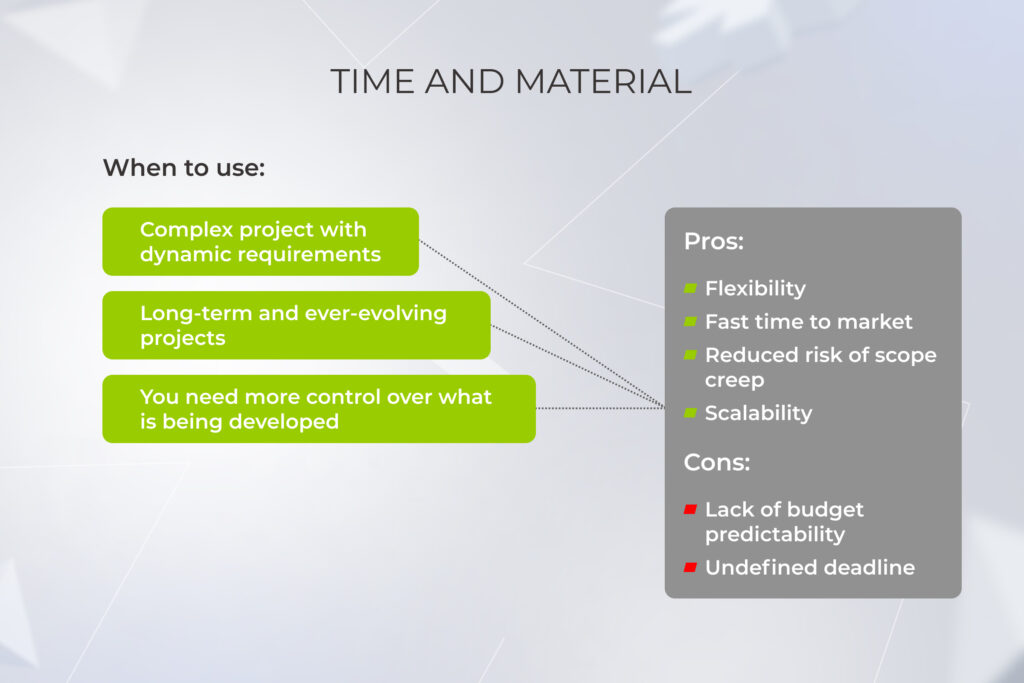
Time & Material
This pricing model provides web development services on an ongoing basis, whereby the client pays the vendor for hours spent on the project and reimburses pre-approved expenses. The T&M contract is based on a general scope and time estimates that can evolve.
Advantages of the Time & Material contracts include:
Flexibility — you can change the scope based on the project dynamics.
Faster time to market — this model allows you to get into app development right away and deliver the product to potential end users faster.
Reduced risk of scope creep — you are well aware of the final deliverables and can fine-tune them at each development stage.
Scalability — you can scale your team up or down on demand.
Cons of the Time & Material price model include:
The risk of going over budget — lack of budget predictability can make it difficult to plan your resources.
Undefined deadline — as the scope is subject to change, you can’t predict an exact release date.
Choose the Time & Material pricing model when:
You have a complex project with dynamic requirements.
You expect your project to be long-term and ever-evolving.
You want to have more control over what is being developed.
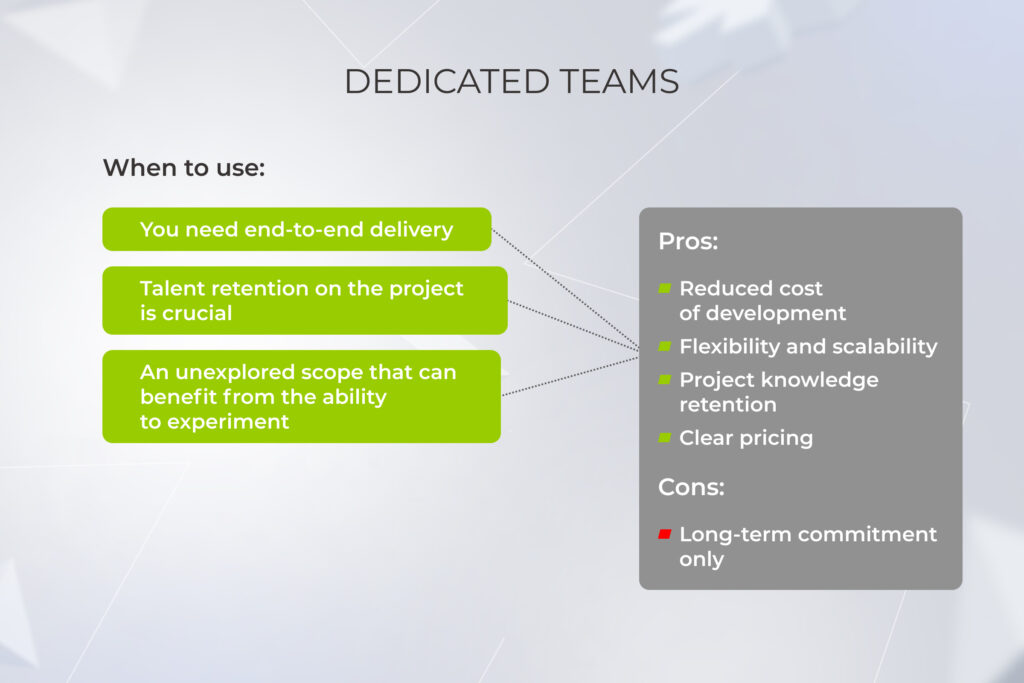
Dedicated team
In the dedicated team model, an outsource web development company charges you monthly based on the team size. The total cost is made up of the members’ rates and the vendor’s fee.
Unlike all other pricing models, this option allows you to bring in an entire, cross-functional team to handle your project, including a project manager, business analysts, QA specialists, and others.
Advantages of working under this arrangement include:
Reduced cost of development — having an outsourced dedicated team to work on your project is less expensive than hiring an entire development team in-house.
Flexibility and scalability — you can easily add or remove team members to adjust workloads and adapt to changing needs.
Project knowledge retention — your development team dives deep into the project to study its unique needs and can use this knowledge to introduce new releases.
Clear pricing — you know the rates of each team member.
Cons of the fixed price model include:
Requires a long-term commitment — the model is not suitable for short-run projects.
Here’s when the dedicated team pricing model is your safe bet:
When you want your long-term web project to be delivered end-to-end
When talent retention on the project is of great importance
When you’re at the beginning of an innovative project with an unexplored scope that can benefit from the ability to experiment.
Cut down risks, dial up value: best practices of web development outsourcing
You can always recognize experienced web developers by the way they approach the development process. Web development teams worth their salt have calibrated project management and quality management frameworks that they incorporate into the development process to reduce development costs by 1.5-2 times, speed up the process, and ensure high quality of the final product as well as meet clients’ expectations.
Here’s what qualifies as the best practices for outsourcing web development.
Comprehensive delivery
Full-scale web development encompasses a lot of activities aimed at bringing your software to the market, including discovery, design, development, and others. Your development team needs to find an optimal way to link all activities into the same chain and unite each team member around a common goal, while also effectively tackling product development challenges.
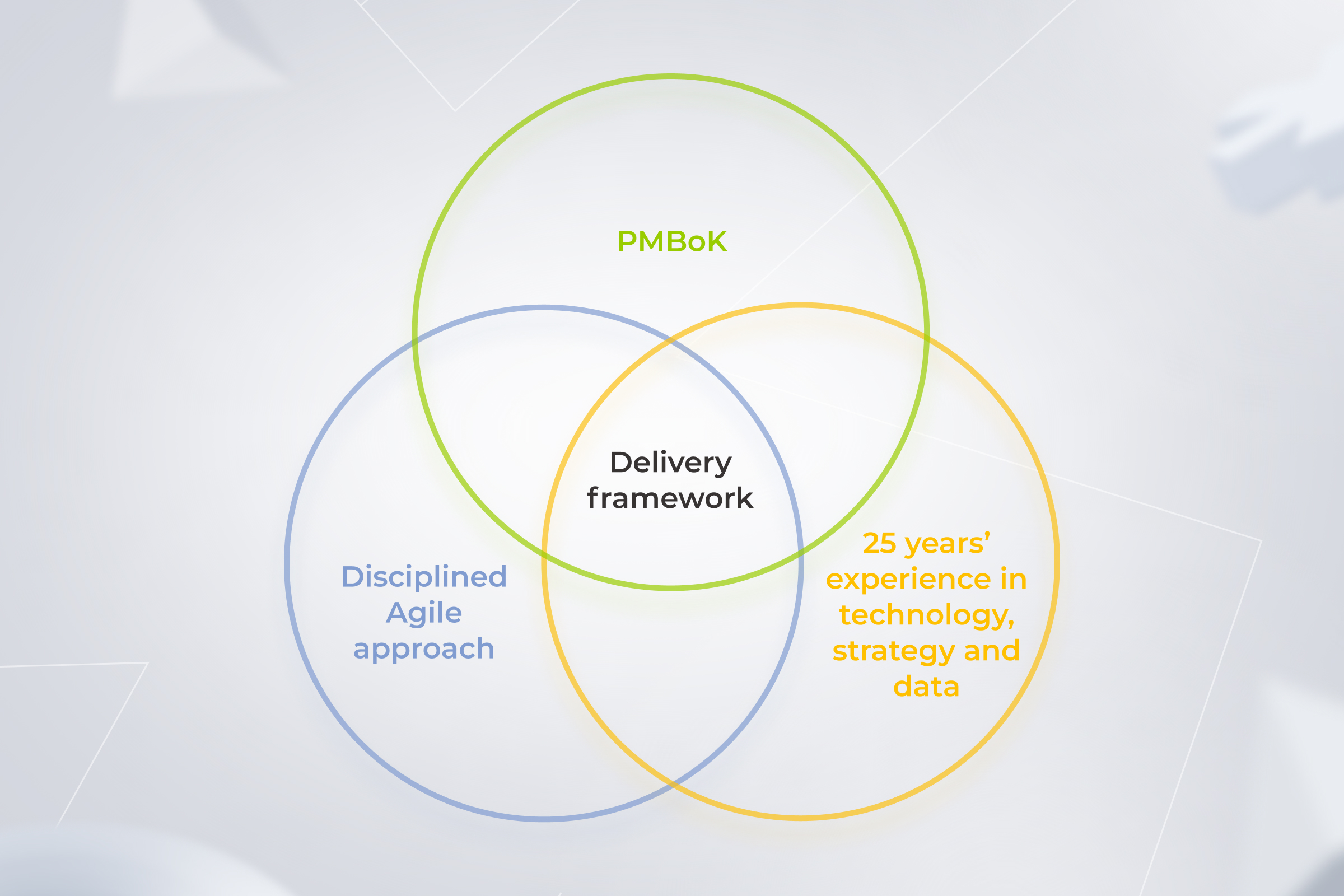
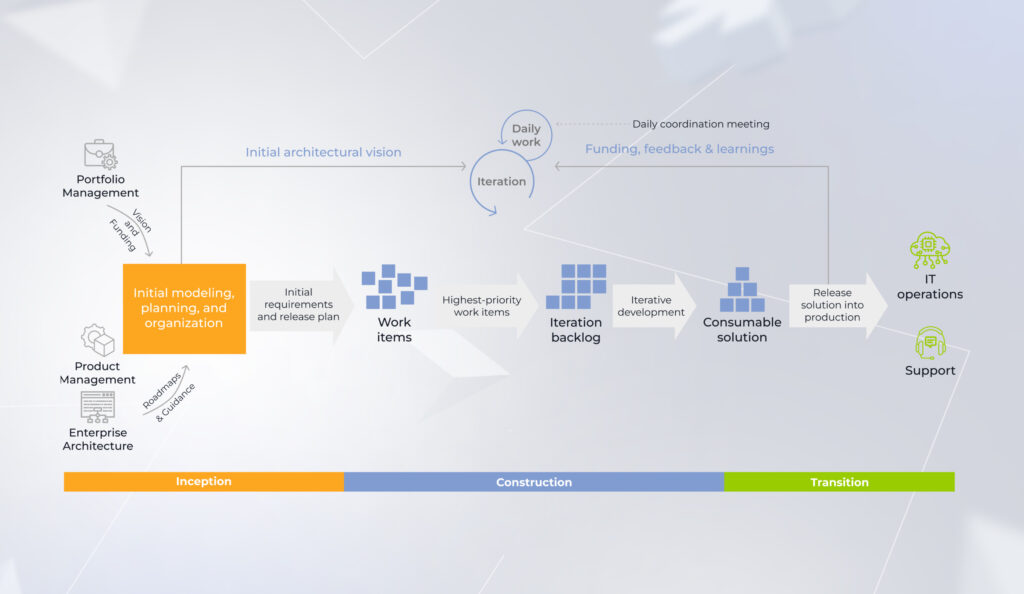
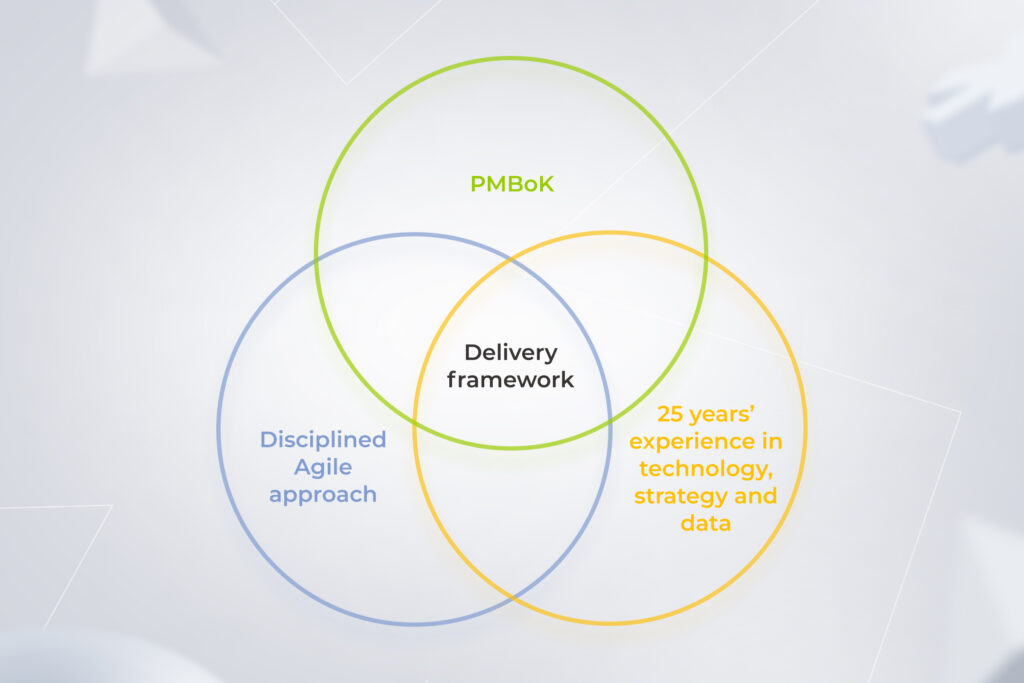
The only way to do that is by putting a trusted delivery model in place that would serve as a guide for the entire software development lifecycle and facilitate collaboration. At *instinctools, the delivery model is anchored in the principles of DAD (Disciplined Agile Delivery) and PMBoK. Thanks to this model, our teams can effectively share project knowledge, reduce development risks, and deliver on the client’s requirements.
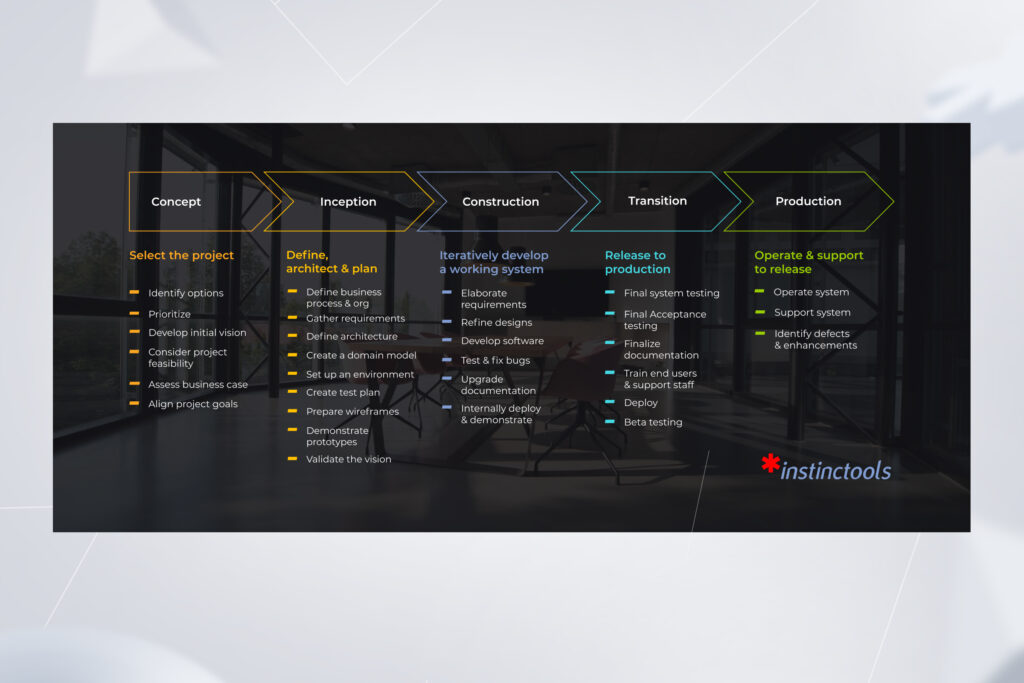
Web application delivery process at *instinctools
Compulsory discovery phase for projects with vague requirements
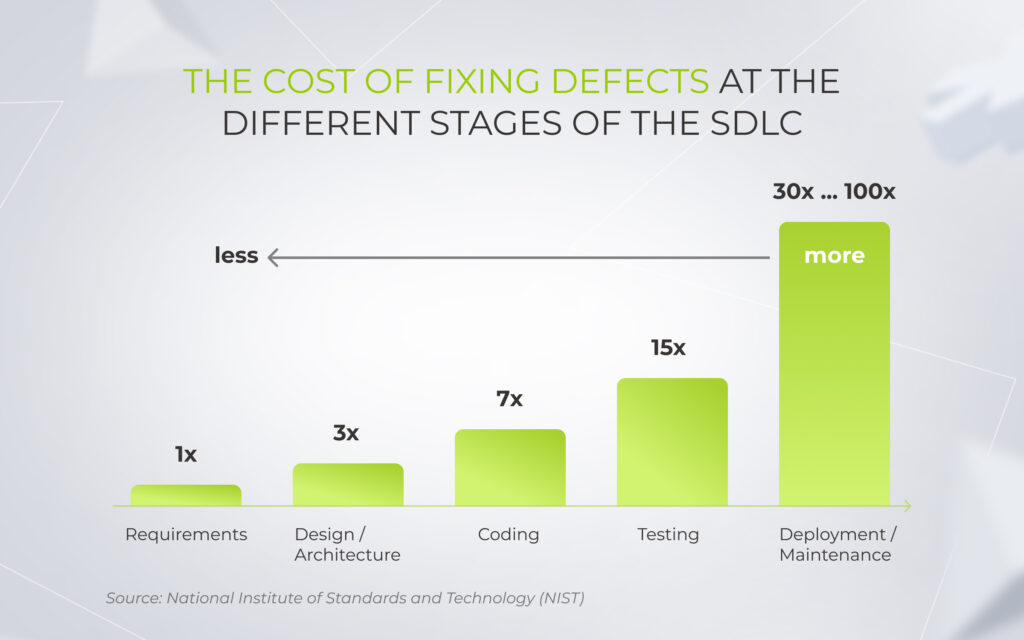
You know what stands behind 64% of software defects? Superficial discovery activities. The success of your web product and web development outsourcing in general hugely relies on proper planning and preparation — and that’s why a thorough discovery phase makes all the difference.
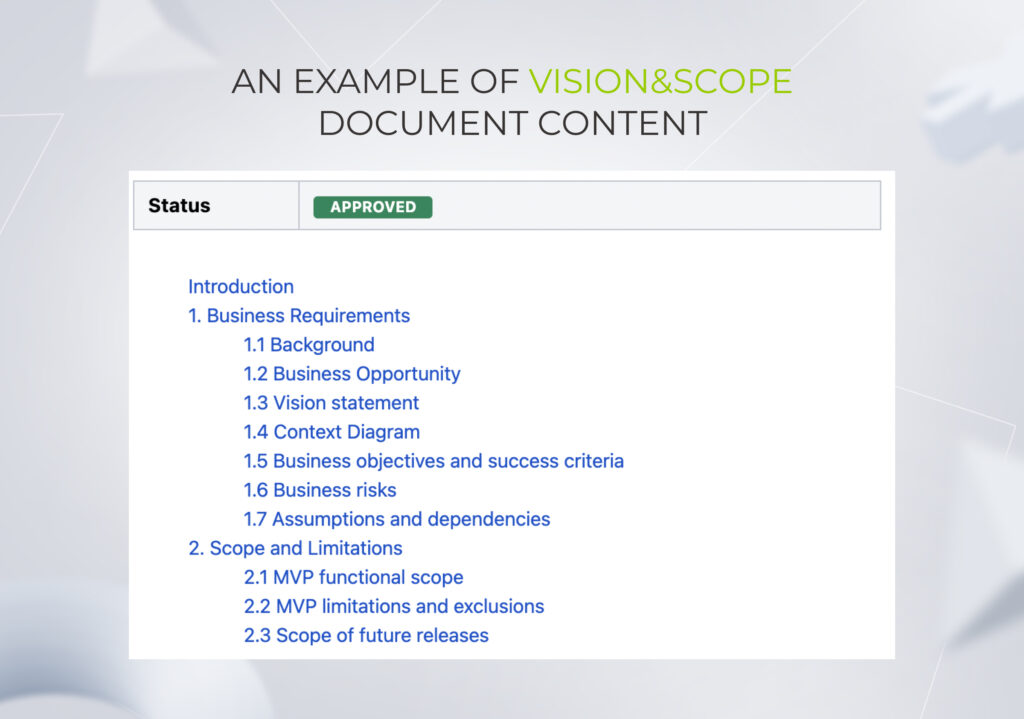
During the discovery phase, your outsource web development company can validate your idea with valuable market and target audience data, refine project scope, prepare solution architecture, and document software requirements specifications. This lays the groundwork for future development and prevents you from investing in unnecessary features.
Commitment to code quality
Readable, easily maintainable, highly efficient — that’s the type of code your web apps need to live a long and prosperous life. A decent outsourcing web development company should have a quality management framework in place and a set of guidelines to standardize code production.
Your vendor should be also well aware of industry-specific coding standards, have a code review system, and know how to proactively manage technical debt. The DevOps methodology and CI/CD should become regular practices for your vendor if you want a high-quality product.
Intellectual property protection
The risks associated with IP theft are intrinsic to outsourcing projects that include proprietary data and code (most projects). To safeguard your intellectual property, you should establish a confidential relationship between your company and the vendor by signing a non-disclosure agreement. Make sure your tech partner has data access controls and encryption to safeguard your sensitive data.
Security and compliance
If you’re building an application for a heavily regulated market such as healthcare or banking, compliance with HIPAA, MDR, GDPR, PCI DSS, and other regulatory requirements should be baked into the development process from the get-go.
Post-implementation maintenance and support
Web development doesn’t end the moment the solution is pushed out into production. To maximize the value of your software and put it up for long-term growth, you should perform regular upkeep and continuously refine the solution based on user and stakeholder feedback. Therefore, post-release maintenance and support should be part of the vendor’s commitment to your company.
There’s no place like….five best countries to outsource web development
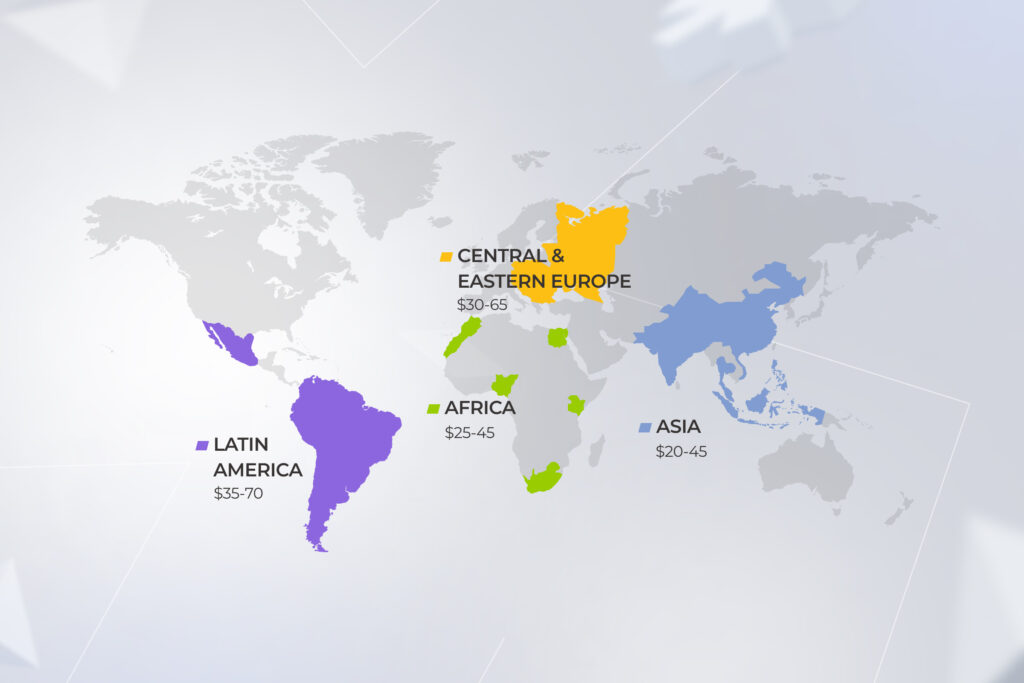
The cost of web development depends not only on your team’s skills and seniority, but on where your outsourcing partner is located as well. Onshore outsourcing is contracting the tasks to someone outside your company but within your country at, give or take, the same cost. Nearshore outsourcing web development provides capacity nearby and can save up to 30% in development labor costs depending on your location. Offshore outsourcing is considered to be the most cost-effective solution, as you outsource the development to a low-cost country, yet it’s furthest away, which introduces greater cultural and communication risks.
While geographical proximity is important in some cases (e.g. need for on-site visits), mature processes, expertise, cultural alignment, cost reduction, and security are more critical factors to justify your choice. With that said, let’s take a look at the best places to outsource web development.
Poland
Rate: $40 to $99
Pros:
High concentration of affordable talent
Belongs to the Central European time zone
High cultural and business affinity with Western Europe
EU-level protection of intellectual property
Strong R&D market
Cons:
Poland has quite high living standards so it might cost you more to build a web app here compared to low-cost locations.
Ranked seventh among the countries with the best programmers in the world (who also speak fluent English), Poland is an attractive outsourcing destination known for its startup activity, stable economy, and innovation strength (41st in the Global Innovation Index). The country is a leading IT outsourcing center in CEE, whose IT outsourcing market is projected to reach $1.8 billion by 2028.
The Philippines
Rate: $28 to $55
Pros:
Low-cost software development
Reliable infrastructure and technologies
Established software outsourcing market
Cons:
Cultural differences and communication barriers can impact the collaboration.
The Land of the Morning Sun is a notable market for software outsourcing with a projected volume of $1,140 million by 2028. In terms of developer talent, the Philippines is ranked third. Global businesses outsource web development to the Philippines mainly because of low hourly rates.
Brazil
Rate: $30 to $55
Pros:
Reasonable cost of software development
A great focus on tech education
An impressive pool of software developers
Cons:
A complex tax structure that increases the costs of development
Web development projects outsourcing companies located in Brazil offer foreign businesses a chance to tap into a diverse talent pool at an affordable rate. The country ranks 49th in the Global Innovation Index and has a rapidly developing IT outsourcing market with an estimated volume of $9.82 billion by 2028. But you should be ready to pay additional taxes for hiring developers from Brazil.
China
Rate: $25 to $45
Pros:
A solid pool of software developers
Supportive government policies
Great startup culture
Cons:
Different IPR laws
Language and culture barriers
China is the world’s second-largest economy — and the local IT outsourcing market keeps pace with a projected volume of $41.60 billion by 2028. The country is an innovation leader and its immense labor pool has made it a hub for software outsourcing. However, the Chinese legal system differs from most Western countries so it may be hard to navigate the local market.
India
Rate: $20 to $40
Pros:
Favorable government policies
Lower labor and infrastructure costs
Emerging R&D center
Cons:
Cultural misalignment
Challenges with communication and project management
The country’s enormous talent pool and low costs have made outsourcing to India increasingly popular in recent years. As a leading tech hub in Southern Asia, India has a mature tech infrastructure and an impressive IT outsourcing market volume of over $10 billion. But low development costs may come at a price here: quality standards and work culture differ greatly from those in Western countries.
Deliver your web development projects, effortlessly
The key to unlocking your project success is choosing a reliable outsourcing web development company
The success of your outsourcing rests on a strong partnership, so choosing the right outsourcing partner can be a make-or-break decision. Here are five things you should consider when looking for the right tech partner abroad.
Optimal size for partnership
“Small enough to care and big enough to scale” is still sage advice. If you want to outsource software development successfully, choose a tech partner with enough resources to handle your product growth. But make sure you’re not just another line item and your partner can provide personalized attention and tailored solutions for your unique project needs.
A fair balance between cost and quality
In web development outsourcing, it’s not just merely about who provides the cheapest service. Lower costs may indicate a compromise on quality or a lack of specialized expertise. Therefore, seek out companies that provide reasonably priced services and demonstrate a clear understanding of the value they bring to your project.
Specialized technical expertise
Be wary of companies that claim to excel in every technology or service area. Instead, look for a tech partner with proven expertise in the technologies and solutions relevant to your project. Ideally, your outsourcing vendor should be also well-versed in your domain.
Credibility and transparency
Don’t be shy to do a thorough background check to verify your partner’s credibility. A trusted software vendor sports a credible online presence backed up with a professional website, authentic testimonials, and a portfolio that showcases their expertise and past successes. You should also look for a partner that prioritizes transparency in communication, especially regarding pricing, experience, business processes, and software development flow.
Product development experience
If your goal is to build a digital product that delivers value to any market, you will need a tech partner with hands-on expertise in growing products from an idea to a product market fit. It means that your tech partner should cover the entire product development lifecycle, including market research, user testing, user-centric design, and iterative improvements.
An experienced outsourcer in product development can not only execute the product but also advise you on an optimal business strategy and revenue generation model.
Web development outsourcing made easy with *instinctools
Web development outsourcing can get your project underway with minimal disruption to the core company’s functions. Significant cost reduction, faster time to market, and innovation agility make outsourcing a rewarding experience, if done right.
Partnering with *instinctools allows you to tap into 20+ years of tech experience and leverage it for your web development project. From definition and design to development and testing, we pitch in when you don’t have the capacity or expertise in-house.
Get off to a good start with your web outsourcing project
Let’s end the endless debate on how to launch an app with a single phrase: it depends. If you’re an emerging startup with a nascent app idea, you’re going to start at the very beginning. Get a solid grip on your app idea, create an MVP, acquire lighthouse users, and analyze what you did wrong or right.
If your product is at its growth stage and you know what you’re doing, you will take a different, more advanced path. Your mobile app should strive to reel in more users, unlock full monetization capabilities, and hopefully secure infinite growth.
Whatever your option is, you may find it challenging to prioritize which fire to address first, and the next best steps to take. That’s why our experts have drawn up a step-by-step checklist that includes the best product launch tips from *instinctools — based on your product maturity.
Round 1: From idea to pilot
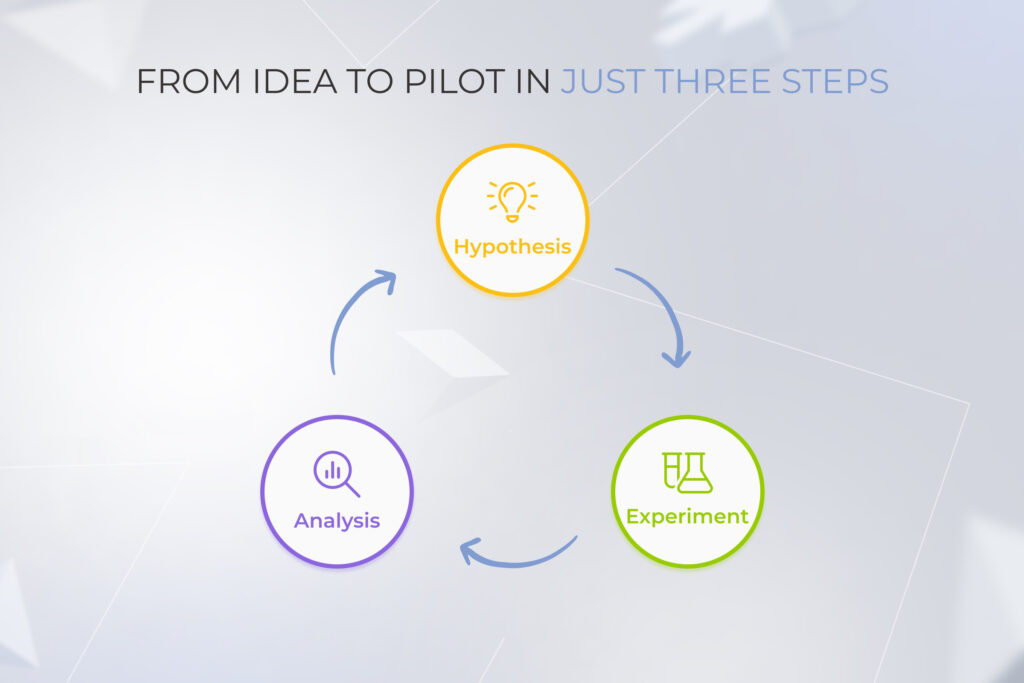
If you are a startup with a vague product concept, your idea of a successful mobile app launch boils down to pushing out a pilot solution and testing it in the wild. In your case, you and your mobile app development team are scientists — you hypothesize, test the hypothesis by performing an experiment, and then, assess the obtained results.
Hypothesize
A good idea for an app is something that solves the problem your target audience encounters every day. In simple words, your hypothesis is all about finding a nagging problem that exists in an addressable market and solving it with a one-of-a-kind mobile application.
Conceptualizing an app
First, you have to formulate and define the idea behind a mobile application. To do that, your development team works closely with your team to understand the goals, requirements, and vision for the app.
A tangible, viable, and functional app conceptprovides clear guidance to the designers, developers, and other stakeholders involved in the development process.
Running market research and competitor analysis
If there’s one hard-and-fast rule in mobile app development, it’s to never skimp on the market research — unless you want to build a product no one needs.
Market research blends consumer behavior and target market trends to confirm and improve your app concept. Competitive analysis is a subset of market research that allows you to identify key market players and evaluate competitor apps to see where your product idea fits in.
Both market and competitor research are crucial to identify opportunities for differentiation, scope out potential features, spot weaknesses and strengths of direct competitors, and assess go-to pricing and marketing strategy.
Setting your goals
Without understanding the destination, it’s very difficult to reach it. The goal-setting is focused on gaining an understanding of what the business is expecting to get from the project and how the team can contribute to this overriding goal.
Usually, there are a few high-level goals behind a project that are then broken down into specific, measurable objectives. At this stage, you also set the KPIs specific to your product. These can include the activation rate, the number of app downloads, MAUs, and other success criteria.
Identifying your target audience
According to Statista, most app categories have an average 30-day retention rate of 1.5% to 11.3%.
To stick around as long as possible, your product should be built with the potential app users in mind.
Your product team can fall back on the various techniques to study the app’s target audience. Surveys, social media research, focus groups, and even a dedicated landing page can plumb the depths of your customer’s thoughts, demographics, needs, and goals. The design team then develops user flows to define interactions needed to achieve a common goal via your product.
With all of the flows captured, you can assume what app features are required to let the user achieve their goal. In parallel with this stage, your development team gathers functional and non-functional requirements for the application.
Running feasibility check
Next up, the team evaluates the technical feasibility of the project. Testing for technical feasibility, the team gains confidence in the proposed solution and ensures that the solution can be implemented with the available resources, technologies, and architectures. The proposed solutions should also meet the functional and non-functional requirements.
If the mobile app development team has been part of the discovery efforts, then by this time, they already know whether the solution is feasible.
Coming up with a unique value proposition
Your mobile app launch strategy is not complete without a unique selling proposition (USP) that embodies the core differentiators of your product.
Your app’s unique selling point can be easily distilled from the app’s value map and user persona mapping.
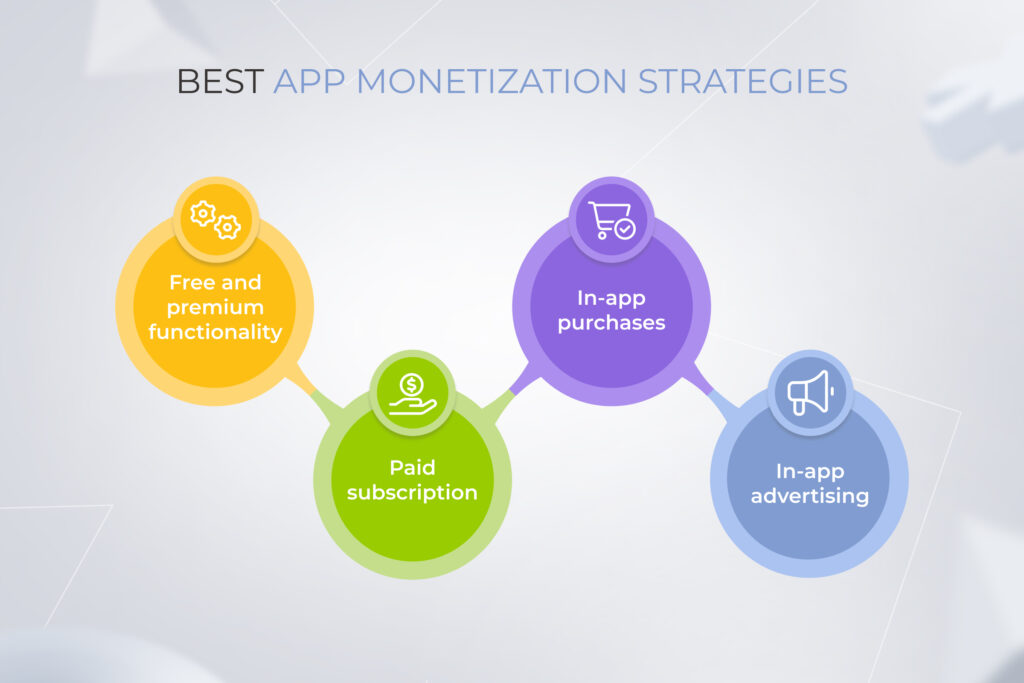
Deciding on a monetization strategy
So many mobile apps fail to generate revenue just because their monetization strategy is off-target. Understanding the preferences, behaviors, and spending habits of your potential users is crucial for choosing the right monetization strategy. The target operating platform should come into consideration as well.
For example, on the Google Play Store, users gravitate towards free mobile apps, while on the App Store, users are more inclined to make in-app purchases and download premium apps.
The previous stage is all about mulling over your new app idea. Meanwhile, the next phase is all about putting your hypothesis into practice.
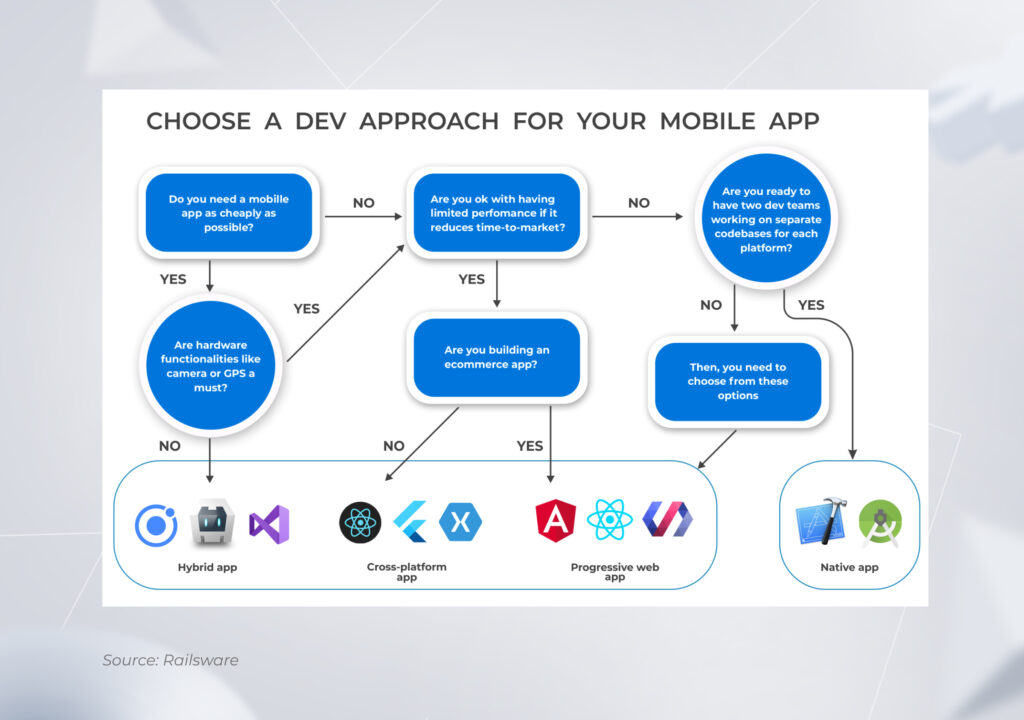
Choosing a type of the app: native, cross-platform, or hybrid
The decision whether to build a native, cross-platform, or hybrid app depends on the app’s complexity, app’s functionality, and target users. Time to market, budget consideration, tech requirements, and other factors also play a role in decision-making.
Creating mockups, wireframes, prototypes
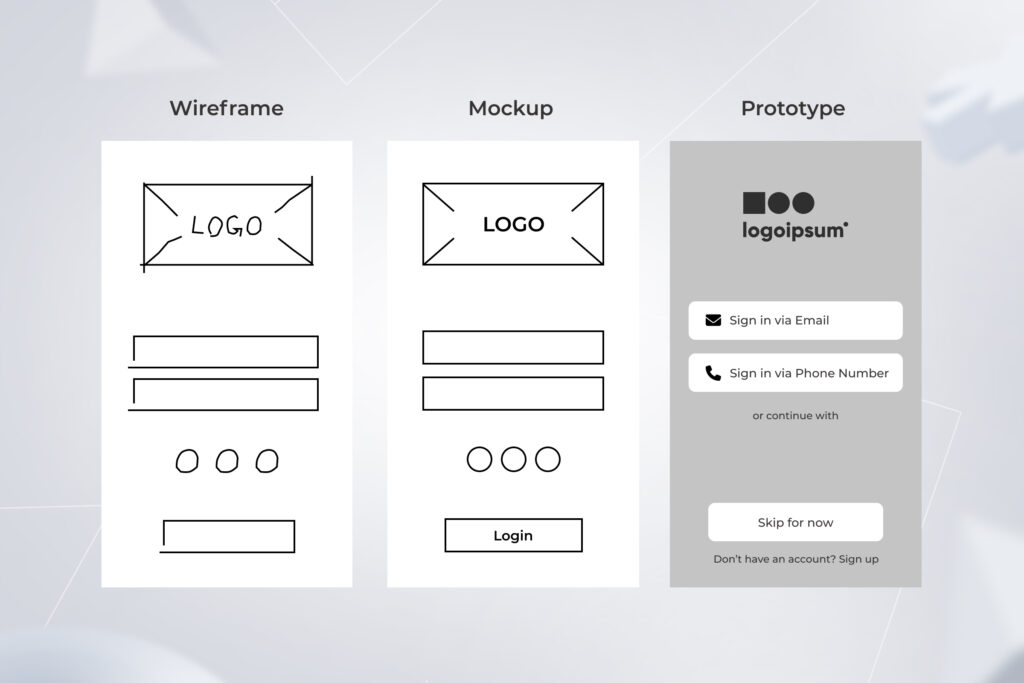
While the developers are figuring out the best path to implement your app idea, UX/UI designers are keying in on the looks. By leaning on the user flow, designers develop a realistic model of what the application will look like.
Since this is an experiment, there’s no point in creating a full-blown user interface. Instead, designers can envision the look and feel of the future product by developing:
A wireframe — a basic, low-fidelity blueprint for UI designs.
A mockup — a more detailed, yet static iteration of the wireframe outline with detailed visual elements
A prototype — functional, pixel-perfect simulations of a ready product used for usability testing and user feedback sessions.
In real life, design teams can start anywhere from low-fidelity to high-fidelity models depending on the project specifics and the team’s experience with the product.
Starting small with a Proof of Concept and/or a Minimum Viable Product
At this stage, you piece together the insights and drafts to give your idea a real turn. There are two popular approaches to giving shape to the hypothesis while also testing the assumptions: you can either start with a PoC or go into developing an MVP.
If the idea has been implemented before or there is a similar product on the market, your development team can move on to building a Minimum Viable Product. For example, something as tried and tested as a food delivery app or a dating app can start its journey as an MVP.
However, if it’s a unique product concept, your app development team might need to assess whether the tech assumption can be implemented (without consuming excessive resources or time) and will function as envisioned. In this case, your team should resort to a Proof of Concept that would allow verifying the overall idea’s feasibility. For example, this might be true for IoT-based applications that integrate with a variety of smart home systems.
Incorporating analytics instruments into the app
Just like with any scientific experiment, you need enough data about the app’s performance to draw a conclusion.
That’s why app developers embed analytics tools like Google Analytics, AppsFlyer, and others into your MVP.
The tools track application data via SDKs and enable you to get a bird’s-eye view of the user journey and drill down into specific metrics like retention rate, engagements, drop-offs, and others. Along with user behavior, you can crunch the numbers to analyze the performance of marketing channels and calculate ROAS.
Testing
Testing your pilot product is another preparation step in the mobile app launch process. Although you create a product for the sake of functionality, you also need to make sure that the product is reliable and usable. In this case, you don’t have to cover all use cases. Usually, manual testing is good enough to validate the product’s usability.
Submitting the app to the stores
Once the MVP is polished, it’s time to debut it to the audience. Advertising campaigns, word of mouth, robust social media presence, and other marketing magic tricks can help you generate more buzz for your product and attract users.
Analysis
Publishing an MVP on app stores is only half the battle of setting it up for future success. Post-launch, you need to gather user feedback and estimate the app’s performance to see whether your hypothesis has been a dud or a hit.
If your hypothesis is proven right and your pilot solution manages to rally a lighthouse audience, you can move on to growing your MVP into a full-fledged solution. If not, you rinse and repeat.
When your pilot solution has gained some traction and got some admirers, you can up the ante by turning it into a popular, mature, and resilient product with a high Average Revenue Per User (ARPU).
At this stage, business owners come to us with a well-defined set of requirements and a well-shaped idea of how, where, and why to grow their mobile applications.
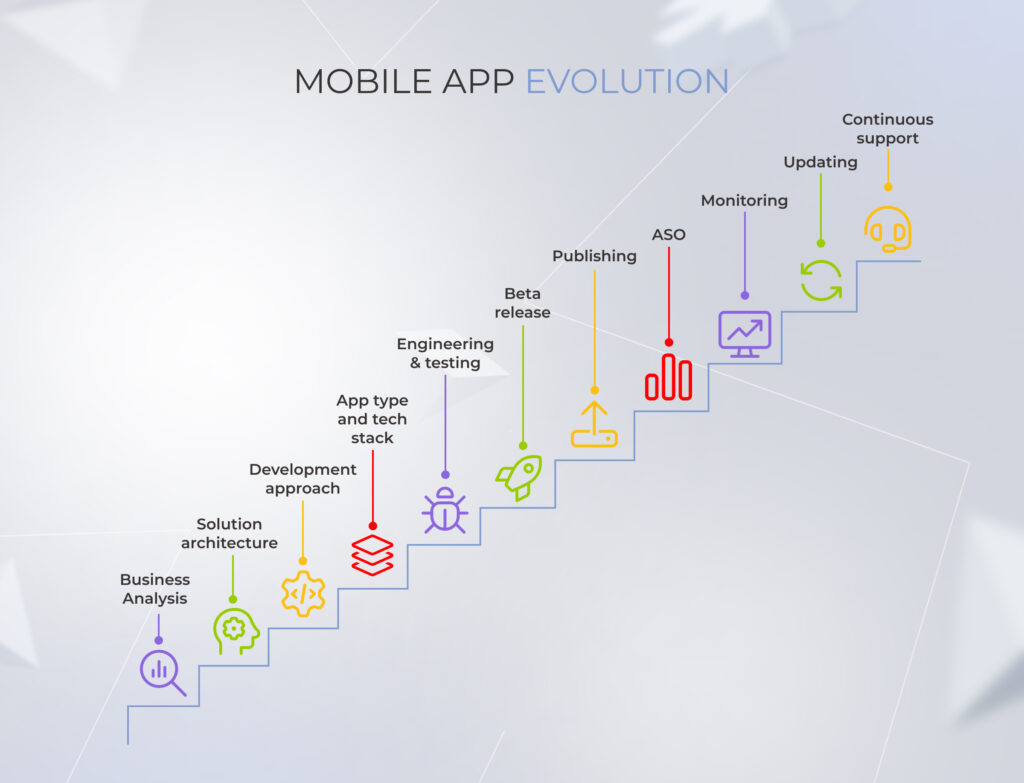
Performing business analysis
Business analysts scope your business requirements and translate them into tech requirements. Together with tech experts, they scope and document the limitations, dependencies, major features, business context, and other crucial input to provide a baseline for development.
Developing a solution architecture that checks all the boxes
Following the tech requirements, technical architects design an optimal architecture for your product. The mobile app architecture lays the foundation for your product and defines what data is collected, how it is transferred, etc. An easily scalable and flexible architecture makes product growth simple and minimizes usability challenges and security issues.
Choosing a development approach
There are many options available when it comes to the development approach. Each differs by the level of flexibility required, the ability to handle change, and the level of collaboration within your team.
Most common approaches fall under the Agile group and break the development process into small, manageable iterations so your development team can release functional increments more quickly. In most cases, the team doesn’t use a methodology in its pure form. Instead, your developers combine different techniques to create a unique workflow that goes with your project.
Deciding on the tech stack and the app type
When validating a hypothesis, you don’t need a solid foundation for your product. When building for growth, however, it’s important to choose the right tech stack. A tech stack includes languages, frameworks, and tools used to build your app, so it’s crucial to choose your technologies wisely. But keep in mind there’s no silver bullet, it all comes down to your unique needs.
Naturally, the choice of the tech stack also depends on the target operating system. If you’re building for iOS, your development team will rely on languages like Swift or Objective-C, while Android apps are typically built using Java or Kotlin. Cross-platform technologies such as Flutter and React Native make your application fit for both platforms.
Engineering, testing, and managing risks
Although some may assume that mobile apps are a simple facade that doesn’t require substantial engineering effort, the very nature of mobile app development makes it an uphill task. A mobile app developer has to consider many different platforms and devices while creating an application to make sure the app works perfectly across all target devices.
To prepare for the engineering stage, your development team sets up the development environment, code servers, and testing servers. If your team is going down the Agile path, they divide the entire development phase into short time-boxed sprints. Each sprint is dedicated to developing specific features and functionalities.
At *instinctools, continuous testing is an essential ingredient of our engineering undertakings that allows our team to spot and address issues early on in the development process. Our QA engineers also rely on automated testing tools to streamline this process and maximize the quality of the deliverables. The implementation of various risk management tools makes it easier for us to guard the project against inevitable risks, issues, and changes.
At this stage, app developers also strike the right balance between innovation and compliance, making sure your solution is up to the industry standards and regulations.
Adding a secret ingredient of a successful launch: beta release
Movies have advanced screenings before the big premiere. Software development has beta testing where your development team makes a beta version of your mobile app available to the public. This pre-release exercise allows the team to test the beta version under real conditions, collect end-user feedback, and resolve any remaining issues before the software’s final release.
A beta release can be open or closed depending on the group of beta testers. In any case, it gives insights into what enhancements should be made before the roll-out and ensures that the final solution meets the desired quality standards.
Publishing your mobile product on the app marketplace
The stable application version is finally all set up to be published on the app store of your choice. Before submitting the application, your app developers make sure it’s in line with the Google Play Store and App Store guidelines, including the application’s analytics services, third-party SDKs, ad networks, and more.
To pave the way for a successful launch, make sure your app’s name, icon, description, and app screenshots are ready for your product page.
Adopting app store optimization to make a splash
According to research, almost 65% of downloads happen directly after a search on the App Store, while 70% of visitors discover apps through search. It means that if you don’t put your product in front of your audience, users might walk past it, carrying their money to your competitors.
App store optimization (ASO) helps rank your app higher in the app store listing and makes it more visible to potential customers. ASO includes optimizing your app name and app title, keywords, description, and other elements for search. Other common ASO tactics include paid ads, category rankings, and top charts.
Monitoring app performance
No one likes having lag issues or using a bug-ridden application. However, bug fixing is a significant time suck for developers. That’s why developers integrate real-time crash reporting tools and analytics into the app before publishing it on the store.
The tools automate collecting, organizing, and prioritizing app crash reports, giving your app team a better idea of how the app fares in the wild. Developers tackle high-severity and high-impact bugs first, while minor issues are put away for later.
Pushing out regular updates
A constant release schedule is a concept that developers incline to as updates positively impact user experience. The rule of thumb is to present 1 to 2 small improvements per month that include minor upgrades, redesigns, and new features.
However, the cadence may vary depending on your improvement roadmap, user feedback, and stakeholder requirements. All updates are planned and implemented sequentially based on the roll-out roadmap. Usually, developers release new features through a phased approach by gradually increasing the number of users who get the updated version.
Providing continuous support
New features may provide additional value to your updates, but the most important reason to keep an eye on your app post-release is to make sure it has relevant functionality and faultless performance. A dedicated support team keeps your application in step with advances in hardware and makes sure it stays compatible with new OS versions.
You can also implement a tier-based user support structure to improve your user experience management. For example, the first support tier is your defense line which solves basic usage issues and updates users on the issue resolution process. The second support tier serves as the second point of contact that handles more complex issues related to app or server configuration.
Real-life examples of our projects that approached app launch differently and all panned out
What do *instinctools’ clients across different scales and domains have in common? They approach us with innovative ideas, and we find the right way to implement them.
An AgTech startup dreamed of a real-time AI and IoT-powered app to monitor 10,000+ plants. As they needed investor buy-in, we charted a smart course from a PoC to an MVP. After fine-tuning the app based on real-world feedback, we delivered a polished, feature-rich solution that wowed investors and positioned the startup for growth.
A transportation company had to make a bold move to conquer a highly competitive taxi app market. We crafted a full-fledged product with conversational AI at the core of customer support, putting our client at the helm of the local market.
Timing is crucial for emerging companies. If you launch the product too early, you risk releasing a half-baked application that fails to take off. Enter a market too late and you might be stuck competing against more established companies. Along with timing, the right team and execution also determine the success of your idea and make sure it hits big.
At *instinctools, we know exactly when the critical mass point for an opportunity arrives and how you can grab it. Whatever your product maturity stage is, our experts can take it from there and ensure your application the success it deserves.
Hit the ground running with your mobile app project
The success of your app depends on how well you plan and execute your launch strategy. First and foremost, you need to make sure that your app idea stands a chance in the market and aligns with the needs of target users. You can check the viability of your idea by developing a Minimum Viable Product. If your MVP manages to attract early users, you can gather their feedback and continue transforming your MVP into a full-fledged solution.
How much money does it take to launch an app?
The cost of app launch depends on your application’s complexity, marketing strategy, and maintenance needs. On average, it may cost you between $30,000 to $150,000+ to launch your application. Keep in mind that this estimate includes only development costs.
To make sure your large-scale software development initiative is destined for success, you need first to figure out why enterprise projects fail.
Deloitte reveals that of 82% of companies that miss their target, 50% achieve less than expected and 42% are late on project schedule. So what are the reasons that contribute to an enterprise project’s stall or fail, and how to safeguard big-ticket solutions?
Our experts are pros at dealing with the challenges of enterprise software development and strategizing your success. Read our guide to get the lessons learned first-hand — without projects burnt.
What is considered a failure for a software project?
“The greatest teacher, failure is.”
However, the degree of failure makes all the difference and when it comes to notable mistakes, it’s better to learn from others’ missteps rather than pay this high-priced teacher out of your own pocket.
Speaking of software development, a project is deemed a failure if it demonstrates one or several of the criteria:
Doesn’t solve the end users’ problem. Mismatching customers’ needs and releasing an undemanded product is the worst scenario possible.
Falls short of its original business objectives. You might end up with a different product if your tech partner wasn’t guided by your goals to provide expected project deliverables.
Lacks quality. Jerry-built software is a one-way ticket to project failure caused by the inability to fit into your software ecosystem and scale appropriately.
Fails to bring intended ROI. If the project can’t meet your ROI target and you don’t see a way to give it another shot, it’s time to stop. Run a retrospective and reflect on why the project went wrong to avoid the same pitfalls in the future.
Messes with a timeline. Rolling out the project on time may win you a competitive advantage over your peers.
Some of these factors, such as budget and due dates, can be considered tolerable for the purpose of creating a top-quality, secure, and scalable product. That’s how challenged yet viable and eventually successful projects rise.
Hurdles that contribute to statistics on project failure
If you made it to the enterprise level, tasks such as resource planning, risk management, choosing appropriate project methodology, etc. aren’t the tough nuts to crack. However, you can still face common project pitfalls stemming from the complexity and longevity of enterprise solutions.
1. Neglected discovery phase
For over two decades, we’ve been witnessing proofs of the principle:
Shortcuts on the basics always bite you later.
As an enterprise project is a marathon, mapping out the route is worth it. And a method to avoid project failure is within your grasp — start with a discovery, or an inception phase. At this initial stage, your tech ally digs into your new ideas and aligns your project vision with business context, market trends, and user needs to shape it into a comprehensive roadmap to a top-notch solution.
The discovery phase isn’t a cure-all, but it can help nip most enterprise software development issues in the bud and unveil strategic opportunities that weren’t on your radar before.
While project deliverables at the inception stagecan vary depending on the specific software development services provider, at *instinctools, we bring a lot to the table to minimize the delta between value and cost.
Our on-field experience in safeguarding large-scale solutions from failure proves that it’s not too late to take another crack, even if it seems that your project has already gone down the drain.
We were once approached by a European venture capital enterprise that wanted to launch a web platform for VC investors and funds. Their trailblazing B2B2C solution was supposed to pull ahead of the competition, but the haphazard implementation approach of the client’s previous tech partner put the product launch at risk.
Nevertheless, during the discovery workshop, we tackled all issues — clarified organizational priorities and product vision, aligned the development scope and project plan with updated expectations, and outlined the backlog for future releases. These efforts led to decreased time to market and fruitful rollout.
Check how the imperilled fintech project made it back on track with our support
Delivering on time, budget, and, more importantly, on value is a tricky mission. Adherence to the Agile development approach is a table stake, and it alone won’t hand the desirable outcome to you on a silver platter.
To ward off shoddy code, jerry-rigged architecture, muddled project documentation, non-transparent processes, and failures in project management, you’ll need a solid delivery model encompassing engineering best practices, a tried-and-true architecture approach, and time-tested project management handbook.
Digital product engineering companies that make the grade in enterprise software development usually build up a custom delivery model backed up with their on-field experience — that’s how we do it at *instinctools. Besides following PMBoK (Project Management Body of Knowledge) and DAD (Disciplined Agile Delivery) principles, we amp up these best practices with our 25+ years of hands-on expertise in crafting large-scale solutions and fortifying them from project failure.
3. Constantly changing goals cripple the project’s scope
Another nail in the project’s coffin is inconsistent objectives and the consequent scope creep. According to the Project Management Institute study, in 2024, 67% of projects experienced it.
The Vision&Scope document can call for revision if the market conditions and customer needs have transformed. Nonetheless, even advisable changes should be applied appropriately. Regarding the development cycle, if a sprint’s goal changes, the project team stops it and starts another iteration with re-planning and re-assessment to avoid scope creep and rework in the future.
If the ship was heading north and then got the command to change the route and move south, sending there a few lifeboats wouldn’t make a difference. You need to turn the whole ship in a new direction. It works the same way for product development.
However, changes may be driven by the desire to implement some trending features without taking into account the existing backlog. In such a case, they only clutter up the scope, slow down the development process, and bring you closer to becoming a failed project example.
That is another reason why a solid basis such as a discovery phase is vital — it’s easier to stick to the goal and the path to get there when they are clearly defined. To drill down on the project objectives, put a premium on investigating the market, existing solutions, and customers’ uncovered needs.
4. Not seeing the forest behind the trees
The degree of a project’s success depends on the business’ overall readiness to embrace the digital transformation, which requires equal attention to its all-important dimensions, from people to processes to technologies.
For example, you can’t adopt cloud-based ‘everything’ to light-speed time to market without taking care of QA automation and honing unit and integration tests. Cloud migration increases the number of releases x20 per day, and such a workload is beyond manual handling.
One of the major project challenges may also lie in delivering software that seamlessly fits into your existing ecosystem. That’s the struggle one of our clients faced. A global software licensing company was looking for a tech partner to deal with a legacy system modernization as a part of its overall digital transformation journey. We offered two options:
Moving fast and renovating the existing software to the most up-to-date solution available
Going step by step by upgrading the versions of existing software and, eventually, adopting a coveted modern solution
Want to know which option the customer bet on and how it impacted the software’s maintenance costs?
5. Inadequate governance model affects communication at all levels
We’ve seen projects that had failure right on their threshold because of poor communication between the development team and stakeholders on the client’s side. What are the consequences?
Insufficient C-level engagement puts additional stumbling blocks on the project’s path
What are your expectations when hiring a dedicated team for enterprise development? Based on our clients’ experiences, this decision is usually driven by a desire to delegate development tasks to industry experts and get top-quality software with minimal risk of the IT project failure.
No CEO, CTO, CXO, or other company executives want to be engaged in the development process on a weekly basis and resolve operational issues. They expect to receive monthly and quarterly visualized strategic reports with highlighted key metrics that prove the project is moving in the right direction.
Yet, no matter how much you want all the magic to be happening behind your tech partner’s doors, top-management involvement — clearly, within reasonable limits — is vital, especially at the initial stages. To arrive at the destination set at the start, C-level product vision should be clearly articulated, documented, and treated as the project’s North Star.
Discrepancies in product vision fuels constantly changing objectives
If several stakeholders on the client side haven’t collaborated much before the project, working together on a roadmap can be a point for bridging the gaps in their perspectives and establishing reliable communication.
Misalignment between the stakeholders, tech partner’s team members, and end users can derail the whole project
Matching technology with common sense is a top priority that should be covered by close collaboration between the development team and the client. Minor details can take their toll and lead to crafting software your employees won’t even be able to use.
Your dedicated team can create a five-star app with ample touch and gesture functionality. But what if the warehouse staff works in gloves and won’t be able to leverage all these touch-based features? As always, the devil is in the details, and your tech services provider should uncover and take them into account from the get-go.
That’s how we deal with it at *instinctools. We have a project governance framework that implies all-encompassing, multi-level collaboration between team members and a client:
Our approach addresses issues at different levels so that they are handled by contributors with the relevant competencies. The majority of head-scratchers are resolved at the project level in a matter of days or weeks. Questions of the company level are discussed at quarterly meetings.
Here’s a real-life example of tackling a project-level issue before it snowballed into an IT project failure. An automation machinery manufacturer approached Instinctools to create a web app for their innovative driverless forklift system. The project had to fit into a seven-week timeline so that the client could present the equipment at the industry trade show.
Initially, the client’s in-house team was in charge of developing a service for the robot coordination, while we took on crafting a user-centered web app for data presentation.
However, there was only one robot model for both teams to work with, and transporting it back and forth for testing between the development centers would violate the project’s deadline. Therefore, our team wrote an emulator that served as a temporary substitute for the coordination service, making it possible for the client to showcase the trailblazing forklift model at the trade show.
When it comes to enterprises, one of their pain points is a large ecosystem of heterogeneous internal solutions adopted throughout an organization’s existence and, therefore, challenging to manage and maintain. As a software company that faced and overcame these hurdles while working on our clients’ projects, we totally understand the hunger for affordable software. However, a quick route to success isn’t always the go-to option and may actually lead to the failure of IT projects.
We once got a request from a manufacturing corporation to review their CI/CD processes and fine-tune them so that everything will keep up and running hitch-free over the next decade.
However, even consulting standard-bearers such as Gartner won’t risk doing horizon scanning for such a distant future and making bold predictions since the IT landscape changes like the wind.
Enterprises need to accept their fate rather than expect a wow effect from the out-of-the-box solutions that promise to fix things once and for all. My 15-year experience in managing large-scale projects shows that there’s no way to avoid customization of ready-made solutions for established IT landscapes.
Nevertheless, be aware of the opposite extreme — over customization, which is just as detrimental to the software and can become one of the reasons why projects fail.
7. Over-reliance on technology instead of business outcomes
It’s important to look under your feet when walking the tightrope, but if you dwell on the road for too long, it’s easy to lose the vision of the final goal.
Similarly, technology isn’t a destination; it’s a way to bring you there.
Here’s one more case from my practice. A fintech company bet on an out-of-the-box DWH solution with a $60,000 yearly license, hoping it would solve 90% of their data-related problems. However, the cost of software integration into their ecosystem exceeded $1,000,000.
A feature-rich, out-of-the-box product — just as they wanted. However, building a custom solution from scratch would have cost much less than adjusting an off-the-shelf solution to their IT landscape.
8. Mismatched expertise
The root of all the previous problems may lie in hiring the wrong team. If a dedicated team lacks the expertise to cover your enterprise-scale projects, it turns into additional risk you have to manage.
Finding a reliable tech partner and leveraging IT staff augmentation to extend your in-house expertise or outsourcing development tasks to a fully-packed dedicated project team is a golden ticket to reaching your high-level goals while ensuring your solution is secure, and the core knowledge won’t leak outside the company.
To cut the chaff at the initial stage and exclude the team factor from the list of potential causes of failure, validate the trustworthiness of the potential vendors:
Verify if they are present on business listings, such as Clutch, GoodFirms, Techbehemoths, SelectedFirms, etc.
Scrutinize their market reputation by checking testimonials of previous clients
Review the company’s case studies to see if its expertise clicks with your project’s needs
Save your time and book a safe pair of hands or a whole dedicated team
Withstanding unclear objectives, unrealistic expectations, and scope creep while keeping your eyes open to new strategic opportunities isn’t an easy road. Yet having a blue-chip partner by your side allows you to rest assured of achieving desired outcomes.
Let your tech ally run a discovery phase, clarify organizational priorities, draw up a project plan, choose adequate delivery and governance models, keep project leaders on the same page, track due dates, and more, to avoid project failure and deliver the results you are aiming for.
Race to the finish without worrying about the tech side
What are the main causes of enterprise project failure?
There are three dimensions that can contribute to the IT project failure — people, processes, and technology. While enterprises are less susceptible to the process-related causes of failure, they still have much to deal with because of the complexity and longevity of large-scale projects. For instance, neglecting the discovery stage can result in unclear objectives and misalignment between stakeholders, choosing the wrong delivery model can lead to jerry-rigged architecture, and constantly changing goals can cripple the project’s scope.
Why do most projects fail?
Project failure statistics remain high year by year as covering users’ needs with a top-quality solution while sticking to your original business objectives and staying within the budget and timeline gets tenfold more challenging when we talk about enterprise software initiatives. Delivering at scale and avoiding project failure is possible with a reliable tech partner, but not everyone has one.
Parlaying expertise, talent, and commitment into measurable business outcomes since 2000.
See how an initiative of young IT professionals transformed into a global custom software development company with engineering hubs across three continents.
History milestones
Founding and early years
Founded in 2000 by Alexey Spas and Diethard Sohn, the company originated in Stuttgart, Germany.
Initially, the start-up focused solely on custom web development of high-loads. In its early years, *instinctools secured a deal with its first client from the Fortune 500 list — Mercedes-Benz Group AG (former Daimler). Crafting a web-based user support system for one of the leading global automotive companies became a turning point for a five-year-old start-up.
Growth and diversification
Over the next fifteen years, *instinctools expanded its services to include mobile app development, enterprise automation, legacy software modernization, cloud computing, and more. This shift enabled the company to attract mid-sized companies and large enterprises and bring other big-name clients, such as Helvar, Nostrum, CANet, and Fujitsu, among others.
2015 became a tipping point in the company’s history. Instinctools outgrew the boundaries of a strictly outsourcing software development company and presented DITAworks Webtop, their first enterprise-grade SaaS product for technical documentation management. This product helped *instinctools win two top-level clients — SAP and DEIF.
Educational initiatives
At the same time, witnessing the emerging global talent shortage in the software development industry, *instinctools launched several educational projects to share their hands-on knowledge with young specialists. The company established a Growth academy for promising students in IT-related disciplines, organized offline coding competitions, and delivered lectures for adult professionals in Hrodna, Belarus, where one of the development centers was located. In 2021, the company began hosting online conferences “Tech Times”, discussing technological trends with industry leaders from all over the world.
International expansion
The years 2010–2020 were fruitful in many ways. New offices were opened in Minsk, Belarus, Moscow, Russia, and Warsaw, Poland. Instinctools also kept expanding their partnership network and signed agreements with Google Cloud, OVHcloud, and Odoo. From 2021, *instinctools operates as a trusted Microsoft Partner.
Team: from 7 to 400+
Instinctools brings together proactive, business-like, and determined doers who shape the company’s DNA as an international software product development and consulting company. Starting with a team of seven, *instinctools has grown to over 400+ employees across ten countries. Key team members:
Alexey Spas, CEO
Gunthilde Sohn, Managing Director, DACH
Chad West, Managing Director, USA
Alexey Astakhov, VP of Engineering
Tatsiana Astakhava, CFO
Along with the increasing number of tech and business talents on board, the company’s expertise area and hands-on experience in working with various industries also kept expanding. To date, *instinctools provides services over a broad technology stack, including Java, Python, Javascript, React, Angular, Microsoft Azure, Power BI, Odoo, HubSpot, AWS, and more, delivering robust technological solutions for businesses across many industries:
Healthcare
Fintech
Ecommerce
Manufacturing
Logistics
Automotive
Energy
Entertainment and media
Education and e-learning
Technology
Ad-tech
Cryptocurrency
Offices
In the middle of 2024, *instinctools had two headquarters on both sides of the Atlantic: in Stuttgart, Germany, and Potomac, MD, USA. The main development hub is located now in Warsaw, Poland. The company has growing development centers in LATAM, Kazakhstan, and India. The offices in Belarus and Russia operated in the 2010th, were closed. To date, the company provides seamless collaboration to customers across the globe and operates within 20+ time zones.
Awards
Instinctools regularly receives awards on the B2B review platforms, such as Clutch, Manifest, TechBehemoths, SelectedFirms, etc. The company’s expertise has been recognized in a number of categories, including but not limited to the following ones:
Deciphering how to choose a software development company is challenging for businesses aiming for project success. There’s a myriad of options for nearly any type of outsourced support, biased opinions both internally and externally, and if your company’s reputation and growth depend on the quality and the suitability of the final deliverables, there’s added pressure to get it right. We get it.
Determining the best criteria, or shortlisting the right questions to ask potential vendors is critical to inform such a decision. That’s why our experts have prepared a detailed guide to help you make the right call and hire a software development company that walks the talk.
Make sure that outsourcing your project to a software development partner is what you really need
According to Deloitte, two thirds of all companies turn to software partnership to get their IT solutions delivered. But as common as it may seem, app development partnership is not a cure-it-all solution. It’s a strategic decision made for very specific reasons.
Innovating new products and features
At the beginning of 2025, the global talent shortage in the IT industry reached 76%, making outsourcing an almost automatic option to secure the right talent on short notice. Digital innovators, more than anyone else, are dependent on the right available tech talent to bring new products to market.
Hiring app development partners allows organizations, anywhere on their transformation journey or product roadmaps, to tap into on-demand technical and subject matter expertise, as and when needed. Software development partners allow companies whose in-house specialists do not have the required technical or product skills or capacity to deliver innovation sooner.
Giving clarity to projects with vague requirements
Most often, companies have a product vision (albeit, often half-baked) but don’t see the path to its implementation. Reaching out to an experienced software development partner is a great way to eliminate requirements ambiguity and put your project on the right track from the get-go.
As a rule, software development companies offering innovation services pay special attention to discovery, an early stage or couple of practical steps focused on laying out your project scope, requirements, cost, and all the must-haves for successful delivery. So if you lack clarity in your journey, it’s better to have a partner with a savvy discovery capability to steer you in the right direction.
Slashed operating costs
Over 55% of companies view outsourcing as a cost-reduction play and for a good reason. With outsourcing, you can forget about the costs associated with recruiting, training, paying salaries, and providing employee benefits including paid vacation and sick leave, while ensuring that at least part of your IT infrastructure is covered by an experienced software development company.
Most importantly, the strategy of outsourcing may help you reduce the cost of software and data projects by 30% – 50%, given the right partner.
Scalability and flexibility
A good software development partner has developer talent on tap, with an ability (and willingness) to flex team sizes up and down as demand fluctuates. With this “flex-capacity”, you can extend your team with outsourced talent and scale down once the workload is completed without the additional costs and fallout associated with in-house termination.
Faster time to market
A company can also leverage outsourcing to accelerate the delivery of a new product. Ideally, the combination of fast hiring and a full-cycle software development process reduces the time to market, without compromising quality. A good software development partner for innovation-related work should articulate and demonstrate a mature, yet practical approach to quality assurance throughout the entire digital product life cycle.
We excel at solo flights in delivering top-tier software solutions to our clients, just as we do at co-piloting. Teaming up with other digital innovators, we join forces to amplify value for our shared customers. Explore.
Avoid the pitfalls of software partnership
There’s one thing you need to understand: outsourcing can fail. The root cause is often traced to the fundamental way companies view and discuss product development from the onset. Instead of prioritizing a product concept, businesses rush straight into outsourcing software development. However, the right approach includes laying the groundwork for a product’s success.
Share your product vision. The more info, the better!
Before deciding upon a software development partner, it’s vital to determine the essence and long-term mission of a product. In other words, communicate the “why” behind your product, including:
Your company’s core motivation (mission, values, and backstory)
Key product information like target customers, needs, key benefits, and differentiators
Information on your business model and insight into any changes
Important or fundamental technologies, methodologies, and protocols
Sharing your product vision early and widely can help you get off on the right foot with an outsourced software development partner.
Determine the rough project scope
With an idea of your final destination, you should then lay out the rough scope of the project to begin identifying the requirements and needed resources.
I recommend documenting and sharing the prioritized or at least the must-have features of the first product version completed with the new partner. To do that, you need to create a list of features based on user flows.
During the Discovery stage, your software development outsourcing company should have the capability to help you specify and prioritize your project scope. But having something to start from will help set the tone and accelerate development.
Set a preliminary budget
Surely, within the Agile software development life cycle, budget estimates evolve as the outsourcing partner gains a deeper understanding of the product with each iteration. However, you should allocate a specific budget before choosing a software development company if you don’t want to work in the dark.
To calculate an optimal amount, you can benchmark your product against similar products in the market and then ask a few development companies for a ballpark estimate.
Plan an approximate timeline
Again, after you reach out to a reliable potential tech partner, dedicated project management should be proposed with a project-specific timeline with all the deliverables laid out in chronological order. Sharing approximate start and end dates of your project and overall expected engagement duration with potential partners will help you align your overall business and marketing strategies, reaping the benefits of client-provider partnership earlier.
Get stakeholder buy-in
After articulating the strategic importance and documenting a description of the work as best as you can, seek executive sponsorship to back your initiative. You should engage stakeholders early in the process and ensure they’ve bought into a shared vision and understand the scope of the project and amount of support they’re asked to provide, in money, time, and attention.
Measuring the potential ROI is a great way to win sponsorship and defend your initiative from competing interests.
Having a well-defined vision, limited scope, preliminary budget approvals, timeline guidance, and a thorough and credible ROI calculation will win stakeholders who not only sponsor your initiative, but support your decisions to execute an ROI model which may incorporate outsourced software engineering help.
When in the market for any needed software development assistance, especially if the work is related to digital product innovation, look for a partner who requests the information and offers upfront consulting services to cover any gaps in project readiness.
How to choose the right software development partner? 7 steps to collaboration success
When the plans and sponsorships are at a good place, it’s time to finally start looking for a software development partner, and you might like a step-by-step plan to guide your search. That’s why *instinctools’ experts have assembled a list of steps to help you choose a reliable software development partner to transform your business ideas into winning products.
1. List down companies
Assuming you have already got a solid grip on your requirements and timeline, the next step will be to find a team that matches your specs. To locate a trusted software development partner, you can use the following resources:
The fastest and easiest way to find a prospective software development partner is to scour the Internet. With the criteria identified, you can shortlist potential companies that meet your requirements.
Peer into professional listings. International and local directories can give you a better idea of reliable software development partners, their experience, average rates, and industry focus. These platforms help you cast your net and narrow your search at the same time, as you can hand-pick companies based on budget, industry, tech stacks, and more.
Browse through your connections on professional networks. On LinkedIn, you can ask around for references or reach out directly to prospective tech partners.
Networking events, exhibitions, and conferences like Web Summit, Mobile World Congress, and others are great places to come across like-minded partners for your business.
Attending the workshops at tech-focused meetups and hackathons will help you to see your potential development partner in action and have a closer look at their skills.
Referral networks and word-of-mouth recommendations can also be a great way to find a team that has been recommended by a company you trust.
2. Choose a location where to hire a software development team
Once you have a list of potential software development partners, you need to trim it down and group the vendors by location. Choosing the right outsourcing location is an important part of the outsourcing strategy. The decision as to where to go hinges on the following factors:
Available talent pool
In top-dollar locations, you can run into stiff competition (which suggests higher costs of hiring) or distance yourself from target candidate pools. Conversely, countries with affordable cost of living have more diversity in their demographics, which leads to more concentrated pockets of talent.
Cost tolerance and quality of services
Although your knee-jerk reaction might be to hire the cheapest software development outsourcing partner, it’s not the affordability that makes your collaboration valuable. It’s the cost-value ratio that should guide your selection process. Therefore, you should look for software development firms with a cost-effective pricing model and a proven track record of software development services.
According to TalentUp, Poland offers the most affordable developer talent in the EU with an average yearly salary of a bit over €30,000. Paired with a high level of services, this location might be your destination for software outsourcing.
Time zone
A significant difference in time zones can complicate communication and even derail your project. However, similar time zones allow you time to collaborate and align on projects without delay. Therefore, choose outsourcing locations with at least 4 hours of time zone overlap so you can easily find windows of collaboration.
Culture
Cultural harmony means that the standards and values of your company align with the ones of your potential software development partner. Cultural compatibility also includes having similar business practices, work ethics, social norms, and communication styles — everything that makes your software development partnership more comfortable for both sides.
English proficiency
Staying on the same page is impossible if both teams don’t speak the same language. That’s why you have to make sure software developers have a good command of the English language. Countries such as Poland, Romania, and Bulgaria boast a high level of English proficiency and pocket-friendly rates.
English proficiency index, by country
Hire a dedicated software team that matches your needs
You need a partner, not a project-doer. So next up is making sure the work approach of your software partner aligns with your project requirements and company culture. A good partner’s methodology should illustrate how the company, not their individuals, will support innovation across the long term and achieve your product development outcomes short term.
A trustworthy software development partner has development approaches published on their website. Agile development practices and other modern software development frameworks such as Scrum and Iterative Incremental model are considered the gold standard for building quality digital products.
4. Verify expertise and experience
The best software development partner has everything your company lacks in terms of tech expertise. Look for fits in technology skills, experience building similar functionality, and industry experience.
Remember to check whether vendors are in tune with industry trends and on-the-radar technologies. Take AI-powered outsourcing and digital workforce ideas, for example.
Leading outsourcing partners go beyond providing you with seasoned experts. They supply you with aces who have already incorporated AI tools, such as co-pilots and AI agents, into their everyday work to deliver top results faster and at a lower cost. Deloitte’s survey pinpoints that 83% of executives expect the use of AI capabilities to be table stakes for fast-tracking outsourcing services without dropping their quality.
You can get an idea of a prospective partner’s experience by studying their portfolio, evaluating case studies, and asking for testimonials from previous clients. A good potential partner’s methodology will support knowledge transfer of any industry knowledge delta in the most efficient manner possible.
Make sure to look into the complementary skills and knowledge that might be valuable for your project. If you’re good at hatching ideas but resource-constrained when it comes to their execution, you’ll need a partner with a vast toolbox to find an optimal way to realize your vision.
5. Explore cooperation models
The specific nature of your project is the key element you should consider when choosing an ideal engagement model. Project scope, certainty of the output, level of involvement, and the agenda differ from model to model.
Now, it’s finally the time for a money talk. When asking for a bid, avoid basing your decision on a generic rate card and seek a specific quote. The right software development firm will help you make key early decisions, provide insight while doing so, and provide you with an executable proposal that includes major terms, price, and timeline estimates. Now you can refine your ROI model to more accurately forecast the expected return and to support your decisions throughout.
Most software development partners work according to the Fixed Budget, Time & Material, and Dedicated team outsourcing contracts. Again, it’s the case of different strokes for different folks so revisit your project specifics.
Fixed budget model
Time & Material
Dedicated team
Project size
Small and mid-size projects, MVP
Any type of projects
Medium, large, long-term projects
Project requirements
Predefined
Not set
Evolving
Flexibility
Little
High
High
Budget
Fixed
Estimated
Estimated
Client’s control
Little
High
High
Timeline
Fixed, but extendable
Predefined, but extendable
Predefined, but extendable
Scalability
No
High
High
7. Investigate market reputation
No matter how heartfelt slogans on your partner’s website might be, you should research their background and reputation to double-check the quality of the services. No company would want a partner who always misses deadlines or is not polite to work with.
Before sealing the deal, read first-hand testimonials from their previous clients on Clutch and GoodFirms or connect with a few of their past clients. We’ve deliberately listed this point last because you’ll have better questions for a potential partner’s referrals at the end of your research journey.
Choose a tech partner that delivers on time and on budget
Revealing red flags in a software development partnership
Here’s the deal. Any company, good or bad, tries to make an irresistible first impression on anyone who passes by. However, you need to see past an impressive client hall of fame, numerous accolades, and bold promises. Below, we’ve outlined early signs of trouble that might make your project go downhill.
Size mismatch
A good development partner should be small enough to care and big enough to scale. Therefore, you should steer clear of partnerships with big (1000+ employees) firms. Their often-rigid structure and broad focus might overlook the specific needs and nuances of your project. On the other hand, if the company is too small, you might have trouble scaling or developing a large-scale project.
Cost-over-quality approach
Be cautious of companies that make low-priced offers, significantly lower than the market average. Underbidding can be indicative of compromised quality and a lack of the specialized expertise necessary for the success of your project. Therefore, it’s best to focus on value for money rather than grabbing the cheapest deal.
Jack-of-all-trades claims
There’s a big difference between a can-doer and a jack of all trades. If the company seems too eager to reel in a new client, they’re either rookies or too desperate to land a project, any project. Either way: you and your product lose.
Therefore, avoid partners who claim to have a decade-long expertise in all technologies. This overreach often results in a superficial breadth of knowledge, lacking the depth required for your specific technological needs.
Failed credibility check
Lastly, consider the visual cues you see on the website of your potential partners. Subpar websites, generic testimonials, and ambiguous portfolios often point to a lack of experience and credibility in company roles. The same goes for companies that put your project in a black box from the very first engagement, giving you evasive answers about the prices, experience, and business processes.
A tech partner worth their salt never operates behind a magic curtain. They are loud and proud of their track record, relevant experience, and terms of cooperation. Trusted development companies also have a clear understanding of who they are as a company. Otherwise, you might be dealing with a vendor that’s going out of business.
The problem of hiring a software development partner, solved
In 2025, your business can’t afford bad software. That’s why you need a trusted software development company to have your back. Although there’s no magic formula for choosing partners, such particulars as project development cost, wide experience, a proven track record, and a favorable location should be among your main selection criteria.
When choosing a software development partner, especially for innovation, it’s important to consider data points outside of the hourly rate. Opting for MVP development services in USA ensures that your product is built with a strategic approach, balancing speed, quality, and scalability. If you dream big and plan small, you realize ROI beyond any model or spreadsheet.
How do I find the right software development company?
First of all, you need to clearly define your requirements and objectives for the project. This will help you narrow down your search and identify the companies that specialize in the specific technology or domain you require. Once you establish a clear understanding of the project, you can either ask your network for recommendations or go on the hunt on your own.
What makes a good software development company?
The best software development company is the company that complements the skills of your team. Your ideal tech partner also has solid technical expertise and a diverse team composition. Make sure to check whether they’ve made a good name in the software development industry and look through the clients’ testimonials. A great partner also has a variety of agile software development methodologies to support the unique needs of different projects.
How much does it cost to hire a team of software developers?
The cost of hiring development teams varies based on the location of your vendor, team size, and the hiring model. Reach out to *instinctools and get a ballpark estimate for your project.
Why hire a dedicated software development team?
This hiring model offers a high level of commitment and accountability as you are working with a team of experts solely focused on your project. This in turn results in greater collaboration, accountability, and a shared sense of ownership. With a dedicated team, you also have the ability to scale your resources according to your project’s needs.
Ever since they entered the mainstream, large language models and LLM use cases have heralded a foundational change in business processes. Eager to rewire their workflows, global companies dived headfirst into LLM adoption, with applications of LLMs and LLM-powered agents featuring everything from field operations to back-office admin.
But as the initial zeal and flurry of activity have cooled off, companies realized that to reap tangible benefits of LLMs, they require something more than incremental improvements. They need an organizational and technological overhaul.
Today, our AI team will break down the best LLM use cases across industries as of 2026 to showcase the potential of large language models in the real world, along with the technological capabilities you need to innovate effectively and at scale.
Key highlights
From customer operations to supply chain management, there is a wide range of LLM use cases, offering significant potential for business automation and cost reduction.
For data-heavy industries such as healthcare, banking, and retail, applications of LLM can become a productivity game-changer, if deployed in accordance with EU AI Act, GDPR, HIPAA, and other necessary regulations and scaled effectively.
The LLM payoff may only come when companies do deeper surgery on enterprise data sets and establish distinctive data capabilities such as vector databases and preprocessing pipelines.
Ever since they entered the mainstream, large language models and LLM use cases have heralded a foundational change in business processes. Eager to rewire their workflows, global companies dived headfirst into LLM adoption, with LLM agent use cases featuring everything from field operations to back-office admin.
But as the initial zeal and flurry of activity have cooled off, companies realized that to score early wins from large language models, they require something more than incremental improvements. They need an organizational and technological overhaul.
Today, our AI team will break down the best LLM use cases to showcase the potential of large language models in the real world and explore the AI development capabilities needed to innovate effectively and scale with confidence.
What is a Large Language Model (LLM)?
LLMs are a class of foundation models that are designed to understand, process, and generate human-like text and other forms of content, making them a core technology behind generative AI.
Built on a transformer neural network architecture and trained on massive amounts of data, large language models excel at modeling sequential dependencies in language and capturing complex statistical patterns across tokens, enabling their application to a wide range of natural language processing tasks.
Large language models are publicly accessible through interfaces such as Anthropic’s Claude Opus and Sonnet, OpenAI’s ChatGPT, Google’s Gemini, xAI’s Grok, and Meta’s Llama family. These prominent products have attained near-universal recognition across both consumer and business contexts.
Key benefits of LLM for enterprises
Despite the challenging road to full-scale adoption, GenAI spending continues to rise, driven by strategic necessity and confidence in its long-term impact. McKinsey’s survey revealed that 92% of US C-suite executives who are already experimenting with AI pilots plan to ramp up investment in generative AI over the next three years. While specific outcomes vary by industry and use case, companies using large language models report significant gains across the board.
Productivity gains
LLMs increase productivity by taking over the repetitive, time-draining work that usually slows teams down: summarizing documents, drafting responses, searching across internal knowledge, generating code snippets, preparing reports, or organizing data. According to OpenAI’s 2025 enterprise report, workers who deeply integrate AI into daily workflows report saving 10+ hours per week in some cases. It drives higher output without increasing headcount, with freed-up time moving into judgment-heavy tasks.
Cost reduction
Along with productivity gains, the compression of marginal costs is among AI’s most fundamental economic effects in many sectors, beginning with industries with a high share of costs associated with cognitive work. The aforementioned survey indicates that 23% of leaders already see favorable changes in costs by delegating time-consuming tasks to LLMs.
Better decision-making
Language models can quickly scan and process vast amounts of both internal and third-party data, including reports, news articles, and customer feedback, to identify patterns and trends. Equipped with a rundown of insights, companies can then take the guesswork out of their strategies and make informed decisions faster, whether it’s the development of a new product or novel market segmentation.
Enhanced customer experience
Hyper-personalized, context-aware, and 24/7 human-like customer support is now available to enterprises thanks to LLMs. They help enhance customer experience by instantly resolving routine queries. For instance, after powering their banking app with GPT-4 capabilities, one European bank lifted customer retention by 7%.
Increased employee satisfaction
45% of companies who regularly use AI at least in one function say it improved employee satisfaction. In corporate environments, large language models can reduce friction in knowledge access, support self-paced training, and help employees learn in ways that match their roles, needs, and preferences. In other words, they make day-to-day work more manageable and professional growth more accessible.
Accelerate the growth of your business with gen AI
To make inroads into gen AI, it’s crucial to know the pragmatic, utilitarian large language model use cases. Let’s have a look at the best LLM use cases and how they can support workloads across different business functions.
1. Customer support
According to McKinsey, 45% of companies scaling applications of LLMs in customer operations have already increased customer satisfaction.
By fine-tuning large language models on its chat logs, customer data, and sector-specific questions and answers, or through RAG, companies can automate interactions with clients and take the workload off the human agents. Virtual text- or voice-enabled self-service assistants powered with emotion and intent recognition, multilingual support, and personalization capabilities can provide instant and accurate help 24/7, escalating to a human representative only when necessary.
2. Sales and marketing
Language models have taken off in marketing and sales functions to streamline communications with customers and drive personalization at scale. Gen AI models can generate tailored messages in multiple languages based on the demographic and purchasing data of your customers. Everything from social media content to brand messaging can be produced with the mighty capabilities of a large language model.
Beyond generic applications, language models can take over customer sentiment analysis, which is the driving force behind social media listening and analysis of customer reviews. Unlike targeted sentiment analysis tools, large language models can better understand more complex nuances of customer sentiment. Also, LLMs can be used for market research, distilling insights from text data to look into consumer behavior and analyzing user preferences.
Moreover, companies can harness the power of gen AI to automate sales. LLMs can move the leads down the sales funnel, facilitate lead scoring, and estimate the number and amount of future sales.
3. Product research and development
LLM-enhanced smart applications have emerged as powerful tools for product ideation and brainstorming. They can provide research proposals, accelerate interdisciplinary research, and store the collective knowledge of researchers for easy retrieval. The technology can also assist researchers with exploratory data analysis, hypothesis testing, and predictive modeling, enabling them to improve their research outcomes.
Multimodal large language models have raised the bar even higher. Not only can they provide product design recommendations, but they can also select cost-efficient production materials, optimize existing designs for manufacturing, and automate the design creation process — and these are only a slew of LLM use cases in manufacturing.
4. Human resource management
In HR, a large language model can pave the way for a more fluid, dynamic approach to skills assessment. Rather than spending hours on resume-by-resume analysis, an HR team can ask the LLM to shortlist the candidates and perform an initial screening of cover letters.
During onboarding, a large language model can act as a corporate guide, referencing the new hire to onboarding materials or providing an informal walk-through of the employee handbook. Other language model use cases in HR include pay and salary analysis, employee experience management, career pathing, and benefits administration.
5. Supply chain management
The application of LLMs is also transforming supply chain management by ushering in more predictability and control over supply-demand balances. Procurement teams rely on generative AI to select vendors, analyze spending data, and gauge supplier performance.
By reaching across datasets, large language models can provide companies with on-the-fly inventory or demand analysis and present findings in digestible formats like graphs and narratives.
Thanks to its contextual learning capability, generative AI can cast its nets even wider by feeding on multiple variables and local context factors to produce detailed, localized forecasting of chain performance in a given environment.
6. Corporate risk management
With a veritable zoo of data points and a large cohort of customers in multiple markets, risk management and compliance monitoring have become a formidable task for enterprises. By prioritizing risks based on the impact and custom criteria, enterprise LLMs enable proactive decision-makers in companies and tackle the heaps of paperwork related to risk assessments.
The model churns out the specs of financial, operational, and reputational risks, possible control measures, and metrics to track potential vulnerabilities. The output serves as a baseline for risk managers to build from and evolve.
7. Software development
Acting as intelligent pair programmers, LLMs in software development accelerate coding by automating routine tasks, generating code from natural language, debugging, and refactoring. More and more companies, whether engineering-focused or not, are building internal LLM-powered workflows and tools to tap into the benefits of LLM in software development.
To enhance their code review process, J.P. Morgan Payments, the B2B and merchant services division of JPMorgan Chase, for instance, have developed an AI-based PRBuddy that generates intelligent feedback and suggestions to streamline the pull requests management. The tool automatically adjusts documentation in accordance with accepted changes. The banking giant says PRBuddy helps accelerate development workflows and maintain higher code quality standards, contributing to more reliable software delivery.
8. Regulatory compliance management
Wrangling with the red tape is a salient part of any organization’s life cycle, a part that can be automated to some extent by LLMs. Not only can such solutions keep up with regulatory changes, but they can also automate the creation of compliance reports and policies.
As for data security, large language models can automatically run DPIAs (Data Privacy Impact Assessments) and notify managers of potential privacy risks. LLMs can also lend a hand in generating incident response reports and automating response procedures.
The unmatched analytics capabilities of large language models also allow them to identify suspicious patterns or anomalies and warn compliance officers about potential regulatory violations.
9. Fraud detection and cybersecurity
Fraud management is yet another of the many LLM use cases for business where the model emulates synthetic data to train fraud detection machine learning models. Fraud detection is among other LLM use cases in cyber security, enabling cyber experts to leverage LLMs to ferret out anomalies in historical data.
On the same line, LM-based fraud detection systems can create new possibilities for high-stakes functions such as claims management, where real-time fraud monitoring is essential to ensure the safety of sensitive customer data and the eligibility of the claimant.
Cybersecurity experts have also made LLMs part of their stack to automate tasks like source-code analysis and vulnerability detection. Thanks to their pattern-finding features, large language models can analyze threat patterns and generate response scripts.
10. Legal management
Besides human language, LLMs can also speak legalese, making sense of fine-print specifics and the Greek of legal code. From contract drafting and analysis to research, LLMs can take over legal management, lightening the load on your in-house lawyers.
By analyzing historical data and precedents, a large language model can also predict possible outcomes and pinpoint potential legal risks.
Let’s make generative AI work for your business case
Applications of LLMs and their value vary from one industry and business area to another, so companies should carefully evaluate where generative AI fits their sector-specific needs. Let’s explore the field notes of how different industries gain from the large language models and analyze common LLM use cases.
LLM use cases in healthcare
With an increasing cost of care, admin workloads, and labor shortages healthcare is a vibrant testing ground for AI-based automation technologies. In particular, LLM use cases in healthcare show promise to transform clinical practice by allowing healthcare providers to spend more time with their patients, thus improving patient outcomes.
Here’s where applications of large language models have made a compelling case:
Back-office automation: Gen AI models can take the admin burden off healthcare professionals by drafting appeal letters, streamlining patient data entry, and categorizing incoming claims and billing. To help their clinicians spend more time focusing on their patients, Mayo Clinic uses ambient AI scribes. These solutions record and summarize patient-physician conversations thanks to speech recognition, natural language processing and large language models.
Patient assistance: LLM-based chatbots and virtual assistants can guide patients through ambulatory care, manage medication schedules, track health metrics, and support communication needs of patients.
Automated compliance management: Gen AI can assist compliance managers in keeping track of regulatory changes and estimating compliance risks.
Medical diagnosis assistance: Along with automating routine tasks, language models can inform medical diagnosis by analyzing patient symptoms based on the medical records analysis.
Clinical trials: Training on raw protein sequences allows the AI to make inferences about molecular and protein structures.
LLM use cases in finance and banking
Large financial institutions such as Wells Fargo, Capital One, and Bank of America have already tested the waters with gen AI and are currently figuring out the best ways to capitalize on applications of LLM and ensure they get scaled enterprise-wide.
High-value LLM enterprise use cases in finance include personalized trading assistance, customer-facing support chatbots, efficient onboarding of new customers, and market predictions. LLMs also enable large-scale report generation and support wealth management workflows by synthesizing financial data and assisting advisors with insights and client reporting.
For example, Morgan Stanley has made a prominent case for LLM-driven financial analysis. The financial services company has launched a gen AI assistant that helps financial advisors sift through a huge database of financial data and extract relevant data in minutes.
Customer support is among other prominent LLM use cases in banking, and the one associated with huge gains. By augmenting the existing chatbot with GPT-4 capabilities, one of our clients, a Czech bank, boosted its Net Promoter Score (NPS) by 34%, and improved its First Contact Resolution (FCR) by 60%.
LLM use cases in retail and ecommerce
In retail and ecommerce, generative AI is already embedded into core workflows, from product discovery to customer engagement and inventory optimization. A clear example is Amazon, which applies AI systems to enhance search relevance, personalize shopping experiences, improve product listings at scale, and facilitate same-day shipping.
The research area of gen AI can be as limited as the company’s internal data or as wide as social media data to enable always-on social media monitoring and listening.
LLM-enhanced customer service and support systems improve user satisfaction, boost sales, and offer 24/7 support to customers. The application area of language models in retail also stretched to procurement management. By digging into seasonality data and customer behaviors, large language models can predict future product demand, thus reducing stockouts and excess inventory.
LLM use cases in education
Learning and education are one of the areas where a tailored approach is key to improve performance and enable better learner engagement. By creating a unique conversation environment, LLMs can bring new ways of personalized learning where each program, quiz, and test is cut out for individual students’ needs, interests, and learning styles.
The model can also become a force multiplier for teachers by taking over menial tasks such as grading and lesson plan development. On a higher level, large language models promote inclusive, equitable learning opportunities for students of all backgrounds by eliminating language barriers and providing multilingual education. Apps like Babbel and Memrise also demonstrate the vast potential of LLMs in language learning and language translation.
LLM use cases in media and entertainment
Generative AI models have also opened up a new set of opportunities for the creative industry. Besides textual data generation, multimodal LLMs can create custom sounds and short-form videos, improve editorial workflows, and fine-tune content of any type to better match the expectations of the intended audience. Netflix has been using machine learning and LLM-driven systems to personalize content recommendations, optimize thumbnails, and improve audience engagement by tailoring content discovery to individual viewer preferences.
They can also empower interactive storytelling to take the audience on an engaging and personalized journey, whether it’s in gaming or in advertising.
LLM use cases in automotive
Recently, language models have also made it into a vehicle’s infotainment system to take voice control to a whole new level. Mercedes-Benz, the undeniable automotive leader, has integrated a GPT-powered model into the voice control system to improve its natural language understanding and level up its responses.
Moreover, gen AI tools can be used in intelligent vehicle production where they co-develop automotive software applications, analyze production data, and brief production employees on safety protocols. Language models can also enable autonomous vehicles to digest complex environment data and make safe driving decisions.
LLM use cases in manufacturing
Manufacturing has long struggled with tribal knowledge, critical operational expertise held by experienced workers and often lost when they leave. LLMs help address this by capturing informal know-how and turning it into SOPs, searchable knowledge bases, and training materials, making expertise reusable across the organization instead of tied to individuals. Siemens has deployed an AI-powered operator assistant that delivers work instructions, microtraining, troubleshooting, and knowledge management for operators and technicians.
Tackle the biggest challenges of your industry with gen AI
What does it take to adapt LLMs to a vertical need?
When companies choose the generative AI path, they are presented with two primary architectural options: augmenting a model’s context at inference time or LLM fine-tuning on proprietary data.
The first approach, LLM RAG (Retrieval-Augmented Generation), has become the dominant enterprise strategy. It keeps the base model frozen and dynamically retrieves relevant information from a company’s knowledge base at query time. This method allows the model to access and cite up-to-date, company-specific context without retraining. The focus has shifted to enhancing RAG with advanced techniques like agentic search, where the system actively manages its own context and iteratively refines its queries for complex, multi-step retrieval.
The second option is LLM fine-tuning, where a pre-trained model is further trained on a curated dataset to update its internal weights. This changes the model’s fundamental behavior and is most effective for instilling a consistent tone, output format, or task-specific reasoning pattern. While full fine-tuning remains costly, parameter-efficient methods like Low-Rank Adaptation (LoRA) are standard, and new hybrid techniques dynamically route training updates to balance performance and efficiency.
A significant 2026 evolution is the rise of hybrid systems that combine both strategies. A domain-specific LLM can be fine-tuned for a particular task or style and then augmented with LLM RAG to retrieve live information, outperforming either method alone.
Challenges and considerations of LLM enterprise use cases
Language models share several well-known AI risks, while also introducing new LLM challenges related to scale, reliability, and natural-language accessibility.
LLM hallucination
The unstructured nature of input being fed into ChatGPT-like tools brings inherent risks of generating irrelevant and off-topic content. A poorly-trained LLM is prone to producing false, functional knowledgenot supported by any training data, as an extrapolation from your prompt.
The reasons for this lapse of judgment are many, from overfitting to poor prompts to complete datasets. That’s why the quality, integrity, and completeness of training data are vital to set the model straight.
Biases
Similar to earlier NLP systems such as statistical models and word embeddings, large language models can inadvertently amplify biases present in the training data. This happens when the data doesn’t represent the entire population, causing your model to produce unreliable results. This, again, puts a special emphasis on accurate curation of training data and ensuring its completeness and versatility.
However, robust validation frameworks and proper AI optimization techniques, like bias detection algorithms and inclusive data collection strategies, can help mitigate these LLM limitations effectively.
Data privacy concerns
A large number of open-source large language models store and process data on the provider’s servers, which goes against enterprise data protection regulations. To introduce a language model into your corporate environment while maintaining data privacy, you have several options:
deploying the model locally on your infrastructure,
running it in a private cloud VPC,
or using confidential computing environments where data remains encrypted even during processing.
Simple API calls to shared cloud models typically violate enterprise data protection regulations, but modern approaches like hardware-attested inference and air-gapped deployments now provide compliant alternatives. This way, your sensitive data will be kept under lock and key.
Cost at scale
As LLM adoption spreads across enterprise teams and customer-facing applications, inference costs, driven by token volume, context length, and request frequency, can scale multiplicatively, quickly eroding projected ROI. Effective containment relies on a layered approach: request caching for repeated queries and routing routine tasks to smaller distilled models while reserving frontier LLMs for genuinely complex reasoning.
Besides caching and routing, prompt compression and context pruning help reduce token waste per call. Furthermore, per-team consumption quotas with automated throttling prevent local spikes from affecting global budgets, and regular audits of usage patterns make it possible to identify and retire redundant or low-value calls before they accumulate.
Compliance and regulatory risk
LLMs can process or generate outputs that unintentionally include sensitive or regulated data (PII, financial info, health data), which can violate laws like GDPR, HIPAA, or sector-specific compliance rules. This is especially relevant when employees paste internal data into external or poorly governed models.
Another related issue is lack of explainability and traceability. Many regulations require organizations to justify decisions (e.g., credit scoring, hiring support). LLMs often behave like black boxes, making auditability harder.
Mitigation usually comes down to tight governance and technical guardrails: restricting what data can be sent to the model, using enterprise or self-hosted LLM setups, and applying PII detection/redaction before prompts are processed.
On top of that, organizations typically add human-in-the-loop review for high-stakes outputs, logging for auditability, and strict policy mapping to regulatory requirements so every LLM use case has a defined compliance boundary.
Does a large language model make it worth a candle for your business?
We’ve seen it multiple times: companies get underway with hyped technologies and not getting their investment paid off. LLM-based innovation, like any other type of AI, calls for careful analysis of your business case and price-value ratio for your company.
The rule of thumb would be estimating the human effort to complete a task manually against the effort spent on fact-checking the gen AI output. Typically, generative AI brings the greatest difference in use cases where human effort is high, while the validation of the output is easy. Mind that a large language model isn’t a fire-and-forget innovation, it requires your constant upkeep and human assistance to succeed.
How to implement LLMs in your business
Ignoring generative AI can put you behind in the productivity race, but adopting large language models just for the sake of it won’t take you anywhere either. McKinsey found that organizations achieving the highest impact from generative AI are more likely to have formal validation processes in place and to invest sufficiently in responsible AI. These two factors are strongly correlated with capturing material EBIT impact.
To capture the leapfrog opportunities of generative AI, companies need a clear LLM strategy, strong technical foundations, and a dedicated team to turn pilots into scalable business outcomes.
Develop an LLM implementation strategy grounded in value
Just like any other type of machine intelligence, gen AI adoption should bestrategic. Your generative AI strategy should align with the existing AI mindset and inherit the same principles as your other AI initiatives. AI governance, risk management, and sensitive data handling are the pillars behind a comprehensive innovation strategy.
Gain guidance from cross-disciplinary teams
The inherent complexity in gen AI projects requires companies to secure cross-disciplinary talent to ideate, develop, and manage the AI lifecycle. Not only will your dedicated team guide you on the gen AI journey, but they will also ensure the right implementation of your data program. Having an experienced tech partner takes the risk out of AI adoption and keeps your gen AI tools compliant with laws and regulations.
Shore up specific tech capabilities
While gen AI doesn’t require fundamental changes in your tech infrastructure (provided it’s AI-ready), you still need to tailor your data architecture to support a broad number of use cases. This includes the collection and curation of proprietary data and distinctive data capabilities such as vector databases and preprocessing pipelines.
Secure enterprise data
Bringing a large language model to your data is not enough to keep it safe and sound. Your company should also have a strong data governance framework in place that includes data encryption, access controls, and regular auditing. Also, your training data should be anonymized and aggregated whenever possible.
To sum it up, your gen AI strategy should be fortified with a crystal-clear vision, a path to value-realization as well as risk and adoption plans. These pillars should align at the adoption, talent, tech, and organizational level.
Exploring generative AI, but unsure where to begin? We help you uncover high-impact LLM opportunities and remove all potential blockers with a tailored AI Adoption workshop
Large language models quickly went from being a shiny new toy to a corporate force to be reckoned with. As companies navigated this transition, they caught promising glimpses of the considerable value at stake but also encountered various challenges associated with scaling standalone LLM use cases. To become LLM-ready, you have to revisit your data platforms, polish your existing AI infrastructure, and start with small-scale pilots to iteratively build up the internal LLM capabilities.
As a custom LLM development company, we enable teams to move from pilots to production with end-to-end LLM consulting, custom model fine-tuning and RAG pipeline development, MLOps, and cloud or on-prem deployment.
What are the most valuable LLM use cases for enterprises?
The top five use cases by measurable ROI are document summarization and analysis, customer support automation, internal knowledge search with RAG, content generation, and code generation.
What are the main applications of LLMs?
The most common applications of large language models focus on automating language-heavy and knowledge-intensive workflows. Businesses use LLMs to process unstructured data faster and scale communication without proportional hiring.
The main applications of LLMs include text generation for articles, emails, and product descriptions; summarization of reports, meetings, and customer calls; translation; sentiment analysis; code generation; structured data extraction from documents; and conversational AI assistants. As LLM capabilities evolve, companies increasingly combine them with workflow automation, analytics, and AI agents to support more complex business processes.
What are the benefits of LLMs for businesses?
One of the strongest benefits of LLM AI is productivity improvement. Microsoft Copilot studies showed users completing tasks up to 29% faster. Businesses also report operational cost reductions of 20-30% through support, reporting, and workflow automation. Other measurable benefits of LLMs include faster decision-making through rapid analysis of unstructured data, 24/7 customer support availability, scalable personalization, and easier access to institutional knowledge for junior employees.
Which industries benefit most from LLMs?
The industries seeing the strongest ROI from applications of LLMs across industries are typically the ones handling large volumes of unstructured text data and complex workflows.
Finance and banking lead with fraud detection, compliance automation, and document analysis. Healthcare organizations use LLMs for clinical documentation, patient triage, and drug discovery support. Ecommerce companies apply LLMs to customer support, recommendation systems, and automated product content generation, while legal firms accelerate contract review, due diligence, and e-discovery processes. Manufacturing companies benefit from predictive maintenance, analytics, and technical documentation automation.
What is the best LLM for enterprise use cases?
Different models excel in different enterprise scenarios. OpenAI’s GPT is considered one of the most versatile models for reasoning, automation, and agentic workflows. Anthropic’s Claude Sonnet models are often preferred for long-context analysis, enterprise compliance, and lower hallucination rates. Gemini models from Google DeepMind integrate well with Google Workspace and multimodal workflows. For companies prioritizing data sovereignty or on-prem deployment, Meta’s Llama models remain one of the strongest open-weight options.
How much does it cost to implement an LLM solution?
The cost of custom LLM development depends on the complexity of the solution, integration scope, and infrastructure requirements.
Simple implementations using existing APIs from providers like OpenAI or Anthropic usually cost between $5,000 and $30,000 for setup, plus ongoing inference expenses. A RAG-based system commonly ranges from $30,000 to $120,000.
Fine-tuning domain-specific models often costs between $40,000 and $200,000, while enterprise-grade on-prem AI platforms with governance and MLOps capabilities can exceed $250,000. The most reliable way to estimate LLM implementation costs is to assess your data readiness, integration complexity, compliance requirements, and highest-priority use cases before development begins.
How long does it take to deploy an LLM use case?
The LLM implementation timeline depends on the complexity of the use case, the quality of enterprise data, and the number of systems involved in integration.
Simple chatbots, summarization tools, or AI assistants built on existing APIs can often be deployed within 2-4 weeks. RAG systems connected to large internal knowledge bases typically require 8-12 weeks because of data preparation, indexing, and security reviews. Enterprise-grade AI platforms with governance frameworks, MLOps infrastructure, and on-prem deployment requirements may take 6-12 months to implement fully.
What are the main challenges and risks of using LLMs?
The biggest LLM risks include hallucinations, data privacy issues, bias, high inference costs, and regulatory compliance challenges. In practice, many enterprise AI initiatives fail because of poor data preparation and governance. That is why scalable AI adoption requires equal attention to infrastructure, security, and operational controls.
According to Deloitte, more than half of failed software projects go awry due to overlooked requirements in the early development phases, underscoring the pattern:
Mistakes made during the initial planning stage are the most expensive to fix.
The discovery phase in software development ensures your project is able to seize the high ground in overall statistics without draining the budget and causing rollout delays.
What is the discovery phase?
A project’s discovery phase is an initial exploratory and planning activity lasting usually three to six weeks. It involves running a discovery workshop, where your tech partner collaborates with you to align your vision with market trends, user demands, and business context, expertly shaping your idea into a detailed roadmap to a solidtechnical solution.
Despite its bite-size nature, the goal of the discovery stage is to deliver tangible value without limiting your cooperation options to a particular service provider.
A stitch in time: when the discovery phase saves more than nine
The crux of the discovery phase boils down to five words: danger foreseen is half avoided.
At the discovery phase of a software project, a team of experts asks the right questions from different angles of software development to unveil any pitfalls you may face in advance, create a plan to prevent them, and, thus, make steps toward eliminating costly failures down the road.
Reaching out to a tech partner with proven expertise in your industry already minimizes the risks such as budget overruns, wrong resource estimates, feature mis-prioritization, stagnant development, among others.
Yet, even with top-tier experts on board, there are cases when conducting a software development discovery phase becomes a good call.
1. Unbiased idea and as-is state audit
Not all business ideas turn out to be great. Some of them can be unrealistic and misleading and result in wasted budget and time or even question the existence of your business when it comes to startups.
The earlier you validate your ideas, the easier it will be to fix your concepts and plans. At *instinctools, we adhere to the principle:
Better bank on project discovery than deal with project recovery.
If you’ve already started working on a project, stay alert to these warning signs that may signal you should have requested a discovery workshop from your vendor:
Your development team is stumped on the project’s further progress and can’t outline possible evolution strategies.
Your project has got off track and can’t find its way back, draining your time and budget without bringing you any closer to the desired outcomes.
Here’s a real-world example that proves the importance of the discovery phase in software development. One of our clients, a fintech startup, planned to develop a web platform to consolidate information for VC investors and funds.
Despite its trailblazing ambitions, the company almost ended up becoming another startup failure statistic. The client’s former contractor rushed into web development without doing market research, clarifying the product vision and scope, collecting project requirements and technical documentation, reviewing available architecture options, discussing UX/UI concepts, etc.
With such an approach, when halfway to rollout, the client found themselves developing a product that nobody needed. Fortunately, running a project discovery phase with *instinctools helped them to marshal the resources and launch a robust MVP that fitted the bill and turned end users’ heads.
2. Bridging the gaps in stakeholders’ perspectives
Connecting your business goals and ambitions with your end users’ needs and expectations might turn out to be tricky if there are multiple stakeholders with different visions for a project, its strategy, and outcomes.
In this case, at the discovery stage, your software service provider should verify the technical feasibility of each stakeholder’s vision:
If the concepts can be brought together into a single solution, a business analyst within the development team will prioritize the features and capture them in the scope of a decomposition document that will serve as a linchpin for further work on your software project.
If the visions are too divergent, your tech partner will highlight the problem, and help you choose the concept to build on top of.
A discovery phase is a not-to-be-missed chance to cut out all the disagreements that drag your project backward.
Working out a clear product vision and keeping stakeholders and development team members on the same page helps stay on the right track during long-term software projects where losing focus is one of the top perils that can screw the entire idea.
3. Preparing documentation for fundraising
You may be sure you know enough to start the project. But given the current turbulent market backdrop, if you ask for financial support to bring your idea to life, you need to make your business goals’ viability crystal clear for possible investors.
Whether seeking private investors or competing for a tender, a compelling business plan indicating the return on investments, assets, sales, and equity is pivotal to persuading stakeholders to put their dollars into your project fulfillment. Above all, you should provide clear administrative, technical, and financial documents to make your project comparable with others and prove that yours can deliver the highest business value.
Embracing an Agile discovery process is the most beneficial way to prepare technical specifications. You get multiple value assets, such as a project brief, scope, system requirements specification, technology environment, delivery schedule, etc., without committing to a long-tenured contract with a tech partner who helps you prepare the documentation.
On top of that, during the product development discovery phase, initial wireframes can be providedto assure your credibility in front of potential investors.
Running a discovery stage empowers you to answer any investor’s questions right away.
Any way you slice it, having consistent and accurate technical documentation — with scope decomposition, features prioritization, and customer journey map — before diving straight into development waters saves you from dealing with a chaos of must-, should-, and could-have features.
Are you struggling with the travails of the software development process?
What happens in the discovery phase? | *instinctools’ experience
As a fundamental stage of working on a project, the discovery phase reveals all the potential pitfalls and ways to bypass them. At *instinctools, we’ve distilled the process into seven definitive steps. Each one is packed with vital questions designed to steer you clear of blind spots and guide you toward the project’s ultimate success.
1. Defining problem and business opportunity
What market demand do you want to cover?
Who are your target audience, and what are they hungry for?
Are there different groups of customers within the target audience?
What is your plan to meet the needs of end users?
2. Analyzing as-is state
What do you already have in place: a bare idea, prototype, or a flawed solution that needs to be fixed?
Have you prepared any project requirements and technical documentation?
Who is a product owner?
Are there any other stakeholders besides you?
Do you foresee any bottlenecks?
3.Figuring out to-be state
What is your vision of the future project?
What business goals are you aiming to achieve?
What are the success criteria?
4.First validation session
Are we on the same page as to the vision of a future solution?
Did we define project goals correctly?
5. Analyzing gaps between an as-is and to-be state
How do you see this software development project’s major business risks and constraints?
Do you have any legal, regulatory, liability, etc., requirements in your target market or markets?
Do you have any preferences or limitations in the technology stack?
6.Planning the technology environment, preparing project backlog, drafting architectural vision, and demonstrating the UX/UI concept
What core features will distinguish your solution from others?
Which features are the most vital, and which can be developed later?
Does the draft correlate with your functional and non-functional requirements?
Have all the integrations you need been covered?
Are you satisfied with the depth of the user research we’ve conducted?
Do the user stories we’ve presented match your vision?
Do you have anything to add to the customer journey map?
7. Second validation session
Do you have any remarks on the project so far?
Do you agree with the estimate of the project timeline and development costs?
Do you want to forge ahead with us or consider another service provider?
With a software project discovery phase, you’ll clearly define your business objectives, pinpoint project milestones, break down the scope, and set a comprehensive roadmap to start the development and deployment process.
Still have questions on the project discovery phase process?
Turn raw ideas into tangible deliverables: your takeaways after the discovery workshop
Wellingtone’s report indicates that only 29% of software projects make it on time, and 43% of them stay within budget. Relying on solid deliverables is the approach that will help you hit that success statistic.
Here is the discovery phase checklist of artifacts you get.
Vision & Scope
This document highlights your business problem, objectives and risks, captures the current product or process and the vision of its future state, identifies opportunities and success metrics, and describes the solution scope and roadmap.
Competitor and target audience analysis
A vital part of a product development process is analyzing market trends and your competitors to spot new value-creation opportunities for your business and evaluate the viability of your project in the first place.
The software discovery process entails mapping the customer journey and creating documents such as user flow diagrams, user stories, and user roles matrix to pave a straight path to your target audience’s minds (and wallets).
Architecture overview
The documentation contains a review of the current state of your infrastructure, its functional elements, and technology stack. During the discovery process, a solution architect gathers technical specifications:
Architecturally significant requirements (ASRs)
Software requirements specifications (SRSs)
These docs help to outline your solution architecture, its components’ correlation, and integrations.
UX/UI concepts
The discovery phase in Agile involves clarifying UX/UI concepts of the future software. At *instinctools, in some cases, we, in some cases, prepare the initial wireframes that can be leveraged for prototype development.
Budget and time estimates
The discovery phase team also draws up a budget estimate for the entire project implementation and a clear timeline for its delivery.
Tech vendors often bring an added value with the delivery proposal. This document highlights partnership strategies and flexible engagement models and ensures a seamless transition to a long-term collaboration if your current contractor meets your project expectations.
The delivery proposal also outlines the project team structure, roles and responsibilities (RACI) within the dedicated team, vendor’s DevOps plan, QA approach, and a delivery roadmap.
Is taking care of these discovery phase deliverables on your to-do list?
Your project’s best asset: the role of a cross-functional team in the discovery phase
Here’s the project team composition for the discovery stage, which may vary depending on the complexity of your idea, the project’s current state, and the project development stage you are in.
Business analyst gathers project’s initial requirements from the business perspective and prepares a Vision&Scope document, conducts user research and prepares user stories and customer journey maps.
Solution architect captures significant architecture requirements and drafts solution’s architecture as a basis for development.
Project manager coordinates project’s development from gathering the requirements clarification to delivering the outcomes you’ve agreed upon with your discovery service provider.
Frontend and backend software engineers are optional, their input is required if you already have a solution you want to dissect and need a code audit.
UX/UI designer is also facultative, yet they can bring more value to the discovery workshop if stakeholders already have clear UX/UI requirements and expect to get initial mockups and wireframes at the end of the discovery.
If you already have all the necessary project documentation where every single nuance is specified, or your tech ally’s expertise is beyond question, then you can bypass the discovery stage and go straight to product engineering.
The discovery phase checklist confirms that you have:
Completed thorough market analysis to gauge its demand
Put a premium on user research to pinpoint your target audience and its needs correctly
Aligned your vision with other stakeholders, if there are any
Captured your product vision in the relevant, accurate, and consistent documentation
Discover and obtain the full value your project can deliver
Whatever the reason for running a discovery workshop, the outcomes of the discovery phase are always a pearl of great price.
You get sufficient, accurate, and consistent documentation that makes a rock-solid foundation for any project you undertake. And with a reliable tech partner by your side, you won’t need to wrap your head around what comes after the discovery phase in a project – they will guide you throughout the whole development process to the planned outcomes.
What is the discovery phase in software development?
The discovery phase in software development is a bite-size initial stage of cooperation with a tech partner. It highlights your business context, end-user needs, and technical capabilities, and leaves you with basic documentation for the project, such as Vision&Scope, competitors and target audience analysis, architecture overview, UX/UI concepts, budget and time estimates. Unlike a long-term contract, the discovery phase offers you the flexibility to choose the right tech partner for further development without being tied down from the get-go.
What happens in the discovery phase?
A dedicated team of experts validates your request from different aspects of software development. They identify the current and desired state of your project to uncover the gaps and strategize how to cover them, review risks and constraints to evaluate idea viability, and collect project requirements (both functional and non-functional). The development team provides you with a draft of the project’s architecture, backlog, UX/UI concept, etc., and approves them during the validation session with the stakeholders.
Merchants flock to custom ecommerce solutions on a quest for unique brand identity, greater control over features, more satisfied customers, and increased sales.
It’s not enough for sellers to offer omnichannel experiences, they also need a tech moat to fit into the next generation of ecommerce.
Complex ecommerce platforms require a blend of cross-functional expertise and hands-on experience — consolidated under the care of a trusted vendor.
Over the last few years, custom ecommerce solutions have got a facelift as a crisis response to shrinking customer wallets. Washed over by generative AI, AR/VR, IoT, and advanced data analytics, of-the-moment tailored ecommerce platforms are no longer limited to basic storefronts. Instead, they evolved into complete ecommerce solutions that integrate R&D, logistics, warehousing, and sales.
To thrive in the market, you need to know what it takes to deliver ecommerce software of such caliber. Today, we’ll crack the code for high-impact custom ecommerce solutions, peering into the technicalities and competitive features that flip the script in 2025.
1. Align the type of store you want to build with your business model
Custom ecommerce development is a complex landscape with a slew of variables. At the onset of your project, the initial focus should be on the high-level image of your ecommerce solution and its interplay with the commercial arena your company operates on:
B2C stores
Business-to-consumer solutions help users complete a task with minimal effort by revolving around simplicity and straightforward sales cycles. From a technical standpoint, this manifests in intuitive UI/UX, distinctive visuals, and an integrated solution core.
To hit their ROIs, B2C companies focus on repeat purchases at a massive scale. This calls for in-depth data analysis, marketing automation, and 24/7 customer support — all folded into a single ecommerce solution. At the same time, B2C platforms employ omnichannel capabilities, which also require corresponding multichannel integrations.
Variety — whether it’s payment options, product demos, or self-service — is also at the front of the mind when building a B2C platform.
B2B portals
If you operate according to the B2B business model, here’s one thing you need to understand: B2B customers’ purchasing journey is not linear. It’s pretzel-shaped. Along with a complex funnel, a B2B company often caters to vendor partners, resellers, or affiliate companies, selling products or services through manifold channels. As B2B customers need to be able to be assigned to multiple accounts, B2B software is often a multi-model interface.
Also, customer acquisition costs are notably higher compared to B2C, making high levels of the customer’s experience a crucial success factor. Lead and scoring automation, quote management, forecasting, and enhanced analytics are the features that make sure no high-ticket lead slips through the cracks.
Along with rich business-focused functionality, an ecommerce platform should also integrate easily with essential business software such as ERP, PIM, CRM, and OMS to support an integrated business view. Compliance and data security often enter the equation as the core ingredients of a custom ecommerce platform for business-to-business companies.
Marketplaces
If you are a company that facilitates the exchange of goods between sellers and buyers, a tailored marketplace would marry well with your business model. Typically, it is a three-sided platform with user-specific features for the admin, seller, and buyer.
The selling side of a marketplace should be supported by a robust order management system, product catalog management software, and easy-to-use dashboards. Tools for messaging and communication bridge the gap between sellers and customers.
The buyer side typically bundles a streamlined cart and checkout flow with multiple payment gateways, order tracking, and powerful product discovery with tailored suggestions. General marketplace management tools, sales and marketing analytics and a tax management module help marketplaces operate effectively across regulations.
2. Decide between a platform-based or a fully custom ecommerce solution
With a solid product vision and well-defined target audience at the ready, you should then decide on the development approach to kick-start your custom ecommerce software development.
Custom ecommerce development approach
A fully custom solution is built from the ground up, taking into account even a minute business requirement.
The ecommerce custom development approach allows you to create a unique, fully compliant platform with a custom ecommerce design, aligned with evolving business needs and data standards. The clean and flexible code base of fully custom ecommerce software readily welcomes any extensions or modules you might need down the road. Similarly, it easily merges into your business ecosystem, resulting in data traceability and performance visibility.
On the downside, custom ecommerce development might be more expensive and time-consuming to develop, especially with a lack of qualified experts. To drive down your TCO and increase time-to-market, your development team can tap into an open-source build that can then be customized and upgraded to match your standards.
Here’s when a fully custom ecommerce platform is right up your alley:
You operate in a highly regulated market
You have complex back-office requirements
You employ various selling channels
You sell to different customer segments
You need to connect multiple business systems
Vendor-based ecommerce development
A platform-based ecommerce solution is a viable entryway if you want to reduce your development costs and access out-of-the-box features fast. In this case, your development team builds an ecommerce platform for your business based on the ready-made features from a vendor such as SAP Commerce or Opencart. Although it is not built from the get-go, the platform is still fine-tuned to your needs, albeit with some limitations.
Thus, if your vendor does not offer a particular integration, plugin, or API, you’ll have to settle for what’s available. And although compliance and data security are offered by default, those parameters are not as granular as in fully custom solutions. Also, a vendor-based ecommerce solution places a layer of control between your customers and your business as well as charges recurring fees that can net a tidy sum in the long run.
A vendor-based ecommerce is a valid choice in the following cases:
You are a fledgling ecommerce business with a modest customer base
You need to hit the market fast
Your compliance and data security requirements are moderate
Below, let’s take a closer look at the core differences between the two options.
3. Guide your way to an impeccable customer experience
Today, over 73% of customers point to experience as an important factor in their purchasing decisions. A successful transition to the next horizon of customer experience is inseparably linked with the latest technologies. The latter allows you to match the evolving dynamics of shopper preferences and compare favorably with other contestants.
Omnichannel commerce
The purchase journey is never a straight line. Today, B2B customers are using up to 10 channels to complete their buying journeys. Therefore, the holy trinity of face-to-face, remote, and self-service commerce is not an option, it’s a prompt response to channel plurality.
The omnichannel model rests on seven pillars — strategy, information flow, the physical flow of products, process automation, and last-mile delivery. From a technical standpoint, this can be supported through integrated marketing, merchandising, accounting, and supply chain management for all channels.
The ability to easily switch between channels and an integrated customer view are also among the core prerequisites for value-added commerce.
Hyper-personalization
At-scale personalization is a harbinger of high customer satisfaction anticipated by over 70% of customers. Conversely, the lack of personalization results in a bad customer experience and leads to 67% of shoppers getting frustrated with the brand.
Consumers no longer fit into traditional archetypes and buying patterns. What consumers want is changing, too. Hyper-personalization and the connection associated with it allows companies to grasp and respond to the unique needs of each customer, supporting the care-of-one approach that differentiates high-performing ecommerce brands.
— Chad West, USA Managing Director, *instinctools
To deliver on the promise of hyper-personalization, retailers need to orchestrate the four Ds — data, decision, design, and distribution. By using data and analytics to create highly personalized shopping experiences, companies can maximize the value at every stage of the customer life cycle, driving more sales and revenue.
This paradigm is also supported by dynamically served content that adjusts to users’ behavior, preferences, and interests in real time, relying on ML algorithms. The final stretch in serving personalized interactions is connecting data, a decisioning engine, and design elements to the marketing technology systems that deliver experiences to consumers.
Advanced technologies
Add a coat of extra customer engagement to the purchasing process, cutting-edge technologies are another building block of a successful shopping experience. In particular, immersive technologies, bundling AR and VR, offer an untapped opportunity for companies in the fast lane. By 2030, the global immersive tech market is projected to grow from $40.64 billion in 2024 to $177.5 billion by 2031.
From product design to virtual showrooms and try-ons, the immersive reality in ecommerce allows customers to know exactly what they’re getting before they place an order — which is not possible with static product images. Recognizing the potential, established brands such as BMW, Ikea, and others have long embraced immersive techs to diversify shopping experiences.
Retailers like Bloomingdale, Burberry, and Nike parlay immersive technologies into metaverse shopping experiences, where customers’ avatars can interact with branded products.
Leading the pack of cutting-edge ecommerce techs is generative AI that has already made its way into customer experience, supply chain management, and even product design. Leading retail giants, including Walmart, eBay, Amazon, and Target, adopted gen AI to improve product search, power shopping AI agents, and generate product information at-scale.
Global ecommerce businesses also capitalize on the growing opportunities of IoT in ecommerce that stretch from inventory visibility to omnichannel fulfillment. Paired with computer vision, these two can automate stock management and deliver a better in-store experience.
Social commerce
By 2028, the global social retail industry is estimated to account for 21.4% of all ecommerce shopping experiences. The social commerce notion refers to the unique shopping experience that takes place on a social media platform, spanning all stages — from product discovery to the check-out process.
On social media, retailers can engage potential customers via content, experience, or networks. Each of these vectors requires specific levers, be it AR shopping or influencer marketing. For companies, social commerce provides a way to connect with consumers in new ways and unlock untapped revenue streams.
Your custom ecommerce website design is what can lure in or push away your customers. To get it right, you need to focus on several hallmarks.
Optimization for mobile
Mobile phones account for the largest share of commerce website visits, constituting around 77% of retail site traffic globally and generating 68% of online shopping orders. Therefore, making your ecommerce store fit for mobile use automatically helps improve your conversion rates. When building for mobile, your UX/UI design team can take a responsive, mobile-friendly, or mobile-optimized approach.
The mobile-friendly approach does the bare minimum of mobile design, meaning that website developers just scale down the desktop website to fit smaller screens. Responsive ecommerce websites are more user-friendly as they automatically reformat themselves to match all the specs of different mobile devices. Designed for mobile-first searching from the get-go, mobile-optimized platforms are a step above responsive solutions.
Your ecommerce site visitors ground their interactions on what they find to be well-known. By reinforcing this intuitive approach in your custom ecommerce web development, you can rake in more revenue and give a boost to the customer and user experience.
Simple, straightforward navigation seamlessly guides the user during their entire purchasing journey — through recognized symbols, uniform design elements, cues, simple search, and website taxonomy.
Minimalistic approach
Ecommerce platforms usually carry a lot of content, so a cluttered web page with visually complex designs can make the search even more complicated. Minimalistic designs shed light on key selling points, without disrupting the user experience.
Moreover, no-frills ecommerce websites load a lot faster and more consistently across devices, contributing to better site discoverability on search engines. The key to minimalistic design lies in a thorough understanding of your user goals so no unnecessary elements stay in the way of customer journeys and seamless user experience.
SEO-optimized online store
Ecommerce site development should also be done with search engine optimization in mind. In simple words, it means optimizing the content and structure of your website so that search engines can locate and surface your site high in search.
Examples of ranking signals that your design team can take care of include page load speed, indexable content, user experience metrics such as bounce rate, and website structure. With all those elements mastered, your custom ecommerce site gets the attention and trust of search engines and steers more organic traffic to your store.
5. Take care of integrations
End-to-end integration between your ecommerce platform and business systems is an important tenet of ultimate data visibility and operational efficiency. By baking your digital systems into an interoperable organism, you also enhance customer experience, minimize administrative burden, and improve data accuracy.
Payment systems
Getting an ecommerce platform to accept payments online implies integrating it with one or multiple payment gateways. The latter facilitates transaction flows between customers and merchants via secure and encrypted pathways. The choice of a payment gateway is based on the currencies you accept, transaction fees, payment methods, and your compliance needs.
The benefits of this integration include flexibility of payment methods, increased security of financial data, faster transactions, and the ability to operate in a global arena.
CRM
A CRM ecommerce integration releases all customer data captured on your website, including purchasing history, browsing data, and others. By getting this data analyzed, you can achieve a holistic view of your customer and feed it into marketing and sales systems for informed activities.
This integration also provides you with a compass to optimize your inventory levels. Your customers’ buying patterns, spending habits, and others help you decide on the top-selling and high-margin products as well as predict inventory needs.
ERP
ERP ecommerce syncing leaves you with more time on your hands and links crucial data points together. From customer data to orders to shipping, all information is shared automatically between systems, which minimizes your product management effort, facilitates pricing control, and streamlines order processing.
A centralized enterprise resource planning system collates orders across locations (online, showroom, email orders, etc.), indicates inventory availability, and updates product descriptions across channels. Your teams can also generate reports on demand, including Balance Sheets, P/L Statements, Trial Balance, Cash Flow, and more to ensure transparency of web transactions and easy access to financial information.
Logistics software
Logistics software is in charge of ensuring the efficient flow of goods, starting from inventory management to last-mile delivery. Integration of ecommerce and logistics operations allows businesses to manage shipping and fulfillment from one location. Once an order is placed, it gets automatically processed and sent to the nearest warehouse or fulfillment center.
Uninterrupted data exchange between the two also helps companies keep track of inventory and ensure that products are always in stock. Additionally, integrating ecommerce with logistics delivers a more seamless experience for customers by allowing them to track their orders from start to finish.
PIM
Product information management (PIM) is a circulatory system for businesses with a high volume of SKUs, so integrating it with customized ecommerce solutions is crucial. Along with accurate product information across all channels, PIM software helps streamline supplier data, consolidate supply chains, and improves internal collaboration.
Social media
With more eyes on social media than ever, not tapping into the market means losing potential customers and sales. This integration bridges data between social media engagement, website visitor behavior, and sales to analyze purchase patterns, campaign performance, and marketing initiatives. Also by connecting with social media platforms, you can dabble in live and shoppable commerce, doubling your revenues and distribution channels.
Accelerate radical growth through end-to-end integration
Delivering high-impact ecommerce software requires cross-functional expertise and hands-on experience in ecommerce development services. To bring a dedicated team of experts on board, you need to make sure the selected B2B ecommerce development company has at least 10 years of experience, a track record of successful custom ecommerce development solutions, and a rich technology stack to implement your ambitious ideas.
Another important consideration is the readiness of your software vendor in providing training, maintenance, and update services to match your evolving needs in custom ecommerce website development. Ideally, this readiness should be supported by on-demand team augmentation services to scale your capacities in a specific development field.
An accomplished custom software development partner also possesses profound advisory expertise and can provide the full picture of your TCO, perform a comprehensive audit of existing business systems, and suggest optimal solutions to your requirements. If you have compliance-heavy business processes, pay attention to the data security standards the vendor works with.
Turn your ecommerce solution into a growth engine
Today, operating a successful ecommerce company requires investing in the right digital capabilities and placing digitally driven commerce at the center of business. Data-first architectures, integrated sales management, and a flexible solution core will guide you to a new performance frontier and create a personalized experience across all channels.
However, a complex consumer and technology landscape makes it hard for companies to place their bets carefully. To size up the impact on their balance sheets, ecommerce business owners need careful guidance from technology partners, paired with a wide selection of tech solutions and ongoing support.
Sell at the speed of life through our custom ecommerce platforms
Custom software development for retail refers to the process of planning, designing, and implementing a web solution that is specifically tailored to solve the challenges of a particular company. A custom ecommerce solution can include a custom look and feel, features, and integrations that are not available in an off-the-shelf solution.
What are ecommerce solutions?
These are platforms that enable businesses to sell their products and services online. These solutions span a variety of tools, including a full-on storefront, payment processing software, product information management systems, and more.
How much does a custom ecommerce website cost?
There is no universal pricing that can apply to all business needs. The cost of custom ecommerce development services hinges on the development approach (platform-based, custom, open-source), the core features, the design, and the hosting and security needs.
How do I create a custom ecommerce website?
You can either choose a ready-made platform or turn to a custom ecommerce web development company. In the second case, a dedicated team of experts takes over the entire development process of your custom ecommerce solution, which helps set your initiatives for success and tap into long-term value.
What are the stages of ecommerce development?
Any custom ecommerce solution goes through the stages of planning, design, development, testing, implementation, and maintenance. Following an Agile-driven approach, our team delivers your custom ecommerce websites iteratively to increase the quality of your solution.
Which is the best ecommerce development platform?
Some of the most popular ecommerce development platforms include SAP Commerce, Opencart, and Zoho. Reach out to our consultants to choose the right one for your needs.
How many hours does it take to build a custom ecommerce website?
The timing varies based on the complexity of your custom ecommerce solution. On average, it may take up to 16 weeks to build a complex custom ecommerce platform from scratch.
AI modified real photo
Anna Vasilevskaya
Account Executive
Get in touch
Drop us a line about your project at [email protected] or via the contact form below, and we will contact you soon.
By continuing to use the site, you agree to the use of cookies