The Ultimate Guide on Software Product Development Process 2025

The journey to a market-winning product rarely goes down a linear path. Unclear objectives, vague user persona, scarce documentation, and other snags haunt enthusiastic businesses. As a result, around 26% of projects make a nosedive, unable to weather the hectic development process.

However, there’s a way to simplify the lion’s share of your software product development process. A methodical approach combined with the right team structure will set up your project for success and increase the odds of high-grade deliverables.

What is software product development and how does it differ from software development?

While both processes revolve around software deliverables, they differ in goals, stages, and even team composition. The software product development strategy is anchored in customer needs. This often involves creating prototypes and running market analysis to determine the viability of the future product. Hence, along with traditional design and development steps, software product development stages also include product ideation, prototyping, and pilot production.

Software product development challenges that shackle your project

Building a consumable product is the ultimate challenge of the software product development process. The thing is, it implies a myriad of other significant roadblocks that might imperil your undertaking right from the get-go. 
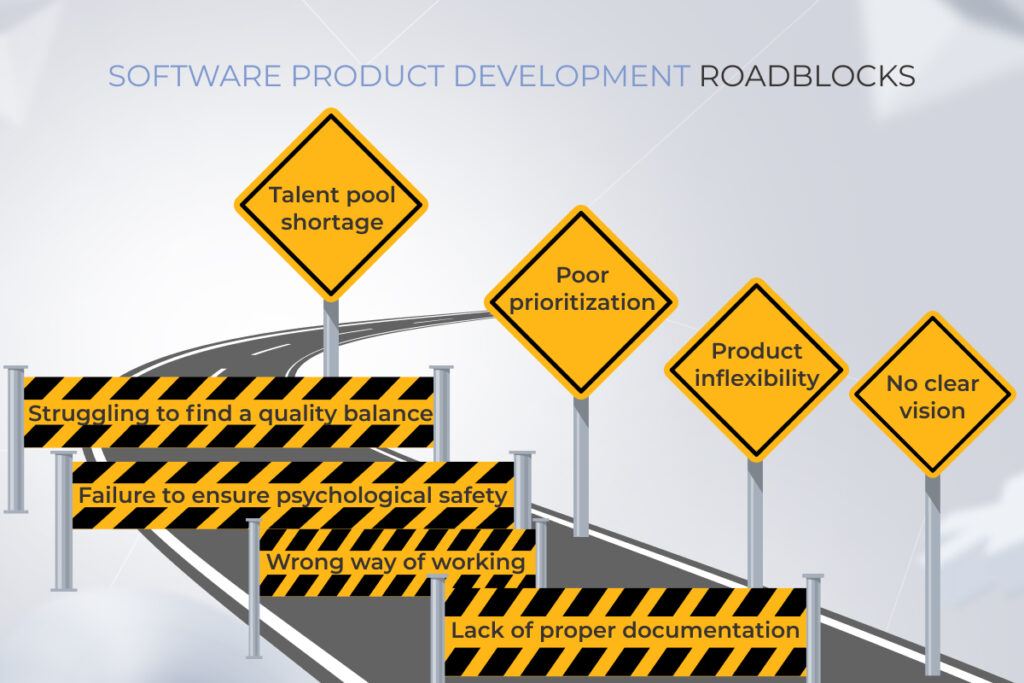
a list of software product development roadblocks

No clear vision

A vague understanding of the end product is a typical pitfall for both startups and well-established businesses. To create a value-packed solution, a team should know the purpose of building a product and the problems it should solve. This long-term mission of the product should be clarified in a product development plan and supported by accurate deliverables and estimates.

Lack of proper documentation

Poorly made software documentation can end up being an expensive headache down the road. From budget overruns to stretched deadlines to irrelevant features, the lack of a unified process for each step directly results from documentation gaps. Also, document inconsistency makes it far more difficult to switch software vendors.

Wrong way of working

Although Agile is billed as a de-facto standard for project management, it can’t be successfully applied by following one-size-fits-all guidelines. And when textbook Agile planning goes awry, teams get frustrated. But the art of Agile adoption lies in understanding the core principles of this management approach and adjusting an Agile-based framework of your choice to fit your unique project needs.

Product inflexibility

New and innovative products usually come with evolving requirements. And if the system design is inflexible and monolithic, you won’t be able to add new features or modify the existing functionality. This also applies to your project management techniques, unless open to change, they won’t let you respond to changing project assumptions safely and effectively.

Poor prioritization

Requirement prioritization is critical for planning, budget control, and scheduling software projects. Therefore, the project backlog should clearly list tasks by priority for the development team. Otherwise, you’ll end up with wasted resources and increased costs of development.

Failure to ensure psychological safety

The central pillar of the agile approach is neither Scrum nor Kanban, but a healthy dialogic process for your development team. Unless fostered positively, intellectual friction will not drive innovation or collaboration. Instead, each team member will be afraid to speak up and suggest new solutions to the problem.

Talent pool shortage

As 1 in 4 organizations are having trouble finding tech talent, skill scarcity can adversely impact your project’s progress. This problem becomes even more critical in competitive domestic markets and is typical for niche skills, meaning that you may spend a large portion of time seeking mythical unicorn staff.

Struggling to find a quality balance

Failed attempts to strike the right quality-cost ratio can also lead to project flops. That’s why teams may struggle to allocate the right amount of resources to prevent product defects or, conversely, spend too many resources on polishing their product. The key here is to reach a compromise between the cost of quality and a usable product.

Supercharge your product development process

Book a call

The four constituents of a well-organized software product development process

Planning a consistent product development journey requires a holistic approach where all variables — from team to technology — operate for the benefit of your product. Here are the four elements that can energize your success potential in the product field. 
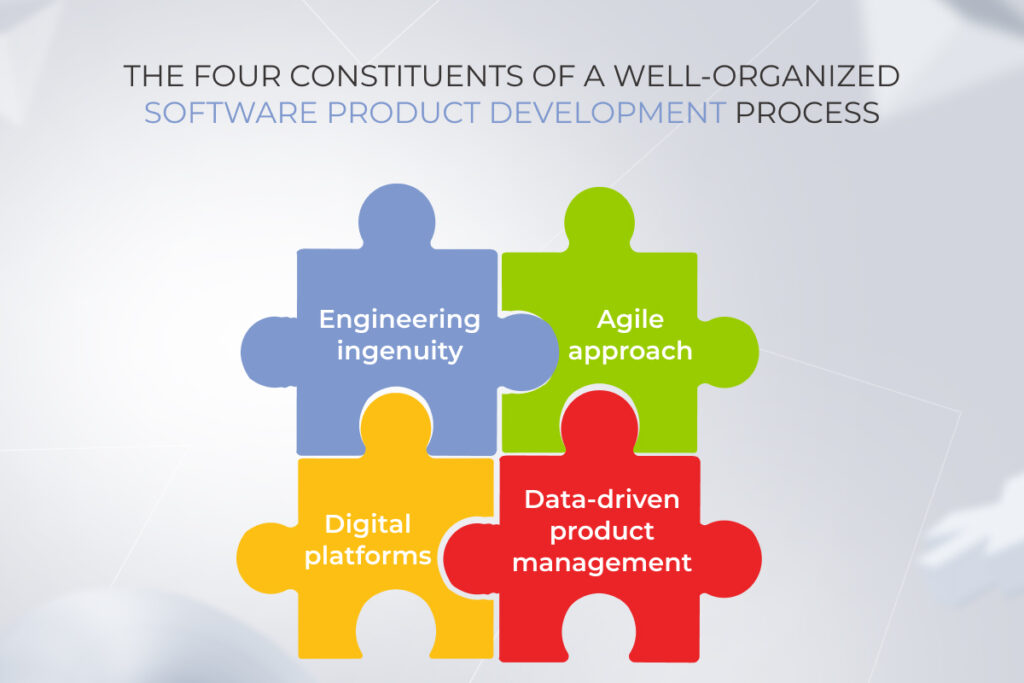
The four constituents of a well-organized software product development process

Engineering ingenuity

Developing an innovation-friendly culture calls for a collaboration-ready environment where self-managed teams are encouraged to generate out-of-the-box ideas. An engineering culture helps drive your product forward and creates a breeding ground for trailblazing solutions.

Agile approach

Adopting an Agile mindset is paramount for building from-scratch products with evolving requirements. This approach prioritizes value and achieves it through dynamic, customer-focused practices. But keep in mind that Agile cannot operate in silos, it thrives when viewed as a collective effort.

Digital platforms

Besides agile process management, your technology stack should also support changeability and give your team the freedom to make any alterations into production in a safe and sustainable manner. Microservices architecture, cloud, and open-source APIs are prominent examples of highly adaptable digital components.

Data-driven product management

Finally, your development team should be autonomous, yet KPI-driven and aligned. This includes tracking and visually representing software product development metrics that measure delivery performance (deployment frequency, lead time, and others).

Agile software product development lifecycle to build great products

Agile software product development cycle and user-centricity go together like bread and butter. An iterative sequence of development steps helps you meet user expectations by delivering products quickly, yet in a predictable way. Below, you will find the common software product development phases present in Agile. 
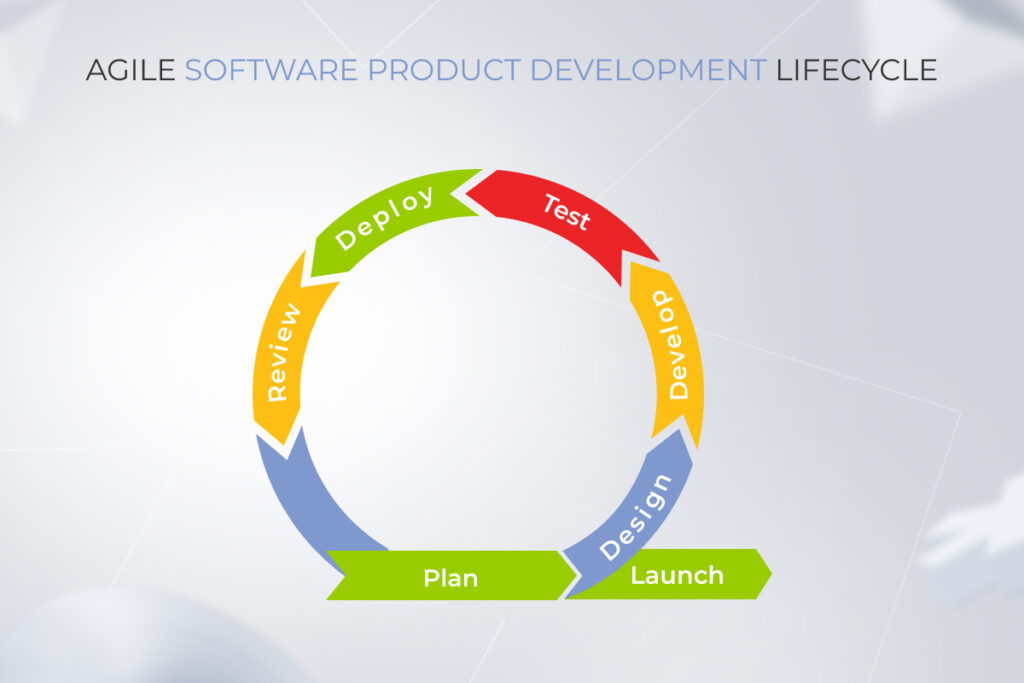
software product development steps in Agile

Product ideation

Everything starts with an idea, but a software product development roadmap kicks off with a crystal clear vision. Working closely with stakeholders, developers, and even future product users, the team first puts together a comprehensive overview of the project. 

From the long-term mission of your product to more detailed business analysis, the ideation process is used to provide clarity around the development of product software and nurture a business concept.

Discovery phase

The Discovery phase also focuses on research-based activities. But unlike ideation, this phase not only delivers hypotheses, but also takes them to the market for a reality check.  During the Discovery phase, you and your team determine business requirements, define the project scope, and suggest possible solutions to validate your product-market fit in the real world.

Below, you will find the milestones of the Discovery phase.

  • Proof of concept

All software product development ideas are worthy until proven otherwise. Therefore, a theoretical demo, or a proof of concept, is required to validate the feasibility of your solution. A PoC is an empirical exercise focused on demonstrating the viability of your solution — from market top-heaviness to risky features.

Once your idea is validated, your team identifies the development scope and proceeds with the design. 

  • Product UX/UI design

In collaboration with business analysts, UX/UI designers create a high-level product prototype, based on customer research. The prototype is then tested with the users, approved by a client, and refined if needed. After that, the final designs are distributed to production.

  • MVP development

A Minimum Viable Product (MVP) is the final destination of your idea verification. An MVP is an early version of your product with just enough features to make it usable for real customers. It helps the product team glean user feedback as quickly as possible to iterate the product. By leveraging MVP development services in USA, businesses can efficiently build, test, and refine their products based on real user feedback, ensuring a faster path to market success.
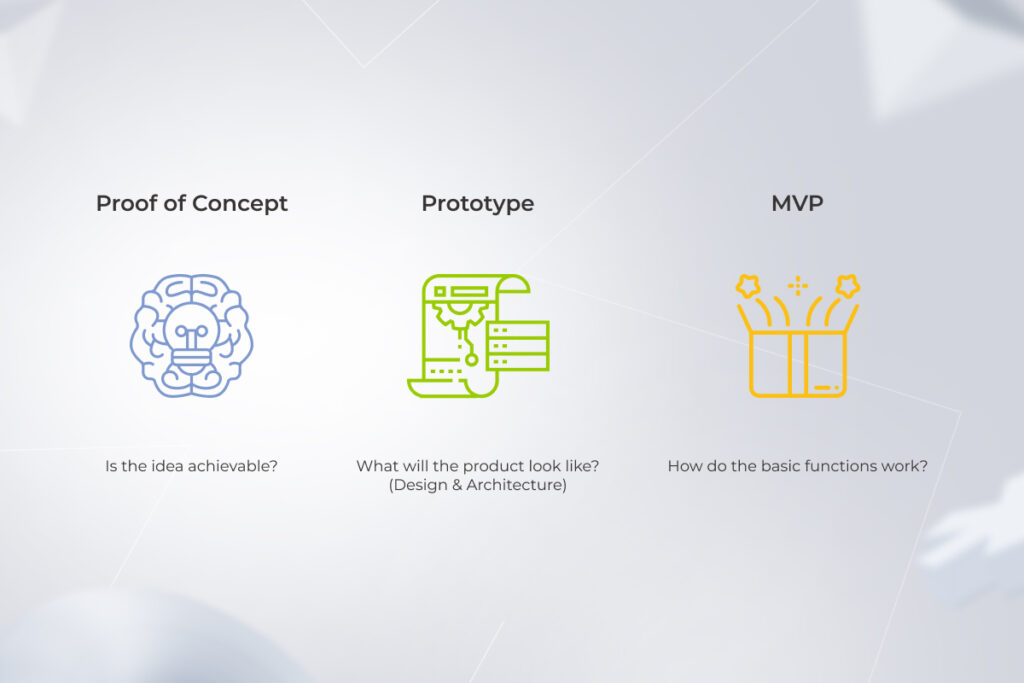
three milestones of a discovery phase in software product developpment

Development

The Development stage helps enhance your MVP with other, nice-to-have features empowering you to turn it into MMP later. In Agile, it’s an iterative, cyclical process that consists of smaller, more manageable increments. Iteration by iteration, your development team builds up the features. Testing happens continuously as new features are added. 

Maintenance and upgrades

Once your product is released into the wild, your development team monitors its health and performs troubleshooting and necessary upgrades. Perfective maintenance is also important at the post-production stage as it allows you to change existing product functionality by refining, deleting, or adding new features

Let’s build great products together

Contact us

The many faces of Agile software product development

The agile software development process is mostly an umbrella term that refers to applying Agile-driven frameworks during development. However, it’s all about matching the development methodology to the project, not fitting the project to the methodology. Below, we flesh out some of the most popular Agile frameworks and techniques to guide your software development lifecycle.

Well-defined system requirements are a luxury commodity for new software products. Frameworks based on the Agile methodology give project teams the platform, culture, and tools to manage changing requirements.

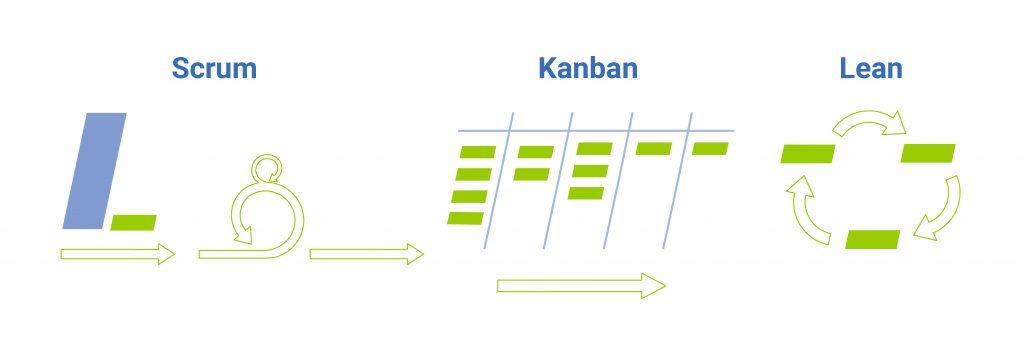
Scrum

According to the report, Scrum gets the highest marks in software development with 63% of teams leveraging it. This framework helps teams deliver value incrementally in short sprints which typically last 2-4 weeks during which the product is designed, coded, and tested. Scrum doesn’t stray from Agile philosophy, instead, it enriches it with rules, roles, events, and artifacts to facilitate the Agile way of development.
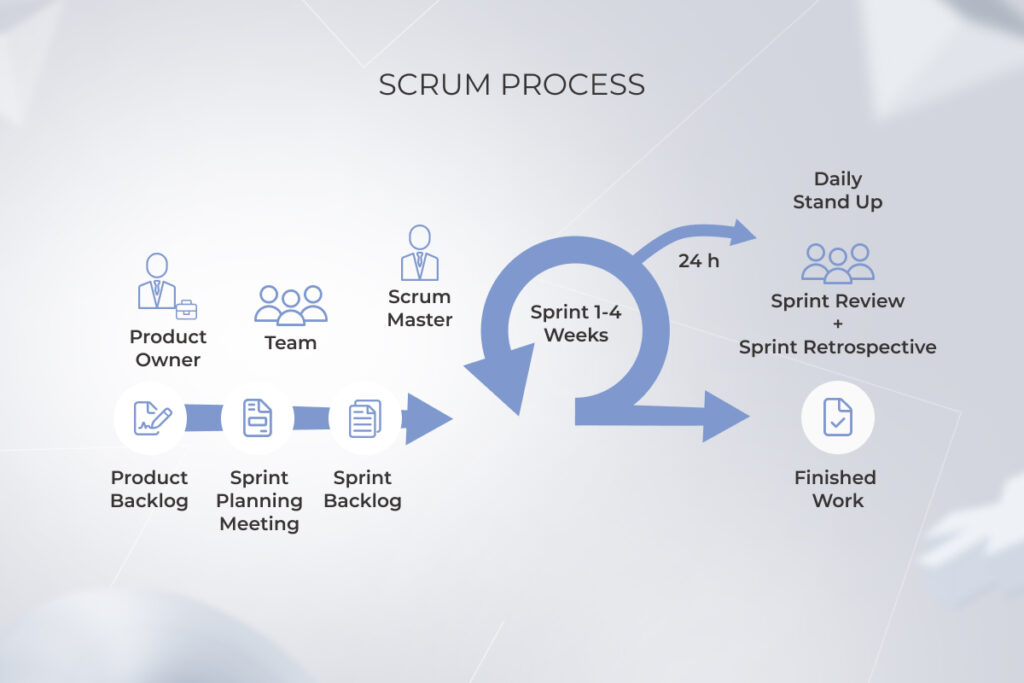
Scrum process in software product development

Scaled agile frameworks (SAFe)

Scaled Agile frameworks are Scrum for enterprises, based on 10 Lean-Agile principles. While Scrum is used to organize small teams, the SAFe framework applies to the whole organization or large, multi-geography teams. The basic construct of SAFe is the Agile Release Train.

Kanban method

Kanban is a popular workflow optimization method that adds more visualization to almost all software development processes — from feature prioritization to testing. Many Scrum teams also use select principles of Kanban as a visual process and project management tool. 

Extreme programming

Extreme programming is a software engineering paradigm that improves the quality and efficiency of your software development process. It is based on a set of values and principles that prioritize customer satisfaction, teamwork, and continuous improvement. 

extreme programming (XP) methodology for software product development

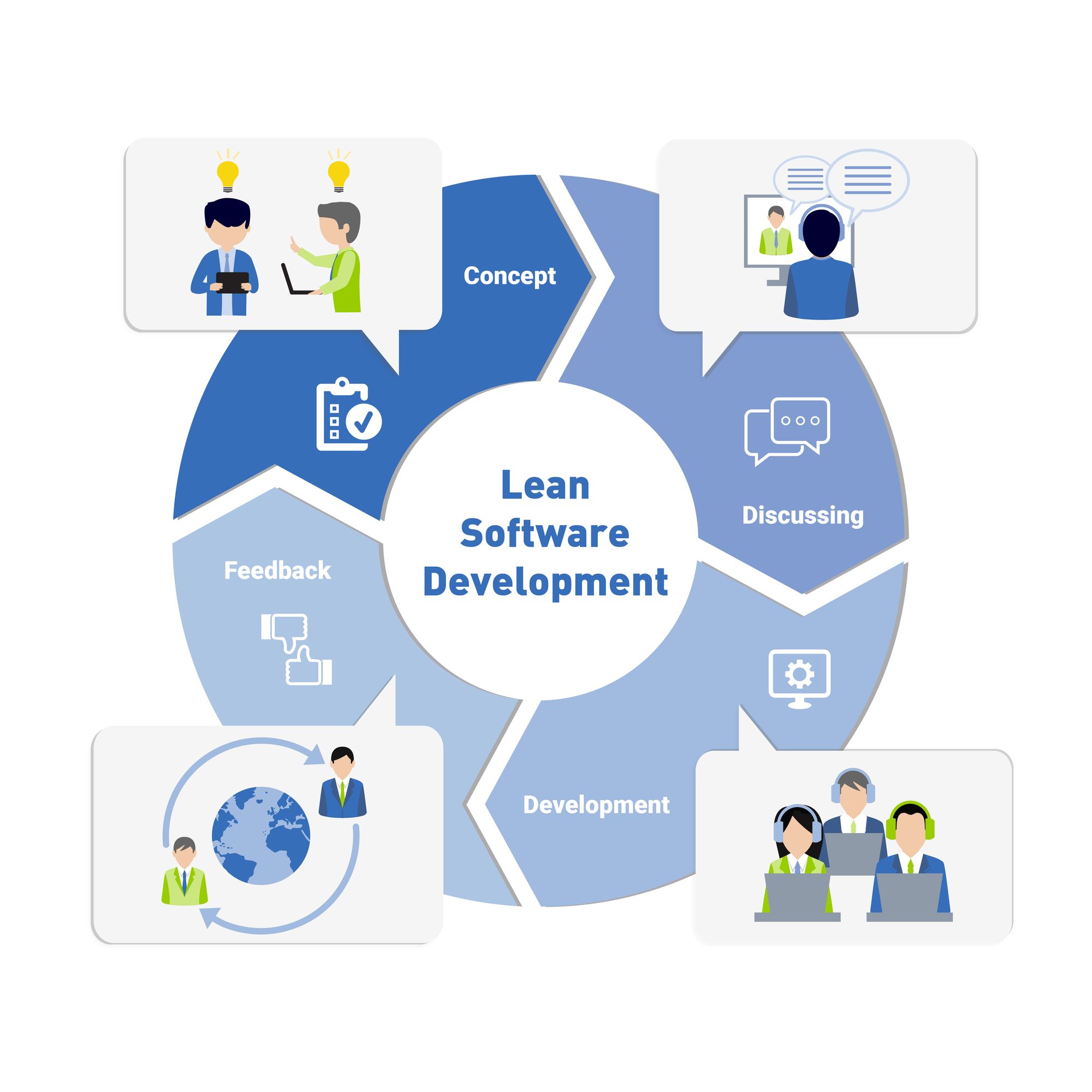
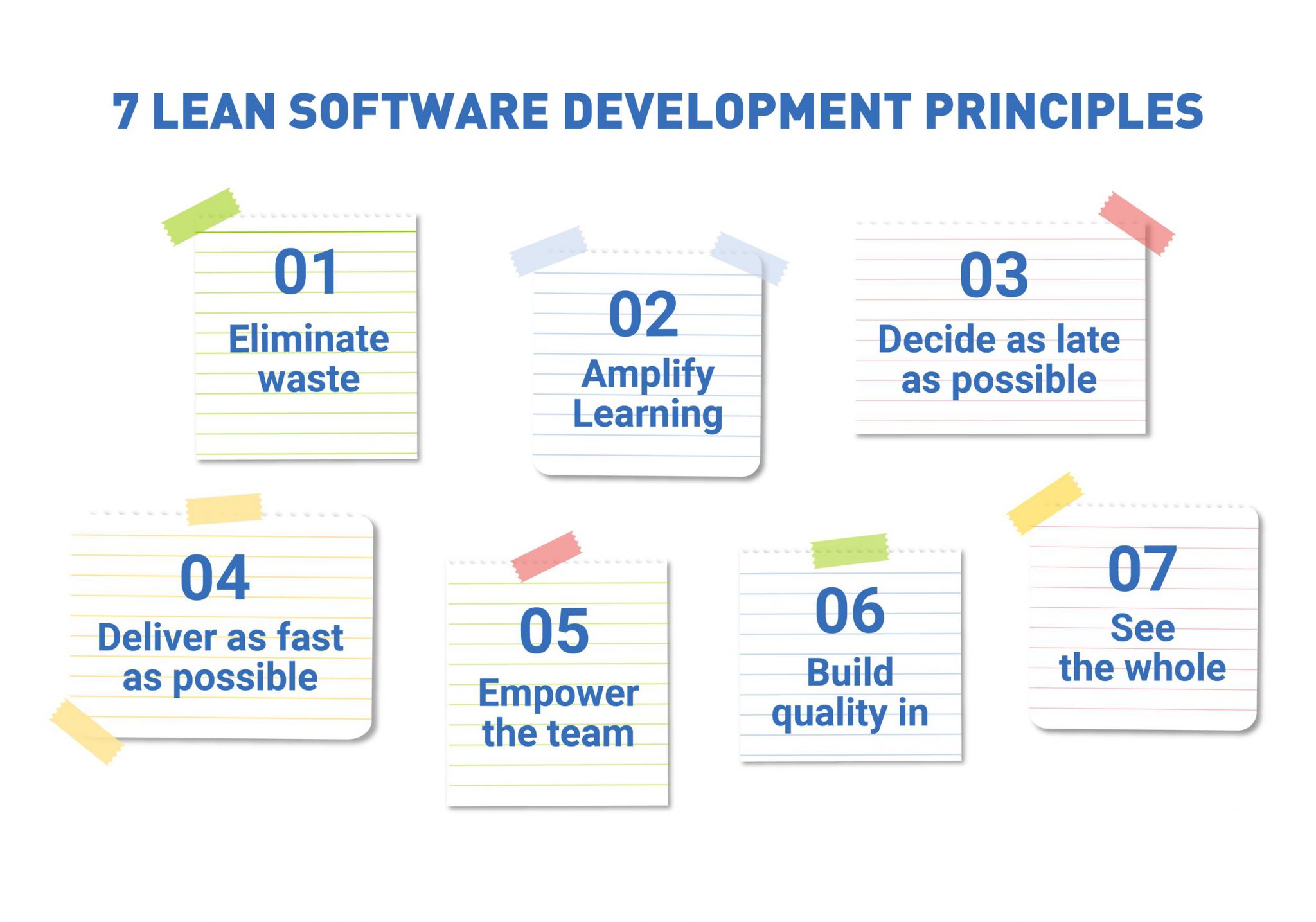
Lean

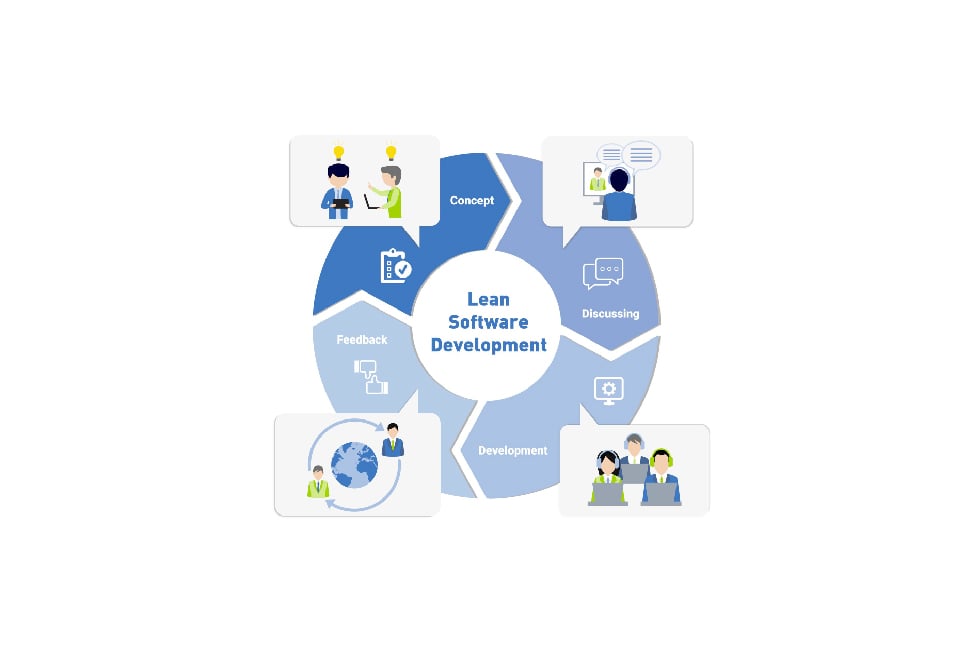
This Agile framework prioritizes addressing what must be worked on at the time, leavingno room for multitasking. With a linchpin idea of cutting waste in mind, product development teams book general meetings only if the issue can’t be resolved otherwise, set a straightforward approval process, and put features prioritization on the front burner to pack software with the most coveted functionality.

Crystal

Crystal is a highly adjustable framework that works for teams of 10 to 1000 people. It banks on osmotic communication, promoting background information sharing among team members. Fundamental rules of this approach imply using development cycles less than 4 months long and running reflection workshops to regulate the methodology with the project priorities.

Other Agile practices

Due to the emerging requirements, Agile teams often bake additional Agile practices into frameworks. Here are a few examples of curated techniques:

  • Test-driven development (TDD) — writing unit test cases for the software before writing the code itself.
  • Code review — involving one or more developers checking another developer’s work.
  • Pair programming — includes two developers teaming up together on one workstation. 
  • Prioritization techniques (MoSCoW) — a four-step technique that ranks project requirements by priority.

How to decide on a software product development team structure?

The right software product development team structure will determine how well your product is built. But although you need a cross-functional squad of software professionals, a mixed assembly of characters doesn’t automatically drive you to success. Here’s how to select your team members strategically.

Typical software product development team

To facilitate a dynamic development process, you’ll need to have the following professionals on board:

  • Product Owner — holds the voice of the customer and keeps the team backlog aligned with customer and stakeholder needs (usually on the client’s side).
  • Delivery Manager/Scrum Master — caretakers that ensure the project is delivered on time and within budget, while also enforcing the best Agile practices.
  • Development Team (Developers, QA, Designers, Solution Architect, DevOps specialist) — hands-on front players that turn requirements into a fully functional software product.

What does a product team structure depend on?

The set of roles in your development team does not fluctuate much from project to project. The only variable is the number of developers and QA engineers that can differ based on the volume of tasks and deadlines. 

Therefore, before you go into hiring, you have to define the scope of your project. So, if you’re in for a proof of concept, your development team will not be bigger than five specialists (PM, Product Owner, business analyst, software architect, UI/UX designer).  Conversely, full-blown product development requires up to nine specialists to complete as software engineers and testers step onto the scene.

Need a team of product development pros?

Reach out!

Key artifacts of efficient product management

To ship the right product successfully to users, your team has to be guided by lighthouses, or artifacts, that refer to project documents, outputs, and specific deliverables. Let’s see the core landmarks that indicate your product management is on the right track.

ArtifactMeaningDocument contents
Competitive analysisDescription of your business’s target market.– Direct/indirect competitors
– Market share and average revenues
– Industry benchmarks
– Monetization models, etc.
Product visionOutlines the long-term mission of your product. – Business goals
– Target audience and needs
– High-level product description
OKRs and KPIsIncludes performance measurement values.– KPI description and measures
– Objectives and Key Results 
Product roadmapDescribes a detailed vision and direction for a product. 

– Product features
– Release schedule
– Short- and long-term goals
– Product features and milestones
Customer Journey MapIllustrates the stages users go through when interacting with your product.– User persona
– User actions
– Touchpoints
– Pain points
Product Requirements DocumentDefines the necessary features and functionality of a product.– MVP features list
– Engineering implementation details
– Functional requirements
– Product development timeline
Product designs and prototyping documentsCovers all aspects of your product design.– User flow and design
– User stories
– Project specifics
Product release planProvides details of all the features of an upcoming product release.– Upcoming features and enhancements
– Timeline

Back in the day, product development firms managed the entire process from ideation to delivery onshore. But supporting the entire process from A to Z is becoming increasingly expensive and counter-productive. As a result, 79% of companies outsource their IT projects.

With offshore software product development, businesses access a global pool of talent at lower costs. Besides getting expertise that might not be available in your country, you can also tap into the latest technologies to ensure the best quality for your product. 

We at *instinctools take over end-to-end product development projects, allowing you to leverage leading-edge expertise, drive down development costs, and build a high-quality product hassle-free.

Mastering software product development process: from ideation to excellence

It takes a lot to create impactful products that win over customers. A properly structured software product development process is half the battle when it comes to success. An Agile-first, customer-centered, and client-oriented workflow, managed by a dedicated development team, grants you better control, improves project predictability, and saves your resources.

Deliver innovative products with ease

Get in touch!

FAQ

What is the product development process in software?

It’s a multi-step process designed to take a product from the initial concept to the final market launch.

What is Agile software product development?

It is an incremental approach to software development that focuses on shipping digital products in a timely and effective manner. The Agile-based process is characterized by short development cycles, or sprints, that allow for quick feedback and constant evolution of the product.

Is Agile only for product development?

This philosophy isn’t limited to building products. The Agile mentality and Agile-driven methods are also helpful in the development and management of services.

What are the 4 pillars of Agile?

This management approach is founded on four key principles:
1. Processes and tools are no replacement for individuals.
2. A functional product is more important than detailed documentation.
3. A collaborative solution is better than a rigid contract.
4. The team should welcome change.

What is the Agile software development life cycle?

The software product development process flow flow can be roughly divided into five phases, including conceptualization, inception, development, release, and maintenance. Each phase leads to the creation of numerous software iterations.

Offshore Development Center: Taking Offshoring to the Next Level

When economic turmoil takes a toll on the outlook of business innovation, an offshore development center appears to be the backbone of cost-efficient technological advancements. 

The already tough situation gets even more complicated due to huge IT skill gaps. Out of about four million job openings in the US tech market, 200.000 positions remain unfilled. The lack of talent goes hand in hand with the rising costs of technological innovation. To battle all-time high salaries and a talent crunch, organizations move technology production to other, more cost-efficient locations.

Outsourcing has been a well-established practice in pre-pandemic times and will continue its reign for years beyond. The rationale is simple: why would you pay $125K to get your software built in the US if you can hire a developer for $36K in Poland? After all, 2020 forced all of us to switch to remote collaboration mode.

But can an offshore development team suffice multiple long-term innovation imperatives? Unfortunately, the answer is probably no, so you might need another option.

What is an offshore development center?

An offshore development center (ODC) refers to an overseas development facility with a cross-functional team, the required office equipment and amenities, and fully managed processes — all tailored to the needs of a client. Opening an overseas development center allows you to save development budgets, accelerate time to market, and grow your market reach even if you face a lack of talent in your country.

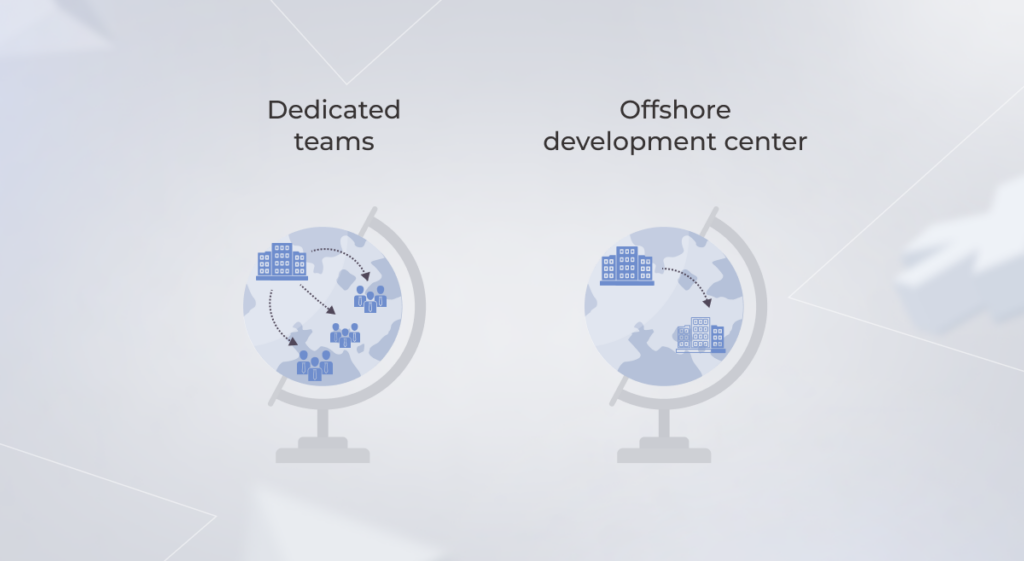
Dedicated team as your first step to the offshore development center

Most companies don’t have the need to commit to full-grown centers in the early days of outsourcing. In this case, the dedicated team model can act as the middle ground between an IT staff augmentation and offshore software center. A dedicated team helps you counter the headwinds of talent shortages and skill scarcities, but with fewer resources compared to a full-scale offshore development branch.

offshore development center

A dedicated team carries the development process from ideation to completion as an autonomous agile squad allocated exclusively to your business needs and development tasks. This hiring model can cover both end-to-end development and specific processes such as design, testing, or business analysis.

Regardless of the area of competence, a dedicated development team brings to the table the following value:

  • Self-management and process setup;
  • Relevant expertise and domain knowledge;
  • Focused approach and transparent collaboration;
  • The flexibility and ease of hiring;
  • Bespoke hiring according to your unique job requirements;
  • Reduced cost of innovation as the vendor takes over overhead expenses, hiring costs, training, and employee benefits.

As you see from the impressive list of advantages, this collaboration option works best for long-term software projects with dynamic requirements. But what if you have specific security requirements or have to handle sensitive health or finance data? Or your project is hardware-dependent? In this case, you might find yourself grappling with a whole lot of security, equipment, and other overheads.

The bright prospects of dedicated development also dim when you need a whole software development hub to address your large-scale project needs. Managing a motley crew of 20 dedicated teams across different geographies and time zones becomes more trouble than it is worth. Outsourcing doesn’t seem like such a win-win solution anymore.

Make software dev outsourcing a breeze

Contact the right vendor

When is an offshore development center your best bet?

So how can you build up your outsourcing capabilities and take the hassle out of team management? Go one step further and switch a dedicated team for a dedicated offshore development center. Along with the ease of crewing, an ODC extends your production capacity without increasing the risks.

Here’s when offshore development services can help you reap the biggest benefits.

Your business has special data security requirements

An offshore development center is like a new offshoot of your company, except that it is premised overseas. Therefore, it has everything you’d need in a traditional office to meet the required level of security. A private office space, authorized entry, software access control, and built-in network security make your ODC space the guarded fortress of product development.

As you have a single development unit, you won’t have to hire multiple management security information officers or compliance officers to track compliance adherence and security.

You require bespoke tech expertise

Niche skills might be expensive to secure or nurture unless trained in a more affordable location. Offshore dev centers allow you to set up a training center without spending your resources on third-party upskilling programs. 

In this case, the training course contents are customized to meet company-specific goals and do not expose your organization to additional security risks. In-house training also guarantees the right level of knowledge and is a perfect match for existing technology gaps.

Your project is huge

One-time or minor projects are often better off with a dedicated development unit, while large-scope development initiatives require continuous support, updates, and limitless scaling. An offshore center allows you to establish a continuous loop of delivery and scale your development facilities for multiple projects — all in one place.

You want to achieve more by spending less

If software development is not the core competence of your company, an offshore development location becomes the best option to keep your development costs moderate. ODCs are not typically packed with the same overhead costs that internal offices are. This way you get to reduce expenses such as office space rent, infrastructure, electricity bills, office maintenance, and, most importantly, salaries and taxes.

Unbeatable triad: benefits of offshore development services

You know there’s something to it when A-list companies resort to offshore development offices. Google, Microsoft, Apple Inc, and other giants have their technology development sites located in other countries, far away from their head offices. So, why do forward-looking businesses flock to offshore teams? We have the answer.

Providing domain expertise and vetted specialists at a lower cost

Offshore development services allow you to tap into the global talent pool, whatever the niche or domain knowledge you need. While your in-house candidate base is limited by geography, an ODC vendor has access to an infinite supply of vetted candidates from a rich, local talent database.

As ODC offices are typically premised in low-cost economies, a vendor helps you secure a local team of professionals at the fraction of the price you’d pay in-house. You don’t also have to deal with the pain of hiring and onboarding a new team, leave, insurance, and other employee costs, which significantly lowers your bill.

Taking care of complex administrative functions

From a legal standpoint, establishing an offshore development center requires you to create a new legal entity. However, you don’t need a degree in Legal Studies to make that happen. Instead, your local ODC partner does the heavy lifting of legal regulations, taxes, HR-related issues, and other administrative burdens.

It also means that you don’t have to dispatch operational resources overseas to solve issues like office renovations and payroll taxes or wade through the jungle of local laws and business processes.

Ensuring full compliance with your requirements

An offshore software team operates in full compliance with your industry regulations following documented development processes. As the team augments your in-house unit, you have full control over its performance and every operation of your projects. Moreover, an offshore software development office gets certified and audited in line with your specifications.

Investing in your own offshore development center: is the game worth the candle?

Offshore development centers have got a lot in store for fast-growing companies. However, you must go a long way to create a development center in an overseas location, especially if you decide to go on your own.

offshore development center

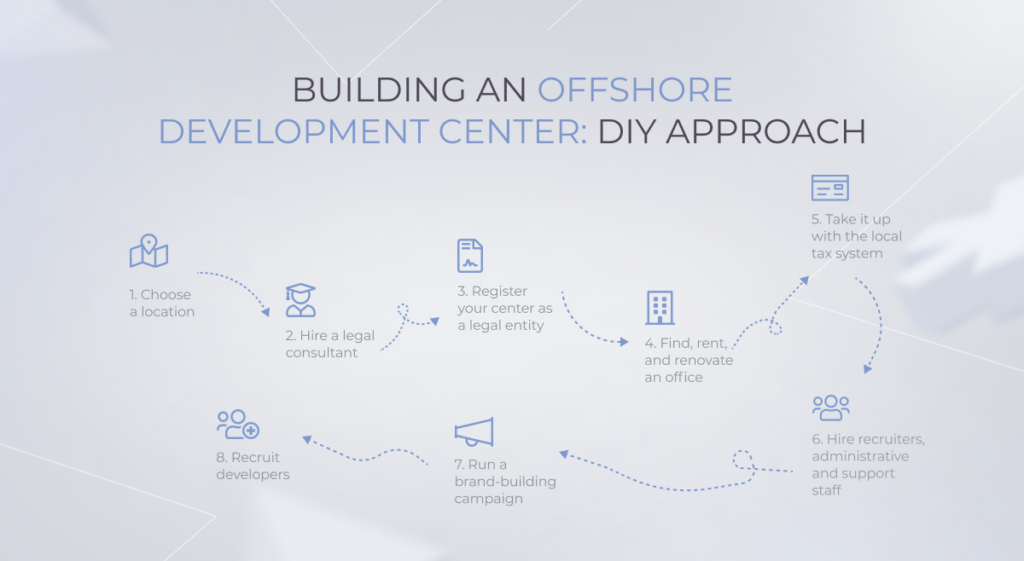
Choose your ODC destination

You first need to decide on the optimal location of your offshore development center. There are a lot of factors to take into consideration — from the tax policy to the English language proficiency.

A professional consultant is needed to help you look into the legalities of a business entity and select the right legal structure.

Once you’ve decided on a legal form, you need to submit a package of documents to the territorial registration authority for state registration.

Find, rent, and renovate an office

After all the paperwork is done, you have to find a workspace for your offshore unit. In most cases, the office will need renovation, new equipment, and other office materials.

Grapple with the local tax system

Now it’s time to dive into the tax mystery and find out more about your tax liabilities.

Hire recruiters, administrative, and support staff

As it’s a full-fledged office, your center requires trained personnel to take care of the workspace and handle your business processes.

Run a brand-building campaign

When you’re all set, your new branch needs some exposure to establish its market presence and get a headstart in the unknown business landscape.

Recruit and retain developers

And now, if you’re persistent enough to complete this arc, you get the final prize — the never-ending dread of hiring local specialists from the uncharted local market.

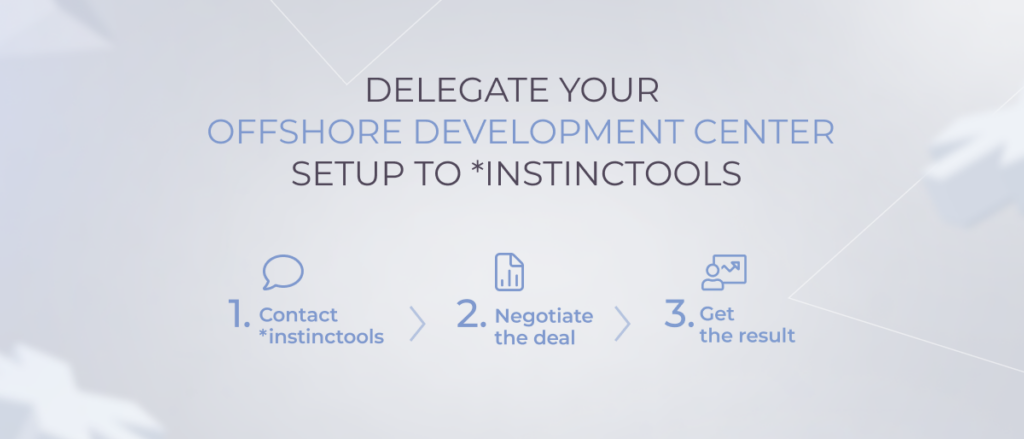
By this time, you might think that initiating an overseas office is an overlong, expensive, and challenging endeavor. You’re right, it is. But it doesn’t have to be if you have a trusted ODC vendor onboard that has a decade-long experience in setting up offshore centers. In this case, your responsibility area (and expenses) shrinks down to choosing your ODC location and validating completed tasks.

offshore development center

Looking for an experienced ODC vendor?

You’ve got one

What location to choose for your offshore software development center?

When scaling beyond borders with an ODC, the location choice can either make or break your undertaking. An ideal destination should offer a sizable talent market not to limit the growth of your center. The price-value ratio is also important to gain from the new office and innovate at lower costs. Moreover, your ODC team must be on the same wavelength as you, which is impossible with cultural and language gaps.

Eastern and Central Europe is traditionally considered to be a cost-affordable offshoring mecca. This is why Bulgaria, Romania, and Poland are among the most favored offshoring locations where all criteria are aligned. So let’s have a closer look at one of the leaders — Poland.

Extensive developers’ skill sets

Poland is home to software developers with high proficiency in multidisciplinary fields. The expertise and knowledge of Polish software engineers have earned them third place among locations with top developers. Moreover, Poland hosts the largest IT talent pool in Europe with over 400,000 IT professionals on the market, which makes this location a key IT powerhouse.

offshore development center

Dynamically growing IT market

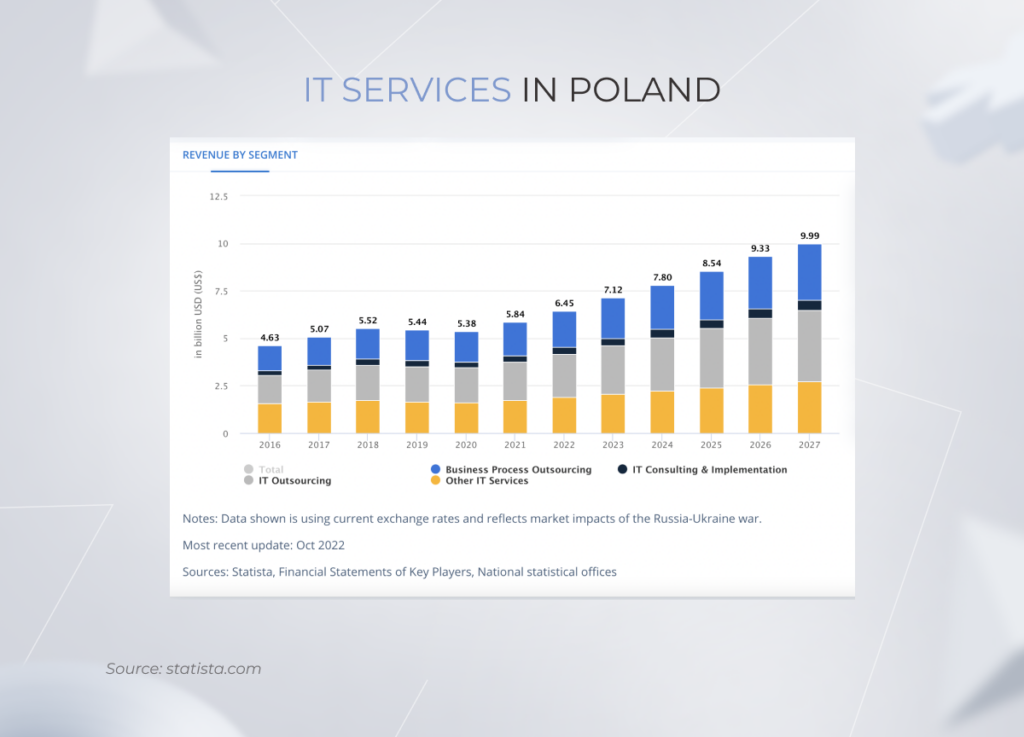
While being a mature outsourcing market, Poland continues to gain more steam in the IT sector. According to Statista, the revenue in both IT and IT outsourcing markets has followed the growth trajectory over the last few years.

offshore development center

The country’s IT services market increased to a projected $6.45 billion in 2022, with outsourcing being the largest segment, valued at $2.29 billion. The resilient economy of Poland contributes to the overall image of a breeding business ground.

Strategic location in Europe

Poland’s EU positioning translates into a convenient time zone. Warsaw has a six-hour time difference from New York, which allows software providers to deal with their clients’ requests without delay. To put it into perspective, India is up to 12 hours away from the USA. As for other countries, such as the UK and the rest of Europe, Poland’s prime location allows for frictionless communication with no time lags.

Low development costs

Unlike other Western European countries, Poland offers vetted talent at affordable rates. According to PayScale, the average yearly rate for Poland-based software engineers stands at over $21,000 per year, while the average US developer is paid x6 times more. 

However, lower rates do not come at the cost of lower quality. Instead, the quality of software development is on the same or higher level than in top-paid locations. 

Compliance with EU and US data protection standards

Due to its strategic location, Poland is subject to the same data protection regulations as other EU countries, such as Germany or the Netherlands. Hence, the data protection regime in Poland is mostly governed by the General Data Protection Regulation or GDPR, a well-known compliance standard for EU companies.

HIPAA certification is also commonplace in the country, validating the skills of Certified HIPAA Professionals (CHPs), Certified HIPAA Administrators (CHAs), and Certified HIPAA Security Specialists (CHSSs). This means that compliance-wise, Poland stands on par with EU- and US-based organizations, suggesting high compliance literacy of local developers.

No communication gaps

Poland is a part of European culture, so there’s no cultural gap between the team and the client. The influence of European culture in Poland is combined with the global mindset of operating businesses. Therefore, business operations aren’t compromised when local teams communicate with people from different backgrounds.

Moreover, the country is well-known for its outstanding English proficiency. According to the EF English Proficiency Index, Poland ranks 11th out of 100 counties in the world for the knowledge of the English language. So as long as you speak English, you’ll be fully aligned with your Poland-based ODC team.

Mature R&D hub

Global tech leaders, including Microsoft, Google, Oracle, and others have located their research and development centers (R&Ds) in Poland. It proves that this ODC location offers a mature, affordable, and tax-friendly outsourcing framework that encourages foreign investment for the development of innovative products.

However, even the best setting can be rendered ineffective with the wrong team onboard. Therefore, the choice of a reputable and experienced partner is yet the most important success factor for establishing your foreign presence.

Setting up an ODC in Poland?

Consult an expert

What to look for when choosing a vendor for offshore development services?

The stakes are high when it comes to confiding a fully functional business unit to a third party. It means that your ODC partner should act as an extension of your company, know the ins and outs of your domain, and keep your business bar high.

And the easiest way to forecast the reliability of your offshore development center vendor is to look at its track record. The more ODC projects they have under their belt, the more likely your initiative to pan out. Here are some other ways you can validate the credibility of your partner.

Evaluate IT expertise

Besides English, your team should speak the language of innovation to power your products with the latest technologies. Usually, the main reason for one business to resort to a third party is the lack of high costs of technical knowledge and domain expertise on site. For instance, a company wanting to drive digital transformation doesn’t have what it takes to build a BI and analytics system, so they farm out the function to the vendor.

On this front, you should consider the particular tech stack and the focused domains that you are interested in. For example, *instinctools is a great fit for cloud-based projects (with Google Cloud, Microsoft Azure, and OVHcloud partnerships under our belt), custom enterprise software development, and Business Intelligence powered by Power BI, Tableau, and Qlik. On top of our tech expertise, we also offer a wide array of consulting services crowned with an end-to-end technology-enabled business transformation.

Besides the broad and in-depth technical knowledge, your partner should know the ins and outs of your industry to align technology with business value. With domain expertise, developers can also contribute on a conceptual level and minimize development risks. We, at *instinctools, have accumulated extensive industry proficiency that spans virtually all domains — from manufacturing to healthcare to entertainment.

Investigate relevant experience

No matter how far and wide your vendor’s technology command spans, it’s feeble without real-world experience. Therefore, the best way to set up your initiative for success is to drill down into the vendor’s portfolio. 

Ideally, the portfolio should feature similar projects in the same or an adjacent domain. Make sure that your selected partner also boasts hands-on experience in establishing offshore development centers and associated processes.

You can also reach out to the partner directly if you cannot find relevant projects — not all projects end up in the Clients section due to confidentiality issues. Client testimonials on Clutch, GoodFirms, and other directories can also give you an idea of the vendor’s maturity.

Focus on cost-effectiveness, not cost

A fully managed operational center holds great promise in terms of lower development expenses and ease of management. However, only a few deals grow into worthwhile investments, and the ODC model is no exception. Low-cost labor is often a key element of price calculations, yet is not the only one to help assess the viability of the offshore development center idea.

In some cases, procurement, project management, travel, and other hidden costs may backfire and get your cost gains to zero. So, the key to landing the right development partner is to understand the value you expect to generate from the offshore center and to correlate this value with the involved effort and investment.

Going beyond cost borders with offshore software development center

The competitive market dynamic cripples any business that isn’t fast enough to adapt and accelerate growth. To maintain a competitive edge, companies accelerate their technological initiatives and supplement traditional services with digital-first experiences. 

However, digital transformation is a costly journey unless taken to a more affordable setting. Offshore development centers help companies innovate and scale their technological offers at lower costs and less administrative hassle.

But despite the outward glitter, an ODC idea has a specific application area and doesn’t cater to all needs. Large-scale projects, niche skills, high-security requirements, and clear economic gain in your particular situation should be the main precursors to setting up a fully operational center in another country.

Scale beyond borders

Contact an ODC partner

Integrated Business Planning: How to Pave Your Way to End-to-end Orchestration

“We plan, God laughs”. True. However, planning is not about knowing the exact outcome. It’s more about gearing up for what-if scenarios, in case something goes awry. 

To adapt successfully to evolving market needs and work around economic turbulence businesses need the collective effort of the whole organization — from finance to marketing.

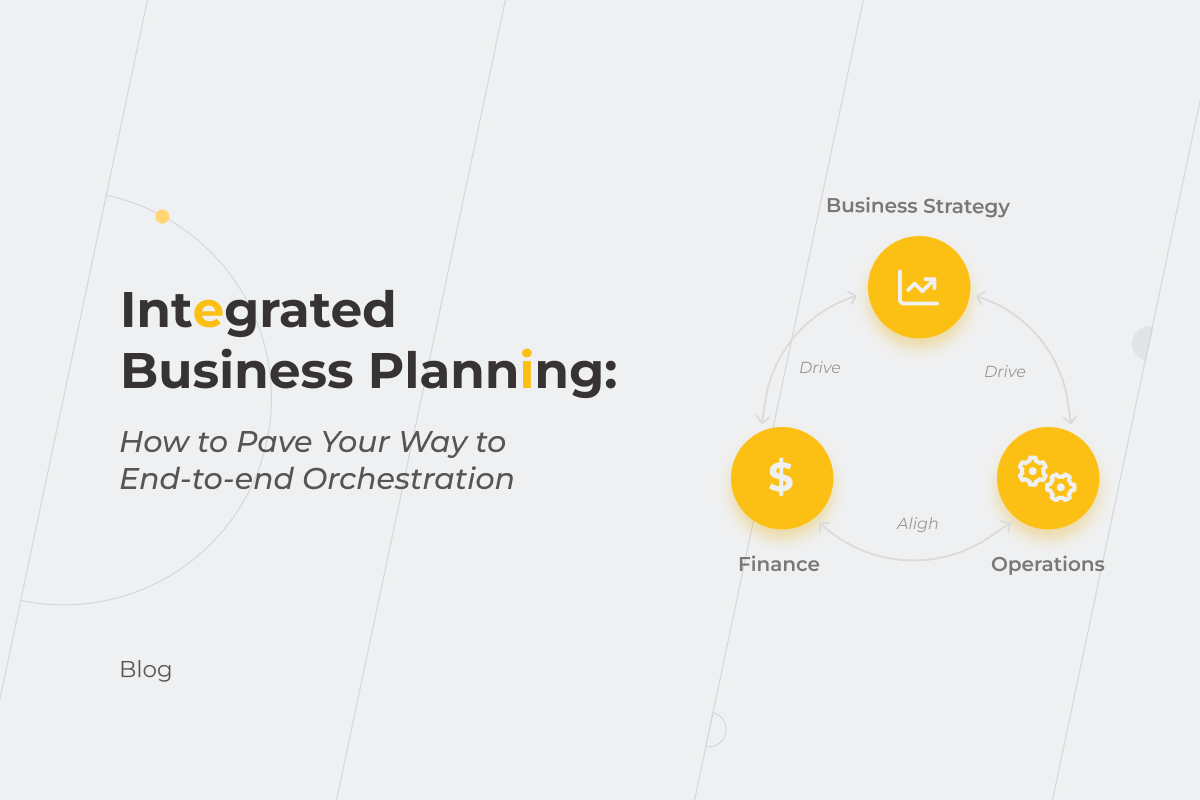
But how can you align the mashup of a company’s strategy, operations, and financial performance? Enter an integrated business planning process.

Once a legacy of Fortune-500 companies, the IBP strategy can be leveraged to transform businesses of all sizes. IBP solutions help both industry giants and young companies manage growth-related risks and help establish disruption-tolerant processes.

What is integrated business planning?

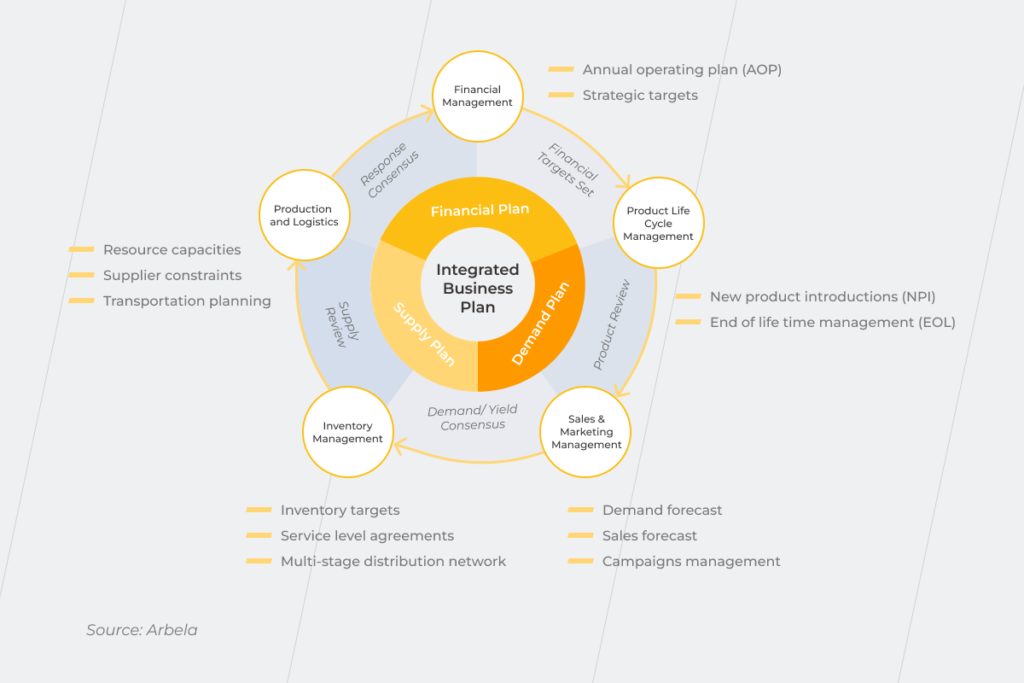
An integrated business planning (IBP) process refers to scaling and connecting the planning activities across each business function, silo, and department. Hailed as the enabler of an innovation-ready environment, IBP also syncs business targets, budgets, operations, and business units across the entire organization. At its core, IBP includes technology and applications that connect the planning and operational functions of the company.

Integrated Business Planning

Why put your planning processes in a broader perspective?

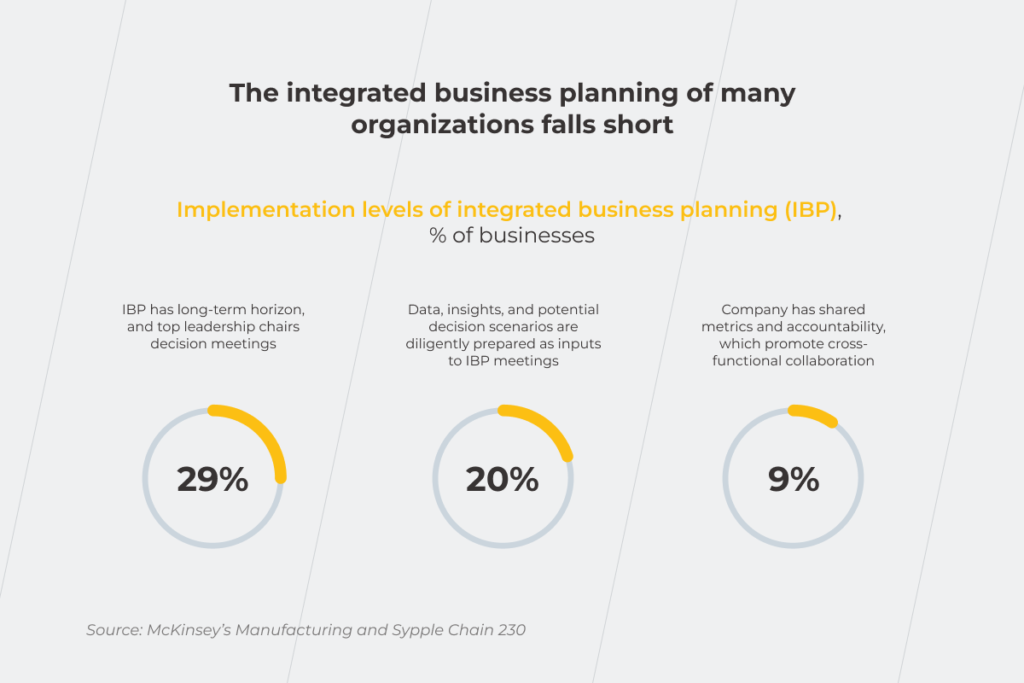
According to McKinsey, businesses that have fully integrated business management are in the minority, with only a handful of companies implementing IBP to its fullest. Two-thirds of companies confine unified strategic planning to occasional business reviews.

This means that most companies leave their business decisions to the mercy of siloed planning solutions with limited process visibility and one-sided insights. Conversely, integrated business planning solutions cast their nets wide to deliver value across the entire business and help battle ever-growing business challenges.

Market uncertainties

In a world of interconnected economies, each company can be affected by the overall market resonance. This is why the pandemic’s disruptions to logistics in China have echoed through global supply chain operations, resulting in a shortage of components. International political uncertainties can reduce the trade openness of a given country, destabilizing the whole world. It means that the success path of a single company depends on a whole lot of political and economic levers involved in internal management.

Holistic data analysis

At least 2.5 quintillion bytes of data are produced every day. However, instead of generating actionable insights, around 95% of companies are unable to make sense of unstructured data — a fundamental building block of business decision-making. The growing amount of big data and its complexity also prevents companies from landing new growth opportunities.

Customer centricity

Focus on a customer is a beacon for successful companies and higher profits with over 70% of consumers considering it a basic expectation. However, isolated planning doesn’t factor in all touchpoints. Unable to create a unified customer image, companies struggle to deliver personalized services and initiatives.

Short product life cycles

Along with granular offerings, customers expect new products to be released faster in regular cycles. However, rolling out new products like a conveyor belt is not enough. To keep up with quickly-changing customer preferences, companies require robust analytical capabilities that consider an entire landscape of opportunities and predict current demand areas.

Smaller margins

The world? Volatile, to say the least. Over the last few years, shrinking margins have made a comeback driven by cutthroat competition, market saturation, and inflated costs. Since 2020, margins have been falling down the curve with a negative of at least 0.04%.

As a result, the traditional supply and demand balancing has been rendered ineffective, jolting companies into optimization based on a patchwork of metrics, market trends, and forecasts.

Globalization

Despite ample opportunities, border-free supply chains have exposed businesses to the ripple effect of global bottlenecks and equipment availability. Differences in standards and regulations, harder planning, and budget constraints require unmatched agility from companies.

To pivot and flex, an organization requires an integrated business planning process flow that eliminates communication lags and steers the whole organization towards its goals despite global instability.

Unmatched benefits of integrated business planning

According to KPMG, integrated business planning best practices stand to increase ROE up to 14 points, reduce costs by up to 10%, and ramp up revenue by 4%. But besides core metrics, what is the true value of IBP solutions?

Being ready for ‘what-if’ scenarios

‘How would the pandemic affect my company? Can I slash the costs to battle the recession?’ Within traditional business management, the answer to your questions is left to guesswork and historical analysis at best.

Paired with robust data analysis, integrated business planning software enables you to simulate the effects of potential actions and changes across the whole organization — from capital expenditures to workforce availability.

You can also mold your growth objective into different market opportunities based on the resources owned or quickly re-allocate the current assets for any transformation with no ad hoc firefighting.

Collaborative and decentralized decision-making

With data sourced across all operations, the decision-making authority is distributed throughout a cross-functional team. Enterprise-wide activation of purpose promotes greater accountability and decision ownership where business units work collaboratively towards a general business goal.

At the same time, consolidated enterprise planning applications eliminate version control and spreadsheet complexity.

Enhanced customer experience

It is stated that agility improves customer experience by up to 30 points. A shared purpose and vision embodied across the organization are some of the qualities required to have agility. Besides enterprise adaptability, a bird’s-eye view and corporate alignment deliver a more unified customer image sourced from across the organization. As a result, customers are served more granular messages, desired products with on-time delivery, and customer-centered services.

Make your business future-proof

Contact our IBP experts

IBP vs S&OP: different names for the same process?

The difference between S&OP and IBP is challenging to spot as integrated business planning is generally considered an exercise of sales and operations planning. However, an integrated business planning framework makes evidence-based thinking more comprehensive, while S&OP prioritizes supply chain planning as the main benchmark.

Moreover, integrated business planning consultants devise a proactive plan that responds to challenges with the most benefits and least losses, while S&OP is more about satisfying customer needs at all costs.

Below, you’ll find the main differences between IBP and S&OP:

Comparison criteriaS&OPIBP
ObjectiveAchieve the right capacity and stock levelsMaximize profit with minimal risks
Focus areaBalancing demand and supply to align appropriate capacity and resources
Identify the connection between integrated plans and long-term business goals
Planning horizon6-12 months24+ Months
StakeholdersFinance, supply chain, sales and marketingThe entire organization
OwnerSupply chainBusiness leaders
ResultsBalanced supply plan, input for financial forecastsAn agile organization, where purchasing, production and inventory rally around sales and financials to meet the demand

How to create real value? Four pillars of fully integrated business management 

According to McKinsey, ineffective consolidated strategic planning is the collective result of three factors. First, if an organization doesn’t include IBP in its regular decision-making process, the added value of unified orchestration tapers off. Secondly, some companies delegate unified planning to junior staff, who, naturally, often lack vision and authority for the function. Lastly, if the executors do not have a single vision of critical decision enablers, they won’t be able to navigate business thinking as a whole.

Integrated Business Planning

Yet, despite common reasons, there is no ultimate integrated business planning template that caters to all businesses with unique needs. However, some practices can bring your organization closer to the desired outcome of SAP integrated business planning.

Prioritize the P&L owner

In most cases, the owners of P&L at your company have a great read of the existing drivers of revenue and spending. Unlike the supply chain or production management, a P&L-focused integrated process has the most practical requirements based on a broad outlook.

When designing your planning regimen, make sure the groundwork also includes input from upper management so that decisions can be made regularly. This way, the footprint of decisions can be checked against financial thresholds.

At the same time, this business plan allows the P&L owner to align the trade-offs between perils and prospects with the affected area, be it local or global. To unlock this level of visibility, companies should employ robust data governance practices and tools which enable real-time data processing.

Decide on the apt design and cadence

To make the most of unified strategizing, companies need to design an IBP flow with a focus on better visibility and critical data sourcing. The main objective of this fit-for-purpose IBP design is to equip the P&L owner with the right output that is clean, standardized, analysis-ready, and can be easily injected into templates. However, even industry-best design practices can fail if the initial input isn’t sifted through an established data infrastructure and effective processing systems.

Adopting the right reviewing rhythm is another salient part of a holistic IBP framework. Analysis-intensive initiatives, such as product releases, should be subject to regular reviews, while urgent issues such as material shortages or insufficient space should be resolved within a weekly agenda.

To facilitate regular feedback loops, companies also need to establish the right technology infrastructure that promotes seamless and real-time communication between business units.

Apply consequential thinking to facilitate decision making

The right integrated business planning example also stimulates an organizational shift within the company. Therefore, when adopting integrated planning, companies should factor in decision-making power, the value of the decision-making variable, and reporting hierarchy as well as giving key stakeholders more authority in the process.

In practice, collaborative and autonomous thinking can be supported with event classification and pre-defined troubleshooting guidelines based on the root cause approach. Also, the autonomous structure should dwell on the scope of operational thinking as well as the escalation mechanism to bring decisions to the appropriate level of responsibility for adequate resolution.

Support IBP with appropriate technology

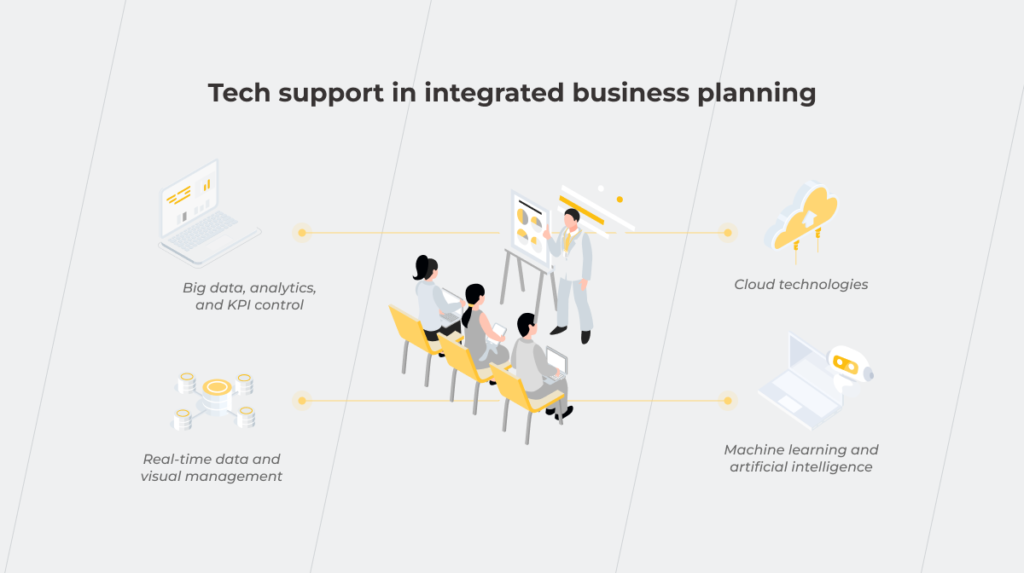
The right technology infrastructure allows each business function to keep its language and still collaborate effectively with each other. Since the operational data becomes paramount in this case, the technology suites have to be easy-to-use interfaces that demonstrate digestible, real-time insights — all within one platform.

Integrated Business Planning

From a technology standpoint, the building blocks of an IBP-friendly ecosystem include but are not limited to:

  • Real-time data and visual management

Plotting the business course is impossible without seamless and real-time data flows. To enable collaborative thinking, your tech ecosystem should also support easy integrations among the modules and enable modeling of the supply chain in real time.

  • Big data, analytics, and KPI control

KPIs dashboards allow your departments to monitor the performance, report the number of open opportunities, and share insights for other business units. Robust analytics, in turn, allows your dedicated team to drill down into specific metrics and initiate corrective actions for those metrics. Predictive analytics also accelerates your planning by improving assessments of your capacity, generates dynamic forecasts as well as supports scenario planning and optimization.

  • Cloud technologies

By moving applications into the cloud, companies can more easily integrate them at a process level. Following a single data model, integrated business planning managers can cover all aspects of planning and arrive at the ‘single number’. Cloud technologies also enable better business continuity and drive down the costs of analytics.

  • Machine learning and artificial intelligence

Injected with expert systems, planning systems offer advanced optimization techniques. The latter, in turn, automatically generates replenishment strategies, inventory optimization, and other response measures needed to embrace the volatility of the market. AI-based stress test simulations also help organizations model the scenarios of combined workloads.

A framework for IBP success

A synergy of strategy and execution is what prevents companies from veering off the rails in chaotic times. This synergy is manifested in integrated planning and allows you to create a link between all business operations, uniting them into a cohesive whole driven by the same goal. Unlike traditional S&OP-enabled planning, IBP allows you to go beyond capacity levels and gain a broader foresight of possible business scenarios.

To achieve IBP excellence, you need to look beyond the internal processes and enable visibility into all pivots, from supply chain leaders to customers. Combined with agility, high visibility levels promote business resilience and maximized profits without low-risk exposure.

Data is also the pinnacle of this visibility, making a technology infrastructure critical to IBP success. That’s why the choice of the right technology partner can advance your planning and fine-tune the planning pathways to your unique business needs, making it a critical step in ensuring success.

Looking for the right IBP partner?

Reach out

Web App vs Mobile App: Which One is Best for Your Business?

Creating an application is the next step after your business has gained leverage online. When your customer buys from you once a year or you are a governmental organization, a web page would normally be enough. However, when frequent client engagement is demanded, the necessity for an app occurs organically. 

There are two ways of engaging with a customer with the assistance of current technology: either by means of a Web App or through a Mobile Application.

It’s a known indisputable fact that mobile applications have helped many companies increase their sales dramatically. Yet, in some cases, mobile applications aren’t needed, and businesses are absolutely thriving with progressive web apps. Some companies have both web apps and mobile apps ready for their users. In the end, the selection of technology is about meeting customer expectations and staying in your lane.

There’s no secret that the most important distinction between web apps and mobile applications lies in their development costs. So as to work out which of the present technologies is going to become the best investment for your specific business needs, we would look deep into the purposes these applications serve.

Want to discuss the business objectives of a mobile app or a web app for your company?

Web Application vs Mobile Application

Pros and Cons of Web Apps

+ A Progressive Web Application, or a Web App, is a website adapted for mobile. This is often one of the foremost progressive technologies nowadays. It imitates a mobile application and is viewable in most browsers on desktops and mobile phones. It costs less to build a web app than a website.

– An existent web app signifies that a corporation has already gained trust among its audience. However, there’s no requirement for constant involvement with an app. Maximum retention and time spent in the application have zero effect on a webpage and brand awareness. 

Pros and Cons of Mobile Apps

+ A mobile application or sometimes it’s called Native Application is a great marketing and sales tool for a variety of consumer-based companies. It involves constant engagement with the product through continuous interactions. Mobile apps collect as much information as possible, studying habits and analyzing user behavior and patterns. 

– A mobile app is a more expensive technology as compared to a web app or a website. Its budget is mostly dictated by the availability and price of skilled mobile developers for Android and iOS. While Hybrid applications are also available as a part of the cross-platform solutions, their updates are less frequent.

Web Apps vs Mobile Apps from a User’s Perspective

Web Application vs Mobile Application

Both web apps and mobile apps signify the trust level users have for the company. The main difference between them is the quantity and frequency of interactions. Native Apps also offer a more robust personalization. The communication is customized to users, supporting their interests, location, behavior, and more.

People download mobile applications after they use web apps on a regular basis. They do that once they get acquainted with a company’s website and social media. If they like how the application is made, they will stick with it. However, many users prefer PWAs, since they are faster and don’t require memory on their devices. Plus it only takes a few lines of code to make usability amendments in a PWA.

– Volha Marskaya, Sales Specialist

Mobile App vs Web App from a Business Standpoint

The common practice for a lot of companies is in building a website, a PWA, and a mobile application as they expand. The latter is a logical step toward broader market outreach. It is a method of business growth and it drives sales. 

There are, however, ways in which it can be cost-effective to work out a novel approach for specific user engagement while also saving on development and maintenance with no effect on sales. 

There are general recommendations for many B2Bs to own a branded application. At the same time eCommerce has shown relevant proof for PWAs, which are made to more easily compare goods in a browser.

What are the main criteria that allow the choice between PWA and Mobile Apps?

When choosing between web and mobile applications, it all depends on the goals and technical requirements for the interaction with the API, like accessing user location.

A website adapted for mobile would be sufficient when its purpose is solely the acquaintance and PR of the product with no requirement of further interaction with a client. Speaking of a short-term interaction once a week or a month, a web app would be enough. When one or two basic functions are solved, a mobile application is not needed.

– Eduard Beleninik, Lead of Mobile Development Unit

World Statistics. PWA and Mobile Applications in the Long Run

Web Application vs Mobile Application

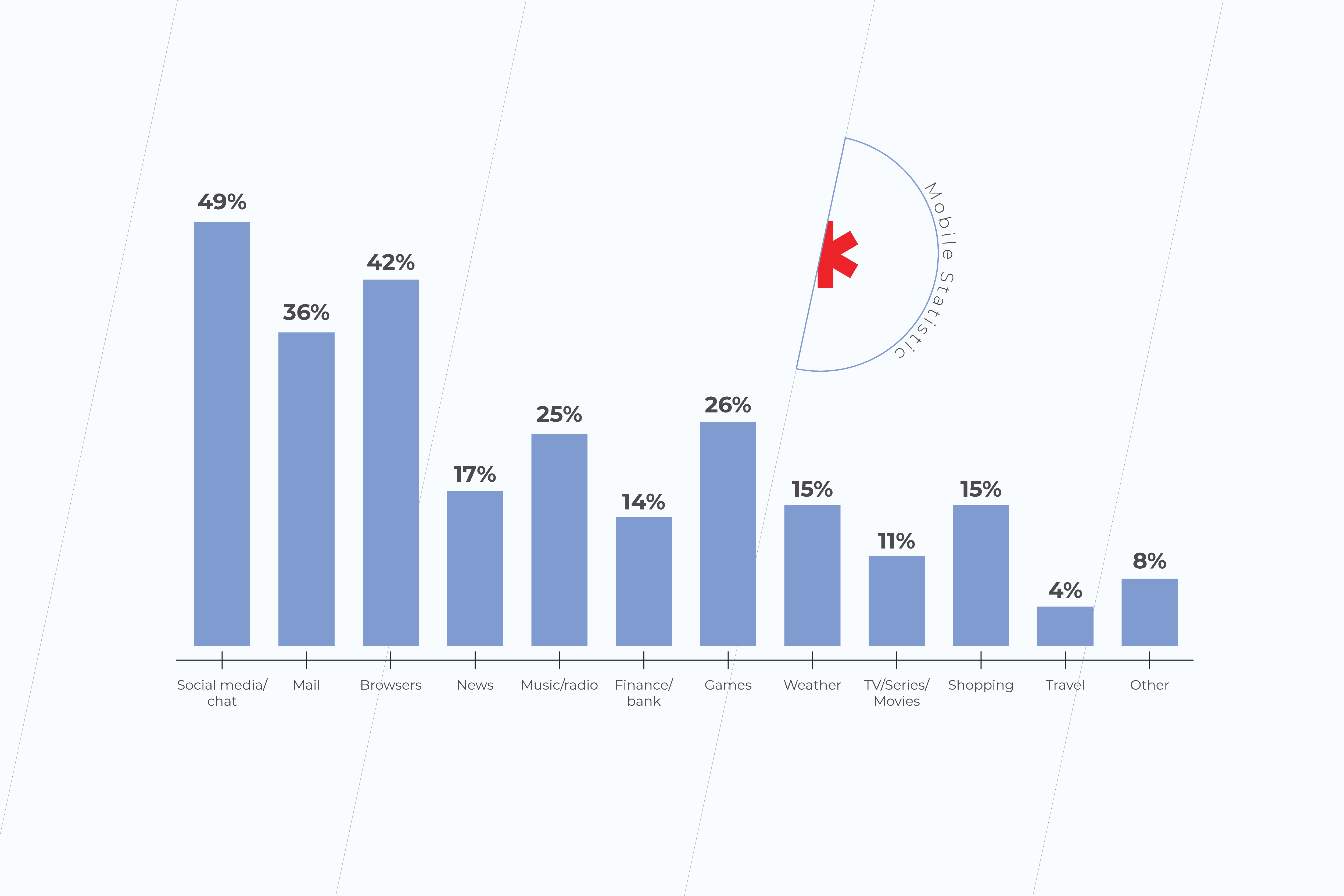
Mobile applications’ downloads have increased in recent years to 218 billion. According to Statista, in 2023 mobile apps will generate more than 935 billion U.S. dollars in revenues through paid downloads and in-app advertising. And word-of-mouth is a very strong factor when deciding what applications to download. Finance, travel, and shopping apps are among those that mobile users in the United States spend the most time on.

Web Application vs Mobile Application

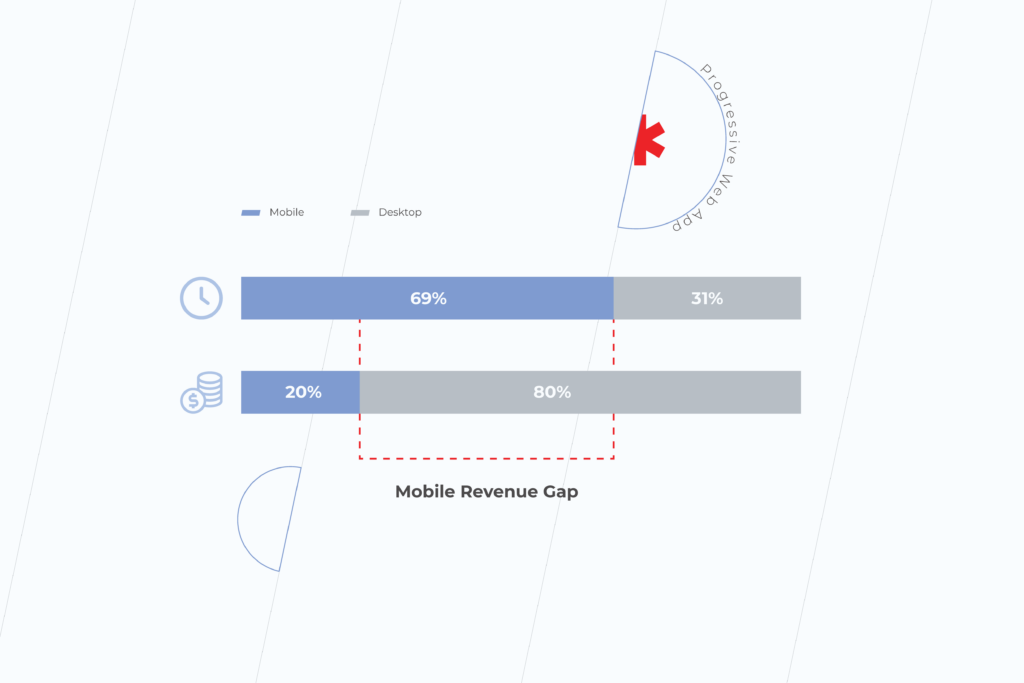
A study has shown that PWAs have 36% higher conversion rates than native apps. The average conversion rate for progressive web apps is higher because mobile traffic and consumer time on mobile is much higher than on the desktop. Many businesses report increased revenue thanks to mobile traffic. For example, the Starbucks PWA has doubled daily active users. And orders on the desktop are nearly the same rate as mobile.

The number of origins with PWAs has grown 170% in 2020. According to the Chrome team, there are tens of millions of installations of WebAPK only on Chrome for Android. However, PWAs are less accessible for Safari and iOS users because of Apple’s policy on a more private web, and more strictly regulated App Store. Following Apple, Mozilla claims deprioritizing progressive web applications soon.

Check other articles on our blog. Subscribe to our social media and get insider information on making your business ready for digital. If you have any questions, get in touch with our expert team or fill in the form below to have your project estimated by progressive web application development company.

The Future of Software Development in 2021 and Beyond

The year 2020 stormed into our lives, bringing changes that most of us were not ready for. Businesses had to either take the path of overwhelmingly rapid digitalization or put their very existence at risk. We reached an unprecedented milestone when technologies were once and for all to become the heart of even very traditional businesses. 

While organizations were flying blind through the dark times of the lockdown, software development came under the spotlight – helping companies to embrace agility and resilience. Considering massive shifts that happened last year, a lot of which are going to stay with us forever, more software innovations are likely to be seen in the near future.

So what’s going to be in the software engineering news in the coming years? Let’s take a stab at it.

Digital skills will remain in high demand

The Covid-19 pandemic has accelerated digital transformation. It resulted in a rapid embrace of technologies and, in the meantime, revealed a shortage of people whose job it is to deliver them – software developers. 

According to the US Bureau of Labor Statistics (BLS), demand for this role is projected to grow 22% by 2029. Today, not only tech companies cry out for software engineers. Many organizations have shifted their business processes online and started to launch services on the Internet from scratch. They are in need of technical talent. As more and more companies want to renew their services and develop new technologies to meet their customers’ fast-evolving needs, the lack of specialists will get even bigger. Furthermore, the skills recruiters are expecting from the applicants now are different from those before the quarantine. 

All this is likely to put small and mid-sized businesses, looking for candidates with the right skill set, into a difficult position. No wonder 41% of organizations intend to increase their spending on software outsourcing, as a Harvey Nash/KPMG CIO survey shows. Not to lose in the race of constantly changing demands, partnering with software development experts sounds like a pretty wise plan – it’ll help businesses to be better equipped with new tools in the software industry to keep the pace of digitization.

Remote work is here to stay

remote work

For the past one and a half years, a number of companies have adopted – not by choice – unprecedented workplace flexibility with all the advantages and drawbacks it entails. What once seemed like a temporary situation is now clearly the new normal and won’t be going anywhere. Since the genie can’t be put back in the bottle, there’s nothing we can do but learn how to effectively deal with more people working remotely.

The Terminal-commissioned research finds the vast majority of employees love the benefits that remote work offers and don’t want to get back to the old ways. The top reported advantages of remote work for software engineers include a lack of a commute, enhanced work-life balance, and increased autonomy. 

At the same time, a lot of respondents admit that it’s become harder to collaborate or feel part of a team. Indeed, no matter how difficult it is to imagine developers’ work without over-the-shoulder reviews, yet here we are – this form of collaboration has become a thing of the past. But if code reviews can be completed through a specialized tool, unstructured, organic interactions that occur due to the physical proximity of employees in the office are difficult to recreate. 

The way software engineering has changed is especially tough for managers and new hires. The former are more likely to face burnout; the latter suffer from the lack of valuable team building and learning that takes place at natural moments of “collision.” New ways of encouraging team collaboration are likely to be found to build more inclusive remote environments for employees.

Proprietary software will be outnumbered by open-source 

Since its emergence in the ’90s and up until recently, open-source software has been disparaged as lower in quality and security than proprietary solutions. With time, these myths were dispelled though, and the situation has changed drastically. Today, business use of open-source software is soaring. 

Although proprietary software providers still dominate the market, open-source software plays an equally important role. Moreover, a number of factors show that more is yet to come for open-source development. The first one is that it’s fast. Increasing the speed of time-to-market and pushing out updates on a frequent basis are no longer issues. Secondly, open-source software is decentralized. As long as open-source projects have multiple backers and stakeholders, businesses won’t suffer from vendor lock-in. Finally, since the code is open, this software is easy to customize, which means that the solution can be tailored to meet customers’ specific needs.

A Red Hat report shows that about 80% of IT departments plan to increase their use of open-source software over the next year, with 95% of IT specialists saying that open-source has become strategically important to their business. While proprietary software use is expected to be down to 32%, the use of open-source, in contrast, will increase to 44%. Using open-source solutions is a software trend for a reason – they offer companies powerful capabilities without having to invest heavily straight away. 

Low-code platforms will be taken more seriously

low-code platforms

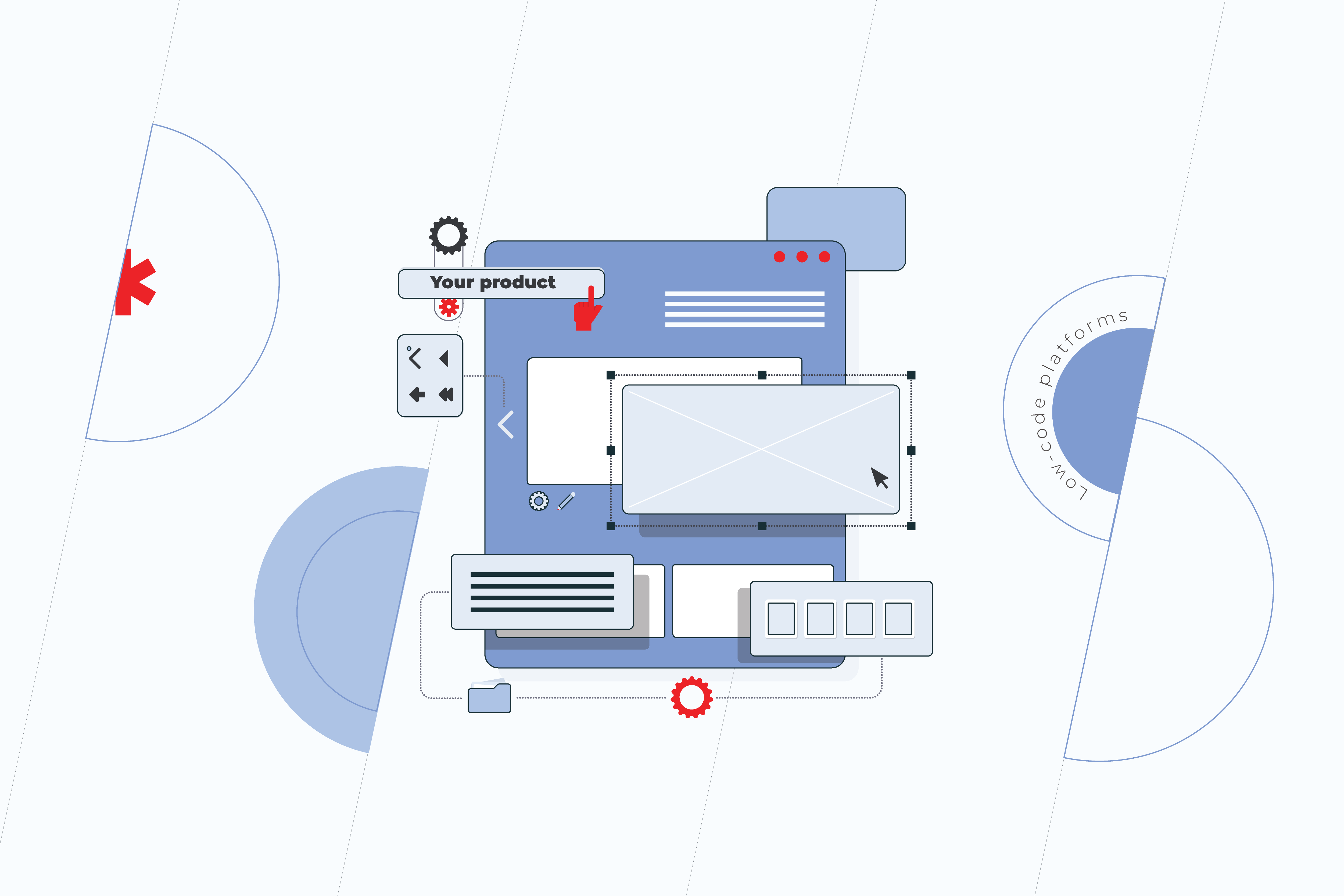
High demand for software solutions and the lack of qualified developers have brought low-code platforms to the forefront. These platforms help businesses quickly react to the changes and rapidly deploy new solutions due to the simplification of the development process. Instead of laboring over raw code forever and a day, engineers can focus on adding more value to the product.

Taking into account the growing gap between developer supply and demand, it’s expected that low-code tools will get even more popular as their adoption doesn’t require any special qualifications. Writing “everything” or “almost everything” from scratch is no longer relevant merely because “almost everything” is already there. Does it mean, however, that programming we got used to will vanish into thin air? Not at all. It’ll just transform from a kind of craft into an act of art. 

The significance of developers is still rising because they are not swamped with low-level programming and integration and have an opportunity to concentrate more on customers’ problems rather than snags in the code. For the past two years, a lot of companies across industries have optimized their business processes, cut development costs, and scaled fast with the help of low-code platforms. 

Because of the pandemic, businesses started massively switching to online operations and needed suitable instruments for that. Creating applications in a traditional way could lead customers to bankruptcy. Meanwhile, with low-code, development has become several times faster and cheaper. Solutions based on low-code are more flexible, which means that companies can effortlessly adapt their software to any changes.

Taking advantage of future software development technologies

The last year put us on a fast track to a completely new world. The future of software development turned into the present in the blink of an eye. Far from everybody was ready to keep afloat – the rest is history. 

Do you want to leverage the changes that the future holds? Contact us for a free consultation on choosing the best software development strategy for your business.

AGILE software development and business management: main highlights

In today’s fast-paced and ever-changing environment, software development companies need and even have to be agile. An agile approach implies the rapid delivery of a valuable product through quick response to customer’s needs and requirements. We have defined 5 key principles of Agile methodology, which are applied to software development processes and companies as a whole.

Changing priorities

Customer satisfaction through early and continuous delivery of highly valuable software becomes a major principle of agile software development. Frequent iterations between requirements specifications facilitate rapid response to changes in scope and priorities. Adjustments are therefore recognized sooner rather than later. The sooner customers receive the final product, the earlier they get benefits from it!

Adaptability

Agile as a tool helps developers effectively handle new requests so as to provide services faster, thereby meeting or even exceeding customer’s expectations. Flexibility and ability to adapt to changing requirements and market conditions help businesses stay competitive and focused.

Self-organizing teams

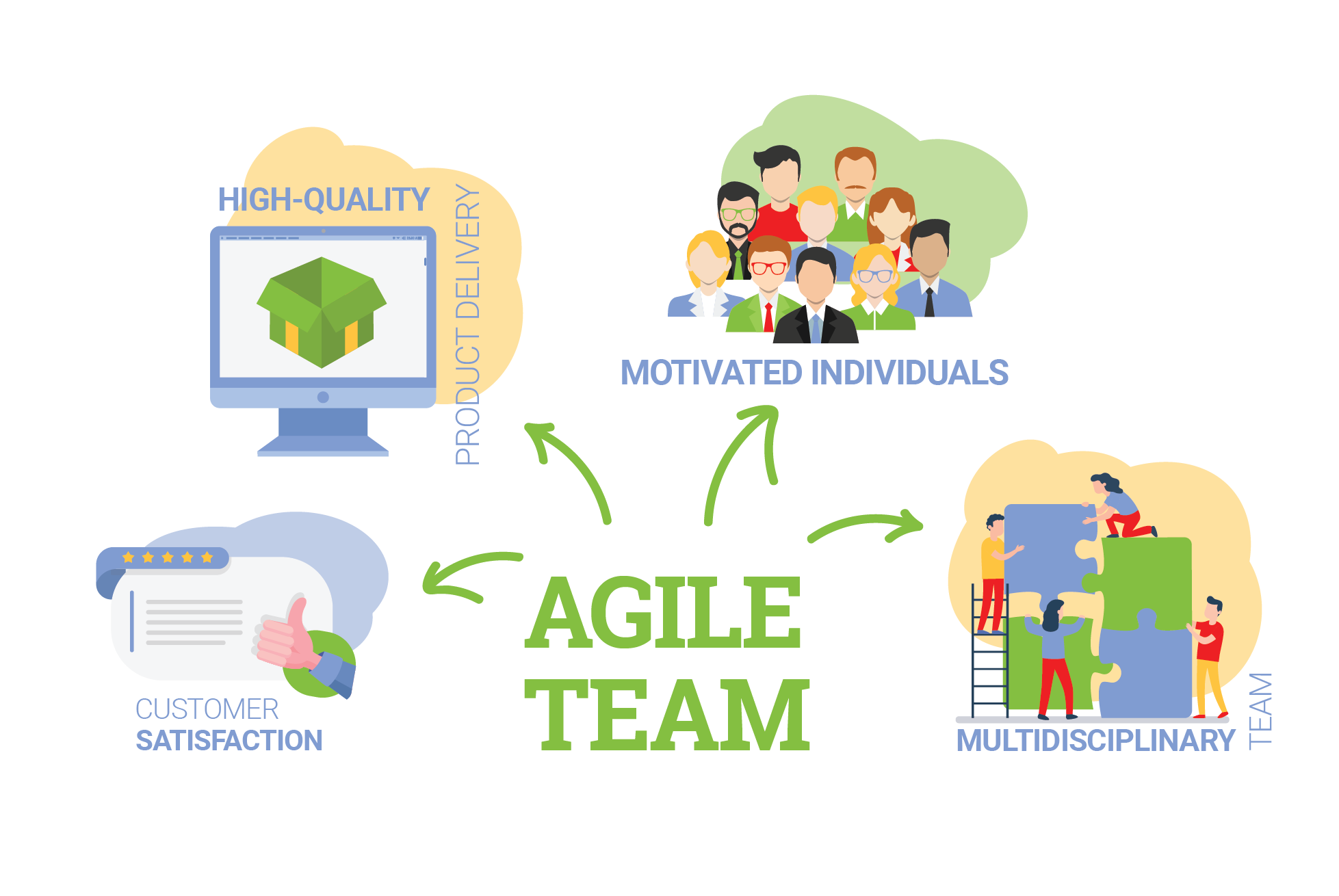
Such teams are multidisciplinary in nature. They can figure out the necessary skill set and distribute knowledge across the members. This ensures the provision of best architecture, requirements, and designs. In this case, co-working and face-to-face communication make development processes faster and more effective.

Working software

The main documentation that helps to understand how the software should work is important. However, the main focus is on the creation of a helpful software solution for the customer. Through face-to-face communication between team members, documentation can be minimized.

Agile mindset

In an agile working environment, it is very important to have high-performing teams delivering a valuable product to customers. The performance of every team member depends not only on his/her skill set but also on the mindset, which comprises such attitudes as respect, collaboration, learning, and improvement, focus on value and adaptability.

Both in software development and company management, an agile approach becomes a part of the corporate culture. It requires understanding and sticking to the main principles of agile philosophy, as well as having an agile mindset. Any business that is based on such an approach should be able to adapt to the changing market, be fast-moving and flexible; it should build team communication on trust and respect, encourage knowledge exchange and improvements, do everything possible to minimize time-consuming processes.

*instinctools centers its company policy around agile methods of development and business management, providing high-quality products within agreed deadlines, meeting customers’ ever-changing needs, and satisfying their expectations!

Why QA Is So Important For Software Project

The Consequences Of Lack Of Testing

Far back in 1999, NASA lost its Mars Climate Orbiter, which came too close to Mars, entered the atmosphere and disintegrated because of atmospheric stresses. While investigating the causes of this accident, it was found that one of the company’s contractors – when developing one of the terrestrial modules of the software serving the satellite – used the English units of measurement as the output values ​​instead of the expected more conventional metric system used by the agency’s team. This mistake led to the failure of the $327.6 million mission. One of the reasons for this discrepancy was that the device systems were not tested enough.

There is a saying that It’s only those who do nothing who make no mistakes. Learning from your own mistakes gives you experience and wisdom. But in software, it is too expensive to learn from your own mistakes. The price of such errors is not only in the higher cost of developing the product or in the need to rework an already finished product. You will also lose your orders, your business reputation will be damaged and user confidence will decrease.

How costly is an error?

In 2002, a study commissioned by the US Department of Commerce’s National Institute of Standards and Technology showed that software errors cost the US economy an estimated $59.5 billion annually.

In 2004, NASA conducted a study to determine the relative cost of fixing errors discovered at different phases of a project life cycle. The results of this study, carried out via three different approaches, showed that the cost of fixing an error in the product escalates at the stage of mass use of the product compared to the initial stage of setting, collecting and validating the requirements.

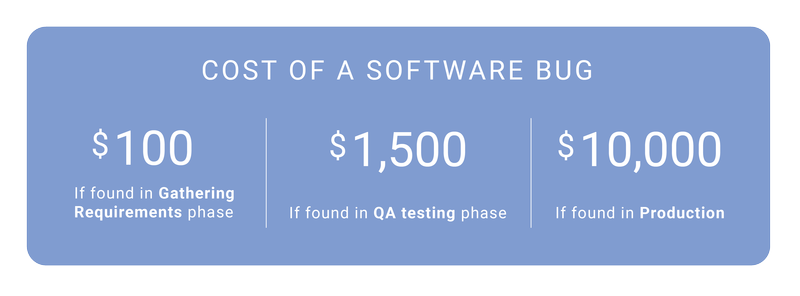
In one article posted on Celerity Blog, the following example is given: a software bug error detected in the gathering requirements phase can cost $100. A bug found at the testing stage can cost $1,500. An error detected after release can cost the customer $10,000.

All this suggests that to reduce the huge costs that come with software bugs in the finished product, it is necessary to make efforts to find such bugs at the earliest phases of the software development life cycle (SDLC). After all, these costs are borne by users in one way or the other – for example, in the form of increased cost of subscribing to a product. Ultimately, such factors can create customer dissatisfaction, weak competitiveness of the product, and, consequently, loss of target audience.

The job of a tester

When it comes to software development, nobody is immune to errors, no matter how well-weighed the project is, how detailed the technical task is and how competent the project manager is. There are just things that cannot be controlled. That’s why software companies test their products to reduce the number of errors and the financial losses that come with these errors.

The main tasks of a software tester are:

  • checking whether the product meets the customer’s requirements
  • detecting errors, thereby minimizing customers’ risks of using the product
  • providing maximum information about the current state of the product.

Thus, software testers enable managers to make timely decisions and release the product on time. After all, the purpose of development is precisely to provide the customer with a suitable and efficient product within a specific deadline.

If you’re interested in more, read Mobile application automated testing

What does a tester do?

A tester performs diverse functions, from planning the testing of separate product modules, to evaluating the finished product as a whole and detecting errors.

  • He checks the product for compliance with the requirements specifications.

It is really important that the product is exactly in the form in which it was conceived, so as to solve the customer’s problems.

  • He checks the product in rare or improbable conditions of use.

Testers find faults in a product which can be detected only in special cases or years of use. For example, it is important to check how the application will behave on February 29 – this day appears every four years in the calendar. Will the reports be properly generated? Can different calculations be carried out? Errors in such “bottlenecks” that were not detected during testing and which did not immediately reveal themselves, could subsequently lead to financial losses, and even to rejection of the product and reduction in the product audience.

  • He explores non-obvious ways of using the product.

A software tester finds areas of the product that need improvement. He does so by performing non-typical actions, that, under the industrial use of the product, can disrupt embedded business processes or the overall performance of the product.

  • He checks data security and product safety.

This is necessary in order to avoid outside interference or unauthorized access to confidential information.

  • He checks the product performance on different devices and platforms.

It is often a requirement that a product works efficiently on different devices and platforms: desktop, mobile apps, different browsers, and, moreover, different versions of browsers. This is typically a rather large task, and it is simply inefficient and unprofitable for developers to spend resources on such a task. A software tester performs this task.

  • He studies interactions with other products.

During testing, the tester checks the interaction between the product and the other products of the customer. Integration with popular social networks, payment aggregators, multimedia portals, etc. is checked, depending on the product requirements.

  • He prepares and submits a product status report to stakeholders.

By so doing, stakeholders receive information about the state of the product. This information enables them to take further decisions on product development and release.

Why can’t developers be good testers?

At first glance, it may seem that developers can test their own product, and this would be an opportunity to save costs on recruiting testers. But actually, this is not the case – developers alone cannot test a product sufficiently.

  • It’s very difficult to check yourself. Certainly, you wouldn’t be objective when you check your own work. In testing his own code, the developer often focuses on the positive aspects, not paying due attention to the negative and problematic side. After all, the task of a tester is to focus on product risks and to search for errors and discrepancies. The developer finds it more difficult to do this, for psychological reasons.
  • Testers have special expertise that developers do not have. Testers know and use various methods and testing techniques, and they prepare sets of typical test cases or checklists, which then help to detect errors or discrepancies with project documentation. Often it is the tester, as an independent party, who discovers bugs in a software product, arising from the fact that the developer initially misinterpreted the requirements.
  • A tester is cheaper than a developer. Therefore, the use of testers is also a cost-saving measure for the customer.

If you’re interested in more, read Automated Testing ROI

How to organize work efficiently?

Engaging a tester for your project after completion of development and before the release of the product may not be sufficient to ensure that the product is delivered exactly as the customer wants and within the agreed timeframe. For efficient testing of a complex and multifaceted process, there is a need for close interaction between the tester and developers, project managers, business analysts, technical writers and other specialists. Therefore, it is important to involve testers in the early stages of development, which will help to avoid discrepancies and ambiguity of requirements, and to introduce a critical view of the product at all its life stages.

Testers should also participate in trials at the end of testing. Problems can be identified based on customer feedback. Testers could take part in addressing such problems: they will reproduce situations and errors that the users encountered, test bug fixes to make sure that these fixes did not create new errors in other places, etc. These specialists have knowledge of the entire complex application and business process.

So, do we test or not?

Testing is a compulsory phase in a product’s life cycle. Both the designer and the builder of a new aircraft, who want to test their creation by themselves, risk their lives. Test pilots solve this problem. They do this before mass production starts and pilots start flying the aircraft.

Both in business and in everyday life, people achieve their goals by taking certain steps and assessing their progress. If your goal were to get an effective, high-quality product, then impeccable organization and testing would enable you to achieve this goal.

Advantages of Lean Software Development

How to boost team productivity

The term “lean software development” was created in 1992. Since then, it has become overloaded with interpretations and refinements, but has remained the same – the rational use of resources. Principles of lean development help to debug the software development process so as to prevent losses at any stage.

Lean use of resources is very important in software development: after all, even a perfect product that is not released on time becomes irrelevant. The same goes for people – developers should not be subjected to constant tension and stress caused by overworking.

Lean production

The principles of lean resources distribution were first developed in the factories of Toyota, the Japanese car manufacturer. Through such an approach to their work, Toyota has become the leader in the production of cars worldwide. In 1989, the company employed slightly more than 90,000 workers and produced 3.3 million vehicles, while American General Motors had 775,000 employees and produced 5.5 million vehicles. The results are obvious.

Toyota did not keep the reason for their extraordinary success a secret. Indeed, the company openly promoted their principles, the main purpose being to avoid losses at all stages of production.

According to Toyota, there are seven kinds of such losses:

  1. Transport losses – unnecessary replacement of the product during production.
  2. Loss of assets – when not all of the components or capabilities are used in the production process.
  3. Movements – people or equipment are making many unnecessary movements during the production process.
  4. Expectations – in the case of delays or interruptions during the production process.
  5. Overproduction – when production volume is more than end user need.
  6. Excessive processing – when low-quality production tools are used.
  7. Defects – when there is a need to involve additional resources for checking the absence of defects in the final product.

Sometimes they single out an eighth kind of loss – when the final product does not meet the expectations or specifications of the end user.

Further on, lean production principles were modified for other types of production activity, including software development.

Why lean development is beneficial for software

15 years ago, lean development was implemented into the field of software. At that time, the software industry began to develop and to attract multimillion-dollar investments very fast.

Here are the basic reasons why lean development is beneficial for software:

  • Rationalizes and simplifies the development process. Lean development helps to get rid of unnecessary stages in the process of designing software. It makes the process of development cheaper and faster, saving the most important resources – time and money.
  • Prevents any losses. It is very important to prevent losses related to overproduction. With regard to software, overproduction means excessive functionality.
  • Increases the team involvement rate. People are one of the key values of lean development methodology. It is their participation that helps to prevent losses and optimize the workflow.

Principles of lean software development

Mary and Tom Poppendieck are the evangelists of the concept of lean software development. They have outlined seven basic principles that ensure success in lean development.

  1. Loss removal. If the product has functionality that the user does not need, this is a loss. If the development is transferred from one team to another, this is a loss (as it takes time to bring a new team up to speed).
  2. Training. Often you have to act in conditions of uncertainty. Therefore, the team needs knowledge and experience to be able to properly respond to the circumstances. For example, they might need another technology stack or other methods of implementing for the development of the product.
  3. Make decisions as late as possible. Due to uncertainty, making decisions may be very difficult. Therefore, if the important decisions are postponed “for later,” when the results of the
    beta testing of MVP are received and you have more information about the market situation, there is more chance you will make the right decision.
  4. Show the results as soon as possible. This principle is related to the previous one. Fast development, even with imperfect code, is much more valuable than slow, thorough, error-free development. Even with a small set of functions, the product will help to collect feedback from users. Then, using these results, you can decide what to do next.
  5. Transfer power to the team. A team of developers knows the technical capabilities of the product and the possibilities for improving it. Team members can also optimize the process
    of change implementation to the product. All of this will help to output new versions of the product quickly.
  6. Integration. The product should give the impression of an integral system that does not lose its worth and utility over time, but is one that is constantly developing and improving. It should have installation convenience and usability, and be geared for the purpose of use – that’s what makes it integrated.
  7. Know it all. In the development field, you need to possess knowledge that goes far beyond this subject area. In good software, the code must provide speed, and the design must be easy to use. If something is wrong with one of those things, the software product is unlikely to be successful.

Areas of lean development

Lean software development is used in IT companies of any size. It goes well with the Scrum and Kanban methodologies, so it can easily be implemented in companies that already work with these methodologies. But it is advisable that lean development is implemented especially in teams that work in uncertainty conditions.

– The team is part of a large company. Financial issues are not a priority for such team. Time is their main value. It is important for the team to release the product before some similar product appears on the market. Principles of lean development help them to release the product quickly and with the functions that are required. Even a “rough” version will help them to collect feedback from users. This will show the direction to be taken.

– The close-knit team of developers. Lean development helps such teams to organize the development process better: to reduce the time between releases and design a product that meets customers’ expectations.

– Startups. Such teams are limited in everything: in finance, in time, in human resources. Lean development helps them to prevent unnecessary losses for an MVP (Minimum Viable Product) that can be quickly developed and shown to investors and even users in closed beta mode. Then, relying on user feedback, they will be able to understand how good their product is and what functionality is mostly in demand.

A few words about startups

Many problems and ways to resolve them with the help of lean software development are considered by American entrepreneur Eric Ries in his book “Lean StartUp.” He wrote this book relying on his work experience in startups, with reference to his own mistakes.

The author considers putting hard effort into planning in conditions of full uncertainty as the main mistake of many startups.

That’s why he confirms that lean software development is especially good in projects for creating a whole new product. Here, the principles of lean software development help to test the MVP and refine it on the basis of customer feedback. After the feedback analysis, developers have to bring in necessary changes to the product and release a new version as fast as possible. Such a cycle of continuous improvements and changes will help startups to produce a compatible product which customers would be ready to pay for.

Lean software development and Kanban

The principles of lean software development are being increasingly used by teams that work with Kanban methodology, for development process improvement and the reduction of time loss. Visualization of the work process, which is common practice for Kanban, helps to improve the development process, to make it faster.

Other peculiarities of Kanban methodology, such as restriction of the number of tasks in workflow and the principle “you must not take on a new task before you finish the previous one,” also blend quite well with the principles of lean software development.

The most important thing is that the Kanban methodology is also focused on rational resource usage and reduction of losses. That is why a team that works with Kanban doesn’t need to change its work process to follow the principles of lean software development.

Lean software development and other Agile practices

Lean software development is linked with other Agile practices. Agile software development methodologies espouse the same values:

  • Continuous development and integration;
  • Leading part of a team in development process;
  • The possibility of making changes to a product when it is still under development.

In such a way, Scrum practice foresees a release at the end of every sprint. Of course, it could be a release on the test server, but in any case, it would be a functional product that you can test and receive feedback about.

One more peculiarity of a Scrum team’s workflow which corresponds to the philosophy of lean software development is daily standups. This is the everyday meeting of the team where each teammate talks briefly about his / her successes of yesterday and today’s plans. These meetings help a team stick together, to find out more about what the others do, and to improve work processes.

Conclusion

Both in the Japanese Toyota plant and in the sphere of software, lean software development leads to outstanding results. Its basic principles help to develop software in conditions of full uncertainty, where every product version depends on customer reaction to the previous one. Nowadays, when the situation in the market changes rapidly and there is no full certainty, the lean software development philosophy helps to achieve success.

Microsoft Roslyn – using the compiler as a service

.NET Compiler Platform from A to Z

One could encounter different situations where it becomes necessary to write one’s own code compiler, interpreter or analyzer for a programming language. Creation of compilers and interpreters is believed to be an “aerobatics” in programming, whilst the creation process itself is seen as very complicated and time consuming. However, the .NET platform has had tools existing quite for a long time, which greatly simplify this task.

What we had before Roslyn came

The .NET Framework can compile a source code without Visual Studio installed on the machine. The .NET Framework (starting with version 2.0) includes command line compilers csc.exe and vbc.exe. These compilers can be used to build .NET applications from any text file containing C# or Visual Basic source code. The compilers are run from the command line. The command line compiler parameters enable you to:

  • Set the name of the compiled file (/out);
  • Collect console applications (/target:exe);
  • Collect applications with graphical interface without using a console (/target:winexe);
  • Collect dynamically linked libraries (/target:library);
  • Add references to external assemblies (/r);
  • Write command-line arguments for the *.rsp file and specify the name of the rsp file as the command-line argument (@file.rsp).

The csc and vbc parameters perfectly handle the task of compiling a source code contained in one file. But MSBuild is used for the more complex tasks of compiling and assembling projects. Moreover, Visual Studio files *.csproj, *.vbproj and *.vcxproj serve as XML codes for MSBuild. Visual Studio uses MSBuild to build projects. In addition, MSBuild can be called from the command line or from a .NET application code via APIs.

It is also possible to generate a low-level MSIL code using System.Reflection.Emit. You can also go for dynamic code generation for .NET programming languages using CodeDOM, and then compile the generated code with the help of code providers (for example, CSharpCodeProvider, which is an add-in over the csc compiler).

All the approaches listed above were being used for code generation before the emergence of the .NET Compiler Platform, better known as Roslyn.

Roslyn is a collection of open-source compilers, code analysis and refactoring tools which work with C# and Visual Basic source codes. This set of compilers and tools can be used to create full-fledged compilers, including, first and foremost, source code analysis tools.

The History of Roslyn

The name “Roslyn”, the new platform for compiling a source code, was first written by Eric Lippert, a former Microsoft employee, when he started to recruit developers for a new project. Lippert named the compiler in honor of Roslyn, a suburb in Washington.

The first version of Roslyn was released in October 2011 as a part of Community Technology Preview (CTP) – an extension for Visual Studio 2010 SP1. The update of CTP in September 2012, despite the large scale, was not very successful. It had the so-called “breaking changes” – changes in Roslyn components, which could potentially crash other components. Besides, not all the features of the CTP APIs were implemented for C# and Visual Basic languages.

At its Build conference in April 2014, Microsoft announced Roslyn as an open source project, and also implemented a way to integrate Roslyn in Visual Studio 2013. Since then, Roslyn has been distributed under the Apache 2.0 license. However, even by then, not all Roslyn features were implemented – there were plans for deployment in C# 6.0 and Visual Basic 14.0.

Starting with 2015 version, Visual Studio uses Roslyn to compile and build its own projects. However, to date, Roslyn only supports two languages – C# and Visual Basic.

In January 2015, Microsoft moved Roslyn source code to GitHub.

Installing Roslyn

To date, Roslyn has remained a part of Visual Studio 2015 and is installed together with it. Roslyn is a part of Visual Studio 2017 as well. It has been released in March 2017.

However, Roslyn is not included in the .NET Framework. Even in the .NET Framework 4.6 version, the traditional csc.exe and vbc.exe compilers are included. This is done for it to be compatible with previous .NET Framework versions.

To install Roslyn compilers without installing Visual Studio, you need to download and install Microsoft Build Tools. Roslyn can also be downloaded from Github, then you can compile and get binary files csc.exe and vbc.exe, which can be accessed from the command line.

APIs for Roslyn compilers

Most of the existing traditional compilers come as “black boxes”, which “magically” convert the source code into an executable file or library. Unlike them, Roslyn allows you to access each stage of the code compilation and application creation process via its own APIs.

Together with compilers, other “black boxes” are often supplied – integrated development environments (IDEs) that can enable you to increase the development speed with convenient tools, such as code highlighting, Intellisense, refactoring tools, performance analysis tools (profilers) and other complex tools. Roslyn takes over these features and also provides an API to them. Moreover, with Roslyn, the developer can work with the compiler from his own application, using the compiler as a service to:

  • Generate code in C# and Visual Basic (like CodeDOM);
  • Analyze code;
  • Refactor code;
  • Use C# and Visual Basic as script languages, interpreting instead of compiling the code. Roslyn APIs are represented by three sets (Figure 1).
Fig. 1 – Roslyn APIs

The compiler APIs allow you to get an object model of processes that occur at each stage of the compilation process, regardless of the Visual Studio components installed (Figure 2).

Fig. 2. Compiler APIs

The Roslyn compiler pipeline is represented by four phases, each of which has its own object representation:

  1. The parser displays information in the form of a syntax tree;
  2. The symbol declaration phase displays a hierarchical symbol table;
  3. The binding phase returns information in the form of semantic analysis results;
  4. The emitting phase provides APIs for generating low-level code in MSIL language (similar to what System.Reflection.Emit does).

Language services use these APIs to perform their own functions. For example, code highlighting uses a syntax tree, while an object browser uses a hierarchical symbol table.

Roslyn diagnostic APIs allow you to handle errors and warnings that occur at all the compilation stages. Roslyn also allows you to process errors through analysis tools written by the user.

Scripting APIs allow executing C# or Visual Basic code without compilation – something similar to the REPL interactive environment in Perl, Python, Haskell, Erlang, and others.

Workspace APIs gives direct access to the application’s object model in the compiler without parsing the source code files for the second time. The APIs also allow for projects tuning, management of project dependencies, source code generation without using Visual Studio components.

Syntax trees

The syntax tree is the basic structure used by Roslyn for compilation, code analysis, binding, refactoring, code generation and other operations. Roslyn syntax trees have three key properties:
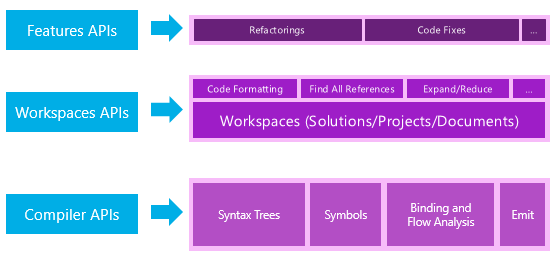
  1. They contain all the source information, such as grammatical constructs, tokens, directives, comments and even whitespaces – all this information is contained in the syntax tree;
  2. The syntax tree or its part can be converted back to the source code – you can build syntax trees and generate code from them, you can edit the syntax tree and it will generate a corrected code;
  3. They are thread-safe and protected from changes. This means that you will not be able to directly change the data in the syntax tree. The tree completely reflects the state of the source code at the time of construction.

These three important attributes of the trees allow you to work with the syntactic structure of the source code, including in custom projects, accessing it through APIs. These properties have also greatly simplified complex refactoring operations, and this happens naturally without direct code editing but only by editing the syntax tree. Each syntax tree consists of the following elements:

  • Syntax Nodes – they represent complex syntactic constructs, such as declarations or expressions;
  • Syntax Tokens – they represent the simplest constructs for constructing syntax nodes. Syntax tokens consist of, for example, an identifier or operator;
  • Syntax Trivia – it represents parts of the source text that are mainly insignificant for the compiler, such as comments, directives or whitespace;
  • Spans display positions within the source text of each node, token or trivia, and its length;
  • Kinds identify the syntax unit in the tree;
  • Errors are processed in the syntax tree in two ways: either by inserting the expected token, or by adding a token that is unknown to the compiler as a trivia.

Semantic model and Workspace APIs

Unlike syntax trees that represent the structure of source code, semantics is the logic in the source code and all its constructs. It includes declarations of variables, classes, objects, fields, methods, function calls and passing parameters to them, types of operands and operation results, and operator priorities. Semantic analysis of source code checks the code (or syntax tree in Roslyn) for compliance with the rules of the language. Semantic model provides the following information about the source code:

  • Semantic symbols: source elements or elements imported from libraries (types, methods, properties, fields, events, etc.);
  • Resulting type of expression;
  • Diagnostic data: errors, warnings, exceptions, etc.

Workspace APIs represent the object model of solutions, projects in solutions and documents in projects. All the objects and methods listed above can be called from any .NET application working with Roslyn as a service and using Roslyn APIs.

Working with Roslyn: samples

There are so many examples of working with Roslyn. Here are some of them:

Future development of Roslyn

Roslyn will be developed further in two important areas: creation of new features and improving existing algorithms. The following are expected among the qualitative improvements of algorithms:

  • Increasing the performance and speed of algorithms in the compiler platform;
  • Creating a new implementation of PDB Writer with big parallelism when writing text to a PDB file;
  • Increasing the test coverage with the help of new testing tools;
  • Eliminating Roslyn’s dependence on the full version of .NET Framework so that Roslyn could be deployed, for example, on WinRT.

Some of the features of Roslyn compilers are still considered experimental and are being tested publicly. Others that have already been implemented can be improved – performance, speed and quality of work can be enhanced. Still others associated with the new functionality require a decision by Microsoft and the .NET Foundation community to be taken first before intensive development and implementation could start. Here are some of the ways to improve the following versions of Roslyn compilers:

  1. New features for programming languages ​​C# 6.0 and Visual Basic 14.0 (more);
  2. APIs for creating XML documentation from code comments;
  3. Improvement of diagnostic APIs for synchronous code analysis in the process of writing it. For example – identifying and indicating errors and warnings while writing code without running it for compilation;
  4. Increasing the performance of code analyzers via Roslyn APIs;
  5. Increasing the number of rules for static code analysis tool FxCop;
  6. Creating APIs for writing custom static code analyzers;
  7. Modifying the semantics of some expressions for scripting languages ​​(C# Script and VB Script);
  8. Improving REPL interface – interactive environment windows for programming within command line interface tools;
  9. Improving APIs for working with scripting languages ​​(C# Script and VB Script);
  10. Increasing the performance of FindAllReferences operation;
  11. Improving the algorithms for finding conflicts when renaming.

Some more piece about Roslyn

Despite the large number of flaws, the Microsoft’s new compiler platform Roslyn is gaining popularity, and it’s no accident. Roslyn is one of the few compilers that give you the opportunity to observe all the compilation and assembly stages, access any intermediate results and internal compiler constructs, as well as use various language services of the compiler, refactoring and diagnostics tools. Due to the wide interpretation options inherent in Roslyn, the C# and Visual Basic have become scripting languages. Despite its relatively small history, Roslyn is already being used in large projects, such as IDE Visual Studio 2015, static code analyzer PVS-Studio, and cross-platform framework .NET Core. It is also used as an alternative to script system Windows PowerShell. In the future, the number of such projects will only increase.

Some life hacks on the use of Roslyn

Roslyn provides a huge set of tools for building your own compilers, code analyzers, interpreters and scripting languages. A significant shortcoming of Roslyn is that it only works with two programming languages: C# and Visual Basic. However, Roslyn makes it easier to create your own language on the .NET platform. In this case, you only need to translate the code into C# or Visual Basic, or create a syntax tree, and then use Roslyn compiler APIs to build a full-fledged application on the .NET platform. Another option is to run the generated code for execution (interpretation) as a script. If you need to generate and compile a source code using C# as a scripting language, then the best solution is to use Roslyn compiler APIs. If you do not like the source code analyzers built into Visual Studio, then Roslyn APIs could enable you to create your own. You can even create your own IDE, using the features of this compiler platform and connecting it as a service to your project.

Roslyn is not just another Microsoft compiler – it is an off-the-shelf framework, which you can use to create your own source code tools. Roslyn gives .NET developers many new features. It is a great tool that helps you to write your own compiler, interpreter or analyzer for a programming language. We advise you to study how the compiler works for it would simplify your tasks. We are interested in Roslyn because it can be used to create your own programming language on the .NET platform.

Lean Software Development Using the React Ecosystem

Choosing the Right JavaScript Framework

In this article we’ll elaborate on how we use React and the ecosystem around it to enable lean software development. Several options for frontend development are presented. When there is need for a web app framework, businesses usually choose between Angular, Ember and React.

React

The decision to choose any of these frameworks is usually driven by a simple question: how easy would it be to hire a dedicated team and later gather the maintenance and support team. By easy staffing, we mean the availability and cost of developers.

Cost and availability are the reasons why non-mainstream frameworks are not even considered for a job.

Aurelia, Vue, Polymer and many other frameworks provide great technical ideas and they are good for special cases. However, these frameworks may lead to excessive costs if selected as a base for business. This is because there is shortage of readily available and qualified developers to do the job using these frameworks.

The use of one of the mainstream frameworks will enable businesses to control costs and manage projects predictably.

Why React?

There is no silver bullet or framework to solve all issues. Apart from technology, many other things should be agreed upon and communicated during a project.

From the prototype to design and implementation, product development requires the use of specialized tools at each production stage. These tools are usually not integrated. There is a person in between, who transforms the output from one tool to an artifact that is useful during later stages. An example is a UX researcher that gives the designs to a frontend engineer, who then manually transforms them into code. This process generates waste and slows down iterations, which is not lean.

Let’s assume that a proof of a concept confirmed our ability to implement some technology. A standard loop for creation of wireframe, prototyping, UX, design, and development should be iterated until there is confidence that MVP is ready for production.

This is the greatest discriminator of the project path that we are about to travel. Depending on team capabilities and the certainty in the path to be executed, we should make our choice from any point between two polar options:

  1. Employ a multi-talented team, where the product owner, UX researchers and designers would draw sketches, wireframes and interactive prototypes which are then handed over to the development team for implementation in a selected technological stack;
  2. Allow the product owner to iterate with the development team directly, while feedback on an artifact from one iteration is a direct input for the next one.

Option A is recommended when the product owner is certain on what is needed as the end result. This is usually the case for a business that is making an investment and the resulting product is expected to be an integral part of an existing system.

Option B would be more desirable for innovative products, startups, and research projects. This is because it allows for very rapid change in development direction while preserving speed. This is possible thanks to the application of lean software development principles and practices which could be enabled by a unified toolset built around a common framework.

React and the ecosystem around it are always in flux, but they are mature enough to cover a full cycle from the prototype to MVP and to production deployment both for web and mobile applications and soon for virtual reality apps.

There is no need to produce wasteful deliverables outside of the React ecosystem. Proof of concept, wireframes, interactive prototypes and MVP could be built from one another on each consecutive iteration. By reusing code between production stages, waste is eliminated and learning amplified.

Each team member could see the whole since the common stack is used throughout the project. It is all React and JavaScript. This helps them to build in integrity since they could refactor parts of a system as new feedback is collected.

Lean Toolset

Convention

The first thing to do on a new project is leveling the ground. Project time shouldn’t be spent on selecting tools, integrating them to work smoothly together and teaching team members to embrace them.

This is why tools should be ready, team members should have the skills and use these skills properly, and convention should be established by a lead. A convention over configuration approach increases certainty. This allows developers to think more about the product instead of arguing about non-significant details. These details should be resolved in advance. For this reason, tools are collected and integrated in a toolset.

Lean Toolset: create-react-app

create-react-app is a React project generator and toolset which allows bootstrapping a React project without configuring the build tools in advance. The convention over configuration approach used by the create-react-app saves time in most cases, while for advanced cases, it is not limiting.

When advanced setup is needed, we eject configuration using built-in react-scripts and extend it accordingly. However, the rule of thumb is to work with the idiomatic create-react-app since it simplifies the overall system and imposes best practices.

Lean Toolset: redux and common packages

create-react-app is good for bootstrapping, but not suitable for application development.

We always add redux for state management and react-router for routing to our applications. Other than simplifying state management and routing, those commonly known packages bring design patterns which would simplify application testing, allow code reuse and portability between different use cases and platforms.
Lean Toolset: Material-UI

React itself is a major enabler. Applications built on React and redux are composed of components with clear state and lifecycle management. They have capabilities which allow us to change composition, behavior and business rules on the fly, without breaking other parts.

Material UI

All of these technical capabilities should be accompanied by a solid UI kit, so the system has the look and feel of an integral whole by the customer. We selected Material-UI from a set of readily available UI kits to unify complex interfaces since it integrates with the create-react-app easily and can be customized.

Material-UI is a readily available UI kit that follows Google’s Material design guidelines. It allows for the quick creation of interactive prototypes. The look and feel are customizable, which is only needed in the later stages. For prototypes, we recommend focusing on user flows.

Lean Toolset: Storybook

Storybook is a tool for creating a living style guide comprising of React components. This means that at any point in time, you can change your components and immediately see how they look, feel and behave in different states. This shortens the feedback loop after each change and makes everyone confident that no look and feel regression was made.

Story Book

In addition to the usual benefits that a living style guide brings, Storybook enforces some useful design patterns, such as differentiation of container and presentational components.

The storybook is composed of presentational components that are shown in different states. Container components, which map presentational components to the rest of the application, are not needed and are not welcomed by a storybook. Therefore, we are forced to separate containers from presentational components.

The separation of concerns principle allows us to decide as late as possible and make architectural decisions on component interconnections, only when uncertainty is eliminated.

With Storybook, we could deliver the interactive look and feel as fast as possible.

Lean Toolset: Jest

While Storybook allows building confidence in the look and feel visually, automated testing empowers every team member to make bold changes with the assurance that no regression is introduced.

Unit Testing with Jest

There is a long list of benefits of automated testing. The key advantage here is the ability to build a robust continuous integration and delivery pipeline which allows fast and iterative delivery.

We selected Jest as a base tool because of its tight integration with React. The developer experience of testing JavaScript code with Jest is excellent. It enables rapid development by running only specific tests just in time when changes are made to units under test.

Pragmatic Development

There is considerable uncertainty in software development. That uncertainty should not block product development. The tools presented empower our team to deliver the known parts fast and to highlight the unknowns. This allows stakeholders to see and act on them early.

Anna Vasilevskaya
AI modified real photo
Anna Vasilevskaya
Account Executive

Get in touch

Drop us a line about your project at
[email protected] or via the contact
form below, and we will contact you soon.