Having undigitized or under digitized inventory can be a drag on your company’s financial performance. Want to transform it into a profit booster, even though the chances of succeeding when adopting new software is one in three at best?
You’re in the right place – we know how to chart a vector toward success. Our tech and business experts outline how to draw up a digital inventory management system (IMS) that is destined to thrive.
IMS killer features to ace inventory operations
Building an inventory management system can uplift your technical capabilities with a raft of not-to-miss opportunities.
Real-time inventory tracking. Access to the relevant information about inventory levels and items in real-time allows you to prevent stockouts and overstocking, and enables shrewd moves, such as adopting demand-driven pricing.
Extensive integration capabilities. Linking your IMS with your software ecosystem grants a bird’s eye view of your inventory operations, such as ordering, storing, receiving and their relation to your business processes.
User-friendly interface and accessibility. By operating a leading-edge intuitive IMS, you can empower even less tech-savvy employees with easy-to-use data analysis capabilities.
Enhanced reporting. No more need to wreck your brain over Excel formulas or outdated inventory management software. Data visualization tools and automated real-time reporting shuffle off the burden of recurrent time-consuming reporting.
What kind of IMS should you opt for? Let’s take a look at the possibilities.
A module within an all-in-one solution or standalone inventory-specific software?
There are usually two types of IMS-related requests that come from business owners. They are either looking for special inventory management softwarethat requires integration with other corporate systems, or for an all-inclusive solution, such as ERP, that covers accounting, production, inventory operations, etc.
Adopting an IMS-specific app is an easier step to take than switching to full-fledged multicomponent corporate software. However, if shifting from jerry-built legacy solutions and embracing overall digitalization is your prior focus, implementing an all-in-one software can be a more effective strategy.
When it comes to “how to code an inventory management system”, there is no notable difference from a technical standpoint. Whether you choose to adopt a single solution and implement modules one by one, including inventory, or bank on specialized software, the core technical task is integrating an IMS with whatever it is – other modules or software.
How to make the grade with creating an inventory system
Working according to a comprehensive strategy is a surefire way to help ensure success in any undertaking, and IMS adoption is no exception. Instinctools’ business analyst and solution architect outline the action plan from inception to triumph.
Discovery phase
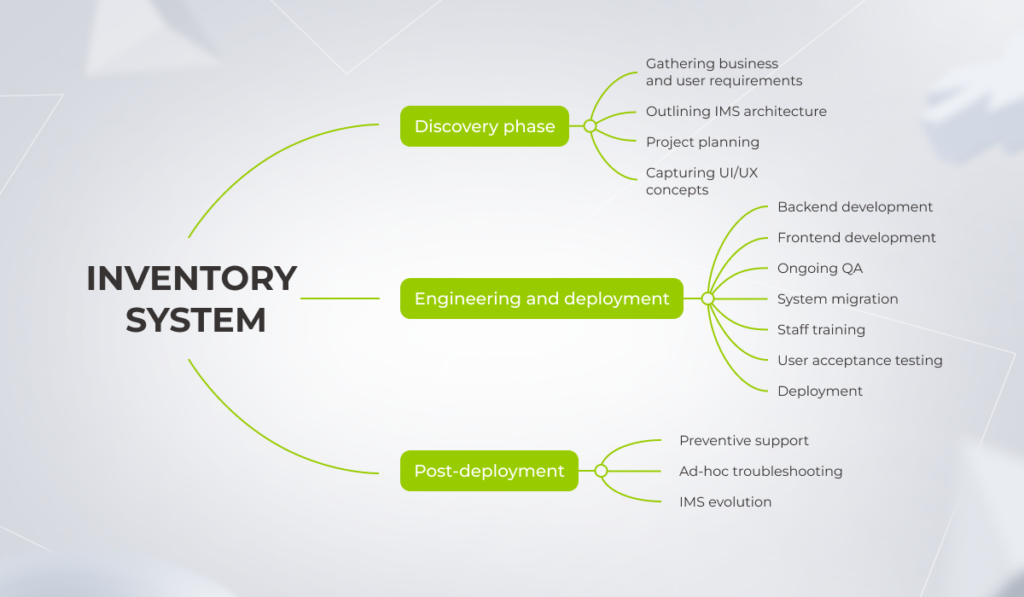
To build an inventory management app, start with idea evaluation and validation. At this stage, your tech ally covers a range of tasks.
Gathering business and user requirements and compiling them in a comprehensive solution scope.
Outlining IMS architecture with tech stack and mandatory integrations based on the collected architecture significant requirements (ASRs).
Project planning to shape your IMS vision into a detailed project roadmap, and provide clear success criteria, transparent overview of roles and responsibilities (RACI), communication plan, and more.
Capturing UI/UX concepts and preparing initial wireframes and mock-ups to chart a path toward full-blown intuitive design.
Backend development to provide your solution with a scalable and secure data access layer.
Frontend development to craft a sleek graphical user interface (GUI).
Ongoing QA with continuous functional and non-functional software tests to move through the IMS development process without any hurdles and release a bug-free system.
System migration in line with your transition plan to prepare accurate data and ensure seamless adoption of new software.
Staff training featuring hands-on guidance to minimize employees’ resistance to change.
User acceptance testing (UAT) to validate if the IMS handles all the necessary tasks and is convenient for end users.
Deployment as a final step in launching your inventory management software in the real-world environment and giving end users full access to the system.
Post-deployment
Keeping your inventory management software up and running is crucial. Tech companies provide multi-level support:
Preventive support by nipping issues in the bud and enabling your IMS longevity.
Ad-hoc troubleshooting to wipe out any glitches ASAP and prevent downtime.
IMS evolution when your partner keeps a close eye on trailblazing IMS trends and adopts those that click with your business needs.
Crafting a five-star software requires care, precision, and a laser focus on the essentials. Among the myriad of tasks that have to be done to draw up a digital inventory management system, there stand three pivotal activities: setting up a project roadmap, planning for integrations, and orchestrating system migration.
1. Planning your IMS
When creating an inventory management system, this universal principle remains valid:
“Whatever you water will grow.”
As inventory is highly interlinked with other company’s systems, insufficient planning can have a crippling effect on the processes’ visibility, business scalability, software maintenance cost, to name a few.
That’s why you have to plan wisely.
Establish your objectives and priorities
Strategy, not technology itself, fuels thriving, high-ROI projects. Therefore, start with the problem your IMS should solve.
KPMG backs this insight with statistics — companies that set clear targets at the onset are 18% more likely to pull off the project.
It’s also crucial to incorporate both short-term goals and long-haul perspectives into your project strategy from the start to hedge against any weak points that could derail your software in the future.
For example, if you aim to operate in different countries, you’ll need regional scalability sooner or later and should take it into account when choosing a tech stack. We suggest a decentralized IMS solution that allows storing inventory data on servers in different legal zones while providing employees across countries with unmatched data accessibility.
Setting the right objectives includes feature prioritization along with identifying software and hardware integrations to save you from getting a hastily-built inventory management application that lacks basic functionality and connections within your software ecosystem. For instance, you can use the MoSCoW method to identify must-have, should-have, and could-have integrations and features to balance the development scope with your budget.
Choose between out-of-the-box and custom solution
Only four cases call for a fully custom, from-scratch IMS:
Operating in a highly specific industry, such as aerospace manufacturing
Crafting unique products
Requiring integration with a legacy system
Covering non-standard business processes
Otherwise, your business workflows can be standardized and handled with customized off-the-shelf inventory management software. Our business analyst notes:
There are plenty of industry-focused, out-of-the-box IMSs for various business domains. Let’s take healthcare as an example.
Aside from tracking the consumption of inventory items such as medicines and blood for transfusion, such systems need workflows to monitor the use and disposal of disposable syringes and sterilization of reusable surgical instruments. There are specialized ready-made IMS solutions to cover these needs, such as SpaceTRAX, Cardinal Health, and AlinIQ Inventory Manager, among others.
There is also a nuance about integration with a legacy system and non-standard business processes.
As we notice across our clientele, maintaining legacy systems and holding on to inadequate business processes are the top two tech hurdles that keep businesses from taking inventory value to the next level.
In the short term, building a custom IMS that can interoperate with your legacy system and cover non-standard processes is a more affordable and fast option. However, these workarounds hold back the system’s scalability when a company grows.
In such cases, we suggest a more forward-looking approach when, along with creating an inventory system that covers the client’s needs here and there, we plan business processes’ transformation and standardization to free the client from legacy constraints in the future.
If you bank on a platform-based solution, remember that it’s not a cure-all either, and you can’t go live with it right away. As ready-made systems are designed to cover the needs of a wide range of customers, they require adjustments to your business processes.
Looking for a stalwart IMS implementation partner?
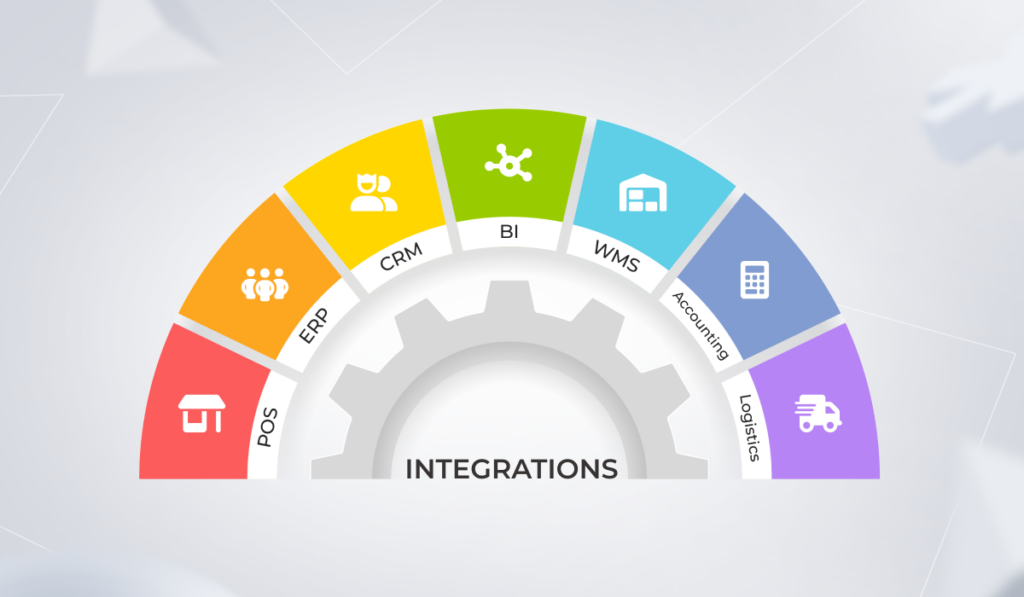
Inventory requires multi-channel integration with your corporate software ecosystem. Our experts mention the most widespread IMS integrations that can maximize business value of the system.
Point of sales (POS):
Updating stock in line with customer demand
Automating order generation and reordering
Implementing dynamic pricing strategies for goods and delivery service
Tracking payments
Enterprise resource planning (ERP):
Achieving 360-degree visibility of inventory-responsible staff and inventory-related tasks
Syncing manufacturing operations with the product components’ and employees’ availability
Simplifying compliance checks due to detailed audit trails
Customer relationship management (CRM):
Up-to-the-minute visibility into stock levels and detailed product information
Real-time order status tracking
Flexible pricing opportunities
Business intelligence (BI):
Inventory processes visualization
Simplified big data analysis of stock levels and their movement
Automated planning for product replenishment according to the analytics-based rules
Accelerated reporting
Warehouse management system (WMS):
Boosting warehouse space efficiency by optimizing item movement between shelves and warehouses
Reducing order picking time
Tracking proper storage conditions for items that require regular maintenance
Decreasing the number of lost orders
Accounting:
Gaining full transparency of the order-to-cash cycle
Automating bookkeeping management
Delineating the balance sheet of different products, materials, etc.
Shipping and logistics:
Establishing efficient goods shipment and receipt
Improving tracking and storing of freight
Optimizing and speeding up delivery
3. System migration
Transitioning to the new solution is one of the final moves you have to make to build an inventory management system. It encompasses two activities, migrating data and switching from your legacy or pre-inventory software to the advanced one.
If an IMS is the heart, then data is the blood. Data quality directly impacts your inventory management system’s overall performance and transparency.
IBM research proves that complete inventory visibility remains a pipe dream for 56% of businesses because of inaccurate data.
To draw up a digital inventory management system that will become a pearl of great price, you should ensure no junk gets into it. Therefore, before transitioning to the new system, review your inventory data to ensure data format standardization across your software ecosystem and the absence of data discrepancies.
An overall IMS implementation strategy entails a transition plan that facilitates a smooth and bump-free shift to the new IMS without missing a beat in the company’s operations.
Small businesses can switch to the new system right away, but medium and large companies that can’t put business continuity at risk should move gradually, department by department. We usually suggest running old and new systems simultaneously in the first few months to prevent data loss while employees are getting used to the software and updated flow.
Technologies that bolster your IMS
While automation, detailed analytics, and other features are considered the linchpins of any inventory system, there are leading-edge technologies that can shore up and broaden your capabilities.
IoT
Adopting Internet of Things (IoT) technology unlocks stock scanning functionality (barcode, RF, RFID scanners, etc.). IoT devices are one of the go-to options to automate and speed up warehouse-related operations, such as spotting low-stock items and replenishment.
NFC
Near-field communication can be an alternative to IoT-based scanning operations. This technology enables staff to operate without WMS-specific hardware, such as scanners — employees can cover the tasks with their mobile devices and corporate inventory management application.
Generative AI
If you want to optimize inventory, warehouse management, and last-mile delivery, weaving generative AI into your software is worth its while. For instance, it unravels capabilities such as intelligent analysis of demand patterns in different areas you operate and optimizing local inventory levels to cut down overstocks and stockouts.
Case in point: our hands-on experience in building a custom IMS
When a French eyewear manufacturer and retailer outgrew their SaaS inventory management software, they faced a tough choice: upgrade to a pricier plan or embrace the freedom of vendor-free custom software. With a rapidly expanding store chain demanding more flexibility, they chose to break free — and turned to *instinctools to make it happen.
An inventory management system strengthened with top-tech capabilities is a tidbit. However, it isn’t that easy to bite off. Wise planning, covering numerous integrations, and running final system migration can seem to be mind-boggling steps to take, but having a battle-tested tech partner by your side streamlines the path to beyond-the-reach inventory functionality and the margin uplift.
Want to set up a top-notch inventory management system?
First, you should identify your inventory problems and put a premium on establishing clear goals of IMS implementation. Run a discovery phase to validate your inventory software idea, work out a unified project vision among stakeholders, and prepare robust documentation. After a proper discovery phase, you can move on to delivery with numerous integrations and system migration, and post-delivery maintenance and support. However, by far, the most critical step in creating an inventory system is to find a reliable tech partner, who’ll cover all the head-scratching moments for you.
How do you digitize inventory management?
You can choose from two paths to draw up a digital inventory management system: – Adopt a specialized inventory management solution that requires integration with other corporate systems. – Bank on an all-inclusive software, such as ERP, that covers inventory as well.
How do I create an inventory management app?
To build an inventory management app, act according to a standard SDLC workflow: 1. Start with gathering requirements, project planning, and capturing IMS architecture and design concepts. 2. Proceed with backend and frontend development, providing all the necessary integrations, migrating the system, ongoing QA, staff training, and roll-out. 3. Don’t forget about post-deployment troubleshooting and maintenance.
What makes a good inventory management system?
A good inventory management system is the one that fully meets your needs. Given the plethora of IMS interconnections with other internal company systems, these needs are primarily related to ensuring that all necessary integrations are in place and operate smoothly. For example, to build an effective inventory system, you may need integrations with POS, ERP, CRM, BI, WMS, shipping and logistics, accounting software, etc.
How much does it cost to build an inventory management system?
It depends. Custom solutions cost more than customized platform-based IMS. Also, the state of your current inventory software and business processes influences the project’s budget. For instance, if your inventory is spreadsheet-based and relies on manual data entry, there is a lot of work ahead on the processes’ digitization and automation before creating an inventory management system.
Deciphering how to choose a software development company is challenging for businesses aiming for project success. There’s a myriad of options for nearly any type of outsourced support, biased opinions both internally and externally, and if your company’s reputation and growth depend on the quality and the suitability of the final deliverables, there’s added pressure to get it right. We get it.
Determining the best criteria, or shortlisting the right questions to ask potential vendors is critical to inform such a decision. That’s why our experts have prepared a detailed guide to help you make the right call and hire a software development company that walks the talk.
Make sure that outsourcing your project to a software development partner is what you really need
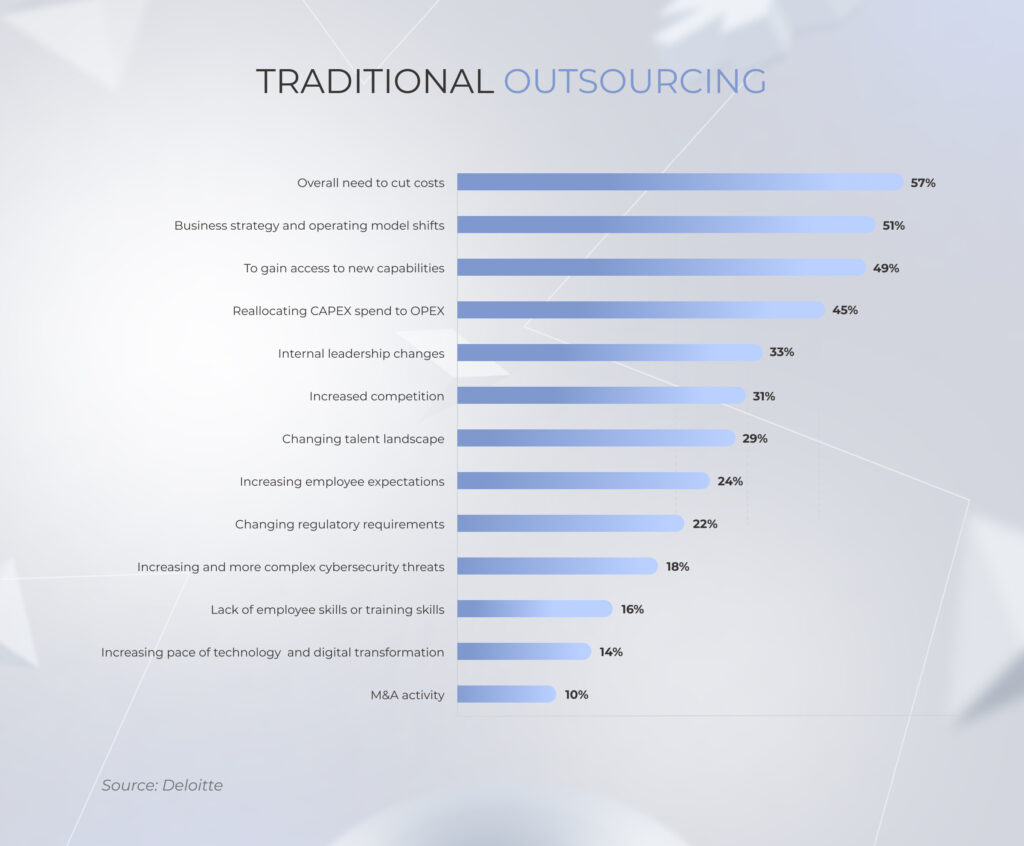
According to Deloitte, two thirds of all companies turn to software partnership to get their IT solutions delivered. But as common as it may seem, app development partnership is not a cure-it-all solution. It’s a strategic decision made for very specific reasons.
Innovating new products and features
At the beginning of 2025, the global talent shortage in the IT industry reached 76%, making outsourcing an almost automatic option to secure the right talent on short notice. Digital innovators, more than anyone else, are dependent on the right available tech talent to bring new products to market.
Hiring app development partners allows organizations, anywhere on their transformation journey or product roadmaps, to tap into on-demand technical and subject matter expertise, as and when needed. Software development partners allow companies whose in-house specialists do not have the required technical or product skills or capacity to deliver innovation sooner.
Giving clarity to projects with vague requirements
Most often, companies have a product vision (albeit, often half-baked) but don’t see the path to its implementation. Reaching out to an experienced software development partner is a great way to eliminate requirements ambiguity and put your project on the right track from the get-go.
As a rule, software development companies offering innovation services pay special attention to discovery, an early stage or couple of practical steps focused on laying out your project scope, requirements, cost, and all the must-haves for successful delivery. So if you lack clarity in your journey, it’s better to have a partner with a savvy discovery capability to steer you in the right direction.
Slashed operating costs
Over 55% of companies view outsourcing as a cost-reduction play and for a good reason. With outsourcing, you can forget about the costs associated with recruiting, training, paying salaries, and providing employee benefits including paid vacation and sick leave, while ensuring that at least part of your IT infrastructure is covered by an experienced software development company.
Most importantly, the strategy of outsourcing may help you reduce the cost of software and data projects by 30% – 50%, given the right partner.
Scalability and flexibility
A good software development partner has developer talent on tap, with an ability (and willingness) to flex team sizes up and down as demand fluctuates. With this “flex-capacity”, you can extend your team with outsourced talent and scale down once the workload is completed without the additional costs and fallout associated with in-house termination.
Faster time to market
A company can also leverage outsourcing to accelerate the delivery of a new product. Ideally, the combination of fast hiring and a full-cycle software development process reduces the time to market, without compromising quality. A good software development partner for innovation-related work should articulate and demonstrate a mature, yet practical approach to quality assurance throughout the entire digital product life cycle.
We excel at solo flights in delivering top-tier software solutions to our clients, just as we do at co-piloting. Teaming up with other digital innovators, we join forces to amplify value for our shared customers. Explore.
Avoid the pitfalls of software partnership
There’s one thing you need to understand: outsourcing can fail. The root cause is often traced to the fundamental way companies view and discuss product development from the onset. Instead of prioritizing a product concept, businesses rush straight into outsourcing software development. However, the right approach includes laying the groundwork for a product’s success.
Share your product vision. The more info, the better!
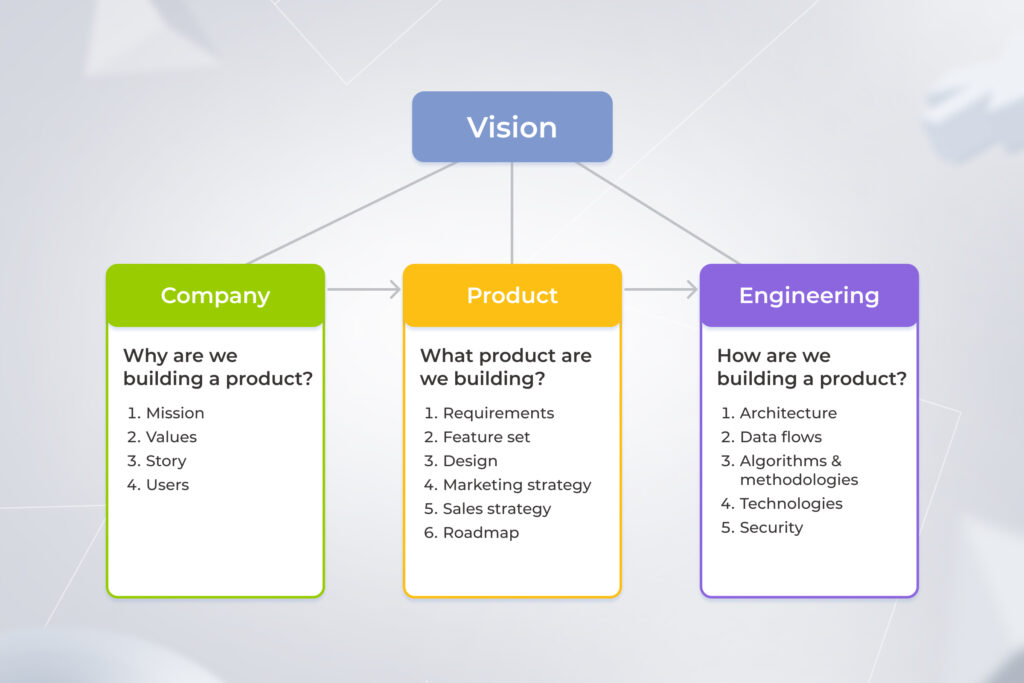
Before deciding upon a software development partner, it’s vital to determine the essence and long-term mission of a product. In other words, communicate the “why” behind your product, including:
Your company’s core motivation (mission, values, and backstory)
Key product information like target customers, needs, key benefits, and differentiators
Information on your business model and insight into any changes
Important or fundamental technologies, methodologies, and protocols
Sharing your product vision early and widely can help you get off on the right foot with an outsourced software development partner.
Determine the rough project scope
With an idea of your final destination, you should then lay out the rough scope of the project to begin identifying the requirements and needed resources.
I recommend documenting and sharing the prioritized or at least the must-have features of the first product version completed with the new partner. To do that, you need to create a list of features based on user flows.
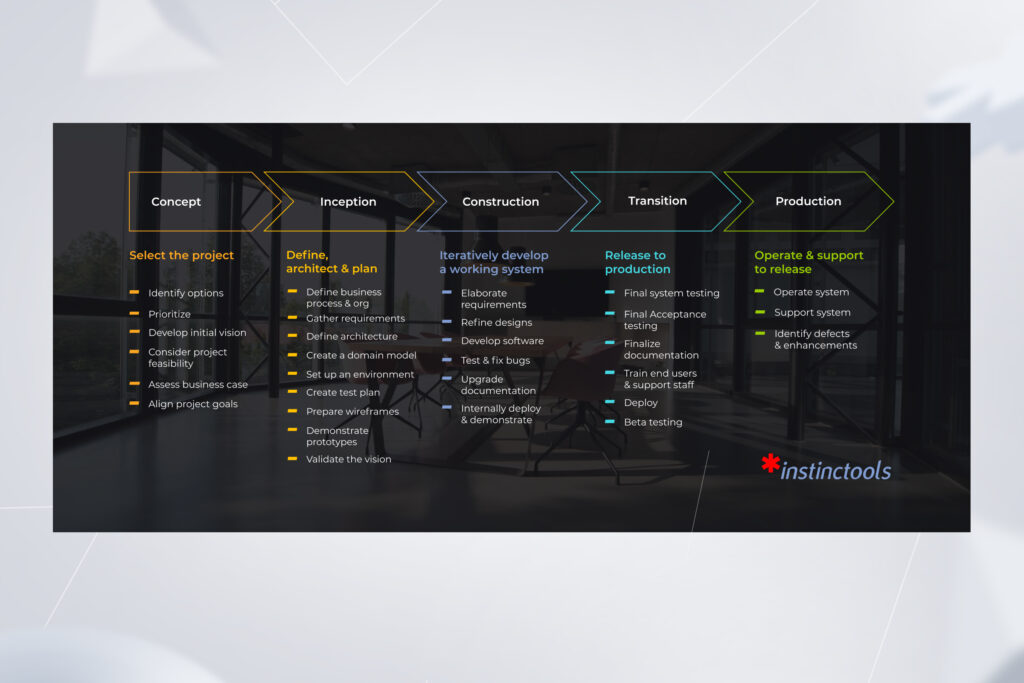
During the Discovery stage, your software development outsourcing company should have the capability to help you specify and prioritize your project scope. But having something to start from will help set the tone and accelerate development.
Set a preliminary budget
Surely, within the Agile software development life cycle, budget estimates evolve as the outsourcing partner gains a deeper understanding of the product with each iteration. However, you should allocate a specific budget before choosing a software development company if you don’t want to work in the dark.
To calculate an optimal amount, you can benchmark your product against similar products in the market and then ask a few development companies for a ballpark estimate.
Plan an approximate timeline
Again, after you reach out to a reliable potential tech partner, dedicated project management should be proposed with a project-specific timeline with all the deliverables laid out in chronological order. Sharing approximate start and end dates of your project and overall expected engagement duration with potential partners will help you align your overall business and marketing strategies, reaping the benefits of client-provider partnership earlier.
Get stakeholder buy-in
After articulating the strategic importance and documenting a description of the work as best as you can, seek executive sponsorship to back your initiative. You should engage stakeholders early in the process and ensure they’ve bought into a shared vision and understand the scope of the project and amount of support they’re asked to provide, in money, time, and attention.
Measuring the potential ROI is a great way to win sponsorship and defend your initiative from competing interests.
Having a well-defined vision, limited scope, preliminary budget approvals, timeline guidance, and a thorough and credible ROI calculation will win stakeholders who not only sponsor your initiative, but support your decisions to execute an ROI model which may incorporate outsourced software engineering help.
When in the market for any needed software development assistance, especially if the work is related to digital product innovation, look for a partner who requests the information and offers upfront consulting services to cover any gaps in project readiness.
How to choose the right software development partner? 7 steps to collaboration success
When the plans and sponsorships are at a good place, it’s time to finally start looking for a software development partner, and you might like a step-by-step plan to guide your search. That’s why *instinctools’ experts have assembled a list of steps to help you choose a reliable software development partner to transform your business ideas into winning products.
1. List down companies
Assuming you have already got a solid grip on your requirements and timeline, the next step will be to find a team that matches your specs. To locate a trusted software development partner, you can use the following resources:
The fastest and easiest way to find a prospective software development partner is to scour the Internet. With the criteria identified, you can shortlist potential companies that meet your requirements.
Peer into professional listings. International and local directories can give you a better idea of reliable software development partners, their experience, average rates, and industry focus. These platforms help you cast your net and narrow your search at the same time, as you can hand-pick companies based on budget, industry, tech stacks, and more.
Browse through your connections on professional networks. On LinkedIn, you can ask around for references or reach out directly to prospective tech partners.
Networking events, exhibitions, and conferences like Web Summit, Mobile World Congress, and others are great places to come across like-minded partners for your business.
Attending the workshops at tech-focused meetups and hackathons will help you to see your potential development partner in action and have a closer look at their skills.
Referral networks and word-of-mouth recommendations can also be a great way to find a team that has been recommended by a company you trust.
2. Choose a location where to hire a software development team
Once you have a list of potential software development partners, you need to trim it down and group the vendors by location. Choosing the right outsourcing location is an important part of the outsourcing strategy. The decision as to where to go hinges on the following factors:
Available talent pool
In top-dollar locations, you can run into stiff competition (which suggests higher costs of hiring) or distance yourself from target candidate pools. Conversely, countries with affordable cost of living have more diversity in their demographics, which leads to more concentrated pockets of talent.
Cost tolerance and quality of services
Although your knee-jerk reaction might be to hire the cheapest software development outsourcing partner, it’s not the affordability that makes your collaboration valuable. It’s the cost-value ratio that should guide your selection process. Therefore, you should look for software development firms with a cost-effective pricing model and a proven track record of software development services.
According to TalentUp, Poland offers the most affordable developer talent in the EU with an average yearly salary of a bit over €30,000. Paired with a high level of services, this location might be your destination for software outsourcing.
Time zone
A significant difference in time zones can complicate communication and even derail your project. However, similar time zones allow you time to collaborate and align on projects without delay. Therefore, choose outsourcing locations with at least 4 hours of time zone overlap so you can easily find windows of collaboration.
Culture
Cultural harmony means that the standards and values of your company align with the ones of your potential software development partner. Cultural compatibility also includes having similar business practices, work ethics, social norms, and communication styles — everything that makes your software development partnership more comfortable for both sides.
English proficiency
Staying on the same page is impossible if both teams don’t speak the same language. That’s why you have to make sure software developers have a good command of the English language. Countries such as Poland, Romania, and Bulgaria boast a high level of English proficiency and pocket-friendly rates.
English proficiency index, by country
Hire a dedicated software team that matches your needs
You need a partner, not a project-doer. So next up is making sure the work approach of your software partner aligns with your project requirements and company culture. A good partner’s methodology should illustrate how the company, not their individuals, will support innovation across the long term and achieve your product development outcomes short term.
A trustworthy software development partner has development approaches published on their website. Agile development practices and other modern software development frameworks such as Scrum and Iterative Incremental model are considered the gold standard for building quality digital products.
4. Verify expertise and experience
The best software development partner has everything your company lacks in terms of tech expertise. Look for fits in technology skills, experience building similar functionality, and industry experience.
Remember to check whether vendors are in tune with industry trends and on-the-radar technologies. Take AI-powered outsourcing and digital workforce ideas, for example.
Leading outsourcing partners go beyond providing you with seasoned experts. They supply you with aces who have already incorporated AI tools, such as co-pilots and AI agents, into their everyday work to deliver top results faster and at a lower cost. Deloitte’s survey pinpoints that 83% of executives expect the use of AI capabilities to be table stakes for fast-tracking outsourcing services without dropping their quality.
You can get an idea of a prospective partner’s experience by studying their portfolio, evaluating case studies, and asking for testimonials from previous clients. A good potential partner’s methodology will support knowledge transfer of any industry knowledge delta in the most efficient manner possible.
Make sure to look into the complementary skills and knowledge that might be valuable for your project. If you’re good at hatching ideas but resource-constrained when it comes to their execution, you’ll need a partner with a vast toolbox to find an optimal way to realize your vision.
5. Explore cooperation models
The specific nature of your project is the key element you should consider when choosing an ideal engagement model. Project scope, certainty of the output, level of involvement, and the agenda differ from model to model.
Now, it’s finally the time for a money talk. When asking for a bid, avoid basing your decision on a generic rate card and seek a specific quote. The right software development firm will help you make key early decisions, provide insight while doing so, and provide you with an executable proposal that includes major terms, price, and timeline estimates. Now you can refine your ROI model to more accurately forecast the expected return and to support your decisions throughout.
Most software development partners work according to the Fixed Budget, Time & Material, and Dedicated team outsourcing contracts. Again, it’s the case of different strokes for different folks so revisit your project specifics.
Fixed budget model
Time & Material
Dedicated team
Project size
Small and mid-size projects, MVP
Any type of projects
Medium, large, long-term projects
Project requirements
Predefined
Not set
Evolving
Flexibility
Little
High
High
Budget
Fixed
Estimated
Estimated
Client’s control
Little
High
High
Timeline
Fixed, but extendable
Predefined, but extendable
Predefined, but extendable
Scalability
No
High
High
7. Investigate market reputation
No matter how heartfelt slogans on your partner’s website might be, you should research their background and reputation to double-check the quality of the services. No company would want a partner who always misses deadlines or is not polite to work with.
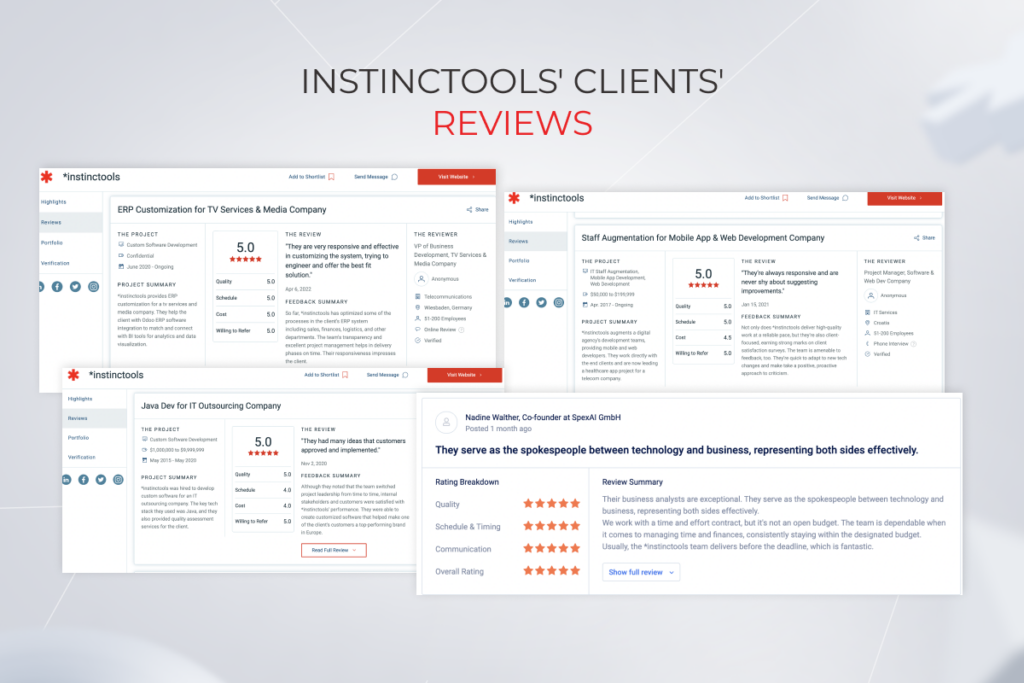
Before sealing the deal, read first-hand testimonials from their previous clients on Clutch and GoodFirms or connect with a few of their past clients. We’ve deliberately listed this point last because you’ll have better questions for a potential partner’s referrals at the end of your research journey.
Choose a tech partner that delivers on time and on budget
Revealing red flags in a software development partnership
Here’s the deal. Any company, good or bad, tries to make an irresistible first impression on anyone who passes by. However, you need to see past an impressive client hall of fame, numerous accolades, and bold promises. Below, we’ve outlined early signs of trouble that might make your project go downhill.
Size mismatch
A good development partner should be small enough to care and big enough to scale. Therefore, you should steer clear of partnerships with big (1000+ employees) firms. Their often-rigid structure and broad focus might overlook the specific needs and nuances of your project. On the other hand, if the company is too small, you might have trouble scaling or developing a large-scale project.
Cost-over-quality approach
Be cautious of companies that make low-priced offers, significantly lower than the market average. Underbidding can be indicative of compromised quality and a lack of the specialized expertise necessary for the success of your project. Therefore, it’s best to focus on value for money rather than grabbing the cheapest deal.
Jack-of-all-trades claims
There’s a big difference between a can-doer and a jack of all trades. If the company seems too eager to reel in a new client, they’re either rookies or too desperate to land a project, any project. Either way: you and your product lose.
Therefore, avoid partners who claim to have a decade-long expertise in all technologies. This overreach often results in a superficial breadth of knowledge, lacking the depth required for your specific technological needs.
Failed credibility check
Lastly, consider the visual cues you see on the website of your potential partners. Subpar websites, generic testimonials, and ambiguous portfolios often point to a lack of experience and credibility in company roles. The same goes for companies that put your project in a black box from the very first engagement, giving you evasive answers about the prices, experience, and business processes.
A tech partner worth their salt never operates behind a magic curtain. They are loud and proud of their track record, relevant experience, and terms of cooperation. Trusted development companies also have a clear understanding of who they are as a company. Otherwise, you might be dealing with a vendor that’s going out of business.
The problem of hiring a software development partner, solved
In 2025, your business can’t afford bad software. That’s why you need a trusted software development company to have your back. Although there’s no magic formula for choosing partners, such particulars as project development cost, wide experience, a proven track record, and a favorable location should be among your main selection criteria.
When choosing a software development partner, especially for innovation, it’s important to consider data points outside of the hourly rate. Opting for MVP development services in USA ensures that your product is built with a strategic approach, balancing speed, quality, and scalability. If you dream big and plan small, you realize ROI beyond any model or spreadsheet.
How do I find the right software development company?
First of all, you need to clearly define your requirements and objectives for the project. This will help you narrow down your search and identify the companies that specialize in the specific technology or domain you require. Once you establish a clear understanding of the project, you can either ask your network for recommendations or go on the hunt on your own.
What makes a good software development company?
The best software development company is the company that complements the skills of your team. Your ideal tech partner also has solid technical expertise and a diverse team composition. Make sure to check whether they’ve made a good name in the software development industry and look through the clients’ testimonials. A great partner also has a variety of agile software development methodologies to support the unique needs of different projects.
How much does it cost to hire a team of software developers?
The cost of hiring development teams varies based on the location of your vendor, team size, and the hiring model. Reach out to *instinctools and get a ballpark estimate for your project.
Why hire a dedicated software development team?
This hiring model offers a high level of commitment and accountability as you are working with a team of experts solely focused on your project. This in turn results in greater collaboration, accountability, and a shared sense of ownership. With a dedicated team, you also have the ability to scale your resources according to your project’s needs.
From customized product visualizations to conversational chatbots and at-scale content generation, generative AI in ecommerce has become a fixture.
Adopting AI solutions for ecommerce takes dedicated effort, scale-ready tech infrastructure, and a careful selection of training and deployment methods to keep sensitive data secure.
The path from LLM to ROI lies through specific use cases and point gen AI solutions that can later be scaled to fit broader business needs and functions.
Retail leaders act like pioneers, diving headfirst into cutting-edge technologies and innovative sales channels to satisfy discerning customers. Generative AI in ecommerce has quickly proved to be yet another powerful and cost-effective tool for them to woo loyal buyers, impress would-be customers, and master the three Rs of top-grade ecommerce — serving the right offer at the right time for the right person.
So here we are, exploring the concept of AI in ecommerce, breaking down the latest proven use cases of gen AI in ecommerce, sharing the secrets of how to boost revenue growth with generative AI, and outlining an implementation roadmap for faster gen AI wins.
What is generative AI in ecommerce?
Where traditional AI finds insights in data, Generative AI acts on them, producing tailored marketing content from product descriptions and ad creatives to email campaigns and landing pages. It also aids in creating personalized product suggestions, real-time chat replies, and even new virtual experiences.
Benefits of adopting generative AI for your ecommerce business
For ecommerce high-performers (those growing at least 10% faster than the industry average) generative AI has become the number one priority. In fact, over a third plan to allocate up to 25% of their budgets toward incorporating generative AI across business operations by the end of 2025. The rationale behind this stems from tangible perks companies anticipate.
Higher customer satisfaction
Typically, retailers cover only three of the seven steps of the customer journey, leaving the rest of customer interactions unattended. Ecommerce AI solutions can pick up the slack by turning unstructured data into clear insights about what consumer expectations really are across the entire value chain. With these insights, brands can deliver personalized customer experiences from initial product discovery to after-sales support, helping shoppers:
find what they want faster with tailored product suggestions or detailed, adaptive descriptions based on their queries
easily compare options and choose the best fit thanks to review summarizations and feature-based comparisons
secure better deals as gen AI tools can adjust pricing on the fly based on competitor pricing and customer behavior data
resolve issues more efficiently or get on-point clarifications 24/7 with context-aware AI-powered chat assistance
Faster, error-free operations
Ecommerce businesses can also implement generative AI solutions to automate time-consuming routine tasks such as product data entry, sales reporting, customer assistance, and others. Not only do gen AI tools speed these tasks up, but they also complete them with near 100% precision.
Besides, with drudgery handed off to generative AI algorithms, companies unlock cost savings and shift their focus to perfecting marketing strategies, adding innovative product features, and other profit-driving areas that hinge on the creative process.
Better efficiency
Another reason why businesses are rushing to employ generative AI is its potential to deliver both short- and long-term efficiency gains.
From delivery route planning and inventory management to the generation of product visuals at scale, gen AI-powered tasks execution brings substantial impact with fewer resources.
Before gen AI, running targeted marketing campaigns, for instance, required a full team and weeks of preparation. Now, a single FTE armed with a custom pre-trained generative transformer can ideate and launch a campaign in a day. Whether it’s creating unique concepts, running A/B tests, selecting optimal timing, or refining targeting strategies, generative AI tools handle every task, ensuring conversion rates are maximized.
— Chad West, Managing Director USA, *instinctools
Sharper decision making
Retailers often race against the clock, trying to analyze what caused sales dips, what market trends to gear up for, and what specific smart moves their competitors made to hit it big with their last marketing campaign. And not all of this data is easy and fast to measure and monitor.
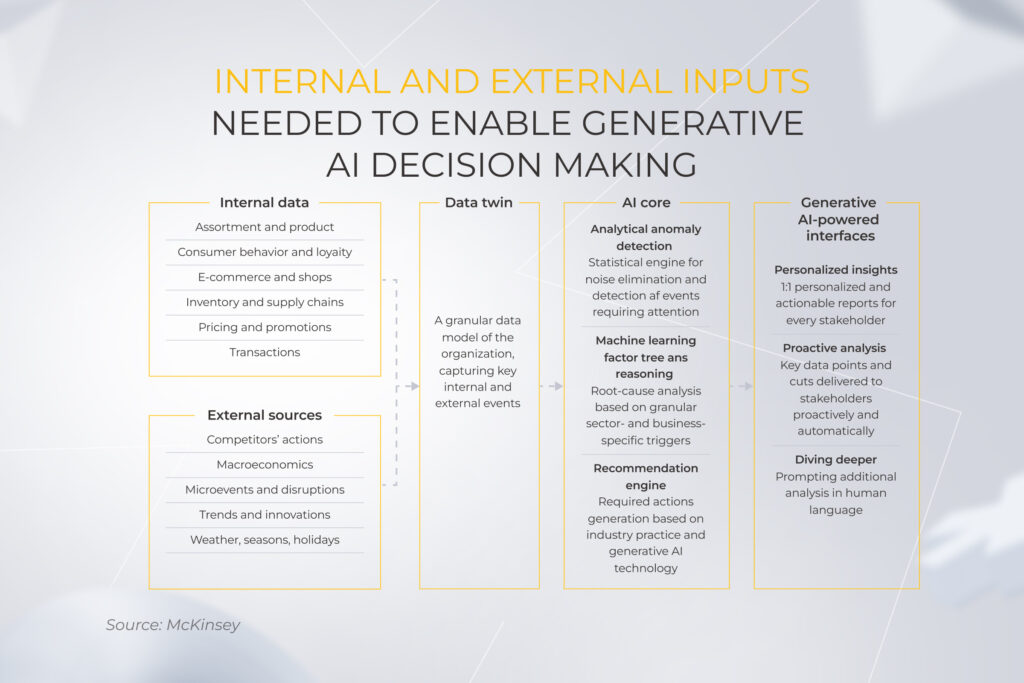
Paired with a robust AI core and a comprehensive data engine, generative AI can deliver whatever insights your ecommerce company needs at the moment and do it in a straightforward, conversational, and actionable way.
Many faces of generative AI in ecommerce
According to Precedence Research, the generative AI for ecommerce is expected to grow by over 320% by 2034. The growth this rapid owes much to its cross-modal versatility.
Gen AI content can be delivered in text, images, videos, audio, and even 3D representations. Below, we’ve broken down specific use cases each representation targets in ecommerce.
Modality
Application
Use case
Text
Content production
– Product descriptions – Personalized AI ecommerce marketing – Messaging and notifications
Chatbots
– Ecommerce customer service tasks and support – Personalized online shopping journey
– Video generation for marketing purposes – Video product description – Product tutorials and manuals
3D representation
Product representation
– 3D product catalogs – Virtual fashion design – New product design
Product design
– Turning text descriptions into 3D product models
Although multi-functional, a gen AI model’s application layer fine-tunes it to complete a specific task.
11 generative AI use cases in ecommerce
Retailers juggle too much to boost margins and keep customers happy — inventory glut, fragile supply chains, ever-increasing number of distribution channels. But now, generative AI systems take the complexity and tedium off their plate.
1. Personalized product visualization
Hyper-personalization is the new status quo for the ecommerce industry, with the majority of customers favoring a curated shopping experience in online stores. Generative AI lives up to the demand and allows customers to customize and play with the styles, colors, and fabrics of the products.
Stitch Fix, an online personal styling service, uses its Outfit Creation Model (OCM) to compile and visualize personalized outfit suggestions based on a consumer’s previous purchases, customer preferences, size, budget, and style.
Sephora and Ulta Beauty are using generative AI to develop personalized skincare product recommendations.
2. Virtual try-ons
Around 19% of US beauty consumers say that virtual product try-ons would help them feel more confident purchasing products digitally. Generative AI brings the visual try-on experience to each screen, allowing consumers to create realistic representations of clothes and other products.
Unlike traditional virtual try-on tools, generative AI applications make the fitting experience more mindful of a body shape, skin tone, and personal style.
Google constantly enhances its virtual try-on feature that demonstrates how clothes look on real models with different hair types, body types, skin types, ethnicities, and sizes.
Ulta Beauty uses style transfer technique, another gen AI offshoot allowing the customer to take two images — a self-portrait and a style reference image — and blend them together to offer a virtual hair style and colour try-on experience.
3. Human-like chatbots
Traditional ecommerce chatbots and virtual assistants guide customers through basic linear flows but have a hard time thinking outside the predefined boundaries. With generative AI chatbots, it’s all different. Retailers swap generic responses for human-like interactions and provide accurate 24/7 support to users, boosting customer service efficiency.
Generative AI can also supplement chatbots with natural language processing capabilities, enabling the bots to process natural language inputs (voice or text) and serve up empathetic outputs for after-sales support and issue resolution.
4. Product discovery and search personalization
In product discovery, generative AI can analyze customer preferences, behavior, and past purchase history to offer personalized product suggestions. Helping customers find relevant new products led to higher spend in 69% of instances.
On the same line, gen AI tools reduce search time as they can anticipate user preferences and search intent.
Besides, with more intuitive, conversational search, discovering products gets easier. Instead of browsing hundreds of product names, customers can describe what they are looking for in their own words, and the virtual assistant will make recommendations. Generative AI powered tools can also interpret uploaded images and process short videos.
5. Content generation assistant
Creating accurate product content for thousands of SKUs is not for the faint-hearted. That’s why AI-generated content was among the first use cases that picked up steam in ecommerce. Gen AI powered solutions have simplified content production for product descriptions, listings, tailored marketing messages, and even social media posts.
Amazon was among the first to bridge AI content and ecommerce, helping sellers write product descriptions at scale.
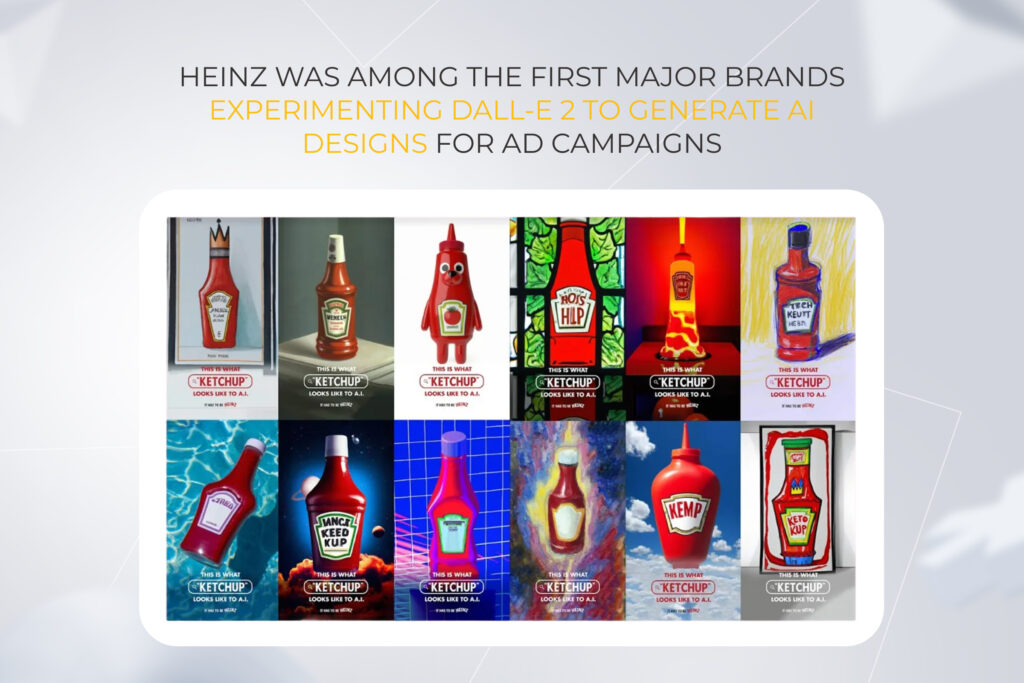
Heinz uses generative AI to create images for advertising.
Shoplazza, an ecommerce website builder, has implemented gen AI models to transform mannequin models into real models.
Whatever it is, AI development services reduce the cost of content creation and streamline manual tasks.
6. Market research
When testing the waters of new markets and customer cohorts, ecommerce businesses need to comb through vast amounts of data to inform their strategies. Customer feedback on social media platforms, extensive customer data, competitors’ ecommerce companies’ moves, and other valuable data have to be made sense of.
Here’s how generative AI can help with analysis-related tasks in ecommerce:
Market intelligence — gen AI can help simulate market scenarios, produce synthetic data to fill data gaps, and forecast customer responses based on historical data.
Information summarization — instead of spending months on research, ecommerce brands can employ AI tools to read and analyze existing material.
Novel market and customer segmentation or product opportunities — gen AI algorithms can uncover untapped market and customer segments as well as identify new product niches within the target market.
7. Planning for promotions and marketing campaigns
Generative AI can supercharge sales and marketing campaigns with personalized loyalty programs and discount structures. Smart generative AI algorithms analyze customer data to create tailored rewards and incentives.
Additionally, gen AI tools can extract valuable insights from EPoS and transactional data using predictive analytics, informing promotional efforts, pricing strategies, and production processes based on expected demand.
8. Boosting retail media networks
Retail media networks rely on loyalty and transaction data to sell ad inventory to third-party brands. By analyzing and deriving insights from customer data, gen AI tools can tell ecommerce businesses what advertiser categories to draw to their RMNs.
Within the network, generative AI tools can help advertisers tie together and optimize their ad spend. Generative artificial intelligence can also
analyze the best-performing offerings of advertisers,
match them to relevant consumers,
and generate campaign configurations to replicate ad success.
It’s a win-win for both: advertisers get the bang for the buck, while retailers get to generate more RMN revenue.
9. Supply chain and inventory management
Out of all industries, retail supply chains are the most dynamic due to ever-evolving customer demand, a large number of products, and rapid product life cycles. Generative AI adds simplicity to supply chain management by taking over the analytics inherent in the process.
AI ecommerce startups today offer many Gen AI tools that can analyze historical and real-time sales data to predict demand, calculate safety stock levels, and identify slow-moving stock. These tools can also assist gen AI ecommerce businesses in:
Running what-if scenarios to get prepared for supply chain disruptions and fluctuations in demand
Evaluating suppliers by analyzing financial reports, performance metrics, and other data
Optimizing logistics routes by analyzing warehouse locations, transport links, and demand patterns
Improving last-mile delivery by selecting the right delivery or pickup routes based on traffic conditions, weather, and other data.
10. Gen AI-driven pricing
Generative AI models support AI-driven tools in identifying the optimal path to a retailer’s sustainable financial health. To do that, AI tools perform price simulations where they create various market scenarios based on: historical data, competitors’ behavior, market trends, etc.
Price simulations also allow ecommerce businesses to locate key-value categories and items in their portfolio, refine their pricing strategy, and spot implicit cross-dependencies between products.
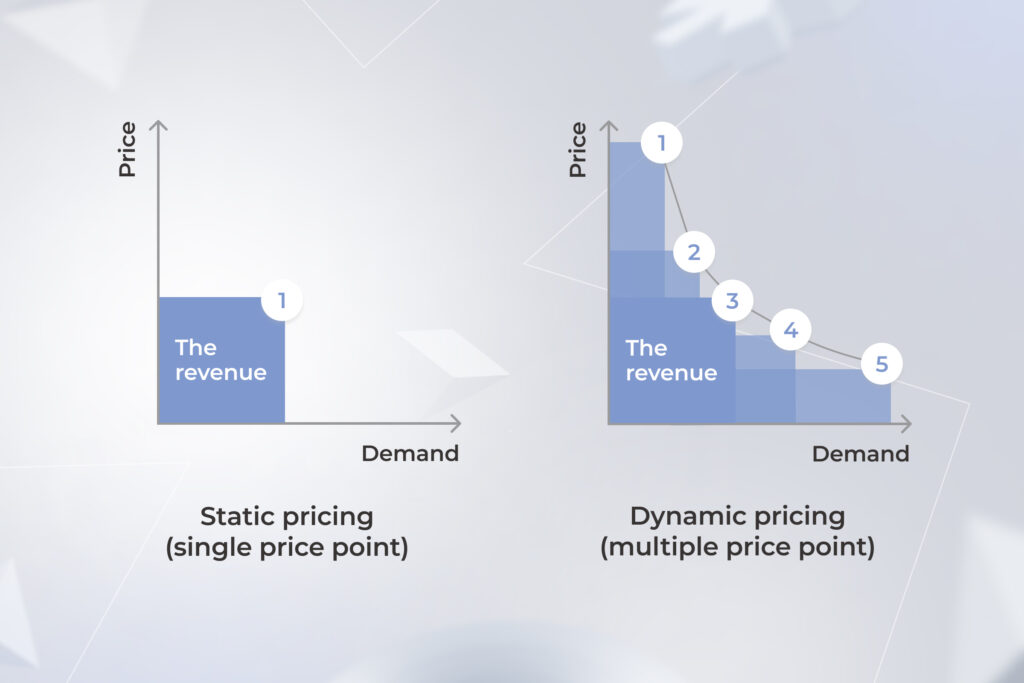
Moreover, with demand-based pricing, ecommerce owners can model demand curves based on seasonality, inflation rates, income levels, and other variables to optimize pricing during spikes or slowdowns in demand.
11. Fraud detection
Generative AI and ecommerce make a powerful combo when it comes to anomaly detection. Traditional methods don’t catch fast-changing fraud tactics. Conversely, generative AI stays adaptive to new fraud patterns by constantly vacuuming up consumer data and analyzing it with past customer interactions.
By understanding genuine past customer behavior and previously detected fraud patterns, generative AI can simulate fraudulent activities and train AI algorithms to detect and counteract them. Paired with a conversational interface, generative AI can also notify fraud engineers about risk flow and give reliable recommendations on what to do next.
Don’t miss a chance to uncover new opportunities with gen AI
Leveraging generative AI for ecommerce takes dedicated effort
The promise of generative AI is enticing. But it can only deliver on its promise if implemented with your unique business strategy, needs, and constraints accounted for.
Get ready for generative AI transformation
A convincing, measurable business case is the foundation for any AI-based adoption. It should define:
a specific business challenge
the outcomes to measure gen AI implementation’s effectiveness
Without a business case outlined, you won’t get a clear understanding of the data needed to train the model and the technical expertise required to set the AI infrastructure in place.
Choose the right model
The choice of a foundational model and the technologies powering it depends on:
your use case,
the type and quality of your data,
and the limitations of your infrastructure.
You might consider implementing Generative Adversarial Networks (GANs) models for image generation, while models like GPT are more suitable for text-only applications.
Gen AI tools aren’t automatically compliant with industry rules, so choose the right training and deployment method to keep customer and sales data safe.
Train, evaluate, and fine-tune the model
The training process begins after collecting and preprocessing data. A lot of back-and-forth identifies the optimal model architecture, hyperparameters, and training algorithm to achieve stable and safe performance. Once the model is trained, you should consistently evaluate its performance and fine-tune the model based on periodic test results.
Deploy and monitor
When the model is up and running, it’s time to make it a part of your ecommerce architecture.
Based on your objectives, you may need to deploy it to a cloud-based service, create a dedicated user interface, or integrate the documents and knowledge databases of your ecommerce business with the model. Once the model is deployed, it needs regular performance monitoring to make sure it lives up to expectations.
Maintain and improve
AI-based models are only as good as the data powering them. Therefore, make sure to refine data patterns to prevent model drifting and update the model as and when necessary. In some cases, your model may need retraining, in other times, new monitoring processes may keep your model up to date. As your ecommerce business grows, be sure to scale the model accordingly.
To see value from generative AI solutions, ecommerce businesses have to take heed of the following considerations.
Data quality and bias
Your gen AI application is only as good as your data. To work effectively, it requires a rich palette of internal and external data that’s accurate, diverse, and representative of real-world scenarios and customer queries.
If any of these boxes are left unchecked, your generative AI solution can perpetuate biases and churn out irrelevant outputs, hurting customer engagement and harming your bottom line.
Scale-ready adoption environment
You may already have a tech estate ready for gen AI adoption, but unless it’s scalable, you will end up with costly gen AI replications that will also be hard to upsize. The optimal gen AI architecture for retailers is function-agnostic and market-agnostic, meaning it can augment various business functions across different markets.
Techwise, an agile generative AI architecture requires the implementation of modular components that will allow for easy LLM swapping and scaling.
Data security and ethical considerations
As generative AI applications thrive on customer data, you must make sure they do it in a secure and responsible way. This includes adherence to relevant data privacy regulations such as GDPR, CCPA, PCI DSS, CalFIPA, and others.
Along with regulation-induced security measures, your gen AI applications must also have data encryption at rest and in transit, role-based access controls, network security, and other data security safeguards if you want your gen AI solutions to be ethically sound and good at maintaining customer trust.
Wrapping up
When powered with AI, an ecommerce business model is more efficient, customer-centric, and future-ready. AI can increase ecommerce sales, deliver unparalleled customer experiences, and more. Instead of getting carried away with the persuasive abilities of AI technologies, retailers should rely on a specific business case to spearhead their gen AI journey focused on fostering customer loyalty.
The right choice of a generative AI model, infrastructure readiness, and dedicated human expertise cracks the code of adoption and makes generative AI a low-risk investment for ecommerce businesses and commerce media professionals.
According to Precedence Research, the global artificial intelligence in ecommerce market size is expected to achieve $22.60 billion by 2032. We can assume that the ecommerce and AI duo will gain even more traction, ushering in new, competitive capabilities.
How is generative AI being used in ecommerce?
In ecommerce, generative AI has taken over a lot of repetitive tasks, including customer support, product descriptions, and ad generation. The technology also assists retailers in forecasting demand, maintaining optimal inventory levels, and providing novel shopping experiences.
How is AI transforming the ecommerce industry today?
Artificial intelligence elevates the customer experience, improves the accuracy of sales forecasts, amplifies marketing with personalized messaging, automates follow-up abandoned cart inquiries, and more.
How can AI boost sales in ecommerce?
Artificial intelligence improves lead retargeting, enhances customer experience, optimizes dynamic pricing strategies, and enables hyper-personalization in marketing. This increases conversion, leading to more sales.
What are the risks of AI in ecommerce?
Before adopting AI models, retailers need to make sure models are compliant with applicable regulations and have enough training data to prevent model bias.
Ever since they entered the mainstream, large language models and LLM use cases have heralded a foundational change in business processes. Eager to rewire their workflows, global companies dived headfirst into LLM adoption, with applications of LLMs and LLM-powered agents featuring everything from field operations to back-office admin.
But as the initial zeal and flurry of activity have cooled off, companies realized that to reap tangible benefits of LLMs, they require something more than incremental improvements. They need an organizational and technological overhaul.
Today, our AI team will break down the best LLM use cases across industries as of 2026 to showcase the potential of large language models in the real world, along with the technological capabilities you need to innovate effectively and at scale.
Key highlights
From customer operations to supply chain management, there is a wide range of LLM use cases, offering significant potential for business automation and cost reduction.
For data-heavy industries such as healthcare, banking, and retail, applications of LLM can become a productivity game-changer, if deployed in accordance with EU AI Act, GDPR, HIPAA, and other necessary regulations and scaled effectively.
The LLM payoff may only come when companies do deeper surgery on enterprise data sets and establish distinctive data capabilities such as vector databases and preprocessing pipelines.
Ever since they entered the mainstream, large language models and LLM use cases have heralded a foundational change in business processes. Eager to rewire their workflows, global companies dived headfirst into LLM adoption, with LLM agent use cases featuring everything from field operations to back-office admin.
But as the initial zeal and flurry of activity have cooled off, companies realized that to score early wins from large language models, they require something more than incremental improvements. They need an organizational and technological overhaul.
Today, our AI team will break down the best LLM use cases to showcase the potential of large language models in the real world and explore the AI development capabilities needed to innovate effectively and scale with confidence.
What is a Large Language Model (LLM)?
LLMs are a class of foundation models that are designed to understand, process, and generate human-like text and other forms of content, making them a core technology behind generative AI.
Built on a transformer neural network architecture and trained on massive amounts of data, large language models excel at modeling sequential dependencies in language and capturing complex statistical patterns across tokens, enabling their application to a wide range of natural language processing tasks.
Large language models are publicly accessible through interfaces such as Anthropic’s Claude Opus and Sonnet, OpenAI’s ChatGPT, Google’s Gemini, xAI’s Grok, and Meta’s Llama family. These prominent products have attained near-universal recognition across both consumer and business contexts.
Key benefits of LLM for enterprises
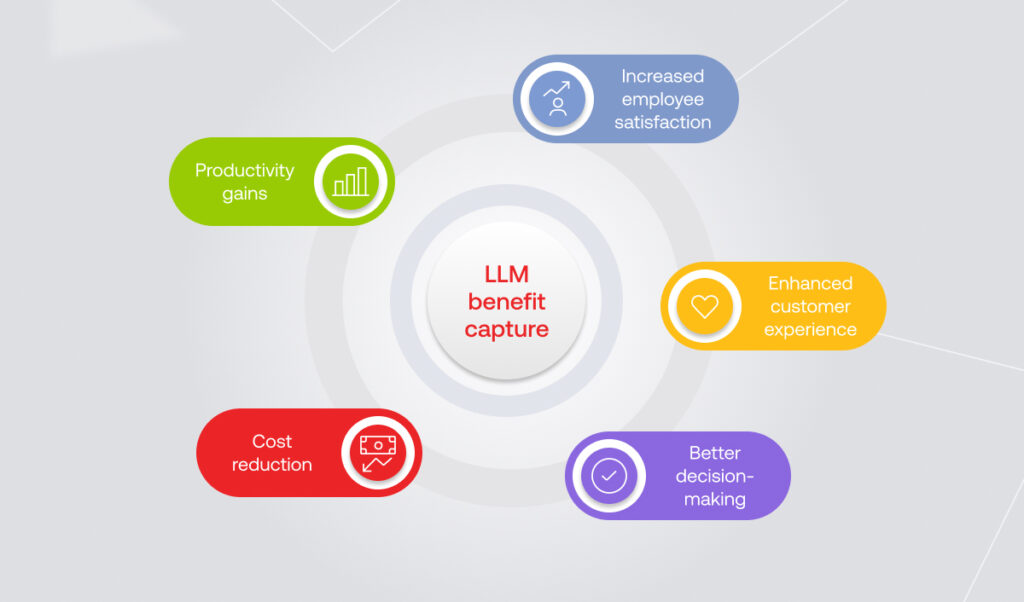
Despite the challenging road to full-scale adoption, GenAI spending continues to rise, driven by strategic necessity and confidence in its long-term impact. McKinsey’s survey revealed that 92% of US C-suite executives who are already experimenting with AI pilots plan to ramp up investment in generative AI over the next three years. While specific outcomes vary by industry and use case, companies using large language models report significant gains across the board.
Productivity gains
LLMs increase productivity by taking over the repetitive, time-draining work that usually slows teams down: summarizing documents, drafting responses, searching across internal knowledge, generating code snippets, preparing reports, or organizing data. According to OpenAI’s 2025 enterprise report, workers who deeply integrate AI into daily workflows report saving 10+ hours per week in some cases. It drives higher output without increasing headcount, with freed-up time moving into judgment-heavy tasks.
Cost reduction
Along with productivity gains, the compression of marginal costs is among AI’s most fundamental economic effects in many sectors, beginning with industries with a high share of costs associated with cognitive work. The aforementioned survey indicates that 23% of leaders already see favorable changes in costs by delegating time-consuming tasks to LLMs.
Better decision-making
Language models can quickly scan and process vast amounts of both internal and third-party data, including reports, news articles, and customer feedback, to identify patterns and trends. Equipped with a rundown of insights, companies can then take the guesswork out of their strategies and make informed decisions faster, whether it’s the development of a new product or novel market segmentation.
Enhanced customer experience
Hyper-personalized, context-aware, and 24/7 human-like customer support is now available to enterprises thanks to LLMs. They help enhance customer experience by instantly resolving routine queries. For instance, after powering their banking app with GPT-4 capabilities, one European bank lifted customer retention by 7%.
Increased employee satisfaction
45% of companies who regularly use AI at least in one function say it improved employee satisfaction. In corporate environments, large language models can reduce friction in knowledge access, support self-paced training, and help employees learn in ways that match their roles, needs, and preferences. In other words, they make day-to-day work more manageable and professional growth more accessible.
Accelerate the growth of your business with gen AI
To make inroads into gen AI, it’s crucial to know the pragmatic, utilitarian large language model use cases. Let’s have a look at the best LLM use cases and how they can support workloads across different business functions.
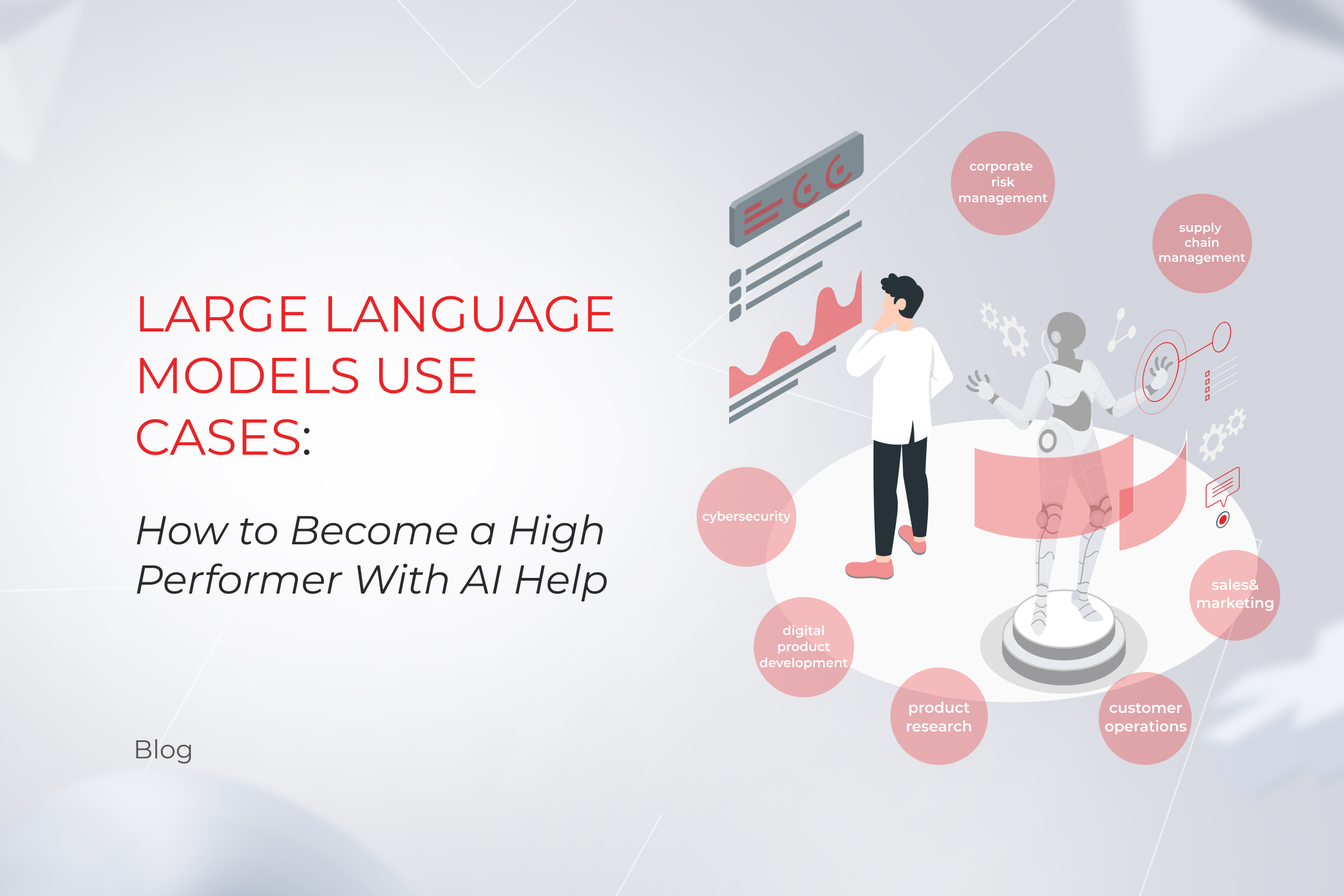
1. Customer support
According to McKinsey, 45% of companies scaling applications of LLMs in customer operations have already increased customer satisfaction.
By fine-tuning large language models on its chat logs, customer data, and sector-specific questions and answers, or through RAG, companies can automate interactions with clients and take the workload off the human agents. Virtual text- or voice-enabled self-service assistants powered with emotion and intent recognition, multilingual support, and personalization capabilities can provide instant and accurate help 24/7, escalating to a human representative only when necessary.
2. Sales and marketing
Language models have taken off in marketing and sales functions to streamline communications with customers and drive personalization at scale. Gen AI models can generate tailored messages in multiple languages based on the demographic and purchasing data of your customers. Everything from social media content to brand messaging can be produced with the mighty capabilities of a large language model.
Beyond generic applications, language models can take over customer sentiment analysis, which is the driving force behind social media listening and analysis of customer reviews. Unlike targeted sentiment analysis tools, large language models can better understand more complex nuances of customer sentiment. Also, LLMs can be used for market research, distilling insights from text data to look into consumer behavior and analyzing user preferences.
Moreover, companies can harness the power of gen AI to automate sales. LLMs can move the leads down the sales funnel, facilitate lead scoring, and estimate the number and amount of future sales.
3. Product research and development
LLM-enhanced smart applications have emerged as powerful tools for product ideation and brainstorming. They can provide research proposals, accelerate interdisciplinary research, and store the collective knowledge of researchers for easy retrieval. The technology can also assist researchers with exploratory data analysis, hypothesis testing, and predictive modeling, enabling them to improve their research outcomes.
Multimodal large language models have raised the bar even higher. Not only can they provide product design recommendations, but they can also select cost-efficient production materials, optimize existing designs for manufacturing, and automate the design creation process — and these are only a slew of LLM use cases in manufacturing.
4. Human resource management
In HR, a large language model can pave the way for a more fluid, dynamic approach to skills assessment. Rather than spending hours on resume-by-resume analysis, an HR team can ask the LLM to shortlist the candidates and perform an initial screening of cover letters.
During onboarding, a large language model can act as a corporate guide, referencing the new hire to onboarding materials or providing an informal walk-through of the employee handbook. Other language model use cases in HR include pay and salary analysis, employee experience management, career pathing, and benefits administration.
5. Supply chain management
The application of LLMs is also transforming supply chain management by ushering in more predictability and control over supply-demand balances. Procurement teams rely on generative AI to select vendors, analyze spending data, and gauge supplier performance.
By reaching across datasets, large language models can provide companies with on-the-fly inventory or demand analysis and present findings in digestible formats like graphs and narratives.
Thanks to its contextual learning capability, generative AI can cast its nets even wider by feeding on multiple variables and local context factors to produce detailed, localized forecasting of chain performance in a given environment.
6. Corporate risk management
With a veritable zoo of data points and a large cohort of customers in multiple markets, risk management and compliance monitoring have become a formidable task for enterprises. By prioritizing risks based on the impact and custom criteria, enterprise LLMs enable proactive decision-makers in companies and tackle the heaps of paperwork related to risk assessments.
The model churns out the specs of financial, operational, and reputational risks, possible control measures, and metrics to track potential vulnerabilities. The output serves as a baseline for risk managers to build from and evolve.
7. Software development
Acting as intelligent pair programmers, LLMs in software development accelerate coding by automating routine tasks, generating code from natural language, debugging, and refactoring. More and more companies, whether engineering-focused or not, are building internal LLM-powered workflows and tools to tap into the benefits of LLM in software development.
To enhance their code review process, J.P. Morgan Payments, the B2B and merchant services division of JPMorgan Chase, for instance, have developed an AI-based PRBuddy that generates intelligent feedback and suggestions to streamline the pull requests management. The tool automatically adjusts documentation in accordance with accepted changes. The banking giant says PRBuddy helps accelerate development workflows and maintain higher code quality standards, contributing to more reliable software delivery.
8. Regulatory compliance management
Wrangling with the red tape is a salient part of any organization’s life cycle, a part that can be automated to some extent by LLMs. Not only can such solutions keep up with regulatory changes, but they can also automate the creation of compliance reports and policies.
As for data security, large language models can automatically run DPIAs (Data Privacy Impact Assessments) and notify managers of potential privacy risks. LLMs can also lend a hand in generating incident response reports and automating response procedures.
The unmatched analytics capabilities of large language models also allow them to identify suspicious patterns or anomalies and warn compliance officers about potential regulatory violations.
9. Fraud detection and cybersecurity
Fraud management is yet another of the many LLM use cases for business where the model emulates synthetic data to train fraud detection machine learning models. Fraud detection is among other LLM use cases in cyber security, enabling cyber experts to leverage LLMs to ferret out anomalies in historical data.
On the same line, LM-based fraud detection systems can create new possibilities for high-stakes functions such as claims management, where real-time fraud monitoring is essential to ensure the safety of sensitive customer data and the eligibility of the claimant.
Cybersecurity experts have also made LLMs part of their stack to automate tasks like source-code analysis and vulnerability detection. Thanks to their pattern-finding features, large language models can analyze threat patterns and generate response scripts.
10. Legal management
Besides human language, LLMs can also speak legalese, making sense of fine-print specifics and the Greek of legal code. From contract drafting and analysis to research, LLMs can take over legal management, lightening the load on your in-house lawyers.
By analyzing historical data and precedents, a large language model can also predict possible outcomes and pinpoint potential legal risks.
Let’s make generative AI work for your business case
Applications of LLMs and their value vary from one industry and business area to another, so companies should carefully evaluate where generative AI fits their sector-specific needs. Let’s explore the field notes of how different industries gain from the large language models and analyze common LLM use cases.
LLM use cases in healthcare
With an increasing cost of care, admin workloads, and labor shortages healthcare is a vibrant testing ground for AI-based automation technologies. In particular, LLM use cases in healthcare show promise to transform clinical practice by allowing healthcare providers to spend more time with their patients, thus improving patient outcomes.
Here’s where applications of large language models have made a compelling case:
Back-office automation: Gen AI models can take the admin burden off healthcare professionals by drafting appeal letters, streamlining patient data entry, and categorizing incoming claims and billing. To help their clinicians spend more time focusing on their patients, Mayo Clinic uses ambient AI scribes. These solutions record and summarize patient-physician conversations thanks to speech recognition, natural language processing and large language models.
Patient assistance: LLM-based chatbots and virtual assistants can guide patients through ambulatory care, manage medication schedules, track health metrics, and support communication needs of patients.
Automated compliance management: Gen AI can assist compliance managers in keeping track of regulatory changes and estimating compliance risks.
Medical diagnosis assistance: Along with automating routine tasks, language models can inform medical diagnosis by analyzing patient symptoms based on the medical records analysis.
Clinical trials: Training on raw protein sequences allows the AI to make inferences about molecular and protein structures.
LLM use cases in finance and banking
Large financial institutions such as Wells Fargo, Capital One, and Bank of America have already tested the waters with gen AI and are currently figuring out the best ways to capitalize on applications of LLM and ensure they get scaled enterprise-wide.
High-value LLM enterprise use cases in finance include personalized trading assistance, customer-facing support chatbots, efficient onboarding of new customers, and market predictions. LLMs also enable large-scale report generation and support wealth management workflows by synthesizing financial data and assisting advisors with insights and client reporting.
For example, Morgan Stanley has made a prominent case for LLM-driven financial analysis. The financial services company has launched a gen AI assistant that helps financial advisors sift through a huge database of financial data and extract relevant data in minutes.
Customer support is among other prominent LLM use cases in banking, and the one associated with huge gains. By augmenting the existing chatbot with GPT-4 capabilities, one of our clients, a Czech bank, boosted its Net Promoter Score (NPS) by 34%, and improved its First Contact Resolution (FCR) by 60%.
LLM use cases in retail and ecommerce
In retail and ecommerce, generative AI is already embedded into core workflows, from product discovery to customer engagement and inventory optimization. A clear example is Amazon, which applies AI systems to enhance search relevance, personalize shopping experiences, improve product listings at scale, and facilitate same-day shipping.
The research area of gen AI can be as limited as the company’s internal data or as wide as social media data to enable always-on social media monitoring and listening.
LLM-enhanced customer service and support systems improve user satisfaction, boost sales, and offer 24/7 support to customers. The application area of language models in retail also stretched to procurement management. By digging into seasonality data and customer behaviors, large language models can predict future product demand, thus reducing stockouts and excess inventory.
LLM use cases in education
Learning and education are one of the areas where a tailored approach is key to improve performance and enable better learner engagement. By creating a unique conversation environment, LLMs can bring new ways of personalized learning where each program, quiz, and test is cut out for individual students’ needs, interests, and learning styles.
The model can also become a force multiplier for teachers by taking over menial tasks such as grading and lesson plan development. On a higher level, large language models promote inclusive, equitable learning opportunities for students of all backgrounds by eliminating language barriers and providing multilingual education. Apps like Babbel and Memrise also demonstrate the vast potential of LLMs in language learning and language translation.
LLM use cases in media and entertainment
Generative AI models have also opened up a new set of opportunities for the creative industry. Besides textual data generation, multimodal LLMs can create custom sounds and short-form videos, improve editorial workflows, and fine-tune content of any type to better match the expectations of the intended audience. Netflix has been using machine learning and LLM-driven systems to personalize content recommendations, optimize thumbnails, and improve audience engagement by tailoring content discovery to individual viewer preferences.
They can also empower interactive storytelling to take the audience on an engaging and personalized journey, whether it’s in gaming or in advertising.
LLM use cases in automotive
Recently, language models have also made it into a vehicle’s infotainment system to take voice control to a whole new level. Mercedes-Benz, the undeniable automotive leader, has integrated a GPT-powered model into the voice control system to improve its natural language understanding and level up its responses.
Moreover, gen AI tools can be used in intelligent vehicle production where they co-develop automotive software applications, analyze production data, and brief production employees on safety protocols. Language models can also enable autonomous vehicles to digest complex environment data and make safe driving decisions.
LLM use cases in manufacturing
Manufacturing has long struggled with tribal knowledge, critical operational expertise held by experienced workers and often lost when they leave. LLMs help address this by capturing informal know-how and turning it into SOPs, searchable knowledge bases, and training materials, making expertise reusable across the organization instead of tied to individuals. Siemens has deployed an AI-powered operator assistant that delivers work instructions, microtraining, troubleshooting, and knowledge management for operators and technicians.
Tackle the biggest challenges of your industry with gen AI
What does it take to adapt LLMs to a vertical need?
When companies choose the generative AI path, they are presented with two primary architectural options: augmenting a model’s context at inference time or LLM fine-tuning on proprietary data.
The first approach, LLM RAG (Retrieval-Augmented Generation), has become the dominant enterprise strategy. It keeps the base model frozen and dynamically retrieves relevant information from a company’s knowledge base at query time. This method allows the model to access and cite up-to-date, company-specific context without retraining. The focus has shifted to enhancing RAG with advanced techniques like agentic search, where the system actively manages its own context and iteratively refines its queries for complex, multi-step retrieval.
The second option is LLM fine-tuning, where a pre-trained model is further trained on a curated dataset to update its internal weights. This changes the model’s fundamental behavior and is most effective for instilling a consistent tone, output format, or task-specific reasoning pattern. While full fine-tuning remains costly, parameter-efficient methods like Low-Rank Adaptation (LoRA) are standard, and new hybrid techniques dynamically route training updates to balance performance and efficiency.
A significant 2026 evolution is the rise of hybrid systems that combine both strategies. A domain-specific LLM can be fine-tuned for a particular task or style and then augmented with LLM RAG to retrieve live information, outperforming either method alone.
Challenges and considerations of LLM enterprise use cases
Language models share several well-known AI risks, while also introducing new LLM challenges related to scale, reliability, and natural-language accessibility.
LLM hallucination
The unstructured nature of input being fed into ChatGPT-like tools brings inherent risks of generating irrelevant and off-topic content. A poorly-trained LLM is prone to producing false, functional knowledgenot supported by any training data, as an extrapolation from your prompt.
The reasons for this lapse of judgment are many, from overfitting to poor prompts to complete datasets. That’s why the quality, integrity, and completeness of training data are vital to set the model straight.
Biases
Similar to earlier NLP systems such as statistical models and word embeddings, large language models can inadvertently amplify biases present in the training data. This happens when the data doesn’t represent the entire population, causing your model to produce unreliable results. This, again, puts a special emphasis on accurate curation of training data and ensuring its completeness and versatility.
However, robust validation frameworks and proper AI optimization techniques, like bias detection algorithms and inclusive data collection strategies, can help mitigate these LLM limitations effectively.
Data privacy concerns
A large number of open-source large language models store and process data on the provider’s servers, which goes against enterprise data protection regulations. To introduce a language model into your corporate environment while maintaining data privacy, you have several options:
deploying the model locally on your infrastructure,
running it in a private cloud VPC,
or using confidential computing environments where data remains encrypted even during processing.
Simple API calls to shared cloud models typically violate enterprise data protection regulations, but modern approaches like hardware-attested inference and air-gapped deployments now provide compliant alternatives. This way, your sensitive data will be kept under lock and key.
Cost at scale
As LLM adoption spreads across enterprise teams and customer-facing applications, inference costs, driven by token volume, context length, and request frequency, can scale multiplicatively, quickly eroding projected ROI. Effective containment relies on a layered approach: request caching for repeated queries and routing routine tasks to smaller distilled models while reserving frontier LLMs for genuinely complex reasoning.
Besides caching and routing, prompt compression and context pruning help reduce token waste per call. Furthermore, per-team consumption quotas with automated throttling prevent local spikes from affecting global budgets, and regular audits of usage patterns make it possible to identify and retire redundant or low-value calls before they accumulate.
Compliance and regulatory risk
LLMs can process or generate outputs that unintentionally include sensitive or regulated data (PII, financial info, health data), which can violate laws like GDPR, HIPAA, or sector-specific compliance rules. This is especially relevant when employees paste internal data into external or poorly governed models.
Another related issue is lack of explainability and traceability. Many regulations require organizations to justify decisions (e.g., credit scoring, hiring support). LLMs often behave like black boxes, making auditability harder.
Mitigation usually comes down to tight governance and technical guardrails: restricting what data can be sent to the model, using enterprise or self-hosted LLM setups, and applying PII detection/redaction before prompts are processed.
On top of that, organizations typically add human-in-the-loop review for high-stakes outputs, logging for auditability, and strict policy mapping to regulatory requirements so every LLM use case has a defined compliance boundary.
Does a large language model make it worth a candle for your business?
We’ve seen it multiple times: companies get underway with hyped technologies and not getting their investment paid off. LLM-based innovation, like any other type of AI, calls for careful analysis of your business case and price-value ratio for your company.
The rule of thumb would be estimating the human effort to complete a task manually against the effort spent on fact-checking the gen AI output. Typically, generative AI brings the greatest difference in use cases where human effort is high, while the validation of the output is easy. Mind that a large language model isn’t a fire-and-forget innovation, it requires your constant upkeep and human assistance to succeed.
How to implement LLMs in your business
Ignoring generative AI can put you behind in the productivity race, but adopting large language models just for the sake of it won’t take you anywhere either. McKinsey found that organizations achieving the highest impact from generative AI are more likely to have formal validation processes in place and to invest sufficiently in responsible AI. These two factors are strongly correlated with capturing material EBIT impact.
To capture the leapfrog opportunities of generative AI, companies need a clear LLM strategy, strong technical foundations, and a dedicated team to turn pilots into scalable business outcomes.
Develop an LLM implementation strategy grounded in value
Just like any other type of machine intelligence, gen AI adoption should bestrategic. Your generative AI strategy should align with the existing AI mindset and inherit the same principles as your other AI initiatives. AI governance, risk management, and sensitive data handling are the pillars behind a comprehensive innovation strategy.
Gain guidance from cross-disciplinary teams
The inherent complexity in gen AI projects requires companies to secure cross-disciplinary talent to ideate, develop, and manage the AI lifecycle. Not only will your dedicated team guide you on the gen AI journey, but they will also ensure the right implementation of your data program. Having an experienced tech partner takes the risk out of AI adoption and keeps your gen AI tools compliant with laws and regulations.
Shore up specific tech capabilities
While gen AI doesn’t require fundamental changes in your tech infrastructure (provided it’s AI-ready), you still need to tailor your data architecture to support a broad number of use cases. This includes the collection and curation of proprietary data and distinctive data capabilities such as vector databases and preprocessing pipelines.
Secure enterprise data
Bringing a large language model to your data is not enough to keep it safe and sound. Your company should also have a strong data governance framework in place that includes data encryption, access controls, and regular auditing. Also, your training data should be anonymized and aggregated whenever possible.
To sum it up, your gen AI strategy should be fortified with a crystal-clear vision, a path to value-realization as well as risk and adoption plans. These pillars should align at the adoption, talent, tech, and organizational level.
Exploring generative AI, but unsure where to begin? We help you uncover high-impact LLM opportunities and remove all potential blockers with a tailored AI Adoption workshop
Large language models quickly went from being a shiny new toy to a corporate force to be reckoned with. As companies navigated this transition, they caught promising glimpses of the considerable value at stake but also encountered various challenges associated with scaling standalone LLM use cases. To become LLM-ready, you have to revisit your data platforms, polish your existing AI infrastructure, and start with small-scale pilots to iteratively build up the internal LLM capabilities.
As a custom LLM development company, we enable teams to move from pilots to production with end-to-end LLM consulting, custom model fine-tuning and RAG pipeline development, MLOps, and cloud or on-prem deployment.
What are the most valuable LLM use cases for enterprises?
The top five use cases by measurable ROI are document summarization and analysis, customer support automation, internal knowledge search with RAG, content generation, and code generation.
What are the main applications of LLMs?
The most common applications of large language models focus on automating language-heavy and knowledge-intensive workflows. Businesses use LLMs to process unstructured data faster and scale communication without proportional hiring.
The main applications of LLMs include text generation for articles, emails, and product descriptions; summarization of reports, meetings, and customer calls; translation; sentiment analysis; code generation; structured data extraction from documents; and conversational AI assistants. As LLM capabilities evolve, companies increasingly combine them with workflow automation, analytics, and AI agents to support more complex business processes.
What are the benefits of LLMs for businesses?
One of the strongest benefits of LLM AI is productivity improvement. Microsoft Copilot studies showed users completing tasks up to 29% faster. Businesses also report operational cost reductions of 20-30% through support, reporting, and workflow automation. Other measurable benefits of LLMs include faster decision-making through rapid analysis of unstructured data, 24/7 customer support availability, scalable personalization, and easier access to institutional knowledge for junior employees.
Which industries benefit most from LLMs?
The industries seeing the strongest ROI from applications of LLMs across industries are typically the ones handling large volumes of unstructured text data and complex workflows.
Finance and banking lead with fraud detection, compliance automation, and document analysis. Healthcare organizations use LLMs for clinical documentation, patient triage, and drug discovery support. Ecommerce companies apply LLMs to customer support, recommendation systems, and automated product content generation, while legal firms accelerate contract review, due diligence, and e-discovery processes. Manufacturing companies benefit from predictive maintenance, analytics, and technical documentation automation.
What is the best LLM for enterprise use cases?
Different models excel in different enterprise scenarios. OpenAI’s GPT is considered one of the most versatile models for reasoning, automation, and agentic workflows. Anthropic’s Claude Sonnet models are often preferred for long-context analysis, enterprise compliance, and lower hallucination rates. Gemini models from Google DeepMind integrate well with Google Workspace and multimodal workflows. For companies prioritizing data sovereignty or on-prem deployment, Meta’s Llama models remain one of the strongest open-weight options.
How much does it cost to implement an LLM solution?
The cost of custom LLM development depends on the complexity of the solution, integration scope, and infrastructure requirements.
Simple implementations using existing APIs from providers like OpenAI or Anthropic usually cost between $5,000 and $30,000 for setup, plus ongoing inference expenses. A RAG-based system commonly ranges from $30,000 to $120,000.
Fine-tuning domain-specific models often costs between $40,000 and $200,000, while enterprise-grade on-prem AI platforms with governance and MLOps capabilities can exceed $250,000. The most reliable way to estimate LLM implementation costs is to assess your data readiness, integration complexity, compliance requirements, and highest-priority use cases before development begins.
How long does it take to deploy an LLM use case?
The LLM implementation timeline depends on the complexity of the use case, the quality of enterprise data, and the number of systems involved in integration.
Simple chatbots, summarization tools, or AI assistants built on existing APIs can often be deployed within 2-4 weeks. RAG systems connected to large internal knowledge bases typically require 8-12 weeks because of data preparation, indexing, and security reviews. Enterprise-grade AI platforms with governance frameworks, MLOps infrastructure, and on-prem deployment requirements may take 6-12 months to implement fully.
What are the main challenges and risks of using LLMs?
The biggest LLM risks include hallucinations, data privacy issues, bias, high inference costs, and regulatory compliance challenges. In practice, many enterprise AI initiatives fail because of poor data preparation and governance. That is why scalable AI adoption requires equal attention to infrastructure, security, and operational controls.
According to Deloitte, more than half of failed software projects go awry due to overlooked requirements in the early development phases, underscoring the pattern:
Mistakes made during the initial planning stage are the most expensive to fix.
The discovery phase in software development ensures your project is able to seize the high ground in overall statistics without draining the budget and causing rollout delays.
What is the discovery phase?
A project’s discovery phase is an initial exploratory and planning activity lasting usually three to six weeks. It involves running a discovery workshop, where your tech partner collaborates with you to align your vision with market trends, user demands, and business context, expertly shaping your idea into a detailed roadmap to a solidtechnical solution.
Despite its bite-size nature, the goal of the discovery stage is to deliver tangible value without limiting your cooperation options to a particular service provider.
A stitch in time: when the discovery phase saves more than nine
The crux of the discovery phase boils down to five words: danger foreseen is half avoided.
At the discovery phase of a software project, a team of experts asks the right questions from different angles of software development to unveil any pitfalls you may face in advance, create a plan to prevent them, and, thus, make steps toward eliminating costly failures down the road.
Reaching out to a tech partner with proven expertise in your industry already minimizes the risks such as budget overruns, wrong resource estimates, feature mis-prioritization, stagnant development, among others.
Yet, even with top-tier experts on board, there are cases when conducting a software development discovery phase becomes a good call.
1. Unbiased idea and as-is state audit
Not all business ideas turn out to be great. Some of them can be unrealistic and misleading and result in wasted budget and time or even question the existence of your business when it comes to startups.
The earlier you validate your ideas, the easier it will be to fix your concepts and plans. At *instinctools, we adhere to the principle:
Better bank on project discovery than deal with project recovery.
If you’ve already started working on a project, stay alert to these warning signs that may signal you should have requested a discovery workshop from your vendor:
Your development team is stumped on the project’s further progress and can’t outline possible evolution strategies.
Your project has got off track and can’t find its way back, draining your time and budget without bringing you any closer to the desired outcomes.
Here’s a real-world example that proves the importance of the discovery phase in software development. One of our clients, a fintech startup, planned to develop a web platform to consolidate information for VC investors and funds.
Despite its trailblazing ambitions, the company almost ended up becoming another startup failure statistic. The client’s former contractor rushed into web development without doing market research, clarifying the product vision and scope, collecting project requirements and technical documentation, reviewing available architecture options, discussing UX/UI concepts, etc.
With such an approach, when halfway to rollout, the client found themselves developing a product that nobody needed. Fortunately, running a project discovery phase with *instinctools helped them to marshal the resources and launch a robust MVP that fitted the bill and turned end users’ heads.
2. Bridging the gaps in stakeholders’ perspectives
Connecting your business goals and ambitions with your end users’ needs and expectations might turn out to be tricky if there are multiple stakeholders with different visions for a project, its strategy, and outcomes.
In this case, at the discovery stage, your software service provider should verify the technical feasibility of each stakeholder’s vision:
If the concepts can be brought together into a single solution, a business analyst within the development team will prioritize the features and capture them in the scope of a decomposition document that will serve as a linchpin for further work on your software project.
If the visions are too divergent, your tech partner will highlight the problem, and help you choose the concept to build on top of.
A discovery phase is a not-to-be-missed chance to cut out all the disagreements that drag your project backward.
Working out a clear product vision and keeping stakeholders and development team members on the same page helps stay on the right track during long-term software projects where losing focus is one of the top perils that can screw the entire idea.
3. Preparing documentation for fundraising
You may be sure you know enough to start the project. But given the current turbulent market backdrop, if you ask for financial support to bring your idea to life, you need to make your business goals’ viability crystal clear for possible investors.
Whether seeking private investors or competing for a tender, a compelling business plan indicating the return on investments, assets, sales, and equity is pivotal to persuading stakeholders to put their dollars into your project fulfillment. Above all, you should provide clear administrative, technical, and financial documents to make your project comparable with others and prove that yours can deliver the highest business value.
Embracing an Agile discovery process is the most beneficial way to prepare technical specifications. You get multiple value assets, such as a project brief, scope, system requirements specification, technology environment, delivery schedule, etc., without committing to a long-tenured contract with a tech partner who helps you prepare the documentation.
On top of that, during the product development discovery phase, initial wireframes can be providedto assure your credibility in front of potential investors.
Running a discovery stage empowers you to answer any investor’s questions right away.
Any way you slice it, having consistent and accurate technical documentation — with scope decomposition, features prioritization, and customer journey map — before diving straight into development waters saves you from dealing with a chaos of must-, should-, and could-have features.
Are you struggling with the travails of the software development process?
What happens in the discovery phase? | *instinctools’ experience
As a fundamental stage of working on a project, the discovery phase reveals all the potential pitfalls and ways to bypass them. At *instinctools, we’ve distilled the process into seven definitive steps. Each one is packed with vital questions designed to steer you clear of blind spots and guide you toward the project’s ultimate success.
1. Defining problem and business opportunity
What market demand do you want to cover?
Who are your target audience, and what are they hungry for?
Are there different groups of customers within the target audience?
What is your plan to meet the needs of end users?
2. Analyzing as-is state
What do you already have in place: a bare idea, prototype, or a flawed solution that needs to be fixed?
Have you prepared any project requirements and technical documentation?
Who is a product owner?
Are there any other stakeholders besides you?
Do you foresee any bottlenecks?
3.Figuring out to-be state
What is your vision of the future project?
What business goals are you aiming to achieve?
What are the success criteria?
4.First validation session
Are we on the same page as to the vision of a future solution?
Did we define project goals correctly?
5. Analyzing gaps between an as-is and to-be state
How do you see this software development project’s major business risks and constraints?
Do you have any legal, regulatory, liability, etc., requirements in your target market or markets?
Do you have any preferences or limitations in the technology stack?
6.Planning the technology environment, preparing project backlog, drafting architectural vision, and demonstrating the UX/UI concept
What core features will distinguish your solution from others?
Which features are the most vital, and which can be developed later?
Does the draft correlate with your functional and non-functional requirements?
Have all the integrations you need been covered?
Are you satisfied with the depth of the user research we’ve conducted?
Do the user stories we’ve presented match your vision?
Do you have anything to add to the customer journey map?
7. Second validation session
Do you have any remarks on the project so far?
Do you agree with the estimate of the project timeline and development costs?
Do you want to forge ahead with us or consider another service provider?
With a software project discovery phase, you’ll clearly define your business objectives, pinpoint project milestones, break down the scope, and set a comprehensive roadmap to start the development and deployment process.
Still have questions on the project discovery phase process?
Turn raw ideas into tangible deliverables: your takeaways after the discovery workshop
Wellingtone’s report indicates that only 29% of software projects make it on time, and 43% of them stay within budget. Relying on solid deliverables is the approach that will help you hit that success statistic.
Here is the discovery phase checklist of artifacts you get.
Vision & Scope
This document highlights your business problem, objectives and risks, captures the current product or process and the vision of its future state, identifies opportunities and success metrics, and describes the solution scope and roadmap.
Competitor and target audience analysis
A vital part of a product development process is analyzing market trends and your competitors to spot new value-creation opportunities for your business and evaluate the viability of your project in the first place.
The software discovery process entails mapping the customer journey and creating documents such as user flow diagrams, user stories, and user roles matrix to pave a straight path to your target audience’s minds (and wallets).
Architecture overview
The documentation contains a review of the current state of your infrastructure, its functional elements, and technology stack. During the discovery process, a solution architect gathers technical specifications:
Architecturally significant requirements (ASRs)
Software requirements specifications (SRSs)
These docs help to outline your solution architecture, its components’ correlation, and integrations.
UX/UI concepts
The discovery phase in Agile involves clarifying UX/UI concepts of the future software. At *instinctools, in some cases, we, in some cases, prepare the initial wireframes that can be leveraged for prototype development.
Budget and time estimates
The discovery phase team also draws up a budget estimate for the entire project implementation and a clear timeline for its delivery.
Tech vendors often bring an added value with the delivery proposal. This document highlights partnership strategies and flexible engagement models and ensures a seamless transition to a long-term collaboration if your current contractor meets your project expectations.
The delivery proposal also outlines the project team structure, roles and responsibilities (RACI) within the dedicated team, vendor’s DevOps plan, QA approach, and a delivery roadmap.
Is taking care of these discovery phase deliverables on your to-do list?
Your project’s best asset: the role of a cross-functional team in the discovery phase
Here’s the project team composition for the discovery stage, which may vary depending on the complexity of your idea, the project’s current state, and the project development stage you are in.
Business analyst gathers project’s initial requirements from the business perspective and prepares a Vision&Scope document, conducts user research and prepares user stories and customer journey maps.
Solution architect captures significant architecture requirements and drafts solution’s architecture as a basis for development.
Project manager coordinates project’s development from gathering the requirements clarification to delivering the outcomes you’ve agreed upon with your discovery service provider.
Frontend and backend software engineers are optional, their input is required if you already have a solution you want to dissect and need a code audit.
UX/UI designer is also facultative, yet they can bring more value to the discovery workshop if stakeholders already have clear UX/UI requirements and expect to get initial mockups and wireframes at the end of the discovery.
If you already have all the necessary project documentation where every single nuance is specified, or your tech ally’s expertise is beyond question, then you can bypass the discovery stage and go straight to product engineering.
The discovery phase checklist confirms that you have:
Completed thorough market analysis to gauge its demand
Put a premium on user research to pinpoint your target audience and its needs correctly
Aligned your vision with other stakeholders, if there are any
Captured your product vision in the relevant, accurate, and consistent documentation
Discover and obtain the full value your project can deliver
Whatever the reason for running a discovery workshop, the outcomes of the discovery phase are always a pearl of great price.
You get sufficient, accurate, and consistent documentation that makes a rock-solid foundation for any project you undertake. And with a reliable tech partner by your side, you won’t need to wrap your head around what comes after the discovery phase in a project – they will guide you throughout the whole development process to the planned outcomes.
What is the discovery phase in software development?
The discovery phase in software development is a bite-size initial stage of cooperation with a tech partner. It highlights your business context, end-user needs, and technical capabilities, and leaves you with basic documentation for the project, such as Vision&Scope, competitors and target audience analysis, architecture overview, UX/UI concepts, budget and time estimates. Unlike a long-term contract, the discovery phase offers you the flexibility to choose the right tech partner for further development without being tied down from the get-go.
What happens in the discovery phase?
A dedicated team of experts validates your request from different aspects of software development. They identify the current and desired state of your project to uncover the gaps and strategize how to cover them, review risks and constraints to evaluate idea viability, and collect project requirements (both functional and non-functional). The development team provides you with a draft of the project’s architecture, backlog, UX/UI concept, etc., and approves them during the validation session with the stakeholders.
Over the last few years, IoT application development has emerged as one of the buckets of innovation, underpinning the digital transformation of business. From wearables to smart homes, IoT apps have become a connective tissue between physical and digital — with a growing economic-value potential.
As field experts, we have put together every bit of information you need to know before building an IoT application. Core components of IoT-driven innovation, benefits, and mishaps, the importance of complementary mobile apps — these and much more await you below.
Untangling IoT market structure: where the value lies
According to McKinsey, the IoT industry is poised to generate up to $12.6 trillion in value by 2030. Its potential is concentrated in certain settings, which can be broadly divided into industrial IoT, consumer-facing IoT technology, and public services. Each of these segments possesses distinct characteristics and market opportunities.
Industrial setting
The industrial or factory environment is projected to scoop up the greatest value from the IoT, around 26% by 2030. Industrial IoT systems are grounded on a relatively private cloud architecture and rely on rich data sets, with smart devices focused mainly on the production environment.
In this category, digital supply network (DSN) applications act as a catalyst of innovation, making the various day-to-day management of assets and people more efficient. Condition-based monitoring, asset tracking, process optimization, and scheduling are the go-to areas transformed by IoT in Industry 4.0.
Consumer IoT
Consumer-focused IoT platforms are designed to support customer experience by operating primarily from within a public cloud environment. By 2030, the market value of the segment is set to hit over $292 billion.
Cut out for the consumer market, these applications include smart wearables, smart homes, wearable technology, asset tracking, and other solutions that revolve around personal and home-connected devices.
Public sector
Adopting IoT for the public sector usually means leveraging connected devices for the greater good, whether it’s public well-being, safety, or resource repletion. In this segment, healthcare IoT exhibits the highest potential with up to $1.8 trillion of economic impact by 2030.
From remote patient monitoring to connected inhalers, the proliferation of IoT solutions in healthcare stretches from individual customers to insurers and governments.
From sensors to services: unpacking facets of IoT application development
You cannot develop IoT applications in a vacuum. The Internet of Things architecture incorporates a combination of hardware and software components that, once connected together, create a smart system full of actionable insights. So let’s see what’s under the hood.
IoT sensors and devices
First and foremost, an IoT system includes a device layer with sensors, devices, or actuators used to collect and transfer data. Sensors can record all types of data — from vitals to humidity — and pass it on to the next layer.
Firmware
Firmware is a chunk of code embedded into smart devices that enables them to collect and transmit data as well as empowers device-to-app and device-to-cloud connectivity. Firmware also determines the response of IoT devices to various inputs and conditions.
Network connectivity
After vacuuming up the data, the device then talks to the cloud through some kind of connectivity. The latter includes a variety of communication technologies such as cellular networks, Wi-Fi, LPWANs, RFID, and others. The connectivity can be enabled either directly or via gateways (if there’s a bridge needed between different communication technologies).
Once parts of the IoT solution are synced, messaging protocols come into the picture. They enable the IoT ecosystem to exchange data with other devices and with the cloud. DDS, AMQP, and MQTT are the most popular protocols used in the IoT ecosystems.
Data processing
When the data gets to the cloud, it needs to be accumulated, stored, and processed. At first, all input ends up in a temporary data storage such as a data lake. If the input is relevant, it’s filtered, enriched, and sent to a permanent location such as a data warehouse where it can be easily accessed for insights.
User interface
Here’s where all the magic happens. The data from a data warehouse is run through smart analytics and presented in an easily digestible form to the user via business intelligence tools. This whole functionality is combined in an IoT app. Depending on the business needs, companies may build web or mobile apps to access data, monitor the variables, and control devices.
Headwinds and tailwinds on the journey to IoT app development
Catching up on the opportunities of Internet of Things app development seems to become a global sport for forward-looking companies. However, with leapfrog potential come significant challenges that, if unattended, can upend your initiative.
Four challenges of building IoT applications
Most IoT ecosystems are secluded with distinctive interfaces, protocols, and standards, making them incompatible with other connected platforms. Due to the lack of essential interoperability, connected devices cannot operate together, preventing companies from accessing deeper, more contextualized insights.
The conflict between different IoT ecosystems ushers in added deployment challenges. When deploying at scale, businesses must customize their IoT infrastructure to meet specific requirements.
Security is another bump on the road to developing IoT applications caused by a large number of connected endpoints. Any vulnerability can end in a system failure or a hacking attack, so every stack layer must have the necessary safeguards in place and be designed with data security in mind.
Along with the technical barriers, IoT adopters have to navigate an extremely scarce IoT talent market. According to research, over 37 percent of companies have to halt their IoT projects because of deficient in-house skills. An expanding market, growing competition, and evolving buyers’ expectations will only make it harder to bring IoT app developers into the fold.
The driving force behind IoT applications
Against all odds, the number of connected devices is steadily growing from 15.1 billion in 2020 to more than 29 billion IoT devices in 2030. The main reason behind this upward spiral is the real value of IoT applications as perceived by individuals and businesses. The connected ecosystem underpins the greatest tech advancements, enhances customer experiences, and promotes a more effective allocation of resources.
The second reason why more businesses are jumping on the bandwagon is that it’s become more cost-efficient to develop IoT apps at scale. Cloud, machine learning, analytics, and other technologies have now come together for successful IoT adoption in revenue-constrained settings.
The emergence of low-cost, wide-area communications solutions also marked a new chapter in cost-effective IoT adoption. Today, LPWAN enables low-power connectivity between IoT devices, maximizing the capacity, speed, latency, and reliability of connected solutions.
Leverage IoT technology to innovate and differentiate
How to create IoT applications: a step-by-step development process
Considering the challenges mentioned above, how can enterprises successfully develop IoT applications and align them with a given business or business case? The answer lies in a holistic and well-planned software development process.
Ideation
As an initial step, you need to get to the bare bones of your objective, identifying the problem your app will solve. Then, it’s time for a feasibility study to see how your solution idea stacks up against existing products in the market. Legal, regulatory, and security requirements should also be top of mind at this stage to create a detailed project specification.
Discovery phase for hardware and firmware
The type of hardware depends on your project requirements. It can be sensors, GPS tags, active and passive RFID tags, RFID readers, and other kinds of hardware. Once you’ve made your choice, you need to drill down into the overall hardware architecture to see whether you need microcontrollers or microprocessors for data processing.
The technology stack of your firmware varies by the hardware platform. As a preliminary step, your development team needs to determine the firmware’s architecture and structure and elicit requirements.
Design phase: IoT architecture and UI/UX
Once all the groundwork is finished, your IoT developers define the structure of the application, its main components, and their interaction. After that, your dev team charts out the data flow mechanics of the solution and designs data warehouses and data lakes for information processing.
At this stage, you also need to address the IoT integration challenges, if any, and identify communication requirements for IoT devices. The scope of integration may include cloud services, analytics tools, and other business platforms to automate actions and workflows based on IoT events.
There is no one-size-fits-all connectivity solution to go with any IoT product, so laying out the IoT connectivity landscape is important. Besides connectivity, you should also opt for a suitable communication protocol like MQTT, CoAP, HTTP, and others as well as ensure
secure and efficient data transfer from devices to the platform and vice versa.
Develop firmware and software
Your technology partner develops IoT apps in stages, launching a first product version with high-value functionality. Every two to four weeks, new features are added to the solution until it reaches its full-fledged state.
Quality Assurance
At this stage, a team of dedicated QA engineers runs multiple tests on your IoT solution to ensure it is ready for real-life applications. Functional testing, performance testing, and security testing are non-negotiables if you want your application to be reliable and high-performance.
Deployment
When your IoT product is ready to go, developers set up and configure the IoT hardware.
They also configure IoT devices and connect them to your enterprise’s network. After that, the IoT app is deployed into the target environment.
Maintenance and update
Driving value from IoT products isn’t fire-and-forget — you need to keep an eye on the ecosystem long after it’s deployed. This includes scheduled maintenance, troubleshooting, proactive diagnosing, and optimization of cloud resources.
As your business needs evolve, you might need to introduce new functionality or optimize the existing components such as device, network, data, and other facets.
From concept to completion, master every stage of IoT development with our expert guidance
IoT app development best practices: Aim high. Start small. Expand rapidly
According to Microsoft, 30% of IoT projects fail in the Proof of Concept phase. The rest of the projects are put on pause due to their complexity, technical challenges, and lack of talent. Our experts have gathered time-tested practices to prevent your IoT project from going down the hill.
Take care of security
IoT ecosystems are particularly vulnerable to malware and attacks because of the high number of endpoints they have and the lack of the necessary built-in security. To protect your organization, the foundation of your IoT ecosystem should be built around security. This includes device security, connection security, and cloud security.
Preventive measures and active monitoring are also essential to continuously check the health of your at-field devices and react proactively to emerging security alerts.
Get to know the data you already have
IoT application development is all about leveraging data to inform decisions and automate processes. But instead of blindly adopting connected devices, organizations should audit the existing raw data that’s already been sitting in isolation. This will help them get a better handle on their data’s current value and install sensors selectively to cover data gaps.
Pilot your ecosystem
The Internet of Things application development involves allocating large-cost resources and good infrastructure, which sometimes may prove irrelevant against the real use cases. Besides, a lot of IoT components can be validated only with real users.
So it’s only logical to test an idea on a smaller scale before committing to full production. Having a trusted IoT partner on board will help you pilot ideas, analyze findings, and pivot your concepts if necessary.
Embrace IoT at scale
Unlike single-case applications, the Internet of Things is meant to be a far-reaching initiative. By embracing IoT and other complementary technologies at scale, you can realize the real value of the connected ecosystem and trigger fundamental changes in the entire organization, not just the IT function. Therefore, you should design for scale from the get-go and make sure your ecosystem is interoperable from the very start.
Adopt an agile approach
The changing dynamics of IoT make a perfect case for the agile approach. Also, as connected infrastructures are multi-faceted, there will always be a degree of software stitching to connect the dots.
Therefore, it’s faster and more cost-effective to downplay your initiatives at first by building lightweight prototypes via rapid application development models. As your solution takes off, you can then iterate your vision, hone the business case for it, and send it for full development.
Invest in tech talent
Skill shortages remain the top barrier for IoT projects with 47% of adopters complaining about the lack of talent and training. Data management, connectivity, hardware and firmware, IoT app development — all these knowledge areas require hands-on expertise, often unavailable in-house.
Today, companies cast a wider net to address the skills gap by attracting outside talent. Dedicated, third-party vendors help you leverage much-needed IoT expertise, give a head start on solution development, and reduce the costs of local hiring.
By 2026, the number of IoT mobile connections is projected to grow twofold — from 2.1 billion in 2021 to 4.3 billion. Acting as a touchpoint between physical devices and digital processing, IoT mobile apps promote a connected environment with automated and remote control of connected devices. But so do web apps, right?
A distinctive capability of IoT mobile apps is their portability. Mobile apps help users monitor the ecosystem on the go, while web and desktop apps are limited to static devices. Therefore, when estimating the necessity for IoT mobile applications, take into account the needs of your end user. For example, Industrial IoT mobile apps can become a great extension to desktop apps at manufacturing companies and enable real-time tracking and monitoring of field asset data.
Also, some use cases are meant exclusively for the mobile such as smart home apps, connected car experiences, fitness IoT, and more.
AIoT: a big moment for IoT and AI
Collating sensor data is not enough to uncover hidden patterns, you need to analyze the data pool to dig up meaningful insights. That’s why the nexus between AI and IoT has become a game-changer, bridging two technologies into a single knowledge hub. By analyzing, processing, and offering recommendations based on IoT data, AI makes the Internet of Things actionable.
The blend of the two technologies has ushered in new use cases that help enterprises solve the most challenging business problems. Examples include predictive maintenance, data analytics for wearables in healthcare, IoT-based quality monitoring, smart energy usage management, and more. Whatever it is, AI and machine learning algorithms act as the brains of the IoT body, unlocking its true potential.
Proven success, real results: *instinctools’ in-the-trenches experience in building IoT applications
At *instinctools, we believe that the Internet of Things is the wave of the future that will pick up even greater momentum in the upcoming years. We offer comprehensive IoT application development services for forward-looking companies who want to develop IoT apps and thus optimize their operations.
In our recent undertaking focused on a plant management solution, we have developed a web application that collects IoT data and visualizes it in a detailed form for end users. The application receives data from the robot plant and BlueIOT® tags and then breaks down critical information on the plants’ health status.
For our other client, *instinctools’ team has built a mobile app for remote unlock of the office. By leveraging iBEACON, the app determines the distance to the door and triggers a remote keyless entry system.
Baby tech is another area redefined by IoT mobile apps. However, it’s crucial to provide high application stability and a convenient app UI — and that’s exactly what we did for one of our clients. We improved the existing app for baby monitoring by updating a communication protocol, revamping the UI, and enabling multiple connections of Parent devices to a Child device.
Want to find out how to bring your project vision to life?
With cutting-edge tech like predictive analytics, and blockchain, the Internet of Things is coming at us at a much faster pace than we expected. But only a few companies will be able to ride the IoT wave and get enough bang for the buck. At-scale adoption, investment in tech talent and infrastructure, prototyping, and iterative development will put companies on track to smoother adoption and higher ROIs.
MVP vs. MMP development – which is worth investing in? Stakeholders face this dilemma when coming up with the idea of a brand-new digital product or exploring ways to build on top of an existing solution.
Where do a minimum viable product and a minimum marketable one fit in the software product development path? Can you leverage MMP and MVP concepts, or do you have to pick one option and stick to it as your North Star? And more importantly, let’s talk money — which approach can your business cash in on? Our experts’ battle-tested experience will help to make the right choice.
Contrast or cohesion: what is the difference between MMP and MVP?
Right off the bat: MVP and MMP aren’t opposites. In the Agile approach, they represent consecutive phases of the software product development process.
Imagine a basic self-riding scooter. Minimum features, no frills. That’s your MVP. It’s all about giving early adopters a taste, a hook — something they can’t resist even if it isn’t perfect and has limited functionality. It’s the spark that ignites their interest despite its raw design. MVP’s charm? It gets users moving through the city. And as a scooter innovator, it’s your golden ticket to leverage validated learning, gather real-world feedback from the product’s initial users, and evolve.
Now, let’s upgrade.
Enter the MMP. Think electric scooter: sleeker design, adjustable handlebars, and the thrill of choosing between multiple speeds. It’s not just about mobility anymore — it’s about zooming around town in style, tailored to target users’ individual preferences. The MMP isn’t a rough draft. It’s a polished piece with new features, primed to conquer the market and meet user needs with its enhanced value proposition. Plus, it tackles distribution challenges head-on.
In essence, while an MVP is the product’s early version with just enough features to capture initial interest, an MMP is the showstopper – refined, feature-rich, and ready for the spotlight.
Decoding MMP vs MVP: a face-to-face analysis
Even though MVP and MMP are rungs of the same product development ladder, it still makes sense to gauge them against various parameters. Consider that choosing one option over the other may have a knock-on effect on the desirable outcome.
1. Purpose and focus
MVP’s primary purpose is confirming your product’s viability, checking the product-market fit, gathering the first real feedback, and identifying areas for improvement. MVP also empowers companies in their startup phase, seeking investors’ financing support, to be more convincing.
When crafting a minimum viable product, a dedicated team has a narrow focus on laying the groundwork for the future final version of full-fledged software.
Generating revenue isn’t necessarily a goal at this stage. Yet, if your product is groundbreaking, odds are high for profits to roll in. Maybe you’ll be the next unicorn startup to join the ranks of successful minimum viable products that hit it big with no-frills MVPs, such as Spotify, Uber, and Airbnb.
As for MMP, its paramount purpose is a successful product launch and drawing customers’ attention to it. Along with product development, it focuses on marketing activities to promote the solution.
2. Target audience
MVP is directed towards early adopters or potential investors if you’re looking for additional funding to develop your product idea.
You can test the MVP concept on your established users if you run a company with a loyal customer base.
One of our clients – a healthcare corporation – developed MVPs to release to their devoted clients first. Not only did those clients gain access to the new products and features ahead of the rest, but the company reaped the rewards of detailed feedback from engaged users.
MMP aims to engage a broad audience of end users. Backed by blow-by-blow market research, you should know your target users better than anyone — what customer expectations have to be met, what pain points need to be addressed, etc., to enable surefire market entrance.
3. Feature set
You don’t need to build a penthouse if all your customers want is a camping tent.
Keep this in mind when crafting your MVP, as its essence is in simplicity and precision.
Our recent collaboration with our client, SpexAI, in developing the MVP of the frontline AgTech solution has once again proven it to be the right approach. We didn’t drown in features. Instead, we sharpened our focus on a singular game-changer: real-time monitoring of nutrient levels in crops.
When it comes to MVP vs. MMP comparison regarding their functional diversity, MMP truly shines. Packed with a richer array of features, minimum marketable product not only provides end-users with key features but also brilliantly caters to a wider spectrum of customer expectations and requirements, and tackles market demand more efficiently.
For instance, here’s how PillPack – an online pharmacy – has rewired the shopping experience for elderly patients with an MMP. Pre-sorted packaging allows each client to receive their medicines arranged according to the individual intake schedule. PillPack’s MMP also covers home delivery, eliminating those pesky pharmacy visits. Add to that effortless collaboration with insurance companies, which simplifies purchasing drugs, and you’ll get the product that wins customers’ hearts and wallets.
4. Development time & cost
Being built around a single killer feature, MVP development spans2 to 6 months, making it a faster and often more cost-effective option compared to a full-blown MMP. However, the time frame can vary based on the project’s intricacies. For instance, if a company reuses its existing solution with legacy architecture for an MVP, the development process might take longer.
With an MMP, which can take place after MVP rollout, you have to consider time for implementing should-have and could-have features.
So, any way you slice it, crafting a minimum marketable product takes more time and money, than developing a minimum viable product.
5. Risks
MVP and MMP arenot just idle undertakings. Think of them as your protective shields against massive expenses and risky ventures. Instead of pouring heaps of money into a full-blown product, MVP and MMP offer a savvy path, ensuring you don’t break the bank or release something that doesn’t resonate with users and can’t generate revenue.
But here’s the fun twist: an MVP, as a minimal offering, is like a sneak peek for early adopters. Even if it’s not perfect, you’ve got a golden opportunity to jazz it up based on the user feedback. It’s your solution’s debut, yet, with room for improvement.
But an MMP? It’s out there for a vast audience, and first impressions matter big time. No do-overs, no second acts to captivate users with your product.
6. Monetization and revenue
Even though the direct purpose of an MVP is to confirm the product’s viability and gather feedback from the early adopters for further development, it doesn’t mean it can’t bring you tangible value. Gartnerwarns against underpricing the MVP or positioning it as a freemium version of the product unless you use a freemium strategy.
If your solution with minimal features can be monetized and bring you ROI without investing a bundle of money in marketing promotion, such an opportunity shouldn’t be sniffed at.
Unlike the MVP, which only lays the foundation for the future product, the MMP captivates a wider audience and is meticulously crafted to drive monetization and boost revenue. As MMP is closer to a full-fledged final product in terms of functionality and UX than MVP, its ROI potential is higher.
7. Marketing investments
MVP is the most cost-conscious option you can choose, as you invest only in software development. Banking on it in the MVP vs. MMP puzzle empowers you to keep the budget in check and save more of it for the upcoming feature releases and product fine-tuning.
There’s a reason for the second ‘M’ in the MMP — it stands for ‘marketable’, implying marketing investments.
Odoo is a living example of a successful minimum marketable product that invested in marketing promotion ⅔ of the funds raised from investors and managed to get into high gear. Now it can compete with ERP titans.
On the flip side, MMP’s expensive launch may consume budgets, leaving insufficient resources to launch the complex product later properly.
We’ve rounded up MMP vs. MVP key differences in a brief table to make it easier for you to grasp these two concepts.
Criteria
MVP
MMP
Purpose and focus
– Confirming your product’s viability – Checking the product-market fit – Gathering the first real feedback – Identifying areas for improvement
– Checking if all the areas for improvement are covered, and primary should-have and could-have features are implemented alongside the must-have ones – Gathering feedback from a wide range of actual customers – Conquering the market
Target audience
Early adopters or potential investors for startups — a loyal customer base of midsize companies and enterprises.
Any end user
Feature set
Must-have features only
Must-have, should-have, and could-have features to ensure market success
Development time & cost
It typically takes 2 to 6 months to craft an MVP and costs less compared to MMP
Requires more time and investments as it involves developing more than the bare minimum features and planning marketing activities
Risks
You always have room for improvement based on the early adopters’ feedback
You have to be quite sure that your product will pan out, as MMP is introduced to a wide audience and won’t have a second chance to reel in users
Monetization and revenue
Can be monetized and bring ROI, but, in the first place, is designed to check the product’s viability
Is designed for monetization and delivering quantifiable value and revenue
Marketing investments
Doesn’t include marketing activities
Requires marketing investment
Real-world examples of MVP vs MMP: when one approach works over another
McKinsey unveils that only 20% of start-ups reach product and market fit and can boast about hitting it big. Although each situation calls for unique approaches, not the standard playbook, you can learn from other established businesses’ experience. Here are two stories of the *instinctools’ clients.
Social media startup picks MMP over MVP to enter a highly competitive market
That’s one of the projects we are currently working on. A client reached us with an idea of a new social media platform. At first, they wanted to develop an MVP. However, given that there are a lot of established players in this field, it would be challenging to entice users with just some basic features.
Therefore, the client decided to craft a more advanced solution and up their game with marketing promotion to highlight the launch of a new social media platform to a broader audience.
An innovative startup conquers the market with an MVP for aggregating EV charging points
Another client, Bonnet, considered going with an MMP from the start. However, as they were a trailblazer with a laser-focused mobile application for gathering EV charging points all over Europe, at first, there was no need for extensive functionality and a large-scale advertising campaign for the app. Therefore, they opted for MVP development and reallocated the funds earmarked for marketing activities for the product’s future versions and releases.
And it was a smart choice. Even the pilot version of the app turned out to be just what the market and users were hungry for. The MVP received support from prominent and influential investors like Lightspeed Venture Partners, Tier Mobility, Wise, etc., and from the product’s initial users, who were willing to participate in Bonnet’s crowdfunding campaign. The company exceeded the goal with 115% of capital raised and continues its thriving growth across the UK and Europe.
Choosing between or going from MVP to MMP
While MVP and MMP aren’t the final versions of a product, they are key players when it comes to testing the market waters.
An MVP allows you to pilot your idea, securing genuine feedback without breaking the bank. On the other hand, an MMP is your ticket to rapidly wooing customers and accelerating your ROI.
If you aren’t tight on budget, why not let MMP use MVP as a launchpad for a double impact?
The good thing is that you don’t have to deal with the MMP vs. MVP dilemma on your own either way. Partnering with an MVP development company in USA ensures you have the right expertise to navigate the transition smoothly. With a reliable tech ally by your side, you are doomed to succeed.
An MVP is a pilot version with a single killer feature that reflects an idea of a future final product and requires minimum investment. It’s a sneak peek at the solution to get feedback from early adopters and/or to attract investors and prove that your idea is worth their financial support.
What is a minimum marketable product (MMP)?
An MMP is a version of a product you can introduce to end users being sure that it will have a positive impression on them. MMP is more feature-rich than MVP and, along with investments in development, should include a budget for marketing promotion.
How does the development process of an MVP and MMP differ?
For an MVP, you have to identify must-have features and center on them, while with an MMP, you need to take care of should-have and could-have features on top of the core one. This difference in feature prioritization impacts the development process as well – you’ll need more sprints to develop and test the features above the bare minimum with the MMP.
How do MVP and MMP contribute to the success of a business?
Both an MVP and MMP can put your business on the fast track to success. In both cases, you start with a small feature set and move iteratively, staying in the loop of customers’ feedback. That way, you ensure crafting a product your target audience is hungry for.
How do MVP and MMP validate a product idea?
Validating the product’s idea is one of the primary purposes of an MVP. It’s designed to confirm the product’s viability by gathering and analyzing feedback from early adopters. And MMP aims to prove that end users will accept the product.
What is the role of user feedback in the MVP and MMP process?
For an MVP, feedback from the early adopters is a guiding star to unveil the areas for improvement before releasing your product to end users. And for an MMP, user feedback is the way to evaluate what kind of first impression the product has made and measure the product’s success.
How do you choose between MVP and MMP for your business?
The choice between MVP vs. MMP depends on a number of criteria — your target customers, purpose and focus of the product’s development, your budget, and if it can cover activities besides development, available time for crafting a software product, expectations of the product’s monetization, acceptable risk level, etc.
Can a product be both an MVP and an MMP?
Don’t bite off more than you can chew – this principle can be applied to software product development. MVP and MMP are close and related stages in the product’s SDLC but aren’t the same. You can craft a few MVPs that will later become an MMP’s components.
MVP development is all about providing a reality check for your business idea. You come up with a lofty ambition but don’t want to waste time and money on building something that nobody needs. That’s where developing an MVP can help.
However, just building an MVP is not enough to make sure your idea pays off. There are a lot of prerequisites that define the outcome you get from your minimum viable product. In some cases, you don’t need an MVP at all.
We address all your concerns about the MVP development process and share actionable advice on how to give your MVP its best chance, with real-world examples thrown in.
MVP development: a minimum viable product to solve an actual problem
A minimum viable product or MVP is a barebone version of your product with a minimum set of features that allow you to implement the critical functionality of your software.
An MVP is not a polished or final product. It’s more about testing the market ground, getting feedback and data from early adopters, and learning what works and what doesn’t.
Although not a full-fledged product, an MVP can still generate value, whether it’s revenue or some other kind of pay-off if its business model is viable. Once the MVP gathers enough data to validate your idea, you can then iterate based on the findings and evolve your MVP into a fully marketable solution.
You should start with an MVP. Or should you?
Test it before you implement it — that’s what the golden rule of successful products says. But jumping right into testing is a sure path to draining your budget and bloating your feature scope. You and your product development team need to lay the groundwork and distill the must-have features that constitute the core of your minimum viable product. Here’s how you do it.
Idea
Every product starts with an idea, but 99% of ideas go through significant changes under the market’s impact. That is why your MVP development process kicks off with the Ideation or Discovery stage that helps de-risk your initiative, while also laying the foundation for a consistent, disruption-free development process. At this stage, your MVP development team sees whether your idea aligns with your budget and time requirements.
To do that, the team strips down your concept to non-negotiables and transforms them into software requirements. The latter describes must-have features and functionalities of the end product. The features are then sized and prioritized to see how they lay out over the sprints.
Proof of Concept (PoC)
A Proof of Concept is essentially a model used to test everything from technical feasibility to market demand. PoCs reduce the risk of failure for new products and services by validating concepts early.
You’ve got a one-of-a-kind, innovative solution and need to make sense of its technical complexity? PoC is the way to go.
A Proof of Concept typically occurs during the late phase of the Ideation stage — before the team gets down to full-scale design and coding. A PoC usually consists of a small, basic, or undeveloped version of the product. At the end of the PoC phase, the team knows exactly how to create an MVP.
At one of our projects, the PoC stage helped our team to identify the most optimal library and backend framework for implementing the idea. The preliminary stages before the MVP also gave us more time to decide on the most cost-effective third-party integrations for our сlient.
Prototype
The MVP product development process usually starts with prototyping. A high-fidelity prototype looks like a real app, yet it’s still a pilot version of the MVP intended for internal use. It delivers a clear demonstration of how a product works so that stakeholders can decide whether it is ready for full production.
The prototype also helps align the expectations and ensures that developers and stakeholders are on the same line. It can be used to test the solution and gather feedback from the end users.
Minimum Viable Product
After testing the technical viability of the solution and deciding on the look and feel of the product, your team continues with building a minimum viable product.
An MVP is a PoC and prototype combined in one — brushed up and brought to the production-ready state.
Your team upgrades the UX as well as fine-tunes and expands the solution’s functionality.
Minimum Marketable Product
While an MVP is the bare minimum, an MMP, or Minimum Marketable Product, is the minimum required to bring your solution to the market. An MMP includes one or a few killer features to make the product valuable for end users and put your company on track to high profit. It’s an upgraded version of an MVP that addresses user demands, delivers the intended user experience, and, as a result, can be easily sold.
The launch of an MMP is typically supported with a full-scale marketing campaign to attract more users from the get-go and improve the profitability of an MMP.
Product evolution
A digital product is never final and so is its development cycle. After releasing an MMP, the development team performs continuous maintenance and support as well as identifies the scope for future releases based on the user feedback or client’s preferences. Features are then prioritized and scheduled for release.
Check our all-encompassing guide on how to launch an app, crafted by engineers with 15+ years of experience.
The million-dollar question: why build an MVP?
Almost every great product we use today started its journey as an MVP. And the rationale behind this trend is simple: creating an MVP results in cost efficiency, minimal risks, product clarity, and some other benefits featured below.
Reducing the risk of overinvestment
Building a minimum viable product means building it with minimum investment and in minimum time. Thanks to documented specifications and a clear understanding of the core functionalities, you and your development team can hop over to developing only the bare minimum of features with high utility. And less guessing means fewer resources spent on developing and testing.
Data-driven scaling
The first step to scaling your product is to get into the heads of your end users. What do they think about your product? What improvements and features do they want to see in the future? And the only way to get your hands on this information is to collect customer feedback through a minimum viable product.
By tracking your user behavior and collecting their feedback, you can chart out your scaling strategy with a clear understanding of high-value features. An MVP release will also bear out an addressable market and validate that buyers will pay to solve their problem, in the first place.
Rapid market entry
The MVP approach allows you to get projects through your pipeline more quickly since you focus on developing only the core features and functionalities that are necessary for the product to be usable.
By putting an early product in the hands of users as soon as possible, you can collate early feedback and use it for further iterations and improvements. As a result, you not only hit the market rapidly, but you also have a user-centered product to secure your place there.
Easier to lure investors
Getting investors on board from pitching an idea alone doesn’t work anymore. They need to see a tangible product that solves a real-world problem and has a good chance of gaining traction. So instead of going with a verbal pitch, you can use MVP to secure funding.
A minimum viable product born and bred from a well-conceived idea is an indicator of high potential for investors, meaning they can get a profit from it.
Sometimes, MVP development is not worth the candle
MVP building is generally recommended for any new product with a poorly defined scope and market to minimize the risk of investing in capabilities that users may not need. However, MVP creation is not a silver bullet for all new products, and there are cases when companies can do without it.
MVP recommended
MVP not recommended
Initial product release based on an innovative idea
New feature for an existing, well-established product
Product release for an emerging market whereby product features are not clearly defined
A well-defined product with clear-cut requirements, validated product idea, and existing market
New product release from an established provider, based on the existing technology, but designed for untapped user base and use cases
Enterprise products that are intended for internal use and are not meant for sale
Overall, a minimum viable product comes into the picture whenever one or all of the project variables (scope, market, or users) are not explicitly stated and are expected to evolve during product development.
One of the reasons not to build an MVP is when the business owner knows exactly what kind of product they are going to implement. Specifically, all product requirements must be gathered and documented, the risks of a poor product-market fit must be low, and the product concept must be final.
As for new features launched in well-established products, providers usually skip the MVP development stage, knowing their users’ needs well. Also, in this case, MVPs with subpar user experience may result in reputational risks for an established provider.
However, our expert provides a different perspective on the importance of MVP for well-established products:
Today, global businesses have shifted from long-term planning to a more adaptive and flexible approach in pursuing new initiatives. This applies to existing products and new feature releases, too. Whether it’s a brand-new product or a new feature for an existing solution, a Minimum Viable Product helps established companies to win the competition and be ahead of it as they implement new viable ideas.
Designed initially for startups, MVPs are now widely used in enterprise projects, too, as part of the agile methodology. Yet, if the product in question is designed to optimize internal business processes, enterprises can skip the MVP stage and move on to gathering product requirements, creating a roadmap, and executing the idea. In this case, a product can even be implemented according to a sequential model instead of an agile workflow.
How to build an MVP: 5 steps that make your idea go from raw to well-done
Minimum viable product development might come across as an anything-goes process, but there’s a defined framework involved. Here’s how to build a minimum viable product step-by-step.
1. Define a problem your product will solve
An MVP development process kicks off with gaining a clear understanding of value addition to early adopters. To define value, start with identifying the problem your solution will solve and work on your product concept from there. Product goals, user personas, features — your product statement shapes all other building blocks of MVP development.
2. Study the market
How to make a minimum viable product without an existing market for it? There’s no way, unless you want to run out of money. That’s why market research is one of the crucial steps to build an MVP. You need to thoroughly analyze the target market, see how your product idea stacks up against competitors, and identify your potential customers. For trail-blazing products, it’s also recommended to assess the market size.
3. Run a Discovery phase
A Discovery phase sets the tone for the entire development process, saves your resources spent on MVP development, and makes sure your product delivery is on time, on point, and on budget. Basically, it ensures that every minute of development time, and every dollar of your budget goes into building a solution that people need.
Project discovery is an essential step for every brand-new venture. It helps the development team ease themselves into the business context, assess the organizational and infrastructure enablers, and estimate the product backlog. Without it, your developers will spend hours brainstorming ideas instead of implementing them.
Conduct Business Analysis
The value of business analysis is triple. First, business analysts help companies arrive at a clear understanding of the business idea by eliciting product requirements. Second, they dive deep into the user needs to identify relevant features for a solution like yours. And third, they prepare critical documentation that drives your development process to risk-free and cost-effective completion.
Conceptualize UX and design
The conceptualization process is an initial stage of the design-thinking approach that finalizes a user-centered picture of the final product design. Here, designers frame a problem, create user personas, and come up with scenarios and storyboards or a clickable prototype of a future product. The goal of this stage is to find a middle ground between user needs and the overall goals of the company.
Prioritize features
The more features, the merrier is not exactly how you develop a minimum viable product. As it includes the bare minimum of features, your product development team first determines essential functionality that will make it into MVP 1.0.
There are several approaches to point out the must-have features for a pilot version, feature prioritization being the most effective of them. At *instinctools, our experts favor the MoSCoW prioritization method as it’s a capable way of dividing features into must-haves, should-haves, could-haves, and won’t-haves.
Create an MVP project roadmap
Once you decide on the deliverables, the product development team creates a plan of action that outlines the vision, priorities, and progress of a solution over time. It’s a shared source of truth that brings each stakeholder under one roof. The roadmap should reflect your product strategy and goals, while also remaining responsive to customer feedback and project changes.
Describe Architecture overview
An Architecture overview is created to share the governing ideas of a future solution. The document communicates architectural decisions to the team, including technologies, system environment, and other building blocks of a solution’s architecture. As there may be multiple architectural approaches to implementing your product idea, an Architecture overview makes sure everyone in the team executes according to the pre-agreed approach.
Work out a QA strategy
During the Discovery stage, the QA team also sets the baseline for the quality assurance process, decides on the priorities, and selects tools that overlap with the developer tools. QA engineers also define the approach to test management and clarify software acceptance criteria.
4. Build & release an MVP
A deployed product available to end users is the ultimate goal of this stage and the MVP development process in general. This stage is carried out according to the Incremental and Iterative approach whereby the project scope is sliced into pieces (increments), with each increment building on top of the previous deliverable. Product features are built through repeated cycles of iterations. The result of one iteration may be refined in subsequent iterations.
Proceed with UX and design
Now, it’s time to flesh out your MVP look and feel with more details. While the Discovery stage helps designers establish a crystal-clear vision of what the target audience looks like and how they interact with similar products, during this phase, the UI/UX design team creates a few prototypes to demonstrate the look and feel of the future solution.
Once the client decides on the exterior of the product, UI/UX designers create layouts for each screen and share them with the developers.
Take care of the product’s back end and front end
Frontend developers transform layouts into user-facing features and make sure the visual and interactive aspects of a product are user-friendly and lightning-fast. While frontend development is concerned with a product’s appearance, backend developers set up all the behind-the-scenes processes. These include database interactions, user requests, APIs, architecture patterns, and other core units of your product.
Wrap it up with quality assurance
Within the Incremental and Iterative approach, quality assurance is not a phase, but rather a continuous activity that overlaps with the development. It means that QA specialists can check and validate a new functionality right from the oven, which accelerates development and speeds up the time-to-market.
DevOps approach makes sure your devs and QAs are on the same page. While employing DevOps, teams also take advantage of the CI/CD pipelines that bring automated testing to the table and allow QAs to spot critical bugs in the early stages.
Celebrate release
Finally, a production-ready solution is deployed into the target environment and made available to users. At this stage, your team also performs user acceptance testing and sets up software monitoring processes.
Ensure easier adoption with post-release hyper-care
After a software launch, your product development team goes into hyper-care by providing application support to address your immediate post-implementation needs. Hyper-care may include minor fixes, software troubleshooting, employee training, and the production of manuals.
Post-release support is essential to maintain the error-free performance of the product and maximize adoption among users.
5. Measure, learn, and optimize
A successful MVP is your first step to a high-impact full-fledged product. After your MVP is pushed out, the development team analyzes user feedback, behavior data, and other metrics to inform future releases and enhance your understanding of what an ideal product should look like.
At this stage, you can either pivot your idea if you’ve misfired or persevere — either way, an MVP results in less effort wasted on things your target users don’t care about.
Building an MVP is a slippery slope, keep away from these mistakes
Emerging businesses have an incredibly high failure rate. More than two-thirds of them fail to live up to the lofty investor expectations when it comes to ROI. And although it’s startup flops that get the most airtime, established businesses aren’t immune to MVP failures as well.
If you’re going at it for the first time, beware of the typical pitfalls that await your MVP on the way to a successful product.
Market ignorance
According to CB Insights, the absence of an actual market need is what makes 35% of startups fall down the hill. Your belief in the idea needs to be backed by existing market demand, otherwise, your product won’t get traction. Also, the market evolves at a blistering pace at the moment, so the need for a particular service or product can vapor quicker than you think.
One simple thing you can do to avoid this mistake is to run deep market research and analysis to identify the exact need of the target market.
Not knowing your target audience
Finding an ideal product-market fit calls for a deep understanding of the target audience. Target audience research involves collating insights about the users who are most likely to adopt your product. You can get this information through focus groups, surveys, and independent research — whatever it is, make sure to paint a clear picture of your ideal user.
Lack of clarity regarding the problem that your product should solve
Your product cannot be everything to everyone, it has to be designed to solve a specific problem. Otherwise, you’ll end up with a bloated solution that lacks a utilitarian use case.
To reduce the odds of a crash, you must first identify the problem, then find a solution to it, and wrap the solution into a digital form.
Haphazard Discovery phase
Around 38% of startups run out of budget even before they take off, and ill-considered ideation is why it happens. Let us hammer this point home: skimping on the Discovery phase is the shortcut to project mishaps, blown budgets, and ruined stakeholder expectations.
In particular, a jerry-rigged Discovery phase or lack thereof can lead to:
A software architecture conflicting with project requirements (you opt for a trendy microservices architecture, but your solution is better off with a monolithic architecture);
An exhausted project budget due to the absence of a prioritized feature backlog and constant switching between ideas and features;
The absence of a project roadmap, in turn, can result in a scattershot software development process ;
Lack of a well-designed CI/CD pipeline, which robs your product of an ongoing flow of new features and bug fixes.
Misalignment of expectations among the stakeholders
Product developers can implement the most ambitious dreams of business owners. The question here is: Do you know exactly what it takes to implement yours? Sometimes, building minimum viable products entails major transformations in the existing IT infrastructure, especially if we are talking about established businesses.
That’s why each expectation should be communicated and managed upfront, before jumping into the development process. This way, all stakeholders will know exactly what has to be done to implement a product idea.
Adding too many features
Overcomplicating a product is one of the biggest mistakes that budding entrepreneurs make. By adding too many features, they make the product harder to use, which hampers easy adoption among users. In other cases, companies’ budgets dry up even before they release the product into the wild as they spread themselves too thin.
To strike the right balance between features and their value, make sure to slim down your business idea and single out a minimum set of features to assess your product against real user needs.
Inexperienced team
There exist a hundred scenarios when an inexperienced product development team drives a project into the ground. Fail squads set the wrong priorities, allocating, already limited, resources to the wrong places.
Teams that lack product development experience may bet on the wrong technical solutions, which results in a sub-par project with limited scaling. Whatever the team’s gray area is, the result will always be the same — and that’s a derailed project.
Your MVP is incomplete
Whether it’s because of execs or investors, companies may be pushed to release an undercooked product. You should postpone your MVP release if you nod to any of these points:
You struggle to identify the target custom, the problem, or your product’s USP (unique selling proposition).
Your MVP lacks critical functionality responsible for delivering value to the end user.
Insufficient security, performance, or scalability will take a toll on the user experience.
The product’s quality is not yet at the level users expect.
The current quality of a product can damage its profitability.
Overinvestment in sales and marketing
Pre-launch and launch campaigns are important to spread the word about your product and funnel in more lighthouse users. Except, a minimum viable product cannot be considered a full product launch. It’s more about testing your product idea and gathering market response. That’s why it’s better to hold the marketing dollars until you decide to go ahead with a minimum marketable product.
Key to MVP development success — hiring an experienced cross-functional team
In an attempt to slash the costs of MVP development, companies may opt for hiring low-skilled teams. In other cases, they take the word ‘minimum’ literally and hire a two-people team of developers that make bold promises of delivering a high-quality product in two months.
In reality, MVP development requires a collaborative approach that involves cross-functional dedicated teams, including business analysts, designers, product managers, and other experts.
In-depth business analysis, competent project management, and well-balanced technological decisions will make up for your lack of expertise and increase the odds of your product going big.
You have two options when it comes to searching for an experienced team. You can do the heavy lifting on your own and scour the common habitats of bright minds, including freelance platforms, job boards, and industry events. The search may take an eternity, and there’s no guarantee that you’ll come across decent professionals.
How to build an MVP app that can rewire modern farming? That’s the exact kind of challenge SpexAI faced. The company is a provider of automated AI-powered plant monitoring services and they were looking to develop an MVP for a flagship web application that can receive the data from the AI-powered robot and visualize it for end users.
SpexAI reached out to *instinctools as they needed an experienced product development partner with a proven track record of projects and a vast portfolio of MVP solutions. Along with MVP development, the client hoped to minimize the risk inherent to new products launched. So we decided to move incrementally, from the proof of concept to the prototype to a robust MVP. With the company’s consent, we also went the extra mile by making the MVP more feature-rich and appealing to investors and users.
Thanks to our solution the company sped up time to market and validated its business idea. Together, we’ve created the very first solution for harmless monitoring and analyzing the state of medical cannabis plants in greenhouses with 10,000–15,000 plants.
From a minimum viable product to maximum value
Having a well-thought-out MVP on your hands is a great start, but you should start earlier. To get the most out of your early product version, you need to see beyond the end result and into the problem you’re trying to solve with your solution. Partnering with an MVP development company in USA can help you lay the necessary groundwork, ensuring proper Discovery and planning phases. With comprehensive preparation, your product will be able to meet the needs of active users and help your business idea catch up with the market.
Secure a team of MVP development experts for your next project
An MVP is a stripped-down version of your product that bundles just enough features to satisfy early customers and gather feedback for future iterations. It usually focuses on delivering the core value proposition of the product.
How do I build an MVP?
The MVP development process starts with getting a good grasp of your product idea. You should research the market, identify your target audience, and analyze the competition. Based on your understanding, you then identify the must-have features for your MVP and start implementing them.
What is the purpose of an MVP?
An MVP is designed to test your business idea, validate it against real user needs, and attract investors.
What are the benefits of an MVP?
One of the main benefits of an MVP is that it allows companies to experiment with new initiatives, test their ideas, and vacuum up valuable feedback from real-world customers before fully developing a product. On the same note, building an MVP can save time and resources.
What is the development process for an MVP?
Ideally, a minimum viable product should be developed incrementally and iteratively. This way, your development team constructs and hones your MVP piece-by-piece by building on the previous deliverables to achieve high product quality.
How much does MVP development cost?
The costs differ based on the project scope and the complexity of your MVP.
How do I choose a development partner for my MVP?
You should choose a development partner with solid experience in delivering MVPs, time-tested domain knowledge, and a cross-functional team of experts. Industry platforms like Clutch and Glassdoor can aid you with selecting a partner.
What are the key features of an MVP?
Each MVP has its own key features. A key feature is the core functionality of your product that makes your solution valuable to the users.
How long does it take to build an MVP?
Based on our experience, developing an MVP may take up to 6 months depending on the complexity of your project.
Pricing analytics has become an indispensable tool for businesses on a quest for profitability.
Even customers root for the use of advanced analytics as a way to get fair pricing — and high-performing businesses don’t think twice about leveraging pricing analytics techniques to achieve that. But does your business need it? And if so, what is the right framework for adopting smart price optimization? Let’s find out.
From optional to table stakes: what makes pricing analytics important for companies?
Back in the day, effective pricing strategies used to be hard to nail. Companies would have to drill down into the spreadsheets, crunch numbers, and, hopefully, locate a few patterns to inform their pricing models. But with data-driven pricing intelligence, it has become a one-click exercise — and that’s not the only thing that makes pricing analytics important.
Improved profit margins
To capture greater margins, companies have to go into the nitty-gritty of price metrics and effectiveness to spot the slightest tendencies. Without pricing analytics models, businesses can only get to the bottom of Average Selling Price by category, Gross Margins by segment, and Gross Margins by customer. But those pricing metrics hide too much discrepancy to be actionable.
Conversely, pricing analytics tools can identify patterns in customer retention rates, loss metrics, and other pricing data at an item level to spot pricing opportunities and margin leakage. According to Accenture, product pricing analysis is able to increase margins by two percentage points.
Reduced pricing-planning times
Usually, it takes a lot of effort to get to grips with financials, especially if the company is in the growth stage. Hundreds of product names sold at different price points, a few pricing tiers, and complex product bundles make companies go with the “sounds about right” pricing strategy as an easier alternative to spending hours manually calculating the medium.
With their drill-down abilities, pricing analysis tools reduce manual effort spent on price optimization and wrap unified data into pricing analytics dashboards that could be then sliced and diced for different departments. Also, the heavy lifting of price planning can be fully automated through smart approval workflows.
Higher pricing performance
To hit it big, a business’s pricing strategy should be based on customer behavior and customer expectations of pricing. In other words, your products should be sold at specific price points that align with the value of your product as seen by a customer. And the shortcut to this value-based pricing is hard data.
By analyzing product pricing data and the impact of past pricing actions, brands can sell items at optimal prices that match customers’ purchasing power. Being in alignment with your customer base also leads to higher customer loyalty and lower customer acquisition costs.
Informed price-setting decisions
No customer is ready to pay extra for your products if other brands retail the same exact items at a lower price. By taking into account your customer, competitor, and company data, predictive pricing analytics software can calculate the price elasticity of demand for your product, making sure you understand all the factors influencing consumer price sensitivity.
As a result, you can set fair and competitive prices, while keeping your customers coming back. Also, most AI-based tools allow you to simulate pricing impact and identify the optimal price points for the products.
Four ways pricing analytics can improve your top and bottom lines
Price testing, competitor analysis, focus groups — one can adopt various approaches to optimize pricing and arrive at maximum profit. But there’s no more efficient and faster way to come across high-value pricing decisions than to wield the sword of predictive data analytics.
Finance, marketing, and sales put under one roof
A pricing structure doesn’t exist in a vacuum. Instead, the adoption of new pricing structures should be done across marketing, sales, and product development.
But you know how it goes in business: sales are chasing volume, marketers are after discount-based promotion, and product development is grappling with increasing supplier prices. The result? Your teams cannot make their mind as one, each having a different understanding of optimal pricing options.
Through price analytics, companies can coordinate pricing and promotions, estimate the outcome of promotions at a product level, and apply customer segmentation to offer tailored promotions.
Also, a unified implementation across teams will help you achieve brand consistency in your discount strategy. Your marketers can implement strategic discounts without making your company lose a high-end brand perception.
Allowing for timely markdowns
Markdowns are the go-to strategy for brands to shed excess inventory. By offering goods at discounted prices, retailers can reel in price-sensitive consumers, boost sales, and bring new customers into their stores. However, the challenge is to mark products down in a way that benefits the business without harming brand perception or profitability.
To make sure all products are bargained for a fair price, retailers need to have a 360-degree view of the following data:
Average revenue generated by item to put up the right items for clearance: here, companies need to stack up historical data of each item’s performance during a specific period against the sales plan.
Optimal sales channels for a given item: retailers run the item-level analysis for each store to make sure the item is put up for sale in the right place — and adjust discount prices to each channel/store.
The timing and frequency of markdowns, which should be based on the merchandise life cycle, seasonality, and customer demand.
Clearance price optimized for gross margin and sell-through: drawing on historical consumer pricing behavior, companies should apply differential discounting across items.
If calculated precisely, each markdown factor can contribute to markdown optimization and increase profitability.
Enabling dynamic pricing
The goal of dynamic pricing is to allow a retailer to adjust prices on the fly to account for changing demand. Companies that implement this technique can change their prices in real-time based on the fluctuations in supply and demand, racking up greater revenues and increasing sales.
Customization is a critical component of effective dynamic pricing, that’s why dynamic pricing tools make predictions based on a large number of variables, including:
Profitability analysis
Price/trend forecasting
Competitive pricing analysis
Customer analysis for personalized pricing
To execute on differentiated price points, companies should also have price management automation in place that allows for quick, at-scale product price setting. Also, pricing should be dictated by accurate, centralized data — otherwise, price reduction can result in big margin losses.
Empowering your sales with personalized pricing
Personalized pricing allows businesses to adjust prices based on customer demographics, location, purchase, and other customer data. Unlike dynamic pricing, this pricing strategy is specific to each customer, instead of relying on external market factors.
By fine-tuning your prices to each client, you can maximize revenue, improve profitability, and identify the maximum value of a product as perceived by the customer. To make the most out of customized pricing, you need to follow a systematic process that involves:
Customer segmentation: grouping customers into cohorts based on similar characteristics.
Data collection: collating relevant data about customers, including purchase history, geography, and other customer insights.
Competitor analysis: monitoring competitors’ prices to strike the right balance between price customization and profitability.
Automation and customization: managing price changes on the go and at scale.
Custom data analytics enables businesses to master all four components at once, fuelling real-time price alterations grounded on unified and complete data.
Find new sales opportunities with our pricing analytics software
Pricing analytics tools aren’t all-mighty, you need data excellence
Although pricing software can ramp up your operational efficiency and increase revenue, it’s a blunt instrument if its data management capabilities are scanty and half-hearted. Let’s look at the building blocks of a pricing analytics tool that can actually move the needle.
Data collection
The first step towards a data-driven pricing strategy is to collect reliable data from multiple sources. Therefore, your pricing analytics tool should be able to collect and vacuum up data related to transaction data, CRM systems, market research, competitor pricing, and supply chain costs.
Data quality and cleansing
No good can come out of incomplete and erroneous data. That’s why your pricing analytics software should ensure data accuracy and reliability by filtering out anomalies, weeding out errors, and handling missing data points.
Integration capabilities
High-performing pricing software integrates with CRMs, sales platforms, ERPs, and inventory management platforms to pave the way for informed decisions based on a holistic view of business operations.
Data analysis
This is when magic happens. Data analytics pricing models churn through your data and pick up the low-hanging fruit that can create extra revenue. To offer on-point pricing optimization strategies, tools should be able to run multiple types of pricing analyses.
Segmentation analysis:
Splitting customers into customer segments based on common characteristics such as purchasing behaviors, preferences, and others, to tailor pricing strategies accordingly.
Competitive analysis:
Analyzing the pricing and promotional strategies of your competitors to gain market share.
Elasticity analysis:
Determining the optimal price for a product by understanding how price changes impact demand.
Cost analysis:
Understanding the rationale and economics of each cost component, from production to distribution, to ensure pricing doesn’t affect profitability.
Scenario analysis:
Simulating various pricing strategies to assess the future performance of price changes and their potential impacts on revenue.
Promotion and discount analysis:
Identifying the impact of promotional campaigns and discounts on overall profitability and assessing their effectiveness.
Pricing analytics dashboards
Visualizing data through interactive dashboards will help your team make sense of pricing tendencies, performance, and potential issues or opportunities. From average selling price to discounting strategy, dashboards reflect outliers and trends in your company’s pricing optimization efforts.
Also, when business models change, current pricing model, product bundling, and channel-specific strategies are rendered irrelevant. Dashboards with iterative forecasts (like the one you can see below) help you keep up with changes without manually updating data.
Turning pricing into smart pricing with AI
Through the use of advanced analytics and artificial intelligence, companies can amplify the capabilities of their pricing analysis tools. Levi’s, for example, has elevated its average unit retail by 10% without negatively impacting demand — all thanks to AI.
Analyzing different data sources, pricing recommendation engines, what-if simulations, and other next-level AI-enabled features give an upper hand to pricing tools, allowing them to create more effective pricing strategies, run more accurate customer segmentation, and recommend optimal price points.
Security and compliance
Last, but not least, your pricing analysis tool should keep your customer data under lock and key to maintain customer privacy. The data processing flow must also meet industry regulations, ensuring compliance excellence at all levels of analysis.
What does it take to brew a successful pricing strategy?
Keeping tabs on customer buying habits, competitor prices, and market conditions can be quite dizzying unless it’s automated. Pricing analytics tools take this burden off your shoulders, revealing a real-time view of every data point that can affect your pricing decisions.
Paired with AI, smart pricing analysis turns from descriptive into predictive, identifying tangible opportunities for revenue growth. But to capitalize on the potential of pricing analytics, your company should first shore up current capabilities, assess data readiness, and make necessary connections in the existing IT ecosystem.
Create a data analytics center of excellence for maximum impact
As the competition is growing and margins are shrinking, pricing analytics will continue to supercharge the pricing strategies of companies. This technology will lead business on the way to optimized pricing aligned across channels, quick pricing wins, and accurate customer insights.
What are the tools for price analysis?
Using pricing analytics software, companies can determine the optimal pricing strategy for their products. Businesses have two options when it comes to price analysis tools: they can either go for platform-based solutions such as systems based on Tableau and Power BI or opt for custom software built from scratch. Each option brings its own benefits to the table so it’s important to know your requirements before going into development.
How do you analyze price data?
A detailed dive into pricing data calls for comprehensive monitoring of pricing history, competitor prices, customer behavior, average revenue per user/ customer, and other data points. Smart pricing tools unify all data and run analysis on input without your manual effort.
From misconfigurations to regulatory hurdles, there are plenty of SaaS security challenges to deal with, but all of them can be covered if you follow a battle-proven SaaS application security checklist.
Security standards for SaaS applications in focus: *instinctools’ tech lead shares the best practices and tips for safeguarding your software.
The game-changing role of AI tools in adopting a proactive security strategy.
Threads as trivial as data breaches, data leakage, and unauthorized access keep ranking among the top security incidents the quarter of software as a service providers experienced in 2024. How do you ward off these hurdles in 2025 and beyond?
Our experts in SaaS security posture management highlight common chinks in the armor of the on-demand solutions and share a battle-proven SaaS security checklist for tackling them with industry best practices.
Major SaaS security concerns putting your solution at stake
Just as the chain is only as strong as its weakest link, it plays out the same way for software as a service security in cloud computing. Here are the five most common SaaS threats that can imperil the overall security level of software applications.
Misconfiguration as a primary reason for data breaches remains the biggest cloud security risk organizations have to face. When security teams fail to configure SaaS software appropriately, or too many roles within the company have access to the SaaS security controls, it can lead to exposing customer data, its leakage, or theft.
Insecure APIs. Jeopardizing the APIs’ security is the second largest of all OWASP API risks. Session tokens in URLs can be leveraged by cyber attackers, resulting in unauthorized access to SaaS data or a data breach.
Unauthorized access. A lack of data encryption and irresponsible key management can also have dire consequences, such as exposing confidential data and personally identifiable information that your customers have entrusted you as their SaaS vendor. Sometimes unauthorized access can take a toll on your business, as happened to LastPass after two security breaches in 2022.
Cloud infrastructure issues. Inadequate security of cloud components, such as physical and virtual servers, network perimeter, etc., makes your software an easy target for cyber attacks.
Inability to meet regulatory requirements. Сomplying with international and industry-specific regulations is a must for software providers. However, undergoing ISO certification or covering HIPAA SaaS compliance, etc. is easier said than done. Such challenges are usually put off until the eleventh hour.
9 SaaS security best practices to fortify your software
Based on the major SaaS vulnerabilities mentioned earlier, *instinctools’ experts have identified security practices to follow so that your product’s safety won’t hinder customer adoption.
1. Adopt security-first mindset within the company
Keeping an eye on security risks from the very beginning of the product development and monitoring security threats through real-time discovery after the solution’s rollout is the surest way to ward off most of the SaaS security issues.
Shifting security left, to the software development life cycle (SDLC), can be done by leveraging the DevSecOps approach. To hone your security level without sacrificing deployment speed, we advise you to bank on:
Threat modeling to uncover weak points and critical vulnerabilities in your solution before they turn into real SaaS threats.
Automated security testing to get a static, dynamic, and interactive CI/CD pipeline security analysis.
Adopting a security-first mindset goes beyond integrating DevOps practices right from the start of product development. It’s also about raising security consciousness and regular security awareness training among employees outside security teams. You can minimize the likelihood of data breaches, sensitive data exposure, and other security incidents by educating your staff on malware, phishing, social engineering attacks, etc.
For instance, make a habit of conducting phishing simulations. Alarming statistics indicate that in 2024, 71% of companies experienced at least one successful phishing attack. Running phishing simulations to check how your staff acts when receiving phishing-like emails is a way to raise their awareness of possible threats and practice the algorithm of identifying and reporting the threat effortlessly.
Strengthening an organization’s overall security posture is especially crucial if you follow the work-from-home trend adopted by 67% of software companies worldwide and allow your staff to work fully or mostly remotely. Software as a service vendors have to monitor employees’ devices and guard their organization’s data with a comprehensive BYOD (bring your own device) policy as part of their SaaS security requirements. For instance, to perfect SaaS data security within the company, the following can be done:
Leverage SSL certificates to ensure secure connection for your employees anywhere anytime;
Stipulate automated wiping of data on the staff’s devices after failed login attempts.
2. Stay compliant with all the necessary industry and location-specific regulations
Legal compliance isn’t just a best practice, it’s a requirement for SaaS providers. Following industry-specific world-wide and local regulations can be worth a thousand words if you want to prove your reliability to potential SaaS customers.
For example, if US-based vendors offer their software to EU-located clients, they should stay compliant not only with GDPR but also with local regulations, such as the Data Governance Act (DGA), ePrivacy Directive, Open Data Directive, to name a few.
If you provide SaaS industry-specific software, you have to take this into account, as local industry regulations may differ. Let’s take the healthcare sector as an example. In the US, you must add compliance with the HITECH Actand HIPAA SaaS requirements to your security standards as a software provider.
However, if you want to expand your market reach and offer your solution, let’s say, in Canada, you’ll need to follow PIPEDA stipulations. This act is quite similar to HIPAA, but there are still differences, the violation of which can cost you up to $100,000. For instance, PIPEDA applies to all customer data, while HIPAA covers only healthcare-related confidential data.
3. Ensure secure API and authentication
API endpoints’ vulnerabilities and authentication flaws set the stage for unauthorized access to sensitive information.
The fewer API keys you have, the less is the probability of an API-related incident. If this approach is out of options, rotate API keys at least annually.
What else can be done to derisk customer data? Build multifactor authentication (MFA) in your software. It’s one of the standard SaaS authentication methods that shields personal and sensitive data from falling into the wrong hands. However, going through it every time when opening an app can become a burden for end users.
You can simplify SaaS data protection without compromising security by providing customers with a single sign-on (SSO) option when they can safely log in to the system with their company’s Google, Microsoft, etc. accounts. For instance, OAuth 2.0 protocol is one of the widespread ways to simplify user access to the scads of a company’s apps.
Just as MFA and SSO are must-have preventive measures to implement in your SaaS solution, they’re also critical to adopt within your company, where the software is being crafted. Neglecting these security standards puts the safety of your SaaS users’ data at stake.
For instance, your employees should be aware that cybercriminals can bombard them with fake MFA push notifications to compromise their accounts, as it happened with SolarWinds. The corporation’s security structure was busted because employees routinely approved a push notification — essentially, the company’s staff invited the attackers to the system’s core. Therefore, if your SaaS solution is targeted at companies related to healthcare, finance, or politics, you shouldn’t take MFA lightly or let approving push notifications become staff’s “second nature.”
In the SaaS development process, robust authentication goes hand in hand with solid identity and access management (IAM). Efficient IAM controls empower SaaS providers to:
Log and monitor all access attempts to have complete visibility across the system and spot attackers right off the bat.
Set different user access rights within the company based on their role (RBAC), identity (IBAC), or attributes (ABAC).
However, consider that any control over data access, processing, and monitoring impacts the system’s performance. More importantly, each security enhancement increases the solution’s complexity for end users. As a SaaS provider, you have to juggle one and the other to provide customers with user-friendly software while keeping their confidential data safe.
Data protection regulations such as GDPR, D-DPA, etc., impose restrictions on using customers’ personally identifiable information for decision-making. Therefore, you’ll need to leverage encryption techniques such as data scrambling and data substitution to ensure users’ anonymity, while still being able to know your customers better. With such an approach, personal data is modified to ensure that it cannot be matched to individuals. However, you still can effectively use this anonymized data to analyze, for example, a product’s popularity in different regions.
SaaS data protection entails a greater responsibility level, than in the IaaS model, where encryption is a customer’s duty.
As a SaaS vendor, you should bet on symmetric or asymmetric encryption to get control of sensitive data, whether it’s at rest, in use, or in motion. With symmetric encryption, the same key per session is used for encryption and decryption. While an asymmetric method implies two encryption keys – public for data encryption and private for its decryption.
These are the protocols you can leverage to secure data in its different states:
TLS (Transport Layer Security) and SSL (Secure Sockets Layer) for the data in motion. Guard emails, files, etc., moved between applications, networks, computers, etc. And no matter how trivial it may seem, if your solution is web-based, use HTTPS (Hypertext Transfer Protocol Secure) protocol to minimize risks.
Secure Encrypted Virtualization (SEV) for the data in use. Defend data storage and files that are currently open.
Advanced Encryption Standard (AES) for the data at rest. This protocol is a top choice for safeguarding databases, cloud storage assets, and file archives.
Ensuring timely updates of these encryption protocols should be on your SaaS checklist.
6. Run regular security audits
Data encryption means performing regular audits, both internal and external, as part of your SaaS data encryption strategy. Knowing the potential risks of your software and understanding how to nip them in a bud can help you become a more reliable vendor for your SaaS customers. Auditing your solution lets you catch sight of minor issues before they turn into a real threat looming over your solution.
What are the vital components of an efficient security audit? Instinctools’ experts gear you up with the most essential steps of a SaaS audit checklist:
Review your security policies, standards, and procedures. Inspect the encryption protocols you use for the data in motion, in use, and at rest, and evaluate how well they do their job. For example, if you use DES (Data Encryption Standard) to secure sensitive information at rest, it may be time to switch to a more sophisticated AES protocol. Another best practice is performing malware checks on files before importing or uploading data to the cloud when running a cloud SaaS security assessment.
Check your coding. Don’t underestimate the importance of secure coding standards. Measuring code quality is an integral part of SaaS security assessment that implies reviewing its efficiency, security, reliability, and maintainability. If one of these parameters has weak spots, for example, you uncover missing initialization, it puts the whole SaaS solution at risk.
Perform various security tests. If you want to comply with regulations such as HIPAA, ISO, IEC, SOC 2, etc., you’ll need to undergo a lot of security tests, including vulnerability scanning, security assessment, penetration tests, and compliance audit. Thereby you’ll prove the solid security level of your solution.
It’s also important to distinguish between internal and external security audits.
Internal audits depend mostly on your capacity – you can run them whenever you have spare time and free hands.
I’d suggest setting an automated trigger for such audits and conducting them before every solution’s update and release of a new feature.
External audits, on the contrary, are performed by specialized third-party organizations, require a sizable chunk of your budget, and take at least several weeks. Therefore, act according to your industry’s SaaS considerations.
As a SaaS provider, who wants to safeguard their solution from external and insider threats, you can require a security audit for any third-party software integrating with your application to mitigate security risks.
7. Provide a comprehensive disaster recovery plan
SaaS risk assessment during a security audit leads to developing incident response and disaster recovery plans as security measures to tackle outages and other issues if they happen. You should ensure data backups are in place and easily accessible to minimize operational disruption when disaster strikes and enable business continuity even in the case of major security blunders.
As a SaaS vendor, you have to provide your clients with a disaster recovery plan that meets two performance goals agreed upon with the customer:
Recovery Point Objective (RPO). This measure determines the amount of data that could be lost in an incident. For example, it can be data for the last 15 minutes.
Recovery Time Objective (RTO). This standard describes how much time you’ll need to recover the lost data. For example, you can set one week for the task.
Having a solid recovery plan doesn’t guarantee that all team members know their roles and responsibilities during an actual incident. Practice makes perfect, that’s why we recommend running disaster recovery drills to test your ability to recover and restore data and systems after a disruption. That way, you minimize downtime and the probability of data loss during a real disaster and ensure compliance with industry standards.
Organizations get used to relying on artificial intelligence technology, and SaaS companies are no exception. For instance, AI tools leveled up the ability to spot and analyze suspicious patterns in real time, enabling software providers to adopt a truly proactive security posture.
AI-driven automation became another heavy hitter reshaping the ways vendors perform routine tasks to ensure the security of their SaaS data. As for 2024, 27% of companies entrusted AI with anomaly and incident detection, prevention, investigation, and response.
In my practical experience, AI software is the most efficient in threat detection. With it, tasks such as vulnerability scanning, prioritizing perils depending on their potential impact, and threat reporting can be fully automated, freeing your employees’ working hours for more challenging assignments.
While some companies question the safety of implementing AI automation, others reap its benefits, accelerating time for prevention, detection, investigation, and response to data breaches by a third.
9. Leverage expert support
93% of organizations are moderately to extremely concerned with the shortage of experienced security aces. Even if you are among the lucky 7% with vetted pros on their in-house IT team, you can lack specific expertise to deal with SaaS security monitoring. Or you may need a safe pair of hands to get over mind-boggling security audits before obtaining compliance with new regulation requirements. Don’t hesitate to reach out to skilled professionals.
Checklist on how to secure SaaS applications: *instinctools edition
As you can see, once you follow SaaS security best practices and rely on battle-tested expertise, managing SaaS security challenges will no longer seem daunting and overwhelming. We’ve summarized the best practices and security measures to focus on.
SaaS security standards put into action: legacy software modernization for a licensing company
While data security is crucial for any software vendor, it’s a matter of reputation for a global security tech provider. Our client needed to hone SaaS security compliance to obtain ISO 27001 certification stress-free.
The tech stack of their licensing software, created in the aughts, became partly outdated. SOAP API and legacy Apache products, such as the Axis2 framework and the TomEE 7 application server, called for present-day replacements.
We opted for a gradual modernization approach to minimize the resistance to change from the client’s in-house team, which had stayed the same for over 30 years. The shift from TomEE 7 to TomEE 8 and from Axis2 to CXF went smoothly, paving the road to the future adoption of the industry standard, the Spring framework. We also conducted code refactoring and wiped out bugs in the client’s testing system to simplify software upkeep.
Securing SaaS isn’t a one-and-done endeavor — it’s a continuous process
Since security is one of the SaaS trends that are here to stay, as a SaaS vendor, you should amp up the security level of your solution. But consider that the diversity of security requirements for SaaS applications doesn’t allow you to stir risks away one by one. For example, you can’t state providing efficient IAM controls without secure APIs, just as running regular security audits makes no sense if it doesn’t lead to creating a robust disaster recovery plan. Therefore, you should address all these issues holistically.
Want to get rid of SaaS security concerns and craft fail-safe software?
What should be included in a SaaS security policy?
SaaS security policy covers compliance with security regulations, authentication methods, identity and access management, types of data encryption, security audits frequency, and disaster recovery plan. It should be comprehensive enough to serve as a basis for your SaaS security strategy.
What are the four security issues in SaaS?
The four SaaS security issues you should address in the first place are misconfigurations, insecure APIs, unauthorized access, and reaching regulatory compliance. All of them can be dealt with by following industry standards for data security — security-first mindset, compliance with industry- and country-specific regulations, secure APIs, IAM controls, data encryption, regular audits, AI-powered threat detection, data recovery plan, and reaching out to security professionals.
How is SaaS secured?
Primary measures for securing SaaS applications are: – Establishing protected cloud environments – Having robust security protocols and data encryption algorithms – Keeping a weather eye on user authentication and access control – Providing solid incident response and data recovery plans
AI modified real photo
Anna Vasilevskaya
Account Executive
Get in touch
Drop us a line about your project at [email protected] or via the contact form below, and we will contact you soon.
By continuing to use the site, you agree to the use of cookies