The Perfect Match: Four Time-Tested Pro Tips on Finding a Remote Development Team

Building an in-house software development team is a challenging undertaking. From finding decent specialists to onboarding and managing them, you have to take on tons of things. The talent crunch in the tech industry does not make that any easier. There were only 65 potential candidates for every 100 vacancies in the US last year. 

All these and a number of other factors put remote teams in a favorable light in terms of software development quality, expenses, and time to market. If the idea of hiring a remote development team has crossed your mind, check yourself against our list of actions to pick a reliable technology partner.

What is a remote software development team?

Remote development is a business partnership model in software development. It involves using the services of a technology vendor located in another country. The vendor sets up a remote development team based on your budget and project requirements to solve your IT challenges. Team composition and seniority levels for different roles are determined by your project complexity and the scope of the tasks. 
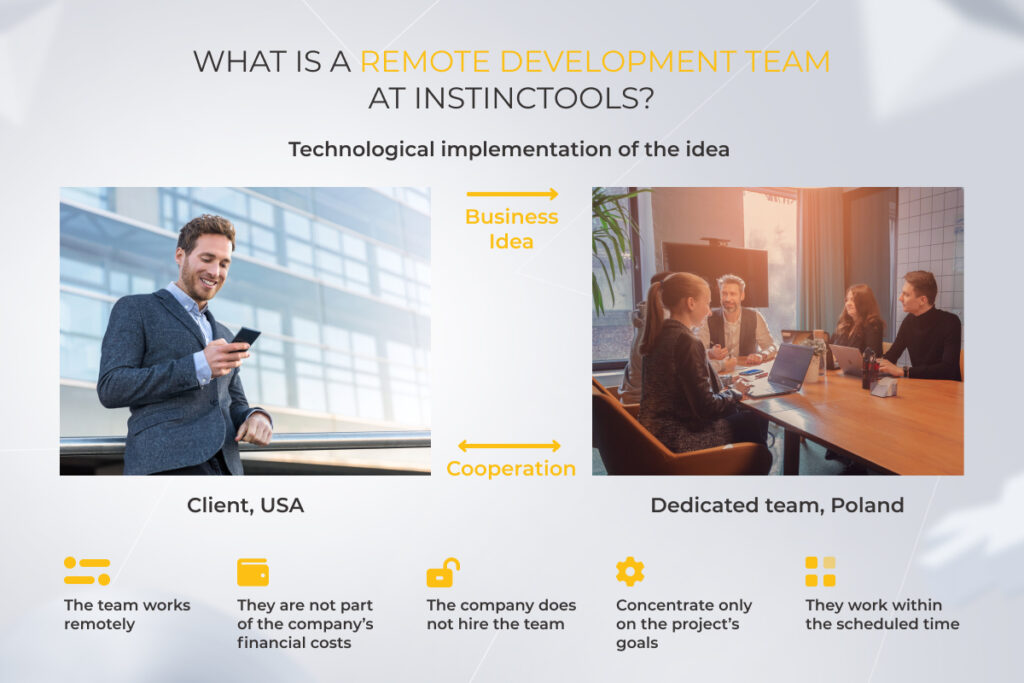
Engagement model - Dedicated Teams

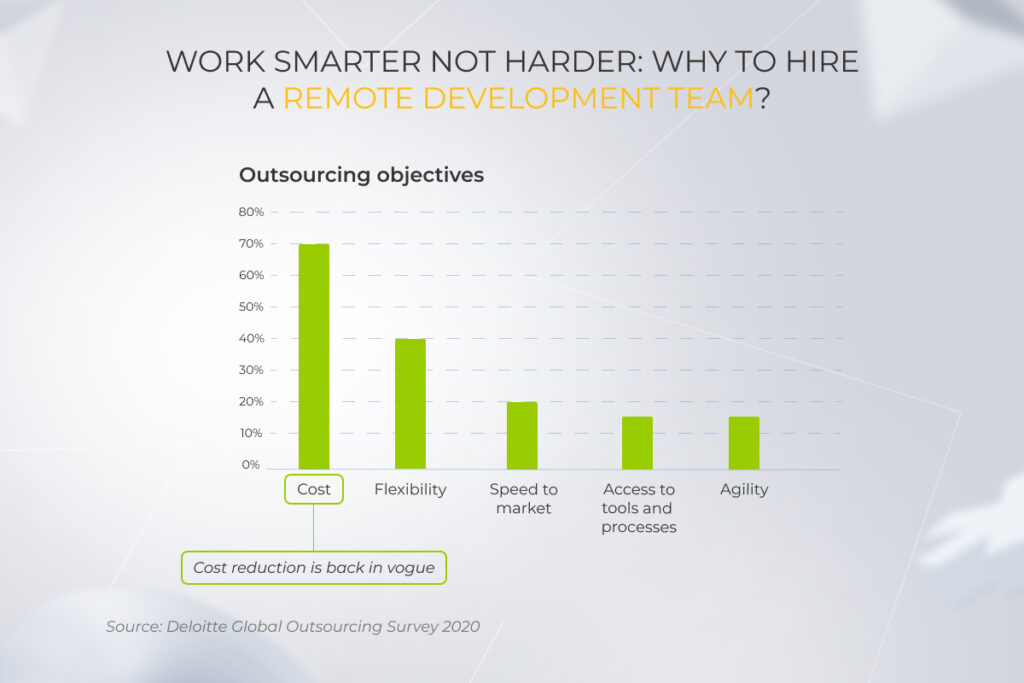
Work smarter not harder: why hire a remote development team?

Delving into new initiatives becomes easier when we understand the deliverables. When it comes to the remote software development process and remote workers, these are reduced costs, greater flexibility, and a faster time to market. 
Engagement model - Dedicated Teams

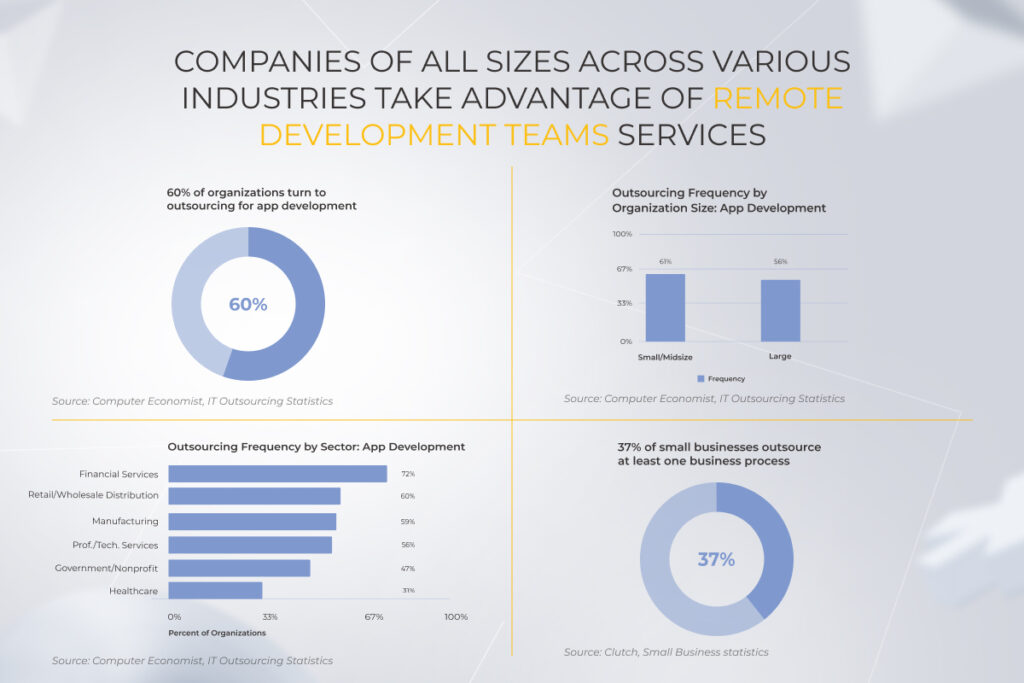
Whether you’re a CTO of a large corporation or a small business owner, outsourcing can become your way to kill two birds with one stone, saving your time, and project budget. 

If you hire a remote team, you don’t waste time setting up processes within the team as it’s self-managed. Just take advantage of ready-to-work, talented software engineers embedded into your IT department. 

For instance, tech giants like McKinsey and Deloitte locate their R&D centers in Poland, where the outsourcing framework is flexible, mature, and tax-friendly. You can also take advantage of local talent and hire specialists or an entire team to develop innovative products.

Looking for experienced software developers to meet your project needs?

Get a quote

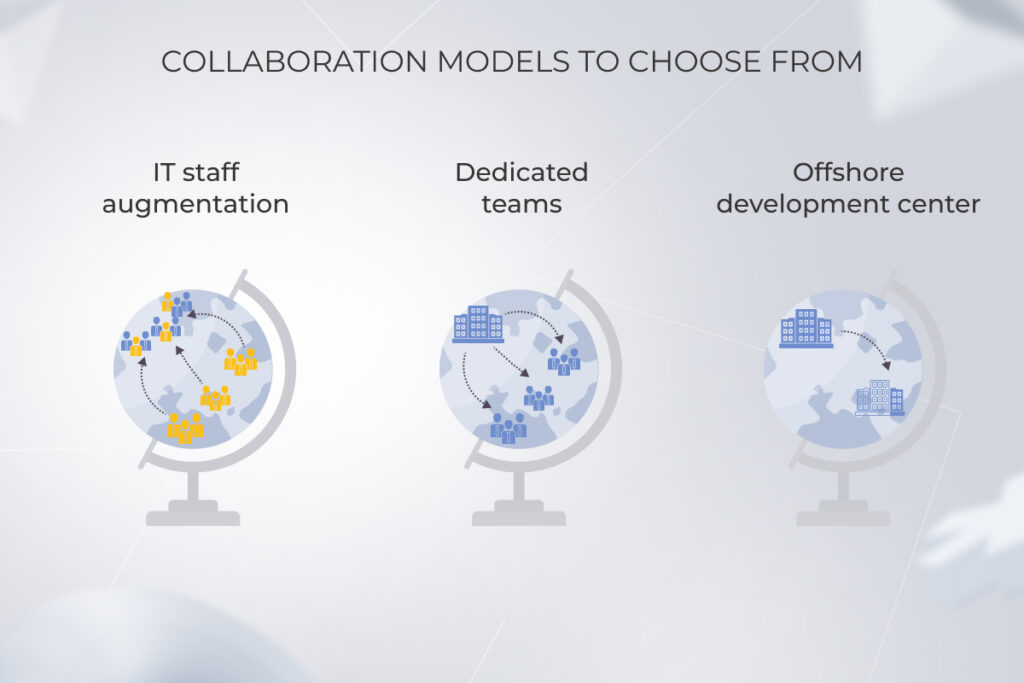
Collaboration models to choose from

No project can be handled by following the same playbook. Successful remote development calls for flexible collaboration methods, calibrated for your business needs. For a company that wants to launch their own product and has no developers onboard, for an organization that craves extra hands to offload their tech backlog, or a corporation which needs a full-scale development center as its numerous project teams have spiraled out of control, there are different team extension options to benefit from. 

IT staff augmentation

Start scaling your business capacities on demand with staff augmentation. It’s the most affordable way to strengthen your IT department with high-qualified experts in software product development, business analysis, UX/UI design, quality assurance, etc., in a matter of days. However, consider that you’ll have to manage these employees by yourself and have the skills and project management tools to do so.

This model of cooperation may be suitable for different projects. For example, a company with its own IT department may lack a specific role for a project. However, it’s impractical to hire the needed domain specialist full-time, especially if no similar projects are planned any time soon. Or there might be the right specialists in place, but the project deadline is on fire, so the organization needs extra hands for a short time to cope with the workload. 

​​​​Another example is when startups seek maximum benefits at an affordable price and in a short timeframe. An IT staff augmentation model provides them with access to a wide range of skill sets and offers financial adaptability and cost-adequacy, which are critical for resource-constrained newcomers.

The advantage of IT staff augmentation is that you don’t just get industry or technology experts but proactive team members who communicate effectively and strive to find and offer the best solution. This is driven by high competition among technology vendors. Remote software engineers have to be proactive so that you want to hire them again for another project. This is why, you can choose the best of the best without compromising your project budget.

Dedicated team

With dedicated development, you hire a whole agile development remote team, so you won’t have to build it from scratch or worry about fitting new employees into the established squad. The dedicated team works as an independent unit whose activities are transparent. Remote dedicated software development teams can cover the whole software delivery process, including analysis, design, development, deployment, quality assurance, and support.

Such an approach is a good fit for long-term projects with frequently changing requirements. You get domain experts who take on IT tasks if you don’t have your own IT department. And if you have your own IT unit, but they are busy on another project, then you can enlist the help of a dedicated team. Moreover, if you fully entrust your vendor with software solution implementation and delivery, then you don’t even need to participate in technical interviews of candidates for the dedicated remote team.

Offshore development center

When the number of separate remote teams you’ve been hiring is growing, at some point, managing them becomes too big of a challenge, taking a toll on the overall project. 

Instead of dealing with multiple remote teams scattered across the globe, you can establish an offshore development center when an overseas business unit becomes an extension of your organization. This collaboration model suits companies with specific security requirements, the ones that handle sensitive data, and large projects that depend on hardware. 
Engagement model - Dedicated Teams

Are you still mulling over what collaboration model will be the best fit for your company?

Let’s discuss it

Four factors to consider when looking for a remote development team

Before hiring a development team, there are a number of things to take into account from a business and technical perspective. The more nuances you think through at the initial stage, the smoother the cooperation will be.

1. Identify limitations of your project and expectations from the remote team 

This information will help you find a highly professional remote development team that matches your budget, time-to-market, and security standards. 

  • Define your budget. Calculate the amount of money you are ready to spend on the project of product development before starting the negotiation process. It’s crucial to engage budget approval persons, and the CTO, who will help define the technical requirements that affect the development cost.
  • Spot the specific requirements for your project. For example, if your project necessitates particular security protocols, it may narrow down the number of software companies, from which you can request a team of remote developers. 
  • Decide on the collaboration and payment model type you need. Earlier, we mentioned collaboration models and use cases for each of them. But at this stage, you should also choose between a fixed price, and a time and material payment model.

Fixed price, with its strict costs, timeline limitations, and inflexibility, is a suitable option for well-specified projects with precise time to market. Ensuring that no new requirements or features will appear during development is a mandatory condition. Moreover, this payment model may include the absence of communication with the client.

But startups without complete specifications and complex long-term projects require a flexible time and material payment model, which implies adaptability to ever-changing requirements. 

  • Following coding standards. It’s not that hard to write code that will work for now. But will it be high-quality and consistent code that any developer can work with? 

When you hire remote software developers, especially at a Java development company, make sure they follow coding standards, such as PEP8 for Python, SEI CERT for Java, MISRA for C/C++, etc. It will save you from code refactoring and rewriting inconsistent or poorly written code in the future. Moreover, such an approach ensures easier code migration and integration with other systems.

Unlock the prospects of software development with a remote dedicated team

Get in touch!

2. Think twice before choosing a region where to hire a remote development team

Although the quality of services plays the first fiddle in choosing a team of remote developers, it’s important to think beyond that. The cost of software development, time zone differences, culture and work mentality of the country you’re hiring from, English proficiency level, can greatly impact the success of your project.

  • Quality of software development services. First things first, it makes no sense to hire a team of remote developers from a cheaper location if the software solutions they create cannot maintain acceptable performance levels consistently, show low average Mean Time Between Failure (MTBF) and Mean Time To Repair (MTTR), and have a high number of defects in the code. Quality shouldn’t be compromised, and solutions should be, first and foremost, holistic, reliable, correct, maintainable, and easy to use. 

Therefore, it’s worth choosing remote software developers in countries with a high level of education in IT disciplines. For instance, while only 41% of developers worldwide have a bachelor’s degree, in Poland the figure is almost twice higher,  reaching 73%.

  • Cost. Instead of hiring a remote development team in the USA, where you would pay $130K for each developer, seek the same services in Poland and pay $40K for a senior software engineer working remotely or $24K for a mid-level specialist. Meanwhile, Poland is one of the five countries with the highest level of tech skills. 

This reduces the project’s cost by three to five times without compromising the development quality — looks too attractive to leave it on read, right?

  • Time zone gaps. For example, the time zone difference between San Francisco and a country in Asia may reach up to 13-16 hours. With a time difference of more than ten hours, it will be challenging to sync with a team and ensure smooth communication and collaboration. 

That’s why, opting for a remote team whose time zone aligns with your work hours is the most beneficial solution. For instance, hiring software developers from Europe will be a lifesaver for US-based companies as the time gap between them is about only six hours. 

  • Mentality and work culture differences. The cultural distinctions between the client and contractor’s sides may lead to misunderstandings and misinterpretations, putting the whole software development undertaking at stake. 

In this respect, it is easier for organizations based in the United States and Western Europe to collaborate with developers from European countries with the same company culture, for instance, Poland, to avoid communication problems down the line and ensure both parties have the same expectations from the project. Statista indicates that Poland is one of the leading countries worldwide when it comes to offshore development services and remote work.

  • English language proficiency. Speaking the same language as your remote development team allows you to be on the same page regarding the project. Poland ranks 16 out of 112 as having a high English proficiency level. 

Experienced developers fly off the shelf in a day in your country?

Leverage our talents

3. Check the reliability of the companies that provide dedicated development team services

Are you sure about the trustworthiness of the companies you’re considering? Here are some steps to help you make a wise choice.

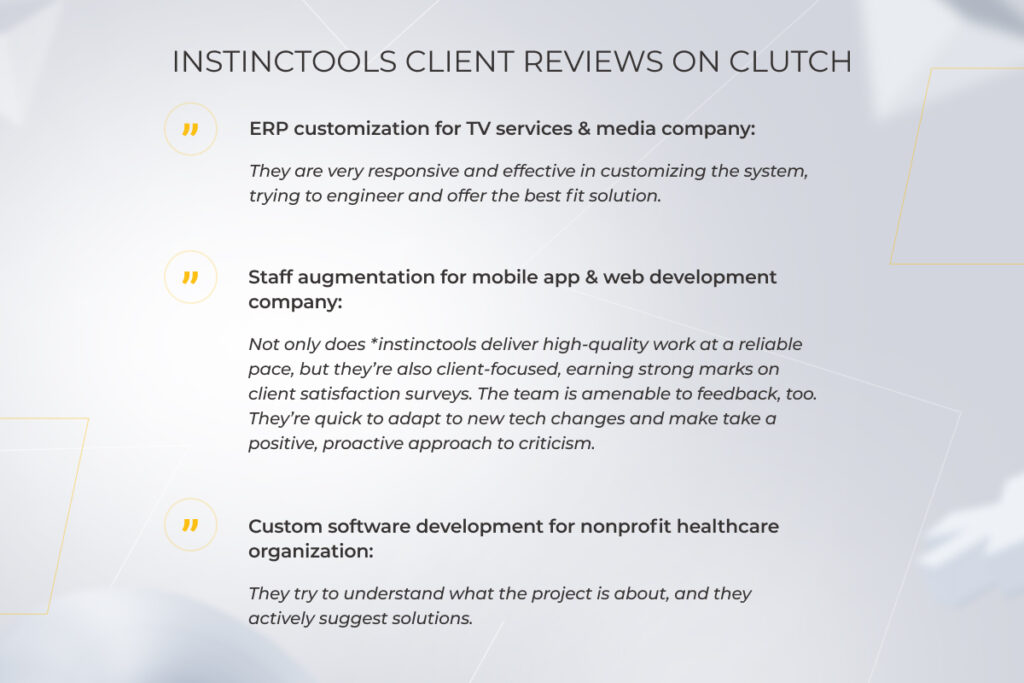
  • Check the reviews of the companies on business listings, such as Clutch, GoodFirms, Techbehemoths, SelectedFirms, etc. Read customer reviews to get an idea of what other clients think about the company and its remote workers. Also, look into their ratings and how long they’ve been in business. 
Expertise - Product Software Development
  • Investigate IT providers’ case studies. Check out their skills in a range of industries and their previous work to identify their area of expertise and see if it matches your needs. That way, you can cut the chaff in the initial stage. 

4. Clarify how companies secure the work of remote development teams

Verifying that your project is kept secure is another essential point to consider when you hire remote software developers. Therefore, ask potential vendors about the security protocols they follow and measures they take to protect the data, such as encryption and secure storage solutions. 

Additionally, inquire about their privacy and data access policies to confirm that they meet your company’s standards. With the right security protocols in place, you can rest assured that your data is safe with the remote development team. 

Your technical partner should take into account local legal regulations and security protocols. Moreover, your remote dedicated software development team needs to be certified and audited in line with your specifications to match your compliance requirements fully.

Speaking of Poland, it stands on par with EU- and US-based organizations and sticks closely to international regulations.

Is a remote development team your golden ticket?

Projects with restrictions related to budget, level of security, complexity, and time to market are the first in line to benefit from remote software development teams.

  • Large, long-term projects 

The challenge of large, long-term projects is that their requirements tend to change. In this case, a remote team of profile experts is your opportunity to quickly adjust the team’s skill set to permanently fluctuating requirements. 

The side benefit you get when augmenting your team with outside talents is knowledge transfer. For example, you have mid-level developers working on a project, and you expand the team with senior-level vendor developers. Working together, they will be able to enhance the expertise and skills of your employees.

  • Product development with limited time to market 

A fast start is key when you’re working on a project from scratch. When you come up with an idea that could influence your company’s position among competitors, it’s crucial not to miss the moment and implement it quickly. 

With an agile remote development team and efficient time management, you can get to the project in one to five days instead of investing up to three months to hire the in-house experts

Average time / Different types of development teamIn-house team*instinctools’ remote team
Recruit & hire talents56 days1 – 10 days
Start working on a project30 days1 – 5 days
Scale up the team40 days2 – 3 days
  • Projects with a limited budget

For startups and small companies, renting office space, recruiting and covering vacations, bonuses, and taxes for their IT department can become a significant part of the budget. Moreover, you’ll need to invest a great deal of time and energy into assembling your own team. 

Hiring a remote team of developers in different countries is an alternative to setting up and maintaining your own IT department and an easy way to obtain your goals while keeping development costs moderate. And if your organization is small or medium-sized and software development isn’t a core part of your competence, you may consider not creating an IT department at all and rely solely on the dedicated team.

Why freelance platforms, such as Upwork, Fiverr, etc., aren’t the best options even if you are short on budget? You can’t be confident in freelancers’ level of expertise. Hence, you run the risk of getting low-quality development.

Expertise - Product Software Development
  • Project with special data security requirements

When hiring remote developers in another country, you determine the desired level of security the team must meet. You state the conditions and choose the development unit that will provide built-in network security, private office space, authorized entry, and software access control. 

If security is the cornerstone of your project, you can send keys on flashcards to work with your architecture and even require your provider to have team members tested for substances — the team will follow these rules and ensure compliance.
Expertise - Product Software Development

Take your time choosing a remote software development team provider to find a reliable one you can trust to set up the team. An experienced partner will determine the needed roles and their seniority level to handle the task effectively. 

Instinctools experience in remote development team services

At *instinctools, we understand the challenges and opportunities of working with a remote development team. We capitalize on our 20+ years in software engineering and innovative consulting to build successful and sustainable agile software development remote teams for our clients. However, we don’t measure our experience solely in years. It’s also reflected in 650+ successful projects in more than ten industries. Besides ensuring the quality of development and providing you with proficient tech skills and industry knowledge, we develop our soft skills and adhere to a continuous learning culture.

Instinctools has extensive knowledge and expertise in all aspects of software development and remote work. Our skilled teams are ready to assist with any project at any stage, from ideation to development and ongoing support and maintenance, while ensuring our clients’ projects are completed on time and on budget.

Our core principle is bringing tangible value to your project, and that’s what our clients say after collaborating with us.

Time is now: access a skill set and expertise that you may not have had before

With the world becoming increasingly digital, businesses need to stay on top of technology. Therefore, they need reliable, professional, and experienced tech allies. And taking advantage of remote development teams is one of the ways to get the software development done faster, more efficiently, and, what’s important, cheaper. While searching for a tech partner might seem daunting, our tips will help you find a professional and affordable match for your project.  

Tap into remote software development and scale beyond borders with us

Get in touch

FAQ

What is a dedicated development team?

A dedicated remote development team is your autonomous tech squad in another country that either strengthens and scales up your in-house IT department or replaces it. It’s fully managed by your tech partner, which frees you from dealing with the paperwork. Just enjoy quick access to the expertise you need.

What is the role of a remote development team?

A remote development team takes on tasks to ease the workload and allow your employees to focus more closely on other undertakings. For example, you are just starting a project, and you need specialists who can manage the process and, at the same time, transfer their core knowledge to your team. Or a large company requires extra hands to sort out tasks in the backlog. Or you are entering a new market and want to hire a full-fledged team in a new location.

What is the advantage of hiring a remote developer?

When you hire a team of remote developers, you save time and money on hiring. You get a whole remote development team that is ready to start working on a project in a few days, while, in the case of in-house developers, you may need up to three months to set up the team and ensure they function in a coordinated way. Moreover, you can scale up your remote development team even by double in just 2-3 days if you need to speed up your time to market.

How to hire remote developers in 2023?

Start by identifying your requirements for a remote software development team. Then check business listings, such as Clutch and GoodFirms, to find companies that provide remote dedicated teams services and have relevant expertise. Dive deeper into their portfolios to narrow down the pool of potential technology partners and interview the remaining applicants.

How do you manage a remote software development team?

Negotiate this concern with your vendor before you start working with a remote development team. For example, you can use tracking tools like Jira and Microsoft Teams to ensure you stay up-to-date on the project’s progress and successful completion. However, working with a dedicated team is convenient precisely because you don’t have to engage in their coordination constantly, as they are self-managed.
The Ultimate Guide on Software Product Development Process 2025

The journey to a market-winning product rarely goes down a linear path. Unclear objectives, vague user persona, scarce documentation, and other snags haunt enthusiastic businesses. As a result, around 26% of projects make a nosedive, unable to weather the hectic development process.

However, there’s a way to simplify the lion’s share of your software product development process. A methodical approach combined with the right team structure will set up your project for success and increase the odds of high-grade deliverables.

What is software product development and how does it differ from software development?

While both processes revolve around software deliverables, they differ in goals, stages, and even team composition. The software product development strategy is anchored in customer needs. This often involves creating prototypes and running market analysis to determine the viability of the future product. Hence, along with traditional design and development steps, software product development stages also include product ideation, prototyping, and pilot production.

Software product development challenges that shackle your project

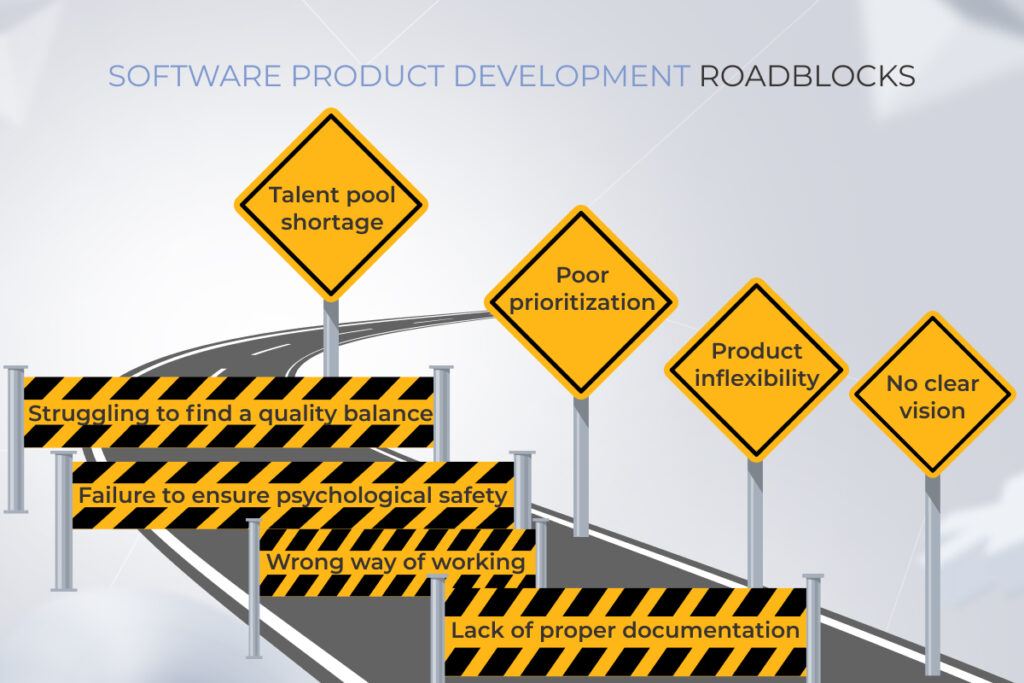
Building a consumable product is the ultimate challenge of the software product development process. The thing is, it implies a myriad of other significant roadblocks that might imperil your undertaking right from the get-go. 

a list of software product development roadblocks

No clear vision

A vague understanding of the end product is a typical pitfall for both startups and well-established businesses. To create a value-packed solution, a team should know the purpose of building a product and the problems it should solve. This long-term mission of the product should be clarified in a product development plan and supported by accurate deliverables and estimates.

Lack of proper documentation

Poorly made software documentation can end up being an expensive headache down the road. From budget overruns to stretched deadlines to irrelevant features, the lack of a unified process for each step directly results from documentation gaps. Also, document inconsistency makes it far more difficult to switch software vendors.

Wrong way of working

Although Agile is billed as a de-facto standard for project management, it can’t be successfully applied by following one-size-fits-all guidelines. And when textbook Agile planning goes awry, teams get frustrated. But the art of Agile adoption lies in understanding the core principles of this management approach and adjusting an Agile-based framework of your choice to fit your unique project needs.

Product inflexibility

New and innovative products usually come with evolving requirements. And if the system design is inflexible and monolithic, you won’t be able to add new features or modify the existing functionality. This also applies to your project management techniques, unless open to change, they won’t let you respond to changing project assumptions safely and effectively.

Poor prioritization

Requirement prioritization is critical for planning, budget control, and scheduling software projects. Therefore, the project backlog should clearly list tasks by priority for the development team. Otherwise, you’ll end up with wasted resources and increased costs of development.

Failure to ensure psychological safety

The central pillar of the agile approach is neither Scrum nor Kanban, but a healthy dialogic process for your development team. Unless fostered positively, intellectual friction will not drive innovation or collaboration. Instead, each team member will be afraid to speak up and suggest new solutions to the problem.

Talent pool shortage

As 1 in 4 organizations are having trouble finding tech talent, skill scarcity can adversely impact your project’s progress. This problem becomes even more critical in competitive domestic markets and is typical for niche skills, meaning that you may spend a large portion of time seeking mythical unicorn staff.

Struggling to find a quality balance

Failed attempts to strike the right quality-cost ratio can also lead to project flops. That’s why teams may struggle to allocate the right amount of resources to prevent product defects or, conversely, spend too many resources on polishing their product. The key here is to reach a compromise between the cost of quality and a usable product.

Supercharge your product development process

Book a call

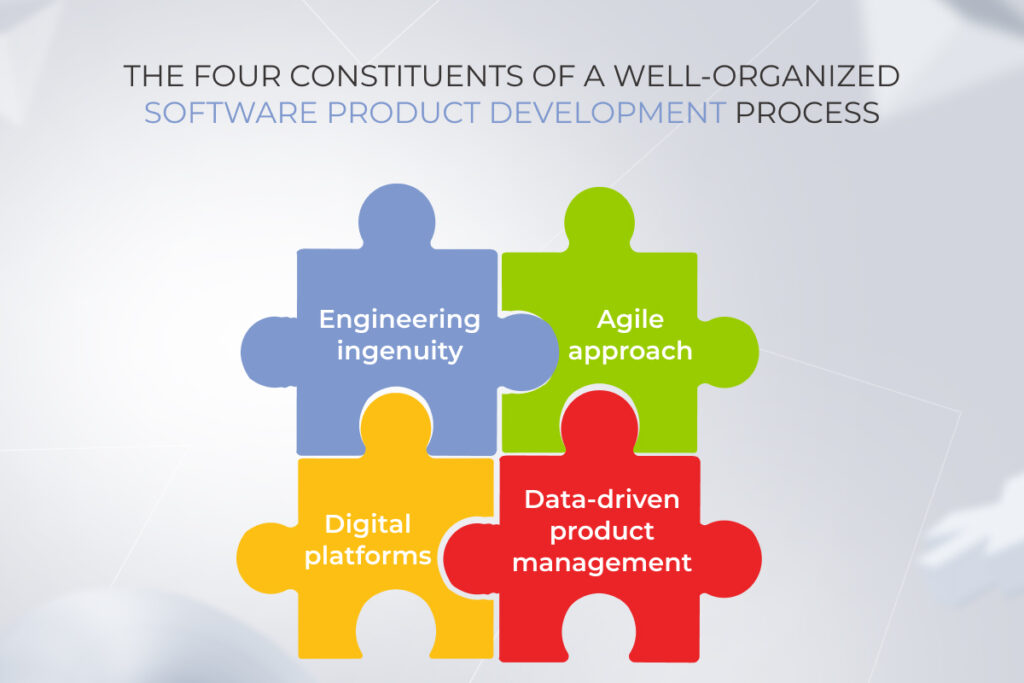
The four constituents of a well-organized software product development process

Planning a consistent product development journey requires a holistic approach where all variables — from team to technology — operate for the benefit of your product. Here are the four elements that can energize your success potential in the product field. 

The four constituents of a well-organized software product development process

Engineering ingenuity

Developing an innovation-friendly culture calls for a collaboration-ready environment where self-managed teams are encouraged to generate out-of-the-box ideas. An engineering culture helps drive your product forward and creates a breeding ground for trailblazing solutions.

Agile approach

Adopting an Agile mindset is paramount for building from-scratch products with evolving requirements. This approach prioritizes value and achieves it through dynamic, customer-focused practices. But keep in mind that Agile cannot operate in silos, it thrives when viewed as a collective effort.

Digital platforms

Besides agile process management, your technology stack should also support changeability and give your team the freedom to make any alterations into production in a safe and sustainable manner. Microservices architecture, cloud, and open-source APIs are prominent examples of highly adaptable digital components.

Data-driven product management

Finally, your development team should be autonomous, yet KPI-driven and aligned. This includes tracking and visually representing software product development metrics that measure delivery performance (deployment frequency, lead time, and others).

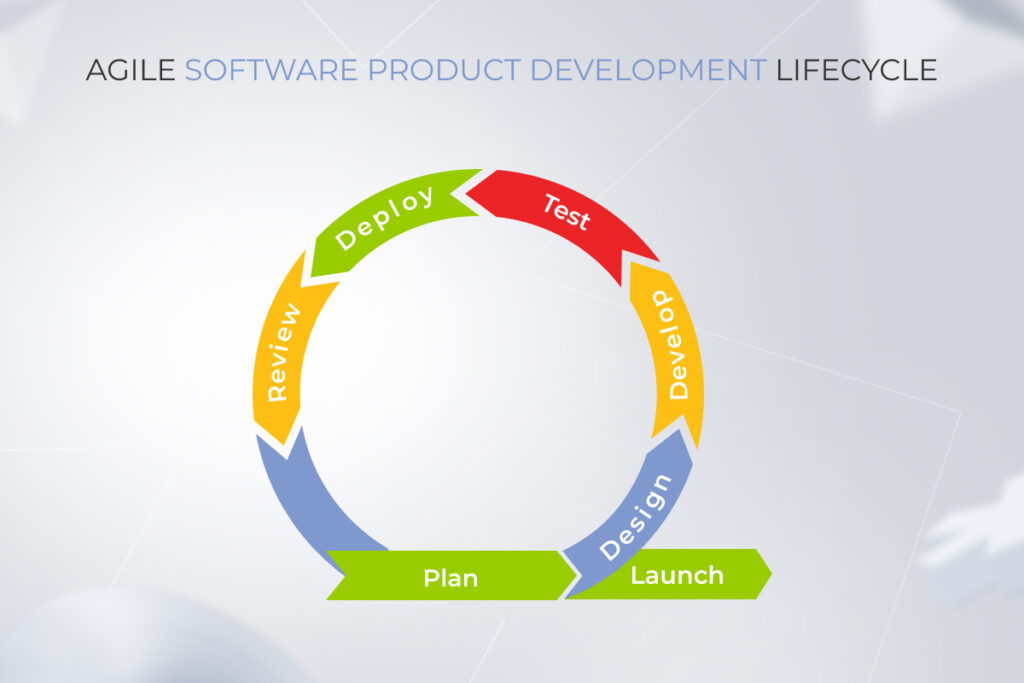
Agile software product development lifecycle to build great products

Agile software product development cycle and user-centricity go together like bread and butter. An iterative sequence of development steps helps you meet user expectations by delivering products quickly, yet in a predictable way. Below, you will find the common software product development phases present in Agile. 

software product development steps in Agile

Product ideation

Everything starts with an idea, but a software product development roadmap kicks off with a crystal clear vision. Working closely with stakeholders, developers, and even future product users, the team first puts together a comprehensive overview of the project. 

From the long-term mission of your product to more detailed business analysis, the ideation process is used to provide clarity around the development of product software and nurture a business concept.

Discovery phase

The Discovery phase also focuses on research-based activities. But unlike ideation, this phase not only delivers hypotheses, but also takes them to the market for a reality check.  During the Discovery phase, you and your team determine business requirements, define the project scope, and suggest possible solutions to validate your product-market fit in the real world.

Below, you will find the milestones of the Discovery phase.

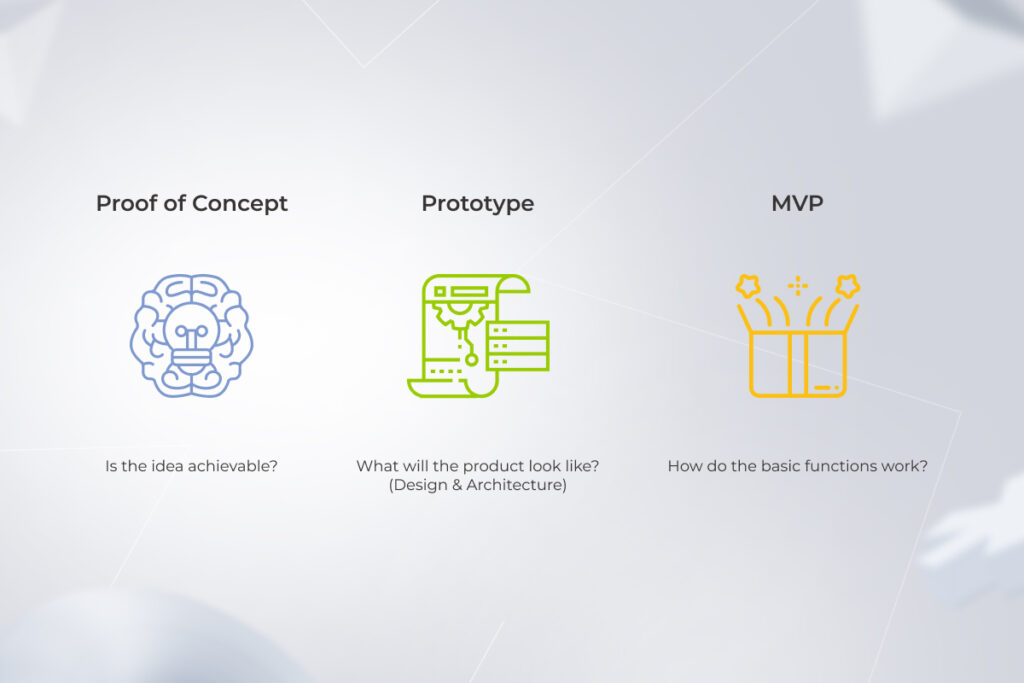
  • Proof of concept

All software product development ideas are worthy until proven otherwise. Therefore, a theoretical demo, or a proof of concept, is required to validate the feasibility of your solution. A PoC is an empirical exercise focused on demonstrating the viability of your solution — from market top-heaviness to risky features.

Once your idea is validated, your team identifies the development scope and proceeds with the design. 

  • Product UX/UI design

In collaboration with business analysts, UX/UI designers create a high-level product prototype, based on customer research. The prototype is then tested with the users, approved by a client, and refined if needed. After that, the final designs are distributed to production.

  • MVP development

A Minimum Viable Product (MVP) is the final destination of your idea verification. An MVP is an early version of your product with just enough features to make it usable for real customers. It helps the product team glean user feedback as quickly as possible to iterate the product. By leveraging MVP development services in USA, businesses can efficiently build, test, and refine their products based on real user feedback, ensuring a faster path to market success.

three milestones of a discovery phase in software product developpment

Development

The Development stage helps enhance your MVP with other, nice-to-have features empowering you to turn it into MMP later. In Agile, it’s an iterative, cyclical process that consists of smaller, more manageable increments. Iteration by iteration, your development team builds up the features. Testing happens continuously as new features are added. 

Maintenance and upgrades

Once your product is released into the wild, your development team monitors its health and performs troubleshooting and necessary upgrades. Perfective maintenance is also important at the post-production stage as it allows you to change existing product functionality by refining, deleting, or adding new features

Let’s build great products together

Contact us

The many faces of Agile software product development

The agile software development process is mostly an umbrella term that refers to applying Agile-driven frameworks during development. However, it’s all about matching the development methodology to the project, not fitting the project to the methodology. Below, we flesh out some of the most popular Agile frameworks and techniques to guide your software development lifecycle.

Well-defined system requirements are a luxury commodity for new software products. Frameworks based on the Agile methodology give project teams the platform, culture, and tools to manage changing requirements.

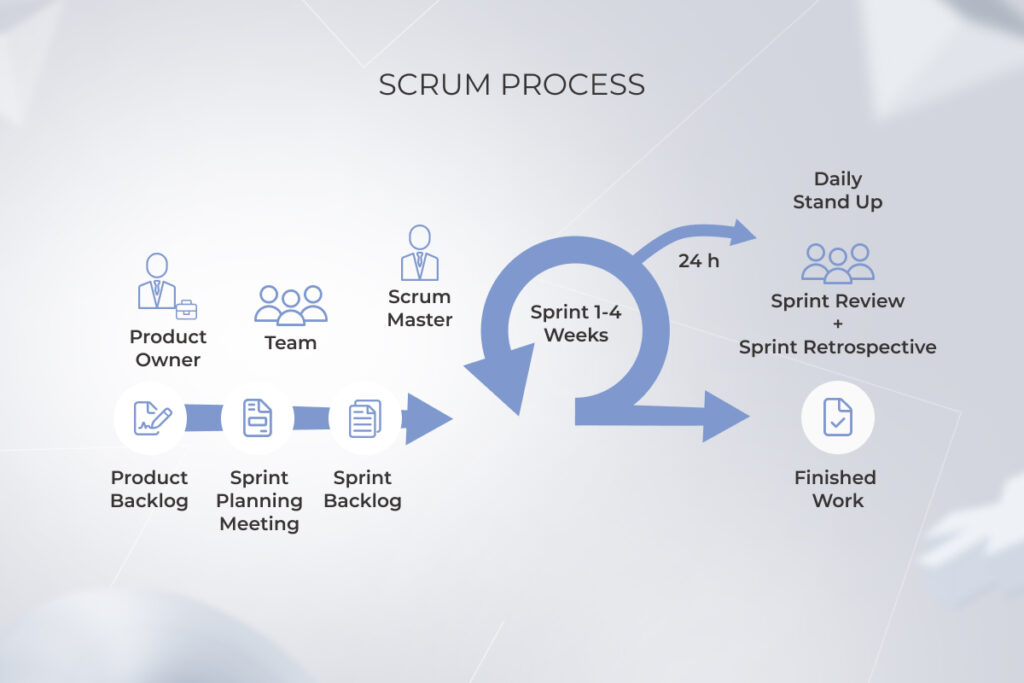
Scrum

According to the report, Scrum gets the highest marks in software development with 63% of teams leveraging it. This framework helps teams deliver value incrementally in short sprints which typically last 2-4 weeks during which the product is designed, coded, and tested. Scrum doesn’t stray from Agile philosophy, instead, it enriches it with rules, roles, events, and artifacts to facilitate the Agile way of development.

Scrum process in software product development

Scaled agile frameworks (SAFe)

Scaled Agile frameworks are Scrum for enterprises, based on 10 Lean-Agile principles. While Scrum is used to organize small teams, the SAFe framework applies to the whole organization or large, multi-geography teams. The basic construct of SAFe is the Agile Release Train.

Kanban method

Kanban is a popular workflow optimization method that adds more visualization to almost all software development processes — from feature prioritization to testing. Many Scrum teams also use select principles of Kanban as a visual process and project management tool. 

Extreme programming

Extreme programming is a software engineering paradigm that improves the quality and efficiency of your software development process. It is based on a set of values and principles that prioritize customer satisfaction, teamwork, and continuous improvement. 

extreme programming (XP) methodology for software product development

Lean

This Agile framework prioritizes addressing what must be worked on at the time, leavingno room for multitasking. With a linchpin idea of cutting waste in mind, product development teams book general meetings only if the issue can’t be resolved otherwise, set a straightforward approval process, and put features prioritization on the front burner to pack software with the most coveted functionality.

Crystal

Crystal is a highly adjustable framework that works for teams of 10 to 1000 people. It banks on osmotic communication, promoting background information sharing among team members. Fundamental rules of this approach imply using development cycles less than 4 months long and running reflection workshops to regulate the methodology with the project priorities.

Other Agile practices

Due to the emerging requirements, Agile teams often bake additional Agile practices into frameworks. Here are a few examples of curated techniques:

  • Test-driven development (TDD) — writing unit test cases for the software before writing the code itself.
  • Code review — involving one or more developers checking another developer’s work.
  • Pair programming — includes two developers teaming up together on one workstation. 
  • Prioritization techniques (MoSCoW) — a four-step technique that ranks project requirements by priority.

How to decide on a software product development team structure?

The right software product development team structure will determine how well your product is built. But although you need a cross-functional squad of software professionals, a mixed assembly of characters doesn’t automatically drive you to success. Here’s how to select your team members strategically.

Typical software product development team

To facilitate a dynamic development process, you’ll need to have the following professionals on board:

  • Product Owner — holds the voice of the customer and keeps the team backlog aligned with customer and stakeholder needs (usually on the client’s side).
  • Delivery Manager/Scrum Master — caretakers that ensure the project is delivered on time and within budget, while also enforcing the best Agile practices.
  • Development Team (Developers, QA, Designers, Solution Architect, DevOps specialist) — hands-on front players that turn requirements into a fully functional software product.

What does a product team structure depend on?

The set of roles in your development team does not fluctuate much from project to project. The only variable is the number of developers and QA engineers that can differ based on the volume of tasks and deadlines. 

Therefore, before you go into hiring, you have to define the scope of your project. So, if you’re in for a proof of concept, your development team will not be bigger than five specialists (PM, Product Owner, business analyst, software architect, UI/UX designer).  Conversely, full-blown product development requires up to nine specialists to complete as software engineers and testers step onto the scene.

Need a team of product development pros?

Reach out!

Key artifacts of efficient product management

To ship the right product successfully to users, your team has to be guided by lighthouses, or artifacts, that refer to project documents, outputs, and specific deliverables. Let’s see the core landmarks that indicate your product management is on the right track.

ArtifactMeaningDocument contents
Competitive analysisDescription of your business’s target market.– Direct/indirect competitors
– Market share and average revenues
– Industry benchmarks
– Monetization models, etc.
Product visionOutlines the long-term mission of your product. – Business goals
– Target audience and needs
– High-level product description
OKRs and KPIsIncludes performance measurement values.– KPI description and measures
– Objectives and Key Results 
Product roadmapDescribes a detailed vision and direction for a product. 

– Product features
– Release schedule
– Short- and long-term goals
– Product features and milestones
Customer Journey MapIllustrates the stages users go through when interacting with your product.– User persona
– User actions
– Touchpoints
– Pain points
Product Requirements DocumentDefines the necessary features and functionality of a product.– MVP features list
– Engineering implementation details
– Functional requirements
– Product development timeline
Product designs and prototyping documentsCovers all aspects of your product design.– User flow and design
– User stories
– Project specifics
Product release planProvides details of all the features of an upcoming product release.– Upcoming features and enhancements
– Timeline

Back in the day, product development firms managed the entire process from ideation to delivery onshore. But supporting the entire process from A to Z is becoming increasingly expensive and counter-productive. As a result, 79% of companies outsource their IT projects.

With offshore software product development, businesses access a global pool of talent at lower costs. Besides getting expertise that might not be available in your country, you can also tap into the latest technologies to ensure the best quality for your product. 

We at *instinctools take over end-to-end product development projects, allowing you to leverage leading-edge expertise, drive down development costs, and build a high-quality product hassle-free.

Mastering software product development process: from ideation to excellence

It takes a lot to create impactful products that win over customers. A properly structured software product development process is half the battle when it comes to success. An Agile-first, customer-centered, and client-oriented workflow, managed by a dedicated development team, grants you better control, improves project predictability, and saves your resources.

Deliver innovative products with ease

Get in touch!

FAQ

What is the product development process in software?

It’s a multi-step process designed to take a product from the initial concept to the final market launch.

What is Agile software product development?

It is an incremental approach to software development that focuses on shipping digital products in a timely and effective manner. The Agile-based process is characterized by short development cycles, or sprints, that allow for quick feedback and constant evolution of the product.

Is Agile only for product development?

This philosophy isn’t limited to building products. The Agile mentality and Agile-driven methods are also helpful in the development and management of services.

What are the 4 pillars of Agile?

This management approach is founded on four key principles:
1. Processes and tools are no replacement for individuals.
2. A functional product is more important than detailed documentation.
3. A collaborative solution is better than a rigid contract.
4. The team should welcome change.

What is the Agile software development life cycle?

The software product development process flow flow can be roughly divided into five phases, including conceptualization, inception, development, release, and maintenance. Each phase leads to the creation of numerous software iterations.

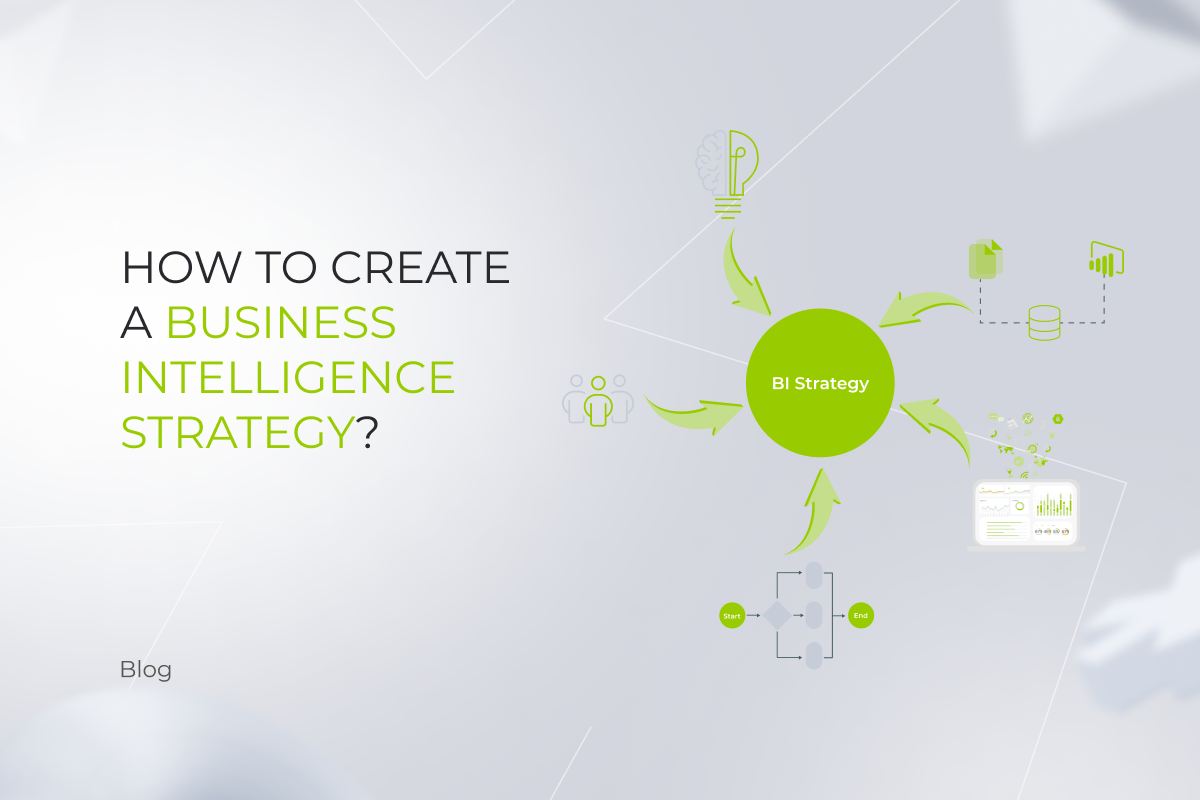
How to Create a Business Intelligence Strategy? | Expert View

What should be the first step of your BI journey? Choosing a tool? Collecting data? Not so much. It’s a comprehensive business intelligence strategy that will help you move toward advanced analysis. 

While BI can make your reporting faster and graphs more sophisticated, even without a proper plan, you still will be deprived of a holistic view of how to use the technology to your maximum benefit. As you probably know, the devil is in the details. That’s why, not to let them slip away, imperiling your whole BI initiative, you need to follow particular business intelligence implementation steps. 

In this article, we analyze real-life cases of our clients who have leveraged a BI strategy despite being at different stages of BI implementation. Some were new to using business intelligence and wanted to ‘make it right’ from the very beginning, others had been already using BI tools, but mostly intuitively, without any specific plan. Nevertheless, all of them could see how much the quality of data analysis improved with proper strategizing.

If you don’t want to fall by the wayside, here are the reasons to care about business intelligence strategy

Business intelligence isn’t only about creating flashy presentations. The potential and value of the technology are much broader, and they can be unlocked through a proper business intelligence plan. With a BI strategy, you can tackle data issues more efficiently, build a holistic, well-integrated system, and ensure it remains to function properly. 

  • Saving time and money. Acting on a whim is fraught with costly mistakes. No one wants to waste money on features that, in the end, no employee will need or buy licenses for 100 employees if the system will be used only by 20 of them. A BI strategy allows you to think through such things in advance, saving time and money.  
  • Adopting advanced risk management. You minimize the likelihood of losing time and money by analyzing each step in detail. Furthermore, with such an approach, you’ll be able to detect weak spots and bottlenecks earlier and fix them right away. 
  • Building end-to-end data analytics across your organization. A well-thought-out BI strategy empowers you to break data silos between departments and connect all your data sources to get end-to-end analytics. Such an approach allows you to track processes throughout the organization, which means you can spot problems in time and make decisions backed up by accurate and up-to-date data.

A well-designed and nuanced BI strategy helps to significantly revamp internal business processes, which, in turn, has a positive impact on the quality of service or product you provide your customers.

Want to boost your BI maturity level? We’re here to support you

Book a call 

3 areas you can’t ignore when building a BI strategy

To create a robust business intelligence strategy, you should take care of vision, people, and processes — paying equal attention to each element and their interrelationships. Let’s investigate them in more detail.

Vision

Before adopting any technology, you need to ask yourself a couple of fundamental questions, such as “What is its practical value for our organization? What do we want to achieve thanks to it?” The answers to them will help you outline an action plan on BI implementation or optimization.  

To build a data-driven culture in your organization, you should also review how you handle your data. Rather than thinking of it as raw material for analytics, treat it as a product with a real return on investment. 

People

When creating a BI implementation strategy, you shouldn’t discount your employees and their skills. Otherwise, you’ll waste your budget and time adopting the technology, which will be sabotaged by people who got used to working differently.  

Therefore, take into account who will interact with a BI tool to provide suitable dashboards for each decision-making level. For example, an employee responsible for machinery maintenance, data analyst, and CEO require different types of dashboards. 

Check here to learn more about operational, analytical, and strategic dashboards.

Another point to keep in mind about your employees is their technical background. Creating a business intelligence strategy and roadmap for a tech-savvy company isn’t the same as building it for an organization that isn’t on close terms with digital technologies. 

When we understand the level of users’ technical expertise and the processes they are involved in, we can create custom dashboards for each role instead of one general dashboard for all company processes with a mind-boggling number of filters. This expands the range of BI users from executives and analysts to rank-and-file managers and employees.

Process

This side of the BI strategy is about setting up the technology implementation process. For this, you should think about employing a Chief Data Officer (CDO), define a project budget, consider security and compliance questions, and identify KPIs to track the effectiveness of the BI blueprint and technology adoption.

Also, it’s crucial to take care of knowledge transfer from your technology partner. Therefore, pay attention to establishing a BI competency center. BICC is your in-house team that will make the self-use of the system truly comfortable for non-tech savvy employees and handle minor adjustments such as dashboard configuration. 

With this approach, you make users more advanced, and as a result, increase the speed of change and the efficiency of working with the BI system. You’ll also become less dependent on your technology partner and only turn to them for major modifications such as connecting new data sources to the system, visualizing data on new business processes, and more.

The final result of the work on the process area of a BI strategy is the development of a BI roadmap. It’s a document that consistently describes the particular steps necessary for implementing BI, project milestones, deadlines, and KPIs to evaluate your progress.

Bolster your digital transformation initiative by turning raw data into refined knowledge

Act now!

Data profiling: a fundamental step you should take

Before loaded into a BI system, your data must be checked for quality and consistency. This is what data profiling is about.

  • Data quality. Poor data quality is the reason for a myriad of business problems, such as inaccurate financial forecasts, regulatory issues, lost customers, reputational damage, etc. If you don’t take care of it in the initial data analysis stage, dealing with low-quality data will drain your staff’s time — and that’s before we mention irrelevant results. Statistics show that covering repetitive problems related to data quality may take up to half of the employees’ working hours.  
  • Data consistency. Duplication of data in different systems can reflect suboptimal business processes, wherein employees manually and in an uncoordinated way enter the same information in two different systems. As a result, input errors and incomplete matching inevitably occur. Instead, the rule of a single entry point for any data should work, and then the systems should only exchange it rather than create a copy.
  • Data classification. This is needed when data comes from a variety of sources. It can be your data lake, ERP, or traffic from your site, to name a few. In addition to the source, you should consider data structure (structured or unstructured) to properly classify data, as it simplifies determining the update frequency for each data profile.   

When profiling data, you may uncover that some of it isn’t updated as often as needed for effective decision-making. 

Consider that you don’t necessarily have to strive for real-time updates. Usually, you only need such things when dealing with financial markets. However, if you own an e-commerce business and your logistics system and ERP are synchronized only once a day, there might be a situation when the product has arrived at the store but it isn’t displayed on the site. Thus, you risk losing customers because of the insufficient frequency of data updates.

We suggest doing continuous data profiling. Leverage automation to speed up and simplify the process. 

Looking for an expert to automate data profiling?

Reach out 

Architecture and toolset selection

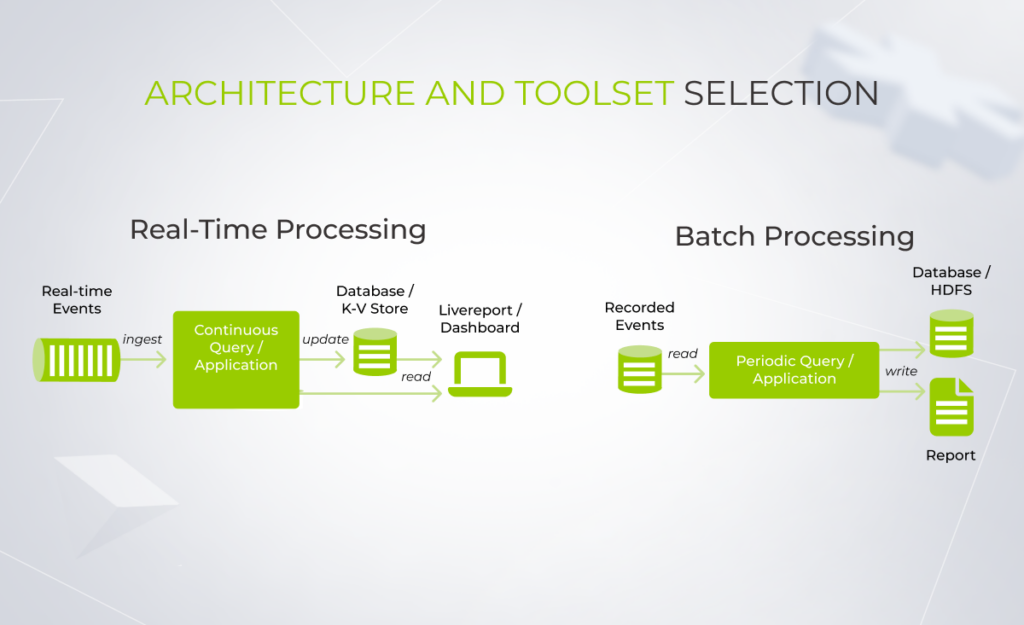
When picking BI tools, you need to choose those that will allow you to ingest, store, process, analyze, and visualize data easily.

1. Ingestion 

Ingesting data implies taking raw data from primary sources without transforming it. You need to choose an appropriate method of data ingestion. 

  • Real-time processing. Once the ingestion software recognizes the data piece, it downloads the data in your data lake or warehouse as a separate object. 
  • Batching. With this approach, data ingestion software collects data, groups it based on criteria or a schedule, and then sends it to the data storage in batches. 
  • Micro batching. This is a subtype of batch processing. The difference is that the batches are smaller. 
business intelligence strategy

Data ingestion software depends on the type of data you process, the data sources you use, and the speed you need to access the data. Apache Kafka, Azure Stream Analytics, and Amazon Kinesis are the most notable players in the data ingestion tools market.

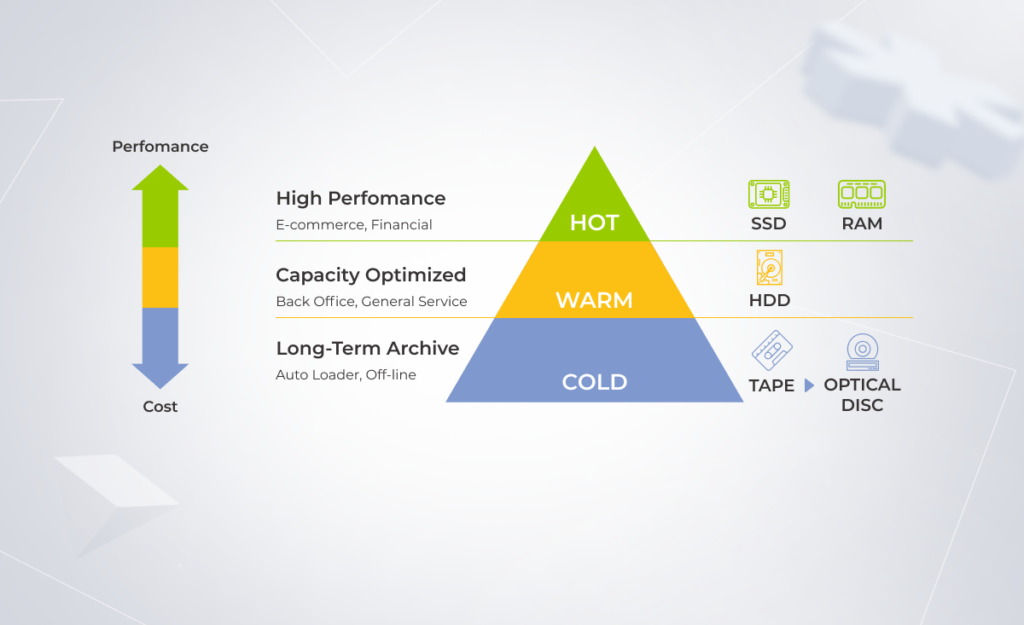
2. Storage

This is the point where you should identify where your data will be stored. Several options are available. We’ve already covered data lake and warehouse differences when discussing building a solid data infrastructure. 

Moreover, you should determine which of your data is ‘hot’ and which is ‘cold’ if you want to save on storing data that you don’t need on hand all the time. Both on-premise and cloud storages offer options for hot and cold data. For instance, hot data that has to be easy and fast to assess can be stored on the solid-state (SSD) drivers and in-memory (RAM), and cold archival data can be kept on optical disks. There’s also warm data that is used not as often but isn’t archived, like the five-year-old sales data you need every few years for a cut-off point. It can be stored on hard disk drivers (HDD). 

business intelligence strategy

3. Processing

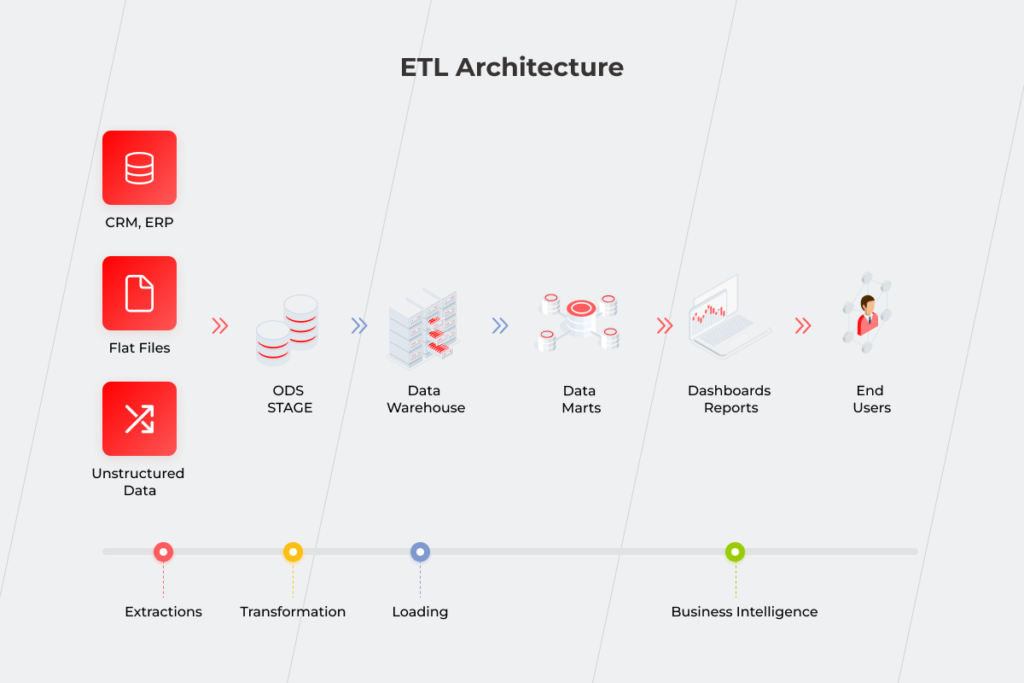
It’s impossible to directly connect heterogeneous data sources and a data warehouse where information has to be cleared of errors, structured, and classified. You’ll need a bridge, an ETL tool that processes the raw data and unifies it in three steps.

  • Extract. The tool retrieves data from your data sources, such as spreadsheets, legacy systems, CRM, ERP, analytics, etc.
  • Transform. All extracted data is analyzed to identify duplicates and delete them, form new columns or split them, etc. After that, the data can be standardized – filtered, sorted, and verified.
  • Load. The data goes into the repository or analytic software.

The difference between ETL and data ingestion is that there is a data transformation step in the case of ETL.

As long as the ETL process plays the first fiddle in providing high-quality data analysis, choosing a proper tool becomes a crucial undertaking. The decision has to be based on multiple factors, such as your use case (a cloud solution or on-premise one, the necessity of real-time updates, etc.), maintenance specifications, scalability, built-in integrations, and costs.  

Struggling to find an ETL tool to enhance your data processing?

We’re here to help

4. Analytics and visualization

Defining an analytical toolset is the next step in your BI strategy. According to the Gartner Magic Quadrant, you should pay attention to three leaders in the field of data analytics – Power BI, Tableau, and Qlik. The choice of the most appropriate tool needs to be guided by your requirements and limitations.

  • Present architecture. It isn’t mandatory to implement a separate BI solution. Analytics can be built into your existing applications to speed up decision-making and its accuracy. Moreover, embedded analytics and immediate access to data encourage users to rely on data more in their everyday tasks.
  • Current technology stack. If your organization already uses Microsoft products, choosing Power BI and other infrastructure tools from the Microsoft stack is a more reasonable approach.
  • Range of users and tasks. Tools for a startup and a corporation with 3,000 users will be different. The latter will probably need an open-source solution to eliminate licensing costs or arrangements with the vendor for a special licensing plan and discounts. Whereas a scaling startup can definitely consider other options.

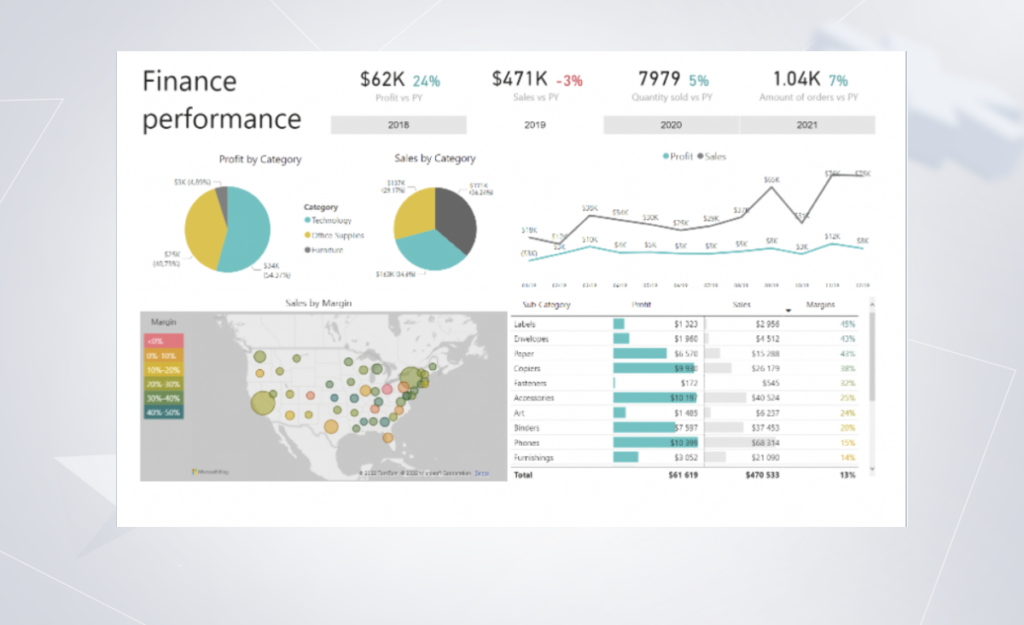
By thoughtfully assembling a toolkit at this stage, you can empower each employee to be a data hero. Here are some examples of dashboards for rank-and-file staff and C-suite team members.

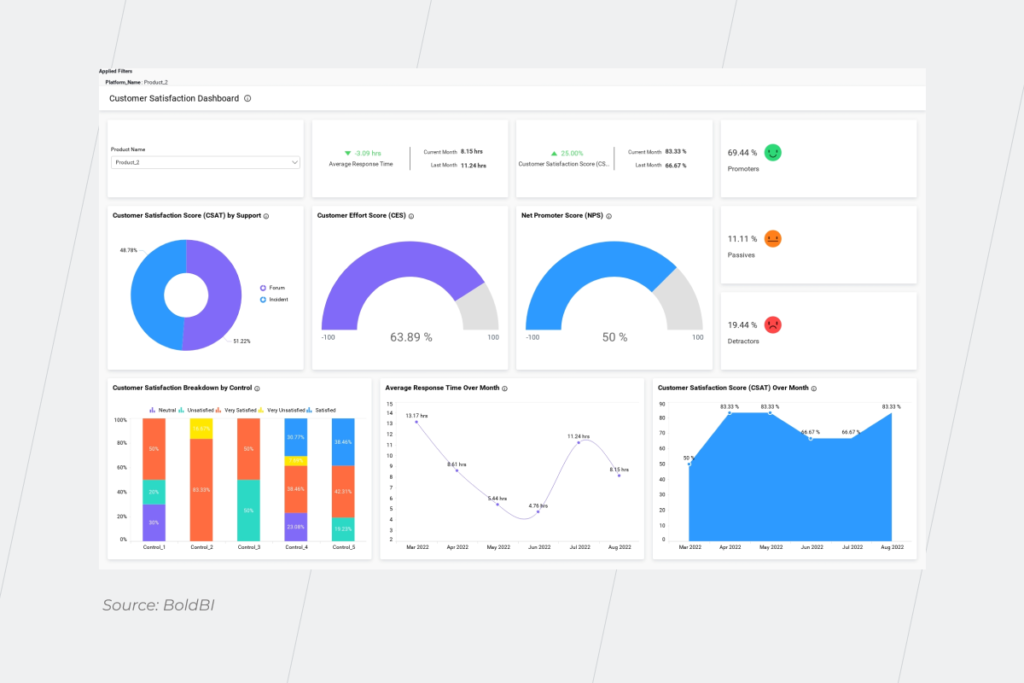
Operational dashboards for employees from different departments include detailed real-time information.

business intelligence strategy

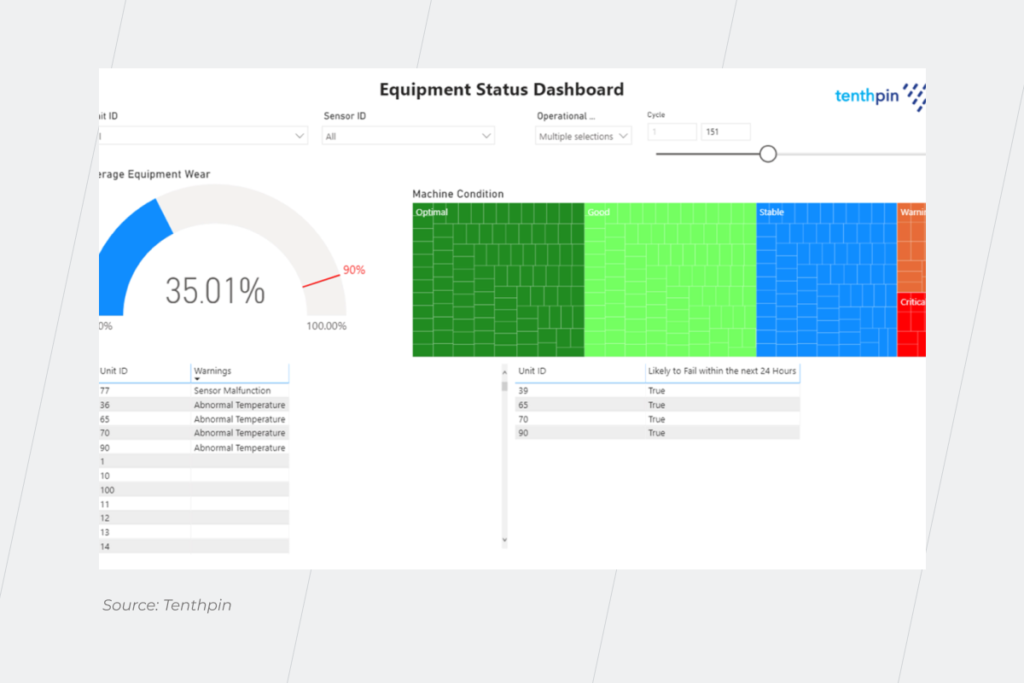
And strategic dashboards for senior-level management include key metrics across the whole organization. 

business intelligence strategy

Don’t puzzle over your data analytics pipeline

We’ll help

How we helped a large retailer to increase a turnover by 9%. Spoiler alert: it’s about a logical BI strategy

A well-developed BI implementation strategy empowers you to leverage the technology entirely. Here’s a BI strategy example that allowed one of our clients, a vending machine retailer, to make more accurate decisions faster, keeping up with their business growth trajectory.

The existing solution was inefficient in terms of scalability:

“We never completely realized that we have so much unused data. Only about half of all the data we had was used to make decisions”, says the company’s product and customer experience director.

So how were the carefully designed strategy and the precise BI roadmap developed? 

During the Vision phase, we found that business intelligence could improve several company processes:

  • Finding lost sales
  • Detecting low-margin contracts
  • Monitoring the technical condition of vending machines in real-time

Additionally, the client needed an intuitive tool without limits on how much data they could process. And although Power BI is the most user-friendly tool, it also has a limit of 3,500 data points. Therefore, because of the client’s data volume requirement, we chose Qlik, which has no rigid limitations in the number of data points.

After implementing BI software in accordance with the strategy worked out in advance, the client reduced the number of lost sales by 30%, renegotiated low-margin contracts, and minimized vending machine downtime as much as possible. The confluence of these results led to a 9% increase in total client turnover in half a year. 

For more details on the aforementioned project

download the full case study

Unleash the full potential of a BI system

Ideally, a strategy is developed before any steps are taken to implement the solution. But what about organizations that have already managed to implement the technology themselves, even picked some low-hanging fruit, but then realized that the capabilities of BI could extend much further? 

At some point, users who are not new to BI understand that they can’t unlock the full potential of the technology without a proper business intelligence strategy and roadmap. 

A BI strategy for organizations that already use the technology will include the same basic steps — just like for beginners. It’s just as vital for them to keep the Vision, People, and Process in mind, take care of data quality, reconsider BI tools, etc. However, another thing to pay attention to is emerging. Organizations with self-implemented BI have to constantly extinguish fires that inevitably occur, such as handling backlogs and dealing with issues that popped up after BI adoption and can’t be shelved for later.

One of our customers implemented Power BI for employees of all departments and levels. But ​​over a year, they realized that they were not using all the capabilities of the tool. Therefore, we took action. Working in two directions while establishing the business intelligence strategy, we:

  • Launched in-depth research on the system’s architecture, features, and limitations. It’s a mandatory step to adjust the data storage architecture to the needs of the system’s end users so that employees at any organizational level can independently retrieve the data they need from the data storage and use this information to create customized reports. 

Simultaneously with this large-scale process, we worked with the client’s current tasks.

  • Helped cover ongoing tasks. The customer also had clearly defined tasks, but their in-house BI team was too small and not skillful enough to handle the workload. We tapped into these activities. This way, the client got the reports they needed faster, and we got to know the system’s architecture and the people on the client side so we could pass the knowledge to them.

Planning to develop a business intelligence strategy to optimize an existing solution?

Drop us a line

A comprehensive BI strategy allows you to increase the odds of your BI project’s success

Without elaboration on the Vision, People, and Process areas, you can’t accurately choose the solution architecture or the most powerful toolset for your tasks. Therefore, it’s better to take a holistic approach to implementing a data analytics solution by developing a BI strategy. Also, keep in mind that your BI project doesn’t end with BI deployment. It’s a long-lasting initiative. Your BI software has to evolve constantly as your external and internal conditions change, and new processes, systems, and data appear. To make these adjustments smooth, you need a business intelligence strategy. Without a robust BI strategy that is periodically adapted to the current state of things, it will be much harder to figure out how to move forward.

Need a tech partner to build a solid BI strategy, adopt the solution, and take on its updates?

Get in touch

How to Create a Crypto Payment Gateway: Our Hands-on Experience

The question of how to create a crypto payment gateway has gained popularity across a wide array of industries for a reason. This is not surprising since the number of blockchain transactions has been growing steadily over the past ten years. For example, from 2012 to 2024, the number of operations with Bitcoin increased 8.5 times.

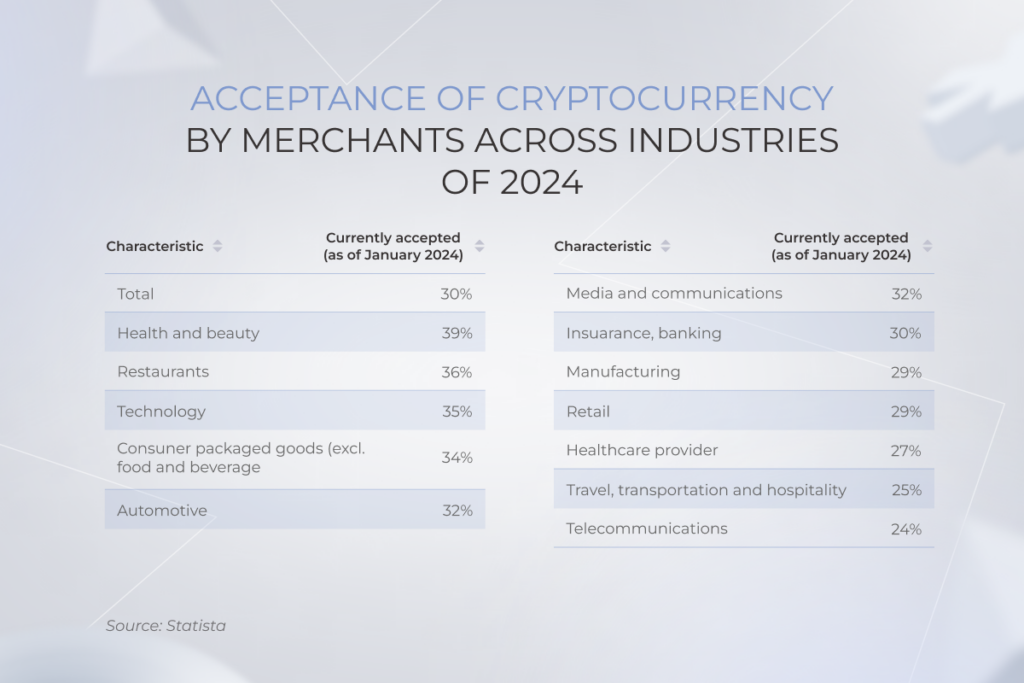
Using crypto allows companies to enable real-time, accurate, and completely secure transactions. Doesn’t that sound like a compelling reason to consider cryptocurrencies for your transactional and operational purposes? Statista indicates that the degree of acceptance of payments in crypto varies from 24% to 39% across industries.

Acceptance of cryptocurrency across industries

Already sparked your organization’s interest in crypto and want to benefit from a crypto payment gateway but don’t know where to start, what it takes to develop and implement a crypto payment processor, and how to choose a reliable partner? We are here to help you cut through the noise about crypto payment gateway development and get straight to work. 

How does a crypto payment gateway work?

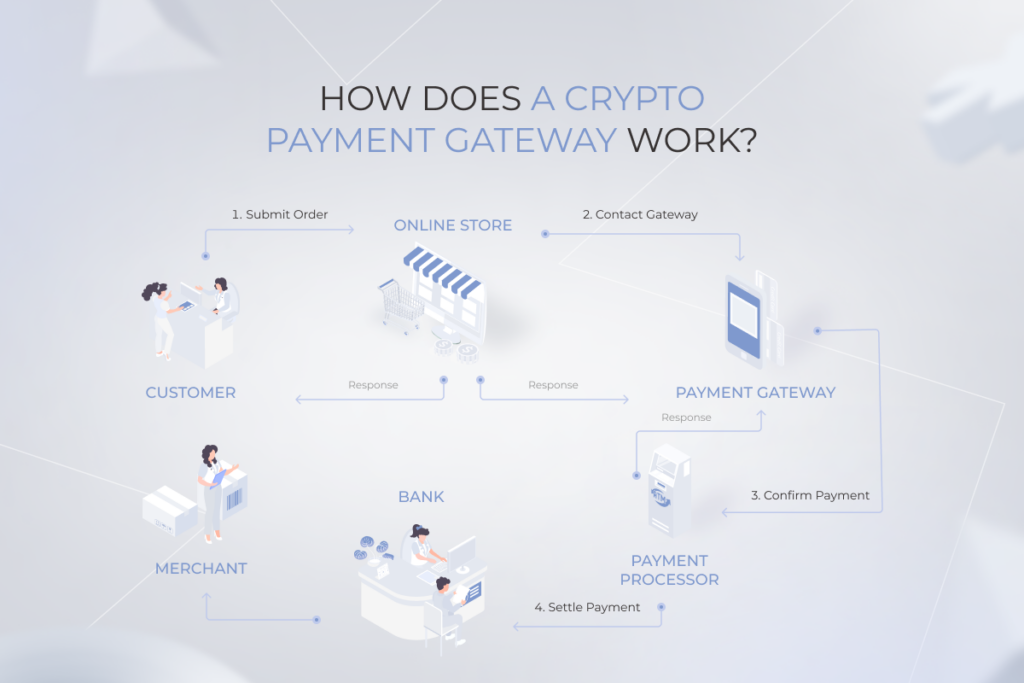
A crypto payment gateway is a payment processor, similar to its traditional alternative. The difference is that it accepts cryptocurrencies instead of conventional money and converts them into fiat, or vice versa. If you implement a crypto payment gateway, the exchange process goes like this:

1. Customers pay in crypto or in fiat for their purchases.

2. If your crypto payment gateway receives Bitcoins, Ethereum, or other cryptocurrencies, it immediately converts them into fiat according to the digital currency’s market value at that moment. If the gateway receives fiat money, then, similarly, they are converted into cryptocurrency at the current rate.

3. That amount of fiat money is sent to your account. Speaking of crypto, it goes into your crypto wallet.

scheme showing how a crypto payment gateway works

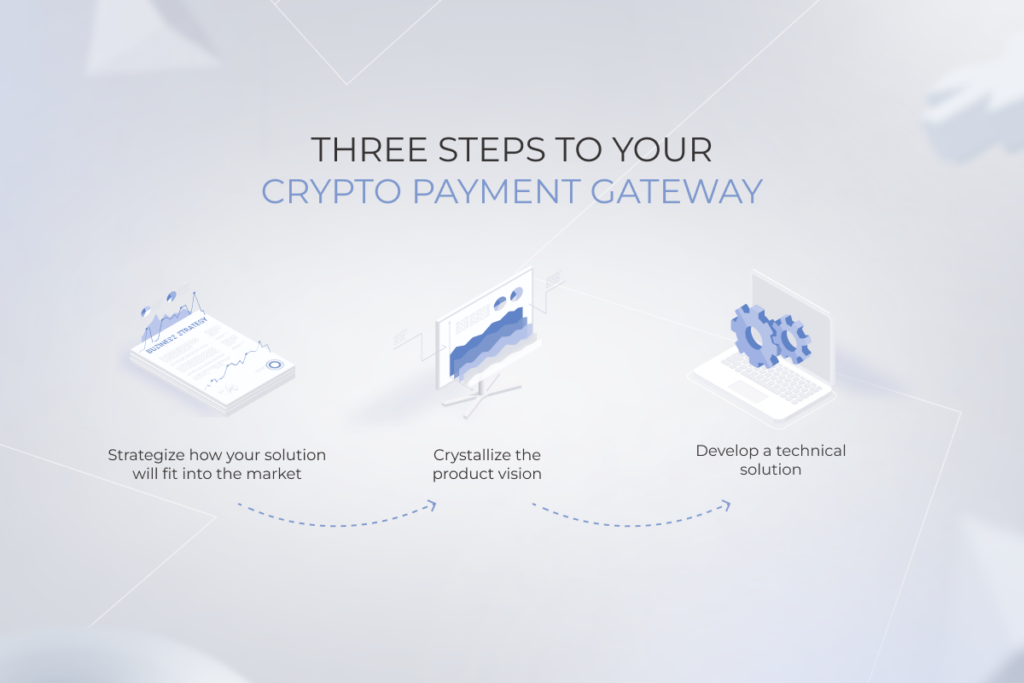
It’s vital to know how to create a crypto payment gateway step by step to ensure your solution works securely, without a glitch, and provides the necessary features. To succeed, you should meet the market demand, have a clear vision of your product, and choose the right technologies to develop an appropriate solution. Take a closer look at the process so you won’t miss anything when the time comes.

Strategize how your cryptocurrency payment gateway will fit into the market

Investigating the needs of the market you’re interested in is key to determining whether your solution will be in demand. For example, Morocco is one of the countries most reliant on cash – 74% of the population is unbanked. But at the same time, 84% of people have internet access. So, if you want to reach possible customers from Morocco, it’s easier to do it with crypto. The fact this country is now known as the second leading crypto-trading nation in the MENA region only proves the point.

Delve into the specifics of the regulatory requirements

Figuring out the regulators’ requirements is one of the most challenging tasks when creating a crypto payment gateway. First of all, you should check the legislations of the countries you are interested in and learn how they regulate operations with cryptocurrency.

Let’s take, for example, that you are located in Europe and want to use crypto to expand your business capabilities in the Asian market. If you have experience with a crypto payment gateway in France, where it’s enough to be an officially registered company and fulfill local AML obligations, it doesn’t mean that the same rules are applicable to another jurisdiction. 

The attitude to cryptocurrencies might vary even within a region (as it is in Asia), not to mention different continents. For instance, Japan recognizes Bitcoin and other digital currencies as legal property, and has the most progressive regulatory climate for cryptocurrencies. At the same time, China and Vietnam have prohibited crypto transactions. 

Don’t struggle while deciphering regulators' requirements

Get in touch

Find banks to cooperate with

Picking out a bank to partner with is usually the biggest stumbling block on your way to crypto payment gateway development. When a bank starts working with cryptocurrency, it gets a high-risk score from payment systems (Visa, Mastercard, etc.) it depends on. So consider the possibility that you may need a couple of FTEs to search for banks open to cooperation. Another option though is to take advantage of a partnership with a consulting company that has experience in building crypto gateways and can help you negotiate with the bank’s decision-makers.

Identify what will make you stand out from the crowd

The odds are that your idea of “the best crypto payment gateway” has already been embodied by another company, and you’re reinventing the wheel. To come up with an eligible solution, you should distinguish your business from the competitors either by the unique functionality of your gateway or by certain privileges, such as support from the authorities or access to a loyal bank that other organizations don’t have. Take a look at your competitors, and analyze their pros and cons to highlight how your solution may differ from theirs.

Take into account the costs of maintaining a crypto payment gateway solution

A crypto gateway is a solution tightly linked to a multitude of services that keep it alive — we’ll describe this in more detail a little later — and that’s why you also have to maintain all of these integrations. 

Technical intricacy is far from the only thing you’ll have to spend money on. Speaking of building a white label crypto payment gateway, your regulator may have specific requirements for your AML (Anti-Money Laundering) and KYC (Know Your Customer) department. The regulator can determine the composition of the team and the required level of expertise for its members, which might cost you a pretty penny.

Does thinking about how to build a crypto payment gateway cause chills down your spine?

We can help

Crystallizing the product vision

Once you’ve solidified your decision to create a crypto payment gateway, it’s time to move on to detailing the vision of your product. Do you want to follow a “hands-off” approach to your fiat-to-crypto payment gateway where you don’t keep your customers’ money in your accounts? Or would you like to be more “hands-on” and deal with custodial storage? The last one is way more complicated and expensive as a “hands-on” approach drastically increases the infrastructure costs and expenses for security specialists. So it’s vital to choose what level of responsibility you’re ready to take and how much you’re ready to spend on a crypto payment gateway solution from the outset. 

Come up with unique features for your crypto gateway

Who is your target audience? What do your customers expect from you? Will you set limits on the sums your customers can operate with? These, and many other questions, demand answers before your project kicks off.

The choice of features for a top crypto payment gateway depends equally on your customers’ needs regarding the convenience of the service, and your administrative needs when it comes to the internal processes of exchange management such as rates, liquidity, control, reporting, and others, including:

  • The number of cryptocurrencies.
    Hypothetically, it’s possible to support any number of cryptocurrencies, but how feasible is it on the technical side? As blockchain is the technology behind crypto, the more cryptocurrencies there are within your exchange, the more blockchains you’ll have to process. It might be more appropriate to choose a few of the most popular cryptocurrencies among your targeted audience, such as Bitcoin, Ethereum, Litecoin, etc., and invest your budget into developing more specific features. 
  • Available payment methods.
    Cards, electronic money transfers, etc. — you should find out what options your customers truly need so that you won’t overload your crypto solution with unnecessary features that will only delay your time-to-market. 
  • Peculiarities of exchange rates.
    You can set the same fee for using your cryptocurrency gateway or create a gradation depending on the increase of the amount of exchange. For example, for the transaction which is under $10,000, it might be 0.6%, over $50,000 – 0.25%, over $100,000 – 0.15%, and so on. Moreover, you can offer personal discounts for transactions of large sums to stimulate customers to opt for your service. Such gradation can be automated so that you don’t waste your employees’ time on tedious, repetitive tasks.
  • Payments automation.
    Because of the cryptocurrency volatility, it’s crucial to convert crypto to fiat and vice versa instantly before the rate changes. You can set up automatic payment cancellation if customers don’t manage to make it in the allotted time. Or you can provide them with a checkout and recalculate the money at the new rate, so you don’t have to transfer them back and forth

Features required on the administrative side can be compared to the underwater part of an iceberg. While the cryptocurrency exchange operation is duck soup for the customer, it’s far from being that easy under the hood due to the complexity of banking internal processes.
In my experience, business owners often have to deal with reality at this stage and accept that it’s more profitable to give up unnecessary and overly sophisticated ideas, such as supporting 100+ cryptocurrencies, so that the development of the gateway won’t be delayed. 

What features would you like your white label crypto payment gateway to have?

Let’s discuss!

Think of integrations with vendors and banks

A crypto payment gateway is a system that cannot live on its own. It requires a plethora of integrations with other systems, tools, etc., through the crypto payment gateway API to keep the platform running. For instance, if your website is built on WordPress and you want to implement a crypto solution in it, you should have a crypto payment gateway for WordPress API. All the required integrations should be well-thought-out so that the whole crypto payment gateway system works harmoniously and securely. 

Balance product features with expected time-to-market

The critical point in any business idea is its timely implementation. You can come up with a crypto exchange unicorn, but does the development of such a solution fit into your go-to-market timeline? Your current plans on crypto payment gateway development will unlikely be relevant in ten years when you’ve finally got to its release. Therefore, balancing the gateway’s functionality and time-to-market is crucial to effectively compete with other crypto solutions providers.  

Developing a technical solution

You can enter the technical development stage only after you’ve clearly understood which regulations work in your target markets, determined the product features you need, and got your bank partner’s approval. The tricky part is the vast number of integrations, especially those involving banks, AML, and KYC processes. While developing the solution, you should keep in mind your business strategy and clear product vision, which we have reviewed above, but, with the support of your technical partner, you’ll be able to bring your idea to life. 

Now let’s see the magic happen…but not quite yet. Before you send your project to market, get ready to deal with add-ons required by the regulator. For instance, they can request to build some extra verification modules on top to strengthen the security of the solution’s infrastructure. Keep in mind this is part of the process and be prepared for some extra work at this stage.

three steps to creating a crypto payment gateway

Go gradually when creating your crypto payment gateway

To build a reliable, efficient, and secure crypto payment gateway, you must tie together your business strategy, product vision, and technical solution while keeping regulations in mind.

Still, puzzling over developing an efficient and secure solution that would allow users to make cryptocurrency transactions legally and transparently and meet the requirements of the banks and payment systems? We are ready to share our expertise and help you build a cryptocurrency payment gateway. Get in touch

The Wild West of Open Source Business Intelligence 

Long gone are the days when the market of business intelligence was at the mercy of proprietary BI tools. In 2023, top-flying companies and startups opt for open source business intelligence to supercharge their business resilience. 

The data shows that public BI is on the rise due to its usage among Fortune 500 companies. Nearly all of the most profitable businesses use open source software, and the tech community is heavily backing this trend. On GitHub, there are more than 140 million open source projects.

The high rate of adoption is a result of the advantages that open source BI offers, such as agility, cost effectiveness, and personalization. Nevertheless, like any other technology, it has some potential issues that need to be examined. In this article, we will provide an overview of the risks as well as share the examples of where open source solutions are most suitable.

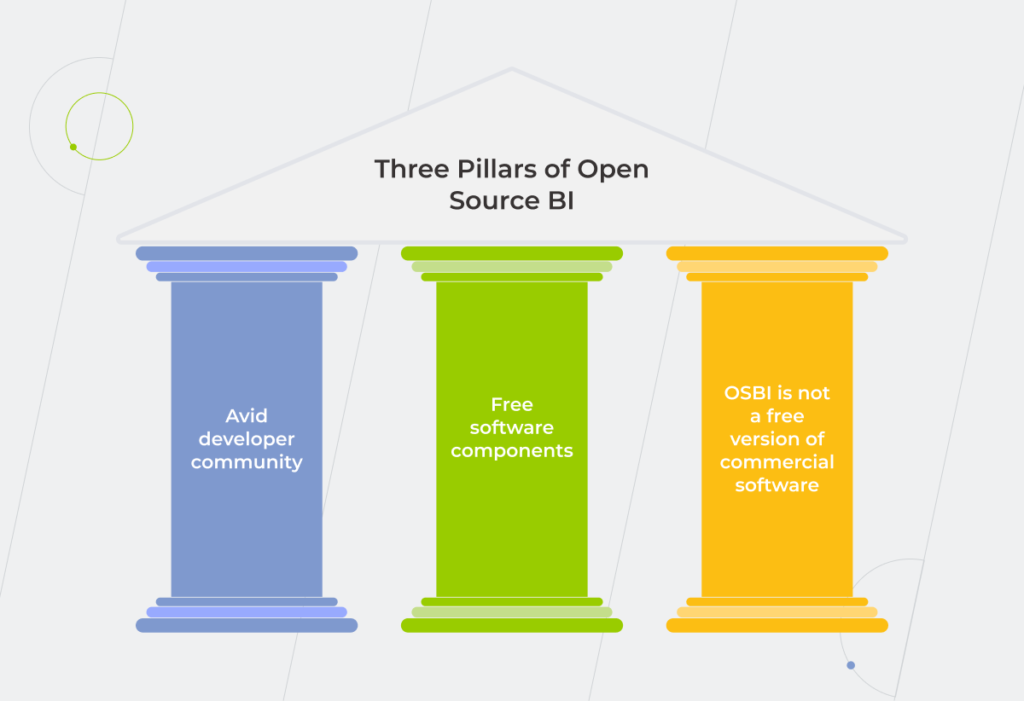
Three pillars of open-source BI tools

Although non-proprietary software has made significant inroads into enterprise systems, it’s still wrapped in myths. Below, we outlined the main differentiators of open-source BI solutions or OSBI, that separate it from traditional, closed products.

An avid developer community makes business intelligence open source

Transparent BI software is backed by a large community of enthusiasts. These communities don’t have a corporate hierarchy and allow each developer to make their contribution to the open source code. Contributions may include custom extensions, security patches, and others.

Open source BI tools are free. But not completely

Unlike commercial products, public business intelligence software doesn’t charge any license fees to access its core functionality. However, these tools may still bill an additional amount for other add-ons or lack some functionality. That’s why Apache Superset has drill-down limitations in data visualization tools. 

OSBI is not synonymous with free commercial products

Some popular business intelligence companies roll out a free version of their canned BI software. However, a license-free model or a trial period does not make these freebies open-source. Users face different kinds of constraints in free versions of commercial software, for example, Tableau Public.

three pillars of open-source BI

The bright side of open-source business intelligence

Non-proprietary solutions are treasured by thousands of companies and tech-savvy individuals. Just like for-sale products, public business intelligence guides its users into taming huge datasets and generating critical insights.

Here is a breakdown of other unique benefits open source BI software has in store.

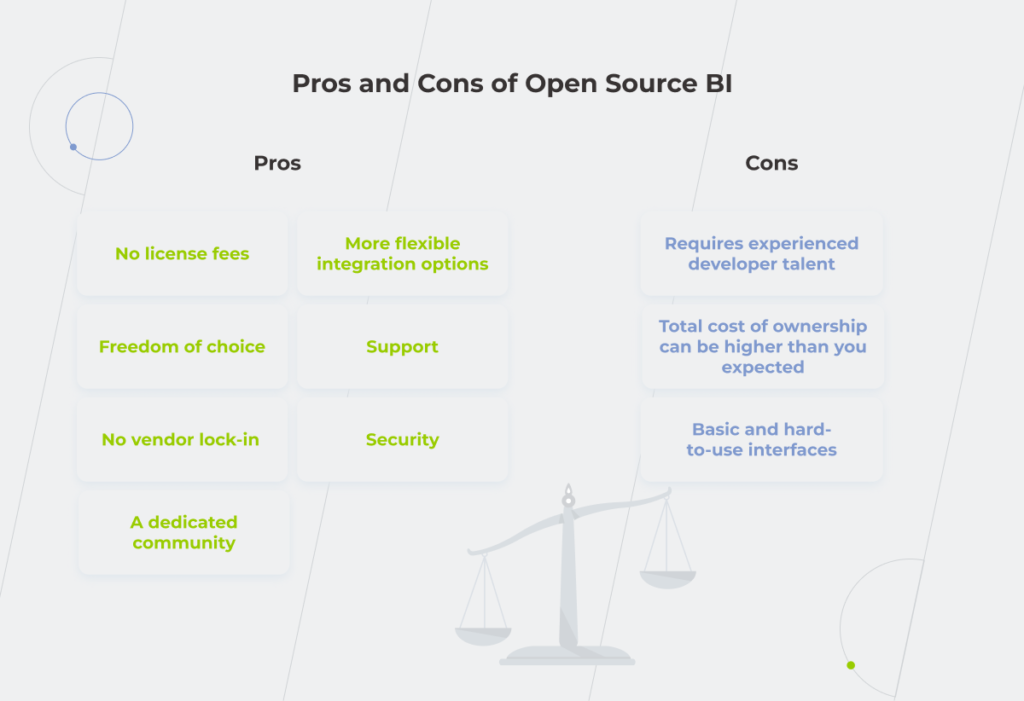
No license fees

Open source business intelligence platforms require little to no upfront investment since they are accessible with no licensing. In most cases, OSBI products offer the core modules at no cost, while additional features can be unlocked for an affordable fee. For example, you can get an infinite number of reports and dashboards, yet your data storage and data connectors will be limited. 

If you already have an in-house team of developers, they can build the needed functionality on top of core modules with no additional costs. In any case, open-source software doesn’t incur the overheads of commercial licensing and offers an affordable takeoff for small and medium businesses.

A dedicated community

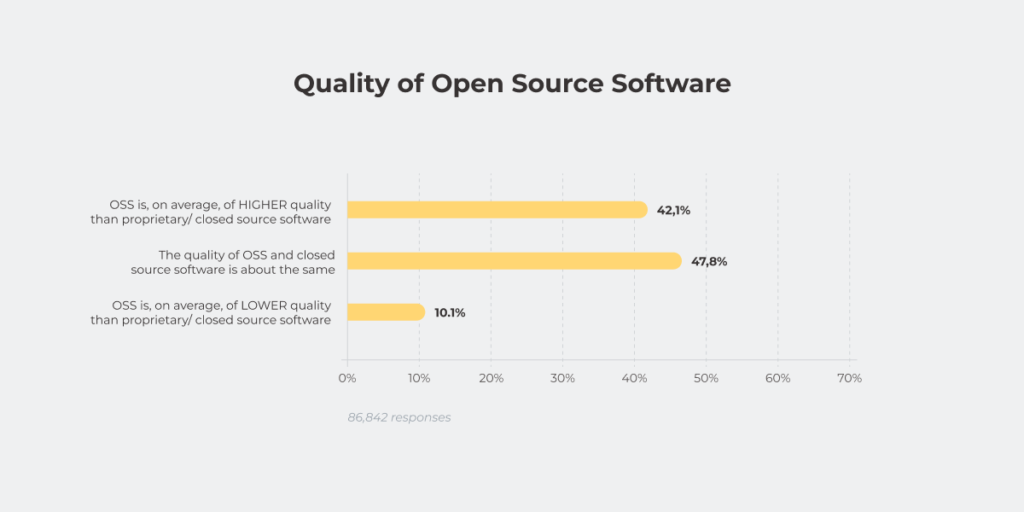
According to StackOverflow, open source solutions often topple or are on par with closed source software in terms of quality. The high quality of open source software is courtesy of a large developer community that is collectively working to enhance the solution. 

open source software

A strong and mature community, in turn, translates into a number of other benefits, including:

  • Faster response to market trends;
  • Faster bug resolution;
  • More consistent release cycles, which equal regular updates;
  • Better reaction to security issues;
  • The diversity of ideas with no bias or lopsided vision.

For companies, it means that it’s not that difficult to find experienced developers. In some cases, enthusiasts can even chip in with a free custom feature for your unique case.

No vendor lock-in

Statistics show that 62% of companies use open source software to avoid vendor lock-in. Open source BI allows businesses to use an optimum set of tools to fit their unique footprint with no price hikes. Most importantly, you don’t need to pay for a package solution from the vendor. Instead, you can get the best of the platform and combine it with the tech stack your company uses. 

Instead of being shackled by one technology, you can test your options and decide on the most optimum one. It also means that you can keep pace with the new transformational trends without costly migration or switchover.  

Freedom of choice

Non-proprietary systems put you in a favorable position to hand-pick each component of your BI solution. While many commercial BI products focus on specific fortes, such as ETL pipelines or interactive dashboards, open sources tend to excel as a solid, full-fledged BI solution. This is a direct result of strong community support and a regular rhythm of new features and updates. 

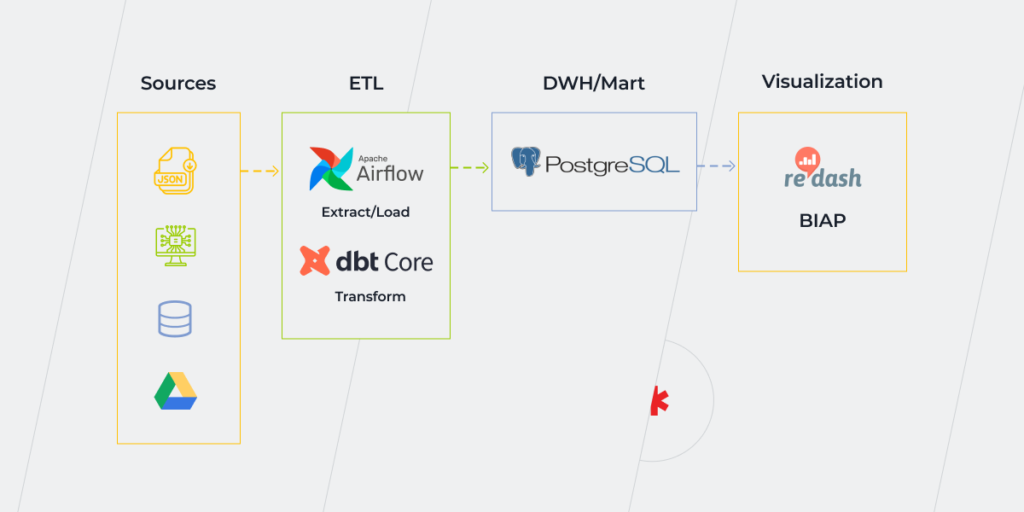
Thus, your developer team can take out each system component and enhance it or combine it with other functionality. For example, at *instinctools, we use data integration studio and Apache Airflow to set up a custom-built ETL pipeline. At the visualization stage, our BI engineers manipulate visualization components with hand-coded libraries such as D3.js to add funnels, pivot tables, and other custom representations or open source BI tools like Redash or Metabase.

All the benefits mentioned above naturally flow into the power of customization. As developers have access to the core code, they can make changes on demand to better suit their needs. Unlike a closed system that locks users in, open-source allows them to adapt and modify the code to meet a particular need or application.

Therefore, coders can tweak and twist open source software for a unique fit — be it functionality or design — to make it a natural part of any type of operating system for any application.

More flexible integration options

The adaptability of open-source tools allows for integration tolerance to support personal data processing needs. It means that you can seamlessly embed the OSBI solution into your enterprise system, even if it doesn’t consist of open-source components, with no disruption or system changes. Thus, if the rest of your business ecosystem is open source (CRM, CMS, ERPs, etc), you are free to plug them into your open source BI tool to create a blended single platform of data excellence.

Proprietary software, on the contrary, tends to cover a specific set of integrations that may limit your business intelligence. Power BI, for example, sits within the Microsoft ecosystem and integrates naturally within Microsoft products, including Excel, Azure, Access, and others. For instance, we’ve already discussed that you can marry Power BI with Excel to benefit from both tools at once.

Support

Timely and quality support is a must for any business intelligence software, be it commercial or free. However, OSBI tools add a bit more confidence to the business owners if the latter faces an issue or needs a quick walk around. 

Issues are resolved even faster when you have skilled developers at your service. 

Security

The secrecy of your code doesn’t guarantee its security. Instead, making the backend available for the public exposes it to a thousand vigilant eyes. As a result, community involvement accounts for responsible vulnerability disclosures that would take longer to detect if the code was closed.

Moreover, open-source BI software gets faster patches and updates when a severe vulnerability is detected. On average, it may take a couple of days until the vulnerability is eliminated. Open source also fares better for compliance and internal security policies since it’s fully customizable for any regulation.

The dark side of open source BI

Open-source business intelligence may still come at a cost. Below, you’ll find the main downsides of such projects.

Requires experienced developer talent

Ready-to-go technology doesn’t free you from the skill investment. To make the most of open-source business intelligence, you need trained developers who can find their way around it and make it work for your benefit. Improving data quality before loading it into the BI system, adjusting the system to your business framework and maintaining it is also knowledge-intensive and mandates an experienced developer pod.  

If you’re looking for a vetted team of developers that can keep your system up and running, *instinctools provides open-source BI services for companies of all sizes. Drop us a line to get a ready-to-go team of BI experts.

Total cost of ownership can be higher than you expected

Until your BI platform is bug-free and fault-tolerant, it doesn’t need any effort from your side. But once you’re facing an issue, your company is left on its own to resolve it. Therefore, while being free, open BI may still require investment to adjust the infrastructure or eliminate a bug. Introducing extensions is also on your payroll.

Basic and hard-to-use interfaces

Finally, public software is purpose-driven. While it isn’t a bad thing, the user experience of open solutions may not keep up with its functionality. Open source business intelligence doesn’t have a team of UX/UI experts to polish its look. Instead, each community member contributes to the software, which makes it a patchwork, rather than a singularity. 

To improve user experience, businesses can add new design elements or other strategies. However, these modifications will incur additional costs.

pros and conc of open-source BI

This is how we handled an open-source BI project for one of our clients

For 25+ years, our team at *instinctools has been helping global businesses introduce custom data analytics solutions that target their unique needs. Open source BI software is what adds an extra individual touch to our business intelligence services and allows our engineers to sculpt a unique business intelligence infrastructure.

One of our clients, an agency of the federal government, was looking to build a custom business intelligence infrastructure. However, a Qlik-based solution, which had been initially offered, didn’t meet both the technical and budget requirements. A ready-made analytics platform required significant upfront investment and an in-house IT department to manage the solution. Moreover, a commercial solution didn’t cover the user’s needs and experience at a given destination.

To eliminate these challenges, our BI engineers suggested a get-started BI infrastructure that covers the individual needs of our client. Our team came up with the following plan to accommodate the data needs of this client:

  • Postgres – as an open-source data storage;
  • ClickHouse – as an open-source data storage system for large data analysis;
  • Apache Airflow – for building a robust ETL pipeline and orchestrating the ETL workflow;
  • Python – as a core data processing technology for an ETL pipeline;
  • Redash – as the main data analysis and visualization tool for in-house data scientists;
  • A custom-made application that generates reports for other user groups.

The open-source component in this custom BI setup helps our client to manage and maintain the solution with no additional effort. It also means that our client can easily find a team of engineers to support the infrastructure.

open source BI

Who benefits from open-source BI the most?

Although open data intelligence solutions seem like a go-to option for all verticals, some industries and user groups will reap more benefits from integrating them into their ecosystem.

SME and start-ups

Virtually any small business is looking to avoid financial drains to optimize its sales revenue. Public BI software helps SMEs and startups get value for money and is easy on their budgets. As small businesses usually have limited in-house tech support, community support of OSBI is also the wisest approach to troubleshooting.

Consulting agencies

Software consulting companies are among the regular users of BI open source. The latter allows companies to speed up development for their clients. As consulting agencies also have experienced developers on-site, they can easily adapt the solution to individual requirements.

Companies operating on legacy software

For some organizations, the hassle of software migration isn’t worth the trouble as they are more focused on their business than on the tech components. Typically, it’s the government or finance verticals that rely on a tried-and-true infrastructure. Thus, no matter how edgy the solution is, it won’t bring them any ROI or business value.

Open-source analytics tools, on the contrary, will still help them adapt to the new reality with no switchover or much budget allocation.

Organizations that seek automation and connectivity

Companies that may benefit the most include those using Internet-of-Things-connected devices, autonomous vehicles, and consumer products as well as retail, manufacturing, and industrial applications. Overall, any industry that needs a consistent and 360° data view can easily integrate the OSBI into the existing infrastructure.

Summing up, public BI strategy can benefit anyone who has specific data needs but lacks either time or money to build a full-fledged platform. 

Your shortcut to data supremacy

Staying on top of your data is a mandate in 2023 to make informed business decisions. But despite a widespread opinion, business intelligence doesn’t have to be a pricey undertaking. Public BI platforms enable companies to drive data efficiency without large investments or huge technical dedication. 

Being a go-to option for SMEs and startups, open-source BI solutions can both invite data consciousness at the early stages of a BI journey or become a highly customizable business asset for existing infrastructure.

Ready for a takeoff?

Get a free consultation now

The Role of Business Intelligence in Digital Transformation: How Advanced Analytics Supports Your Business Remodeling

What is the impact of business intelligence in digital transformation? Given the sheer volume of disparate unstructured data that modern organizations have to deal with, you’ll need some technology to enhance data quality and speed up the delivery of valuable insights for your strategic and tactical decisions. Business Intelligence (BI) can become one of the drivers of your transformational efforts. 

In this article, our expert reviews how BI can help you create the right conditions for achieving the ultimate goals of digital transformation, such as agility, resilience, efficiency, and transparency. Explore BI technology and discover real-world examples of how it transforms data into profit.

What elements of digital transformation can be entrusted to Business Intelligence?

A fundamental component of any digital transformation is making well-informed decisions and tracking the impact they have on your business. This is exactly what BI in digital transformation is responsible for.

  • Enhanced quality of information 

Huge data volumes aren’t of much use in their raw form. To clear the way for accurate data analysis, you first need to take care of data quality. Business Intelligence involves ETL processes when you extract structured and unstructured data from various channels, transform it according to your business rules to get standardized sorted data, and load this information into a unified repository. Only then is the data suitable for use in analytics tools, such as Power BI, Tableau, Qlik, etc.
Forming an integral part of business intelligence platforms, ETL processes can be also built as part of an open-source BI project, amplifying the quality of your data at an affordable cost.  

BI in digital transformation
  • A holistic view of an organization’s operations in real-time 

Besides grasping large volumes of information in the blink of an eye, you can uncover hidden patterns that would be barely deciphered from numerical data. Moreover, these improvements can be implemented across the entire organization with custom dashboards for each level of decision-making. Staff from different departments will benefit from the operational dashboards with detailed visualizations of their current activities. Analytical dashboards can save a lot of time for department leaders by providing them with a comprehensive overview of crucial data by periods and categories. Well-honed data analytics sharpens your business acumen, helping you make pivotal decisions, like setting the right prices. Meanwhile, C-suite members can rely on strategic dashboards with key statistics when making fundamental decisions. 

  • An opportunity to track whether you are moving in line with your business strategy

With its basic functionality, Business Intelligence in digital transformation is responsible for reporting, analysis, and monitoring. It helps you answer all-important questions such as “what is happening?” and “why did it happen?” Beyond that, coupled with Machine Learning (ML) and Artificial Intelligence (AI), BI is extremely beneficial for forecasting, predictive, and prescriptive analytics to get responses to “what might happen?” as well as “when and why will this happen?” Making predictions based on historical data, patterns, trends, and complex interactions, your system serves you as a dead-on fortune-telling ball.

BI in digital transformation
  • Improved customer experience

When all the data about your customers from your website, CRM, social channels, etc., is gathered in a single location, it’s easier for you to analyze, segment, and target various customer groups. That way, you can enhance customer relationship management and increase customer satisfaction. 

Moreover, adopting BI in digital transformation allows you to avoid wasting time analyzing data manually. The system handles it for you. Therefore, the information is available ad-hoc – you don’t have to wait for the weekly or monthly reports and can make decisions immediately. Your employees don’t have to waste their time on the operations that can be entrusted to the technology and can dedicate it to more responsive customer service.

BI in digital transformation

Want to get actionable information on time to make well-balanced business decisions? Transform data into value with Business Intelligence consulting provided by our team.

Want to get actionable information on time to make well-balanced business decisions?

Transform data into value

Real-life examples of how BI transforms data into actual profit

Business Intelligence is a heavy hitter that empowers you to follow your digital path and become a data-driven organization. It sounds great in theory, so let’s see how the technology works when you put it into practice.

Imagine that there’s a chain of gas stations. Not only is the fuel itself a source of income, but the sales of related products can generate significant revenue as well. However, without proper data analysis and visualization, it’s easy to overlook this potential as the organization doesn’t realize how much data it has and, more importantly, how it can be turned into business-oriented information. Having a clear idea of how much fuel people tend to fill up per visit, how frequently they come to gas stations, etc., you can target promotions more accurately. For instance, if your customers fill up at an average of 6.5 gallons, you can offer a promotion “Fill up at 7 gallons and get a free coffee”. Also, accurate and timely data analysis can uncover what services should be added to the existing ones to increase the average check or the number of customers.

The way we capture, transform, and analyze data determines our decision-making velocity. Making the right decisions faster becomes extremely important when it comes to human lives. That’s why, using BI technology in the healthcare industry provides an opportunity to improve medical services and patient care. 

At the beginning of the COVID-19 era, when the whole healthcare system was in a shake-up and had to really transform its approach to patient care, we created a BI solution for hospitals. The point was to analyze the staffing levels of the hospitals and check available places, ventilators, etc. To keep the intensive care unit running non-stop, you should calculate the number of resuscitators per unit, considering how many patients one can take care of. Data on available doctors was crucial, given the rate at which the number of patients was increasing. 

How have we, with the help of BI, made it possible for hospitals to cope with such a workload? We collected primary data on available doctors and put it on the map so that there was an understanding – if a hospital has extra resuscitators, it can send one of them to a hospital that lacks these specialists. This way, you can quickly reallocate resources while considering the distance between hospitals since doctors are humans after all, and they get tired too. 

BI can help track not only the people’s condition but also the state of mechanisms. An example from the manufacturing industry proves this. You can leverage BI for predictive maintenance. If you couple the technology with the Internet of Things (IoT), you’ll be able to analyze sensor data such as temperature, the vibration of your machinery, etc. With this data, you uncover even minor issues and fix them before they become severe problems that can cause downtimes. From that standpoint, BI is a way to unlock the pleasure of working with a minimum of accidents.

BI in digital transformation

Digital transformation is especially urgent in industries that haven’t changed in a long time and are craving for reinvention. One of these is education. You can take advantage of BI to create personalized experiences for the students instead of a one-size-fits-all approach. How does it work in practice? Teachers can be empowered with custom interactive dashboards that show their students’ academic progress. 

Here’s an example from our guide about EdTech trends that shape the future of education:

BI in digital transformation

On this dashboard, you can see and assess the progress of any student in one discipline. Green columns mean that the student has mastered the topic perfectly, blue identifies students who need to refine and consolidate the topic, and red marks denote underachieving students. With technology support, you can spot gaps and issues in time to help students achieve their best. 

BI is full of outstanding capabilities with each bringing value on its own. By simply monitoring the actual state of what’s happening within your organization, a BI system helps uncover anomalies that you’d like to know about before they hit your wallet. Before the implementation of BI software, one of our clients, a tech retailer that sells devices, once mispriced a category of items on the site by charging $1 instead of $100 for them. As the sales data was analyzed once a week in spreadsheets, the problem was identified later than it should have been and hit the company’s wallet hard. If their data was organized conveniently enough and checked daily, they would notice that the average price of the product had dropped drastically and that would have prompted further investigation.

Be proactive: what to start with?

Implementing technology on an unprepared basis is like stacking bricks on top of bare ground, without a foundation, in the hope that you’ll end up with a livable facility. Just as it doesn’t work for construction, it’s not an option for business either. To make use of the Business Intelligence part in digital transformation, the core processes in a company should already be digital and stable. What processes are considered to be core? It depends on the industry that your company represents. For example, for healthcare, it might be patients’ scheduling, for banking – lending and mortgage operations, etc. They have to be in your system in a digital form, not on paper. So, before rushing into advanced analytics, you first might leverage RPA technology for end-to-end document processing.

It is also crucial to standardize the basic functions of the organization. For example, a medical company that deals with patients should have a standard digitized process for making appointments, etc. 

The fundamental point is that until there are no standard processes and data in a digital format, the technology has nothing to analyze and visualize. Hence, you can’t wrap large volumes of data efficiently. 

If you want to benefit from custom dashboards but can’t identify core processes that should be automated, or have other questions about the stages that precede digital transformation, take advantage of the dedicated team’s expertise.

Fuel your digital transformation with qualitative business analytics

To succeed in digital transformation and build a data-driven organization, you should organize processes around customers and technology around data. Technologies such as Business Intelligence improve the quality of data and, therefore, the quality of decisions that fuel your business. BI offers easy-to-grasp dashboards and provides a transformative speed to business insights. 

Reach out to our experts to discuss your perspectives on leveraging BI during your digital transformation journey. 

10 Business Problems BI Automation Cracks

What opportunities become available to you with business intelligence automation in place? Extracting value from diverse data sources leads to increased customer satisfaction, better staff engagement and productivity, minimized number of human errors, and more. However, utilizing the full potential of BI is possible only when it’s married with a robust automation strategy. 

The rapidly growing demand for automation among the leading analytics platforms proves the point. For instance, a famous analytics vendor, Tibco, was about to merge with Blue prism, a pioneer among RPA vendors at the end of 2021, while Alteryx partnered with UiPath, a company that also delivers an RPA-based platform. Automation is now viewed as not only a facilitator of the repeated processes but also as an essential part of insight delivery. So whether you’re at the beginning of your journey to a data-driven organization or you’ve been leveraging BI for a while, here’s a list of problems that BI automation can help you solve.

1. An inefficient process of discovering and ranking insights

Extracting and ranking data-driven insights manually is quite an exhausting process. Besides, it steals precious working hours that your team could dedicate to more important tasks.

The implementation of BI dashboards is a wise step for organizations overwhelmed with data. It can help them avoid wasting time and human effort and streamline workflows overall. Apart from uncovering actionable insights in real time, automated tools enable users to prioritize them, thus contributing to smarter decision-making. 

Speaking of the opportunities BI automation entails, healthcare is a vivid example of an industry that craves them most. Producing tremendous amounts of data, medical organizations often face the challenges of handling loads of heterogeneous data with a limited number of employees. They might find themselves confused on how to implement high-end software in a clinical setting.

Thus, medical organizations can become more proactive in exploring trends and demographics by using the clustering feature in Tableau. The solution helps to define statistically similar groups based on the indicated attributes, for example, rank insights on pediatrics and compare short-stay patients to the extended-stay ones.

2. Poor data quality

When processing large volumes of data, it’s too hard to overcome the human factor and detect every single error on the spot. Sacrificing data quality can cost you a lot as this leads to large financial losses, a damaged company reputation, inaccurate targeting, uninformed decisions, among others.

Specifically, poor data can affect sales and marketing pipelines. If your mailing lists lack “hygiene”, have wrong contact information, or include addressees who have already unsubscribed, you are likely to have extremely high churn rates and lose potential clients.

In this regard, data preprocessing becomes a big deal in a struggle for accurate and reliable analytics. However, data scientists often fail to perform thorough preprocessing due to the acute lack of time. The use of platforms, such as Microsoft Power BI, can eliminate the need for repetitive manual data cleansing. With the help of Power Query Editor, you can automatically identify and remove duplicates, missing values, or errors, thus waving goodbye to another obstacle to the overall company’s productivity.

3. Analyzing data from disparate systems

Some companies can’t keep pace with digital transformation and fall behind in migrating from legacy systems to more modern ones. A recent survey by CIO Insider revealed that an average IT department across all industries spends about 55% of its technology budget on maintaining existing infrastructures instead of building new innovative capabilities. In this way, legacy systems become a heavy burden as their expensive maintenance and lack of integration with modern ecosystems hold back a lot of organizations.

Business Intelligence automation, in its turn, effectively streamlines data flow from one system to another and helps to collect data into a single source of truth. Additionally, automated solutions simplify structuring content to get it ready for analysis.

4. Limited access to information due to dependence on technical staff 

Though having unimpeded access to data for all teams within an organization seems a sure thing, it doesn’t really work this way in practice. In most cases, legacy systems simply lack flexibility and require the participation of data scientists to derive data-driven insights and distribute them to all levels of the company.

Applying a BI toolset greatly contributes to the democratization of information. The use of cloud databases like Azure or Google Cloud empowers users without deep technical knowledge to access any information in the company’s warehouse and convert data into a convenient format for quick sharing of the important content through corporate channels independently from an IT department.

5. Poor customer experience

Most businesses aim at providing a better customer experience, but very few really succeed. The reason is random guesswork, as confused managers often base their conclusions on insufficient or unreliable data. All this leads to the promotion of the wrong goods, services, or features, resulting in unsatisfied customers.

Why is BI automation a win-win scenario in this case? It hardly needs saying that communication is the key. Customers themselves know what they want. In this regard, collecting feedback with interactive in-app or online surveys and tracking customer behavior on websites are forward-leaning steps on the way to understanding customer needs, being more responsive to market changes, and increasing revenue.

6. Manual data entry

Given that manual data entry is a time-consuming routine process prone to errors and typos, it’s not a practical option for most companies. Whether you need to capture personal information from a CV for HR purposes or extract important data from invoices for an accounting report, automated OCR-based software can successfully optimize these tasks.

Such solutions help to automatically pull out data from varied resources, including PDFs, photos, or websites, and deliver it in a structured visible format in several clicks.

Is the implementation of automated BI among your priorities for 2022?

Learn More

7. Manual querying

Instead of wasting employees’ time on searching and summarizing information, automated solutions gather data from multiple sources, generate reports and present them on schedule, without the need for human effort.

Giants like Netflix and TLC have embarked on their automation journey and their achievements inspire others to do the same. Specifically, TLC claimed its productivity increased by 25%, while Netflix manages to save 50 employee hours daily by leveraging automated reporting solutions.

Recently, our team also helped a media-services provider to optimize the decision-making flows by deploying self-service BI. The implemented solution freed up business users from cumbersome report generation, saving approximately 280 hours per month and increasing customer satisfaction by 85%.

8. Having no idea of what your competitors are up to

Today’s highly competitive business landscape makes companies struggle for their position more than ever before. As they say, forewarned is forearmed, and BI automation should become your major weapon in tracking performance.

While Ahrefs and Semrush can help you find your competitors’ keywords, Google Alerts will timely notify you when your rivals are mentioned online. Detecting and analyzing the key performance metrics with smart BI automation tools will keep you updated about the market situation in real-time and reveal if you are at risk of being out of the running. 

9. Low employee productivity and engagement

Nowadays, employee burnout is spreading almost as fast as the COVID-19 pandemic. The findings from recent research by Deloitte indicated that 77% of employees face the problem of burnout at their current workplace. Apart from working extra hours and lack of vacation time, respondents also mention unclear job expectations and lack of workplace communication as the reasons.

Keeping the staff motivated can be solved by Business Intelligence automation in several directions:

  • As BI dashboards visualize important metrics and provide important statistics, they can be used as tools for keeping employees informed about the company’s mission, vision, and priorities. A transparent information flow creates a sense of engagement and belonging to common goals.
  • In terms of personal performance, BI dashboards are useful assistants as well, enabling employees to easily access all the needed metrics and identify areas for improvement with a click of a button. Such analysis empowers the teams to have a clear understanding of their strengths and weaknesses, better identify priorities and improve in-house communication, thus avoiding overloads and minimizing the risk of burnouts.

10. An overworked and overwhelmed HR department

The COVID-19 pandemic affected the way businesses get the workflows going, and HR departments were among the first to adapt to the new circumstances. 98% of HR leaders highlight that they have experienced significant transformations in their roles and responsibilities throughout the pandemic.

With automated BI, recruiters can gather data about past, current, and potential employees in one place to successfully assess employee strengths and weaknesses, track performance, offer relevant professional courses, motivate the staff, prevent conflicts and burnouts, and a lot more.

Automation unleashes the never-before-seen power of Business Intelligence

Business Intelligence is a valuable asset and critical ingredient of every operational field, regardless of the organization’s size and domain. It ensures that you won’t miss out on any meaningful data insights and put decision-making on a higher level. However, only automation makes the mission of BI a reality. At *instinctools, we’ve helped hundreds of business users to apply intelligent automation and make their BI adventures intuitive and secure, ensuring productivity and prudent use of resources.

How to Avoid a Bad Customer Experience in eCommerce: Five Mistakes to Learn from

Statistics demonstrate that customers’ favorable reviews of an organization’s service can have a positive effect on the business, as 38% of these customers are likely to recommend the company. On the other hand, 80% of customers will turn to your rivals if they are not content with your product or service. This clearly shows that customer experience in eCommerce is just as important as the product or service itself.

With three-quarters of people shopping online at least once a month, businesses need to know how to provide satisfactory online service to their customers.

What can be done to ensure that customers have a top-notch experience while shopping at your online store, and how can you stay competitive in the eCommerce world? Continue reading to find out.

ecommerce attachment

Why is customer experience important?

How much does it cost you to attract a customer? The Customer Acquisition Cost (CAC) among eCommerce platforms ranges from $127 to $462, depending on your industry. From that standpoint, it’s also crucial, alongside attracting buyers, to keep them from leaving your shop after making one $5 purchase. 

So what can you do to retain customers and increase their lifetime value? McKinsey describes a long-term strategy for collecting customer data. They suggest identifying profitable and high-value consumers and running targeted investments to create a superior level of customer experience. This is one of the factors that drives consumers to use your platform and turns them into loyal customers, providing you as a business owner with a steady cash flow and loyal client base. 

However, not everything always goes to plan. We’ve listed some fatal mistakes that may never let this happen. Repeat them at your own risk!

Failing to leverage customers’ uniqueness without affecting customers’ privacy

Everybody appreciates when their concerns are understood, and their issues are resolved quickly. Customizing clients’ interactions with your platform, you make it easier for them to navigate through a wide range of diverse information and, thereby, increase the likelihood of purchase. Customers usually find it convenient, when based on particular characteristics of an item they are looking for, the system recommends similar options and provides a list of goods being bought with that item.  

Personalization of the customer experience in eCommerce comes first in the race of competencies essential for your business success, leaving the Internet of Things and Big Data analytics behind in the dust.

customer experience attachment

To implement true personalization and improve the online shopping experience of your consumers, you need to explore their customer journey. Find out what is essential for each shopper, and what influences their decision to buy. 

However, before collecting data on buyers it’s crucial to find a balance between customer experience and customer privacy. PwC study shows that 43% of US-based consumers aren’t willing to give organizations permission to collect information about their age, location, purchase history, lifestyle, preferences, etc. To convince users to share their data, you first need to explain how this data will help enhance the service they get from you and prove that nothing threatens its privacy.

Three things matter to customers most: what data is gathered, how it’s done, and why a seller needs it. Buyers may simply not understand the purposes for which companies need their personal information. According to the BCG survey, more than half of consumers think vendors are selling their data. Therefore, the lack of clear answers to these three questions may be the reason for users’ reluctance to share their information. But, just promising not to sell the data to third-party organizations won’t motivate customers to disclose their info. Offer them data control and appropriate “value exchange” to get more information. Give them a one-time coupon or a permanent personal discount, a free sample of a product saved to favorites, access to the community, etc. to bring additional value to sharing personal data. 

Consumers’ data security doesn’t depend only on whether or not you sell it to third parties. You must also protect this information from cybercriminals. How to provide this valuable service considering that 31% of eCommerce platforms visitors are intruders trying to steal the personal data of real people? Here are some best practices that eCommerce platforms should follow to ensure customers’ data security:

  • Performing regular SQL checks to prevent SQL injections when hackers can access databases and retrieve consumers’ information from them. 
  • Encrypting personal data to make it impossible for cybercriminals to reconnect the information about buyers with real people. 
  • Implementing additional authentication factors to minimize the possibility of a data breach. Multi-factor authentication and two-step verification ensure that only authorized users are logged into the system. 

This is great if you managed to get customers’ consent to collect and process their data, and do it securely. But that’s not the last item on the list — you may face the problem of fragmentation of collected data. 

customer experience attachment

Implementation of robust Business Intelligence (BI) technologies and tools can resolve the problem of scattered customer data. Still, only 46% of organizations make use of BI to handle this issue. If you are also among the 36% of companies that are just planning BI adoption, prioritize this task to start making most of your data.

Accessibility issues and user-unfriendly UX/UI

To improve the online shopping experience, above all, create an inclusive design of your solution. Make your site accessible to everybody, including users with special needs.  According to the National Center of Birth Defects and Developmental Disabilities, 26% of adult Americans have some form of disability. That’s 64 million potential shoppers with an estimated spending power of $490 billion. From a business perspective, it’s a huge consumer market and prospective customer base. And if you don’t adjust the site to their needs, 69% of them will simply leave your store. 

Digital inclusion not only encourages new customers to interact with your brand and purchase your products and services. It also prevents your company from facing web accessibility lawsuits — according to UsableNet research, 74% of lawsuits involve eCommerce sites.

Here are some website requirements, stated by WCAG 2.1 AA digital accessibility standard:

  • The opportunity to resize any text up to 200% without assistive technology.
  • The possibility to change written text into alternative formats such as speech, simpler language, braille, or symbols. As for the text supposed to be entered by customers, you need alternative options too. For instance, speech recognition allows clients to perform such basic functions as clicking links and buttons, filling data in a field. Advanced speech recognition tools even can help with copying and pasting text, scrolling the screen, etc.
  • All functions should be available from a keyboard without using a mouse.

A well-thought-out human-focused design is not limited to accessibility solely. There are other actions you can take to improve customer experience on the website. Don’t miss the opportunity to boost your profits with basic steps such as placing common elements in expected areas. Choosing a unique design for a custom eCommerce solution is okay, but don’t get carried away with over-the-top customization. For instance, users may get lost if you don’t put the shopping cart in the upper right corner.

Also, remember to provide website visitors with a search bar. According to a Forrester report, 68% of customers state that they won’t return to a site with a poorly designed search function. 

The location of the search field is also important. The WallMonkeys’ example shows that simply moving it to the center of the screen can boost the conversion rate by 550%. 

Omitting the importance of the load speed

If you’re wondering how to improve customer experience online, first ensure any page of your website loads in a few seconds top. The times when consumers were okay with waiting for 20-30 seconds until site loads have long sank into oblivion. Amazon reports that every 100 ms of extra load time costs them 1 percent in sales. From this standpoint, your main threat is a back button.

Also, provide customers with mobile functionality for all the stages of their communication with your business, from browsing to purchase processing and payment as more than two-thirds of Americans use their smartphones to shop on the websites. 

If you’re not only working in the US market, where customers change smartphones every 2,5 years, but also in less affluent regions, where users shop from the phones that have been discontinued for five or more years, make sure that your platform adjusts well to the old-model gadgets. 

Neglecting omnichannel communication

It may seem that representatives of different generations require different communication channels, but in practice, the use of these channels varies slightly as we are all living at the same time. 

The truth is that nowadays online consulting is critical for your customers. The transformation of the eCommerce industry during the pandemic proved that consumers don’t necessarily need personal or face-to-face experience with a company to find and buy the products they’re looking for. Ensure flexibility of digital channels to make it easy and seamless for the customers to get detailed information about the products, discount programs, payment methods, and delivery options. 

Apart from standard forms of online consulting in eCommerce such as emails, chatbots, live chats, and phone calls, you can implement cutting-edge technologies, for instance, chatbots based on the RPA and AI technology. Even basic chatbots improve the online shopping experience by dealing with simple user requests 24/7. As for the adoption of AI, intelligent virtual assistants can replace real people in many ways. You can automatically deal not only with FAQ but also enable buyers to handle a wide range of problems related to their orders without having to wait for an answer from a customer service representative. 

Disregard for delivery and payment experience

Sending order/payment confirmation emails and timely updates of the shipping details are basic things, but first of all, you have to make sure that information about payment and delivery methods is easy to find. It’s optimal to create a dedicated section on the site. Use the right payment gateway that will be secure and will allow shoppers to easily pay for the items they buy.

If you sell and deliver goods over the globe there may be more complicated issues. For instance, you have to ensure that you offer enough options for payment and delivery to meet the expectations of your customers from different countries. For instance, there are some countries (e.g. China, Turkey) where buyers can’t pay with PayPal, so if you are interested in these markets, you should provide customers with alternative payment methods. Besides using different payment systems, consider the possibility to pay with cryptocurrency, as Amazon does for its gift cards. The same works for shipping too — standard services such as DPD, FedEx, etc. may be unavailable in some countries or be too costly compared to the products.

Forewarned is forearmed: mitigate the risks of losing your customers

Knowing about the most widespread mistakes related to CX and preventing them is the minimum that any company can do to keep afloat in a highly competitive area of eCommerce. 

Improving customer experience in eCommerce can be also achieved by proactive integration of cutting-edge technologies. Above all, it’ll help your employees to get rid of mundane tasks and acquire new tools for in-depth analysis of customer needs. However, it’s critical to choose the right technologies, the adoption of which will support your business, rather than to try implementing all the innovations indiscriminately. 

Book a call with our B2B ecommerce software development experts to determine how to bring your customer experience to a whole new level of excellence. 

Revealing EdTech Trends That Shape the Future of Education

How will education evolve in 2025 and beyond, and where does that leave educational institutions and edtech companies? Discover the biggest EdTech trends to shape the industry.

Education is one of the few industries that inimitably resists change and ignores the needs of its stakeholders.

To illustrate this, it is enough to trace how school was adjusting to the ever-transforming world over the last hundred years. In short, it wasn’t. From the early 1900s up to pre-pandemic times — the same designated classrooms, the same teachers towering over the audience, and the same students performing the role of silent listeners.

schools from 1910s to 1950s to 2010s

The situation with higher and postgraduate education was not much better. However, 2020 made the industry develop at an overwhelming pace. On-site learning, the role of the teacher as the main expert and content provider, and one-fits-all approach — all these pillars that had supported education for centuries fell. So what are going to be the next ones to take their place? Here are some of the top trends in education technology to look out for in 2025.

What does the future hold? EdTech ideas

While the world outside classrooms is changing faster and faster, we aim to create a new model of education suited to the needs of the future that’s coming. Technology let the genie out of the bottle, allowing ideas that have been brewing for quite a while, evolve and be implemented at breakneck speed.

The total market for eLearning worldwide (in billion U.S. dollars)

1. Hybrid learning is here to stay

Although the idea of hybrid learning gained its momentum back during the first COVID-19 outbreak, it’s naive to think that it’ll go away any time soon. With so much money spent on the transition to eLearning (devices, infrastructure, etc.), educational institutions want to get more out of their investments. So rather than being a fleeting thing just for the pandemic, hybrid learning becomes a long-lasting movement that has provided a new setting for other education technology trends to occur. 

Shaping this new landscape for more groundbreaking ideas to be implemented and thrive, hybrid learning is not in a perfect shape itself. At the beginning of 2020, when the world was suddenly awoken to one of the dystopian scenarios of the future, the pain points of education that had remained unnoticed for so long, had to be dealt with immediately. With such a rapid and abrupt shift from in-person to remote learning, making a bunch of mistakes was unavoidable. Some teachers, for example, state that switching to a partially online format has doubled their workload. 

“With the amount of stuff we are juggling, it feels like it’s impossible to always kind of keep your head above water. The sort of administrative stuff really piles up. So even if we’re doing our best, we’re still dropping balls left and right,” says Kristine Harootunian, a math teacher at South Burlington High, Williston, Vermont.

Does it mean though that we need to give up on the idea of teaching children outside the classroom? Not at all. One of the possible solutions might be the use of refined learning management systems (LMS). They simplify lesson-building for educators, allow them to  consolidate administrative tasks in one place, automate routine, and offer access anywhere. Yet, so far, LMS have been more about management and less about learning, but the balance can be found.

Thanks to technology advancements, the LMS of tomorrow has every chance to turn into truly intelligent learning platforms. Whether we think about employees in a workplace setting, or kids in a classroom talking about a new lesson, people need both social interaction and some solitary work in order to successfully learn everything from a formal course. xAPI (Experience API) makes it possible to measure all types of learning experiences, and it can do so within an LMS. So it’s just a matter of time until xAPI becomes a standard for all learning management systems.

2. Creating life-long learning experience

With the ever-growing demand for new skills conditioned by rapid world changes, learners have been put under pressure of continuous acquisition of new skills. Those who are not agile enough to adjust will end up on the sidelines of their career opportunities.

The problem with the current state of things is that the education levels are absurdly detached from each other. What students are taught in high school barely correlates with what they do at college or university, just as getting a degree doesn’t guarantee that their knowledge will be applicable in the workplace.

But an EdTech company that’ll break these silos and find the way to navigate learners throughout their life-long educational process could become the next Netflix for educational systems. Sounds impossible? Until it’s done. 

Most breakthroughs once started with a ‘what if?’ question. So what if there was a system that would ‘meet’ a learner at a pre-school and help acquire the skills (alphabet, numbers, colors, etc.) appropriate for this developmental stage. Imagine that the system can link a kid’s school and home accounts so that the progress could be more easily tracked. The same model can work for K-12, and apart from supporting pupils in their studies, it will be able to track not only what is being learned but also how, and, thus, ensure smooth transition from school classes to assignments done at home. Thanks to predictive analytics, the system will also anticipate the student’s future needs and advise on the right college to apply to, and, when the time comes, all the data gathered in the system could be very helpful to match with employers. 

As the range of the user’s devices extends (a smart speaker, smart phone, laptop), all the apps track the learner’s progress collectively, delivering perfectly calibrated lessons via audio mini-lessons, or quizzes, or games.

Once a job has been landed, the person’s account can be connected to the employer’s LMS and ensure appropriate professional development. The best thing about the system is that it evolves along with the user, adjusting to their changing needs.

Machine learning (ML) technology makes it possible to build an educational system that will grow and mature with the user, using the data gathered from them for unprecedented customization. Throughout their whole lives people will be able to leverage a smart system’s assistance, which is especially beneficial for those, who suddenly find themselves needing to switch jobs or even industries.

EdTech companies can start moving in this direction by partnering with a vendor that already has expertise in building strategies for educational system development, data analytics, and experience design. 

3. Reversing the lecture-homework routine with flipped learning

A flipped classroom overturns conventional learning by focusing on practical content that is delivered online and often outside the classroom. It leads to more collaborative environments as students get an opportunity to interact with each other instead of being silent listeners to what their teachers say.

traditional teaching vs. flipped focus

By removing the one-size-fits-all lecture from the classroom and allowing students to have a self-paced lecture at home, they are encouraged to do the actual work in the classroom, interacting with their teacher and classmates. 

Technology is used to humanize the classroom.

Such an approach encourages experimentation, whereas the traditional model doesn’t have time for that. It overconcentrates on the result, missing though that the truly great result can’t be achieved without experimentation and failure.

The technology makes flipped learning not only possible but genuinely effective. Its concept is not limited to simply recording videos and letting students watch them as many times as they’d like. The whole idea is that learning should be based on well-thought-out software ideally bolstered with BI dashboards to help teachers track their students’ academic progress. You can convert the entire curriculum along with the data on students’ performance into the form of a dashboard.

Let’s take a look at how it’s done at Khan Academy.

an example of flipped learning

Every row is a student, every column is one of the concepts within a discipline. Green means that students are already proficient, blue means they are working on it, red indicates they are stuck. With this solution, teachers can easily decipher which kids need their active participation or, even better, which can be tutored by their “green-area” peers. Interestingly enough, it seamlessly flows into another education tech trend – peer-to-peer learning. The idea is not cutting-edge in itself, but with the help of technology it has reached a whole new level. Peer-to-peer learning goes beyond the classroom and becomes a global platform where students from different corners of the world can tutor each other, expanding their minds.

an example of peer-to-peer learning
A circular progress chart for a math exercise on dividing decimals, displaying completion stats and categories

Getting back to flipped learning, it’s worth mentioning that with so much data about students wrapped into comprehensible dashboards, educators can make the process as productive as possible. Teachers know exactly what students are up to: how long they’ve been spending watching videos, when they pause videos, when they stop watching, what exercises they do, the areas they focus on. The data is pretty granular so that the teacher can see where a student’s Achilles’ heel is.

As valuable as this model is at secondary schools, imagine what it does for adult learners who might be embarrassed to learn stuff they think they should have learned ages ago or to a kid from a disadvantaged community, who doesn’t have the opportunity to attend a brick-and-mortar school on a daily basis.  

Furthermore, in a traditional model, teachers spend most of their time doing lectures, grading, and whatnot, whereas in a flipped classroom, the student-to-valuable-human-time-with-the-teacher ratio increases.

4. Scaling up personalization with adaptive learning

The model of education we have now is a mass production model, a factory model. It doesn’t provide any individualized experience.

In a personalized school, each child defines their own learning path in a way that feels natural. Technologies play a foundational role here versus a superficial role in a traditional model. 

Adaptive learning software uses Artificial Intelligence to move students up and down through a grade’s level content based on their performance.

For example, in AltSchool, there are two main tools that enable personalization. The first one, called “portrait”, is a student’s profile. It is a representation of all things that are important about each child, with the data being constantly updated to curate the day-to-day education experience. The second tool – “playlist” – is kind of a basis for each child’s day. It contains a to-do list and a calendar, and allows each child to decide in what order they want to do things, and, as they get older they are allowed to choose what’s on that playlist. 

Apart from significant academic progress validated by national tests, kids advance in their ability to work with others and manage their time, set goals, and think critically so that they can successfully enter a working world that demands these characteristics from them.

Adaptive learning is a win-win both for teachers, who get the possibility to refocus their attention from simply giving instructions to curriculum design, motivation, mentoring, and students as they are given the chance to explore the subject through the prism of their personal interest and abilities.

The idea of eliminating the one-size-fits-all approach and ‘meeting students where they are’ can be applied to learners of different ages. But the earlier it’s integrated in the learning process, the better and faster results can be expected.

“We focus on the practical application of AI in tasks related to scientific work or tasks that students will later perform in their jobs. We can be flexible in the design and launch of programs, meaning that we can respond quickly to student needs for upskilling or reskilling and add to our portfolio of courses,” says Dr. Sven Schütt, CEO of the European university group IU Group (IUG), explaining how they leverage gen AI to fulfill the ‘education-for-all’ principle.

The recipe for a groundbreaking educational platform

The reason why a lot of outstanding education ideas fell on deaf ears was not so much in the reluctance to change something, but rather in the impossibility of realizing the change. After all, it is only a technological breakthrough that makes these ideas feasible.

Unleash the potential of cloud-based infrastructure

Cloud technology gained its momentum in education during the lockdown, as lots of schools didn’t have infrastructure built to support remote learning. Admittedly, cloud-based environments provide hassle-free solutions for deployment, management and safety administration, leaving more room for consistent learning experiences instead.

Speaking of safety, it wouldn’t be amiss to mention that back in the pre-pandemic times, many schools used to store their data in-house in file cabinets, and it was easy enough for someone to take a file and walk out with that data. Now, when adopting the cloud and partnering with reliable cloud vendors who adhere to the strictest security guidelines, school tech directors can be sure that school data is adequately protected.

The up-and-coming EdTech trend of cloud adoption is not likely to stop growing in popularity. On the contrary, it’ll maintain its foothold in education thanks to its ability to access work from any device and the ease of scaling deployed applications to meet students’ needs.

Ensure data privacy

Cybersecurity has been a hot topic in the education sector since the ‘record-breaking’ 2020. Cyberattacks have hit schools and colleges really hard and cost educational institutions millions of dollars.

Some of the most popular cybersecurity tools to surface in response to these cyberattacks are next-generation protections powered by AI and ML. These include endpoint security solutions and next-generation firewalls. Security orchestration, automation and response tools specifically use automation to detect and remediate possible cybersecurity breaches. 

The automated component in SOAR (Security Orchestration, Automation, and Response) helps make cybersecurity more manageable for understaffed IT teams in K–12 environments. Incorporating multifactor authentication is also strongly recommended.

Not only has the number of cyberthreats increased greatly, but the requirements to educational institutions in terms of data protection have become more rigid too. As schools and universities process many types of data, they need to comply with requirements that also apply to healthcare, financial, and government organizations. FEPRA, HEOA, PPRA, GDPR are just some of the regulations that educational organizations have to follow. And, yet, the authorities go even further to mitigate the risks of exposing personal data. In October, 2021, the US President Joe Biden signed the K-12 Cybersecurity Act, which is the first cybersecurity-focused law for secondary schools.

This type of regulatory compliance is becoming more challenging for educational institutions of all kinds, which makes it extremely important to choose a tech partner able to protect your software from breaches and data losses as well as develop solutions in strict compliance with the current data management regulations and major quality standards.

Add value to the learning process with Extended Reality (XR)

While more people have got access to knowledge, the current approach to education has two significant problems. First of all, teaching is still based on fact retention, whereas being informed is not the same as being educated. And, secondly, the old ways of providing information make it difficult for some students (especially those with ADHD, that is 10.5% of children in the US according to the latest data) to comprehend it. Struggling to process and memorize large amounts of information can become extremely disengaging. This applies to all types of learners, whether it’s in a school setting, on a workplace training course, or in lifelong learning.

The possibilities of XR, an umbrella term that covers Augmented Reality (AR), Virtual Reality (VR), and Mixed Reality (MR), empower students to stay inside their learning process with full control over their experience.

AR/VR technologies are a promising addition to the EdTech space due to their immersive nature, ability to share information in new and engaging ways, and potential to offer virtual experiences that can mitigate barriers from cost or distance.

The concept of the traditional educational classroom has gone stale and will eventually be swapped with the idea of a ‘global class’. Students will hardly opt against an opportunity to learn science on the International Space Station with their peers from all over the world, or shrinking to the size of a DNA strand to collaboratively manipulate molecules in a virtual hands-on way, or traveling back in time to explore ancient Rome and role-play out important historic events.

The role of XR in K-12 and higher education is going to grow exponentially but it won’t be limited to school or college environments alone. Workplace training will be enhanced due to this technology as well. For example, the Australian company FLAIM Systems has developed a VR learning solution for training firefighters in hazardous and emergency situations. The same works for lifelong learning. Whatever you want to learn in your everyday life, AR or VR could improve the experience. Take public speaking for example. Award-winning VR provider VirtualSpeech has created a VR tool to help people practice public speaking in a near-real way.

Understanding the impact these technologies have on the learning process, EdTech companies spare no expense in VR/AR solutions. According to Statista, the investments in augmented and virtual reality in the education segment will have more than doubled by 2025, and made 700 million dollars, compared to 300 million in 2020. And that’s not to mention, that only in the US, the number of residents who started using VR increased to 65.9 million people in 2023 and the number of AR users jumped to 110.1 million.

If that is not the reason to bolster your education solution with some form of XR, then what is?

Make the educational process easier & more efficient for both teachers and learners with generative Artificial Intelligence (AI)

AI-powered solutions have been among the top EdTech trends for quite a while. A plethora of opportunities, from task automation and smart content creation to personalized learning and 24/7 assistance, have become available for both students and teachers. Despite drastic shifts having already been done so far, Artificial Intelligence, NLP algorithms, and large language models (LLMs) show no signs of slowing down their rapid transformation of education, bringing even more promising developmental perspectives to the table.

  • Gen AI-assisted immersive classrooms

The combined power of Artificial Intelligence and the technology of extended reality allowed IBM Research and Rensselaer Polytechnic Institute to create a next generation teaching environment, providing a study-abroad-like experience with no travel required. The students learn Mandarin Chinese by conversing with AI avatars that can recognize not only what they say but their gestures and expressions, all against a computer-generated backdrop of Chinese street markets, restaurants and other scenes. 

“Students in the immersion lab mastered Mandarin about twice as fast as their counterparts in conventional classrooms,” assures Shirley Ann Jackson, the president of Rensselaer.

  • Proactive chatbots 

Designed to simplify the interaction between the participants of the educational process, chatbots provide a wide range of benefits, including spaced interval learning, immediate feedback, performance tracking, and, in the case of schoolchildren, communication with parents. AI assistants are also being used to watch for signs that students might be struggling, and to alert their academic advisers.

“If we could catch early signals, we could go to them much earlier and say, ‘Hey, you’re still in the window’ to pass,” says Donna Kidwell, CTO of the university’s digital teaching and learning lab, EdPlus.

Besides shaping a personalized learning experience for schoolchildren and students, tools like virtual assistants help facilities. For instance, data gathered from the gen AI-driven software empowers methodologists to clarify and enhance course materials. 

how AI-powered chatbots improve the learning process for teachers, students, and parents
  • AI grading 

NLP algorithms are powerful enough to assess students’ written responses and provide real-time feedback. It can be applied to online courses with thousands of students studying simultaneously.

Stanford researchers built a neural network that spent hours analyzing examples from old exams on computer programming, learning from a decade of possibilities. When given just a handful of extra examples from the new exam offered, it could quickly grasp the task. After the new exam had been taken, the system provided 16,000 pieces of feedback, and students agreed with the feedback 97.9 percent of the time. To compare, students agreed with the feedback from human instructors 96.7 percent of the time.

As you can see, coming up with ideas for leveling up studying and teaching experience with gen AI isn’t challenging. The tricky part is laying a safe, trustworthy, and ethical foundation for technology adoption, omitting AI-related risks. A UNESCO survey unveiled that only 13% of educational institutions worldwide established clear guidance regarding using gen AI applications.  

Having an AI-literate tech partner by your side will help you set up a transparent, explainable, and secure AI system and draw up robust policies.

Turn to gamification to engage young learners

Adults are often puzzled as to if children are able to store whole databases in their heads about a universe within a computer game, then why do they have so much trouble with the multiplication table? The trick is in constant practice and gamification, that makes the process truly engaging.

Education has long had, in a sense, elements of a game: good and bad grades for completing an assignment are like points in finishing a quest. And at the end of a school year, everyone has a Level Up, the transition to the next level of difficulty.

Speaking of gamification, as one of the trends in education technology, we no longer mean basic stuff that has existed for quite a while.

In online projects, gamification is much more complex. Originally structured programs, coupled, for example, with a detective story, make the learning process more engaging, children want to return to classes regularly and learn new things. For completing tasks, achieving goals, as in a computer game, they can receive points, additional rewards, and enter new levels.

The theoretical knowledge that students gain in class, can be immediately applied when they complete game challenges. This helps children look at knowledge and learning in general from an entirely different perspective.

The main benefit of gamified online learning is the motivation to learn. Students can see and self-evaluate their progress and achievement of the goals set. This helps nurture such qualities as independence, responsibility, and decision-making. For example, at the 

University of California, one study found that students who participated in an educational cybersports program showed much more impressive learning results than their peers, who are not involved in esports.

Drive the mission of learning with mobile technology

According to figures from the tech research company, Technavio, the education apps market is poised to grow by $6.08 billion and is estimated to grow at a CAGR of 14.5% between 2024 and 2029. All signs point to a permanent shift in how people access education.

For Generation Z, also known as generation digital, who learnt how to type before they learnt to write, using smartphones or tablets for their studies is as natural as breathing. They value the freedom that comes with mobile apps to study whenever and wherever, and willingly pay for it with a high level of engagement.

However, the education technology trend of mobile learning applies not only to Zoomers. For the past few years, mLearning has flipped the view of delivering quality content. You’ve probably heard of MasterClass, an online learning platform that allows taking classes from some of the biggest names in the business. It offers a multitude of options to consume their courses, you can watch it on a desktop, TV, phone, or tablet. Still, being more about “edutainment” rather than strictly education, MasterClass is something you’re not going to turn on your computer for (unless it’s already turned on), but are more likely to open on a smartphone or tablet sitting in a traffic jam, lining up in a coffee shop, or passing that quarter of an hour before falling asleep at night. A great-quality mobile application, Android and iOS users have rated the apps with great feedback (4.8 and 4.9 respectively for the platforms), is definitely one of the clues that contributes to the success of this costly platform.

Moreover, mobile learning complements the idea of bite-sized lessons that can seamlessly fit into your schedule, which in turn makes the subscription-based educational model more attractive. When students don’t have to wait for that perfect time (which may never come) to start or continue the course and can study “right here right now”, they won’t feel as if they are blowing their money. 

In addition, mobile technology not only makes learning more comfortable for those who can’t imagine their lives without a smartphone or tablet, but also makes it the only option for people who otherwise wouldn’t have access to educational resources.

Education is the mission and mobile is the means.

Smartphones are now available to a large part of the world’s population, in the future perhaps to the majority, even in the least developed countries. The spread and cheapening of technology, as UNESCO notes, “gives marginalized people and communities, people with disabilities, refugees, those out of school, and those living in isolated communities access to appropriate learning opportunities’’, making education global and crisis-resistant.

how EdTech solutions transform the use of smartphones and tablets from passive to active

Engaging, sophisticated, and, most importantly, effective education will always resonate with learners. But it’s not enough. A VUCA world (short for volatility, uncertainty, complexity, and ambiguity) gives us little faith that things will stay the way they are, which means the only correct strategy is to be flexible and agile. Education – at all levels – must evolve to teach people the skills they need to thrive in our changing world. 

Get a better grasp of your students’ needs and adapt to how, what and where they want to learn

Let’s discuss

Right Here, Right Now: Reap the Benefits of RPA Implementation

It is estimated that a large majority of businesses, roughly 60%, conduct a minimum of a third of their operations and duties manually. Nonetheless, this can be altered through the use of robotic process automation (RPA) – a software solution that has great potential to improve a company’s productivity and efficacy. The benefits of RPA technology extend far and wide. When integrated with traditional business solutions, it can help support digital transformation by helping organizations to enhance end-to-end operations and, at the end of the day, ensure your company’s prosperity. What are some other unsurpassed RPA advantages? To explore how automation can become a critical aspect of your business’ success, let’s look into it further. 

Ensuring uniformity in operations and preventing human error

Can you guarantee that all the staff in each branch of your business adheres to rigid regulations for every process without exception? People tend to customize processes to suit their convenience, which can lead to detrimental results when security is concerned. For instance, omitting the stage of sandbox scanning for all the emails an employee receives makes your organization more susceptible to social engineering attacks. In that regard, RPA technology is of much help as it follows an algorithm ensuring that security requirements are consistently met across all units and offices.

Accurate processing and collecting data, improved analytics

Collecting and processing information can take up a lot of working time. On the bright side, they also have the highest automation potential compared with other time-consuming activities. 

technical automation

Other operations that relate to data, such as data entry, verification, management, sorting, cleansing, integration, and migration can also be simplified thanks to the process automation. 

For instance, during data collection, the main advantages of RPA are accuracy and elimination of human error. At the stage of data cleansing, RPA helps automate data deduplication, data monitoring for anomalies, and data migration between disparate enterprise applications.

Here’s an example of how RPA can be used to improve the analytics of an e-commerce solution: 

Bots collect information about the customers, such as the amount of money being spent, buying habits, etc. to help you personalize customer experience. During the stages that follow data processing, automation can be used to analyze the data, build reports, and compare information from them with the store’s product inventory. Such an approach will help facilitate and accelerate the work of the sales and marketing teams.

RPA technologies also provide organizations with a bonus benefit — task execution data that can enhance analytics. It’s useful for uncovering hidden patterns and drawbacks in your business processes to find an appropriate way to optimize the supply chain. Also, bots notify you about the exceptions they cannot handle within their algorithm during task execution so that you can more efficiently ​​develop the BPM strategy. 

Compatibility with existing systems

Let’s take a real-life example from the healthcare industry. Clinics have Electronic Medical Records (EMR) with patients’ medical history and treatment. They also have Clinical Decision Support (CDS) systems that help doctors predict drug interactions and prepare diagnoses for patients by analyzing data from various systems, including EMR. So it’s crucial to organize an error-free data flow between these systems. RPA technology handles this task faster and more efficiently than a human, who can make mistakes when copying data from EMR to CDS. 

A bot copies human actions. This means it acts just like a human would. With one difference, the technology operates according to a well-designed algorithm and doesn’t make mistakes. It’s also important to acknowledge that it completes these operations even outside business hours. As a result, organizations process data faster and don’t need to replace or reengineer existing systems when implementing RPA because this technology isn’t built into them but layered on them — you can adjust processes in a blink of an eye, and start taking advantage of their agility and efficiency straight away. Such an approach allows companies to adopt process automation in a non-interruptive way, which makes RPA unique among other types of automation. 

Increased productivity and higher efficiency

Productivity is the most noticeable benefit of RPA implementation in any industry, which is not surprising at all. Bots can complete operations more quickly than people, and often at a lower cost. 

RPA benefits

It’s hard for humans to compete with a technology that doesn’t need sick days and vacations and works 24/7. Luckily, there’s no need to measure up. Instead, your staff can use their time and talent for tasks that robots can’t handle. Combine the capabilities of people and machines to obtain better outcomes. The PwC Finance Benchmarking Report reveals that you can save up to 40% of working time thanks to automation. Take eBay with its complicated accounts system as an example. Creating a month-end financial close report manually took up to 10 days, and after RPA adoption this time decreased to three days. Now imagine how helpful RPA technology can be in banking when coupled with another powerful technology such as business intelligence. 

automation potential

When the robotic part of the work is done, the document is reviewed by the person responsible for its preparation. So, adopting automation doesn’t mean you can fully replace an employee with an RPA technology. However, it allows you to free your staff from boring, monotonous operations and use their abilities for advanced tasks where RPA fails. 

RPA automation

Higher security level

Speed is the cornerstone of successful defence against cyberattacks. The faster you identify an invasion of your system, the faster you’ll deal with it and minimize its influence. CISOs and security leaders who were the respondents of the EY Global Information Security Survey stated that they’d seen a clear rise in attacks over the previous 12 months. RPA implementation is a way to cope with this situation because the technology speeds up threat identification and response processes. 

Even if an attack occurs, RPA helps mitigate its impact, creating backup copies of core processes in case of the system’s shutdown is another function that bots perform. They record even small actions with data, so that you always have complete audit trails with every click logged. This way, later it’s easier to find out which part of the system was the weak link and strengthen it. 
RPA contributes to improving security, but human experts still play a key role as most organization would prefer their security analysts to make the final calls about security issues, not a machine. When it comes to shutting down a critical server, who would you trust with the final decision-making — an RPA bot or a person?

Better regulatory compliance

For some industries, being compliant with regulations is vital. For example, high compliance level is a compulsory condition for healthcare where organizations should meet a variety of standards, such as HIPAA, HITECH act, PSQIA, etc. as it’s a matter of profitability, reputation, and legality. In these cases, working without specific software that ensures all the requirements are met is impossible.

The undeniable RPA advantage is that it facilitates business processes in heavily regulated environments. RPA bots are worth looking into as you can hard-code compliance checks in their logic to prevent the possibility of data breaches. The collateral damage for HIPAA violations that vary from $1,000 per mild accident to $100,000 for serious breaches.

Improved customer experience

Customer experience is one of the main areas of competition right now. If you failed to attract a client via a couple of touch-points, then consider you missed them. RPA is exceedingly important in retail, where 63% of consumers expect businesses to know their unique needs and expectations. 

For claims processing, the results of automation adoption are tangible indeed. The faster the reaction to a claim is, the higher customer satisfaction level will be. Think of it in numbers:

Simply checking the claim’s status takes about 85 seconds of the employee’s time. And how many claims do you get every day? Multiply those 85 seconds by the number of requests — that’s how much time your staff waste on a primitive mechanical task. What if you automate this part of the operation to speed up claim processing and give the employees more time to get to the bottom of things and meet customers’ expectations? Care1st Health Plan Arizona also thought about it and decided to use RPA advantages in their practice. The technology allowed the organization to process 20 requests in 1 minute. On a workday scale, such an approach reduced 8-10-hour work to 1 hour. With this approach to improving customer experience, clients get the information they need quickly and easily, and become loyal customers who can recommend your organization.

If it comes to the financial benefits of RPA implementation, McKinsey states that replacing humans with bots for 60-70% of operations related to claims processing leads to a 30% reduction in claims processing costs. 

RPA also helps you personalize the customer experience. For example, in the education sector, you can use robotic algorithms to determine which teaching methods are likely to work on each student.

Increased employee satisfaction

When your staff is engaged in high-value work, which requires a deep dive into the issues surrounding the topic, switching to small routine tasks can give the brain a break — no one can be equally efficient all day long. But what if dealing with those mundane operations takes up most of your employees’ time, slowing them down and hindering their productivity? Will they be satisfied with groundhog-day-like work? Deloitte’s report indicates that 42% of employees who plan to leave their current employer don’t believe their talents and abilities are being used effectively and don’t find their work worthwhile. And being buried under the flurry of repetitive mechanical actions is one of the reasons for it. RPA takes over mundane repetitive operations and helps to keep highly-qualified employees focused on meaningful tasks. 

Since RPA software is user-friendly and flexible enough to allow non-technical employees to adjust the software to their needs, you gain one more advantage of the RPA adoption — it decreases the workload of your IT department.

RPA in business is a way to boost your productivity while decreasing costs

Robotic process automation is a key enabler for digital transformation initiatives within any industry. Implementing RPA you kill two birds with one stone —speed up routine operations and keep your employees engaged in meaningful tasks. The business value of such changes is also obvious — cost savings by industry vary from 40% for operational tasks in manufacturing to 30-70% for processing activities in the banking sector. The general trend is clear — RPA adoptions meet or even exceed expectations in cost reduction for 81% of organizations that have implemented the technology.

Wondering how far you can go by adopting RPA in your business?

Reach out

FAQ

Why do businesses need RPA?

If you think you don’t need RPA, it means you are ready to give up on a number of opportunities this technology offers. RPA helps achieve process standardization, higher efficiency, better security level and regulatory compliance, increased customer experience and improved staff satisfaction. The cherry on top of the cake is cost reduction. If you want to get more by spending less then you need RPA. 

What companies benefit from RPA?

RPA plays an essential role for organizations that want to streamline their processes while reducing their costs. But adopting robotic process automation is especially valuable for industries that have to meet regulatory requirements, such as healthcare and fintech.

Anna Vasilevskaya
AI modified real photo
Anna Vasilevskaya
Account Executive

Get in touch

Drop us a line about your project at
[email protected] or via the contact
form below, and we will contact you soon.