Have you ever had a problem you couldn’t handle until after endless hours of work? The equation you’d been banging your head against the wall trying to solve and then finally realized that one of the variables was missing… So here’s the big reveal. BI is that variable for the construction industry. It glues all the data together and turns it into a seamless plan for achieving business goals, steadily paving the way from flaws to strengths.
From putting a lot at stake to minimizing risks
Construction projects go hand in hand with a high level of uncertainty both on the client’s and the contractor’s sides. And this has been typical for the industry for a long time. This uncertainty comes from clients’ unrealistic expectations and contractors’ inability to quantify the risks before trying to meet them. Contractors frequently bid on work they can’t deliver. These bids have a low likelihood of winning. Meanwhile, the effort spent on winning the bid can cost a fortune. In this case, even if the contractor is lucky enough to seal the deal, there’s little chance to meet the client’s expectations. This will eventually result in a lack of trust in the contractor.
However, the BI implementation in construction business can change it for the better. Contractors get an opportunity to make a precise and error-free scope of work assessment, balancing engineering effort with the odds of not winning the bid. They have a chance to determine the risks and apportion them fairly, involving early-stage financiers and insurers.
At the same time, clients get the amount of certainty they need and can make smarter and more informed decisions. At the end of the day, it ensures the validity of the project’s business case. Knowing the risks and being able to quantify them, clients also feel more confident about their further investments.
From delays and over-the-top spendings to delivering on time & budget
Breaking up a project into smaller, workable plans can lower the odds of missed deadlines and overspendings. BI helps construction businesses to track the pipelines of the projects and their associated budget to plan and allocate resources effectively and identify focus areas for future growth and revenue.
Besides, seeing a project in various stages of completion allows to nip problems in the bud.
Software remains impartial and humble about the known and unknown. It means that data analysis within a BI system estimates the costs, time, and resources way more accurately than a person will ever be able to.
From backbreaking tasks to challenging ones
Vast amounts of data used to be kept in autonomous systems and not formatted for integrated use. BI makes it possible to integrate and analyze all data together. You no longer need to waste time and effort on pulling the data from multiple sources and drawing it together. If to take away this huge amount of workload from your employees they can focus on more challenging tasks.
Moreover, centralized data can be, simultaneously, sliced and diced in the most coherent manner and distributed to the relevant decision-makers. This will allow them to react in no time to the information provided. All this information can now be accessible to the team at a click both on construction sites and in meetings.
From fragmented variety to a single truth
A centralized source of data helps to avoid differences in the core information and sync the team on the business processes. It eliminates finger-pointing by making the work of the company’s units and the dataflow more transparent and clearly visible. BI custom dashboards for construction company demonstrate the impact of each party involved in the process. Architects, site managers, craftsmen, etc. get an opportunity to easily document their services in the system.
Any combined items of information, from vendor agreements toarchitectural wishes, can build a single version of the truth.
From losses of profit to staying within profitable margins
The ability to identify strengths and weaknesses allows businesses to readily define where to reproduce successful aspects or employ corrective actions before it’s too late. This is crucial to those companies that have projects with mostly small profit margins. There are many aspects where intelligent software can make a difference with better data and budget tracking, analysis of materials, inventories and equipment, collaborative working environments, and cost management.
From past data to future success
Another advantage of BI is that it allows construction companies to analyze their past projects, and make a decision about whether a new project is suitable and potentially profitable. You can track the types of contracts, employees’ performance, and see trends by area, timeframe, and job type.
Contractors can leverage the insights derived from past data to negotiate with clients and provide them with a highly probable outcome for the project. At this point, it’s much easier for both contractors and clients to come to an agreement of the most realistic deliverables of the project. So if you’re looking for a win-win situation, that’s exactly what it looks like.
Skepticism aside, Business Intelligence creates a new face of the industry, based on trust rather than subjective opinions of a few. And all the aforementioned transformations are nothing less, but components of a gigantic breakthrough the construction industry is about to make: from breaking promises to keeping them.
Nothing lasts forever. Software is no exception. Something that once was a solution, suddenly or gradually – depending on your luck – turns into a problem. We’re all going digital and agile, while those big old dusty back-office systems hold us back, becoming a hindrance, not a help.
We tend to put off the changes for as long as we can because we’re afraid of them. Terrified, really. The last thing any CEO wants is to be the person who spent a fortune on an IT overhaul. But it’s almost impossible to predict whether some unusual or unexpected combination of activities will one day cause a catastrophic crash of the super complex software your business relies upon.
The “do-not-touch-the-bomb” approach doesn’t work all that well, as the explosion is inevitable anyway. And then, will you be ready to deal with the damage? Once you realize that keeping the old system as it becomes a bigger risk and a greater cost than changing it, it’s time to take action.
Lack of understanding of your current state
Before taking on such a significant and costly process as software modernization, you need to make sure your decisions will not be mere guesswork but based on solid facts. To pinpoint the root causes of the problems and define the critical steps for fixing them, you need to have a proper diagnostic view of your system.
The main metrics you have to pay attention to while assessing your system are its efficiency, robustness, security, changeability, transferability, compliance, technical debt, and size. Moreover, find out the major risks by identifying the most critical resiliency and performance vulnerabilities.
Acting without a plan
Instant decision-making is one of the most common mistakes when it comes to software modernization. Thinking that “it’s too simple to be carefully planned” is another one. In fact, a good plan allows you to set measurable objectives and doesn’t let the details (which may turn out to be crucial for the project) slip your mind.
Being TOO agile
Agility is everything, or so they say. Go for it and never look back, they prod.
Well, yeah, an agile approach helps to make smarter and more creative decisions. However, over-the-top obsession on it provokes unnecessary hesitation on each stage of the project.Constant changes ‘here and there’ ‘every now and then’ might take you so far off track that you can easily get lost in your good intentions which are the direct way to a technical hell. This means at some point, you need to stop just generating great ideas and actually start implementing them.
Losing the focus
The desire to handle more than was initially planned can be pretty tempting. Sometimes making unscripted fixes is the right choice. Other times it can lead to unfavorable consequences in terms of quality or deadline. To avoid them you need to be aware of the impact of different reengineering or architectural changes.
Underestimating the power of testing
Users are unlikely to tolerate disruptions in the software they use. Proper testing at each stage helps to detect regressions before a roll-out and ensures alignment and accuracy.
Losing touch with the team
Legacy software modernization requires constant communication with the entire team. Forcing employees to change their habits is not the best policy. Instead, try to get them involved in new routines. Updates to the stakeholders, memos, and short staff meetings are an essential part of accepting the changes.
Not taking into account the impact of data
When starting the software modernization process, companies usually pay close attention to functionality and code, ignoring the underlying data. Well, they shouldn’t, actually. Inappropriate data structures can make the necessary changes impossible, or a new code more complex. On the other hand, restructuring data may also have an unexpected impact on the existing code or performance. So don’t let this issue catch you off guard, and make sure to consider all the options in advance.
Thinking that re-engineering is not that big of a deal
As we’ve already mentioned, re-engineering is not about writing “a piece of code.” There needs to be a set of tasks and guidance to perform each step, as well as an understanding of how the whole fits together. In addition, it’s necessary to take a broad reengineering-in-the-large view that integrates the processes and work products for the entire project. The best way to do this is to find an experienced IT partner who will guide you through the process ‘one step at a time,’ avoiding the pitfalls and complementing your in-house abilities.
This is not the full list of sticking points you may have when deciding on legacy software modernization. However, if any of them seem familiar to you and your company, we are here to clear up all the doubts and help you to analyze your current system performance, provide high-level consultancy and make up a perfect team for re-engineering or legacy software update.
Today’s business world is increasingly (and dizzyingly) complex. Traditional methods of navigation through this complexity are obsolete. C-suites admit that they don’t have enough of the right information at the right time, because their inner reports are no longer reliable.
Indeed, having data is key. But a blessing turns into a curse, if this data is not accurate or timely. Business Intelligence (BI) makes all the difference. And here is how.
1. HELPING TO MAKE DATA-DRIVEN AND FORWARD-LOOKING DECISIONS
Smart appliances and devices tell us more about consumer behavior than we could have ever imagined. The Internet of Things (IoT) has conditioned the rise and the availability of global data, which not just can, but must, be used for business purposes. Due to the power and scalability of cloud computing, we can harness and process millions of signals and clues in minutes to state what really matters. The thing is, to not only have this information, but to be able to convert it into structured and analyzable insights. Using the data, based on customers’ own experience rather than on abstractions or mere assumptions, leads to smarter business decisions. This can’t but contribute to better financial performance. CRM (Customer Relationship Management) solutions play a crucial part in intelligent decision-making. By delivering a wide variety of business metrics they make it possible to highlight hotspots, detect processes that can be reproduced in other parts of the business and identify where there’s a need for adjustments.
2. BOOSTING SALES
It’s a fact: who owns the information… earns more. When it comes to sales, the tools that measure customers’ activity and reveal behavioral trends are priceless. They provide information that helps to make perfectly calibrated, strategically correct business decisions. BI solutions shed light on the sales process, analysis and forecasting.
3. GETTING TO KNOW YOUR CUSTOMER. FOR REAL
It’s difficult, not to say impossible, to reach customers without understanding how they interact with you. Failing to understand it means you lose a competitive advantage to your rivals. Customers don’t want to be sold to, they want their needs to be met. Constantly updating info, which is available thanks to BI technologies, helps to achieve this.
4. DELIVERING CUSTOMER-TAILORED EXPERIENCE
All the information about your customers is gathered not just to ‘be there,’ but to raise your customers’ satisfaction and improve their experience. Customer Experience is nowadays considered to be a new marketing battlefront since a lot of companies compete primarily on this basis. Being unable to give the consumer a unique product is not the end of the world, as long as you can provide them with a unique experience. Having instant access to the information within the sales cycle encourages more advanced service responses and allows it to handle those situations where customer experience can be put at risk. Also, you can pinpoint the typical profile of your most profitable customers and see whether the resources you spend contribute to your business growth.
5. SPEEDING UP THE PROCESS OF ANALYSIS AND SKYROCKETING PRODUCTIVITY
With the help of BI technologies, real-time reports and dashboards are at hand, making the process of analysis much faster than it used to be. Routine tasks become automated, customer service is more responsive, salespeople use their time better. All of this directly leads to increased productivity.
6. RAISING RETURN-ON-INVESTMENT
As soon as you incorporate BI tools in your company, the maximization of your ROI will not be long in coming. Deepening the actual knowledge about your customers (not just making unfounded predictions or hypotheses), improving and accelerating the process of marketing analysis, increasing the efficiency of the employees contribute not only to revenue growth but also to investment optimization. Take marketing. Each campaign is tracked and measured thoroughly, which makes future marketing initiatives more effective and profitable. In other words, due to careful analysis of the information and the visibility of it, marketers will know for sure how to allocate the budget.
7. CUTTING DOWN ON EXCESS INVENTORY
Usually, companies carry a lot of excess inventory, which is costly. They carry more than needed, being afraid to lose their customers’ loyalty in case they’re out of stock. But with the help of BI solutions, you can get more accurate on demand for inventory and, thus, erase millions of bottom-line costs to help the profitability.
8. PREVENTING TEAM BURNOUT
Trying to squeeze your employees like lemons to gain more is a dead end. Nobody is really productive under constant stress. Luckily, today you can decrease the stress level of your employees by bringing intelligence to your business. They will no longer waste time on tasks that can be automated and will be able to remain focused on impactful things that require their skills, knowledge, and experience. The first step in this direction can be a set-up of a collaborative work management (CWM) platform. It brings your teams together to optimize the work processes. It’s possible to connect the data collected within the CWM to a BI solution where it can be transformed into applicable insights on project efficiency and ROI.
Business Intelligence technology does what people don’t have the capacity to do – it brings a lot of data together to deliver a personalized message to your customer. In the age of convenience when everything is available in a click, if you can’t forecast your customers’ desires, they’ll go with someone who can. In letting BI contribute to your business, you’re making the right decision. All it takes is just one. And then it opens up doors for so many.
Isn’t this “it’s-not-about-the-age” philosophy just adorable? So affirmative, so promising and yet… so untrue? You know what? Age matters. At least when it comes to technologies.
Here are some points, which clearly show how using outdated software may, someday, lay waste to your projects in an epic display of mass destruction.
1. DIFFICULTIES WITH INTEGRATION AND COMPATIBILITY
Just take it: running your business efficiently is impossible without the ability to integrate your software with other tools or applications. If your business isn’t flexible enough in technological terms, your customers will probably find another provider, leaving you high and dry.
2. SLOW AND POOR PERFORMANCE
You see, spending oodles of time to perform a standard task is not okay for both your team and your business. However, it’s inevitable if your software is either outdated or of low-quality. Are you sure you have enough time to waste?
3. INSECURITY
Outdated systems are vulnerable to malware and breaches, and they’re less resistant to cyber attacks. What was secure a decade ago, is unlikely to be all that reliable now.
4. ABSENCE OF VENDOR SUPPORT
Using third-party software implies dependence on the vendor for an update and maintenance. You’re putting a lot at stake here, as anything can happen to the vendor (bankruptcy? acquisition by another company?..), that could affect your business in a negative way. If the vendor stops the support for the software you are using, you will be neither receiving updates nor getting the assistance fixing any issues. And that’s what will be a technological nail into your business’s coffin. Plus, if the system fails or data is lost, you will definitely want to be able to use your warranty. But that becomes absolutely impossible since your third-party provider no longer exists.
5. DEVICE-DEPENDENCY
goes together with point
6. LOUSY MOBILE USABILITY
Succeeding in today’s market is tough. Constant development – that’s where breakthrough opportunities reside. But a breakthrough is impossible without using up-to-date technologies. Here’s the truth: if your software can only be accessed from office computers, you’re lagging far behind, as it deprives users of the flexibility they’ve got used to. For the past decade, the workplace has been narrowed – or expanded? – to the mobile device. For better or for worse, we take our offices with us while traveling, commuting or parked at home on the couch.
7. USER-UNFRIENDLY TECHNOLOGIES
Clarity and simplicity are definitely not the words that can describe legacy software. Today’s business systems are, on the contrary, intuitive and easy to interact with, which significantly decreases the time spent on training your employees to actually use it.
8. YOUR BUSINESS REQUIREMENTS ARE NOT BEING MET
Yeah, we get it! People tend to stick to old stuff out of habit. Nevertheless, if you want your company to evolve, you can’t adapt the business to the software. It should be the other way around. Here’s the shortest checklist ever of the tasks your software must fulfill:
increase productivity;
have the possibility to expand;
be able to scale and change.
9. MAINTENANCE COSTS ARE HIGHER
Do you think that the modernization of your systems will cost you a fortune? Well, the cost of legacy system maintenance is incomparably higher. And the neglect of it is not an option as it results in outages and, eventually, costs you even more. A vicious cycle indeed.
10. ONCE AGAIN: IT IS EXPENSIVE. NO, REALLY! IT IS!
Inefficiency, staff training, outages… We’ve just mentioned plenty of obstacles, which get in the way of your business’s success. Yet, there are some hidden costs you might not be aware of. We’d better put them in separate sentences so that you’ll understand all the significance. Employee satisfaction. Customer loyalty. Your brand image, which, by the way, is not “nothing” as Sprite’s slogan claims, but “everything.” Go ask Starbucks.
There are domains (e.g. construction, warehouse control, oil and gas production, logistics, etc.) that can hardly exist without a proper revamp. Even if you think your company is not ready to dive deep into the modernization process, a good idea is to consider a step-by-step approach. Sometimes an all-or-nothing attitude can be really dangerous, as the odds of doing nothing are too high.
Everything changes. Whether we like it or not. Whether we accept it or not.
Transformation of legacy systems is significantly less expensive than losing customers and precious time while dealing with prehistoric software solutions. So wouldn’t it be better to embrace new things instead of resisting them? Just in case: this is a rhetorical question;)
One of the most important factors in choosing the right web development company is making sure the two companies are on the same page. That means setting expectations and goals between your company and its web developers and making sure both sides envision the same end goal.
At *instinctools, we keep open lines of communication to make sure we are always on the same page as our clients. We keep full transparency with clients through daily reporting and deep involvement in the client’s processes.
A few of our clients have recently reviewed us on Clutch, a ratings and review website for B2B service providers. Client feedback is so important to us at *instinctools, which is why we are grateful for these reviews. We’re proud of our Clutch ranking as a top web development company in Germany.
One of our most recent clients was a nonprofit healthcare organization called CANet. We helped the organization with custom software development, including a mobile application with associated dashboards and web portals. This client wanted to allow patients and healthcare professionals to track the flow of patient information more easily.
CANet gave us a perfect 5 stars and also noted that we actively suggested solutions for their company. At *instinctools, we always strive to be communicative and ensure that we’re meeting our clients’ goals.
The self-management healthcare app that we built for CANet was well-received at an industry event! We are going to continue on an IT project with CANet to optimize processes for patients and clinicians.
Read a full-text review from Dimitri Popolov, CANet Technical Lead, on Clutch.
Another satisfied client was Morebis, an advertising and marketing firm. We worked with them on app creation and development. An executive assistant at Morebis left the following review:
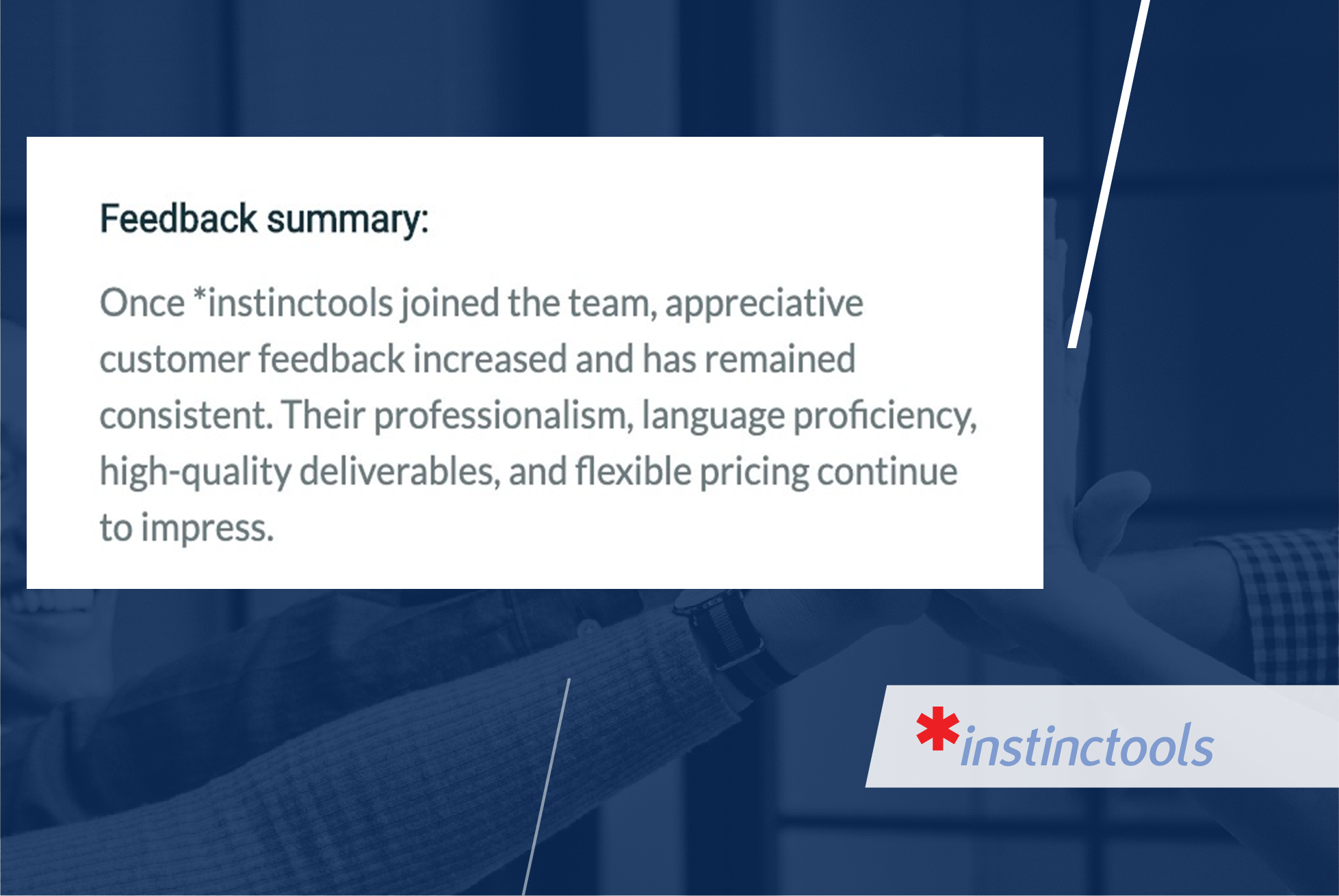
We are very glad this client acknowledged our professionalism, language proficiency, high-quality deliverables, and flexible pricing. Those are aspects of our business that we try to uphold, and getting that type of feedback helps us affirm that we’re doing things right!
There is another website called The Manifest, which is a guide for practical business wisdom about various B2B service providers. Of all the software developers in Germany, The Manifest lists us at the top!
You can find us on Visual Objects as well, where you can get a sense for some of the clients we have worked for.
We take client feedback very seriously, and we factor it into our business model so that we get better and better at what we do.
Contact us if you’d like to hear about how we can help your business grow with custom software/app/web development solutions!
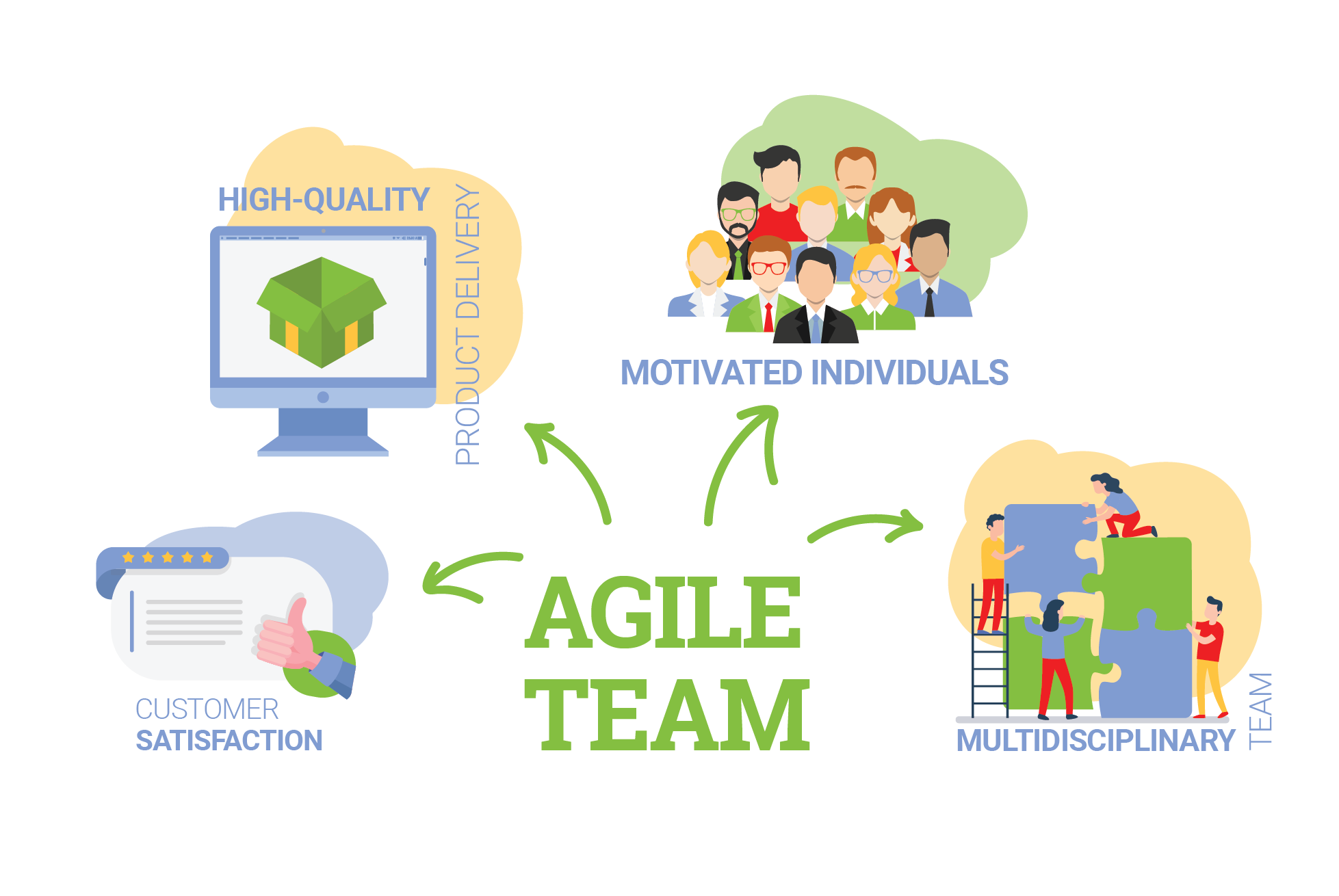
In today’s fast-paced and ever-changing environment, software development companies need and even have to be agile. An agile approach implies the rapid delivery of a valuable product through quick response to customer’s needs and requirements. We have defined 5 key principles of Agile methodology, which are applied to software development processes and companies as a whole.
Changing priorities
Customer satisfaction through early and continuous delivery of highly valuable software becomes a major principle of agile software development. Frequent iterations between requirements specifications facilitate rapid response to changes in scope and priorities. Adjustments are therefore recognized sooner rather than later. The sooner customers receive the final product, the earlier they get benefits from it!
Adaptability
Agile as a tool helps developers effectively handle new requests so as to provide services faster, thereby meeting or even exceeding customer’s expectations. Flexibility and ability to adapt to changing requirements and market conditions help businesses stay competitive and focused.
Self-organizing teams
Such teams are multidisciplinary in nature. They can figure out the necessary skill set and distribute knowledge across the members. This ensures the provision of best architecture, requirements, and designs. In this case, co-working and face-to-face communication make development processes faster and more effective.
Working software
The main documentation that helps to understand how the software should work is important. However, the main focus is on the creation of a helpful software solution for the customer. Through face-to-face communication between team members, documentation can be minimized.
Agile mindset
In an agile working environment, it is very important to have high-performing teams delivering a valuable product to customers. The performance of every team member depends not only on his/her skill set but also on the mindset, which comprises such attitudes as respect, collaboration, learning, and improvement, focus on value and adaptability.
Both in software development and company management, an agile approach becomes a part of the corporate culture. It requires understanding and sticking to the main principles of agile philosophy, as well as having an agile mindset. Any business that is based on such an approach should be able to adapt to the changing market, be fast-moving and flexible; it should build team communication on trust and respect, encourage knowledge exchange and improvements, do everything possible to minimize time-consuming processes.
*instinctools centers its company policy around agile methods of development and business management, providing high-quality products within agreed deadlines, meeting customers’ ever-changing needs, and satisfying their expectations!
The healthcare industry has been very welcoming to the increasing popularity and availability of technological innovations. That is why innovations in healthcare have been taking giant steps forward over recent years. Today, with a smartphone in your pocket, you can control your health and well-being online.
Nowadays there are mobile apps that can remind us to take our medications on time, some apps can measure our cardiac activity or recommend diet and workout plans. There are apps out there that can even bring the world’s best doctors to us through video consultations – within minutes instead of weeks or even more.
Let’s take a look on how Big Data and IoT have been driving the healthcare industry.
Big Data
We often hear about Big Data when talking about enormous volumes of information. The healthcare industry generates a huge amount of data that is generally stored in physical media. However, with advances in technology, there is need to keep this data digital. That is where Big Data comes in.
Along with traditional medical records which are in the form of text, Doppler and MRI scans contain X-ray images and ultrasound records. Also some medical practitioners prefer to keep a record of their conversations with patients.
All this information is mostly unstructured and not set up in in the form of neat graphs and tables of the relevant database. And this is exactly where databases are most needed. However, it is one thing to store Big Data and quite another to retrieve it effectively.
Big Data solves any information storage issue. It helps to keep data systematic and always ensure quick and convenient access to data. It makes the work of a hospital more efficient.
An electronic health record (EHR) is quite a new but already very popular phenomenon today. It is also supported by Big Data. EHRs systematically gather the clinical info of every particular person and provide easy and rapid access to the medical data.
Big Data also accumulates data on the latest treatment methods and best cure practices. It becomes easier for healthcare practitioners to make objective decisions on treatment in every particular case. So, when it comes to the process of collecting huge volume of information, Big Data will easily cope with any task.
If healthcare providers store information in a properly manner, the patient’s health can be holistically reviewed. Consequently, diagnosis is made easier for the medical practitioner and the patient’s life is simplified.
Internet of Things
IoT cannot but be mentioned when talking about data analysis. This technology is a network of Internet-connected objects that collect and exchange data coming from embedded services.
IoT is a rather new paradigm, which has already been extensively applied in the healthcare industry and in a number of other industries. With IoT, medical centers are able to function more efficiently, thereby ensuring better treatment for patients.
IoT makes simultaneous monitoring and reporting applicable: devices collect and transmit health data, such as blood pressure level, oxygen and blood sugar level, pulse, etc. All this data is stored in the cloud and can be used by a doctor or any other healthcare practitioner.
24/7 availability of data enables the medical expert to react quickly to any changes in patients’ situation. Alert feature provides an on-time warning signalling that treatment measures need to be taken.
Moreover, IoT devices can easily report and analyze collected data in real-time. This allows to minimize the time spent on data processing, evaluation and analysis.
All this can easily guarantee remote medical assistance. A simple example: during an emergency, a patient can contact his doctor via a mobile app. With smart app solutions, healthcare practitioners can instantly check a patient’s physical condition and identify the first symptoms of illness on-the-go.
Summary
Both Big Data and IoT deal with information but process it in different ways. Combining this with mobile devices, especially smartphones and tablets, our health may now be easily monitored on a continuous and proactive basis. Once a problem is detected, a healthcare professional is alerted to take appropriate action. Besides, there appears a huge potential to deliver simple, effective, inexpensive solutions to improve healthcare professionals’ working methods and the general health level of the population.
In this article, we will look at how to attract money to your project using cryptocurrencies. ICO provides an opportunity to raise millions of dollars even if your startup is limited only by ambition and a good idea. It is an excellent chance for companies that are just preparing to demonstrate their product or technology but are not able to obtain financing in the traditional way – through large facilities and business incubators.
For any question on what an ICO is, please read the article “What is an ICO?”. We now move to the heart of the problem.
Algorithm for starting a successful ICO
In order to attract funding, we advise you study the proven experience of soaring ICOs along with the mistakes of the failed ones.
Development of an economic model and concept;
Marketing PR campaign;
Launching the project and entering the exchange system.
Let’s look at the key points of each phase to understand what to focus on and what to worry about first.
Concept
ICO’s popularity as a tool for collecting money is based on development and widespread introduction of cryptocurrencies and blockchain technologies. An ICO can hardly succeed if you cannot clearly state how your project is connected with blockchain and why your tokens are produced.
Theoretically, a bookstore or a bicycle rental store can conduct an ICO but it is unlikely that they will be able to attract $16 million from investors within half an hour, as it was possible for the Token Card startup, which issues cryptocurrency-based Visa debit cards. The reason is that your project must use blockchain technology to generate interest in the community.
The project tokencard.io allows you to keep Ethereum and other cryptocurrencies on a debit card and pay with the card when making purchases in stores, as well as when making transfers.
Marketing
In a PR campaign, your task is to convey convincing arguments to potential investors that the released product needs your tokens, and that the demand for them will increase, making it possible to earn on the exchange.
Cryptoeconomics is very similar to the subcultural get-togethers, where there are authoritative opinion leaders. Therefore, no one will convince your investors better than those people who are listened to in the environment of blockchain technologies and cryptocurrencies.
Mobile payment platform tenx.tech sold 245,000 ETH within 5 minutes in its ICO thanks to support from Vitalik Buterin, co-founder of Ethereum.
There are free or at least fairly cheap methods to promote your ICO project. The first thing to pay attention to is social networks, forums and thematic blogs.
The main platform where you will need to present your project is the Bitcointalk forum. Create several branches to discuss your project in different languages. By so doing, you will be able to bring your idea to the audience, attract attention to yourself and get a feedback.
bitcointalk.org — world’s most popular cryptocurrency forum.
Apart from Bitcointalk, there are hundreds of special-purpose online media outlets and private blogs that cover the subject of cryptocurrency. Send your press releases and articles to these media so that people could recognize your ICO and experts could talk about you.
Entering the exchange
Most investors would like to use your tokens as cryptocurrency, which can be profitable to trade on the exchange after the ICO. All cryptocurrency exchanges are independent, so you will face a complex and multifaceted negotiation process with the owners of these platforms.
However, not all exchange systems charge transaction commissions. Some monetize by listing tokens. Be prepared for the fact that you will need a whole team of managers, as well as additional huge cash in order to prepare for the process of issuing a new cryptocurrency for bidding.
Who and why invests in ICO?
The purpose of investment is quite obvious – by purchasing the project tokens during the initial offering, you can make good money by selling them at some later time on the exchange. Despite the fact that the cryptocurrency market is still very young, dynamic and poorly regulated, ordinary users as well as large investment funds are increasingly showing a major interest in ICO investing today.
Venture company blockchain.capital was in 2013 one of the first to consider financing requests from cryptocurrency startups.
Venture companies that are focused on ICO investment emerge from around the world. Large companies show interest due to the high liquidity of almost any cryptocurrency, which is signaled by the huge turnover of exchange systems. ICO is attractive in many respects due to the fact that tokens can be exchanged at any time for another cryptocurrency or for traditional money.
Legal status of ICO
The legal status of ICO is poorly regulated by legislation. This method of financing can be called gray. Relationship between the investor and the founder of an ICO project are difficult to consider classical in the economic sense because it is mostly based on reputation and trust.
Today, there are no jurisdictions that would regulate ICOs, which relieves organizers of a lot of headaches. But states, for example, EU countries, are trying to take this niche under control. If ICO projects are required in the future to comply with many laws and bureaucratic procedures, many of the advantages of ICO over traditional methods of financing will simply disappear. But in the absence of regulation, there is also a shortcoming – there is nobody to fight against numerous scam.
Differences between ICO and securities trading:
Investors do not receive a share in an ICO project;
In fact, the cryptocurrency is a digital commodity and not a security;
ICO is a decentralized and international instrument;
Tokens can be used to get the products developed by the startup.
Investor risks
Regulation of the young cryptocurrency market provides a serious technical challenge. Online transactions under a new virtual economy, where the buyer often cannot contact the seller in person, are fraught with many risks. This is directly related to ICO.
The ICO boom provided many investment opportunities and greatly simplified the investment process, making it available to everyone. There is an interesting article in CryptoCompare that a considerable part of ICO projects being announced and conducted is a scam. Also, the article gives good advice on how to distinguish scammers from honest developers. So we recommend you read it!
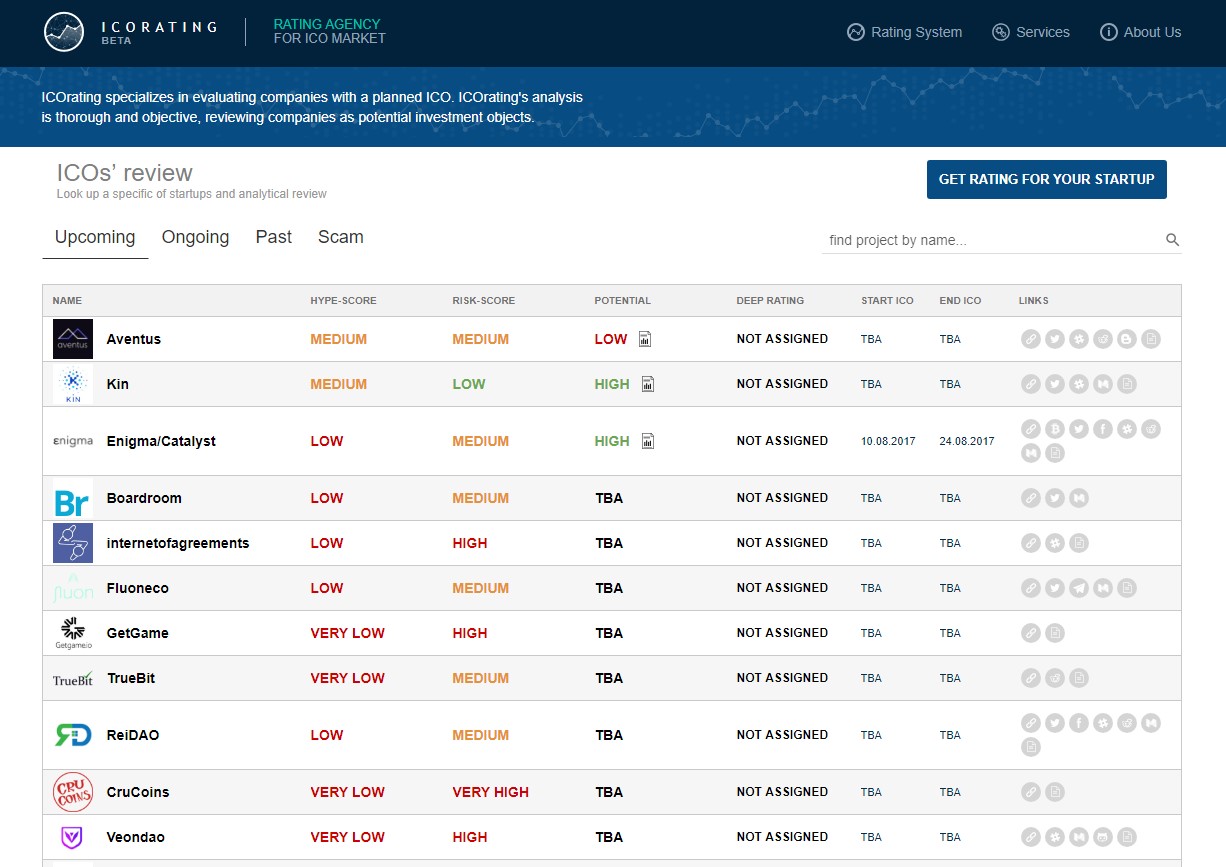
Rating agencies that migrate to cryptoeconomy from traditional ones are trying to minimize investor risks. The agencies conduct an independent ICO due diligence and describe both the strengths and weaknesses of projects.
Rating agency icorating.com describes in a simple form the popularity, potential and risks of ICO projects being conducted and announced.
Companies that launch and conduct ICOs for startups willingly cooperate with rating agencies. This increases the transparency of the project in the eyes of potential investors. Publication of a deep and independent due diligence for your ICO will significantly increase the chances of successful fundraising.
Summary
Remember that the success of any promotion can be provisionally divided into two components – conveying information about your ICO to maximum number of people and convincing this audience of your honesty and reliability. In the end, you will need to secure your tokens with a presence on all popular exchanges. It is through such exchanges that the public would learn about the emergence of a new cryptocurrency.
In the next article, we’ll talk about the merits and demerits of ICO, and you’ll be able to find out if this method of attracting investments is suitable for your project.
Initial coin offering (ICO) is equivalent to initial public offering (IPO) from the world of cryptocurrency. ICOs are conducted by blockchain startups – fund raising is announced at the early stage, and then investors receive a share of the new cryptocurrency in proportion to their respective investments. After the ICO, investors will earn if the price of that cryptocurrency rises. And the price rises if the startup succeeds in business or if it earns from speculation on the exchange.
Why conduct an ICO and why is it popular?
The purpose of any ICO is to raise funds for a project. Investors are attracted by any opportunity to enrich themselves.
In the first half of 2017 alone, ICOs organized by startups around the world raised $180 million, which is 80% more than for the entire 2016. Obviously, this upward trend will continue, and for now there are no signs it will stop or fall.
The boom around ICO and cryptocurrencies is very similar to the IPO boom of Internet projects in the late 90’s. Many projects that conduct ICOs just try to make money on the emerging excitement, but there are startups, nobly using the new tool to develop a variety of markets and technologies.
Philosophically speaking, the cryptocurrency boom is driven by the idea of information and financial anarchism that is soaring in the air and captivating the youth. This reminds us of the popularity of 3D-printed guns!
Economically speaking, the popularity of ICO is very simple: it is an opportunity for any interesting project to attract huge amounts of money, at the same time bypassing greedy corporations and business funds. For ordinary people, it is a chance to earn real money from investment, bypassing exchange brokers, licenses and the taxation system.
Comparing ICO, IPO and crowdfunding
A common feature of ICO, IPO and crowdfunding is the goal. All these three events are aimed at attracting investment for a project.
The main difference between an ICO and crowdfunding is that for you to successfully raise funds in crowdfunding on sites like Kickstarter, you will need either already produced goods or a prototype. But with an ICO, you can attract investment at the earliest, embryonic stage of a project.
Despite this, ICO can be considered a variety of crowdfunding, but instead of having a physical product (in fact pre-order of goods), participants are offered to receive (to invest in) a new cryptocurrency. Participants invest money in a project, hoping to make some dividends from it in the future: most often in the form of an opportunity to sell coins at an increased price.
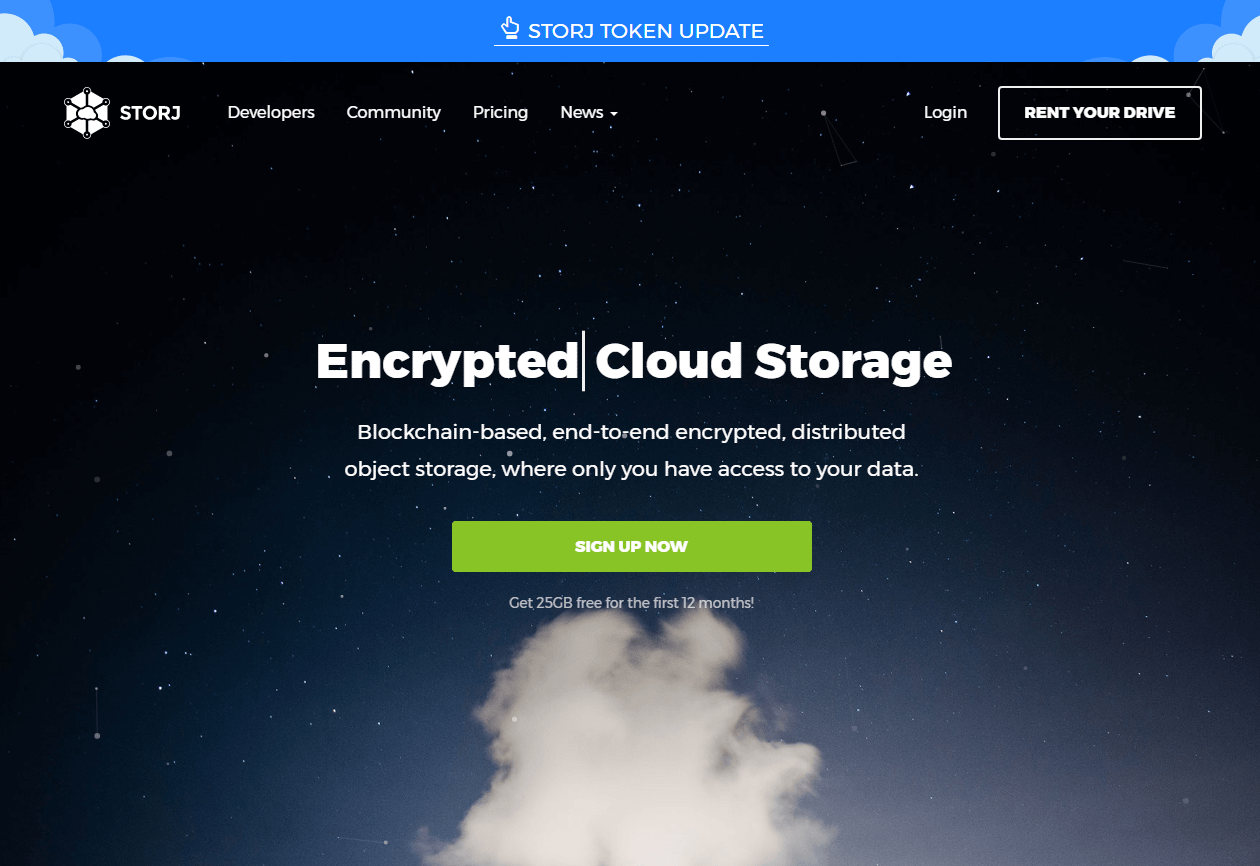
For the tokens of the project storj.io, you can buy disk space on the service, tokens can also be earned by leasing a part of your hard drive.
The main difference between ICO and the traditional IPO is that ICO has no government regulation. This provides a boom, since any high schooler can launch his or her own ICO, but also retain major investors. After all, absence of regulatory legislation in the field of ICO makes such investments based purely on trust and enthusiasm, which is often not suitable for major transactions.
But there are exceptions. During the initial offering of the Brave web browser, one investor alone acquired the equivalent of 20,000 ETH, which was $4.7 million then.
Investors pursue one of the following three goals or even more than one at once:
To support their favorite startup;
To get the product at a low price;
To earn on speculation with tokens on the exchange in the future.
ICO differs from IPO also in the fact that buying tokens at the initial offering does not give investors a share in the company. Therefore, ICO still looks more like a crowdfunding than an IPO model.
Examples of successful ICOs
An ICO can be considered successful if it is able to raise financing, and investors succeed when the value of tokens further increases. Therefore, large ICOs are successful from the point of view of startups, while the profitable ones, for which the token value grows on the exchange, are successful for investors. But one does not contradict or interfere with the other.
Most profitable ICOs
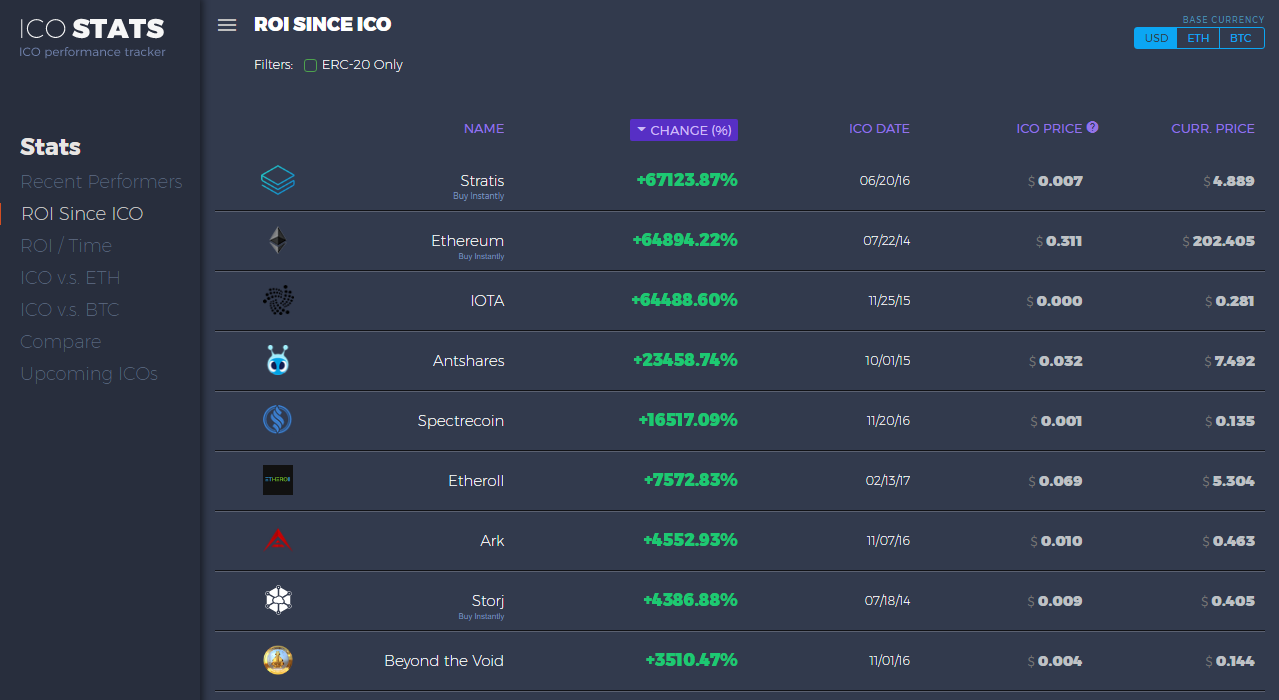
Stratis. In June 2016, this blockchain platform raised almost $600,000 in funds, selling 84 million tokens to ICO investors at a starting price of $0.007. After the project was launched, the price of 1 token reached $10, and as of July 2017, it was selling at $5, recording a 67410% growth.
Ethereum. It is an example of not only one of the most lucrative but at the same time one of the largest ICOs. The blockchain platform raised over $15.5 million in 2014, selling 50 million tokens at a price of $0.311. As of July 2017, one token was selling at $202. Growth was 64980%.
IOTA. The project is an exchange network for the Internet of things and closes the top three. A distinctive feature of IOTA is that there are no commissions for micropayments. Since its offering, the price of tokens has increased by 64480%.
The most profitable ICO according to icostats.com
Largest ICOs
Brave web browser. The project was created by Mozilla co-founder Brendan Eich and raised $35 million from its ICO in just 24 seconds. For a week, the return on investment from ICO for investors after the sale of tokens on the exchange was almost 700%.
Aragon. The startup develops a platform for managing blockchain-based business processes. In May 2017, the startup sucked in the targeted $25 million in just 15 minutes.
Upcoming ICOs
There are thematic sites on the network that track upcoming ICOs. They help to achieve better results and attract the attention of investors and the public.
The site icoalert.com shows upcoming ICOs in a convenient manner.
Conclusions and practical tips
The cryptocurrency market is on the rise and ICO’s are constantly setting new records. This new financial tool enables young projects to start and investors to earn. But ICO investments carry some risk for investors.
Your project will inspire confidence and attract investors’ attention if:
The required funding amount is clearly stated.
Direct cryptocurrency mining is possible.
A test version of the product is implemented.
There is a clear development plan for the startup after receiving investment.
There is a set of expert estimates for the project.
The identity of the organizers is known.
The need for ICO and the launching of a new cryptocurrency is well-reasoned.
Owing to the nature of a particular project, some of the requirements listed above can of course be ignored, but most often they are mandatory. There are several cases of major ICO scam. This severely undermines investor confidence in each new project. So it is always important to prove that the project is a reliable one.
The focus of the final part of this article is not dedicated to the methods of application performance improvement through multithreading. Instead, it examines its degradation using methods of thread synchronization. However, in this case, the application performance degradation is essential, since the processing of the same data in asynchronous threads may lead to unpredictable results and the application will perform poorly.
If you are interested in ways of creating multi-threaded applications in .NET, we invite you to read Part 1, Part 2, and Part 3 of the article.
Why is thread synchronization essential?
Thread synchronization is essential in the case when the same resource (a variable, an object, data source or a file) which is common for the whole application, is used by several threads synchronously as provided in the code below.
using System; using System.Threading; namespace NonSyncExample { classProgram { static int x = 0; // Function, that is sent to a thread public static void Count() { x = 1; for (int i = 1; i < 9; i++) { // In this cycle x is increasing by step = 1 Console.WriteLine("{0}: {1}", Thread.CurrentThread.Name, x); x++; // This operation is executed by 5 threads, so x will have an unpredictable value Thread.Sleep(100); } }
static void Main(string[] args) { for (int i = 0; i < 5; i++) { Thread th1 = newThread(Count); th1.Name = "Thread " + i.ToString(); th1.Start(); }
Console.ReadLine(); } } }
In this example, the variable “x” is common to all five threads ( five threads of Thread class, the Main thread does not perform the Count method()). The Count method searches “x” variables from 1 to 8. But the Count method itself is evoked in five threads. The threads will switch during the application performance. In this case, the “x” value will be unpredictable.
The Lock operator
The Lock operator limits the other threads access to the resource of the other threads, while it is used by the the current thread. The Lock operator identifies the code block which can be referred to by only one thread at any specific moment.
using System; using System.Threading; namespace LockExample { classProgram { // door is an object which can be locked then thread process it // and it will be released then thread is finished his work on it static object door = new object(); static int x = 0;
public static void Count() { lock (door) { // in this section code will be executed by only one thread at the moment x = 1; for (int i = 1; i < 9; i++) { Console.WriteLine("{0}: {1}", Thread.CurrentThread.Name, x); x++; Thread.Sleep(100); } } }
static void Main(string[] args) { for (int i = 0; i < 5; i++) { Thread myThread = newThread(Count); myThread.Name = "Thread " + i.ToString(); myThread.Start(); }
Console.ReadLine(); } } }
An object is issued to the lock operator as a parameter. It can be both a specific variable of the Object type and This – a reference to an object of the current class. The object is locked up, when the code performance reaches the Lock operator. Only one thread gets exclusive access to the object during the lock-up. Another thread can “capture” the object issued to the Lock and get exclusive access to it, when the object is released.
The performance of the monitor objects of the System.Threading.The Monitor class is similar to that of lock operator. Moreover, the lock uses the Monitor in its performance. An example of Monitor performance is provided below:
using System; using System.Threading; namespace MonitorExample
{ classProgram
{ static int x = 0; static object door = new object; public static void Count()
{ Monitor.Enter(door); try
{
x = 1; for (int i = 1; i < 9; i++)
{ Console.WriteLine(“{0}: {1}”, Thread.CurrentThread.Name, x);
x++; Thread.Sleep(100);
}
} finally
{ Monitor.Exit(door);
}
} static void Main(string[] args)
{ for (int i = 0; i < 5; i++)
{ Thread myThread = newThread(Count);
myThread.Name = “Thread “ + i.ToString();
myThread.Start();
} Console.ReadLine();
}
}
The Monitor.Enter() method takes an object as a parameter, just like the Lock operator. The object is blocked, giving access for one thread only. There is a code block in the block try, which is performed by only one thread at any specific moment. The block finally releases the object which was issued to the monitor by means of the Monitor.Exit method() in order to make it accessible to other threads.
The Monitor also provides several methods of lock management:
Wait() unlocks the object and transfers the thread to the wait queue, which allows the next thread from the queue to lock the object;
Pulse() allows the thread to release from the wait queue and lock the object;
PulseAll() allows all of the threads to release from the wait queue and transfer to the ready queue, where one of the treads will be allowed to get the object locking.
This class is a Wrap over WinAPI events. It allows the sending of signals from events to objects, which control the threads synchronization. At the same time, the object AutoResetEvent switches from the non-signal state to the signal state and functions as the sender and the receiver of these signals.
using System; using System.Windows; using System.Windows.Media; using System.Windows.Media.Imaging; using System.Threading; using System.Windows.Threading; namespace MyApp
{ public partial classMainWindow : Window
{ AutoResetEvent ewh; public void consrenew()
{ this.Dispatcher.BeginInvoke(DispatcherPriority.Normal,
(ThreadStart)delegate() { Cons.Text = “City at night”;});
ewh.Reset();
ewh.WaitOne();
}
After creation of the variable of AutoResetEvent type, we may specify that initially the object will be in non-signal or signal state by having transmitted to the constructor true or false.
The ewh.Set() method notifies all of the waiting threads that the object autoResetEvent is in the signal state and one of the threads can capture this object.
The ewh.WaitOne() method locks the object autoResetEvent and prevents other threads’ access to it, until the Set() signal arrives.
The methods WaitAny and WaitAll can be used, if the program uses several objects of the AutoResetEvent. These methods take as a parameter, the array of the AutoResetEvent objects.
The ewh.Reset() notifies all of the threads that the autoResetEvent object is captured by another thread.
In the example above, the access to the WPF application interface (API) and the WPF from another thread is used by means of Dispatcher and the button Cons which is assigned the name “City at night”. After the assignment operation, the reset of the signal state AutoResetEvent occurs by evoking the ewh.WaitOne () function; then the thread performance is suspended until the button Cons is pushed. After the Cons button the thread is signaled by means of the ewh.Set () method and the thread performance continues.
AutoResetEvent performs the method Reset() automatically as soon as the object autoResetEvent is captured by another thread. It is its main advantage over the ManualResetEvent, where the method Reset is to be evoked manually. Otherwise, the AutoResetEvent and ManualResetEvent perform the same methods of thread synchronization by means of events and signals.
Mutex
The System.Threading.Mutex type is a wrap over the object WinAPI Mutex.
using System; using System.Threading; namespace MutexExample
{ classProgram
{ static Mutex mutex = new Mutex(); static int x = 0;
public static void Count()
{
mutex.WaitOne();
x = 1; for (int i = 1; i < 9; i++)
{ Console.WriteLine(“{0}: {1}”, Thread.CurrentThread.Name, x);
x++; Thread.Sleep(100);
}
mutex.ReleaseMutex();
}
static void Main(string[] args)
{ for (int i = 0; i < 5; i++)
{ Thread myThread = newThread(Count);
myThread.Name = “Thread “ + i.ToString();
myThread.Start();
} Console.ReadLine();
}
}
There are only two Mutex methods for thread synchronization: the mutex WaitOne() method suspends the thread performance until the method mutex.ReleaseMutex() is evoked.
However, Mutex can be used not only as the thread synchronization object but also for synchronization between processes. For instance, an application for only one run can be created.
using System; using System.Reflection; using System.Runtime.InteropServices; using System.Threading; namespace SingleAppExample
{ classProgram
{ static void Main(string[] args)
{ bool exist; // we get GUID applications string guid = Marshal.GetTypeLibGuidForAssembly(Assembly.GetExecutingAssembly()).ToString();
Mutex mutex = newMutex(true, guid, out exist);
if (exist)
{ Console.WriteLine(“App is working”);
} else
{ Console.WriteLine(“App is already working. And this copy will be closed now.”); Thread.Sleep(5000); return;
} Console.ReadLine();
}
}
}
The overloaded constructor is used when the Mutex object is created.
The first parameter identifies whether the invoking thread must be the primary operator of the Mutex.
The second parameter receives the unique identificator guid obtained as a GUID application (application unit linking) of .NET.
The third parameter existed of the bool type returns true, if the mutex object has been requested and received successfully. In this case, the Mutex will be requested and received successfully only once. When the second copy of the application is run, it will be closed in 5 seconds.
Semaphore
The System.Threading. Semaphore type is a wrap over the WinAPI Semaphore object. The Semaphore limits the access to the common resource only for a certain number of threads. Only one semaphore can be created in the application, as its constructor is declared to be static.
using System; using System.Threading; namespace SemaphoreExample
{ classReader
{ staticSemaphore sem = newSemaphore(5, 5); Thread thr; int n = 5; // reader’s visit counter
Console.WriteLine(“{0} leave the library”, Thread.CurrentThread.Name);
sem.Release();
n–; Thread.Sleep(500);
}
}
} classProgram
{ static void Main(string[] args)
{ for (int i = 1; i < 10; i++)
{ Reader r = newReader(i);
} Console.ReadLine();
}
}
}
Two parameters are transferred to the semaphore constructor:
The first parameter identifies the number of threads which get access to the semaphore immediately after its creation.
The second parameter shows the maximum number of threads which the semaphore can use.
The example shows the behavior of the readers in the library. Each reader r may visit the library not more than five times within a certain period. In this case, no more than five readers can be in the “sem” library simultaneously. After a while, when one reader leaves the library (sem.Release()), another one replaces him. It does not matter how many threads have been created in the Main method, the Read() function wrapped by the semaphore ‘sem’ will be performed by five threads only.
How the synchronization affects the application performance
It is better to use the synchronization in the extreme case only, when it is truly essential. The use of thread synchronization methods in multi-threaded applications can very often lead to the degradation of application performance. This is due to the fact that only a certain number of threads can be performed at a certain moment, and very often only one thread can be performed.
The use of the Lock operator or Monitor is the most effective. However, this is not always true. The issue is that the Lock operator, Monitor and Mutex have similar parameters and solve the same problem. However, the mutexes are more convenient compared to the critical sections. The speed response of the Mutex is also much higher than the critical section.
The critical sections are simple and effective when there are few competitive threads. However, when their number increases, the number of input and output cycles also increases.
It is more appropriate to use the semaphore when the number of competitive threads is great. The semaphore decreases the number of competitive threads, without changing the program model.
The use of the Event model of synchronization (AutoResetEvent and ManualResetEvent) also decreases the application performance due to the lock-ups. The decrease is minor when the section of the code is chosen correctly.
In terms of performance, it is inappropriate to lock a big object by means of one global lock-up. Any lock-up consumes significant system resources. The reason is not only that very often one thread performs, but that the lock-up (or mutex) itself also takes a lot of time. Therefore, it is recommended to use several different mutexes for different resources which require locking-up and processing by a single thread (or by a limited number of threads). Frequent lock-up and unlocking of the resource also negatively affects the application performance.
Summary
The article, which consists of four parts, considers the principal ways of thread creation and management in .NET.
Thread pool (see Part 1) automates creation, destruction and re-use of the threads.
Low-level thread management with the use of Thread type objects (see Part 2) allows the manual creation of the number of threads needed, call the name of the thread and prioritize the threads.
Asynchronous delegates (see Part 2) use the pool thread when they perform. Therefore, they implement all the peculiarities of the pool use with its advantages and disadvantages.
BackgroundWorker (see Part 2) also uses the pool thread to perform the tasks in an asynchronous mode. BackgroundWorker is intended to perform the tasks in a background mode. It has full access to the visual application interface without the use of Invoke and Dispatcher and supports the inheritance of the user class from it.
Libraries TPL and PLINQ (see Part 3) are used to parallelize separate code snippets or database queries. The libraries fully automate the process of thread creation and destruction.
The methods of thread synchronization (Part 4) are essential when the application resources are used by several threads and it is necessary to get rid of the unpredictable operation results.
Due to their peculiarities, each of the above-mentioned methods can be used effectively, only in certain cases. Despite all of the disadvantages of these methods, the construction of modern computers enables parallel data processing by several processor cores simultaneously. This processing would be impossible without the creation of multi-threaded applications.
AI modified real photo
Anna Vasilevskaya
Account Executive
Get in touch
Drop us a line about your project at [email protected] or via the contact form below, and we will contact you soon.
By continuing to use the site, you agree to the use of cookies