

Enterprise AI use cases are finding their way into nearly every corner of the business. Yet turning promising deployments into capabilities that work reliably at scale remains a work in progress.
In 2026, the share of organizations that had successfully scaled agents in at least one business function rose from 27% to 40% year over year. That’s meaningful progress, but it still leaves 60% of companies short of that milestone.
The root problem is often strategic. Without a coherent AI adoption strategy, organizations end up pursuing disconnected use cases, underpreparing their data, and underinvesting in the engineering skills and operational capabilities required for production.
In this article, we’ve brought together 57 enterprise AI use cases that have moved beyond the demo stage, covering eight business functions. Some of the applications are backed by projects we’ve delivered, with insights into our implementation approach and the business value achieved. Looking across the broader selection, we’ve also traced where the next wave of enterprise AI adoption is likely to come from.
Key highlights
- Enterprise AI use cases now cover nearly every business function, from sales and customer service to finance and manufacturing. Scaling them is another story: only 40% of organizations have scaled AI agents in at least one function.
- The bigger opportunity lies in connecting individual use cases into end-to-end workflows rather than automating isolated tasks, whether it’s a sales pipeline from lead qualification to proposal or a support process from ticket intake to response.
- Agentic AI is already delivering measurable results in production: in our projects, it cut first-response time in customer support by 75%, reduced partner onboarding from 3-6 months to 2 weeks, and made field troubleshooting 2.5x faster.
- Every new agent needs much of the same context, integrations, permissions, and governance. Building that foundation once instead of for each use case is what turns isolated AI wins into enterprise-wide impact.
Agentic AI use cases in sales
Agentic AI is gaining traction across different parts of the sales process, from lead qualification and account research to pricing and proposal generation. The bigger opportunity, however, lies in connecting those capabilities into end-to-end commercial workflows rather than automating individual tasks in isolation. In practice, agentic AI can support sales in the following ways:
- Lead identification and qualification. Given a new lead, an AI sales agent enriches its profile with internal and permitted external data, checks it against ICP criteria, identifies relevant decision-makers, and determines whether it should enter the sales pipeline.
- Next-best-opportunity prioritization. By analyzing market signals, account activity, and pipeline data, the agent surfaces promising prospects and ranks opportunities according to their potential value.
- Account intelligence. A continuously updated 360° account view brings together CRM records, emails, project data, and external business signals, helping sales reps spot changes, risks, and emerging customer needs.
- Personalized outreach and lead nurturing. For high-value prospects, the agent develops account-specific outreach. For lower-tier or transactional accounts, it can take over initial engagement and nurture leads through automated interactions.
- Next-best-action and follow-up execution. Once a customer meeting ends, the agent turns its outcomes into action: updating CRM, creating Jira or Teams tasks, drafting follow-ups, scheduling next steps, and flagging stalled deals.
- Upsell and cross-sell identification. Existing customer relationships and project histories become a source of expansion opportunities as the agent matches uncovered business needs with relevant products and services.
- Meeting and account planning support. Ahead of a customer conversation, salespeople receive tailored meeting briefs, account intelligence, and pitch recommendations. Afterward, the agent captures feedback and updates relationship records.
- Pricing and deal optimization. AI agents evaluate deal economics, customer value, historical transactions, and commercial constraints to recommend pricing and discount levels, assess margin implications, and support negotiation and approval decisions.
- Proposal and quote preparation. Once a customer request is qualified, the quoting agent maps requirements to relevant products or services, identifies the resources needed to deliver them, checks availability, retrieves applicable pricing, and drafts a proposal or quote for human review.
- Sales performance monitoring and coaching. A virtual sales coach reviews funnel performance, identifies anomalies and underperforming opportunities, and helps reps prepare for difficult conversations through simulated negotiations, product pitches, and objection-handling exercises.
How we implemented an AI sales agent
While each application improves an individual sales activity, their combined impact can be much greater when integrated into a single, end-to-end sales process.
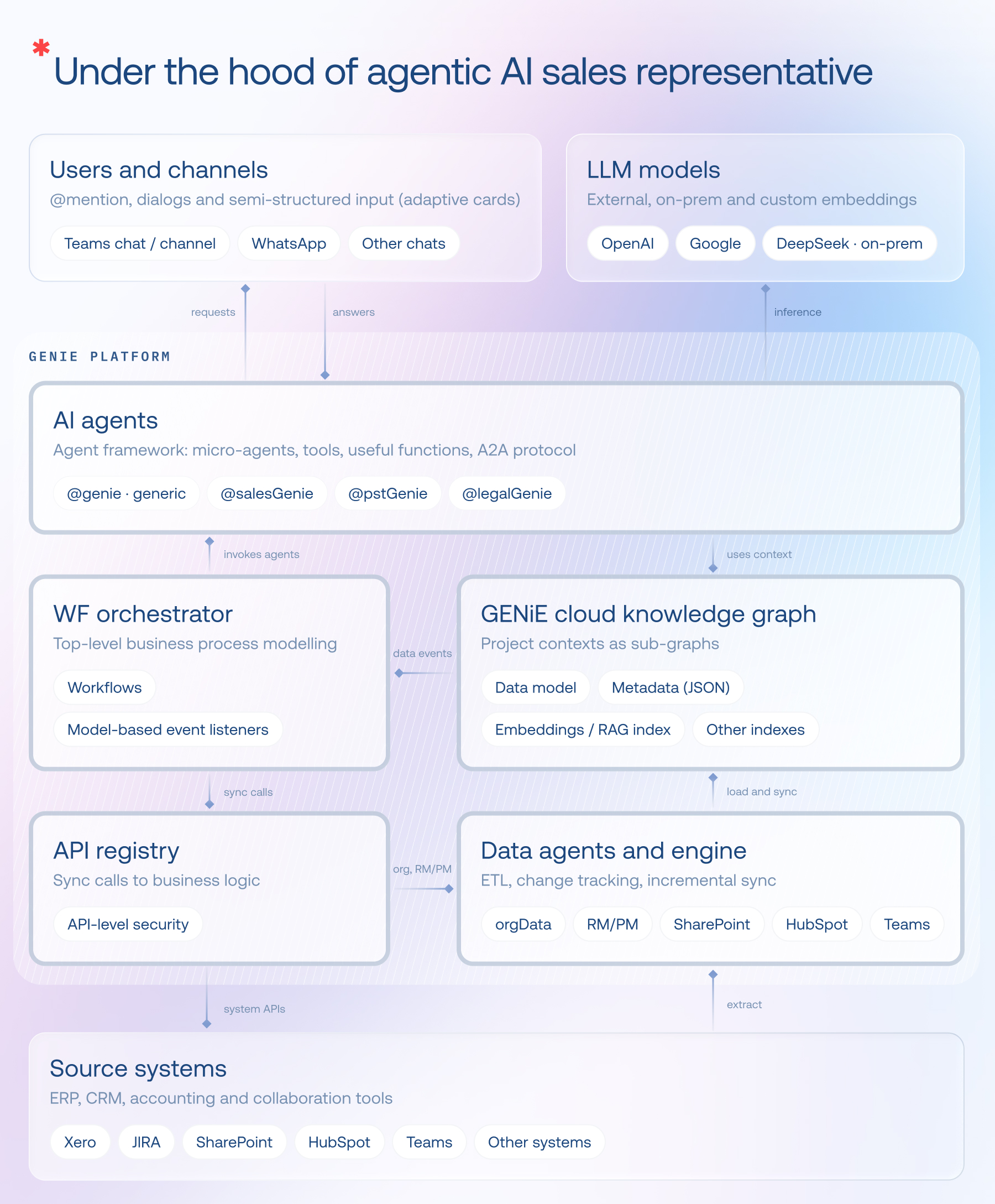
An autonomous AI sales representative we developed for an Australian consulting company brought several sales activities into one connected workflow.
The client’s earlier attempt with Microsoft Copilot Studio fell short because the agents could not reliably work across the non-Microsoft tools the sales team used, including HubSpot, Jira, Miro, and LinkedIn. As a result, they relied on static context and user prompts instead of reducing reps’ workload.
Using our proprietary agent orchestration platform GENiE, we built a multi-agent system that connects across the client’s toolset, keeps context current, and can proactively recommend or take next steps across the pipeline. The project increased leads processed per sales rep by 20%, upsell and cross-sell initiatives by 19%, and reduced cost per lead by 15%.
AI agent use cases in marketing
Agentic AI adoption in marketing mirrors what is happening in sales. Companies are experimenting with agents across content creation, audience research, campaign planning, and media optimization, but most applications remain isolated. McKinsey reports that fewer than 10% of surveyed CMOs have captured value across end-to-end workflows.
As in sales, the greater opportunity lies in connecting individual applications into workflows that span the entire function. McKinsey estimates that agentic AI could eventually power up to two-thirds of current marketing activities. Here are some of the use cases already taking shape:
11. Consumer signal analysis and insight generation. Analytical agents run continuous RAG pipelines across first-party telemetry, search trends, sales calls, reviews, and social data to surface emerging demand, friction points, and message-market fit. In data-sparse niches, they can test weak signals against synthetic personas before turning validated insights into audience, budget, or campaign adjustments.
12. Multimodal content generation and contextual personalization. Specialized agents coordinate content creation, localization, and compliance across markets and channels. Using product data, brand guidelines, customer profiles, and multimodal inputs, they generate and adapt copy, visuals, and video, while human reviewers handle flagged inaccuracies, cultural issues, and regulatory exceptions.
13. Autonomous campaign optimization through creative intelligence and experimentation. Agents combine creative diagnostics with structured testing to identify what actually improves performance. Google’s 2026 capabilities, for example, let marketers turn Performance Max edits into one-click A/B tests, while Gemini-powered diagnostics flag coverage gaps and suggest fixes such as logo placement, trimming, or aspect-ratio changes.
14. Marketing spend optimization and financial forecasting. Specialized agents model revenue, acquisition, retention, and profitability against different budget assumptions. By combining channel performance, ROI, ROAS, and customer lifetime value with scenario planning, they continuously update forecasts and help redirect spend toward higher-value opportunities.
Agentic AI use cases in customer service operations
The customer service industry has moved beyond AI-powered FAQ bots toward agentic issue resolution. AI customer service agents increasingly take over routine and data-intensive work, while humans focus on escalated tickets that call for empathy, judgment, and nuanced problem-solving.
As a result, 64% of service leaders surveyed by Deloitte report higher productivity among customer support teams, while 39% report lower costs per customer contact. But the impact of AI customer service use cases extends beyond faster and cheaper support to stronger customer retention, challenging the traditional perception of customer service as a cost center and repositioning it as a potential revenue driver.
15. Automated ticket triage, prioritization, and routing. Upon receiving a customer request, an agent identifies the issue, retrieves relevant customer context, and assesses its urgency by detecting priority markers in the message (e.g., “ASAP,” “immediately,” or repeated follow-ups) and factoring in metadata captured during ingestion. It then assigns a priority level – from critical to low – and routes the ticket to the appropriate team. If a request involves multiple issues, the agent can split it into separate linked tickets and direct each to the relevant team. Sensitive personal and payment data can also be detected and redacted before processing.
16. Context-aware response generation. An agent retrieves customer history and relevant knowledge base information, determines how to address the inquiry, and prepares a personalized response. Before submission, another agent can validate the draft against brand guidelines and applicable service policies, leaving the final approval to a human specialist.
17. Returns and refunds management. When a customer requests a return or refund, an agent checks the order, verifies eligibility against the applicable policy, and initiates the appropriate refund or replacement. Cases falling outside predefined rules are escalated for human review.
18. Customer onboarding and account servicing. An AI agent coordinates onboarding workflows by interpreting customer submissions, identifying missing or inconsistent information, and determining the next steps based on customer profiles and applicable requirements. For example, in corporate banking, when a business applies for accounts for multiple subsidiaries, the agent can cross-check ownership information across submitted documents, investigate discrepancies, request additional evidence, and coordinate KYC checks across internal systems. Cases involving potential compliance risks are escalated to specialists with the relevant findings attached. The agent can also handle non-standard account servicing requests that require interpreting customer intent and coordinating actions across multiple systems.
19. Conversational customer self-service. An agentic-enabled invoice explainer helps customers understand billing details, while a general-purpose Q&A agent handles questions about products and services. These use cases can be implemented as conversational AI chatbots, supporting text-based and/or voice conversations, intent recognition, emotion detection, sentiment analysis, and other capabilities.
How we implemented a multi-agent customer support system
A US-based online retailer serving more than 3 million customers turned to Instinctools to automate ticket triage with AI agents. Its support team handled about 5,000 requests a day, rising to 10,000 at peak, while manual categorization, prioritization, and routing slowed responses and made scaling through hiring expensive.
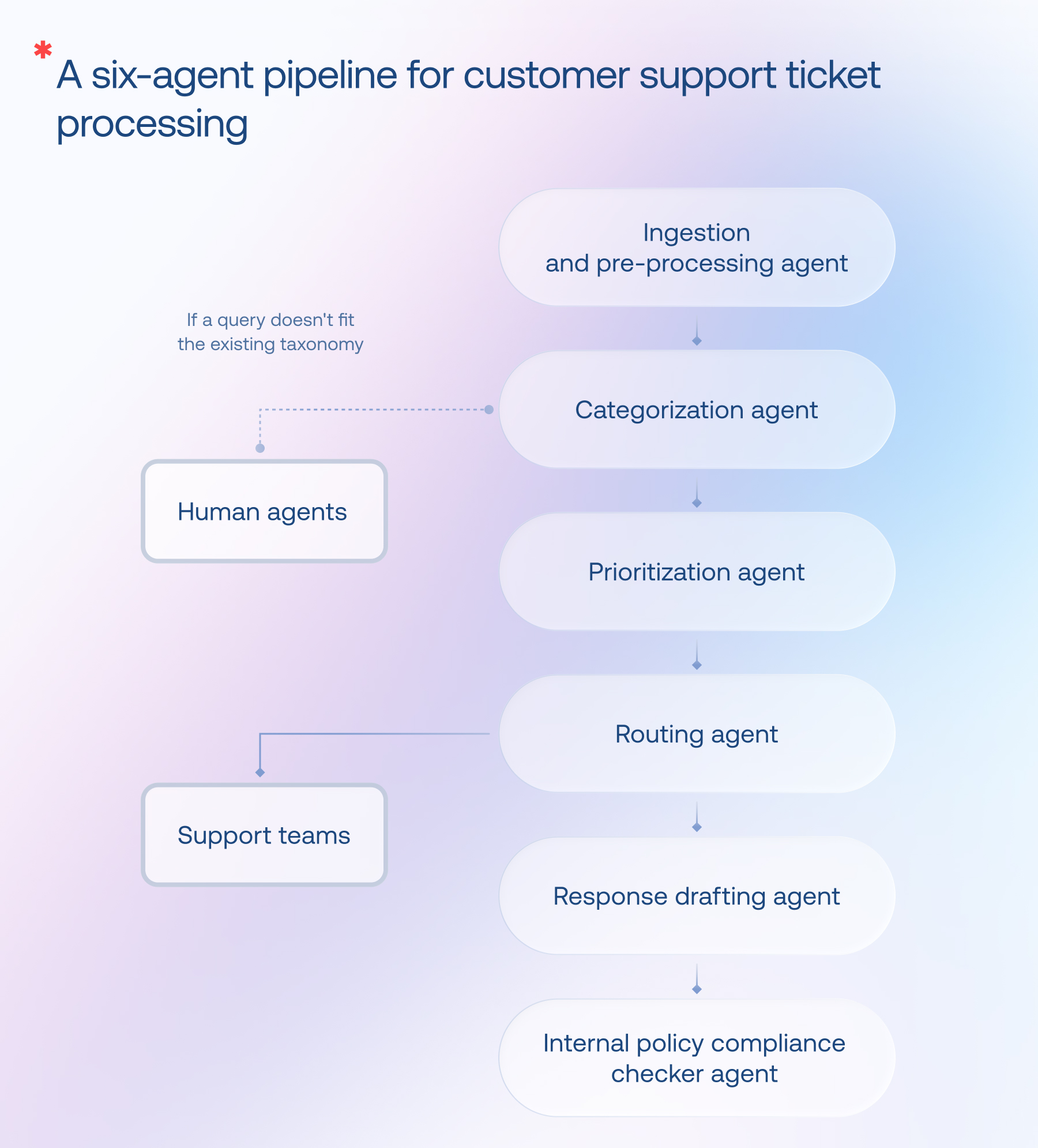
We built a multi-agent system around six specialized agents covering the full triage pipeline: ingestion and preprocessing, categorization, prioritization, routing, response drafting, and policy checks. Synthetic data generation, model optimization, and RAG pipelines helped the system distinguish request types and policy violations while keeping latency low. Tickets are processed in milliseconds, with human specialists retaining final review.
- Throughput jumped from 50-70 tickets per agent/day to 200-250 tickets/day.
- The speed of ticket processing dropped from 6-12 minutes down to 1-3 minutes.
- Impact reached a 75% reduction in first-response time and a 15% uplift in CSAT without expanding the support team.
AI agents for enterprise knowledge and document management
Knowledge management is leading the charge as the operational area where organizations most reliably scale agentic AI implementation.
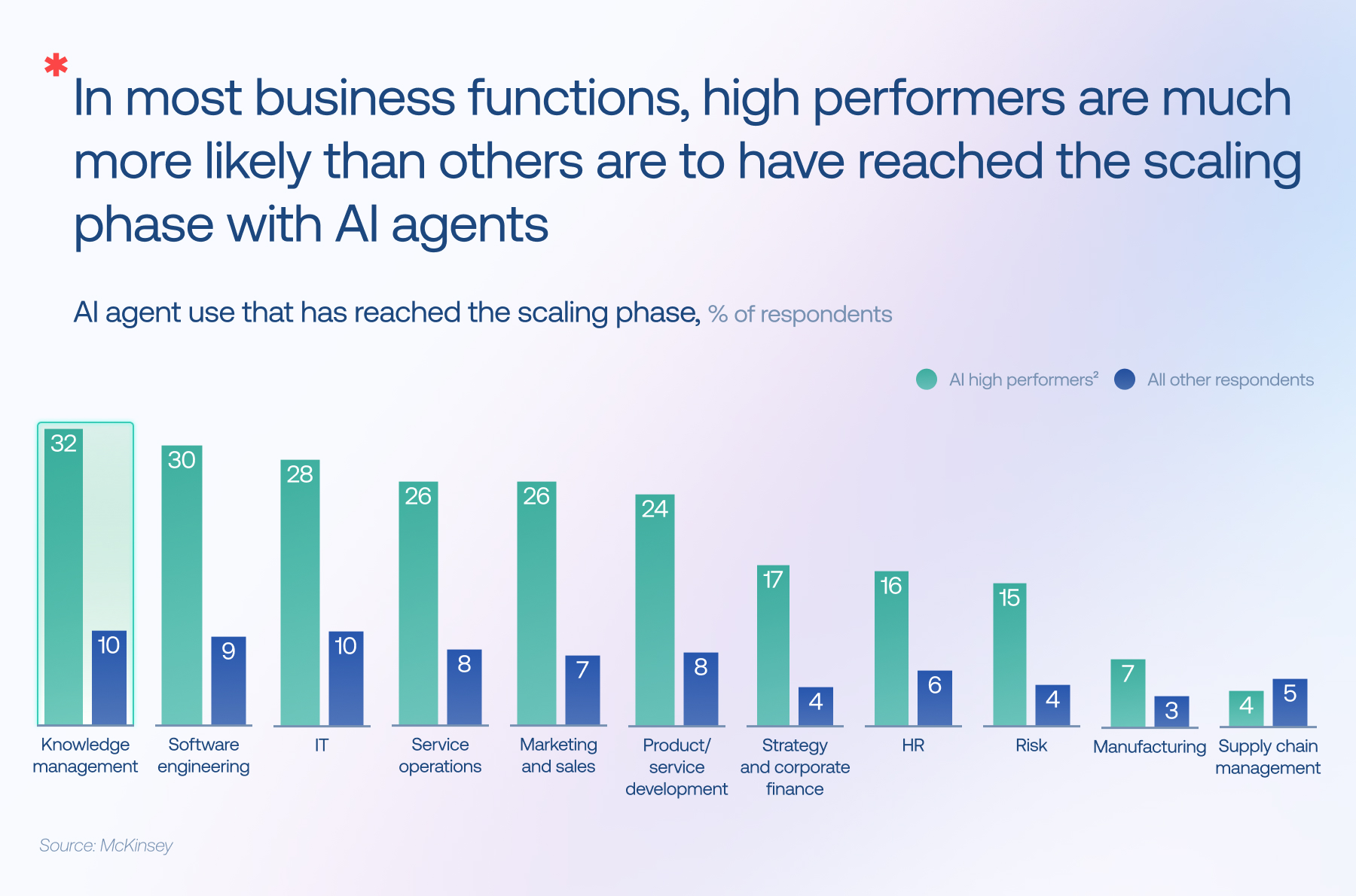
With critical knowledge scattered across document repositories, project systems, technical manuals, and meeting notes, organizations spend significant time retrieving, organizing, and keeping information up to date – work that autonomous agentic employee assistants are well suited to take on:
20. Conversational document and specification retrieval. Parsing complex multi-entity knowledge bases, technical manuals, and project records instantly through natural language chat to surface accurate answers without manual digging.
21. Intelligent content ingestion and tagging. Automatically reading, categorizing, and tagging unstructured files, meeting notes, and internal documents into a unified, searchable taxonomy.
22. Autonomous content maintenance and curation. Identifying outdated, redundant, or missing documentation across repositories and flagging them for review or automated updates.
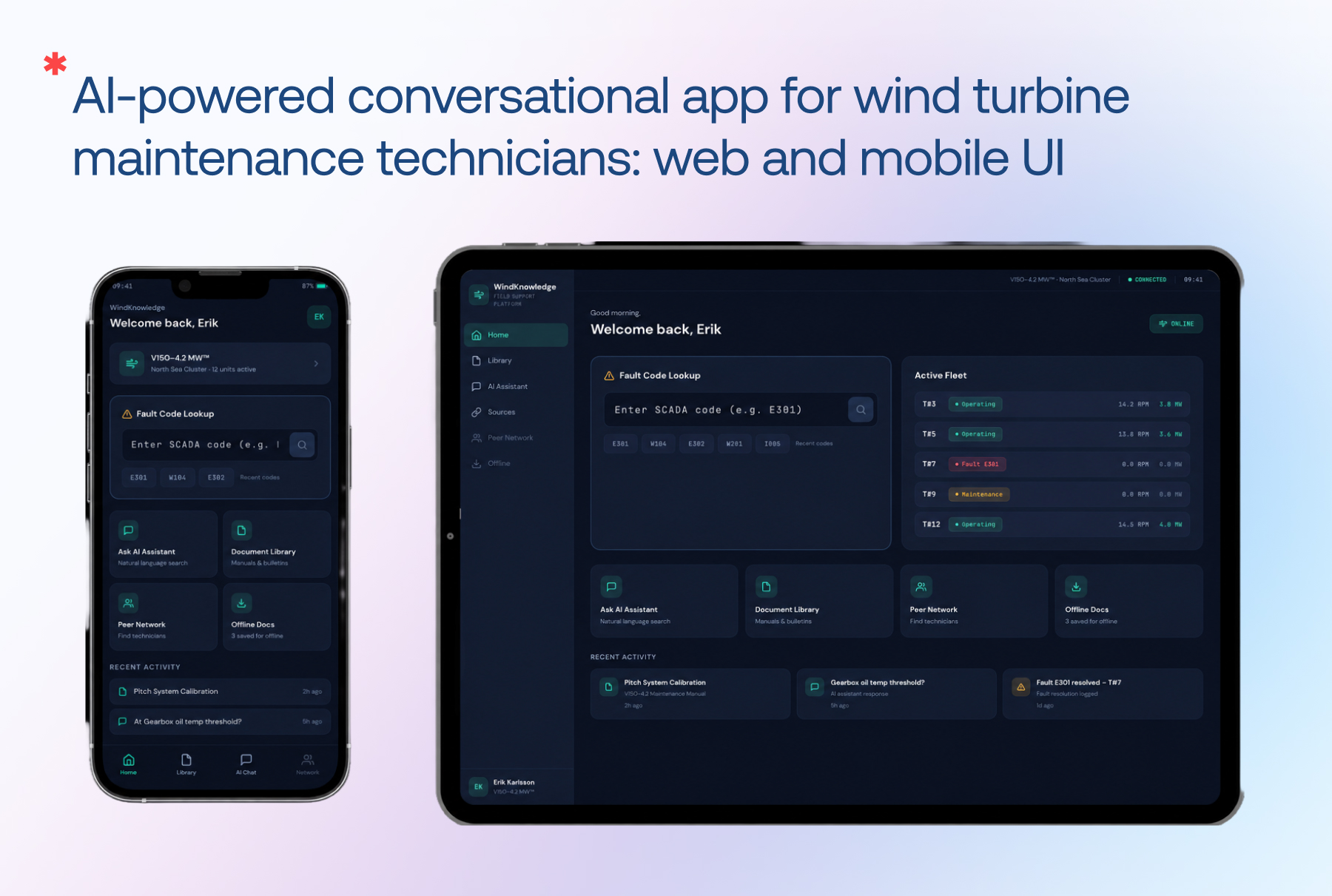
Instinctools’ AI team helped a European wind turbine manufacturer consolidate scattered technical documentation into a searchable AI-powered knowledge hub. Field technicians can ask questions in natural language and get cited answers in under 30 seconds, while peer knowledge sharing helps them troubleshoot unfamiliar issues. The platform reduced requests escalated to customer support by 37% and made troubleshooting 2.5× faster.
How we implemented an AI-powered knowledge platform
Building the AI knowledge platform is a prime example of why laying the right architectural foundation is mission-critical. Had we chosen a hosting environment unable to handle the AI layer securely, skipped building a high-quality retrieval layer, ignored local caching for the app interface and bookmarked documents, left out strict identity and access controls, or failed to integrate on-demand technical translation – the approved prototype would have never survived outside sterile testing conditions.
Besides, early feedback from roughly 20 testers also helped us refine the prototype around actual field workflows, from prioritizing SCADA fault-code searches and simplifying offline document saving to making expert discovery depend on technical expertise rather than proximity. So, instead of a shelfware demo, we built an enterprise-grade platform that field technicians actually rely on across every corner of the EU market.
In another project, Instinctools developed an employee assistant chatbot grounded in the company’s HR documentation and operational FAQs. The team configured it to handle queries in German and English across several internal processes, including leave policies, expense procedures, onboarding, and IT access. We also implemented confidence-based escalation, ensuring that unanswered questions reached the appropriate employees with the original context attached. The chatbot now handles repetitive inquiries autonomously, saving managers and office admins up to 6 hours a week.

Read more about AI-powered knowledge management >>>
AI agents for legal operations and other document-heavy workflows
In knowledge-intensive businesses, a significant share of expert time goes into processing incoming requests, reviewing documents, gathering context, and preparing work for professional decisions. Even seemingly minor activities eat up a substantial amount of time: according to iManage’s report, knowledge workers spend an average of 37 minutes a day just searching for information. That’s nearly two full working days a month per employee spent on search alone, before accounting for the time needed to review, analyze, and act on that information. AI agents, meanwhile, can retrieve relevant context in seconds, as well as take other groundwork off specialists’ hands:
23. Intelligent request intake and work routing. An email agent identifies the request’s intent, distinguishes existing clients from prospects, assigns the relevant business unit, checks for links to active matters, and identifies deadlines and determines the next steps. In one of our agentic development projects, we helped a German professional services company accelerate request processing by 72%.
24. Policy-aware document review and exception handling. In legal operations, agents can review contracts against approved clause libraries, negotiation playbooks, and internal policies, flag deviations and missing provisions, suggest approved fallback language, and route only material exceptions to legal counsel. Each issue remains linked to the exact clause and source document, so lawyers spend less time on routine review and more on decisions that genuinely require legal judgment.
25. Risk assessment and case preparation. In AI-assisted underwriting, agents can extract data from submissions, enrich risk profiles with internal and external information, flag anomalies and guideline conflicts, prepare referral packets, and draft quote memos for underwriter review.
AI agent use cases in ITSM operations
IT service management (ITSM) involves a high volume of repetitive requests, incident investigations, routine fixes, and infrastructure management tasks. Agentic AI can take on a growing share of this workload across five key areas:
26. Automated service desk and ticket resolution. Routine requests such as password resets, account unlocks, and access provisioning can be completed without a service desk employee handling each ticket.
27. Incident detection and prevention. Drawing on ITSM records, logs, metrics, and configuration data, agents can spot patterns that signal emerging problems and help prevent recurring incidents.
28. Incident diagnosis and response coordination. When an issue occurs, agents correlate operational data, investigate possible causes, propose remediation, and coordinate the response. Low-risk fixes can be executed autonomously, while high-impact changes remain subject to human approval.
29. Besides handling operational workloads, agents can help control infrastructure and vendor spending. They analyze usage data, license entitlements, contracts, and pricing benchmarks to identify underused resources, reclaim unused licenses, flag cost-inefficient configurations, validate invoices, and identify opportunities to renegotiate vendor terms.
AI agents for software development
If agentic AI has a definitive killer application, it is software development. Across enterprise engineering teams, the paradigm has shifted from individual productivity boosts, such as inline code completion, to a fully-integrated AI-driven SDLC. Leading organizations are even rethinking the composition of software delivery teams, introducing AI pods as a new operating unit.
An AI pod brings together a core of 1-3 senior engineers and a coordinated fleet of specialized AI agents, with on-demand access to additional expertise when the scope requires it. This setup expands engineering capacity without requiring a proportional increase in headcount, turning what traditionally takes a larger cross-functional team into a smaller, AI-augmented delivery operation.
30. Requirements-to-code delivery. An agent ingests raw requirements, analyzes the existing repository for architectural patterns and dependencies, generates a step-by-step implementation plan, writes production code alongside matching test suites, runs build verification checks, and submits a pull request for human review.
31. API and partner integration. Agents can convert heterogeneous API contracts, legacy documents, and schemas into production-ready adapters and automated test suites. For instance, Instinctools deployed multi-agent workflows for a global insurance aggregator, compressing partner onboarding from 3-6 months down to just 2 weeks while maintaining strict compliance guardrails.
The partner integration process is broken down into a 13-step pipeline built around three phases: Analyze, Plan, and Generate. First, agents parse partner documentation, extract API specifications and business rules, and identify gaps through a short intake questionnaire. They then examine existing repositories and previously built adapters to develop an implementation plan, before generating the required services, data-transfer objects, mappers, and tests for each endpoint. Automated build-and-fix cycles, contract and integration tests, and smoke checks allow agents to identify and correct implementation errors before submitting the resulting artifacts as a GitHub pull request. At each stage, client’s developers validate outputs and handle edge cases, while reusable implementation patterns make subsequent integrations progressively faster.
32. Legacy modernization. Squads of specialized agents (data engineers, coders, and testers) analyze aging codebases, extract business logic into plain-language specifications, and rewrite legacy models into modern stacks (such as converting legacy SAS risk models to Python) with up to 80% timeline acceleration, as demonstrated by McKinsey’s LegacyX platform deployments.
33. Continuous validation and regression checks. Agents execute contract schema tests, unit suites, and live HTTP probes without manual oversight, isolating failures and auto-fixing compile errors before developers start their day.
34. Automated codebase documentation and security scanning. Agents summarize daily pull requests, flag security vulnerabilities or exposed secrets, and maintain up-to-date API references and system architecture diagrams in real time.
Agentic AI use cases in supply chain management
With economic and geopolitical disruptions becoming a recurring feature of the global business landscape, the case for AI-driven supply chain optimization has never been stronger. Interestingly, it turns out that SCM is one of the business units where companies most often report cost benefits from AI deployment.
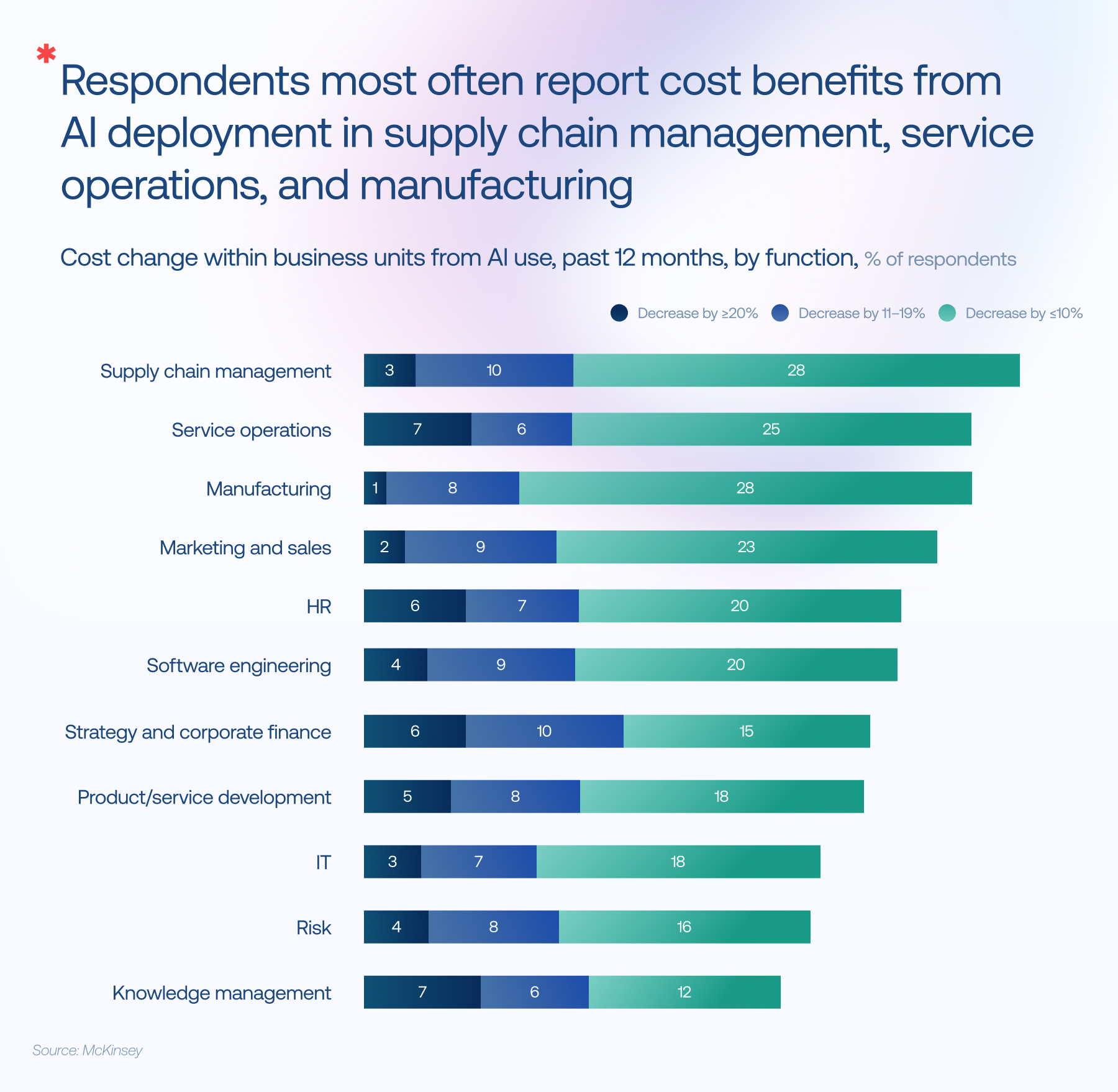
Almost 30% of surveyed respondents report a cost decrease of up to 10%, 10% say they reduced costs by 11-19%, and 3% managed to achieve a decrease of 20% or more. The following AI use cases in supply chain management drive these bottom-line savings:
35. Supply chain exception management. Upon detecting a late shipment, shortage, or demand shift, the agent assesses downstream impact, investigates alternatives, proposes or rebooks the shipment or supplier, and notifies stakeholders.
36. Inventory and replenishment orchestration. By combining forecasts, current inventory, purchase orders, service levels, and supplier constraints, the agent initiates replenishment or surfaces an exception to a planner. In a project for a large grocery retailer, AI models predicted inventory shortages and triggered agents to automatically generate purchase orders for suppliers, helping maintain optimal stock levels and reduce the risk of shortages. We incorporated this functionality, alongside other AI-powered features, into the retailer’s custom-built dark store management platform.
37. Procurement and supplier negotiation support. Given a sourcing need, the agent compares supplier quotes, contracts, performance history, and pricing benchmarks, flags risks, and prepares a negotiation brief for the buyer.
38. Demand sensing and forecasting. By integrating with ERP, WMS, CRM, and POS systems, as well as external data providers, the agent consolidates historical sales, current order volumes, inventory levels, customer activity, and market signals. Suppose the agent detects that demand for a particular product category is growing faster than forecast across several regions. It correlates actual sales data from POS systems, incoming orders from ERP, current stock levels from WMS, and changes in customer demand captured in CRM. Taking seasonal patterns and external market factors into account, it recalculates the demand forecast, identifies where existing inventory may fall short of projected needs, and alerts supply chain planners to potential shortages, recommending adjustments to procurement volumes or replenishment schedules.
39. Planning analytics. Through natural language questions from planners, the agent runs ad hoc analyses, explains KPI deviations, and traces them to their root causes. For a planning decision, the agent simulates alternatives, quantifies trade-offs between inventory cost and service level, and recommends an option with supporting rationale. For example, based on sales trends, stock positions, and store or channel profiles, an agent can propose assortment and allocation changes and flag overstock and out-of-stock risks.
40. Market and supplier risk monitoring. Scanning news, regulatory, geopolitical, and supplier data, the agent identifies emerging risks, maps them to affected suppliers and products, and recommends mitigation options.
41. Order management and customer inquiries. Upon receiving an order or a status request, the agent checks availability and capability to promise across inventory, order, and logistics systems, validates transport feasibility and cost to serve, and confirms or escalates within defined thresholds.
AI agents in finance
Finance is a good example of why AI agent autonomy should be calibrated rather than maximized. The right level depends on the task and the risks involved. CFI distinguishes three levels of agent autonomy:
- Human-executed, agent-supported tasks, such as financial statement sign-offs, use agents to gather evidence or prepare analysis, while a qualified professional makes the consequential decision.
- Agent-executed, human-approved tasks, such as reconciliations or variance commentary, are carried out or drafted by agents but require professional review before the result is accepted or acted on.
- Agent-driven tasks, such as data aggregation or standard cash application, are completed by agents within defined rules.
These autonomy levels can be seen in how agents are used across key finance processes:
42. Financial close and reconciliation support. When a mismatch appears, the agent investigates it, gathers source evidence, prepares an explanation, and routes unresolved cases to the responsible accountant, rather than making accounting judgments autonomously. For intercompany reconciliation, it orchestrates currency conversion, account matching, and exception reporting.
43. Cash flow forecasting. By combining actuals, receivables and payables, and market data, the agent updates the cash forecast, monitors liquidity and compliance with financial covenants, and alerts the treasury when thresholds are approached.
44. Accounts payable and receivable. On the payables side, the agent validates invoices against purchase orders and contract terms, flags exceptions, and routes approvals. On the receivables side, it prioritizes collections, triages disputes, and supports cash application.
45. Financial planning and analysis. Working alongside analysts, the agent gathers driver data, builds and stress-tests scenario models, drafts variance commentary, and root-causes deviations, while analysts interpret and validate the results. When month-end close reveals a margin dip, the agent autonomously pulls data from ERP and logistics systems, pinpoints the root cause, such as a spike in air freight costs, recalculates the annual forecast, and delivers a draft commentary to Slack. The analyst simply validates the model’s logic, refines the inputs (like factoring in a vendor switching penalty), and approves the final report for the CFO.
46. Risk monitoring and exception management. Monitoring transactions and risk signals, the agent detects anomalies, assembles the supporting context, and escalates cases to the responsible reviewer.
47. Spend and cost analysis. Across invoices, purchase orders, and supplier data, the agent classifies spend into a structured taxonomy, detects anomalies and waste, and surfaces savings opportunities for expert review.
AI agents for HR operations
HR automation used to mean employee portals, workflow rules, and, more recently, basic generative AI assistants that answered routine questions, such as how to request time off, when salaries are paid, or whom to contact about benefits and payroll issues. Agentic AI extends that model from answering to acting: agents can coordinate multi-step work across HRIS, applicant-tracking, payroll, IT, learning, and collaboration systems, while handing consequential employment decisions back to people.
48. End-to-end talent acquisition pipelines with human oversight. An agentic workflow manages candidate sourcing, screens incoming CVs against competency frameworks, coordinates interview availability, gathers structured feedback from hiring panels, maintains candidate communication, and drafts personalized offer packages.
49. Cross-functional onboarding and internal mobility. Multi-agent systems bridge operations across HR, IT provisioning, payroll setup, facilities management, and team leaders to prepare access, hardware, and personalized training plans before a new hire or internal transfer starts.
50. Unified employee service and HR case management. Operating as a single conversational front door, an AI agent interprets incoming employee inquiries, retrieves policy context, and executes cross-system resolutions, escalating complex edge cases directly to specialized HR representatives.
51. Dynamic staffing support. Rather than relying on static annual headcount planning, autonomous models combine real-time business demand, current assignments, availability, skills, location, and contractor capacity to identify staffing gaps and suggest ways to rebalance work.
52. Continuous skills intelligence and reskilling pathways. Agents can build a skills profile from roles, project history, learning records, and employee-provided profiles, compare them with emerging capability needs, and recommend training, mentors, projects, or internal openings. As employees complete new work or learning, the skills picture can update continuously instead of depending on an annual talent review.
Agentic AI use cases in manufacturing
In manufacturing, few operational problems stay inside one system or one team. A machine failure can throw off the production schedule, create a material shortage downstream, delay customer orders, and trigger maintenance and quality checks at the same time. AI agents can bring together signals from MES, ERP, CMMS, QMS, IoT platforms, and engineering systems, determine what needs to happen next, and carry approved actions across the workflow. This opens the door to more adaptive, increasingly self-optimizing operations.
53. Predictive maintenance and asset management. An agent can move beyond predicting that a machine is likely to fail: it can inspect telemetry and maintenance history, identify the probable failure mode, check spare-parts inventory and technician availability, propose the least disruptive maintenance window, and create the work order. Digital twins can further support this process by simulating equipment wear and comparing maintenance strategies.
54. Production issue diagnosis and recovery. When output drops or a line stops, agents can correlate equipment events, quality signals, operator logs, maintenance records, and standard operating procedures to narrow down likely causes. From there, they can assemble a recovery plan, open the necessary work orders, bring in the right specialists, and track actions until production is restored instead of leaving coordination to phone calls and spreadsheets.
55. Constraint-aware production scheduling. Instead of replanning from scratch whenever a machine goes down or a supplier slips, agents can continuously reevaluate schedules against real constraints: demand priorities, equipment capacity, labor skills, changeover times, material availability, maintenance windows, and delivery commitments. They can compare recovery scenarios, recommend the least disruptive option, and coordinate approved changes across planning and execution systems.
56. Engineering change and product improvement. Connecting product specifications, design records, simulation results, and field-service feedback allows agents to support engineering work throughout the product lifecycle. Applications include generating customized design blueprints, identifying recurring product failures, preparing design improvements, and coordinating validation and transfer into production.
57. Cross-functional operations orchestration. A production shortfall rarely ends at the factory floor, affecting customer orders, material requirements, maintenance priorities, and costs. Agents can assess these dependencies, coordinate the relevant teams and systems, and track approved recovery actions against the production plan.
From AI pilot to production: how GENiE supports enterprise-wide agent scaling
One agent can be built around one workflow. By the time an enterprise needs its second, third, or tenth agent, the economics change: a growing collection of agents becomes increasingly expensive and difficult to govern as a whole.
We ran into exactly this challenge when building AI operating layers for enterprise clients: every new agent needed access to much of the same context sources, integrations, permissions, monitoring, and governance mechanisms. Recreating that infrastructure for every use case made little sense, both technically and economically.
That recurring need led us to create GENiE, our vendor-agnostic agentic OS: a foundation packed with reusable context templates, connectors, tools, and governance controls that can be leveraged across multiple agentic use cases, helping teams bring new agents to production at least 2x faster. On average, a fully functional agent with dynamic context is assembled from scratch in just 6-8 weeks. In practice, four core pillars make that possible:
- Governed shared context. Just as effective agents depend on prompt engineering, they also require real-time awareness of customer profiles, case histories, active projects, organizational policies, prior actions, and current process states. GENiE bakes short- and long-term memory into its core architecture while maintaining a secure, governed context layer across all active agents.
- Reusable enterprise integrations. Enterprise operations rely on a fragmented stack across CRM, ERP, ITSM, email, documentation, data platforms, and legacy software. Built on an OpenAPI-first standard, our vendor-agnostic platform functions as an orchestration overlay across heterogeneous systems, eliminating single-vendor lock-in.
- Hybrid orchestration. Business workflows rarely rely on an LLM alone. They combine probabilistic reasoning with deterministic rules, APIs, specialist agents, and human approvals. GENiE supports this hybrid execution model and multi-agent orchestration.
- Built-in governance and control. Greater agent autonomy requires clear boundaries: controlled permissions, continuous monitoring, audit trails, and human oversight. GENiE provides governance and compliance mechanisms, with visual monitoring of agent interactions, performance, and spend. These controls also extend to agent-to-agent communication and align with the risk-management principles of the NIST AI Risk Management Framework and the EU AI Act.
GENiE encapsulates the hard-won practical knowledge we’ve accumulated while building production-grade AI agents for our own operations and client projects alike. Having identified what makes agentic AI initiatives succeed beyond the proof-of-concept stage, we’ve distilled those insights into a highly customizable platform that brings together everything that matters, and none of the bells and whistles that don’t. The businesses we build AI agents for with GENiE fundamentally change the mechanics and economics of day-to-day operations.
— Alexey Spas, Instinctools’ CEO
Ready to scale beyond isolated AI deployments?
Explore GENiEHow to identify AI use cases that are worth investing in
Choosing the right starting point for enterprise AI adoption is rarely about picking the most complex or dazzling capability. It requires a disciplined methodology to transition from scattered brainstorming and isolated proof-of-concepts to a structured, high-value deployment roadmap.
The core principle of effective AI identification is balancing operational impact against implementation friction. A successful pilot must solve a genuine, data-intensive bottleneck while aligning directly with organizational readiness, data maturity, and measurable business ROI.
When a fast-growing B2B SaaS provider wanted to scale AI across their product and operations, they faced a common dilemma: an overwhelming backlog of scattered AI ideas. During a two-day AI adoption workshop, Instinctools engineers evaluated 16 potential opportunities, filtering and prioritizing them into a focused, interconnected shortlist.
By mapping out concrete usage scenarios and establishing foundational governance from day one, the client successfully transformed ambiguous concepts into a clear, scalable roadmap.
You can apply the same logic to your initiative using our free AI adoption guide. It will help you map potential opportunities, assess their business value and feasibility, identify shared dependencies, and determine where to start.
FAQ
Enterprise AI use cases span customer service, sales and marketing, finance, HR, IT, and operations. Common applications include customer inquiry handling, lead qualification, financial forecasting, invoice processing, employee onboarding, predictive maintenance, fraud detection, and internal knowledge management.
Start with a use case that has a clear business owner, a measurable baseline, and data that is already accessible and reasonably clean. Internal, lower-risk processes such as knowledge search, document handling or support triage work well, because they show value fast and don’t expose customers to errors. Avoid starting with the most ambitious, cross-department initiative. A focused AI adoption workshop can help you validate the idea before you commit a full budget.
A prototype or proof of concept usually takes a few weeks. An AI agent typically reaches production in 6-8 weeks with GENiE, while a full multi-agent system development takes around 14 weeks. Timeline usually depends on the scope, architecture, data readiness, and integration requirements.
The most common AI adoption challenges include fragmented or poor-quality data, legacy system integration, lack of AI strategy, security and compliance requirements, and a shortage of in-house expertise. Even when a pilot delivers promising results, scaling it across business functions introduces additional challenges around governance, workflow redesign, infrastructure, and change management.
Running costs depend on the model and token usage, the number of agent steps per task, infrastructure and monitoring, integrations, and ongoing maintenance and evaluation. Major cost components include LLM usage/token consumption/inference, cloud compute, data storage and retrieval, third-party tools and integrations, monitoring, and human review.
A traditional chatbot primarily responds to user queries through predefined conversation flows or LLM-generated answers. An AI agent goes further: its defining capability is the ability to act. It can interpret a goal, determine the steps needed to achieve it, interact with enterprise systems through APIs and tools, and execute multi-step tasks with varying levels of autonomy.
Subscribe to
Instinctools blog