

AI in the oil and gas industry has found its footing in a set of workflows, from predictive maintenance and production optimization to emissions monitoring and refinery scheduling.
How exactly are oil and gas companies using AI across the value chain? What’s under the hood of a production-ready AI solution? Has AI’s bold promise started showing up in ROI? Our engineers draw on their hands-on experience to answer these questions.
Key highlights
- AI in oil and gas is moving from supporting decisions to executing bounded workflows, but large-scale autonomy is still emerging.
- A relatively small number of AI use cases account for most of the value, especially where data and business impact are easy to measure.
- The real challenge is not proving AI can work, but getting it from pilot to production despite data, integration, governance, and adoption barriers.
- Production-ready AI depends on more than the model itself: data, context, orchestration, control, and monitoring all have to work together.
What AI in oil and gas means in 2026
AI in oil and gas now spans technologies from predictive machine learning and computer vision to generative and agentic AI. They use operational, engineering, and business data to predict events, optimize decisions, automate workflows, and, in some cases, take action across upstream, midstream, downstream, and corporate operations.
As of 2026, one of the clearest ways to understand artificial intelligence in the oil and gas industry is by the level of autonomy it is given:
- Assistive AI supports decisions. AI-powered chatbots and assistants can answer technical questions, recommend drilling parameters, spot and flag an anomaly on a compressor, while a human takes action. That’s the entry level where oil and gas companies have already found their footing.
- Agentic AI executes work. AI agents can carry out multistep workflows, coordinate tools and systems, prepare or file documents, and, where controls allow, trigger operational actions. Human experts set the boundaries, oversee higher-risk decisions, and step in for exceptions. The industry is already moving in this direction, but broader autonomous operations remain an emerging frontier rather than the norm.
What has changed in AI adoption in oil and gas?
AI in the oil and gas market has grown from a collection of experiments into a technology companies plan their budgets around. Generative AI holds steady in document-heavy work, and AI agents are working through bounded pilots, but scaling beyond them remains rare.
So how is AI transforming the oil and gas industry, if not through scale? Through intent.
Companies now focus on narrowing the gap between AI’s near-term value and its full potential. 79% of oil and gas tech leaders rank AI among their top investment priorities, and their sights are shifting from single-task savings to business models rearranged around AI to unlock system-level improvements in production, reliability, safety, and capital efficiency.
Generative AI in oil and gas has reached production
Generative AI in the oil and gas industry is used mainly for low-risk, high-volume tasks, such as searching technical documentation, drafting regulated paperwork, and pulling answers out of decades of records. Oil and gas companies sit on enormous volumes of manuals, reports, work orders, and other unstructured information, making this a natural place for GenAI to create value.
What generative AI does not do is make the underlying data problem disappear. LLMs can make unstructured information easier to search and use, particularly when paired with retrieval, but reliable output still depends on relevant, current, governed source data.
Although generative AI gained ground in the oil and gas market, its adoption has fallen well short of early expectations – at least judging by the example of oilfield services and equipment companies. In McKinsey’s OFSE research, leaders surveyed in 2023 expected more than 70% of companies to be piloting and scaling GenAI by 2025. Instead, fewer than 25% showed some level of use in 2025, and just 1% reported significant scale.
For companies still working out where GenAI belongs, that gap is revealing: much of the value remains uncaptured, but the opportunity window hasn’t closed yet.
Agentic AI in the oil and gas industry: the new type of autonomous workforce
Oil and gas companies started onboarding a different kind of staff members: AI agents that carry out multistep tasks from start to finish on their own. Their value goes beyond incremental productivity gains to substantial performance improvements, such as adjusting mud weight on the fly to prevent blowouts or catching pipeline anomalies before they turn into costly failures down the line. For most organizations, though, agents haven’t left the pilot stage, and the promise of fully autonomous AI teammates has yet to come true.
Hard data on the agentic AI adoption rate in the oil and gas industry says that 20% of companies use agentic AI at least moderately, just below the 23% cross-industry average. Some segments run ahead, for instance, in upstream, 29% of players are piloting agents to optimize drilling and production.
If current plans materialize, the agentic AI adoption curve is about to steepen. Within two years, the percentage of oil and gas companies expected to use agentic AI at least moderately will reach 71%, according to Deloitte’s ER&I survey. The share using it extensively or as a fully integrated part of operations is set to jump from 1% to 22%.

There is one obvious constraint though: a lack of codified oversight. As businesses across the sector plan to double down on agentic AI in the near future, only 25% have a mature model for governing autonomous agents.
For agents to take root in the oil and gas industry, the guardrails have to scale as fast as the AI initiatives crop up.
Regulatory changes are raising the bar for AI adoption in the oil and gas industry
Evolving environmental, safety, and AI-specific regulations and frameworks are reshaping the application of AI in the oil and gas industry. The effect runs in two directions: regulation can create new opportunities for automation while also raising the requirements for AI used in higher-risk settings:
- Creating demand for AI-enabled monitoring and compliance. The EU Methane Regulation in Europe and the EPA’s methane rules in the US require systematic measurement of emissions, leak detection, and reporting. Although AI is not mandated by either regulatory framework, computer vision, sensor analytics, satellite or drone processing, and automated reporting can help operators handle the growing volume of detection and compliance work.
- Becoming a deployment constraint. Under the EU AI Act, certain AI systems used as safety components in critical infrastructure qualify as high-risk and face requirements around risk management, data governance, logging, transparency, human oversight, accuracy, and cybersecurity. Not every AI used in the oil and gas industry falls into this category. Say, a demand-forecasting model doesn’t, but software acting as a safety component in gas supply may. Either way, teams now have to check where each system lands and design the controls to match.
Unlike the European Union, the US has no single federal law equivalent to the EU AI Act. The cross-sector NIST AI Risk Management Framework is voluntary guidance. That leaves AI governance a matter of choice for US operators, but those who build controls early will be ahead of the pack if Congress or the states pass AI laws that reach industrial operations.
The implications tied to AI use run straight into system design: data provenance, audit trails, and named human accountability cost far less to engineer into an AI solution from the outset than retrofit once it goes live.
The target of AI adoption is moving
Even a year ago, oil and gas companies could launch multiple AI pilots while keeping the core processes and business model as is. In 2026, the industry is starting to ask how operations themselves need to change to capture more value from it.
The transition is already visible. While 40% of ER&I organizations still use AI with little or no change to underlying processes, 37% are redesigning key processes, and another 23% are pursuing deeper transformation of products, processes, and business models.
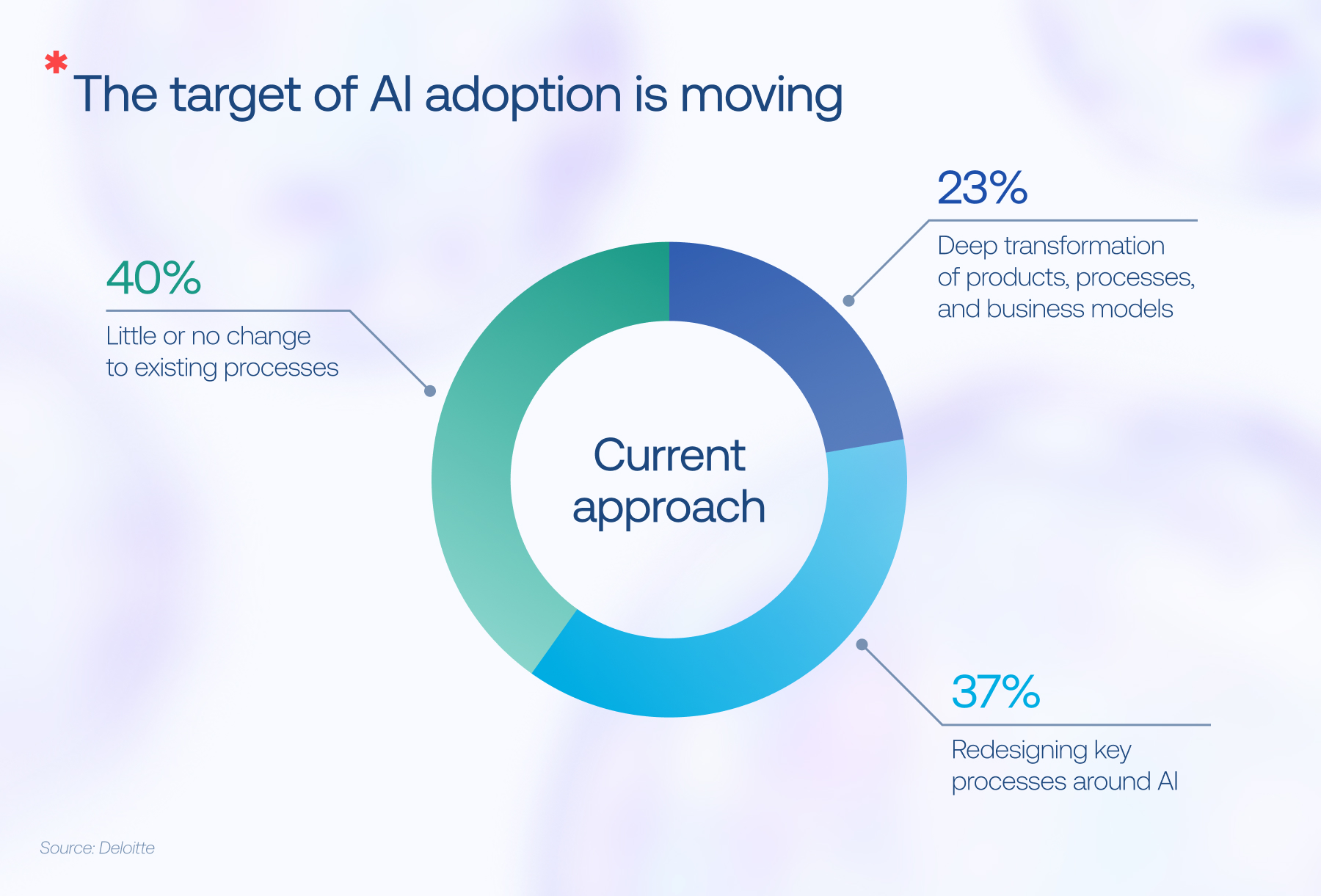
In practice, the shift comes down to three moves:
- From experimentation to prioritization. Use cases are judged on business impact, implementation feasibility, and scalability. A flashy demo alone is no longer enough to justify continued investment.
- From isolated pilots to production systems. The focus moves to data integration, governance, and operational ownership.
- From individual efficiency gains to organization-wide improvements. Companies increasingly seek to connect AI capabilities across workflows rather than optimize individual tasks in isolation.
The economics of AI in the oil and gas market: investment vs. value at stake
The money flowing into AI and digital technologies in oil and gas is substantial. The value companies hope to unlock is larger still. But the distance between the two is where the economics of AI are ultimately decided: spending creates capability, yet only adoption at scale turns it into return.
- How much is the industry investing? Upstream oil and gas organizations spent up to $25 billion on digital and AI products and services in 2025, and the figure is projected to exceed $35 billion by 2030.
- What is the estimated economic potential? In upstream alone, AI could generate about $65 billion in annual recurring value and up to $230 billion at full potential, even after implementation costs.
- Why doesn’t spending alone translate into value? A model that works is not the same as a capability that pays. AI has to make it into production, connect with the data and systems around it, become part of how operational decisions are made, and have its impact measured against a credible baseline. Overlook any of these, and the investment in AI in the oil industry remains a cost with no ROI.
The best-paying artificial intelligence use cases in oil and gas look less like wildcats and more like brownfield wells: they target operational ground where the data, workflows, and value pools are already visible.
AI or die: the highest-value AI use cases in oil and gas, ranked
What separates a high-value AI project from an expensive pilot comes down to three traits: plenty of operational data, fast physical feedback, and a direct line to cost, revenue, or safety. Across the value chain, that points to production and drilling optimization upstream, plant efficiency and pipeline monitoring in midstream, refinery scheduling and fuel pricing downstream, and safety and knowledge access everywhere in between.
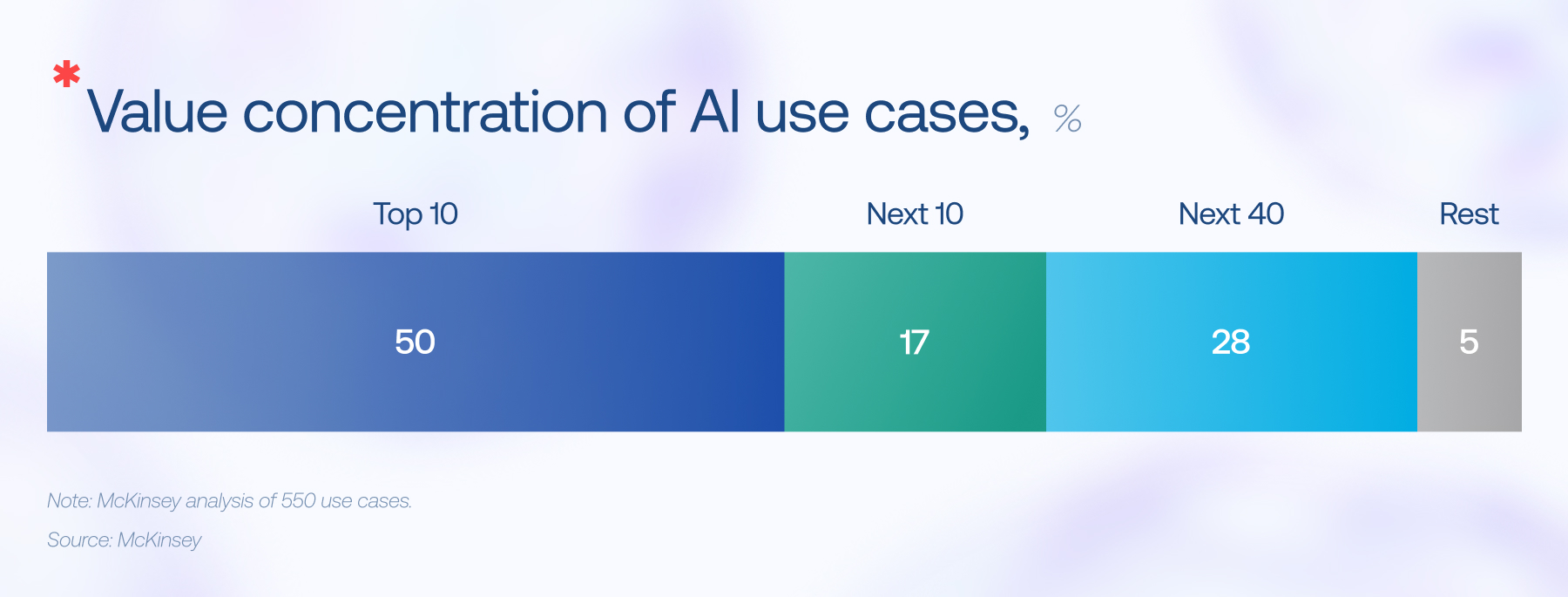
The value of AI in oil and gas follows a Pareto-like pattern: a relatively small number of use cases account for a disproportionate share of the total value. So you should choose AI initiatives to invest in wisely.
Upstream: AI in oil and gas exploration, drilling, and production
In upstream, some of the richest AI value pools sit close to physical operations: production optimization, real-time drilling optimization, reservoir management, and predictive maintenance in oil and gas, where high-frequency data and fast physical feedback make results measurable within weeks.
1. Production optimization
Production assets generate high-frequency data with immediate physical feedback, making production optimization particularly fertile ground for machine learning applications in oil and gas. AI models can use pressure, flow, pump, and other telemetry to recommend – or, within approved operating envelopes, execute – changes to rod pumps, ESPs, gas lift, waterfloods, and other production systems.
The payoff shows up in metrics operators already track:
- extra barrels,
- less well downtime,
- fewer pump failures,
- lower well repair costs.
U.S. Energy Development Corporation, a mid-size independent oil and gas producer, tested this on 12 Permian wells. Its AI system monitored each well’s lift equipment, adjusted settings within an approved range, and learned from every result. Production rose 12.2% against the pre-activation baseline.
The same idea is now moving to much larger asset portfolios. US natural gas producer Expand Energy, for example, is rolling out an AI-powered production platform across thousands of wells in the Marcellus, Utica, and Haynesville shales.
2. Drilling and well deliver
Drilling is one of upstream’s largest cost pools, so minutes saved at the rig can compound into meaningful capital savings. Well-placed AI solutions for oil and gas can attack that cost from several directions: improving well planning and equipment selection, detecting anomalies earlier, optimizing drilling parameters in real time, and cutting the time lost to routine activities such as connections and tripping.
Nonproductive time is the obvious target, but it is not the only one. Invisible lost time (ILT) is harder to see: the rig is technically working, yet routine activities take longer than their achievable benchmark. Those extra minutes rarely appear as downtime, but they accumulate over the course of a well.
One BCG case study shows how AI can go after that hidden loss. A real-time prescriptive tool combines rig sensor data with planning information and daily drilling reports, then gives field crews recommended parameters and time targets for individual activities in seconds. In that specific case, ILT accounted for more than 35% of drilling time, while BCG estimated a 10–20% capex reduction potential from the approach.
Rate of penetration (ROP) is another big lever. Instead of relying only on fixed parameters or crew experience, AI can benchmark current performance against comparable high-performing wells and continuously recommend adjustments to weight on bit, rotary speed, flow rate, and other controllable parameters. The goal is not simply to drill faster, but to find a better operating window without creating new reliability or well-control problems.
3. Exploration and reservoir management
AI successfully compresses the slowest, exploratory work, with seismic interpretation being the clearest case. Equinor says its AI tools have delivered a tenfold increase in seismic interpretation capacity, allowing geoscientists to analyze far more subsurface data while keeping experts in the decision loop.
In reservoir management, AI speeds up simulation. Traditionally, engineers use physics-based simulators to predict how oil, gas, and water flow through underground rock formations, but running large numbers of scenarios is computationally expensive. AI surrogate models trained on simulation results can approximate similar cases much faster, helping reservoir teams screen more development options and reserve full-physics simulations for the ones worth deeper analysis. The next step is to combine those models with AI agents capable of coordinating multistep workflows, which can shrink exploration and field development timelines from months and years to days and weeks.
4. Predictive maintenance and facility operations
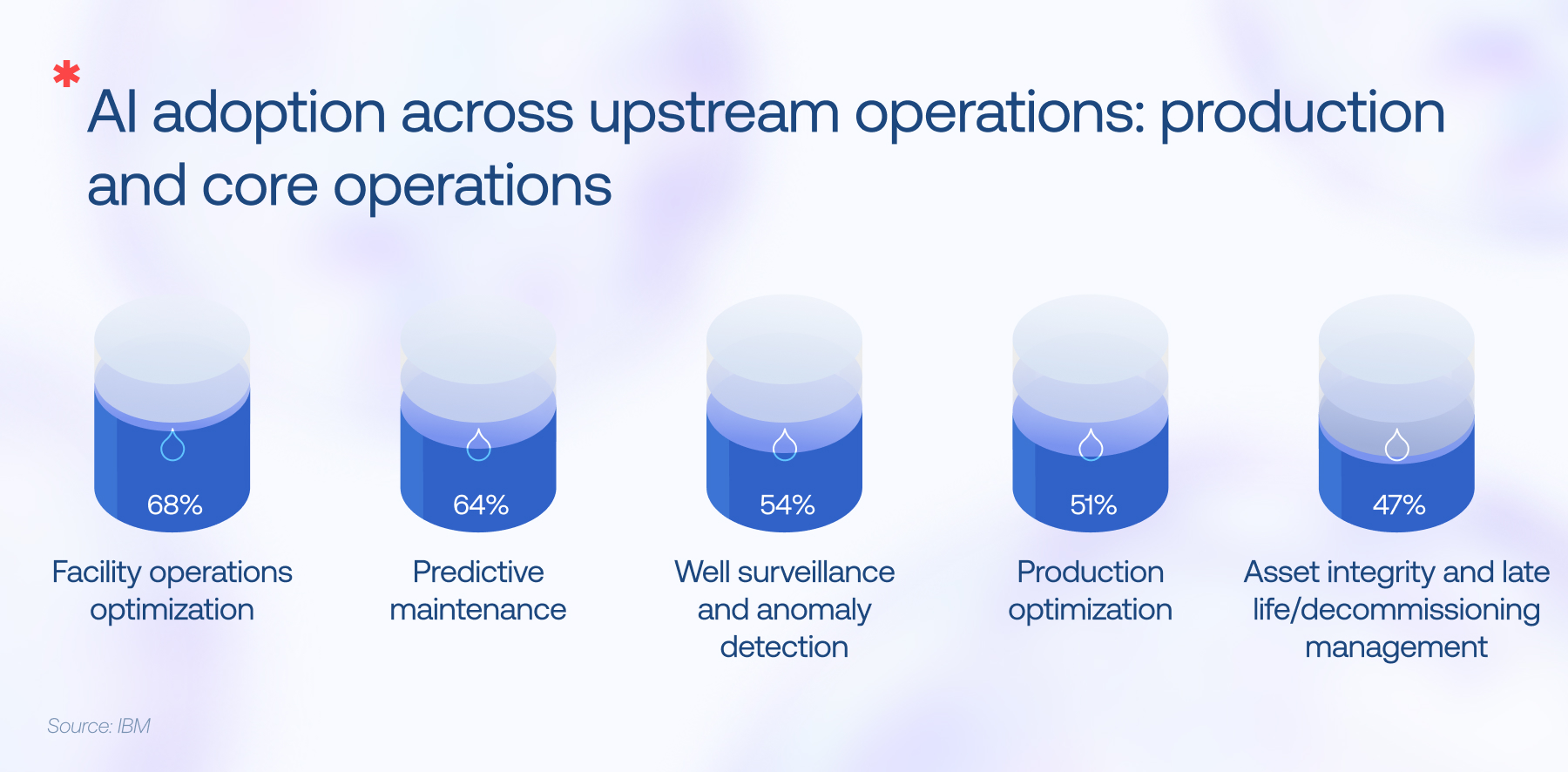
IBM data suggests that, of all use cases for AI in upstream oil and gas, equipment upkeep has moved furthest from pilots to daily operations. In facility operations, 68% of companies have rolled out or fully implemented AI, and predictive maintenance follows at 64%.
ML models learn what normal vibration, pressure, and temperature readings look like for each pump or compressor, then flag the drift that comes before a failure. AI agents are starting to take on the tasks that follow an alert, such as tracking spare parts, filling in maintenance reports, and scheduling repairs.
Real-life examples prove that savings from applying artificial intelligence build year over year. Equinor has realized over $330 million from AI in industrial processes since 2020, $130 million of it in 2025 alone. Predictive maintenance accounts for $120 million of that total: 24,000 sensors monitor more than 700 rotating machines across the company’s facilities to predict failures before they happen.
5. Emissions monitoring and leak detection
Methane monitoring is another natural fit for artificial intelligence in upstream oil and gas because the problem is inherently data-heavy: operators need to identify leaks across dispersed assets, distinguish meaningful signals from noise, prioritize interventions, and maintain a record of what was detected and addressed.
SOCAR provides one recent example. The company has developed its own Methane AI software to support methane monitoring and reduction. According to SOCAR, the system ingests measurement data to identify emissions priorities and forecast potential risks. Regional partners have since shown interest in implementing it.
Midstream: AI for oil and gas processing, transportation, and storage
AI makes midstream operations cheaper, safer, and better timed. It detects damage early along oil and gas pipelines, reduces the energy gas processing plants consume, keeps liquefied natural gas (LNG) shipments on schedule, and helps companies make smarter storage and delivery decisions.
1. Processing plant optimization
Before gas enters long-distance pipelines, processing plants strip out water, impurities, and heavier liquids. These plants and the compressor stations consume large amounts of energy, making efficiency AI’s main target. Companies report a 22% improvement in energy efficiency coming from AI-optimized control systems in processing and compression facilities.
These systems learn from plant data and continuously adjust process settings, a job that used to depend on operators making manual changes. Aramco’s Fadhili Gas Plant shows how far this can go. There, coordinated AI agents were trained on a plant simulator, then connected to the plant’s existing control system so they operate within its safety functions. The agents manage the acid gas removal process, with early results showing 10–15% less chemical solvent and steam, about 5% less power, steadier operations, and far fewer manual adjustments by operators.
2. Pipeline monitoring and LNG logistics
Midstream companies move oil and gas from fields to processing plants, refineries, and export terminals in two ways: through pipelines over land, and by tanker across the sea. AI for oil and gas infrastructure makes both routes safer and more efficient.
On land, the biggest risk is the pipeline itself. Corrosion, cracking, ground movement, equipment faults, and other degradation mechanisms can create leaks or force shutdowns if they go undetected.
AI-powered pipeline monitoring systems can catch these problems early and enable what we call targeted maintenance. AI combines real-time data from drones, satellites, and sensors along the line, looking for subtle anomalies in pressure, flow, and environmental readings that point to faults, leaks, or structural weaknesses. Repair crews can then zero in on the damaged segment instead of inspecting the whole line.
— Ivan Dubouski, Lead AI Engineer, Instinctools
Disruptions, such as capacity cuts and schedule changes, call for agentic AI. When a pipeline operator announces one, an AI agent reads the notice, works out which contracts it affects, and alerts the planner responsible for those deliveries.
At sea, the challenge shifts from safety to logistics. LNG cargoes have to be matched with routes, vessel availability, terminal slots, contracts, and changing freight economics. AI-driven optimization tools can compare routing and departure options and help planners build more efficient shipping schedules. Agentic systems handle exceptions, such as flagging a missing cargo document before a tanker gets stuck in port and starts racking up late fees.
3. Storage and delivery planning
Every cubic meter of gas in storage carries a timing decision: sell or deliver it now, or hold it for later. That choice depends on demand, prices, inventory levels, pipeline capacity, maintenance outages, and contractual obligations – all of which can shift quickly.
AI can continuously bring those signals together and help planners decide when to inject gas into storage and when to withdraw it. Rather than replacing commercial judgment, it gives teams a faster way to evaluate changing market and infrastructure conditions and compare alternative delivery strategies.
AI in downstream oil and gas: refining and marketing
A large share of downstream profit is made or lost in three places: the refinery schedule, the price at the pump, and the delivery network that connects them. And that’s where AI adoption can make a difference: layered on top of the systems companies already have, it sharpens planning decisions, optimizes process control, and supports responsive pricing.
1. Refinery planning and scheduling optimization
A refinery’s margin depends on a chain of daily choices: which crude to buy, how to blend it, what conditions each processing unit should operate under, and when to ship finished products out. Few places show the value of artificial intelligence in the petroleum industry as clearly, since a small change at any link can ripple through the economics of the entire operation.
Refiners have long relied on optimization models to build production plans and schedules. The challenge is keeping those plans current when crude deliveries slip, equipment constraints change, or demand moves. AI planning and scheduling tools in the petrochemical industry can search large numbers of possible crude, blending, operating, and shipment combinations much faster, helping planners identify more profitable options.
A digital twin can extend that capability by giving teams a virtual environment in which to test decisions before they affect the physical plant. At one US refinery, AI-powered planning and scheduling built around a digital twin cut the optimization cycle from hours to under 10 minutes.
But you know the drill: a schedule is only as good as its execution. Once the plan sets targets for each processing unit, AI keeps it on track by adjusting temperatures, pressures, flows, and other setpoints as conditions change, all while staying within predefined operating limits.
— Ivan Dubouski, Lead AI Engineer, Instinctools
2. Product quality control
Refined products have to meet strict specifications, and checking them the old way involves taking samples and waiting for lab results. In one refinery’s LPG purification unit, an off-spec batch could go undetected for up to 24 hours. By then, the refinery would have to re-blend or re-purify the product, or, in the worst case, discard it.
AI-powered soft sensors narrow that gap. Trained on readings from instruments already installed in the plant, they continuously estimate product quality, so operators can correct drift long before the lab would catch it.
Real-time product quality data also helps refiners stop overshooting. Without it, operators aim well inside the specification to be safe, spending extra processing effort on quality the customer doesn’t pay for. Better visibility allows the process to run closer to target without sacrificing compliance.
— Pavel Klapatsiuk, Lead AI Engineer, Instinctools
3. Fuel pricing and sales
Pricing is one of the AI applications in the oil and gas industry with the clearest link to revenue. The price on a gas station’s sign has to balance margin against volume: set it a few cents too high and drivers fill up at the station across the street, set it too low and the station gives money away.
AI-driven pricing engines follow competitor prices, demand, and traffic, learn from every outcome, and adjust prices as conditions shift. An Australian fuel retailer that deployed such an engine across more than 600 service stations increased gross profit by 7% while selling 5% more fuel.
Bulk sales create another opportunity for AI automation:
Wholesale deals often come through brokers via email or chat. A sales rep then enters the price, volume, and delivery date into the energy trading and risk management (ETRM) system, verifies the buyer and product against approved lists, and sends the deal for approval. An AI agent can handle all these steps, leaving people to review and approve the deal.
— Pavel Klapatsiuk, Lead AI Engineer, Instinctools
Cross-stream: AI applications in oil and gas for safety, compliance, and the back office
Some of the most practical AI applications cut across upstream, midstream, and downstream. They help companies monitor workplace risks, make technical knowledge easier to access, and automate the document-heavy work that surrounds industrial operations. Many of these solutions build on assets companies already have, such as existing camera networks and document archives, which can lower the barrier to adoption.
1. HSE and workplace safety monitoring
Health, safety, and environment (HSE) risks exist across the oil and gas value chain, from drilling rigs to refineries. Computer vision in oil and gas turns existing camera feeds into an extra pair of eyes: it spots a missing hard hat, an unfastened harness, or a worker drifting into the danger zone around moving equipment. AI agents then check each alert, rate the risk, attach the video clip, and send a short summary to the responsible supervisor. At one offshore site in Abu Dhabi, computer vision monitoring cut safety violations by 80%.
Combining AI and IoT in oil and gas adds another layer of visibility. Wearables, location tags, and environmental sensors can provide signals on fatigue, worker location, heat exposure, or hazardous conditions. Fused with camera analytics, that data gives supervisors a more complete view of risk than video alone.
2. Knowledge access and field assistants
Oil and gas operations depend on decades of technical knowledge, much of it buried in manuals, drawings, and long-tenured employees’ heads. AI assistants built with retrieval-augmented generation (RAG) make that information easier to reach. Ask a question in plain language and receive an answer grounded in approved internal documentation, together with links or references back to the source material.
On-site, AI in oil and gas operations can support crews in two complementary ways:
- AI assistants help people find and interpret information faster, suggesting troubleshooting steps, diagnosing equipment problems from a photo, and pulling up repair instructions.
- AI agents take on the paperwork around the task, drafting work orders and logging what was done once the repair is finished.
3. Back-office automation
Every well, lease, and contract leaves a document trail – lease agreements, hand-drawn property maps, invoices, amendments, and decades of archived records. Many have been digitized, but digitization alone does not make the information inside them easy to find, compare, or act on.
AI can extract and structure information from heterogeneous documents, classify records, identify relevant clauses, and connect information that would otherwise require manual review across multiple files. However, land and legal specialists still need to validate higher-risk interpretations, particularly where ownership rights, obligations, or contractual language are involved.
For accounting teams, AI streamlines the reconciliation of high-volume billing data from partners, flagging discrepancies, checking revenue against contract terms, and improving accuracy over time by learning from reviewers’ corrections.
AI in EPC oil and gas projects: a cautious start with plenty of room to grow
AI has a role to play across the entire engineering, procurement, and construction (EPC) lifecycle. In engineering, it helps teams retrieve knowledge from past projects and review technical documentation. Procurement teams can use AI to analyze supplier bids and check documents against project requirements. During construction, AI can track progress, identify scheduling risks, and flag potential delays.
Yet the AI adoption rate in the EPC oil and gas industry remains hard to quantify. EPC companies appear in broader oilfield-services and construction surveys, but their results are rarely broken out as a separate group. But in the broader engineering and construction sector, fewer than 1% of organizations have embedded AI organization-wide, and only 1.5% use it across multiple processes.
Part of the friction is commercial. Under some contract models, greater efficiency does not automatically translate into greater value for the contractor. If AI reduces the engineering effort or time required to deliver the same outcome, the economic upside may accrue primarily to the client unless the commercial model rewards productivity as well. That’s why new commercial models, such as outcome-based pricing and gain-sharing, are emerging: they let both sides benefit from the efficiency gains AI brings.
Worley shows what a practical starting point can look like. Their AI knowledge platform, used by roughly 3,000 engineers, makes design decisions and lessons from previous projects easier to retrieve. A team working on a new facility can quickly find how a similar engineering problem was handled before, instead of rebuilding that knowledge from scratch.
Where AI implementation in the oil and gas industry gets stuck
AI accelerates what happens inside a digitally capable organization, but it can’t create one overnight. Data discipline, a thorough plan for scaling projects beyond pilots, clear workflow ownership, strong governance and security measures, and careful change management become even more important as AI moves deeper into operations.
Data isn’t ready for AI
As operations across the entire oil and gas value chain become more complex, distributed, and data-intensive, data preparation for AI tops organizations’ agendas. More than half of oil and gas companies name data fragmentation and legacy systems as their main barriers to scaling AI. The problem is especially visible across long-lived industrial assets: wells, platforms, and plants built before the 2010s often lack the sensors and connectivity needed to feed AI models. And where sensors exist, years of readings may remain unlabeled and lack the engineering context needed to interpret them.
If your data is messy, AI will scale the mess.
Pilots break at scale
Getting an AI pilot to work is the easy part, as the only thing it should prove is that AI can work under a defined set of conditions. Production, on the other hand, has to prove that it can keep working when those conditions change. A model trained around one well, plant, or equipment configuration may encounter different sensors, naming conventions, operating regimes, maintenance histories, and data gaps when deployed across the next 10+ assets.
Economics becomes harder too. Scaling requires infrastructure, monitoring, integration, model maintenance, and people to own the system in production. When companies cannot connect those costs to a credible baseline and measurable business impact, further investment becomes much harder to justify.
Security and governance get traded for speed
Nearly three-quarters of energy companies admit that pushing for speed and lower costs forces them to compromise on security, scalability, and data standards. This shortcut gets risky once AI starts acting on physical equipment: a model fed inconsistent data or left open to attackers can cause real damage on site.
Before AI takes on greater operational responsibility, companies need a solid AI governance framework around it: trustworthy sensor data, resilient connectivity, tightly scoped permissions, secure integration between IT and OT, and continuous monitoring of both data and system behavior.
Change management falls behind
Even sure-fire AI use cases in oil and gas create little value if people work around it, ignore it, or do not trust its output.
The harder part of adoption is often not introducing the model but changing the decisions and workflows around it. Teams need to know when AI should be trusted, when its output needs verification, when to override it, and who owns the next step.
That makes change management part of the implementation itself. Training, workflow redesign, clear responsibilities, and feedback from the people using the system determine whether AI becomes part of everyday operations or remains another tool people rarely open.
Instinctools’ five-layer approach to production-ready AI in oil and gas
To become production-ready, an AI system in oil and gas needs to safely access data from plant systems, understand what that data means, coordinate work across systems and people, stay within defined limits, and show when its own performance starts to degrade. Organized into five layers, those capabilities form a practical architecture for taking enterprise AI for the gas industry beyond the pilot and into day-to-day industrial operations.
Data and integration
Raw operational data is rarely ready for AI. Preparing it involves filling or flagging gaps, filtering out spikes and duplicates, aligning units and timestamps across sources, and checking each data set for accuracy, timeliness, consistency, and completeness.
Integrations matter just as much, as no single system tells the whole story:
- Equipment sensors provide real-time readings
- SCADA systems monitor and control plant operations
- ERP holds business and maintenance records
- Subsurface platforms built on the OSDU standard store geological data
- Industrial historians such as AVEVA PI keep years of equipment readings
Forecasting a drop in a well’s output, for example, takes sensor readings, subsurface data, and maintenance schedules together.
Pro tip: Route operational data through a protected network zone, and let AI work with a copy there. This standard practice in industrial data engineering keeps control systems out of reach, since nothing from outside ever connects to them directly.
Сontext engineering
A sensor reading such as “TI-2041: 87°C” tells an AI system very little on its own. To know whether it matters, the system needs context: which asset the tag belongs to, what the normal operating range looks like, what maintenance has already been performed, what process is running, and which procedures apply.
This layer connects raw operational signals with asset hierarchies, engineering documentation, maintenance histories, operating limits, and other business context – often through a modern data platform or semantic layer.
Pro tip: Start from the asset hierarchy. Map every sensor tag and document to the equipment it describes before AI gets access to the data, so each answer points to the right asset.
Orchestration
Take a compressor alert. A predictive maintenance system flags the anomaly, an AI agent drafts a work order, another checks whether the parts are in stock, and, when a work order is prepared, a supervisor approves the repair.
AI orchestration is what keeps that chain moving: it tracks where each task stands, retries failed steps, and stops for human sign-off where company rules require it. Agent orchestration frameworks like LangGraph and CrewAI provide some of the mechanics, but the real orchestration logic has to reflect the operator’s own workflows, systems, escalation paths, and approval structure.
Pro tip: Map escalation paths and the approval chain with the people who own them before writing any orchestration logic. Then connect agents into a single sequence, so results pass between steps automatically.
Governance and control
AI in oil and gas operations needs a clearly defined authority. Permissions determine which systems it can read, which actions it can initiate, and where human approval is mandatory. Audit trails record what the system saw, recommended, and changed. Where AI interacts with industrial control environments, such as SCADA and plant control systems, those limits also have to meet industrial cybersecurity standards: IEC 62443 for industrial automation and API 1164 for pipelines.
But permission to act doesn’t mean permission to do anything. AI should climb the autonomy ladder in phases, moving up a step only once the evidence is in place. If AI adjusts equipment settings, it must operate through approved control interfaces and within independently enforced operating limits. Existing safety mechanisms, like automatic emergency shutdown systems, must remain independent of AI and take priority over its decisions.
Pro tip: Test every new AI permission in shadow mode first, where the system proposes actions without executing them. Grant real authority only once its track record holds up.
Monitoring
An AI model doesn’t stay reliable simply because it worked on launch day. Its accuracy slips as equipment ages and operating conditions shift, and the data feeding it can drift too: for example, a pressure sensor that slid out of calibration years ago may keep sending readings that look plausible but are wrong, and the model learns from them.
Therefore, monitoring has to cover more than uptime. Teams need visibility into model performance, data quality, sensor health, workflow failures, exception rates, and the operational outcomes the AI is supposed to improve.
Pro tip: Involve engineers with hands-on knowledge of the equipment in AI monitoring alongside the data team. They can distinguish sensor drift from a genuine process change.
AI in oil and gas vendor landscape: platforms, oilfield service tools, and custom development
No single vendor covers everything a production AI system needs. The operators getting the most value combine several types of providers, from general-purpose and industrial AI platforms to oilfield service firms and custom AI development, matching each to the job it does best.
| Vendor type | What they offer | Examples | Strengths | Limits |
| Enterprise AI providers | General-purpose platforms for building and deploying AI across a company | Microsoft Azure AI, Palantir AIP | Provide a common platform for AI development and deployment across departments | Require additional integration and engineering work to understand plant-specific equipment, processes, and operating constraints |
| Industrial AI platform providers | Platforms that connect and organize plant and equipment data across industries, so companies can build AI on top | Cognite Data Fusion, AVEVA CONNECT, Honeywell Forge | Integrate operational data from sensors, control systems, and engineering documents | Focus on industrial operations; enterprise-wide AI use cases may require additional integrations |
| Oilfield service companies | AI applications tailored to exploration, drilling, production, and other oil and gas workflows | SLB Lumi and Delfi, Halliburton DecisionSpace 365, Baker Hughes Leucipa | Deep industry expertise, domain-specific models, and established operational workflows | Custom workflows and integration with existing systems may require additional engineering |
| AI engineering companies | Custom AI solutions for oil and gas, tailored to the operator’s workflows and connected to their existing systems | Instinctools and its AI solution accelerator – GENiE – for building and orchestrating custom AI agentic systems | Combines bespoke engineering with reusable capabilities for context management, agent orchestration, cross-platform integration, and AI governance; adapts to the company’s existing systems, workflows, and approval rules | Requires more upfront engineering and solution design than an off-the-shelf product |
When to build and when to buy AI solutions in oil and gas
There is no universal cost advantage to buying or building when it comes to the application of AI in the oil and gas industry. A ready-made product can shorten time to deployment, but licensing, usage-based pricing, integration, and customization costs can grow quickly at scale. A custom solution takes more engineering upfront, but may offer better economics and control when workflows, data, or operating conditions are highly specific to the company.
In practice, most AI environments combine both approaches. The balance depends on how differentiated the use case is, what already exists on the market, how deeply the solution needs to integrate with operations, and what the total cost looks like over its lifecycle.
| Approach | When it fits | Examples | Watch out for |
| Buy | Standard workflows with proven commercial solutions | Equipment monitoring, production surveillance, document summarization | Licensing and usage costs can rise sharply with the number of users, assets, or data volumes; customization and integration may still require substantial work |
| Build | Proprietary workflows, site-specific conditions, unique operating logic, or strategically important IP | Custom reservoir analytics, exploration workflows, optimization and agentic systems built around internal processes | Higher development and maintenance costs |
You can buy the same AI tools as your competitors. What is much harder to replicate is the operational knowledge built around them: how the data is prepared, how AI connects to existing workflows, where people stay in the loop, and what has been learned from running the system across different assets. That experience compounds over time – and it can compound much faster when you work with an experienced AI software development company that brings proven architectures, delivery patterns, and lessons learned from previous implementations.
— Ivan Dubouski, Lead AI Engineer, Instinctools
Instinctools’ fast track for AI implementation in oil and gas
Many AI-driven oil and gas digital transformations go off course before a model is ever built, at the point where companies decide which problems are worth solving with AI. The strongest candidates combine measurable business value with usable data and a realistic path to adoption. Get that choice right, and every later decision becomes easier. Pick the wrong initiatives, and no amount of engineering will save them.
For companies new to artificial intelligence and machine learning in the oil and gas industry, an AI adoption workshop helps identify viable use cases, assess current maturity, and turn a broad ambition such as “we need AI” into a prioritized roadmap.
The same exercise helps companies stuck in the pilot purgatory, with solutions that work but don’t scale. Each pilot is assessed against business value, technical feasibility, adoption, and scalability, then assigned to one of four decision tracks: ‘scale’, ‘rework’, ‘consolidate’, or ‘stop’.
Freeing the budget from weak pilots lets the strong ones reach production.
You don’t have to start with a costly consulting engagement, though. Our free agentic AI playbook walks you through the first round of discovery on your own. Choose one real workflow, follow five practical steps, and get a blueprint you can take into technical discovery, with no model selection or AI stack design required.
Map your first AI workflow before you invest in development
Download the playbookStrike while the rig is hot
AI in the oil and gas industry has already proven itself in a number of workflows, from production optimization and refinery scheduling to leak detection and safety monitoring. Still, moving beyond the pilot stage is a bumpy road: data isn’t ready for AI, systems aren’t connected, governance comes as an afterthought, and people need time to adapt to working side by side with an increasingly autonomous AI workforce.
None of these challenges is insurmountable. But they do change what successful implementation looks like. The next competitive advantage will come from choosing use cases with clear economics, building the foundations to run them safely in production, and scaling only what proves its value.
Invest in AI where it pays off
Let’s talkFAQ
AI is changing how oil and gas companies make decisions and run operations. Predictive models help teams prevent failures and optimize production, while AI assistants speed up knowledge-intensive work. The next shift is toward AI agents that coordinate tasks across systems, although most agentic deployments remain in their early stages.
Organizations use artificial intelligence in oil and gas across the whole value chain: upstream to optimize production and drilling, midstream to monitor pipelines and plan LNG shipments, downstream to schedule refineries and price fuel, and cross-stream to improve safety and automate paperwork.
High-value AI use cases in oil and gas include production and drilling optimization, predictive maintenance, refinery scheduling, and emissions monitoring. The best choice depends on the available data, implementation costs, operational constraints, and measurable business impact.
Generative AI use cases in the oil and gas industry span knowledge- and document-heavy tasks, such as finding answers in standards and manuals, drafting reports, and extracting clauses from old contracts, saving hours of manual work.
Agentic AI in the oil and gas industry refers to systems that can plan and carry out multistep tasks across tools and applications within predefined limits. In oil and gas, most deployments are still bounded rather than fully autonomous. Examples include preparing maintenance work orders, checking parts availability, processing operational notices, coordinating information across enterprise systems, and supporting selected drilling or production workflows.
Operators including Aramco, Equinor, Expand Energy, and SOCAR apply AI to production, maintenance, and emissions monitoring. Oilfield service and technology providers, such as SLB, Halliburton, and Baker Hughes, build AI into their software and services.
There’s no widely reported AI adoption rate in the EPC oil and gas industry. EPC companies appear in broader oilfield-services and construction studies, but their results are rarely segmented separately. Across engineering and construction more broadly, fewer than 1% of organizations report AI embedded organization-wide, while only 1.5% use it across multiple processes.
There’s no standard price or timeline for industrial AI projects. Costs depend on the use case, data readiness, integration complexity, and sourcing approach. A focused prototype can often be delivered in 6-8 weeks, but production deployment usually takes half a year and longer because integration, validation, governance, and operational rollout have to be addressed as well.
Yes, small-to-mid-size companies can successfully adopt AI as long as they choose their bets carefully. A smart approach is to focus on a limited number of use cases with clear economics and avoid unnecessary complexity. Depending on the workload, that may mean using a commercial product, building a custom solution, or combining the two.
Start with data relevant to your chosen use case. It should be accurate, relevant, and properly documented, with enough context to interpret it correctly. You also need a secure way to access and combine data from different sources, especially when working with industrial control systems.
Messy data tops the list of AI adoption risks, as AI amplifies the chaos. Next come cybersecurity vulnerabilities and insufficient human oversight. These become more serious when AI connects to industrial control systems or makes operational decisions. Employee resistance and unclear accountability can also prevent technically sound solutions from delivering results.
Subscribe to
Instinctools blog