3D Room Scanning and AR Visualization Solution

How a luxury furniture retailer enhanced both the online and offline shopping experience by letting customers preview furniture in their own rooms, capture precise measurements automatically, and explore products in immersive 3D showrooms, ultimately raising the customer satisfaction score by 25%.

Business challenge

When it comes to luxury shopping, customers expect more than polished web pages and more than white-glove service in-store. That is the entry ticket. When every serious competitor delivers excellence by default, the real challenge is differentiation.

One lever not every luxury brand has mastered is innovation through technology. Applied correctly, they can strengthen both digital and physical customer touchpoints.

A high-end furniture retailer for whom we’ve already built a tailored ecommerce ecosystem, chose to lean into that opportunity.

The goals were to:

  1. Help customers visualize furniture in their own homes, so they can understand how pieces will fit and look in real spaces.
  2. Recommend optimal furniture dimensions for each room using an intelligent matching algorithm, reducing uncertainty about scale and fit.
  3. Handle cases where no catalog item fits perfectly by suggesting safe and feasible size customizations of existing models.
  4. Enable 3D exploration in showrooms for visitors to experience items that cannot be physically displayed due to space constraints.

To meet those objectives, Instinctools’ dedicated team was brought in to design a suite of innovative solutions that could remove friction from both online and in-store shopping experiences.

Solution

Our team designed and implemented the scanning app, matching algorithm, and holographic web application. Each solution was built to integrate seamlessly with the client’s existing workflows and data structures, ensuring a smooth end-to-end customer journey from scanning a room to selecting the right configuration and completing a purchase.

  1. Building a mobile app for room scanning 

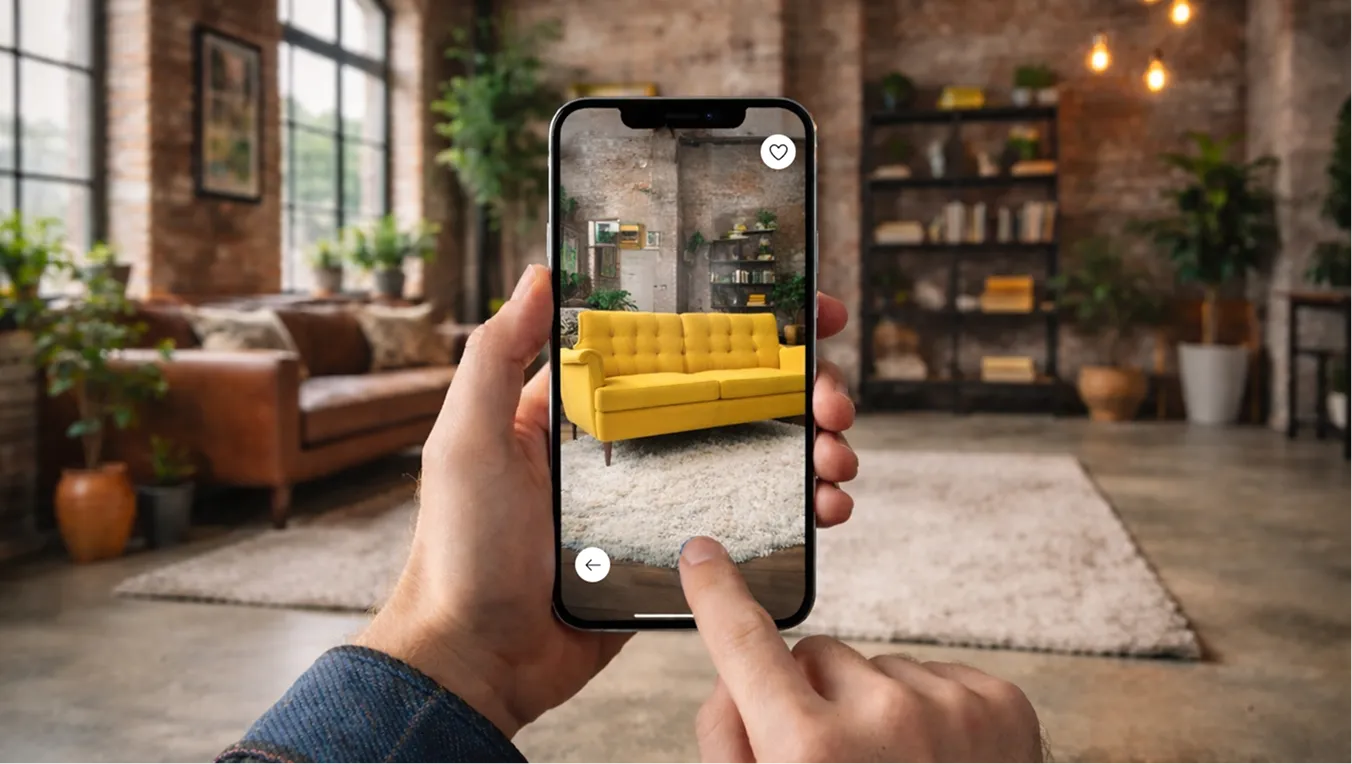
We built a mobile app that reconstructs a room as a dimensionally accurate 3D model from LiDAR depth data. Computer vision algorithms detect structural elements such as walls, doors, and windows, while AR technology is used to visualize the reconstructed space in real time.

Once a user scans the room, the app analyzes the available space and generates optimal furniture recommendations from a catalog. Users can further customize items to match their personal preferences. The matching algorithm ensures that every suggested piece is compatible with the room’s exact dimensions, avoiding guesswork or manual measurements.

To keep the experience truly frictionless, our team integrated the app with the client’s Odoo-based ecommerce ecosystem so scan results and calculated dimensions flow directly into it. 

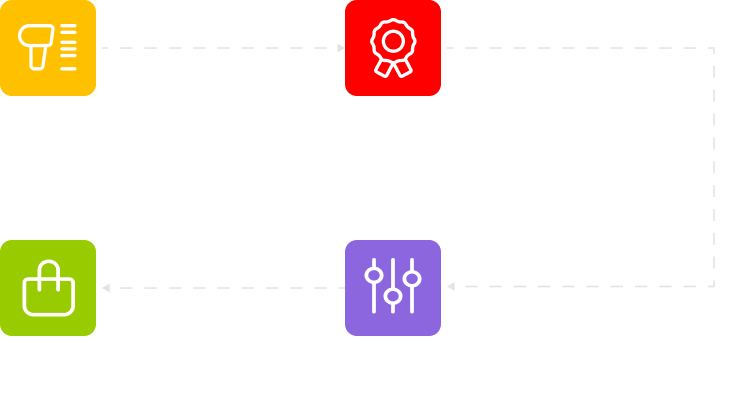
We’ve enabled real-time product selection and faster purchasing through creating a continuous path:

A flowchart with four colored boxes: yellow Scan with a barcode icon, red Recommendation with a ribbon icon, green Checkout with a shopping bag icon, and purple Configuration with a sliders icon. Text and icons are on a light gray background.

By combining AR visualization, precise spatial analysis, and automated product matching, the app delivers a frictionless experience for users and a data-driven tool for the retailer, enhancing both engagement and conversion.

A person holds a smartphone, using an app to preview a yellow sofa in a living room. The real room has brown leather furniture, shelves, plants, and large windows. The phone screen shows the yellow sofa on a rug in the same space.

Calculating optimal furniture dimensions from scanned spatial data to suggest in-stock items or custom-sized/MTO options

At the core of the room scanning app is a purpose-built matching engine designed to bridge the gap between a customer’s space and their desired furniture. The system starts with processing the room’s dimensions, captured through a 3D scanning feature.

The algorithm’s logic is built around dimensional compatibility. For each furniture category, such as sofas, tables, or armchairs, the system calculates an optimal size range based on the  room’s proportions and available space. It then filters the catalogue accordingly, showing only the items that fall within those parameters, so customers see options that actually fit rather than a generic product grid.

Where it gets especially valuable is in situations when no standard catalog item matches the room. In these cases, the algorithm identifies the customer’s preferred model and proposes a feasible, custom-sized option, suggesting adjusted dimensions to achieve a perfect fit and preserve design integrity.

From concept to client-ready solution

This feature started as a client’s Proof of Concept for how a size-aware recommendation engine should work. Using it as a blueprint, our backend developer delivered the first working version. After the demo, the client requested several modifications and provided additional requirements to align the logic more closely with their specific workflow. Following the update, the client’s subsequent testing confirmed that the final implementation matched their expectations perfectly, validating both the concept and its execution.

  1. Enabling immersive in-store product showcase through a holographic application

To make the showroom visit as premium and memorable as the products themselves, we developed an integrated solution that pairs a custom web application with Holobox holographic displays. The client acquired two Holobox units from Holoconnects – specialized hardware that uses a strategically positioned high-definition screen to create the illusion of a floating, three-dimensional image from 2D content, delivering a striking ‘hologram-like’ effect.

Technology foundation

Holobox runs on a proprietary operating system that boots directly into a full-screen Chromium instance. This setup effectively turns the entire holographic display into a web-rendering engine: any content loaded in the browser is instantly broadcast as a hologram.

We built a dedicated web application that serves as the brain of this experience. The app is designed to respond to user interactions in real-time, creating a seamless bridge between a handheld device and the large-format display.

Interactive workflow

In-store, customers can explore pieces that aren’t physically on the floor due to space constraints. For example, they can rotate a sofa, switch colors/finishes, and evaluate the look and presence of the product before committing.

The user journey is simple but powerful:

  1. A customer approaches the Holobox in the store and picks up a paired tablet.
  2. The web application loads on the tablet, presenting a browsable product catalog.
  3. As the user scrolls or selects an item on the tablet, the app transmits a signal to Holobox.
  4. The Chromium browser on the Holobox  updates instantly, displaying a high-resolution, holographic visualization of the selected product.

From a technical standpoint, this required implementing a robust, low-latency communication channel (using WebSockets) to ensure the holographic display feels like a direct extension of the tablet. The result is an immersive, interactive experience which also helps customers make more informed decisions.

Before

  • Inability to picture furniture at home
  • Manual guesswork about furniture fit
  • Physical showroom space limitations

After

  • Realistic AR visualizations for confident decisions
  • Intelligent matching algorithm calculating optimal size ranges per room and proposing safe customization when no SKU fits perfectly
  • Immersive holographic product display via Holobox hardware, powered by a dedicated web app

Business value

  • Premier buying experience offline and online
  • +20% online sales growth
  • +25% CSAT increase

Do you have a similar project idea?

Anna Vasilevskaya
Anna Vasilevskaya Account Executive

Get in touch

Drop us a line about your project at contact@instinctools.com or via the contact form below, and we will contact you soon.