How website modernization enabled a Canadian cleaning services provider to expand its customer base and increase its customer satisfaction score (CSAT).
Citrus Cleaning, a Canadian cleaning services provider, had earned recognition among local customers in Calgary, largely through referrals. But as more prospects began discovering and comparing cleaning providers online, the company’s website was not strong enough to capture that demand, guide visitors toward quote requests, or support the speed of response expected in a competitive service market.
The first issue was visibility. While the website existed, it performed almost exclusively as a branded destination for people already familiar with the company. It had little presence in local, high-intent search results where potential customers actively compare providers and request services. Competitors with stronger SEO foundations were consistently capturing that traffic first, limiting Citrus Cleaning’s ability to expand its inbound pipeline.
The second challenge was conversion friction. Quote requests were handled through fragmented phone conversations and manual follow-ups, which slowed response times and introduced friction at the earliest stage of the customer journey. For a service business where speed and convenience heavily influence conversion, the process created unnecessary drop-off at the most critical point of the customer journey, when a visitor was ready to become a lead.
On top of that, the outdated website design didn’t fully communicate the company’s quality, reliability, or customer-first service model. For new visitors evaluating cleaning providers online, that gap was weakening trust before the first interaction even happened.
Citrus Cleaning wanted to turn its existing website into a performance-driven acquisition channel, capable of improving discoverability, reducing lead handling friction, and presenting the brand with the same level of quality customers experienced offline. To secure more online business opportunities, the company partnered with Instinctools’ development team on a website modernization initiative.
Solution
Instead of recommending a costly, ground-up rebuild, Instinctools took a more targeted approach. We reengineered the existing website around the factors that mattered most for a local service business:
a new, distinctive brand identity aligned with the client’s requirements and market needs
a conversion-focused user journey for quote requests
mobile-first performance improvements
a scalable SEO framework
automated integrations between website forms and internal operations
The result was a modern, fast, and scalable website that worked not only as a digital storefront, but as a growth channel.
Building a distinctive visual language that stands out in a crowded local market
Cleaning services are often marketed through predictable visual patterns: blue for trust, white for cleanliness, and generic imagery that makes providers difficult to tell apart. Citrus Cleaning needed a brand experience that felt cleaner, fresher, and more memorable without losing professionalism.
In updating the visual identity, our UX designer built on the client’s established brand and introduced a palette of crisp whites, lime green, and orange accents, grounded in research on how colors shape customer perception.
The visual identity mirrors the company’s name, using a citrus-inspired palette to create an immediate link between the brand and its fresh, clean image.
Green communicates eco-friendliness, sanitation, and a non-toxic home environment, while vibrant orange injects optimism and cheer, suggesting that the client’s service brings brightness and joy back into customers’ homes.
Orange CTA buttons provide a clear visual cue, guiding users toward engagement.
Meanwhile, dark gray text maintains a professional and trustworthy tone for both residential and commercial clients.
Engineering a frictionless, conversion-driven UX
We redesigned the user journey around a simple conversion logic: understand the problem, match it with the right service, and make the next step obvious.
To reduce the friction in users’ decision-making process, we introduced:
clear service-page structures built around user intent
repeated but unobtrusive “Get a Free Quote” calls to action
short paths from service pages to the booking form
trust-building testimonials placed close to decision points
homepage sections designed to quickly communicate credibility and service quality
Optimizing mobile-first performance for on-the-go users
Since many local service searches happen on mobile devices, mobile performance is closely tied to customer acquisition. If the experience feels slow, unstable, or difficult to navigate, the business can lose high-intent visitors. In that context, mobile-first optimization became a key part of the redesign.
The engineering team focused heavily on lightweight asset delivery, faster image loading, and rapid script execution. By minimizing asset overhead and prioritizing critical rendering paths, we ensured minimal latency and zero layout shifts (CLS).
As a result, the client received a lightning-fast mobile experience that safeguards mobile search rankings and prevents bounce rates driven by slow loading times.
Architecting a highly scalable content framework built around localized search intent
To compete for neighborhood-specific, high-intent search demand, Instinctools built a programmatic semantic architecture designed around service relevance and geographic intent.
Localized schema injection: The site utilizes strict semantic HTML5 coupled with LocalBusiness structured data markers. This helps search engines better understand what Citrus Cleaning offers and where it operates.
Scalable content expansion: A programmatic semantic architecture we implemented enables the rapid rollout of neighborhood-specific landing pages and service-focused content, expanding the website’s coverage across relevant local search terms.
Automating back-office workflows and CRM syncing
The previous quote process depended heavily on manual communication. That created delays at exactly the moment when speed mattered most.
To reduce this operational bottleneck, Instinctools connected frontend quote submissions with the client’s internal dispatch and CRM workflows.
We engineered secure API endpoints and webhook integrations so that once a prospect submitted a quote request online, the data could flow directly into the client’s internal systems.
This reduced manual data entry, helped the operations team act faster, and made the lead handling process more consistent.
For Citrus Cleaning, this meant the website was no longer just collecting inquiries, but became part of the company’s service operations, reducing the risk of losing ready-to-book customers.
Business value
30% growth in the active local customer base within the first two quarters after the redesign.
Up to 20% increase in CSAT, thanks to a streamlined and optimized digital experience.
Faster lead response times: by reaching customers within the critical 5-minute window, where close rates are up to 8× higher than delayed manual replies, the client captured opportunities that previously slipped away.
WordPress To Shopify Migration For a European Eyewear Retailer
How switching from an outdated WordPress website with a WooCommerce plugin to a sleek Shopify platform with a tailored theme empowered the French eyewear retailer to accelerate loading speed x6, lower bounce rate twice, increase session durations fourfold, and boost page visits per session by 64% — all without missing a beat in their operations.
Grappling with fierce competition, owners of ecommerce businesses know better than anyone how tough it is to win customers and turn them into regulars. Especially, when a raft of external factors have already been preventing ecom companies from capturing buyers’ attention.
While environmental, economic, and political hurdles are something that you can’t fend off, there are areas within your control – and technical prowess of your ecommerce solution is definitely among them.
Facing the challenge of revamping their tech foundation, our client — a leading French eyewear brand with a production hub and a network of over 20 retail stores — sought to elevate their three-year-old ecommerce solution, crafted on WordPress with WooCommerce integration.
Why did the existing online store with the WooCommerce plugin become a pain in the neck for the client?
Due to a slew of plugins and underlying spaghetti code, their website’s loading time increased to a concerning 6 seconds. While this didn’t impact its visual appeal, it significantly affected user experience, leading to brief average use sessions of under 30 seconds and a 70% bounce rate. It’s an urgent matter we can’t overlook.
There were problems with updating and maintaining of the current ecommerce entity as updates for plugins and WordPress versions aren’t synchronized. Situations where the update was available for WordPress but not plugins were far from rare.
This left our client in a tight spot: prioritize security by upgrading WordPress and risk plugin functionality, or patiently wait for a full alignment of updates? As you can probably guess, neither of which seemed an attractive option.
Considering its outdated nature and maintenance challenges, the existing store was exposed to security vulnerabilities. Notably, the client’s previous system leaned heavily on the jQuery library, deemed unsafe by modern security standards.
There was no easy — or even remotely acceptable — way to add localization for Belgium, where the client was going to open new brick-and-mortar stores. With WordPress, they would have had to invest a sizable chunk of time and budget in adding a new language version by installing another plugin, which would have slowed down the loading speed even more.
The client has investigated available options and reached out to *instinctools with a request for WordPress to Shopify migration services.
As an all-in-one ecommerce platform, Shopify was expected to meet their current and future needs since it:
Can handle up to 10,000 requests per minute
Eliminates the need to deal with website updates and maintenance, which are the responsibility of the platform’s tech support
Simplifies content management thanks to the isolated fields in the admin panel so that employees can easily update the content without the risk of breaking the system
Keeps the security bar high
Offers free localizations for additional markets with a built-in auto-redirect without affecting the client’s search engine ranking
Provides vital ecommerce functionality, such as a multi-currency plugin, an automatic country-by-country tax calculator, analytics section, etc., right out of the box
How to migrate from WordPress to Shopify seamlessly and provide a client with a soaped-up new ecommerce solution, and what Shopify nuances did we have to deal with?
Solution
WordPress to Shopify migration wasn’t the client’s first project with *instinctools. The new Shopify store was supposed to become a part of a comprehensive ecommerce ecosystem, crafted by our dedicated team within our long-term cooperation with the client.
We didn’t need to deal with the hassle of WordPress data migration to Shopify thanks to our team’s prior work, which included developing an inventory and logistics app and an ERP system for the client. All the required data was extracted from the shared back end of these solutions.
However, there still were issues that we had to sort out to successfully migrate from WordPress to Shopify.
Matching Shopify’s capabilities with the specifics of eyewear products
Although Shopify provides a plethora of vital ecommerce features out of the box, such as a multi-currency plugin, an automatic country-by-country tax calculator, an analytics section, etc., our dedicated team developed a custom theme in line with the client’s corporate style, and fine-tuned the solution’s initial setup considering the specifics of the client’s business and products.
Chose a pricing plan based on product variation limits
Glasses can be of different sizes and colors, yet it’s still one product available in multiple variations, with different prices and quantities in stock. Shopify’s standard plan has a limitation – the total amount of variations of a single product can’t exceed 100.
As for the moment of WordPress to Shopify product migration, the client had a maximum of 60 variations of one product. We’ve negotiated that until the next solution upgrade (in nearly three years), the basic version of Shopify is enough to cover their needs.
When the number of variations approaches 100, the client will need to upgrade to Shopify+, but until then, there’s no need to overpay for a high-tier plan.
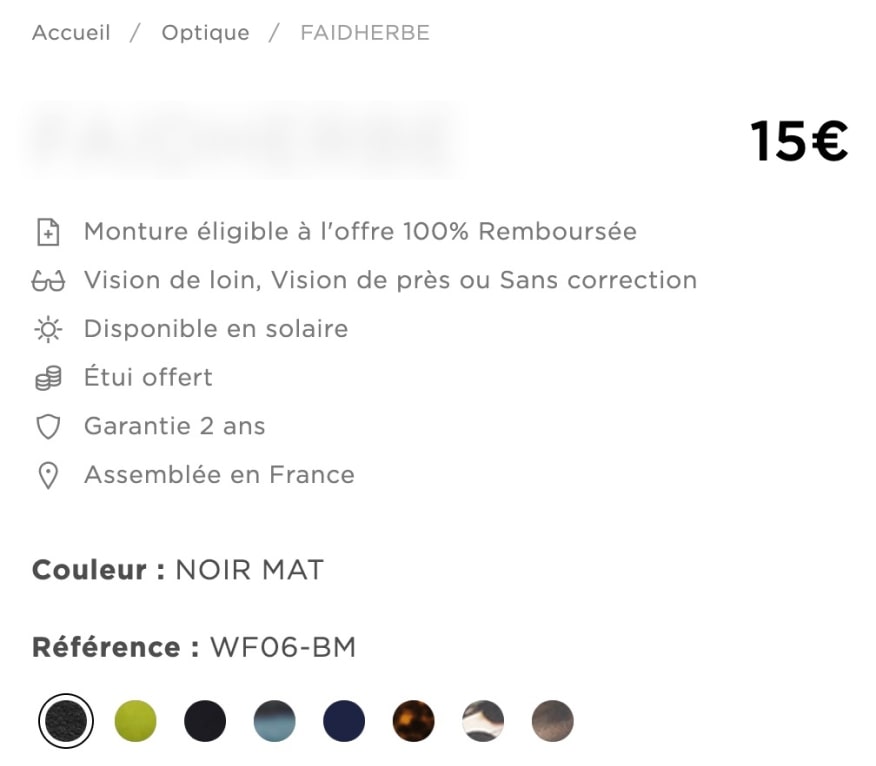
* For example, these glasses have 40 variations due to the combination of colors with parameters, such as diopters for near and far sight or without diopters, transparent or sun lenses.
Found a way to add more than three parameters in the product descriptions
Every product has a set of different attributes – size, color, width, etc. There are many more parameters for eyeglasses – weight, lenses, dioptres, interpupillary distance (PD), etc.
However, in Shopify, the maximum number of product characteristics is three, and it can’t be changed even by writing custom code. However, the platform has numerous custom fields that can be tailored to the product’s specifics. To solve this, our experts offered to leverage this opportunity to solve the issue and made a template for all the extra parameters.
Honed SEO functionality
Based on the client’s request to enhance SEO capabilities of a new Shopify store, we’ve bolstered it with two additional paid SEO modules. One of them allowed the client to swiftly generate titles and descriptions for multiple dynamic pages using adaptable variables. For example, a variable “buy in France” following a product name in the admin panel, can be integrated across all or chosen pages automatically.
The other SEO module speeds up caching, preloading pages, etc., based on the analysis of user behavior.
Thanks to this upgrade, our client elevated their search engines’ rankings by three to five positions on average.
Going extra mile without upping the project’s budget
The client was interested in Shopify’s analytics capabilities. They could have chosen Shopify+ to get access to this functionality. Still, our development team came up with a more budget-friendly option – they found and installed a free sales and analytics module that provides the same ability to collect detailed data from Google Tag Manager, GA4, and Facebook.
Before
6-second website loading speed
Average session duration below 30 seconds
70% bounce rate
A mind-boggling amount of plugins to ensure basic ecommerce functionality
Difficulties of maintaining an outdated ecommerce Frankenstein
After
1-second website loading speed
Average session duration over two minutes
35% bounce rate
Off-the-shelf budget-friendly solution fine-tuned to meet the client’s requirements
Free access to detailed customer analytics
Seamless solution updates and maintenance covered by the platform’s support
Key features
Continuity
WordPress to Shopify migration and revamping the whole ecommerce solution didn’t cause any disruption to the client’s business operation flow.
Scalability
The new store, based on the specialized ecommerce platform, supports the client’s plans to scale beyond France.
Reliability
The client always has the latest vulnerability-free version of the solution without lifting their finger, all thanks to delegating the maintenance hassle to the ecommerce vendor.
Business value
x6 higher loading speed
Halved bounce rate
x4 longer time spent on page
64% boost in the number of pages visited per session
Free detailed analytics into customer behavior
Three to five positions higher search engine rankings
Client’s testimonial
Now, let’s here how the product owner talks the project’s results and the expected outcomes:
How dividing legacy monolithic architecture into microservices helped a global LMS producer to hop on the train of remote work with their updated LMS application for staff training and raise the number of customers worldwide by 37% without risking business continuity.
Industry: Education
Duration: 11 months
Budget: $200 000+
Team: three FTE engineers, two QA specialists, project manager, business analyst
With the client’s LMS platform, users can access up-to-the-minute data, staff training results, average test scores, personal tests, performance appraisals, surveys, and financial data with comparative reporting. It allows every manager to train, track and communicate with employees, plus control company compliance nationally and globally.
Challenge
Our client has been planning to modernize some parts of their LMS for a while and, as is often the case, they haven’t gotten around to it until recently. However, the delay was no longer an option since Adobe Flash, where one of the modules was written, was on its way out. Major browsers have been slowly pulling support for years now, and Adobe itself has announced that it would be stopping the development and support of Flash at the end of December 2020.
So, at that point, modernization turned from a vague long-running goal into a clear necessity, that would prevent the loss of customers. At the same time, the client wanted to leverage the situation and not only make an updated application, supported by all browsers, but also implement a bunch of new features, that would be beneficial for end-users.
The client chose *instinctools since they wanted to lift the burden of managing the project off their shoulders and put it on a Tech partner providing a dedicated team, who would take responsibility for what they do and where the project goes.
Objectives:
Make a module for presentation editing supported by all browsers
Implement a new proposed design that improves the UX
Implement a working product by the end of December 2020
Keep performance on thе same level
Switch from Flash to modern technology
Turn the presentation tool into a standalone application, that will function as a separate microservice.
Solution
*instinctools dedicated team has developed a cross-browser application supporting mobile devices and tablets. The solution was based on new secure and scalable technologies. At the final and most challenging stage of the project, we migrated all the digital assets from a legacy system to a new structured microservice application without any loss.
Key features
modern and engaging design
completely customizable assets
ability to export presentations as printable documents (PDF)
ability to undo/redo most recent actions
copying, pasting, deleting, and rearranging multiple slides simultaneously
selecting and manipulating multiple elements at the same time
copying selected elements from one slide to another while maintaining the original positioning of each element from the original slide
ability to use keyboard shortcuts
Business Value
With the brand-new version of the application delivered just in time when remote work was a rising trend, it’s become possible for its users to create inspiring and meaningful content that makes remote or in-person activities way more impactful than they used to be. It helped our client to increase loyalty to a product and gain new customers globally.
Encouraged by our collaboration, the client plans to continue improving the software module by adding new features in subsequent phases.
Cross-Browser Website Development For a US Marketing Agency
How developing and launching three websites on WordPress, Shopify, and Squarespace for a US-based marketing company led to a 46% boost in web traffic and a 22% ramp-up in loyal customer base, all while maintaining seamless operational continuity.
Our customer is a typical problem-solver. Their team primarily deals with clients who have already tried digital marketing…but nothing magical happened – no leads, no sales – except for the marketing budget that ran out wondrously fast. Our customer’s team does a thorough research on the peculiarities of their client’s business, analyzes the arising problems and, finally, comes up with a perfectly calibrated plan on how to upgrade their client’s digital strategy. The next equally important step is to make this plan work. That’s why they were looking for a technical partner who would work as part of a large team of marketers and designers and whose expertise would make a substantial contribution to the common goal.
Task
The task was to create adaptive cross-browser websites using completely different CMS platforms according to clients’ specific needs.
Solution
When you are building a site using a CMS, you are effectively creating Lego pieces that editors then use to piece together their pages. This also forces developers to think about how to support different use success-stories and placements of functionality and content.
The main complexity of the project lay in the necessity to adapt really quickly to the constantly changing circumstances, which meant jumping from platform to platform, keeping pace and high quality. The use of different platforms [in its turn] was conditioned by a wide variety of sites and their specific features.
While working on the project we were dealing not only with well-known platforms but also with less popular ones, which had just started to compete with big players. However tempting it might be to follow the beaten track, you need to take the path that will lead you to your goal. And that’s exactly what we did, exploring the possibilities of different CMS.
Squarespace turned out to be definitely the best option in terms of templates. It caters to small or mid-sized businesses. It is not as customizable as, for example, WordPress, but it’s not lacking in any important functionalities.
For sure, WordPress is the leader for the online site builders. Around the world, countless companies rely on WordPress to keep their business up and running. The open-source nature of WordPress makes it a lot more flexible than Squarespace, but it can be a lot harder to use too.
Shopify is clearly one of the biggest and most popular platforms for ecommerce site building in the digital world. This elegant and easy-to-use platform comes with a range of customizable templates in both free and premium formats. There’s also plenty of easy integration with third-party apps. Shopify is particularly good for companies that want access to advanced functionality, like social media, customer service, dropshipping, and inventory management.
Our team’s slogan for this project was “we code what you need and even more”. Meticulously meeting all the customer’s requirements, we, nevertheless, didn’t miss a chance to see the room for improvement and offered more suitable options, such as using another slider or library.
At the end of the day, it was up to the customer whether to agree to the changes or not. But we always had an ace up our sleeve and were happy to use it.
Value
Thanks to this project, we proved to the customer and once again to ourselves that we can perform the task by one hundred percent. Some of the CMS we had to work with were completely unknown to us, but being proactive and navigating swiftly in a new environment is our jam. So we didn’t wallow on the surface and dived deep in the context straightaway. As a result, we created the websites that allow our customer’s clients to get maximum ROI from their sales strategy: impersonal “clicks” and “likes” turned into loyal customers that keep coming back.
Digital Transport Booking Platform To Rewire Last Mile Delivery
How *instinctools put the project back on track and developed both web and mobile solutions that directly connect haulers and transport buyers, allowing the client to double the number of new users.
Before the company turned to *instinctools, they had already begun a project involving website and mobile app creation. But their contractors had coped badly with the tasks assigned, so the company asked *instinctools for help. We had to complete functionality which had already begun to be developed, and develop new functions.
The customer turned to us for the finalization of modules for an already existing web application. It was necessary to develop the frontend part. We were asked to complete the website sections that involved order execution, transport search, planning, price-list and settings.
We were asked to complete the mobile app development for the project. Three developers for iOS and Android had already worked on the development, but the code which was written for the app was of very bad quality. That is why the *instinctools team had completed the basic functionality and corrected the bugs.
We completed the functionality in the same way for both the mobile application and the website.
Solution
We developed all requested functionality on the website with clean and valid code, and a sophisticated look and modern style.
As for the mobile application, after the code was corrected and the functionality was improved, our developers began to add new functions to it.
Our developers created large code refactoring for both the Android and iOS versions of app. Thanks to this, we reduced the time for new functional implementation and improved the quality of the code.
Now when a new developer works with the project, much less time will be needed for implementation because the code has become clean and understandable.
How launching a website for a promo event allowed a retail company to proceed with the new market entry strategy and increase the number of customers by 13%.
To create a website for the promo event with intent to use as part of advertising campaign. The Website should give the user an opportunity to get acquainted with the promo event, put a question to Technical Support, to look through most-oft asked questions, to see the prizes, etc.
*instinctools team need to develop:
Wordpress plugin which displays the list of winners, adds ability to edit this list from the admin panel of the website
Display all information about future events on the landing page located on the wordpress CMS
Plugin for the news which allows news to be editable, to add or remove them from admin panel by administrator
Wordpress plugin which allows to subscribe on the website news
Add countdown to the promo event which sponsors are going to run soon.
Give users the ability to view most frequently asked questions and ask their own questions
View participating rules of the planned event
Solution
The website meeting the objectives has been developed, which allows to look through information of the following types: HTML pages, video, images, PDF. It is integrated with WordPress CMS.
Key features
learn rules for participating in promo event
view some recent news about past and future events
Document Management System For a Healthcare Company
How adopting new features empowered a HealthTech company to take their DMS software to the next level, fully automate document management, and put an extra coat on personal information protection.
SAP Commerce Cloud (Hybris) Migration For a Retail Company
How switching from their outdated ecommerce software to SAP Commerce Cloud helped a European company improve scalability and integration potential of the system, hone personalization, and level up customer satisfaction by 13%.
At some point shop’s management became too difficult, so demand for a customization based on customers geo location has greatly risen. The work was unproductive without centralized management system.
The key requirement for our development team was the ability to deliver across a wide amount of technologies and platforms, including desktop and mobile, and offer a complete set of services, from business analysis and development to quality assurance, support and creation of comprehensive project documentation of new features. The major dev task was to move PHP written code to a new platform, keeping old design and preserving extended functionality.
Solution
We were asked by our client to make a switch from PHP to SAP Commerce Cloud, a Java based ecommerce engine. As part of our PHP development services, we analyzed the PHP code and the old system functionality. Some of functionality was refactored and redesigned. Missing functionality was developed according to business needs and new rules.
Key features
Single codebase for many shops
Easy extendibility/flexibility
Ecommerce solution “from top to toe”
Channel selection
User Features
Easier for workers to control the operations of new shops
Easier to scale up the business
Shop assistants spend less time on shop’s сare-about and get more flexible pricing system
Easy integration with a third-party applications provide further customer company expansion
Wide range of payment & delivery options
Flexible progress hop: after successful implementation of innovation in one shop - diffused on the rest of other client shops
How developing a multifunctional e-library with social media elements, such as chat and a rating system, provided a virtual publishing house with a 36% growth in the flow of new readers and authors.
The main aim was to develop an e-library similar to Amazon Reader. The app had to be interesting for a wide range of users: both authors and readers. The e-library was required to be multifunctional, and contain lots of possibilities, such as chat, convenient reading, sharing, and publishing.
Solutions
Development of the library/chat sections with the elements of social networks, authors’ rating system
Adaptation of the e-book reader
Development of print functionality
Possibility to order a book even with a one copy edition
Choice of book format/ type and the nearest printing office
Publisher features
Transform your text in three clicks into a professionally-designed book
No need to print a great number of copies to get an author's edition – order even just one
Choose your own edition design – font, text & pictures, decorative fixtures, etc
Share links to your books – let your readers & colleagues make you famous!
Keep your copyrights effectively protected: with this e-library be sure that nobody will be able to steal the results of your book writing
Let your book work for you: get fair remuneration for your piece of art
Reader features
Find editions of every trend in the catalogue (even sector-specific texts)
Read books in a convenient format – on paper or on any device
Be an expert, share your opinion on works you like, let it find its target audience and be an interesting subject for discussion
Work with information, know your onions – leave your mark, highlight quotations, write comments directly in a book, share your thoughts with friends and likeminded people
How developing a secure platform for sharing ecommerce data between companies became the last puzzle of a trailblazing data processing solution that empowered a German consulting organization to level up their market proposition and take on digital transformation projects.
The customer turned to us for help in implementing its idea of an eCommerce data platform for data exchange. The idea was to develop a platform where different companies can exchange data sets on a paid or free-of-charge basis.
The platform had to comply with the Industrial Data Space Association’s standards for sharing data in data spaces.
Solution
To solve the issue, we offered and developed:
UX/UI design
web application
server side and API development based on Yass microservices
Key features
share your photos with friends in social networks
personal or company account creation and editing
creation and management of closed user groups
data sets creation and setting access rights
searching for items by filters and display of results
notification and shopping functionality
Technologies
Web technologies:
Angular 2
Typescript
Javascript
HTML 5
Bootstrap 4
CSS 3
Server-side technologies:
SAP Yaas
Java
JUnit
JEE
AI modified real photo
Anna Vasilevskaya
Account Executive
Get in touch
Drop us a line about your project at [email protected] or via the contact form below, and we will contact you soon.
By continuing to use the site, you agree to the use of cookies