Rapid Prototyping Services for SaaS

Rapid Prototyping of a Recruitment-Focused Software For a French SaaS Startup

How banking on AI-driven rapid prototyping instead of the traditional approach enabled a French startup to validate their business idea in 4 days instead of several weeks and cut down the cost of developing a product demo by 60%.

Industry:
Technology

AI Development

UX and Design

SaaS Development

Business challenge

“Take your time” doesn’t apply to testing business ideas. If companies aim to get ahead of competitors, they need to test their hypotheses fast. And the timeframe for “fast” has shrunk over the past years. Back in the pre-GenAI era, it was fine to spend up to 8 weeks working on the wireframes, low-fidelity prototypes, and then high-fidelity ones. In 2025, with all AI capabilities available, even two weeks is a luxury. 

For our client, a French SaaS startup, speed to proof could make or break their fundraising efforts. They had an idea of an applicant tracking system (ATS) with the workflows tailored to French labor laws, local data regulations, equal opportunity compliance, etc.

A solid product demo was a must-have to achieve two goals in one go:  

  1. Validate the idea’s viability
  2. Get a tangible asset to “show, not tell” investors to win their financial support

To make it happen, the client needed a software partner well-versed in AI-driven SDLC practices who could deliver a clickable prototype of a future product ASAP. That’s when *instinctools entered the picture.  

Solution

One of the practices our teams lean on to speed up the development process is rapid prototyping with workflow automation platforms. For this project, we used n8n, where software engineers can orchestrate complex workflows with a visual workflow builder instead of hard-coding.

Beyond ease of use, n8n stood out for being:

  • Open-source. With full control over the data, it’s easier for the team to ensure air-tight safety of sensitive information.
  • Scalable. n8n is useful for more than prototypes, as the platform can seamlessly handle up to 220 workflow executions per second.
  • Secure. It’s a SOC 2 audited software with strong access control, debugging, and monitoring mechanisms out of the box.
  • Budget-friendly. With the self-hostable approach, the tool is free to use if you run it on your cloud or hardware.

We started with backend prototyping to ensure the product demo checks all functionality and compliance boxes from the get-go:

  • Integration with Pôle Emploi (French national employment agency), where all job openings have to be posted
  • Integration with the URSSAF portal to submit the DPAE (Déclaration Préalable à l’Embauche) directly without separate logging into the system
  • Integration with local payroll and HRIS vendors, such as Cegid, ADP France, and PayFit, for hitch-free compliance audits and downstream processing
  • Alignment with CNIL (Commission nationale de l’informatique et des libertés), as it enforces French-specific laws on data privacy, such as a 24-month limit for storing the candidates’ CVs

With all the integrations wired up, our UX/UI designers created a clickable product demo. Here’s an example of a drag-and-drop interface that lets HR managers select an applicant’s hard skills.
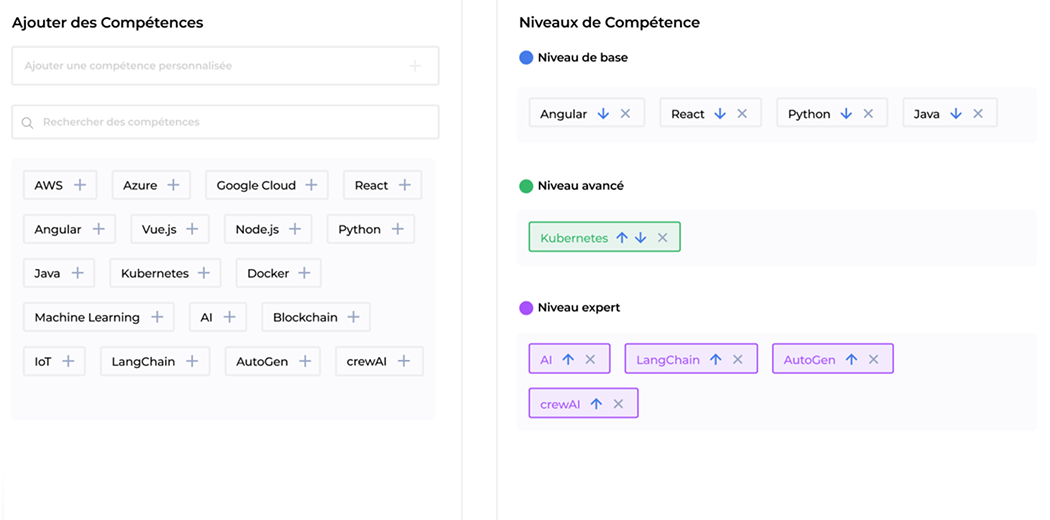
A user interface in French for adding and categorizing skills. On the left, selectable skill tags like AWS, Python, Java, and Docker. On the right, skills are sorted into “Niveau de base,” “Niveau avancé,” and “Niveau expert” with colored tags.

Four days after the start of the cooperation, the client had a working demo in hand. Not only did it prove the idea to be valid, it also became the centerpiece of their administrative, technical, and financial materials for investor pitches. Within six months, they raised €1 million to accelerate the next stage of development. 

Multiplier effect

Alongside startups in need of financial support from investors, rapid prototyping is a game-changer for established companies wanting to test their hypotheses faster. Earlier, business ideas used to pile up in the backlog, waiting for the team to catch up. 

With AI-powered rapid prototyping, idea verification becomes far less resource-intensive. Development teams no longer need weeks to create a high-fidelity, clickable product prototype – several days are enough. Testing the viability of new features takes even less time and can be done within hours. 

Six hands, each wearing differently colored sleeves, work together to connect four white puzzle pieces over a black tablet on a white table, symbolizing teamwork and collaboration.

Business value

  • Solid product demo ready in 4 days
  • – 60% in the product prototype development cost
  • Prototype features can be reused for full-scale product development

Quality Assurance Audit For a Fintech Company

Quality Assurance Audit For a Fintech Company

How a thorough QA audit and strategic fixes allowed a Swedish Fintech company to gain full visibility into their software at every stage of the SDLC, speed up new feature releases by 26%, lower customer support expenditures by 33%, and increase CSAT by 16%.

Industry:
Fintech

Quality Assurance

SaaS Development

Business challenge

When underestimated from the start, QA issues bite back in the later stages. Our client learned this the hard way. A Swedish Fintech company, providing SaaS software for expense management, has prioritized feature development, putting QA on the back burner.

However, as their products gained traction, cracks began to reveal themselves:

Inadequate QA processes
allowed bugs to slip into their customers’ software environments

Given how diverse their clients’ IT ecosystems can be, each support request required a customized solution. The number of tickets was mounting, going beyond the customer support team capacity.

The lack of test automation
delayed releases

Sticking to a quarterly release plan was already off the table, and new features were rolled out once a year at best.

Although the products kept operating somehow, the quality assurance process was chaotic and unmanageable, putting the client’s reputation at stake.

In the face of the QA turmoil, the client was at a crossroads: rush to hire a quick fix or pinpoint weak spots in their existing framework and rebuild it with expert guidance. While the former option would put out the immediate fires, it wouldn’t align with the client’s determination to have flawless software in the future. So they opted for the other route, seeking *instinctools’ expertise to establish a robust and sustainable QA framework.

Solution

The client engaged our QA engineers to run an all-encompassing quality assurance audit of their expense management software, identify problem areas, and suggest improvements.

  1. In-depth audit of the client’s QA processes

Instinctools’ QA specialists:
Held a pre-audit briefing with the client’s in-house team to see how the absence of QA expertise affected the software
Defined the audit scope and objectives to keep all stakeholders in the loop
Examined the client’s QA and project management tools, such as Jira and Confluence, to assess existing workflows and testing methodologies
Revised available documentation and performed code review
Analyzed the findings to prepare spot-on, actionable recommendations

The audit revealed three fundamental hurdles to address:

  1. Disorganized software testing management. The expense management software had its dedicated Jira space, but QA tasks were unstructured, and the overall testing lifecycle remained unclear, making it almost impossible to track test objects or related tasks.
  1. Inconsistent documentation. Test cases were recorded arbitrarily, leading to an opaque and inefficient QA workflow.
  2. Reliance on outdated tools. The client used legacy software without questioning its effectiveness.
Besides identifying the problems, we mapped out solutions in three key areas:
Quality assurance
Standardizing test management in a centralized QA-specific system and adding a post-testing check-up to verify the accuracy of test results.
Project management
Integrating the QA platform with Jira to ensure complete visibility into testing stages at all times.
Business analysis
Setting documentation standards for stress-free accreditation for any certification.

Satisfied with the audit’s scope and depth, the client decided to move forward with *instinctools to act on these changes.

  1. QA management platform implementation

To bring structure and visibility to QA operations, we explored multiple options and landed on TestRail, which offers the most budget-friendly pricing for small QA teams with up to five users.

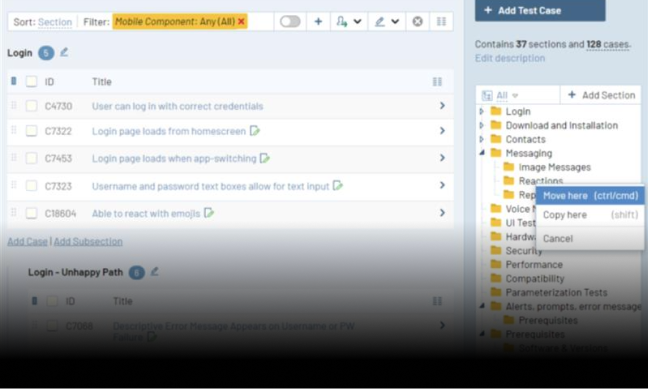
TestRail interface
TestRail interface

With intuitive test plan management and deep analytics, TestRail gave engineers real-time insight into patches and releases, helping them ship high-quality code faster.

We also integrated TestRail with the client’s Jira. This way, users can link test cases to tasks, stories, and epics to clearly indicate what is being tested. Other product team members, like project managers or business analysts, can access test plans and test cases from Jira tickets with one click.

Jira test management integration with TestRail
  1. Stress testing upgrade

The client’s stress-testing tool was outdated and tricky to upkeep, making its ongoing use impractical. We suggested switching to a Hyper and Apache JMeter combo. The first is an advanced terminal emulator used as an interface to run JMeter. However, the terminal’s functionality extends beyond stress testing. Thanks to automation and additional plugins, it streamlines multiple everyday QA tasks, such as log parsing, cleaning up environments, and debugging.

  1. Performance testing with 99,99999% reliability of test results

Smooth performance testing with load, stress, spike, and soak tests has always been at the top of the client’s agenda, and they wanted us to put a premium on it.

First, we ran regular tests, measuring solutions’ responses to unusual, sudden, and extreme loads over different periods. However, as the client’s software implies corporate card management, invoice processing, and other financial operations, they need to be more than 99% certain of the reliability of the test results.

That’s why we added a check-up step when the QA team analyzes performance test data and confirms that the outcomes are 99,99999% reliable.

  1. Robust workflows for other mission-critical tests

We proceeded with writing missing templates for test plans, cases, scripts, and reports in TestRail for usability, regression, and new feature testing. All activities were carried out in parallel. Our QA engineers performed:

  • New feature testing within release management
  • Regression testing after every hotfix, patch, or release
  • Usability testing alongside every regression and new feature test
  1. API and UI test automation

Following the classic pyramid of testing, we moved on to API and UI tests.

Our QA engineers worked in three directions:

  • Revising old tests created by the client’s previous vendor and revamping them if possible
  • Writing missing auto tests for old APIs
  • Designing tests for new APIs

During periods when no new APIs are being written, test coverage reaches 100%.

Speaking of automating UI tests, we’ve already covered 55% and keep working on it.

  1. Expanding our testing coverage

With every new iteration of the change management plan, we are increasing our efforts in other types of testing to ensure even better software quality. For instance, along with further UI test automation, accessibility, durability, and penetration testing are in the project’s backlog.

Before

  • Chaotic, opaque, and unpredictable QA process
  • Bugs constantly slipping into the customers’ environments
  • Annual releases at best
  • Unverified performance tests’ results
  • Up to 90% of customer support requests required input from senior-level specialists

After

  • Centralized, transparent, structured, and easy-to-manage QA process
  • Bugs are uncovered and fixed in the early development stages
  • Quarterly releases
  • 99,99999% accuracy in performance testing
  • Junior engineers resolve up to 75% of customer support queries

Business value

  • Fully transparent and traceable software testing pipeline
  • 20% faster test case creation
  • x1.5 faster release cycles
  • 26% reduction in time-to-market for new features
  • 33% drop in customer support costs
  • 86% CSAT

Client’s testimonial

Here’s how the client’s Product Owner describes *instinctools’ QA experts’ contribution to their product’s uplift:

Multiplier effect

It’s good if your developers follow the basic playbook by writing clean, modular code, conducting regular code reviews, or even building simple API and unit tests themselves. Good, but not enough. The lack of well-honed QA processes is a ticking time bomb — the cracks might not show early on, but they will emerge when you decide to scale your solution.

The good news is that even if QA-related issues snowball into a costly threat, there’s still room for change as long as you have a stalwart tech partner by your side. Opt for an all-encompassing QA audit to forge the path toward transparent, structured, and easy-to-manage QA processes.

The importance of regular quality assurance checks

Quality Assurance for a Custom LMS

Top-Notch Quality Assurance for a Custom LMS

How implementing end-to-end manual and automated testing enabled an EdTech company to detect x40 more bugs at the early stage, speed up development cycles x5, cut down the cost of fixing errors and bugs x160, and bring down overall software maintenance costs by 16%.
Industry:
Education, Technology

Software Product Development

SaaS Development

Business challenge

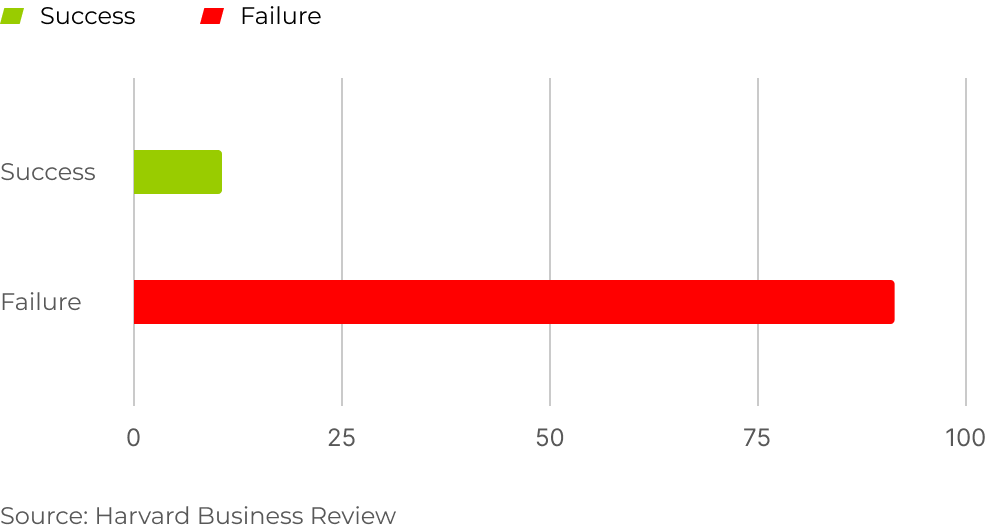
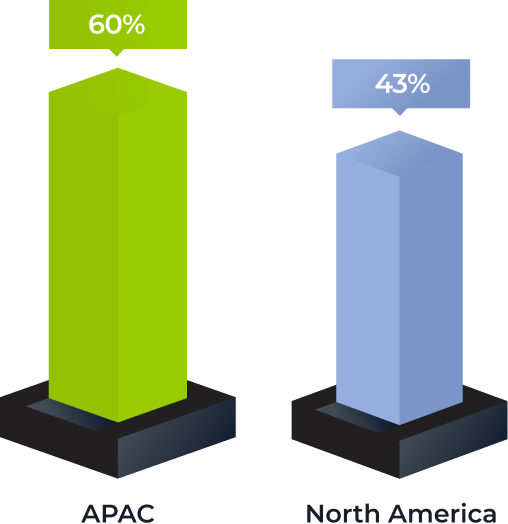
Only 10% of startups can keep up with a current highly competitive market — and there’s a reason for that. Newcomers tend to adopt a ‘we can take care of it later’ mindset, often skimping on crucial areas of SDLC, such as requirements analysis, project documentation management, software testing, etc.

Startup succes & failure rate

Nevertheless, as your solution evolves, these shortcuts inevitably stab you in the back, sometimes putting at risk the overall success of your product.

That’s exactly where our client found themselves. An EdTech company providing a custom SaaS LMS with gamified courses had put software testing and project documentation on the back burner at the outset. Several years after the rollout, their e-learning library had ballooned to 40+ courses in 30+ languages, and their initial issues started to backfire. The client’s LMS became unstable, underperforming, plagued with errors and bugs, and expensive to maintain.

A closer look revealed even more issues:

  • The system was overcomplicated and non-transparent, even for the admins. Managers, not engineers, were steering the project regarding all technical decisions, including tech stack and architecture planning.
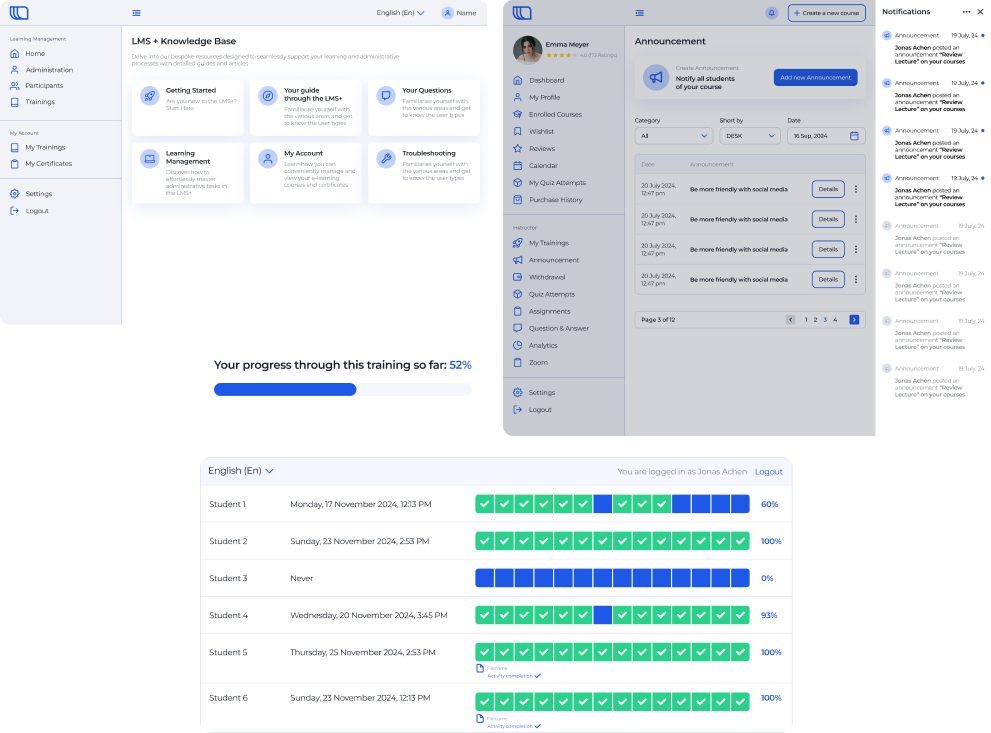
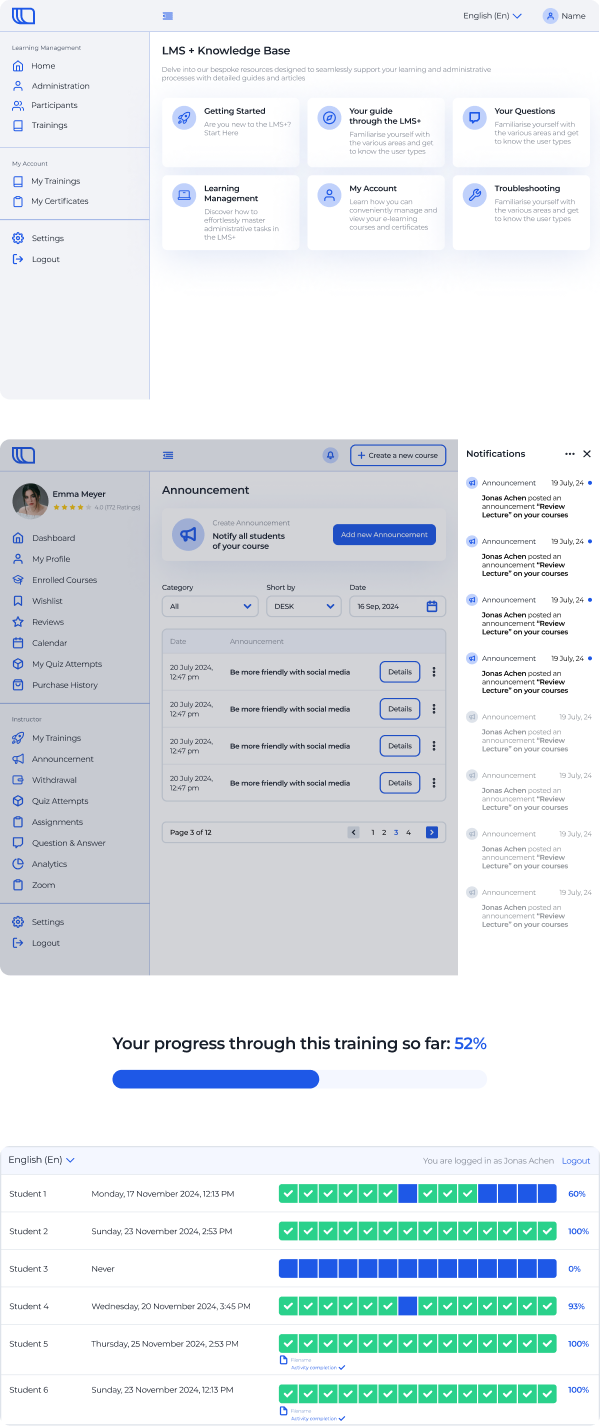
  • The platform lacked standard LMS UI elements like notifications and progress bars to easily track user progress.

Realizing that doing nothing would lead to losing customers, the client decided to turn things around by adopting software testing, documenting their projects, and enhancing the platform’s UX/UI.

The benefits they aimed to achieve included:

  • More user-friendly LMS, both for admins and end users
  • Greater customer satisfaction from enhanced UX/UI
  • Transparent SDLC processes
  • Higher software quality due to making QA a mandatory pre-release step
  • Faster development cycles through automated testing

However, the client’s internal team couldn’t carry out these tasks on their own due to the lack of top-tier QA expertise and their already heavy workload. Therefore, they opted for IT staff augmentation services and partnered with *instinctools. We provided them with a senior-level QA engineers and frontend developers.

Solution

Before getting to user experience setbacks, we focused on adequate functional testing as a straight way to boost the LMS’s quality and accelerate development cycles.

  1. Setting up manual functional testing

For the client to fully cash in on the perks of automation, it was necessary to make sure that their manual processes run like clockwork.

Therefore, starting with the basics, our QA engineers mapped out a clear workflow for various types of manual functional testing, including unit, integration, interface, system, smoke, sanity, acceptance, and regression tests.

We’ve hit the ground running with the Cucumber testing framework as one of the leading options in the market, and during the first two months of cooperation, our QA specialists covered:

  1. Extending QA capabilities by adding automated functional testing

With manual testing paving the way, automation was the next natural step.

We blended the Cucumber framework with the WebDriverIO automation framework as this combo is not only powerful enough for large and technically sophisticated projects but also free of charge.

Thanks to our dedication during the manual testing phase, the transition to automation was hitch-free. Our automated functional testing now covers:

  • LMS database
  • APIs
  • User interface
  • Communication between the server and clients

We blew past the client’s expectations — automated tests now handle 85% of the LMS functionality, 25% more than the initial 60% target.

  1. Leveling up UX/UI

Our developers teamed up with the client’s UX/UI designers to upgrade the platform’s interface and functionality. The revamped LMS now boasts intuitive notifications and progress bars for users and admins.

We continue working on test automation, implementing non-functional tests, and supporting the client’s in-house team in handling the rising scope of the platform’s interface makeover tasks.

Before

  • Overcomplicated system
  • Absence of adequate software testing
  • Inability to fix defects
  • Lack of project documentation
  • Questionable software quality
  • Skyrocketing maintenance cost

After

  • Well-thought-out and user-friendly system
  • End-to-end manual and automated functional testing
  • Clear workflow for fixing any issues that arise
  • Documented test cases
  • Enhanced software quality
  • Decreased maintenance cost

Business value

  • Catching defects x40 earlier in the SDLC before they play havoc on the bottom line
  • Slashing bug repair costs x160
  • Speeding up development cycles x5 to get features to market quicker
  • Bringing down LMS maintenance expenditures by 16%
  • Minimizing the possibility of costly human error

Client’s testimonial

The client’s VP of Engineering highlights cooperation with *instinctools:

Multiplier effect

Cutting corners on quality assurance is like setting yourself up for a sure failure. In 2024, businesses can’t afford bad software.

It’s never too late to bridge the gaps in your existing software testing with a comprehensive QA strategy and add powerful automation to your manual testing for maximum impact.

Quality Management System

SaaS Quality Management App For a Leading Maritime Software Provider

How broadening their industry-specific software pool with a quality management system (QMS) for maritime companies allowed a world-class SaaS software provider to win new customers.

Industry:
Ecommerce

Web Development
SaaS Development
Software Product Development
Enterprise Automation

Business challenge

Is there a more common and widespread bottleneck than paper-based workflows? Despite the seemingly ubiquitous focus on technology-enabled business transformation, non-digital-born companies across industries still depend on paper documentation.

Such an approach leads to flawed records, delayed updates, etc., which overcomplicates the quality management process. When quality-related debacles take place at the enterprise scale, companies have to pay for them, not rarely with something more valuable than money — their reputation.
This was the weak spot our client aimed to tackle to help their customers move quickly and confidently down the digitalization path. A world-class maritime software provider with several solutions for streamlining industry-specific processes contacted *instinctools to widen their offering with a cloud-based SaaS quality management system (QMS).

What percentage of organizations depend on paper-based processes?

*Source: Forrester, Digital Documents Necessity

What issues did maritime enterprises face while managing quality documents mostly manually?
Delays at all stages of working with documentation
Failure to keep quality management documents updated
Lack of traceability within quality management processes
Risk of overlooking updated standards and compliance requirements in time
Human error in full bloom

Our client wanted to fix these problems with robust software that spans quality, health, safety, and environment (QHSE) processes by:

Digitizing

and streamlining all document-related operations, including creation, editing, etc.

Ensuring

compliance with general and maritime-specific standards

Providing

a centralized repository with role-based access to allow users to work with quality documents anywhere, anytime, without compromising security

Automating

quality management workflows, such as authoring, reviewing, approving, notifying, etc., to free employees from mundane rule-based tasks and eliminate the possibility of human error

Fostering

transparency of quality management processes thanks to the detailed audit trail

Solution

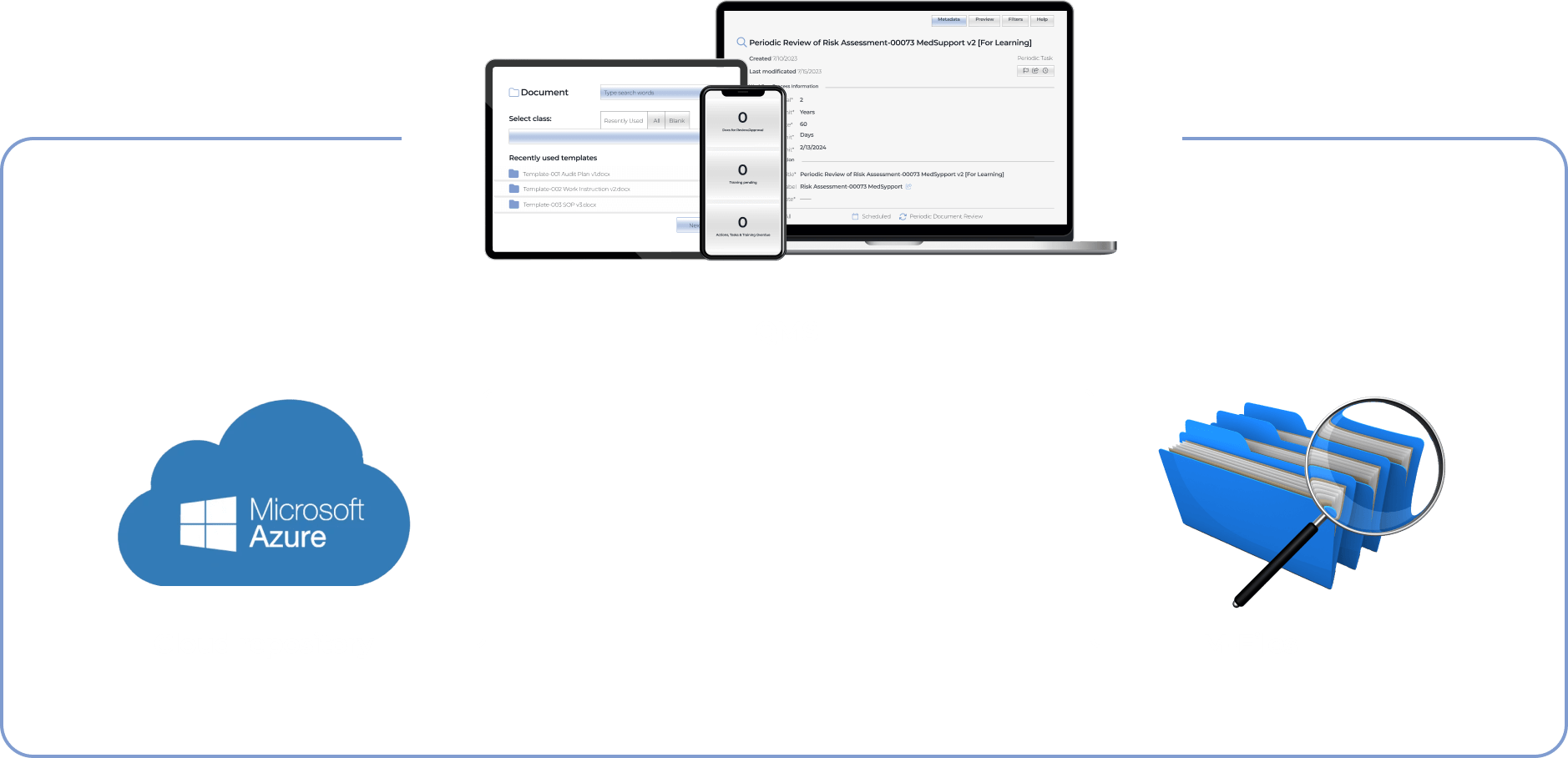
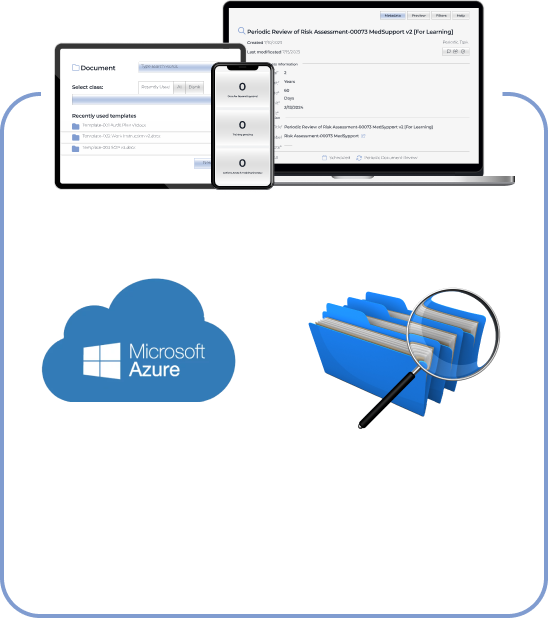
The client has been delivering solutions for enterprises using Microsoft 365 products. Therefore, our dedicated team went with Microsoft Azure as a cloud repository for the QMS. The system also needed a metadata-driven document management platform to automate document creation workflows. We’ve chosen M-Files with out-of-the-box integration with Microsoft Azure.

  1. Packing the QMS with broad functionality

Banking on the rich off-the-shelf functionality for their customers was at the core of the client’s strategy. Therefore, we’ve crafted the software with multiple out-of-the-box modules that go beyond simple document creation and review and cover regulatory compliance, audits, and risk management tasks.

Document creation module

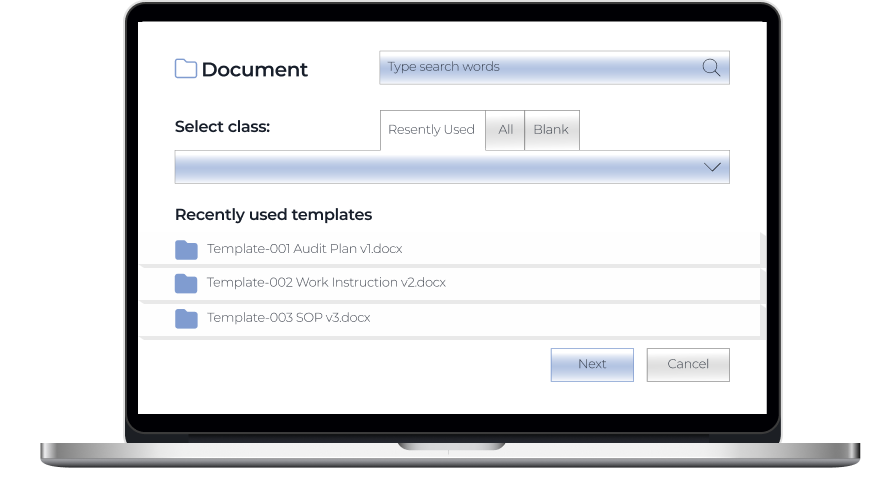
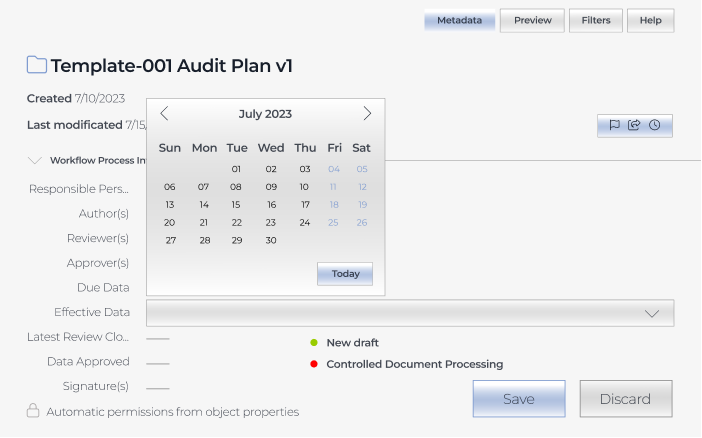
Users can create a document using templates or drag and drop existing Word, Excel, PPTX, HTML, and PDF files directly into the system.

Review and approval module

Drafted documents are sent for review or approval.

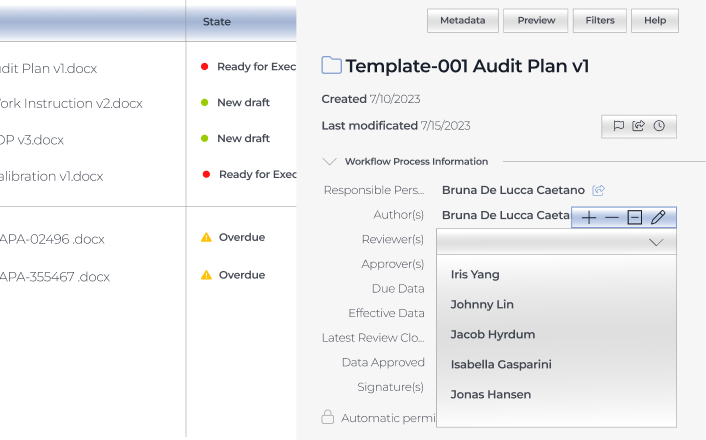
If there are several reviewers and approvers, they can collaborate on document editing using track changes.

Authors can set a deadline for reviews or approvals.

Assigners have real-time visibility into the state of reviews and approvals.

Assignees get email auto notifications about the documents waiting for their review or approval. Assigners also get auto alerts about suggestions and comments in the documents and when assignees mark them as reviewed or approved.

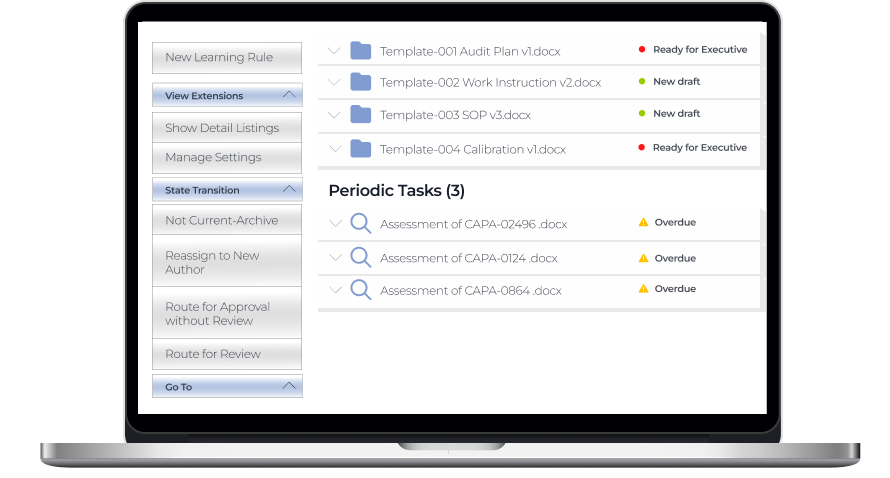
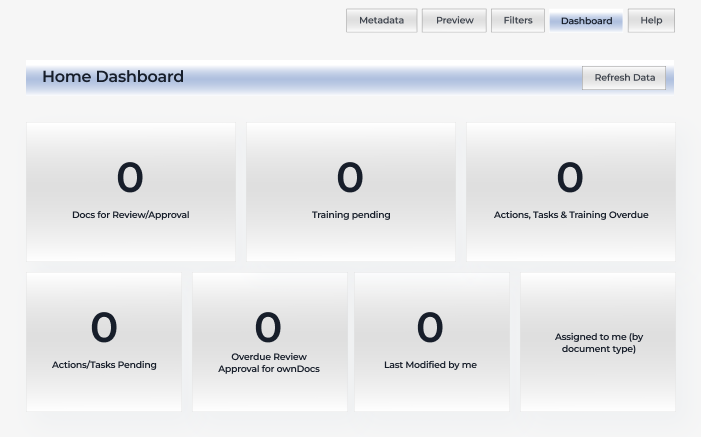
All users have personal dashboards as an easy way to access the files for review and approval, last modified documents, etc., just by clicking on the corresponding section.

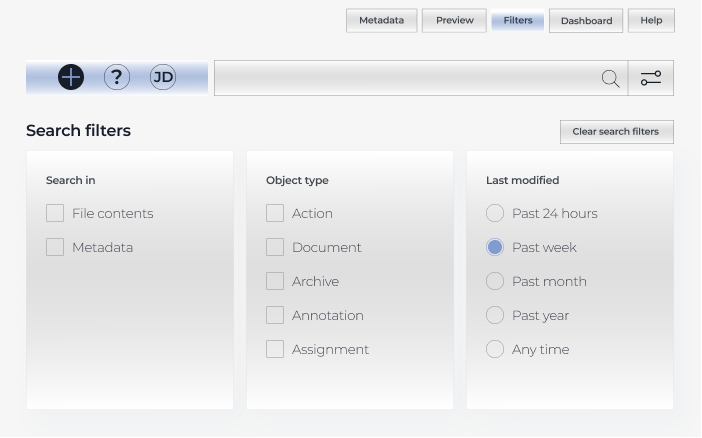
Also, all users can look for documents across the system with an intuitive search bar.

It provides the possibility to search for exact words matching the titles and content of the files.

Regulatory compliance module

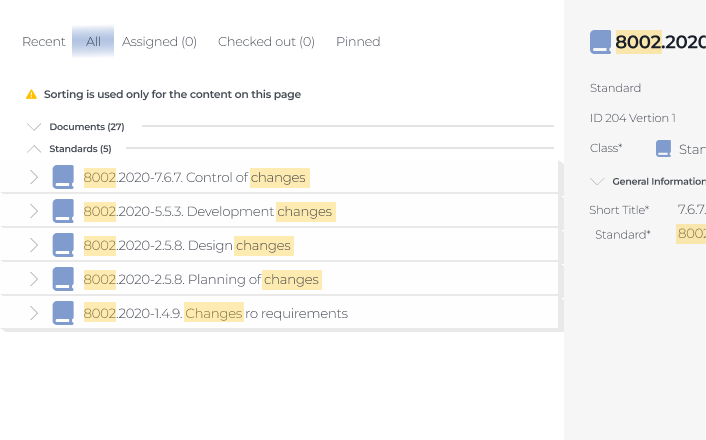
This module is the heart of the whole system. The QMS is compliant with the following standards by default:

ISM (International Safety Management) guidelines define the safe operation of ships and address preventing pollution.

ISPS (International Ship and Port Facility Security) is designed to uncover and prevent criminal threats, such as piracy, acts of terrorism, etc.

ISO 9001 (Quality Management System) establishes requirements for a QMS

ISO 14001 (Environmental Management System) clarifies best practices that companies should follow to reduce their environmental footprint

ISO 45001 (Occupational Health and Safety Management System) determines physical, chemical, biological, ergonomic, and psychosocial hazards to minimize their impact on the employees’ health and safety

Audit module

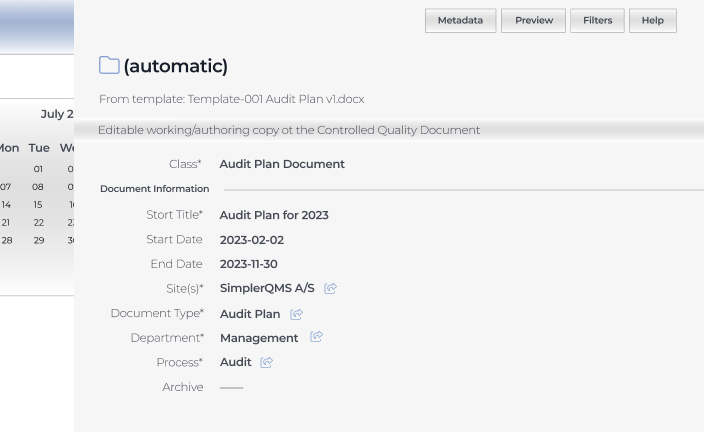
The client wanted to ensure complete traceability across the system, as keeping the company’s documentation in order is one of the success factors contributing to smooth external audits. Therefore, we crafted a system where any document changes are recorded, and users have a time-stamped audit trail and the history of each document at their fingertips.

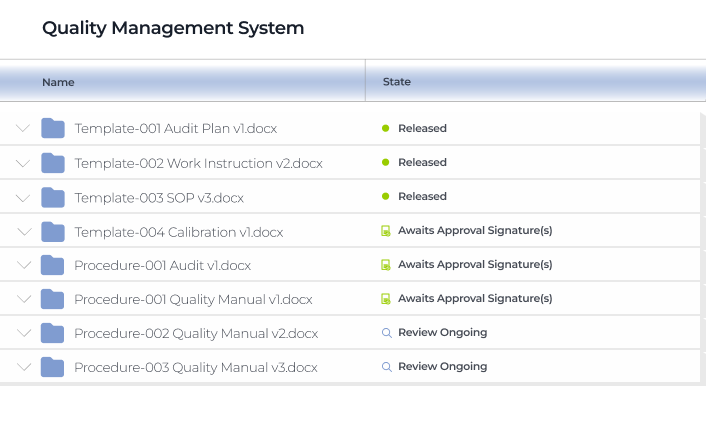
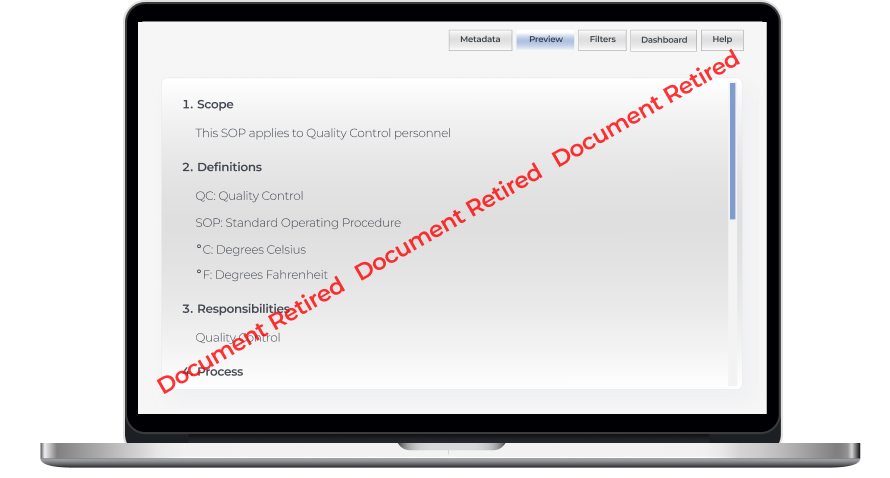
While the QMS always suggests the most recent file version, all roles have access to the previous ones. Document owners can set up auto retirement of the document’s previous versions when the new one is released.

Internal audits and regulatory checks also become a breeze for maritime organizations with this QMS. 

Our development team provided a complementary document template package for:

  • Creating audit plans
  • Scheduling internal audits
  • Assigning responsible personnel and reviewers

Both authors, assignees, and reviewers can attach evidence related to the audit findings, making it easier to unearth and fix alarming issues internally.

Risk management module

The QMS we’ve developed enables companies to foresee dangers and prevent or minimize their negative impact

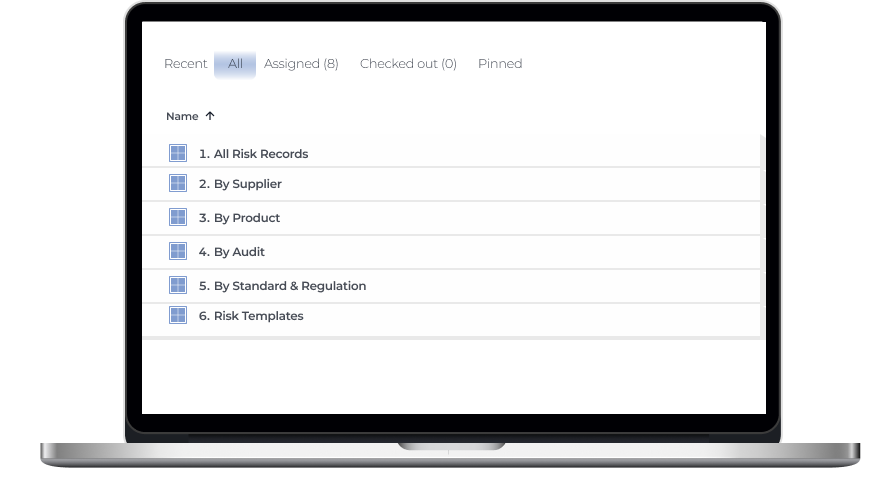
  • Connect information within the quality management system

Users can connect risk management documents with audit data, records related to suppliers and products, and other items within the system to enhance traceability of potential hazards.

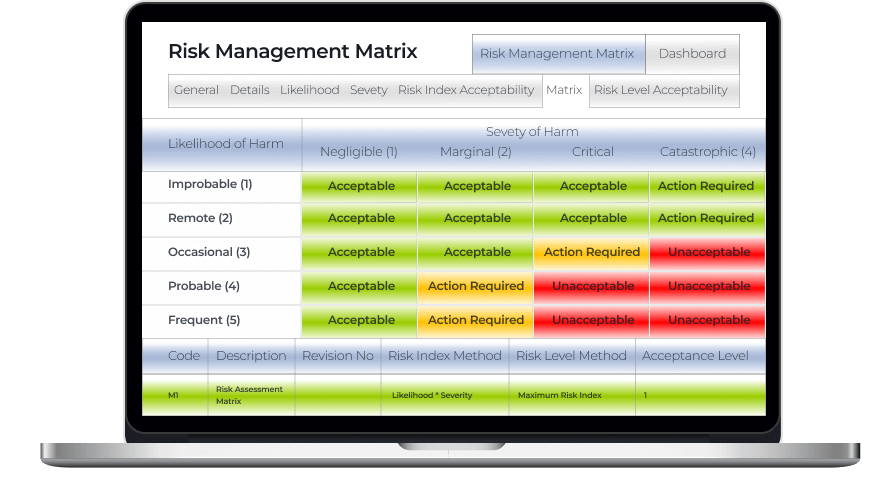
  • Identify possible hazards with a risk management matrix

Spotting risk-prone issues as early as possible helps cover them before they snowball into severe threats and cause noticeable accidents. The risk management matrix is color-coded so that users can immediately see if there are any catastrophic and critical events that have to be addressed ASAP.

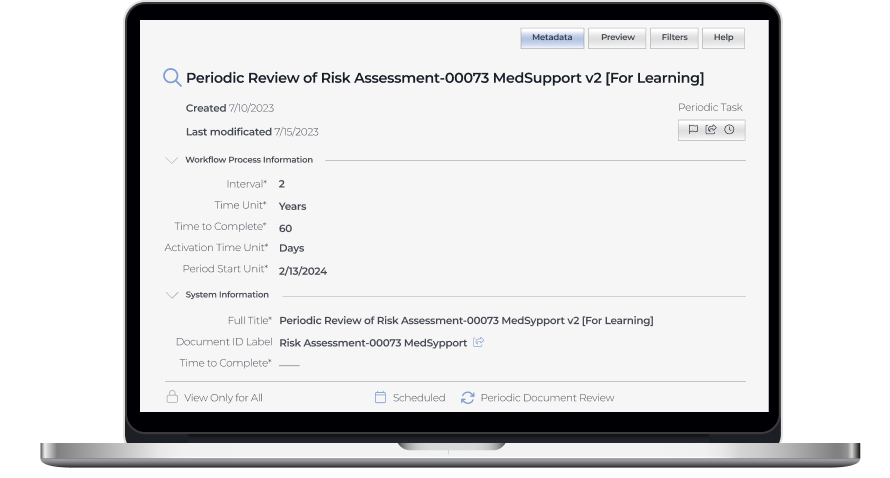
  • Schedule periodic risk assessments

Risk assessment is an area with high automation potential, and we didn’t miss the chance to take full advantage of it, empowering users to set periodic risk assessments within any time frame.

  1. Ensuring integrability with any corporate systems

Our software developers wrote APIs for data synchronization with external tools to allow the client’s customers to seamlessly incorporate the web app into their existing software landscape and facilitate efficient data flow between the QMS and other systems, such as ERP, CRM, IMS, etc.

Business value

Before

  • Underdigitized quality management workflow
  • Scattered quality management data
  • Non-automated workflows
  • Delays at all stages of working with documentation
  • Lack of visibility into quality management processes
  • High probability of human error

After

  • Fully digitized quality management processes
  • Single source of documentation
  • Minimized manual effort with automated workflows
  • Streamlined audit-related activities
  • Complete traceability thanks to time-stamped audit trail
  • Reduced human error

Client’s testimonial

Hear about the project’s progress and outcomes directly from its product owner:

Tim Rosenberger

Director, Global R&D at SpecTec

I was impressed by the developers’ skills and by the ability of *instinctools to extend the team on really short notice. I’m looking forward to the collaboration with *instinctools on our upcoming digital transportation projects

Odoo On-Premise Implementation For a European Streaming Platform

Odoo On-Premise Implementation For a European Streaming Platform

How replacing outdated software with Odoo ERP and custom BI tools allowed a streaming service provider to implement a monthly billing model, get a 360-degree view of their customer data, save 1000+ hours of manual operations on inventory management, and bring thousands of new customers to the platform all over the EU.

Industry:
Media and Telecommunications

Duration:
12 months

Team:
a project manager, two business analysts, a UX designer, a solution architect, four backend and four frontend developers, four quality assurance specialists, and a business intelligence consultant

Context

Any company’s growth brings opportunities for investment and new market outreach, and entails a transformation of business processes, operations, IT infrastructure, etc. Experiencing a significant rise in customers, our client decided to improve their subscription-based business model, allowing their end-users worldwide to be billed for IP television services on a monthly basis, not annually as it had been before.

The introduction of such a seemingly simple change in the subscription model required a significant transformation of current business processes, which also led to the implementation of a corporate ERP system. The company got in touch with *instinctools for IT consultancy to find a solution and for ERP system development to run their business more effectively and quickly adapt to ever-changing market needs.

The main goal for our team was to advise on and implement an ERP system that would match the company’s existing business processes, taking into account growth plans. Another essential requirement was choosing an ERP system that was easy to maintain and develop in terms of cost and availability of specialists.

During the Pre-Discovery workshop, our team analyzed a current client’s business model and suggested a best-fit solution. The customer’s key non-functional requirements for an ERP software were the following: an on-premise solution that can be managed on company servers, free licensing, fault tolerance, and customer support. Implementing the solution as soon as possible was vital, as they needed to handle an ever-increasing array of data.

*instinctools provided a detailed project estimate with a scope and vision of the future ERP solution as a primary output of the workshop. After a thorough analysis, our experts suggested implementing the Odoo ERP system. Here are a few reasons why we’ve chosen Odoo, alongside the fact that it ultimately met the client’s requirements mentioned above:

  • Multiple module integration. The Odoo system has a broad set of features and modules ready for customization according to any department’s needs.
  • Odoo is among the leading ERP solutions in the market with a huge community and app store.
  • Odoo fits small and medium businesses bringing them high flexibility and scalability.

Dedicated team

To successfully complete the project within the time frame set by the customer, *instinctools gathered a dedicated cross-functional self-managed team able to implement the project end-to-end. The project’s dedicated team consisted of: a project manager, two business analysts, a UX designer, a solution architect, four backend and four frontend developers, four quality assurance specialists, and a business intelligence consultant. The right composition and skill set made it possible to implement the project within the required timeframe.

Challenge

When implementing new IT solutions, companies usually face many challenges in operations and processes, not just purely tech issues. Our customer collaborated closely with the *instinctools dedicated team, allowing them to focus mainly on IT challenges and some organizational issues.

  • Data migration

    The data about users’ quantity was one of the unknowns in the first stages of the project estimate. It complicated the process of data migration to the new system, as the actual number of users (internal and external) was much bigger than the pre-estimated. As a result, we had hurdles with the performance of certain system operations and needed to react quickly to changing requirements and other issues.

  • Odoo modules integration and customization

    One of the benefits of the Odoo ERP system is the variety of modules for different units, operations, and management. The choice of the modules for particular business needs wasn’t as challenging as their integration into the current system. Most essential components needed customization and adjustments that our engineering team managed to implement.

  • Data visualization and reporting

    Companies not using an ERP system may lack data visualization and fast reporting available for different units. With the growing amount of data and the length of Excel spreadsheets, the implementation of Business Intelligence became a necessity for our client. The standard Odoo module didn’t meet the client’s data visualization and reporting requirements. We needed to build a BI tool and enable its connectivity and accessibility within different units.

  • Integration with third-party services

    The last but not the least important challenge for our dedicated team was integrating the Odoo ERP system with the services, enabling the sustainability and smooth operation of the whole business machine, from notifications and stock management to acquiring systems and legal resources.

Solution

Instinctools’ dedicated team, working closely with the customer’s IT and Operations departments, was able to implement a holistic ERP system, connect all the necessary integrations, and develop and set up the required Odoo modules. It fully met the demand for sustainable and scalable software solutions that are compatible with internal and external services, running on on-premise servers, having fast reporting and visualized analytics, and ensuring reduced costs on the maintenance and support side.

With this solution, we helped our client achieve its primary goal, the upgrade of a subscription model provided to their customers.

Key features

  • Customized Odoo modules for stock management, logistics, accounting, legal operations, and marketing analytics.
  • Internal integrations with Google Analytics, e-mail services, and notification systems.
  • Tableau business intelligence tool with distributed access for all units and fast reporting.
  • External integrations with DHL, Hermes, NevelNet, Stripe, and other services.
  • Sepa acquiring system.
  • DATEV-format reports compliant with the law for tax authorities.
  • Odoo Website SSO (Single Sign On) module.

Business Value

Thousands of new customers have tried the monthly subscription service offered by our client since the first project solution release. It allowed the company to understand their customer’s pains and needs better while interacting with the product and services. That, in turn, helped to deliver value and improve customer experience.

We revealed the hidden issues in our client’s company’s complex processes and operations during the project implementation. They noticed the flaws of the old system that had been holding the company back from innovations and opportunities to scale faster and increase clientele worldwide for a very long time.

The client’s digital transformation became the enabler of positive changes bringing their business more revenue, new market opportunities, and, most importantly – customer loyalty.

Technologies

React
Python
keycloak
Odoo Material UI
Tableau

NFT Marketplace Development For a Fintech Company

NFT Marketplace Development For a Fintech Company

ipwe white

How developing an NFT platform allowed a global Fintech company to increase its annual revenue by 34%, rack up the number of B2B clients by 47%, and wipe out the risks related to intellectual property when selling and buying patents all over the world.

Industry:
Fintech, Intellectual property

Team:
team lead, BE engineers, FE engineers, business analyst, project manager, QA specialist, UI designer

Context

*instinctools was approached by IPwe for assistance in revamping their marketplace for monetizing patents encased in non-fungible tokens or NFTs. Their goal was to make the intellectual property market more transparent, liquid, and accessible to every stakeholder interested in patent acquisitions or sales. The key requirements for the IPwe Platform were the following:

  • a clear and transparent structure
  • information accessibility with equal opportunities for both patent licensors and licensees
  • an intuitive interface for fast and easy transactions.

Challenge

The primary purpose of the project’s first stage was to construct the core application for market launch, allowing new users, customers, stakeholders, and investors to gain a better understanding of IPwe’s products and their features. The *instinctools team was challenged to cover the following tasks:

  • Designing a web interface with an intuitive user experience.
  • Developing a web application with extended functionality, including secure transactions, real-time dashboard visualization, and personal user accounts.
  • Creating an interlayer for efficient blockchain operation and enabling smooth connectivity between the front-end and back-end.

Solution

The key component of the project was finished and released on time thanks to the smooth collaboration of *instinctools professionals working alongside IPwe’s team.

“We have delivered the core web application functionality meeting all client’s requirements for the platform, and now we actively continue to bolster it with new features. The IPwe team clearly knows what they want, and we always have ideas in our stash on how to meet their needs.” – Alesia V., Account Executive at *instinctools.

The NFT marketplace platform is a complex solution consisting of several components delivered by the *instinctools dedicated team: web app, user account, and a Smart Pool system.

  • A web application with an admin role on the backend allows for controlling and managing user activity and operations with tokens. In particular, a database administrator can manage and optimize requests coming from IPwe Platform users to add new assets as well as the structure and aggregate databases for further processing with an inbuilt artificial intelligence tool.
  • A user account with a dashboard view of various assets, patents, and trade secrets with issued tokens (NFT). The total number of active licenses the company bought or is currently selling, transaction status feed, and notifications.
  • Smart Pool system for a group of patents united by one technology and establishing a pool with members and patent owners. Through IPwe’s Smart Pool technology, members can access the tools they need to improve their patent portfolio.

Patent owners can add their assets to the IPwe Platform according to the privacy levels they wish to apply to their tokens. There are two types of privacy for the assets: “private capture” and “strictly confidential.” Private capture allows users to add trade secrets with related documents and send them to the blockchain. Strictly confidential implies the same procedure except that the files that a particular person signs are hashed and not stored in our backend. Though the user still can save the original file name or hash it.

Currently, the *instinctools’ team is enriching the application with new functionality and maintaining the stable operability and security of the platform.

Key features

  • Stable and secure platform providing different levels of access and personal accounts functionality
  • Smart dashboards that visualize all the user’s data and assets
  • Reach and fine-tune notification functionality
  • Smart Pools that unite assets with similar technology and reduce transactions costs

Business Value

The NFT marketplace for selling and buying patents helps businesses increase the value of their assets, establish new partnerships, and mitigate risks related to intellectual property. With this solution enriched with new functionality, our client is expanding their B2B service offering, bringing revenue and added value to the business.

Technologies

React
Node.js

Recommendation System For A Streaming Service Provider

Recommendation System For a Streaming Service Provider

How taking personalization to the next level by introducing an ML-powered recommendation engine allowed a European streaming provider to upsurge the number of their premium subscribers by a third in just six months.

Domain:
Media and Telecommunications

Duration:
6 months

Team:
BE Team, FE Team, QA Team, Data Scientist, SA, BA, UX/UI Designer, PM

Challenge

Navigating through an endless stream of options is insanely difficult and time-consuming. Being far too jaded, people are unlikely to pay attention to anything that doesn’t captivate them instantly. This gives entertainment businesses a hard time when ‘living up to expectations’ and ‘anticipating the desires’ are not just advertising overstatements but a real must.

Our customer understood that the only way to make their subscribers keep using the service is to whip up their interest by offering the content which appeals specifically to them.

As quality and taste are barely the same things, one-size-fits-all recommendation services seemed useless and even harmful – a couple of mistakes are enough to lose a subscriber. That’s why it was decided to create a system that would provide users with recommendations tailored to each individual.

Task

  • to identify user’s activity patterns and preferences based on their viewing experience;
  • to create algorithms that would guide the users through a vast selection of movies and TV-shows the provider offers to something that meets their individual needs.

Solution

How to deal with giving worthwhile recommendations to millions of subscribers? The answer is machine learning (ML) and algorithms.

*instinctools team has developed a system that learns from its users. It processes users’ data, for instance, the genre of a program a user is watching and adapts recommendations to his or her contemporary viewing habits.

An ML model identifies viewers’ preferences, using the statistics of their content consumption. It is based on particular algorithms – sets of databased instructions – that tell the service which content to offer.

We’ve also applied a collaborative filtering mechanism to our solution. It means that each viewer fits into certain taste groups, which are identified by plenty of factors coming together (the number of views, genre peculiarities, etc.), and this influences what recommendations are displayed. If a user’s viewing patterns are similar to another user, the system will give recommendations based on the behavior of that other user as well.

Value

The problem of choosing what to watch is no longer relevant. The system that we’ve made can sustain not only users’ current interests but also the evolution of their tastes.

The trick is that now the viewers can find captivating shows that they might not have initially thought of watching. As long as there’s no chance for the users to get bored they’ll hardly stop binging and cancel the subscription.

Furthermore, the number of subscribers is constantly increasing as people want to pay for TV-shows and movies that ‘fit in’ their vision of great content and not waste money – not to say time – on something that doesn’t.

Technologies

Python
Flask
MySQL
ML libraries

Multi-Module School Transportation Solution

Multi-Module School Transportation Solution

How developing a multifunctional app for students’ safety with real-time location tracking, notification system, in-app messages and voice calls, and other top-tier capabilities improved security and efficiency of school transportation management.

Domain:
Education, Automotive

Expertise:
Web/Mobile development

Team:
30 specialists

Duration:
approx. 2 years

Project description

A multifunctional application (Web/iOS/Android) for school enabling communication between several stakeholders: staff members, students, parents and external transportation service providers (bus drivers and transportation managers).

Challenge

Understanding customer’s pains and goals we defined the following objectives that the final product should solve:

Optimize and simplify the process of students’ transportation

Provide information sharing and communication between stakeholders in a more fast and convenient way

Thus the main requirements to the multi-module application were set:

Mobile notifications of multiple school events via location

Possibility of planning and tracking the transportation of students

Communication between the staff members and other stakeholders like students, parents and contracted external service providers

Dedicated Apps for mobile phones (Android and iOS), the corresponding web interfaces and the needed backend service logic

Task

The main task set for the *instinctools team was to design and develop multipurpose management system with applications integrated with iSAMS, DAKS systems. 30 specialists in the software development, the architecture and the project management were employed in a turnkey project development.

Solution

The final result was delivered as cloud solution including a web part for staff members and mobile apps for students, parents and drivers with the set of features based on logged in user role. It also includes third-party systems integration and has a range of functional features:

Key features

iOS/Android applications for students, parents, school staff and drivers

In-app messages and voice calls with several parties involved

Transportation Web-dashboard (routes, drivers and buses management and communication)

Events/actions history accessible anytime

One-click check-in/out for users

Map localization of students

Data storage & synchronization (The app can be used in an offline mode and the data will be saved and synched after connection is back)

Alarm system sending fire/lockdown alarm signals to recipients

Assistance request option in case of emergency

Notification system (personal and mass-notifications of bus delays, accidents, student absence, and other events/actions)

Value

The final solution brings special value to every participant and system as a whole.

  • Drivers now can manage their routes and notify Transportation Managers about breakdowns or incidents through delay announcements, alarms and voice calls.
  • Any user in case of emergency situations can quickly communicate via voice calls to get some help.
  • Since the security of children is one of the most important points, the parents now have the ability to track their children location and receive notifications of any emergencies.
  • All school updates, changes in the schedule, delays in transportations, emergency signals and other options available in these apps facilitate communication and information exchange between parties.

Technologies

Front-End:

IOS:

Integrations with external systems:

Android:

Front-End:

Video Streaming App For a Media & Entertainment Company

Video Streaming App For a Media & Entertainment Company

How fine-tuning iOS and Android video streaming applications alongside crafting new apps for Apple tvOS and Amazon FireOS platforms empowered a US media & entertainment company to amp up the inflow of viewers by 22%.

Challenge

Our customer previously developed an application for iOS, Android, and Roku platforms. However, this application required the development of new features, as well as optimization and refactoring of the code.

The customer also decided to develop an application for Apple tvOS and Amazon FireOS platforms.

The company contacted us for the development. They asked us to:

  • Add updates and deploy them to all existing platforms.
  • Make enhancements and to add and deploy new features.
  • Launch Apple tvOS and Amazon FireOS apps.

Solution

For the iOS, Android, and Roku platforms we developed such features as:

  • Google Analytics for event tracking
  • Mixpanel integration to capture play events
  • Ability to “cast” videos via Chromecast
  • Have videos in series and playlist views play continuously
  • Auto removal of video from playlist once watched
  • Ability to rearrange the order of videos in playlist or favorites
  • Ability to start video from previously ended position from another device assuming the video is not completed, cross device resume (XDR)

Our team also developed Apple tvOS and Amazon FireOS apps from scratch.

Key features

User-friendly interface

Ability to arrange videos by various ratings (favorite, new, popular)

Streaming videos and movies

Technologies

iOS:
Android:
tvOS:
FireTV:
Anna Vasilevskaya
AI modified real photo
Anna Vasilevskaya
Account Executive

Get in touch

Drop us a line about your project at
[email protected] or via the contact
form below, and we will contact you soon.