

A vibe coding audit is probably the last thing on your mind when you first start exploring Cursor, Lovable, Bolt, Replit, v0, or Claude Code and watch a product idea you’ve been carrying around for months materialize into a working application right before your eyes. But once that thrill wears off, the high-stakes questions start piling up. Is this something I can safely ship? Will it fall apart under real-world load? And did the AI build an architecture that won’t become a bottleneck six months from now?
Pure promptcraft, however, offers no real answers to any of them. Few leaders are reckless enough to ship raw synthetic code straight to real users. Yet almost no one who has experienced that kind of development velocity wants to go back to a six-month development cycle with a full army of developers, business analysts, and QA engineers.
This inevitable production reality check has given rise to a critical new practice: the vibe coding audit, a service now being rolled out by a slew of vibe coding security vendors over the last year. In this article, we break down the entire process of getting from vibe coding to production.
Key highlights
- A working vibe-coded application can still conceal architectural drift, security gaps, GDPR/HIPAA compliance violations, fabricated logic, code bloat, and tests that create the appearance of coverage without validating real behavior.
- A vibe coding audit goes beyond traditional code review. Instead of examining whether an individual change was implemented correctly, it assesses whether an AI-generated codebase can be trusted, maintained, secured, and scaled in production.
- Moving from vibe coding to production does not automatically mean rebuilding from scratch. A multi-dimensional audit reveals whether the existing foundation is worth rescuing and produces a prioritized roadmap for architecture stabilization, code cleanup, testing, security remediation, performance tuning, and production-ready delivery.
Vibe coding side effects that spawned a new service category
Every leap in software development productivity has eventually produced a corresponding quality discipline, like unit testing that followed procedural programming or DevOps that emerged once deployments became continuous.
Vibe coding is following the same pattern. Its side effects are distinct enough to slip past traditional review processes.
Working with AI coding agents every day, our engineers keep running into recurring patterns, ones that may remain invisible in a functional prototype but trigger serious downstream issues if left unaddressed.
- AI models often favor the happy path, generating code that assumes perfect connectivity and valid payloads while remaining completely unequipped for real-world network latency, aborted transactions, or race conditions.
- Codebases balloon through additive sprawl because generative models append new logic rather than revisit and refactor what already exists, inflating the repository with dead code and unnecessary abstractions.
- Architectural drift sets in as context windows grow, causing the model to forget early project conventions and introduce conflicting design patterns, such as three distinct state management approaches inside a single application.
- Test suites create an illusion of coverage by generating clean 100% metrics through trivial assertions or heavily mocked dependencies that test the scaffold rather than the actual business logic and real system behavior.
- Security gaps slip in unnoticed, from hallucinated package names vulnerable to typosquatting attacks to hardcoded API keys, unconfigured Row-Level Security (RLS) policies, and active debug authentication routes in production.
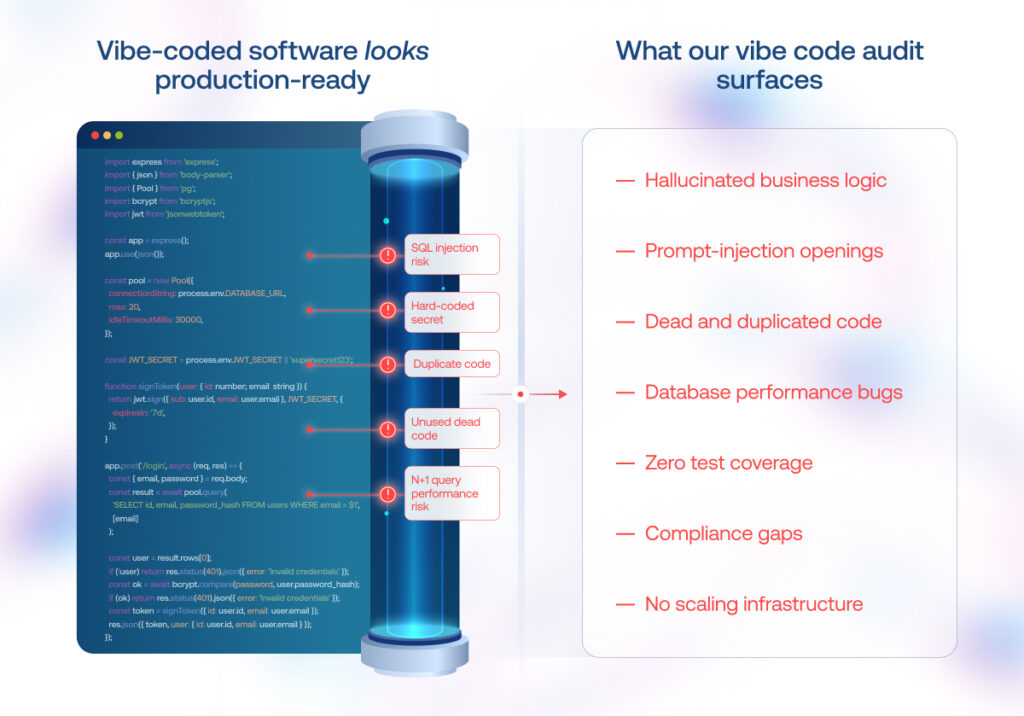
The most dangerous part is that none of these issues necessarily prevent the prototype from working. A vibe coding audit acts as an X-ray for your codebase, revealing the hidden structural defects beneath an otherwise healthy-looking application.
What is a vibe coding audit?
A vibe coding audit is a systematic evaluation of AI-assisted or heavily AI-generated codebases across security, architectural integrity, performance, data consistency, and long-term maintainability. Unlike a traditional code review, it specifically targets risks unique to AI-generated outputs, such as hallucinated logic, insecure patterns, context gaps, and more, and then, translates those findings into a prioritized roadmap for refactoring, remediation, and production stabilization.
Isn’t a vibe coding audit the same as a traditional code review?
For decades, software teams have relied on code reviews to catch bugs, uphold engineering standards, and keep fragile code out of production. Those goals haven’t changed simply because developers now write prompts alongside code. What has changed is the nature and the volume of the output under review.
AI coding assistants can generate thousands of lines of production-looking code in minutes. The result is often syntactically correct, well-formatted, and internally consistent, all of which makes its quality easy to overestimate. Reviewers must now look beyond obvious implementation errors: what the model misunderstood, omitted, or confidently fabricated.
That transforms the scope of the review.
A traditional code review focuses on whether a developer implemented a specific change correctly. A vibe coding audit asks a broader question: is this AI-generated code safe, explainable, maintainable, and aligned with the architecture before it becomes part of the product?
| Dimension | Traditional code review | Vibe coding audit |
| Primary artifact | Human-written pull requests and code diffs | AI-generated features, modules, or entire repositories |
| Typical scope | Incremental changes (tens to hundreds of lines) | End-to-end analysis of generated codebases and system interactions |
| Main question | Was this implemented correctly? | Should this generated code be trusted in production? |
| Primary risks | Logic errors, coding mistakes, style violations | Hallucinated logic, hidden security gaps, architectural drift, code bloat, false confidence |
| Security focus | Known vulnerabilities, dependencies, secrets | Traditional risks plus AI-specific issues such as fabricated libraries, insecure generated patterns, unintended data exposure, and mock security logic |
| Testing review | Coverage, correctness of unit and integration tests | Whether AI-generated tests meaningfully validate behavior rather than inflate coverage metrics |
| Architecture | Consistency with existing patterns | System boundaries, scalability, dependency health, long-term maintainability |
| Typical outcome | Approved pull request | Risk assessment, prioritized remediation plan, and production-readiness roadmap |
In other words, a vibe coding audit extends conventional engineering practices with checks designed specifically for AI-generated software – system-wide architectural analysis, hallucination detection, ownership validation, security verification beyond traditional static analysis, and remediation planning. The objective remains the same: shipping reliable software. The audit simply reflects the new risks introduced by AI-assisted development.
What a vibe coding audit covers
The range of defects outlined above makes one thing clear: AI-generated code rarely suffers from a single, isolated flaw. Issues tend to accumulate across multiple dimensions of the codebase, from architecture and business logic to security and performance. Consequently, a professional audit cannot rely on one review lens.
The table below outlines the core areas we assess when auditing our clients’ vibe-coded applications.
| Audit area | What is done |
| Infrastructure | Validating environment provisioningChecking configuration artifacts for exposed credentialsRevoking data-training consentsVerifying backup isolation and disaster recovery runbooks |
| Business logic | Identifying instances where AI models invented or hallucinated redundant logic to bypass complex requirementsStress-testing unhappy paths like malformed inputs, duplicate records, or out-of-sequence events |
| Architecture | Reverse-engineering AI-generated structures to uncover:tight couplingleaky abstractionscircular dependencies brittle orchestration that could trigger cascading failures under load |
| Data model | Assessing data normalization, entity relationships, and ingestion pipelinesChecking adherence to compliance standards like GDPR, CCPA, and SOC2 |
| Codebase quality | Detecting dead code, over-engineered abstraction layers, spaghetti dependencies, and inconsistent naming conventions to determine necessary refactoring areas |
| Security | Scanning for prompt-injection risks in agentic workflows, hardcoded secrets, weak authentication, unsanitized inputs, and OWASP Top 10 vulnerabilities introduced by AI training patterns |
| Performance | Identifying hidden performance bottlenecks, such as: N+1 query problemsmemory-heavy data transformationsexcessive recursive loops |
| Cost-benefit analysis | Quantifying accumulated AI technical debt against the effort required to fix it |
Upon completing this multi-dimensional evaluation, the client receives a prioritized roadmap for vibe coding cleanup and long-term stabilization.
Sitting on a vibe-coded prototype you need to make production-ready?
Start an auditSo the audit flags a wall of issues. What comes next?
If the audit may uncover vulnerabilities, architectural weaknesses, and accumulated technical debt across the codebase and the cost-benefit analysis shows that remediation is more viable than rebuilding from scratch, the project moves into targeted vibe coding rescue.
Vibe coding cleanup teams stabilize the architecture, close security gaps, and reinforce the application’s core so it can withstand production load.
Architecture stabilization
The first priority is rearchitecting the system’s structure so it can carry real weight. AI-generated systems often suffer from tight coupling and leaky abstractions – components that look modular but secretly depend on each other’s internal behavior. Our team usually starts by reverse-engineering whatever rationale the model followed, then decoupling services so failures remain contained. We fix brittle dependency structures early, because in our experience, that’s what turns minor changes into production incidents.
Codebase health optimization
Once the architecture is stable, attention shifts to code quality. In most vibe coding cleanup projects we handle, the codebase is carrying dead code, duplicated implementations, oversized functions, and generated artifacts that don’t serve any purpose but still get compiled. All of these must be systematically eliminated or refactored to make the codebase easier to understand and maintain.
Test coverage
Our vibe coding rescue specialists rarely rely on a single testing strategy when rehabilitating vibe-coded applications. AI is particularly good at generating broad, repeatable test coverage, so we use it to stress the system and detect regressions at scale.
Human reviewers then focus on what automation cannot easily determine: whether the product behaves consistently, whether the generated implementation reflects the original intent behind the prompts, whether integrations exchange data correctly, and whether subsequent prompt-driven changes have broken functionality that previously worked.
Security remediation
Security issues uncovered during the audit are addressed according to their severity and potential business impact. This typically includes eliminating exposed secrets, strengthening authentication and authorization, validating inputs, closing common injection vectors, updating vulnerable dependencies, enforcing secure configuration, and applying least-privilege principles throughout the application.
Performance tuning
Performance problems in vibe-coded applications can hide behind redundant middleware, duplicated processing, inefficient queries, and unnecessarily complex execution paths. These patterns may barely register in a prototype but become costly once traffic, data volumes, and integration loads increase.
At the architectural level, we first remove unnecessary processing layers and simplify execution paths that add latency or consume resources without delivering business value. The work then moves to the data layer, where AI-generated implementations may rely on broad fetching patterns, repeated queries, or unnecessary data transfers. We replace them with more precise queries, appropriate caching, and better-structured data access.
By cutting unnecessary overhead early, before user load makes it expensive to fix, we keep the platform responsive and leave headroom for scaling without rewriting the core.
Production-ready CI/CD
Deploying a vibe-coded application shouldn’t feel like a leap of faith. The final phase in vibe coding rescue is establishing automated, immutable CI/CD pipelines backed by robust recovery runbooks. With automated linting, security scanning, and test suites embedded directly into the deployment gate, code shifts from developer sandboxes to production predictably, safely, and with zero guesswork.
No need to start over. Targeted cleanup turns audited code into a secure, scalable system
Reach out nowSix rules we’ve learned from auditing and rescuing vibe-coded projects
Once a team experiences a tenfold increase in build speed, there’s no putting that genie back in the bottle. But until AI coding assistants can match the engineering rigor of professional teams, the only path to production is to wrap that speed in layers of clear constraints, disciplined review, and validation pipelines that check outputs against intent.
Having experimented with different LLMs and agent swarms for coding since 2024, our AI Center of Excellence team distilled six core practices that now form the foundation of our proprietary AI-assisted engineering framework and vibe coding as a service model.
1. Running AI inside controlled, policy-bound development environments
One of the harder lessons in scaling vibe coding is that a development environment itself becomes a liability if it operates without guardrails. Letting AI agents write code in an unrestricted environment means prompts, outputs, and sensitive context can leak into model training pipelines or propagate across projects without oversight. The practice we have found effective is running agentic development inside controlled, policy-bound workspaces where the tool stack is explicitly configured rather than inherited from a default installation.
This goes beyond simple access controls. The environment is designed as a multi-agent operating layer that sits between the developer and the underlying models. Tasks are routed to specialized agents based on what needs to happen – architecture decisions go to one channel, implementation to another, security validation to a third – each receiving only the context and tool permissions required for that specific job. This compartmentalization prevents context drift and reduces the surface area for errors.
2. Treating data preparation as the first engineering task
AI models amplify whatever signal they receive, including noise. In practice, this means ambiguous, inconsistent, or poorly structured data becomes the context that shapes every subsequent decision the model makes. So before any AI-assisted development begins, the focus should be on hardening the data layer: cleaning inconsistencies, standardizing formats, locking down schemas, and building ingestion pipelines that validate rather than pass through. The goal is to eliminate ambiguity at the source, because anything left unresolved in the data will be magnified by model behavior rather than corrected by it.
3. Packaging repeatable architectural and coding patterns into reusable context bundles
When two engineers prompt an AI for similar tasks without shared context, the model free-styles, producing different abstractions, naming conventions, and error-handling patterns each time. Architectural drift follows fast.
To prevent this, we treat prompts as code that needs a standard library. Engineers paste context bundles – predefined blocks of project-specific rules, interface contracts, and code patterns – directly into the conversation before asking for implementation. The model then generates within that frame instead of inventing its own structure.
The payoff of this approach is twofold. First, it keeps output consistent across different sessions and different team members. Second, it creates a single maintenance point. When a pattern needs to improve, you update the context bundle once, and every future prompt that includes it inherits the change.
4. Enforcing automated validation gates
When a model can produce thousands of lines in minutes, manual review alone becomes a bottleneck and a risk.
Our baseline is simple: every AI-generated output has to be treated as untrusted until it passes automated validation.
We enforce this through a default pipeline of SAST, dependency scanning, secret detection, and SBOM generation, run before any human reviewer opens the file. The codebase then goes through additional testing layers: unit, integration, and behavioral checks. The purpose is to ensure that what ships has the same trust level as code written by a senior engineer who understands the consequences.
5. Constraining AI with strict execution guardrails
AI performs more reliably when the boundaries of acceptable behavior are clearly defined. Establishing architectural north stars, clear ownership rules, and automated compliance gates narrows the range of acceptable solutions, resulting in more consistent code and significantly less rework downstream.
6. Using AI to challenge AI while keeping human experts as the final approval authority
We combine human oversight with a lightweight multi-agent peer review. Our engineers challenge AI assumptions and flag risky logic, while supervising agents verify that execution agents follow the declared approach. One generates, another challenges, a third validates structure and edge cases. This creates several independent perspectives on every output, catching blind spots that a single reviewer – human or machine – would likely miss.
The final authority, however, remains human. Experienced engineers decide whether the implementation reflects the intended business logic, meets architectural and security standards, and is safe to merge or release.
Make your AI-built solution growth-ready with a proper vibe coding audit and cleanup
Vibe coding changes how software is developed, but not what it must withstand. Security, architecture, maintainability, performance, and governance requirements don’t disappear simply because the first working prototype comes together overnight.
Vibe coding audit and cleanup services, delivered by a trusted engineering partner, preserve the speed advantage while bringing the codebase up to engineering standards.
Have a vibe-coded application that has outgrown the prototype stage?
Let’s make it ready for real users and long-term evolutionFAQ
Yes. Senior software engineers, enterprise architects, and vibe coding security specialists perform vibe coding code quality reviews and audits. They evaluate AI-generated code for hidden architectural flaws, security vulnerabilities, hallucinated dependencies, and data compliance to ensure the codebase meets enterprise standards before deployment.
A vibe coding audit is a 360-degree review of software built with AI coding tools that identifies technical debt, security risks, architectural flaws, and scalability and maintainability issues before the application moves to production. The outcome is a prioritized remediation roadmap for stabilizing the vibe-coded app.
A traditional code review checks what a human developer intended to write, focusing on logic, style, and team standards. A vibe coding audit treats the output as untrusted until verified: it validates that AI-generated code matches the intended architecture, contains no hallucinated dependencies or hidden vulnerabilities, and meets the same production-ready security, performance, and maintainability standards as human-written code.
Follow field-proven vibe coding best practices: establish all the right guardrails upfront, keep seasoned engineers in the loop, and enforce automated quality and security checks.
AI-generated code can be secure, but it is not secure by default. Whether it is safe depends entirely on the human-in-the-loop oversight, guardrails, and verification steps wrapped around its generation. A reliable vibe coding security vendor enforces a disciplined SDLC around it: embedding automated SAST/DAST scans, mandating human review for critical paths, and validating every dependency and secret exposure.
Yes. Vibe coding rescue is a core component of our vibe coding audit and cleanup services. Beyond rescue operations, we also help teams adopt agentic development safely and effectively through our vibe coding enablement program, or deliver fully managed software through our end-to-end vibe coding services.
Vibe coding governance hasn’t yet crystallized into an industry-wide standard. However, we’ve established our own vibe coding guidelines that underpin our proprietary AI-assisted engineering framework. These include establishing a solid data foundation upfront, using our technology-agnostic agentic operating system, prompting with predefined context templates, routing all generated code through mandatory quality and security gates, and requiring human engineers to review critical AI-driven decisions.
The vibe coding audit typically takes 1-2 weeks, depending on the size and complexity of the codebase. After the assessment, we usually need about a week to develop a strategic stabilization roadmap. If you decide to move forward, cleanup and remediation sprints typically take 3-6 weeks, followed by ongoing support as needed. So while the audit itself is relatively quick, the full journey from assessment to a secure, stable codebase typically spans 5-9 weeks, with the option to extend into continuous improvement afterward.
The audit report delivers a full-spectrum view of your codebase health, covering architectural soundness, security vulnerabilities, threat modeling, data integrity, test quality, performance bottlenecks, and infrastructure cost efficiency, all wrapped into a prioritized remediation roadmap and a clear refactoring blueprint to guide your next steps.
Subscribe to
Instinctools blog