
MVP Development For a Fintech Startup

Full-scale MVP Development For a Fintech Startup

How running a discovery workshop saved a fintech startup tens of thousands of dollars on needless software development and enabled the company to craft a trailblazing MVP for venture funds and investors. 

Industry:
Fintech

DevOps Services

UX and design

Web Development

Software Product Development

Business challenge

Securing a top-notch development team when building a software product is only one part of the equation. The key lies in defining what kind of product you want to create, who for, and what problems of the target audience it will address. For those operating in highly demanding niches, like our client, this precision represents both a challenge and an opportunity.

Instinctools was approached by a European venture capital company with €800m+ in assets under management. They planned to launch a fintech startup and develop a web platform to consolidate information for VC investors and funds. 

The envisioned solution was supposed to:

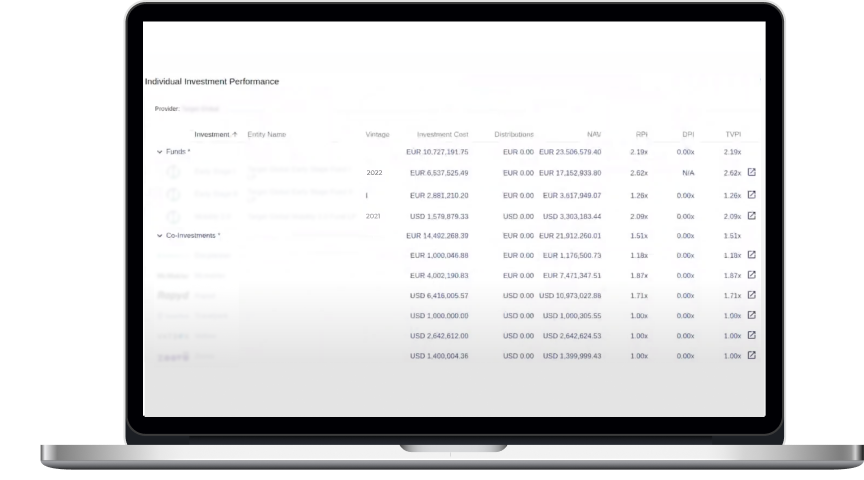
Present investors with concise, visually appealing information about potential investment opportunities and their terms, rather than extensive 50-page reports

Provide a secure space for communication between funds and investors moving away from traditional emailing

Offer a comprehensive experience for investors, eliminating the need to switch between several systems

Empower funds with automated back-office functions, significantly reducing staff hours.

This innovative and far-reaching B2B2C solution had the potential to take the market by storm even as an MVP. However, the haphazard approach to its implementation put the whole project at stake.

Initially, the client worked with another tech partner who had offered to set up a developers-only team for the project. Specifying the requirements and prioritizing features fell under the client’s purview.

Here is how it played out. The client outlined the platform’s core idea to their contractor and continued to pile up features throughout the development process. Not surprisingly, those efforts didn’t hit the mark the client was aiming for.

It turned out the client had been draining their budget crafting a solution that veered far from their original vision. Letting multiple stakeholders from different departments define the project requirements on a whim and the lack of a unified product vision between the product owners and dedicated team resulted in a deep chasm between expectations and reality. The developed solution looked like a nice visualized Excel spreadsheet instead of being a 
top⁠-⁠of⁠-⁠the⁠-⁠line digital fundraising platform.

Despite developing some of the intended features, the team couldn’t pull the whole solution together, and the situation was being exacerbated with each new feature implementation. The web platform benefited no one: not funds and investors, not the client. 

The problem required input from a skilled Product development consultant, and since the previous contractor couldn’t provide one, the client started to look for a new tech ally. This time, they decided to search among vendors whose expertise in information security and quality management was backed with ISO 27001:2022 and ISO 9001:2015 certificates. And that’s how *instinctools entered the scene. 

In the project, the main puzzles were lurking at the pre-development stage. Our team had to:
Process the information

received from the client and create the project’s Vision&Scope documentation

Gather and clear up

business requirements along with technical and non-technical constraints

Prioritize

the solution’s features

Shape the project’s

iterations in line with the features it should have

Evaluate

the current product against the updated requirements

Solution

At *instinctools, we know how to address the problems of clients who turn to us after dismal cooperation with other tech partners. Sometimes, the situation can be completely muddled. There may be no basic documentation on the project, and it can be challenging for the stakeholders to define how they see the final product. In such cases, we suggest conducting a discovery workshop before diving into the development to frame the product vision into a set of specific actions that would ensure the project’s success. 

What was the value of a discovery workshop for the client?
  • Clearly defined business requirements and product vision

The client obtained a Vision&Scope document, where all functional and non-functional requirements for the project were captured. That information ensured all the participants involved in the development process were on the same line and had similar expectations regarding the final product. 

Additionally, with Vision&Scope in hand, the client could seamlessly transition to another tech partner — if they felt the need to do so — without going back to square one.

  • Balanced development scope and business value

Following the here-and-now principle in developing product features, trying to implement every single idea you come up with is a sure way to oversaturate your product with flashy components at the expense of vital ones. It’s a slippery slope, especially for an MVP. By chasing excessive functionality, it’s easy to lose the crux of the MVP, resulting in missed deadlines, and wasted budget.

A proper evaluation and prioritization of features with the solution architect empowered the client to balance business value, development cost, and time.

  • Potential for product enhancement

All artifacts created at the discovery workshop were documented. And anything that didn’t make it into the MVP could be put into the subsequent product releases. That way, the client got a backlog primed for future development after the minimum viable product rollout.

  • Aligned product vision between the client and the dedicated team

Cooperating closely with our stakeholders empowered us to sculpt the product seamlessly within the projected time and budget.

  • Decreased time to market

Although a discovery workshop took some time, working out requirements, prioritizing features, and developing a common vision of the project paid off. It allowed the team to move at a rapid pace through the development phase as they had a well-defined action plan and could fully focus on product development and testing.

  1. Behind the scenes: how did the discovery workshop go?

The number and duration of workshop sessions depends on the project’s complexity and the scope of issues that need to be clarified before starting development. In our client’s case, we proposed two three-hour sessions. 

What did they cover?

Examining the existing solution with the product owners and gathering up-to-date business requirements and constraints
of the product

Within the first workshop, our dedicated team collected and analyzed the information about:

  • Problem, task, and business opportunity
  • As-is state of the product
  • Success criteria
  • Stakeholders
  • Our product
  • Risks
  • Functional and non-functional requirements
  • Target audience
  • Competitors
  • Unique value proposition
  • Constraints

For example, one of the client’s concerns was that the solution wouldn’t be secure enough to manage documents with sensitive financial data from venture funds and investors. 

To guarantee that Fort-Knox security level, we offered to tighten requirements for authorization on the platform and offered to conduct training on using and managing the solution for the client’s employees.

After an in-depth discussion, our team spent a week processing the collected data, brainstorming possible strategies to put the project back on the right track, and preparing a Vision&Scope document for the second workshop.

Vision&Scope presentation to highlight our idea of revamping the existing solution according to the updated requirements

Instead of scrapping the existing software we decided to breathe new life into it, moving gradually:

Transition phase to take on the project

Alpha release of the product’s demo version to fix already implemented linchpin features

MVP Block 1 release to develop mandatory core features for the fund user (investor) role within the platform

MVP Block 2 release to add secondary core features for the fund admin role within the solution

Future releases to hone the product functionality
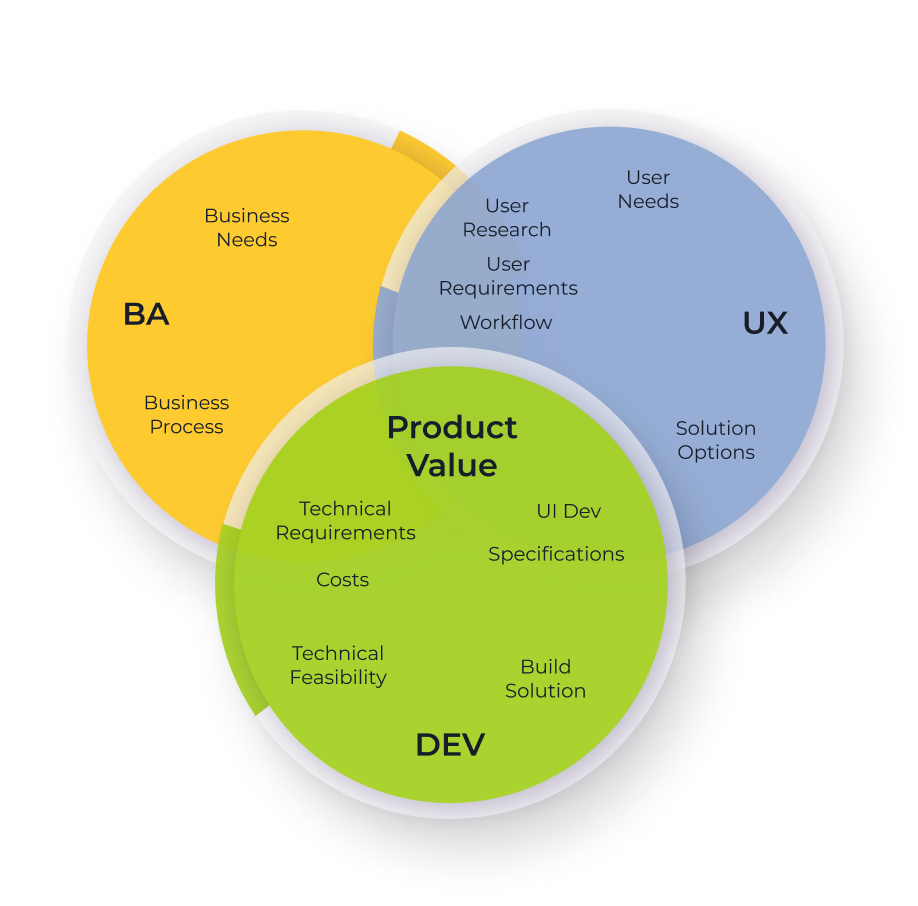
After their previous tech partner delivered a final solution that deviated significantly from the initial idea, the client appreciated our iterative and incremental approach.

Furthermore, that strategy allowed the client to use the product’s beta version to reel in future platform users – investors and funds. Engaging customers is way easier if you have a demo version they can click through to get an idea of the platform’s functionality.

During the second workshop, we also introduced to the client how we see the product’s:

  • Business goals
  • Scope decomposition
  • Milestones
  • Timeline

The scope decomposition discussion allowed us to prioritize the order of the features’ implementation. Some of them, such as two-factor authentication (2FA), were moved to the Alpha release, while others were postponed for later stages. For example, the client wanted to include integrated analytics for the Opportunities page in the Alpha release, but they needed integration with Tableau to do so. Therefore, this functionality was shifted to future releases.

We also suggested reconsidering the team composition and strengthening it with our classic triad of a business analyst, solution architect, and UX/UI designer, typical for an *instinctools’ product approach. That way, our experts ensured creating the product centered around customer experience. 

The client appreciated the businesslike approach of the *instinctools team. They approved our ideas, and so we jumped right into work on the next stage.

  1. Transition phase

At this stage, we focused on:

  • Auditing the current platform. We reviewed the client’s functionality as the Fund admin and end-user’s functions for the Fund user (Investor) role implemented on the platform before cooperation with *instinctools. That way, we determined which of the already developed features to include in the Alpha release.
  • Troubleshooting and bug fixing. We evaluated bug fixing priorities. For example, authentication, notification system, and chat had to be fixed first.

The transition phase resulted in creating a joint value-based development model with described stages, milestones, and releases. As we’ve elaborated the scope for the Alpha release, we moved on to it. 

  1. Alpha release

Our primary goal was to establish a base for future development. The Alpha release included a limited set of core features to speed up the product’s time to market and provide maximum business value with minimum effort and cost.

Instinctools’ team covered:

  • Conducting code refactoring. We eliminated the spaghetti code inherited from the client’s former tech partner to simplify the process of uncovering bugs and vulnerabilities and hone the product’s efficiency and maintainability.
  • Implementing necessary fixes to current features. Only manual logout had been available earlier, so we added auto logout for the Fund User (Investor) role.
  • Reviewing UX/UI. The current platform looked more like a visually appealing Excel spreadsheet, while the client wanted to put a premium on innovation and make the product up-to-the-minute in look and feel.

The Alpha release led to crafting the product’s version with updated core features and design ready to be tested by early adopters.

  1. MVP release

The client showcased the demo from the Alpha release to one of the funds. It was a sort of validation milestone for our client, which they passed. Therefore, we moved to fine-tuning the product, considering feedback from the early adopter, and added new features to the platform to provide more tangible value to customers.

First, we extended the functionality for the Fund user role. The following features were included in MVP Block 1:

  • 2FA. In line with best practices and the client’s desire to raise the bar on the platform’s security, we implemented two-factor authentication for fund users.
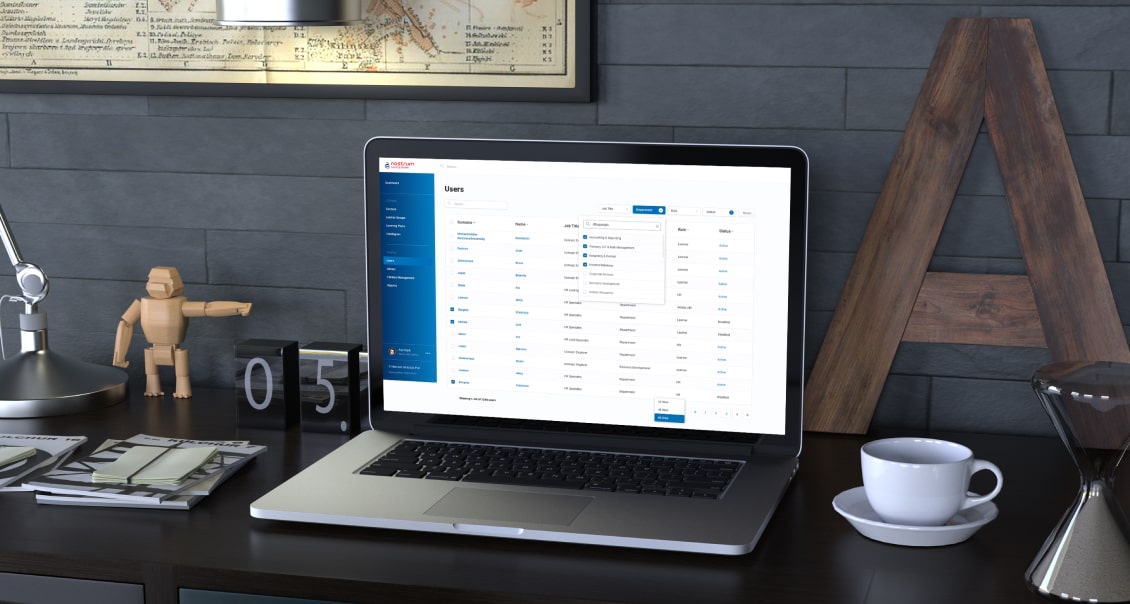
  • Manage documentation. Fund users can open, read, and download docs in various formats unlike in the platform’s version, provided by the previous contractor, where users could only see the list of documents.
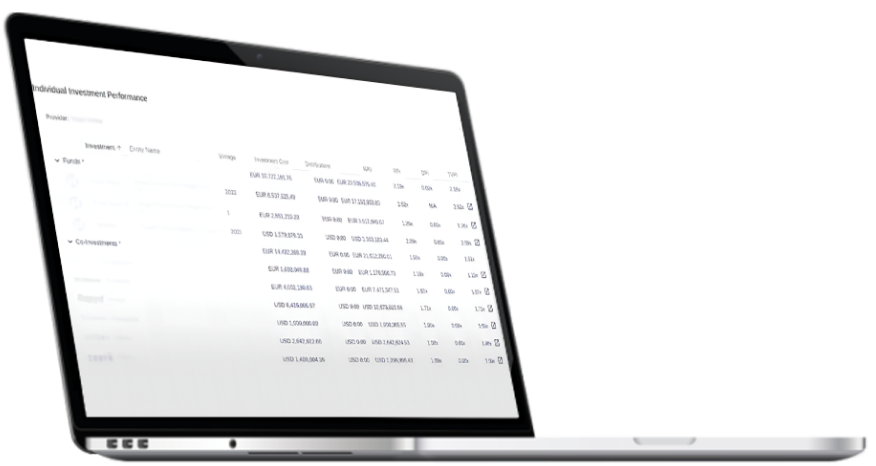
  • See the full picture of investment activity. Fund users can check the invested money and the remaining amount they can invest.

At the MVP Block 2 stage, we enhanced the functionality for the Fund admin role:

  • Oversee investor organizations users. Fund admin can delete the investor organization users, activate, and deactivate user accounts. In the past version, the admin could only create and edit users.
  • Manage Opportunities. Fund admin is allowed to add new Opportunities, set their visibility, edit, or deactivate them. Previously, admins could only view the Opportunities the platform owner published.
  • Handle documentation. Fund admin can search and filter docs, while they could only view a list of documents earlier.

The main deliverable of the MVP stage was launching the product to the public.

  1. Future releases

Based on the feedback from end users, we’ve planned updates that are sure to captivate both funds and investors:

  • Benefit from third-party integrations

IIntegration with Tableau is at the top of the list to provide end users with embedded analytics within the platform.

  • Prepare the data for internal and external purposes

Summarize investments and generate reports to make back-office tasks a breeze.

  • Manage Opportunities

Automated notifications for investors about changes in Opportunities to help them keep an eye on the offers they are interested in.

  • Communicate with investors

Secure in-app messaging instead of emailing.

Before

  • Confusion about where the project is going and when it will be finished
  • Doubts about whether the goal is worth pursuing any further
  • Lack of understanding between the development team and product stakeholders
  • Random order of the features’ implementation
  • Budget drained on the creation of an undercooked product
  • Half-finished product with no value for the client or end users

After

  • Clear project roadmap with a blow-by-blow description of each stage
  • Shared vision of the future product
  • Step-by-step feature rollout, prioritizing what matters most
  • A robust MVP that not only fits the bill but also turn heads of user

Client’s testimonial

The product owner says how expectations align with reality when partnering with the *instinctools team:

Key features

Consistency

Laser-focused strategy adherence.

Cohesion

Continuous collaboration between the stakeholders and the dedicated team. 

Efficiency

Delivering the solution that is profitable even as an MVP.

Business value

  • Balanced development scope to provide maximum value with minimum investment
  • Decreased time to market
  • Fail-safe MVP, ready to conquer the venture capital market

Custom LMS development and design

Custom LMS development for an energy corporation

How implementing a custom LMS helped an oil and gas enterprise automate 84% of training management tasks while increasing employee engagement by 45% and saving 41% of the education budget by moving online.

Industry:
Education, Oil and Gas

UX and Design

Web Development

Enterprise Software Development

Software Product Development

Business challenge

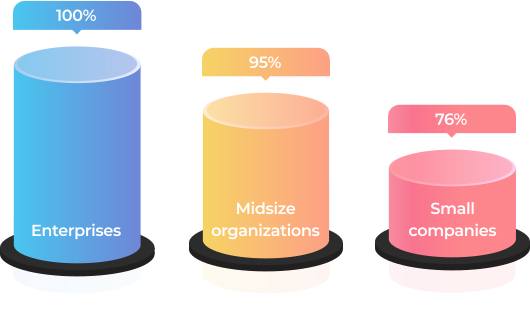
An efficient learning culture within an organization is one of the key ingredients that drive business forward. Statistics unveil that in 2022, 100% of enterprises, 95% of midsize organizations, and 76% of small companies used LMS software to deliver training.

It’s also worth saying that for some industries, continuous staff training is not a nice-to-have option but a requirement that has to be met unequivocally. Just as it was for our client — a UK-headquartered oil and gas company with a production and operations center in the Middle East, which needed an LMS for internal usage.

Before reaching out to us as an LMS development company, the client used to have only offline training programs.

What percentage of companies bank on LMS?

Source: Training magazine, Training Industry Report 2022

What problems did such an approach bring?

No single point
for gathering and storing learning materials
As courses were scattered across HRs’ devices, notes, etc., it was impossible to efficiently organize and reuse them to save time on curriculum preparation. The absence of well-established and consistent management of learning materials was also deteriorating learner engagement and led to employee resistance to education. 
Hardships
with controlling timely staff certification
The client’s HR team was having a bumpy ride with managing employee certification, which is vital in the oil and gas industry. Therefore, HRs had to manually track each worker certificates’ due dates to set required training so it was on the dot.
Manual performance
of mundane, repetitive tasks
As the client’s production center was based in the Middle East, they had to regularly submit a report on the staff certification to the local Ministry of Oil and Gas. The data for it was also gathered manually, which ate a sizable chunk of the HRs’ working hours. 
Inflexible
educational process
The training was available only at the corporate training centers and, therefore, required time commuting for the staff who worked on oil and gas production sites or from home.
Lack of transparency
in training
Teachers and learners didn’t have tools to track real learning progress, and, thus, measure it.

As the company kept growing, the problems were snowballing. At some point, it became clear that the situation had to be fixed urgently. The Head of the HR department proposed switching from in-face education to e-learning. This idea implied LMS development to go from training management turmoil to a single point for storing and organizing educational materials as well as tracking the learning process.

LMS can empower the client's business with a list of benefits

Automation
By automating repetitive tasks, such as grouping, adding, and deactivating users, handling group enrollments, etc., the client can lighten the burden for HRs. Moreover, LMS software allows for creating PDF certificates for employees when they finish a course.
Time optimization
Thanks to storing all the learning programs and materials in one place, teachers can efficiently reuse them. For instance, before creating a new course from scratch, they can check the LMS’s repository for data on the same topic, combine old courses, or just finetune them.
Regulation compliance
A powerful learning management system provides an opportunity to make keeping all staff aligned with the industry regulations a breeze. You have a centralized way to deliver the same information to all of your employees.
Security
With an LMS limited to internal usage, the client can assure the inaccessibility of the company’s sensitive data from the outside.
Cost reduction
Putting a premium on automation and a time-saving approach decreases the cost of training in the long run. 
Flexibility
After switching to digital learning, employees can attend courses anywhere, anytime.
Transparency
Both teachers and learners can track training progress. In a nutshell, LMS offers a competency matrix for each employee in the corporation.
Higher employee retention
3 out of 4 employees are more likely to stay with a company that offers continuous training and a rich learning experience.

Source: Society for Human Resources Management, The State of L&D in 2022

Also, the client considered that they would need a software solution adjustable to the specifics of the oil and gas industry and their enterprise-scale multinational company, including:

Opportunity
to create, gather, and store learning materials and courses on a plethora of topics
The flexibility of the LMS solution regarding the diversity of topics to cover — from technically specific courses to programs on finance management.
High resilience
of the system
The LMS software was supposed to accommodate a simultaneous workload of 1,000+ users during standard working hours.
Ability
to generate custom reports
As mentioned, the client had to provide a specific report to the Ministry of Oil and Gas. This task also had to be automated.
Localization
options
For the multinational corporation, the possibility to provide training in many languages (including  Arabic) was an essential feature. Where the top management could study in English, but rank-and-file employees needed materials and the LMS’s interface in localized languages.

The off-the-shelf LMS platforms won’t cover these requirements. Therefore, it was decided to develop a custom LMS software. This option also suited the client better from the business perspective as they had an in-house IT department, and maintaining their own system was more cost-effective than constantly investing in a ready-made software license.

Our business analysts clarified what devices should be used for the learning process. As the customer planned to provide access to the learning system only on the desktop, we ended up with the idea of a web application hosted in the client’s cloud.

Solution

At the product ideation stage it became clear that the client didn’t have a clear understanding of custom learning management system capabilities and what LMS features they needed. The only well-defined requirement was related to the LMS’s visual design — the platform had to match the company’s corporate colors.

However, our extensive expertise in bespoke software product development allowed us to sprint ahead without getting stuck at the starting line. Instinctools’ business analysts took the initiative during the collection and elaboration of requirements.

After finishing this stage in three weeks, we outlined the vision of the roles within the LMS, its architecture, components, functionality, and management.

  1. LMS functionality

As a custom LMS development company, we aimed to provide the client with a feature-reach and user-friendly software product. Therefore, our dedicated team devoted special attention to crafting an easy-to-use materials repository, clear course structure, simple course management, detailed progress tracking, diverse testing programs, and in-depth reporting.

Roles

After analyzing the structure of the client’s training process, we suggested the following roles within the learning management system:

  • Admin for their in-house IT department
  • Teacher for HRs
  • Learner for employees

Content Library

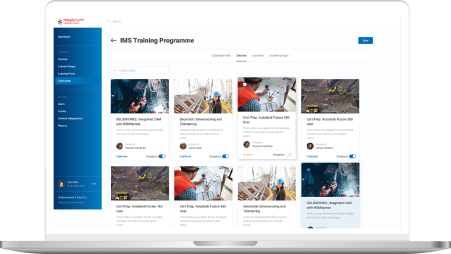
Storage for courses and educational materials is a basic component of any LMS. Speaking of the client’s Content Library, they planned to use it to collect both their in-house courses and learning programs they acquire from other training centers.

Considering the requirements of the oil and gas industry, all the data can be sorted out in various ways. For instance, general or industry-specific, by topics, available language, etc.

Content formats also vary. In the era of offline training, the client offered employees only text and illustrations. Our BAs proposed adding videos to increase learner engagement and enhance educational outcomes by diversifying learning activities.

Course structure and management

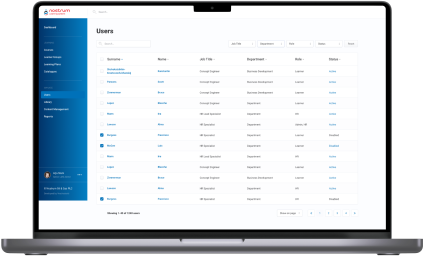
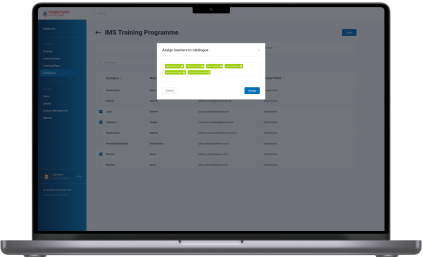
Learners can’t choose a course by themselves; training is always assigned by the Teacher or Admin to an employee or a group of employees. Also, educational materials are categorized according to the staff’s specialization and their level within the corporation. For instance, materials for rank-and-file workers and top managers will be in different categories, as well as courses on specific topics, such as risk management in finance and safety in oil production.

Progress tracking and analytics 

The success of training programs is measured by their influence on the staff. To estimate this impact, we visualized students’ progress with data analytics tools.

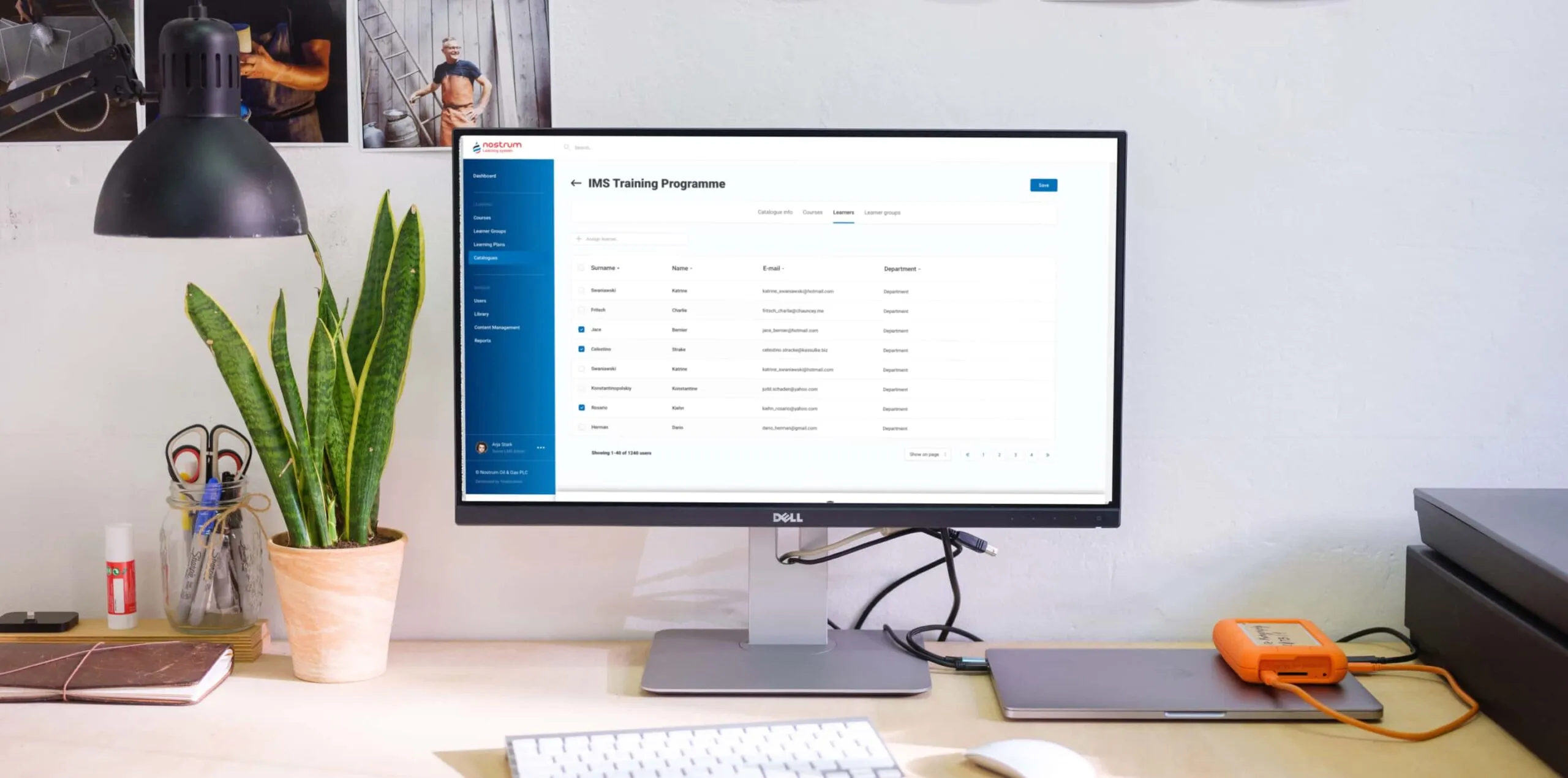
Custom LMS development implied offering dashboards on both sides:

  • Admin/Teacher’s
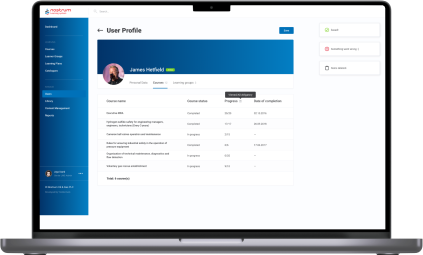
functionality includes tracking percentage of Learners completed a group course. Furthermore, as they can set a deadline for a course or test, there is a statistic on how many employees managed to meet the deadline. Teachers and Admins can also look for detailed analytics for each employee – what percentage of assigned courses and tests they have already passed, the number of failed tests, if there are any, etc.
  • Learner’s

functionality is not that extensive, but each employee can check their training performance and monitor deadlines to make it on time. All reports can be downloaded as Excel, CSV, or PDF files.

Communication within the LMS 

Having a single point of communication is also significant in ensuring personalized learning experience and high-quality training. Learners can leave comments on the courses, tag their Teachers or other participants if there is a group training, and Admins if they can’t sort out some technical issues. 

The same goes for Teachers. For example, they can tag Learners in the courses where the deadline is around the corner.

Notifications

Communication goes hand in hand with automated notifications to simplify time management for both Teachers and Learners. Within the custom LMS development, we recommended and implemented email notifications with ready-made templates for five cases:
  • A Teacher assigned a course to the employee
  • The Learner was tagged by a Teacher, Admin, or other Learner from a group
  • A course has a deadline, and the Learner receives auto reminders ten, five, and two days before
  • The Learner missed the deadline for a mandatory course
  • Admin also receives a message about the readiness of auto-generated reports for the Ministry of Oil and Gas

Tests

This feature became a new helpful add-on in the certification process to ensure a high level of expertise across the company. Now, employees can only be certified after passing tests following the course.

Here are some features of the testing process we suggested and implemented during the custom LMS development:

  • Tests can include open, single-answer, and multiple-answer questions
  • There may be text, illustrations, and videos in the tests
  • New hires have to complete an initial test to assess what skills they may lack for their specialty or position. Based on the results, Teachers can create fully personalized learning for these employees
  • Teachers and Admins can set a deadline for the course.
  • Teachers and Admins can set a course’s completion as a prerequisite for access to the next one

Reporting

As we’ve mentioned, the automated report preparation for the Ministry of Oil and Gas was one of the reasons that tipped the scales in favor of the custom LMS development services. We relieved people from a manual collection of data on employees’ courses completion, putting that data together in a list, and entering it into the report template.

All these operations were automated. The LMS generated an Excel file with all the necessary information according to the Ministry of Oil and Gas template. HRs had only to download it and send the document to the ministry.

Since the project scope was quite substantial, we divided the work into two parts — MVP (Minimum Viable Product) and post MVP. The MVP incorporated the Admin’s and Teacher’s functionality – Authorization/Login, Course Catalog Management, Course Management, Content Management, and Content Library. It took our LMS developers three months to finish this part. 

  1. Integrations and security

The client used Microsoft Azure as their corporate cloud platform, which influenced the LMS integration they needed and the way we took care of security:

  • Integration with Azure Active Directory

All employees already had profiles in the Active Directory. We took advantage of this to avoid creating the staff profiles in the learning management system from scratch.

All employees already had profiles in the Active Directory. We took advantage of this to avoid creating the staff profiles in the learning management system from scratch.

  • LMS authentication through Azure OAuth 2
We suggested using this up-to-date standard authentication protocol to allow users to sign in to the LMS through their profile in the Active Directory. 

Besides saving personnel’s time, such an approach is beneficial from a security standpoint. As you can guess, employees rarely come up with new passwords and use the same one for multiple systems, which increases software vulnerability drastically. A single point of authentication (SSO) means fewer scattered logins into various corporate apps and minimizes the possibility of external attacks and data theft. 

Within the project, our LMS developers worked only with the API addresses of specific servers provided by the clients for the web app. The software’s maintenance and support were supposed to be provided by their in-house IT department. 

However, we went the extra mile to optimize the task for the client. Our DevOps has automated the web app’s installation and deployment on the server side. Thus, all the LMS services located in Docker containers were automatically brought up on the server via Docker Compose.

  1. Visual design

Good design emphasizes the product’s functionality. Our product designer had to translate custom LMS software’s versatile capabilities into a dynamic and feature-filled interface. As we were strapped for time, there was no wireframing. We went straight to visual design. Our UX/UI designer took the risk and prepared a lot of screens for a future web app at once and reached the client for approval. Thanks to our product-first mindset and battle-tested expertise of the LMS development company, it worked out.

Here are a few examples of our initiatives regarding learning management system design and usability:
  • Nesting levels
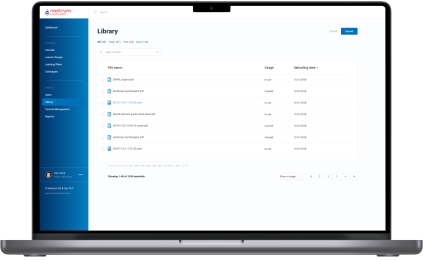
As we were in charge of the solution’s architecture, we also proposed the components hierarchy. For example, we suggested creating All, Video, Text, and Cover sections within the Content Library and All, For review, Declined, and Published tabs in the Courses Catalog. 
  • Quick access tab
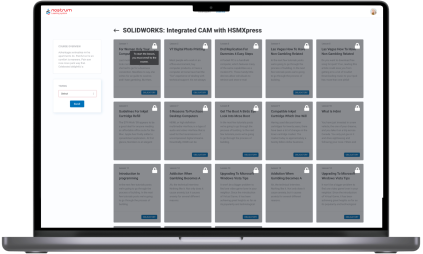
Learners can be overwhelmed with the number of courses they need to complete. Therefore, we offered to add a “Quick access” menu, where each employee can check assigned materials, which are obligatory, which are in progress, etc.
  • Intuitive and handy file uploading
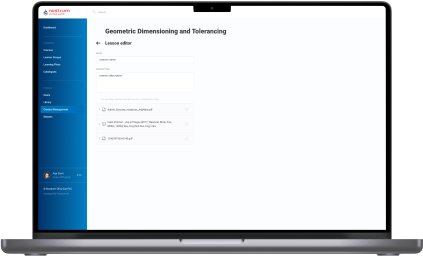
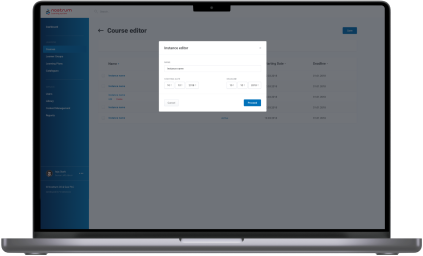
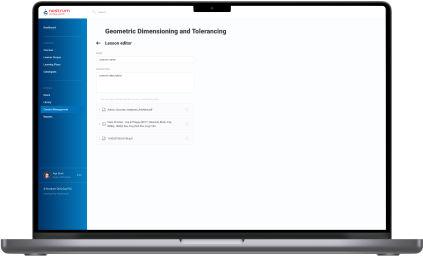
With the drag-and-drop interface, Admins and Teachers can easily download materials of any type to the Content Library and change their order in the Course Editor.
  1. Post-implementation stage

After the LMS rollout, our business analysts trained HRs to familiarize them with the system and show them how to take advantage of it to the fullest.

Next, we moved to working on the post-MVP features and added them in four iterations:

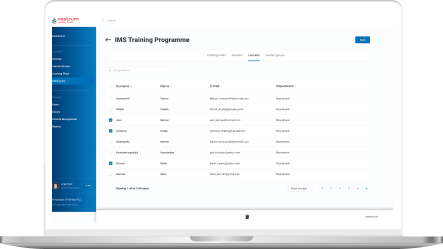
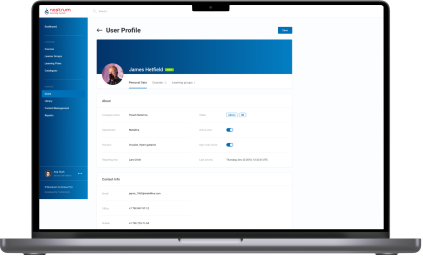
Iteration 1 User Accounts management, Learning groups management.
Iteration 2 Courses, Catalog, Admin/Learner modules architecture.
Iteration 3 Lessons (Learner module), Course listing (User management).
Iteration 4 Enhancements (improve UX), Report (Course completion), Course management (selection material from Library, material sequence).

This part of the custom LMS development took another four months of the full-fledged team work.

Before

  • Training materials and courses are scattered across teachers’ devices and hand-written notes
  • Manual performance of management tasks that could be easily automated
  • Lack of personalized learning
  • Inability to measure the effectiveness of corporate training materials
  • Absence of educational analytics
  • Slow delivery of the educational programs
  • Difficulties with tracking learners’ progress
  • Manual preparation of obligatory reports

After

  • Transparent measurement of corporate educational programs’ success and learner’s progress
  • Simplified and mostly automated preparation of industry-specific reports
  • Speeded up courses delivery
  • Automation and facilitation of all the learning management operations
  • Centralized learning data storage
  • Unlimited ability to personalize the learning experience
  • Detailed visualization of each employee’s training progress and a bird’s eye view of the staff certificates across all company

Key features

Inclusiveness
The biggest gain of custom LMS software is its adaptability to the various staff’s specialties and flexibility in providing access to the courses regardless of the employees’ time and location.
Resilience
Besides the ability to withstand the simultaneous workload of 1,000+ employees, custom LMS development has become a harbinger of opportunities for the client to ensure stability and consistency of training programs.
Customizability
With a custom LMS solution, the client can uncover the areas of improvement and tailor a curriculum to the company’s needs and employees’ ambitions.

Business value

  • Provide a single point of control over the training programs to ensure ongoing improvement of employees’ knowledge and expertise
  • Automate 84% of teachers’ tasks related to managing the educational process
  • Save up to 4 hours of teachers’ working time weekly and relocate their efforts to developing personalized curriculums
  • Save 41% of the education budget thanks to moving online
  • Speed up new staff onboarding from 1–3 days to 4–10 hours, depending on the employee’s position
  • 45% increase in employee engagement
  • Securing the company’s education materials with single sign-on (SSO) authentication

Multiplier effect

Any way you slice it, even small companies can no longer afford to put off the question of consistent and centralized employee training until later, not to mention medium-scale companies and enterprises.

The absence of a robust learning management system can slow the roll of a company in any industry, from education and healthcare to manufacturing, automotive, and fintech. Creating a powerful LMS can help you rise from a dizzying array of unsorted educational materials and courses and make your employees’ progress traceable.

Furthermore, experts in any field are a hot commodity nowadays, given the world-scale talent crunch, and hunting them can cost you a pretty cent. Therefore, you should bank on the LMS software for internal usage and cultivate experienced professionals within your company.

Effective training helps companies to fill skill gaps by leveraging staff they already know and trust and foster long-tenured relationships with their employees. Moreover, by putting talent management first, companies of all sizes can improve organizational performance and potentially gain a competitive advantage over their peers.

Custom OKR Application For a European Retailer With $700 Million Revenue

Custom OKR Application For a European Retailer With $700 Million Revenue

How switching from manual and time-consuming Google spreadsheets to a custom Objectives and Key Results (OKR) framework empowered a retailer with 1,400+ stores in 12 countries to get a hassle-free and fully transparent OKR progress tracking, boosted staff engagement rate from 15% to 59%, and increased employee productivity by 33%.

Domain:
Management

Duration:
3 months

Challenge

Setting goals and keeping employees in sync in terms of accomplishing them is essential for every company. That’s exactly what the OKR (Objectives and Key Results) framework is for. It helps employees to focus on a certain goal and measure the progress toward it.

Before turning to *instinctools, our customer had been using Google spreadsheets to track their OKR progress. However, it was a manual, time consuming, not-at-all engaging process that was difficult to manage and keep track of. As a result, teams used to lose interest in keeping the spreadsheets updated.

Having considered a bunch of out-of-the box solutions, the customer realized that it’s difficult to find “the one”, that would be a perfect fit for their business. Some lack certain features, others cost too much.

That’s why we suggested the most efficient option: to design a decent OKR app, which would help the company to accommodate all their needs and stay away from any problems the teams might face while setting and tracking OKRs.

Tasks

  • to let the employees know the business goals so that they can work together in achieving these goals
  • to enable the teams to integrate goals with everything they do and allow employees to align their individual achievements along with business success
  • to track the progress towards goals instantly to see if you are going in the right direction
  • to share the feedback on the goals and the process of achieving them

Solutions

We’ve developed a flexible product that offers a wide range of features, making the process of creating and tracking OKRs easier and faster.

  • quick and intuitive creation of objectives
  • possibility to assign users, add duration, description, and name for each OKR
  • setting the deadlines of objectives so that everyone can see them
  • grading the OKRs mid-term which helps to highlight areas where the team is falling behind so that appropriate measures can be taken
  • cascading OKR implementation with the possibility for individuals and teams to set their own goals and align them with company’s goals via measurable results
  • real-time dashboards to display the dynamics and monitor the progress of goals
  • charts that contain description for each task
  • graphs that show information about goal contributors
  • collecting and giving feedback to identify bottlenecks before they occur
  • integration with other communication and business apps – such as Gmail, Jira, etc. – to make updating the OKR progress hassle-free

Value

According to the customer, the implemented OKR application has become, abstractly speaking, a compass which shows what to focus on to help the team and company to be successful. Specifically, it resulted in:

  • being more effective and clear in setting goals
  • boosting engagement and empowerment through goal-setting
  • defining and measuring team performance against clear objectives
  • increasing transparency between management and teams and, thus, preventing ambiguity
  • creating a greater sense of shared accountability, transparency and purpose

Technologies

Frontend technologies:

React
Redux
Redux-Saga
JavaScript
Apexcharts
Highcharts
Axios
Sass
i18next
Jest
Enzyme
Sonarqube

Energy Trading Platform For a GreenTech Startup 

Energy Trading Platform For a GreenTech Startup

How creating a trailblazing digital marketplace for renewable energy producers and local households with an opportunity to save up to 20% on their monthly energy bill allowed a German startup to be available for 41 million households across Germany.

Domain:
Energy

Expertise:
Blockchain

Duration:
~1 year

About the project

The objective of the project was to implement a blockchain infrastructure based trading platform for open and direct energy trading.

Challenge

Lition approached instinctools with an idea of creating a platform for direct energy exchange within Lition Energy System. The goal of the project was to simplify the legal, operational and economic hurdles for green power producers while facilitating customers to buy truly green electricity at a reduced price.

Tasks

An initial consulting phase ensured clarification of customer needs and purpose of the product. It helped to determine the main tasks for the *instinctools team:

  • Trading platform development including backend, frontend and UI/UX design reflecting Lition corporate style
  • Blockchain-based solution development
  • Consulting and integration of project management methodology and configuration of project management processes

Solution

The end solution met all the customer’s requirements and expectations. Around 10 JavaScript frameworks were implemented to build reliable and functionally rich web application.

Key features

Well-organized development process from goals and needs decision to solution architecture allowed to create the product with the following key features:

High performance and usability

Informative dashboard (with information about producers, types of energy, current rates, transactions and contract data)

Option to choose power plants and create several energy supply contracts with Lition

Based on Ethereum and proprietary blockchain

Access to energy market – the platform connects customers and producers to trade energy and receive financial benefits

Possibility to try a live demo and experience the trading platform interface

Result

The platform is currently the key product of the Lition and commercially available for 41 million households in Germany. Customers from more than 30 cities save up to 20% on their monthly energy bill, and producers generate up to 30% more profit. The solution gives users a possibility to support ecological energy plants and help to save the environment.

Client’s testimonial

“People at *instinctools are quite tech heads, which I like. They have used very advanced libraries, advanced techniques, advanced coding paradigms. So the advantage is that we get reusable code, that we get well-testable code, we get well-maintained code.”

– Richard Lohwasser, Co-founder and CEO of Lition

Technologies

SCRUM

Frontend:

Backend:

Blockchain:

LMS Development For a Canadian Company

LMS Development For a Canadian Company

How developing a top-notch front end for a learning management app and broadening its administrative functionality allowed a local e-learning platform to get support and funds for further evolution from the Royal Bank of Canada.

Challenge

The challenge that the customer set up for *instinctools team was directly connected with their product – a special application.

This application is an innovating learning management system that is responsible for tracking the learning for two major verticals:

  • Compliance for Occupational Health and Safety Training
  • Workforce Development for people who are looking to either re-train or upskill to get jobs

*instinctools team was to build a frontend interface using existing client’s APIs. It had to meet the following conditions:

  • to fill some gaps of the product;
  • to be related to administrative and super-administrative functionality.

The micro-app was meant to be used by the customer’s internal Customer Success team. The client was looking for *instinctools team both to design and develop this micro-app.

Technologies

The project was implemented based on React and Redux.

Solution

Frontend developers took part in the project on behalf of *instinctools team. To succeed in the process we communicated directly with client’s backend team. The teams kept in touch daily, discussing all the questions quickly and effectively. Having productive communication our developers successfully implemented the frontend part of the app based on the existing client’s API.

Key features

Networks

  • Network Edit Form (UI)
  • Network List/Table (UI)
  • Integration with API

Completions

  • Completion Edit Form (UI)
  • Completion List/Table (UI)
  • Integration with API

Offline Products

  • Product Edit Form (UI)
  • Product List/Table (UI)
  • Integration with API

Certificates

  • Certificate Edit Form (UI)
  • Certificate List/Table (UI)
  • Integration with API

Video Platform Modernization For an Entertainment & Media Company

Video Platform Modernization For an Entertainment & Media Company

How migrating their existing video platform to React JS framework and enriching the solution’s functionality helped a UK entertainment and media company up their user base by 11%.

Challenge

The customer turned to us with a ready-made product that had to be transferred to a new modern technology that would be able to maintain the current functionality of the product and expand it.

Also, it was necessary to support MPV boxes to display the video on the basis of the new technology.

Solution

For this project, it was decided to develop a frontend based on a modern technology – React JS, which is currently the most suitable for this kind of task. The introduction of this technology has allowed us to significantly expand the functionality of the Video Platform.

Key features

Viewing of a video library

Video search within the library

Video filtering

Use of virtual keyboard

Program guide

The ability to set the filter parameters using the TV remote control

Support of input using the TV remote control

Technologies

JavaScript
Javascript
React JS
Redux.js
Anna Vasilevskaya
AI modified real photo
Anna Vasilevskaya
Account Executive

Get in touch

Drop us a line about your project at
[email protected] or via the contact
form below, and we will contact you soon.