How building a crowdfunding platform with Ethereum blockchain at its core allowed a fintech company to shorten the quarterly profit processing from two days to five minutes and grow their user base by 34%.
Within the rapid project’s development the significant growth of the user’s database took place and Caviar faced the following issue:
Long-term processing: quarter profit sending process took several days to process;
Lack of visibility: Caviar was in need for a tool to show the growth of capitalization;
Record system absence: Caviar tokenholders had no established system for tracking their income and remaining up to date with Caviar.io news.
Solution
On project estimation stage *instinctools team discussed with the customer all aspects of the future application, technologies to use and best ways for the application implementation.
To show the growth of capitalization it was decided to implement the functionality to build the portfolio allocation tool which will show funds invested to:
Real estate;
Early stage (ICOs);
Assets in cash;
Assets in other cryptos.
Key features
The needed data was collected, requirements were listed carefully and our developers started working. In the period of 6 person – months we represented to the customer a well-built solution with the following key features:
One entry point for tokenholders and Caviar stuff:
2 factor authentication as an option;
KYC (Know Your Customer) provider integration.
Profit payment:
Payment should be confirmed with 2 persons from Caviar;
Profits are paid in Ethereum.
Powerful tool to build the portfolio:
Manual Entry of Real Estate, Early Stage and Cash Assets;
Automatic sync with cryptoexchanges Bitmex, Kraken, Bittrex, etc;
Real-time exchange rates powered by CryptoCompare.
How developing a top-notch front end for a learning management app and broadening its administrative functionality allowed a local e-learning platform to get support and funds for further evolution from the Royal Bank of Canada.
The challenge that the customer set up for *instinctools team was directly connected with their product – a special application.
This application is an innovating learning management system that is responsible for tracking the learning for two major verticals:
Compliance for Occupational Health and Safety Training
Workforce Development for people who are looking to either re-train or upskill to get jobs
*instinctools team was to build a frontend interface using existing client’s APIs. It had to meet the following conditions:
to fill some gaps of the product;
to be related to administrative and super-administrative functionality.
The micro-app was meant to be used by the customer’s internal Customer Success team. The client was looking for *instinctools team both to design and develop this micro-app.
Technologies
The project was implemented based on React and Redux.
Solution
Frontend developers took part in the project on behalf of *instinctools team. To succeed in the process we communicated directly with client’s backend team. The teams kept in touch daily, discussing all the questions quickly and effectively. Having productive communication our developers successfully implemented the frontend part of the app based on the existing client’s API.
Video Platform Modernization For an Entertainment & Media Company
How migrating their existing video platform to React JS framework and enriching the solution’s functionality helped a UK entertainment and media company up their user base by 11%.
The customer turned to us with a ready-made product that had to be transferred to a new modern technology that would be able to maintain the current functionality of the product and expand it.
Also, it was necessary to support MPV boxes to display the video on the basis of the new technology.
Solution
For this project, it was decided to develop a frontend based on a modern technology – React JS, which is currently the most suitable for this kind of task. The introduction of this technology has allowed us to significantly expand the functionality of the Video Platform.
Key features
Viewing of a video library
Video search within the library
Video filtering
Use of virtual keyboard
Program guide
The ability to set the filter parameters using the TV remote control
Price Comparison and Purchasing Platform For a SaaS Company
How modernizing the price comparison web platform and bolstering it with online and offline deal-making decreased the software maintenance costs by 23% and expanded the customer pool by 14%.
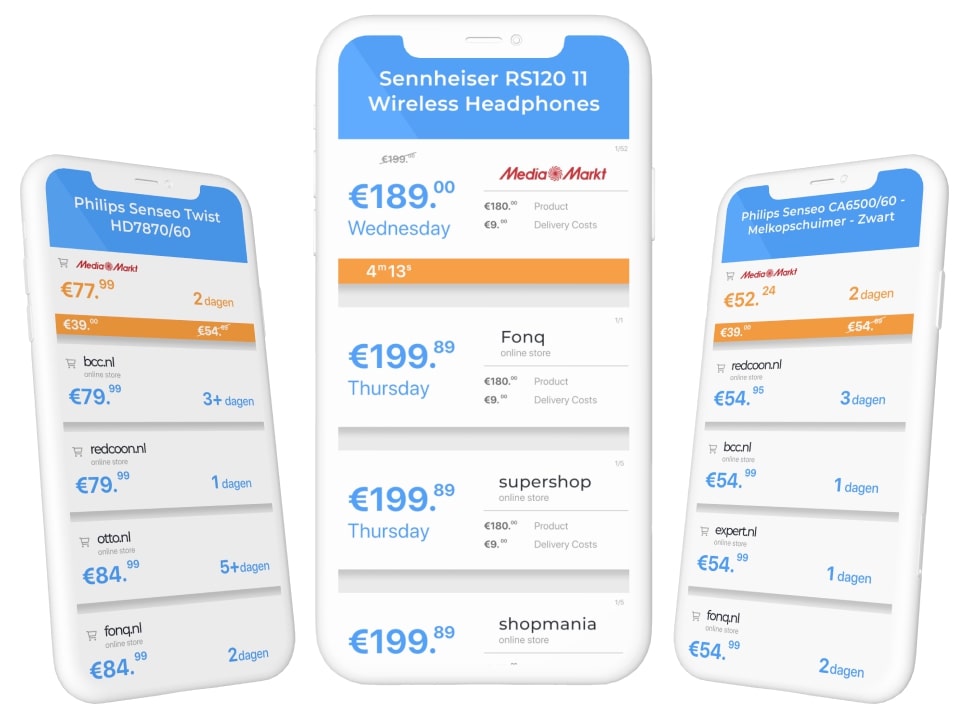
The Price Comparison and Personal Offers platform instantly provides an overview of all shops and their offers for a product that a customer is looking for. Personalized offers can be made just-in-time taking into account a customer’s profile and market data.
About the Project
The *instinctools Company was involved in a price comparison project with a unique capability to make personal offers to customers based on their profile and current market conditions. The Price Comparison platform aggregates offers from all shops, and shows them to the customer using a browser add-on and mobile application while the user is looking for the product.
The Personal Offers platform allows shops to offer personalized deals using a rule engine, taking into account a customer’s profile and competitor’s offers. This allows shops to implement a loyalty program and compete for best offer in terms of price, delivery terms or additional value.
The whole process takes a split second. Therefore, the best deals are presented to a customer while rhey are looking into a product and are ready to buy it right away.
Challenges
Redesign and refactor existing system, going from a monolith application to micro-services architecture to support growing number of offers and impressions.
Monitor and orchestrate micro-services to provide high availability and low latency service to customers.
Implement online and offline deal making process, reliable tracking transactions and accounting commissions.
Support existing system functionality lacking original developers’ knowledge.
Solution
We delivered online and offline deal-making process by collecting requirements, designing a new system, planning a change to the existing product and successfully integrating it together. The existing functionality has been maintained throughout the process. It was covered with automatic tests and redesigned to support a growing number of requests.
To support operations, we implemented monitoring of backend services while providing reliable tracking of transactions and making user’s behavioral data available for data analytics.
We have done major refactoring to unify approaches used throughout the micro-services, which lowered costs for operations and maintenance.
We also have:
fixed existing security issues and implemented best practices to protect the business from common security threats, which was confirmed by penetration testing done by an independent contractor;
implemented event tracking for behavioral analytics;
managed cloud resources and implemented automation which reduced operating costs;
set up DevOps practices and implemented continuous integration and delivery;
redesigned a system to enable horizontal scaling.
Key features
The client has obtained the desired functionality in time to run partnership programs with online and offline shops. The delivered platform was cloud-ready and modular, allowing the scaling of hot spots and handling business growth and peak load.
The benefits of the delivered platform are:
Ability to handle increasing traffic
Monitoring the system in a real-time mode
Gathering of customer behavioral data for analytics purposes
Integration with third-party analytics products
Vendor-free deployment to cloud, no lock-in to AWS
Performing the expected functions fast and accurately
The client was pleased with our fulfillment of the requirements and the recommendations of the affiliate partners. We are currently continuing to maintain the stable operation of the platform.
Technologies
JavaScript was chosen as a common language for the platform. The existing system used a mixture of CoffeeScript and pre-ES5 code. We used Babel to bring the expressiveness of ECMAScript 2016 to every service.
The system was deployed to Amazon EC2 using Terraform, Ansible and Docker, with core components independent from AWS platform offerings. The delivered solution is not locked to AWS.
MongoDB, Elasticsearch and Redis were used as operational data storages.
Continuous integration and delivery were implemented around Git repositories using the Gitflow model. The integrated setup of Jenkins, Docker, Slack and GitHub Status API was used to implement DevOps practices.
Prometheus and Graphana were used to build a backbone for backend monitoring. Sentry was used on both the frontend and backend to catch runtime errors from all environments.
Node.js and React were chosen as two pillars to establish a common ground and allow, among other things, server-side rendering and code reuse between web application, browser add-ons and mobile application created in React Native.
Amazon Kinesis, Redshift and S3 were used to build analytics platform open to third-party analytics products, e.g. Tableau and Amazon Quicksight.
An increasing number of offers and data crunching tasks were gracefully handled by a scalable pool of workers getting jobs from the RabbitMQ queue.
npm was used for public and private package registry. The combination of semantic versioning, GitHub Releases and private npm registry allowed the sharing of knowledge inside a distributed team.
NodeJs
Github
React Native
RabbitMQ
npm
Elasticsearch
Redis
Prometheus
Grafana
Sentry
Docker
Babel
Webpack
Ansible
Jenkins
Terraform
MongoDB
Amazon Web Services
AI modified real photo
Anna Vasilevskaya
Account Executive
Get in touch
Drop us a line about your project at [email protected] or via the contact form below, and we will contact you soon.
By continuing to use the site, you agree to the use of cookies