
WordPress To Shopify Migration For a European Eyewear Retailer
How switching from an outdated WordPress website with a WooCommerce plugin to a sleek Shopify platform with a tailored theme empowered the French eyewear retailer to accelerate loading speed x6, lower bounce rate twice, increase session durations fourfold, and boost page visits per session by 64% — all without missing a beat in their operations.
Web Development
Software Product Development
Business сhallenge
Grappling with fierce competition, owners of ecommerce businesses know better than anyone how tough it is to win customers and turn them into regulars. Especially, when a raft of external factors have already been preventing ecom companies from capturing buyers’ attention.
While environmental, economic, and political hurdles are something that you can’t fend off, there are areas within your control – and technical prowess of your ecommerce solution is definitely among them.
Facing the challenge of revamping their tech foundation, our client — a leading French eyewear brand with a production hub and a network of over 20 retail stores — sought to elevate their three-year-old ecommerce solution, crafted on WordPress with WooCommerce integration.
- Due to a slew of plugins and underlying spaghetti code, their website’s loading time increased to a concerning 6 seconds. While this didn’t impact its visual appeal, it significantly affected user experience, leading to brief average use sessions of under 30 seconds and a 70% bounce rate. It’s an urgent matter we can’t overlook.
- There were problems with updating and maintaining of the current ecommerce entity as updates for plugins and WordPress versions aren’t synchronized. Situations where the update was available for WordPress but not plugins were far from rare.
This left our client in a tight spot: prioritize security by upgrading WordPress and risk plugin functionality, or patiently wait for a full alignment of updates? As you can probably guess, neither of which seemed an attractive option.
- Considering its outdated nature and maintenance challenges, the existing store was exposed to security vulnerabilities. Notably, the client’s previous system leaned heavily on the jQuery library, deemed unsafe by modern security standards.
- There was no easy — or even remotely acceptable — way to add localization for Belgium, where the client was going to open new brick-and-mortar stores. With WordPress, they would have had to invest a sizable chunk of time and budget in adding a new language version by installing another plugin, which would have slowed down the loading speed even more.
The client has investigated available options and reached out to *instinctools with a request for WordPress to Shopify migration services.
As an all-in-one ecommerce platform, Shopify was expected to meet their current and future needs since it:
- Can handle up to 10,000 requests per minute
- Eliminates the need to deal with website updates and maintenance, which are the responsibility of the platform’s tech support
- Simplifies content management thanks to the isolated fields in the admin panel so that employees can easily update the content without the risk of breaking the system
- Keeps the security bar high
- Offers free localizations for additional markets with a built-in auto-redirect without affecting the client’s search engine ranking
- Provides vital ecommerce functionality, such as a multi-currency plugin, an automatic country-by-country tax calculator, analytics section, etc., right out of the box
How to migrate from WordPress to Shopify seamlessly and provide a client with a soaped-up new ecommerce solution, and what Shopify nuances did we have to deal with?
Solution
WordPress to Shopify migration wasn’t the client’s first project with *instinctools. The new Shopify store was supposed to become a part of a comprehensive ecommerce ecosystem, crafted by our dedicated team within our long-term cooperation with the client.
We didn’t need to deal with the hassle of WordPress data migration to Shopify thanks to our team’s prior work, which included developing an inventory and logistics app and an ERP system for the client. All the required data was extracted from the shared back end of these solutions.
However, there still were issues that we had to sort out to successfully migrate from WordPress to Shopify.
Matching Shopify’s capabilities with the specifics of eyewear products
Although Shopify provides a plethora of vital ecommerce features out of the box, such as a multi-currency plugin, an automatic country-by-country tax calculator, an analytics section, etc., our dedicated team developed a custom theme in line with the client’s corporate style, and fine-tuned the solution’s initial setup considering the specifics of the client’s business and products.
- Chose a pricing plan based on product variation limits
Glasses can be of different sizes and colors, yet it’s still one product available in multiple variations, with different prices and quantities in stock. Shopify’s standard plan has a limitation – the total amount of variations of a single product can’t exceed 100.
As for the moment of WordPress to Shopify product migration, the client had a maximum of 60 variations of one product. We’ve negotiated that until the next solution upgrade (in nearly three years), the basic version of Shopify is enough to cover their needs.
When the number of variations approaches 100, the client will need to upgrade to Shopify+, but until then, there’s no need to overpay for a high-tier plan.
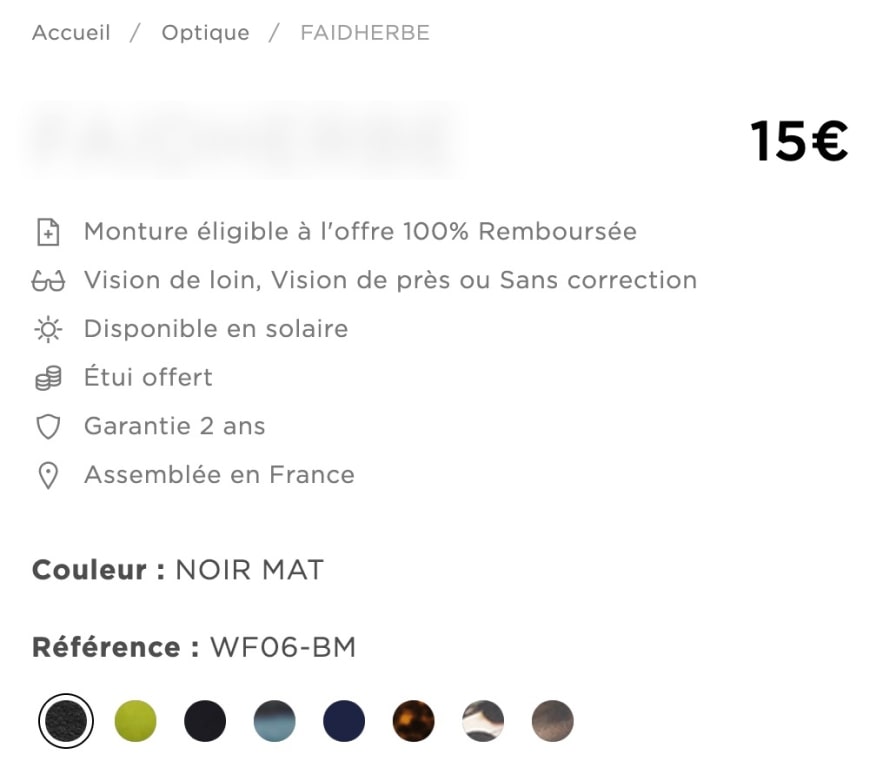
* For example, these glasses have 40 variations due to the combination of colors with parameters, such as diopters for near and far sight or without diopters, transparent or sun lenses.
- Found a way to add more than three parameters in the product descriptions
Every product has a set of different attributes – size, color, width, etc. There are many more parameters for eyeglasses – weight, lenses, dioptres, interpupillary distance (PD), etc.
However, in Shopify, the maximum number of product characteristics is three, and it can’t be changed even by writing custom code. However, the platform has numerous custom fields that can be tailored to the product’s specifics. To solve this, our experts offered to leverage this opportunity to solve the issue and made a template for all the extra parameters.
- Honed SEO functionality
Based on the client’s request to enhance SEO capabilities of a new Shopify store, we’ve bolstered it with two additional paid SEO modules. One of them allowed the client to swiftly generate titles and descriptions for multiple dynamic pages using adaptable variables. For example, a variable “buy in France” following a product name in the admin panel, can be integrated across all or chosen pages automatically.
The other SEO module speeds up caching, preloading pages, etc., based on the analysis of user behavior.
Thanks to this upgrade, our client elevated their search engines’ rankings by three to five positions on average.
Going extra mile without upping the project’s budget
The client was interested in Shopify’s analytics capabilities. They could have chosen Shopify+ to get access to this functionality. Still, our development team came up with a more budget-friendly option – they found and installed a free sales and analytics module that provides the same ability to collect detailed data from Google Tag Manager, GA4, and Facebook.
Before
- 6-second website loading speed
- Average session duration below 30 seconds
- 70% bounce rate
- A mind-boggling amount of plugins to ensure basic ecommerce functionality
- Difficulties of maintaining an outdated ecommerce Frankenstein
After
- 1-second website loading speed
- Average session duration over two minutes
- 35% bounce rate
- Off-the-shelf budget-friendly solution fine-tuned to meet the client’s requirements
- Free access to detailed customer analytics
- Seamless solution updates and maintenance covered by the platform’s support
Key features
WordPress to Shopify migration and revamping the whole ecommerce solution didn’t cause any disruption to the client’s business operation flow.
The new store, based on the specialized ecommerce platform, supports the client’s plans to scale beyond France.
The client always has the latest vulnerability-free version of the solution without lifting their finger, all thanks to delegating the maintenance hassle to the ecommerce vendor.
Business value
- x6 higher loading speed
- Halved bounce rate
- x4 longer time spent on page
- 64% boost in the number of pages visited per session
- Free detailed analytics into customer behavior
- Three to five positions higher search engine rankings
Client’s testimonial
Now, let’s here how the product owner talks the project’s results and the expected outcomes: