Computer Vision Deepfake ID Detection

Computer Vision Deepfake ID Detection For a Dutch Digital Bank

How adding a custom computer vision layer to the existing SaaS ID verification platform empowered a Dutch digital bank to keep up with the evolving threat landscape and stop 30% more AI-generated identity fraud, while reducing false positives for real users by 60% and decreasing manual document review workload by 40%.

Business challenge

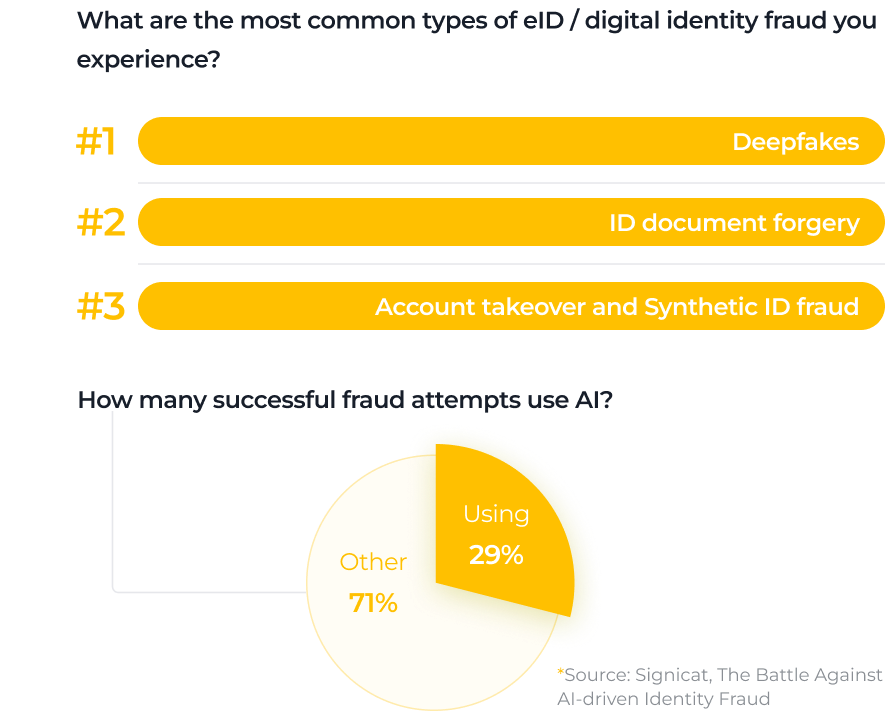
Bar chart listing common types of digital identity fraud: 1. Deepfakes, 2. ID document forgery, 3. Account takeover & synthetic ID fraud. Pie chart: 29% of successful fraud uses AI, 71% uses other methods. Source: Syntiant.
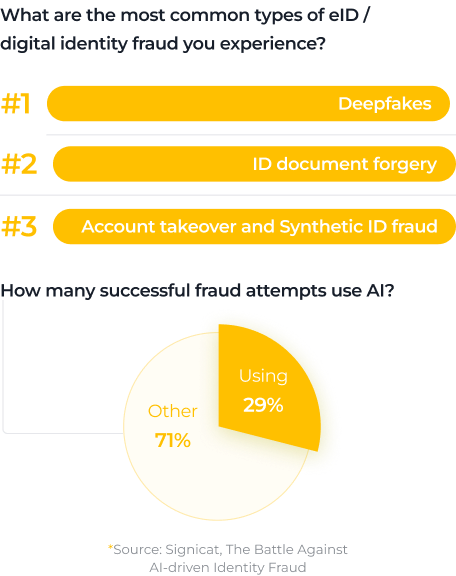
A graphic showing the top three eID/digital identity fraud types: #1 Deepfakes, #2 ID document forgery, #3 Account takeover and synthetic ID fraud. A pie chart shows 29% of successful fraud uses AI, while 71% is categorized as “Other.”.
A graphic lists the top three eID/digital identity fraud types: #1 Deepfakes, #2 ID document forgery, #3 Account takeover and Synthetic ID fraud. A pie chart shows 29% of successful fraud attempts use AI, while 71% are other types. Source: Signicat.

When GenAI emerged as a viable tech capability, businesses weren’t the only ones who went for it. So did cybercriminals who used the technology to create highly realistic deepfakes and pass Know Your Customer (KYC) onboarding at digital banks. Since the mass adoption of artificial intelligence, the number of AI-generated identity fraud cases in fintech has increased by 2137%. Now, 1 in 15 attacks involves deepfakes, and 29% of them succeed.

Our client, a Netherlands-based digital bank serving customers across the European Economic Area, chose to be one step ahead of fraudsters. As the bank onboards 4-5 million new users annually, they must protect real customers from account takeover, not to mention safeguarding brand trust in a highly competitive digital banking market.

At the time, the client relied on a third-party SaaS identity verification (IDV) platform with OCR and NFC/RFID technologies at its core, which fell short on several fronts:

  1. Failures in detecting AI-generated identity documents. Passports with AI-altered images or completely fake documents could pass through the checks if they visually match the templates of authentic IDs.
  2. Slow speed of adaptation to fraud patterns. The SaaS IDV was tied to the vendor’s release cycles, meaning weeks of waiting for new reported fraud cases to be updated in the system’s detection logic, while the new attack patterns kept snowballing.
  3. Limited control over the deepfake detection mechanism. The client’s team didn’t have direct access to the underlying algorithm and couldn’t strengthen the SaaS IDV’s forgery detection and analysis by training it on their own fraud samples.

For a bank operating at a multi-million-user scale, the gap between their needs and software capabilities posed significant financial and reputational risk. They needed a tech partner with proven expertise in finance to address the issue.

Solution

Instinctools’ dedicated team looked into ways to strengthen the client’s identity verification algorithm. Investing in a custom computer vision-based deepfake detection to run alongside the SaaS IDV proved to be the most beneficial option, as it enabled hotfixes and retraining on confirmed internal fraud cases within days.

Our computer vision experts took full ownership of the system’s design, training, calibration, and production rollout.

  1. Assembling a fraud-realistic dataset

The effectiveness of the custom CV detection mechanism hinged on the quality of the training data. Generic examples of ID fraud, that the off-the-shelf IDV platform had covered, were not enough. Therefore, our team prioritized assembling a solid dataset.

  • Doubling down on data preparation (exploration, cross-source collection, cleanup) to reduce training time.
  • Defining attack taxonomy that reflected the most relevant fraud patterns, from partial manipulations of photos, textual and numerical data to fully AI-generated documents.
  • Building a dataset that included the fake IDs the staff caught during KYC checks, partly and completely synthetic documents, and legitimate but low-quality photos and scans of passports.
  • Increasing the share of hard negatives in the dataset through data augmentation. Valid documents with blur, glare, or perspective distortion often triggered false alarms in the SaaS IDV platform, and we wanted to avoid this issue by training the custom CV algorithm to accurately distinguish poor capture quality from actual manipulation.
  • Labeling the data based on different criteria (real document vs. fake, fraud location, etc.).
  1. Designing an ID-focused CV pipeline

What is YOLO?

YOLO (You Only Look Once) is a computer vision object detection model. It’s an example of a leading-edge single-stage detector, known for its ability to locate and classify objects in a single pass through the network and, therefore, a go-to option for real-time object detection.

Our team built the solution around a single, well-controlled YOLO-based computer vision pipeline, tailored for identity document analysis. The model excels at:

  • Detecting the presence of a document
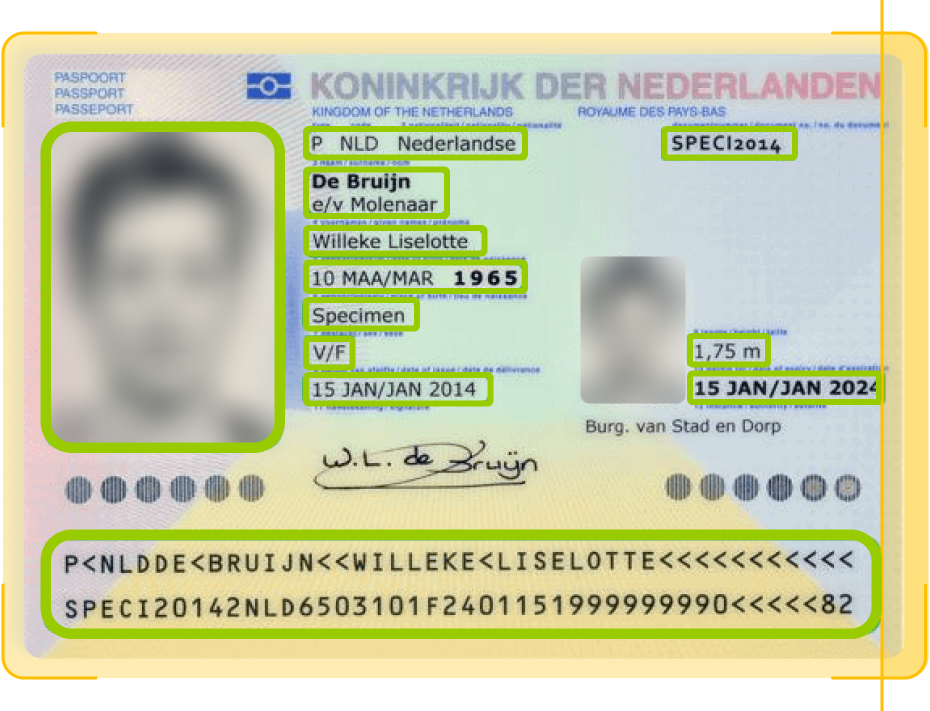
  • Localizing and analyzing in a single pass critical document regions, such as the data page, portrait area, and MRZ code
  • Highlighting suspicious area(s) of the document
  • Providing a risk score for each problematic element to simplify and speed up the review process

This approach ensured consistency while keeping inference fast enough for real-time KYC flows.
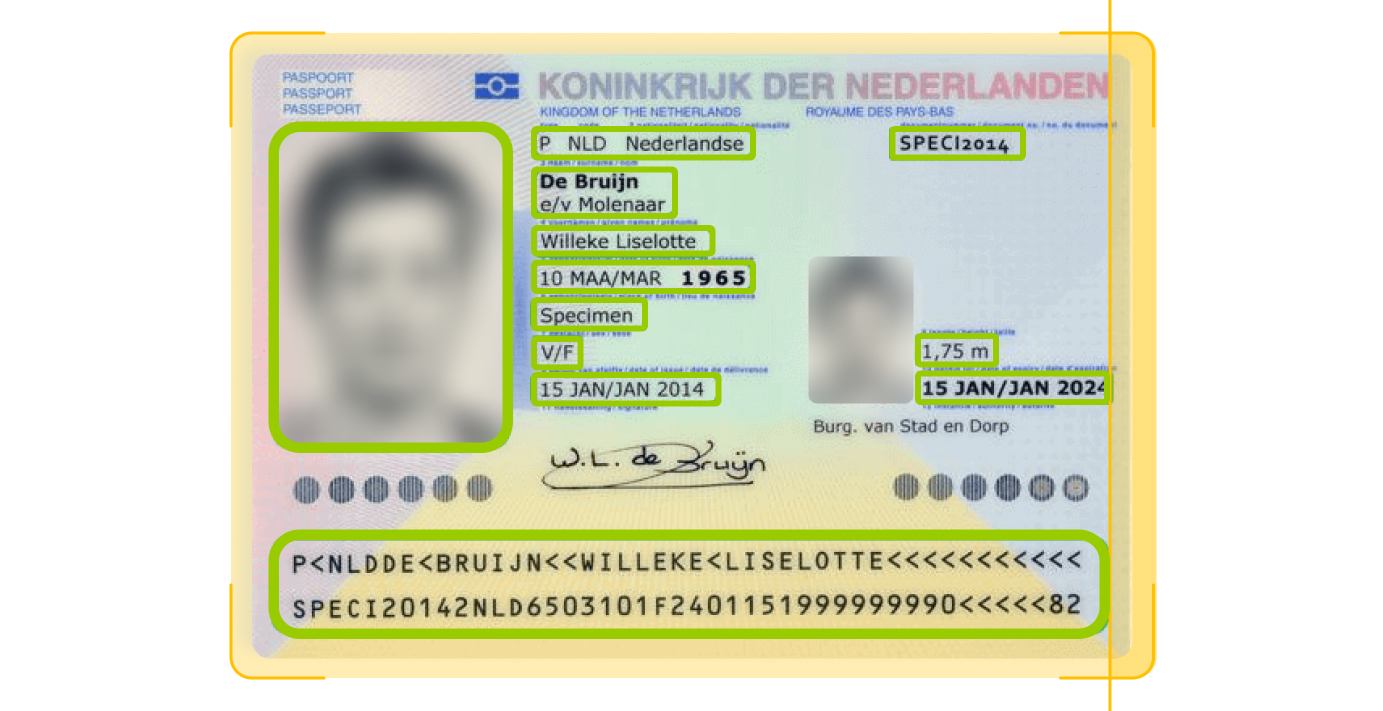
A sample Dutch passport shows personal details: a blurred photo, name “WiIieke Liselotte De Bruijn,” date of birth 10 March 1965, height 1.75m, and expiry date 15 January 2024. Text is in Dutch and English with blue and orange highlights.
A Dutch passport for Willeke Liselotte de Bruijn with personal details, passport photo, and security features. The passport text is in Dutch and English, and highlighted sections include name, birth date, height, gender, and document number.
  1. Ensuring the detection is reliable beyond known fraud patterns

To avoid building a system that works only for already known fraud tricks, we focused on how well the solution would hold up when attackers change their techniques and tools. Therefore, we deliberately checked it against document manipulations and generation methods it hadn’t seen before.

The test dataset included:

  • Data created by the same top 10 deepfake generation tools we used when assembling the training dataset, but with different faces and parameters
  • Data generated by other tools that weren’t used for creating the training dataset

This approach ensured the detection logic wasn’t tied to a specific deepfake tool or editing technique, but rather to the visual inconsistencies that tend to appear across AI-generated and manipulated documents, so the custom CV system remains effective even if fraudsters switch to new image generators.

  1. Decision threshold calibration

One of the key challenges with the SaaS IDV platform was the sensitivity of its fraud calibrator, which sometimes caused it to reject legitimate customers due to minor issues (like glare in a photo) while overlooking more serious fraud attempts. To address this problem, we linked the decision thresholds to the risk scores.

The custom CV layer now follows a tiered decision logic:

  • Low-risk cases continue through onboarding automatically, without any additional steps
  • Middle-risk cases trigger targeted step-ups, such as an NFC scan, requesting  an extra selfie or a short video
  • High-risk cases are flagged for manual review or outright rejection

This approach helped the client strengthen fraud controls and decrease the workload of human reviewers while ensuring fast onboarding for legitimate users.

  1. Seamless integration
of the CV layer into the client’s KYC flow

To keep the onboarding experience unchanged for customers, we deployed the custom computer vision system as a decision microservice within the existing onboarding pipeline. 

Still, before letting it influence real onboarding decisions, the team ran the custom CV system in observation mode. At this stage, it processed live KYC traffic alongside the existing systems, but its outputs were not used to approve or reject customers. 

Once we validated that the model behaved as expected with real-world data, we rolled it out gradually by feeding it controlled portions of traffic, expanding coverage step by step. This phased approach ensured that the new detection layer strengthened fraud controls without unintended consequences, such as over-flagging legitimate users or missing edge cases.

Here’s how the client’s updated KYC flow works:

  1. A user submits their documents (and, if required, a selfie or short video)
  2. The existing SaaS IDV platform performs its standard checks, such as OCR, MRZ reading, and NFC validation
  3. The custom computer vision system analyzes the same inputs in parallel
  4. The higher-level KYC orchestrator then collects and combines the results from both systems and applies the bank’s decision logic to determine the next action (approval, step-up verification, or manual review)

Since all checks run behind the scenes and in parallel, customer experience stays the same, with no extra waiting time or redundant requests. Meanwhile, under the hood, confirmed fraud cases are auto-labeled and folded into retraining cycles within days, enabling hotfixes. As a result, deepfake document detection had shifted from a static vendor capability to a living, bank-owned system evolving at the same pace as the threat landscape.

Before

  • Deepfake document detection depends entirely on a third-party SaaS IDV platform
  • AI-generated or partially manipulated documents highly resembling valid ID templates the SaaS platform was trained on could pass checks, while low-quality documents from real customers could have been rejected as synthetic
  • Time-intensive manual reviews due to the software’s unreliability
  • Weeks-long response to new deepfake techniques due to vendor-controlled update cycles

After

  • Custom, bank-owned computer vision layer added on top of the existing SaaS IDV platform
  • The CV system is trained on a high-quality dataset and follows tiered decision logic to perfect deepfake detection without affecting legitimate customers
  • Reduced review workload on the humans in the loop thanks to the well-calibrated decision logic
  • Adaptation to new deepfake patterns within days thanks to hotfixes

Business value

  • + 30% in detected synthetic document fraud
  • – 60% falsely flagged legitimate users
  • – 40% in manual review workload

Client’s testimonial

Multiplier effect

Computer vision threat detection use cases extend far beyond digital banking. Any company that relies on document checks or user verification, from insurance and healthcare to travel and ecommerce, faces the same growing risk from AI-generated identities and forged documents. A custom computer vision system trained on real-world fraud patterns can help businesses react faster than when relying on generic vendor tools.


A person in a dark blue shirt holds a smartphone in one hand and types on a laptop with the other. Digital facial recognition icons and a checkmark appear, indicating successful facial authentication on the phone. The background is blurred.

Web Solution For Remote Real-time Management of Green Public Transport Substations

Web Solution For Remote Real-time Management of Green Public Transport Substations

How replacing manual monitoring with an automated control system for the trams’ and trolleybuses’ traction substations allowed green public transport management municipalities in the Netherlands to remotely monitor, manage, and retrieve information on emergencies at the substations in real time.

Green public transport powered by electricity is now widely used in modern cities. There are different means of transportation that use various electricity storage and delivery methods. But the most famous among them are trams and trolleybuses.

A complex overhead wiring network infrastructure is used to deliver electric power to consumers. This includes kilometers of wires stretched along routes, carrying current and powering transport.

The so-called traction substations are used for delivery of electric current to the various points of a contact network. Traction substations are complex structures consisting of a set of high-power electrical installations, carrying out transformation and switching roles.

These facilities require constant monitoring and management. Usually, there are at least 10-15 substations within a city. Manually monitoring all the substations and ensuring the continuous operation is obviously very difficult. In this case, the use of automated control and management systems would certainly help consolidate and improve the time of response to various kinds of failures and emergencies, thereby directly increasing the uptime.

Challenge

We needed to develop an automated control system, consisting of a hardware-software complex.

It was necessary that the control system would allow to remotely monitor, manage and retrieve information on emergencies at the substation.

In some success-stories, the system would automatically carry out control actions aimed at restoring efficient management.

Solutions

This task was quite specific. We, therefore, built an architecture based on the tasks assigned to us. We selected solutions for this architecture, which meet the customer’s requirements and comply with the operating conditions. We also focused on price while selecting solutions. We were looking for the most favorable combination of price and technology needed to solve the task.

  • From a list of criteria, we selected a specialized x86-based industrial computer running Windows Embedded Standard. Such computers were installed at each substation
  • We selected a set of specialized digital and analog I/O modules from Advantech, a 3G modem for the provision of a communication channel with the central control room, interface converters for communication with intelligent modules at the substation
  • We developed an automated monitoring and control software featuring an external communication interface
  • We developed a centralized control and management software that allows you to obtain telemetry and remote signaling data from all substations and perform remote control actions

Key features

Constant monitoring and control of substations

Remote retrieval of information on emergencies at substations

Ensuring continuous operation of substations

Restoration of efficient automated management

Technologies

Custom BI Dashboards For The Sales Department Of a EU Corporation

Custom BI Dashboards For The Sales Department Of a EU Corporation

How the adoption of Tableau with six custom dashboards for sales analytics, planning, and forecasting empowered a manufacturing corporation to back up sales strategies with real-time data and increase the number of won deals by 54% and upselling deals by 16%.

Challenge

Our customer’s business has been expanding rapidly for the past decade: new brands have been launched, new chains have been opened, new offices have popped up. In these circumstances, without proper up-to-date instruments, following the company’s processes turned out to be a real problem. It was all the more obvious when came to the sales department. The existing methods of navigating through sales performance – with reports prepared on a monthly or quarterly basis – appeared to be ineffective and time-consuming.

Our customer wanted to improve the overall visibility of analysis and reporting activities across different business units and get a centralized view of the massive volumes of data.

Tasks

  • to bring all the business units together to have a single source of information in an integrated set of tools
  • the ability to “slice and dice” the information according to the user’s needs
  • to provide data security
  • the possibility to scale up the solution as the business grows

Solution

We’ve developed a sales performance management solution, which not only contains all the necessary data but also combines analytics, planning, and forecasting capabilities.

The complexity of the whole sales optimization process has been wrapped into 6 dashboards, integrated with different sources of information. Each dashboard fulfills its own functions.

  • A customer overview
    Contributes to building up a complete, explicit view of the customer by collecting data from contract billing, the CRM and ERP systems, so that the sales representatives can easily identify the information, which is useful for their daily sales processes and customer relationship management.
  • Sales Pipeline
    Brings visibility to all the stages of a sales process within different channels or lines of business and makes overseeing and directing future sales much more data-based than they used to be.
  • Sales process optimization
    Takes the data out of the CRM system, measures these data against the targets, showing what activities need to be done to achieve the assigned goals.

  • Salesperson focus
    Clusters the information on customer sales activity and converts it into a user-friendly format. It shows sales representatives their month-to-date and year-to-date results and how these results correlate with their objectives.
  • Account coverage
    Helps to stick to customer retention strategy through the analysis of certain KPIs.
  • Sales forecasting
    Estimates the accuracy of sales forecasts, comparing them against actual results for both individual sales representatives and the whole teams.

Key features

an integrated set of tools

self-service analysis and reporting

scalability

data security

cloud solution

Value

The BI solution allows our customer to explore the data without a hitch. Fragmented and disintegrated reports are replaced by one set of tools where all the necessary information is gathered. Thus, user groups get quick and easy access to real-time data and the analysis tailored to their needs, which increases the chances of the right decision making. The visibility that has been brought to each stage of the sales cycle along with end-to-end analytics helps managers identify blind spots and, therefore, improve the performance.

“With *instinctools solution, it’s become possible to get a complete and honest answer to the question: “How are things?” either on a unit level or on the level of the whole company. We’re happy to have accurate, up-to-date information on our sales processes and keep all our units in sync”.

Judging by enthusiastic reviews of our customer, data harmonization within the sales department was a giant step (but just the first one) on the way to digital transformation. Apparently, there’s more to come.

Technologies

React
NodeJS
Python
Tableau
AWS

Price Comparison and Purchasing Platform For a SaaS Company

Price Comparison and Purchasing Platform For a SaaS Company

How modernizing the price comparison web platform and bolstering it with online and offline deal-making decreased the software maintenance costs by 23% and expanded the customer pool by 14%.

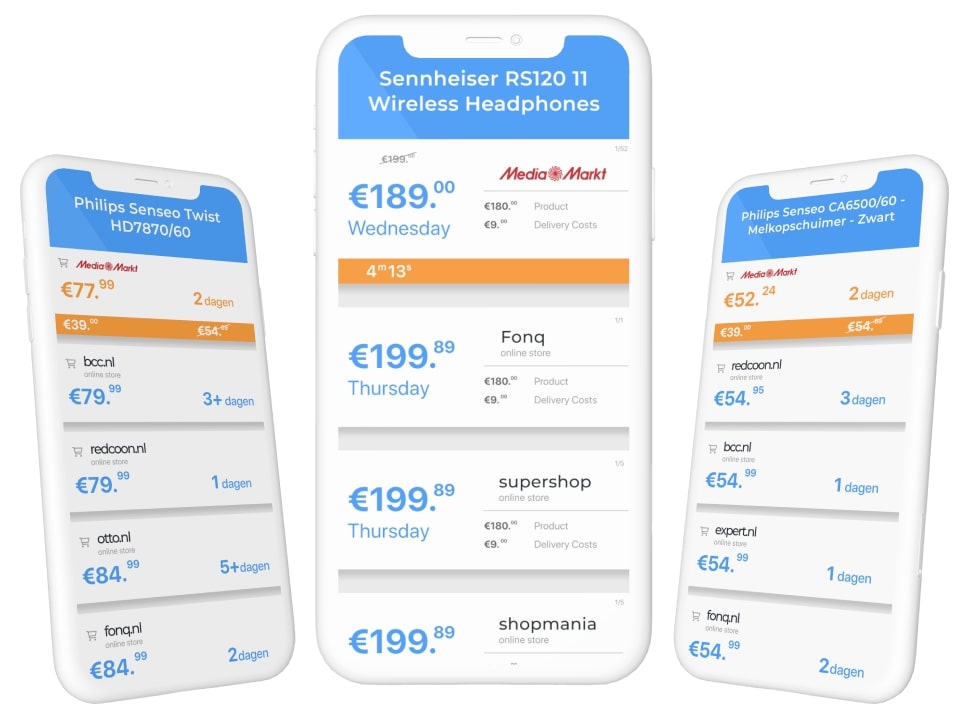
The Price Comparison and Personal Offers platform instantly provides an overview of all shops and their offers for a product that a customer is looking for. Personalized offers can be made just-in-time taking into account a customer’s profile and market data.

About the Project

The *instinctools Company was involved in a price comparison project with a unique capability to make personal offers to customers based on their profile and current market conditions. The Price Comparison platform aggregates offers from all shops, and shows them to the customer using a browser add-on and mobile application while the user is looking for the product.

The Personal Offers platform allows shops to offer personalized deals using a rule engine, taking into account a customer’s profile and competitor’s offers. This allows shops to implement a loyalty program and compete for best offer in terms of price, delivery terms or additional value.

The whole process takes a split second. Therefore, the best deals are presented to a customer while rhey are looking into a product and are ready to buy it right away.

Challenges

  • Redesign and refactor existing system, going from a monolith application to micro-services architecture to support growing number of offers and impressions.
  • Monitor and orchestrate micro-services to provide high availability and low latency service to customers.
  • Implement online and offline deal making process, reliable tracking transactions and accounting commissions.
  • Support existing system functionality lacking original developers’ knowledge.

Solution

We delivered online and offline deal-making process by collecting requirements, designing a new system, planning a change to the existing product and successfully integrating it together. The existing functionality has been maintained throughout the process. It was covered with automatic tests and redesigned to support a growing number of requests.

To support operations, we implemented monitoring of backend services while providing reliable tracking of transactions and making user’s behavioral data available for data analytics.

We have done major refactoring to unify approaches used throughout the micro-services, which lowered costs for operations and maintenance.

We also have:

  • fixed existing security issues and implemented best practices to protect the business from common security threats, which was confirmed by penetration testing done by an independent contractor;
  • implemented event tracking for behavioral analytics;
  • managed cloud resources and implemented automation which reduced operating costs;
  • set up DevOps practices and implemented continuous integration and delivery;
  • redesigned a system to enable horizontal scaling.

Key features

The client has obtained the desired functionality in time to run partnership programs with online and offline shops. The delivered platform was cloud-ready and modular, allowing the scaling of hot spots and handling business growth and peak load.

The benefits of the delivered platform are:

Ability to handle increasing traffic

Monitoring the system in a real-time mode

Gathering of customer behavioral data for analytics purposes

Integration with third-party analytics products

Vendor-free deployment to cloud, no lock-in to AWS

Performing the expected functions fast and accurately

The client was pleased with our fulfillment of the requirements and the recommendations of the affiliate partners. We are currently continuing to maintain the stable operation of the platform.

Technologies

JavaScript was chosen as a common language for the platform. The existing system used a mixture of CoffeeScript and pre-ES5 code. We used Babel to bring the expressiveness of ECMAScript 2016 to every service.

The system was deployed to Amazon EC2 using Terraform, Ansible and Docker, with core components independent from AWS platform offerings. The delivered solution is not locked to AWS.

MongoDB, Elasticsearch and Redis were used as operational data storages.

Continuous integration and delivery were implemented around Git repositories using the Gitflow model. The integrated setup of Jenkins, Docker, Slack and GitHub Status API was used to implement DevOps practices.

Prometheus and Graphana were used to build a backbone for backend monitoring. Sentry was used on both the frontend and backend to catch runtime errors from all environments.

Node.js and React were chosen as two pillars to establish a common ground and allow, among other things, server-side rendering and code reuse between web application, browser add-ons and mobile application created in React Native.

Amazon Kinesis, Redshift and S3 were used to build analytics platform open to third-party analytics products, e.g. Tableau and Amazon Quicksight.

An increasing number of offers and data crunching tasks were gracefully handled by a scalable pool of workers getting jobs from the RabbitMQ queue.

npm was used for public and private package registry. The combination of semantic versioning, GitHub Releases and private npm registry allowed the sharing of knowledge inside a distributed team.

NodeJs
Github
React Native
RabbitMQ
npm
Elasticsearch
Redis
Prometheus
Grafana
Sentry
Docker
Babel
Webpack
Ansible
Jenkins
Terraform
MongoDB
Amazon Web Services

Video-Sharing Platform For a Dutch Media Company

Video-Sharing Platform For a Dutch Media Company

How updating the UI and perfecting the architecture of their existing video-sharing platform helped a media company boost video quality for low-cost Internet connections and drive user satisfaction by 12%.

Challenge

The customer contacted *instinctools while looking for a contractor to help them implement several new features on their platform. The main challenge for our team was to implement:

  • New UI
  • A caching feature to increase the quality over the public Internet.

Solution

We have:

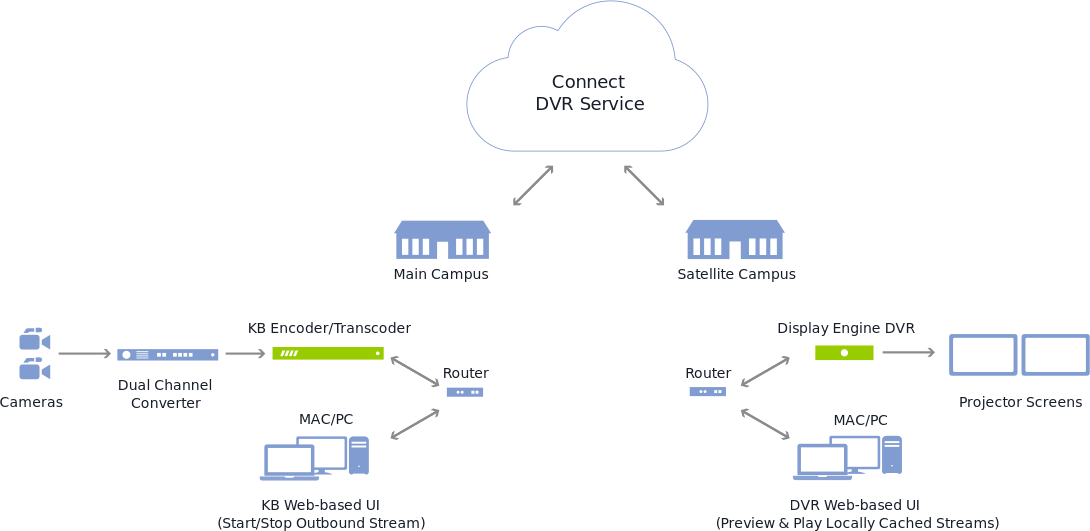
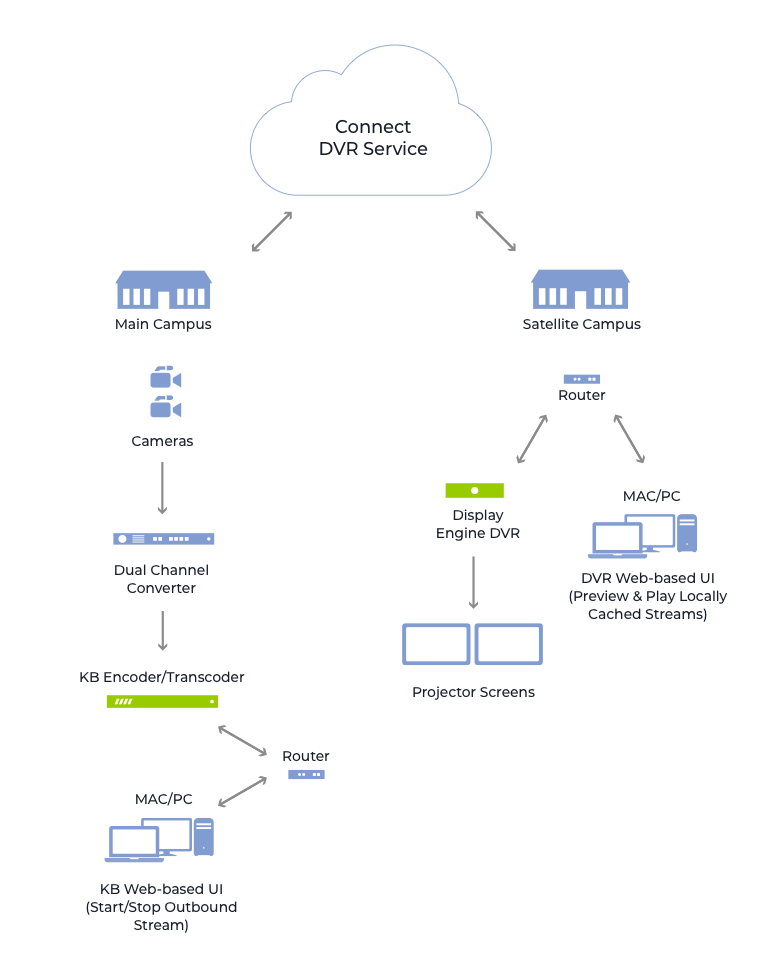
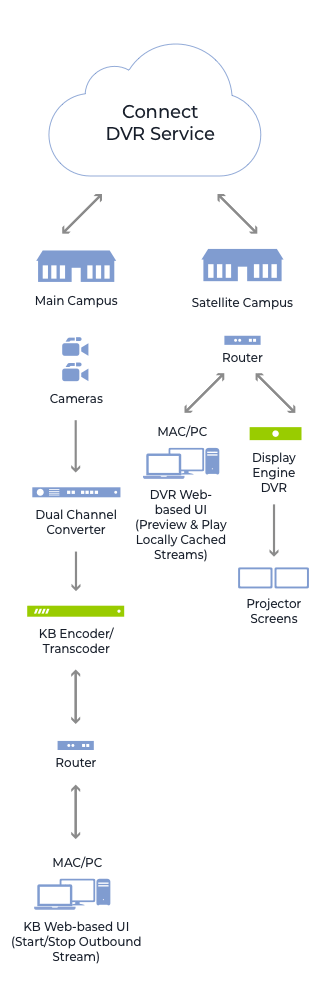
  • Integrated Haivision’s high-quality KB encoder, Akamai’s industry-leading Content Delivery Network (CDN), and the compact and powerful Display Engine DVR remote appliances.
  • Integrated KB Internet media encoder and local caching.
  • Provided synchronized dual video streams.
  • Implemented new UI.
  • Developed a caching function to increase public Internet quality.

Key Features

End-to-End Simplicity

  • The solution integrates customer’s high-quality KB encoder, Akamai’s industry-leading CDN (Content Delivery Network), and the compact and powerful Display Engine DVR remote appliances.
  • Staff and volunteers can easily connect to preview, play, and share inspirational messages from the main campus at remote locations.

The Highest Quality of Public Internet

  • Delivery of the highest quality HD experience to remote campuses.
  • Using low-cost Internet connections allows the distribution of streams, without sacrificing quality.
  • Low-cost Internet connections help save time and money.
  • Local caching makes sure new content is safe.

Complete Control, with Flexibility

  • Haivision Connect DVR gives remote campuses control and flexibility.
  • Remote campuses can preserve either the full stage and IMAG camera angles or the presenter and presentation, from the main campus.

Technologies

Backend

NodeJs

Frontend

Backbone.js

Legacy System Modernization For an Environmental Company

Legacy System Modernization For an Environmental Company

How migrating from no longer supported VB6 to Java provided an environmental company with an app that seamlessly handles multiple customer requests at a time.

Challenge

Customers turned to us with the following problems:

  • They needed a convenient way to build complex queries in the database.
  • There were some performance problems with the client’s site. The system was running slowly in the case of multiple requests.
  • Customers needed to restrict access to the application using a White IP List where access would be allowed only to certain IP addresses.
  • There was a need to synchronize data with other databases.
  • It was necessary to construct graphs based on the processed data (e.g., “Number of bags per hour,” “Number of shipments per hour,” etc.).
  • Customers needed improvement of TimeSlot overview and scheduling. It was necessary to develop an electronic schedule (organizer) enabling the reserving of time for unloading and servicing of trucks with bottles.
  • They needed the ability to obtain additional user data from LDAP.

Solution

The problem was solved in the following way:

  • To enable easy construction of complex queries in the database, we suggested and implemented the use of Querydsl.
  • We optimized and used cache data to solve the performance problem and improve the operation speed when there are multiple requests.
  • To restrict access to the application, we implemented Interceptor for requests intercepting and filtering (White IP List and Whitelist for paths).
  • We implemented a file manager based on Qdrive.
  • To construct graphs on the basis of processed data, we used an additional module of chart.js.
  • We developed a data model and implemented basic logic for CRUD operations in accordance with business requirements (frontend and backend sides).
  • We developed Time Slots Overview – an electronic schedule (organizer) to reserve the unloading time of the machine with bottles, featuring marking of fields “reserved time” / “available for reservation time” / “unavailable for reservation time” by different colors. The mechanism takes into account the overlap of reserved periods, and automatically suggests the nearest free time, if the time the customer has chosen for reservation is already taken. After reservation, the customer can view its details at any time.
  • We created jobs or scheduling tasks for processing the scheduled data.
  • We developed a variety of services for the system, for example, MailService – a shared service to send e-mails.

Key features

Access by roles

Sending e-mails

History of the entities’ changes

Report generation

Display of the data in graphs

Receiving and sending data to external terminals and databases

Imitation of logging in as a different user for the administrator

Tasks that process data in manual or automated mode

Technologies

MySQL
AngularJS
Autocad
Gradle
JasperReports
Anna Vasilevskaya
AI modified real photo
Anna Vasilevskaya
Account Executive

Get in touch

Drop us a line about your project at
[email protected] or via the contact
form below, and we will contact you soon.