Quality Assurance Audit For a Fintech Company

Quality Assurance Audit For a Fintech Company

How a thorough QA audit and strategic fixes allowed a Swedish Fintech company to gain full visibility into their software at every stage of the SDLC, speed up new feature releases by 26%, lower customer support expenditures by 33%, and increase CSAT by 16%.

Industry:
Fintech

Quality Assurance

SaaS Development

Business challenge

When underestimated from the start, QA issues bite back in the later stages. Our client learned this the hard way. A Swedish Fintech company, providing SaaS software for expense management, has prioritized feature development, putting QA on the back burner.

However, as their products gained traction, cracks began to reveal themselves:

Inadequate QA processes
allowed bugs to slip into their customers’ software environments

Given how diverse their clients’ IT ecosystems can be, each support request required a customized solution. The number of tickets was mounting, going beyond the customer support team capacity.

The lack of test automation
delayed releases

Sticking to a quarterly release plan was already off the table, and new features were rolled out once a year at best.

Although the products kept operating somehow, the quality assurance process was chaotic and unmanageable, putting the client’s reputation at stake.

In the face of the QA turmoil, the client was at a crossroads: rush to hire a quick fix or pinpoint weak spots in their existing framework and rebuild it with expert guidance. While the former option would put out the immediate fires, it wouldn’t align with the client’s determination to have flawless software in the future. So they opted for the other route, seeking *instinctools’ expertise to establish a robust and sustainable QA framework.

Solution

The client engaged our QA engineers to run an all-encompassing quality assurance audit of their expense management software, identify problem areas, and suggest improvements.

  1. In-depth audit of the client’s QA processes

Instinctools’ QA specialists:
Held a pre-audit briefing with the client’s in-house team to see how the absence of QA expertise affected the software
Defined the audit scope and objectives to keep all stakeholders in the loop
Examined the client’s QA and project management tools, such as Jira and Confluence, to assess existing workflows and testing methodologies
Revised available documentation and performed code review
Analyzed the findings to prepare spot-on, actionable recommendations

The audit revealed three fundamental hurdles to address:

  1. Disorganized software testing management. The expense management software had its dedicated Jira space, but QA tasks were unstructured, and the overall testing lifecycle remained unclear, making it almost impossible to track test objects or related tasks.
  1. Inconsistent documentation. Test cases were recorded arbitrarily, leading to an opaque and inefficient QA workflow.
  2. Reliance on outdated tools. The client used legacy software without questioning its effectiveness.
Besides identifying the problems, we mapped out solutions in three key areas:
Quality assurance
Standardizing test management in a centralized QA-specific system and adding a post-testing check-up to verify the accuracy of test results.
Project management
Integrating the QA platform with Jira to ensure complete visibility into testing stages at all times.
Business analysis
Setting documentation standards for stress-free accreditation for any certification.

Satisfied with the audit’s scope and depth, the client decided to move forward with *instinctools to act on these changes.

  1. QA management platform implementation

To bring structure and visibility to QA operations, we explored multiple options and landed on TestRail, which offers the most budget-friendly pricing for small QA teams with up to five users.
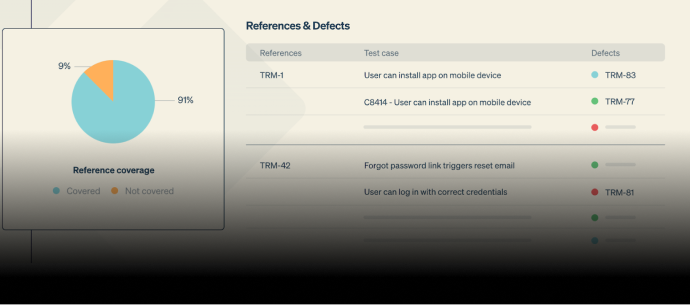
TestRail interface
TestRail interface

With intuitive test plan management and deep analytics, TestRail gave engineers real-time insight into patches and releases, helping them ship high-quality code faster.

We also integrated TestRail with the client’s Jira. This way, users can link test cases to tasks, stories, and epics to clearly indicate what is being tested. Other product team members, like project managers or business analysts, can access test plans and test cases from Jira tickets with one click.
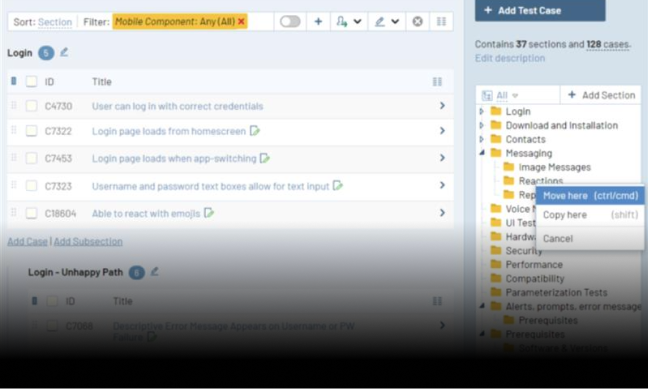
Jira test management integration with TestRail
  1. Stress testing upgrade

The client’s stress-testing tool was outdated and tricky to upkeep, making its ongoing use impractical. We suggested switching to a Hyper and Apache JMeter combo. The first is an advanced terminal emulator used as an interface to run JMeter. However, the terminal’s functionality extends beyond stress testing. Thanks to automation and additional plugins, it streamlines multiple everyday QA tasks, such as log parsing, cleaning up environments, and debugging.

  1. Performance testing with 99,99999% reliability of test results

Smooth performance testing with load, stress, spike, and soak tests has always been at the top of the client’s agenda, and they wanted us to put a premium on it.

First, we ran regular tests, measuring solutions’ responses to unusual, sudden, and extreme loads over different periods. However, as the client’s software implies corporate card management, invoice processing, and other financial operations, they need to be more than 99% certain of the reliability of the test results.

That’s why we added a check-up step when the QA team analyzes performance test data and confirms that the outcomes are 99,99999% reliable.

  1. Robust workflows for other mission-critical tests

We proceeded with writing missing templates for test plans, cases, scripts, and reports in TestRail for usability, regression, and new feature testing. All activities were carried out in parallel. Our QA engineers performed:

  • New feature testing within release management
  • Regression testing after every hotfix, patch, or release
  • Usability testing alongside every regression and new feature test
  1. API and UI test automation

Following the classic pyramid of testing, we moved on to API and UI tests.

Our QA engineers worked in three directions:

  • Revising old tests created by the client’s previous vendor and revamping them if possible
  • Writing missing auto tests for old APIs
  • Designing tests for new APIs

During periods when no new APIs are being written, test coverage reaches 100%.

Speaking of automating UI tests, we’ve already covered 55% and keep working on it.

  1. Expanding our testing coverage

With every new iteration of the change management plan, we are increasing our efforts in other types of testing to ensure even better software quality. For instance, along with further UI test automation, accessibility, durability, and penetration testing are in the project’s backlog.

Before

  • Chaotic, opaque, and unpredictable QA process
  • Bugs constantly slipping into the customers’ environments
  • Annual releases at best
  • Unverified performance tests’ results
  • Up to 90% of customer support requests required input from senior-level specialists

After

  • Centralized, transparent, structured, and easy-to-manage QA process
  • Bugs are uncovered and fixed in the early development stages
  • Quarterly releases
  • 99,99999% accuracy in performance testing
  • Junior engineers resolve up to 75% of customer support queries

Business value

  • Fully transparent and traceable software testing pipeline
  • 20% faster test case creation
  • x1.5 faster release cycles
  • 26% reduction in time-to-market for new features
  • 33% drop in customer support costs
  • 86% CSAT

Client’s testimonial

Here’s how the client’s Product Owner describes *instinctools’ QA experts’ contribution to their product’s uplift:

Multiplier effect

It’s good if your developers follow the basic playbook by writing clean, modular code, conducting regular code reviews, or even building simple API and unit tests themselves. Good, but not enough. The lack of well-honed QA processes is a ticking time bomb — the cracks might not show early on, but they will emerge when you decide to scale your solution.

The good news is that even if QA-related issues snowball into a costly threat, there’s still room for change as long as you have a stalwart tech partner by your side. Opt for an all-encompassing QA audit to forge the path toward transparent, structured, and easy-to-manage QA processes.

The importance of regular quality assurance checks

MVP Development For a Fintech Startup

Full-scale MVP Development For a Fintech Startup

How running a discovery workshop saved a fintech startup tens of thousands of dollars on needless software development and enabled the company to craft a trailblazing MVP for venture funds and investors. 

Industry:
Fintech

DevOps Services

UX and design

Web Development

Software Product Development

Business challenge

Securing a top-notch development team when building a software product is only one part of the equation. The key lies in defining what kind of product you want to create, who for, and what problems of the target audience it will address. For those operating in highly demanding niches, like our client, this precision represents both a challenge and an opportunity.

Instinctools was approached by a European venture capital company with €800m+ in assets under management. They planned to launch a fintech startup and develop a web platform to consolidate information for VC investors and funds. 

The envisioned solution was supposed to:

Present investors with concise, visually appealing information about potential investment opportunities and their terms, rather than extensive 50-page reports

Provide a secure space for communication between funds and investors moving away from traditional emailing

Offer a comprehensive experience for investors, eliminating the need to switch between several systems

Empower funds with automated back-office functions, significantly reducing staff hours.

This innovative and far-reaching B2B2C solution had the potential to take the market by storm even as an MVP. However, the haphazard approach to its implementation put the whole project at stake.

Initially, the client worked with another tech partner who had offered to set up a developers-only team for the project. Specifying the requirements and prioritizing features fell under the client’s purview.

Here is how it played out. The client outlined the platform’s core idea to their contractor and continued to pile up features throughout the development process. Not surprisingly, those efforts didn’t hit the mark the client was aiming for.

It turned out the client had been draining their budget crafting a solution that veered far from their original vision. Letting multiple stakeholders from different departments define the project requirements on a whim and the lack of a unified product vision between the product owners and dedicated team resulted in a deep chasm between expectations and reality. The developed solution looked like a nice visualized Excel spreadsheet instead of being a 
top⁠-⁠of⁠-⁠the⁠-⁠line digital fundraising platform.

Despite developing some of the intended features, the team couldn’t pull the whole solution together, and the situation was being exacerbated with each new feature implementation. The web platform benefited no one: not funds and investors, not the client. 

The problem required input from a skilled Product development consultant, and since the previous contractor couldn’t provide one, the client started to look for a new tech ally. This time, they decided to search among vendors whose expertise in information security and quality management was backed with ISO 27001:2022 and ISO 9001:2015 certificates. And that’s how *instinctools entered the scene. 

In the project, the main puzzles were lurking at the pre-development stage. Our team had to:
Process the information

received from the client and create the project’s Vision&Scope documentation

Gather and clear up

business requirements along with technical and non-technical constraints

Prioritize

the solution’s features

Shape the project’s

iterations in line with the features it should have

Evaluate

the current product against the updated requirements

Solution

At *instinctools, we know how to address the problems of clients who turn to us after dismal cooperation with other tech partners. Sometimes, the situation can be completely muddled. There may be no basic documentation on the project, and it can be challenging for the stakeholders to define how they see the final product. In such cases, we suggest conducting a discovery workshop before diving into the development to frame the product vision into a set of specific actions that would ensure the project’s success. 

What was the value of a discovery workshop for the client?
  • Clearly defined business requirements and product vision

The client obtained a Vision&Scope document, where all functional and non-functional requirements for the project were captured. That information ensured all the participants involved in the development process were on the same line and had similar expectations regarding the final product. 

Additionally, with Vision&Scope in hand, the client could seamlessly transition to another tech partner — if they felt the need to do so — without going back to square one.

  • Balanced development scope and business value

Following the here-and-now principle in developing product features, trying to implement every single idea you come up with is a sure way to oversaturate your product with flashy components at the expense of vital ones. It’s a slippery slope, especially for an MVP. By chasing excessive functionality, it’s easy to lose the crux of the MVP, resulting in missed deadlines, and wasted budget.

A proper evaluation and prioritization of features with the solution architect empowered the client to balance business value, development cost, and time.

  • Potential for product enhancement

All artifacts created at the discovery workshop were documented. And anything that didn’t make it into the MVP could be put into the subsequent product releases. That way, the client got a backlog primed for future development after the minimum viable product rollout.

  • Aligned product vision between the client and the dedicated team

Cooperating closely with our stakeholders empowered us to sculpt the product seamlessly within the projected time and budget.

  • Decreased time to market

Although a discovery workshop took some time, working out requirements, prioritizing features, and developing a common vision of the project paid off. It allowed the team to move at a rapid pace through the development phase as they had a well-defined action plan and could fully focus on product development and testing.

  1. Behind the scenes: how did the discovery workshop go?

The number and duration of workshop sessions depends on the project’s complexity and the scope of issues that need to be clarified before starting development. In our client’s case, we proposed two three-hour sessions. 

What did they cover?

Examining the existing solution with the product owners and gathering up-to-date business requirements and constraints
of the product

Within the first workshop, our dedicated team collected and analyzed the information about:

  • Problem, task, and business opportunity
  • As-is state of the product
  • Success criteria
  • Stakeholders
  • Our product
  • Risks
  • Functional and non-functional requirements
  • Target audience
  • Competitors
  • Unique value proposition
  • Constraints

For example, one of the client’s concerns was that the solution wouldn’t be secure enough to manage documents with sensitive financial data from venture funds and investors. 

To guarantee that Fort-Knox security level, we offered to tighten requirements for authorization on the platform and offered to conduct training on using and managing the solution for the client’s employees.

After an in-depth discussion, our team spent a week processing the collected data, brainstorming possible strategies to put the project back on the right track, and preparing a Vision&Scope document for the second workshop.

Vision&Scope presentation to highlight our idea of revamping the existing solution according to the updated requirements

Instead of scrapping the existing software we decided to breathe new life into it, moving gradually:

Transition phase to take on the project

Alpha release of the product’s demo version to fix already implemented linchpin features

MVP Block 1 release to develop mandatory core features for the fund user (investor) role within the platform

MVP Block 2 release to add secondary core features for the fund admin role within the solution

Future releases to hone the product functionality

After their previous tech partner delivered a final solution that deviated significantly from the initial idea, the client appreciated our iterative and incremental approach.

Furthermore, that strategy allowed the client to use the product’s beta version to reel in future platform users – investors and funds. Engaging customers is way easier if you have a demo version they can click through to get an idea of the platform’s functionality.
During the second workshop, we also introduced to the client how we see the product’s:

  • Business goals
  • Scope decomposition
  • Milestones
  • Timeline

The scope decomposition discussion allowed us to prioritize the order of the features’ implementation. Some of them, such as two-factor authentication (2FA), were moved to the Alpha release, while others were postponed for later stages. For example, the client wanted to include integrated analytics for the Opportunities page in the Alpha release, but they needed integration with Tableau to do so. Therefore, this functionality was shifted to future releases.

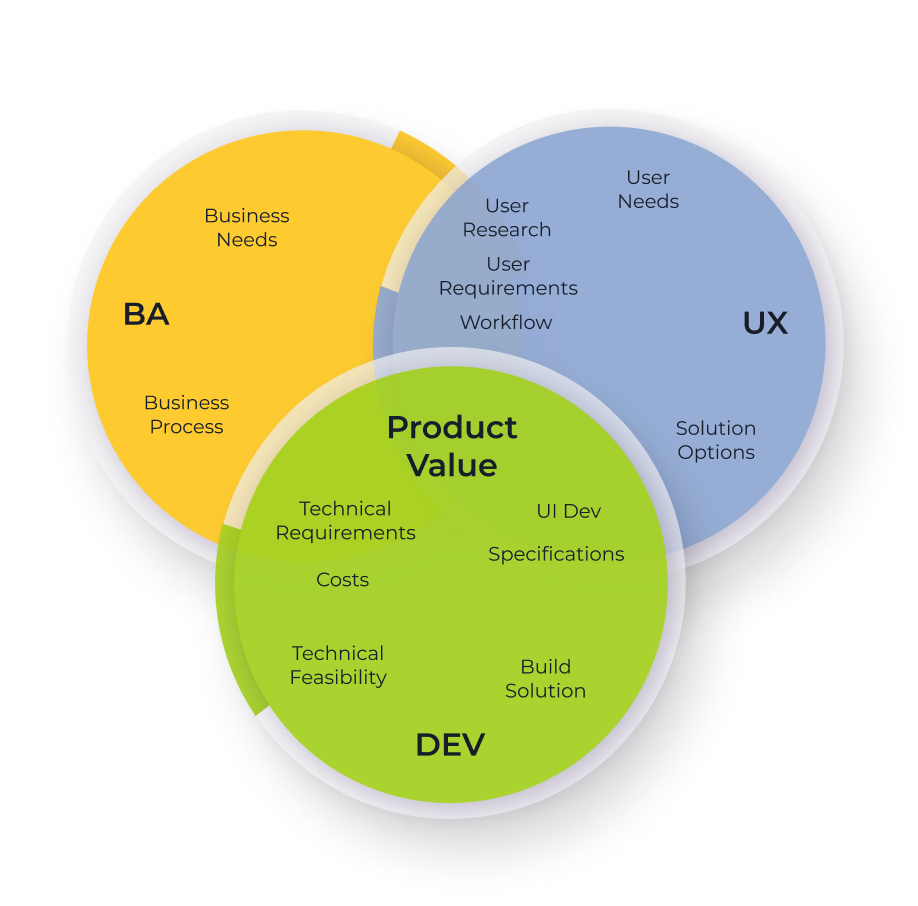
We also suggested reconsidering the team composition and strengthening it with our classic triad of a business analyst, solution architect, and UX/UI designer, typical for an *instinctools’ product approach. That way, our experts ensured creating the product centered around customer experience. 

The client appreciated the businesslike approach of the *instinctools team. They approved our ideas, and so we jumped right into work on the next stage.

  1. Transition phase

At this stage, we focused on:

  • Auditing the current platform. We reviewed the client’s functionality as the Fund admin and end-user’s functions for the Fund user (Investor) role implemented on the platform before cooperation with *instinctools. That way, we determined which of the already developed features to include in the Alpha release.
  • Troubleshooting and bug fixing. We evaluated bug fixing priorities. For example, authentication, notification system, and chat had to be fixed first.

The transition phase resulted in creating a joint value-based development model with described stages, milestones, and releases. As we’ve elaborated the scope for the Alpha release, we moved on to it. 

  1. Alpha release

Our primary goal was to establish a base for future development. The Alpha release included a limited set of core features to speed up the product’s time to market and provide maximum business value with minimum effort and cost.

Instinctools’ team covered:

  • Conducting code refactoring. We eliminated the spaghetti code inherited from the client’s former tech partner to simplify the process of uncovering bugs and vulnerabilities and hone the product’s efficiency and maintainability.
  • Implementing necessary fixes to current features. Only manual logout had been available earlier, so we added auto logout for the Fund User (Investor) role.
  • Reviewing UX/UI. The current platform looked more like a visually appealing Excel spreadsheet, while the client wanted to put a premium on innovation and make the product up-to-the-minute in look and feel.

The Alpha release led to crafting the product’s version with updated core features and design ready to be tested by early adopters.

  1. MVP release

The client showcased the demo from the Alpha release to one of the funds. It was a sort of validation milestone for our client, which they passed. Therefore, we moved to fine-tuning the product, considering feedback from the early adopter, and added new features to the platform to provide more tangible value to customers.

First, we extended the functionality for the Fund user role. The following features were included in MVP Block 1:

  • 2FA. In line with best practices and the client’s desire to raise the bar on the platform’s security, we implemented two-factor authentication for fund users.
  • Manage documentation. Fund users can open, read, and download docs in various formats unlike in the platform’s version, provided by the previous contractor, where users could only see the list of documents.
  • See the full picture of investment activity. Fund users can check the invested money and the remaining amount they can invest.

At the MVP Block 2 stage, we enhanced the functionality for the Fund admin role:

  • Oversee investor organizations users. Fund admin can delete the investor organization users, activate, and deactivate user accounts. In the past version, the admin could only create and edit users.
  • Manage Opportunities. Fund admin is allowed to add new Opportunities, set their visibility, edit, or deactivate them. Previously, admins could only view the Opportunities the platform owner published.
  • Handle documentation. Fund admin can search and filter docs, while they could only view a list of documents earlier.

The main deliverable of the MVP stage was launching the product to the public.

  1. Future releases

Based on the feedback from end users, we’ve planned updates that are sure to captivate both funds and investors:

  • Benefit from third-party integrations

IIntegration with Tableau is at the top of the list to provide end users with embedded analytics within the platform.

  • Prepare the data for internal and external purposes

Summarize investments and generate reports to make back-office tasks a breeze.

  • Manage Opportunities

Automated notifications for investors about changes in Opportunities to help them keep an eye on the offers they are interested in.

  • Communicate with investors

Secure in-app messaging instead of emailing.

Before

  • Confusion about where the project is going and when it will be finished
  • Doubts about whether the goal is worth pursuing any further
  • Lack of understanding between the development team and product stakeholders
  • Random order of the features’ implementation
  • Budget drained on the creation of an undercooked product
  • Half-finished product with no value for the client or end users

After

  • Clear project roadmap with a blow-by-blow description of each stage
  • Shared vision of the future product
  • Step-by-step feature rollout, prioritizing what matters most
  • A robust MVP that not only fits the bill but also turn heads of user

Client’s testimonial

The product owner says how expectations align with reality when partnering with the *instinctools team:

Key features

Consistency

Laser-focused strategy adherence.

Cohesion

Continuous collaboration between the stakeholders and the dedicated team. 

Efficiency

Delivering the solution that is profitable even as an MVP.

Business value

  • Balanced development scope to provide maximum value with minimum investment
  • Decreased time to market
  • Fail-safe MVP, ready to conquer the venture capital market

Product Engineering For AgTech

Product Engineering For an AgTech Manufacturer

Logo SpexAI

How developing a frictionless web app empowered an agricultural startup to bring the idea of a real-time AI-powered monitoring system to life and serve farms with 10,000–15,000 plants.

Industry:
AgTech

UX and Design

Web Development

Software Product Development

Product Design

Business challenge

There are industries, such as agriculture, that alongside tough market conditions, have to grapple with the pressure of an extreme qualified labor shortage*.

*Source: National Agricultural Statistics Services Farm Labor Survey (NASS FLS)

Our client is an example of an innovative AgTech startup that is rewiring modern farming — SpexAI offers automated AI-powered plant monitoring services for large US and Canadian greenhouses specializing in medical cannabis* production.

*It’s used for medical purposes only and contains no more that 0.3% of THC according to USDA-ARS, 2021 (US) and Cannabis Act, 2018 (Canada)

The client’s goal was to streamline the plant care process in several aspects:

  • Replace manual labor with automation to save a sizable chunk of farm employees’ time.
  • Substitute a lack of workforce for intelligent sensors.
  • Spot problem plants in the early stages of mildew, botrytis, or pest infestation through accurate and detailed real-time health tracking.
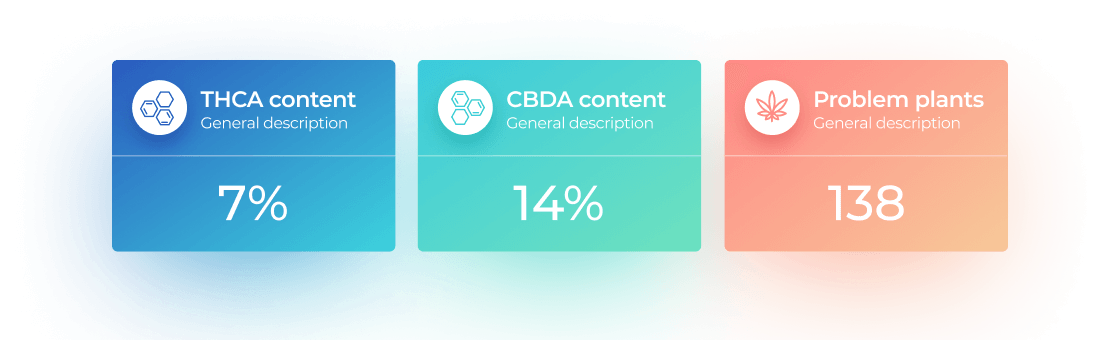
  • Detect plants with unsafe levels of THC due to hyperspectral imaging analysis, as in the US and Canada, plants exceeding the 0.3% total THC level must be destroyed, causing tremendous financial loss to farmers.
  • Back up harvest predictions and decision-making with accurate up-to-date analytics instead of guesswork to avoid year-end surprises.

Before reaching out to us, the client had already had:

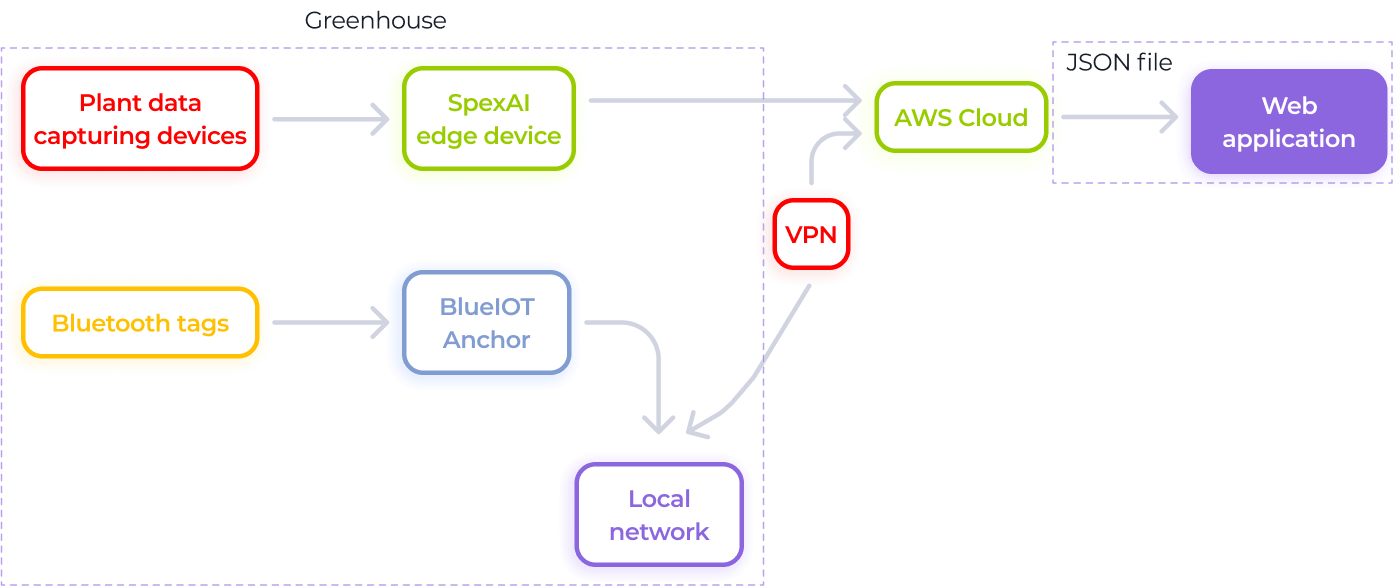
  • BlueIOT® tags that identify each plant
  • A robot – Hugin, harmlessly collecting data from the plants
  • AI – Odin – for analyzing the data

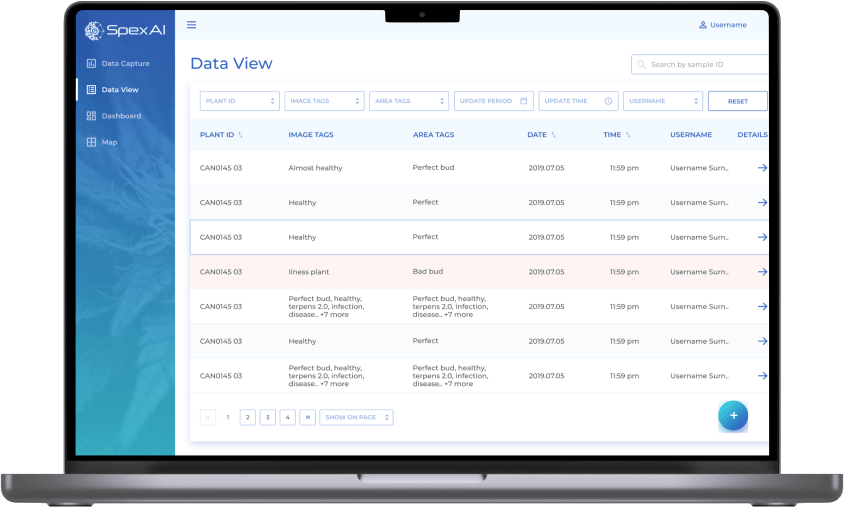
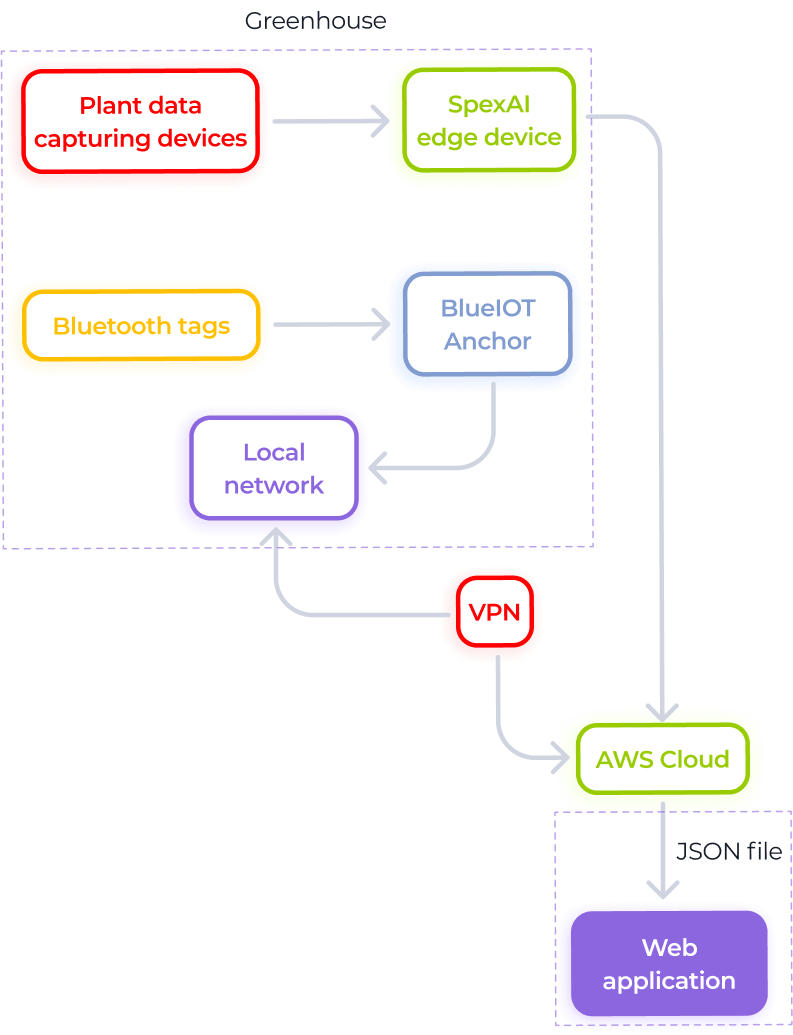
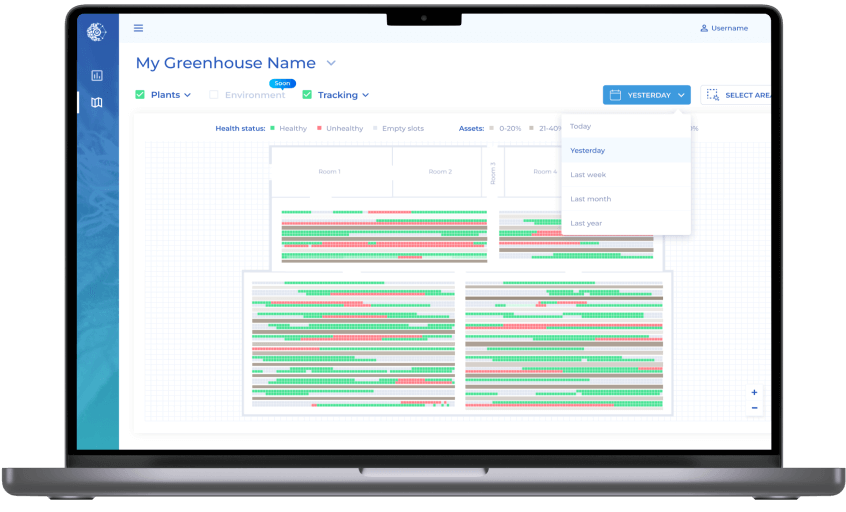
However, there was no software that would receive the data from the AI-powered robot and visualize it in a detailed yet easy-to-grasp form for the end users – farmers. The client needed a web app, and creating such a solution became the purpose of our project. 

How does the client's solution work?

Instinctools’ dedicated team had to craft:

Frontend

capable of displaying maps of farms with 2,000+ plants.

Backend

able to process up to 1,000 requests from the frontend in a second.

Visualization

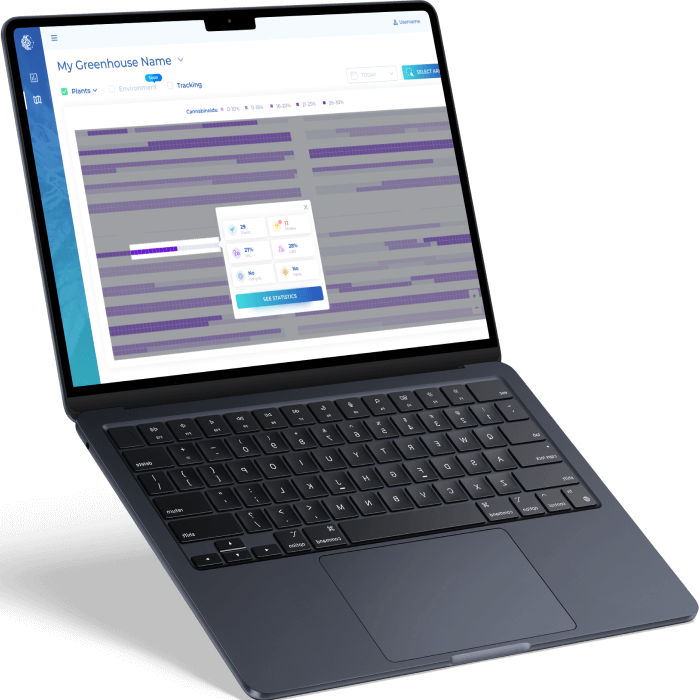
of the map itself to see the data collected by Hugin (smart sensor) and analyzed by Odin (AI) in a simple and intuitive format.

User-friendly visual design

for the web app.

Solution

The client’s end goal was not just to get a Minimum Viable Product (MVP) but also to de-risk the product launch as much as possible. They decided to move incrementally, from the proof of concept (PoC) to prototype to a robust MVP. 

Besides implementing the changes driven by the farmers’ feedback on the prototype, we went the extra mile by crafting a solid MVP and making the app more feature-rich and appealing to investors and users.

  1. PoC and prototype

We assembled a core team consisting of a business analyst, product designer, and software architect to more effectively deal with the project requirements and limitations from the get-go.

Puzzling over the map of plants

Identifying the best way to visualize a farm’s map and finding the most suitable library to implement this concept on a technical level was the major head-scratcher of the whole project.

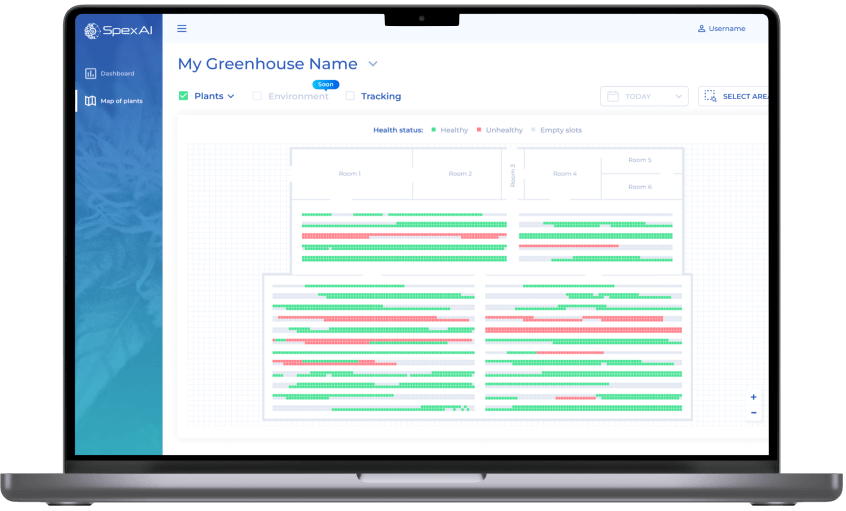
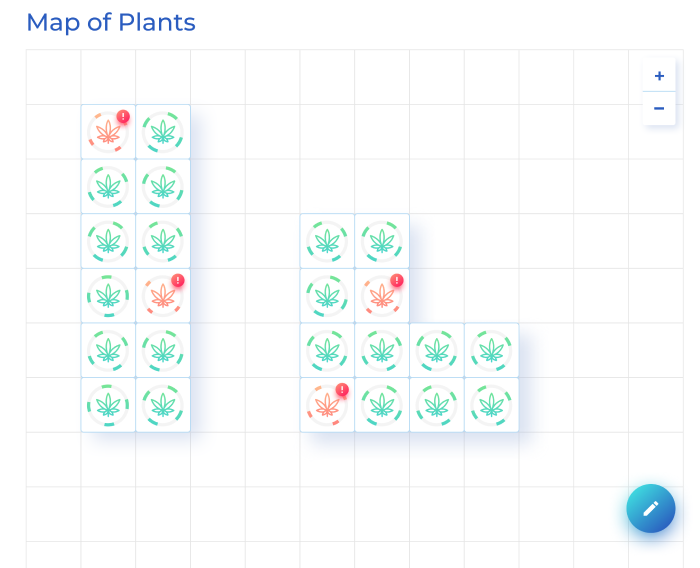
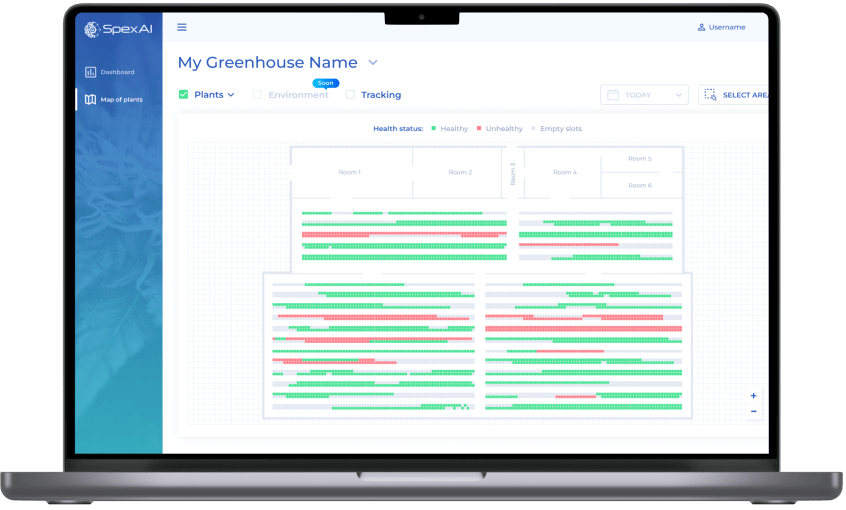
Since access to every plant was a prerequisite, our dedicated team devised a grid map with large cells, where a cell equals a plant.

For the technical implementation of the project, we chose D3.js — a JavaScript library for bespoke data visualization, as it allows:

  • Drawing a map with 10,000–15,000* cells quickly
  • Painting cells in specific colors
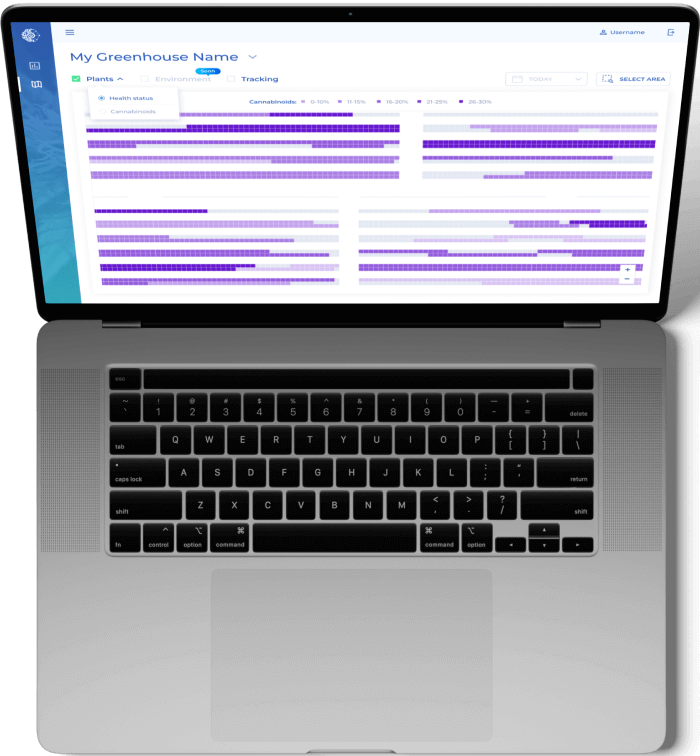
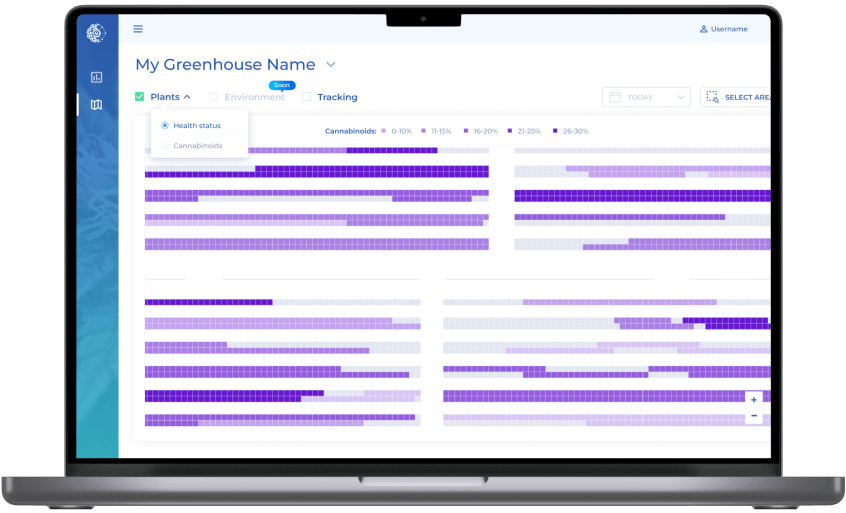
  • Illustrating different parameters (Health status, Cannabinoids, Environment) in layers
  • Showing pop-ups with detailed information about plants

* It was the amount we needed for the MVP.

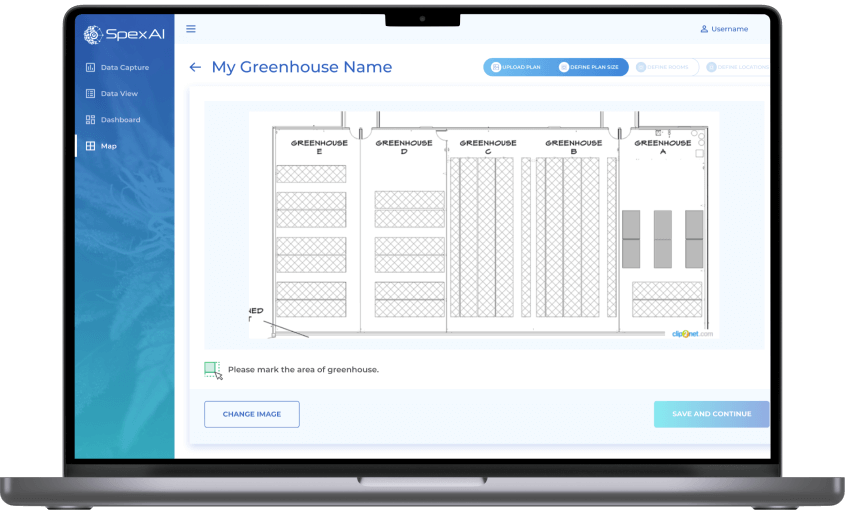
Looking for the best way to transfer the original farm map structure to the app

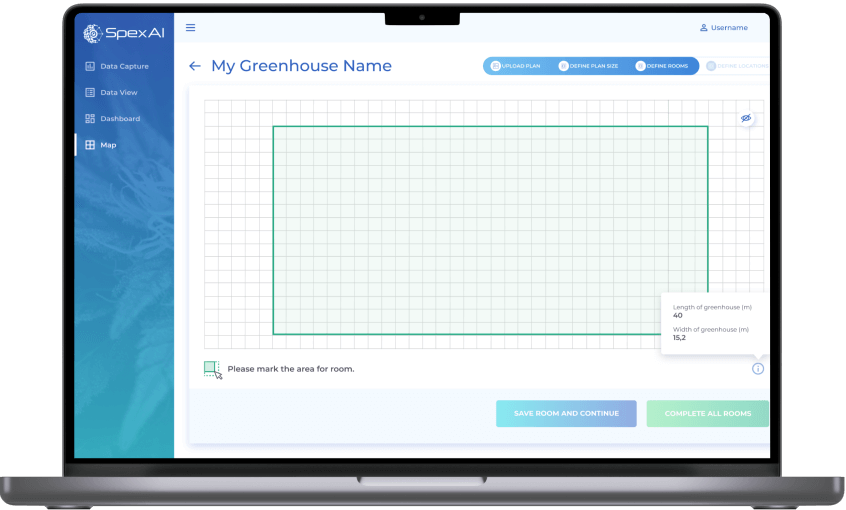
At this stage, we faced another question — what is the best way for our frontend and backend developers to receive the configuration of the farm? This issue could be solved by using a tool for software solution structure visualization. The client entrusted us with finding the most beneficial option available.

In Visio, Miro, Lucidchart, and other popular tools, monthly subscription costs $5–8 for a user. We managed to find a more affordable solution – draw.io – that costs $5 per month for ten users.

Identifying the most appropriate framework for the back end

According to the client’s requirements, the web app’s back end had to handle up to 1,000 requests from the front end per second. Therefore, we suggested using the asynchronous framework FastAPI, designed specifically for building high-performing web applications. FastAPI was also the best bet, as it is:

  • Fast to code*
  • Fully compatible with the declarative language JSON Schema, which allows for confident validation and annotation of JSON files, understandable for our web app’s front end
  • Compatible with OAuth 2.0 protocol, which simplifies signing in for the end users while ensuring the security of the process

* According to the FastAPI documentation, the framework provides developers with the possibility to speed up the features development process by about 200% to 300%.

What user functionality was provided in the prototype?

Ability to log in and sign in with Google and Microsoft credentials.

Digital twin of a greenhouse.

Access to key data on each plant.

Information visualization on the plants’ health status and their cannabinoids level at the scale of a whole greenhouse, updated once a day.

  1. MVP

The app’s prototype was successfully tested on a Canadian farmer’s greenhouse. Farm employees’ feedback unveiled how to improve the application, which we did at the MVP development stage. Instinctools’ team upgraded the UX, fine-tuned and expanded the solution’s functionality. What has been enhanced?

The scale and view of the map and the ability to zoom it

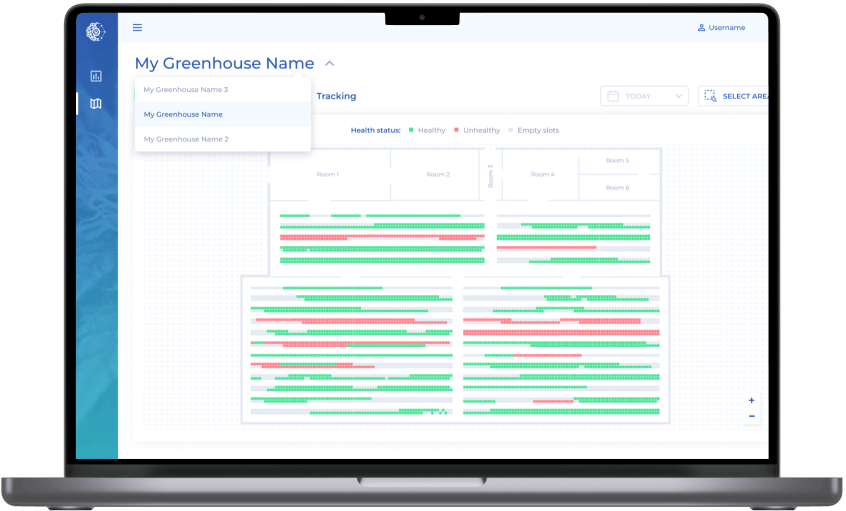
As having a top-level view was mandatory for managing the whole greenhouse, we suggested reducing the map’s scale and adding the ability to zoom it up to 500%, considering the client’s ambition to cover the farms with 10,000–15,000 plants and several greenhouses.

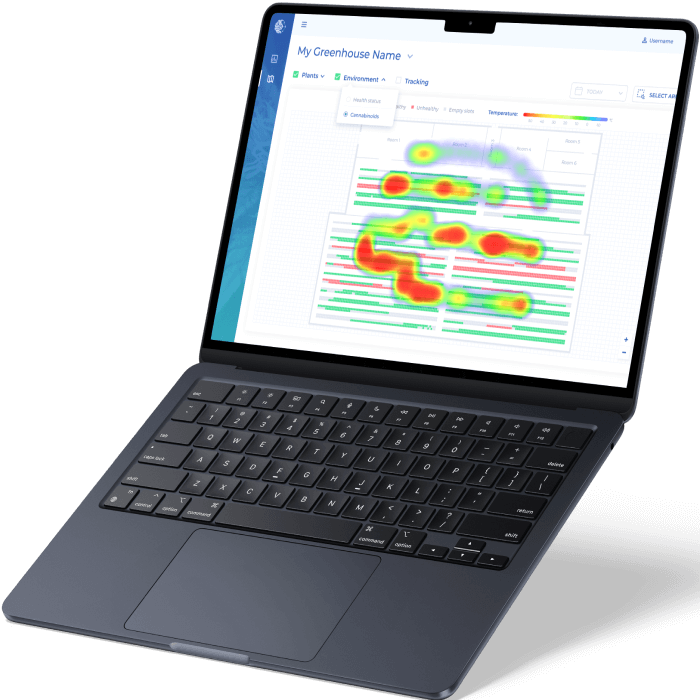
As you can see on the mock-up, we’ve added gray cells to show free spots. If a plant is transplanted, the system automatically reflects it in a new cell as Hugin (a smart sensor) reads its BlueIOT tag at the new location, and the former cell of this plant becomes gray indicating a vacant place.

Enhanced UX

Whereas in the prototype users could only see cannabinoid levels for a single plant, now this parameter is visible at the scale of an entire farm.

Broader amount of data collected about plants

We’ve added tracking of mildew, botrytis, and pests that affect plants’ health status and updated the logic for determining healthy/diseased plants. Now, if a plant has at least one of the problematic parameters, it will be marked by the system as unhealthy.

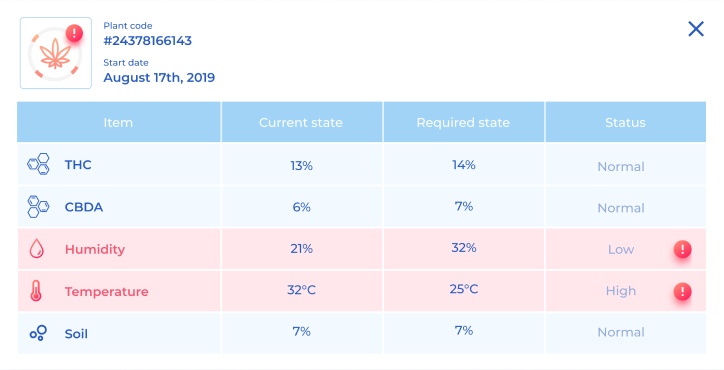
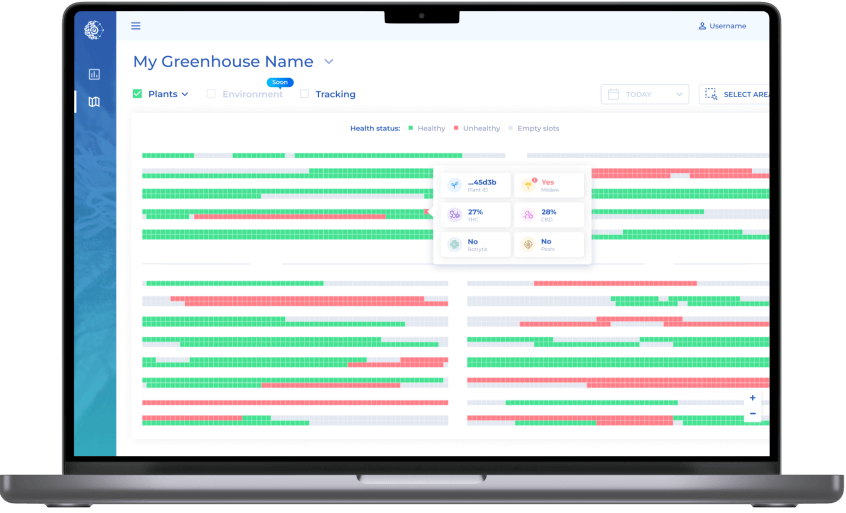
In a nutshell, when a user moves the cursor over the plant, they now see a hover with the following data:

  • Last numbers of the Plant ID
  • TCH index
  • CBD index
  • Botrytis presence
  • Mildew presence
  • Pest presence

Select mode on the map with the ability to see statistics for the chosen area

While in the prototype, it was possible to view statistics only for individual plants by clicking on them, in MVP, users can select any area on the map and check up-to-the-minute data about it. This functionality works in the same way for all map layers.

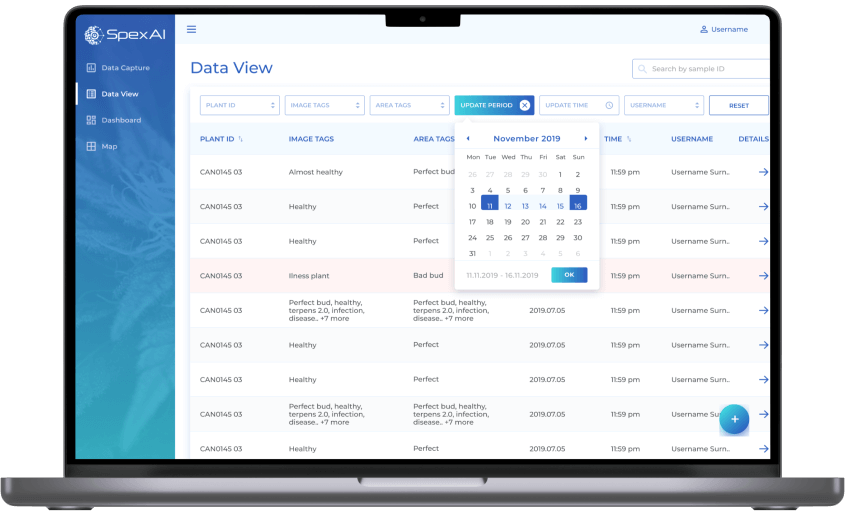
More detailed filtering with the option to set check-boxes on several tracking layers simultaneously

With multiple filters required, setting the filtering was one of the project’s tough calls. Partially, this was solved simply by colors. But the client wanted to add another layer – ‘Environment’ – to check how humidity and temperature influence plants’ health status and cannabinoids level. 

They also wanted to allow end users to visualize a combination of parameters from the different map layers. This was tricky both in terms of graphics and technical implementation. We solved the issue using heat maps overlaid on the farm’s map.

Now the map has two layers:

Plants
Environment

Real-time data updates

As the temperature and humidity in the greenhouse can change more than once during a day and influence the plant’s condition, updating data once a day carries a probability of inaccuracy in analytics. Therefore, we ensured that Hugin (the smart sensor) was constantly collecting data and Odin (AI) analyzing it so employees could access up-to-date data any time.

  1. MVP evolution

The MVP version of the app was successfully tested on the Canadian investor’s farm. Yet, we went the extra mile and suggested several features to make the software even more beneficial for farmers and put SpexAI on track to high profit.

Ability to view the greenhouse history

Users can access retrospectives of an entire farm, its highlighted area, or an individual plant to check how its health status and cannabinoids level changed over time. With data from previous periods, farmers can better plan the following season.

Leaving notes on the map

Farm staff who tested the app’s prototype mentioned that leaving notes about plants on the map would be convenient. With such an approach, if an employee working during one shift discovers that certain plants require special attention, they can leave notes for employees working during other shifts to notice deviations straight away.

Multiple greenhouses within one account

Although the solution was tested on a farm with one large greenhouse, the client expected that in the future, the application would be used by farmers with multiple greenhouses, so we built in such functionality. 

This feature came in very handy as, thanks to the elaborated MVP, the client has found farmers with several greenhouses for 10,000 and 15,000 plants.

Different roles within the app

There were no different roles in the app’s prototype version. However, its architecture allowed implementing this logic down the road. Therefore, we designed two initial roles for MVP — greenhouse managers and farm owners with different levels of access to data and depth of the reports:

  • Greenhouse managers can only check the greenhouse they are responsible for, but they have highly granular reports.
  • Farm owners can view all greenhouses and all farms, but they have top-level data in their reports.

Before

  • Absence of a specialized tech solution for the safe monitoring and analysis of the plants’ state in greenhouses
  • Lack of top-level view of a whole farm and ability to drill down into greenhouses areas and separate plants
  • Inability to provide real-time monitoring of the farm
  • Decision-making based on personal insights and guesswork
  • Failure to spot plants with non-safe THC levels before they have to be disposed of
  • Incapability to track the history of plants’ condition to predict future changes 

After

  • Easy-to-grasp actionable insights based on leaf-level images from crop monitoring
  • The very first solution for harmless monitoring and analyzing the state of medical cannabis plants in greenhouses
  • Interactive multi-layered greenhouse map
  • Holistic data about plants’ condition in real-time
  • Decreased number of plants requiring eradication due to THC exceedances thanks to predicting the cannabinoid level during growth
  • Greenhouse history at the fingertips empowers farmers to make accurate hypotheses about possible changes ahead

Key features

Innovation

SpexAI is a trailblazer for intelligent and harmless solutions for medical cannabis monitoring and analysis.

Profitability

The software unleashes new profit prospects for farmers by fundamentally reducing the number of plants that had to be disposed of due to non-safe THC levels.

Scalability

The web application can be used both for relatively small greenhouses with 2,000 plants or huge farms with tens of thousands of plants.

Business value

  • The very first solution for harmless monitoring and analyzing the state of medical cannabis plants in greenhouses
  • 100% automated plant monitoring and analysis
  • Interactive health trends at the scale of one or multiple greenhouses
  • Detailed data about each plant available at the click of a button
  • Minimized cases of plant eradication because of the exceeded THC level
  • Decision-making backed up with up-to-the-minute information and historical data

Client’s testimonial

MVP Development For an EV Charging Startup

MVP Development For an EV Charging Startup

How crafting an MVP of a mobile app for 16 EV car models and 65,000 charging points across Europe empowered the UK-based startup to conquer the European EV charging market on the first try, connect 17+ charging networks, and raise funds for further development from prominent and influential investors – Lightspeed Venture Partners, Tier Mobility, and Wise.

Industry:
Technology

Expertise:
Mobile App Development

Context

Bonnet founder and CEO, Patrick Reich, entrusted us with the implementation of his start-up idea in 2020. His vision and belief, empowered by *instinctools product development expertise, served as the basis for the creation of a unique tech solution for millions of EV drivers all around Europe.

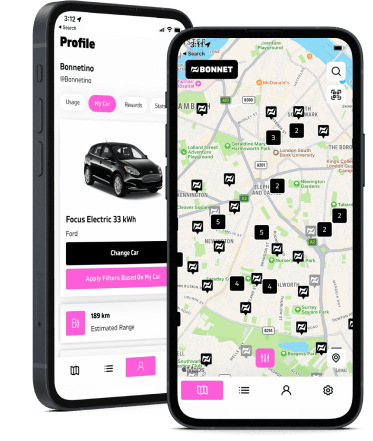
The application for iOS and Android devices aimed at aggregating all the local EV charging points and allowing its users to smoothly find and drive to the nearest spot and instantly pay for the charge.

Challenge

Despite a few core features and the app itself, that we needed to build together with our client, there were some technical challenges and decisions to be made to ensure the solution was properly implemented and to make sure further performance was stable.

01. The synchronization of the app’s front end, back end and charging points servers.

The communication between “applications” is no less important than communication between people. Our first major task was to enable the proper connection between the main parts of the application and the charging points servers to get a real-time status of the charging process, even in background mode. Together with our client’s development team, we analyzed the algorithms and work logic of each charging spot provider and enabled its unhindered synchronization with the Bonnet application.

02. Payment service integration.

The integration of the Stripe payment service required efficient communication with the back end of the application. Together with our client, we thought over the development of technical algorithms for various scenarios related to the user’s bank account, withdrawals, including repeated transactions, etc. Our senior backend developer dived into Stripe’s operation system to bring more value and help create secure connectivity between the systems.

Solution

We developed an Android application which became the basis for the development of an iOS app. It provides EV drivers with smooth access to the public charging infrastructure.

The Bonnet app has an extended functionality for customer service, instant payments, bonuses, and useful analytics about recent charges.

The implemented subscription model, in addition to a pay-as-you-go service, is defined by the charge type (all points or the cheapest only) or user type (individual or corporate client).

Key features

  • In-app analytics and history of all the charges.
  • Online chat Intercom with FAQ and real-time support functionality.
  • QR-code on charging points for quick access and charge start.
  • Map with available charging points and search functionality.
  • Authorization via Google or Apple accounts for different applications.
  • Payment account with an integrated coupon system
  • Push-notifications

Client’s testimonial

“The expectations for the quality of the initial product were very high. I think *instinctools did a great job ensuring those expectations are met. We met the developers we were going to be working with and it quickly became apparent that they are very qualified and were able to deliver the vision that we had from our side for the product. They clearly told us what they were going to do, and if there were questions or problems along the way, they clarified them really quickly thanks to transparent communication.”

– Patrick Reich, CEO and Founder at Bonnet

Business Value

Software product development mindset — this is what start-up founders look for when selecting the right technology partner for their business. This is the approach that allows the tech team to be on the same page as the customer and deliver the MVP in a short time. *instinctools work helped Bonnet enter the market promptly and form the basis of a successful fast-growing tech business.

Technologies

RX Java
Kotlin
Google Maps API
Firebase Cloud Messaging
Pusher
Socket.io
Stripe

NFT Marketplace Development For a Fintech Company

NFT Marketplace Development For a Fintech Company

ipwe white

How developing an NFT platform allowed a global Fintech company to increase its annual revenue by 34%, rack up the number of B2B clients by 47%, and wipe out the risks related to intellectual property when selling and buying patents all over the world.

Industry:
Fintech, Intellectual property

Team:
team lead, BE engineers, FE engineers, business analyst, project manager, QA specialist, UI designer

Context

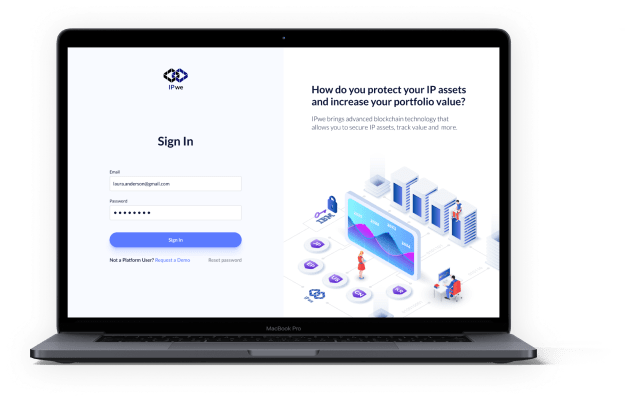
*instinctools was approached by IPwe for assistance in revamping their marketplace for monetizing patents encased in non-fungible tokens or NFTs. Their goal was to make the intellectual property market more transparent, liquid, and accessible to every stakeholder interested in patent acquisitions or sales. The key requirements for the IPwe Platform were the following:

  • a clear and transparent structure
  • information accessibility with equal opportunities for both patent licensors and licensees
  • an intuitive interface for fast and easy transactions.

Challenge

The primary purpose of the project’s first stage was to construct the core application for market launch, allowing new users, customers, stakeholders, and investors to gain a better understanding of IPwe’s products and their features. The *instinctools team was challenged to cover the following tasks:

  • Designing a web interface with an intuitive user experience.
  • Developing a web application with extended functionality, including secure transactions, real-time dashboard visualization, and personal user accounts.
  • Creating an interlayer for efficient blockchain operation and enabling smooth connectivity between the front-end and back-end.

Solution

The key component of the project was finished and released on time thanks to the smooth collaboration of *instinctools professionals working alongside IPwe’s team.

“We have delivered the core web application functionality meeting all client’s requirements for the platform, and now we actively continue to bolster it with new features. The IPwe team clearly knows what they want, and we always have ideas in our stash on how to meet their needs.” – Alesia V., Account Executive at *instinctools.

The NFT marketplace platform is a complex solution consisting of several components delivered by the *instinctools dedicated team: web app, user account, and a Smart Pool system.

  • A web application with an admin role on the backend allows for controlling and managing user activity and operations with tokens. In particular, a database administrator can manage and optimize requests coming from IPwe Platform users to add new assets as well as the structure and aggregate databases for further processing with an inbuilt artificial intelligence tool.
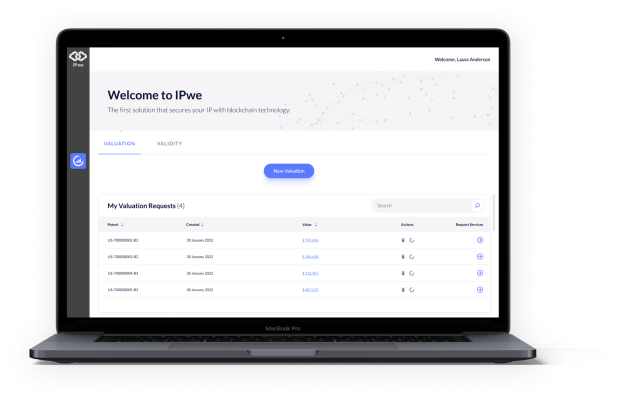
  • A user account with a dashboard view of various assets, patents, and trade secrets with issued tokens (NFT). The total number of active licenses the company bought or is currently selling, transaction status feed, and notifications.
  • Smart Pool system for a group of patents united by one technology and establishing a pool with members and patent owners. Through IPwe’s Smart Pool technology, members can access the tools they need to improve their patent portfolio.

Patent owners can add their assets to the IPwe Platform according to the privacy levels they wish to apply to their tokens. There are two types of privacy for the assets: “private capture” and “strictly confidential.” Private capture allows users to add trade secrets with related documents and send them to the blockchain. Strictly confidential implies the same procedure except that the files that a particular person signs are hashed and not stored in our backend. Though the user still can save the original file name or hash it.

Currently, the *instinctools’ team is enriching the application with new functionality and maintaining the stable operability and security of the platform.

Key features

  • Stable and secure platform providing different levels of access and personal accounts functionality
  • Smart dashboards that visualize all the user’s data and assets
  • Reach and fine-tune notification functionality
  • Smart Pools that unite assets with similar technology and reduce transactions costs

Business Value

The NFT marketplace for selling and buying patents helps businesses increase the value of their assets, establish new partnerships, and mitigate risks related to intellectual property. With this solution enriched with new functionality, our client is expanding their B2B service offering, bringing revenue and added value to the business.

Technologies

React
Node.js

Energy Trading Platform For a GreenTech Startup 

Energy Trading Platform For a GreenTech Startup

How creating a trailblazing digital marketplace for renewable energy producers and local households with an opportunity to save up to 20% on their monthly energy bill allowed a German startup to be available for 41 million households across Germany.

Domain:
Energy

Expertise:
Blockchain

Duration:
~1 year

About the project

The objective of the project was to implement a blockchain infrastructure based trading platform for open and direct energy trading.

Challenge

Lition approached instinctools with an idea of creating a platform for direct energy exchange within Lition Energy System. The goal of the project was to simplify the legal, operational and economic hurdles for green power producers while facilitating customers to buy truly green electricity at a reduced price.

Tasks

An initial consulting phase ensured clarification of customer needs and purpose of the product. It helped to determine the main tasks for the *instinctools team:

  • Trading platform development including backend, frontend and UI/UX design reflecting Lition corporate style
  • Blockchain-based solution development
  • Consulting and integration of project management methodology and configuration of project management processes

Solution

The end solution met all the customer’s requirements and expectations. Around 10 JavaScript frameworks were implemented to build reliable and functionally rich web application.

Key features

Well-organized development process from goals and needs decision to solution architecture allowed to create the product with the following key features:

High performance and usability

Informative dashboard (with information about producers, types of energy, current rates, transactions and contract data)

Option to choose power plants and create several energy supply contracts with Lition

Based on Ethereum and proprietary blockchain

Access to energy market – the platform connects customers and producers to trade energy and receive financial benefits

Possibility to try a live demo and experience the trading platform interface

Result

The platform is currently the key product of the Lition and commercially available for 41 million households in Germany. Customers from more than 30 cities save up to 20% on their monthly energy bill, and producers generate up to 30% more profit. The solution gives users a possibility to support ecological energy plants and help to save the environment.

Client’s testimonial

“People at *instinctools are quite tech heads, which I like. They have used very advanced libraries, advanced techniques, advanced coding paradigms. So the advantage is that we get reusable code, that we get well-testable code, we get well-maintained code.”

– Richard Lohwasser, Co-founder and CEO of Lition

Technologies

SCRUM

Frontend:

Backend:

Blockchain:

Anna Vasilevskaya
AI modified real photo
Anna Vasilevskaya
Account Executive

Get in touch

Drop us a line about your project at
[email protected] or via the contact
form below, and we will contact you soon.