Top-Notch Quality Assurance for a Custom LMS
How implementing end-to-end manual and automated testing enabled an EdTech company to detect x40 more bugs at the early stage, speed up development cycles x5, cut down the cost of fixing errors and bugs x160, and bring down overall software maintenance costs by 16%.
Industry:
Education, Technology
Software Product Development
SaaS Development
Business challenge
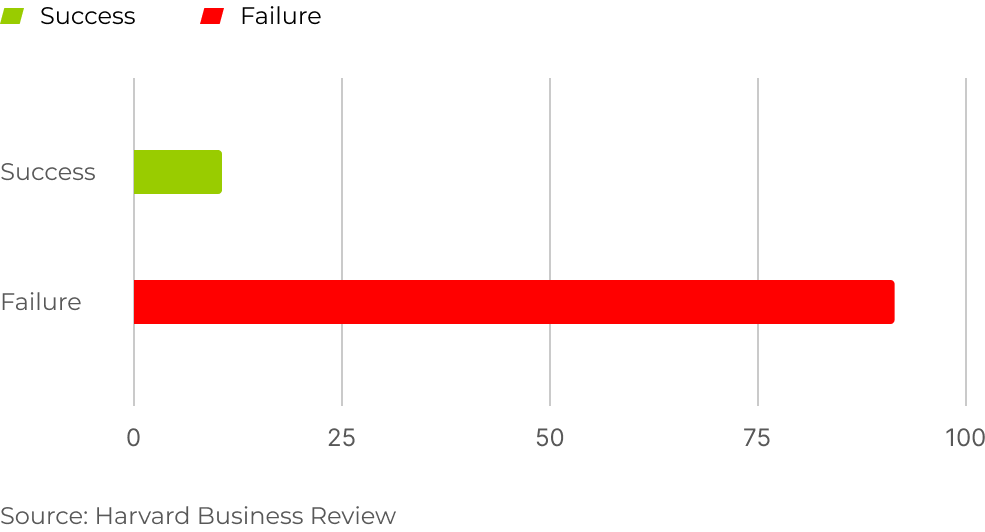
Only 10% of startups can keep up with a current highly competitive market — and there’s a reason for that. Newcomers tend to adopt a ‘we can take care of it later’ mindset, often skimping on crucial areas of SDLC, such as requirements analysis, project documentation management, software testing, etc.
Startup succes & failure rate
Nevertheless, as your solution evolves, these shortcuts inevitably stab you in the back, sometimes putting at risk the overall success of your product.
That’s exactly where our client found themselves. An EdTech company providing a custom SaaS LMS with gamified courses had put software testing and project documentation on the back burner at the outset. Several years after the rollout, their e-learning library had ballooned to 40+ courses in 30+ languages, and their initial issues started to backfire. The client’s LMS became unstable, underperforming, plagued with errors and bugs, and expensive to maintain.
A closer look revealed even more issues:
- The system was overcomplicated and non-transparent, even for the admins. Managers, not engineers, were steering the project regarding all technical decisions, including tech stack and architecture planning.
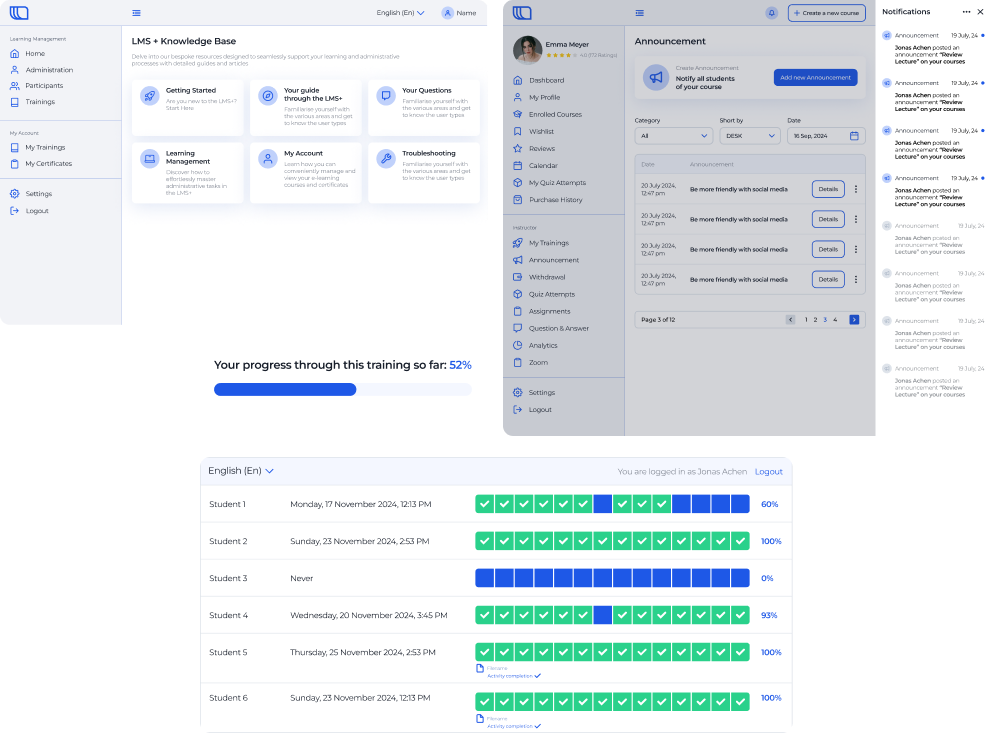
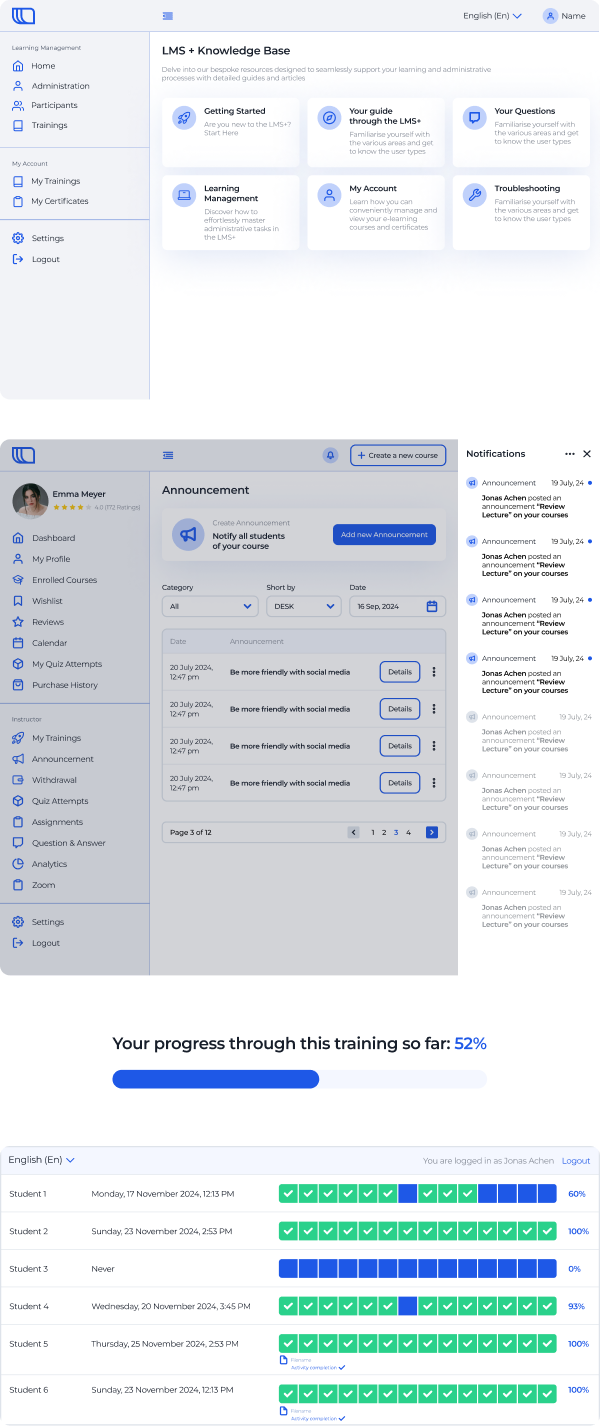
- The platform lacked standard LMS UI elements like notifications and progress bars to easily track user progress.
Realizing that doing nothing would lead to losing customers, the client decided to turn things around by adopting software testing, documenting their projects, and enhancing the platform’s UX/UI.
The benefits they aimed to achieve included:
- More user-friendly LMS, both for admins and end users
- Greater customer satisfaction from enhanced UX/UI
- Transparent SDLC processes
- Higher software quality due to making QA a mandatory pre-release step
- Faster development cycles through automated testing
However, the client’s internal team couldn’t carry out these tasks on their own due to the lack of top-tier QA expertise and their already heavy workload. Therefore, they opted for IT staff augmentation services and partnered with *instinctools. We provided them with a senior-level QA engineers and frontend developers.
Solution
Before getting to user experience setbacks, we focused on adequate functional testing as a straight way to boost the LMS’s quality and accelerate development cycles.
-
Setting up manual functional testing
For the client to fully cash in on the perks of automation, it was necessary to make sure that their manual processes run like clockwork.
Therefore, starting with the basics, our QA engineers mapped out a clear workflow for various types of manual functional testing, including unit, integration, interface, system, smoke, sanity, acceptance, and regression tests.
We’ve hit the ground running with the Cucumber testing framework as one of the leading options in the market, and during the first two months of cooperation, our QA specialists covered:

Extending QA capabilities by adding automated functional testing
With manual testing paving the way, automation was the next natural step.
We blended the Cucumber framework with the WebDriverIO automation framework as this combo is not only powerful enough for large and technically sophisticated projects but also free of charge.
Thanks to our dedication during the manual testing phase, the transition to automation was hitch-free. Our automated functional testing now covers:
- LMS database
- APIs
- User interface
- Communication between the server and clients
We blew past the client’s expectations — automated tests now handle 85% of the LMS functionality, 25% more than the initial 60% target.
Leveling up UX/UI
Our developers teamed up with the client’s UX/UI designers to upgrade the platform’s interface and functionality. The revamped LMS now boasts intuitive notifications and progress bars for users and admins.
We continue working on test automation, implementing non-functional tests, and supporting the client’s in-house team in handling the rising scope of the platform’s interface makeover tasks.
Before
- Overcomplicated system
- Absence of adequate software testing
- Inability to fix defects
- Lack of project documentation
- Questionable software quality
- Skyrocketing maintenance cost
After
- Well-thought-out and user-friendly system
- End-to-end manual and automated functional testing
- Clear workflow for fixing any issues that arise
- Documented test cases
- Enhanced software quality
- Decreased maintenance cost
Business value
- Catching defects x40 earlier in the SDLC before they play havoc on the bottom line
- Slashing bug repair costs x160
- Speeding up development cycles x5 to get features to market quicker
- Bringing down LMS maintenance expenditures by 16%
- Minimizing the possibility of costly human error
Client’s testimonial
The client’s VP of Engineering highlights cooperation with *instinctools:
Multiplier effect
Cutting corners on quality assurance is like setting yourself up for a sure failure. In 2024, businesses can’t afford bad software.
It’s never too late to bridge the gaps in your existing software testing with a comprehensive QA strategy and add powerful automation to your manual testing for maximum impact.