Website Redesign for a Canadian Cleaning Company

Website Redesign for a Canadian Cleaning Company

How website modernization enabled a Canadian cleaning services provider to expand its customer base and increase its customer satisfaction score (CSAT).

Business challenge

Citrus Cleaning, a Canadian cleaning services provider, had earned recognition among local customers in Calgary, largely through referrals. But as more prospects began discovering and comparing cleaning providers online, the company’s website was not strong enough to capture that demand, guide visitors toward quote requests, or support the speed of response expected in a competitive service market.

An apple shape made of small icons related to health, fitness, food, and medical supplies. The icons are colored green on the leaf, fading to orange and red toward the base, all on a white background.
  • The first issue was visibility. While the website existed, it performed almost exclusively as a branded destination for people already familiar with the company. It had little presence in local, high-intent search results where potential customers actively compare providers and request services. Competitors with stronger SEO foundations were consistently capturing that traffic first, limiting Citrus Cleaning’s ability to expand its inbound pipeline.
  • The second challenge was conversion friction. Quote requests were handled through fragmented phone conversations and manual follow-ups, which slowed response times and introduced friction at the earliest stage of the customer journey. For a service business where speed and convenience heavily influence conversion, the process created unnecessary drop-off at the most critical point of the customer journey, when a visitor was ready to become a lead.
  • On top of that, the outdated website design didn’t fully communicate the company’s quality, reliability, or customer-first service model. For new visitors evaluating cleaning providers online, that gap was weakening trust before the first interaction even happened.

Citrus Cleaning wanted to turn its existing website into a performance-driven acquisition channel, capable of improving discoverability, reducing lead handling friction, and presenting the brand with the same level of quality customers experienced offline. To secure more online business opportunities, the company partnered with Instinctools’ development team on a website modernization initiative.

Solution

Instead of recommending a costly, ground-up rebuild, Instinctools took a more targeted approach. We reengineered the existing website around the factors that mattered most for a local service business:

  • a new, distinctive brand identity aligned with the client’s requirements and market needs
  • a conversion-focused user journey for quote requests
  • mobile-first performance improvements
  • a scalable SEO framework
  • automated integrations between website forms and internal operations

The result was a modern, fast, and scalable website that worked not only as a digital storefront, but as a growth channel.

  1. Building a distinctive visual language that stands out in a crowded local market

Cleaning services are often marketed through predictable visual patterns: blue for trust, white for cleanliness, and generic imagery that makes providers difficult to tell apart. Citrus Cleaning needed a brand experience that felt cleaner, fresher, and more memorable without losing professionalism.

In updating the visual identity, our UX designer built on the client’s established brand and introduced a palette of crisp whites, lime green, and orange accents, grounded in research on how colors shape customer perception.

  • The visual identity mirrors the company’s name, using a citrus-inspired palette to create an immediate link between the brand and its fresh, clean image.
  • Green communicates eco-friendliness, sanitation, and a non-toxic home environment, while vibrant orange injects optimism and cheer, suggesting that the client’s service brings brightness and joy back into customers’ homes.
  • Orange CTA buttons provide a clear visual cue, guiding users toward engagement.
  • Meanwhile, dark gray text maintains a professional and trustworthy tone for both residential and commercial clients.
Four color swatches: orange with orange slices (#F7B02B), bright orange with grapefruit flesh (#FB3D00), vivid green with cucumber close-up (#79C122), and dark gray with a building facade (#414141). Each color shows a matching photo.
Logo for Citrus Cleaning features an orange slice inside a letter C with a green leaf. “Commercial & Residential” is written below in smaller, light orange and gray letters. The word “cleaning” is in light gray. The background is white.
  1. Engineering a frictionless, conversion-driven UX

We redesigned the user journey around a simple conversion logic: understand the problem, match it with the right service, and make the next step obvious.

To reduce the friction in users’ decision-making process, we introduced:

  • clear service-page structures built around user intent
  • repeated but unobtrusive “Get a Free Quote” calls to action
  • short paths from service pages to the booking form
  • trust-building testimonials placed close to decision points
  • homepage sections designed to quickly communicate credibility and service quality
  1. Optimizing mobile-first performance for on-the-go users

Since many local service searches happen on mobile devices, mobile performance is closely tied to customer acquisition. If the experience feels slow, unstable, or difficult to navigate, the business can lose high-intent visitors. In that context, mobile-first optimization became a key part of  the redesign.

The engineering team focused heavily on lightweight asset delivery, faster image loading, and rapid script execution. By minimizing asset overhead and prioritizing critical rendering paths, we ensured minimal latency and zero layout shifts (CLS).

As a result, the client received a lightning-fast mobile experience that safeguards mobile search rankings and prevents bounce rates driven by slow loading times.

  1. Architecting a highly scalable content framework built around localized search intent

To compete for neighborhood-specific, high-intent search demand, Instinctools built a programmatic semantic architecture designed around service relevance and geographic intent.

  • Localized schema injection: The site utilizes strict semantic HTML5 coupled with LocalBusiness structured data markers. This helps search engines better understand what Citrus Cleaning offers and where it operates.
  • Scalable content expansion: A programmatic semantic architecture we implemented enables the rapid rollout of neighborhood-specific landing pages and service-focused content, expanding the website’s coverage across relevant local search terms.
  1. Automating back-office workflows and CRM syncing

The previous quote process depended heavily on manual communication. That created delays at exactly the moment when speed mattered most.

To reduce this operational bottleneck, Instinctools connected frontend quote submissions with the client’s internal dispatch and CRM workflows.

We engineered secure API endpoints and webhook integrations so that once a prospect submitted a quote request online, the data could flow directly into the client’s internal systems.

This reduced manual data entry, helped the operations team act faster, and made the lead handling process more consistent.

For Citrus Cleaning, this meant the website was no longer just collecting inquiries, but became part of the company’s service operations, reducing the risk of losing ready-to-book customers.

Business value

  • 30% growth in the active local customer base within the first two quarters after the redesign.
  • Up to 20% increase in CSAT, thanks to a streamlined and optimized digital experience.
  • Faster lead response times: by reaching customers within the critical 5-minute window, where close rates are up to 8× higher than delayed manual replies, the client captured opportunities that previously slipped away.

WordPress To Shopify Migration

WordPress To Shopify Migration For a European Eyewear Retailer

How switching from an outdated WordPress website with a WooCommerce plugin to a sleek Shopify platform with a tailored theme empowered the French eyewear retailer to accelerate loading speed x6, lower bounce rate twice, increase session durations fourfold, and boost page visits per session by 64% — all without missing a beat in their operations.

Web Development

Software Product Development

Business сhallenge

Grappling with fierce competition, o​​wners of ecommerce businesses know better than anyone how tough it is to win customers and turn them into regulars. Especially, when a raft of external factors have already been preventing ecom companies from capturing buyers’ attention. 

While environmental, economic, and political hurdles are something that you can’t fend off, there are areas within your control – and technical prowess of your ecommerce solution is definitely among them.

Facing the challenge of revamping their tech foundation, our client — a leading French eyewear brand with a production hub and a network of over 20 retail stores — sought to elevate their three-year-old ecommerce solution, crafted on WordPress with WooCommerce integration.

Why did the existing online store with the WooCommerce plugin become a pain in the neck for the client?
  1. Due to a slew of plugins and underlying spaghetti code, their website’s loading time increased to a concerning 6 seconds. While this didn’t impact its visual appeal, it significantly affected user experience, leading to brief average use sessions of under 30 seconds and a 70% bounce rate. It’s an urgent matter we can’t overlook.
  2. There were problems with updating and maintaining of the current ecommerce entity as updates for plugins and WordPress versions aren’t synchronized. Situations where the update was available for WordPress but not plugins were far from rare.

    This left our client in a tight spot: prioritize security by upgrading WordPress and risk plugin functionality, or patiently wait for a full alignment of updates? As you can probably guess, neither of which seemed an attractive option.
  1. Considering its outdated nature and maintenance challenges, the existing store was exposed to security vulnerabilities. Notably, the client’s previous system leaned heavily on the jQuery library, deemed unsafe by modern security standards.
  2. There was no easy — or even remotely acceptable — way to add localization for Belgium, where the client was going to open new brick-and-mortar stores. With WordPress, they would have had to invest a sizable chunk of time and budget in adding a new language version by installing another plugin, which would have slowed down the loading speed even more.

The client has investigated available options and reached out to *instinctools with a request for WordPress to Shopify migration services.

As an all-in-one ecommerce platform, Shopify was expected to meet their current and future needs since it:

  • Can handle up to 10,000 requests per minute
  • Eliminates the need to deal with website updates and maintenance, which are the responsibility of the platform’s tech support
  • Simplifies content management thanks to the isolated fields in the admin panel so that employees can easily update the content without the risk of breaking the system
  • Keeps the security bar high
  • Offers free localizations for additional markets with a built-in auto-redirect without affecting the client’s search engine ranking
  • Provides vital ecommerce functionality, such as a multi-currency plugin, an automatic country-by-country tax calculator, analytics section, etc., right out of the box

How to migrate from WordPress to Shopify seamlessly and provide a client with a soaped-up new ecommerce solution, and what Shopify nuances did we have to deal with?

Solution

WordPress to Shopify migration wasn’t the client’s first project with *instinctools. The new Shopify store was supposed to become a part of a comprehensive ecommerce ecosystem, crafted by our dedicated team within our long-term cooperation with the client. 

We didn’t need to deal with the hassle of WordPress data migration to Shopify thanks to our team’s prior work, which included developing an inventory and logistics app and an ERP system for the client. All the required data was extracted from the shared back end of these solutions.

However, there still were issues that we had to sort out to successfully migrate from WordPress to Shopify.

Matching Shopify’s capabilities with the specifics of eyewear products

Although Shopify provides a plethora of vital ecommerce features out of the box, such as a multi-currency plugin, an automatic country-by-country tax calculator, an analytics section, etc., our dedicated team developed a custom theme in line with the client’s corporate style, and fine-tuned the solution’s initial setup considering the specifics of the client’s business and products.

  • Chose a pricing plan based on product variation limits

Glasses can be of different sizes and colors, yet it’s still one product available in multiple variations, with different prices and quantities in stock. Shopify’s standard plan has a limitation – the total amount of variations of a single product can’t exceed 100.

As for the moment of WordPress to Shopify product migration, the client had a maximum of 60 variations of one product. We’ve negotiated that until the next solution upgrade (in nearly three years), the basic version of Shopify is enough to cover their needs

When the number of variations approaches 100, the client will need to upgrade to Shopify+, but until then, there’s no need to overpay for a high-tier plan.

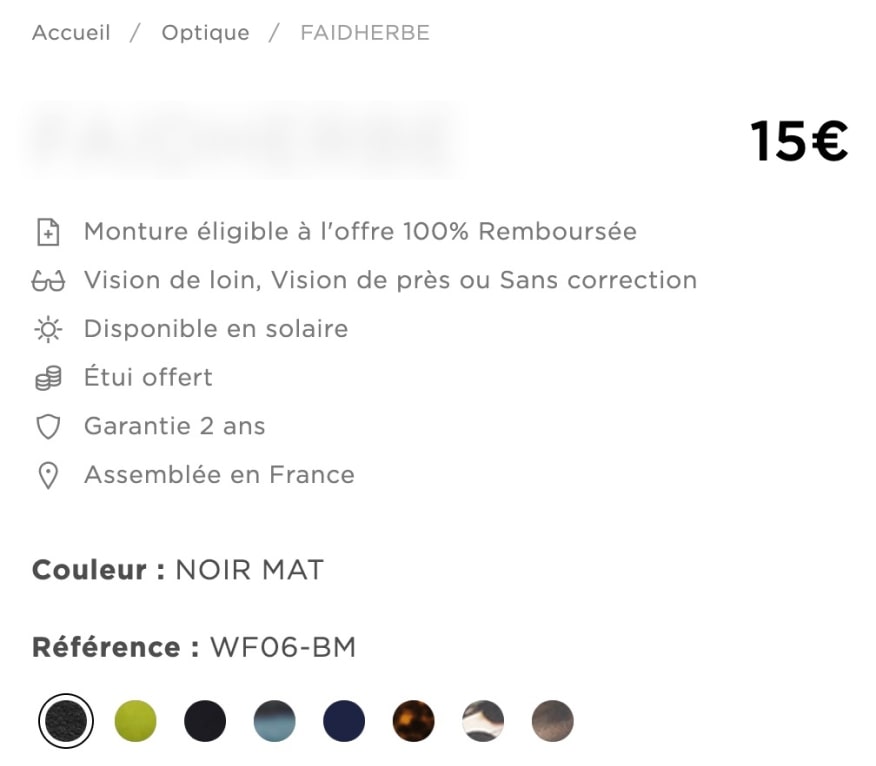
* For example, these glasses have 40 variations due to the combination of colors with parameters, such as diopters for near and far sight or without diopters, transparent or sun lenses.

  • Found a way to add more than three parameters in the product descriptions

Every product has a set of different attributes – size, color, width, etc. There are many more parameters for eyeglasses – weight, lenses, dioptres, interpupillary distance (PD), etc.

However, in Shopify, the maximum number of product characteristics is three, and it can’t be changed even by writing custom code. However, the platform has numerous custom fields that can be tailored to the product’s specifics. To solve this, our experts offered to leverage this opportunity to solve the issue and made a template for all the extra parameters.


  • Honed SEO functionality

Based on the client’s request to enhance SEO capabilities of a new Shopify store, we’ve bolstered it with two additional paid SEO modules. One of them allowed the client to swiftly generate titles and descriptions for multiple dynamic pages using adaptable variables. For example, a variable  “buy in France” following a product name in the admin panel, can be integrated across all or chosen pages automatically.

The other SEO module speeds up caching, preloading pages, etc., based on the analysis of user behavior.

Thanks to this upgrade, our client elevated their search engines’ rankings by three to five positions on average

Going extra mile without upping the project’s budget

The client was interested in Shopify’s analytics capabilities. They could have chosen Shopify+ to get access to this functionality. Still, our development team came up with a more budget-friendly option – they found and installed a free sales and analytics module that provides the same ability to collect detailed data from Google Tag Manager, GA4, and Facebook.

Before

  • 6-second website loading speed
  • Average session duration below 30 seconds
  • 70% bounce rate
  • A mind-boggling amount of plugins to ensure basic ecommerce functionality
  • Difficulties of maintaining an outdated ecommerce Frankenstein

After

  • 1-second website loading speed
  • Average session duration over two minutes
  • 35% bounce rate
  • Off-the-shelf budget-friendly solution fine-tuned to meet the client’s requirements
  • Free access to detailed customer analytics
  • Seamless solution updates and maintenance covered by the platform’s support

Key features

Continuity

WordPress to Shopify migration and revamping the whole ecommerce solution didn’t cause any disruption to the client’s business operation flow.

Scalability

The new store, based on the specialized ecommerce platform, supports the client’s plans to scale beyond France.

Reliability

The client always has the latest vulnerability-free version of the solution without lifting their finger, all thanks to delegating the maintenance hassle to the ecommerce vendor.

Business value

  • x6 higher loading speed
  • Halved bounce rate
  • x4 longer time spent on page
  • 64% boost in the number of pages visited per session
  • Free detailed analytics into customer behavior
  • Three to five positions higher search engine rankings

Client’s testimonial

Now, let’s here how the product owner talks the project’s results and the expected outcomes:

Anna Vasilevskaya
AI modified real photo
Anna Vasilevskaya
Account Executive

Get in touch

Drop us a line about your project at
[email protected] or via the contact
form below, and we will contact you soon.