Autonomous AI Sales Representative

Autonomous AI Sales Representative For an Australian Consulting Company

How building an autonomous AI virtual worker enabled an Australian consulting firm to process 20% more leads and boost upselling/cross-selling by 19% while reducing cost per lead by 15%.

Industry:
Technology

AI Development

Enterprise Automation

Business challenge

With AI agents being marketed as a magic wand to wave away employees’ daily grind, businesses have quite high expectations of their potential value. Low-code platforms make it look like building AI agents that automate entire workflows is a matter of a few prompts and several clicks. In reality, platform constraints often block the integration required for those much-coveted outcomes. That’s where our client got stuck.

An Australian consulting company with an in-house IT team but no solid internal AI expertise tried experimenting with Microsoft Copilot Studio to fit their mostly MS-first software environment. Yet, the devil turned out to be in those non-Microsoft integration details. Copilot Studio’s native connectors covered MS apps only, so anything outside the stack called for custom builds the in-house team didn’t have the expertise to deliver.

Microsoft-bound agents made little sense, as a typical day of the client’s sales representatives meant bouncing between Outlook and Teams for communication, HubSpot for client and deal records, OneDrive for shared documents, Jira for project tracking, Miro for brainstorming, Power BI for reporting, and LinkedIn for prospecting and messaging.

Three dead ends of Microsoft-centric agents in a heterogeneous stack were:
Static context

As agents couldn’t track changes across the full toolset and refresh memory on their own, staff members had to manually collect updates from multiple apps and feed the agents.

Prompt sensitivity

Sales reps had to remember which prompts triggered the right responses, adding another layer of mental burden on top of managing pipelines.

Passive mode

Initiating the communication was always the humans’ duty, which also took its toll on the mental workload and became exhausting for sales reps.

While the promise of AI agents was powerful, the reality looked more like AI crutches that only added to the employees’ cognitive load.

Time went by, but the much-anticipated productivity boost never showed. Still, that setback helped the client solidify their vision of a helpful AI agent as one that can:

  • “Walk” within their multi-vendor software ecosystem freely to pull together fragmented information into a dynamic, up-to-date project context
  • Join the conversations of their core human team to make proactive suggestions and then act on them

With this idea in mind, they started looking for a tech partner to build a sales-focused AI agent. The bar was high: the client expected more from an AI vendor than acquaintance with popular AI frameworks, they wanted deep, hands-on experience. Instinctools, with their own agent-building platform, proved to be the right match.

Solution

Instead of forcing a client to adapt to a rigid AI framework, we used our very own technology-agnostic GENE platform to build a truly adaptive autonomous sales representative that each team member can configure to match their personal workflow.

  • By default, the virtual worker is connected to the company’s Confluence, Jira, HubSpot, Power BI, Miro, and OneDrive. 
  • Additionally, employees could drop the AI worker into any Teams chats and channels and give it access to their LinkedIn profile.

Once connected, the AI sales representative kept project context fresh and proactively suggested next steps, or took them, at any stage of the pipeline, from triaging inbound leads to post-project follow-ups. 

The virtual worker reduced staff’s mental strain, freeing them up for complex tasks and high-touch client interactions. The payoff was almost immediate. Within the first month, the client saw measurable improvements in the number of leads processed, cost per lead, upselling/cross-selling, and hours saved.

What is Gene?

GENE is *instinctools infrastructure middleware for building secure-by-design AI agents and multi-agent systems faster than with bare-bones AI frameworks.

What did we leverage in GENE to 
build a better agent?
  1. A single workspace for open-source AI frameworks like crewAI, LangGraph, LangChain, and others.
  2. Built-in responsible AI mechanisms, including bias detection and mitigation, AI governance, and AI regulation compliance.
  3. A library of pre-vetted APIs for a hitch-free agent integration into the client’s software ecosystem.

Compared to building AI agents from scratch, GENE enabled our AI engineers to develop and integrate reliable, scalable agents 70% faster. What typically requires 8–12 weeks with just frameworks alone, was condensed into 2–3 weeks with GENE. 

Here’s how GENE addressed the client’s past frustrations with a constrained low-code platform:
  1. Providing built-in agents that automatically maintain tasks, workflows, and project context up to date, so users don’t have to.
  2. Eliminating repetitive prompting thanks to pre-configured workflows and agents’ ability to “listen” to connected tools, allowing for context-aware actions before being asked.  
  3. Presenting a wide range of whitelisted APIs for AI agents to solve problems independently. 

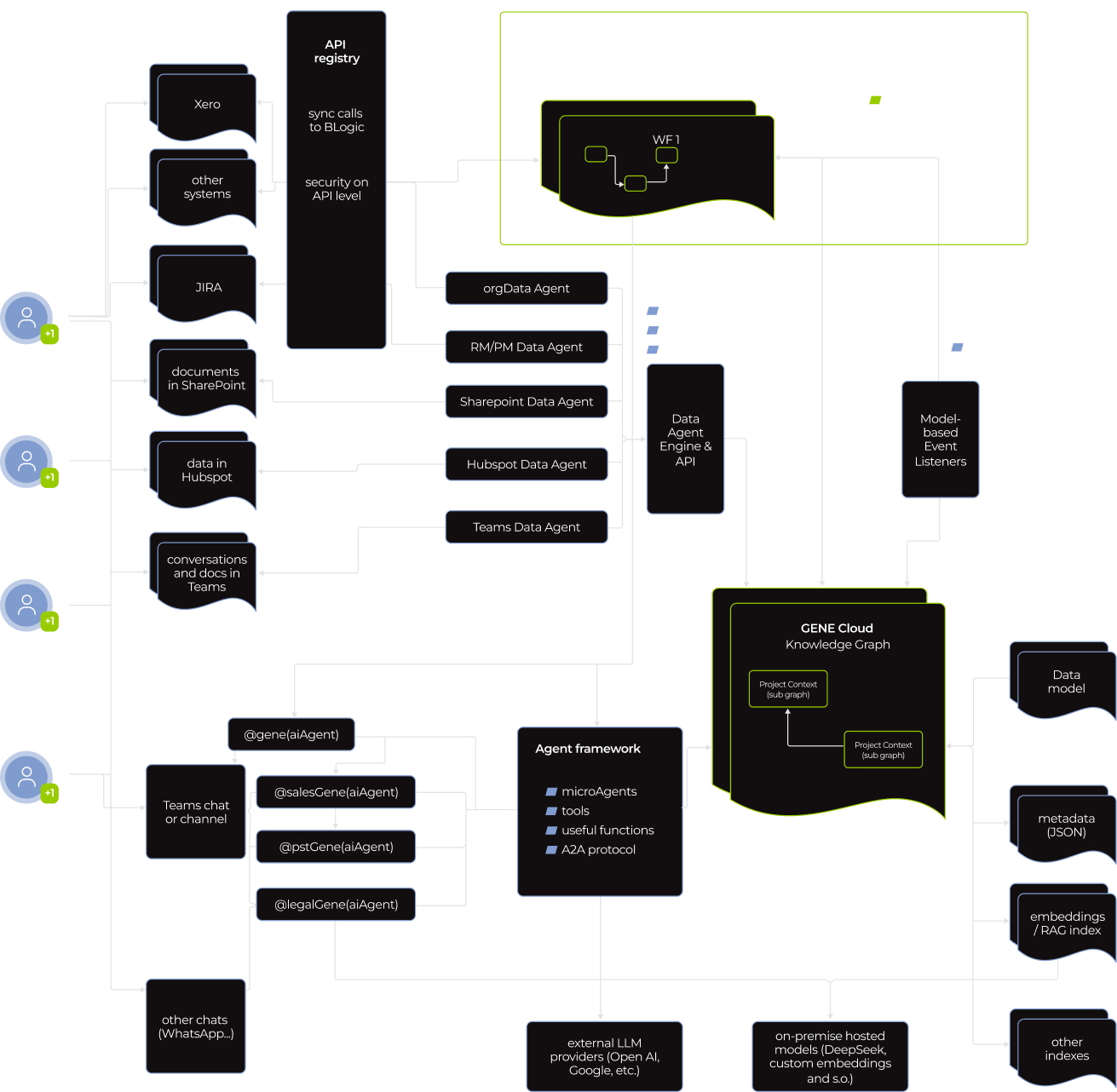
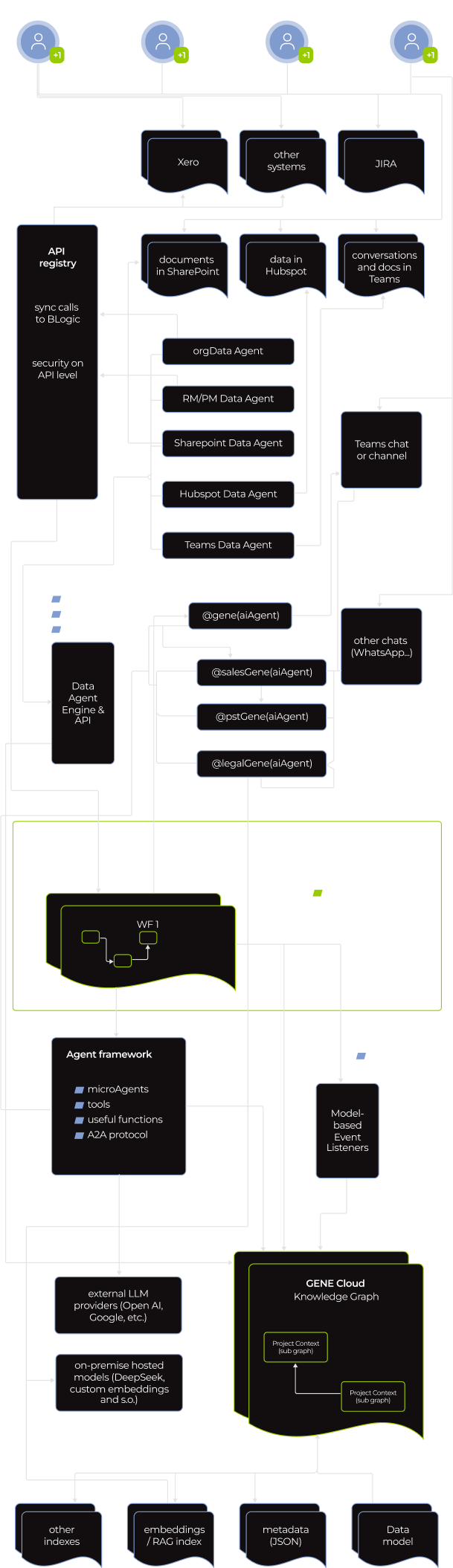
Under the hood of the virtual worker there is a multi-agent system. 
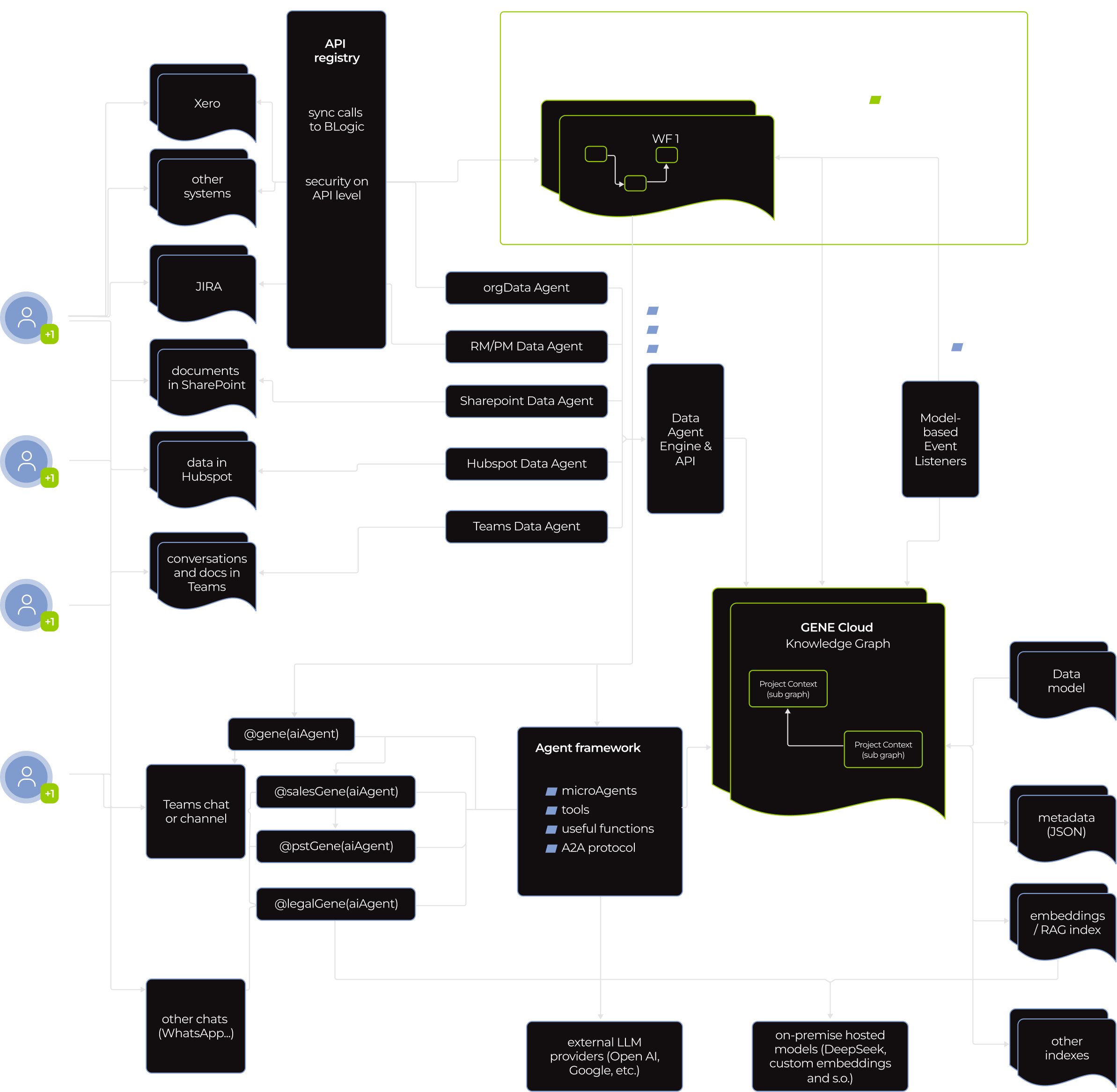
A flowchart showing data integration and workflow orchestration: Sources (e.g., Xero, Jira, SharePoint, email, Teams) connect via agents to a central GenAI Cloud Knowledge Graph, managed by a WF orchestrator. Paths include API calls, data pipelines, and external LLM endpoints.
A complex flowchart showing data integration between various agents (ERP, Sharepoint, Hubspot, Teams, JIRA, etc.), a WF orchestrator, and a knowledge graph. Lines represent data flow; black and green boxes detail agents and system functions.
A flowchart displays data flow from various SaaS platforms (e.g., Xero, Jira, GitHub) into multiple data agents (e.g., SynData, Hybrid, Transparent, Rulepack, AI agents). These feed into a WR connector, agent framework, and further into cloud integration.

Knowing the stakes, the client put data safety and overall software security front and center. Our dedicated team did too.

Standard measures, such as mandatory user authentication, access control, activity tracking, and data encryption at rest and in motion, were table stakes. We built on that with GENE’s AI-specific safeguards, aligned with NIST AI RMF, Google’s SAIF, OWASP AI, and other AI regulation frameworks. 

  • Robust secret management

OAuth tokens, database credentials, API keys, and other secrets are stored in an isolated vault inaccessible to agents themselves. We implemented automated credential rotation, with a standard 30-day cycle that can be tightened to daily for highly regulated industries.

  • Agent-to-agent (A2A) communication protocol

It allowed agents to work together without exposing their memory, proprietary logic, or tools to each other.

  • Whitelisted AI tools

We strictly supervise which tools agents can use and what they can do. For example, the virtual worker can create a Jira ticket based on a conversation in Teams, but only human reps can delete it.

Before

  • Microsoft Copilot Studio couldn’t deliver the tangible value the client was after
  • Agents rely on a static, manually updated context 
  • Agents add to the sales reps’ cognitive load
  • Passive AI is overreliant on humans to push it along

After

  • Instinctools’ technology-agnostic GENE platform made it possible to develop an autonomous sales representative that covered all the client’s needs
  • The AI sales representative keeps a living, self-updating context
  • The autonomous virtual worker offloads routine tasks from humans
  • Proactive AI agent acts on context and gets things done without interrupting human sales reps

Business value

  • Faster agent development without security trade-offs thanks to reliance on a solid infrastructure middleware instead of bare-bones AI frameworks
  • + 20%  leads processed per sales representative
  • + 19% more upsell/cross-sell initiatives
  • – 15% in cost per lead
  • – 10 hours of manual work per employee weekly

Multiplier effect

This success story points to a not-so-distant future where AI workers are graduating from assistants to full-scale teammates operating within your workflows. You can start with AI virtual workers as personal secretaries for staff members to ease their mental load. And then scale with autonomous AI employees contributing to the projects’ progress on par with your human team. Best of all, you get reliable employees on board right when you need them, omitting a time- and budget-draining hiring process. 
A person’s hand points at a glowing AI icon on a digital network overlay above a laptop keyboard. Futuristic data charts, chat bubbles, and circuit lines suggest artificial intelligence technology and data processing.

LMS Architecture Modernization For a SaaS Company

LMS Architecture Modernization For a SaaS Company

How dividing legacy monolithic architecture into microservices helped a global LMS producer to hop on the train of remote work with their updated LMS application for staff training and raise the number of customers worldwide by 37% without risking business continuity.

Industry:
Education

Duration:
11 months

Budget:
$200 000+

Team:
three FTE engineers, two QA specialists, project manager, business analyst

Context

With the client’s LMS platform, users can access up-to-the-minute data, staff training results, average test scores, personal tests, performance appraisals, surveys, and financial data with comparative reporting. It allows every manager to train, track and communicate with employees, plus control company compliance nationally and globally.

Challenge

Our client has been planning to modernize some parts of their LMS for a while and, as is often the case, they haven’t gotten around to it until recently. However, the delay was no longer an option since Adobe Flash, where one of the modules was written, was on its way out. Major browsers have been slowly pulling support for years now, and Adobe itself has announced that it would be stopping the development and support of Flash at the end of December 2020.

So, at that point, modernization turned from a vague long-running goal into a clear necessity, that would prevent the loss of customers. At the same time, the client wanted to leverage the situation and not only make an updated application, supported by all browsers, but also implement a bunch of new features, that would be beneficial for end-users.

The client chose *instinctools since they wanted to lift the burden of managing the project off their shoulders and put it on a Tech partner providing a dedicated team, who would take responsibility for what they do and where the project goes.

Objectives:

  • Make a module for presentation editing supported by all browsers
  • Implement a new proposed design that improves the UX
  • Implement a working product by the end of December 2020
  • Keep performance on thе same level
  • Switch from Flash to modern technology
  • Turn the presentation tool into a standalone application, that will function as a separate microservice.

Solution

*instinctools dedicated team has developed a cross-browser application supporting mobile devices and tablets. The solution was based on new secure and scalable technologies. At the final and most challenging stage of the project, we migrated all the digital assets from a legacy system to a new structured microservice application without any loss.

Key features

  • modern and engaging design
  • completely customizable assets
  • ability to export presentations as printable documents (PDF)
  • ability to undo/redo most recent actions
  • copying, pasting, deleting, and rearranging multiple slides simultaneously
  • selecting and manipulating multiple elements at the same time
  • copying selected elements from one slide to another while maintaining the original positioning of each element from the original slide
  • ability to use keyboard shortcuts

Business Value

With the brand-new version of the application delivered just in time when remote work was a rising trend, it’s become possible for its users to create inspiring and meaningful content that makes remote or in-person activities way more impactful than they used to be. It helped our client to increase loyalty to a product and gain new customers globally.

Encouraged by our collaboration, the client plans to continue improving the software module by adding new features in subsequent phases.

Technologies

Frontier Blockchain Project For an Australian Fintech Company

Frontier Blockchain Project For an Australian Fintech Company

How rolling out a robust Ethereum-based solution empowered a fintech company to rewire the whole HR industry, take an international blockchain jobs platform by storm, and win the users as the first blockchain app in recruitment.

Challenge

Chrono.tech was looking for talented blockchain specialists. They needed engineers to maintain smart contracts, performance optimization, security audits, research and technical development implementation.

Solution

To complete customer’s request, we ran security audit and created:

  • ERC20 tokens and their advanced management systems (blacklists, multi owners, limits, extended access rights);
  • Crowdsale contracts (multi-currency support, ERC20 Donations, external price tickets, start/stop dates (blocks), limits);
  • Exchange contracts;
  • Vesting contracts;

Technologies

Parity Networks:

Live Translation App For The Rio 2016 Olympics

Live Translation App For The Olympics

How creating a translation service app with real-time communication between users and language professionals instead of manual prompting and machine translation empowered an Australian startup to target Rio 2016 Olympics visitors and strike 6.6 million users in the first month after the rollout.

The software is invaluable for everyday situations:

  • Bargaining with sales people overseas
  • Negotiating prices with taxi drivers
  • Asking strangers for directions, etc.

Challenge

The customer was looking for software development experts capable of creating a certain kind of solution – Uber for interpreters. The greatest challenge of this project was to create a search system which could quickly and easily find the best interpreter according to language, rating and price.

Solutions

The team worked with a task router, which made the search very efficient. While working on this project, *instinctools closely cooperated with the remote front-end team. Due to the nature of the product and constantly changing requirements, many product aspects had to be designed and formalized in parallel with the development. Therefore, Scrum was chosen to make the development process flexible and efficient for all of the parties involved.

Key features

The software that was developed has the following features:

Possibility to connect the user with an assistant who speaks the required language by clicking the Call button

Live interpreting services offered by the solution. The person on the other end of the line does everything possible to make sure that the original message is understood

After the conversation, there’s an option to rate the interpreter

Result

The work on the translation service application was a great experience for *instinctools. As a result of productive cooperation, the customer received a robust, high-quality product that met their requirements and was ready for launch. This application was widely used during the Rio 2016 Olympics.

Technologies

PHP
Redis
PostgreSQL
AWS
Twilio
Anna Vasilevskaya
AI modified real photo
Anna Vasilevskaya
Account Executive

Get in touch

Drop us a line about your project at
[email protected] or via the contact
form below, and we will contact you soon.