Updated: November 28, 2025
Contents
- What is a dedicated team?
- Typical dedicated team structure: roles and responsibilities
- When to hire a dedicated software development team
- When a dedicated development team might not be the best fit
- How to choose a dedicated development team
- Common concerns about dedicated teams and how to mitigate them
- Hire a dedicated software development team from *instinctools in 3 steps
- Seal the deal: next steps and guarantees
- FAQ
An external dedicated software development team, integrated seamlessly with your in-house operations, remains a default sourcing model for enterprises. And for a good reason. Executives turn to dedicated development teams for predictable results and accelerating technology initiatives.
Yet, their value is conditional. The right fit depends on aligning the team with precise project needs. If you’re weighing how best to structure your development resources, this guide offers a measured, actionable perspective.
At *instinctools, we’ve spent 25+ years helping global companies architect, launch, and scale dedicated teams that consistently produce long-term impact. This guide distills that experience into something you can act on right away:
- why and when to hire a development team,
- when alternative models might serve you better,
and how to sidestep the traps of managing your own dedicated development team.
Key highlights
- Dedicated software development teams are cross-functional, adjustable in size and composition, and can be tailored to changing project needs, providing the flexibility of in-house teams without the hiring and management burden.
- Dedicated teams accelerate time-to-market, reduce development costs, and provide access to a global talent pool. They are best suited for complex, high-stakes projects, tight timelines, evolving requirements, or when internal resources are insufficient.
- Proper selection of a dedicated engineering team involves careful vendor evaluation, which essentially boils down to methodology, communication, and domain experience assessment, and reputation check.
What is a dedicated team?
A dedicated development team is an engagement model where a group of cross-functional experts put their backs into your project to bring it across the goal line. You can hire either a full or partial team, but in both cases, it works exclusively on your software projects.
Just like an in-house team, a dedicated developer team remains skin in the game throughout the entire development process, except you don’t have to stress over the hiring, onboarding, and daily management. You can have as much or as little involvement in the development and management process as you want. Anyway, a dedicated software development team is capable of taking over the entire process of digital product development.
Such a team dynamically adjusts to the pace and scale of software development, allowing you to fine-tune the team size and composition based on your evolving needs. Developers, designers, QA engineers, and any other roles can be hand-picked on demand when and as you need them.
See how our dedicated teams work >>>
Why companies choose dedicated development teams
The software development outsourcing market is expected to grow from USD 564.22 billion in 2025 to nearly USD 897.44 billion by 2030, with a steady 9.73% CAGR. With strong demand for external digital engineering talent, the rapid adoption of generative AI, and a chronic shortage of senior technology professionals across OECD countries, dedicated development teams, being a tried-and-true engagement model, remain a highly practical solution for enterprises. The reasons for hiring a dedicated engineering team are manifold — our experts have listed the most significant ones below.
Rapid scalability
Adapting to fluctuating project demands and scalability requirements in-house is a challenging endeavor due to resource limitations and the time required for recruitment and onboarding. A dedicated team model is flexible in roles and skills, allowing companies to build up their capabilities on demand to accelerate time-to-market and support evolving project needs.
Cost efficiency
More than 90% of Fortune 2000 companies outsource at least part of their IT functions to cut costs associated with in-house hiring and development. A dedicated app development team eases the financial burden on companies by relieving them of operational overheads and other costs related to sourcing candidates and employee training. Moreover, you can source tech talent in cost-effective regions such as Central and Eastern Europe to bring down the financial outlay of development.
Stress-free hiring
From long hiring cycles to administrative burden, in-house hiring is not for the faint of heart and is definitely not for the employers in a hurry. Conversely, hiring a dedicated application development team is as easy as proving a job specification and approving the candidates cherry-picked to your requirements.
360-degree visibility into the process, away from the grind
In-house hiring and team management are generally associated with the highest level of visibility. But to build it up, company leaders need to constantly have their fingers on the pulse and mother hen their development team. When it comes to an offshore dedicated development team, a powerful combo of dedicated project managers and project management tools can ensure a high level of visibility into the project progress, minus the supervision fuss.
Access to a wide talent pool
Talent scarcity keeps 4 in 5 company leaders on their toes, stalling new projects and decreasing the odds of securing a niche or highly-coveted talent. By banking on dedicated development team services, companies enter a global talent pool where they can hire skilled experts at a reasonable price. Better yet, this engagement model helps you develop expertise in adjacent fields or completely different ones, including AI, mobile app development, MVP development services in USA, and other projects.
| In-house team | Dedicated team | |
| Hiring the team | ~ 2 months | 2-10 days |
| Scaling the team | 1-2 months | 1-5 days |
| Recruitment and hiring costs | ~ $3500 per hire | 0 |
| Training costs | ~ $1100 per employee | 0 |
| Expertise | Might be insufficient | Exactly matches the project’s needs |
| Level of control | High | High |
To make an informed call on the most suitable sourcing strategy, check out our detailed comparison of in-house development and an external dedicated team, breaking down the strengths, gaps, and practical implications of both.
Tired of hiring frenzies and project delays? Let’s build your dream tech team in a matter of days
Typical dedicated team structure: roles and responsibilities
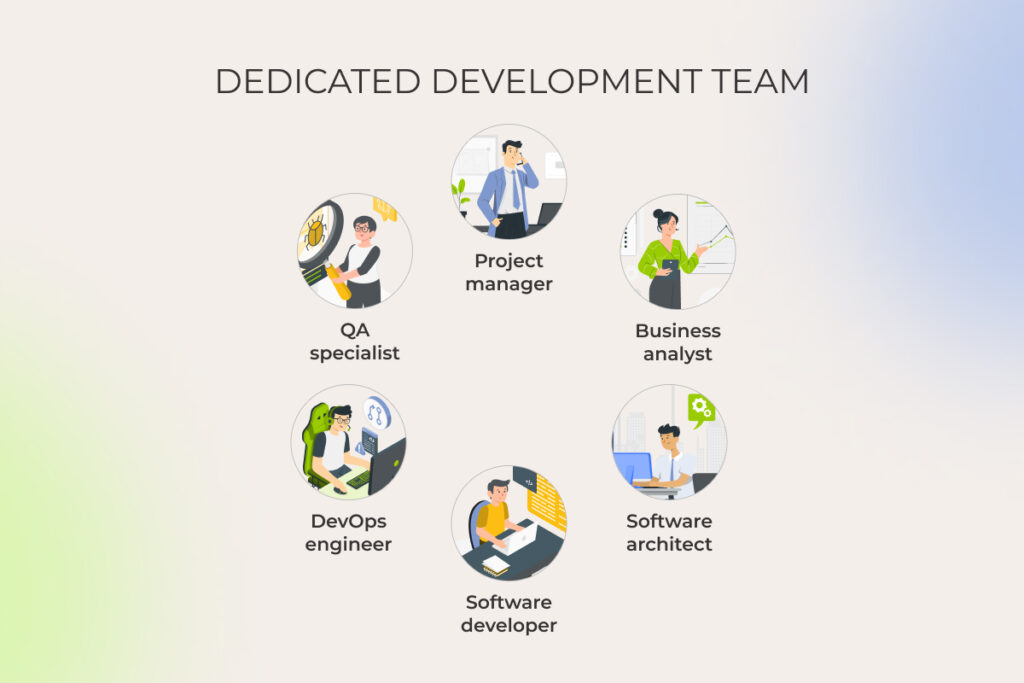
The structure of a software development team is determined by a combination of factors. These include the type and complexity of your software product, your timeline, and the allocated budget. Let’s expand on the bare-bones development team structure:
Project manager
A project manager is the point person behind your project responsible for its day-to-day management. Typically, a software vendor assigns a dedicated project manager to lead the entire team, oversee project cost and resource allocation, define project goals, and keep you updated on the project’s progress.
Business analyst
Business analysts are guardians of business goals and values that bridge the chasm between the business and technical teams. They are instrumental in planning development activities, validating requirements to ensure alignment with business goals, and standardizing processes to maintain a cohesive workflow, facilitating continual improvement based on stakeholder feedback.
Software architect
Equipped with broad technical knowledge, software architects are the great minds behind your software solution architecture and critical technical decisions. They have a final say in the selection of the technology stack, making sure your solution is functional, performant, resilient, and scalable.
Software developers
A dedicated backend development team is in charge of building and maintaining the inner mechanisms of your software, including data storage, security, and other server-side functions. Frontend developers focus on building user-facing components of web and mobile applications, making your software easy and engaging to interact with.
DevOps engineers
DevOps engineers are at the wheel of development, testing, and release automation activities. Geared up with special tools and DevOps practices, they enable continuous integration and deployment and ensure smooth collaboration between development and ops teams to speed up development cycles and improve software quality.
QA specialists
Quality assurance engineers inspect every aspect of your software, from code to design, to make sure it meets predefined quality standards and is bug-free. Their turf also spans compliance reviews and security testing to eliminate any potential vulnerabilities in your software solutions.
Depending on your project scope, you may need a different combination of team roles to accommodate your project dynamics.
| Project scope | Team size | Team roles |
| Discovery | Up to 5 specialists | Business analyst, project manager, software architect, UX designer |
| MVP development | 6+ specialists | Project manager, business analyst, UX designer, front-end developer, back-end developer, QA engineers |
| Custom software development | Around 9 specialists | Project manager, business analyst, UX designer, software architect, front-end developer, back-end developer, QA engineers, DevOps engineer |
When to hire a dedicated software development team
Often, it might be not just one, but a whole set of factors that tip the scales in favor of a dedicated team engagement option.
Specialized skill sets across multiple technologies and business domains
Complex projects that implement a variety of technologies, including cutting-edge ones, are a great mesh for an offshore dedicated team. Most companies lack the internal expertise to proceed with the implementation of such projects, while a software development dedicated team has the varied tech knowledge, skills, and hands-on experience to muster it on their own.
High cost of failure
Another scenario fit for a dedicated software team is when your project comes with functional or reputational risks — in other words when you bet big on the software quality. Thanks to their experience, dedicated software development teams know how to build a high-quality solution and they usually go by a mature software quality management framework to do so.
Last-chance-to-get-it-right
When a client’s in-house team is underperforming or their previous vendor has failed to deliver on the promise, dedicated software development teams can pick up the slack in the nick of time. At *instinctools, we’ve seen this scenario many times, providing a team of experts to rescue projects like fintech MVP development and others.
Borrowed expertise
The dedicated team approach also comes in handy when you need to pick the brains of lead software engineers every now and then to identify improvement areas, determine the right development approach, or get actionable advice on the tech architecture. Dedicated experts can provide tech consulting when needed, headache-free.
Turnkey product development
You can hire a dedicated development team to deliver and launch your custom software product faster and more efficiently. The team focuses solely on your product, selecting the right approach, frameworks, and tools to ensure consistent progress. More importantly, a dedicated remote team is cross-functional, allowing for a one-stop-shop development experience.
Time to market is critical
If you’re at crunch time for a prototype, an MVP, or a full-fledged product, dedicated teams can offer a shortcut to a successful delivery. Opting for a standby team offers you the double wins of streamlined coordination and specialized expertise, promoting a swift and efficient software development process with no quality trade-offs. So, when time is of the essence, a dedicated team ensures you’re not just fast, but also first-rate.
Complex software development
When it comes to long term projects with an evolving and highly complicated scope, say you’re building an entire ecommerce ecosystem like one of our clients did, a dedicated team runs circles around other engagement models. If you have both a mobile app and a web solution in your backlog, a dedicated team can move from one project to another, being able to deliver results faster thanks to staying in the loop.
Vague, unclear, ever-changing requirements
Last but not least, you can hire dedicated development teams when you don’t have a good grasp of your software product. A dedicated team can work in lockstep with your changing requirements, developing in small increments to incorporate regular feedback. We’re not advocating for working in the dark though: when your vision is blurred, run a discovery session with your team to solidify your project requirements and map out the roadmap to a successful delivery.
Squash your project challenges with a savvy development team
When a dedicated development team might not be the best fit
The dedicated team model brings a wealth of benefits to your table, but only if it marries well with the nature of your project — and this isn’t always the case. For example, if you’re looking to fill specific skill gaps rather than farm out an entire project, then outsourcing software development to a dedicated team is not the right path for you to follow. In this case, staff augmentation will do the trick.
Staff augmentation does justice to intermittent or short term projects, where you need an extra pair of hands to temporarily augment the capacity of your in-house team, develop a different component of the product, or bridge in-house skill gaps.
The main difference between hiring a dedicated development team and bringing in augmented experts lies in the level of the vendor’s responsibility, including risk management, process setups, and knowledge transfer.
| Vendor’s responsibility | Staff augmentation | Dedicated team |
| Providing engineering capacity |  | |
| Onboarding and knowledge transfer |  | |
| Project documentation | | |
| Software development process setup and maintenance | | |
| Project, team and risk management | | |
Keep in mind that neither team extension model can suffice decade-long, strategic initiatives that have very specific requirements in terms of security, tech stack, personnel training, and other essentials. If that’s the case, your company will be better off with an offshore development center — an overseas extension of your company set up and equipped to meet whatever floats your boat.
Costs of hiring a dedicated software development team
Depending on the team’s seniority and the country the engineers are located in, a 4-6 person team can run anywhere from ~$8,000/month (nearshore/junior bench in lower-cost markets) up to $60,000+/month (US or top-tier enterprise rates).
If you want a clear sense of what a dedicated development team for hire will cost each month, take these factors into account:
- Dedicated development team structure and seniority mix: number of juniors, mids, seniors, and leads (senior engineers and tech leads increase costs disproportionately).
- Region: US, Western Europe, Eastern Europe, LATAM, and Asia have very different salary bands and employer taxes.
- Vendor margin and management: vendor fees, account management, and any bundled managed services like project management, recruitment, HR, etc.
- Benefits, payroll taxes, and statutory contributions: employer social charges, paid leave, insurance and any local mandatory costs.
- Contract length, SLAs, and attrition risk: short contracts and high churn push prices up; long engagements often secure better monthly rates.
Want a tailored dedicated development team cost for your project?
How to choose a dedicated development team
You might think that the quality of products and services comes first when choosing a software development company. This hallmark certainly carries the day, but other traits such as transparency, trustworthiness, and understanding of your business context also count for a lot when it comes to remote teams. Let us facilitate matters for you by providing an algorithm that will help you choose the right company and set up your collaboration for success.
Step 1: Document the use case
Without a use case, an idea just remains an idea, making it hard for you to describe how a software system can be used to achieve your business goals. So taking the time to document use cases before contacting vendors should be your opening move. You don’t have to get into much detail when describing the use case: try to distill it as best as you can, specifying the general requirements for what’s being built.
A dedicated team can fill in the blanks, but provide as much as possible to communicate the need better and allow for a “solution”, not just a body.
Step 2: Decide on a location where to hire a dedicated development team
Back in the day, the location used to be a deal-breaker in choosing a dedicated development team, but the rise of remote work has made it less critical. Nevertheless, some outsourcing locations are easier on your budget and have more time zone overlap with your company’s home country.
You should also take into account other considerations, such as cultural fit, regulatory and legal environment, talent pools, and the skills of local developers. As a popular outsourcing destination, Poland checks all the boxes in terms of service quality, time zone compatibility, and cultural fit. It’s also ranked third among the countries with the best programmers in the world.
Step 3: Make a list of potential vendors
Once you’ve decided on the location, go on a hunt for local software vendors to online directories, review sites, and search engines. You can also ask around for recommendations or visit industry conferences to evaluate potential tech partners. Following your search results, compile a list of potential vendors that have made it through the basic screening.
Step 4: Pay attention to work methodology
You can reach out to the shortlisted vendors to get more details about how they handle project development, including their methodologies, communication, and project management infrastructure. Keep in mind that a trusted software vendor should be ready to adjust to your requirements and exercise a collaborative approach where they provide regular progress updates for your team.
Step 5: Examine expertise and experience
Make sure your dedicated team can deliver on their promise by checking their previous projects and researching client testimonials. You can ask about their experience with the specific technologies and assess their skills in action during technical interviews. Besides technical proficiency, a top-grade vendor should understand your business context and have hands-on domain experience.
Step 6: Check market reputation
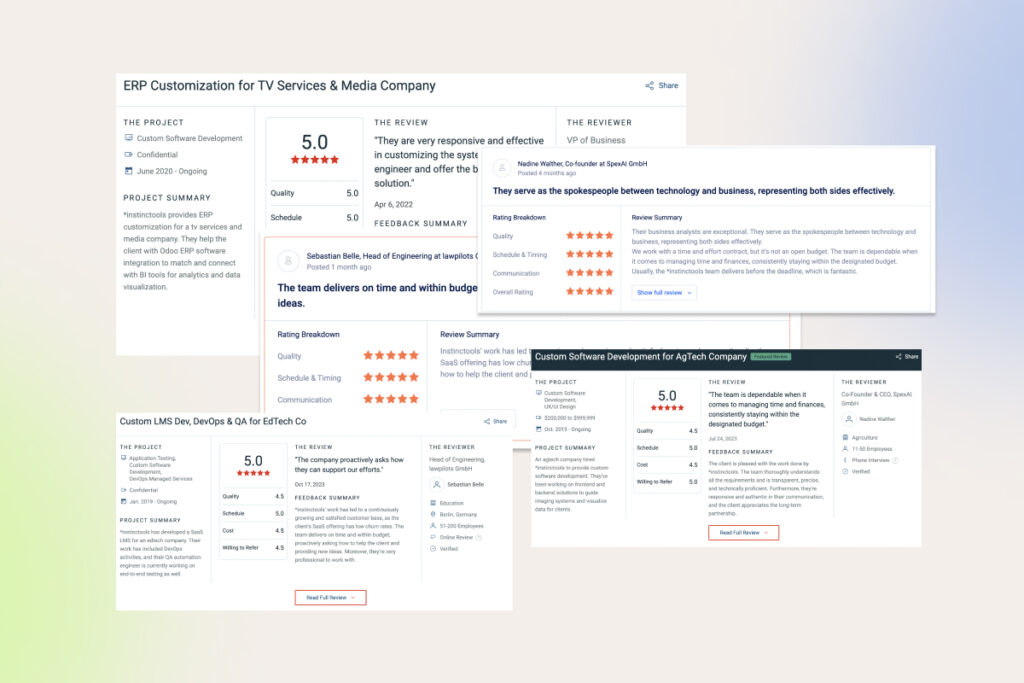
Finally, you should gauge the market perception and image of your software vendor by analyzing their social media presence, noting the insights from past customers, and looking into their rating on industry-specific platforms like Clutch and Goodfirms. A trustworthy outsourcing company should come highly recommended and have a good name in the market.
Don’t settle for average, find a perfect match for your tech project
Common concerns about dedicated teams and how to mitigate them
Before you jump into the unexplored terrain, it’s natural to have your doubts about it. Let’s look into the common fears associated with dedicated teams and how you can overcome them.
Cultural gaps
Different countries have varying communication styles, work expectations, and business practices, which can throw a wrench into project quality, communication, delivery timelines, and even the final development cost.
Mitigation strategy: Single out countries that have a strong cultural overlap with your company’s base location. For example, if your company is located in the US, UK, or EU, a country like Poland can offer the combined benefits of skilled talent pools and a similar cultural background to your company’s host country.
No visibility
With some outsourcing setups built on the ‘throw-over-the-wall’ approach, you only see the output, not the process. You get irregular updates, limited insight into day-to-day progress, and no early warning when something goes off track. That blind spot makes it hard to steer the project or manage expectations.
Mitigation strategy: Work with a dedicated development team operating under a transparent delivery framework, one that defines workflows, reporting cadence, quality gates, and ownership from day one. Combine that with structured weekly checkpoints and real-time communication channels, and you get full visibility into progress, risks, and decisions as they happen.
Communication hurdles
The lack of consistent communication can get both sides misaligned on the project goals, deliverables, and milestones.
Mitigation strategy: To prevent that from happening, your dedicated team should adapt to your communication framework, including your communication channels and meeting cadence. Also, your software vendor should have a mature governance and escalation infrastructure in place to proactively handle escalation triggers and keep all the aspects of project delivery in check.
Mismatch in expectations
There’s a raft of factors, including miscommunication, inadequate project management, and lack of documentation, that can result in the disconnect between your vision and your dedicated team’s perception of your idea. Unclear requirements, more than anything else, can bring on this disconnect, leading to scope creep and wasted budget.
Mitigation strategy: A comprehensive discovery stage paired with thorough requirement-gathering sessions can bring more clarity to your project vision and project’s requirements, ensuring that each stakeholder is looking in the same direction. And if anything goes awry, Agile methodologies and regular feedback can help your team swiftly adapt to your feedback and right the ship.
Think these troubles are inevitable?
Hire a dedicated software development team from *instinctools in 3 steps
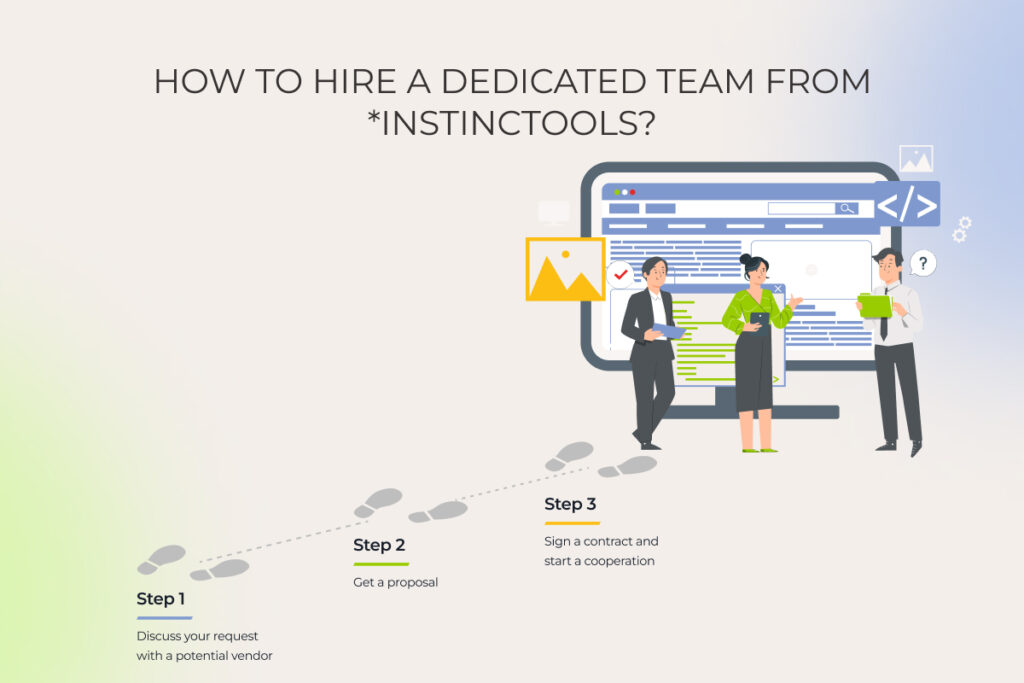
Building your dream software requires a lean, dynamic team by your side. At *instinctools, we offer a simple, transparent hiring process to help you land your dream team in mere days and jump-start your software development project.
Step 1: Discuss your request with a potential vendor
Our collaboration kicks off with carefully studying your project request and seeing how our expertise can benefit your company. This typically takes 1-3 days, depending on how detailed your initial brief is.
If your project vision is limited to a high-level description, our team helps you scope the project by conducting a discovery session. We run discovery workshops with key stakeholders to define the project essentials, including the objectives, deliverables, core technologies, and resources needed. Following the scope, our experts provide accurate time and budget estimations.
Step 2: Get a proposal
Building on a detailed project understanding, we pre-select a team and provide a shortlist of best-fit candidates. You can be as involved in the pre-selection as you want, we always encourage our clients to participate in CV selection and interviews to double-check the specialists’ technical skills. Shortlisting and interviews usually take 2-5 days, depending on the seniority you need and your involvement.
Once our final candidates get your approval, we prepare a Statement of Work that defines the scope of work being provided, project deliverables, timelines, work location, and payment terms and conditions.
Step 3: Sign a contract and start a cooperation
Before the project launch, we finalize the legal agreements and handle all remaining paperwork, which normally takes 1-3 days.
We brief your dedicated team on your project background and help you effectively onboard the specialists.
Seal the deal: next steps and guarantees
Gliding through development projects is easier when you have the right development team as your tech wingman. Dedicated teams offer a cost-effective, flexible, and reliable solution for companies seeking tech professionals dedicated to their project’s success. Although this engagement model has a few inherent complexities, you can offset them by teaming up with a mature software vendor well-versed in managing an outsourced team.
Ready to build a thriving remote dev team?
FAQ
The dedicated team engagement model allows companies to outsource their software development to a remote team of experts who give their undivided attention to their client’s projects.
A dedicated team structure varies based on the nature of your project. Typically, a dedicated team is made up of a project manager, business analyst, frontend and backend developers, and QA engineers. Software architects and DevOps engineers are also essential team players.
Usually, your vendor does the heavy lifting of team management by assigning a dedicated Project Manager to your project. Project managers act as a liaison between you and your team, making sure the project flows smoothly and guiding the rest of the team in the right direction.
Dedicated team development gives you access to skilled talent at a lower cost than in-house hires. Thanks to the specialized expertise, a dedicated team can improve the quality of your software product and work autonomously to deliver it within the shortest possible time. This engagement option also frees up your time for strategic tasks as you don’t have to invest your efforts and resources into grasping something that’s beyond your knowledge.
Before you outsource dedicated software development teams, you should clearly define the goals of your project and document the use case for your software. You don’t need a detailed description for your project — high-level requirements are enough to get off on the right foot. With a clear project vision on hand, you can then research potential vendors, filtering them by geography, company size, core technology, and maturity. Shortlist strong candidates and schedule a call with them to pick the one that aligns best with your needs.